Search
December 9, 2025

MISO, Stakeholders Appeal to FERC to Leave Long-range Tx Plan Intact

MISO and several stakeholders came to the defense of the RTO’s $21.8 billion, 24-project long-range transmission plan (LRTP) portfolio for the Midwest as five Republican states seek to repeal the projects’ approval.

The state utility commissions of Arkansas, Louisiana, Mississippi, North Dakota and Montana filed a complaint in late July asking FERC to order MISO to revoke the classification of its second LRTP portfolio and nullify the portfolio’s load-ratio share cost allocation. The five states claim MISO and its board erred by advancing transmission projects that will cost more than the value they can provide and said FERC should scrutinize all the RTO’s future business cases supporting long-range transmission portfolios (EL25-109).

The states argued that MISO has no authority to direct the projects’ construction because the projects don’t meet the required 1:1 benefit-cost ratio in the RTO’s tariff. (See MISO States Split on FERC Complaint to Unwind $22B Long-range Tx Plan and Five Republican States File FERC Complaint to Undercut $22B MISO Long-range Tx Plan.)

MISO didn’t mince words in a Sept. 9 response. It said the derailment of a 765-kV backbone furnished by the projects would jeopardize it and its states’ ability to meet growing electricity demand and swap comprehensive regional planning for a more expensive, piecemeal buildout. MISO said the states made nothing more than a collateral attack on its established planning practices and long-established postage stamp cost allocation method for projects.

“The deficient and misleading complaint filed in this docket puts at risk not only the needed infrastructure resulting from a comprehensive, stakeholder-driven planning process, but also future generation, transmission and large load additions by creating regulatory uncertainty, which the commission, federal and state policymakers and the courts have sought to reduce,” MISO said.

The grid operator said the five states advocated for a “haphazard and unrealistic approach to regional transmission planning” that is “profoundly inconsistent” with FERC precedent and Order 1920. MISO added that North Dakota and Montana stand to benefit significantly from the second LRTP portfolio “in exchange for a very small percentage of the costs” and stood by its original 1.8 to 3.5:1 cost-benefit estimate for the total portfolio.

Arkansas, Louisiana and Mississippi are not going to fund any of the projects because MISO South was not part of the LRTP planning exercise. The South is destined for its own long-range planning that is set to begin in 2026.

MISO said it conducted more than more than 300 stakeholder meetings, considered 100 alternative projects and made 500-plus revisions to assumptions in its planning process on the advice of its stakeholders. The RTO also said the five state commissions didn’t attempt to initiate MISO’s dispute resolution process while the portfolio was in the draft stages.

Several MISO stakeholders asked FERC to throw out the complaint in other responses posted on the Sept. 9 deadline.

Xcel Energy agreed with MISO and said the RTO granted requests from the North Dakota Public Service Commission to model up to nearly 15 GW of additional wind capacity in the state and included more dispatchable resources in the plan, even though the hypothetical megawatts didn’t appear in states’ generation plans.

Xcel said the second LRTP portfolio is now — “if anything — more essential and more urgent” given that load growth projections have eclipsed what MISO could have predicted in 2024. It said North Dakota was joined in its complaint by “state commissions that either effectively sat out” the planning process (Montana) or states that have “no concrete stake” in the portfolio (Arkansas, Louisiana and Mississippi). The utility argued that now is the time for developers to “go forth and build, without endless trips back to the commission or nonstop second-guessing.” Xcel also criticized the states for appearing to demand MISO be a “Soviet-style central planner” that should have planned generation and transmission simultaneously.

IMM Doubles Down that MISO Benefit Calculations are Faulty

However, MISO Independent Market Monitor David Patton again said the RTO overstated its future transmission needs through the 20-year planning future it based the portfolio on.

Patton was a vocal opponent of the second LRTP portfolio throughout 2024 and repeatedly said MISO should consider capacity expansion with fewer intermittent renewable resources and more energy storage and dispatchable generation built closer to the load they would serve. (See $21.8B Long-range Tx Plan Goes to Membership Vote; MISO Resolute, IMM Protesting.) This would obviate the need for 113 GW of intermittent renewable resources by 2042 and reduce costs by $92 billion, he said.

MISO’s second future — which the second LRTP portfolio is based on — predicts the RTO operating with 466 GW of nameplate capacity by 2042, broken down into 160 GW of wind generation, 112 GW of solar, 65 GW of natural gas, 41 GW of other generation, 31 GW of battery storage, 12 GW of nuclear, 10 GW of storage, 6 GW of coal and 29 GW of shadowy, “flex” dispatchable resources that will be necessary to meet reliability but aren’t in member plans.

Patton said the transmission portfolio “will undermine the market incentives for participants to invest in lower-cost resources and transmission upgrades that would be more efficient and lower MISO’s long-term costs.” He asked FERC to order the RTO to revise the transmission portfolio based on a more realistic view of the future system and a more thorough benefits assessment.

Patton also argued that the trajectory of members’ generation planning is changing, evidenced by the mostly dispatchable energy lining up for MISO’s newly introduced expedited queue lane. Patton said the queue fast lane will “substantially” lower the RTO’s transmission needs. (See MISO Selects 10 Gen Proposals at 5.3 GW in 1st Expedited Queue Class.)

The Coalition of MISO Transmission Customers agreed with the Monitor that the RTO overstated the benefits of the projects and that it didn’t meet a least-regrets planning standard with the portfolio.

8 States vs. 5 States

Eight states registered comments supporting the LRTP portfolio.

The Illinois Commerce Commission, Michigan Public Service Commission, Minnesota Public Utilities Commission and Public Service Commission of Wisconsin united to defend the portfolio in a joint filing. They said that of MISO’s 15-state jurisdictions and the New Orleans City Council and Manitoba (which makes 17 total jurisdictions), just five states disputed the portfolio, with the three Southern states not set to pay anything for the Midwest projects.

The band of Northern states said the 765-kV projects will help MISO meet a peak load that’s expected to grow by 1 to 2% annually through 2044, with anywhere from 23 to 37 GW coming from new data centers. The LRTP portfolio, they said, will “help maintain reliability as load continues to grow, the fleet transitions and weather becomes more extreme.”

The four states further disagreed that MISO defied its tariff and said the RTO has “wide latitude” to measure the benefits of long-range transmission.

The Minnesota PUC and Minnesota Department of Commerce called MISO’s planning process “thorough, transparent and collaborative” and asked FERC to reject the complaint with prejudice.

Indiana Secretary of Energy Suzanne Jaworowski (a former MISO employee) said the state’s leadership is “steadfast” in support of the second LRTP, which she said will ensure long-term reliability of the grid while accommodating higher loads.

The Kentucky Public Service Commission agreed, saying, “The buildout of large-scale, high-voltage transmission is part and parcel to the overall value proposition of RTO membership.”

Iowa Gov. Kim Reynolds likewise said the portfolio would help the Midwest reliably meet demand and reduce congestion. She wrote that more than 7 GW of proposed generation in the state is on the line if the second LRTP portfolio is interfered with. The Iowa Utilities Commission said the state risks “delayed transmission infrastructure, resource adequacy concerns and potential reliability issues” if the portfolio doesn’t proceed.

Consumer advocates, including the citizens utility boards of Illinois, Michigan and Minnesota and the Alliance for Affordable Energy, called the complaint a “full-out assault on MISO’s transmission planning process” that fails to specify how the RTO violated its tariff.

“The complainants must not be allowed to come forward months after the fact and allege that MISO’s tariff should have included their preferred assumptions,” they said.

TOs Unsurprisingly Back LRTP

As expected, MISO transmission owners said the complaint amounted to an “unconvincing attack” on MISO’s well established transmission planning process.

They said derailing the projects would jeopardize the Midwest’s ability to get essential generation online, including 117 GW of MISO’s 300-GW interconnection queue and the 26.5 GW that lined up for the fast-track queue.

“The complaint, if granted, would arrest this potential generation influx and result in unnecessary obstacles to MISO’s efforts to reliably, efficiently and cost-effectively address the load-growth projected for the next years. Transmission and generation investment will almost certainly be chilled, compromising MISO’s ability to plan the transmission facilities needed to support historic load growth — particularly the load growth due to growing electrification and, crucially, the proliferation of data centers that support budding artificial intelligence technology,” the TOs argued. They said if MISO is forced to complete a time-consuming re-evaluation and reassignment of the 24 transmission projects, transmission and generation planning would be “irrevocably” delayed.

The TOs noted that the five states filed the complaint eight months after the MISO Board of Directors voted to approve the portfolio in December 2024 and more than three years since the RTO began the planning process.

DTE Energy likewise said it supported the LRTP’s role in modernizing the grid and said the portfolio is “necessary during these unique transitional times in our nation’s energy journey.”

A joint protest from Clean Wisconsin, the Environmental Defense Fund, Fresh Energy, the Natural Resources Defense Council, Sierra Club, the Solar Energy Industries Association, Sustainable FERC Project and Union of Concerned Scientists said the five states’ “true contention is that MISO should have used the modeling assumptions they prefer.” They said the complainants were silent as to the fact that MISO doubled-checked the value of the portfolio against its more conservative, first 20-year planning future that contemplates less renewable energy growth and still found a benefit-cost ratio better than 1:1.

Groups including the Data Center Coalition, the Clean Energy Buyers Association and the Electricity Customer Alliance emphasized the need for electricity infrastructure like the LRTP portfolio to win the AI race.

Americans for a Clean Energy Grid pointed to the U.S. Department of Energy’s triennial state-of-the-grid report, which found that the Midwest region needs to more than double its regional transmission to meet moderate load growth by 2035.

The Corn Refiners Association and emPower Rural America also said the lines are “long overdue” in comments.

The nonpartisan think tank Institute for Policy Integrity at the New York University School of Law weighed in that the five states “nitpick[ed] at MISO’s numbers.”

Stakeholder Forum: What Does a Reliable Grid Cost?

By Michelle Bloodworth

More and more, energy policy analysis seems to be based on finding a preferred answer rather than a realistic answer. Case in point, a recent Grid Strategies report, sponsored by several environmental organizations, claims that Department of Energy (DOE) emergency orders to temporarily keep fossil power plants from retiring could cost either $3 billion or $6 billion annually by 2028. 

Each estimate is based on a different assumption about how many fossil fuel power plants might retire over the next three years. For perspective, these costs, even if correct, would represent either 0.6 or 1.2% of annual consumer expenditures for electricity, which total about $500 billion. (According to EIA, end use electricity expenditures totaled $488 billion in 2023, which is the most recent data.) 

The Secretary of Energy has the legal authority under Section 202(c) of the Federal Power Act to issue orders to prevent “energy emergencies.” The potential reliability problems NERC has been warning about qualify as an emergency under the Federal Power Act. 

Michelle Bloodworth

Former FERC Chair Mark Christie in July warned that “the reliability threat is not on the future horizon. It is now here.” 

One of the primary reasons for these serious warnings is the retirement of fossil power plants. That’s why it has become increasingly important to stop retiring power plants because they are needed for reliability.   

From a cost-benefit standpoint, it’s important to consider the benefits of 202(c) orders, which the report ignores. DOE, for example, estimates the annual cost of blackouts to be $150 billion.  

Also, an unreliable electricity grid during Winter Storm Uri cost the Texas economy between $80 billion and $130 billion.  

As to the possible cost of DOE orders to keep plants running, the report makes a number of questionable assumptions that drive its large cost estimates. One assumption is that all fossil power plants (as many as 90, according to the report) that might retire for one reason or another over the next three years actually will retire. 

This seems improbable because fossil power plants will be needed to satisfy load growth driven by data centers, advanced manufacturing, crypto mining and electrification of the economy, and EPA is rewriting rules that were expected to cause the premature retirement of many fossil power plants. In fact, utilities already are changing their minds and, so far, have deferred the retirement of 29,000 MW of coal-fired generation. 

Another assumption is that every one of these 90 retiring plants would be directed by DOE to continue operating for a full year. However, we don’t really know how many plants actually would receive 202(c) orders, but we know that DOE’s authority under Section 202(c) has been used sparingly — just 27 times since 2000. Only two of these orders lasted for more than 90 days, so assuming that every retiring plant, regardless of how many there might be, would be directed to operate for one year seems unlikely, if not improbable. 

We thought using different assumptions would be an interesting way to test the Grid Strategies cost estimates. So we assumed that fewer retirements would happen (half the number Grid Strategies assumed), that only half of these retirements would receive 202(c) orders and that the orders would direct each of the plants to operate for three months, not a full year. 

With these alternative assumptions, the cost estimates are more than an order of magnitude lower. The $3 billion estimate is reduced to a little less than $200 million, and $9 billion is reduced to $370 million. 

Obviously, no one knows what will happen by 2028, but suspending plans to retire coal and natural gas power plants is even more critical for grid reliability than issuing temporary 202(c) orders.   

Michelle Bloodworth is president and CEO of America’s Power. 

MISO Discloses $280M Error, Over-procurement in 2025/26 Capacity Auction

MISO said a yearslong software error caused it to clear more capacity than intended in past capacity auctions and resulted in an approximate $280 million impact to market participants in this year’s auction.  

MISO said it uncovered the coding error — which had gone unnoticed since 2017 — in a third-party vendor’s work. The error caused MISO to clear additional capacity at higher auction clearing prices in the 2025/26 Planning Resource Auction (PRA), the RTO said.  

That likely means the error produced higher prices and higher reserve margin requirements in MISO’s auctions all the way back to the 2018/19 planning year.  

MISO said the error calculated its loss-of-load expectation (LOLE) using an “all-hours” methodology, rather than the tariff-defined “daily peak hour” methodology, leading this year’s auction to clear more capacity than intended.  

MISO’s tariff defines LOLE as “the sum of the loss-of-load probability for the integrated daily peak hour for each day of the year.” As currently defined, a day with a loss-of-load event is counted in MISO’s LOLE calculations only if the event happens during the hour with daily peak load.  

MISO said it discovered the error in June while running simulations of LOLE in preparation for the very change the software error induced. MISO wants to change its LOLE definition from one that’s expected only on the daily peak hour (the “daily peak hour” methodology) to one that could crop up at any hour in the day (the “all-hours” methodology). MISO has said that increasingly, generation emergencies can strike at any time.  

MISO made a FERC filing in late August to transition from the daily peak hour to the all-hours LOLE methodology. It plans to use the approach formally beginning with the 2026/27 planning year if it receives FERC permission.  

In MISO, the LOLE is the primary factor that determines demand curves in the capacity auction, which has a direct effect on clearing prices.  

MISO said that while it won’t specify the exact number of additional megawatts that ended up clearing, the all-hours software approach led to an estimated 1 to 2% over-procurement of resources in the case of the 2025/26 auction.  

In an email to RTO Insider, MISO said the $280 million financial impact from the over-procurement will extend to companies that entered the auction long or short on megawatts. That means if a market participant was paid based on auction results, then they must pay back a portion of their earnings to MISO. Market participants who were charged, on the other hand, can expect a refund from MISO. 

MISO added that it will make only “paper adjustments” without financial impact for market participants that netted out their generation and load in the auction.  

Settlement adjustments could affect any generator with accredited capacity in the 2025/26 PRA, MISO added.  

MISO acknowledged that planning reserve margin requirements likely have been skewed since 2018 because of the software error. However, the RTO noted that its tariff limits evaluation of a continuing error to a one-year look-back period.   

MISO’s seasonal planning reserve margin requirements for the 2025/26 planning year are 7.9% in summer, 14.9% in fall, 18.4% in winter and 25.3% in spring.  

MISO said it will not retroactively alter 2025/26 capacity clearing prices to correct the error. 

“MISO is not rerunning or resettling the PRA. We are not accepting new bids or establishing a new auction clearing price. Instead, adjustments will be made via settlements, not through price recalculation,” MISO said in a statement to RTO Insider.

The 2025/26 auction cleared at $666.50/MW-day in summer, $69.88/MW-day in spring, $33.20/MW-day in winter and $91.60/MW-day in MISO Midwest and $74.09/MW-day in MISO South for fall. (See MISO Summer Capacity Prices Shoot to $666.50 in 2025/26 Auction.)  

MISO said it’s sending notices to generation companies about the financial impacts to their portfolios. It said it plans to “issue all adjustment statements or invoices” by Sept. 25. 

MISO told RTO Insider that it would not disclose the vendor responsible for the error. The grid operator did not comment on whether it would continue to use the vendor’s services. MISO said at the time it discovered the error, the vendor “confirmed the software has never calculated LOLE based on the daily peak hour methodology since implemented in the 2018/19 PRA.”

MISO said it made a self-report with FERC and notified its Independent Market Monitor and Board of Directors. The grid operator also said it’s “working to strengthen validation and product testing for critical software.”  

MISO leadership plans to discuss the software error and ongoing correction efforts with its board during a Sept. 16 meeting in Detroit, part of its quarterly Board Week.

EIA Increases Projections of Power Generation Growth

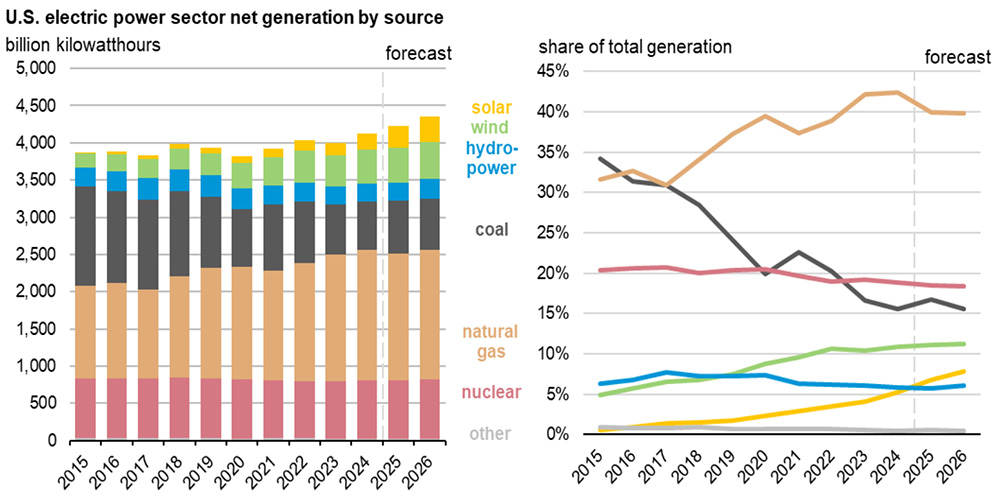
The U.S. Energy Information Administration is boosting its estimate of national power generation growth to 2.3% this year and 3% next year. 

The details are reported in the September Short Term Energy Outlook the agency issued Sept. 9. In the outlook published in January, it had forecast an average of 1.5% growth in 2025 and 2026. 

EIA said the increase is from a colder-than-expected start to 2025 and load growth assessments by ERCOT and PJM. The latter had the largest amount of generation of any region in 2024: 873 billion kWh. It is expected to have 904 billion in 2025 and 946 billion in 2026. 

ERCOT is forecast to have the largest increase in generation, from 459 billion kWh in 2024 to 560 billion in 2026 — a 22% jump. 

The January STEO forecast only 499 billion kWh in ERCOT in 2026 and only 902 billion kWh for PJM. 

The predictions for all other grid regions are nearly the same in the September report as in the January report. 

To meet this rising demand, utility-scale solar generation is expected to increase 33% this year over 2024, the most of any technology, and then 19% in 2026. 

Natural gas generation is expected to be 3% lower in 2025 than in 2024 because of sharply higher gas prices, but it still will be the largest source of electricity by a wide margin, providing 1,698 billion kWh, or 40% of the country’s electricity. 

Coal-fired generation is expected to be 9% higher this year than last — the first year-over-year increase for coal since 2021. The 2024-2025 decrease in gas and increase in coal both are approximately 61 billion kWh. 

The U.S. Energy Information Administration expects significantly more solar and coal power generation in 2025 than in 2024 from increases in installed solar capacity and increases in natural gas prices that make coal more attractive. | EIA

Small increases also are forecast in 2025 for wind power (4%) and hydropower (2%). Together with solar, this puts renewable energy at 25% of U.S. electricity generation in 2025 and 26% in 2026, compared with 23% in 2024. 

Nuclear fission is expected to produce only slightly more power in 2025 than in 2024 but 2% more in 2026, thanks to the anticipated restart of the Palisades Nuclear Plant in Michigan. 

The average price per kilowatt-hour is projected to increase from 16.48 cents in 2024 to 17.22 cents in 2025 and 17.9 cents in 2026 for residential customers; 12.85 to 13.36 and 13.5 cents for commercial customers; and 8.15 to 8.49 to 8.54 cents for industrial customers. 

Nationwide average electricity prices for the three classes are projected to be 13.53 cents/kWh this year and 13.79 cents next year. The West South Central region — Texas, Oklahoma, Arkansas and Louisiana — retains the lowest average in 2025, at 9.87 cents/kWh, and New England remains highest, at 25.12 cents. 

NWPCC Updates Power Plan Model in Light of Trump

The Northwest Power and Conservation Council has provided more details regarding how its ninth power plan will consider new federal policies that could affect the buildout of new resources and transmission.

The council will consider two priority scenarios to build the plan’s model, including a changing hydro operations scenario and a new resource and transmission risk scenario, the latter of which was discussed during the Sept. 9 meeting.

“This is exploring a range of uncertainty or risk … related to the region’s ability to build new resources and transmission,” Jennifer Light, director of power planning at NWPCC, said during the meeting.

The resource and transmission risk scenario includes six sensitivities:

    • Constrained new resources.
    • Changing transmission availability.
    • Changing technology costs.
    • Limited short-duration storage availability.
    • Slower demand-side resource availability.
    • Evolving federal policy landscape.

These sensitivities are intended to help the council get a better understanding of the availability of resources under certain circumstances.

When council staff first started developing the sensitivities at the beginning of 2025, President Donald Trump had yet to target tax incentives for renewables under the Inflation Reduction Act. (See NWPCC Considers Trump, Data Centers in Regional Power Plan.)

Council staff anticipate the administration will remove amendments to the Clean Air Act that imposed stricter requirements on the buildout of new natural gas resources.

Five of the sensitivities originally were modeled with the tax credits and gas requirements in mind, and the evolving federal landscape scenario considered what would happen if those were removed.

“Well, now we’re flipping that around a bit,” Light said.

Since those clean energy incentives and gas requirements no longer are relevant, council staff have removed them from the bulk of their modeling. Instead, those are tacked on to the federal landscape scenario, which assumes the credits will return in 2030, Light explained.

“Why are we proposing doing that? Well, the IRA gives us a set of assumptions we can use,” Light said. “We’ve already started using them. So, it wouldn’t make sense to come up with different tax credits now, and I think that’d just be a lot of work and a lot of guessing, not necessarily getting us any more precise than using IRA assumptions that they come back.”

The council is required under the Northwest Power Act “to develop a plan to ensure an adequate, efficient, economical and reliable power supply for the region,” according to its website. NWPCC publishes a plan every five years, and the goal is to have a draft ninth power plan done by July 2026 and a final version by the end of that year. (See NWPCC’s Initial Demand Forecast Sees Sharp Growth for Northwest.)

“If there is another administration down the road that wants to bring stuff in, it’s not necessarily going to look identical to the Inflation Reduction Act,” Light said. “But it is a set of policies that we have that we can use as a basis for assumptions that feels just as good as making a guess. And I think it will give us directionally useful information.”

Calif. Pathways Legislation Poised for Passage After Being Shifted into New Bill

California lawmakers on Sept. 10 shifted the legislation designed to transition governance of CAISO’s markets to an independent “regional organization” (RO) into a different bill: AB 825. 

The “new” bill replaces SB 540, which sought to implement the West-Wide Governance Pathways Initiative’s plan to create a regional organization (RO) to oversee CAISO’s Western Energy Imbalance Market and soon-to-be-launched Extended Day-Ahead Market — and authorize the ISO to participate in the RO. 

The move is the product of considerable legislative maneuvering over the past week. AB 825, which passed out of the Senate Appropriations Committee on Aug. 29 and is poised for a full Senate vote, previously was an “energy affordability” bill intended to limit the rate impact of utility investments in transmission infrastructure needed to prevent wildfires and meet California’s clean energy goals. Those provisions have been removed from AB 825, which has been renamed “Independent System Operator: independent regional organization” to reflect its new purpose.  

The new version of AB 825 importantly strips out a controversial provision added to the original version of SB 540 that would have authorized a new Regional Energy Market Oversight Council to force CAISO and the state’s investor-owned utilities to withdraw from a regional energy market if it found participation no longer served the interests of the state. The amendment prompted many of SB 540’s backers to pull their support in July. (See Calif. Pathways Bill Delayed After Orgs Withdraw Support, While Newsom Signals Backing for Effort.) 

Sponsored by Assemblymember Cotti Petrie-Norris and Sen. Josh Becker, AB 825 “would authorize the ISO and the electrical corporations that are participating transmission owners whose transmission systems are operated by the ISO to use voluntary energy markets governed by an independent regional organization, only if specified requirements are satisfied.” 

The 13 requirements outlined in the bill largely align with the principles and plans set out by the Pathways Initiative during its “Step 2” process for designing the new independent RO. 

Among them is a guarantee that the RO will be a nonprofit whose governance documents and FERC-approved tariff include provisions “to respect the authority of each state that has a load-serving entity or balancing authority participating in the market to set its own procurement, resource adequacy, environmental, reliability and other public interest policies and exercise oversight over its regulated entities.” 

Another requirement calls for the RO’s governing board to maintain a public policy committee of the governing board “that engages with states, local power authorities and federal power marketing administrations about potential impacts to state, local or federal policies before it approves a tariff change” for filing with FERC. 

The bill would require CAISO to continue to operate its energy markets “subject to the market rules determined by the independent regional organization as accepted by” FERC. The bill would also require that the RO “provide greenhouse gas emissions information and protocols sufficient to enable compliance with the requirements of any state agency.” 

The legislation also stipulates that the RO’s tariff provide “a procedure for unilateral withdrawal from the independent regional organization’s energy markets by any participant on their own accord, or as required by an applicable regulatory authority or state statute, with reasonable prior notice and without any penalties, unreasonable costs or further discretionary approvals.” 

The bill would authorize the ISO to implement tariff changes needed to transfer its governance to the RO and join the entity on or after Jan. 1, 2028. 

Renewed Support

Sources close to the Pathways process have expressed confidence about the prospects for the AB 825, telling RTO Insider the bill appears to have the approval of the Assembly, Senate and Gov. Gavin Newsom. 

“As we move toward achieving California’s 100% clean energy goals, we must look at every opportunity to reduce costs, improve reliability and cut emissions,” Sen. Becker said in a press release. “AB 825 strikes that balance by unlocking the benefits of a regional energy market while safeguarding California’s public policy priorities. This is a win-win for California families, our economy and our climate future.” 

Becker’s release said the amended AB 825 includes “rigorous annual legislative oversight by relevant California legislative policy committees to ensure the new market operates in line with California’s clean energy and reliability goals” and “provides strong protections for state authority, including California’s right to withdraw at any time if participation ceases to benefit the state.” 

“We got it done :-),” Becker said in a more unvarnished comment responding to a post on LinkedIn. 

“California decision-makers, including Governor Newsom, see the value of a regional market and are committed to seeing this through,” Leah Rubin Shen, managing director of Advanced Energy United, said in a statement. “The fact that the fixed SB 540 language has now been amended into the Assembly’s former energy affordability package, AB 825, is a positive step forward. It shows a strong commitment toward a Western market that delivers on what California and the rest of the West need the most, more affordable and reliable power.” 

The Environmental Defense Fund and Natural Resources Defense Council, which both pulled their support from the amended version of SB 540, voiced their support for the new bill in a joint statement. 

“With state leaders rightly focused on making California more affordable, the choice on AB 825 is simple. We can’t keep the lights on or fight climate change alone,” said Katelyn Roedner Sutter, EDF’s California state director. “By passing this bill this year, lawmakers will keep power bills in check while expanding clean electricity access and preventing blackouts.” 

“Building a 100% clean energy economy the cheapest and fastest way possible starts with passing AB 825,” said Victoria Rome, NRDC’s senior director of California affairs. “Right now, we generate more clean power than ever, but we are not able to use all of it efficiently. This bill is a chance for California to lead a broader transition to cheaper clean power by working with our neighbors across the West.” 

The latest version of AB 825 is still subject to a California legislative requirement that an amended version of a bill be in print for 72 hours before it can become eligible for a full floor vote in either house. The timing of the release of the final bill means a vote can’t be taken ahead of the legislature’s scheduled Sept. 12 recess. Becker’s office confirmed lawmakers will extend the session to vote on the bill Sept. 13 — a Saturday. 

NERC Task Force Members Talk Internal Controls Improvements

Entities should be “prepared to discuss internal controls at [a] deeper level” during compliance audits and show regional entity staff how they plan to address reliability risks, members of a NERC task force said in a webinar hosted by the Texas Reliability Entity. 

Speaking in the regular Talk with Texas RE webinar Sept. 9, William Braun, Texas Reliability Entity’s senior risk assessment analyst, and Molly Elliott, senior technical analyst for oversight planning at WECC, discussed the importance of internal controls for registered entities and how the ERO’s thinking on the issue has evolved in recent years. 

Elliott is co-chair, and Braun is a member, of the Internal Controls Task Force, an organization comprising members from NERC and all six REs. The group includes auditors, risk practitioners, managers and others “from either an audit or risk discipline,” Elliott said. 

The purpose of internal controls is to anticipate and address risks that could affect the compliance of a registered entity, along with risks that do not necessarily affect compliance but could impact the entity’s reliability. The ERO considers internal controls a useful index for a registered entity’s overall level of risk, Braun said, with strong internal controls indicating a less risky environment and a less developed regime correlated with higher risk. He added that “well defined internal controls give us predictability about the future.” 

The goal of the ICTF is to ensure that REs “understand internal controls and their contributions to mitigating risk to the [electric grid] the same way,” Elliott said. The task force is working on a public-facing guide to internal controls, as well as a handbook for auditors. While each region likely will establish its own approach to examining entities’ internal controls, the plan is for all to follow the same basic strategy. 

Noting that “most [entities] have room for improvement” in their internal controls, Braun and Elliott held up the COSO model — named for its developer, the Committee of Sponsoring Organizations of the Treadway Commission — as a useful guide for upgrades. The model is found in the Government Accounting Office’s Green Book, which presents standards for internal control in the federal government. 

The model is presented as a cube, with one face representing five components of internal control: control environment, risk assessment, control activities, information and communication, and monitoring. These components operate across the four levels of organizational structure presented on the second face: function, operating unit, division and entity. The last face includes operations, reporting and compliance, the objectives the entity aims to meet through its internal controls. 

Elliott called the COSO model “a very helpful guide [that] fits in well with our audit approach,” which uses government auditing standards found in the GAO’s Yellow Book. But she emphasized that the purpose of an internal controls program is not just “making a regional entity happy.” A robust set of internal controls can ensure an entity is meeting its business objectives beyond compliance. It also can enhance internal communications and external relationships, particularly with regulators that can see the improvements. 

“Information and communication is a key component of the Green Book model, and our entities tell us that they have improved relationships between compliance and operations, and they found the different business units are more aware of how their work affects others in the organization and vice versa when they put in an intentional controls program,” Elliott said. “An entity [that’s] been successful in reducing reliability and security risk may [also] see less frequent monitoring [or] smaller scope or less in-depth audits.” 

Permitting Legislation Effort Picks up Steam, but Passage Remains Difficult

Permitting reform legislation is starting to move through Congress, with a key House committee holding a hearing and supporters lobbying legislators, though actually passing a bill is tough in any political climate.

The House Natural Resources Committee is holding a hearing Sept. 10 to take testimony on three pieces of legislation: H.R. 573, H.R. 4503 and H.R. 4776.

The e-Permit Act (H.R. 4503) is a bipartisan bill introduced by Reps. Dusty Johnson (R-S.D.) and Scott Peters (D-Calif.), the latter of whom has supported major overhauls of transmission rules. The bill would require the government to use new technology to speed up permitting. (See Hickenlooper and Peters Introduce BIG WIRES Act.)

Committee Chair Bruce Westerman (R-Ark.) and Rep. Jared Golden (D-Maine) introduced the SPEED Act (H.R. 4776) that would change the National Environmental Policy Act in order to streamline the permitting process by shortening timelines, simplifying analyses and limiting litigation.

Last session a Senate effort on permitting reform, championed by former Sen. Joe Manchin (I-W. Va.) and Sen. John Barrasso (R-Wyo.), fell short. Energy and Natural Resources Committee Chair Mike Lee (R-Utah) said at the committee’s recent FERC confirmation hearing that he would like to make another attempt at legislation this Congress. (See Lame Duke Permitting Push Fails; Manchin Blames House GOP Leaders.)

“Assuming you’re confirmed, I look forward to working with both of you on prioritizing permanent reform,” Lee said at the hearing Sept. 4. “Sen. Barrasso and others have referred to that effort today, and it’s priority I look forward to working with both of you on, as FERC has an important role in the permitting process for the areas we’ve discussed.”

The Senate Environment and Public Works Committee is engaged in a bipartisan process to develop reforms, which its chair, Sen. Shelley Moore Capito (R-W.Va.), explained in a floor speech in late July where she referenced working with Ranking Member Sheldon Whitehouse (D-R.I.).

“Right now, we have the momentum, I believe, needed to deliver meaningful and lasting reforms to the environmental review and permitting process, and I believe this is an unprecedented opportunity and something we can truly accomplish,” Capito said in the speech. “I do believe, and … Sen. Whitehouse and I know this well, that there are areas of strong disagreement in this area between the two of us, and what we’re going to try to do is to find those areas of like-thinking that move the process along. No matter how difficult it might be, this is the only way we get a permanent solution, so we don’t see the swings of the environmental process that we’ve seen over the last few years.”

Those are not the only committees that might have to weigh in on a complete permitting system overhaul, Arnab Datta, director of infrastructure policy for the Institute for Progress, said on a webinar hosted by the R Street Institute on Sept. 9. Manchin and Barrasso were able to make some headway last year, but the ENR Committee’s remit does not cover NEPA or judicial reforms.

“You run into some of these political/congressional dynamics that can also make it quite difficult to get to comprehensive reform,” Datta said.

Capito and Whitehouse’s efforts are promising this Congress, he said, but hopefully something more comprehensive can get passed.

A big part of the recent change in the politics around permitting is that laws like NEPA were passed when major polluting facilities were being built regularly, which drove support from environmentalists, Bipartisan Policy Center Vice President for Energy Xan Fishman said on the webinar.

“That process for issuing the permit went from something that was fairly simple — didn’t take a whole lot of time; didn’t take a whole lot of staff work at an agency — to something that took years and years and years, and the environmental review documents ballooned into hundreds of pages, or more than 1,000 pages,” Fishman said. “And as it happened over time, the types of projects that people tried to build also started to change.”

The bureaucratic delays started to impact clean energy projects that environmentalists support and see as needed to combat climate change, and they started supporting permitting reforms. But just because they support reforms now does not mean they agree with all the other supporters on what that means.

“It means different things to different people, right?” Datta said. “So … on the more hardcore environmental left, it means, ‘Make it easier to build rooftop solar,’ and that’s it. And then you can move a little bit over, and it starts to include new types of emissions-free energy; in other cases, maybe it’s tech neutral.”

Emily Domenech, executive director of the White House’s Federal Permitting Improvement Steering Council, said on the webinar that she would welcome some congressional updates to her organization’s 10-year-old governing statute.

“We’re treating the symptoms, not the cause, of our permitting challenges, with the function of the permitting council,” Domenech said. “So, we serve as the ‘Sherpas’ for large projects going through federal permitting.”

Projects need to be worth at least $200 million, must come from one of 19 sectors that cover the gamut of major infrastructure including energy and data centers and must trigger the NEPA review process, which the council helps them get through as quickly as possible. The projects reviewed by the council can change by administration, with Domenech noting that it is reviewing 40 mining projects; only one was before it when Donald Trump returned to office.

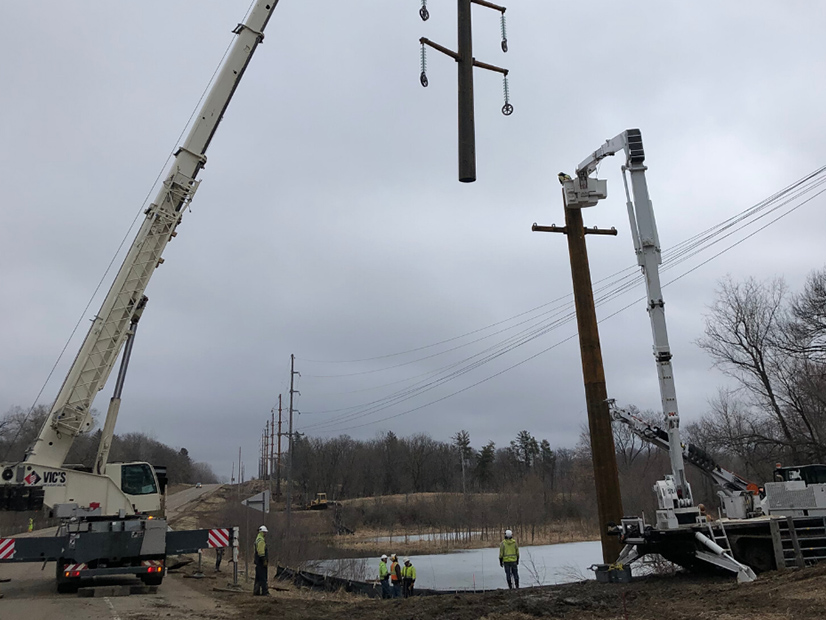
Great River Energy line construction in 2020 | Great River Energy

Domenech said she hoped Congress will improve the situation and praised the House Natural Resources Committee’s work on permitting legislation.

“We always love the opportunity to work with Congress to give us more authorities and get more things done, but really, this administration’s approach has been about using the council’s authority to the fullest extent,” she added.

Support for permitting reform is coming from the outside, with a broad coalition of trade groups headed by the U.S. Chamber of Commerce sending a letter to congressional leadership. Other signatories include the American Council on Renewable Energy, Electric Power Supply Association and the National Rural Electric Cooperative Association.

The letter argues for legislation that ensures predictability in the permitting process, makes it more efficient and transparent and ensures that all relevant stakeholders are informed in time to comment on the process.

“A modernized permitting system will help us build smarter, faster and more sustainably; we just need a system that keeps pace with our ambition,” the letter says. “We urge Congress to work across the aisle to enact durable legislation this fall that reflects the urgency and opportunity before us.”

Another letter headlined by the Industrial Energy Consumers of America, with more than 70 other manufacturing groups, urged Congress to enact permitting legislation as well, with a focus on expanding natural gas pipelines to minimize curtailments.

“No one is more impacted by inadequate natural gas pipeline capacity than the manufacturing sector,” the letter says. “Under state end-use curtailment plans, when there is insufficient supply to serve the residential consumer or for electricity generation, natural gas service to manufacturing companies is curtailed — there is a mandatory reduction of natural gas supply. The frequency of curtailment rates is increasing annually and comes at significant costs and disruption to manufacturing supply chains that also include materials for national security.”

CTR Plans 500-MW Geothermal Project in Lithium Valley

Controlled Thermal Resources has taken a step forward on its plans to build a 500-MW geothermal energy plant in California’s Lithium Valley, where it is eyeing co-location of manufacturing or data centers. 

CTR announced Sept. 9 that it is partnering on the geothermal project with Baker Hughes, an energy technology company. Baker Hughes will supply high-temperature drilling technologies, power systems and digital field services. 

The project location is near the Salton Sea in the Imperial Valley region of Southern California — an area that’s been dubbed Lithium Valley. Not only is the region a known geothermal resource area, but brines produced there during geothermal electricity generation have been found to be rich sources of lithium. 

In fact, the region may have enough lithium to allow the U.S. “to meet or exceed global lithium demand for decades,” the Department of Energy said previously. (See Salton Sea Could Supply Lithium Needs for Decades, Study Finds.) 

CTR’s Hell’s Kitchen project is a combination of advanced geothermal power generation and critical minerals extraction. 

The goal for Stage 1 of the project is 50 MW of geothermal energy and 25,000 metric tons per year of lithium hydroxide. 

Interconnection Delay Bypass

From there, geothermal generation will be expanded in stages, up to an additional 500 MW. The expansion will support hyperscale data center growth and advanced battery manufacturing “with the capacity to accommodate behind-the-meter, direct-source baseload power, bypassing grid interconnection delays,” CTR CEO Rod Colwell said in a July project update. 

“Hyperscale data center and AI demands are surging, but they cannot run on intermittent renewables,” Colwell said in a statement. “The Hell’s Kitchen project will provide 500 MW of baseload energy to meet this demand.” 

Maria Claudia Borras, chief growth and experience officer at Baker Hughes, called the 500 MW geothermal plant “one of the largest baseload renewable energy projects in the United States.” 

Commenting on the CTR project, California Gov. Gavin Newsom said the state “continues to build more clean energy, faster.”

“Together with partners like Controlled Thermal Resources, we’re advancing a vision for Lithium Valley that promises to become a global source of critical minerals while also powering a new economic boom for the region,” Newsom said in a statement. 

The CTR campus is one piece of Imperial County’s Lithium Valley Specific Plan. When finalized, the plan will provide a framework across 51,000 acres for clean energy, advanced manufacturing and data centers. 

Also in Lithium Valley, data center developer CalEthos is planning a 315-acre campus for clean energy-powered data centers.

CTR is close to making a final investment decision on Stage 1 of the Hell’s Kitchen project, and construction could start in 2026, a company spokesperson told RTO Insider 

CTR has a 40-MW power purchase agreement with the Imperial Irrigation District as well as lithium supply agreements with major U.S. auto manufacturers. 

As for the 500-MW geothermal project, CTR plans to build it in 50- to 100-MW increments. The first stages may be complete in the late 2020s, the company said. 

Federal Policy Shifts

The buildout for CTR’s Lithium Valley campus includes several co-location sites, according to conceptual plans. The co-location sites could accommodate hyperscale data centers, precursor cathode active material production or battery manufacturing, according to the spokesperson. 

Permitting work also is under way. In June, Hell’s Kitchen formally received a Fast-41 Covered Project designation. FAST-41 is an initiative to streamline federal permitting through a predictable and transparent process. 

CTR’s plans also may get a boost from recent shifts in federal policy.  

The One Big Beautiful Bill Act directs incentives and funding toward projects “that can deliver domestic baseload energy security, critical minerals, manufacturing capacity and supply chain resilience,” Colwell said in his July update. 

CTR recently took part in a series of high-level meetings in Washington, D.C. Colwell said the meetings “confirmed CTR’s alignment with national priorities.” 

D.C. Circuit Upholds FERC PURPA Decision Without Chevron Deference

A three-judge panel of the D.C. Circuit Court of Appeals on Sept. 9 upheld its decision to side with FERC over whether a solar plant in Montana is a qualifying facility under the Public Utility Regulatory Policies Act without relying on Chevron deference. 

The Supreme Court had remanded the initial decision in July 2024, after it had ended the Chevron doctrine in Loper Bright Enterprises v. Raimondo. (See PURPA Case Offers FERC Early Glimpse of Post-Chevron World.) Under the doctrine, courts would defer to regulatory agencies in their administration of a law as long as their decision-making was reasonably explained. 

In Solar Energy Industries Association v. FERC, the D.C. Circuit still sided with the commission that the Broadview facility, with 160 MW of nameplate capacity, is a QF. The solar plant includes a 50-MWdc battery, limiting the power that actually flows to the grid to PURPA’s 80-MW maximum, FERC found. 

FERC has consistently defined power production capacity as the amount of power a facility can ship to the grid. Petitioners in the case, including NorthWestern Energy, argued it should be applied to the nameplate capacity. 

Initially, the court sided with FERC under the Chevron precedent, but in the decision issued Sept. 9, it concluded under Loper Bright that power production capacity should be defined as the amount of power that can be sent to the grid. 

“That reading accounts for all the facility’s components working together, not just the maximum capacity of one subcomponent, and it appropriately focuses on grid-usable AC power,” the court said. “Because the Broadview inverters’ maximum output capacity at any given time is 80 MW of AC power, the entire facility’s send-out capacity is capped at that level consistent with FERC’s decision to certify it as a small power production facility.” 

The generator is linking to the grid through NorthWestern’s transmission system. The utility filed an objection to its certification at FERC along with the Edison Electric Institute. In a September 2020 order, FERC initially denied the certification, finding that the relevant capacity was the 160 MW of solar. 

Broadview sought rehearing, and in March 2021 (soon after President Joe Biden took office), FERC reversed course and granted it QF status under PURPA. 

FERC rejected arguments from EEI that the setup was designed to “game” PURPA’s power production capacity limit. The facility’s design enables a higher capacity factor, achieving its maximum 80-MW output about 35 to 40% of the time, with FERC finding that a permissible use of technology to boost its capacity factor while remaining under PURPA’s limit. 

After the D.C. Circuit sided with FERC in 2023, EEI and NorthWestern sought Supreme Court review. The high court granted the petition without deciding the merits, vacating the earlier decision based on the Loper Bright decision. On remand, the circuit court followed the Supreme Court’s directive to exercise its independent judgment in deciding whether the agency had acted within its statutory authority. 

“We hold that a small power production facility’s ‘power production capacity’ refers to its maximum net output of AC power to the electrical grid at any given point in time,” the court said. “Because the amount of power the Broadview facility can send out to the grid is limited by its inverters to 80 MW, it qualifies as a small power production facility under PURPA.” 

Based on the law’s text, “facility” applies to all components as they function together, which includes the inverters and their 80-MW limit. The power production capacity rule refers to a “facility” rather than a particular subcomponent, such as a generator.  

“The only grid-usable form of electric energy the facility produces is AC power,” the court said. “The most natural reading of ‘power production capacity’ of the facility, then, is the amount of AC power that the overall facility transmits to the electrical grid.”