Data center-fueled demand growth continues to soar while reserve margins continue to shrink. Meanwhile, the timelines for building load versus building generation and transmission are wildly out of sync.

Large loads can stand up in one to two years or less when co-located with generation, while new generation interconnection routinely takes years, and major transmission lines average about a decade from conception to energization.
Because data centers can be developed significantly faster than the generation and transmission required to serve them, NERC has flagged the speed and scale of data center buildout as a near-term reliability challenge. Large loads also pose risks to long-term planning, operations, grid stability, balancing, power quality, forecasting, modeling and grid security.
In light of the rising operational and resource adequacy risks, federal agencies, regional organizations, power system operators and utilities are scrambling to analyze and address the impacts related to emerging large loads.
The Department of Energy (DOE) has launched the Speed to Power initiative to accelerate the large-scale generation and transmission additions needed to support data center buildout and the AI race. FERC has held technical conferences and written letters around these issues, while NERC and other regional reliability organizations have created task forces and studied the risks of these emerging large loads.
ERCOT, SPP and PJM are paving the way with large load interconnection and participation initiatives.
Just How Big is Large Load Growth?
U.S. data center electricity use rose from 58 TWh in 2014 to 176 TWh in 2023 and is estimated to reach 325-580 TWh by 2028. That translates into roughly 6.7 to 12% of U.S. electricity by 2028 (up from about 4.4% in 2023), according to DOE, underscoring how quickly this new class of demand is growing.
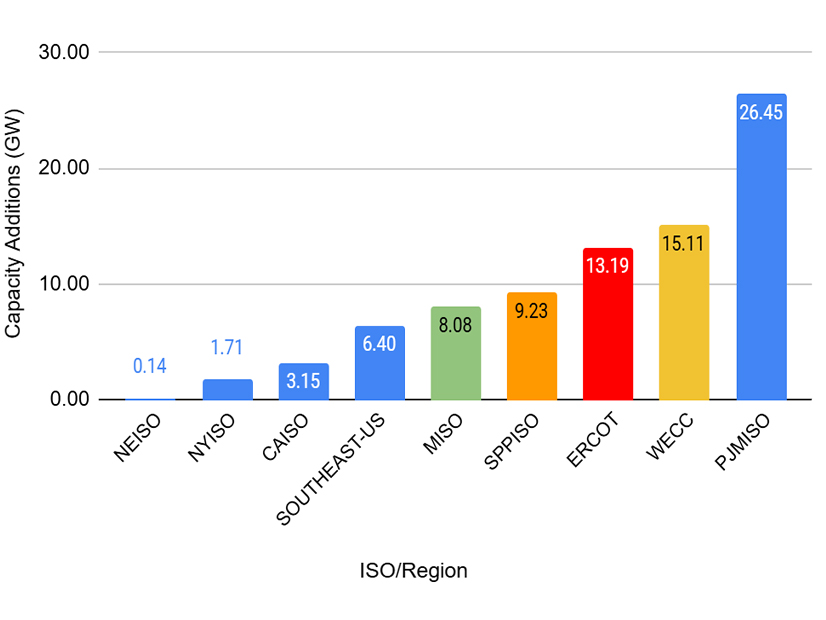
Growth is highly geographic, with PJM, the Western Interconnection and ERCOT leading the way due to the major data center hot spots in Virginia, Texas and the Northwest.
Since 2020, PJM has added about 26.5 GW and ERCOT about 13.2 GW of load‑center capacity, with more in the queue but significant uncertainty on what actually will be built. SPP also has positioned itself to capture a meaningful slice of data center growth. (See this for more information on current and future data center hot spots.)
ERCOT and PJM’s load capacity additions are projected to skyrocket in the coming years, but it’s still uncertain how much load will get built out.
Characteristics and Risks of Large Loads
Large loads today differ from conventional commercial loads. Large loads can be either large individual consumers or collections of smaller loads that create significant demand and strain on the power grid. Most talked about are data centers, including AI hyperscale data centers, but NERC categorizes large loads as follows:
-
- Data centers: These include traditional data centers, AI training facilities, AI inference facilities and cryptocurrency mining facilities.
- Industrial load: This includes semiconductor and electronics manufacturing, mining and mineral processing, oil and gas production, metals and heavy manufacturing, and chemical and petrochemical processing.
- Hydrogen production (electrolyzer) facilities.
- Aggregate loads: These are primarily EV charging centers and electrified heating and cooling. Large loads are being built quickly, at large unit sizes, in tight geographic clusters. Many of them, particularly data centers, can shift their computational demand rapidly in response to changing energy pricing, emission intensity and currency pricing.
Compared to traditional electricity load growth, today’s large loads are far more location-constrained (e.g., loads need available grid capacity, access to robust fiber optic networks and water access or a suitable climate for cost-effective cooling). They’re also far more schedule‑driven by corporate road maps and much less interruptible than conventional commercial load.
NERC ranked the risks from large loads:
-
- high-priority risks: long-term planning for resource adequacy, operations of balancing and reserves, and grid stability.
- medium-priority risks: short‑ and long-term demand forecasting, real‑time coordination, transmission adequacy, frequency stability, cybersecurity, manual load‑shed obligations and automatic under-frequency load shed programs.
- low-priority risks: power quality (harmonics, voltage fluctuations) and system restoration following load shedding events.
Consequently, large loads are characterized not only by their MW capacity but also by their behaviors that pose grid reliability risks. The consensus defines large load capacity as greater than 75 MW, but voltage level, local system strength and relative size to the area matter as much as raw MW. Their behaviors include ramp rates, ride‑through behavior, power‑electronics content, voltage sensitivity, predictability and internal segmentation.
Existing ISO Large Load Constructs
Before September 2025, ERCOT and NYISO were the only ISOs to have requirements for large load interconnection and preliminary definitions and programs for large loads. In 2022, NERC modified its requirements and measures for facility interconnection studies (FAC-002-4), but it didn’t have any megawatt threshold or special process for large loads.
ERCOT established an interim large‑load interconnection process in 2022 that requires transmission service providers to submit interconnection studies that meet the NERC Reliability Standard FAC-002-2 requirements for each applicable large load seeking to interconnect within two years. ERCOT formalized and improved this process April 15, 2025, after approving Nodal Protocol Revision Request 1234 (NPRR1234) and its accompanying Planning Guide Revision Request 115 (PGRR115).
NPRR1234 updated ERCOT’s definition of a large load to be one or more facilities at a single site with an aggregate peak demand greater than 75 MW behind one or more common points of interconnection or service delivery points. NPRR1234 also formalized interconnection and modeling standards for large loads, set standards for loads of more than 25 MW, set requirements for a reactive power study requirement for resource entities adding more than 20 MW of load at a site with existing generation, and established a standardized large load interconnection study. The study is conducted by the transmission service provider with ERCOT review and is described in PGRR115.
In NYISO, interconnection studies are required for loads greater than 10 MW at more than 115 kV or greater than 80 MW at more than 115 kV. Smaller projects are handled entirely by the applicable transmission operator’s interconnection procedures.
Federal Activity
Demand growth outpacing the grid buildout, alongside several executive orders relating to energy dominance and AI, have led DOE to launch the Speed to Power initiative.
The initiative kicked off Sept. 18, 2025, with a request for information. It aims to accelerate large-scale additions of generation and transmission so the U.S. “has the power needed to win the global artificial intelligence race” and can continue to serve fast-growing loads.
The RFI seeks details on infrastructure projects that would quickly enable 3 to 20 GW of incremental load, such as new interregional transmission of at least 1,000 MVA, reconductoring of existing lines of at least 500 MVA, restarts of retired thermal plants using existing interconnections and construction of new generation portfolios. MVA measures the apparent power in an AC transmission system, essentially the combined voltage and current capacity a line or transformer can handle. The RFI also asks how DOE should best deploy existing tools and funding programs.
RFI responses are due Nov. 21, 2025.
Texas Senate Bill 6, PUCT and ERCOT Action
ERCOT is seeing some of the largest forecast load growth from data centers, with 138 GW of large loads expected on its grid by 2030.
To address the reliability concerns this raises, the Texas state government pushed the envelope with its Senate Bill 6, which passed on June 20, 2025. It directs the Public Utility Commission of Texas to adopt large‑load interconnection standards for new or expanded large loads greater than 75 MW at a single site in ERCOT, along with study fees ($100,000 minimum initial interconnection fee), site control, uniform financial commitment rules, grid infrastructure cost allocation and a requirement to disclose to utilities any duplicate interconnection requests in Texas.
SB6 also directs the PUCT to develop one mandatory and one voluntary demand management program. The mandatory program requires protocols to curtail large loads of greater than 75 MW that are interconnected after Dec. 31, 2025, during firm load shed (with some exceptions for critical load).
The voluntary program, the Large Load Demand Management Service, requires ERCOT to competitively procure demand reductions from loads greater than 75 MW in advance of anticipated emergency conditions.
The PUCT projects for SB 6 are PUCT filings 58317 and 58479.
ERCOT has begun related notices and data collection but is prioritizing its Real-Time Co-optimization + Batteries (RTC+B) initiative, which goes live Dec. 5, 2025.
SPP’s HILLs and CHILLs
SPP recognizes how much uncertainty there is with the load of the future and subsequently has designed a three-phase project that aims to set SPP up for success in all likely electricity load growth scenarios. SPP’s three future large load services are:
-
- a high-impact large load generation interconnection assessment (HILLGA)
- a conditional high-impact large load service (CHILLS)
- a price adaptive load (PAL) service.
The new services aim to reduce interconnection times with a 90-day study-and-approval process for HILLGA and CHILLS, provide flexibility for connection or operation of large loads within system limits and reduce transmission upgrade cost uncertainty. This will offer a clear path to interconnection agreements while maintaining SPP’s reliability standards and transparency in cost allocation.
The first phase of the project began with SPP’s revision request (RR696), which was approved by SPP’s Board of Directors on Sept. 16. It defines high-impact large loads (HILLs) and introduces a generation-supported HILLGA. A HILL is a non-conforming load facility interconnected to the grid that can pose reliability risks.
The HILLGA service offers HILLs two paths for studying and interconnecting associated generation: the common bus path and the local area path.
The common bus path is for HILLs with supporting generation behind the same point of interconnection as the HILL, where generation won’t be injected into the grid.
The local area path is a five-year service term for HILL-supporting generation that’s within two buses. With the local area path, energy flows on the grid are limited by the HILL’s needs and system capacity.
RR696 initially had designs for a third HILLGA path, deliverability area and for a CHILLS. They were removed from RR696 following feedback from stakeholders, who wanted more time to review and revise the deliverability area and CHILLS designs. The CHILLS service was introduced later with RR720, which was voted on and failed to pass in SPP’s Market Working Group meeting Sept. 23-24. This will delay SPP’s timeline, which initially sought to vote on RR720 in the Oct. 14-15 MOPC meeting.
The CHILLS will be a new curtailable transmission service available to HILLs that don’t have sufficient transmission capacity or generation to serve all their energy requirements. The portion of a HILL’s energy needs that can’t be served on a firm basis will be acquired on a conditional basis, so CHILLS is interruptible as needed to maintain reliability.
Conditional HILLs don’t need to be supported by generation, but they are required to transition to firm service by the end of the term. In a notable change from its old design in RR696, conditional HILLs must begin the process of establishing firm service within the first year. The CHILLS term now is up to seven years long, increased from five years.
SPP also has discussed a price adaptive load service for any load willing to take price‑responsive withdrawal based on real‑time pricing. SPP aims to create the revision request by January 2026 and get it approved in April 2026. This timeline may be delayed due to the recent failure to pass RR720 in the September Market Working Group.
SPP’s load-centric interconnection lane compresses the study cycle by pairing load with proximate generation and using conditional service while enduring solutions catch up.
While Texas’ SB 6 is the most comprehensive legislative package to date specifically aimed at large loads, SPP is leading the way among ISOs and RTOs with its large load interconnection lanes.
PJM’s Critical Issue Fast Path for Large Load Additions
On Aug. 8, 2025, PJM’s Board initiated the Critical Issue Fast Path (CIFP) to develop reliability-based solutions so large loads can interconnect quickly without causing resource inadequacy.
This initiative was motivated by PJM’s high capacity prices and looming resource adequacy crisis. PJM’s independent market monitor, Monitoring Analytics, found in its analysis of PJM’s 2026/27 capacity auction that data center load growth was the primary reason for high capacity prices. Nearly 100% of the offered supply was committed in the auction, and data center load drove a $7.2 billion, or 82.1%, increase in capacity market revenues.
PJM’s 2025 long-term load forecast showed PJM still may face unmet demand even if everything is built in the generation interconnection queue.
PJM is targeting a FERC filing by December 2025 and aims to implement in time for the 2028/29 capacity auction.
The CIFP for large load additions is evaluating criteria for large‑load interconnection and coordination with load-serving entities/electric distribution companies (critical for data centers). It’s also addressing alignment of large loads connecting to the power grid with the obligation to also provide some generation capacity to contribute to ensuring resource adequacy in the grid, rather than relying on others to do so.
PJM’s Stage 1 meeting was held Sept. 15, and the initial proposal centered around three large load interconnection options: BYOG (“bring your own generation”) credits for load that arranges new supply, demand response pathways and a transitional non‑capacity‑backed load (NCBL) service that lets incremental large loads connect quickly but assigns them a lower curtailment priority during emergencies if capacity is short.
After listening to stakeholder feedback, PJM’s current proposal has three components:
-
- Price-responsive demand (PRD) and demand response: PJM removed the mandatory NCBL concept and instead will use existing DR and modified PRD products to facilitate a process similar to voluntary NCBL. PJM proposes replacing the dynamic retail rate requirements seen in PRD with an energy market offer price. Load could elect not to take on a capacity obligation, requiring it to reduce demand during stressed system conditions rather than pay for capacity.
- Load forecasting enhancements: These include allowing state commissions to review and provide feedback on large load adjustments prior to finalizing load forecasts, and add a duplication check in load analysis subcommittee submissions. Each annual large load adjustment submission must inquire and report whether customer interconnection requests are duplicative (inside/outside PJM) and quantify the duplicated megawatts.
- Expedited Interconnection Track (EIT): Introduce a 10-month EIT for “sponsored” generation that operates outside and in parallel to the PJM cycle process (the standard generation interconnection process). The EIT would be limited in volume and have strict entry requirements to minimize impact on PJM’s cycle process.
Alternative approaches for procuring new resources on a longer-term basis still are in discussion and may be included in the CIFP for large load additions. PJM also mentioned that the manual load shed allocation mechanism needs to be reviewed following the conclusion of this CIFP.
Conclusion
Unprecedented data center-driven demand growth requires unique solutions to address the rising resource adequacy and grid operations risks. There is a timing gap with large loads arriving in months to a few years, while new generation and transmission take far longer.
Besides being large, these loads ramp quickly, are electronics-heavy and location-constrained, and can be price-adaptive, so treating them like conventional commercial growth will miss real reliability and planning risks.
ERCOT, SPP and PJM are leading the charge, creating large load-specific programs to speed up the interconnection and offer unique participation models for large loads and the necessary accompanying supply and transmission capacity.
The path forward includes standardized definitions and studies across ISOs/RTOs, improved participation models and forecasting for high-impact large loads, price-responsive operation, improved time-to-connect, conditional service, curtailment performance and progress to firm capacity.
Tim Hough is a market analyst on the market monitoring team at Yes Energy. RTO Insider is a wholly owned subsidiary of Yes Energy.