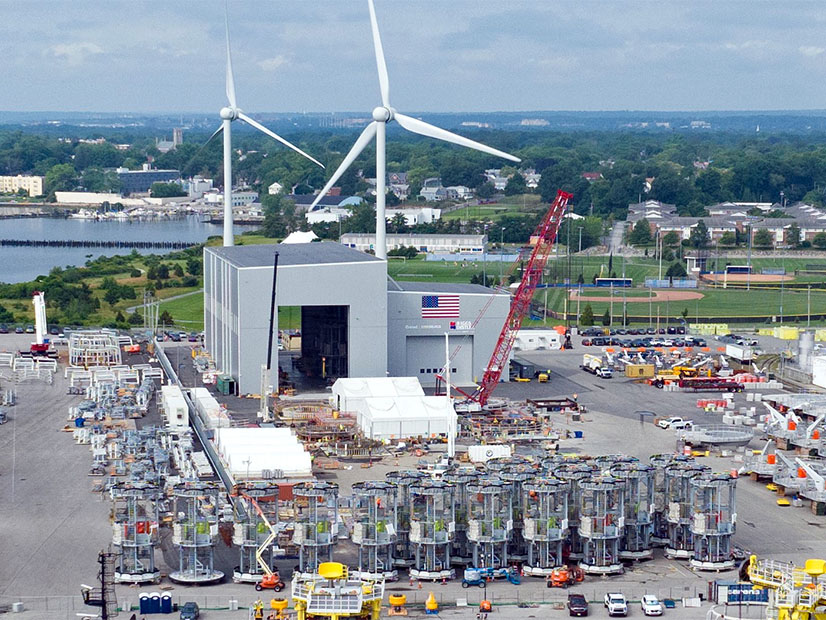
The antipathy of the Trump administration to the offshore wind industry is well known, and so it has come as little surprise that various federal agencies have been directed to impede the progress of offshore wind developments. This comes at a bad time, just as the multibillion-dollar industry was gearing up, constructing ports and building ships, while training the workforce necessary for the remarkably challenging task of building gigawatts of wind capacity miles offshore.
An Initially Promising Resource: In the early and heady years, the U.S. industry had looked eagerly to Europe’s North Sea, where each new offshore project boasted progressively lower costs, and gigawatt-scale projects quickly emerged. That anticipation soon translated to U.S. markets, where billions of dollars were funneled into enabling infrastructure and supply chains, and the Biden administration announced an ambitious target of 30,000 MW of offshore capacity by 2030. Offshore federal leases for hundreds of thousands of acres along the East Coast were signed, followed by the first steel in the ground, for projects as large as Dominion’s $10.9 billion, 2,600-MW Coastal Virginia Offshore Wind Project.
A Radical Change in Direction: With the 2024 presidential elections, however, the winds of fortune shifted rapidly. Within months, the Trump administration announced it was taking a hard line in opposing such projects, and it became clear the future of the industry might be in peril. Most observers were surprised, however, by the intensity of the opposition.
Since taking office, the new administration’s Bureau of Ocean Energy Management (BOEM) has stopped leasing new projects, rescinding all previously designated offshore wind areas, while withdrawing nearly $680 million for ports and manufacturing, and prematurely ending the program of federal tax credits. Perhaps even more critically, the Trump administration took the additional and largely unexpected step of targeting specific projects that already were underway.
The first affected was New York’s 810-MW Empire Wind project, which was roughly 30% complete when hit by a stop-work order in April which Secretary of the Interior Doug Burgum justified in a letter to the BOEM saying the project had been “rushed through” the approval process by the previous administration “without sufficient analysis or consultation among the relevant agencies.” The project got back on track a month later, apparently following an arrangement for a quid pro quo affecting a long-delayed New York gas pipeline.
That was followed by New England’s 700-MW Revolution Wind project, which was 80% complete when it got smacked by a stop-work order. The justification in this instance was national security concerns, with Secretary Burgum at one point citing the possibility that “people with bad ulterior motives against the United States would launch a swarm drone attack through a wind farm.” That order was quickly overturned by a U.S. District Court judge, who characterized the order as being “the height of arbitrary and capricious action.”
Then last month, the BOEM also filed a lawsuit to revoke a critical permit for the 2,200-MW Maryland Offshore Wind Project, claiming it had previously underestimated the effect on search and rescue helicopters and to offshore fisheries.
For its part, the Coastal Virginia Offshore Wind endeavor continues to move forward, reaching 60% completion, with plans to start delivering power by March 2026. It thus far has managed to avoid federal backlash, with a Dominion spokesperson recently and explicitly citing the historical bipartisan support for the endeavor.
So, for at least the next several years, we will have two categories of projects: those that manage to squeak through to commissioning, and those that will never make it, despite years of planning, permitting activities and investments in ancillary infrastructure such as ports and ships. Longer-term, the industry may take decades to recover, if it ever does, with investors rightly reluctant to dip their toes into politically fraught waters.
The Costs to Our Power Grids and Investors: Already, the economic casualties are mounting. The latest, announced the second week of October, is Maersk’s cancellation of an order for a $475 million offshore wind turbine installation ship that is 99% complete and was intended to support New York’s Empire Wind effort. There will be many more such investments stranded on the hostile shores of the U.S. offshore wind debacle, totaling in the many billions of dollars, and the implications of these failures likely will spread well beyond a few wind farms. Let’s examine the ones that matter the most.
First, there are significant implications for utilities and grid planners in affected areas. Many of these offshore projects have been in the planning stages for years, and the grid operators (as well as other energy investors) have incorporated them into their energy resource and transmission planning processes.
Since these are big projects, their success or failure matters greatly, especially given the difficulty and time required for alternative projects to navigate interconnection queues. One doesn’t simply replace these canceled projects with a fleet of gas turbines overnight (one will probably have to wait many years to access a new turbine).
Pursuant to the Revolution Wind stop order, grid operator ISO-NE commented that it “is expecting this project to come online and it is included in our analyses of near-term and future grid reliability. Delaying the project will increase risks to reliability. … Beyond near-term impacts to reliability in the summer and winter peak periods, delays in the availability of new resources will adversely affect New England’s economy and industrial growth.”
The grid operator went on to say: “Unpredictable risks and threats to resources — regardless of technology — that have made significant capital investments, secured necessary permits and are close to completion will stifle future investments, increase costs to consumers, and undermine the power grid’s reliability and the region’s economy now and in the future.”
And that gets to the heart of the matter for all energy investors. Unpredictability is the greatest threat to a functioning economy, especially if that uncertainty is politically driven and perceived to be mercurial. Today’s energy darling can quickly become tomorrow’s pariah.
Offshore wind may be the target of the current administration, but at some future date, those winds may shift again. Which is why ExxonMobil CEO Darren Woods commented to The New York Times in September that “ever-changing policy, particularly as administrations change, is not good for business.”
In September, Martin Durbin, senior vice president of policy for the U.S. Chamber of Commerce, voiced similar sentiments and cautioned against yanking existing project permits, since such a practice “injects significant uncertainty into the infrastructure development process” and could increase the cost of electricity for consumers.
That sentiment was echoed more recently by the president of Shell USA, who pointed out in October that the current approach of canceling permitted projects is damaging to business, noting the risk: “However far the pendulum swings one way,” she said, “it’s likely that it’s going to swing just as far the other way.”
The Need for a More Consistent Regulatory Environment: The stroke of the regulatory pen is powerful in its ability to stimulate investments at a time when the country’s economy desperately needs more energy. But if that same pen cannot be relied upon to exhibit some level of predictability and consistency, then our energy future becomes very uncertain indeed. The infrastructure that supports our ability to generate and move those critically needed electrons relies heavily on a regulatory environment that offers some consistent level of predictability.
Investors must have faith that the hundreds of billions of dollars they place at risk in building out our future energy world will not be arbitrarily affected by a capricious regulatory approach supported by flimsy justifications. The U.S. traditionally has been a far more stable haven for investment than many parts of the world, and we have flourished as a result.
However, if we increasingly turn this effort into a risky and unpredictable political game, the global flow of capital will look for a more hospitable home, and we in the United States will all be the poorer for it.
Around the Corner columnist Peter Kelly-Detwiler of NorthBridge Energy Partners is an industry expert in the complex interaction between power markets and evolving technologies on both sides of the meter.