The West-Wide Governance Pathways Initiative’s Launch Committee asked CAISO to initiate a stakeholder process to create a funding mechanism for the newly incorporated organization that is to assume governance over the ISO’s energy markets.
In a Feb. 3 letter, Launch Committee co-Chairs Kathleen Staks (Western Freedom) and Pam Sporborg (Portland General Electric) asked CAISO CEO Elliot Mainzer to facilitate discussions about creating mechanisms for ISO market participants to cover the debt financing costs for the Regional Organization for Western Energy’s (ROWE).
“We have received generous financial support from stakeholder and philanthropic contributions but will need additional funding for the ROWE implementation efforts,” Staks and Sporborg wrote.
The Launch Committee seeks approximately $8 million to fund ROWE’s implementation costs until the organization can collect funding from members starting in 2028. The $8 million will go toward seating an initial board, hiring key staff and consulting support, according to the letter.
So far, the committee has collected about $1.1 million in stakeholder contributions and grants. To cover the rest, the committee is exploring debt financing with commercial banks “that could be repaid by market participants in 2028 after the anticipated transfer of governance of the markets to the ROWE,” the chairs wrote. (See Pathways’ ROWE Incorporated in Delaware, Board Search Underway.)
“The commercial banks would require ROWE to have a way of guaranteeing repayment of the loan,” according to the letter. “Therefore, the Launch Committee is requesting [that] CAISO facilitate a stakeholder process to develop a proposal to create a funding mechanism for the ROWE’s debt financed startup costs that would be repaid by market participants.”
ROWE is the product of California Assembly Bill 825, which implements Pathways’ “Step 2” plan to create an independent organization to oversee CAISO’s Western Energy Imbalance Market and soon-to-be-launched Extended Day-Ahead Market, and authorizes the ISO and California’s investor-owned utilities to join ROWE. (See Newsom Signs Calif. Pathways Bill into Law.)
One goal in establishing ROWE was to remove what some in the Western power sector see as a barrier to wider participation in CAISO-run markets by ensuring they are not governed primarily by officials and stakeholders in California.
ROWE was incorporated in Delaware on Jan. 21. The organization is to assume governance over the markets in 2028.
The U.S. electricity sector is at a turning point where after nearly two decades of flat demand, electricity use is projected to surge over the next several years. A major reason is the growth of data centers for artificial intelligence (AI) and cloud computing. The country is on the road to build data centers quickly and at enormous scale. AI is a highly critical technology that will shape the future U.S. economy and its place in the world.
State and local government policies to attract data centers seem at odds with many locales opposing the building of new data centers. These policies are offering tax breaks and other inducements to lure data centers, while vocal groups are slamming data centers for various reasons, including their intensive use of land, electricity and water.
Ken Costello
In my home state of New Mexico, there is an active and growing opposition to data center projects. For one proposed facility, Oracle’s Project Jupiter, opponents of the project raised concerns about electricity consumption and air pollution (especially since it will rely on natural-gas-fired microgrids), scarce water resources for cooling and inadequate public input.
There also is a political undercurrent from both the left and the right that raises questions on AI and the need for data centers, if only because they are owned by Silicon Valley billionaires. As stated in one article, “just like some Democrats are worried they’re ceding the anti-AI development lane to Republicans, the same is true on the other side.”
We see NIMBYism and corporate welfare at play simultaneously. Each action is misguided by either obstructing the building of new data centers or compelling taxpayers to subsidize them. One challenge is to facilitate the building of new data centers to accommodate AI. NIMBYism can either delay their construction and operation or, worst, terminate their construction. Corporate welfare, besides encouraging wasteful rent-seeking, redistributes wealth from taxpayers to owners of highly profitable data centers.
NIMBYism
Three general problems underlie the NIMBY syndrome. NIMBY projects are facilities that increase overall social welfare but inflict net costs (or at least perceived as such) on the citizens living in the host locality. Data centers seem to fall in this category.
First, the risk perceptions of local citizens may be distorted because of faulty information. Better education of citizens can mitigate this problem. While data centers may increase the price of electricity — which is a major concern of policymakers and activists opposed to data centers — this is not a sure outcome.
Proposals to address this potential problem are numerous and seem plausible if policymakers are willing to implement them. They include:
allowing data centers to purchase or produce electricity, free of regulation, from facilities off the grid;
requiring data centers to sign long-term contracts with utilities that include exit fees and minimum billing requirements;
requiring curtailments or time-of-use pricing of power for data centers during peak periods.
The second problem is that the siting/political process may not mirror a locality’s consensus. An active minority of opponents to a facility can dominate the preference of a more passive majority at town meetings or in referenda. This intervention can lead to a decision not representative of the majority preference in the community. The vocal group may be most affected by a facility or have ideological or self-interest reasons for opposing it. The group may perceive no benefits, for example, but only environmental, economic or safety threats from the facility.
The third problem is that the local benefits of a facility may fall short of the local costs. For example, the local area may suffer environmental costs and higher energy costs, while most of the benefits from cloud computing or AI accrue to other areas; a parallel example is the production of shale gas (that emits methane and threatens the local water quality) that benefits out-of-state consumers. Overall, a decision based on faulty information, a defective political process or disregard for out-of-area effects is likely to cause a NIMBY problem.
Corporate Welfare
Corporate welfare (sometimes pejoratively labeled “crony capitalism”) refers to government handouts and special protections granted to certain businesses to locate in a specific jurisdiction. Tax breaks, or as some observers call them tax incentives, have in particular become a popular device for state and local governments. Politicians, whether Democrats or Republicans, have relied on tax breaks to attract new businesses. Several states and locales have taxpayer-funded inducements for data centers.
Proponents argue that tax breaks are necessary to attract businesses and that their costs are offset by the additional tax revenue from increased economic activity. They claim that to compete with other jurisdictions, they need to offer tax breaks or businesses will go elsewhere.
Politicians see themselves entangled in a vicious cycle where they are competing with other jurisdictions to attract new businesses. They don’t want to appear indifferent to attracting businesses that can bring new jobs and other economic benefits.
What we have seen, with Amazon as a prime example (no pun intended), is jurisdictions driving up the tax breaks they are willing to pay to exorbitant levels. Analysts refer to this as the “race to the bottom.”
Studies have shown that these giveaways to businesses most times have little effect on their decision on where to locate. Recipients who receive tax breaks often use their political and economic clout to gain favors at the expense of their competitors and taxpayers. It is a classic example of special interests benefiting at the expense of the general public.
At first thought, it seems audacious for government officials to expect poor households and small, struggling businesses to apportion some of the taxes they pay to large, profitable businesses headquartered outside their state or locality (like Meta, Amazon, Microsoft and Goggle). But their behavior shows that they would rather chance a groundless handout than being perceived as anti-job and anti-business.
While governments offer handouts with the hope of realizing greater economic returns, companies often make promises to create jobs they fail to keep. Handouts often are no more than a zero-sum game where one jurisdiction benefits at the expense of another.
For many of them, the added revenue from the recipient business falls short of the tax break. While data centers employ many people during construction, relatively few employees operate the facilities. Their effect on local economic development arguably is minor.
Tax breaks are just as likely to result in perverse behavior and unintended consequences. They can shrink the tax base, shift tax burdens to other taxpayers or reduce public goods valued by the local citizenry.
Tax breaks also open the door to rent-seeking and corruption: Large companies threaten to locate elsewhere unless they receive special treatment and even “bribe” officials with campaign funds in exchange for favoritism.
Of course, one can imagine situations where a tax break could contribute to the economic well-being of the local or state citizenry net of the subsidy cost. But government officials should make that determination before offering tax breaks to any company.
What we frequently observe is the failure of government officials to provide the public with a transparent accounting of the actual costs of the tax breaks offered to businesses. Most states and localities neglect to fully disclose all the details of their “tax break” packages. A good argument can be made that they should either stamp out tax breaks to businesses or make government officials more accountable for their decisions. Their taxpayers deserve no less.
Redressing the Conflict
Real-world experiences have shown the importance of local participation in every aspect of the siting process (for example, economic, safety, environmental). Not only should local individuals or groups have the opportunity to participate, but government and industry should encourage them to do so.
Industry acts as a good citizen when responsive to the concerns of local people over a facility that can, or is perceived to, cause substantial harm. Education and public understanding are critical in subsiding opposition and fear and gaining support for a facility. Frequently, the fears are irrational; but the political reality remains that if the public is wary of a new facility in their locality, the owner will need to address those fears or face strong opposition.
One often-suggested remedy to the NIMBY syndrome is to shift jurisdiction to a less local authority, such as the state and federal government. Of course, that may have its own problems and should be used only as a last resort.
Instead of tax breaks, governments should create a good business climate with reasonable tax rates and regulations, and pro-growth public expenditures like for infrastructure development. States and locales can better satisfy this goal by broad-based tax cuts than by discriminatory and wasteful tax breaks where they play the role of picking winners and losers.
If governments continue to offer handouts to businesses, they should at least do a cost-benefit analysis. Experience has shown that public officials often understate the true costs of tax breaks and overstate the benefits, which should be no surprise.
For data centers, the two wrongs of NIMBYism and corporate welfare don’t make a right: They drive up the costs of data centers, delay or even terminate their construction, dampen the benefits to the economy from AI and cloud computing, and unfairly burden taxpayers. All of these outcomes will harm society, and for what purpose?
Kenneth W. Costello is a regulatory economist and independent consultant who resides in Santa Fe, N.M.
As the West appears to move toward two separate day-ahead markets, data center developers like Google and clean energy companies are investing with the intent to mitigate seams and ensure operational consistency, panelists at an Advanced Energy United webinar said.
Representatives from Google, Leap Energy and Pattern Energy discussed the newly incorporated Regional Organization for Western Energy (ROWE) during a Feb. 3 webinar in conjunction with the release of a new AEU report on the advantages of a unified Western market.
The West-Wide Governance Pathways Initiative created ROWE as an independent organization to remove what some see as a barrier to wider participation in WEIM and EDAM by ensuring they are not governed predominantly by officials and stakeholders in California.
However, EDAM is not the only day-ahead market under development. Despite ROWE, a significant number of entities have opted to join SPP’s Markets+, which is scheduled to go live in 2027. (See BPA Outlines Next Steps in Markets+ Implementation.)
For Google, the split between EDAM and Markets+ could make moving clean energy “complicated and expensive,” according to Sydney Henry, the company’s data center strategic negotiator.
“This fragmentation will make specific clean firm projects financially unviable if we have to cross market borders to reach our key investments, in this case, likely our data center investments,” Henry said.
One issue is the market seams that will arise between EDAM and Markets+. The seams are created by different policies and separate dispatch between neighboring markets, which can result in additional costs for transferring energy across the boundary.
Google now looks at its data center investments in the context of how markets are likely to be structured and how to mitigate seams risk by, for example, ensuring that power purchase agreements are “in the same market or within the same structure as the data center,” she said.
“That’s always opportune, because then they’re operating under the same rules and the same constraints,” Henry said. “So, it’s both an opportunity and a bit of a risk mitigation effort as we continue to see how the different states land and the different utilities land within their preferences. But I think it would definitely be preferable, from our perspective, to have it as regionalized and stable as possible.”
Meanwhile, independent governance reduces seams costs and regulatory friction, which is important for large-scale energy investors like Google, Henry noted.
“We are investing in new markets,” she said. “This isn’t investments that we were maybe seeing five or 10 years ago in the couple million dollars. It’s now billions of dollars of investments.”
Resource Developer Challenges
Jack Wadleigh, senior regulatory and market affairs manager at clean energy developer Pattern Energy, likewise said the “multi-market landscape” introduces challenges for both existing projects and meeting contractual obligations.
Changes to Pattern’s settlement points within the markets for resources that are “pseudo-tied or dynamically scheduled” can significantly impact developers, Wadleigh said.
“And these issues are kind of ongoing, especially when we talk about things like congestion, revenues and whether you’re settling with the market operator or settling with the balancing area,” he said. “So, these are all kind of high-priority topics for Pattern as we’re thinking about the future state as we go into a world with multiple markets in the West.”
Instead of having a standardized approach, market fragmentation forces providers to adapt to the different markets’ bidding rules, timelines and performance metrics, according to Collin Smith, regulatory affairs manager at Leap Energy.
Leap’s operations are “largely limited to California because of the difficulty of integrating across multiple different types of participation in other states.”
“If you are creating multiple markets across the region, you’re just slowing down the ability for companies like Leap to be able to operate in those areas and make use of the different technologies that are already being adapted by customers across the West for their own purposes … losing the ability for those to be quickly integrated into the grid,” Smith said.
WASHINGTON — All five FERC commissioners faced questions from the House Energy and Commerce Subcommittee on Energy on how to balance reliability and affordability as demand grows.
“FERC stands at a critical juncture in history, domestically and in the world,” FERC Chair Laura Swett told the subcommittee during an oversight hearing Feb. 3. “We’re in a global energy arms race created by the rise of technology, its tremendous load growth, and our push to onshore manufacturing and jobs. I want the United States to lead that race.”
FERC is working to streamline its processes, cut connection times and ensure efficient, durable infrastructure development, she added.
The commission’s main job is to deliver affordable and reliable energy for Americans while upholding Congress’ vision for a bipartisan, independent and resource-neutral regulator, Commissioner David Rosner said. That is easier said than done, especially with all the changes the industries it regulates are facing, he said.
“Our energy systems face these pressures at a time when families and small businesses have been struggling with high prices, including their utility bills,” Rosner said. “While meeting this moment presents challenges, it also creates opportunities for us to modernize America’s energy infrastructure.”
While the demand growth, largely from data centers, does present the opportunity to modernize the grid in a way that increases reliability and efficiency, FERC has work to do to make that a reality, Commissioner Judy Chang said.
“To date, the system buildout has contributed to high prices for customers, whose utility rates have already increased in recent years due to other factors,” she said. “Thus, as regulators, the commission has a responsibility to guide the industry’s efforts towards cost-effective and durable solutions that address these pressing challenges while protecting customers from adverse reliability and cost impacts.”
The hearing was held as the district is still digging out from the late January winter storm, and many members of Congress noted it took out power to more than 1 million customers. Ranking Member Kathy Castor (D-Fla.) noted that the storm knocked out some transmission lines owned by the Tennessee Valley Authority. But the bulk power system largely held throughout the winter weather, FERC Commissioner Lindsay See said.
“Though information is still coming in, I’m encouraged to see good results from better winterization and prep work, and coordinating across the gas and electric industries,” See said. “We have more to do in these areas, but the progress so far is real.”
Subcommittee Chair Bob Latta (R-Ohio) asked his standard question of whether the U.S. needs more power — to which all five commissioners answered “yes” — before asking Swett how FERC is working to ensure regulatory certainty to help that happen.
“We are taking a hard, holistic look at the open items at FERC,” Swett answered. “First of all, I shut down quite a few lingering dockets at my first meeting with the help of my colleagues here. That is one way to eliminate uncertainty that has come from previous administrations. Another way is to end the flip-flopping of FERC’s regulatory paradigm and the uncertainty that’s created by increasing regulation that has built up over the years that far exceeds what FERC’s mission is under the law.”
Castor asked what FERC was doing to speed up the interconnection of new power plants on the grid.
Chang answered that the commission has been working on that for years, with Order 2023 requiring a first-ready, first-served approach with cluster studies for interconnecting projects. Progress is being made to speed up the queues, she said.
“No matter how fast we can study the projects in the generation interconnection process, one of the bottlenecks I talked about in my opening statement is the transmission system,” Chang said. “So, if the transmission system is not ready, or if it’s inadequate for interconnecting the generator and the load, that becomes the bottleneck.”
Affordability was the focus of many questions, with Swett noting that the aspects of the power system that FERC regulates are responsible for about one-third of the average customer’s bill.
“Increasingly Americans are struggling in paying those utility bills,” Rep. Alexandria Ocasio-Cortez (D-N.Y.) said. “In 2024, more than a third of households skipped out on necessities to pay an energy bill, and close to a quarter of households kept their homes at hazardous temperatures to avoid the cost of heating or cooling. Yet the energy utilities charging Americans are among some of the most powerful and profitable companies on earth.”
She then started asking Swett questions about the average return on equity FERC approves for utilities engaged in interstate commerce. She ran short of time for questions, but later Rep. Greg Landsman (D-Ohio) picked up where she left off.
“Most Americans don’t know how much power you all have in terms of adjusting down the profit margin in order to adjust down some of these utility bills,” Landsman said.
He asked Swett what kind of debates FERC is having about lowering power bills for consumers considering their ability to trim utility profits.
“The heated debate we are having is a contest to see who can save ratepayers more money,” Swett said. “Every time we have a docket come before us, every single one of them has raised, ‘Well could we lower this, or can we lower that? How is this going to pass through to consumers?’”
Landsman then asked how quickly FERC could act to lower utility profits by trimming their rates.
“Every single rate that comes before us, we do look at what rate of return the utility has,” Swett said. “And that can help Americans, but like I said, that’s only one-third of the bill that they pay every month.”
Forty years after adopting a public involvement policy, the Bonneville Power Administration is reviewing the document with an eye toward modernizing it.
BPA held a workshop Feb. 3 to start gathering feedback on the 16-page policy, issued in 1986.
“It is quite aged. There are things in it that are not really part of how anybody does business anymore,” said Kim Thompson, BPA’s vice president of Northwest requirements marketing.
The policy was written before the arrival of spellcheck, and one task will be to correct typos.
At the same time, BPA wants to rewrite the policy so it holds up in coming years despite changes such as technology advancements.
BPA wrote the policy in response to requirements of the 1980 Northwest Power Act. The policy applies to “major regional power policy formulation.” It also allows for varying levels of public involvement on issues such as transmission, renewable resources, energy conservation, and fish and wildlife.
The public involvement policy exempts certain other processes, such as ratemaking and major resource acquisition, which follow their own specific procedures. The policy also preserves the BPA administrator’s discretion to react quickly when warranted.
BPA plans to review the 1986 document’s definition of “major regional power policy,” as well as the list of exemptions. Tariff changes under the Federal Power Act are a possible new exemption.
Another area for review is the best method for publishing notices of intent. Depending on the situation, BPA might publish a notice in the Federal Register, mail it to landowners or use another means.
One workshop participant said it would be helpful to Bonneville’s “core audience” if notices were included in BPA tech forums — an email distribution group — even if they’re published in other ways.
Another attendee asked if notices could include links to relevant documents so stakeholders could get a head start on reviewing materials.
A section that’s being eyed for deletion pertains to public comment forums, in which members of the public gather to comment on an issue in person. A verbatim transcript of the forum is then prepared to be added to the record.
Although BPA still occasionally holds a public comment forum, written comments have become the standard.
The 1986 policy specifies a 30-day window for submitting written public comments, a period that allowed for mailing materials back and forth, BPA representatives said. Even though comments may now be submitted more quickly by electronic means, workshop participants seemed to favor keeping the comment period at 30 days.
“It’s not just about the time it takes to review and write comments,” said Fred Heutte, senior policy associate with the NW Energy Coalition. “Many organizations have internal processes that they have to go through to respond to an important formal proposal by Bonneville.”
BPA plans to hold at least one additional workshop on its public involvement policy. A draft policy would then be released in early April followed by a public comment period. BPA hopes to finalize the policy around July 1.
Feedback on the scope of policy changes may be submitted by Feb. 11 to communications@bpa.gov.
Picture this: It’s late on a school night and a kid asks their parents for a last-minute trip to the store. There’s a project due the next day, and without an emergency run to the market, disaster looms. What follows is familiar: some back-and-forth about how this happened, a short lecture on procrastination and finally a reluctant agreement to make an exception.
Lately, it’s hard not to feel like state and federal energy regulators are playing this game, facing utilities that waited too long and now insist everything is urgent.
A clear example is FERC’s recent approval of ERAS processes in both MISO and SPP (the Expedited Resource Addition Study and Expedited Resource Adequacy Study, respectively). These new processes allow certain power plants to effectively jump the interconnection line, skipping ahead of hundreds of other projects already waiting their turn. (See FERC Dismisses Rehearing Ask for SPP’s ERAS Process.)
When ERAS was proposed through stakeholder processes, the underlying rationale was widely understood: Utilities had not planned far enough ahead, particularly for new natural gas plants, and now wanted a faster path forward.
When ERAS was proposed in 2024, MISO and SPP together had more than 300 GW of generation projects in their queues. The vast majority were wind, solar and battery storage by competitive developers, with relatively little natural gas by the utilities. In fact, MISO’s queue grew so large that the grid operator was forced to cap new entries altogether. Yet at the same time, utilities and planners began warning of an imminent reliability crisis.
Simon Mahan
Integrated resource planning (IRP) processes exist specifically to avoid this outcome. Many utilities conduct IRPs every two to three years to forecast demand and identify future resource needs. Those plans routinely show large additions of solar, wind and battery storage, often alongside some natural gas.
The labyrinth of interconnection studies can take three to four years. Renewable projects often can be built in one to two years once contracted. Natural gas plants frequently take much longer. Utilities know this all too well, yet many failed to submit gas projects early enough to align with their own forecasts.
Now, with electricity demand rising from data centers, industrial growth and electrification, utilities are asking regulators to let them cut in line.
MISO already has received more than 60 ERAS project requests, with nearly three-quarters of the proposed megawatts coming from natural gas. These projects often skip competitive solicitations, too. They are self-identified by utilities as “needed” and advanced on an expedited basis. Entergy alone has submitted more than 8,500 MW of gas generation through ERAS. (See MISO Accepts 6 GW of Mostly Gas Gen in 2nd Queue Fast Lane Class.)
Traditionally, state commissions approve new power plants only after reviewing a full certificate application, including cost estimates, alternatives analysis and transmission impacts. ERAS turns that structure upside down. Under these expedited processes, regulators are asked to effectively bless projects before a formal application is even filed. Once a project receives accelerated interconnection treatment, it becomes far harder to later reject it or disallow its costs.
After all, once you’re already standing in the checkout line with emergency school supplies in hand, it’s difficult for a parent to say, “You’re on your own, kid.”
In this case, tens of billions of dollars are at stake.
To be clear, ERAS technically is resource neutral. Wind, solar, battery storage, gas and even nuclear projects are eligible. A few have been submitted. But they pale in comparison to the surge of utility-owned, non-competitively selected natural gas plants now racing ahead of the queue.
Fast-tracking these projects risks rewarding exactly the behavior regulators should be discouraging.
So, what can regulators do instead? Here are three practical solutions:
IRPs must be more than a paper exercise. They provide value only if regulators are actively engaged, assumptions are realistic, load forecasts are transparent and modeling reflects real-world timelines.
Competitive procurement is essential. Requiring utilities to issue requests for proposals ensures that regulators and consumers can see what the market is offering. Competition disciplines costs. Sole-source generation does not.
Diversification and transmission expansion must remain central to reliability planning. A grid built around a narrow set of resources is inherently more fragile, not less. Maybe there’s merit in a connect and manage interconnection option, like what ERCOT has.
ERAS may be described as a temporary emergency valve, but history suggests that “temporary” exceptions have a way of becoming permanent precedents.
If regulators aren’t careful, today’s emergency trip won’t be the last time.
And that’s a lesson ratepayers shouldn’t be forced to pay for.
Simon Mahan is executive director of the Southern Renewable Energy Association.
The geothermal electricity sector continues its slow growth in the U.S., but the cost of next-generation technology has fallen sharply, setting the stage for wider expansion.
The 99 U.S. plants online in 2024 had a combined nameplate capacity of 3.97 GW, up 8% from 2020, a new report indicates.
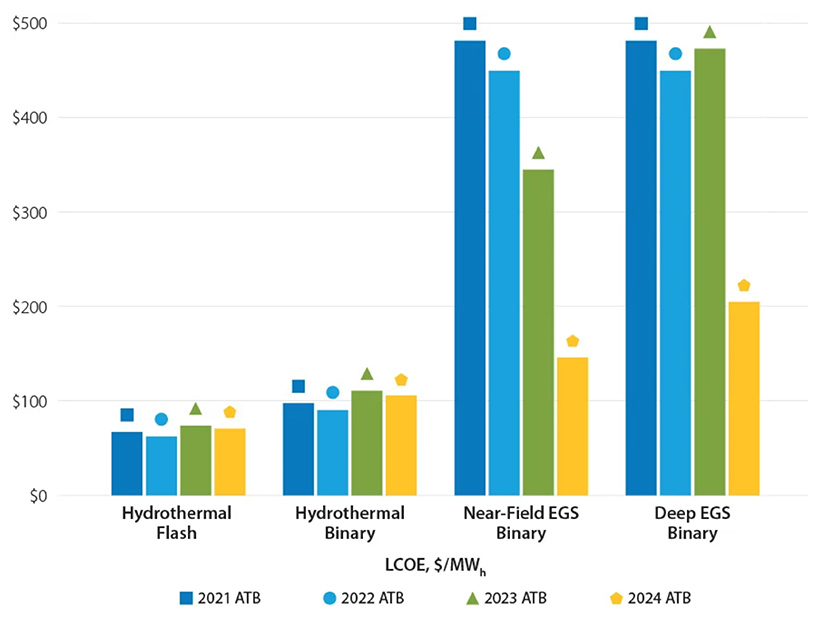
Over the same time frame, the levelized cost of electricity (LCOE) for conventional geothermal technology held relatively steady at $63 to $74/MWh for flash plants and $90 to $110/MWh for binary plants. With reported geothermal power purchase agreements running in the $70-to-$99/MWh range, the authors say, these LCOEs are considered investable for a firm, high-capacity factor source of electricity.
While the LCOE for enhanced geothermal systems (EGS) remained significantly higher — as much as $200/MWh in 2024, depending on technology — it was close to $500/MWh just three years earlier.
Recent advances could lower the cost of EGS to the level of conventional geothermal technology by the mid-2030s, the authors write.
The details come in the “2025 U.S. Geothermal Market Report,” issued in January by the former National Renewable Energy Laboratory (NREL) and nonprofit advocacy group Geothermal Rising.
The levelized cost of electricity from enhanced geothermal systems decreased sharply from 2021 to 2024. | National Laboratory of the Rockies
The Trump administration recently renamed NREL the National Laboratory of the Rockies, an indication and reflection of its energy priorities. However, geothermal energy is among the few components of the renewable energy sector in favor with the current administration amid its push for more oil, gas and coal combustion.
Recent advances in oil and gas extraction techniques have brought down drilling costs in that sector. While geothermal drilling remains more expensive than oil and gas drilling, its costs have declined as well, which is important — drilling accounts for 29 to 57% of the total cost of developing a geothermal field, according to the report, which is an expansion of a 2021 NREL report.
However great its potential, geothermal was a minimally used resource in 2024, accounting for only 15,407 of the 4,308,634 GWh of electricity generated nationwide in all utility-scale sectors, according to the U.S. Energy Information Administration.
The 8% increase in U.S. geothermal generation from 2020 to 2024 was higher than the 7.4% increase for all types of utility-scale generation over the same period.
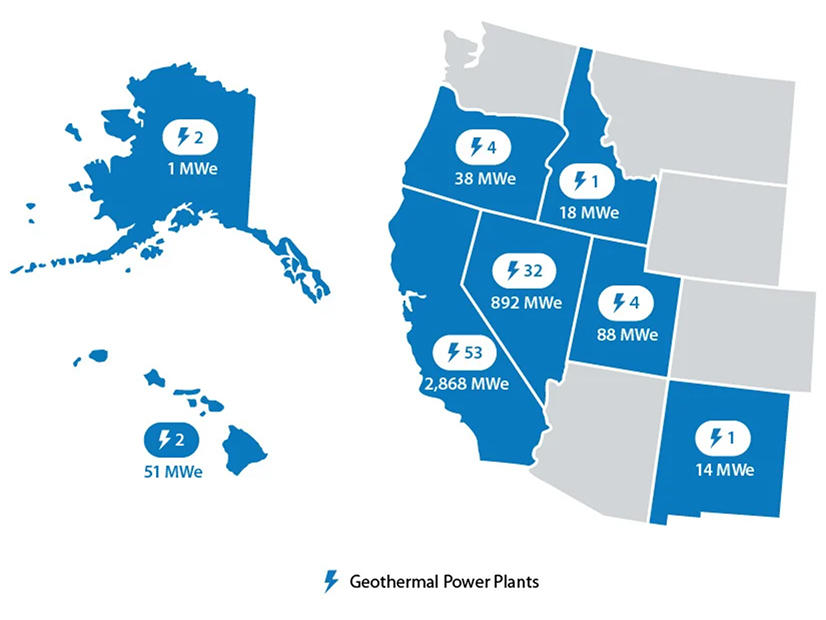
U.S. geothermal power generation is concentrated in the Southwest. | National Laboratory of the Rockies
Geothermal nonetheless remained one of the least used technologies — wood and other biomass fuels were burned to make three times as many watts as geothermal generated in 2024.
But the report makes an optimistic case for the potential of the earth’s heat to generate more electricity and to heat or cool more structures in the United States.
It indicates the number of geothermal projects in development increased from 54 in 2020 to 64 in 2024 as research improved replicable EGS processes with substantial decreases in drilling time.
As of late 2025, 29 states had enacted geothermal incentive policies, 17 of which encourage geothermal electricity production.
The authors further present geothermal as a component of U.S. energy security and independence: a potential power plant for data centers, a potential option for hybridization with thermal storage and a potential source of critical materials from the extracted underground brine.
A recent analysis by the laboratory estimated 27 to 57 TW of EGS potential at a depth of 0.62 to 4.3 miles across the continental U.S. Approximately 4.4 TW of that is in areas under federal management, but only about 1% of it would be considered economically developable.
California and Nevada remained the center of the U.S. geothermal sector as of 2024, the sites respectively of 53 and 32 of the nation’s 99 facilities.
Analysts with the Public Service Commission of Wisconsin said ratepayers are at risk of subsidizing data centers if We Energies’ proposed rate framework for data centers is given the go-ahead as proposed.
We Energies in late 2025 proposed a framework for customers requiring 500 MW or more to subscribe to dedicated resources, poised to be mostly natural gas at this point.
The utility proposed two types of electricity subscriptions for very large customers: The first would allow data centers to take all of a resource’s output provided they cover all costs associated with the resource; the second would allow data centers to count a resource toward their capacity needs. In the second case, data centers would foot the bill on 75% of the specified resource’s fixed costs; other customers would cover the remaining 25% plus all fuel costs. We Energies theorized that MISO market revenues would be enough to offset the expenses allocated to other customers (6630-TE-113).
Data centers that enroll would be bound to an initial, minimum 10-year contract, renewed thereafter in one-year increments. The rate styles contain early termination provisions where data centers could be billed for unrecovered capital costs if the resources don’t find other customers.
Staff with the commission flagged consumer protection weak spots in We Energies’ filing in late January. They said without stronger protection, utility customers could financially support data centers’ grid needs. They said the 75/25 allocation and 10-year contract term were cause for concern.
Andrew Field, a utility auditor with the commission, said We Energies didn’t capture the full range of market price volatility in its assumption that its other customers wouldn’t underwrite data centers. In testimony, he said We Energies didn’t “provide much detail supporting the specific future scenarios, or potential alternatives, upon which the provided analyses are based.”
Field said We Energies’ own analyses show the potential for costs to exceed benefits for the general rate base.
Even with the hopeful scenarios in its analyses, Field said We Energies found a net benefit for non-participating customers in only 67% of cases that include We Energies’ pending Foundry Ridge turbine project and 81% of the cases that include its planned Red Oak Ridge turbine project.
Tyler Meulemans, a utility financial analyst with the PSC, said he harbors concerns with the 10-year term, including a data center’s “ramp-up period,” when projected load isn’t fully realized. He said including the ramp-up period raises concerns over whether the agreement length is “sufficient to cover the costs incurred to provide service” of a massive data center.
Meulemans said when PSC staff requested a demonstration of revenue recovery would look like during a ramp-up period, We Energies’ analysis showed that a 10-year term “would not cover all costs.”
Two data center projects in We Energies’ territory — Microsoft’s AI data center campus in Mount Pleasant, Wis., and the Vantage/Oracle/OpenAI facility in Port Washington, Wis. — are to double We Energies’ load by 2030. We Energies’ investor presentations show the utility is prepared to spend $19.3 billion on new generation through 2029. The increase of more than $6 billion is due to increasing data center demand.
The Citizens Utility Board of Wisconsin and Power Forward Wisconsin, the latter of which is composed of clean energy groups, oppose the 75/25 allocation and have called on the PSC to make sure data centers pay for all the costs they cause.
Sierra Club’s Jeremy Fisher was critical of the utilities’ proposed rates and said they relied on assumptions that are too rosy.
Fisher said the rate structures “appear to have been negotiated and designed with the company’s new data center customers, Microsoft and Vantage/Oracle,” and rely on the assumptions that immense data centers will become profitable and future customers would have massive electricity needs and the means to finance them.
Fisher asked what happens if the AI boom fizzles.
We Energies “may look at these customers as an enormous opportunity to increase its rate base and expand operations, but the purpose of the tariffs must not only be to provide for reasonable allocation under optimistic conditions but ensure that incumbent ratepayers are protected under adverse scenarios,” Fisher said in testimony to the PSC.
Fisher also said the rates would lead to an “inconsistent and balkanized planning process that should be deeply concerning to regulators in assessing actual resource requirements.”
Richard Stasik, vice president of regulatory affairs of We Energies’ parent company, said PSC staff and interest groups ignored We Energies’ statutory obligation to serve all customers. He said the Sierra Club didn’t quantify risks wrought by data centers and didn’t acknowledge that the situation would be riskier without a dedicated rate schedule.
Stasik said We Energies existing customers would pay at least $1.5 billion in additional capital investments if large customers were to take service under the utility’s existing rate designs.
ACEG said the reforms are starting to improve outcomes in several regions, but rising demand from data centers, manufacturing and electrification are increasing the cost of delay, especially where planning processes remain incremental or reactive.
“Progress is real, but it’s uneven — and demand growth means delay now carries real costs for customers,” ACEG Executive Director Christina Hayes said in a statement. “Where regions have embraced proactive, long-term planning, we’re seeing better results. Where planning remains fragmented, reliability risks and costs increasingly show up in household electricity bills.”
Grades assess performance at the regional level and do not assign responsibility to single institutions, instead reflecting the collective actions of utilities, regional planning organizations, states and other stakeholders. To earn top grades, regions must adopt proactive, long-term, scenario-based planning that evaluates multiple system benefits, integrates regional and interregional needs, and delivers transmission at the pace required to meet rising demand.
CAISO, MISO and SPP continue to show the benefits of proactive, long-term regional planning. SPP’s Coordinated Planning Process, once approved by FERC, would be an important reform that merges transmission planning and generator interconnection planning, the report said.
ISO-NE, NYISO and PJM have shown meaningful improvement due to FERC Order 1920 compliance filings and greater engagement with states.
ERCOT got a C, with the report highlighting the Permian Basin Reliability plan to electrify oil and gas drilling and data centers, which was released in July 2024 with options for 345-Kv and a 765-Kv portfolio. The Texas PUC picked the 765-Kv option in April 2025. While Texas has seen plenty of transmission planned, the report noted it still is done in a “siloed” style, which kept it from a higher grade.
Many regions — including all the non-RTO regions — “continue to face significant gaps in both regional and interregional planning frameworks,” the report said, “In these regions, transmission development often occurs through individual utility investments or ad hoc coordination rather than durable, region-scale planning processes, limiting the ability to fully capture systemwide benefits.”
The West, which is split into three regions, is meeting under the Western Transmission Expansion Coalition (WestTEC), a voluntary interregional planning process that the report called “one of the best interregional transmission planning practices in the country.”
The first report card from ACEG came out in 2023 and ranked the regions before Order 1920 was issued, while the second one from 2024 did not change the grades and checked in after that order. Now, the report takes the requirements from Order 1920 and adds a new focus on interregional transmission.
Load growth forecasts have changed significantly since the last report, with Grid Strategies’ summary of nationwide, five-year peak load forecasts going from 24 GW three years ago to 150 GW in its most recent update. Load growth is affecting transmission development, with FERC saying it was the main driver for 1,000 miles of new facilities in 2024.
“While today’s load growth can tempt a crisis‑response mindset focused solely on short‑term fixes, the industry must move beyond ad hoc solutions and embrace long‑term regional and interregional planning,” the report said. “Proactive, holistic long‑term planning that also accommodates near‑term needs has proven to deliver the lowest costs to consumers. It captures economies of scale that ‘just‑in‑time’ projects miss and enables high‑capacity upgrades to come online ahead of demand.”
The report looked at interregional planning and gave the country an overall “C-minus” that reflects continued reliance on voluntary coordination rather than a formal requirement for regions to implement interregional planning best practices capable of finding the highest value projects.
“The takeaway is not that nothing is working,” Hayes said. “Transmission planning works when it’s proactive, coordinated and long term. The challenge now is scaling those successes fast enough — across and between regions — to keep electricity affordable and reliable for all Americans as demand continues to grow.”
Dominion Energy’s $11.2 billion Coastal Virginia Offshore Wind project off Virginia Beach’s coast reached a major milestone on Jan. 21 with the installation of the first turbine.
The tower was installed less than a week after the utility won a preliminary injunction in federal court, allowing it to resume construction on the project.
TerraForm Power, an affiliate of Brookfield Asset Management, announced the acquisition of a 1.56-GW solar project in Illinois from its original developer, Hexagon Energy.
The Steward Creek Solar project recently sealed a 600-MW interconnection agreement between TerraForm, Commonwealth Edison and PJM.