Search
February 24, 2026

PJM Stakeholders Begin Discussions on Reliability Backstop Design

PJM and stakeholders laid out their initial thoughts on the structure of the in-development reliability backstop procurement as the RTO looks to meet a September target set out by the White House and all 13 member states’ governors.

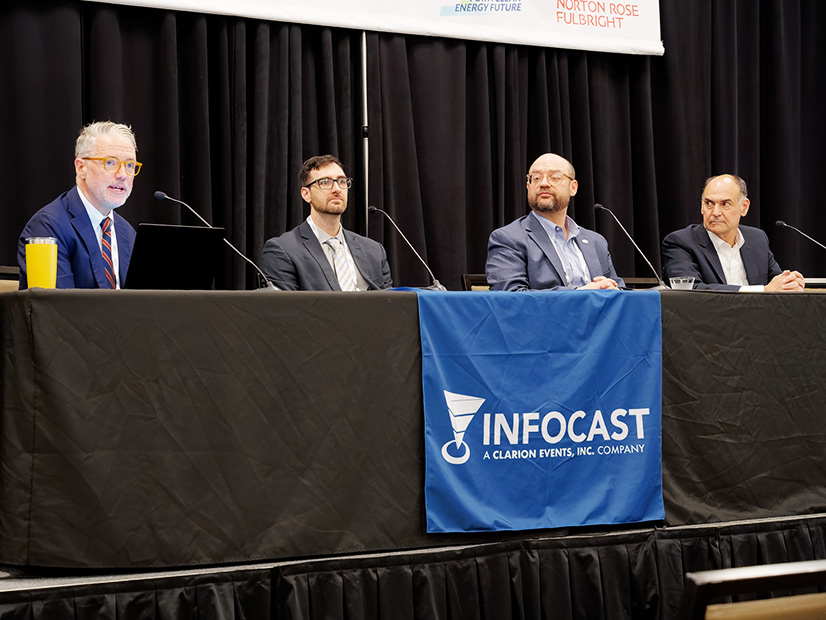
During the Feb. 19 Members Committee meeting, PJM Board of Managers Chair David Mills, who is serving as interim CEO, said the board met at the White House with the National Energy Dominance Council (NEDC) to discuss the backstop. He said the council was adamant that the backstop be a one-time measure to secure the stability of the market and allow PJM to return to meeting its needs using market structures as quickly as possible. He added that the request to return to market forces was not specific to the existing Reliability Pricing Model design.

Mills said the council said the backstop should be designed to procure PJM’s capacity needs, rather than the needs of specific customers. The quantity PJM aims to purchase should be limited by the ability to bring new supply online, not the appetite for supply. Mills said council members mentioned a figure of about 12 GW during the meeting, which he took as indicative rather than a specific target to reach. He said there was clarity that existing generation should not be able to bid into the backstop.

Senior Vice President of Market Services Adam Keech said the eligibility of repowered deactivated resources will have to be considered further.

Design Workshops

While PJM is still in the process of drafting a proposal, Charles River Associates presented several designs during a Feb. 18 workshop. The firm was hired by PJM to share its expertise managing competitive procurements in other regions. Several stakeholders presented initial thoughts on how the backstop could be designed in a separate Feb. 17 workshop meeting.

The early sticking points emerging include what resources should be eligible, how much capacity should be procured and whether PJM should act as a “matchmaker” helping pair data centers with new resources or procure multiyear commitments for the expected capacity shortfall.

During the Feb. 18 workshop, PJM Senior Director of Market Design and Economics Rebecca Carroll said staff are firm on using a one-time design but are considering splitting it into two stages: one focused on shovel-ready projects already at some stage in PJM’s interconnection queue, the other a window for greenfield projects PJM doesn’t already have an “eye on” through existing planning processes. While they could be run concurrently, the second window is expected to take longer because of the additional design and engineering needed; possible time frames she mentioned are four to six months for existing projects and nine to 12 months for new submissions. She presented a working paper describing the broad strokes of how a backstop could function.

Stakeholders said having multiple backstop windows open at the same time PJM is administering capacity auctions could create opportunities for gaming. Carroll said the RTO is not considering changing the auction schedule but that it’s something for stakeholders to think about during future workshops.

PJM’s “strong preference” is for there to be demand-side participation around the amount the backstop should procure, Carroll said, adding that the RTO is not in the best position to define that quantity if the procurement does not have a bilateral approach.

“We’re trying to get to the people who have more certainty about what this load forecasting is supposed to be,” she said.

Keech said one roadblock to a bilateral design, in which PJM is a matchmaker between data centers and capacity developers, is most new resources will take five or more years to build, while projects on the demand side are much faster to construct. That difference in development timelines could make it difficult to identify a single customer for a bilateral arrangement.

PJM Senior Counsel Chen Lu said PJM plans to ask FERC for a waiver to substitute the one-time procurement for the existing backstop.

Generation Coalition Proposal

A joint proposal from independent power producers Constellation Energy, Vistra, Alpha Generation and Earthrise would trigger a reliability backstop auction (RBA) offering multiyear commitments up to 15 years.

It would be triggered when a Base Residual Auction (BRA) clears below 98% of the reliability requirement. The proposal would extend the price collar on the BRA, limiting the maximum price to about $420/MW-day.

Offers would receive the same clearing price as the BRA and would be selected with priority for shorter commitment periods and earlier commercial operation dates. The backstop would award enough commitments to meet the reliability requirement. New and reactivated resources would be eligible to submit offers, as well as generation not committed in the BRA because their offers exceed the maximum price, projects to uprate existing resources and demand response resources taking multiyear commitments.

Constellation’s Erik Heinle said a uniform clearing price between the RBA and BRA would avoid undervaluing existing resources, which could see a retirement signal if they receive a lower price than new resources. Pairing a multiyear commitment with the $420/MW-day clearing price cap would provide the incentive needed for new resources without creating price shock for consumers, he argued.

The RBA is designed to be a one-time measure to procure enough capacity for the 2028/29 auction, with the expectation that development will catch up with supply in future auctions, Heinle said.

E-Cubed Policy Associates President Paul Sotkiewicz said efforts to incorporate affordability into the backstop design are misguided and intertwine state retail issues with wholesale market design. Affordability for consumers is not in any of the FERC orders laying out the scope and responsibilities of RTOs.

“This is a state matter; we have no business addressing this,” he said.

Consumer Advocate Priorities

The consumer advocates of Pennsylvania, Delaware and Maryland presented their priorities for a backstop procurement, which center around new resources being paired with data center load.

Data centers or load-serving entities supplying them would submit buy offers by eligible new resources for terms between 10 and 20 years. New resources could include reactivated resources and uprates, but units in the process of deactivating or fuel switching would not qualify.

The backstop would be an alternative for data centers who do not bring their own generation or agree to curtailment under PJM’s proposed connect-and-manage process. Without participation in one of the three pathways, data centers would not be able to come online starting in June 2028.

Monitor Proposal

The Independent Market Monitor presented a proposal that would require data centers above 5 MW to purchase capacity through a backstop auction in which they are paired with new generation to serve their load, including the reserve margin.

While PJM would coordinate the auction, the data centers and generation owners would be counterparties to the bilateral contracts arranged by the auction. Data centers could avoid having to participate in the auction by bringing their own generation; the connect-and-manage approach would not be implemented under the Monitor’s proposal.

Monitor Joe Bowring said proposals in which PJM would be the counterparty to the capacity sellers in a backstop design would shift risk to the rest of the RTO’s load if the data centers fail to come online or use less than the forecast capacity.

“PJM should not be the counterparty of these deals and should not impose the risk of these deals to all other members,” he said.

Bowring also argued that electric distribution companies and LSEs should not be counterparties to capacity sellers for similar reasons. If the data centers fail to come online, the costs would be imposed on the other customers of the EDCs/LSEs who had nothing to do with the costs of the capacity.

Bowring said both points are fully consistent with one of the key principles advanced by the NEDC and the governors of PJM states: The costs resulting from the addition of data center load should be paid by the data centers themselves. Bowring asserted that the Monitor’s proposal is the only one that fully implements that principle.

The relatively low 5-MW threshold for being subject to the backstop is intended to prevent data centers from splitting their load into several smaller customers, Bowring said. Large loads other than data centers would not be subject to the proposal, and PJM would be able to act against data centers believed to be breaking large sites into increments smaller than 5 MW.

Several stakeholders argued the proposal would unduly discriminate against one class of consumers by focusing on the type of customer the load is for, rather than characteristics such as size.

Bowring said there has not been a large influx of other categories of large loads, leaving data centers as the drivers of the imbalance between supply and demand. He acknowledged it would be discriminatory to focus on data centers, but if they are the cause of the issue stakeholders are focused on, it should be considered due discrimination.

“For better or worse, data centers are the cause of the problem,” he said. The Monitor has documented the impacts of data centers on PJM markets and found data centers have added $23 billion to the costs of capacity over the past three BRAs.

Amazon Proposal

A proposal from Amazon Web Services, Talen Energy and Competitive Power Ventures would create a pay-as-bid procurement in which participants would submit offers to supply capacity to PJM for 15-year terms to meet the shortfall in the 2028/29 BRA plus the expected amount the RTO expects to be short in the subsequent auction.

Bid selection would be based on when the project could enter service and the price, weighted 75% in favor of the former. The bid price would be capped at 25% above the RTO-wide net cost of new entry, though higher offers would be allowed with Monitor evaluation while the bidding window is open.

PJM would conduct expedited network impact studies for submitted projects, and the price and construction time for transmission upgrades identified would be accounted for in the bid evaluation.

Projects that do not come into service by their commercial operation date would forgo capacity payments for that delivery year and face penalties if the cause was within the developer’s control. The resources would be subject to Capacity Performance penalties if they did not meet their obligations during emergency conditions, although the penalty rate would be based on the bid price they were awarded rather than the BRA clearing price.

The procurement costs would be allocated to the relevant LSE for large loads, leaving it up to state regulators to determine how they are accounted for in consumer rates.

PJM Consults MC on Price Collar Extension, Expedited Interconnection Track

PJM consulted with the Members Committee on two proposals to revise its tariff to extend the collar on capacity prices for two more years and implement an expedited interconnection track for large projects to bring new capacity online quickly.

The price collar extension would apply to the 2028/29 and 2029/30 Base Residual Auctions (BRAs), a change PJM’s Board of Managers asked stakeholders to comment on at the conclusion of the Critical Issue Fast Path (CIFP) process in 2025. Board chair and interim CEO David Mills noted the extension also was requested in a letter from the National Energy Dominance Council and governors of all 13 PJM member states, though he said the letter was not determinative in the board’s decision to proceed with the changes. (See PJM Board of Managers Selects CIFP Proposal to Address Large Load Growth.)

Stakeholders were divided on the announcement. Generation owners pointed to PJM’s statements that the price collar was a one-time measure to allow supply to catch up to ballooning demand. State officials said it supports the discussions around implementing a reliability backstop auction to procure resources outside the capacity market.

Mills said the market conditions that originally led PJM to implement the collar still are present.

The expedited interconnection track (EIT) proposal would allow 10 projects with at least 250 MW of unforced capacity to undergo a 10-month study process. It would require readiness deposits of $15,000/MW and $500,000 study deposits from the developer and notice from the state’s primary siting authority indicating support for the project timeline. The EIT was one of several changes the Board of Managers approved through the CIFP process.

The 250-MW threshold has been a core point of contention between stakeholders, with some arguing it should be lower to allow a wider range of projects to qualify, especially if large resources take longer to complete. PJM lowered the threshold from 500 MW during the CIFP process based on those comments. (See “PJM Proposal,” PJM Stakeholders to Vote on Large Load CIFP Proposals.)

PJM’s Jason Shoemaker said if the same network upgrades are identified for projects in the general interconnection queue and EIT, the costs would be assigned to the EIT on the grounds there are stricter timelines for that resource coming online. Shoemaker said the intention is to avoid having costs split between two processes and neither proceeding with their end.

Once an application is submitted, no changes would be permitted to site control or characteristics such as fuel type or output.

Shoemaker said if there were fewer than 10 projects submitted in a delivery year, PJM would not revise the eligibility requirements, adding that the EIT is designed to have a large impact on system reliability while minimizing disruption to the interconnection queue. In response to stakeholders saying the entry requirements could prove so onerous that there will be no applications, Shoemaker said if a project is going to be allowed to jump the rest of the queue, the requirements to do so should be steep.

Mills said stakeholders should not assume a one-size-fits-all approach will be taken for how states will signal their support for the timeline on project siting and permitting. He said there will be a full range of responses across the 13 states within the RTO, with some states supportive of projects while others may seek to limit or prohibit data centers.

Police, FBI Seeking Motive in Nevada Grid Attack

The New York native who drove a car into a Los Angeles Department of Water and Power substation in Nevada left an array of data points, but no clear ideological motivation behind his action has emerged, law enforcement officials said.

Police found 23-year-old Dawson Maloney of Albany, N.Y., inside the fence of the Boulder City substation Feb. 19, following reports from a 911 caller of a car accident and gunshot, Sheriff Kevin McMahill of the Las Vegas Metropolitan Police said in a news conference Feb. 20. Maloney was holding a shotgun and died of “an apparent self-inflicted gunshot wound,” McMahill continued. He also was wearing body armor.

Surveillance video from the substation showed Maloney’s car, a Nissan Sentra bearing New York plates that he had rented in Albany on Feb. 12, driving through the facility’s fence. When officers found the car, it was stopped against several spools of industrial wire. Other weapons were found inside the car, including firearms and objects that McMahill described as homemade flamethrowers, but officers “cleared the vehicle for secondary threats.”

Tim Shea, chief of the Boulder City Police Department, said there was “no indication of major damage to any of the critical infrastructure” at the facility, and no known interruptions to service as a result of the incident. The substation connects generation facilities at Hoover Dam with Los Angeles.

Photo of Dawson Maloney released by investigators | Las Vegas Metropolitan Police

The FBI’s offices in Las Vegas and New York are assisting the Boulder and Las Vegas police departments with the case, which is being treated as an act of terrorism, Christopher Delzotto with the FBI Las Vegas office said. Agents in New York, working with local law enforcement, executed search warrants at two homes in Albany. They recovered electronic equipment, which is being analyzed by law enforcement, along with gun components and a 3D printer.

The motivations of the attacker have been difficult to determine, McMahill said, although he apparently made statements to his mother before the incident about being seen “on the news” and calling himself “a dead terrorist.”

In a hotel room rented by Maloney, Boulder police found several documents. These included pamphlets from the U.S. military on survival behind enemy lines and improvised weapons, along with books on magic from the 17th century and novels by right-wing extremist Mike Mahoney promoting anti-government terrorism and white supremacy.

Asked if police had uncovered anything in Maloney’s background to indicate why he would attempt such an attack, McMahill said investigators are sifting through “all the computers, all the documents [and] this smorgasbord of radical literature.”

Range of Ideologies in Grid Incidents

“This is something that we have seen in the last couple of years, that individuals will take very left-wing ideology, very right-wing ideology, combine it with [the] occult and a number of different types of things, and then they come up with their own ideology,” McMahill said.

He compared Maloney’s attack to a 2023 incident, in which Mohammed Mesmarian, a dentist from Colorado, rammed his car through a fence at Invenergy’s Dry Lake Solar Plant northeast of Las Vegas, also called the Mega Solar Array. According to police, Mesmarian set the car on fire, then managed to get it moving and watched it drive into a pit beneath the plant’s main transformer. Mesmarian left while the car was burning, having been in the facility for about nine hours with no employees present. (See Suspect in Vegas Solar Array Damage: Act was Protest Against Old Tech.)

At the time of his arrest, Mesmarian claimed he committed the vandalism as an act of protest against polluting technology, but he seemed confused about the facility’s function, referring to the transformer as a “computer” and claiming the plant was built or run by Tesla, among other inaccuracies. He later pleaded guilty but mentally ill to charges of felony arson and property destruction, citing the loss of his marriage and business as sources of mental stress, and was sentenced to two to 10 years in prison along with more than $200,000 in restitution.

The electric grid continues to be a tempting target for politically motivated vandals, with multiple completed or planned attacks in recent years. Far-right ideology has been a common thread in many incidents, including a plot by neo-Nazi leader Brandon Russell to destroy electric substations in Baltimore in hopes of sparking a civil war in 2023. (See Neo-Nazi Convicted in Baltimore Grid Attack Conspiracy.) Skyler Philippi of Tennessee was arrested in 2024 for attempting to use bomb-laden drones to destroy a facility near Nashville; he pleaded guilty the following year.

Attacks also might be motivated by foreign policy, as with the 2022 bombings of transformers in San Jose owned by Pacific Gas and Electric by computer engineer Peter Karasev. Prosecutors said Karasev, who was sentenced in December 2025 to 10 years in federal prison, was upset by the ongoing conflict between Ukraine and Russia; he has family connections to both countries.

FERC Approves Blackstone’s $11.5B Acquisition of PNM

FERC has approved Blackstone Infrastructure’s proposed $11.5 billion acquisition of TXNM Energy, the parent company of Public Service Company of New Mexico (PNM), rejecting concerns the deal could lead to adverse impacts on competition and rates.

FERC reviewed the deal under the commission’s merger policy, finding the transaction consistent with public interest, according to a Feb. 20 order. (EC25-140).

The acquisition has received approval from the Public Utility Commission of Texas and TXNM Energy shareholders. It still requires support from the Nuclear Regulatory Commission and the New Mexico Public Regulation Commission (PRC).

“The approval of the acquisition by … FERC is an important milestone in the overall regulatory review process and is a great step towards bringing unprecedented benefits to our customers,” PNM spokesperson Eric Chavez told RTO Insider in an email. “The order states that FERC finds the transaction consistent with the public interest, that state and federal regulation will not be impaired and that there will be no adverse impact on rates. We will continue working transparently with regulators, stakeholders and customers as the review continues. Our focus remains on delivering safe, reliable and affordable service to the communities we serve.”

Under the merger, PNM and TXNM Energy would be acquired by Blackstone Infrastructure subsidiary Troy ParentCo. FERC authorized the deal after analyzing its effects on competition, rates and regulations, according to the order.

“Based on applicants’ representations, we find that the proposed transaction will not have an adverse effect on vertical competition,” the commission wrote. “Applicants have demonstrated that the entities involved … do not provide inputs to electricity products or to electricity products in the same market.”

In filings with FERC, the Center for Biological Diversity raised concerns about the deal’s potential adverse impacts on competition and rates in New Mexico. For example, the environmental organization noted that PNM could end up serving Blackstone-owned data centers and other large customers.

Similarly, the center argued Blackstone owns stakes in power producers in New Mexico that could become suppliers of energy to PNM, according to the order.

FERC, however, wrote “these arguments are outside the scope of the commission’s vertical competition analysis.”

“[I]n evaluating vertical market power concerns the commission considers the combination of upstream inputs with downstream capacity and transmission,” the order states. “Ownership by applicants of load sources, whether large or otherwise, does not constitute an input under this analysis.”

TXNM Energy and Blackstone Infrastructure announced the proposed acquisition in May 2025. In addition to PNM, TXNM owns Texas New Mexico Power, a transmission and distribution utility in Texas that serves about 280,000 customers. (See PNM Seeks Approval for Blackstone Acquisition.)

Under terms of the $11.5 billion deal, Blackstone would pay $61.25 per share in cash upon closing. The purchase would be funded through equity and assumption of existing debt.

The benefit package includes a $105 million acquisition rate credit, which would be the largest in state history, according to PNM’s filing with the New Mexico PRC. The credit would be paid to PNM customers over four years and would reduce the average residential customer bill by 3.5%.

PNM serves nearly 550,000 customers in New Mexico, making it the state’s largest electricity provider.

The filing includes a $25 million commitment to speed progress toward the state’s energy transition goals, including funding for new technologies.

The FERC filing states the acquisition would not raise rates charged to either wholesale power sales or transmission service customers.

In its Feb. 20 order, FERC said it found no evidence the deal would adversely affect rates, despite the center’s fear that ratepayers could bear the cost for Blackstone’s proposed $2 billion premium paid to TXNM shareholders.

“We accept applicants’ commitment to hold customers harmless from costs related to the proposed transaction,” the order states. That commitment applies to costs prior to the transaction and in “the five years after the proposed transaction’s consummation.”

Consumer advocacy group Public Citizen joined the Center for Biological Diversity in intervening in the docket.

Tyson Slocum, director of the organization’s energy program, said in a statement to RTO Insider that “FERC takes an absurdly narrow review of whether an acquisition of a franchised utility with hundreds of thousands of captive customers is consistent with the public interest.”

“FERC’s review is largely developed from 2005 and fails to include more recent issues, including the impacts of allowing private equity to control public utilities,” Slocum added. “Luckily, the state of New Mexico is taking a far more responsible approach.”

The PRC has yet to approve the deal, which has garnered “strong community interest.” The commission has held several public hearings to gather feedback on the proposed sale, according to its website.

Oregon’s Offshore Wind Road Map Acknowledges Uncertainty

Oregon has released a draft road map to provide state lawmakers with recommendations on how to proceed with offshore wind endeavors, while acknowledging the uncertainty the industry faces.

The Oregon Department of Land Conservation and Development (DLCD) released the draft offshore wind energy road map for public review Feb. 17.

The document is the product of 2024 Oregon House Bill 4080. The 192-page report comes amid policy uncertainty, with the federal government attempting to stop offshore wind projects across the country. (See N.Y. Cancels Solicitation but Remains Committed to OSW.)

“Since the adoption of House Bill 4080, uncertainties about federal policy and the future of the offshore wind energy industry have grown,” the document states. “Nevertheless, the need remains to advance state clean energy and climate goals, to strengthen state policies, and to build capacity and knowledge should the federal interest in offshore wind energy development off Oregon’s coast return.”

The report considers four scenarios: large-scale offshore wind development, pilot projects, economic participation without wind turbines or opting out of wind development.

Under the large-scale offshore wind development and pilot project scenarios, the DLCD recommends launching rulemaking efforts to address policy gaps related to offshore wind technology.

Policymakers should encourage investments and reduce risks for emerging technologies, collaborate with other states, support local governments, and enhance coordination in areas like transmission and procurement, among other recommendations, according to the road map.

“By leading with proactive planning, broad community engagement and strategic capacity-building now, Oregon can better position itself to protect its treasured resources, secure meaningful community benefits and be ready to make informed decisions when the time comes to decide on offshore wind energy development,” the DLCD wrote. “Under any future scenario, Oregon can act now to strengthen its policy standards, grow the state’s knowledge of the ocean and build a resilient energy system that moves Oregon closer to our climate goals and prepares us for the multiple paths ahead.”

The deadline to submit comments on the road map is April 3. The public can send comments to dlcd.oswroadmap@dlcd.oregon.gov.

Solar and Wind Dominate California’s Energy Future, CEC Model Shows

Solar and wind resources could generate up to 85% of California’s electricity by 2045, according to a report being drafted by the state’s Energy Commission.

CEC staff presented the findings at a Feb. 19 workshop on SB 100, the law requiring that renewable and zero-carbon resources supply 100% of retail sales and electricity procured in California by 2045.

The findings are part of a joint agency draft report on SB 100 that has not been published. The commission expects to publish the report in April, Senior Information Officer Stacey Shepard told NetZero Insider.

At the workshop, CEC staff presented a reference scenario in which the total system capacity increases from 150 GW in 2025 to 310 GW in 2045, with most of the new resources coming from solar (97 GW), energy storage (45 GW) and wind (24 GW in-state, 27 GW out of state).

“However, all scenarios do have a need for some other sort of resources in addition to solar and storage,” Hannah Craig, lead modeler for the CEC, said at the workshop. “Some scenarios are building carbon capture and storage, and some scenarios are building geothermal, and a lot of scenarios are building in-state wind.”

Natural gas could provide as little as 3% of the state’s energy, according to the presentation.

The federal One Big Beautiful Bill Act increased the cost of the modeled resources by 20 to 30%, Craig said. Staff observed that the model selected more clean, firm resources, such as geothermal and carbon capture and storage, moving “a little bit away from wind and solar [because] those resources are no longer receiving” subsidies under the Inflation Reduction Act, Craig said.

Solar curtailment would no longer be limited to spring in California, according to the model. Instead, curtailment increases throughout the year because of the widespread deployment of solar resources, along with changing import patterns, Craig said. “So out-of-state imports are dropping in the spring and summer, but they’re rising in winter, and the model really does depend a lot on those imports being able to show up in winter.”

California also becomes a net electricity exporter in the model, Craig added.

One potential hole in the model is that it does not currently include forecasted data center loads, and data center growth is one of the biggest uncertainties for California’s grid, CEC Vice Chair Siva Gunda said at the workshop.

Data center load in the state could reach 25 GW by 2045 under some scenarios, Gunda said. However, the demand scenarios used for the SB 100 report use the 2023 integrated energy policy report demand forecast, which doesn’t include this level of new data center load, CEC staff said.

CPUC President Alice Reynolds asked if the upcoming expansion of Western markets would affect the model’s resource mix.

“The more that we can integrate California with the West, the more that we can tap into synergies,” Craig replied. “It’s just a little bit easier for the model because there’s different renewable profiles happening all across the West. There is a lot of value in being able to ship that power and meet some of your winter needs with out-of-state wind.”

The Co-location Quandary: The Cybersecurity Risk to Nuclear

By Shahid Mahdi

To feed the voracious energy appetite of the AI revolution, Silicon Valley has found a massive, carbon-free battery: the American nuclear fleet.

Faced with a staggering projected increase in summer peak demand over the next decade, Big Tech is attempting to bypass congested grid interconnection queues. Its solution is co-location: physically plugging hyperscale data centers into nuclear power plants. (See Talen, Amazon Enter PPA for 1.9 GW of Power from Susquehanna.)

While FERC and state regulators fiercely debate whether these deals will shift costs onto residential ratepayers, they are ignoring a more critical question: By physically and electrically fusing our most hyper-connected digital assets (AI data centers) with our most sensitive kinetic assets (nuclear reactors), are we engineering a catastrophic vulnerability?

Put simply: If a co-located data center is hit with ransomware, does the nuclear plant have to trip offline?

Shahid Mahdi

To find the answer, we must look to the greatest cybersecurity failure in modern U.S. energy infrastructure history: the May 2021 Colonial Pipeline attack. (See Colonial Hack Sparks Competing Recommendations at FERC.)

In the energy sector, infrastructure is built on distinct layers of technology. There is the information technology (IT), which handles software and billing, and the operational technology (OT), which are the physical levers, valves and switches that control the flow of energy.

When Russian ransomware group DarkSide infiltrated Colonial Pipeline, it did not hack the OT. It never touched the pipeline’s physical controls. It attacked the IT systems, locking up administrative files containing sensitive information and demanding a $5 million ransom.

Yet the pipeline was shut down, paralyzing the Eastern Seaboard. Why? Because out of blind panic and an inability to safely segregate the IT networks from the OT networks, the operators were forced to pull the plug on the physical infrastructure to prevent the infection from spreading.

Ultimate IT and OT Assets

An AI data center is the ultimate IT asset. It is a sprawling supercomputer designed to be connected to global networks, ingesting and processing massive amounts of data from the open internet. A nuclear power plant, conversely, is the ultimate OT asset, reliant on precise, secure and isolated physical engineering.

If a state-sponsored adversary or a ransomware-as-a-service syndicate breaches the data center’s IT network, the resulting chaos will not be contained to silicon chips. If the utility operator cannot prove an “air gap” exists between the data center’s infected servers and the nuclear reactor’s operational controls, they will face the same horrific choice Colonial Pipeline did. Out of an abundance of caution, the nuclear reactor may have to be scrammed — abruptly taken offline — costing millions of dollars and draining firm baseload power from the surrounding public grid.

Currently, the regulatory apparatus is fundamentally misaligned to handle this threat. State utility commissions and federal agencies are operating in a “regulatory labyrinth,” tracking thousands of filings across a fragmented system. But their focus remains mostly financial. FERC in 2025 was directed to initiate a proceeding (Docket EL25-49-000) to consider issues related to the co-location of large loads at generation facilities, but the primary concerns remain grid reliability and cost allocation.

As Congress, FERC and NERC establish the rules of the road for AI-nuclear co-location, they must mandate “resilience by design.” Tech companies seeking direct access to nuclear power must be required by law to finance and implement military-grade network segmentation. The burden of proof must fall on the developers to demonstrate that a catastrophic digital breach of their AI servers will not mathematically or operationally necessitate the shutdown of the adjacent nuclear core.

The AI era promises immense breakthroughs, but it also transforms every server farm into a potential backdoor to our critical infrastructure. We learned the hard way that a hacked billing system can stop the flow of gas. We cannot afford to learn what a hacked algorithm might do to a nuclear reactor.

Shahid Mahdi is a director at energy regulatory intelligence company EnerKnol and an expert in cybersecurity threats to energy infrastructure.

ERCOT Promises More Details on Batch Study Process

ERCOT staff have promised more clarity on the link between the initial batch study process for large loads and the subsequent studies and existing planning structure during a workshop scheduled for Feb. 26.

Jeff Billo, the grid operator’s vice president of interconnection and grid analysis, told the Texas Public Utility Commission at its open meeting Feb. 20 that several open questions remain from the first of two previous batch study workshops and the stakeholder input gathered since (59142).

“There’s still things we need to work through … to try to address that feedback,” he said.

Chief among them is the linkage between the batch studies and ERCOT’s Regional Planning Group, the primary forum for discussion, input and comment on issues related to planning the system for reliable and efficient operation. He said stakeholders want to know how “Batch Zero,” the first study, will link directly to “actionable” transmission project approvals by the RPG.

Also at issue is how controllable load resources (CLRs) and co-located generation should be treated within the batch study.

Billo said ERCOT expects four sets of revision requests will be needed to resolve those questions and fully implement the batch process:

    • the transitional Batch Zero study, with a filing targeted for March 4;
    • the ongoing study process referred to as Batch One+;
    • co-located generation; and
    • the CLR concept.

Stakeholders have coalesced around a six-month cadence for batch studies; more proactive, structured and transparent communication; and including operation readiness and financial commitments for Batch Zero eligibility, Billo said.

ERCOT is targeting the Board of Directors’ meeting June 1-2 to receive approval for Batch Zero. It has scheduled four workshops on the filing, with the later meetings narrowing in on specific topics with deep-dive discussions.

The grid operator is also attempting to bring the co-located generation and CLR revisions to the same board meeting.

“There is just a lot of technical details to work through with those,” Billo said. “It’s possible that those don’t make it to June, but we’re at least going to start off with the anticipation that we’re going to try for that.”

He said staff will work with the Technical Advisory Committee’s leadership and schedule additional meetings to ensure protocol changes for another ancillary service, Dispatchable Reliability Reserve Service, and voltage ride-through requirements don’t fall through the cracks. ERCOT plans to bring both to the board in June.

“I think the key to being successful here is listening to stakeholders about the questions … specifically around transparency into this process,” PUC Chair Thomas Gleeson said. “I think ERCOT heard loud and clear from the commission that this needs to be a public process with a lot of input.” (See related story, Batch Study Job No. 1 for ERCOT Stakeholders.)

PUC Rejects EPE Cost Recovery for Newman

The PUC approved an administrative law judge’s proposed decision in El Paso Electric’s first fully litigated base-rate case since 1991, but not before directing revisions to 10 items in the order primarily related to cost recovery.

EPE was seeking 100% recovery of $47 million in cost overruns for Newman Unit 6, with 100% allocation to its Texas retail jurisdiction. The gas-fired unit, which serves parts of neighboring New Mexico, was brought online in 2025.

The commissioners agreed with Gleeson’s recommendation to reject the utility’s request. They added a finding that EPE’s off-system sales margins “are being used in a way that benefits both New Mexico and Texas customers.”

EPE filed the rate case in January 2025, seeking a $129 million increase in Texas-jurisdictional retail rates. The utility cited about $1.55 billion in investment in new and existing generation, transmission and distribution capacity and was attempting to set all customer class base-rate levels at the total cost of service.

The ALJ issued its decision in December.

NYISO Seeks to Avoid ‘Flip-flopping’ in Revised Planning Process

NYISO is proposing to use a set of scenarios rather than relying on a single base case in its Reliability Planning Process to avoid study-by-study fluctuations in determining reliability needs.

ISO officials detailed its proposed revisions for the first time in a marathon meeting of the Transmission Planning Advisory Subcommittee on Feb. 19.

Under the new process, NYISO would compose a base case and several alternative scenarios with stakeholder feedback. It would then determine whether reliability violations occur across the scenarios and base case. If a large magnitude violation persisted across multiple scenarios, NYISO would declare a reliability need.

Yachi Lin, NYISO director of system planning, said this would help avoid being too conservative and overbuilding the system.

Currently, NYISO relies on a single base case, which is updated annually based on what system changes the ISO observes. In recent cycles, this has led to finding and declaring needs only to retract them as the base case updated.

“We have that issue of flip-flopping based on year-over-year volatility of our assumptions,” said Ross Altman, senior manager of reliability planning for NYISO. The new process would weigh the base case against a range of “likely scenarios.”

Altman pointed to the whiplash of reliability findings for New York City. (See NYISO Cancels 2033 Reliability Need for NYC.) He said under the new system, the ISO would not declare a reliability need if a reliability violation did not “significantly persist” across multiple scenarios.

How these findings would interact with other NYISO reliability studies will be discussed at a joint meeting of the TPAS and Installed Capacity Working Group on Feb. 26.

The discussion at the Feb. 19 meeting lingered on whether stakeholders would have voting power over which scenarios would be included in the Reliability Needs Assessment.

“It looks like NYISO is developing all the scenarios without market input. Results are posted for consideration of feedback which NYISO may ignore, which may actually lead to way overbuilding the system,” said Martin Paszek, system and performance planner for Consolidated Edison. “Why not give the market a vote on what scenarios go forward?”

This question seemed to confuse Lin, who said stakeholders would be able to comment on scenarios and base case assumptions during the process. Zackary Smith, vice president of system planning for NYISO, also stepped in to reinforce that stakeholders would be involved at the start of base case development through the process.

“Ultimately this will result in the same vote that there is today in the process,” Smith said. “We document all of that in the Reliability Needs Assessment report, which goes in front of the Operating Committee and Management Committee for two separate stakeholder votes.”

Kevin Lang, representing New York City, said this missed Paszek’s point that stakeholders should have input on the scenario development process. Smith said stakeholders would be encouraged to provide feedback under the proposed process.

“The point is that we are giving NYISO all the power in this case,” Paszek said. “There is a difference between feedback and … having some real market input. There’s a huge difference.”

Another stakeholder asked whether the ISO would be able to provide calculated probabilities of the likelihood of each scenario. Lin said given the number of inputs into the calculation, this was not feasible with NYISO’s current workflow.

“We’re talking about the things that keep me up at night,” Lin said. “With large loads, for example, it’s almost impossible to say if this load is coming online with 50% likelihood or 20%. … There is very little transparency, not because NYISO isn’t trying, but because that’s just how the load centers are.”

Lin detailed how NYISO would define and consider the magnitude, urgency, severity of impact, number of scenarios and duration over the planning horizon for determining whether something constituted a reliability violation.

“It’s important to us moving ahead with any scenario planning that it is not in any way, shape or form turned into some formulaic default,” Smith said. “I want us to take a balanced approach to considering the uncertainty around demand forecasts, around generation mix, and everything else that goes into our planning.”

Dominion Reports $3B in 2025 Earnings, Progress on CVOW Despite Delay

Dominion Energy reported earnings of $567 million for the fourth quarter and $3 billion for 2025, as executives offered updates on the firm’s offshore wind project and pipeline of data centers coming onto its system.

The Coastal Virginia Offshore Wind (CVOW) project was delayed by a federal decision that has since been overturned by the courts, but its total cost increased only slightly, to $11.5 billion from $11.2 billion before the delay, the company told the Securities and Exchange Commission in January. (See Dominion Wins Injunction, Can Restart Offshore Wind Construction.)

“We’re now over 70% complete,” CEO Robert Blue said during an earnings call Feb. 23. “We continue to be on track for the delivery of first power to the grid by the end of March. That will represent a remarkable project milestone.”

The installation of monopiles went more quickly than expected, as has work around the transmission elements of CVOW, which are over 70% installed, with the rest of the equipment on-site at the Portsmouth Marine Terminal awaiting installation.

The towers are 70% manufactured, and the blades are 30% manufactured. Dominion successfully completed the first turbine in January.

“During the first few iterations, we’re deliberately moving more slowly in order to ensure we figuratively measure twice and cut once,” Blue said. “We view this as prudent construction management aligned with the lessons we’ve learned over years of large project construction.”

Once the injunction was lifted, winter weather added to another week of delays in the turbine installation process, Blue said. Workers are getting used to the process, as Dominion has seen in other parts of the project, and turbine installation should get easier and take less time as it continues.

While the project is expected to deliver its first power in the next month or so, Dominion’s schedule to finish CVOW runs through July 2027. That includes some expected downtime for weather, but delays will raise the budget by about $150 million to $200 million/quarter, some of which would be covered by Dominion’s financing partner, Blue said.

One analyst asked about the possibility of the federal government appealing the decision that allowed CVOW construction to resume. Blue argued that would not make sense given rising demand in Dominion’s territory.

“We continue to see CVOW as the fastest way to get a significant amount of electricity at a low-cost way [online] for our customers who are leading the AI race, who are building ships for the Navy,” Blue said. “And so, we continue to believe it just makes sense for this project to be allowed to continue. Slowing it down, as was demonstrated with the last stop-work order, adds costs. And adding costs and delays in the data center capital of the world — we think that doesn’t make sense.”

The pipeline of new data centers Dominion hopes to serve continued to grow slightly in the past quarter.

“We now have over 48 GW in various stages of contracting as of December 2025, which compares to around 47 GW as of September, an increase of approximately 1.4 GW, or 3%,” Blue said.

That includes 10.2 GW that have signed an electric service agreement — the highest level of commitment — and 11 GW that have signed construction letters of authorization. That leaves 27.4 GW in the least certain category, which have a “substation engineering letter of authorization,” where the utility is reimbursed for detailed engineering plans.

Load growth is already showing up on its system, with 14 out of its top 20 demand days in history having occurred in the past 14 months, the company reported.

Data centers are also at issue with Dominion’s Millstone nuclear plant in Connecticut, where it continues to look for an off-taker.

“In January, the Connecticut Department of Energy and Environmental Protection issued a zero-carbon energy request for proposals for which Millstone is eligible,” Blue said. “Bids are due in the RFP in March. The Connecticut RFP process also intends to coordinate bid evaluation in conjunction with other New England states. In addition to state-sponsored procurement, we continue to evaluate the prospect of supporting incremental data center activity.”

Any deals with data centers would “need to be pursued in a collaborative fashion with stakeholders in Connecticut,” and Dominion remains committed to achieving a constructive outcome for the nuclear plant, he added.