FERC has extended the timeline for the New England transmission owners to refund customers for excess revenues collected after the commission in March set a lower base return on equity with a 2014 effective date (EL11-66, et al.).
The deadline for completing the refunds — originally set for just 30 days after the March 19 ROE order — will now be May 20, 2027.
FERC’s 14-month refund timeline falls in between those proposed by a group of consumer advocates, state agencies and end users and jointly by ISO-NE and the TOs.
The latter sought to push the deadline to December 2027. The RTO argued that “proposed refund schedule represents the fastest timeline under which ISO-NE can calculate and administer the refunds.”
In contrast, the consumer groups argued that FERC should not allow an extension exceeding nine months.
“A limited extension of the refund deadline may be appropriate, but the wholesale 20-month extension requested by the [TOs] and ISO-NE is premature, unsubstantiated and excessive,” they wrote. They argued that ISO-NE and the TOs failed to provide evidence or detail to justify their timeline.
“Given the extraordinary nature of the financial burden endured by New England ratepayers since the commencement of these proceedings, the [TOs] and ISO-NE should make every available effort to issue refunds as soon as practicable,” the consumer groups wrote, arguing that ISO-NE transmission rates are “by far” the highest of any RTO.
They also urged ISO-NE and the TOs to refund customers “on a rolling basis” prior to the deadline, to the extent that this is possible.
TOs already are contesting the refund obligations, which they estimate to total more than $1.5 billion. Eversource Energy and Avangrid, the companies with the largest transmission footprints in the region, have asked FERC for a stay on the bulk of the refund obligations. (See New England TOs Seek Stay of ‘Astonishing’ Refund Obligations.)
On April 15, the two companies filed an emergency petition with the D.C. Circuit Court of Appeals with a similar request for a stay on the refund obligations.
“Absent a stay from this court, the order will impose immediate, irreversible financial and operational harm on the [companies] and their customers, harm that cannot be undone even if the order is later vacated,” they wrote.
“Critically, an extension of the refund deadline does not cure these harms,” they added. “Even if FERC were to grant additional time to process refunds, the [companies] would still be required to carry the full retroactive refund obligation on their balance sheets and to plan for its financing.”
PacifiCorp is on schedule to begin trading in CAISO’s Extended Day-Ahead Market on May 1, with the utility now in its final phase of market settlements and simulations testing.
Portland, Ore.-based PacifiCorp, which operates in six Western states, will be EDAM’s first participant, with PGE following Oct. 1.
The utility’s market simulations in EDAM’s parallel operations testing phase “have gone well overall, and we’ve been working through expected issues in close coordination with CAISO and our technology partners,” PacifiCorp spokesperson Omar Granados told RTO Insider.
“PacifiCorp continues to make steady progress on the systems and process changes needed to join EDAM, including routine software updates across multiple platforms,” Granados said. “A successful launch depends on tight coordination with CAISO and vendor, and we’re executing a sequenced rollout, with updates first at CAISO, then through PacifiCorp systems and outside vendors.”
Parallel operations testing has provided valuable insight into how the new imbalance reserve and reliability capacity products interact with energy supply and influence market prices, Granados said.
“While we continue to work through remaining market software items with CAISO and our vendors, the prices, awards and EDAM transfers we’re seeing are consistent with expectations and reinforce our confidence the market is operating as intended,” Granados said.
A 2024 study showed that PacifiCorp could earn up to $359 million a year in net benefits from participating in EDAM, nearly double a previous estimate. (See Updated EDAM Study Shows Doubling of PacifiCorp Benefits.) The study showed the utility could reduce its adjusted production costs by $53 million under and expanded EDAM footprint while earning an additional $120 million through EDAM congestion and transfer revenues.
Asked whether PacifiCorp thinks those estimated benefits still appear feasible based on the work the utility has been doing over the past few months to join EDAM on May 1, Granados said:
“While the study assumed a larger EDAM footprint than will be in place at go‑live, its key conclusions about the value of day‑ahead coordination remain consistent with what we’re seeing. Parallel operations show that the EDAM can efficiently schedule resources, transmission use and transfers to serve load at the lowest cost to customers. This lines up with the study’s findings on lowering electricity wholesale costs through improved scheduling.”
In January, PacifiCorp said a few challenges remained before the utility could go live in EDAM, including building and testing IT systems, and managing communication testing across numerous transmission customers and 14 neighboring utilities. (See EDAM Implementation Remains CAISO’s Focus in 2026.)
Granados told RTO Insider PacifiCorp has been addressing those challenges.
“We’ve been working closely with CAISO and our vendors to manage IT complexities and prepare for the market go-live, focusing on resolving key items and planning for future improvements,” he said. “Our transmission customers and neighboring utilities have been engaged and collaborative, and the volume of questions reflects solid progress and overall readiness.”
“We’ve also planned for unforeseen challenges by establishing tools and processes with CAISO to respond quickly and adapt as needed,” he added.
WASHINGTON — FERC Chair Laura Swett told the Energy Bar Association that she wants to push the commission’s authority as far as she can.
“I know very well from litigating where the absolute edge of precedent is on many topics in our jurisdiction, and I have an appetite to push right up to that edge, if it may secure effective results,” Swett said April 15. “But the other side of that coin is my borderline obsession — it’s not borderline; it’s a full-blown obsession. I’m obsessed with legal durability.”
Swett said her personal goal was to “be one of the most impactful chairmen in FERC history,” especially given the issues facing the regulator now.
“We are at a historic crossroads of some of the biggest issues of our lifetimes when it comes to energy,” Swett said. “And so, I recognize the great responsibility that the commission has right now, over the next few years. Everything has to be very thoughtful and very grounded in the law. I can only accomplish my personal goal if our orders stand the test of time and appeal.”
Working in a democracy means that FERC could have a very different composition in a few years with very different priorities.
“The only thing that I can do is help ensure that the orders that go out under my tenure are as tight and excellent as possible, and that means less susceptible to reversal on appeal,” Swett said. “When we leave out orders; if we don’t address arguments that are raised; if we don’t analyze the evidence, then we are vulnerable.”
Swett did not bring up any specific case regarding maximizing FERC authority, but the concept is at issue in Energy Secretary Chris Wright’s Advance Notice of Proposed Rulemaking, which directed the commission to consider assuming jurisdiction over large loads that connect to the transmission system by April 30. (See Energy Secretary Asks FERC to Assert Jurisdiction over Large Load Interconnections.)
While still fairly new to her current job, Swett has been working in and around FERC for 15 years, beginning as a law clerk at the Office of Enforcement while at Georgetown Law School, then becoming an investigator in the office and eventually an adviser to Chair Kevin McIntyre. In between stints at the agency, she worked in private practice representing all kinds of the entities the commission regulates.
“In the past 15 years, I kept a running list of observations about how FERC is run, how the industry is run and what we can all do better,” she said.
Swett is running FERC at a time when reliability is being challenged by the rapid integration of large loads, most notably — but not exclusively — data centers.
“Confronting the problem of large loads is, in my view, the most important and pressing problem in contemporary American public policy,” Swett said. “We have to ensure that these loads can connect quickly and efficiently, but at the same time, we have to ensure that the costs are allocated fairly.”
The authors of the Federal Power Act in 1935 did not anticipate artificial intelligence and the hyperscale data centers it needs, so now regulators and the industry need to evolve, she said.
“We have to use the precedent that we have and solve a problem that the law never anticipated,” Swett said. “However, the authors of the act did anticipate and understand the paramount importance of reliability.”
Reliability remains core to FERC’s mission, and it does not have to be in tension with integrating large loads, she said.
“There’s a lot of creativity that we’ve seen even in the past six months of my tenure, and stakeholders are committing to confront this problem head on, as are our partners at all levels of the government,” Swett said. “And the developers of organized markets have already proposed a number of creative solutions that FERC has approved.”
ALBANY, N.Y. — Another mass cancellation is potentially in the works for New York’s contracted renewable energy pipeline.
This one would not be as large as the infamous collapse in late 2023, which exceeded 8 GW, but would follow the same pattern: Renewable energy certificate (REC) contracts signed years ago not containing cost adjustment mechanisms and the state refusing to consider adding them after construction costs have soared.
Marguerite Wells, executive director of the advocacy and trade group Alliance for Clean Energy New York, said the projects at risk total roughly 3 GW of nameplate capacity.
Wells led a panel discussion April 15 at the New York Energy Summit focusing on the causes of this latest setback for New York renewables — inflation, tariffs and vanishing federal tax credits — rather than on the situation itself. (See related story, N.Y. Energy Summit Examines State of Renewables.)
Afterward, she told RTO Insider that while the state’s position is understandable, it does not make project economics work.
“That was the same problem that the earlier cohort, the big 90-project termination in 2023 had, because the contract is exactly fixed and flat and has no adjustability,” Wells said.
The New York State Energy Research and Development Authority (NYSERDA), which manages the REC process, had recommended in mid-2023 that the Public Service Commission (PSC) grant developers’ request for more money, but the PSC refused, triggering the mass exodus and a rush effort from NYSERDA to negotiate new contracts. (See Sweeping Reset Underway for NY Renewable Development.)
Asked for comment, NYSERDA indicated there would be no renegotiation of existing contracts in 2026, either.
“NYSERDA expects developers that have already signed contracts with New York State to honor their commitments,” a spokesperson told RTO Insider. “The competitive bidding process is designed to protect consumers and result in fair and cost-effective contracts, ensuring developers are not able to offload risk onto New York ratepayers. NYSERDA intends to continue to protect ratepayers by holding contractors to the terms they agreed to.”
But the economics of those contracts simply do not work in mid-2026, Wells said. The 3 GW is her best estimate of the capacity that could be lost as a result, a significant amount for a state far behind on its renewable energy goals.
“That is my math based on conversations with all of my members on the projects that have contracts and that are mature enough to actually go dig holes if they had a contract that held water,” she said.
The next step is unclear.
Wells does not know if NYSERDA will allow developers that cancel contracts to rebid the same projects into the upcoming 2026 large-scale renewables solicitation. It did after the 2023 exodus but did not allow it in the 2025 solicitation, she said.
Moving forward, there should be fewer of these wholesale collapses, Wells said.
“I think people across the state, no matter where they sit, are frustrated that renewables haven’t been built as fast as we all would wish,” she said.
But NYSERDA has revised its approach substantially, she added.
“Starting in the 2025 RFP, they put the [price] flexibility in there that we’d been asking for for years. And so I think this batch of three years of projects should be the end of this frustrating line of terminations.”
NYSERDA is in the process of contracting the 2025 solicitation and will announce results when it is completed.
ALBANY, N.Y. — Each year brings new progress and challenges for those planning, building, regulating and running New York’s grid.
Whether it balances out in one direction or another is a matter of opinion as much as detail.
As the 2026 New York Energy Summit opened April 14, the state has a new framework in place to expedite transmission development, its governor is steering away from some of the statutory requirements for power generation and the Coordinated Grid Planning Process has progressed significantly.
But tariffs and vanishing federal tax credits have altered the finances of many projects years in the making, and New York remains a costly and complex place to do business, even with the progress it has made.
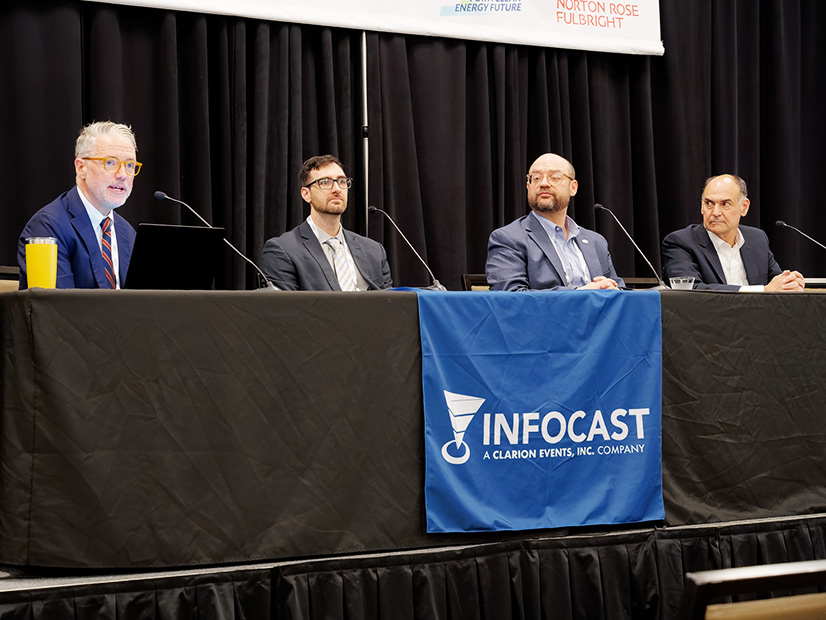
Finding the balancing point was a recurring theme at the Infocast event.
“If it was easy, anyone could do it; I think we have to continue to think big, and get big things done,” said Stuart Nachmias, CEO of Con Edison Transmission.
His suggestion — expand transmission headroom at the geographic confluence of customer demand and community support for meeting that demand — is at once logical to pursue and difficult to achieve.
“And we should build big when it comes to building transmission so that we have room for growth,” Nachmias said. “And I think that’s really something that we have not done well. It also seems to take too long, but we know what we can do, and we should just start doing that.”
This potentially bumps against the imperative to go easy on ratepayers in a state with some of the most expensive electricity in the U.S.
What should the state be doing now to address the soaring costs of the renewable energy it has been pushing so hard to build? moderator Robert Rosenthal of Greenberg Traurig asked his panel.
Nachmias didn’t sugarcoat his answer.
“Prices for everything have gone up. So I think it’s relative, and trying to mitigate the cost doesn’t mean they’re not going to go up, but to go up less.”
Stephane Desdunes, EDF Power Solutions’ vice president of development for Canada and the northeast U.S., said he has seen project costs jump $80 million over the course of 48 hours.
“When you look at what’s happening here in New York, across the U.S., we’re trying to clear a construction cliff. We’re trying to manage permitting risk. We’re trying to absorb tariffs while still trying to meet our contractual [commercial operation date]. I would say every day we wake up, we’re kind of hoping that the day goes well and the project won’t get canceled today.”
The continuing problems developing renewable energy in New York have set the stage for consideration of what until recently was a remote or even implausible concept: new gas-fired generation.
“That actually provides room to have the pragmatic discussion around, what can we bring to the table now to ensure that we have a reliable and resilient grid in this transition period?” said Sarah Salati, chief commercial officer of National Grid Ventures, which operates a gas-fired fleet in southern New York.
Some of those facilities have been in service for more than 50 years, she said, and repowering them would not only improve reliability but reduce emissions while renewable energy development gets back on track.
“We’ve estimated that if we repowered the assets that we have on Long Island, that it would be equivalent to basically taking 570,000 vehicles off the roads over a 15-year period,” Salati said.
Rosenthal flagged a detail of the state’s landmark 2019 climate law: New York must generate its electricity with zero emissions by 2040, which he said is a deterrent to any significant investment of funds in new gas-fired generation in 2026. He asked the panel if the Public Service Commission should exercise its authority to modify the 2040 target.
No one gave him a “yes” or “no,” but the clear sense was that natural gas should not be excluded from consideration.
“Without directly answering your question,” Nachmias said, “I would say reliability is paramount, and I think the state and the NYISO has been ringing the bell here.”
“It’s an optimization problem,” said Tom Vaccaro, vice president of development for TDI-USA Holdings. “The engineer in me knows that if you take resources off the table before you do the optimization calculation, you’re more likely to come to a suboptimal outcome.”
The grid is the most complex machine in human history, he said, and the clean energy transition is a fundamental reworking of it. No effort on that scale has ever proceeded on schedule or on budget, and the plan for achieving it will change over time even as the end goal does not, he said.
Zeryai Hagos, executive director of the state Office of Renewable Energy Siting and Electric Transmission, gave an update on the RAPID Act (Public Service Law Article VIII), the state’s effort to streamline permitting of large-scale transmission projects in the same manner it streamlined permitting of large-scale renewable generation.
The first set of regulations implementing the law took effect in March.
“As of right now, we are working with the first wave of utilities who are preparing to enter the pre-application process for the first Article VIII siting projects,” Hagos said.
Proposals along new rights of way may not advance any more quickly than under the old system, he said, but those that would follow existing rights of way and create no new impacts are expected to see a 50% reduction in their construction timelines.
Another moderator, John McManus of Harris Beach Murtha, framed his panel discussion as a look at the difficulty of hitting a moving target amid changing rules of engagement.
“The result is a transmission system that is actively being redesigned, not only while it’s being expanded and rebuilt, but also while it’s being used,” he said. “This panel is about that tension: How do you plan, finance and permit energy infrastructure in a world where the regulatory and policy landscape is still in flux?”
McManus asked Paul Haering, vice president of capital investment for New York Transco, whether he thought permitting would be faster under Article VIII, or it would just look faster because so much of the process would be moved from the application phase to the pre-application phase.
“I think we’ll have to see,” Haering said. “From our perspective, I think the level of effort is still going to be about the same. It just becomes a matter of the sequencing.”
He said he does like the concept, however. “I think a single one-stop shop for permitting for large infrastructure projects makes the most sense. At the end of the day, hopefully that results in a more efficient process. But I think the jury is going to still be out until we actually get through an Article VIII siting process.”
Schuyler Matteson, clean energy planning lead at the state Department of Public Service, picked up on Haering’s point: The RAPID Act is not just an attempt to speed the process but to reduce its internal friction.
“We don’t want people bouncing around between processes,” Matteson said. “Having a centralized place where everybody can go [and a] clearly understood process I think [are] very, very important. So even if it takes a similar amount of time, if it’s much, much clearer and it reduces risk, I think that’s going to be a win overall.”
McManus raised the often cited prospect of optimizing the existing grid with more speed and less money than would be required to expand the grid. Are grid-enhancing technologies an interim solution while new transmission is built or are they a replacement? he asked.
“Yes,” said John Bernecker, director of large-scale resources at the New York State Energy Research and Development Authority.
“We shouldn’t view it as one or the other,” he explained. “A lot of the barriers are, frankly, regulatory and market barriers that we should be focusing on addressing. A number of these technologies are quite mature and have significant deployment in other regions, and so we need to be focused on addressing some of the cultural challenges or resistance to their deployment where it exists.”
McManus broached another hot button issue: “Are any of you concerned that the pace and the scale of large load growth, as well as the economics and politics behind that, create pressure to make transmission planning decisions faster than may be prudent?”
Haering said New York seems unlikely to become a hotbed for data centers, but the concerns centered on their development are valid.
“I think the whole issue is cost causation and responsibility,” he said. “You don’t know how long some of these entities will be around for. Is their load really going to be their load? Is their load factor exactly what they said? Getting in front of this and making sure the policy’s set so that ratepayers don’t share the cost, I think, is critically important.”
Hydropower generation in the Northwest and Rockies is expected to increase 17% from 2025 levels despite snow drought conditions, the U.S. Energy Information Administration said.
The EIA reported April 14 that it expects hydropower generation in the region to hit 125 billion kWh (BkWh) in 2026, a 17% increase compared with 2025 but 4% below the 10-year average. The agency’s projection follows “record warm winter temperatures” in the West and a heat wave in March that led to early snow melt, according to the EIA’s Short-Term Energy Outlook.
In the Northwest, “Hydropower generation in December 2025 and January 2026 was unusually high due to a series of atmospheric rivers that led to devastating flooding in the region,” the EIA stated. The agency said its outlook is based on water supply forecasts from the National Oceanic and Atmospheric Administration.
Nationwide, the EIA expects hydropower generation to increase by 5% in 2026 but remain 1.8% below the 10-year average following snow drought conditions. In 2026, the report expects hydropower generation to be 259 BkWh, representing 6% of the United States’ electricity generation.
The EIA report shows hydropower is a reliable source of base load generation even during snow drought, according to Malcolm Woolf, president of the National Hydropower Association.
“Yes, there was snow drought, but actually hydropower generation is expected to increase 5% in 2026,” Woolf said. “We are still in a historic multi-year drought cycle, so hydropower production is not expected to reach records, but it’s not going to be as bad as the 2024 record low generation year.”
Though some people may assume the opposite, “the modeling shows that climate change is water change … and that actually means more hydro generation,” according to Woolf.
Still, droughts can impact a dam operator’s bottom line and create serious concerns from season to season, Woolf said.
Another challenge is managing spill levels to prevent dams and reservoirs from overflowing during an atmospheric river event. Spilled water is a missed opportunity to produce electrons, Woolf noted.
He pointed to the Bonneville Power Administration, which markets power from 31 federal dams in the Columbia River Basin. The agency must spill a certain amount of water over the dams instead of running it through turbines to protect migrating salmon, Woolf said. (See BPA Explores Rate Alternatives Following Order to Increase Dam Spills.)
However, new technology, including better climate modeling and fish-friendly turbines, can optimize the system and enable dams to produce power when the grid needs it the most, Woolf said.
“I think what you’re hearing from the EIA report is that climate change isn’t impeding that,” Woolf said. “If anything, it’s actually increasing the amount of water available for hydropower.”
Meanwhile, the EIA forecasts California’s hydropower generation in 2026 to be 28.5 BkWh, 6% less than 2025 but 15% more than the 10-year average.
The Golden State’s reservoir levels were above the 30-year historical average as of April 1, with the two largest reservoirs, Shasta and Oroville, at 114% and 124% of the historical average, respectively, the EIA stated.
“The state of California also experienced three consecutive weeks of no drought or drier than normal conditions,” the EIA stated. “However, according to the California Department of Water Resources, snowpack conditions as of April 1 were well below normal with Northern Sierra Nevada at 7%, Central Sierra at 25%, and Southern Sierra at 39%. Additionally, warmer-than-normal temperatures in March led to some early snowmelt across the state.”
MISO expects to manage a 163-GW demand peak by 2035, and potentially 230 GW by 2046 in a high-demand environment, according to the RTO’s first crack at comprehensive long-term load forecasting.
The grid operator said data center load is the most consequential variable in its 20-year view of load growth.
MISO’s projections show a 163-GW coincident peak in 2035. That could become more than 180 GW by 2046 at a 2% compound annual growth rate. But the RTO said a 3% CAGR could have it topping 230 GW in peak demand in two decades.
The RTO managed an approximately 121-GW coincident demand peak in 2025.
The latest figures show that what was considered unlikely two years ago has become the norm. The RTO’s “high” scenario from its less intensive load forecasting effort in 2024 now mirrors its “current” trajectory. (See MISO Switches to In-house Load Forecasting to Gauge Soaring Demand.)
“What was previously upside is now base case,” Brad Decker, of MISO’s Strategic Insights Group, said during an April 13 stakeholder workshop on the forecast.
Decker said the 20-year forecast reflects “evermore announcements and expectations” for data center infrastructure through 2035.
MISO said it’s in an AI “super cycle,” with 22 GW of data center demand alone projected by 2030. It found that data centers could proliferate at an 18% CAGR through 2046.
“Data centers are scaling quickly and introducing a lot more local planning dynamics,” Decker said. “A single project can rival the load of a mid-size city.”
Decker said MISO discovered that since its most recent load check-in in 2024, trends are “tilting” toward more traditional generation resources to handle the ballooning load, combined with “softer expectations” for electrification-driven load growth.
Additionally, loads are poised to become more consistent with the “structural” change of around-the-clock data center demand, Decker said. He said MISO’s system load factor is set to increase from about 63% currently to nearly 70% by 2040.
However, Decker said the trajectory of AI is uncertain, including “monetization challenges” that could slow investment and consolidate the industry. He said there “are signs” of obstacles already, comparing data center announcements to restaurant reservations in which only five to six people ultimately show up for a reservation for 10.
MISO included a lower growth case that contemplates a slowdown in data centers in its range of possibilities. In that scenario, it might experience a 1.1% CAGR and manage an approximately 150-GW peak by 2046.
During the Board of Directors’ meeting in March, CEO John Bear said the expected 2% rate “is quite a bit away from the 0.4%, 0.2%” annual growth the RTO had been managing for years.
At the workshop, Executive Director of Markets and Grid Research DL Oates said MISO focused on piloting a long-term load forecast because of demand brought on by data center growth.
“The growth expected going forward is quite different than what we’ve experienced,” Oates said.
If MISO is to oversee a 163-GW peak in less than a decade, it needs significantly more generation. The RTO reported in March that its expedited interconnection queue could soon add 19 GW in nameplate capacity to the footprint. It said it is ready to clear or has cleared 11 GW of projects to connect and is studying an additional 8 GW for interconnection. (See MISO: NERC to Dial Down RTO’s Risk Level; Members Create Large Load Working Group.)
The grid operator also reports it is sitting on 76 GW in generation with approved interconnection agreements that have yet to be built. It’s urging developers to bring their projects online as quickly as possible or let it know if those projects cannot be completed.
Oates said the pilot long-term load forecast won’t be used in 2026 in the 20-year futures scenarios that influence long-term transmission planning, but it would be incorporated in subsequent years. The informational nature of the pilot long-term load forecast is nevertheless valuable and will serve as a guide for gathering data from members, he said.
“We’re trying to get this long-term load forecast on a predictable, annual cadence,” he said.
In future annual load forecasts, MISO plans to refine its member data collection process, improve geospatial load growth results, and incorporate extreme weather and its influence on load. It also has hired energy analytics company Kevala to update its projections for distributed energy resources.
Decker said that once MISO factors in demand-side projections, it would produce a gross load forecast in addition to its net load forecast.
With new generations of computers capable of breaking most existing forms of encryption potentially only a few years away, there is no time to waste when it comes to future-proofing technology, a computing expert warned attendees at a webinar hosted by the Midwest Reliability Organization.
The MRO webinar focused on the security risks posed by quantum computing, a form of computing based on the properties of subatomic particles that is believed to be capable of performing certain calculations exponentially faster than any other available computer.
Such machines could provide significant benefits in the form of accelerated drug discovery and chemical development, but will also endanger public key cryptography, which accounts for the vast majority of data encryption on today’s internet along with user, device and application authentication.
Although decoding the public keys generated by current methods requires vast amounts of resources and energy under traditional conditions without a mathematically linked private key, experts believe they will be trivially easy to crack with quantum computers.
The primary speaker at the webinar was Garfield Jones, senior vice president of global strategy and research at security firm QuSecure. He quoted recent research from Google indicating cryptographically relevant quantum computers (CRQCs) — the industry term for quantum computers capable of breaking public key encryption — may be easier to achieve than previously thought and therefore available within the next three years, far earlier than most estimates.
“When I first started this [work], we were looking at [the year] 2050” as the date when CRQCs would become a reality, Jones said. “Then we started looking at 2035, and now we’re looking at 2028 [or] 2029. Technology moves really, really fast, so that’s why we have to be up front and actually get aware and prepared for this.”
Adding to the urgency is the fact that digital spies don’t need to wait until CRQCs are available to steal data. Jones and other experts believe many threat actors are pursuing a “harvest now, decrypt later” (HNDL) strategy in which they store stolen encrypted information from target companies in anticipation of the development of CRQCs to decrypt it.
HNDL attacks are aimed at data in transit from one device to another. This kind of data is protected with public key encryption, as opposed to data in use — which is currently being processed in a user’s computer or smartphone and thus cannot be secured — and data at rest, which is kept in a physical storage medium, ideally under symmetric encryption keys.
No Shouting from Rooftops
The good news for electric utilities, Jones said, is that action is underway in multiple sectors to prepare for the world of post-quantum cryptography (PQC). Executive orders issued by Presidents Biden and Trump aimed to prepare the country for a PQC future by directing the Cybersecurity and Infrastructure Security Agency to publicize categories of products in which PQC is available and directing agencies to support quantum-safe protocols by no later than 2030.
Jones also reminded listeners that the National Institute for Standards and Technology in 2024 released a set of encryption tools designed to resist quantum cracking attempts and can be used with current technology. He urged utilities to adopt the new tools as soon as possible to ensure safe transmission of data in the future and to continue to monitor NIST for new algorithms to improve the initial set.
This work will not be accomplished overnight, Jones acknowledged. Utilities must not only adopt PQC in their internal systems after decades of accumulated experience working with traditional methods, but also push their vendors to do so as well. Robust implementation and funding plans will be needed to ensure long-term commitment.
Asked how experts can be sure a nation-state or other adversary does not already possess a CRQC, Jones answered simply, “We don’t.” He clarified that he thought it unlikely that the milestone had been reached because of the resources needed, but also warned listeners not to underestimate the ingenuity of their opponents.
Jones observed that programming advances have reduced the estimated computing resources needed to break public key encryption by a factor of 10 and suggested the advent of quantum decryption is not likely to be publicized.
“I don’t think there’s one right now, but when one does come online — I mean, if I owned it, I wouldn’t shout from the rooftops. I would just start using that [like] we did [in] World War II,” Jones said, referring to the successful efforts by Allied intelligence to break Germany’s Enigma encryption. “Just keep sending that data, and I’ll just keep reading every single thing.”
The Bonneville Power Administration said it continues to face steep energy deficits under “firm” water conditions over the next 10 years, but the outlook is slightly better than what the agency foresaw a year ago.
The finding comes out of BPA’s most recent Pacific Northwest Loads and Resources Study, also known as the “White Book,” which offers a 10-year outlook on the agency’s ability to serve its load obligations with its own federal resources.
The study provides predictions for BPA’s own load and resources, as well as the entire region’s retail loads, power supply obligations and resources. The findings are used in long-term planning for BPA and the Columbia River Treaty, and they provide a record of information for customers and other regional planning entities.
“Firm” water conditions represent the agency’s lowest estimate for flows in the Federal Columbia River Power System, a conservative planning scenario intended to ensure the agency maintains system reliability and avoids overextending its contract obligations. BPA noted that under “median” conditions, which reflect historical flows, it would remain in surplus for the entire study period.
The 2026 White Book, released April 13, projects annual energy deficits across the 10-year span under firm conditions, ranging from 535 average megawatts (aMW) in operating year (OY) 2027 to 834 aMW in 2036 — with a peak deficit of 937 aMW in 2036. In comparison, the 2025 White Book showed deficits ranging from 426 aMW in 2026 to a peak of 1,012 aMW in 2036. (See BPA Predicts Energy Deficits Over Next 10 Years.)
“The 2026 White Book shows a slight improvement in deficits annually in seven of the 10 years,” BPA noted in the report, attributing that change to a decrease in federal load obligations during the first half of the study period and the impact of a planned uprate of the Columbia Generating Station nuclear plant during the latter half. (See BPA Approves $700M Plan to Boost Columbia Generating Station Output.)
The outlook is more volatile for the entire Pacific Northwest, which under firm conditions could see a surplus of 337 aMW in OY 2027 but decline steeply to a deficit of 3,514 aMW in 2035. The first deficit appears in 2029 (747 aMW) then begins accelerating in 2031 (2,135 aMW).
“This result was mainly driven by the increasing PNW retail loads,” Rachel Dibble, BPA vice president of generation asset management, said in a letter accompanying the White Book.
Dibble noted also the Pacific Northwest analysis consisted of a “forecast of regional firm loads and resources, based on expected retail loads and different levels of generating resources that vary by water conditions.”
“The scheduled decommissioning of existing resources, the extent of forecasted load growth, the availability of uncommitted PNW independent power producer generation to meet regional load, and new resource additions are key variables in the results of this analysis,” she wrote.
BPA said the total retail load, contracts and generation forecasts used in the White Book were up to date as of February.
“While [BPA] Provider of Choice contracts were signed in December 2025, Bonneville will not have a full understanding of its Provider of Choice load obligations until Tier 2 elections are made in summer 2026. Thus, Provider of Choice updates are not included in this issue of White Book,” the agency wrote. (See BPA Signs New Multiyear Contracts with over 130 Customers.)
FERC has accepted SPP’s tariff revision that establishes procedures governing interregional transmission coordination in the Western Interconnection between the grid operator and its neighboring planning regions following its RTO Expansion (ER26-1311).
SPP’s proposal also included a method for allocating interregional projects between SPP’s Western region and the planning regions that the commission found to be just and reasonable. FERC said in the April 10 order that the interregional coordination procedures and cost-allocation methodology comply with Order 1000’s requirements.
In a separate concurring statement, Commissioner David Rosner commended the RTO for reaching consensus with its new Western neighbors on the tariff provisions but also highlighted “broader deficiencies” with the commission’s current interregional transmission coordination framework.
He said that since 2011, Order 1000 has resulted in “exactly zero” interregional projects, noting that interregional transmission “time and time again over those 15 years” has made “meaningful” contributions to grid reliability during extremely stressful periods.
“It is imperative that the commission and industry advance meaningful action on interregional transmission planning as soon as possible,” Rosner wrote, saying he is ready to “take swift action” on any future industry filings. “Absent such filings, I intend to work with my fellow commissioners to move this critical ball forward.”
Pointing to NERC’s Interregional Transfer Capability Study, he said it identified a 35-GW gap that, if left unaddressed, “will contribute to a grid that is less reliable.”
“This is a concerning finding that we must address,” Rosner said.
The commission noted the tariff revisions deviated from the common interregional cost-allocation language by assigning project costs to the SPP region according to its existing mechanisms, as applied only to projects in the Western Interconnection. However, it said the revisions comply with Order 1000 because they ensure any project costs in the Western Interconnection allocated to the SPP region on a pro rata basis are allocated only according to SPP’s commission-accepted regional cost allocation method.
FERC found several other variations from the common tariff language to be just and reasonable because it said they clarify the appropriate handling of sensitive information and ensure that costs for projects no longer viable to SPP’s regional transmission needs are not allocated to its region.
The commission also accepted the RTO’s proposal to define CAISO as a “planning region.” It agreed with SPP that while CAISO is not contiguous with and does not neighbor the RTO’s new Western region, including it as a planning region will promote interregional transmission coordination.