PacifiCorp is preparing to bring online enough long-term clean energy resources to help the utility meet Washington’s strict 2030 greenhouse gas targets.
Specifically, PacifiCorp has selected a shortlist of resources from a Washington-specific request for proposals for supply-side resources with an expected commercial online date before the end of 2029. The company issued the RFP to comply with Washington’s Clean Energy Transformation Act (CETA), Rohini Ghosh, PacifiCorp’s director of clean energy planning, told the Washington Utilities and Transportation Commission (UTC) on March 24.
CETA requires all electric utilities in the state to become greenhouse gas-neutral by 2030 (allowing for use of offsets and other programs) on the way to generating all power from emissions-free resources by 2045. It also prohibits utilities from serving their Washington customers with any coal-fired generation after 2025. (See Washington Agencies Adopt New Rules to Implement CETA.)
PacifiCorp’s shortlist includes 853 MW of solar resources and 200 MW of batteries. The utility has begun executing the contracts, Ghosh said. She added that the new resources alone are enough to meet 80% of PacifiCorp’s CETA targets.
The resources fall under power purchase agreements, Ghosh noted. Although potential federal tax credits would not flow directly to the company, “it should be reflected in the prices we have received,” she said.
“Another specific action the company will take is to continue to evaluate potential cost-effective short-term products to make additional progress towards the clean energy targets,” Ghosh said. “While we have identified a healthy number of resources from this RFP, I will note that they largely come online in 2028 and by the end of 2029. So, we’re on a firm target for 2030, but there is still some room to potentially evaluate short-term options between now and then.”
Zachary Rogala, staff attorney at PacifiCorp, noted that the company’s service territory in Washington is “much smaller” than that of other utilities operating in the state.
“Given the size of our service territory, these are realistic targets, and we’re excited to share that news today,” Rogala said.
The costs associated with the procurement of the new resources “will be reviewed in the context of CETA’s cost-containment provisions and associated commission rules,” Drew Marine, PacifiCorp spokesperson, told RTO Insider in an email.
“Additional information about the costs of these resources will be provided in a subsequent filing in this same docket, based on the conditions of approval adopted by the commission,” Marine added. “PacifiCorp recognizes affordability concerns and is committed to helping mitigate customer cost pressures driven by Washington’s policies.”
The announcement came during a UTC meeting on PacifiCorp’s 2025 clean energy implementation plan, which is filed on a four-year cycle. PacifiCorp filed the plan in October 2025 for the UTC’s approval.
Since 2021, PacifiCorp has brought online or contracted for 3.3 GW of new renewable or storage resources, according to the utility’s presentation slides.
Over the next two decades, PacifiCorp says it needs over 2.5 GW of new renewable and storage resources to serve Washington customers and remain compliant with CETA. The company estimates it will need over $1.7 billion in transmission investments to connect the resources.
In the near term, PacifiCorp found that Washington customers will require 1.4 GW of new renewable resources by 2030, including 709 MW of wind and 735 of solar, supported by 462 MW of batteries, to generate CETA-compliant energy.
PacifiCorp anticipates $25.39 million in CETA compliance costs between 2026 and 2029. Compliance costs over the next 21 years could reach $1.4 billion, or a $72 million annual revenue increase, according to presentation slides.
In February, PacifiCorp agreed to sell most of its Washington utility operations to Portland General Electric for $1.9 billion. That deal is expected to close by early 2027, pending regulatory approvals. (See PGE to Acquire PacifiCorp’s Wash. Operations for $1.9B.)
NEW ORLEANS — In a case of déjà vu, MISO announced that NERC is poised to issue a follow-up to its Long-Term Reliability Assessment that stands to lower the RTO’s reliability vulnerability from “high risk” to “elevated.”
MISO Vice President of System Planning Aubrey Johnson said NERC would issue the updated findings in early May.
Speaking at a March 24 meeting of the System Planning Committee of the MISO Board of Directors, Johnson said this time around, NERC would factor in MISO’s interconnection queue fast lane, which boosts supply adequacy.
A NERC representative confirmed the agency would issue a special assessment in April.
MISO’s separate, expedited interconnection queue has attracted 27 GW worth of proposals across 53 generation projects, 72% of which is natural gas, 16% storage, 7% solar and 5% wind. So far, MISO is ready to clear or has cleared 11 GW of nameplate capacity to connect and is studying an additional 8 GW for interconnection. (See MISO’s 3rd Expedited Queue: 8 GW of Gas and Batteries.)
MISO Director Nancy Lange said NERC’s initial decision to ignore contributions from the expedited queue in its assessment is “puzzling.” NERC officials have said the organization enforces a cutoff date for information that informs the assessment.
Director Mark Johnson said even the improved standing to “elevated risk” is “still a discount to what’s being done” by MISO and its members to address reliability.
MISO Independent Market Monitor (IMM) David Patton told the RTO’s board, executives and stakeholders he continues to believe NERC was off base to designate MISO a high-risk area.
Patton said “probably the most significant” consequence of NERC’s LTRA is the U.S. Department of Energy issuing several 90-day retirement delays for coal plants in MISO’s territory. He said the orders are racking up extraordinary costs.
The U.S. Department of Energy reupped stay-open orders March 24 for NIPSCO’s R.M. Schahfer Generating Station and Centerpoint’s F.B. Culley Generating Station through June 21, 2026.
“It’s pretty easy to come the conclusion that none of these orders are actually needed,” Patton said at a March 24 meeting of the Markets Committee of the MISO Board of Directors.
Patton quipped that “nobody reads the report” and instead focuses on the vibrant colors on NERC’s indicative map.
Multiple state regulators belonging to the Organization of MISO States sent a letter in February to challenge NERC’s results and the omission of MISO’s fast-tracked interconnection process. (See MISO States Dispute ‘High Risk’ Designation from NERC.)
But at a March 25 Advisory Committee meeting, Clean Grid Alliance Executive Director Beth Soholt criticized MISO’s efforts to bring more supply online for translating overwhelmingly into new gas generation.
“I’m wondering where the balance is in this ‘all of the above’ approach,” Soholt said.
NERC similarly downgraded MISO’s alert level in the LTRA in 2025 through an after-the-fact supplement. In that case, the IMM criticized NERC’s original conclusion and pointed out an error: NERC used unforced capacity values for MISO when calculating a margin that it ultimately compared to an installed capacity requirement.
In February, MISO Senior Manager of Market Design Neil Shah told the Entergy Regional State Committee the RTO was in contact with NERC to hopefully improve assumptions used in the latest LTRA.
Shah said including the generator interconnection express lane would likely “close the gap” in the NERC report. However, he said uncertainty remains due to the potential for additional large loads claiming spots on the grid.
MISO expects the first projects from its expedited generator queue to come online in 2028. Beyond that, Shah said, “MISO is projecting higher rate of new resource additions in 2026” than have historically come online annually from 2022 to 2025.
Large Loads, Uptick in Supply Additions
NERC’s revised findings are set to arrive as large loads continue to ratchet up in MISO and the RTO sets sights on record-setting capacity additions.
MISO’s Advisory Committee at its March 25 meeting voted to create a Large Load Working Group, which would discuss ever-larger load integrations and report to the Advisory Committee. The new stakeholder group doesn’t yet have a charter or management plan, but it will likely help develop ideas to better integrate demand.
MISO has indicated it will introduce reliability requirements for large loads at the time of interconnection and could file a proposal with FERC in late 2026.
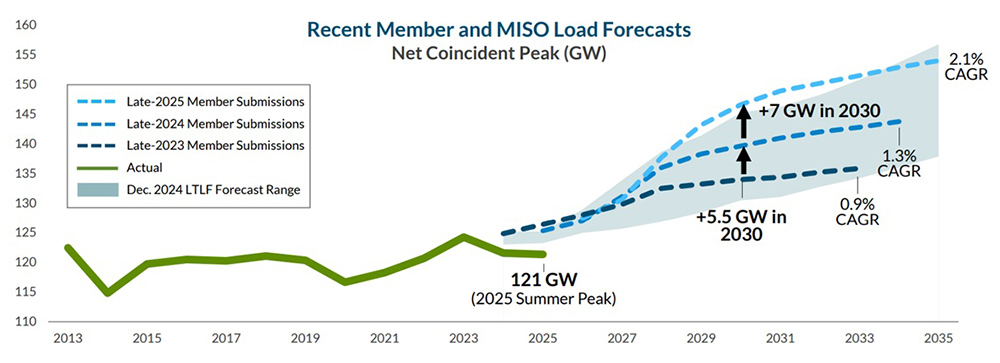
During Board Week, MISO said its recent load estimates and its members’ load forecasting show it could have more than 145 GW in load by 2030 and about 155 GW in 2035.
MISO and members’ load projections through 2035 | MISO
MISO expects to add about 15 GW of capacity by the end of 2026. If realized, it would be a record for the RTO.
“The systems are responding. The work we’re doing is really coming to fruition,” Aubrey Johnson said of MISO’s interconnection process.
MISO’s legacy interconnection queue contains 192 GW, but the RTO expects that number to continue declining as federal tax credits are phased out. The grid operator faced a more-than-300-GW queue at one point in 2025.
MISO has recently issued $60 million in refunds to withdrawing interconnection customers, a figure significant enough to be featured in the RTO’s financial updates.
Relatedly, the grid operator now has 76 GW in generation with approved interconnection agreements but has yet to be built.
“We predict that we will have close to 100 GW … by the end of the year,” Johnson said at the System Planning Committee meeting.
Of the 76 GW, MISO reported that 42 GW are delayed three years or more beyond their stated commercial operation dates. Johnson said developers remain dogged by permitting hurdles, supply chain issues and, in some cases, the lack of an off-taker for their planned projects.
However, Johnson said MISO was able to process the first study phase of the regular 2025 cycle of interconnection projects in just 54 business days.
“And that’s going to be the slowest we ever do it,” Johnson said. “Going forward, we expect to only have one open queue cycle per year.”
However, Soholt said she’s heard that some interconnection customers don’t trust the results Pearl Street’s SUGAR software (which MISO is using to automate studies) is producing, noting interconnection customers are having difficulty replicating the study results they receive.
The volatility of supply and demand straining the U.S. bulk power system is generally accepted as the Senate Energy and Natural Resources Committee continues to work on permitting legislation. How to address that imbalance drew varied testimony in a March 25 hearing.
“This hearing is one of the series on the importance of permitting reform to inform our committee’s deliberations on the challenges facing the nation’s bulk power system and what Congress should do to address them,” Chair Mike Lee (R-Utah) said to open the hearing.
The imbalance is the result of power plant retirements made when demand growth was flat. Demand has surged because of the addition of large loads like data centers.
“These are structural changes in our economy that require really large amounts of electricity around the clock,” Lee said. “Our grid was designed to meet peaks most of the time. It operates with excess capacity, but that cushion is shrinking. In some regions, the margin is already gone.”
Ranking Member Martin Heinrich (D-N.M.) agreed the grid is straining due to rising demand but argued some Trump administration policies are not helping.
“This imbalance has led to electricity bills rising by as much as 13% since President Trump took office,” Heinrich said. “These rising costs made worse by the administration’s fossil-only agenda, which includes propping up uneconomic coal plants, stalling 116 GW of new capacity from coming online, canceling clean energy projects and starting a war with Iran that is driving up oil and gas prices.”
Demand is rising, but exactly when and where the new large customers will show up is far from certain, said Todd Snitchler, CEO of the Electric Power Supply Association.
“This uncertainty is perhaps the greatest risk for both reliability and affordability for electric consumers because of the danger of either over- or under-producing capacity during a time of volatile demand projections,” he added.
That risk can be minimized by using competitive wholesale energy markets, encouraging bilateral or co-located agreements, improving load forecasting, passing a permitting law and recognizing that much of the recent increase in prices is due to state policies and regulations, Snitchler said.
“When competitive power suppliers, like our members, invest in generation assets, they do so without guarantees for cost recovery and an approved rate of return,” Snitchler said. “The risk of investing in those generation resources remains on the developers and owners of the plants and not the ratepayer.”
Travis Fisher, Cato Institute director of energy and environmental policy studies, said Congress should embrace competition, arguing that federal policy has fallen well short of that.
“I very much agree with a 2002 book by Cato that referred to the mandatory open access model of transmission, which is basically what we’re dealing with now, which is the restructuring — I wouldn’t call it deregulation — restructuring from the late 1990s, referred to that as ‘infrastructure socialism,’” Fisher said. “Now that is, I think, a fair way to characterize the public grid. That’s why I’ve been advocating today for a new parallel path to allow private grids.”
The growth in artificial intelligence data centers and advanced manufacturing is a sign of an expanding economy, but the grid cannot keep up. Consumer-regulated electricity can meet that demand quickly without overburdening other consumers, Fisher said. (See GOP Senator Introduces Bill to Let Large Loads Set up Consumer Regulated Utilities.)
“The idea is straightforward: allow new large-scale customers, like data centers, to develop off-grid power systems under voluntary contracts,” he said. “These systems would be physically separate from the existing grid. That means no interconnection delays, no reliance on congested transmission networks, and importantly, no shifting of costs or risks onto existing ratepayers.”
The best way the committee can help the grid meet rising demand is by expanding the power grid, said Liza Reid, Niskanen Center director of climate and energy policy.
“We are building a more diverse set of energy resources at the same time: gas, nuclear, wind, solar, geothermal and storage,” Reid said. “But no single resource is sufficient on its own. Reliability depends on how these resources work together, and transmission is what allows that coordination to happen and ensures that every American has access to that affordable power.”
The bulk power system is made up of regional grids, with limited transfer capability between them, which has been illustrated in recent winter storms when one region is facing tight conditions while its neighbor operates normally.
“Interregional transmission lines are in the national public interest because of these affordability and reliability benefits that they provide, yet they face much higher siting and permitting barriers than other energy infrastructure, because the authority to prove approve interstate projects still rests largely with the states or even sometimes counties,” Reid said.
A shortage of grid capacity is the primary barrier to AI in the country, and without a dominant grid, the technology will develop faster elsewhere, she said. Congress can help deliver that grid with permitting legislation, she added.
New England transmission owners have added over $376 million in projects to the region’s asset condition list since October while placing over $560 million in projects in service.
Eversource Energy is responsible for about $260 million of the recently proposed spending, followed by National Grid at over $95 million and Rhode Island Energy at $21 million.
The update brings total spending on asset condition projects placed in service since 2020 to $5.23 billion. The companies plan to spend an additional $4.44 billion on projects expected to come online by the end of 2030, though this number will likely increase as they identify additional needs and projects.
Asset condition projects, which are intended to address transmission infrastructure deterioration, account for the bulk of new transmission spending in New England.
Addressing increasing asset condition costs has been a main focus for consumer advocates in the region. In 2025, ISO-NE agreed to establish an internal asset condition project reviewer, which it hopes to stand up by the start of 2027. The reviewer would evaluate project needs, cost effectiveness and alternatives for proposals over $25 million. This information could be used by third parties to challenge cost recovery with FERC. (See ISO-NE Refines Details on Asset Condition Reviewer.)
Project Presentations
For all asset condition projects expected to cost over $5 million, the transmission owners are required to give advisory presentations to the ISO-NE Planning Advisory Committee (PAC). The committee does not have the power to deny or approve projects.
At the PAC on March 24, representatives of the transmission owners presented a trio of relatively small projects.
Eversource presented a $17.6 million project to replace two breakers and address a lack of cable shielding at a substation in Connecticut. The proposal is part of a larger effort to upgrade substations that lack cable shielding and replace breakers that rely on out-of-date air compression systems.
The company also presented a $5 million project to replace outdated relays at a substation in western Connecticut.
Versant Power presented a $12.7 million project to replace thyristor switched capacitor valves and add a new control system at a facility providing reactive power to maintain stability on a line between New England and the Canadian Maritime provinces.
ISO-NE’s initial review of proposals submitted for a first-of-its-kind transmission procurement indicates four of the six proposals do not meet the technical requirements and are not eligible for selection.
The screening narrows an already-limited group of projects eligible for selection in ISO-NE’s first run of its Longer-term Transmission Planning (LTTP) procurement process. This procurement is focused on increasing transmission capacity in Maine and New Hampshire and enabling the interconnection of onshore wind in northern Maine. (See ISO-NE Releases Longer-term Transmission Planning RFP.)
ISO-NE received six responses to its request for proposals (RFP) in fall 2025, less interest than expected. Multiple stakeholders expressed surprise and concern in reaction to the elimination of four of these proposals at the ISO-NE Planning Advisory Committee (PAC) on March 24.
“I don’t think we should sugarcoat this — this is a pretty bad situation,” said Alex Lawton, director at Advanced Energy United, expressing concern about how the elimination of projects will affect the competitiveness of the process.
ISO-NE’s initial analysis of the proposals included three components: energy standard testing, capacity standard testing and transfer analysis testing.
The energy and capacity analysis evaluated whether the proposals would adequately enable the interconnection of 1,200 MW of wind energy. The transfer analysis evaluated whether the projects would increase the limits of the Maine-New Hampshire interface to at least 3,000 MW and the Surowiec–South interface to at least 3,200 MW.
Just one project failed the energy and capacity tests. This project “could not accommodate the full 1,200 MW of additional onshore wind in the energy testing or the expected winter output (65%) in the capacity testing due to post-contingency overloads,” ISO-NE noted.
Four proposals failed the transfer analysis, with ISO-NE’s analysis indicating thermal, voltage or stability issues.
The two projects that passed the physical analyses are similar proposals, ranging in cost from $2.14 billion to $2.20 billion. They would consist of two new 345-kV lines and upgrades to existing 345- and 115-kV lines in Maine and New Hampshire. They both have an expected in-service date of late 2032. (See ISO-NE Provides More Detail on Responses to LTTP Procurement.)
Several stakeholders argued that ISO-NE should allow project sponsors to make changes to projects to address minor issues.
“If you cure a minor deficiency and that would lead to a better outcome, why would you not do that?” asked Shadab Ali, senior director of transmission development at NextEra Energy.
But representatives of ISO-NE stressed that its tariff does not allow for material changes to projects after submission. They said the RTO has no intention of making tariff changes midway through the procurement process, as this could undermine the value of the RFP.
Multiple representatives of NextEra asked ISO-NE to provide the data from its analysis to project bidders as quickly as possible to allow sponsors to check for errors. ISO-NE said it would provide the data to sponsors on request, adding that it is open to corrections if project sponsors identify legitimate issues with its analysis.
Michelle Gardner, executive director of Northeast regulatory affairs at NextEra, said it is confusing to see so many proposals fail the initial screening given the amount of effort and investment required to develop a proposal.
“It’s hard to imagine how you would go through all that effort and there’s not enough reactive power and a stability failure based on the testing,” she said.
Brian Forshaw, principal at Energy Market Advisors, said it makes little sense to change the rules mid-process but that there seems to be “a lot of work to do when we get to the lessons-learned phase.”
With the models and the data used in the assessment all defined from the start, “why are there surprises that are coming out at this point in the process?” he asked.
Eversource Energy, the transmission owner with the largest footprint in the region, did not comment during the meeting but wrote in comments submitted to ISO-NE that it is “very concerned by stakeholder suggestions that the ISO allow bidders to modify their proposals during the evaluation phase.”
Allowing such changes “would undermine confidence in the process,” wrote Dave Burnham, director of transmission policy at Eversource.
Following the technical analysis, ISO-NE plans to move forward on additional analysis of the two remaining projects. This will include evaluation of adverse impacts on other parts of the system and a cost-benefit analysis, which will determine whether the remaining projects are eligible for selection as a preferred solution.
ISO-NE will rely on a consultant to evaluate construction feasibility, corollary upgrade costs and the financial health of project sponsors.
It plans to make a final determination on a preferred solution by September.
NEW ORLEANS — A new group formed to represent electric ratepayer interests has raised questions about interactions between MISO’s Independent Market Monitor and the state regulatory agencies seeking to overturn the RTO’s $22 billion long-range transmission portfolio through a FERC complaint.
The publication of email records by Manifest Energy coincides with the MISO Board of Directors opening a “best practices review” of the IMM, although the board’s Markets Committee did not publicly cite a link between the two developments when it voted unanimously to begin the examination at a March 24 meeting.
Manifest Energy — which also uses the name Manifest American Energy — said it engaged consulting firm New Fundamentals to conduct an analysis using the firm’s Transmission Governance Intelligence section, which monitors transmission planning processes and regulatory dynamics. The analysis focused on communications related to a FERC complaint disputing the benefits of MISO’s second long-range transmission plan (LRTP) (EL25-109). (See MISO, Stakeholders Appeal to FERC to Leave Long-range Tx Plan Intact.)
The North Dakota-led complaint, which remains pending before FERC, could unravel MISO’s second long-range transmission portfolio and fundamentally alter how MISO plans its long-range transmission, one of the RTO’s raisons d’être.
“When billions of dollars and grid reliability are on the line, transparency is what allows decisions to move forward with credibility,” said New Fundamentals’ Claire Douglass, speaking on behalf of Manifest Energy in a press release. Douglass said Manifest Energy applauds the MISO board’s decision to take “good governance seriously.”
Manifest Energy describes itself as an apolitical initiative bringing together individuals from a range of communities and perspectives focused on lowering energy costs, strengthening grid reliability and improving transparency in how transmission decisions are made. The group said it is working to obtain nonprofit status.
Email records obtained through multistate public records requests reviewed by Manifest Energy show that MISO IMM David Patton was included in — and in some instances responded to — April 2025 email communications referencing an “LRTP Complaint,” alongside state regulatory personnel, outside counsel and consultants associated with the complaint effort.
The records show the circulation of draft materials and invitations to calls concerning the complaint. Patton appears in multiple threads with instances of engagement; however, the records alone do not establish the extent of his role in developing the complaint.
Manifest Energy said the communications raise questions about how the IMM engages with stakeholders in proceedings that may later intersect with the Monitor’s official responsibilities.
Among those included in the communications was Bill Booth, currently a consultant to the Mississippi Public Service Commission, who at the time was working in connection with the North Dakota effort supporting the complaint. The records show Booth coordinating communications and circulating draft materials among participants.
In a July 2025 email that circulated a draft complaint titled “PLEASE READ TODAY — NDPSC Complaint re MISO Tranche 2.1 Benefit Calculations (DRAFT)” and marked “CONFIDENTIAL,” Booth wrote that he had received edits from Patton and that “they’re accurate.” Attachments referenced in that email were not included in the materials produced in response to the North Dakota Public Service Commission records request.
The records also show Patton was invited to a late June 2025 Microsoft Teams call labeled “Metrics Status.” The available records do not establish whether he attended.
In another July 2025 email concerning outreach to additional regulators, Booth wrote, “If we can defeat these metrics now, we won’t [h]ave to deal with them later,” when MISO South becomes the focus of long-range transmission planning.
By late July 2025, North Dakota, Montana, Mississippi, Arkansas and Louisiana had joined the complaint.
In September 2025, the IMM filed comments in the docket in its official capacity, stating that “we find the arguments made in the complaint to generally be sound and accurate.” The filing does not describe the prior communications reflected in the emails.
MISO declined to comment to RTO Insider on whether its best practices review of the IMM is connected to the release of the emails obtained through state records requests.
MISO said a memo it circulated before the March 24 Markets Committee meeting serves as its comment on the matter. The memo said the RTO’s Markets Committee of the Board of Directors “has a fiduciary obligation to review the services of the” IMM to “ensure that we have the right objectives, and we are fully prepared to meet those objectives in a changing environment.”
Stakeholders who asked not to be identified noted a connection between MISO’s review and the release of the emails. Others said the depth of attention Patton appeared to dedicate to North Dakota staffers and others seemed unusual.
The RTO similarly didn’t respond to questions about whether its review would cover the collaboration that took place over 2025 or whether it believed that level of communication was appropriate.
MISO’s rules do not appear to explicitly prohibit the IMM from meetings or communications related to the complaint, including potential input on FERC filings.
Disputes over the degree to which the IMM should be involved in scrutinizing MISO’s transmission planning are not new for the RTO. In 2025, MISO petitioned FERC for a declaratory order to determine whether the RTO’s tariff authorizes the IMM to monitor transmission plans in addition to markets. FERC ultimately decided it’s proper for the IMM to do so — and be compensated by MISO. (See MISO IMM Contends He Should Have Role in Tx Oversight and FERC Sides with Market Monitor over MISO in Compensation Dispute.)
Patton: Discussed Benefits Analysis — Nothing More
Patton said his involvement in the complaint was limited to explaining his own transmission cost-benefit analysis to the parties interested in filing. He said he neither strategized with the complainants nor helped them develop the complaint.
In a phone interview with RTO Insider, Patton said he sees it as his obligation to speak with any stakeholders about his analyses and presentations. He said his decision to speak with stakeholders on data points is not motivated by any potential complaints stakeholders might plan to file against MISO processes, saying it would make no difference.
“It had nothing to do with this being associated with a complaint,” Patton said. He noted that the LRTP complaint relies on his analyses, so it makes sense that complainants would seek him out.
Patton said any allegation that he prompted the complaint is untrue. He also said he never billed MISO for any discussions about the complaint.
He also recalled pushing back against requests to become involved in drafting the complaint. He said Manifest Energy appeared to be “manufacturing an interpretation” of what’s happening based on the emails.
Patton told RTO Insider that he had “no indication” from MISO that the best practices review is linked to the email release in any way.
“I talked to lots of people about my analyses,” he said.
Patton said he intends to cooperate with the review, adding that if the review helps spotlight beneficial tasks he’s already doing “that are not easy for people to observe, then it could be a useful process.”
The Review
Meanwhile, MISO’s Markets Committee of the Board of Directors said the review would engage a third party to perform the process and recommend improvements.
MISO Director Barbara Krumsiek told RTO stakeholders the move is “purely a best practice review” to reaffirm a “commitment to openness and transparency.”
Krumsiek said it’s good practice from time to time to evaluate MISO’s major vendors, including the IMM.
“Good governance would suggest from time to time that you do look at your relationship,” Krumsiek said of the MISO-IMM relationship. “I hope that whoever we choose is respectful of the uniqueness of this vendor relationship.”
Patton did not speak during the agenda item discussion preceding the committee’s vote.
“We’re not looking for a third party to tell us what to do … but quantify risks and opportunities for improvements,” MISO Director Theresa Wise added.
Wise said MISO won’t discuss selection of a third-party vendor during the open session of a meeting but revealed that Patton has asked that one, unnamed firm be excluded from a potential list. She said MISO would honor that request.
Director Nancy Lange said she was entering the review process “with an extremely open mind” to see what might need to change or what’s already working.
Multiple members of board said the review process should include stakeholder voices, though they didn’t specify how they would collect their community’s input.
Patton has served as MISO’s external Monitor for more than 20 years.
Later in the meeting, Patton said his monitoring is valuable to MISO. He said over winter 2025/26, for instance, he and his team were able to uncover a software error that caused generators to receive unjustified day-ahead margin assistance payments.
“It’s unlikely that any other Market Monitor would uncover that,” Patton said.
A stakeholder speaking on background said MISO board members moving to investigate Patton after he supported the complaint against the LRTP “smacks of retaliation.”
“The board should recognize how this looks to stakeholders and regulators — MISO attempting to silence objective criticism required by FERC rules and regulations. If this review is warranted, then FERC, not MISO, should conduct the review to ensure an objective, unbiased evaluation. The IMM works for FERC, not MISO,” the source told RTO Insider. The source also questioned MISO’s ability to find a firm that has the “technical and informational wherewithal to evaluate the IMM’s performance.”
The IMM ended 2025 $46,000 over budget, or 0.5% over the budget MISO agreed to. Patton attributed the “small overage” to monitoring suspicious behavior from demand-side resources and concentrating on the root of renewable resources frequently not following MISO’s dispatch orders.
Krumsiek said she would like the IMM to provide budget projections and a “scope of work periodically throughout the year.”
FERC rejected a complaint from the PJM Independent Market Monitor asking it to determine the RTO holds the authority to deny transmission service for large loads that cannot be reliably served (EL26-30).
The March 23 order found the Monitor had not demonstrated PJM would be in violation of statutory or regulatory requirements without that authority, nor would its governing documents be unjust and unreasonable. While NERC standards mandate PJM determine the amount of capacity needed to maintain reliability and identify shortfalls, the RTO is not required to solve deficiencies.
But FERC also noted that “our rejection of a procedurally inadequate complaint is unrelated to the gravity of the issues the deficient complaint raises. Though we find that the IMM failed to meet its burden under Federal Power Act Section 206, we acknowledge that the IMM and commenters raise very important issues regarding the challenges posed by large load additions to PJM’s transmission system, including ensuring reliable transmission service and resource adequacy.”
The Monitor had argued that PJM is considering changes to its capacity market that would allow data centers to come online regardless of whether there is sufficient capacity and transmission capability to cover their load. It said PJM has an obligation to ensure all customers receive reliable service and argued that allowing these large loads to come online would undermine the quality for all other consumers. (See Market Monitor Files Complaint Over PJM Large Load Interconnections.)
The Nov. 25, 2025, complaint stems from proposals brought by PJM staff and stakeholders during the Critical Issue Fast Path (CIFP) proceeding to identify how to serve ballooning load. The Monitor sponsored the implementation of an interconnection queue for large loads, which would prevent them from coming online until the requisite capacity and transmission is in place. The PJM Board of Managers opted to go with a package of market changes that would create an expedited interconnection track for new resources; require large loads to either bring their own capacity or be subject to curtailment on PJM request; and overhaul the load forecasting process.
PJM responded that the complaint was effectively a petition for a declaratory order seeking to curb the options available to it in the CIFP process and the Advance Notice of Proposed Rulemaking focused on large load interconnection (EL25-49). (See PJM Presents 1st Look at Co-located Load Compliance Filings.)
Several generation owners, data center representatives and utilities protested the filing on the grounds that the Monitor had not shown PJM is failing to meet reliability standards. Constellation Energy, Talen Energy, FirstEnergy and the Electric Power Supply Association submitted protests, and the Data Center Coalition and PJM Power Providers Group jointly requested the commission dismiss the complaint.
The Natural Resources Defense Council and Sierra Club also objected to the Monitor’s complaint, arguing the requested relief was too vague and would impinge on state jurisdiction and PJM’s ability to prevent data center costs from being shifted to other consumers.
While they agreed large load growth threatens reliability and affordability, the issue should be addressed through the several related FERC dockets already open. They pointed to the large load ANOPR, a consumer advocate complaint arguing the capacity market lacks adequate market power mitigation and a complaint from the Office of the Ohio Consumers’ Counsel regarding the growing cost of local transmission projects (EL25-18, EL23-105). (See Consumer Advocates File Wide-ranging Complaint on PJM Capacity Market.)
The commission’s order stated it is “considering and adjudicating” issues raised in the filing in other proceedings and anticipates additional filings from PJM relating to co-locating generation and large loads, a new reliability backstop mechanism and a connect-and-manage framework under which large loads would be required to curtail under strained system conditions.
Pennsylvania Gov. Josh Shapiro (D) submitted comments agreeing with the Monitor that PJM lacks processes to modulate load growth at a time when large loads are driving high market prices and declining reliability. But he argued that “rationing” interconnection service is not the path forward and that PJM should pursue rule changes to allow new capacity to come online faster and incentivize large loads to be curtailable.
Consumer advocates in Pennsylvania, Maryland, Illinois, Delaware and Ohio jointly supported the Monitor, arguing that without the authority to reject large load interconnections, PJM’s right to review utilities’ interconnection requests is little more than a rubber stamp. A proactive process for approving new service requests would pace load growth with reliability.
“Aside from fulfilling its fundamental role and obligation of ensuring grid reliability and administering efficient energy and capacity markets, PJM serves no purpose in pursuing the policy aim of continued proliferation of data centers and AI within the region if it conflicts with PJM’s ability to meet its priority obligations,” they wrote. “PJM can and must say ‘no’ to the undisciplined interconnection of data center and AI large loads to the PJM transmission system to protect grid reliability unless and until there exists sufficient resource adequacy.”
The New Jersey Board of Public Utilities argued it would be insufficient to leave oversight of large load interconnections to the states, as the cost and reliability impacts of large loads can extend across the PJM region.
While domestic grid planning’s regional nature offers different policy examples, countries around the world offer even more diverse examples that could inform domestic transmission policy, experts said during a webinar hosted by Americans for a Clean Energy Grid.
China has a large, well-connected national grid now, but its system is regional enough that this was not some inevitable destiny. It was the result of deliberate policy choices, said Michael Davidson, associate professor at the University of California San Diego.
“When I first started studying Chinese energy systems in 2008, there were no UHV [ultra-high-voltage] lines,” Davidson said. “There were a handful of HVDC lines. But now they have over 40 UHV lines. And if you include those HVDC lines, it’s actually closer to 70.”
Building out a backbone transmission system to help grow renewable energy’s share of the grid while ensuring reliability has become a key strategic priority of the central government, he added.
“China actually has some fairly deep provincial fragmentation and a lot of autonomies granted to local governments,” Davidson said. “But during the restructuring of the power sector, which split up the grid company and the separate generation companies, you started to see some synthesis around this. And then, basically through the actions of very connected political leaders and top-down decisions, it was decided in early 2000s to go big on a national backbone.”
The Chinese Communist Party’s latest five-year plan focused on building a “new energy system,” which would be powered by renewable energy, and that means grid planners are focused on projects that help integrate renewable power, he said.
Any transmission lines 500 kV and above are planned federally, with provincial governments having to site them, but lower-voltage lines are entirely within the remit of the provinces. The planning also includes new sources of renewables, which are built on one side of new lines to bring them to serve load in a city, which means the Chinese avoid the chicken-and-egg problem often seen with generation and transmission domestically, Davidson said.
“All land is owned by the state,” Davidson said. “Even if the land has been allocated for different uses, the state always has significant power, and you don’t face the same legal bottlenecks that you would have in the United States around building new lines.”
The companies building out the grid are state-owned, with massive balance sheets, easy access to financing and much lower returns than U.S. utilities.
While the return to demand growth is a recent trend for U.S. grid planners, China has seen rapid growth for decades, and new demand from manufacturing and other more traditional loads greatly exceeds that from data centers, which Davidson pegged at 10% of incremental load.
“There’s none of the ‘bring your own generation’ kind of situation in China, because there’s just so much ample capacity on the transmission side and on the generation side,” Davidson said. “And now what they’re trying to deal with is how they power these new loads with renewables.”
One area where the U.S. industry is ahead of China is how sophisticated its planning is, with Davidson specifically pointing to CAISO’s 20-year transmission plan as more advanced than Chinese efforts. (See CAISO Sees $30B Need for Transmission Development.)
Germany’s grid is split between four transmission system operators, which is rare for Europe where one entity usually runs a national grid, said Katerina Simou, energy policy adviser at 50Hertz. Her company is partially owned by Elia Group, which runs the grid in eastern Germany and includes its two largest cities, Berlin and Hamburg.
“And in that capacity, we are responsible for optimizing, expanding and planning our extra-high-voltage grids,” Simou said. “We’re also responsible for operating them in a safe and efficient manner, for ensuring security of supply.”
Every two years there is a nationally coordinated planning process between Elia and the other three system operators to match supply and demand over the next 10 to 15 years, she added. Generally, the generation is concentrated in the north and east of Germany and has to flow south and west.
“We have a lot of renewables, particularly offshore here, and a lot of Germany’s heavy industry is located in the south and southwest of the country,” Simou said.
A federal ministry reviews the plan, and Germany’s parliament votes on the largest, most important lines, which acquire a specific legal status where they are considered necessary and urgent, she said.
CAISO’s Department of Market Monitoring urged the ISO to replace its interim congestion revenue allocation rules under its forthcoming Extended Day-Ahead Market “as soon as practicable.”
EDAM’s interim congestion revenue allocation (CRA) rules will apply initially to PacifiCorp, the market’s first participant in May. But these rules can create incentives to self-schedule resources, which can have detrimental market impacts, CAISO’s DMM said in March 9 comments to the ISO’s EDAM initiative.
In 2025, CAISO began work on new CRA rules in cases of parallel — or loop — flows, after Powerex published a paper contending the EDAM model contained a “design flaw” with potentially $1 billion in unjustifiable charges at stake. (See Powerex Paper Sparks Dispute over EDAM ‘Design Flaw’.)
The need to replace the interim CRA rules will become “more important as additional balancing areas join EDAM and increase the potential for cross-BAA congestion impacts within the EDAM,” DMM said.
“There may be several options to replace the interim CRA [and] whichever option is chosen, the replacement allocation should not be tied to the actual schedules in the market, including schedules resulting from cleared economics offers,” DMM said.
Certain CRA designs can create incentives for market participants to submit offers not consistent with their true marginal costs, which “can undermine the purpose of the market and potentially lead to market dysfunction,” DMM said. A CRA replacement process therefore should ensure that a CRA is not tied to cleared schedules in the EDAM, DMM said.
The interim design could incent self-scheduling rather than economic bidding of generation in certain circumstances, CAISO Policy Development Manager Milos Bosanac, told RTO Insider on March 24. The extent to which market participants will exercise their transmission rights through a self-schedule to fully limit their congestion cost exposure is something that will be monitored through operational experience, Bosanac said.
The ISO is committed to transparent and frequent reporting on congestion in the EDAM footprint, bidding patterns and congestion allocation among EDAM balancing areas, he added.
CAISO is in Phase 2 of its CRA design for EDAM, which is looking at how to eliminate or reduce self-schedule incentives and ensure symmetry in allocation of parallel flow congestion revenues for CAISO balancing areas.
Phase 2 will result in a new long-term CRA design to congestion revenue allocation. CAISO plans to release this Phase 2 proposal by Q2 2027, Bosanac said.
CRA design should ensure that revenues are distributed equitably to avoid cost shifts between EDAM BAAs, CAISO staff said in a February presentation on the subject. The new design also should support transmission customers’ firm transmission rights or CRRs so they can manage and hedge congestion risk exposure, staff said.
CAISO must continue to improve its understanding and modeling of unscheduled parallel flows on its system associated with all Balancing Authority Areas (BAA) in the WECC, Justin Cockrell, assistant general counsel with DC Energy California, said in March 9 comments to the ISO.
“This improved understanding and modeling is essential both for developing more accurate CRR auction models and other related CRR enhancements in the CAISO and for developing durable approaches to congestion revenue allocation and seams issues as EDAM expands and evolves,” Cockrell said.
In a required annual update to FERC on cybersecurity incidents on the electric grid, NERC reported only a single incident occurred in 2025 that met the ERO’s reporting requirements, down from three the previous year (RM18-2).
However, NERC suggested that rather than being a vindication of the ERO’s cybersecurity policies, the lack of additional incidents may indicate that reporting requirements need to be tightened to improve awareness of cyber threats.
Reliability standard CIP-008-6 (Cybersecurity — incident reporting and response planning) requires electric utilities to report qualifying cybersecurity incidents to the Electricity Information Sharing and Analysis Center. (See FERC OKs Cyber Reporting Rule.) Reportable incidents are defined in the technical rationale for the standard as those that compromise or disrupt:
a cyber system that performs one or more reliability tasks of a functional entity;
an electronic security perimeter of a high- or medium-impact grid cyber system; or
an electronic access control or monitoring system of a high-impact grid cyber system.
Reports must include the intended effect of the cyber incident, the attack vector of the incident and the level of intrusion the attacker achieved or attempted. They may be submitted through the E-ISAC portal, the NERC EOP-004 reporting form or the Department of Energy’s DOE-417 form. NERC must submit an anonymized summary of the reports to FERC each year, according to FERC Order 848.
The ERO’s cyber incident report for 2025, released March 20, was light on details. The reporting entity was not identified beyond being in the SERC Reliability region. NERC also did not specify when the incident took place.
NERC did disclose that the incident involved a single medium-impact grid cyber system, which an unidentified intruder attempted to compromise through “connection attempts to multiple external interfaces from a single internet protocol … address.” The attacker did not gain access to the system because network perimeter controls blocked the connection requests, and the target entity activated its cyber incident response plan.
No operational impacts were reported from the intrusion. NERC reported that there was no impact to grid reliability and “the controls in place were effective in identifying and mitigating the attempt to compromise.”
The single incident report collected in 2025 was the lowest since NERC began its annual reporting in 2022. That year, the ERO reported two cyber incidents to FERC that occurred in 2021; subsequent annual reports outlined eight incidents in 2022 and three each in 2023 and 2024. (See ERO Says 2024 Cyber Incidents Showed Increased ‘Sophistication’.)
The ERO wrote in the most recent report that the number may have decreased because of “the subjective criteria to define attempts to compromise,” citing a study it undertook in 2021 to examine registered entities’ implementation of CIP-008-6. The report’s writers mentioned that Project 2022-05 (Modifications to CIP-008 reporting threshold) is underway to clarify the type of events that qualify under the standard.
“NERC is encouraged that there were no reliability impacts from the reported incident … and that the [responsible] entity reported the attempt to compromise to the E-ISAC,” NERC wrote. “However, the diminished number of reports … reinforces the importance of establishing criteria that [do] not rule out attempts to compromise from being reported simply because no harm to, or intent to harm, a [grid cyber system] was identified.”