Search
February 1, 2026

ERCOT Leaned on Mobile Gens, RMR Unit During Storm

ERCOT says Texas’ 15 mobile generating units and a reliability-must-run unit all played an “important reliability function” during the Jan. 25-27 winter storm, the state’s first major cold-weather event since 2021’s disastrous Winter Storm Uri.

Grid operator staff told the Texas Public Utility Commission during its Jan. 29 open meeting that CPS Energy completed repairs to its Braunig Unit 3 before the storm arrived and that it was committed throughout the event.

Dan Woodfin, ERCOT’s vice president of system operations, told commissioners that Unit 3 provided “necessary support” to relieve overloads in the San Antonio region after a large unit in Central Texas tripped Jan. 25. The trip caused “brief exceedance” on the South Texas export constraint and post-contingency overloads on some transmission lines between the region and Houston, necessitating a localized transmission emergency declaration that lasted about 13 hours.

Woodfin said the grid operator also committed the mobile generating units that were moved from Houston to San Antonio in 2025 to provide reliability support for the South Texas constraint. The constraint was binding throughout the storm, he said.

“The combination of these actions was sufficient to operate the system reliably until the large unit came back on” Jan. 26, Woodfin said.

CPS had intended to retire the 55-year-old gas unit in 2025, but ERCOT determined that it was needed to address the South Texas constraint. The RMR is the grid operator’s first since 2016, when it entered into an agreement with NRG Texas Power over a previously mothballed gas unit near Houston. (See “Braunig Outage to End in December,” ERCOT: New Ancillary Service Key to Resource Adequacy.)

“Kudos to ERCOT and to everyone involved for how the grid played out during this storm,” PUC Chair Thomas Gleeson said. “I think everyone resoundingly said this was a success [in] probably the most difficult storm we’ve had to endure since Winter Storm Uri. Everyone should be commended for the work done on this.”

ERCOT navigated the storm without resorting to calls for conservation, issuing energy emergency alerts or suffering systemwide power outages. Demand peaked at nearly 76 GW on Jan. 26, far short of early projections of 83 GW. Staff said the state’s cloud cover and closures of businesses and schools helped reduce demand.

“In summary, ERCOT successfully managed the Texas electric grid through this cold-weather event. As always, we will continue to learn from this event to improve our tools and processes going forward,” Woodfin said.

FFSS Criteria Approved

The commissioners approved staff’s proposal establishing the criteria for participation in ERCOT’s Firm Fuel Supply Service (FFSS) program and the grid operator’s requirements to implement it, a result of a law passed during the 2021 legislative session in Uri’s aftermath (58434).

The rule codifies requirements to procure FFSS during natural gas curtailments and cold-weather events. Staff identified three categories of resources eligible to provide the service: on-site, resource-controlled and contractual off-site. The latter expands the program, although its budget remains unchanged at $54 million.

Jeff McDonald, the Independent Market Monitor’s director, objected to the inclusion of gas-fired resources but said he understood that the 2021 storm “precipitated a need on the reliability side.” He said he was more concerned that FFSS, other ancillary services and residential demand response are all out-of-market actions that affect the ERCOT energy-only market’s reliance on shortage pricing to incent investment.

“They suppress the shortage-pricing mechanism from being able to adequately signal that there’s shortages,” McDonald said. “Therefore, there’s less revenue in the market. Therefore, you’re going to have delayed or reduced new investment.

“I would like to see these programs be diminished over time and more focus placed on the kernel of resource adequacy for ERCOT, which is shortage pricing,” he added. “I do understand the need after Uri. Cracks were exposed that needed to be filled. Enough time has passed now that I think it’s time to … focus more on in-market price signaling to provide reliability services to fill those cracks.”

Gleeson said he agreed with McDonald about the need to allow the market to provide revenues from scarcity, but he also said the rule makes sense “where we sit right now.”

“I think what you’ll see is continued discussion about that and the right timing to actually implement those changes,” Gleeson said.

Batch Zero’s Phased Study

ERCOT will conduct its first “batch” study of large load interconnection requests in two phases, Jeff Billo, vice president of interconnection and grid analysis, told the PUC.

The grid operator has already proposed a “Batch Zero” process to address the 232 GW of interconnection requests from AI facilities, cryptocurrency miners and other large loads. Now, that batch’s first phase, or Phase A, will be limited to large loads that want to be energized early in 2027. Projects in that batch will undergo an abbreviated version of the Batch Zero study. (See ERCOT Again Revising Large Load Interconnection Process.)

A longer, full Phase B study will be for projects with longer timelines. It would begin in August and be completed early in 2027. Even then, the loads will have to pass ERCOT’s quarterly stability assessment five to eight months before they are energized.

“We need to do an operational assessment before those loads connect … to see if there’s anything that has changed since the studies were performed and see if we need to implement any sort of operational constraints to make sure that we know where the constraints are on the system,” Billo said.

The Batch Zero study will serve as a foundation for the other batch studies that follow every six months, beginning in the first quarter of 2027, Billo said. ERCOT will share the draft criteria for large load requests during a Feb. 3 workshop.

Responding to Federal Issues

Staff told commissioners that the PUC has joined the ballot pool for NERC’s Long-Term Planning Energy Assurance project (2024-02), allowing it to participate in future votes and comment windows (54987).

NERC has scheduled a workshop and meetings Feb. 17-19 to discuss concerns and start drafting revisions to the proposed standard, which has drawn pushback from utilities over a requirement to create corrective action plans. The standard failed to pass a first round of voting, garnering only 17.8% support.

PUC staff plan to return to the commission with comments to file in the proceeding.

“I think that’s the right course of action. I think corrective action plans seem out of scope for” NERC, Gleeson said.

The PUC has already adopted a reliability standard that sets criteria for frequency, duration and magnitude of loss-of-load events. (See Texas PUC Sets Reliability Standard for ERCOT.)

Following a closed session, the PUC voted to file amicus briefs supporting FERC in two dockets before the D.C. Circuit Court of Appeals: Clean Wisconsin, the Natural Resources Defense Council and the Sierra Club’s appeal of the commission’s approval of MISO’s Expedited Resource Addition Study process (25-1264), and Advanced Energy United, Advanced Power Alliance, American Clean Power Association and Solar Energy Industries Association’s challenge to SPP’s Expedited Resource Adequacy Study (25-1265).
IESO Seeks Input on RFP for 3rd Toronto Transmission Line

IESO is seeking stakeholder input on its first competitive transmission solicitation: a $1.5 billion HVDC line under Lake Ontario that will become the third major supply line for Toronto.

The ISO recommended the 65-kilometer, 900-MW Toronto Third Line (TTL) in September 2025, saying it would be more “future proof” than two cheaper options. Planners say the line, which was approved by Ontario’s Minister of Energy and Mines in January, is needed to meet a potential doubling of Toronto’s electricity demand by 2050. (See Ontario OKs Underwater HVDC Line to Toronto.)

In July, IESO opened enrollment in its Transmitter Selection Framework (TSF) Registry, a prequalification mechanism for competitive procurements. (See IESO Removes Credit Requirement for Transmission Registry.) As of Dec. 12, two transmission companies — Fortis and Emera — were approved for listing in the registry.

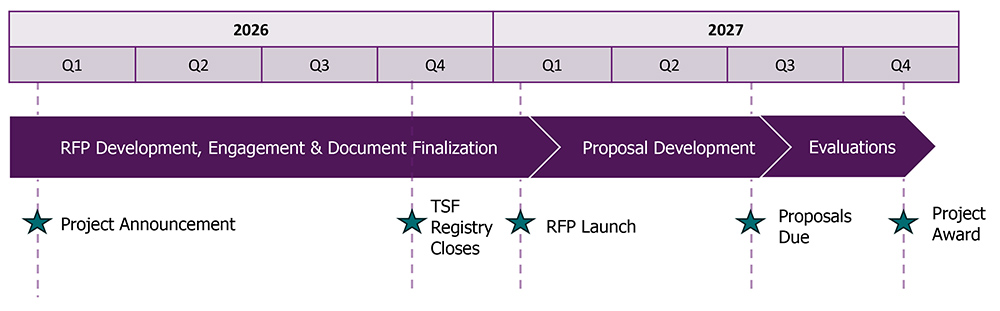
The ISO’s tentative procurement plan, outlined in a Jan. 28 stakeholder engagement, calls for closing the TSF registry in the fourth quarter and opening the request for proposals in the first quarter of 2027, with proposals due in the third quarter and an award in the fourth. The projected in-service date is 2037 “or sooner,” IESO said.

Electricity demand is expected to exceed the capacity of the two transmission lines currently supplying Toronto by 2038. Closure of the 550-MW gas-fired Portlands Energy Centre would accelerate that “reliability need” to 2034.

Design Elements

Although the TTL will be the first HVDC and underwater line in Ontario, similar projects have been built elsewhere in Canada, as well as in the U.S. and Europe.

Under IESO’s standard competitive model, the winning bidder would receive a contract covering all costs for the transmission line’s first 10 years of commercial operation, with the contract transitioning to traditional rate regulation under the Ontario Energy Board in Year 11.

But IESO said the TTL’s “unique technical, environmental and delivery risks [are] not well suited to a contractual model that only allows limited cost adjustments over a longer contract term.”

Tentative procurement plan for the Toronto Third Line | IESO

The ISO said schedule commitments and costs that proponents can reasonably scope and price will be subject to an IESO contract. Uncertain or “externally influenced” costs will be subject to review by the OEB under its “just and reasonable” prudency standard. The OEB’s cost of capital parameters and deemed capital structure also will apply.

“We are seeking input on potential appropriate cost adjustment mechanisms to reduce unnecessary risk premiums while protecting ratepayer value,” the ISO said.

IESO also asked for comments on how prescriptive its technical requirements should be at the RFP stage.

Experience, Indigenous Engagement

Bidders will be required to have experience developing, constructing, operating and mitigating environmental impacts of underwater transmission projects as well as engaging with Indigenous communities, “including undertaking rights-based consultation within treaty and traditional territories.”

IESO is seeking feedback on how to define experience and whether it should be demonstrated at the corporate level or through individual team members, including partners and subcontractors.

All bidders will be required to submit an Indigenous Engagement & Participation Plan (IEPP) to “ensure Indigenous communities are provided with meaningful opportunities to participate” in the project. IESO’s evaluation of the IEPPs will include proposed equity participation structures and non-equity opportunities, including employment, contracting, supply chain participation, training and scholarships.

It asked for input on how it should weight the importance of equity and non-equity participation and how it can ensure early Indigenous community engagement without “inundating communities with requests for engagement from prospective bidders.”

“We’re not setting up a system that rewards who can get a signature [from communities] first,” IESO’s Andrew Lee said.

The Ministry of Energy and Mines says dozens of Indigenous communities have rights or interests in the project area, including the Mississaugas and Chippewas. The ministry’s delegation letter will identify the Indigenous communities to be consulted and the level of consultation.

Aaron Detlor, a lawyer for the Haudenosaunee Development Institute, which represents the Haudenosaunee Confederacy Chiefs Council (HCCC) in the development of lands within areas of Haudenosaunee jurisdiction, questioned the legality of the IESO’s RFP.

“We haven’t had any engagement with the Crown on this RFP process, and that itself is a breach of the honor of the Crown,” he said. “You’ve excluded all kinds of Indigenous people from even bidding on this. So, what you’re doing is you’re creating an RFP process to exclude Indigenous people.”

Amy Gibson, manager of the ministry’s Indigenous Energy Policy unit, said the ministry has not delegated any consultation duties to IESO and is “directly consulting with communities,” including the HCCC.

The ISO is “separately having early engagement around design features because of the timelines associated with this project, but we have not given the direction to the IESO yet on the specific criteria that they will proceed with. So, this is information gathering,” she said.

Detlor declined officials’ offer to continue the discussion offline.

“I’ve written you dozens of times on different IESO hearings and meetings, and I’ve never gotten an answer back,” he said. “I’ve written to the ministry, and I’ve written to IESO … 60 times.”

Engagement Sessions

IESO plans to hold engagement sessions on the procurement every two or three months through 2026, with a March session on RFP and IEPP design considerations.

The ministry is seeking comments on the RFP until Feb. 21 through an Environmental Registry of Ontario posting.

Comments on the Jan. 28 engagement are due Feb. 18 to engagement@ieso.ca using the feedback form posted on the engagement webpage.

IESO is pausing engagement on the competitive process while the TTL procurement is under development. However, it continues to develop recommendations for upcoming transmission projects and determining which ones would also be suitable for competitive procurements.

Pathways’ ROWE Incorporated in Del., Board Search Underway

Delaware has approved the certificate of incorporation for the Regional Organization for Western Energy (ROWE), and an executive search firm has been hired to vet candidates for the organization’s initial board, the West-Wide Governance Pathways Initiative’s Launch Committee announced.

ROWE was incorporated Jan. 21, and the committee is preparing the next steps in establishing the organization that will assume governance over CAISO’s energy markets, consultant Sarah Davis said during a Pathways stakeholder meeting Jan. 30. Next up is registering for nonprofit status and submitting the bylaws and conflict-of-interest policy with the Internal Revenue Service.

The Launch Committee’s Formation Board must approve the IRS documents. The Formation Board’s sole purpose is to serve in an administrative role before the initial board takes over, Davis explained. It will approve the initial board’s first five members and hand off its duties to them. (See Pathways Takes Key Step Toward Establishing ROWE.)

“This is a big milestone,” she said.

The committee has hired Lyceum Leadership Consulting to run the selection process for the initial board. Members of the committee’s nine sectors have each selected a representative to serve on the Nominating Committee, which began its work Jan. 23, according to Davis.

The work will be split into two phases. The first phase includes refining the search strategy and developing the role specification for the full seven-member board. The second phase includes conducting the board search with the goal of having the first five members seated by July.

ROWE is the product of California Assembly Bill 825, which implements Pathways’ “Step 2” plan to create an independent organization to oversee CAISO’s Western Energy Imbalance Market and soon-to-be-launched Extended Day-Ahead Market, and authorizes the ISO and California’s investor-owned utilities to join ROWE. (See Newsom Signs Calif. Pathways Bill into Law.)

One goal in establishing ROWE was to remove what some see as a barrier to wider participation in CAISO-run markets by ensuring they are not governed solely by officials and stakeholders in California.

The market governance structure is still being defined by a working group, Davis said.

“The work group has a few objectives,” she explained. “The first is providing clarity for FERC oversight. The second is providing clarity for stakeholder processes. We’re also wanting to set up a structure that we can use for a potential transition to Step 3 at some point in the future.”

Step 3 in Pathways’ plan includes expanding the scope of ROWE’s functions and services.

“We’re also being mindful of the resource commitments for these potential approaches and those constraints,” Davis said.

Some areas will still be under joint authority between CAISO and ROWE, but sole authority over market policy rules will go to ROWE, Adam Schultz, CAISO manager of regional coordination, said during the meeting.

The joint areas are not related to market policy but concern certain overlapping areas such as financial and corporate issues, he clarified.

The Launch Committee seeks between $7 million and $8 million to fund ROWE’s implementation costs over the next two years, Jim Shetler, general manager of the Balancing Authority of Northern California, said during the meeting. The committee is exploring funding primarily through stakeholder contributions, grants and debt financing.

“We’re looking at somewhere around $750,000 to $800,000 in stakeholder contributions that we should have here in the next month or so,” Shetler said.

The committee anticipates an additional $300,000 in grants, Shetler added.

With a balance of about $1.1 million, Shetler said the committee has enough money to continue operations through “[the middle] to third quarter [of] this year.” The committee is working with several banks to fund the remaining portion through debt financing, he said.

EPRI Suggests Path to Limit Grid Costs of Data Center Surge

The expected rapid addition of large loads to the grid need not raise electricity rates, EPRI explains in a new research paper.

The authors conclude that if the incremental costs of serving the new loads are below the current average costs, new demand can actually lower the average retail rates as the system costs are spread across a wider base.

However, this depends on excess grid capacity or a relatively cheap source of new electrons being available.

If, instead, expensive grid investments are needed to serve that new load, or if the new load reduces its demands before those investments are paid for, the opposite effect can be seen: Prices could rise for other customers on the grid.

That is the root of the growing consternation about the largest component of the large load influx expected for the U.S. grid, data centers and the growing calls to make them pay their own way as electricity rates surge far above inflation. (See U.S. Utility Rate Increase Requests Topped $30B in 2025.)

EPRI President Arshad Mansoor said in a Jan. 29 news release the research paper shows a path toward the right balance: “As AI, electrification and industrial onshoring reshape the U.S. energy landscape, understanding how load growth interacts with system costs has never been more important. This research shows that with planning, pricing structures and flexible demand, growing electricity needs can support affordability and reliability for all.”

“Win-Win Watts: When Can Data Centers, Efficient Electrification and New Loads Lower Electricity Prices?” suggests three main action points:

    • rate design and cost allocation that protect existing customers;
    • demand flexibility; and
    • proactive planning that links demand with clean energy and grid investments.

Striking the right balance could lower costs, accelerate clean energy resources, support emerging technologies, reduce emissions and support better system operations.

The authors acknowledge the challenges implied in all this: “Whether those ‘win-win’ outcomes are realized depends on rate design, infrastructure needs and policy choices that affect whether new loads cover their costs and risks. Some answers depend on testing new technologies and business models, such as [EPRI’s DCFlex Initiative’s] demonstrations of data center load flexibility, that could offer new tools for managing growth while protecting affordability.”

The factors that help determine whether a new load raises or lowers electricity prices include:

    • system conditions: generation mix, current average costs, demand profiles, spare capacity, investments in the pipeline and reliability requirements;
    • shape of new loads: size, load factor, coincidence with net system peaks and ability to shift or curtail demand during stress periods;
    • technologies available: costs and performance of new generation, energy storage and demand-side options, including how quickly they can be financed, permitted and built; and
    • regulatory and market context: in cost-of-service regions, more of the new infrastructure costs show up directly in rates; in restructured markets, more of the impact shows up in wholesale prices and contracts that large customers sign with suppliers.

A correlation emerges in state-level analysis: States with faster load growth from 2019 to 2024 experienced smaller price increases or even price decreases, but states with flat or decreasing power sales saw larger price increases.

Large loads, the authors note, tend to locate where they expect future costs to be favorable.

Factors identified as supporting affordability amid large load growth:

    • incremental costs for generation, transmission and distribution additions being lower than present average costs;
    • high and predictable rates of utilization, to avoid wide gaps between contracted and realized load;
    • data availability and baseline transparency, so that flexibility can be incorporated into planning;
    • favorable load shapes and flexibility, so the new demand either flattens the system profile or does not contribute to its coincident peaks; and
    • well-designed tariffs and cost allocations that ensure large load customers cover the costs and risks they impose and are compensated for flexibility they offer.

EPRI, which describes itself as “rigorously objective,” has a board of directors populated almost entirely by top executives of major power providers.

N.Y. Reports Minimal Increase in Renewable Power

New York has notched a tiny step forward on its path to a cleaner grid: Renewables provided 23.6% of the electricity provided by load-serving entities in 2024, up from 23.2% in 2023.

But after a decade of intensive policy work and billions of dollars expended, the state’s grid was more reliant on carbon-based fuels in 2024 than in 2014, when renewables accounted for 25.3% of the fuel mix, a new report indicates.

A key difference is that hydroelectric output in 2024 was 28.6% less than in 2014. Solar output was 898.2% higher in 2024 after that decade of intense policy and financial support, but at 6.8 TWh, it constituted only 4.5% of the system mix.

The largest source of carbon-free (though not renewable) electricity for New York is the four commercial nuclear reactors within its borders, which provided 21% of the state’s power in 2024.

But there again, progress to a cleaner grid has been elusive: As recently as 2019, there were six operating reactors, and they provided 32.4% of the state’s electricity.

As a result, combustion remains indispensable to New York’s grids. Natural gas provided 50.5% of the state’s electricity in 2024. Trash incineration and imported coal-fired generation each provided 2.1%, while oil, biomass and biogas combined for 0.73%.

The statistics are in the “Clean Energy Standard Annual Progress Report,” which the New York State Energy Research and Development Authority (NYSERDA) submitted Jan. 30 to the state Public Service Commission (PSC).

The PSC’s “Proceeding on Motion of the Commission to Implement a Large-Scale Renewable Program and a Clean Energy Standard” (15-E-0302) dates to 2015. The 2,200-plus documents and 23,000-plus public comments in the case record trace the development of what state leaders would often call a nation-leading clean energy and climate protection vision.

Among those records are multiple indications that following through on the vision has become more difficult than expected, such as when NYSERDA and the Department of Public Service conceded in 2024 that the state’s statutory goal of 70% renewables by 2030 had likely fallen out of reach. (See NY Expects to Miss 2030 Renewable Energy Target.)

More recently, the PSC began taking public comments on a Jan. 6 petition by a coalition of industry groups urging that the PSC temporarily suspend or modify the targets or provisions of the state Renewable Energy Program under Section 66-P of state Public Service Law.

A PSC spokesperson told RTO Insider that the commission has made no decision about the petition — it is seeking perspectives and information from different sources on the issues raised in the petition, which is not an uncommon step for it to take.

Underlying the petition and the 2024 NYSERDA report on the Clean Energy Standard is the fact that New York is running short of clean and affordable options for its grid:

    • NYISO is projecting reliability violations in the New York City and Long Island zones starting in mid-2026.
    • Existing transmission and generation assets are aging and need to be expanded if the state is to electrify buildings and transportation and attract industry.
    • The governor has directed development of new nuclear generation, which has no recent track record in the United States as a financially acceptable or timely new-build grid asset.
    • Solar, which in some ways is a success story in New York’s renewable portfolio, presents shortcomings for a state expecting to shift to a winter-peaking grid — winter days here are short and cloudy, and the sun’s rays come at a low angle. Large-scale photovoltaic capacity factor drops to single digits in December and January; behind-the-meter solar, which accounts for more than 90% of the state’s photovoltaic output, is in the single digits in November and in February.
    • The renewable power project pipeline imploded in late 2023 amid soaring construction prices; it has been rebuilt only partly.
    • Batteries provided just 6,840 MWh in 2024, or 0.0045% of the total 152.1-TWh load.
    • The Trump administration and its allies in Congress are working to limit renewables development; the impact already is felt, even as New York fights back on multiple fronts in federal court.
    • The state has been counting on offshore wind as a significant component of its carbon-free grid; the two projects under construction off the New York coast have been halted a combined three times by the Trump administration, and developers likely will think long and hard about starting any future projects.
    • The state has some of the highest electricity rates in the nation, and there is pressure to not load ratepayers with further costs to support policy goals.
    • New York is a slow and expensive place to develop energy, even after progress through streamlining initiatives.

Beyond all this, the NYSERDA report does offer some optimism: Significant new renewable generation came online in 2024, it said, and these facilities’ contributions will be reflected more completely in the 2025 report.

More is coming: Seven large-scale projects with a total 1,197 MW of capacity were in some stage of construction in 2024, and work started on 10 projects with a combined 683 MW of capacity in 2025.

Hundreds of jobs and millions of dollars in economic impact resulted from this work.

And there are environmental benefits to decarbonization: The state Department of Environmental Conservation in December 2025 reported that energy-sector greenhouse gas emissions were 24% lower in 2023 than in 1990.

MISO Hits Pause on Integrated Survey Idea After Regulator Unease

MISO has deferred plans for an all-encompassing future-looking assessment that relies on member data after state regulators appeared hesitant about the move.

MISO has its sights set on creating what it calls an “integrated forward assessment,” which would rely on member data to create a one-stop data source for transmission planning, resource adequacy insights, load growth and operational needs.

But some members of the Organization of MISO States (OMS) voiced reservations over how much involvement state regulators would be permitted, or how much influence they would wield over resource adequacy conclusions.

MISO canceled a March 4 workshop to discuss the possibility of a comprehensive assessment. It said it postponed the meeting to a later, unspecified date.

“In the context of growing load, an evolving fleet and a new resource accreditation framework, MISO sees a need to update some of the data and processes underlying the forward assessments we provide,” MISO spokesperson McKenzie Barbknecht said in a statement to RTO Insider.

MISO’s forward assessments include its 20-year transmission futures, its 20-year regional resource assessment, its five-year-out resource adequacy survey in conjunction with OMS and its new attempt at long-term load forecasting.

However, MISO added it’s still determining the “exact scope” of what an integrated forward assessment would encompass.

MISO said the “effort must build on MISO’s partnership with OMS.”

During a Jan. 22 OMS Board of Directors meeting, Minnesota Public Utilities Commissioner Joseph Sullivan said he worried that MISO’s assessments might supplant the annual OMS-MISO resource adequacy survey. He said OMS might need to draw up a written agreement with MISO on how data is construed.

Multiple regulators said they worried about the messaging MISO could share as a result of the surveys and whether OMS’s stamp of approval might be automatically placed on MISO’s conclusions.

Werner Roth, economist with the Public Utility Commission of Texas, said he wasn’t willing to accept “anything less than a full partnership” between OMS and MISO on a more universal assessment.

MISO Senior Vice President Todd Ramey said MISO understands that regulators are in control of resource adequacy in the footprint.

“You guys are in the driver’s seat here,” Ramey told OMS members.

In comments to MISO, OMS said it “cautiously supports moving forward” with an integrated survey design. It said it recognizes that MISO stakeholders could benefit from the increased efficiency and “minimized” confusion that could accompany a more streamlined point of data collection.

Regulators, though, said MISO must take care to preserve state jurisdiction and keep “clear lines of communication” with OMS regarding which data inputs to collect, what scenarios MISO paints and how MISO interprets results.

“Continued discussion and buy-in from the OMS Board will be required as the process develops and on an ongoing basis in order to ensure effective and useful assessments; agreement on that process is a key component needed before entering this discussion,” OMS wrote.

The organization added that it would be open to establishing a memorandum of understanding or enshrining some ground rules in the MISO tariff of business practice manuals.

Barbknecht said MISO “greatly appreciates” OMS’s input and “is taking the time needed to review before moving forward.”

FERC Approves Duke Proposal to Combine Carolinas Subsidiaries

FERC approved Duke Energy’s request to reorganize its utilities in the Carolinas, eliminating a subsidiary of old Progress Energy utilities so the firm will have just Duke Energy Carolinas serving customers in the two states (EC25-128).

Duke Energy Carolinas has been a vertically integrated utility serving 2.9 million retail customers in central and western North Carolina and western South Carolina. Progress Energy serves 1.6 million retail customers in eastern North Carolina, the area around Asheville and northeastern South Carolina. Duke Energy and Progress merged in 2011, and it has had the two subsidiaries in the Carolinas since then.

Duke asked to combine them because it would make resource planning and operations simpler and more efficient. Over time, Duke claims the efficiencies will save between $1.6billion and $3.2 billion, said the FERC order released Jan. 30.

FERC found the impact on horizontal and vertical competition would be acceptable under its rules. The only aspect of the filing that was protested was its impact on rates, by a group of wholesale customers including several municipalities and a couple of universities.

Duke’s “hold harmless” commitment to customers said it would ensure that any transaction and transition costs that exceed savings from the combination would not affect wholesale or transmission customers for five years.

The protest from the customer group argued that some of the Duke-Progress merger costs were misallocated to customers, which came out after FERC staff audited the deal after it happened. They wanted to see recoverable costs and costs from combining the firm clearly labeled so they could ensure the hold-harmless commitment was upheld.

The current system with two subsidiaries means Duke Carolinas’ transmission system is sometimes needed to serve Duke Progress customers, and that involves Duke paying some of its transmission customers, the order said.

“Customer group argues that, in contrast, the point-to-point revenues, for which Duke Carolinas’ transmission customers receive credit, will disappear, Duke Progress customers will no longer have to pay for the use of the Duke Carolinas transmission system, and the costs that were previously borne by Duke Progress transmission customers will be socialized among all of Duke Carolinas and Duke Progress customers,” the order documented.

FERC was not convinced by those arguments, finding the combination of the subsidiaries will not harm rates.

“Under the Share the Benefits Plan, Duke Carolinas’ customers will be protected from an immediate rate increase at the cost of deferred benefits by Duke Progress’ customers,” FERC said in the order. “The separate OATT Mitigation Plan addresses cost shifts impacting transmission customers of Duke Carolinas and Duke Progress, providing a credit to Duke Carolinas’ transmission customers over a five-year period, and adopts the lower rate between the two companies when setting ancillary services rates in the future.”

The customer group acknowledges Duke’s plan will resolve up to 91% of the impact on their rates. FERC declined to eliminate the phaseout of the charges because indemnifying customers in perpetuity goes beyond its merger policies.

“Five-year hold-harmless period is considered ‘standard’ as the majority of costs incurred as a result of a transaction are in the first five years after the closing of the transaction, particularly in this instance as the merger is between public utilities in the same holding company, and extending a hold-harmless commitment into perpetuity would risk becoming administratively unmanageable,” the order said.

APS Loses $1.8B Federal Loan Guarantee for Tx, Renewable Projects

The U.S. Department of Energy has canceled a pending $1.8 billion loan guarantee to Arizona Public Service that was intended to help finance transmission, renewable energy and storage projects.

DOE announced Jan. 22 that its Office of Energy Dominance Financing was revising or eliminating more than $83 billion in “green new scam” loans and conditional commitments. The action followed a yearlong review of the loan obligations from the Biden administration, “including approximately $85 billion rushed out the door in the final months after election day,” DOE said. The Office of Energy Dominance Financing is the new name for DOE’s Loan Programs Office.

Following its announcement, DOE sent RTO Insider a list of projects that had been fully or partly de-obligated and made public. Other de-obligations are underway but haven’t been publicly revealed yet, a spokesperson said, and other projects have been de-obligated but not made public.

To submit a commentary on this topic, email forum@rtoinsider.com.

A project called APS ReCoVR is on the list of projects as a de-obligated conditional commitment. Although the list did not include project details, DOE’s Loan Programs Office announced in January 2025 a conditional commitment for an up-to $1.81 billion loan guarantee to APS to help finance new or upgraded transmission, renewable power generation, and grid-integrated energy storage systems.

The first project targeted for financing assistance was Phase 1 of the Agave battery energy storage system, a four-hour, 150-MW project to be built next to an existing solar power plant.

One requirement of the program was that savings from the financing assistance would be passed on to customers. The APS loan guarantee was expected to save customers $250 million by reducing the cost of debt.

APS representatives didn’t respond to a request for comment.

APS applied for the loan guarantee in November 2023. The approval was conditional, and APS and DOE still needed to work out technical, legal, environmental and financial conditions before it was finalized.

The application came around the same time the company filed its 2023 integrated resource plan with the Arizona Corporation Commission. The plan projected that APS would need to increase its resources from 9,400 MW to 11,350 MW in 2027, 13,000 MW in 2031 and 14,820 MW in 2038. (See APS IRP Envisions Increased Renewables, Natural Gas.)

Other projects for which the DOE de-obligated a conditional loan guarantee include the Grain Belt Express transmission line. DOE announced the termination of the $4.9 billion commitment in July 2025, saying federal support for the project was “not critical.” The Biden administration issued the conditional approval in November 2024. (See DOE Pulls $4.9B in Funding for Grain Belt Express.)

Grain Belt Express, an 800-mile HVDC line, would move a diverse mix of energy from Kansas to Indiana. The Invenergy project could power 50 data centers, the project website said.

NERC Warns of ‘Worsening’ Resource Adequacy Through 2035

The North American power grid’s resource adequacy outlook is “worsening,” and multiple assessment areas are at high risk of energy shortfalls over the next 10 years, NERC wrote in its 2025 Long-Term Reliability Assessment released Jan. 29.

NERC determined that five of the ERO’s 23 assessment areas — MISO, PJM, Texas RE-ERCOT, WECC-Basin and WECC-Northwest — could develop into high risk between 2026 and 2030, meaning planned resources as of July 2025 would lead to energy shortfalls in excess of resource adequacy targets or baseline criteria for unserved energy or loss of load.

A further eight areas — MRO-Manitoba, MRO-SaskPower, MRO-SPP, NPCC-Maritimes, NPCC-New England, NPCC-New York, NPCC-Quebec and SERC-East — were assessed as elevated risk. These areas met resource adequacy targets but were likely to experience energy shortfalls in extreme weather conditions. The remaining 10 assessment areas were labeled normal risk, indicating sufficient resources under a broad range of conditions.

In a webinar accompanying the release of the LTRA, John Moura, NERC’s director of reliability assessments and performance analysis, called the message of the assessment “pretty straightforward: Reliability risk is increasing … not because we lack awareness, but [because] the system is changing faster than the infrastructure needed to support it.”

This is a common theme among the elevated and high-risk areas, most of which were described in the LTRA with some variation of “demand growth projections are outpacing planned resource additions,” as NERC wrote about NPCC-Quebec. Summer and winter peak demand across the continent are projected to grow more quickly over the next 10 years than in any decade since 1995-2004, reaching a constant annual growth rate of 3% and 2.5%, respectively.

To submit a commentary on this topic, email forum@rtoinsider.com.

Demand growth in many areas is being driven by multiple factors, including large loads such as data centers and industrial centers in nearly every area, along with the electrification of transportation in the U.S. East Coast and Canada, and the growth of heat pumps in areas such as New England and PJM. Population growth is contributing to demand in NPCC-Quebec and ERCOT.

Another frequently mentioned concern is the nature of new resources, with variable energy resources like solar and wind generation projected to rise from 10.2% of on-peak capacity in 2025 to as much as 20% in 2035, depending on the completion of planned projects. This creates vulnerability in winter, because winter peak demand usually occurs during early morning, when availability of weather-dependent resources is low.

As a result, most areas likely will need to turn to natural gas generation to fill the gap. Utilities are projected to add at least 12 GW of new gas generation through 2035, and possibly as much as 41 GW; 11 to 39 GW of this capacity is expected to be completed within the next five years. This buildout also will require investment in gas infrastructure to ensure the availability of fuel, NERC observed.

The report “shows that there’s still time to act, and the results shouldn’t be taken as an indictment of those [assessment] areas. In fact, the level of industry and policy engagement, and, of course, analytical rigor behind the work is higher than ever,” Moura said. “The challenge is not a lack of effort; it’s really the pace and scale of the system transformation occurring at the same time as demand growth accelerates.”

Reactions to the LTRA among industry stakeholders were varied. Michelle Bloodworth, CEO of coal lobbying group America’s Power, highlighted the report’s projections of coal plant retirements in high-risk regions and warned that “the grid will lose an energy-secure, affordable and reliable source of baseload power” as a result.

Caitlin Marquis, a managing director at renewable energy trade group Advanced Energy United, urged state governments and grid operators “to remove the red tape blocking deployment of the most cost-effective and fastest-to-build resources, including solar, energy storage and demand-side resources.”

“Rather than double down on resources that already dominate the supply stack, adding more affordable, reliable advanced energy technologies like storage paired with renewable energy and demand-side solutions will increase resource diversity and support affordability by minimizing fuel-based price spikes,” Marquis wrote.

Todd Snitchler, CEO of the Electric Power Supply Association, said in a statement that the challenges mentioned in the LTRA “are national in scope and are not limited to any single market or operational structure.” He said the best approach for reliability is “competitive electricity markets that send clear, durable development signals — not by policy interventions that create misalignment between supply and demand.”

U.S. Utility Rate Increase Requests Topped $30B in 2025

A newly published review of utilities serving 81.1 million U.S. customers found $30.5 billion in 2025 rate hike requests — a record high, and twice as much as was sought in 2024.

The report issued Jan. 29 by PowerLines further quantifies what has become a salient political issue: rising energy costs.

“As these costs keep climbing,” PowerLines Executive Director Charles Hua said, “policymakers of all political stripes will face growing pressure to take action and advance solutions to improve our grid and lower utility bills for American consumers and businesses.”

Rate hike requests do not go through unchanged, and state utility regulators of all political persuasions continually announce steps to protect ratepayers.

To submit a commentary on this topic, email forum@rtoinsider.com.

But even with that regulatory effort factored in, the impact of rising prices is being felt. The report notes that an estimated 80 million Americans struggle to pay their utility bills and more than 50 million keep their homes at unsafe or unhealthy temperatures. More than 20% of American households experience energy poverty, spending more than 6% of their income on energy bills.

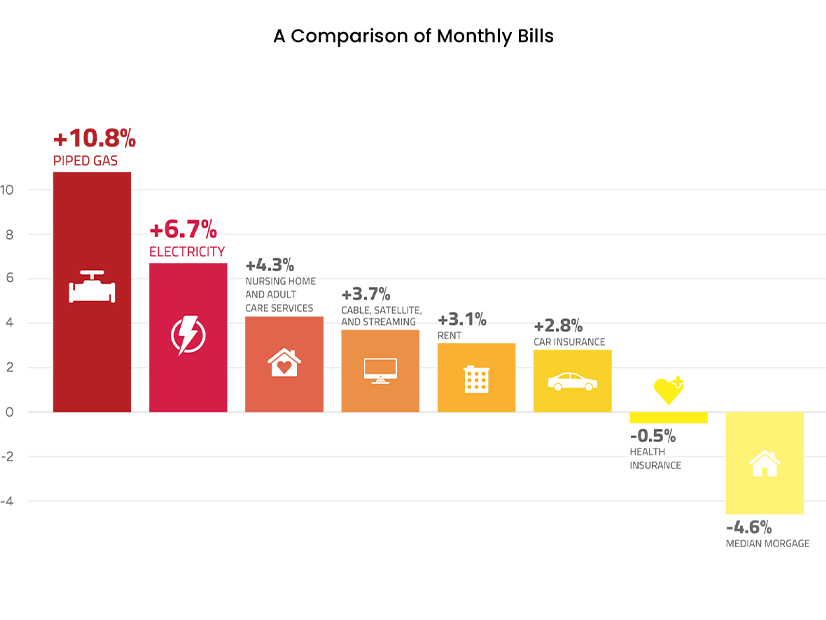
Monthly utility bills — which include charges and/or credits beyond rates — increased 10.8% for piped gas and 6.7% for electricity from December 2024 to December 2025 while the overall U.S. inflation rate was just 3%, the authors write. Since the first quarter of 2021, residential retail electricity prices have increased approximately 40%.

Electricity and natural gas prices have become the fastest drivers of inflation, the report states.

Commercial and industrial electric prices did not increase as sharply as residential prices in 2025, only about 5%. But such increases typically are passed on to consumers through higher costs for goods and services.

A March 2025 poll conducted by Ipsos for PowerLines concluded three in five Americans were not familiar with the public regulatory board that controls their utility bills, three in four are concerned about rising utility bills and four in five feel powerless over these costs.

Data from the U.S. Bureau of Labor Statistics shows that utility prices for gas and electricity increased much more significantly than some other major household expenses. | PowerLines

Against this backdrop, it was inevitable perhaps that rising utility bills would become a leading political issue. PowerLines expects these costs to be a top concern for voters in the midterm elections, particularly in competitive 2026 congressional and gubernatorial races.

The report notes that early projections for 2026 do show some moderation: The Energy Information Administration expects electricity prices to increase about 4%, but that still is much more than the Federal Reserve’s projected 2.4% inflation rate.

Collecting data from public databases, news reports, press releases and utility regulatory filings, PowerLines counted $30.5 billion in 2025 rate increases compared with $15 billion in 2024.

The impact was most intense in the Northeast, where $6.5 billion in rate increases spread across 11.5 million customers were sought. The least intense impact was in the Midwest — $3.2 billion in increases affecting 16.7 million customers.

In between were the South ($14.3 billion across 32.9 million customers) and West ($6.5 billion across 20 million customers).

Each of the rate increase requests is different, but four key factors emerged as PowerLines analyzed the data collected: aging infrastructure that needs to be replaced; repairing damage from past extreme weather or making upgrades to prevent future damage; volatile fuel costs; and rising electricity demand, although some utility markets and some investments are structured so that rising demand can lower electricity prices by spreading costs over a broader customer base.

The authors note  that utility capital expenditures — a key driver of profit for utilities and costs for their ratepayers — increased more than 14% between 2024 and 2025.