ROUND ROCK, Texas — A slew of “pent-up” interconnection requests from large load customers submitted by Oncor Electric Delivery has pushed the ERCOT queue for interested data centers and crypto miners to over 410 GW.
The large load interconnection queue stood at 238 GW in early March. However, ERCOT staff said they have received 137 new interconnection submissions since then totaling about 140 GW of new large loads by 2036. Oncor submitted about 130 GW of those requests, almost as much as the grid’s current nameplate generation capacity of about 150 GW.
“It looks like there were some pent-up projects that had not yet gotten into the queue,” ERCOT CEO Pablo Vegas said while meeting with reporters March 31 during ERCOT’s annual Innovation Summit. “They all kind of landed in a one-week period.”
Vegas delivered the same news to the Texas Senate Business and Commerce Committee April 1 during its first interim hearing before the 2027 legislative session begins in January. Committee members were unfazed.
“Import the sun directly to Texas. Hook it up to our grid,” cracked committee Chair Charles Schwertner (R).
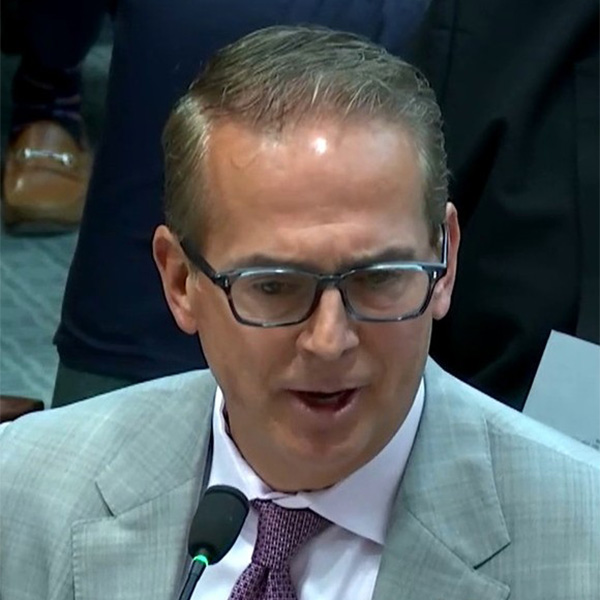
ERCOT CEO Pablo Vegas | Texas Senate
Load projections are submitted to ERCOT by transmission companies, who work directly with the interested customers and have “varying approaches to complying” with state law, Vegas told senators.
“ERCOT is continuing to work through new processes to study large loads in a coordinated manner as part of transmission system planning,” Oncor told RTO Insider in an email. “Oncor periodically formally requests new study assignments for large loads seeking interconnection to our system. To ensure ERCOT has appropriate visibility during this process development, we recently provided an extended scope of our requests. Oncor will continue to provide updated interconnection requests as appropriate.”
The Public Utility Commission has filed a proposed rule change that would establish interconnection standards for large load customers. The rule would require those customers to execute an intermediate agreement that makes certain disclosures before their projects’ inclusion in an interconnection study and to post $50,000/MW in financial security. Within 30 days of the completion of the study, the customers would have to execute an interconnection agreement that updates their disclosures and pay a nonrefundable $50,000/MW interconnection fee (58481). (See Texas PUC Proposes Large Load Interconnection Standards.)
“Those same requirements could be used to effectively filter down the load forecast to a realistic number,” Vegas said.
Asked how long the “gold rush” of large loads flocking to Texas will last, PUC Chair Thomas Gleeson told the committee: “This is something that will definitely be here for the foreseeable future. I really believe, from the companies I’ve talked to, that … it may not be this upward trend. It’s such a high slope. But I do think we’re going to continue to see data centers look to locate here and get power from us for at least five to seven years.”
“This cycle is about a five-year cycle we’re going to see develop,” Vegas said, “and then we’ll have to evaluate what’s ahead.”
In the meantime, the Texas grid will be in the Legislature’s crosshairs. Lt. Gov. Dan Patrick has issued eight interim charges for senators to study in preparation for the 2027 session. The first four all relate to ERCOT and the grid, including:
assessing the state of the grid;
managing the effect on 765-kV transmission lines on landowners’ rights;
modernizing transmission and improving affordability; and
managing data center growth.
The House of Representatives’ interim charges focus on similar issues.
“These interim charges reflect issues Texans have asked the Senate to study,” Patrick said in a statement. “When the 90th regular legislative session begins … the Texas Senate will move quickly to address these priorities and many more.”
The Bonneville Power Administration could end up revising its rates to tackle the financial fallout of a federal judge in Oregon ordering increased spill levels at eight dams on the Columbia and Snake rivers.
In the wake of the court-ordered injunction, BPA staff hosted a workshop March 30 to discuss proposed revisions to the 2026-2028 power general rate schedule provisions.
Before the injunction, the agency expected to end fiscal year 2028 with $397 million in financial reserves. But with the court order, if it were to take no action, the agency anticipates ending 2028 with $196 million in reserves, according to Daniel Fisher, BPA’s power rates manager.
“That’s a big number. There’s just no way around that,” Fisher said.
The agency said the court order changes how it operates its system and the inventory levels from what it had anticipated when it set rates for the FY26-28 period (BP-26).
To tackle the issue, staff presented several solutions, each of which assumes the agency is $85 million worse off in each year of the three-year rate period relative to the rates set under BP-26, according to their presentation.
Staff prefer a solution that includes collecting $125 million in expected costs upfront in fiscal years 2027 and 2028. The solution includes an end-of-year true-up provision that would return a portion or all $125 million if BPA’s financial reserves attributable to power are higher than 90 days’ cash at the end of each year.
Under the solution, called Conditional PNRR, BPA expects to end fiscal year 2028 with $392 million in financial reserves, $5 million lower than the pre-injunction results. Staff said they favor the approach because its last true-up occurs at the end of 2028 rather than at the end of 2027.
“This increases the chance that BPA will start the new contract with financial reserves at a level similar to that had BPA known about the court-ordered operations when it first set BP-26 rates,” according to the presentation.
Another solution would entail a new surcharge capped at $125 million. The surcharge “would trigger if fiscal years 2026 and 2027 ended below 90 days’ cash and would collect the difference up to the cap of $125 million in the next fiscal year,” it says.
Utility representatives voiced support for BPA’s efforts to address the financial impact of the court order.
Garrison Marr, senior manager of power supply at Snohomish County Public Utility District, said BPA moving quickly on the rate case process “helps us for transparency for utility planning; helps with risk reduction … and cost certainty in the context of the spill injunction.”
Marr said Snohomish leans in favor of the Conditional PNRR solution.
Chris Roden, director of energy resources at Clatskanie People’s Utility District, said he appreciates BPA addressing potential impacts early.
“It’s helpful for a utility that does concurrent ratemaking that’s largely driven by Bonneville to have a certain amount of certainty in our planning assumption, so that when we go through our own processes, we know what to bake in,” Roden said.
He added that staff have done a “good job” of not “getting stuck in the muck of politics, administrative outcomes. … Just sticking to the guns of good, prudent financial policy.”
BPA aims to issue an initial proposal in early May with testimony and supporting documents.
Court Injunction
The issue stems from a Feb. 25 court order in which U.S. District Judge Michael H. Simon granted a preliminary injunction sought by the states of Oregon and Washington, tribes and environmental groups. The order requires the U.S. Army Corps of Engineers and the Bureau of Reclamation to spill large amounts of water over the eight dams instead of running it through turbines to protect migrating salmon and steelhead in the Columbia and Snake rivers. (See Judge Orders Spill at Northwest Dams to Aid Salmon, Despite Energy Concerns.)
The long-running case now concerns an environmental impact statement and a biological opinion from 2020 that the court ordered the federal agencies to prepare for the Federal Columbia River Power System.
In challenging the analysis, the plaintiffs alleged the Army Corps’ plan failed to adequately protect salmon.
The case was stayed under a deal plaintiffs struck with President Joe Biden, which included, among other things, $1 billion toward salmon restoration. President Donald Trump upended the deal in June 2025. The Trump administration said it would have several negative impacts on energy production, shipping channels and water supply for local farmers. (See Trump Directs Feds to Withdraw from Deal on Snake River Dams.)
When the case resumed, plaintiffs asked for injunctive relief beginning March 1, urging the court to require federal defendants to increase spill levels, lower reservoir levels and implement emergency conservation measures for the salmon.
In granting the request, Simon said the injunction includes a provision for the federal agencies to adjust spill for emergency power generation and transportation needs. However, he rejected arguments that increasing spill levels could impact power generation, saying the granted relief is “narrowly tailored and essentially maintains the status quo.”
Talen Energy’s proposal to buy more than 2.5 GW of generation from Energy Capital Partners will lead to a more concentrated PJM market and more market power for the fourth-largest generator in the RTO, the PJM’s Independent Market Monitor said in comments filed with FERC on March 31 (EC26-59).
The deal for the Cornerstone Generation portfolio does not fail FERC’s Herfindahl-Hirschman Index (HHI) thresholds in a delivered price test Talen included in its application to buy the three power plants from ECP, which in turn bought them from ArcLight and Blackstone in 2025. The additional generation would increase Talen’s PJM generation portfolio from 13,139 MW to 15,684 MW.
While the deal does not break any HHI thresholds, Monitoring Analytics said the pivotal supplier test shows Talen already has market power and the deal would increase it.
“There are gaps in the market power mitigation rules for the PJM energy, capacity and ancillary services markets,” the IMM said. “The existence of pivotal suppliers in the PJM markets, along with insufficient market power mitigation, means that all increases in structural market power undermine the competitiveness of the PJM markets.”
The IMM said the deal should be approved only if Talen agrees to behavioral commitments, which would not burden the applicants because they only ensure competitive behavior. FERC should reject the initial application and require it be refiled with commitments, otherwise it would not be consistent with the public interest, the Monitor said.
“The broader question for the commission’s merger policy is whether any transactions that result in incremental increases in market power in the PJM capacity market, or any PJM market, without clear behavioral conditions should be approved as consistent with the public interest given the fact that the PJM capacity market is already characterized by endemic market power,” the IMM said.
The current need for new generation in PJM is an opportunity for increased competition and new entry, but generation ownership is instead being consolidated in a small group of owners, it contended.
“Talen has been one of the largest owners of generation in PJM since its creation in 2015,” the IMM said. “Talen is one of the top five owners of PJM capacity and recently acquired two large gas fired combined cycle resources, the Moxie Freedom and Guernsey plants, in 2025. Other owners in the top five also have recent and/or pending transactions: Constellation, Vistra and ArcLight. The market power created by this ownership consolidation creates the potential for additional upward pressure on PJM energy and capacity prices, at a time when data center load growth is already resulting in noncompetitive prices.”
FERC needs to consider the consolidation trend in every merger application for assets in PJM that comes before the agency, the Monitor added.
‘Even Greater Risk’
The commission has been relying on HHI tests as its primary market power screen for decades. HHI is the sum of the squared market shares of all market participants, and even a supplier that passes the screen can still raise market prices above a competitive level.
The market power mitigation rules for the energy market rely on the assumption that enough competitive sellers exist so that if anyone tried to raise prices, another would underbid it at a competitive price.
“This assumption requires that the total demand for energy can be met without the supply from any individual supplier or without the supply from a small group of suppliers,” the IMM said. “This assumption is not correct when there are pivotal suppliers in the energy market. In 2025, there were pivotal suppliers in the aggregate energy market on 95.3 percent of days.”
The capacity market is extremely tight, and that is expected to continue for the foreseeable future, leading to prices above historical norms that only increase the impact of market power.
As far as specific behavioral requirements for Talen, the IMM said the firm should commit to keeping existing capacity in the market, instead of withdrawing it to serve data centers via colocation. Removing existing capacity would make the market less competitive and lead to higher rates for consumers.
“The fact that PJM is already short of its reliability target and that PJM faces very significant levels of forecast data center load makes this reliability impact an even greater risk,” the IMM said. “Allowing the removal of capacity to serve data center load shifts the costs and risks of data centers from data centers to all other PJM customers.”
The IMM also suggested several ways Talen should be limited in its market bids and a commitment to retire units only when they are uneconomic.
NEW ORLEANS — A sitting state commissioner and two former regulators have asked MISO to publicly share any information it might gather on its Independent Market Monitor’s possible involvement in a five-state complaint against the RTO’s long-range transmission planning.
The regulators emphasized the need for transparency after emails surfaced pertaining to the drafting of the complaint.
Their requests come after Manifest Energy, a new group focused on ratepayer interests and industry transparency, in late March published a trove of emails from 2025 that circulated among state regulatory staff, outside counsel and consultants working on the complaint against MISO’s second, $22 billion long-range transmission plan (LRTP) portfolio approved in late 2024.
State utility commissions from Arkansas, Louisiana, Mississippi, North Dakota and Montana filed their complaint in July 2025, asking FERC to order MISO to revoke the classification of its second, $22 billion LRTP portfolio and nullify the portfolio’s load-ratio share cost allocation.
The states contend MISO and its board erred by advancing transmission projects that will cost more than the value they can provide and said FERC should scrutinize all the RTO’s future business cases supporting LRTPs (EL25-109).
Around the same time as the emails’ release, MISO board members authorized a third-party review of IMM best practices. MISO has neither confirmed nor denied a link between the review and the email discovery.
At a March 26 meeting of MISO’s Board of Directors, Director Theresa Wise said the best practices review is sensible given that the RTO subjects other vendors to such a standard.
Patton has said his involvement with the parties who authored the complaint was limited to explaining his own transmission cost-benefit analysis that the complaint relied upon. He said he neither strategized with the complainants nor helped them draft the complaint.
Norris: MISO ‘Well Within’ Scope to Prod
Speaking for the Natural Resources Defense Council, John Norris, a former FERC commissioner, Iowa Utilities Board member and president of the Organization of MISO States, said he is concerned about the “genesis and construction” of the LRTP complaint.
During the March 26 meeting, Norris urged the MISO board to be open about what they discover.
“That notion of secrecy and surprise … don’t devolve into that. There’s nothing to be gained from the element of surprise.”
Norris said MISO is “well within its scope” to ask for a complete report from the IMM that outlines when the engagement began and how long it lasted, the nature of the engagement, and “what input was provided on the construction and drafting of the complaint.” The RTO is “entitled to know” those details, he added.
MISO should “take the initiative” to uncover those details while the LRTP complaint remains outstanding, Norris said.
“I would encourage you to act on this right away. Transparency is critical to public trust in our process. Any divergence from that … should not be permissible,” he said. “As best I can tell in talking to folks, MISO wasn’t aware. That concerns me.”
Norris said if he were still a FERC commissioner, he’d be interested in what transpires.
“How do you give an independent assessment when there was at least some level of engagement that impacts your ability to provide an independent assessment?” he asked.
Norris said based on “what I’ve seen so far of the documentation provided … something does not add up.” He noted the engagement between Patton and those authoring the complaint seemed to span months based on email chains.
“It’s just, ‘Come clean,’” Norris said later in an interview with RTO Insider.
Speaking before the MISO board, Norris said the process behind the complaint “diverted from” what he remembered as a culture of mutual respect and openness while involved with OMS. He lamented that a majority of OMS members “this time weren’t a part of the conversation.”
“Transparency is essential for continuity of investment and for public trust,” he said. “That’s what troubled me about both the process and the complaint — is that all MISO states have been open with each other and shared positions and unequivocally accepted dissent, so what was the need for the secrecy around the action of six OMS members?”
Norris contended that MISO South’s aversion to transmission planning now stands to affect MISO Midwest’s transmission planning successes.
“The genesis of this complaint comes from MISO South, and it’s the same set of stall tactics that have prevented long-range transmission from ever getting off the ground in 13 years,” Norris said.
Entergy and others joined MISO in 2013, creating MISO South. Norris was one of the FERC regulators to approve the utility’s membership, but he has since criticized a lack of regional transmission planning in the South and has said given what he knows now, he would not have cast a vote for Entergy to join MISO.
Norris said one thought struck him while meeting with young members of MISO’s Environmental Sector during the RTO’s Board Week: “You’ll probably be middle-aged before a long-term transmission project is built in MISO South.”
Norris told the board he’s a “longtime believer of long-range transmission planning and building for the future.”
“Planning is critical. We owe it to the next generation to get this done,” Norris said.
Differing Views
On the other hand, former FERC Chair Mark Christie, now director of the Center for Energy Law and Policy, supported Patton on social media.
Christie said both the PJM and MISO monitors are “frequently attacked by interest groups who don’t like it when the IMMs do their jobs.”
“Their job is to put out the facts with independent analysis, regardless of which interests don’t like it,” Christie said, calling Patton an “invaluable neutral analyst.”
“Patton correctly understands that transmission planning, which costs consumers literally trillions of dollars, should be subject to the same scrutiny as markets,” Christie wrote in a March 31 LinkedIn post.
But Energize Strategies’ Ted Thomas, former chair of the Arkansas Public Service Commission, seconded the call for transparency.
“When you’re dealing with decisions of this scale, transparency is what gives the process credibility,” Thomas said in an email to RTO Insider. “If discussions involving the Independent Market Monitor occurred before FERC had issued an order clarifying its authority under the tariff to weigh in on transmission matters, that timing raises reasonable questions about role clarity and process.”
“Stakeholders deserve transparency on that point,” Thomas said. “At the same time, we shouldn’t lose sight of the bigger picture — a reliable, well-planned transmission system is essential to keeping costs down. The goal should be disciplined governance and continued investment, not uncertainty that ultimately puts ratepayers at risk.”
Ham: ‘Clear’ the Perception
Minnesota Public Utilities Commissioner Hwikwon Ham said if MISO’s review delves into the extent of communications between the IMM and states regarding the LRTP complaint, then the RTO should present public findings to its stakeholder community. He said trust relies on public information.
Ham said it’s “too soon to tell if trust has been violated” regarding the IMM.
“I don’t think the IMM office’s intention is anticompetitive behavior. … But we need to make sure we have trust in the IMM’s office. At least if there’s some perception in the community, I think we need to clear that perception,” Ham told RTO Insider. “[Possibly] being associated with that kind of activity makes his office less credible — that’s my concern.”
Ham said the perception that the IMM could have “potentially taken a side” and engaged with testimony while later intervening in the complaint “makes me uncomfortable.” He added that he had no direct knowledge of the communications until the release of the emails.
Ham said he’s engaged the IMM for his advice many times over the years, particularly in regard to understanding the effect a sloped demand curve would have on MISO’s capacity market.
Ham said what appears unusual about this instance is that it involves parties protesting an adopted MISO stakeholder agreement. He said personally, he’s never heard of the IMM becoming involved in a protest of MISO processes.
Ham stressed that he and the Minnesota PUC “strongly support a market monitoring function at the RTO.”
Above all, the complaint is about allocating the cost of MISO’s long-range transmission lines, Ham said. He said the discord could mean it’s time for stakeholders to revisit MISO’s cost allocation methodologies.
“Hopefully people are more focused on doing it than fighting over this. That is my wish,” Ham said. “Hopefully, MISO and OMS can regroup and talk about long-range cost allocation. Hopefully, everybody can focus on the core issue, and everyone can agree on a solution to this. Because the nation needs those transmission lines.”
Ham said it’s not a problem that OMS contains differing views across the states.
“Overall, I think OMS is not a consensus organization,” he said, adding that he’s there to protect Minnesota’s best interests while other states act in their best interests.
Ham recounted that when he worked previously as a PUC staff member, he and now fellow Commissioner Joseph Sullivan spent about three years starting in 2020 trying to create cost allocation solutions that would work across the MISO footprint.
“I strongly believed we could do that,” Ham said. “That’s why it’s very painful for me to see this secondary legal challenge rather than solutions through the OMS process.”
A draft order from the Public Utilities Commission of Nevada signals that the commission is likely to approve NV Energy’s participation in CAISO’s Extended Day-Ahead Market, but with conditions to address stakeholder concerns.
The draft order, released March 31, would grant NV Energy’s request to join EDAM in fall 2028. The commission is to vote on the order April 3.
In potentially granting NV Energy’s request to join EDAM, the draft order noted the company’s positive experience with CAISO’s Western Energy Imbalance Market. And being a WEIM participant is expected to reduce implementation costs for joining EDAM, the draft order stated.
The draft order also pointed to NV Energy’s “numerous, significant interties” with other expected EDAM participants. Those include eight direct interconnections with CAISO and connections with Idaho Power, Los Angeles Department of Water and Power, and PacifiCorp.
Diverse energy resources available through EDAM was another factor in the draft decision.
NV Energy filed its request to join EDAM on Oct. 22 as an amendment to its 2025-2027 Energy Supply Plan. (See NV Energy Files Request to Join EDAM.)
The application cited a Brattle Group study that projected the company would save $93.1 million a year by joining EDAM relative to participating in WEIM alone. In contrast, joining SPP’s competing day-ahead market, Markets+, would increase annual costs by an estimated $7.3 million.
Some parties argued that the benefits to NV Energy of joining EDAM are uncertain because they’re based on assumptions in a production cost model. They said the commission should wait until EDAM is in operation in 2026 and 2027 before finding it’s prudent for the company to join. (See Caution Urged as Regulators Consider NV Energy’s Request to Join EDAM.)
The draft order said that “while the commission finds and agrees that there will be benefits [from joining EDAM], the commission cannot find that $93.1 million is a precise estimate of projected benefits.”
The draft order would require NV Energy to come up with a way to measure annual adjusted production cost savings from EDAM participation.
“The commission finds that NV Energy’s potential APC savings are seasonal and highly dependent on NV Energy’s ability to acquire excess California solar energy at very low, zero, or negative cost during limited hours of the day in the spring,” the draft order said.
The draft order also addressed surcharges to EDAM participants who don’t meet a daily resource sufficiency evaluation (RSE). NV Energy argued that it has enough resources to pass the RSE and doesn’t expect to pay any surcharges. The draft order says if there are RSE surcharges, company shareholders will be responsible for paying them.
Another stakeholder concern was that NV Energy has not yet revised its Open Access Transmission Tariff. The commission’s draft order includes a requirement for the company to file reports on the progress of its OATT stakeholder process, with drafts, comments and responses posted to its Open Access Same-time Information System (OASIS).
In comments filed to FERC, NERC opposes a proposal that would require the ERO and utilities to harden the grid against space radiation and electromagnetic pulse (EMP) attacks, claiming the proponents offers “no new compelling facts” to support their recommendations (EL26-49).
The proposal by the Center for Security Policy (CSP) and the Secure the Grid Coalition (STG) drew support from a range of commenters, including scientists, engineers, lawmakers and lobbying groups. In comments filed March 30, they described the risks raised by CSP and STG as “not speculative” and NERC’s relevant reliability standard TPL-007-4 (Transmission system planned performance for geomagnetic disturbance events) as “a false assurance” that is inadequate to protect the grid.
CSP and STG’s complaint, filed March 9, called for FERC to direct NERC to study electric utilities’ risk exposure to disruption by ground-induced current (GIC) from solar weather and EMPs, and for the commission to incentivize utilities to harden their systems through rate recovery.
‘Catastrophic’ Threat from GICs
The threat from GICs is “both inevitable and catastrophic,” the groups argued, citing testimony to Congress in 2019 in which Joseph McClelland, director of FERC’s Office of Energy Infrastructure Security, warned that such events “pose substantial risk to equipment and operation of the nation’s electric grid.” GIC-related damages to the U.S. power grid cause almost $7 billion in economic losses each year, they continued, referring to a study published in the journal Space Weather, and are likely to grow as the construction of data centers accelerates.
Publications from the U.S. Department of Energy and a U.S. Senate commission on EMPs, as well as the International Electrotechnical Commission’s (IEC) EMP protection standard, support hardening the electrical system to withstand GIC events with a field strength of 85 V/km, the groups observed. But, they continued, TPL-007-4 “does not protect against [GICs] … which routinely damage equipment in the” electric grid.
In fact, the model used to create the standard “purposely excluded” a 1921 solar storm that produced a strength of 20 V/km, the groups alleged, criticizing NERC’s consensus-based standards development process as designed to produce “the lowest common denominator to achieve sufficient votes by the regulated industry.”
To address the GIC threat, the groups asked that FERC direct NERC to survey all registered entities by requiring a “technical assessment of all covered equipment to determine vulnerability to GICs.” They requested the assessment require:
Modeling behavior of equipment under peak magnetic field strength of 20,000 nanoteslas or peak electric field strength of 85 V/km, using waveforms in the IEC EMP standard.
Assuming GIC exposure with transformers fully loaded.
Modeling transformer age and condition according to standards of the American National Standards Institute and the Institute of Electrical and Electronic Engineers.
Determining vulnerability to “half-cycle saturation, GIC-induced harmonics, reactive power consumption, hot spot generation and insulation degradation.”
They also requested that the commission “provide cost recovery for assessment and GIC protection to 85 V/km.”
NERC Claims No Basis for Complaint
NERC’s March 30 response asked that FERC deny the complaint, claiming it “fails to set forth the basis in fact and law for the positions taken and fails to demonstrate the existence of any action or inaction that is inconsistent with applicable laws.”
The ERO wrote that the groups’ objection to TPL-007-4 “appears to rest on an inaccurate understanding” of the standard, which was developed to address the risk of geomagnetic disturbances from solar storms rather than EMP attacks. NERC reminded the commission that “extensive rulemaking proceedings” and studies preceded the adoption of the original TPL-007-1 standard, and that FERC found it and all of its successors to be just, reasonable and in the public interest.
The ERO pointed out that its analysis of a GMD event that occurred in May 2024 showed the electric grid “experienced few … impacts” during the storm. This was the first major GMD event since TPL-007-1 took effect, NERC wrote, indicating that TPL-007-4 and other GMD-related standards “are operating as intended to protect the grid during severe solar storms.” NERC said the complainants’ call for a study, and their focus on the threshold of 85 V/km, was “a collateral attack on matters settled long ago.”
The ERO also asked whether STG and CSP wished to move toward a “technology mandated” approach that prescribes specific remedies, citing a section of the complaint in which the groups called GIC-blocking devices “proven and validated” and suggested requiring it on U.S. grid transformers.
NERC wrote that GIC blockers “are an important tool in mitigating potential GIC risks,” but warned that deploying them at scale requires considerable analysis and potentially increases risks to grid reliability “due to potential issues with installation and misoperation.” The ERO reminded FERC that such factors are why NERC prefers a “technology-neutral” approach that allows registered entities the flexibility to choose their own best solutions.
Most Comments Support Original Complaint
Despite NERC’s defense of TPL-007-4, additional comments filed in the docket overwhelmingly supported the original complaint, indicating widespread concern about the risk of grid disturbances from GIC events.
Individual respondents included Tennessee state Sen. Janice Bowling (R), who wrote that she has “observed a major reluctance of utilities … to address the GIC threat with hardware protection because they are afforded no financial incentives from FERC to do so.” She requested the commission “thoroughly investigate” the issue and make the findings available to the state Senate, where a bill sponsored by Bowling to require investigation of GICs’ impacts on the grid is under consideration.
Similarly, Texas state Sen. Bob Hall (R) wrote that despite “numerous forms of legislation,” the Texas grid remains vulnerable to GICs, for which he blamed a lack of “financial incentives for utilities to take aggressive action.” He also called on FERC to investigate the complaint and “create proper financial incentives” that will allow Texas regulators “to do the same for the utilities under their jurisdiction.”
The Foundation for Infrastructure Resilience (FIR), a nonprofit focused on preparing the U.S. for extended widespread grid failures caused by natural disasters, EMPs or physical and cyberattacks, wrote that “the GIC threat is not speculative” and the “regulatory and financial framework” to support needed resilience measures is not in place. Like NERC, FIR wrote that it prefers technology-neutral solutions and suggested the commission “frame any resulting reliability standard or order in terms of performance outcomes and engineering thresholds.”
Andrew Scott, a geologist affiliated with FIR, observed in a separate comment that geological evidence indicates the Earth has experienced multiple solar storms with field strengths of over 200 V/km. He compared NERC’s current approach to GICs to “placing fire sprinklers in one room of a house rather than across the entire structure, and then claiming the house is fully protected from fire.”
“Much money is saved by installing only one sprinkler, and everything looks great until a fire occurs. But to assume or claim the structure is fully protected and safe is misleading at best, deceptive at worst, and most likely fatal to those trapped inside the structure,” Scott wrote. “The unrealistic NERC TPL-007-4 GMD values must be increased upwards to 85+ V/km to address realistic threats to the power grid.”
“No Virginian should ever have to choose between seeing their doctor, paying their rent or mortgage, or keeping their lights on,” Spanberger said in a statement. “I am signing this legislation to respond to the real, pressing concerns I have heard from Virginia families across the commonwealth about high costs — particularly at the pharmacy counter, in the housing market and on their utility bills. I’m grateful to the lawmakers who made addressing rising costs a priority during this legislative session.”
The new laws include:
HB 1191 and SB 377, which permit high-energy-use customers to invest in substations that cooperatives need to serve them that are then turned over to the co-op upon completion;
HB 369, which encourages investment in cutting-edge energy technology, like fusion and nuclear;
SB 505, which evaluates how to best protect ratepayers from excessive costs from spikes in fuel market prices;
HB 562, which encourages co-ops to provide more reliable power for customers and help ease demand elsewhere on the grid;
HB 889 and SB 497, which streamline permitting of new high-voltage infrastructure in existing utility and highway corridors; and
HB 1225 and SB 407, which support the development of electric vehicle charging stations.
Spanberger said she would take additional action, including signing more legislation meant to cut costs for consumers.
Less than a week before signing the bills, Spanberger signed an executive order that creates a new cabinet-level position, the chief energy officer, and named Josephus Allmond to the new role. He will work with Spanberger, other state officials, PJM and utilities to address rising energy costs, increase clean energy and develop a statewide energy strategy.
“It is critical to make sure families and businesses have access to affordable, reliable energy so that Virginia businesses can stay competitive, while also meeting our long-term clean energy goals,” Spanberger said in a statement. “Throughout his career, Mr. Allmond has gained extensive experience in Virginia’s energy industry — through litigating numerous regulatory cases and successfully advocating for legislation to bring Virginia into our energy future.”
Allmond is an energy lawyer, most recently working as staff attorney at the Southern Environmental Law Center, for which he litigated dozens of utility regulatory cases before the State Corporation Commission.
“By maximizing the use of our existing grid, making sure high-energy-use customers are not driving up energy bills for everyone else, and prioritizing the deployment of more homegrown clean energy and battery storage, we will ensure that our energy future remains sustainable, predictable and — most importantly — affordable for Virginians,” Allmond said in a statement.
FERC has approved ISO-NE’s proposal to replace its Forward Capacity Market with a prompt market, cutting the time between auctions and commitment periods from more than three years to about one month (ER26-925).
The new rules will take effect for the 2028/29 capacity commitment period (CCP), which begins June 1, 2028. ISO-NE held its last Forward Capacity Auction, FCA 18, in February 2024 for the 2027/28 CCP.
FERC’s March 30 approval marks the end of the first phase of ISO-NE’s Capacity Market Reforms (CAR) project. The RTO is amid stakeholder discussions on the second phase of the project, which centers around capacity accreditation changes and the division of annual CCPs into winter and summer seasons.
Under the new design, only resources that have achieved commercial operations will be allowed to participate in the Annual Capacity Auctions. A key motivation driving the prompt market proposal was ISO-NE’s desire to eliminate “phantom entry,” which occurred in the FCM when non-commercial resources obtained capacity supply obligations (CSOs) but failed to come online in time for the commitment period.
ISO-NE has argued that the new auction format will help protect the region against increasing uncertainty in load forecasts. While New England states have set ambitious electrification goals, the RTO has scaled back its electrification forecasts in recent years because of slower-than-expected electrification adoption. And while the data center boom has yet to hit New England, the potential for new large loads adds additional uncertainty to the forecasts.
“The combination of forecasted demand growth into the next decade, and the uncertainty over the extent of such growth, underscores the value in transitioning from the three-year forward market construct to the proposed prompt market construct,” ISO-NE wrote in its filing.
Accurate demand forecasting “will be especially important when accounting for data centers and other large load proposals, which are often highly uncertain in terms of proposal attrition rates, relative construction time and electric demand characteristics,” it added.
The approved changes also include provisions affecting resource deactivations, resource qualification and the auction clearing mechanism, and will eliminate the need for annual capacity reconfiguration auctions.
In the prompt market, the resource retirement process will be decoupled from the auction qualification process. Retiring resources must submit deactivation notices a year prior to the applicable commitment period. In the forward market, ISO-NE processed retirements about four years prior to each CCP.
The RTO has said the reduced notification period will enable resources to make retirement decisions with more up-to-date market information, while still giving the region some time to respond to deactivations. In the NEPOOL discussions of the changes, some stakeholders expressed concern that reducing the notification timeline will increase the likelihood and duration of reliability-must-run agreements.
All commercially available capacity resources that do not deactivate will be required to participate in the auction.
The new qualification process includes a February deadline for data submission and an April deadline for new resources to demonstrate they have achieved commercial operations. Each auction will be held in early May prior to the June 1 start of each CCP.
The move to a prompt auction will affect which costs that participants are allowed to incorporate into capacity offers. Bids are supposed to reflect the incremental cost of assuming a CSO, and costs associated with investments made in resources prior to the auction cannot be included in bids.
But ISO-NE argued this will “not necessarily lower capacity offer prices,” as it impacts just one factor affecting offer prices in the auction. The RTO told FERC the transition to a prompt market will allow for more efficient market outcomes but will not systematically influence the trajectory of clearing prices.
“The change in the timing of the capacity auction does not change the fundamental pricing dynamics within the capacity market,” Chris Geissler, director of economic analysis at ISO-NE, wrote in testimony supporting the RTO’s proposal.
The prompt market proposal received near-universal support from the NEPOOL Participants Committee, and a range of commenters expressed general support for the RTO’s filing with FERC. (See NEPOOL Supports First Phase of ISO-NE Capacity Market Reform.)
The New England Power Generators Association (NEPGA) expressed concern about how the RTO would calculate the competitive price offer threshold, which determines whether an offer will be subject to review by the ISO-NE Internal Market Monitor. While NEPGA has argued that ISO-NE’s proposal to maintain its existing methodology would make it reliant on stale data, ISO-NE has committed to evaluating potential issues prior to the 2028/29 CCP.
FERC said the new design will reduce both supply and demand uncertainty. It agreed the retirement changes “will allow market participants to make their retirement decisions based on better information about market conditions, revenues, costs and the remaining economic life of the resource.”
“We’re pleased to receive the commission’s approval on the first phase of capacity market reforms, which enjoyed broad support from stakeholders and the New England states,” ISO-NE said in a statement. “We look forward to this collaboration continuing as we develop the second phase of reforms ahead of a filing with the commission later this year.”
While the prompt market changes are intended to be able to stand on their own, ISO-NE hopes to implement both phases of the CAR project for the 2028/29 CCP. But the second phase is widely considered to be the more controversial component, and there is no guarantee ISO-NE will obtain approval of these additional changes in time for the commitment period.
The Smart Electric Power Alliance’s update to its Database of Emerging Large-Load Tariffs (DELTa) shows how much the concept is spreading for utilities as state regulators grapple with a surge in load growth driven by new large customers.
SEPA created DELTa in partnership with the North Carolina Clean Energy Technology Center to track the proliferation of utility tariffs for large load customers after hearing interest from its members that include utilities, regulators and tech companies, SEPA’s Ann Collier said during a March 30 interview with RTO Insider.
“Everyone would like to know what are the solutions and strategies they have to meet load growth in a way that not only protects existing customers from some of the cost or reliability risks that we’ve seen come out in other papers, but also, to look proactively at this as a moment to do something good for the grid and to improve service to everyone,” Collier said.
The database, which anyone can download, shows 77 large load tariffs either in place or being considered at utilities around the country. Only 12 states neither have adopted nor are considering such a tariff.
Users can break down the data by whether the tariff has been approved and what kind of customers it applies to, by types like data centers or general commercial and industrial customers, and by how big a customer needs to be to qualify.
While hyperscalers have dominated headlines, just five states have large load tariffs that kick in at 100 MW or greater: Georgia, Kentucky, Michigan, Missouri and West Virginia. Florida, Minnesota, Virginia and Wisconsin are considering specific rules for customers at or above 100 MW.
Some states have found that the standard way of dealing with larger commercial and industrial customers with conventional tariffs and electric service agreements continues to work for them, Collier said.
“Of the states that are in DELTa, we see interest really accelerating,” Collier said. “It’s this hockey stick inflection point for the regulatory industry right now where we have 77 tariffs and service rules in DELTa right now with this quarterly update, and 29 of those were approved last year alone.”
The tariffs blend longtime principles used in traditional utility ratemaking with new contractual mechanisms that are seen as helpful for large customers participating in emerging industries, she added.
Before 2025, most tariffs SEPA was tracking were for smaller customers — applying to facilities with demand of 5-10 MW.
“Now we’re seeing that load threshold increase sort of in parallel with the emergence of hyperscale and frontier data centers,” Collier said. “So, thinking around what is large and what requires this new way of contracting for service is starting to change.”
Most of the tariffs characterize large loads by their size and load factor, but some get more specific and are aimed at specific types of customers, such as data centers or crypto miners. Other changes are designed to require data center projects to provide upfront interconnection deposits meant to weed out speculative projects shopping for the best, cheapest connections to the grid.
“We’re also seeing provisions that are meant to provide increased certainty to the utility over the long term,” Collier said. “So, contractual timelines and take-or-pay contracts terms where they’re used, they tend to settle in that 75-to-85% range.”
Other terms include different financial security provisions meant to limit the risks of stranded costs in the event of an economic downturn, or whatever causes a large customer to shut down before completion of the useful life of infrastructure built to serve it.
“The process of utility ratemaking is an art and a science,” Collier said. “And it’s not for me to really say how precise the science is going to be able to get here. But I know from broad conversations with utilities, with those in the regulatory community, and with those at data centers and large customers, that there is shared interest in figuring this out so that the degree of error is minimized. So, we’re looking for a risk-minimization approach here.”
Entergy announced a massive addition to Meta’s Hyperion AI data center project in northeastern Louisiana and said it plans to add seven additional natural gas plants to deliver more than 5 GW to power the site.
The expansion involves a second hyperscale data center, called “Project Evest,” adjacent to the Hyperion data center in Richland Parish and would further entrench Meta’s dependence on gas for its data centers.
Entergy Louisiana filed an application for an electric service agreement March 26, again asking the Louisiana Public Service Commission to approve a 20-year contract for the seven plants on a fast-tracked basis (U-37882).
Combined, the data centers would be supplied by 10 natural gas plants at nearly 7.5 GW. Entergy Louisiana already is building a trio of plants at 2.26 GW for the Richland Parish project: two in the parish and a third near Baton Rouge.
All told, the planned gas plants for the Meta facility would total more than half of Entergy Louisiana’s 12-GW load.
Entergy Louisiana CEO Phillip May promised the data center campus and its needs would be funded solely by Meta. Entergy claimed that Meta’s expansion would save customers a total of $2.67 billion through 2046.
May and other Entergy officials met with Louisiana Public Service Commissioner Foster Campbell, who represents the district, in his office March 27 to discuss the ballooning plans. Campbell told a USA TODAY affiliate that he supports the project “1,000%” and is confident the expansion will benefit ratepayers.
The Richland Parish data center “serves as a symbol of the ambition and scale of next-generation AI infrastructure,” Meta Vice President Rachel Peterson said in Entergy Louisiana’s news release.
Peterson said Meta has been “working closely with Entergy since early on-site planning to ensure our power needs are met and, importantly, so that Entergy’s other consumers aren’t paying our costs.”
In early March, Meta was one of seven major technology companies to sign on to the White House’s “Ratepayer Protection Pledge” to ensure data centers don’t raise electricity costs for American households.
Entergy’s plants would feature technological capabilities for future carbon capture and hydrogen co-firing. The utility said the generation would require about 240 miles of new 500-kV transmission lines connecting southern Louisiana to northern Louisiana and Arkansas.
Entergy also said Meta would fund up to 2.5 GW of new renewable energy, an unspecified amount of battery storage in three locations and power uprates in the utility’s existing fleet. Per Entergy, the agreement includes a “memorandum of understanding to explore the future development and use of nuclear power.”
Entergy said Meta would contribute $260 million to programs for low-income residential customers.
Louisiana’s primary consumer advocate group for utility customers met the news with unease.
Logan Burke, executive director of the Alliance for Affordable Energy, called the expansion “an unprecedented ask.”
“We’re talking about 10 new gas power plants and over $16 billion in new fossil fuel infrastructure. That’s a nearly 70% increase in Entergy Louisiana’s total gas capacity, adding to the already heavy dependence on the fuel, at a time when market analysts expect price volatility to continue,” Burke said in a March 31 press release.
Alaina DiLaura, a policy coordinator for the alliance, questioned the more than $2 billion benefit claim. She said it’s not clear how the PSC, should it act on an expedited basis, can “allow for the scrutiny necessary to verify those benefits and the supposed ratepayer protections.”
The alliance said the fleet of gas plants would drive a “huge increase in CO2 emissions,” at almost 26 million metric tons/year. The nonprofit drew attention to local reporting that Richland Parish residents already have been subjected to power outages and brown water coming out of taps while the Hyperion facility and first round of gas plants are built.
Meta aims to achieve net-zero emissions across its entire “value chain” within the next four years.
“Meta’s proposed expansion and Entergy Louisiana’s new application demands a full transparent review and an opportunity for the community to weigh in,” the Alliance for Affordable Energy said.