Participants in CAISO’s Extended Day-Ahead Market likely would remain subject to the market’s daily resource sufficiency evaluation even if they joined a new resource adequacy program that’s being crafted, developers of the new RA program said.
“The idea is it takes you right up to the doorstep of EDAM RSE. And then you participate in EDAM as designed,” said Jon Olson, director of energy trading and contracts at the Sacramento Municipal Utility District (SMUD).
The group developing the RA program is open to “some kind of swapping of RSE or potential obligations,” said Olson, who noted one goal of the program is to avoid the need for EDAM tariff adjustments.
Olson, along with Ben Faulkinberry of PacifiCorp, gave a presentation on the potential new RA program during a March 16 meeting of CAISO’s Western Energy Markets (WEM) Regional Issues Forum.
Participants in the RA project are PacifiCorp, Portland General Electric, Public Service Company of New Mexico, Los Angeles Department of Water and Power, NV Energy, the Turlock Irrigation District and the Balancing Authority of Northern California — of which SMUD is a member. The group is “self-organized,” Faulkinberry said, with CAISO involved as a technical consultant.
The group plans to release a draft design document in April. Faulkinberry said the document will leave “plenty of space for regional input.”
“Our intention was never to come out of the door with a fully baked, fully designed program,” said Faulkinberry, who is senior originator in PacifiCorp’s energy supply business unit.
WRAP Alternative
The new resource adequacy program is seen as an alternative to Western Power Pool’s Western Resource Adequacy Program (WRAP).
Participants in the day-ahead market competing with EDAM — SPP’s Markets+ — will be required to join WRAP. EDAM members also may join WRAP, but some expected EDAM participants have expressed concerns about the program and decided to withdraw. (See PacifiCorp Next to Leave WRAP After Raising Concerns.)
A variety of RA programs isn’t a problem for EDAM. CAISO has described the EDAM resource sufficiency evaluation as a “universal adaptor that connects entities with varying resource adequacy programs to efficiently commit/dispatch resources.”
Faulkinberry said the new RA program might appeal to utilities in Oregon, where jurisdictional entities must comply with state resource adequacy rules or participate in a qualifying regional program. The new RA program could become one such qualifying program.
One of the new RA program’s guiding principles is to use transmission connectivity within the EDAM footprint to allow capacity savings for customers. Market dispatch would be used for RA resource delivery, “so that the whole breadth and depth of the regional footprint could ensure that entities received megawatts when they needed them the most,” Faulkinberry said.
Other guiding principles include minimizing administrative burdens and having a common capacity counting standard, with ways to incentivize compliance.
Voluntary Offering
The RA program would be a voluntary offering, with an option for participants to withdraw if they feel it’s not working.
The group has been discussing a bevy of topics, such as methodology for capacity counting and load forecasts, transmission requirements, cure options if there’s a deficiency, binding-phase timing, transparency and ways to “instill trust in each other’s showings,” Faulkinberry said.
The presentation to the WEM Regional Issues Forum followed a March 7 letter that RA program developers sent to the CAISO WEM Body of State Regulators, outlining how the program could take shape. (See EDAM Utilities Moving to Develop RA Program.)
Following release of the draft design document, the group plans to solicit stakeholder feedback and issue a revised design document in the fall. That document then would be handed off to the Regional Organization for Western Energy (ROWE).
ROWE’s newly formed Formation Committee is scheduled to discuss the RA program March 19.
NERC CEO Jim Robb said in congressional testimony that while the bulk power system made it through the late January winter storm reliably, the weather highlighted how at risk it is.
“A system bordering on the edge during winter extreme should not be normalized,” Robb told the House Energy and Commerce Subcommittee on Energy on March 17. “A larger, colder, longer storm would have had far more consequence.”
To shore up the system, NERC has four primary recommendations, and the first is to effectively address permitting reform at the federal, state and local levels. Efforts to add new resources to the grid need to be accelerated; the industry needs to figure out how to reliably integrate large loads; and more work needs to be done to better coordinate the electric and natural gas systems, Robb said.
While the BPS did not see any major incidents, millions of consumers around the country lost power because of issues on the distribution system. American Electric Power’s Southwestern Electric Power Co. saw 200,000 of its customers lose service, utility President Brett Mattison said.
“Our experience during Winter Storm Fern and other recent winters reaffirm a core principle: Reliability depends on being able to call on a resource when it’s needed for as long as it’s needed, regardless of the weather,” Mattison said. “During the storm, coal supplied more than half of SWEPCO-owned generation supported by on-site fuel that ensured steady performance.”
Natural gas units provided needed flexibility, but they depend on pipeline delivery. SWEPCO also benefited from wind power, but Mattison said its intermittency means it cannot substitute for round-the-clock power.
Grid Strategies Executive Vice President Michael Goggin argued the opposite, saying wind and solar exceeded expectations, while fossil-fired plants suffered a high level of outages.
“Wind and solar resources performed well during Winter Storm Fern and other recent events, while fossil generation did not,” Goggin said. “Second, in all recent cold snap events, natural gas accounted for the majority of generator outages, followed by coal. We also saw natural gas prices spike during Winter Storm Fern and these other events, costing consumers billions of dollars.”
A diverse mix of generation offers an economic hedge against spiking natural gas spot prices and helps maintain reliability as well, Goggin argued. Wind and solar made up 20 to 25% of power at peak demand in ERCOT, MISO and SPP during the peak demand hours of the storm, he said.
“Wind and solar provided over 38,000 MW, nearly twice the 21,000-MW output they are compensated to provide and are expected to provide during peak demand events,” Goggin said. They picked up the slack, as gas underperformed by 52,000 MW and coal by 7,000 MW, he added.
“Coal generators that the Department Energy has mandated remain online also performed poorly during Winter Storm Fern, consistently delivering only 29 to 42% of their capacity, according to the Department of Energy’s own numbers,” Goggin said. “In contrast, a largely complete Vineyard Wind project, which the administration has repeatedly attempted to halt by retroactively revoking its permits, operated at a 75% capacity factor.”
Robb had a different take on the plants operating under DOE’s novel interpretation of Section 202(c) of the Federal Power Act, saying they were needed “to keep the lights on.”
“There’s no question about that,” he said. “The second thing is that those facilities create the special sauce that keeps the grid operating. They create frequency; they create voltage; they create the ability to control those within very tight parameters, which is what allows the high-voltage transmission system to operate.”
For now, the grid would be inoperable without those reliability services, he said. Eventually, newer technology like grid-forming inverters could provide them, but they are not “ready for prime time,” Robb said.
Robb and Goggin agreed that more transmission could have helped, with the NERC chief saying the ERO’s Interregional Transfer Capacity Study showed more transmission would enable regions to better share reserves. (See FERC Declines to Suggest Interregional Transfer Requirements.)
That study used data from 2023, which was just before the industry started to see demand growth pick up from large loads such as data centers.
“I honestly can’t tell you how it changes, because areas … that showed deficiency probably are showing more deficiency,” Robb said. “Areas that might have been able to export may also be in deficiency now because of the load growth.”
Focusing on economics, Goggin said more transmission would have eased spiking prices as the storm blew through the Eastern Interconnection from the west.
“In Winter Storm Fern, a modest transit transmission expansion between western and eastern PJM would have saved ratepayers in the Eastern U.S. around $90 million,” Goggin said. “Customers across the Midwest, similarly, could have saved tens of millions of dollars with stronger transmission ties among those grid operating areas.”
Those benefits happen because even different parts of the same RTO experience peak demands at different times: When demand was highest in western PJM, flows from the east could have significant costs, while the reverse would be true just hours later, he added.
The U.S. Department of Energy has extended an order that will continue to keep Washington’s last remaining coal-fired plant open past its long-scheduled retirement at the end of 2025, setting it up for a pitched legal battle with the state and environmental groups.
Once again citing an energy “emergency” in the Northwest, DOE on March 16 directed TransAlta to keep Unit 2 at the Centralia Power Plant available for operation for another 90 days — until June 14, following on a similar order issued in December requiring the unit to stay online for the winter. (See DOE Orders Retiring Wash. Coal Plant to Stay Online for Winter.)
The unit had been slated for closure Dec. 31 based on a 2011 Washington law and subsequent agreement between TransAlta and the state.
“The reliable supply of power from the Centralia plant is essential to maintaining grid stability across the Northwest, and this order ensures that the region avoids unnecessary blackout risks and costs,” the department said in a press release announcing the order.
The action is part of a broader Trump administration strategy to use the DOE’s emergency powers under Section 202(c) of the Federal Power Act to extend the life of retiring coal plants across the U.S.
The new Centralia order recounts many of the points DOE made in justifying in the original one, including NERC’s2025-2026 Winter Reliability Assessment, which placed WECC’s Northwest region among seven in North America that were at “elevated” risk for grid outages during “extreme weather” during the season.
“The assessment notes that peak load in the region ‘is forecast to increase by 6.6 GW (19%) over the next 10 years, driven by an influx of data centers into the Pacific Northwest,’” DOE wrote in the order. “Additionally, while over 10 GW of new variable resources are in development, the assessment warns that ‘additional resources will be needed to avoid shortfalls in planning reserves and prevent energy risks from emerging.’”
DOE pointed to a U.S. District Court judge’s Feb. 25 preliminary injunction ordering the U.S. Army Corps of Engineers and Bureau of Reclamation to increase spill at dams in the Federal Columbia River Power System to improve salmon and steelhead runs. (See Judge Orders Spill at Northwest Dams to Aid Salmon, Despite Energy Concerns.)
“The restrictions imposed by the preliminary injunction will impact power and transmission system reliability, grid stability and the ability to meet reserve requirements in the WECC Northwest assessment region,” DOE wrote. “The District Court did not give adequate consideration to the impacts that the preliminary injunction measures will have on the Bonneville Power Administration’s ability to provide reliable power and transmission services.”
Roadblocks?
The Centralia order faces opposition on two fronts.
On the first front, Washington’s attorney general and public interest organizations (PIOs) in early March filed separate lawsuits in the 9th U.S. Circuit Court of Appeals seeking to overturn the order.
“Trying to force Washington to restart a defunct power plant is not only illegal but would also jeopardize public health. Washington state will not be bullied,” Washington Attorney General Nick Brown said in March 3 statement announcing his office’s suit.
Led by Earthjustice, other parties to the PIOs’ suit include Northwest Energy Coalition, Washington Conservation Action, Climate Solutions, Environmental Defense Fund and Sierra Club.
“The Department of Energy cannot twist the law to suit its preference for dirty, inefficient coal plants. TransAlta has never said it wants to keep the coal plant open, and the people of Washington don’t want unreliable energy and more pollution,” Patti Goldman, senior attorney at Earthjustice, said in a statement in response to the second order.
On the second front, Washington Gov. Bob Ferguson on March 11 signed a new law intended to make it prohibitively expensive for TransAlta to generate and sell power from the Centralia plant.
Revokes Centralia’s exemption from the state’s cap-and-invest program, which will require TransAlta to purchase emissions allowances at state auctions to cover any carbon emissions from the plant.
Subjects the plant to more stringent greenhouse gas performance standards from which it previously was exempt based on its retirement agreement.
Removes sales and use tax exemptions for coal used to generate power at the plant, meaning that coal will be subject to Washington’s sales tax.
TransAlta did not oppose the bill as it moved through the legislature. The company did not respond to a request for comment for this article in time for publication.
CAISO is proposing new methods to address “poor-quality data” from some variable energy resources in its markets to improve grid forecasting, the ISO said in a March 9 straw proposal.
California and the West each year rely increasingly on variable resources such as solar and wind, with 93% of California’s energy coming from these two resources on March 16, for example.
Grid forecasting requires accurate data from variable resources, but CAISO has observed significant differences between a resource’s high sustainable limit and its generation data. This discrepancy indicates that some resources are submitting poor-quality data, specifically high sustainable limit data, the ISO said in the proposal.
A resource’s “high sustainable limit” is the generation capacity of the resource after accounting for weather. For example, a 10-MW solar facility that generates 8 MW on a sunny day has a high sustainable limit of 8 MW. But on a cloudy day, the facility might generate 5 MW, so its new high sustainable limit is 5 MW.
High sustainable limit data is associated with co-located variable energy resources and renewable components of hybrid resources. Firm resources, such as gas and nuclear, are minimally affected by weather.
High sustainable limit data is useful for grid forecasting because it is unimpacted by economic and operational conditions, CAISO staff said in the proposal. In CAISO and the WEIM, all variable energy resources providing ancillary services and all hybrid variable energy components must submit high sustainable limit data, staff said.
CAISO uses a resource’s high sustainable limit data to calculate real-time dispatch and pre-dispatch forecasts. If this data is not accurate, the ISO’s real-time forecast accuracy decreases, leading to inefficient dispatch by overestimating or underestimating a resource’s true generation potential, staff said.
Because data quality is inconsistent across resources, the ISO cannot systematically correct for poor data quality, they said in the proposal.
In CAISO’s initiative on the subject, some stakeholders suggested the ISO — rather than the resource owner — calculate a resource’s high sustainable limit. But CAISO noted that shifting calculation responsibility would not address the overall concerns with data quality.
“An ISO-calculated high sustainable limit would still rely on the quality of data provided by the resource,” staff said. “In addition, the ISO does not have visibility to all operational factors that could impact high sustainable limit, such as the status of an inverter.”
To improve high sustainable limit data, CAISO proposed to provide a new, clearer definition of what good quality data looks like. The ISO provided also an example methodology for solar resource owners to calculate their high sustainable limit data more accurate, though the example methodology serves as “guidance,” but other ways of calculating high sustainable limit data could meet data quality requirements too, staff said.
Stakeholder feedback on CAISO’s straw proposal is due March 30.
The announcements include expansion of the U.S. LNG sector, procurement of small modular reactors (SMRs) and a new U.S. coal-fired power plant.
The Indo-Pacific Energy Security Ministerial and Business Forum brought representatives from 17 countries to Tokyo March 14 and 15. U.S. officials framed the results as a boost for the American workforce and a step toward President Donald Trump’s vision of U.S. energy dominance.
The list of agreements announced by the U.S. Department of the Interior (DOI) is lengthy due to the number of deals included rather than the level of detail provided.
Some of the parties involved elaborated in their own announcements. Others did not.
Details were minimal on the $1 billion agreement in principle between Terra Energy Center and Hyundai Heavy Industries Power Systems to provide boilers for a new 1.25-GW coal-fired power plant in Alaska. KOREIT committed a $500 million equity investment.
DOI said it was the first utility-scale announcement of its kind since approximately 2006. If it comes to pass, it will prove wrong many experts, observers and pundits who predicted no new coal plants would be built in the U.S. because of regulatory risks under future Democratic administrations and uncompetitive operating costs.
The DOI announcement framed it as part of America’s “Big Beautiful Coal” resurgence, one of Trump’s regular talking points. If a resurgence happens, it would mark the end of a steep and sustained decline: U.S. coal power generation dropped from 2,016 TWh in 2007 to 652 TWh in 2024 as plants were run less often or retired in the face of stricter emissions controls, cheaper natural gas generation and proliferating renewables.
The most recent new U.S. coal plant was the 900-MW Sandy Creek Energy Station in Texas, which began construction in 2008 and started commercial operation in 2012.
Other announcements ranged from letters of interest to binding commitments covering a wide range of technologies. LNG figured prominently in the DOI announcement and in the $56 billion tally:
Venture Global closed an $8.6 billion final investment decision for the CP2 LNG facility in Louisiana, bringing total financing to $20.7 billion.
Venture Global and Hanwha Aerospace executed a 20-year purchase agreement valued at about $10 billion for 1.5 million tons of U.S. LNG per year starting in 2030.
X-Energy and Doosan Enerbility struck a binding agreement to manufacture 16 main power systems for X-Energy’s Xe-100 SMR and to build the world’s first dedicated fabrication facility for the reactors.
Holtec International, Mitsubishi Electric and Hyundai Engineering & Construction entered a memorandum of understanding to jointly deliver the first two units of Holtec’s SMR-300 in Michigan and to deploy more SMR-300s across the Indo-Pacific region.
GE Vernova and Hitachi agreed to advance market development and commercial opportunities for deployment of their BWRX-300 SMR in Southeast Asia.
Other announcements included:
LG Energy Solution and Tesla reached a supply agreement to build a $4.3 billion lithium-iron-phosphate prismatic battery cell factory in Michigan that will supply Tesla’s Megapack 3 energy storage systems.
The U.S. and South Korea are exploring a critical minerals memorandum of understanding.
The U.S. Trade and Development Agency (USTDA) awarded an unspecified grant to PT Geo Dipa Energi supporting a pilot project to assess viability of U.S. ion-exchange technology from Lilac Solutions.
The USTDA organized the summit. The U.S. delegation was led by Interior Secretary Doug Burgum, who also is chair of the National Energy Dominance Council (NEDC); Environmental Protection Agency Administrator Lee Zeldin; EXIM President John Jovanovic; NEDC Director Jarrod Agen; and USTDA Deputy Director Thomas Hardy.
The digital world may be driving much of the growth in electricity demand, but physical limits are shaping how the industry responds. And few limits are more apparent than the shortage of transformers.
Expanding manufacturing and extending the life of existing transmission assets should be considered as essential to the country’s economic future as the build-out of the grid is. And like grid expansion, easing the shortage needs to be a national priority. Yet it’s hard to create priorities without a clear picture of the future grid.
At a recent Silicon Valley media summit, Anthony Allard, executive vice president and North America region head at Hitachi Energy, called for national planning, “like we see in some countries around the world: 20, 30 years.” That forward view is essential for infrastructure planning. “We need to take that long-term view to make sure that we optimize the grid and infrastructure that we build in the country.”
Across North America, utilities report load growth numbers that would have seemed implausible a decade ago. Gigawatt-scale artificial intelligence data centers are opening anywhere that access to generation or the grid is relatively easy. Manufacturing is reshoring. Transportation and building heat are electrifying. Some regions are seeing year-over-year load growth in the mid-single digits, a dramatic shift after decades of flat demand.
All of that new generation and load has to pass through a narrow physical choke point: the transformer fleet.
Transformer availability is a bottleneck choking the growing market, with lead times for power transformers running at 128 weeks and for generation step-up transformers at 143 weeks, according to a Q2 2025 Wood Mackenzie study. While interconnection queues may be longer, this transformer shortage prevents the market from working around them: without transformers, hyperscalers won’t be able to end-run the queues with behind-the-meter generation.
Growing Demand, Meet the Aging Grid
The growth in demand is far from the only issue. It is happening against the backdrop of supply chain challenges and fluctuating tariffs that have muddied the math for companies considering manufacturing facilities in the U.S. And it’s happening at a time when the aging grid requires more upkeep than ever.
Dej Knuckey |
The grid is old, and there are plenty of operational transformers living on borrowed time. A Bank of America Institute study found that 31% of transmission infrastructure was within five years of, or beyond, its useful life. “Further, 67% of electric utilities’ spending in 2024 was on replacements ($63 billion), while only $32 billion was spent on new lines and substations.”
For the small transformers that hang on the poles near your home, that’s one thing: They are uniform and fairly easy to replace, even if supplies are short. It’s the behemoths, the ultra-high voltage power transformers, that are the issue: Without those, the grid simply can’t grow.
Upgrading the grid is an urgent national issue, so much so that federal grid upgrade grant programs have survived this administration while almost none of their renewable counterparts have. But it’s the companies that control the transformer manufacturing base that are setting the pace of the energy transition.
The Workhorse Becomes the Constraint
Transformers change voltage, stepping it up for long-distance transmission and down so it can be delivered safely to cities, factories and data centers. Without them, electrons don’t move from generator to load.
For most of the past 20 years, transformers were an afterthought in planning conversations. They were heavy, custom pieces of hardware with long but manageable procurement timelines. They rarely drove interconnection queues or delayed major industrial projects.
That is no longer the case.
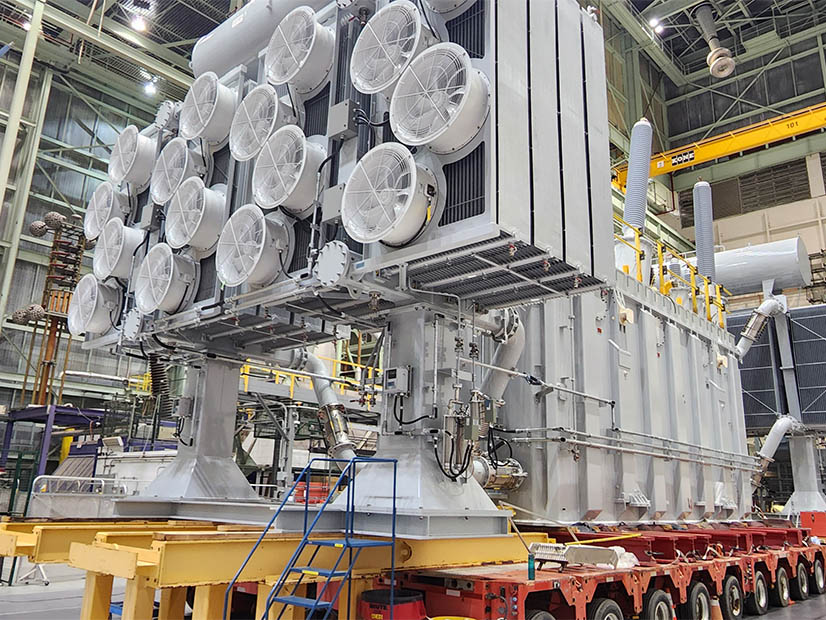
Large power transformers, the 800-kV UHVDC ones essential for efficient long-distance power transmission, are custom-designed and built, often the size of a two-story home and weighing as much as 400 tons. They are engineered to specific customer requirements, and, surprisingly, the experts I met with were aware of only one customer standardizing across its fleets of transformers.
To date, there is no industry-wide effort to share specifications that could help bring transformers to market faster. Perhaps they should look to other industries, like the airlines, which build similarly large and complex machines: a certain amount of standardization has made the industry more efficient while still allowing for customization. There’s no need to go as far as Southwest Airlines’ famous “only Boeing 737” policy, but it would be worth exploring whether unifying around specs could help manufacturing scale as quickly as possible.
A Supply Chain That Can’t Simply Scale
The current load surge driven by AI, electrification and reshoring is structural, not cyclical. If that growth persists, North America will need smarter use of existing infrastructure and a sustained expansion of manufacturing capacity.
It’s tempting to assume high demand will naturally attract new entrants. But transformer manufacturing is not easily replicable.
Standing up a new factory takes years and hundreds of millions of dollars. Even expansions of existing facilities require long lead times and a deeply skilled workforce that understands high-voltage design, insulation systems and quality control. It is not software; it is steel, copper, oil, insulation and people.
The policy challenge is that transformer factories require long-term visibility into demand. Capital-intensive facilities are hard to justify in a world of volatile interconnection reforms, shifting trade rules and uncertain permitting timelines. Manufacturers need confidence that today’s demand spike is not tomorrow’s policy whiplash.
Hitachi Energy’s Billion-dollar Bet
Into that gap steps the largest global supplier of transformers and other high-voltage equipment: Hitachi Energy.
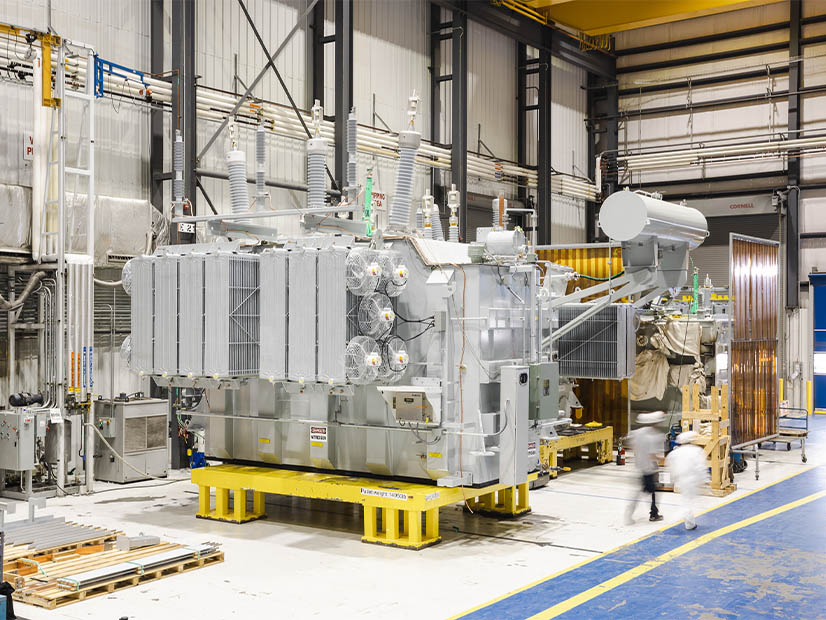
In September 2025, the company announced it would expand production of critical electrical grid infrastructure in the U.S., with its largest $457 million investment in a new power transformer facility in South Boston, Va. The plant expands an existing distribution and medium-voltage (up to 345 kV) transformer production facility.
Before its $457 million expansion, the plant in South Boston, Va., produced distribution and medium-voltage transformers. | Hitachi Energy
Construction is expected to be complete in 2028, with deliveries beginning in 2029. It will create more than the 800 new jobs, on top of roughly 700 existing employees at that location. The announcement signals relief is coming — but not immediately.
The announcement included additional investments in a transformer components facility in Tennessee ($106 million) and expansion of its dry-type transformer capacity in Virginia ($22.5 million) and its high-voltage components production in Pennsylvania ($70 million).
Investments like these are not a slam dunk, despite years of capacity already accounted for. While demand is surging now, the production line will take years to come online and will take even longer to pay back the considerable capital investment. The “super-cycle” in the market is likely to continue for at least the next five to 10 years, Arya Barirani, CMO of Hitachi Americas and Hitachi Digital, told me at a recent briefing. The biggest question that companies like Hitachi Energy have to contend with is: What happens when that demand is no longer there or not at the same clip?
For RTOs and utilities, that timeline matters. Transmission planning cycles and interconnection reforms are operating on similar multiyear horizons. A transformer factory that delivers its first units in 2029 aligns more with the back half of the decade’s capacity needs than the immediate surge.
Who Gets a Transformer?
In a constrained market, allocation matters. Large, creditworthy customers, particularly hyperscale data center developers, may be better positioned to secure production slots by committing capital early. Smaller or rural utilities could find themselves further back in the queue.
The market’s demand is evident in the fact that Hitachi Energy’s UHVDC transformer production capacity already is reserved for several years, though they would not share specific numbers.
This dynamic has implications for RTOs and state regulators. If transformer availability becomes a gating factor for interconnection, market rules and cost-allocation frameworks increasingly will shape who moves forward and who waits.
The industry already is experimenting with approaches in which large customers pay up front for network upgrades. In a world of scarce transformers, those financial signals could directly influence manufacturing schedules.
Optimizing the Grid We Have
Expanding manufacturing is only half the story. The other half is lifecycle management.
Transformer fleets across North America are aging. Even with perfect condition monitoring and predictive analytics, transformers have finite thermal and mechanical limits. Insulation ages. Bushings fail. Core steel saturates. At some point, the grid needs more iron in the ground.
Many large units are decades old but not yet at end of life. Extending their useful service through refurbishment, monitoring and predictive maintenance can free up scarce capital and defer replacements.
“The fastest way to add capacity is to really take care of the existing infrastructure and the grid,” said Emrah Ercan, Hitachi Energy’s vice president and head of service for North America. So, as other parts of Hitachi Energy are “adding steel” to the grid, Ercan’s team’s mandate is “to take care of the existing grid and get as much as possible as we can out of the transformers [and] the high voltage assets that we have on the ground.”
Large power transformer mounted on a wide trailer ready for transportation from Hitachi Energy’s production facility in Varennes, Quebec | Hitachi Energy
The company is the leader in the space, with $230 billion of existing HV assets deployed globally, $60 billion of which are in the U.S. By using its digital expertise to deliver predictive maintenance, it is well positioned to demonstrate the value of O&M to optimize performance and prolong the life of those assets.
Digital condition monitoring — from dissolved gas analysis to thermal imaging to advanced sensing — allows operators to detect insulation breakdown, overheating or abnormal loading before catastrophic failure. AI-enabled asset management platforms, such as the digital twins discussed in my most recent column, synthesize historical maintenance data, environmental conditions and load patterns to optimize maintenance schedules.
In a world where new units take 30-plus months to arrive, preventing one unexpected failure can be worth millions of dollars in avoided outage costs and reputational damage. But while digital tools and efficiently deployed maintenance teams can stretch capacity, they cannot create it.
What to Watch
For grid planners and market participants, three signals are worth tracking:
New factory announcements and expansions in North America. Capacity geography will influence project timelines and transport logistics.
Regulatory and trade policy shifts affecting electrical steel, copper and high-voltage equipment.
Utility filings and RFPs that explicitly identify transformer lead times as a binding constraint.
The 21st-century grid is trying to move gigawatts of new clean generation and AI-era load through a narrow physical waist: the global transformer fleet. Software can make that waist more flexible. Digital twins and predictive maintenance can squeeze out incremental performance. But only sustained investment in steel, copper and skilled labor will widen it.
Transformers may not be glamorous. But for the foreseeable future, they are the hottest thing on the market.
The companies like Hitachi Energy that are committing billions today, and the regions that attract those factories, will determine how fast the next decade of grid build-out can proceed.
Power Play Columnist Dej Knuckey is a climate and energy writer with decades of industry experience.
Many electric utilities are not prepared for the “unique challenge” presented by the expected rapid growth of data centers and large loads on the grid, and the ERO must support the industry through multiple measures including new reliability standards, according to a report released by NERC.
The new report, published March 17, reviews the responses by registered entities to a Level 2 alert sent in September 2025. That alert provided 105 questions for respondents to answer according to their functions: 44 applied to transmission owners and distribution providers; 23 to transmission planners and planning coordinators; 28 to reliability coordinators, balancing authorities and transmission operators; and 10 to resource planners.
Entities’ responses to the Level 2 alert revealed that utilities expect major changes in the composition of large loads on their systems in the next five years.
In one chart, NERC aggregated entities’ predictions for the demand associated with large loads in 2028 and 2030 as 300.5 GW and 612.7 GW, respectively — significantly more than the 69.5 GW recorded at the end of 2025. About one-third of the demand in 2028, 109.1 GW, is expected to consist of data centers. That share is expected to more than double two years later to 400.8 GW. However, NERC cautioned its confidence in these figures is “questionable due to the differences associated with entity interpretations on the word ‘forecast.’”
NERC also found that “entities largely did not have a formalized definition of ‘large load.’” Those that did revealed a wide range of thresholds, ranging from 100 kW to 400 MW. The greatest number of respondents to this question, which was directed to TOs and DPs, indicated their cutoff was either 50 or 75 MW. About 50 respondents each chose one of these options.
Other popular selections were 10, 20 and 25 MW, each of which was chosen by about 20 utilities. NERC indicated that DPs tended to report thresholds below 20 MW, while all TO respondents reported thresholds above this level.
Recommendations Unfulfilled
The Level 2 alert listed five recommendations related to maintaining reliability with large loads:
TOs should create clear facility design and performance criteria in their interconnection requirements for large loads;
TPs and PCs should establish a comprehensive interconnection and systemwide study process to assess the reliability impacts of large loads;
TOs need a comprehensive load commissioning process that ensures operational readiness for large loads;
TOs should establish operating protocols and communication infrastructure to support reliable ongoing operations after large load facilities enter commercial operations; and
TPs, RPs and PCs should identify and implement a process to include large loads in their near-term and long-term planning horizon demand forecasts.
Responses to the questions showed many utilities have not taken steps to meet these recommendations, NERC wrote, indicating “that additional steps are needed to reliably integrate computational loads.” The ERO is working on several follow-up actions.
First, NERC plans to issue a Level 3 alert on computational large loads by May. Unlike Level 2, a Level 3 alert identifies specific actions deemed essential for certain stakeholders to maintain grid reliability. NERC’s Board of Trustees must approve the issuance of a Level 3 alert.
Second, the ERO expects to draft registry criteria updates to address the integration of computational loads, along with updating reliability standards as needed. These efforts are scheduled to begin in the second quarter of 2026. NERC’s third planned action is to release a reliability guideline in mid-2026 that will “immediately share best practices to improve reliability.”
NERC encouraged registered entities to stay up to date on the initiatives by following its Large Loads Action Plan webpage.
Valley Link Transmission Group Plans 765-kV Line in Virginia
Valley Link Transmission, a partnership between Dominion Energy, FirstEnergy Transmission and Transource Energy, is planning a 115-mile, 765-kV line in Virginia.
The final route of the $1 billion project is yet to be determined, but a map of possibilities shows it could cross nine counties: Appomattox, Buckingham, Campbell, Culpeper, Fluvanna, Goochland, Louisa, Orange and Spotsylvania. PJM has already approved the project.
Officials anticipate the State Corporation Commission will take a year to evaluate the project and its route, with a decision coming around September 2027. The line is expected to be completed in 2029.
The Senate passed a bill that would expand the Public Service Commission from three members to seven, who would represent areas of the state rather than serving in an at-large capacity.
According to the bill, the governor would appoint four commissioners by July 15. Two commissioners would serve two‑year terms while two would serve four‑year terms. The governor would be required to select appointees from a list of three names submitted by the lieutenant governor, house speaker and senate pro tempore for each position. Commissioners elected after June 1 would serve six-year terms.
The bill does not change the way utilities are regulated or address profit but would freeze base rates through June 2029.
Senate Passes Bill Exempting EPIC from Open Records Law
The Senate voted 29-6 to approve a bill that would exempt the taxpayer-funded Energy Planning and Inventory Commission (EPIC) from the state’s Open Records Act.
The bill would exempt “information, records, data, files, documents or correspondence” created by EPIC. The legislature created EPIC in 2024 to review utilities’ plans to retire fossil fuel-fired power plants, along with analyzing supply, demand and infrastructure.
The bill would also remove appointments made by Gov. Andy Beshear to an executive committee within EPIC and give appointment power to Attorney General Russell Coleman.
The town of Harrington voted to enact a moratorium on utility‑scale solar farms.
The Solar Energy Ordinance authorizes personal ground‑mounted systems and personal and commercial roof‑mounted installations but does not authorize power to be distributed to the grid for profit. The commercial provision applies only to businesses that install systems to power their own operations.
House Passes Bill Requiring PUC to Consider Affordability
The House passed a bill that would require the Public Utilities Commission to consider the impact of affordability and publicize data from utilities.
The amended bill directs the PUC to develop an affordability metric to assess the impact of bills on customers’ overall energy burden, which would be submitted to a legislative committee by Jan. 15, 2027. The commission also would be required to publicize data from utilities related to credit and collection activities, and to conduct a review of rates, during which it would consider options to contain costs in delivery rates, reduce transmission and distribution bill volatility, and increase bill transparency.
The Department of Environmental Quality unanimously approved a plan by xAI to build a 41-turbine natural gas power plant.
The generator would power xAI’s data centers in Memphis, Tenn.
The DEQ’s decision comes three weeks after it held a town hall to invite feedback on xAI’s application. Dozens of residents and advocates — both from Mississippi and Tennessee — spoke out against the permit. No one spoke in favor of the facility.
NV Energy Asks PUC to Delay Peak Demand Charge Start Date
NV Energy asked the Public Utilities Commission to push back implementation of its peak demand charge until Oct. 1.
The legality of the demand charge is being challenged by the Attorney General’s Bureau of Consumer Protection. It was scheduled to go into effect April 1. Under state law, utilities can ask to change the implementation of new charges up to 10 days before they are scheduled to go into effect.
South Central Judicial District Judge Jackson Lofgren revoked Summit Carbon Solutions’ permits for underground carbon dioxide storage, saying parts of the state law under which they were issued are unconstitutional.
The decision is the second time a judge has reached the conclusion that the 2009 state law violates the state’s constitution. The law authorizes regulators to permit the storage of carbon dioxide beneath the property of nonconsenting landowners.
A Summit spokesperson said the company is reviewing the decision and evaluating next steps.
Gov. Rhoden Signs Bill Limiting Utilities’ Wildfire Liability
Gov. Larry Rhoden signed a bill that will limit utilities’ liability in wildfire lawsuits.
Once the law takes effect July 1, people who sue will be able to recover damages only from utilities that either fail to file fire mitigation plans and follow them, or act with criminal intent or exhibit “willful and wanton” misconduct. No claims will be valid after four years and plaintiffs will be limited in the types of damages they can recover.
The Public Utilities Commission approved a $3.3 million rate hike for Otter Trail Power.
The company originally asked for $5.7 million, which would have raised average residential rates by more than $14/month. The settlement will raise rates by $8.97/month.
Black Hills Energy also has asked for a rate increase that would raise rates by about $25/month.
The Public Service Commission unanimously approved We Energies’ purchase of the 200-MW Dawn Harvest Solar and Battery Energy Storage Facility.
The $443 million project will provide 150 MW of solar capacity and 50 MW of battery storage. We Energies will own the storage facility and 80% of the solar generation. The remaining power will be split between the Wisconsin Public Service Corporation and Madison Gas & Electric.
The project is expected to be operational in 2028.
BloombergNEF: Global Wind Power Installations Hit All-time High
Global wind capacity additions hit an all-time high in 2025, marking a third consecutive year of record installations, according to BloombergNEF’s “Global Wind Turbine Market Shares 2025” report.
Project developers brought 169 GW of wind online in 2025, 38% more than in 2024. About 161 GW (95%) of the additions were onshore, while 8 GW were installed offshore.
China’s onshore wind sector accounted for most of the growth, becoming the first market to add more than 100 GW in a single year.
The Trump administration is considering waiving the Jones Act for 30 days to ensure energy and agricultural shipments can move freely between U.S. ports, Press Secretary Karoline Leavitt said.
Under the Jones Act, goods shipped between U.S. ports must be carried on U.S.-built, U.S.-flagged and mostly U.S.-owned vessels. The requirement sharply limits the number of tankers available for domestic shipments but is supported by maritime labor unions. The move would be aimed at combating spiking fuel prices and other disruptions since the start of the U.S.-Israeli war on Iran.
Seven maritime labor unions have publicly rejected the idea.
Trump Memo: TVA Employee Comp Should be $500K at Most
President Donald Trump recently issued a memo calling for the TVA board to limit compensation for all employees to $500,000.
The move would affect not just new CEO Don Moul, who is set to be paid $6 million/year, but about 230 other employees. Former board members said TVA would likely struggle to attract a qualified CEO for only $500,000.
The CEO role was created in 2006 after Congress amended the TVA Act. The move also changed the three-person executive board into a nine-person part-time corporate board.