Oregon and Washington lawmakers are exploring ways to build new transmission independent of the Bonneville Power Administration as electric sector stakeholders in the Pacific Northwest worry about the agency’s struggle to build transmission fast enough to keep up with aggressive clean energy laws and increased load.
BPA paused certain planning processes in 2025 to consider how to address nearly 61 GW of transmission service requests. The agency presented several proposals to reduce the queue, but concerns have been raised that many of the efforts would go into effect after the 2030 deadline for utilities in Oregon and Washington to meet strict greenhouse gas standards.
Former BPA Administrator Randy Hardy has previously argued that the issue lies with the states’ respective clean energy laws, which he said set off a “gold rush” among developers, leaving BPA to solve the issue of building enough transmission to keep up. His comments received support from utilities and other organizations during BPA meetings. (See BPA Tx Planning Overhaul Prompts Concern for Northwest Clean Energy Compliance.)
But Oregon state Rep. Mark Gamba (D) pushed back on that notion in an interview with RTO Insider.
Oregon’s House Bill 2021 directs the state’s investor-owned utilities to reduce their greenhouse gas emissions by 80% by 2030, on the path to achieving 100% GHG-free generation by 2040. (See Clean Energy, Equity Goals to Reshape Oregon IRP Process.)
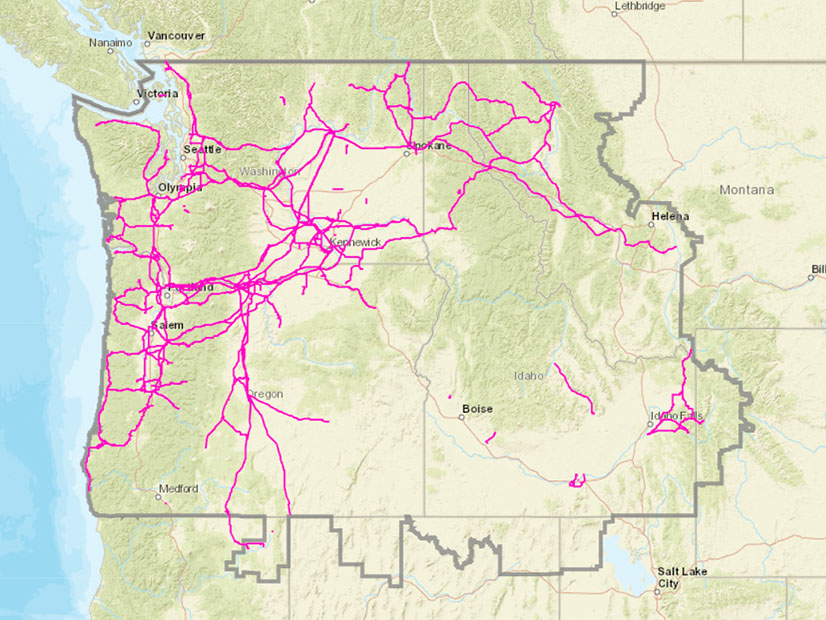
For Gamba, the issue is not the law’s requirements but rather that BPA, which controls approximately 75% of the region’s high-voltage transmission, has failed to build enough transmission.
“I’m less concerned with HB 2021 and the law as I am with the fact that we are still burning fossil fuels in the state of Oregon to supply energy to a rapidly growing load. That needs to come to a screeching halt,” he said. “But the only way that’s going to happen is if we build more transmission.”
As a federal entity, BPA does not have to follow mandates imposed by the Oregon legislature. The agency has focused on its preference customers — publicly owned utilities that rely on it for generation — and failed to realize “they are the backbone of the transmission system in the whole Pacific Northwest,” Gamba contended.
The situation worsened in 2025 after approximately 200 employees accepted a “deferred resignation” buyout offer under President Donald Trump’s effort to slim down the federal government, according to Gamba.
BPA resumed hiring in September 2025. (See BPA Looks to Fill 155 Positions After Hiring Freeze.)
BPA declined to comment for this story, but the agency has previously noted its efforts to build out transmission and generation.
For example, when BPA paused its transmission planning processes to deal with the 61 GW of generation in its current interconnection study, it identified 16 GW of late-stage projects that are now being integrated at a rate of roughly 1 to 1.5 GW per year, with the goal of integrating the full 16 GW by 2035, according to the agency.
As for transmission, the agency secured $773.8 million in transmission capital for 2025 with the goal of doubling transmission capital execution by 2028. It plans to issue awards to contractors in March 2026 that will cover a 10-year period with a maximum value of $25 billion to build and modify lines.
BPA also launched its $5 billion Grid Expansion and Reinforcement Portfolio initiative in 2023 with the aim of building 23 new transmission lines and substation projects.
However, Gamba said BPA was “pretty nonresponsive” even before staffing cuts, adding that he doubts the agency will “start building significant new lines anytime soon.”
Instead, the Democratic lawmaker thinks Oregon should take matters into its own hands. Gamba presented a bill last year aimed at creating a transmission authority (TA) and intends to revive that effort this year.
“We just need some entity to act like an adult in the room and actually start developing the transmission that we need,” Gamba said.
The TA would explore where transmission is needed and begin the siting and permitting process. It would then work with either utilities or third parties to get lines built. The approach has found success in New Mexico and Colorado, according to Gamba.
In an email to RTO Insider, JD Podlesnik, Portland General Electric’s senior director of transmission delivery, said the utility is ready to work with both BPA and other regional entities to expand transmission.
Podlesnik noted that PGE has added more than 3,000 MW of clean energy and storage to the grid and recently finalized agreements for an additional 1,000 MW of clean energy resources, “making steady progress toward customer-driven clean energy targets.”
“At the same time, transmission capacity remains a key challenge across the region, both for reliability and clean energy targets,” Podlesnik said in the email. “BPA plays an important role in expanding the transmission network and accelerating the interconnection of new generation resources. Continuing to execute on BPA’s Grid Expansion and Reinforcement Portfolio is one of the critical steps in addressing those constraints.”
Washington Issues
But Oregon entities are not alone in grappling with transmission constraints and compliance with clean energy laws. Washington utilities face a similar situation.
A study by Energy and Environmental Economics predicts that accelerated load growth and aging power plant retirements will create a resource gap in the Northwest starting at about 1.3 GW in 2026 and expanding to almost 9 GW by 2030. That is approximately the load of the state of Oregon.
For context, BPA’s White Book released in May 2025 projected the Northwest would have about 27.9 aMW of total (not just federal) generation available in 2026.
As is the case nationwide, data centers and electric vehicles are the primary drivers behind the expected load growth.
And just as in Oregon, Washington’s Clean Energy Transformation Act (CETA) requires all electric utilities in the state to become greenhouse gas-neutral by 2030 (allowing for use of offsets and other programs) on the way to generating all power from emissions-free resources by 2045. It also prohibits utilities from serving their Washington customers with any coal-fired generation after 2025. (See Washington Agencies Adopt New Rules to Implement CETA.)
But again, lack of transmission poses challenges for utilities to meet the law’s requirements.
There is collaboration across state lines to build more transmission independent of BPA, according to Washington Rep. Alex Ramel (D).
Washington lawmakers are also seeking to create a transmission authority under Senate Bill 6355.
“There is this sort of federal government monopoly in the space,” Ramel said.
Relying too much on the federal government as BPA struggles with staffing shortages “is a real concern,” according to Ramel.
“That, to me, is part of the reason why we need to be more expeditious about how we think about putting together these kinds of projects,” Ramel said in referring to a potential Washington TA. “Because if [BPA] is losing staff, that can only … impact negatively our need to be able to increase clean energy transmission opportunities.”
As for CETA, Ramel said he is not ready to “pull the plug on it.” He acknowledged the law was passed when the region did not have the same electricity use that comes with the development of AI and electric vehicles.
“I could be persuaded to have reasonable extensions or extenuating circumstances for utilities that really can’t meet those goals,” Ramel said. “But right now, I haven’t seen anything that persuades me that those goals can’t be met. We could revisit that in the future if we need to. Right now, I think we should stay full steam and let’s build out clean energy and let’s accelerate transmission.”
Puget Sound Energy, which is one of BPA’s largest transmission customers, has removed coal from its energy portfolio in accordance with CETA and is focused on providing 80% of its electricity from renewable or non-emitting resources by 2030-2033, according to Matt Steuerwalt, PSE’s vice president of external affairs.
Still, BPA’s ability to expand transmission capacity and allow new resources to come online “will have a major impact on our progress toward Washington clean energy laws,” Steuerwalt told RTO Insider.
“We also have to consider permitting and siting for energy infrastructure development undertaken by entities other than BPA, which is a major challenge to building any project,” he added. “We have been following the current legislation closely to see the extent to which it can address these and other issues.”
‘Morass of People’
But for Scott Simms, executive director of the Public Power Council, there are risks with creating separate TAs.
“I think that once you create an additional apparatus to try to do the exact same thing that other organizations are statutorily obligated to do, it’s going to create a morass of people trying to all do the same things,” Simms said.
Instead of solving the transmission challenges, the risk is that additional TAs would “exacerbate the very problem you’re trying to solve,” he added.
Rather, Oregon and Washington should fix the challenging operating environments they have created for consumer-owned and investor-owned utilities alike, Simms contended.
“There’s a variety of things on both the energy policy side with regards to resources and there are fixes on the transmission side when it comes to permitting and the planning process,” he said. “If the states were just to focus on how to best facilitate and streamline the transmission permitting and siting elements, that would be a huge help.”