The digital world may be driving much of the growth in electricity demand, but physical limits are shaping how the industry responds. And few limits are more apparent than the shortage of transformers.
Expanding manufacturing and extending the life of existing transmission assets should be considered as essential to the country’s economic future as the build-out of the grid is. And like grid expansion, easing the shortage needs to be a national priority. Yet it’s hard to create priorities without a clear picture of the future grid.
At a recent Silicon Valley media summit, Anthony Allard, executive vice president and North America region head at Hitachi Energy, called for national planning, “like we see in some countries around the world: 20, 30 years.” That forward view is essential for infrastructure planning. “We need to take that long-term view to make sure that we optimize the grid and infrastructure that we build in the country.”
Across North America, utilities report load growth numbers that would have seemed implausible a decade ago. Gigawatt-scale artificial intelligence data centers are opening anywhere that access to generation or the grid is relatively easy. Manufacturing is reshoring. Transportation and building heat are electrifying. Some regions are seeing year-over-year load growth in the mid-single digits, a dramatic shift after decades of flat demand.
All of that new generation and load has to pass through a narrow physical choke point: the transformer fleet.
Transformer availability is a bottleneck choking the growing market, with lead times for power transformers running at 128 weeks and for generation step-up transformers at 143 weeks, according to a Q2 2025 Wood Mackenzie study. While interconnection queues may be longer, this transformer shortage prevents the market from working around them: without transformers, hyperscalers won’t be able to end-run the queues with behind-the-meter generation.
Growing Demand, Meet the Aging Grid
The growth in demand is far from the only issue. It is happening against the backdrop of supply chain challenges and fluctuating tariffs that have muddied the math for companies considering manufacturing facilities in the U.S. And it’s happening at a time when the aging grid requires more upkeep than ever.

The grid is old, and there are plenty of operational transformers living on borrowed time. A Bank of America Institute study found that 31% of transmission infrastructure was within five years of, or beyond, its useful life. “Further, 67% of electric utilities’ spending in 2024 was on replacements ($63 billion), while only $32 billion was spent on new lines and substations.”
For the small transformers that hang on the poles near your home, that’s one thing: They are uniform and fairly easy to replace, even if supplies are short. It’s the behemoths, the ultra-high voltage power transformers, that are the issue: Without those, the grid simply can’t grow.
Upgrading the grid is an urgent national issue, so much so that federal grid upgrade grant programs have survived this administration while almost none of their renewable counterparts have. But it’s the companies that control the transformer manufacturing base that are setting the pace of the energy transition.
The Workhorse Becomes the Constraint
Transformers change voltage, stepping it up for long-distance transmission and down so it can be delivered safely to cities, factories and data centers. Without them, electrons don’t move from generator to load.
For most of the past 20 years, transformers were an afterthought in planning conversations. They were heavy, custom pieces of hardware with long but manageable procurement timelines. They rarely drove interconnection queues or delayed major industrial projects.
That is no longer the case.
Large power transformers, the 800-kV UHVDC ones essential for efficient long-distance power transmission, are custom-designed and built, often the size of a two-story home and weighing as much as 400 tons. They are engineered to specific customer requirements, and, surprisingly, the experts I met with were aware of only one customer standardizing across its fleets of transformers.
To date, there is no industry-wide effort to share specifications that could help bring transformers to market faster. Perhaps they should look to other industries, like the airlines, which build similarly large and complex machines: a certain amount of standardization has made the industry more efficient while still allowing for customization. There’s no need to go as far as Southwest Airlines’ famous “only Boeing 737” policy, but it would be worth exploring whether unifying around specs could help manufacturing scale as quickly as possible.
A Supply Chain That Can’t Simply Scale
The current load surge driven by AI, electrification and reshoring is structural, not cyclical. If that growth persists, North America will need smarter use of existing infrastructure and a sustained expansion of manufacturing capacity.
It’s tempting to assume high demand will naturally attract new entrants. But transformer manufacturing is not easily replicable.
Standing up a new factory takes years and hundreds of millions of dollars. Even expansions of existing facilities require long lead times and a deeply skilled workforce that understands high-voltage design, insulation systems and quality control. It is not software; it is steel, copper, oil, insulation and people.
The policy challenge is that transformer factories require long-term visibility into demand. Capital-intensive facilities are hard to justify in a world of volatile interconnection reforms, shifting trade rules and uncertain permitting timelines. Manufacturers need confidence that today’s demand spike is not tomorrow’s policy whiplash.
Hitachi Energy’s Billion-dollar Bet
Into that gap steps the largest global supplier of transformers and other high-voltage equipment: Hitachi Energy.
In September 2025, the company announced it would expand production of critical electrical grid infrastructure in the U.S., with its largest $457 million investment in a new power transformer facility in South Boston, Va. The plant expands an existing distribution and medium-voltage (up to 345 kV) transformer production facility.
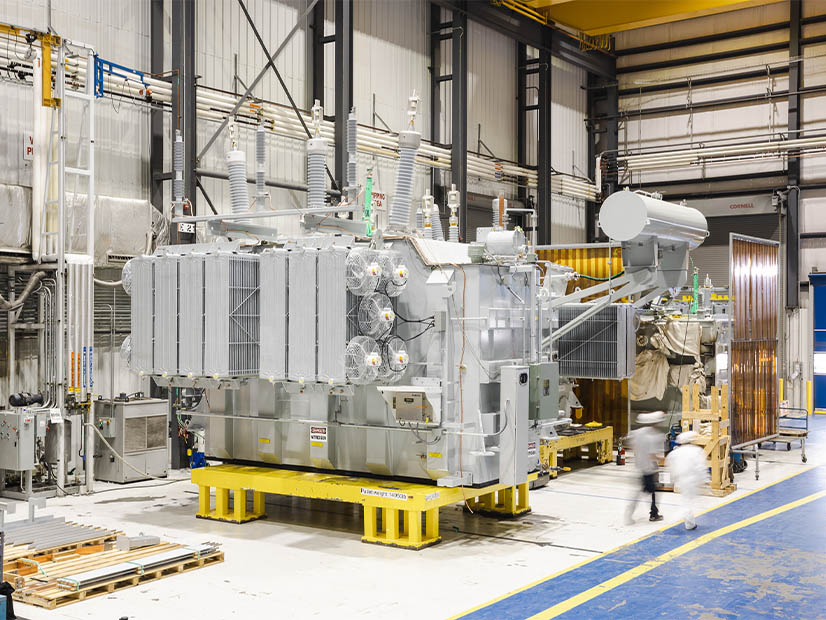
Construction is expected to be complete in 2028, with deliveries beginning in 2029. It will create more than the 800 new jobs, on top of roughly 700 existing employees at that location. The announcement signals relief is coming — but not immediately.
The announcement included additional investments in a transformer components facility in Tennessee ($106 million) and expansion of its dry-type transformer capacity in Virginia ($22.5 million) and its high-voltage components production in Pennsylvania ($70 million).
Investments like these are not a slam dunk, despite years of capacity already accounted for. While demand is surging now, the production line will take years to come online and will take even longer to pay back the considerable capital investment. The “super-cycle” in the market is likely to continue for at least the next five to 10 years, Arya Barirani, CMO of Hitachi Americas and Hitachi Digital, told me at a recent briefing. The biggest question that companies like Hitachi Energy have to contend with is: What happens when that demand is no longer there or not at the same clip?
It’s not the only company investing in transformer manufacturing capacity — Pennsylvania Transformer Technology announced a $102 million expansion in February, and WEG announced a $77 million expansion in 2025 — but it is the largest and the only one making large power transformers.
For RTOs and utilities, that timeline matters. Transmission planning cycles and interconnection reforms are operating on similar multiyear horizons. A transformer factory that delivers its first units in 2029 aligns more with the back half of the decade’s capacity needs than the immediate surge.
Who Gets a Transformer?
In a constrained market, allocation matters. Large, creditworthy customers, particularly hyperscale data center developers, may be better positioned to secure production slots by committing capital early. Smaller or rural utilities could find themselves further back in the queue.
The market’s demand is evident in the fact that Hitachi Energy’s UHVDC transformer production capacity already is reserved for several years, though they would not share specific numbers.
This dynamic has implications for RTOs and state regulators. If transformer availability becomes a gating factor for interconnection, market rules and cost-allocation frameworks increasingly will shape who moves forward and who waits.
The industry already is experimenting with approaches in which large customers pay up front for network upgrades. In a world of scarce transformers, those financial signals could directly influence manufacturing schedules.
Optimizing the Grid We Have
Expanding manufacturing is only half the story. The other half is lifecycle management.
Transformer fleets across North America are aging. Even with perfect condition monitoring and predictive analytics, transformers have finite thermal and mechanical limits. Insulation ages. Bushings fail. Core steel saturates. At some point, the grid needs more iron in the ground.
Many large units are decades old but not yet at end of life. Extending their useful service through refurbishment, monitoring and predictive maintenance can free up scarce capital and defer replacements.
“The fastest way to add capacity is to really take care of the existing infrastructure and the grid,” said Emrah Ercan, Hitachi Energy’s vice president and head of service for North America. So, as other parts of Hitachi Energy are “adding steel” to the grid, Ercan’s team’s mandate is “to take care of the existing grid and get as much as possible as we can out of the transformers [and] the high voltage assets that we have on the ground.”
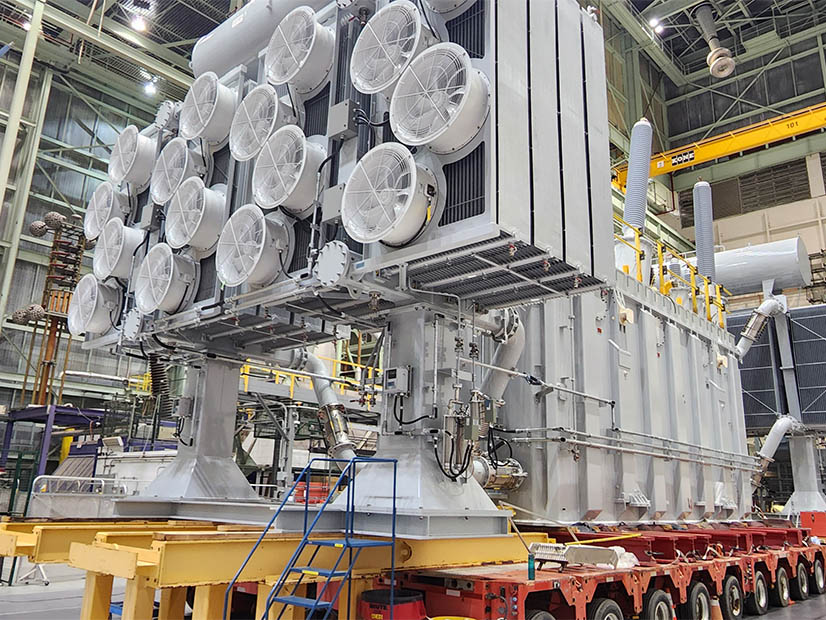
The company is the leader in the space, with $230 billion of existing HV assets deployed globally, $60 billion of which are in the U.S. By using its digital expertise to deliver predictive maintenance, it is well positioned to demonstrate the value of O&M to optimize performance and prolong the life of those assets.
Digital condition monitoring — from dissolved gas analysis to thermal imaging to advanced sensing — allows operators to detect insulation breakdown, overheating or abnormal loading before catastrophic failure. AI-enabled asset management platforms, such as the digital twins discussed in my most recent column, synthesize historical maintenance data, environmental conditions and load patterns to optimize maintenance schedules.
In a world where new units take 30-plus months to arrive, preventing one unexpected failure can be worth millions of dollars in avoided outage costs and reputational damage. But while digital tools and efficiently deployed maintenance teams can stretch capacity, they cannot create it.
What to Watch
For grid planners and market participants, three signals are worth tracking:
-
- New factory announcements and expansions in North America. Capacity geography will influence project timelines and transport logistics.
- Regulatory and trade policy shifts affecting electrical steel, copper and high-voltage equipment.
- Utility filings and RFPs that explicitly identify transformer lead times as a binding constraint.
The 21st-century grid is trying to move gigawatts of new clean generation and AI-era load through a narrow physical waist: the global transformer fleet. Software can make that waist more flexible. Digital twins and predictive maintenance can squeeze out incremental performance. But only sustained investment in steel, copper and skilled labor will widen it.
Transformers may not be glamorous. But for the foreseeable future, they are the hottest thing on the market.
The companies like Hitachi Energy that are committing billions today, and the regions that attract those factories, will determine how fast the next decade of grid build-out can proceed.
Power Play Columnist Dej Knuckey is a climate and energy writer with decades of industry experience.