Search
December 21, 2025

ISO-NE CEO Gordon van Welie Announces Retirement

ISO-NE CEO Gordon van Welie has announced plans to step down at the end of 2025. He will be replaced by longtime ISO-NE COO Vamsi Chadalavada.  

“I have been fortunate to spend 25 wonderful years at the ISO,” van Welie said in a statement. “I’m extremely proud of what we’ve accomplished, from a startup organization to a sophisticated company with world-class people, systems and processes that is well positioned to help the region navigate an increasingly complex energy environment.” 

Van Welie is by far the longest-serving CEO of any RTO or ISO, having led ISO-NE for most of its history. He has overseen ISO-NE’s transition to becoming an RTO, the launch of its capacity market, the shift in the region’s generation mix from coal and oil toward natural gas, and multiple overhauls of its wholesale electricity markets.  

More recently, ISO-NE has embarked on a series of major changes to its capacity market and is running the first-ever longer-term transmission planning (LTTP) procurement, intended to reduce transmission constraints between northern Maine and southern New England. (See ISO-NE Discusses Details of New Prompt Capacity Market and ISO-NE Releases Longer-term Transmission Planning RFP.) 

In the retirement announcement, van Welie said the region’s supply and demand outlook should remain “relatively stable through the next several years.” The ongoing overhaul of the capacity market and anticipated longer-term changes in the region’s resource mix and load profile make this “an appropriate time to step aside and allow new leadership to steer the path forward.” 

Cheryl LaFleur, chair of the ISO-NE Board of Directors, applauded van Welie on his time with the RTO and said he has “led the ISO through significant transformation, building a strong team of professionals who keep the lights on and run the markets for our region.” 

Vamsi Chadalavada | ISO-NE

“I know Gordon will be missed greatly at the ISO and across the New England region,” LaFleur added.  

“Gordon van Welie is an institution,” said Dan Dolan, president of the New England Power Generators Association. “Gordon has been a thoughtful, innovative and tireless leader for the region. His candor and willingness to engage in difficult, but necessary, conversations is a testament to his commitment to doing what is right for New England.” 

Chadalavada, who is slated to take over for van Welie at the beginning of 2026, has worked for ISO-NE since 2004 and has served as COO since 2008. As the RTO’s second in command, he oversees the operation of the power system and market operations, along with system planning. Like van Welie, Chadalavada worked as a vice president for Siemens Power Transmission and Distribution before joining ISO-NE. 

“We are very fortunate to have someone with Vamsi’s leadership, experience and qualifications ready to take on the role,” LaFleur said. “His appointment demonstrates our strong confidence in his ability to lead the organization through the grid transition ahead.” 

Reacting to the news, ISO-NE stakeholders commended van Welie on his tenure and retirement and emphasized the major role he has played in ISO-NE’s evolution. Industry members also praised the selection of Chadalavada as the next CEO, saying he’s well prepared to take the reins. 

“NEPOOL would like to congratulate Gordon on the announcement of his upcoming retirement,” NEPOOL Chair Sarah Bresolin said. “During his tenure, NEPOOL has benefited from his intellect and dedicated service. Gordon leaves the region in a strong position.” Bresolin applauded Chadalavada’s appointment, which she said leaves the region “in very good hands.”  

Alex Lawton of Advanced Energy United said Chadalavada “is the right person for the job, and we are confident he will work diligently and collaboratively with stakeholders and the New England states to navigate the evolution of our grid.” 

Joe LaRusso of the Acadia Center said van Welie’s retirement comes at a “pivotal moment” for ISO-NE, with power demand likely to grow after a long period of stability, intermittent renewables set to come online, and increasing conflicts between state and federal energy policy.  

“I expect the transition from Gordon to his successor Vamsi Chadalavada to be a smooth one,” LaRusso said, adding that Chadalavada “is well aware of all of the challenges facing the ISO and will certainly see current initiatives such as capacity market and reliability reforms, and Longer-Term Transmission Planning and FERC Order 1920 compliance through to completion. The ISO won’t deviate much, if at all, from its current path, and Gordon’s stamp will inevitably remain imprinted on ISO New England for some years to come.” 

NWPCC Appoints Former BPA Official as New Executive Director

The Northwest Power and Conservation Council has hired Peter Cogswell, the former director of intergovernmental affairs at the Bonneville Power Administration, as its next executive director.

Cogswell will assume the position on July 7, succeeding Bill Edmonds, who stepped down as executive director in April after serving for five years with the council, according to a June 23 news release.

Council Chair Mike Milburn said in a statement that Cogswell “is an experienced leader with an impressive energy policy background who is deeply connected to the region.”

“We’re confident that Peter will be able to hit the ground running at this critical time as we ramp up our work on the next Columbia River Basin Fish and Wildlife Program and Ninth Northwest Regional Power Plan,” Milburn added.

The council is required under the Northwest Power Act “to develop a plan to ensure an adequate, efficient, economical and reliable power supply for the region.” NWPCC publishes a plan every five years, with the next plan slated for release in 2026, according to the council’s website.

Cogswell will oversee the development of the plan amid an expected sharp increase in energy demand and shifting energy priorities under President Donald Trump. (See NWPCC’s Initial Demand Forecast Sees Sharp Growth for Northwest and NWPCC Considers Trump, Data Centers in Regional Power Plan.)

For example, the council’s initial 20-year forecast found that electric vehicles and data centers could bring annual energy demand in the Pacific Northwest to 31,000 and 44,000 aMW by 2046 — up from an average of approximately 22,000 aMW during the past several years.

The council also is considering updating models used in the 2021 power plan after Trump rescinded several clean energy initiatives implemented under former President Joe Biden.

Cogswell brings decades of experience from the energy industry to the council.

According to his LinkedIn profile, Cogswell joined BPA in October 2007 and served as council liaison and the agency’s director of intergovernmental affairs until January 2022. During his time with BPA, Cogswell helped develop two of the council’s power plans.

After leaving BPA, Cogswell assumed the role of director of government and external affairs at renewable energy developer Simply Blue.

The release also notes that Cogswell worked at PacifiCorp and as deputy chief of staff and policy advisor to former Oregon Gov. Ted Kulongoski. While in the governor’s office, Cogswell “led efforts to adopt several early clean energy policies, including Oregon’s first renewable energy standard,” according to the release.

“I am very fortunate to have engaged extensively with the council over the course of my career,” Cogswell said in a statement. “I am excited about the opportunity to build on that experience by working with members, staff and a broad group of partners, including tribes, states, utilities and advocates, to ensure the council continues its important work in the region.”

The NWPCC is an interstate group with representatives from Idaho, Montana, Oregon and Washington, and works with regional partners, including the Bonneville Power Administration, the U.S. Army Corps of Engineers and the Bureau of Reclamation, as well as with FERC, to implement its plans and programs.

FERC Approves Changes to PJM Capacity Deficiency Rate

FERC has approved a PJM proposal to revise the penalty rate for resources that are unable to meet their capacity obligation due to a decrease to their accreditation after it receives a commitment in a capacity auction (ER25-2002). (See PJM Stakeholders Endorse Proposals to Rework ELCC Accreditation.) 

The change reduces the penalty rate to match the resource’s clearing price, rather than the full deficiency rate taking the greater of 120% of the clearing price or $20/MW-day. The issue was brought before stakeholders after shifts in the expected generation mix and performance data led parameters for the 2025/26 third Incremental Auction (IA) to shift toward higher winter risk. (See “Revised Incremental Auction Parameters Endorsed,” PJM MRC/MC Briefs: Jan. 23, 2025.) 

The higher deficiency rate would remain in effect for resources that cannot meet their obligation due to reductions in installed capacity (ICAP) or testing failures. 

PJM argued the approach would continue to incentivize the owners of resources with diminished accreditation to procure replacement capacity to cover their shortfall without being punitive. It also would avoid requiring consumers to pay for capacity that is not expected to be provided. 

Even without the deficiency penalty, PJM argued that market sellers still would have an incentive to procure replacement capacity at a cost equal to the clearing price plus expected capacity performance penalties for not meeting their obligation during any capacity deployments. 

“Because the capacity market clearing price is a reasonable proxy for the replacement cost of capacity, and a seller’s expected net non-performance charges will be strictly greater than zero, due to the risk of non-performance, if they fail to purchase replacement capacity, we find that a rational seller would prefer to purchase replacement capacity under PJM’s proposal,” the commission wrote in its June 17 order. 

Another package rejected by the Markets and Reliability Committee (MRC) would have frozen resources’ effective load carrying capability (ELCC) ratings and accredited unforced capacity (AUCAP) at the values used in the base residual auction (BRA), which several stakeholders argued would have put the full brunt on consumers when generators could mitigate the issue by maintaining high performance. 

Compared to the prior equivalent forced outage rate demand (EFORd) accreditation paradigm, which considered only generator performance, PJM said the shift to ELCC has widened the factors that can affect a unit’s rating to include factors beyond the owner’s control, particularly how the load forecast affects seasonal risk. It argued this creates an unhedgeable risk for market sellers that could be mitigated by creating an exception to the deficiency rate. 

The commission wrote the filing balanced the benefits of updating ELCC ratings with the latest information between IAs without penalizing resource owners for changes in accreditation that may be driven by factors beyond their control. 

“While shifts in capacity accreditation under EFORd were related to an individual unit’s performance, shifts in capacity accreditation under ELCC are driven by more complex, system-wide factors that ‘are not solely a function of such resource’s performance, and may not entirely be within the control of the capacity market seller,’” the commission wrote, citing PJM’s filing. “Moreover, prior to PJM’s transition to the ELCC methodology, sellers could elect to offer less capacity in the BRA than their full (unforced capacity) to mitigate against potential reductions in a resource’s UCAP, whereas under the ELCC methodology, a resource must offer the entirety of its accredited UCAP, which reduces a resource’s ability to mitigate against a potential shortfall due to a reduction in accredited UCAP value.” 

Christie Dissents

Dissenting on the June 17 order, Chair Mark Christie wrote that PJM’s proposal leaves little incentive for market sellers to procure replacement capacity and is emblematic of a capacity market design that is under constant repair while failing to deliver reliability at least cost. He cited a protest from the Independent Market Monitor (IMM) finding that the cost to purchase replacement capacity in the 2026/27 and following delivery years would be between $63,875/MW-year and $118,625/MW-year, while PJM analysis found that annual capacity performance penalties would be below $24,156/MW-year in 99% of the scenarios considered. 

“What’s left is a ‘penalty’ with no teeth. Without an incentive for generators to honor their capacity commitments, generators have less incentive to make the system reliable, and consumers are left with increased reliability risk in the event of an emergency,” he said. 

Christie wrote that the proposal constitutes a shifting of risk from resource owners to consumers, a dynamic he argued has presented itself repeatedly in deregulated markets. 

“This proposal is only the latest example of the endless Rube Goldberg tinkering with the minute details of the capacity market construct. This time, PJM seeks to ‘mitigate’ potential ELCC variability. Such tinkering has gone on for years and never reaches a point of stability — every ‘fix’ makes the market construct more incomprehensible (and as I have said many times, it’s an administrative construct, not a market),” he wrote. “The Federal Power Act (FPA) is, at its core, a consumer protection statute, and the principal role of this commission is to ensure consumers have reliable and affordable power. Today’s order serves neither of those purposes. On the contrary, I agree with the market monitor, that the revisions approved in today’s order — contrary to the FPA and this commission’s principal role — inappropriately impose reliability risk on consumers.” 

PJM stakeholders have formed a senior task force to evaluate several components of ELCC, with a proposal aimed at adding transparency to the process endorsed in May. The task force has shifted its focus on how the winter-skewed risk modeling behind ELCC interacts with the summer-focused capacity emergency transfer limit (CETL). (See “Stakeholders Endorse Proposal to Add Transparency to ELCC,” PJM MRC Briefs: May 21, 2025.) 

IMM Argues Proposal Undermines Reliability

The Monitor argued the proposal would reduce the incentive for market sellers to cover deficiencies resulting from accreditation changes and undermine the purpose of ELCC accreditation, which is to determine the expected reliability contribution for each resource. If resource owners do not procure replacement capacity, the Monitor said system reliability could be implicated. 

The Monitor also argued the elimination of the penalty payments would outweigh the benefit load may realize from not paying for capacity PJM determines is unlikely to be dependable. 

FERC Accepts Revisions to SPP’s WEIS Market

FERC accepted SPP’s tariff revisions for its Western Energy Imbalance Service (WEIS) market that allow the grid operator to begin a market hold for reliability-based concerns when requested by a balancing authority (ER25-1137).

In its June 20 order, the commission found the proposed tariff revisions to be just and reasonable and accepted them effective April 5, 2025. It said the changes will help facilitate the WEIS market’s operation by specifying that SPP will suspend the calculation of dispatch instructions for certain resources and treat them as self-dispatched if a participating BA asks for a market hold.

FERC said the changes allow the WEIS market’s relevant entities — the participating BAs, the SPP West Reliability Coordinator and SPP as the market operator — “to coordinate and timely respond to reliability-based events while avoiding significant disruptions to the operation of the WEIS market and providing clarity regarding settlements for the time period of those events.”

It noted that “importantly,” the BAs and SPP West RC “retain their NERC-mandated reliability responsibilities in the WEIS market.”

SPP’s Market Monitoring Unit protested the tariff revisions, saying they were not clarifying in nature. The MMU said a market hold initiated by a BA for reliability-based concerns instead is a new condition that would suspend the market dispatch.

The Monitor said that while a BA should be able to initiate the hold, a lack of detail in two key areas rendered the proposed revisions unjust and unreasonable. It argued they have neither clear guidelines for the types of reliability concerns that would trigger a market hold nor an explanation of the actions that should be taken leading up to and after the market hold. It also asserted the proposals lack transparent communication to market participants.

FERC disagreed, finding that a “reliability-based concern” is appropriate because the BAs are the entities ultimately responsible for initiating market holds in their respective areas. It noted that SPP said a market operator does not have authority to dictate what BAs can and cannot do for reliability reasons, pointing to a list of examples of reliability-based concerns that could warrant a market hold.

“These examples illustrate that there are myriad operational issues that could pose a risk to reliability,” the commission said. “We recognize a balancing authority’s responsibility to maintain reliability in the face of a wide range of potential operational issues and the necessary flexibility required to adequately do so.”

The commissioners also were “unpersuaded” by the MMU’s contention that the revisions are unjust and unreasonable because they fail to set forth an expectation that the BAs will exhaust alternative solutions before implementing a market hold. FERC found that the tariff doesn’t need to “set forth such an expectation in order to be just and reasonable because the tariff does not govern balancing authorities’ responsibilities to ensure reliability.” Those responsibilities are governed by the applicable reliability standards, it said.

SPP has administered the WEIS market on a contract basis since February 2021, balancing generation and load for 12 participants, primarily in the Rocky Mountain region. The RTO has said the market participants eventually will transition to either its Western RTO expansion or its Markets+ program. (See SPP to Phase Out WEIS as New Market Offerings Expand.)

Calpine Sees Support for TCC Auction Proposal from NYISO Stakeholders

Calpine came to the NYISO Installed Capacity Working Group on June 17 with its proposal to create on- and off-peak transmission congestion contract auctions. 

The company unveiled its proposal in May to the Budget and Priorities Working Group. (See Calpine Proposes Time-varying TCCs at NYISO.) 

TCCs allow generators to hedge the congestion component of their output. Jung Suh, manager of ISO analytics for Calpine, said this was important for intermittent resources because of their varying load profiles. Calpine’s proposal would reduce the cost of congestion by better aligning it with load and generation behavior and improve the modeling of the system, he argued. 

“We just need more granularity in the marketplace,” Suh said. “Granularity is transparency, and transparency for the market is a good thing.” 

Tony Abate of the New York Power Authority asked Suh to clarify how the proposal would improve modeling of the system. Suh replied that TCCs themselves improve modeling the system as a side benefit as they naturally model congestion. But keeping TCCs to 24-hour blocks forces the model to consider only daylong averages, which does not reflect load. 

NYISO is the only grid operator not to offer time-granulated financial transmission rights, and one stakeholder wondered why that was. Suh said he wasn’t sure: Calpine made the same proposal five years ago and stakeholders supported it, but there may have been other, more pressing matters for NYISO that may have overshadowed the project, like integrating the Champlain Hudson Power Express line. 

Greg Williams, manager of TCC market operations for NYISO, said that to his recollection, market participants had not ranked the project highly enough five years ago to move forward. 

“This one has been on the list for prioritization since 2000, and it just hasn’t garnered enough support,” Williams said. 

Doreen Saia of Greenberg Traurig asked whether there were any provisions in the ISO’s governing documents that might come into play if trying to change the structure of the TCC market. 

Williams said there was some language that covers the concept of TCCs but that if anything were to go forward, more tariff revisions probably would be needed. He also said there wasn’t a credit policy that covers TCCs that has the ability to deal with on- and off-peak products. This would require “substantial revision.” It’s not impossible, Williams explained, but it would require more work. 

“The reality here is that there would be a great deal of additional effort that would be necessary — better policy, software systems and so on — to mode this forward,” Williams said.

Another stakeholder said they were worried that NYISO was falling behind the other ISOs in terms of their practices, lending support for updating the TCC market. 

Abate also pointed out that the Market Monitoring Unit already identified issues with the TCC market in the context of the ongoing dynamic reserves project. 

“My concern is that … I don’t think we can look at this in a vacuum without thinking about the impacts of the changes, the monumental changes, we’re already making with dynamic reserves,” he said.  

Another stakeholder responded to Abate saying they were thinking the same thing, but that is why they supported prioritizing the project. The TCC market would be affected by other changes and needed an update to reflect how intermittent resources and batteries impact the grid. 

Texas Bills Targeting Renewables Come up Short

SAN ANTONIO — Cheers rang out in the Texas Capitol in early June as the lawmakers, lobbyists and public advocates celebrated the end of the biennial legislative session, a 140-day marathon of meetings, hearings and votes. 

Perhaps fewer celebrated more than Mark Stover, executive director of the Texas Solar + Storage Association (TSSA). For the second session in a row, clean energy interests dodged the most damaging legislation. Data center developers and other large loads, however, saw several constraints placed on their integration into the ERCOT grid. 

Not surprisingly, Stover said he was extremely pleased with the session. The five bills his organization prioritized all made their way to Gov. Greg Abbott’s desk. Proposals he said would have “greatly harmed” the clean energy sector, raised energy prices, undermined grid reliability, and weakened economic and business energy strategy died on June 2, the legislature’s sine die. 

The most onerous bill would have required county governments within 25 miles of new renewable projects to hold hearings before regulators could rule on a permit application and would have required setbacks from property lines and any habitable structure. A second bill would have stipulated that 50% of all new capacity be sourced from dispatchable generation, excluding batteries. 

Still a third would have directed existing renewable facilities in the ERCOT region to back up their energy production with gas generation or be subject to fines. (See Growing Clean Energy Sector in Texas May Avoid Damaging Legislation.) 

“These proposals would have distorted the energy market and damaged the all-of-the-above energy strategy that drives success in Texas and is needed more than ever,” Stover told RTO Insider. 

Mark Stover, TSSA | © RTO Insider LLC

He said lawmakers instead advanced “thoughtful solar power and energy storage policy” and rejected efforts to “unnecessarily punish” grid-scale clean energy or restrict distributed resources. 

Aurora Energy Research said in a report that restricting renewable energy’s expansion would increase the risk of capacity shortfalls and load shedding and increase power prices 14% by 2035. That translates to a 10% increase in customer bills, adding $225 each year to the average Texas household and $6.3 million annually for 100-MW and above industrial consumers. Total system costs would climb by $5.2 billion, the analytics firm said. 

“As demand surges, the findings underscore the essential role of renewables and flexible technologies in meeting ERCOT’s accelerating electricity needs,” Aurora said in the report. 

Stover said solar and storage’s continued growth, along with the upcoming deployment of the dispatchable reliability reserve service (DRRS) product and real-time co-optimization, will help meet that demand in the near term. 

“Solar power and energy storage are the fastest-growing grid technologies in Texas and can be deployed more quickly than any other generation resource,” he said. “Solar and storage are best positioned to help Texas meet new load growth while increasing reliability and driving affordability.” 

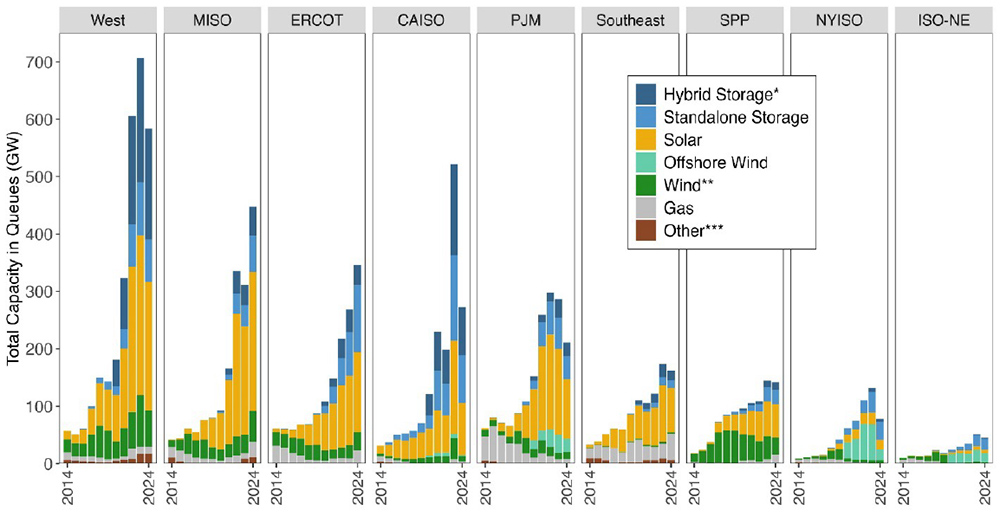
ERCOT’s generator interconnection queue indeed is dominated by battery storage (174 GW) and solar (158 GW), followed by wind (41 GW) and gas (32 GW). The queue has 2,031 active requests totaling 409 GW of capacity. 

Having escaped legislation that could have derailed their progress, renewable resources and storage will be critical in meeting demand over the next few years. Long lead times for steam turbines and the potential negative effects of steel and aluminum tariffs have pushed gas projects into the future. The Texas Energy Fund’s low-interest loan program, designed to add 10 GW of gas generation, has had eight projects drop out or be removed in recent months. (See 2 More Projects Fall out of TEF Loan Program.) 

While quipping that he “survived” the session, ERCOT CEO Pablo Vegas said he saw lawmakers keenly focused on trying to bring balance to the grid and its resources, each with their own pros and cons. 

“Many of the bills that gave the renewable community concerns, based on the approach of how … they were going to try to bring that balance, were grounded in the right intention,” he said in an interview. “‘How do we make sure that there is an even playing field for the opportunity and the incentive for reliable long-duration, dispatchable generation?’ And I think that’s a laudable goal that we still need to continue to focus. 

“We just don’t want to slow down the growth of energy supply right now in an environment where we’re seeing such a significant growth projection and growth forecast ahead of us over the next three, four, five years.” 

The grid operator is tracking about 156 GW of large loads, more than double the 63 GW it was following in December; it defines large loads as those 75 MW or above. Residential load, meanwhile, is growing at 1.2%.

Recent state legislation requires ERCOT to include any load in its projections that has not yet signed an interconnection agreement. Recognizing that not all proposed data centers and cryptocurrency mines will show up, staff now apply a discount factor to load projections. They have proposed a 49.8% reduction in data center loads and a 55.4% cut in loads that have been attested to by officers from transmission and distribution providers. (See ERCOT, PUC Refining Future Load Projections.) 

ERCOT added more than 13 GW of capacity last year. However, effective load-carrying capability — generation’s ability to serve demand — reduces that capacity to a little bit more than the 7,527 MW of ELCC capacity added in 2001. Much of the additional capacity that year was gas-fired. 

“We don’t have a shortage of energy on the ERCOT grid. What we really have, for a few hours, are these higher-risk tail-level events [where] we need to make sure we can always keep the lights on,” Vegas said. “There’s really a lot of energy throughout the year that these data centers can leverage and that are going to be coming online. They’re going to bring even more economic support for growth and supply.” 

Batteries and solar proved instrumental last year in meeting demand. Solar energy provided energy during the afternoon (along with wind, it produced 34.8% of ERCOT’s total energy in 2024), with batteries picking up when the sun set. Storage capacity reached 10 GW in 2024 and is forecast to almost triple to 27.5 GW over the next two years. 

Vegas called batteries the grid’s “Swiss Army knife.” 

“Batteries can be the load when they’re needed. They can be supply when they need to be, and they bring incredible flexibility and agility,” he said. “But their duration is limited, and so it’s matter of building a portfolio that can leverage all of [batteries’] characteristics and features in a way to bring the most value to the system.” 

Saying the renewable energy policies were one part of the legislature’s storyline, Vegas turned his attention to Senate Bill 6. One of the Senate’s top priorities, the legislation directs the Public Utility Commission to determine a cost allocation for large loads to ensure they pay their fair share of infrastructure expenses. 

The bill also requires large-load developers to pay a $100,000 fee for the initial screening studies, with an increase for larger capacity requests. That has been met with approval by the cryptomining community, which says it will address the “phantom loads” in the queue. 

texas

ERCOT CEO Pablo Vegas | © RTO Insider LLC

Vegas agreed that SB6 will ensure cost allocation is “being done fairly.” 

“The other side of it was creating that pathway for the large data centers,” he said. “Senate Bill 6 really created some clarity and a pathway for that growth to be enabled in a very reliable way. I’m encouraged that the legislature recognized the need for some rules around how to make sure that large energy users could work with the grid and the grid operator in partnership to not only support the economic growth that the data centers are bringing, but the reliability for the rest of the constituents. 

“It takes up the questions of cost allocation, and that’ll be something that the Public Utility Commission and the stakeholders will work through as well,” he added. 

As of June 19, Abbott had yet to sign the bill. He has until June 22 to sign or veto legislation. Those he doesn’t sign become law. 

Panel Ponders Impacts, Priorities Around Western Market Seams

RENO, Nev. – The formation of two competing day-ahead markets will create seams across the West, but at least one utility representative is more worried about seams resulting from the fracture of CAISO’s real-time Western Energy Imbalance Market.

“My biggest concerns are definitely not the seams created by the day-ahead market, but by the breakup of the EIM footprint,” said Kelsey Martinez, director of regional markets and transmission strategy for Public Service Company of New Mexico (PNM).

Her comments came during a panel discussion on seams as part of a Western Energy Markets Regional Issues Forum meeting June 17.

Since CAISO launched the WEIM in November 2014, it has grown to include 22 market participants representing about 80% of the electricity demand in the Western Interconnection. As of April 30, WEIM’s cumulative gross benefits totaled $6.99 billion, the ISO has estimated.

But participants who choose to join SPP’s Markets+ rather than CAISO’s Extended Day Ahead Market (EDAM) will leave the WEIM for an SPP day-ahead market.

For PNM, WEIM has helped relieve congestion that comes from “overbuilt” intermittent resources such as solar and wind, Martinez said.

“The EIM footprint has allowed us to integrate most of our renewables,” she said. “And we will be faced with a completely new problem when we have the same renewable mix but we don’t have the same connectivity through EIM that we used to.”

Martinez called for a focus on real-time seams “because those are the ones creating a reliability problem.”

Seams Road Map

Panelist Mark Rothleder, CAISO’s chief operating officer, said the seams that should be addressed first are those that are needed for the launch of EDAM.

PacifiCorp is scheduled to go live with EDAM in spring 2026, followed by Portland General Electric (PGE) in the fall. (See CAISO EDAM Pioneers Share Implementation Details.)

“Launching EDAM is our main focus and resolving any of those immediate seams issues, especially as they relate to reliability but also market efficiency for EDAM to go live,” Rothleder said.

Rothleder said it would be preferable to avoid creating new seams. He proposed “as a concept” learning from the experience with WEIM “to mitigate and not create a real-time seam, especially where one does not exist today.”

“The EIM works very efficiently over a wide footprint,” he said. “How do you maintain that, even if markets may fragment? We should look for those opportunities and explore them and be open to them.”

Pam Sporborg, PGE’s director of transmission and markets, said PGE’s top focus is for EDAM to go live. She said EDAM is a key strategic goal for PGE that will help address affordability challenges for customers.

“Conversations that distract from the ISO’s focus on EDAM go-live or on our focus on EDAM go-live are just non-starters,” Sporborg said.

Sporborg proposed the creation of a seams “road map” giving a timeline for when particular seams — such as those between the two markets, or even between EDAM and WEIM — would be addressed. Other panelists liked the idea.

“For me, the value of the road map is it gives us a collaboration point with those who are also looking at Markets+,” said Kathy Anderson, transmission and markets senior manager at Idaho Power. “We all are customers of each other. So regardless of what market you’re going to be going to, you’re likely going to be participating in some way in that other market.”

Idaho Power has said it is leaning toward EDAM as its day-ahead market choice.

Rothleder said CAISO hoped to develop a seams road map that it would release to stakeholders for feedback.

Communications Seam

With the competition between EDAM and Markets+ becoming heated at times between proponents of each option, Sporborg called for work on what she called a communications seam. Rather than continuing with the divisive language that’s sometimes been used, she said, “We have to be nice to each other.”

“As those market footprints are aligning and coming into focus, I think we have an opportunity to step back and reset the way we are communicating with each other and recogniz[e] that we all have common interests at heart,” Sporborg said.

“We all want reliability, we all want affordability. We are all making choices that are in the best interest of our customers,” she said.

MISO Debates What-ifs, Vows Improvements in Front of La. PSC After Load Shed

MISO leadership again promised to step up the RTO’s advance communication of tight system conditions following its four-hour load-shed directive for about 600 MW in Greater New Orleans on May 25.

MISO dispatched Senior Vice President Todd Hillman and MISO Executive Director of Market Operations JT Smith to the Louisiana Public Service Commission’s June 18 meeting to elucidate steps leading up to the blackouts and face censure from commissioners.

Hillman said MISO is thinking through how it can better communicate the risk it expects before “these types of rare and unfortunate events.” He said MISO is accountable as the reliability coordinator of the wholesale electric grid and that staff worked diligently on that Sunday to combat unavailable generation, transmission congestion and a tornado-damaged, unreachable Nelson-Richard 500-kV line. (See MISO Says Public Communication Needs Work After NOLA Load Shed.)

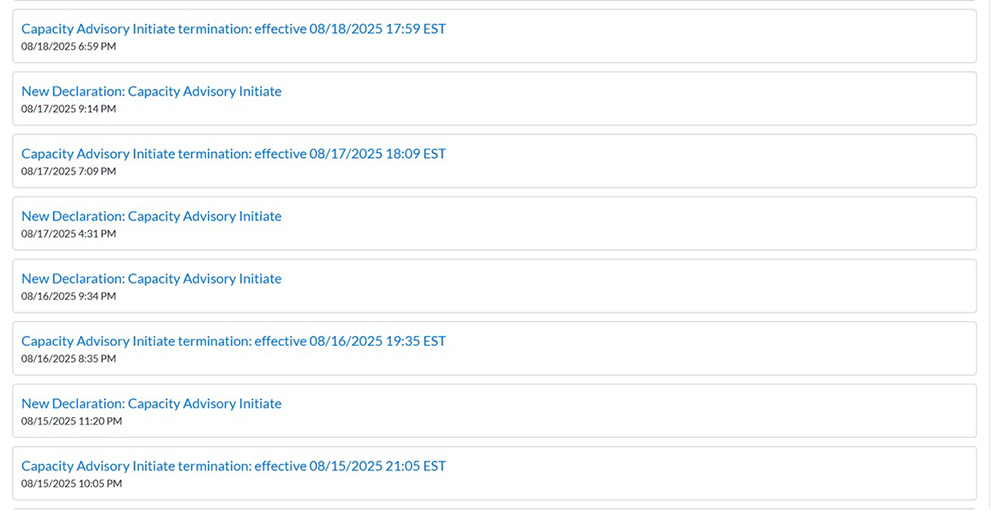
Hillman told commissioners that because the emergency ultimately can be traced to a transmission emergency instead of a capacity emergency, MISO did not sequence through its typical alerts and warnings before resorting to load shed.

MISO’s capacity advisories and maximum generation alerts and warnings are reserved for when MISO could be short on capacity, not transmission availability. Hillman said MISO doesn’t have warning protocols for transmission emergencies and is working on implementing some.

“We don’t have a lot of those. We’re not quite used to those,” he said of transmission emergencies.

Entergy CEO Phillip May said Entergy is similarly investigating how to improve the “timeliness of communication of load-shed risk.”

Commissioner Foster Campbell asked Hillman if MISO thought it owed people compensation for damages, lost revenue and adverse health outcomes during the blackouts. He said it’s “hard to swallow” that customers are obligated to not miss bills, but MISO could drop the ball without consequence.

Like he did before the New Orleans City Council, Hillman explained that MISO does not interact with retail customers and only has operational control over Entergy and Cleco’s transmission, not generation. He said MISO is a nonprofit that doesn’t have a mechanism to reimburse ratepayers, and its wholesale customers are Entergy and Cleco. (See NOLA City Council Puts Entergy, MISO in Hot Seat over Outages and MISO: New Orleans Area Outages Owed to Scant Gen, Congestion, Heat.)

Campbell said that Entergy seemed to be pointing the finger at MISO for providing roughly eight minutes of notification before the utility was forced to take load offline. Once MISO identified the risk of exceeding an interconnection reliability operating limit (IROL) on Entergy’s system on May 25, the RTO had a total of 30 minutes to offload demand and clear conditions per NERC requirements.

“That’s the nature of the conditions of this IROL,” Hillman said.

May confirmed that Entergy had less than 10 minutes to comply and dial down load.

Smith said MISO spent some of the half-hour trying to find alternatives to the last resort of blackouts. He added that MISO is trying to figure out if it met NERC’s 30-minute time limit and told commissioners MISO should have been “communicating much earlier about this risk.”

In addition to 2.65 GW of planned outages across four generating units near the southeastern Louisiana load pocket, MISO experienced eight unplanned generation outages on May 25 totaling 3.86 GW. Generation derates accounted for another lost 1.1 GW on top of that.

“That’s just a very large number to have out in a load pocket,” Hillman said.

Commissioner Davante Lewis asked if MISO would name the generators. He said that although he knew of Entergy’s two offline nuclear units, no one has identified the other generators.

MISO’s Todd Hillman addresses the Louisiana Public Service Commission at its June 18 meeting. | La. PSC

Hillman said MISO would provide that information in data response requests and only when a utility has allowed MISO to release the information. MISO as a rule doesn’t identify units that are on outage.

However, Commissioner Eric Skrmetta said Entergy told him it has a waiver letter on file with MISO that allows the RTO to disclose utility data when asked by the commission. He said he viewed it as a “serious infraction” that MISO seemed not to follow the waiver letter and noted that commissioners must answer questions from the public and the press while MISO does not. He added that the PSC will seek data requests.

Skrmetta said he thought MISO could have “staved off” some of the load shed by turning to some of Entergy’s more than 400 MW of interruptible customers. He said some generating units that were on unplanned outage had been offline for days at that point, so they wouldn’t have shown up in the day-ahead market that morning either.

Skrmetta said the outage seemed carried out “in more of a panic” than in a “planned, methodical … activation.” He said in pre-RTO days, it seemed that companies took more pains to avoid blackouts, and the PSC could issue fines against shareholders and order rate credits for the public. He said in this case, the PSC is left with no recourse save for maybe a class-action lawsuit against MISO because it left Entergy and Cleco no choice but to “start flipping switches” or risk widespread system damage.

“I think we’ve got real problems with this,” Skrmetta said. “It’s unacceptable, and I hope people find a way to, you know, effectively get their pound of flesh out of you. We’re not going to be able to do it, but we’re going to have to find a way to make it more reliable in the future.”

Skrmetta said he did not need MISO leadership to respond to his criticisms.

Earlier, Hillman said he understood the load-shed event was “frustrating, disruptive and deeply concerning.”

Lewis asked if MISO had ever before experienced so many outages in a single local resource zone.

Smith said outside of significant storm damage, he couldn’t recall ever having “such a consolidated area of outages like that.”

Lewis noted that some unplanned outages already were in play the week prior and asked what conversations MISO had around contingencies ahead of time.

Hillman said communications were flowing between operators, with reconfiguration plans, studies and analyses performed throughout the day.

Smith said May 24 started out remarkably similar to May 25, but storms in the afternoon cooled the air and dampened demand. He said operator logs from May 24 noted that MISO was coming close to localized load shed, though they managed conditions with reconfiguration and dispatching generation down to avoid infrastructure damage.

Commissioner Jean-Paul P. Coussan asked if the load-shed judgement call was the result of automated processes or AI use.

Hillman said while a computer system runs system simulations, it’s backed up by MISO’s experienced human operators. He said the decisions that day were not dominated by technology, and control room operators tested conclusions and made phone calls to members in a plea for emergency-range output before making the order.

Smith said that on May 25, about 160 MW of Entergy’s approximately 400 MW of load-modifying resources were available with about four-hour lead times. Had MISO called them up in advance, they may have improved conditions, he said.

However, Smith said MISO’s forecasts at the time were “generally good” and its forward-view models did not reflect “the dire conditions that were eventually shown.” He said the IROL was unforeseen, and MISO is investigating the accuracy of its modeling. Hillman said in addition to modeling improvements, MISO is considering introducing drills so it can lay out what members can expect in a transmission emergency.

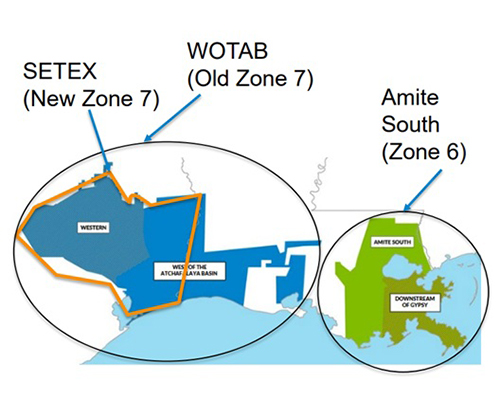
Lewis said the event clearly shows that Louisiana needs more transmission capacity in and around the Downstream of Gypsy load pocket. That load pocket predates Entergy’s inclusion into MISO.

May said Entergy is pursuing multiple, “significant” transmission projects that could help inject more power into the Amite South load pocket, which encompasses most of southeastern Louisiana and includes the Downstream of Gypsy load pocket. Entergy representatives said a new 41-mile, 230-kV Adams Creek-to-Robert line approved under MISO’s 2023 Transmission Expansion Plan and expected to be in service at the end of 2027 should help the area by adding 100 MW of import capability.

Asked by Lewis about Entergy’s receptiveness to long-range transmission planning from MISO, Entergy Associate General Counsel Matthew Brown said he didn’t believe long-term transmission is best suited to resolve load pockets in Louisiana. Brown said more targeted transmission that can be built quickly is an ideal solution, not big-picture, long-range projects that can take a decade to build and can assign costs to customers in states that don’t stand to benefit.

Lewis said he worried that without some intensive transmission planning, Louisiana could be in for more problems.

CAISO Approves New EDAM Congestion Revenue Allocation Design

CAISO has approved the final proposal in its highest-priority initiative in 2025.  

The CAISO Board of Governors and Western Energy Markets (WEM) Governing Body at a joint meeting June 19 approved a new method for allocating certain congestion revenues in the ISO’s Extended Day-Ahead Market (EDAM), set to launch in 2026. 

CAISO began the initiative to address a paper by Powerex that said the existing EDAM model contains a “design flaw” with potentially $1 billion in unjustifiable charges at stake. (See Powerex Paper Sparks Dispute over EDAM ‘Design Flaw’.) 

Since then, CAISO has issued multiple proposals on the subject and has held stakeholder workshops to resolve potential congestion revenue allocation issues that could arise under EDAM — some of which continue to exist in the final design, certain stakeholders contend. (See CAISO EDAM Congestion Revenue Proposal Gains Support.)  

“I think it would be an understatement to say that this initiative and proposal seem to be the most intense and engaged issue since the approval of EDAM,” Governing Body Chair Robert Kondziolka said at the June 19 meeting. “Although painful at times, the stakeholder process works.”  

“It’s clear that we are in territory that other ISOs haven’t navigated, so we are learning as we go,” CAISO board Chair Severin Borenstein added. 

The proposal is intended to address the fact that congestion revenues, or rents, will occur when a transmission constraint in one EDAM balancing area affects the locational marginal prices in neighboring balancing areas. In these cases, the market operator pays less to suppliers than to market participants. 

Under the current EDAM model, congestion revenues would be allocated to the balancing authority area that contains the transmission constraint that is causing congestion on the system. This design is in effect in the WEIM and has been approved by FERC. 

Under the new design, certain congestion revenues would be allocated to the BA where the energy is scheduled, rather than where the constraint is located. The new design applies in cases of parallel flow — or loop flow — on the system. In these parallel flow situations, congestion revenues will be allocated to an EDAM BA where congestion revenues are collected by using eligible firm Open Access Transmission Tariff transmission rights submitted and cleared as day-ahead balanced self-schedules, CAISO said in a June 12 memo on the matter. 

The purpose of the new design is to improve congestion cost protections for transmission customers exercising eligible firm transmission rights under the terms of the EDAM entity’s OATT, CAISO said in the memo. The design applies only to the day-ahead market, not congestion revenue allocations in the Western Energy Imbalance Market (WEIM). 

Most stakeholders support the final design, CAISO staff said at the meeting. However, two primary concerns remain among many stakeholders: one, that the design is ‘transitional’; and two, that the design could create economic incentives to self-schedule energy resources. 

The Unknowns

For transitional concerns, stakeholders want the ISO to “ensure there is a forum for consideration of a long-term design for congestion revenue allocation as the EDAM footprint grows,” CAISO said in its memo. CAISO therefore will hold working groups with stakeholders before EDAM begins in 2026.  

After these working groups, CASIO said it will propose a long-term design within the next two years. CAISO also will monitor the performance and impacts of this transitional change using certain metrics that will be shared with stakeholders.

The primary concern of CAISO’s Market Surveillance Committee (MSC) is about the new design’s potential to create self-scheduling incentives, which potentially reduce the benefits of coordinating unit commitment and dispatch across multiple balancing areas that EDAM is intended to provide, and potentially result in unintended cost shifts, MSC committee members said in a June 16 memo. 

“We do want to avoid those self-scheduling incentives,” consultant Scott Harvey, MSC member, said at the meeting. “On the other hand, they might be small … and there is not going to be a lot of self-scheduling in response to these incentives. But we think that is not a given and these are things CAISO needs to look at.” 

“EDAM is not an off-the-shelf product,” Harvey added. “When you’re doing something for the first time, you should never assume everything is going to work right.” 

The ISO’s Department of Market Monitor (DMM) agreed the new design is likely to create economic incentives for some inefficient self-scheduling of resources. However, while this will reduce the efficiency benefits from managing congestion over an expanded EDAM footprint relative to the currently approved design, there still would be significant benefits from an expanded market relative to the current pre-EDAM market, Eric Hildebrandt, DMM executive director, said in a June 12 memo 

The ISO has provided data showing there is reasonable hope that the potential for inefficient self-scheduling would be limited in the PacifiCorp balancing areas, Hildebrandt said. 

Tri-State Tells Colorado PUC Joining SPP RTO in Public Interest

Tri-State Generation and Transmission Association asked the Colorado Public Utilities Commission to find it would be in the public interest for the power supplier to join SPP, saying integrating with the RTO woud bring significant benefits. 

Tri-State said in a June 17 news release that it is preparing to fully integrate with SPP’s RTO West expansion in April 2026 together with six other Western utilities and that it has filed an application for a public interest determination with the commission. 

By joining the RTO, Tri-State would bring resources located in the power supplier’s Colorado, Nebraska and Wyoming Western Interconnection system, totaling more than 20 generating units, more than 3,100 miles of high voltage transmission and portions of 23 of Tri-State’s members’ loads, “representing 67% percent of gross load across the Tri-State system,” according to the release. 

Additionally, Tri-State touted the benefits of joining the RTO, saying it would bring an estimated $20 million in annual net benefits and increased ability to meet energy demand and greenhouse gas reduction targets, among other benefits. 

“The expansion of the SPP RTO is the most cost-effective pathway to organized market benefit for Tri-State’s members,” Duane Highley, Tri-State’s CEO, said in a statement. “Our participation will support our members’ goals for reliability, affordability and a cleaner energy future, with cost savings shared by all members.” 

“SPP welcomes Tri-State’s announcement about their expanded participation in the SPP RTO,” Carrie Simpson, SPP vice president of markets, told RTO Insider. “As a long-standing SPP member and key energy provider in the West, Tri-State’s deeper involvement strengthens our shared commitment to responsibly and economically keep the lights on today and in the future.”

“This announcement formalizes plans announced years ago and applies only to Tri-State’s Colorado facilities outside the Xcel system. It does not impact Tri-State’s continued participation in Markets+ for facilities within Xcel,” Simpson added.

FERC on March 20 accepted SPP’s proposed revisions to its tariff that will incorporate seven Western Interconnection entities as transmission-owning members of the RTO, making the grid operator the first to provide full market services in the grid’s two major interconnections. (See FERC Approves Tariff for SPP RTO West.) 

SPP has targeted April 2026 as when the entities, including Tri-State, will begin participating in its Integrated Marketplace, transmission planning, reliability coordination and other RTO services. They all are members of the Western Energy Imbalance Service market, which SPP has administered since 2021: 

    • Basin Electric Power Cooperative 
    • Colorado Springs Utilities 
    • Deseret Power Electric Cooperative 
    • Municipal Energy Agency of Nebraska 
    • Platte River Power Authority
    • Western Area Power Administration 

SPP has said RTO West will provide more than $200 million in annual benefits to its members, primarily through the optimization of DC ties with the Eastern Interconnection. 

In the June 17 news release, Tri-State said the RTO will reduce seams between providers in “Colorado, Wyoming, Montana and Nebraska through the consolidation of seven transmission providers’ tariffs into an SPP RTO common tariff, also reducing the costly “pancaking” of transmission rates.” 

Tri-State noted that seams will continue to exist between the Western Area Power Administration’s Colorado-Missouri balancing area and that of the Public Service Company of Colorado, which is seeking to join SPP’s Markets+ day-ahead market offering. (See PSCo Seeks to Join SPP’s Markets+.) 

Tri-State has been one of the signatories to a series of “issue alerts” touting the purported advantages of Markets+ over CAISO’s extended day-ahead market and the Western Energy Imbalance Market (WEIM). (See 7th ‘Issue Alert’ Highlights Markets+ Footprint.) 

“We greatly value the full benefits of the SPP RTO, including day-ahead, real-time and ancillary services markets, efficient regional transmission planning, reliability coordination, a common transmission tariff and a participatory governance model that help us reduce costs and advance clean energy goals,” Highley said.