PORTLAND, Ore. — In their respective speeches during the annual meeting of the Western Conference of Public Service Commissioners, outgoing FERC Chair Mark Christie and former Colorado Gov. Bill Ritter both emphasized that the West controls the future of the Western Interconnection, not Washington.
Christie addressed WCPSC participants remotely June 2, a few hours before news broke that President Donald Trump would nominate Laura Swett of Vinson & Elkins to replace Christie on FERC. (See related story, Trump Replacing FERC Chair Christie with Laura Swett.)
Christie said in his speech that the “early days” of FERC trying to force states and utilities to join an RTO are over.
“It’s called standard market design, and I remember that, and I thought that was a horrible mistake. And fortunately, it didn’t happen,” Christie said.
“It’s not for us at FERC to tell you what to do,” he told the audience. “You’ve got to make that choice on what’s right for you.”
The chair said if the West decides to create an RTO, the industry should think of it “as a bundle of services,” functioning mainly as a grid operator.
An RTO is “not one single service. … I liken it to going through a cafeteria,” he said. “You can pick what you want and not pick what you don’t want.”
Christie’s comments come as many in the power industry in the West are deciding whether to join day-ahead markets offered by either SPP or CAISO.
“You’ve had the choice for years to go into CAISO’s energy market, the [Western Energy Imbalance Market], without even joining … the CAISO itself. So, you can even pick the market without the RTO, but you’ve got a choice of a real-time energy market,” Christie said. “You’ve got a choice of a day-ahead market now; CAISO has it; SPP offers it.”
SPP operates WRAP, and the program will provide a mandatory RA framework for participants in Markets+ in an effort to ensure members with a surplus generating capacity assist those with a deficit.
“Resource adequacy is a challenge everywhere,” Christie said. “And we’ve seen with the data center explosion … load forecasts that are just mind-boggling.”
In a similar vein, Ritter, founder of Colorado State University’s Center for the New Energy Economy, noted the energy industry is grappling with significant change, both politically and technologically.
For example, artificial intelligence will impact technologies that provide power to the grid, but also power demand on the grid, Ritter said during his WCPSC address June 4.
Another change is shifting views on the energy transition, Ritter noted. He pointed to the One Big Beautiful Bill Act that recently passed in the House of Representatives. The bill would extend tax cuts for individuals and render energy tax credits effectively useless. The proposed legislation is a sharp departure from the Inflation Reduction Act of 2022, passed by Democrats, which expanded clean energy tax credits. (See House Passes Reconciliation Package that Would End Energy Tax Credits.)
Long-term planning and near-term decision-making become difficult when “the politics of the moment can shift on a dime,” Ritter said.
However, the West still exercises control over how it chooses to modernize its grid, whether it’s through RTOs or day-ahead markets, but that requires bipartisan discussions over state lines, according to Ritter.
“We need to talk across political boundaries, within states, in order to solve this issue about how we should build out transmission of the West and what that should look like as we go forward, as we look at the things that are going to change,” Ritter said.
“It’s going to be difficult, but if we don’t do it, we’re going to wind up a little bit like Washington, D.C., sounds right now,” Ritter said. “A fairly toxic place — difficult to operate.”
The International Energy Agency is forecasting record energy investment worldwide in 2025, despite the present uncertainties and headwinds.
As it released the 10th edition of its annual report June 5, the IEA said investment in clean technologies is predicted to hit $2.2 trillion this year, or about two-thirds of the total energy investment. Both figures would be record highs — the $3.3 trillion total investment would be 2% more than in 2024.
Photovoltaic solar is drawing more investment than any other technology, IEA said, and China is investing more than any other country or bloc of countries.
“When the IEA published the first ever edition of its ‘World Energy Investment’ report nearly 10 years ago, it showed energy investment in China in 2015 just edging ahead of that of the United States,” IEA Executive Director Fatih Birol said in the news release. “Today, China is by far the largest energy investor globally, spending twice as much on energy as the European Union — and almost as much as the EU and United States combined.”
The 10-year stretch was marked by another change: a de-emphasis on fossil fuel investments. In 2015, investment in the fossil sector was 30% higher than in electric generation and grids. In 2025, electricity investments are expected to be 50% greater than in fossils.
The volatility seen in the global economy and trade so far has not had a major effect, Birol said: “The fast-evolving economic and trade picture means that some investors are adopting a wait-and-see approach to new energy project approvals, but in most areas, we have yet to see significant implications for existing projects.”
IEA also flagged a disconnect that has been apparent in some regions for some time: The investment in grids to transmit all this new electricity is not keeping up with the investments to generate and use that electricity.
Transmission investment stands at $400 billion annually but is being held back by cumbersome permitting processes and limited supply of transformers and cables.
There also remains a significant geographic disparity in all types of investment. Many emerging markets and developing economies lag far behind the advanced economies, IEA said, particularly in Africa, which is home to 20% of the world’s people but attracts only 2% of global clean energy investment.
Looking specifically at the United States, the IEA report contrasts its increasing production and export of oil and natural gas over the past decade with its decreasing percentage of electricity generation investments going to fossil fuels.
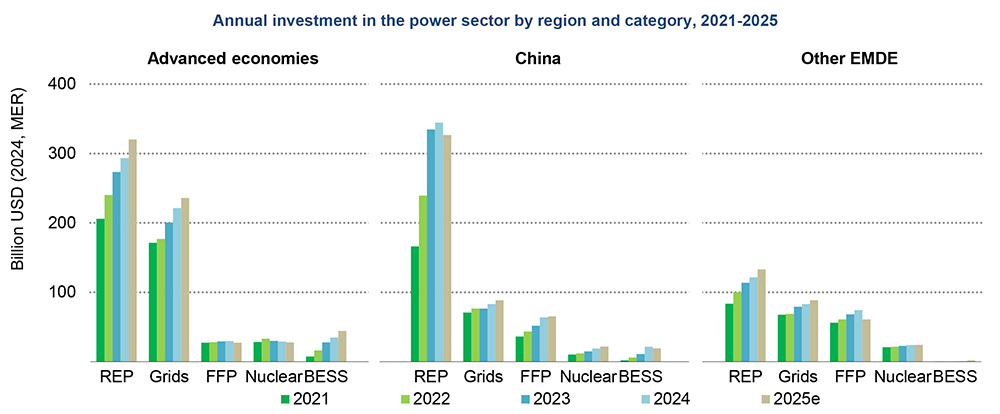
The International Energy Agency expects investment in renewable power generation to outstrip fossil fuel power by a wide margin in the advanced economies and China but a narrower margin in emerging markets and developing economies. | IEA
IEA also notes the surging investment in data centers and the interest in powering them with clean energy, and the resulting enthusiasm for next-generation nuclear power to fulfill that need non-intermittently.
With its deep financial resources and its long history in nuclear power, the United States could emerge as a leader in next-generation nuclear, as well as in other technologies, such as geothermal, IEA said.
But here again, interconnection delays and transmission constraints are a potential hurdle. Power availability is the top concern for 90% of data center developers, IEA said, and nearly 50% consider upgrading grid infrastructure to be the best possible mitigation for this.
Compounding the problem, data center operators are competing with generation and transmission developers for the already-inadequate supply of key grid components such as transformers, IEA said. As a result, while a data center can take three to six years from concept to completion, new grid infrastructure can run five to 15 years.
FERC Order 2023 and other grid reforms may prove to be critical tools to enable growth, it added.
MISO’s 2022 and 2023 generator interconnection queue cycles are lagging behind their stated timelines once again as the RTO continues working to produce study results in a new, automated process.
The grid operator said it now will post a final system impact study for the 2022 cycle July 8 and move those generation proposals to the second phase of the three-part queue by Aug. 6. It will move on to studying project applications submitted in 2023 on Aug. 20.
This is MISO’s second postponement for the 2022, 2023 and 2025 queue cycles. The grid operator skipped acceptance of a 2024 cycle while it tried to get a handle on study delays and design a megawatt-capped queue that could sort out projects over a one-year span instead of three to four years.
In January, MISO planned to begin studying the 2023 cycle in May and the 2025 cycle by the end of the year, a few months behind the schedule it announced in 2024. At the time, the grid operator envisioned all generation projects from the three cycles striking interconnection agreements over 2026, with the 2022 cycle proceeding in the second quarter, 2023 in the third quarter and 2025 by the end of 2026. (See MISO Unveils Later Timeline for Queue Processing Restart.)
MISO’s Kyle Trotter said MISO would post a new schedule soon detailing when it will proceed with the 2025 cycle of projects.
Senior Manager of Resource Utilization Ryan Westphal said MISO wants to finalize the 2022 cycle’s system impact study after multiple rounds of adjusting modeling assumptions at stakeholders’ suggestions and presenting different drafts of the study for review.
“We’re ready to move forward at this point,” Westphal said during a June 3 teleconference focused on MISO’s interconnection process. He added that MISO will account for project withdrawals from the 2022 cycle in the screening process for the 2023 batch of projects.
Westphal said MISO’s later, Aug. 20 study kickoff also would give the RTO time to seek FERC approval to include MISO and SPP’s $1.65-billion Joint Targeted Interconnection Queue (JTIQ) portfolio in its modeling for the 2023 cycle of generation projects. The move is unpopular among MISO’s generation developers, who are set to shoulder all JTIQ costs; they’ve said the cost allocation could attach high, unpredictable expenses to their projects. (See MISO Gen Developers Sour on RTO’s JTIQ Cost Allocation.)
“We want to make sure we have enough time to hear back from FERC,” Westphal said.
MISO has 1,273 projects totaling 237.8 GW in its interconnection queue.
The PJM Board of Managers has elected David Mills to serve as its chair.
“It is an honor to lead this board at a time when continuity and stability are critical to our mission of preserving the reliability and affordability of the grid,” Mills said in an announcement PJM published June 5. “Our stakeholders have made clear their desire to strengthen communication channels with the board, which we have already taken steps to accomplish. I look forward to working together to make the hard choices required of us to maintain the balance between electricity supply and demand.”
He was elected to the board’s chair-elect position in 2024, putting him in place to assume leadership if the prior chair, Mark Takahashi, left the role. Takahashi was not elected to another term on the Board of Managers during the May 12 Members Committee meeting and took his name out of the running before the vote was set to be reconsidered the following day. Mills was elected formally to be the board’s chair on May 14.
“David is a very capable leader,” PJM CEO Manu Asthana said in the announcement. “He understands the tradeoffs required to preserve reliability and affordability, and he has demonstrated his commitment to listening to and working in partnership with our stakeholders. I am confident that the reins of the PJM board are in able hands.”
During the May 12-14 PJM Annual Meeting, Mills said he supports the board taking steps to improve communications with stakeholders. He said he would seek to add agenda items to future Members Committee meetings for attending board members to speak with stakeholders during the meeting, as well as for them to remain accessible after the meeting and wait until the following day to return home.
Mills first was elected to the board in 2021. He has chaired the Competitive Markets Committee and is a member of the Nominating Committee. Prior to joining the board, he served as Puget Sound Energy’s chief strategy officer and previously worked for the Bonneville Power Administration. He earned a Bachelor of Science in economics from Portland State University.
The California bill to implement the West-Wide Governance Pathways Initiative’s Step 2 proposal to allow CAISO to relinquish market governance to an independent “regional organization” (RO) passed the state Senate on June 4 on a 36-0 vote, with four members abstaining.
SB 540 was approved after 40 minutes of floor debate in which several senators expressed concern about the extensive amendments added to the original bill, particularly a provision creating a new Regional Energy Market Oversight Council responsible for ensuring CAISO’s participation in a regional energy market that “serves the interests of the state.” (See Amended ‘Pathways’ Bill Boosts — and Complicates — Calif. Protections.)
The new council would be authorized to mandate withdrawal if those interests are compromised.
Those senators sought assurances that the bill’s sponsors, Sens. Josh Becker and Henry Stern, both Democrats, would work with members of the state Assembly to return the bill to something closer to its original form.
But other senators said they wanted to ensure preservation of an “off-ramp” from the RO, expressing worry that the ISO’s participation could compromise California’s environmental and clean energy policies, particularly in the face of the Trump administration’s efforts to support coal-fired generation.
Becker assured his colleagues the bill would not increase California’s exposure to federal political interference, but did point to the risks of the state losing potential “partners” on the electricity grid to “a market out of Little Rock” — SPP’s Markets+, the competitor for participants to CAISO’s Extended Day-Ahead Market (EDAM).
“Make no mistake: if we do not act, we will be worse off,” Becker said.
‘Strong Coalition’
During the debate, Sen. Tony Strickland (R) called the recent amendments to SB 540 “very problematic” but expressed confidence that Sens. Becker and Stern would “work out some of these problems” as the bill advances through the lower house.
Strickland pointed to the “strong coalition” backing the bill, including labor and business groups.
“I haven’t seen a coalition like this in a long time, and I’ve been on [Senate] Energy Committee going back 13, 14, 15 years,” he said. “Because everybody understands status quo is not an option. We need to get this fixed. We need to move forward. We need to make sure energy is reliable for all California residents.”
Sen. Angelique Ashby (D) opened her comments saying she likes to “brag” about the publicly owned utility that serves her constituency, the Sacramento Municipal Utility District (SMUD), and voiced concern that SMUD had changed its position on the bill in light of the amendments.
Ashby asked the bill’s authors how they will “get from where you are now back to a space where you can earn the support of the one of the most trusted entities in the state of California, which is SMUD.”
“I know SMUD, other than [having] issues with the bill, would like to see it move forward, and I’m committed to working with them going forward,” Becker said.
Sen. Christopher Cabaldon (D) said a small portion of his constituents are served by SMUD and echoed Ashby’s concerns, urging “less work” to be done on the bill.
“Because the problem here is all of the benefits of this bill — and they are numerous and profound — depend on us actually joining with the region and the region joining with us,” he said. “I think the problem that I hope we will work on to resolve in the Assembly is that we cannot replicate all of the state rules and interests and what have you, as though the rest of the world is just waiting for California to allow them to be partners.”
Sen. Rosilicie Ochoa Bogh (R) said she supported the bill in the Senate Energy Committee “because it reflected a bipartisan, holistic compromise. Literally every group, as mentioned earlier, related to energy, visited my office, and nearly all were in alignment. Not all were pleased, but they were aligned.”
But Ochoa Bogh said the proposed oversight council in the amended bill “fundamentally alters the governance structure” by giving the body “extraordinary authority” over California’s participation in a regional market. She said that would “inject an uncertainty into what should be a technical, market-driven process” and compromise long-term resource planning if the state were “suddenly withdrawn,” threatening grid reliability and affordability for residents.
‘Energy Island’
Sen. Thomas Umberg (D) said SB 540 is “a very difficult bill” because it brings up “a clash of interests that is very difficult to reconcile” — namely, the differing views on climate change between California’s leaders and the Trump administration.
“The challenge is that, once we’re in [the RO], it may be very difficult to leave, either legally or practically, because we become so reliant on the grid. And it also vests California in a place where, potentially, the current administration can wreak havoc on California,” Umberg said.
Sen. Suzette Martinez Valladares (R) recalled a previous visit to CAISO was a “phenomenal experience” before noting the ISO has “urged” for a “regional approach.” She warned that California faced risking becoming “an energy island” like Texas, but also said she wanted additional clarity around the role of the proposed oversight council.
Sen. Ben Allen (D) added his voice to supporters of the bill but said inclusion of the oversight council was “bizarre” and represented a “bad direction,” in part because it would make withdrawal from the RO a “governor-dominated” decision. He pointed to a suggestion that the decision should come down to “some sort of supermajority vote in the legislature.”
Sen. Aisha Wahab (D) expressed the greatest reservations about SB 540, saying creation of the five-member oversight council is “not enough” and that she was concerned “that we’re not going to bring it back to the legislature to have a full picture of what this regional organization will actually look like.”
“If it is that we have a lot of confidence in a regional organization — the fact that it won’t impact the RPS and won’t take away green jobs and won’t force Californians to subsidize an organization they no longer have control over — then we should be able to review the facts once we have more concrete evidence,” she said, later abstaining from voting on the bill.
Sen. Anna Caballero (D) said she favored “regionalism” because “I think our weather patterns and the energy that we can create regionally is diverse enough, so it’ll benefit California.” But she also called for the bill to include the option for an “off-ramp” from the RO to avoid tying the hands of a future governor and legislature.
In his closing speech stumping for his bill, Sen. Becker reminded his Senate colleagues that SPP’s Markets+ has been able to attract more participants in recent months.
“So, if they’re able to sort of pull something together, we’ll end up isolated — so we need to do this,” he said. “I appreciate everyone who’s had their input and wants to keep working on this going forward.”
Reactions
Clean energy groups that have backed the Pathways Initiative commended the California Senate for advancing the bill while also urging changes to the bill as it moves through the Assembly.
“California can’t afford to go it alone when it comes to meeting skyrocketing energy demand while tackling the energy affordability crisis,” Edson Perez, California lead at Advanced Energy United (AEU), said in a statement. “We need to be able to keep the lights on in the fourth-largest economy in the world without charging ratepayers an arm and a leg. Joining a robust Western regional energy market is essential to keeping energy costs under control while still spearheading the transition to clean energy.”
AEU said bill supporters “remain committed to ongoing collaboration to ensure the final version reflects the shared priorities of the diverse coalition engaged in this effort for regional energy collaboration.”
“Today’s Senate vote is an important step in a long process to ensure California is at the forefront of a fast-moving revolution in how electricity will be bought and sold across the West,” Katelyn Roedner Sutter, California state director at the Environmental Defense Fund (EDF), said in a statement. “California cannot keep the lights on or solve the climate crisis alone — we need an electricity system with diverse clean resources that can withstand simultaneous extreme weather events.”
Roedner Sutter said EDF shares “significant concerns about recent bill amendments that undermine the benefits of California’s participation in a Western market and urge California leaders to act decisively to avoid losing more trading partners to a competing Arkansas market.”
Ontario’s nodal market is showing promise one month after its launch, with improved price certainty, increased day-ahead trading and LMPs reflecting expected congestion patterns, IESO officials say.
IESO’s Market Renewal Program (MRP) is designed to improve the way the grid operator supplies, schedules and prices power by creating a financially binding day-ahead market (DAM) and adding about 1,000 LMP nodes. The ISO says the nodal market, which launched May 1, should save Ontario $700 million over the next decade through reduced out-of-market payments and increased efficiency. (See IESO Nodal Market Launch Successful.)
In a briefing June 4, IESO said the initial month of operations were “consistent” with the MRP’s goals. The only glitches to date were a day-ahead market failure May 22 and a delayed opening to the new virtual market.
While day-ahead prices were not financially binding in the prior market — meaning all settlements were against real-time prices — about 95% of energy volume is now clearing in the DAM. Most non-quick-start generator commitments are being made in the day-ahead rather than in real time, and pre-dispatch reviews are selecting least-cost resources.
‘Encouraging’ Results
“The results that we’re seeing from the first couple of weeks are actually really encouraging,” said Darren Matsugu, director of markets. “Our locational prices really have aligned with the expectations that we’ve seen historically based upon congestion across different parts of the province.
Darren Matsugu, IESO | IESO
“With the introduction of the day-ahead market … we are seeing improved real-time certainty, both from participants and importantly for the ISO.”
Most export transactions now are being scheduled day-ahead, up from virtually none in the old market. The shift “really gives the ISO a much more complete picture about the next day’s operation than we used to see,” Matsugu said.
While the real-time market has shown more volatility than day-ahead prices because of unanticipated outages and supply/demand changes, those spikes are muted in consumer prices because only 5% of energy volume is settled in real time.
“We’re seeing really complete participation and competitive participation [in the day-ahead market], which has given us good confidence in those day-ahead market results,” Matsugu said. “And of course, if there’s any additional scheduling needed in between day-ahead and real-time, we are seeing that this vastly improved pre-dispatch sequence is doing a good job of selecting the least-cost resources.”
A Small Snapshot
Officials cautioned that their ability to draw conclusions is limited because of the short time the market has been operating. Participants still are learning about the market and developing their trading strategies, they said.
“A full year, covering all four seasons, will provide more complete information,” IESO said.
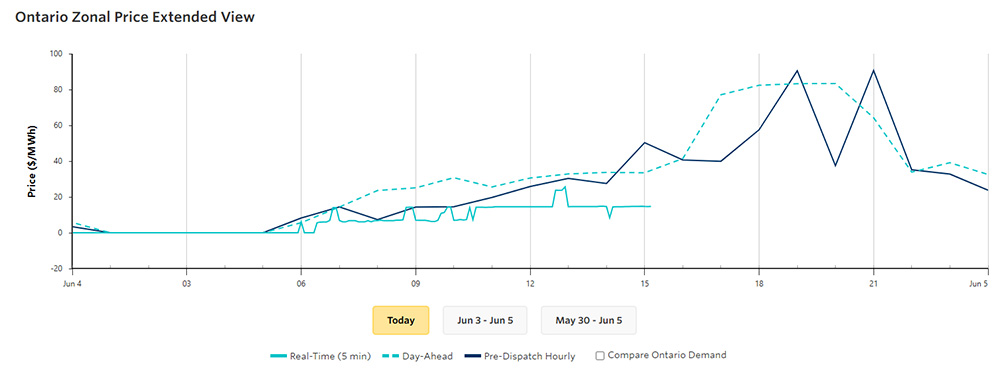
IESO day-ahead, real-time and pre-dispatch prices | IESO
“Market performance really does need to be considered under a wide variety … of system conditions,” Matsugu said. “Every season, every month, presents itself with very material differences in terms of demand, supply conditions, transmission [and] outages. All those things are very different, and the market needs to perform very different optimization through the year. So, for example, performance during the summer and winter peak days, there’s quite significant differences in system peaks and that kind of transition from overnight periods. And those really are kind of our best test of the market’s ability to be able to efficiently maintain reliability.”
‘Defects’ Corrected
The transition to the new market “went very smoothly thanks in no small part [to] the efforts of many of you out there,” said Candice Trickey, director of MRP readiness.
Candice Trickey, IESO | IESO
She singled out the MRP Implementation Working Group, composed of representatives from different market sectors that helped the ISO design training and testing of the new market.
The first run of the DAM calculation engine was successful on May 2, and the first market settlement statements were issued May 15.
“Since the transition, the settlement statements have been issued on time, and there have only been a small number of disagreements that we’ve seen by a limited number of participants,” she added. “To date, anyway, we haven’t seen any widespread calculation or settlement errors.”
Although the ISO’s support teams saw a large jump in the number of contacts and tickets in the first week, “those have fairly quickly petered out to more normal volumes,” she said.
IESO identified some “defects” during and after the launch. “Not a surprise, once you put everything into production; new things pop up, and we did identify some defects,” Trickey said. “Those have all been quite quickly addressed through either workarounds or permanent fixes. Most of those things were fixed before any of you saw them.
“This was a very complex project [involving] more than 10 different systems that we had to integrate together,” she added. “They all ran 24/7, providing a continuous stream of results and instructions and reports. So, it’s no surprise that we experienced a few hiccups.”
Timothée Denis of Air Liquide said his company’s day-ahead trading limit — 50 MW before the transition — initially was limited to 25 MW at the new market’s launch. “So we had to bid on half of our capacity and liquidate the rest of that on the real-time market,” he said, adding that the problem was resolved May 22.
Virtual Market Delayed
Trickey also said there were some problems completing authorizations for virtual traders, which delayed the launch of the virtual market from May 8 to May 13.
The new system allows market participants to submit hourly bids and offers in any of nine virtual transaction zones.
A defect related to virtual trades caused IESO to declare a day-ahead market failure for the May 22 trade date, causing it to use real-time prices.
The ISO halted virtual trading to avoid further DAM failures until a fix was implemented, with virtual trading resuming May 24.
“Since then, we haven’t experienced any other issues, but it is early days, and we still remain on high alert, monitoring and watching to see if anything else should arise,” Trickey said.
Speakers and attendees of the ISO-NE Consumer Liaison Group’s quarterly meeting June 4 advocated for governance changes at the RTO after the grid operator received a failing grade on a recent report card on RTO transparency.
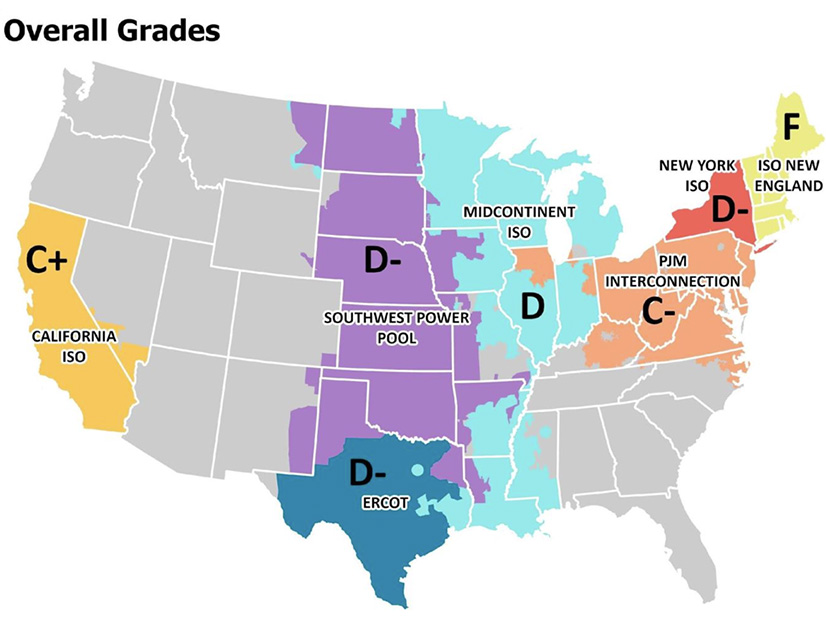
The report, commissioned by New England-based environmental justice nonprofit Slingshot, graded each RTO and ISO on public accountability, transparency and accessibility. ISO-NE was the only grid operator to receive a failing grade, which the report attributed to the RTO’s “exclusive stakeholder process and inaccessible, opaque board proceedings.”
The report also detailed concerns about the limited voting power of end-user organizations in the NEPOOL voting process, language barriers, the lack of a “streamlined public comment process” and the entrenchment of existing leadership.
None of the grid operators, however, received higher than a “C+.”
Governance issues have been a major topic at the CLG since a coalition of environmental and consumer advocates took control of the CLG Coordinating Committee in late 2022. (See Climate Activists Take Over Small Piece of ISO-NE.)
Activists have argued frequently that the nonpublic nature of NEPOOL proceedings and meetings of the ISO-NE Board of Directors prevents meaningful public engagement, while the RTO has pointed to recent steps taken to increase engagement, including annual public board meetings and the addition of an environmental and community affairs policy adviser. (See In Conversation with ISO-NE’s First Community Affairs Policy Adviser.)
Anne George, chief external affairs officer at ISO-NE, called the Slingshot report inaccurate and said it overlooked data and information the RTO has made available to the public.
“Obviously we’re not happy receiving an ‘F’; we disagree with a lot of what’s in that report, and we think it would have been helpful to talk with the researchers,” George said. “I don’t think we’re planning any major changes in what we’re doing based on that report.”
Bryndís Woods, principal analyst at the Applied Economics Clinic and one of the report’s authors, defended its methodology, stressing that the researchers were able to consider only publicly available inputs. Woods noted ISO-NE has made recent steps toward translating some materials into Spanish that were not captured in the report.
RTO transparency, accessibility and accountability grades | Applied Economics Clinic
Charles Hua, executive director of PowerLines, an affordability-focused nonprofit, said cost pressures have caused increased consumer interest in engaging with energy policy issues.
“The vast majority of Americans feel powerless to do anything about their utility bills,” Hua said, adding that limited public education and opportunities to engage with public utility commissions and RTOs create “significant risk for all stakeholders in the system.”
“It’s critical we create opportunities and processes for consumers to participate,” he said.
Joshua Macey, associate professor of law at Yale Law School, made the case that RTOs and ISOs across the country, including ISO-NE, structurally favor the interests of incumbent transmission and generation owners.
“What you see across all [RTOs and ISOs] is that the voting empowers entities that owned facilities in the 1990s,” Macey said, adding that utilities — and transmission owners in particular — played a major role in establishing the existing governance structures.
NEPOOL voting rules give each of the six sectors an equal share of the voting power and require an approval threshold of 60% for market tariff changes, 66% for non-market changes and 70% for endorsing candidate slates for the ISO-NE board. The high thresholds create a requirement for broad support for rule changes and board endorsements.
While ISO-NE is an independent organization, the transmission and generation sectors, which have a “a significant financial interest in the assets that are already on the system,” would have the power to block any slate of candidates for the board, Macey said.
So far, no slate of candidates for the board has ever been rejected. Slates are chosen by the Joint Nominating Committee, which typically consists of members of the ISO-NE board, representatives from each sector and a state representative.
Macey said the power of incumbent interests has contributed to resource adequacy rules that typically “favor incumbent resources” and provide inadequate incentives for resource entry. He also added that the TOs’ retention of filing rights over local projects likely has contributed to the high costs of asset-condition projects. (See ISO-NE Open to Asset Condition Review Role amid Rising Costs.)
Macey said the RTO has made progress in recent years in changing its rules to enable the addition of new renewables and said electricity restructuring has driven “meaningful cost reductions” and lowered barriers to decarbonization.
“As many challenges as we have here in New England … we should thank our lucky stars that we are not in a vertically integrated market,” Macey said.
Voting will begin soon on NERC’s latest proposed reliability standard to address FERC’s directive to improve the reliability of inverter-based resources, the oldest of the ERO’s high-priority standards projects.
NERC’s Standards Committee approved posting MOD-026-2 (Verification and validation of dynamic models and data) for a 26-day comment period at its latest meeting May 21. (See NERC Standards Committee Rejects IBR Definitions Request.) The comment period began May 22; voting will begin June 9 and end the same day as the comment period on June 18.
Formation of ballot pools began May 22 and concluded at 8 p.m. ET on June 4. The implementation plan for MOD-026-2 will be up for a vote along with the standard.
According to the technical rationale provided by the standard development team, the project originally was suggested by NERC’s Inverter-based Resource Performance Task Force (IRPTF) in 2020. The IRPTF said MOD-026-1 and MOD-027-1 — which “require generator owners to provide verified dynamic models to their transmission [planners] for … power system planning studies” — needed updates to “clarify requirements related to IBRs and to require sufficient model verification to ensure accurate generator representation in dynamic simulations.”
When FERC issued Order 901 in 2023 directing NERC to develop standards to improve the reliability of IBRs, NERC tapped Project 2020-06 — begun in response to the IRPTF’s report — to address the third milestone in the order, along with two other ongoing projects. The standards for Milestone 3 must be filed with FERC by Nov. 4, with full implementation by Jan. 1, 2030.
To satisfy FERC’s directive, MOD-026-2 combines MOD-026-1 and MOD-027-1, with changes that include expanding requirement R1 of MOD-026-1 to cover electromagnetic transient models. These were not mentioned in the previous version because they are required only of IBRs, flexible AC transmission system devices and HVDC facilities. It adds requirements that transmission planners and planning coordinators develop processes for generator and transmission owners to submit documents on model verification.
A new requirement concerns verification of models’ relationship to in-service equipment at IBR facilities. The SDT said “transmission planners and planning coordinators are faced with challenges relying solely on positive sequence dynamic models to ensure reliable operation” of the grid.
For example, simulation platforms currently in use “are generally not suitable for capturing the dynamic response of” IBRs, meaning that some protection systems or controls cannot be accurately modeled and ride-through performance cannot be assessed. The models also do not include IBRs’ real code behavior, instead relying on “engineering judgment based on controller block diagrams.”
The implementation plan for MOD-026-2 envisions requirement R1 becoming effective on the first day of the first calendar quarter that is 12 months after the date of FERC’s approval, with MOD-026-1 and MOD-027-1 to be retired immediately prior. All other requirements of the new standard would become effective 24 months after the overall standard.
Called to the podium by the New Orleans City Council, MISO and Entergy leadership agreed that a perfect storm of factors merged to cause the Memorial Day weekend power outages in the metro area.
The council convened a special Utility Committee on June 3 to grill MISO and Entergy leadership. MISO delivered 600 MW in load-shed orders May 25 in a last-ditch effort to maintain the system before something more catastrophic could befall the grid. The RTO ordered 500 MW offline in the Entergy territory and 100 MW offline in the Cleco territory. (See MISO: New Orleans Area Outages Owed to Scant Gen, Congestion, Heat.)
Senior Vice President and Chief Customer Officer Todd Hillman said with a “short amount of customer impact,” MISO was able to avert a “larger, more far-reaching” outage event.
Hillman said it’s “frustrating” that MISO cannot single out a source of the outages. Rather, he said it was a “culmination of factors.”
“It wasn’t one thing that happened. It wasn’t one thing you can point to and say, ‘oh OK, it was that transmission line’ or ‘oh OK, it was that unit,’” Hillman said. He said while MISO’s earlier modeling showed Louisiana would come through May 25 without issue, in the literal heat of the day, conditions changed.
In all, about 4.5 GW of generation was out in the area at the time, including Entergy’s Waterford and River Bend nuclear stations, the latter of which unexpectedly flickered off days before due to a cooling leak. The limited generation availability coincided with offline and overloaded transmission facilities. At the time, Entergy’s 500-kV transmission path near Jennings, La., remained out of service from a March tornado.
“We had a number of units that were [on] unplanned outages during that week. The good news is most of those are back on. So, they were working through that to get back on. In fact, that major transmission line to the west was back on two days after the event. So, they’re working feverishly to get ready for the peak season; it was just that all of these things sort of came together for that one, single moment,” Hillman said of MISO South utilities following the event.
Hillman assured the council that MISO works with its members to expand transmission and generation plans to make sure MISO South is reliable. He said MISO studied and approved the planned generation outages months before the event.
JT Smith (left) and Todd Hillman of MISO attend the special June 3 New Orleans City Council Utility Committee meeting. | New Orleans City Council
But he also said south Louisiana lacks import ability and can be affected when local generation is sparse.
Executive Director of Market Operations JT Smith said MISO is delving into why it experienced so many outages that week. He said the biggest change from days leading up to the outage to May 25 was an uptick in load due to hotter temperatures.
‘Plane Crash’
Council member Oliver Thomas questioned MISO’s deftness that day as the “air traffic controller” of the power grid. MISO leadership often makes the analogy.
“The plane didn’t land. It crashed,” Thomas said.
“We prevented a crash by making sure that plane never took off,” Hillman responded.
Thomas asked how many customers lost power that day. Hillman and Smith confirmed it was about 100,000.
“Tell them it was a landing,” Thomas retorted.
Hillman said he wasn’t trying to suggest there wasn’t a problem but stressed that MISO managed to avoid rampant, unchecked blackouts.
Council member Jean-Paul “JP” Morrell said a more suitable analogy might be likening the blackouts to the city’s periodic flooding when its pumping system is overwhelmed and decisions are made to release water in one neighborhood to save the larger city.
“Though the rest of the city celebrates not being flooded, the one neighborhood that is flooded is rightfully pretty upset about it and pretty pissed,” Morrell said.
MISO identified the risk of an interconnection reliability operating limit (IROL) violation at 4 p.m. CT on a transmission constraint on the north shore of Lake Pontchartrain. After 20 minutes where it conducted an analysis of available options, MISO called upon Entergy to commence load shed in the New Orleans and Slidell areas. MISO directed Cleco to shed load about 10 minutes after it delivered instructions to Entergy.
“We want to make sure double, triply, quadruply sure that’s the only course of action that we have at that point,” Hillman said of the 20 minutes of review time.
MISO, Entergy Vow to Improve Notification Time
Council member Eugene Green said residents needed more time to prepare and questioned why an alert was not sent out through NOLA Ready, the city’s emergency preparedness texting system.
Hillman said MISO is considering introducing more notifications to give the public “fair warning” about its risk posture.
Hillman and Smith emphasized throughout the hearing that NERC allots grid operators 30 minutes to get load off the system to prevent larger blackouts once it’s clear that an IROL issue is a possibility.
“We should have been communicating much greater externally that we were on that precipice,” Smith said. He added that even though MISO was “on the cutting edge” from Thursday onward managing congestion, MISO believed it would navigate the event without resorting to drastic measures.
Smith said prior to the event, MISO and Entergy had compared notes and had a mitigation plan at the ready. However, he said in the moment, for reasons that MISO has yet to understand, the agreed-upon transmission reconfiguration solution wasn’t viable.
“So yes, it would have surprised everyone participating in it,” Smith said.
Hillman said MISO hoped to avoid an IROL situation by talking through mitigation plans ahead of time.
“Those solved until they didn’t solve when we got to the real-time conditions,” Hillman said. Hillman said MISO conducted a “tremendous” amount of analysis on system conditions over the weekend leading into Sunday.
MISO ultimately was able to use the reconfiguration plan a few hours after it instructed the utilities to shed load as it restored power.
Though Entergy maintained a day after the outages that it had not seen a reason to shed load, company officials who appeared at the meeting said it was necessary.
Entergy New Orleans CEO Deanna Rodriguez said MISO’s load-shed orders served to avoid a “potentially catastrophic outage such as occurred recently in Portugal and Spain.” She said the circumstances were beyond Entergy’s “immediate control” and apologized to council members.
Entergy New Orleans CEO Deanna Rodriguez | New Orleans City Council
“We are working closely with MISO to better understand this highly unusual event and what can be done to prevent this from ever happening again,” she told council members. She said Entergy New Orleans would take pains to be “more aligned with MISO” in order to give ratepayers more notice.
Fielding questioning over the comprehensiveness of Entergy’s risk modeling, Rodriguez said while Entergy and MISO plan workarounds for maintenance outages, unplanned outages, hot weather and transmission outages, those variables never have all lined up at the same time. She also said Entergy didn’t know its reconfiguration plan would not have worked until MISO informed the utility in real time. Rodriguez said that failure will inform Entergy’s training and planning going forward.
Hillman said it’s not surprising MISO’s wider view of system vulnerabilities contradicted Entergy’s risk estimations up to the load shed.
Smith said load shedding to avoid potential collapse from IROL violations is an extremely rare event in MISO. He said a load-shed event during Winter Storm Uri in 2021 and an incident around 2014 in Baton Rouge when generation and transmission went down suddenly were the only other instances he could think of in his 20 years at MISO.
Entergy Senior Vice President Power Delivery Charles Long said Entergy, like MISO, believed it wouldn’t find itself in a load-shed situation over the holiday weekend.
Long said no significant transmission or generation outages occurred on May 25, with the unplanned generation outages all starting before the weekend.
“We knew that Memorial Day weekend was going to be a challenge. We knew that it was tight,” Long said.
Long said Entergy now understands the reconfiguration plan MISO and Entergy worked out would have failed, per MISO’s broader modeling. He said while catastrophic outages tend to develop slowly, “this one was rare and evolved very quickly.”
Council members repeatedly asked who decided which neighborhoods should go without electricity.
Long said Entergy operators choose to interrupt substations based on maximum relief on constrained transmission, without worsening system conditions, with fewest customers impacted. He said there was no time to be “surgical” and shed load according to its usual prioritization of critical loads. Long said Entergy didn’t have time to single out its interruptible industrial customers and instead cast off load closest to the problem area.
Morrell said he learned of the load shedding only when the power was cut. He said he didn’t know “what the hell was going on,” undermining his ability to regulate Entergy. He said from his perspective, Entergy could have notified regulators sooner of the grid stress and could have made public appeals ahead of the weekend for customers to lower usage.
“There’s always going to be that jerk that keeps his AC on 60,” Morrell added.
Entergy officials confirmed the New Orleans Power Station, a controversial, 128-MW gas generator built in 2020 and touted for its black start capability, was running at the time and helped to avoid further outages of about 25,000 customers. (See Entergy Touts Restoration; NOLA Leaders Question Lack of Blackstart Service.)
Council member Helena Moreno said it might be time for Entergy to weigh adding a battery storage facility to the New Orleans Power Station.
Attention Turns to MISO South Tx Planning
“Let’s talk about the bigger issue. The bigger issue here is we have not had the level of transmission development in our area that we should have,” Moreno said, adding that she remembered writing a letter urging MISO South transmission planning in the aftermath of Hurricane Ida in 2021.
Louisiana Public Service Commissioner Davante Lewis, who was a guest at the invitation of the city, said southeastern Louisiana not being able to access otherwise plentiful electricity to the north is evidence the region needs transmission planning.
Moreno asked MISO when it would focus its long-range transmission planning on MISO South. MISO long-term planning so far has focused solely on MISO Midwest; the RTO has planned to draft a third portfolio for the Midwest region before it focuses on the South.
Hillman said between 2017 and 2023, MISO South utilities independently planned about $13 billion in local transmission projects that MISO has approved.
“While they may not be doing it in that same, grandiose way as the North and Central [regions], there’s actually a lot of transmission planning happening in this region along with generation planning,” he said.
But Hillman acknowledged MISO South was “owed” a long-range transmission plan. He said MISO could begin a MISO South long-range transmission portfolio as soon as sometime in 2026.
In response to council members’ questions over Entergy’s receptiveness to transmission planning, Long said Entergy has transmission planned that might have helped the May 25 situation: a 230-kV Adams Creek-to-Robert line and 230-kV and 500-kV reliability projects around the Amite South load pocket.
However, Lewis said those planned projects appear tailored to serve growing industrial load and aren’t “necessarily combatting the transmission lock hold” that exists in the South.
Long likened the upgrades to a “tide that raises all ships,” meaning they will serve new load while strengthening MISO South’s system.
Lewis asked if Entergy believes FERC’s Order 1920 is a positive development. Long said he would have to read Order 1920 first to answer the question.
Long added that Entergy got to work as quickly as it could to rebuild the 19 damaged structures of the Jennings 500-kV line before summer. However, he said the company encountered some supply chain issues getting steel to finish repairs.
Consumer Advocate Faults Regulator Inaction
Consumer and environmental advocate Alliance for Affordable Energy held a June 2 virtual town hall meeting where they asked the public to pressure regulators to demand meaningful planning from Entergy.
Yvonne Cappel-Vickery, an organizer with the alliance, said this “won’t be the last load-shed event unless we deploy solutions.” She said Louisianans need demand response programs and renewables paired with battery storage in the short term and more transmission capacity in the long term.
Alliance for Affordable Energy’s Logan Burke displays MISO’s May 25 pricing at the special Utility Committee meeting June 3. | New Orleans City Council
“We need more lanes, and we need more highways to move power,” Cappel-Vickery said. She said despite “finger-pointing” over blackouts, elected officials in the New Orleans City Council and the Louisiana Public Service Commission deserve much of the blame.
Cappel-Vickery said it’s the elected officials’ responsibility to push utilities to incorporate assets like battery storage and plan long-term transmission. She said they’ve been derelict in their duties to guide utilities and need to be “held accountable for the situation they have created.”
The Alliance for Affordable Energy denounced Entergy for suggesting MISO alone was the originator of the curtailments.
“While MISO ordered the load shed to limit larger outages, inaction by Entergy, Cleco and their elected regulators created the conditions requiring those blackouts,” the Alliance wrote in a June 2 letter to the New Orleans City Council. “This blackout could have potentially been avoided if regulators had been consistently pushing our regulated utilities to begin regional transmission planning and investment years ago. Instead of encouraging utilities to begin transmission planning, Louisiana regulators have allowed costly consultants to quibble over cost allocation methodologies without finding a solution.”
“It was a perfect storm with this one. It was a lot of unplanned outages,” Southern Renewable Energy Association Transmission Director Andy Kowalczyk summed up during the webinar. He said MISO acted swiftly to dodge a more serious outage that could have taken several days to resolve.
Kowalczyk appeared at the council meeting to request MISO South get similar planning treatment as MISO Midwest. He also said grid operators are time and again “caught off guard” with unplanned outages of thermal generation and said utility-scale renewable energy and storage could assist the region.
Meanwhile, Louisiana Public Service Commissioner Eric Skrmetta did not address the southeastern Louisiana blackouts when he appeared during The Hill’s “Securing the Grid: Powering the Gulf South Region” June 2 conference and webinar sponsored by Entergy.
Louisiana Public Service Commissioner Eric Skrmetta | The Hill
Skrmetta focused instead on outages in the aftermath of hurricanes. He said while post-storm outages years ago lasted “18-20 days,” outages now last one to two days. He said outages in the Gulf South are inevitable while the Louisiana PSC works with utilities and urged public patience.
Skrmetta also touted Louisiana’s low electricity rates and said they’re the product of the commission being tough on utilities.
“We put strong demands on our utilities to achieve these goals. … We don’t actually knuckle under to our utilities. We work this out,” Skrmetta said. “We’ve trimmed off things that we don’t think the ratepayers should be paying for.”
Skrmetta said he wanted more industrial load and power plants to come to Louisiana and said he’s “agnostic” about the types of industry attracted to the region or the types of electricity that ultimately serve them.
“Whatever the cocktail of megawatts that they’re searching for, Louisiana is going to provide that,” he said.
The Louisiana PSC will hold its own hearing over the blackout on June 18.
PORTLAND, Ore. — Bonneville Power Administration CEO John Hairston’s keynote at the annual meeting of the Western Conference of Public Service Commissioners spotlighted a theme that would dominate discussion at the event: the looming prospect of overwhelming growth in electricity demand in the West and across the U.S.
Hairston’s core message: Utility planning practices must change to deal with what’s on the horizon.
“Current grid practices were designed for low growth that was more predictable and gradual, but I think you all understand that those days are over today,” he told the audience of Western regulators and power industry stakeholders.
Hairston said transmission providers have been “flooded” with interconnection requests that would require developing new infrastructure to serve “power-hungry” data centers or connect new generators to the grid.
Requests for new service in BPA’s territory exceed the entire Northwest’s current peak load, he said.
“In BPA’s experience, our processes have been overwhelmed by transmission service requests or duplicative and speculative projects,” he said. “The reality is, it is not easy to plan for transmission grid advancement around prospective data centers or generators that may never come to fruition, and the volumes that we’re seeing is just simply too big for our models to handle.”
Hairston said the agency sees the need for a “new planning paradigm” and is “rethinking” its transmission planning processes and working with its utility customers to identify new approaches by the end of the year.
“BPA understands that time is of the essence. We have an ambitious timeline for establishing transmission planning reforms. It’s my expectation that by November, we will have developed a solution that will allow us to move ahead with studying requests in our current transmission service queue. That’s all 65,000 MW of that,” he said.
Hairston also pointed to a key challenge the agency — and the industry in general — faces in addressing interconnection queues: a shortage of staff to do the work.
In BPA’s case, staffing issues were exacerbated by the Trump administration’s actions earlier in 2025 to reduce the size of the federal workforce, which resulted in many agency employees taking “deferred resignation” buyout packages. (See BPA to Restore 89 ‘Probationary’ Staff, Agency Confirms.)
“At Bonneville, our critical functions are being met, and the lights will continue to stay on, but with fewer resources, there will be impacts, and workforce needs could potentially slow our progress toward greater expansion,” Hairston said.
The issue has been compounded by a federal hiring freeze, but Hairston said he’s “hopeful” about the agency’s “prospect of regaining our hiring authorities.”
“The Department of Energy recognizes the vital role that BPA plays in supporting our nation’s grid and is committed to ensuring that we have the staffing that we need to execute on our mission,” he said.
‘Collaboration was Key’
Hairston’s speech notably omitted mention of a subject that’s consumed the attention of many Western stakeholders for the past two years: BPA’s much-awaited decision in May to join SPP’s Markets+ rather than CAISO’s Extended Day-Ahead Market. (See BPA Chooses Markets+ over EDAM.)
Critics of that decision contend it will prevent the Western Interconnection from developing the kind of single electricity market necessary to take full advantage of the region’s resource and load diversity, thereby maximizing the use of non-emitting renewable resources. The “seams” between Markets+ and EDAM will impede the coordination required to do that, they argue. (See Debate Lingers After BPA Day-ahead Market Decision.)
Throughout BPA’s day-ahead decision-making process, BPA staff have expressed confidence in the ability of the agency — and SPP — to manage energy transfers across seams based on its own history of doing so within the Northwest.
Hairston’s speech appeared to pick up on that line of thinking, if obliquely.
“On paper,” he said, the Western Interconnection might look fragmented to many, divided into multiple balancing areas “that operate and plan for the future of the grid independently.”
“But that doesn’t mean that we work in silos,” he said. “We understand that reliability and efficient operations require a lot of coordination. In fact, if you look back over the history of the Western Interconnection, it’s safe to say that collaboration was key to almost every major advancement that we’ve had.”
Hairston also pointed to historical efforts to share resources across the West, including development of what now is known as the Western Power Pool, which in recent years has led development of the Western Resource Adequacy Program (WRAP), which will provide a mandatory RA framework for participants in Markets+.
“Essentially, the program addresses the segmentation in the region where multiple utilities could be counting on the same power during the same time, which may not be available in the market,” he said. “Now, with all members using the same resource planning methods, WRAP provides greater assurance of maintaining region-wide reliability.”
Without naming the market, Hairston’s speech appeared to refer to one of the key challenges facing Markets+: the lack of transmission connecting its non-contiguous footprint, spread across discrete pockets in the Northwest, Desert Southwest and Colorado.
In speaking about BPA’s proposed interregional transmission projects, he called out plans for a possible line that would run from Central Oregon to the Nevada-Oregon border, “opening an opportunity for a southern partner to take it from that point, enabling energy transfers between the Pacific Northwest and the Desert Southwest.”
“And while I’m encouraged and hopeful about our prospects, I’m clear-eyed about the obstacles that we face. Among them is the challenge of making significant infrastructure investments while preserving affordability,” he said.