Stakeholders are mostly supportive of CAISO’s proposed new method for allocating congestion revenues in its Extended Day-Ahead Market (EDAM) after months of workshops and multiple proposals on the topic, according to comments filed with the ISO ahead of a June 2 deadline.
The congestion revenue issue is a top priority for CAISO this year. The “expedited” initiative began in March after Powerex published a paper contending that EDAM contains a “design flaw.” (See Fast-paced Effort will Address EDAM Congestion Revenue Issue.)
The primary question is whether certain congestion revenues should be allocated to the balancing authority area in which the costs accrued or to the neighboring area where the transmission constraint is located, specifically in cases in which parallel — or loop — flows occur.
Under EDAM’s existing rules, congestion revenues will be allocated to the BAA containing the constraint. The new method would allocate a portion of congestion revenue, such as network integration transmission service (NITS) rights, to the BAA where the energy is scheduled.
CAISO committed to making the new method temporary to allow the ISO to maintain its go-live target for the FERC-approved market in 2026. “This narrowly tailored design change appropriately addresses congestion revenues allocated associated with parallel flows to ensure a just and reasonable congestion revenue allocation for EDAM go-live,” the proposal says.
The ISO noted that stakeholders “were divided on the temporal aspect of the design.” Several argued it should establish a concrete timeline for consideration of a long-term solution, though without a hard sunset date for the temporary method.
The Balancing Authority of Northern California said it generally supports the draft final proposal, published May 19. It is “a workable interim solution while … CAISO and stakeholders take the necessary time to develop a more durable approach that addresses the identified issues surrounding incentives for self-scheduling,” BANC General Counsel Tony Braun wrote.
CAISO’s Department of Market Monitoring said it believes the new method is an acceptable transitional measure. While the department said it might create increased incentives to self-schedule that could reduce market benefits relative to the approved EDAM design, the implementation with the new allocation method “will still create market benefits relative to the current pre-EDAM market.”
The Bonneville Power Administration also said it supported the proposal, although it, too, is concerned the method potentially incentivizes increased self-scheduling.
Other stakeholders said the proposal is headed in the right direction but needs a few tweaks. San Diego Gas & Electric, for example, said that without additional analysis, it is challenging to evaluate with “any level of certainty whether this design supports market efficiency or minimizes cost shifts between the EDAM balancing authority areas.”
“Although the flow patterns and market results from market simulation and parallel operations are likely to evolve significantly following go-live and as participants gain actual market experience, any reporting regarding the potential impact of the transitional methodology that CAISO can provide to participants would ground the working group efforts planned in 2026,” SDG&E staff said in their comments. “SDG&E recommends CAISO prioritize providing this information to the extent it is possible.”
CAISO plans to publish the final proposal June 6. It then would be reviewed by the CAISO Board of Governors and Western Energy Markets Governing Body during a special meeting June 19.
GLEN, N.Y. — Roadside signs sprinkled through this rural town indicate someone nearby is “Saying NO! to MEGA SOLAR.”
But signs sprinkled through state law and reams of case records suggest these residents are shouting into the wind — the state will override local restrictions and objections to allow nearly 2 square miles of photovoltaic panels to be installed on what now is farm fields and woodlands.
Local input will shape the details of the approval, but local opposition will not block it.
The 250-MW Mill Point Solar 1 project Repsol Renewables wants to build in Glen is a microcosm of many of the issues that have put New York behind schedule in its drive to decarbonize its grid.
Building one of those large-scale renewable projects in New York is a long, expensive and fraught process with a lot of strong opinions on all sides. Many things can delay or kill a proposal, but local opposition of the kind seen in Glen is less of a threat than it once was.
With New York’s strong home-rule tradition, its 900-plus towns traditionally have the power to limit or block such development.
So when the state Legislature voted a clean-energy vision into law in 2019, it also created a mechanism to override local opposition, lest the vision die of a thousand cuts at the hands of opponents and elected leaders like those in Glen.
Which is not to say everyone in Glen is opposed.
More than 700 small solar arrays already exist in town, and some residents support Mill Point, which would be one of the largest arrays ever built in New York state.
Speakers at a May 28 public comment session were split between support and opposition. But many of those who spoke in favor would stand to benefit financially, and many of those opposed stood to lose — whether from the aesthetics of so many solar panels or from the feared impacts on the land and community where they and their families have lived for decades, or sometimes generations.
Compounding the resistance is that there is not just one of these huge solar arrays on the table. Multiple utility-scale proposals have been floated in the county, where land is gently sloped and relatively cheap, and where there are multiple major transmission lines.
In response to an even larger solar proposal just west of Glen, the Montgomery County Legislature passed a local law in October 2024 requiring developers to avoid or mitigate the cumulative impacts of the multiple “industrial solar arrays” proposed.
These same issues are playing out in numerous states, as state leaders either expand or limit local governments’ ability to thwart renewable energy development.
Role of ORES
ORES was created in 2020 to smooth the path to the statutory goals of New York’s landmark 2019 climate law, which include 70% renewable electricity by 2030 and 100% emissions-free electricity by 2040.
ORES is intended to streamline and standardize the environmental review and permitting of renewable energy facility proposals with a nameplate capacity of 25 MW or greater; projects rated at 20 to 25 MW also can opt in.
To accomplish this, ORES can waive compliance with local laws that would limit or block a proposal. Glen’s 18-page Solar Energy Facilities Law is a textbook example. It contains such requirements as a 500-foot setback on all sides in areas zoned rural residential, a ban on clear-cutting more than nine acres of trees and a requirement that substations not be visible.
In the draft permit, ORES provides relief or limited relief from nine separate aspects of the town law (Matter 23-02972).
Separately, it found that the 2024 Montgomery County law was not in effect at the time Mill Point was proposed and found that the county’s 2021 scenic byways law also was not applicable.
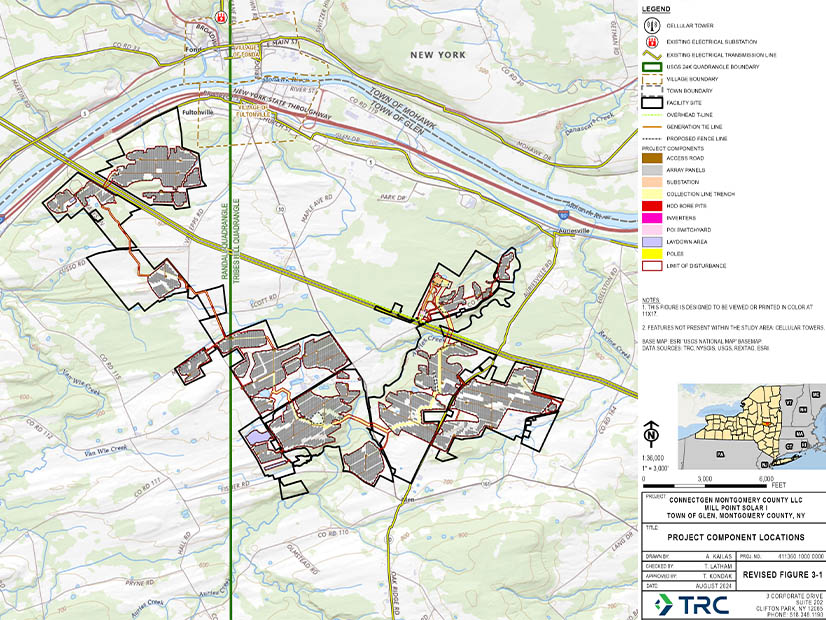
A map shows the configuration of the Mill Point Solar 1 project Repsol is proposing in the town of Glen. The diagonal yellow stripes are National Grid’s 345-kV lines. | Repsol Renewables
ORES does encourage public opinion and offers multiple opportunities to submit it.
Straight-up NIMBY statements and opposition to renewables seem unlikely to sway ORES, as it was created to promote renewables and blunt NIMBYism.
Twenty-three of the 39 applications listed on the ORES database have been approved, and all likely faced at least some local objections. But only one application has been denied, and that was because the developer had lost property rights, not because of opposition voiced in the 1,003 written comments submitted in the matter.
Nonetheless, local input is foundational to shaping ORES’ decisions. A spokesperson told NetZero Insider:
“The statements made at the public comment hearing, along with statements submitted in writing, may be used by the [administrative law judge overseeing the case] to determine if there is a sufficient doubt about the applicant’s ability to meet statutory or regulatory criteria applicable to the permit to warrant adjudicatory hearings on the application and draft permit.”
On a more granular level, the spokesperson said, local input is important to identifying impacts of a project and identifying the priorities or concerns of its neighbors.
This can shape ORES’ decision, so that these impacts are minimized while renewable energy development is advanced.
The public comment period on Mill Point Solar 1’s draft permit closed two days after the public comment session.
Project Details
Lead project development manager Andrew Barrett told NetZero Insider the Mill Point Solar 1 team first put feet on the ground in Glen in 2020. They hope to make a final investment decision in mid-to-late 2026, start construction soon after and begin commercial operation by the end of 2027.
This is not an uncommonly long timeline.
Along the way, ORES twice returned the application as incomplete, and Repsol had to put $250,000 in an intervenor fund so that opponents can pay for research and legal challenges.
The process, Barrett said, is “thorough with a capital T.”
The draft permit issued by ORES contains dozens and dozens of stipulations that fill 56 pages (with no appendices, footnotes or punchy graphics to take up space).
New York’s goal is to not damage the environment while trying to save it, Barrett added, which is important to the company and foundational to renewable energy.
And it is a draft permit that Repsol finds workable.
“Other than taking a lot of time and a lot of money, it is good because it does what we would do anyway, which is, forces us to be up there, forces us to be open and transparent with maps and schedules.”
Money has been a problem and may be again. Mill Point was among the huge tranche of renewable projects whose developers canceled their renewable energy certificate contracts with the state in late 2023 when the terms became financially untenable.
Just recently, it won a new contract from the New York State Energy Research and Development Authority — presumably at much higher cost, though NYSERDA is not saying and Repsol holds the information as confidential.
But great financial uncertainty still hangs over the proposal in the potential loss of the federal tax credits created by the Inflation Reduction Act. They are vital to Mill Point, Barrett said, though losing them would not necessarily kill the project. There also is the threat of tariffs.
“There are a lot of moving pieces in this,” he added. “The uncertainty the Trump administration has added recently is not helpful.”
As planned, Mill Point Solar 1 would have a nameplate capacity of 250 MW, operate at a 22% capacity factor and cover about 1,124 acres. Fencing and infrastructure on the patchwork of parcels would push the total footprint above 2 square miles.
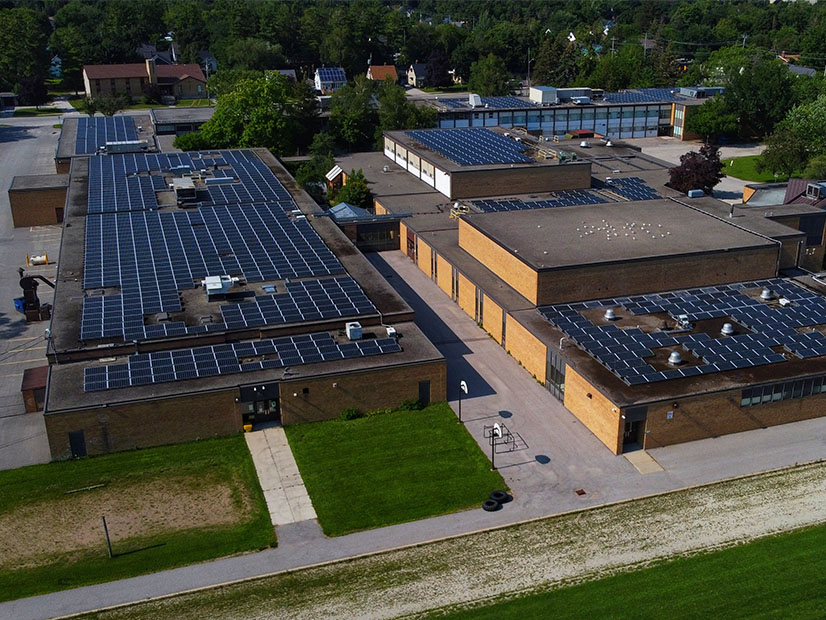
Distributed solar already has a foothold in town, where 730 arrays ranging from 0.7 to 6,900 kW were connected to the grid as of March 31.
Utility-scale solar development is not nearly so quick and nimble. But just one completed large project could far outstrip the 83.8-MW DC combined output of those 730 little solar arrays.
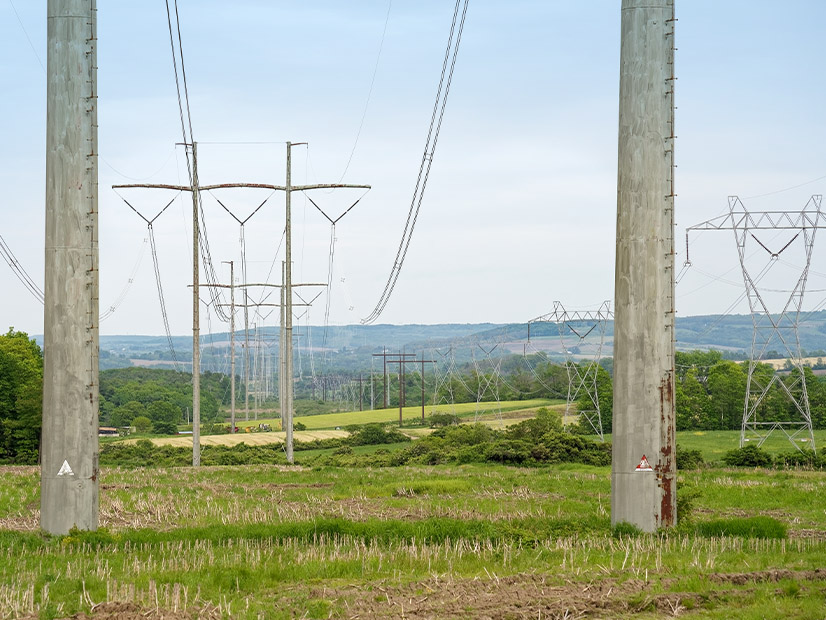
Large-scale solar is interested in the county because of its topography and its transmission lines — dual 345-kV circuits operated by National Grid cross right over Mill Point’s proposed footprint. To the south, LS Power and NYPA have 345-kV circuits that recently were enhanced to carry more upstate renewable energy to the downstate market. Additional smaller lines cross the area.
NYISO’s 2025 system map shows that this concentration of transmission is uncommon in upstate New York.
NYSERDA and the Department of Public Service looked specifically for areas that contain this combination of relatively flat land near transmission as part of the effort to accelerate large-scale solar development in New York.
“Montgomery County was identified by NYSERDA and DPS as having strong potential for such project sites,” a spokesperson said.
Other projects in the county include the 300-MW Flat Creek Solar, now under review by ORES. NextEra has the 90-MW High River Energy Center. Repsol also plans the 100-MW Mill Point Solar 2. Avangrid proposed the 90.5-MW Mohawk Solar. Greenbacker won a NYSERDA contract for the 20-MW Tayandenega Solar. SunEast Development won an 80-MW contract. And that is only a partial list.
Some of these proposals have been canceled or shelved, and others may never break ground. But the steady flow of proposals has dismayed a vocal segment of the county.
Push and Pull
The May 28 meeting showed the depth of local division, seldom more clearly than when the top elected official in Glen and his predecessor took the mic for their allotted three minutes.
“Small, rural towns with large agricultural open land holdings, limited budgets, like the town of Glen, are the target of these energy companies,” Town Supervisor Timothy Reilly said, “because in the context of New York state, we have insufficient funds and other resources to sustain a legitimate fight of these projects on a level playing field.”
Former Town Supervisor John Thomas countered: “There are far too many falsehoods being bandied about regarding the supposed evils of solar energy — I’m sure you will hear some of these tonight. The amount of energy from the sun hitting the Earth in one hour could power the world for an entire year. Solar energy is essential to combating climate change.”
In the following two hours, the comments volleyed back and forth with a rhythm of opposition and support.
This will destroy prime farmland.
Anyone who calls this prime farmland has never farmed it.
This will affect our Amish neighbors terribly.
A lot of the Amish are craftsmen more than farmers.
We’re trading in our agricultural heritage and future for a temporary source of electricity … and to benefit a corporation … and for little financial benefit to the community.
I can’t afford to farm … or farming is hard work that I’m getting old to do … or I don’t want my son to follow me into farming.
We’re being asked to trade our dreams for someone else’s vision of progress.
Would you rather see another warehouse there?
All this solar electricity is going downstate.
I have a right to do what I want with my land.
Not if it contaminates my land.
Construction will provide work for my union members.
This solar farm will create almost no permanent jobs.
Not Keeping up
There is much to unpack in those comments.
Montgomery County is like most of upstate New York: farmland and wooded former farmland dotted with villages and hamlets that date to the 1700s and 1800s. Commercial and industrial operations large and small survive and even thrive but occupy only a tiny fraction of the landscape. Its only city bears the scars of industrial decline and 1970s urban renewal.
Montgomery County’s population dropped more than 11% from 1970 to 2020 while the nation’s grew more than 62%. The percentages of county residents older than 65 and younger than 18 are both higher than the national average.
In other words, some young people look elsewhere for opportunity, and some never come back.
Farmland has been going out of production for a century, but a local statistic stands out in the ag census the USDA publishes every five years: There are many more small farms in Montgomery County now than in the 1990s, even as the amount of land in active production has continued to shrink.
The number of farms statewide decreased 20% from 1997 to 2022 but only 3.6% in Montgomery County.
This trend at least partly is due to a large influx of Amish attracted by one of the things that solar developers appreciate: affordable land suited for their purposes.
A large contingent of Amish men attended the May 28 comment session. But in keeping with their Old Order ways, they sat in a cluster and listened to their “English” neighbors speak, rather than offer comment themselves.
It was a bit ironic, given that some of them may not even use electricity. But the land-use debate does bear directly on the Amish.
The state in 2024 authorized eminent domain for transmission siting, but there is no such provision for solar power — if a photovoltaic array is placed in a pasture, it is with the landowner’s permission.
So the Amish need not lose the land they have. The concern may be more for the future and the options Amish children will have if farmland is scarce by the time they grow up.
Common Ground
At the May 28 public session, a third-generation town resident went in a different direction than other speakers and wondered why state policies did not offer more support for agriculture, so that farmers were not forced to make these hard choices about their land.
“I hate to see our community divided like this. It really breaks my heart,” she said.
It certainly is divided, but the tone throughout the evening was civil, not hostile.
“I think that the civility of the meeting, I think that comes with time,” Reilly told NetZero Insider later. “I think we have really come from becoming adversarial to each other and [those] kind of comments to a more participatory type of meeting where, ‘Look, I just want to get my point across.’”
Town Board meetings and community meetings hosted by the developer helped smooth that out, he said.
“It was a tribute to both sides for that,” Reilly said.
Unprompted, he added: “Andrew [Barrett] has been nothing but a gentleman since day one. You know, he comes in here and we sit, and we visit. We could almost go fishing together, but we’re on opposite sides.”
Barrett said this is the nature of his role and the job of others like him around the state and nation as they look for enough land and enough of a consensus to put together viable projects.
After the company identified Glen as a potential large-scale solar site, the development team was on the ground introducing themselves and explaining what they wanted to do as they looked for potential leases.
“Honesty and transparency is important, and we think it makes a difference,” he said.
And it is important not just to listen but to process what is said. After dialogue with the community, for example, Repsol moved the project footprint away from a cemetery and away from the historic hamlet at the center of the town. That soothed some feelings, but far from all.
“Twenty-five hundred people are never going to agree perfectly on any topic, certainly a large project like this,” Barrett said. “You’re always going to have someone who thinks this is a good idea because we need it for the environment, someone who would like to participate because it helps them save their farm. And then you will get people that are across the street and don’t like the look of panels, even if they’re going to be well screened.
“You’re not going to win over everybody.”
Reilly said the problem for him is not just the state usurping home rule but doing it to push through something that will start depreciating soon after it is installed.
“Much of the resistance, I think, in the town is not necessarily for renewable energy. It is the consumption, the vast consumption, of these huge swathes of land for something that’s going to be outdated in 30 years.”
But Reilly said the town is not ready to concede.
“I don’t think people think it’s a done deal by any stretch of the imagination,” he said. “You know, there are some that think, ‘We’re it’s the ninth inning, and we’re down a lot of runs.’ But as Yogi Berra would say, ‘It’s not over till it’s over.’”
Meta has signed a 20-year power purchase agreement for the output of Constellation Energy’s 1,121-MW Clinton nuclear plant in Central Illinois, the companies announced June 3.
The deal will begin in June 2027, upon expiration of the state’s zero-emission credit program that has been subsidizing operation of the plant. The PPA in effect will replace the ratepayer-funded ZECs.
In their announcements, Constellation and Meta hailed the deal as a landmark market-based solution to keep older nuclear facilities online, producing high-capacity-factor baseload power without carbon emissions.
With 38 years in service, Clinton is among the youngest U.S. commercial reactors. It was operating at a continuing loss in the mid-2010s and was slated for early retirement, but Illinois created the ZEC subsidy in 2017, returning it to profitability.
The facility’s license extends through April 2027. Constellation in 2024 filed an application with the Nuclear Regulatory Commission for a 20-year renewal, with the caveat that how long it actually operated the reactor would depend on the economics and on policy support.
As part of the agreement with Meta, Constellation will perform uprates that will add 30 MW to the existing 1,092-MW nameplate capacity of the facility.
Constellation now is considering seeking an extension of Clinton’s existing early site permit or seeking a construction permit for an advanced reactor or small modular reactor to be co-located with the existing facility, located in Zone 4 of MISO’s capacity market.
In September 2024, the company announced a PPA with Microsoft for output from the Crane Clean Energy Center — the former Three Mile Island Unit 1, which it retired in 2019 for economic reasons. The company had begun the decommissioning process but is working to restart the reactor.
In Constellation’s news release, CEO Joe Dominguez asked rhetorically why Three Mile Island had shut down in the first place, and said Meta had asked a similar question about the future of Clinton.
“They figured out that supporting the relicensing and expansion of existing plants is just as impactful as finding new sources of energy,” Dominguez said. “Sometimes the most important part of our journey forward is to stop taking steps backwards.”
“Securing clean, reliable energy is necessary to continue advancing our AI ambitions,” said Urvi Parekh, Meta’s head of global energy.
Meta also provided an update June 3 on its advanced energy ambitions, as it seeks to match the electricity used in its data centers with 100% clean and renewable energy. It said that as it considers emergent technologies, it recognizes the value of the firm, reliable capacity offered by nuclear fission.
The tech giant said it has received more than 50 qualified submissions in response to its nuclear request for proposals and is in final discussions with shortlisted developers for potential projects.
Meta is focusing on sites where nuclear development can be advanced with speed and certainty as it tries to assemble a 1- to 4-GW portfolio of projects. It hopes to finalize the process this year.
All of this, and the Constellation PPA, are intended to send signals of support and demand to the nuclear sector, Meta said: “Our investments in nuclear energy ensure that we will have the robust energy infrastructure needed to power the AI innovations that are set to spark economic growth and prepare our communities for the future.”
New Jersey legislators have backed clean energy bills that include efforts to promote the development of small modular nuclear reactors and enable the state to better deal with data centers.
The Senate Environment and Energy Committee approved S4423, which would enable the Board of Public Utilities (BPU) to authorize site approval for a small modular reactor (SMR) in a municipality where a nuclear facility previously was located. The agency could supersede municipal and county decisions to authorize reactors able to generate 300 MW of power or less. The reactors would be licensed by the Nuclear Regulatory Commission, and nuclear fuel would be stored on-site.
In a separate vote, the full Senate on June 2 voted 38-0 in support of a third data center bill, A5466, which would direct the BPU to study the “effect of electricity usage by data centers on electricity rates in the state.”
The bill, which goes to the governor’s desk, would require the study to look at:
Cost allocation, to determine if other electricity customers “unreasonably subsidize” the costs of data centers.
Whether other customers incur “unreasonable rate increases” to support new transmission, distribution or generation facilities that serve data centers.
Policy alternatives such as “the use of a special tariff to be applied to data centers, that could be used to mitigate or avoid rate increases caused by increased electricity demand by data centers.”
Fixing an Energy Shortfall
The votes come as New Jersey, an importer of energy, searches for ways to boost its generating capacity. Demand for electricity is expected to rise dramatically over the next decade, fueled in part by the growth in electric vehicle use and the needs of data centers. PJM says its region, which includes New Jersey, faces an energy crunch because new generating sources aren’t coming online as quickly as old, fossil-fueled sources are closing.
The nuclear and data center bills were among a slew of bills — including initiatives focused on storage, solar and geothermal energy — aimed at boosting the state’s clean energy resources and curbing energy use.
Two bills moved by the Senate committee address the expected arrival of data centers, including those supporting artificial intelligence capability. The committee backed S4293, which would require the owner or operator of a data center to prepare an annual report to the BPU of the facility’s water and electricity use.
The report also should include “basic information” on the facility and “performance calculations and indicators for the data center, including the energy reuse factor, power usage effectiveness, renewable energy factor and water usage effectiveness.”
Opposing the bill, Ray Cantor, a lobbyist for the New Jersey Business and Industry Association, said the bill would needlessly add a burden to data centers that might consider coming to the state. State requirements already ensure water permits are not issued unless there is sufficient water, he said.
“From an energy perspective, these data centers are either bringing their own energy, or they’re using energy off the grid, and that’s all being accounted for,” he said.
“On the one hand, we have policies in the state, and the governor has mentioned this as well, where we want business to come and locate here in New Jersey,” he said. “And then [on] the other hand, we pass legislation like this, which, while it’s not the end of the world from a regulatory perspective — it’s just another thing that’s being required. And it’s another thing that’s being required that doesn’t need to be required.”
Erecting Roadblocks
Cantor said he had similar concerns about another bill later backed by the committee, S4307. It aims to protect ratepayers from shouldering the burden of the development of generation systems that support data centers.
The bill is designed to incentivize data centers to increase energy efficiency, including through the use of technologies that use the heat produced by the data center. In addition, it would require that the BPU review each application to ensure the data center creates and submits a tariff that demonstrates the facility’s compliance with the law.
Cantor said enticing data centers to move into the state would be difficult if “we’re continually putting roadblocks in the way or making it more expensive or problematic to develop here in New Jersey.”
“We recognize that data centers are large energy users,” he said. “But they’re not the only large energy users. We have large manufacturing plants that use as much or more energy than data centers. Even hospitals could use more energy than a data center. And yet we don’t single them out for special treatment.”
Senate Environment and Energy Committee Chair Bob Smith said the bill “is absolutely a response” to a $20 hike in the average electricity bill that took effect June 1. State officials say the increase, set by the state’s Basic Generation Services auction, was triggered in large part by PJM’s capacity auction in July 2024, which included a massive jump in prices compared to the previous auction. PJM officials attributed the jump in part to high-demand data centers.
Doug O’Malley, director of Environment New Jersey, disputed Cantor’s claim, saying data centers can be far larger than community institutions, using as much as 1 million gallons a day for cooling and electricity generation.
“We can’t just rely on what we have right now. That’s why this bill is so important,” he said. “This is a reminder that we cannot have water hogs, (or) an energy hog, that literally spikes electricity rates (for) everybody.”
The committee passed the bill with a 3-2 vote. The bill will go to the Senate Budget and Appropriations Committee.
Fixing an Energy Shortfall
In a separate vote, the Environment and Energy Committee voted 5-0 to back a bill, S4100, designed to simplify and speed up the process by which solar projects are permitted.
State officials say developing more solar is one of the quickest ways to address the pending electricity shortfall. But the bill says “New Jersey has the fifth-slowest-known solar permitting timelines of any state.”
“Vestiges of outdated, overly bureaucratic permitting requirements” cause residents to “significantly delay installation efforts and significantly increase costs incurred in installing residential solar energy storage,” the bill states.
Elowyn Corby, mid-Atlantic director for Vote Solar, in supporting the bill, told committee members that “local solar benefits our entire grid and society.”
“While large-scale solar projects are important, they are often facing multiyear delays in the PJM interconnection queue,” she said. “Local solar, on the other hand, can be rapidly deployed without these delays, addressing our immediate energy needs while giving us breathing room to bring large-scale renewables online.”
To speed up the process, the bill calls for a State Smart Solar Permitting Platform that would automate permitting. It would enhance the ability of a local agency to review permit applications and permit revisions for safety and code compliance. The platform also would enable permitting agencies to release permits and permit revisions for residential solar energy systems, residential energy storage systems and main electric panel upgrades.
The state assembly backed a version of the bill, which goes to the Senate Budget and Appropriations Committee for consideration.
Storage and Geothermal
The Senate committee also backed a bill, S4289, that would authorize the BPU to procure and incentivize transmission-scale energy storage projects capable of storing at least 5 MW and connected with PJM.
Under the bill, the BPU would create an incentive program and then solicit applications for a tranche of projects. At its conclusion, the BPU would evaluate the impact on the sector, and, if needed, launch one or more tranches. The board’s 3-2 vote sent the bill to the Senate Budget and Appropriations Committee.
Bob Gordon, a former BPU commissioner now representing a renewable energy company, argued that storage can save ratepayers money by providing energy to the grid at peak times. With the law in place, he said, New Jersey would have saved $100 million to $200 million in the coming year if the state had 500 MW to 1000 MW of transmission-connected battery storage.
“A state-led competitive-procurement program such as this will put New Jersey on the path to getting resources online and be able to provide the immediate benefits and cost relief for wholesale power costs to New Jersey,” he said.
The committee backed by a 5-0 vote a bill, S4424, that would establish a three-year pilot program to replace aging or leaking natural gas pipelines with geothermal energy infrastructure.
The bill would enable gas utilities to submit plans to the BPU for review of the project size, scope and scale, and the expected benefits. The agency would assess the ratepayer impact and whether the benefits justify the cost.
FERC Chair Mark Christie’s tenure running the commission is coming to an end, as President Donald Trump on June 2 nominated Laura Swett of Vinson & Elkins to replace him.
“I learned this evening from a media inquiry that President Trump has appointed Laura Swett to replace me when my term expires,” Christie posted on X. “I congratulate Laura and wish her the best. I will remain in office for a few weeks after June 30 to help get key orders out.”
Christie’s term ends June 30; if confirmed, and depending on when she is sworn in, Swett would be able to serve a full five-year term. Another seat remains open since former Chair Willie Phillips stepped down earlier this year, but that term would extend only into 2026. Any new commissioner in that seat effectively would need to be nominated and confirmed twice to serve longer.
Swett’s nomination has been referred to the Senate Energy and Natural Resources Committee. She has previous experience at FERC serving on the staff of Chair Kevin McIntyre and former Commissioner Bernard McNamee, both Trump nominees in his first term. She also worked at the Office of Enforcement, according to her LinkedIn page.
Former FERC Chair Neil Chatterjee, who overlapped with both Swett and Christie on the commission, called the news bittersweet on X.
“I adore Laura Swett and believe she will be an excellent FERC chair (if given the chance by OIRA and OMB),” Chatterjee said, referencing the White House’s Office of Information and Regulatory Affairs and Office of Management and Budget. “But Christie is a patriot; all he did was run the agency well. He’s a veteran who has dedicated his life to serving America. He deserved better.”
The Trump administration has been skeptical of independent agencies generally, reportedly telling Phillips it would fire him if he did not step down, leading to his resignation. Trump issued an executive order in February trying to bring FERC and other similar agencies more under its control. (See Trump Claims Authority over Independent Agencies in Executive Order.)
Christie spent his first press conference as chair addressing that executive order and has repeatedly answered questions on it since. While he put some of it in the context of normal relations between a president and FERC, he also made it clear he had to follow the laws that govern FERC. (See FERC’s Christie Says Existing Policies Can Align with Trump’s Order.)
One area Christie made clear then that FERC could not tolerate was ex parte communications on cases pending before it.
“We do not allow ex parte communications; that would violate the [Government in the] Sunshine Act,” Christie said at the press conference in February. “It would also violate everything I know about due process in contested proceedings going back to being a state regulator. We didn’t allow it in Virginia, so we’re not going to start allowing ex parte communications.”
Reactions
“I think it’s great that Laura has been nominated by the president,” McNamee said in an interview. “I think she’ll do a fantastic job as a commissioner, and I knew that because she provided great and sound advice to me when she was my attorney adviser, when I was a commissioner.”
Swett advised McNamee on pipeline issues when she was his staffer, and much of her work at Vinson was in that area.
The issue of environmental assessment in pipeline permitting has caused some partisan splits among commissioners in the past decade, especially around how much attention FERC must pay to the downstream greenhouse gas emissions.
Former Chair Richard Glick’s efforts to update the pipeline approval process after some losses in the courts wound up sinking his renomination in 2022, but a recent Supreme Court decision means those debates likely are coming to an end regardless of FERC’s composition.
In Seven County Infrastructure Coalition v. Eagle County, issued May 29, the majority found that the U.S. Surface Transportation Board was right to not consider upstream and downstream effects from approving oil shipments over rail. In a post on X, Christie called the decision “the most important permitting reform in decades.”
Trade associations and other groups active before FERC released statements on June 3 congratulating Swett for the nomination.
Americans for a Clean Energy Grid Executive Director Christina Hayes offered congratulations in a statement and argued for continued action on transmission.
“In her previous stints as a senior leader at FERC, she worked on policies that emphasized grid reliability,” Hayes said. “At a time when American energy demand is set to skyrocket, no policy area is as essential to our energy dominance as transmission planning reform. ACEG’s coalition of transmission policy advocates across the political spectrum looks forward to working with Swett in her new role and urges continued FERC leadership in implementing the bipartisan consensus behind Order No. 1920. America’s energy dominance depends on it.”
In addition to congratulating Swett, Electricity Customer Alliance Executive Director Jeff Dennis thanked Christie for his service and for keeping reliability at the top of FERC’s priorities.
“We look forward to working with her and the rest of the commission to advance customer-centric solutions that support the power system expansion our nation needs to meet the demands of a growing digital economy while keeping energy affordable for all customers,” Dennis said.
Electricity cooperatives, independent power producers and biogas generators have asked IESO to reconsider key components of its proposed Local Generation Program, calling for longer contract terms and special consideration for some generation types.
Twenty-two organizations weighed in with written comments last month on the LGP, which is intended to retain local generation resources whose existing contracts are nearing expiration and provide additional capacity to meet rising demand.
IESO has contracts with about 2,500 facilities with installed capacities between 100 kW and 10 MW. Over the next decade, about 1,600 of the contracts — representing 2,000 of the total 3,300 MW of capacity — will expire. IESO forecasts Ontario’s electricity demand will increase by 75% by 2050 as a result of electrification and industrial and data center growth.
The grid operator says smaller, distribution-connected generation can be built more quickly than large-scale projects and help meet local demand, freeing up transmission capacity.
Generation sources of 100 kW to 10 MW would be eligible to participate in either the re-contracting stream, with proposed five-year contracts, or the new build program, for which IESO is proposing 20-year contracts.
Jonathan Scratch, IESO senior manager of market and system adequacy, said during a webinar in April that the grid operator hopes to sign new contracts with “the lowest-cost 80%” of facilities with target quantities reflecting provincial, local and regional energy needs. “[To be determined] on whether there would be price caps,” he said.
In selecting new projects, the grid operator said it also may weigh policy considerations such as economic participation in the project by an indigenous community and municipal and local distribution company support.
Contract Term
IESO proposed that generators be eligible to seek new contracts if their existing contracts are expiring within five years, making facilities with contracts expiring before 2031 eligible to bid during the 2026 application period.
It proposed five-year terms on renewed contracts, identical to its medium-term procurement program, which it runs every two to three years, as needed.
That is too short for some.
“Where a facility is being recontracted without any refurbishments, upgrades or expansions, the five-year term length proposed is sufficient,” wrote Community Energy Co-operatives Canada (CECC). “However, where any refurbishments, upgrades or expansions are undertaken, the term length of five years will not be sufficient to recoup those costs.”
The Canadian Biogas Association said the recontracting term should be 15 to 20 years to provide sufficient certainty to invest in maintenance and secure feedstock agreements.
Biogas is a renewable source of methane gas produced when organic matter breaks down without oxygen. | Canadian Biogas Association
Twenty of Ontario’s 56 biogas facilities between 100 kW and 10 MW, totaling 79 MW, are seeking new contracts as soon as 2030. Most facilities are 250 kW to 1 MW, according to the group.
“A short-term contract, paired with frequent participating in competitive procurements, creates too much pricing and uncertainty risk for biogas developers,” it said. “Our industry and facility owners (many of whom are small-scale local farmers) will require a longer contract to ensure greater price stability and certainty for a longer term.
“For many facilities, the expiration of current contracts coincides with the end of their engines’ useful life. As a result, significant capital investments in upgrades or replacements may be required,” it added. “If the program does not provide sufficient value, permanent shutdowns may become necessary for some operators.”
The association also said smaller facilities will be at a competitive disadvantage versus larger projects using different technologies that can offer lower prices.
Independent power producer Capstone Infrastructure also called for lengthier contracts. It suggested suppliers be granted the flexibility to select a preferred contract length — with up to 30 years for new builds — which it said would produce lower-cost bids through better financing terms. “We are seeing other regions offer longer-term contracts, and this would align with where the industry is heading,” it said.
Standard Offer vs. Competitive Bidding
Power cooperatives and clean energy advocates also called for the use of standard offer contracts rather than competitive bidding.
The Ontario Clean Air Alliance said it favors competitive bidding for large generation projects. “But … IESO’s proposed LGP competitive bidding process for small power projects does not make sense, since it will impose onerous costs on participants and create unnecessary uncertainty as to whether their projects will be funded,” it said. “Instead of discouraging participation by creating needless red tape, the IESO should establish a fair market value standard offer price(s) for small-scale generation projects. All projects that are willing to accept the fair market value standard offer price(s) should be awarded contracts.”
IESO officials said they attempted to make the application less onerous for cooperatives.
“It sounds simple,” IESO’s Scratch said of the standard offer alternative. “It’s inherently not simple to make an assessment of what the right price is. … So, cognizant of that, we’ve set this up as simplified application process and … the dollar-per-megawatt-hour rate.”
Technology Agnostic
IESO’s proposal that new build procurements be technology agnostic drew mixed reaction, winning support from the Ontario Waterpower Association, which represents the hydropower industry, but opposition from the Canadian Biogas Association.
The biogas group said IESO should conduct technology-specific procurements to acknowledge “the unique operational characteristics, value propositions and cost structures associated with different generation technologies.”
“Biogas projects, in particular, provide distinct and system-critical benefits that are often undervalued in competitive procurement processes when assessed alongside technologies with inherently different generation profiles, cost structures and system services (e.g., solar PV or small hydro). These benefits include: firm, dispatchable generation with high reliability; waste-to-energy capabilities that contribute to circular economy goals and emissions reductions; local environmental and economic co-benefits, such as reduced methane emissions from organic waste and support for agricultural and industrial sectors; and baseload or peak-shaving potential, enhancing grid stability and reducing curtailment risks for intermittent renewables.”
Capstone called for “bucketing” generation sources by technology types, to acknowledge those with capabilities such as peaking support, and by region, to reflect higher site costs in urban areas. “This will support reliability where it is often needed most,” it said.
The CHP Canadian Advisory Network said the projects IESO is seeking to re-contract originally were contracted through a program that was not technology agnostic, “which therefore makes it difficult to re-contract in a technology-agnostic manner.”
“For example, [combined heat and power] offers unique value (grid resiliency, improved overall system efficiency, etc.), which may come at a higher price,” it said.
It also requested the grid operator add a natural gas price hedging mechanism or “a more equitable sharing of risks, enabling more competitive bidding.”
The Ontario Clean Air Alliance countered that fossil fuel generation should be excluded from the program, noting that more than 70% of the gas used in Ontario power generation is imported from the U.S.
IESO’s 2025 Annual Planning Outlook predicts fossil gas will generate 25% of the province’s electricity in 2030, up from 4% in 2017. “It doesn’t make sense to increase our dependence on American gas when Canada’s sovereignty and economy are under attack by President Trump,” it said.
LDCs vs. Cooperatives: Transparency, Weighing Local Benefits
Another fault line is the role of LDCs.
CECC said the program should “reward meaningful community and indigenous ownership where genuine community equity and governance are embedded (while avoiding LDCs and private developers creating nominal co-ops or token partnerships solely for preferential treatment).”
IESO programs strategist Greg Bonser said the grid operator is “exploring” criteria other than price, “but we haven’t decided what those rated criteria might be at this point. For example, we might need to use them for tie breaking.”
The Electricity Distributors Association and Ontario Energy Association said LDCs “should lead re-contracting and new contracting.”
“The EDA and OEA believe that Ontario’s local distribution companies are best positioned to lead both re-contracting of existing distributed generation and the contracting of new DG resources,” they wrote. “LDCs have deep visibility into the local value of existing assets within their distribution networks and can engage directly with facility owners on key issues such as refurbishment needs, term lengths and future operational plans.”
CECC countered that its members’ ability to design new projects is hamstrung because they “mostly do not know if their connection points or local circuits could support an expansion or upgrade.”
“The IESO must work with LDCs to publish real-time or forecasted hosting capacity tools and ensure transparent, fair allocation mechanisms when multiple proponents seek access to the same line. Another suggestion is to establish standardized interconnection cost ranges across the province based on project size,” it said. “This would give community proponents clearer upfront cost expectations, reduce risk and uncertainty, and enable more predictable financial planning.”
Roles for Storage, Rooftop Solar, Virtual Net Metering
IESO also received appeals to expand the LGP program to include storage and smaller facilities such as rooftop solar.
Currently, new rooftop solar generation facilities between 1 kW and 1 MW are eligible for incentives through IESO’s electricity Demand-Side Management (eDSM) programs.
Improved technology could result in increased solar production from existing sites. “Given the realized and anticipated increases in the efficiency of solar panels, it is anticipated that we would plan to explore increases in generation capacity at all sites, even where rooftop size or land area constraints exist,” Community Energy Development (CED) Cooperative said in its written comments.
More efficient solar panels mean facilities can increase their output when they renew their contracts with IESO. But critics say the ISO’s proposed procurement policy may mean some facilities cannot afford to renew. | Shutterstock
But many rooftop solar installations have been in place for nearly two decades, meaning the roofs may need repairs or replacement, adding costs to any re-contracting.
Bonser said the LGP would not offer additional compensation for storage or demand response. “However, if you can cost-effectively integrate those elements into your projects, you may be able to do so,” he said.
The Ontario Clean Air Alliance said “all environmentally responsible renewable energy projects,” including rooftop solar, should be eligible for the LGP, citing its study that found rooftop solar projects in Toronto could meet 50 to 80% of the city’s electricity needs.
CECC said IESO’s SaveOnEnergy program does not provide enough financial support for re-contracting solar facilities. It also said community-scale battery energy storage systems (BESS) should be included in the LGP.
“Cooperative ownership ensures that the benefits of storage — including grid services and cost savings — flow back to communities. This scale of storage is well suited for municipal feeders and can play a pivotal role in supporting local energy reliability projects (LERPs) and reducing the need for large-scale infrastructure upgrades, e.g. transmission lines. Bid evaluation should account for both location and time of generation and the advantages of community-scale BESS paired with solar can deliver.”
John Kirkwood, president of the Ottawa Renewable Energy Cooperative, said co-ops have had difficulty deploying storage because community-scale batteries are too small for participation in IESO “and LDCs can’t contract [with] us.”
“Batteries are part of the solution — we all know that — but it’s not very easy to add them to the grid,” he said.
Kirkwood also urged the grid operator to allow it to aggregate generation from its more than 1,100 members, many of which now have microFIT (feed-in tariff) contracts on individual meters, “which is challenging and costly for the province.”
“We’re willing to take it into consideration,” Bonser responded. “We want to make sure this program is as simple and cost effective as possible for all of the different parties involved, from suppliers such as yourself, who have members, for the LDCs and for the ISO. So, there are a few competing interests.”
Kirkwood and other cooperative representatives also called for co-ops to engage in virtual net metering, which would allow members to purchase electricity directly from cooperatively owned projects, even if they are not located on-site.
Allowing cooperative-owned projects to transition into community net-metering structures at the end of the current contract would allow them to continue, said CED Co-op, which has more than 100 FIT and microFIT contracts.
“If there are no reasonable contracting options available upon conclusion of the current contract, we would likely need to decommission the facility,” it said. “The current spot market rates do not appear that they would adequately exceed the costs of insurance, LDC fees, lease payments, and operations and maintenance expenses.”
Next Steps
IESO expects to report back to the Minister of Energy and Electrification on the LGP this summer and launch the program in 2026.
The grid operator will provide its responses to stakeholders’ feedback and present more details about the program designs in a webinar June 5.
The U.S. Department of Energy has issued an emergency order to keep Constellation Energy’s Eddystone Units 3 and 4, located outside Philadelphia, online under Section 202(c) of the Federal Power Act. The order directs Constellation and PJM to keep the units available for dispatch through Aug. 28.
The order states that retaining the two gas-fired generators, with a combined output of 760 MW, is necessary to prevent emergency conditions in PJM “due to a shortage of facilities for the generation of electric energy, resource adequacy concerns and other causes.”
“Maintaining access to affordable, reliable and secure power is always our top priority, particularly during the summer months when electricity demand reaches its peak,” U.S. Secretary of Energy Chris Wright said in a May 31 announcement of the order. The generators were scheduled to be retired that day.
The order cited PJM CEO Manu Asthana’s March congressional testimony that reliability is challenged by a combination of government policies prompting generation deactivations, data center load growth and an interconnection queue composed mostly of non-dispatchable generation. It also pointed to PJM’s February 2023 “Energy Transition in PJM: Resource Retirements, Replacements & Risks” position paper, which found the RTO could face a capacity shortfall in 2030. (See PJM Whitepaper to Highlight Future RA Concerns.)
PJM voiced its support for the emergency order in a May 31 statement, in which it calls the order a “prudent, time-limited step” that will allow the department, RTO and Constellation to further analyze whether there is a long-term need to retain the Eddystone generators.
“For over two years, PJM has repeatedly documented and voiced its concerns over the growing risk of a supply-and-demand imbalance driven by the confluence of generator retirements and demand growth. Such an imbalance could have serious ramifications for reliability and affordability for consumers,” PJM said.
In its 2025 Summer Outlook, PJM stated it could fall short of peak loads under an “extreme planning scenario,” requiring the deployment of demand response and increased risk of emergency procedures. The extreme scenario looks at maintaining PJM’s reserve requirement under a 90/10 peak load, which is set at 166.6 GW for summer 2025, whereas the Operations Assessment Task Force’s report focuses on the ability to reliably serve the 50/50 forecast peak of 161 GW. The latter report did not identify any reliability violations in the summer. (See “Summer Outlook Finds Possible Reserve Shortage,” PJM OC Briefs: May 8, 2025.)
Constellation requested PJM authorization to bring Eddystone offline on Dec. 1, 2023, on the grounds that “continued operation of these units is expected to be uneconomic.” PJM responded a year later that it found no transmission reliability violations associated with the deactivation, clearing Constellation to retire the units on May 31, 2025.
“Constellation is pleased to work with the Department of Energy and PJM and is taking emergency measures to meet the need for power at this critical time when America must win the AI race,” the company said in an emailed statement. “Constellation is taking immediate steps to continue to operate Eddystone Units 3 and 4 throughout the summer.”
PJM spokesperson Jeff Shields told RTO Insider that PJM does not hold the authority to require generation owners to continue operating when needed for resource adequacy.
“We can only request reliability-must-run to provide us enough time to build transmission to address system issues that will be created by the removal of the resource from the grid. It is not meant for resource adequacy; we can’t ask an owner to continue to run based on current supply/demand challenges,” he said.
The order directs PJM to submit the steps it’s taking to ensure Eddystone remains available by June 15, as well as to provide information as requested about the environmental impact of the order. Both the RTO and Constellation also are directed to file with FERC any necessary tariff revisions or waivers.
Noting that when Section 202(c) emergency orders may conflict with environmental standards, generation run hours should be limited to hours needed to resolve the emergency, the order limits dispatch to “the times and within the parameters determined by PJM for reliability purposes.”
“To minimize adverse environmental impacts, this order limits operation of dispatched units through the expiration of the order. PJM shall provide a daily notification to the department reporting whether the Eddystone Units have operated in compliance with the allowances contained in this order,” it continues.
DOE is developing a methodology “to identify current and anticipated reserve margins for all regions of the bulk-power system” regulated by FERC. The EO “requires this methodology to be published by July 7, 2025, and be used to establish a protocol to identify which generation resources within a region are critical to system reliability and prevent identified generation resources from leaving the bulk-power system.”
Earlier in May, DOE issued another emergency order to keep Consumers Energy’s 1,560-MW J.H. Campbell coal plant in West Olive, Mich., operational beyond its May 31 retirement. The company entered into an agreement with the Michigan Public Service Commission to stop burning coal by the end of 2025. (See DOE Orders Michigan Coal Plant to Reverse Retirement.)
Environmental Organizations Object to Emergency Order
The NRDC wrote that the orders in PJM and MISO are part of a larger effort to promote fossil fuel generation at the expense of impacts to health and consumer rates.
“The Department of Energy’s move to keep these zombie plants online will have significant public health impacts and increase electricity costs for people in Michigan and Pennsylvania,” said Kit Kennedy, power sector managing director at NRDC. “These orders are about a power grab, not a power emergency. These dirty and expensive fossil plants were slated to close because they could not compete with cheaper, cleaner alternatives.”
President Donald Trump issued four executive orders on nuclear power in late May, bizarrely bragging that this number of executive orders is twice the number of new nuclear plants started in the U.S. since 1978.
Say what? We haven’t built new nuclear plants over the past 50 years (other than the Vogtle disaster) because they haven’t made any economic sense, as I discussed years ago.
One of his executive orders directs a program for installing nuclear reactors at critical defense facilities, based on the claim that nuclear reactors can deliver resilient, reliable power to these facilities.
Trump’s claim is wrong and misleading for many reasons.
Reason No. 1: Nuclear reactors cannot provide resilient, reliable power to defense facilities. As FERC has observed, in the event of an outage on the grid the nuclear reactor has to shut down and cannot restart until grid power is restored (page 44).
Steve Huntoon
And as 41 transmission owners in PJMrecently said to FERC: “Further, load that is co-located with a nuclear unit depends on services such as load following, voltage support, black start and other ancillary services that will be and can only be delivered over the grid. Nuclear units cannot move their output up and down from moment to moment to match variations in the load, and because the nuclear units cannot provide these services, they must instead be provided through connection to the grid” (page 13). Thus, nuclear reactors would contribute 0.0 reliability value to critical defense facilities.
Reason No. 2: Critical defense facilities already have backup power, generally on-site diesel generators. Thus, nuclear reactors would be superfluous.
Reason No. 3: A total of 87% of defense facility outages are due to problems on the distribution systems inside the bases. Thus, a nuclear reactor outside a base would provide 0.0 reliability value relative to such outages.
Reason No. 4: Nuclear reactors have lengthy refueling outages and obviously couldn’t provide power during such outages.
Reason No. 5: If nuclear is to have any hope of commercial viability — which it doesn’t have for reasons I’ve given —then it has to achieve economies of scale through modular production. Since every defense facility has its own unique power needs, that means every nuclear reactor for a given defense facility would need to be unique, thus defeating the only conceivable purpose of having taxpayers subsidize this Trump program.
Defense facilities are only one aspect of Trump’s four executive orders, which collectively are intended to increase the U.S. nuclear fleet from today’s 100 GW to 400 GW by 2050.
What’s that going to cost us? If we take the Ontario SMR cost per reactor (excluding the most expensive first unit) of $3.5 billion, optimistically assume no cost overruns, and divide by the SMR capacity of 300 MW, we get $11.5 million/MW. If we plug that capital cost into the Lazard capital cost range, it interpolates to $181/MWh in the levelized cost of energy range (page 38).
That is an excess of $143/MWh over the $38/MWh average cost of generation in PJM (Figure 3, transmission costs excluded). At nuclear’s 90% capacity factor, Trump’s 300 GW would translate to 2.6 million GWh/year, or 2.4 billion MWh/year, and thus into excessive costs of $343 billion/year for the U.S. overall, and an average excessive cost of $1,000/year for each of us. Please note that this would be a total “own goal” relative to the U.S. Energy Information Administration’s base case for 2050, which has nuclear output and electric customer costs essentially unchanged from today.
Simply put, Trump’s extra 300 GW of nuclear means each of us, as taxpayer or electric consumer or both, would lose $1,000 every year.
Now that is one Big (Not So) Beautiful Bill!
Columnist Steve Huntoon, a former president of the Energy Bar Association, practiced energy law for more than 30 years.
“The last several Summer Reliability Assessments from [NERC], including this year’s, continue to demonstrate resource adequacy risks facing the power system given hotter summers, load growth and an aging generation fleet,” said co-author Adria Brooks, director of transmission planning for Grid Strategies. “This report demonstrates yet another benefit of interregional transmission, adding to a growing list of reliability and cost benefits. We have to stop ignoring the value of interregional transmission and instead create mechanisms to build it.”
Interregional transmission offers value because different regions have different resource mixes and their peak demand is often at different times, the report says.
“Interregional transmission allows capacity resources to be shared between regions with noncoincident demand,” the report says. “The interregional transmission assets themselves tend to be available nearly 100% of the time. Consumers benefit from this sharing of reserves, both in terms of improved reliability and reduced costs. These reliability and economic benefits are heightened during grid stress events.”
To move forward with more interregional transmission investment, the industry will need to integrate capacity value into its resource adequacy assessments, which can be calculated using standard industry methods such as effective load-carrying capacity (ELCC).
“ELCC considers the difference in loss-of-load expectation (LOLE) — or any other RA metric — for the system with and without the supply resource and calculates how much additional load the resource can serve to return the system to the standard LOLE baseline of one day in 10 years,” the report says. “This method has been successfully applied in several recent transmission facility or resource adequacy studies to derive the capacity value of several interregional transmission lines both in the United States and abroad.”
System planners historically have not calculated the LOLE reduction from an individual transmission line and converted it to a capacity value. But most have calculated the cut in LOLE associated with the current fleet of interregional lines, which is called “external assistance,” “tie benefits” and “firm and non-firm imports” in different regions.
Without a benefit that load-serving entities can credit to their resource adequacy obligations that indirectly provides value to transmission developers, or direct payments to transmission for its resource adequacy contributions, the industry will have fewer incentives to build interregional lines. The valuation and compensation can be done for either fully regulated transmission or merchant lines.
The report argues that considering the benefits of lower planning reserve margins from interregional lines will not worsen reliability; it would represent a cut in the amount of capacity needed to maintain resource adequacy. Those benefits can even come from non-firm imports, with grid planners using a probabilistic treatment of available imports to avoid overcounting such resources.
“All regions we surveyed include firm imports from neighbors in their resource adequacy assessments, but only a handful also consider the contribution of non-firm imports,” the report says. “Those that do incorporate non-firm imports rarely accredit the interregional transmission [that] enables non-firm imports with a capacity value for their contribution to resource adequacy.”
Non-firm imports are a way to quantify the “net load diversity” between regions, such as when one region faces a shortage but its neighbor has excess supply.
“Non-firm imports are a vital resource to the system, allowing operators to keep customers’ lights on even when there are no more internal resources to call on for support,” the report says. “However, these imports are not consistently incorporated into resource adequacy assessments. This omission may result in the over-procurement of capacity resources internal to the planning region to meet the planning reserve requirement, raising costs for ratepayers.”
At the simplest level, planners can look at historic imports to determine how many non-firm imports can be included in LOLE studies. Doing that seasonally, or only during tight-capacity periods, provides more confidence that external support will be available in the future.
SERC Reliability expects above-average temperatures to drive higher demand this summer, and registered entities should have the resources to meet demand under normal operating conditions, the regional entity said in its 2025 Summer Reliability Assessment.
However, SERC also warned that some areas do face a risk of shortfalls should weather conditions become more extreme.
SERC published the SRA on May 29 as a supplement to NERC’s 2025 summer assessment, in which the ERO warned that multiple subregions across North America showed a potential for insufficient operating reserves in above-normal conditions. (See NERC Warns Summer Shortfalls Possible in Multiple Regions.) NERC identified rising demand and the retirement of traditional generation resources as primary contributors to the risk in the summer season, which for both assessments runs from June to September.
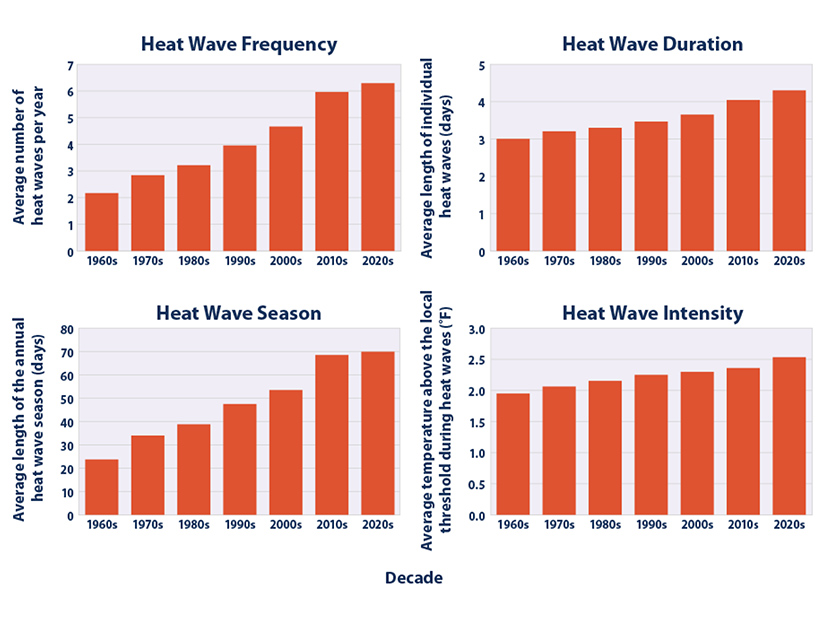
SERC’s assessment noted that extreme weather continues to be a major concern for the region, which “contains those areas of the U.S. most likely to be in the path of a hurricane, as well as many of the states that are prone to high summer temperatures.” The RE included data from EPA showing that the frequency, intensity and duration of heat waves in major U.S. cities have all steadily increased since 1961, while the average length of heat wave seasons has lengthened from just over 20 days in the 1960s to 70 days in the 2020s.
“Hotter summer temperatures cause increased demand due to heightened use of commercial and residential air conditioning,” SERC said. “Simultaneously, hotter temperatures can reduce the generation capacity and efficiency of thermal generation units and reduce air density, which decreases the capability of wind turbines. … Extreme heat along with high demand can overwhelm the transmission lines and cause them to sag and touch trees or other objects, which can potentially lead to outages.”
Despite the growing threat of extreme heat, SERC said all of its subregions have enough resources to meet NERC’s recommended 15% reserve margin target under the 50/50 load forecast, which represents a 50% chance that the actual peak load will be higher or lower than the prediction. This prediction held for most areas even under the 90/10 forecast, in which there is a 10% chance that peak load will be higher than expected.
Charts included in SERC’s SRA, based on EPA data, on the frequency, duration and intensity of heat waves in major U.S. cities, along with the length of heat wave season, since the 1960s. | SERC
The one exception was the Central subregion, covering all or parts of Alabama, Georgia, Iowa, Kentucky, Mississippi, Missouri, North Carolina, Oklahoma, Tennessee and Virginia. Its predicted reserve margin was 19% under the 50/50 forecast, but 9% under the 90/10, putting it into the “elevated risk” category.
Natural gas generation constituted the largest share of SERC Central’s summer on-peak generation mix, with 19.7 GW, or 41% of the total generation fleet; coal was next at 12.7 GW (27%); followed by nuclear at 8.2 GW (17%). For comparison, in SERC’s overall footprint, gas accounted for 49% of the nearly 324 GW on-peak generation capacity, with coal at 18% and nuclear at 13%.
The report observed solar generation still is increasing across the SERC region, with 30 GW of on-peak solar capacity expected to be online by this summer, up 7 GW from summer 2024. This growth has driven operators to rely on natural gas to balance the weather dependence of solar generation.
However, SERC noted that “while [gas] generators are capable of quickly ramping up and down to provide ‘load following’ service as necessary, this is only possible if they have access to the full amount of natural gas commodity needed for the periods for which they are dispatched.”
The RE mentioned that one registered entity said, “If operational flow orders (OFO) were issued on the pipelines serving its generating units, the OFOs would require the units to maintain the day-ahead planned fuel usage.” This could prevent operators from redispatching the affected gas units to handle transmission line loading issues.
SERC recommended that reliability coordinators, balancing authorities and transmission operators review their seasonal operating plans with a focus on communication and resolution of potential supply shortfalls during periods of extreme demand. The RE also said utilities should ensure resource availability through conservative generation and transmission outage coordination procedures, and state and provincial regulators should prepare to implement demand-side management mechanisms.