Search
December 22, 2025

MISO CEO: Slim Reserves Not Necessarily Bad

ROSEMONT, Ill. — MISO CEO John Bear put a positive spin on the grid operator making do with little cushion in its supply. 

During the Organization of MISO States’ annual Resource Adequacy Summit on May 13 in Chicagoland, Bear said it’s not necessarily a bad thing that MISO has only thin excesses on top of its margins. Other speakers posed ideas on how to beef up supply.  

Bear said even though NERC and the industry might say MISO is “on fire” in terms of resource adequacy, MISO is managing nicely while operating ever closer to its planning reserve margins.  

“Being glass half full, I’d say we’re pretty efficient,” Bear said.  

Bear said last year, the RTO and the Organization of MISO States’ joint resource adequacy survey “gave us some warning lights” and members reacted accordingly to avert a potential 2.7-GW capacity deficit the survey showed arriving as soon as summer 2025. (See OMS-MISO RA Survey: Potential 14-GW Capacity Deficit by Summer 2029.)  

Nevertheless, Bear said MISO and the stakeholder community must get comfortable with enacting market and planning changes swiftly to continue to be resource sufficient.  

“Eighteen months to redo the futures is incredible. We’ve got to do it in six,” Bear said, referencing the several months MISO has set aside to update the set of 20-year scenarios it relies on to chart big-ticket transmission projects.  

MISO Vice President of System Planning Aubrey Johnson said MISO was inspired to add its supply-constrained fourth future to its existing trio of scenarios because staff noticed a few years ago that generation was not coming online as scheduled. (See MISO Forming 4th Tx Planning Scenario Based on Supply Chain Barriers.) Johnson said to finish the futures, MISO needs to “move,” meaning MISO gets its futures information in front of stakeholders and makes sure they understand and are mostly comfortable with them before finalizing them.  

“Those that are not quite there, we can’t let them hold up the pace of change,” Johnson said.  

Bear acknowledged that achieving the cooperation to move fast is “tough” across the country right now. But he added that MISO would be challenged even if load growth continued at a docile 1% per year and data center projections didn’t jump exponentially.  

“We’ve got a lot of old power plants that aren’t performing well. That’s changing, by the way, thankfully,” he said. “We’re going to have to get more energy on the system … even if the data centers don’t show up.”  
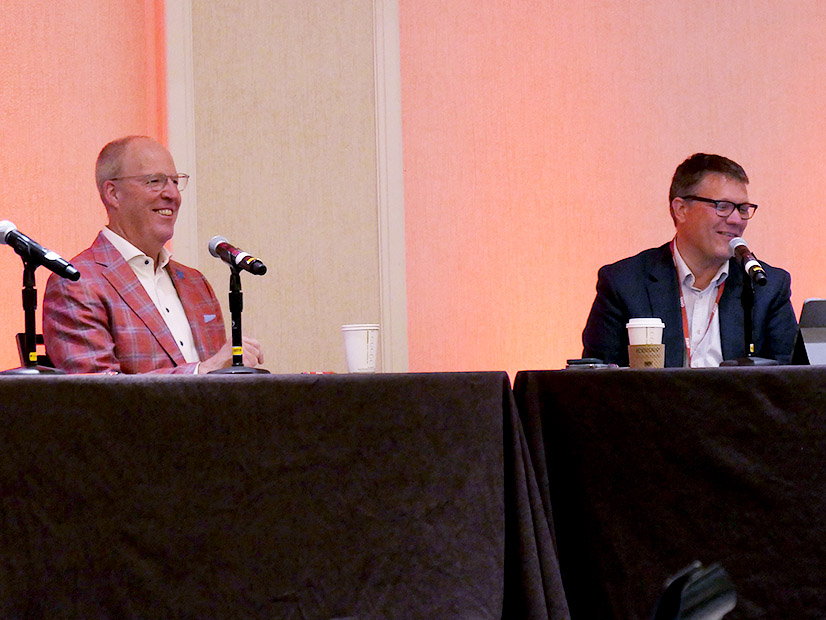
MISO CEO John Bear (left) interviewed by Minnesota Public Utilities Commissioner Joseph Sullivan | © RTO Insider 

Bear said MISO is poised to double its 13-GW solar fleet over the next two years. However, he cautioned that MISO must be thoughtful about balancing its inverter-based resources. He said the risk posed by inverter-based resources is very real, exemplified by the frequency issues that likely were the culprit behind the late April blackout in Portugal and Spain.  

MISO has noticed it increasingly encounters challenging operations in spring and fall on days when renewable energy output is high, Bear said. He said MISO is keeping tabs on its changing needs and will investigate adding frequency products or accrediting resources differently around frequency and inertia.  

Bear also said MISO’s proposed fast track in the queue for proposed generators deemed indispensable to resource adequacy by state authorities should get key projects online sooner. (See MISO Fast Lane Proposal Disadvantages IPPs, Retail Choice States, Critics Tell FERC.) 

Bear said MISO has devoted considerable time to planning transmission so wind and solar can be dispatched efficiently across the footprint. He pointed out MISO doesn’t need to track a significant number of curtailments, like the graph CAISO maintains.  

MISO Independent Market Monitor David Patton asked the audience if anyone was surprised by the capacity auction’s $666.50/MW-day clearing price for the upcoming summer. MISO’s capacity auction left all but 300 MW of offers unused. (See MISO Summer Capacity Prices Shoot to $666.50 in 2025/26 Auction.)  

He was met with silence.  

“If you haven’t been tuned in, capacity prices went up manyfold from past years,” Patton said.  

Patton said MISO buying 2% beyond the absolute summer minimum capacity standards is good for the health of the system. 

“It was a bargain to buy it. … It’s not a bad thing that we bought beyond the minimum requirement,” he said. Patton also said states were instrumental in getting the auction clearing on a sloped demand curve. 

“We saw how powerful I was, recommending this for 10 years,” Patton joked.  

However, Patton said the “full” signal to build generation won’t arrive until MISO institutes its new, availability-based capacity accreditation beginning in mid-2028. He said the accreditation will deliver a final puzzle piece and allow the footprint to better meet long-term resource adequacy objectives.  

Under the new accreditation, most resources’ capacity values are set to fall, as evidenced by MISO’s evaluation of this year’s supply had the accreditation been in place.  

“It’s going to change how people plan, it’s going to change how merchant generation is built, how [integrated resource plans] are made,” Patton said.  

IMM: Problem Remains with ‘Not Real’ DR

However, Patton said he remains deeply concerned about demand response gaming MISO’s markets. He said MISO’s recently filed suite of stricter rules should close some loopholes that allow DR to collect payments for doing nothing. (See Stakeholders Ask FERC to Soften MISO’s Proposed DR Accreditation.)  

He said MISO is right to “aggressively” confirm that DR resources are genuine. He said if MISO does that, DR should function more like MISO traditional generation, which responds when called upon. Patton said MISO carrying only authentic and responsive DR ultimately should reduce costs.  

Patton hinted at more referrals to FERC’s Office of Enforcement. He said an audit of MISO’s DR fleet turned up a retail customer that was registered under multiple market participants and a data center that has offered demand reductions and collected payments for about two years despite not yet being built.  

“If you look at the site, it’s a really pretty greenfield with weeds,” Patton said. “We cannot allow people to sell us something that’s not real.”  

Other Perspectives

Other speakers at the OMS meetup had plenty to say with resource adequacy risk at MISO’s doorstep. Alliant CEO Lisa Barton struck a decidedly graver tone in her keynote address.  

Barton said she was sure the audience “was glued to their phones on April 28,” tracking the Iberian outage as it unfolded. She said she was sure attendees are focused on “making sure what happened there doesn’t happen here.”  

Barton said industry players should be dedicated to at least holding up or bettering today’s levels of reliability and resiliency. She said “one of the unfortunate things” is people eventually forget grid disasters like Winter Storm Uri.   

“We need to remind ourselves that’s out there,” Barton said.  

Barton said there’s value in assessing events that “might not have happened in our backyard” and committing to learning from them. She said Spain and Portugal are dealing with a $1.7 billion fallout and a handful of deaths from just “one day of the lights not being on.”  

Barton said the event should reinforce the idea that resource adequacy takes all kinds of generation, with some types more consequential than others.  

Barton praised MISO for proposing an interconnection queue fast lane to get select generation online faster.  

“I know it’s not a universally popular decision, but it’s action,” Barton said, adding that “not acting is a far greater risk.  

“I remember saying to my daughters, ‘Not making a decision is a decision.’” 

Barton said it can’t be ignored the U.S. population is benefiting and living on grid investments made decades ago. She said no matter your politics, nearly all can agree the industry needs to expand generation to support American innovation.  

“What I think we can agree on is, we have to win the technology war,” she said. 

Barton said MISO members should be insistent on striking flexible load arrangements to handle incoming large loads. She warned that it “all can’t be fixed with transmission.”  

Finally, Barton said it’s not a good idea for data centers to strike out on their own and secure their own generation construction. She said data center developers likely would seek components that utilities also are vying for, likely exacerbating supply chain problems. Barton said independent generation construction is reminiscent of a pre-RTO world, where utilities planned in isolation and transmission and generation redundancies existed. It’s possible, Barton said, to work in protections for ratepayers while still offering attractive rates to data centers.  

Data Center DR?

Despite the IMM’s indication to expect more enforcement against DR double-dealing, some are bullish that data centers are a new frontier.  

Duke University fellow Tyler Norris said the idea that data centers are strictly inflexible and need firm service 24/7 isn’t true, as evidenced by a 2024 report from the Secretary of Energy’s Advisory Board. He said there could be some load flexibility found when the system needs it most.  

“Outside of the 15 to 20 hours across the year … during cold snaps or heat waves, there’s a lot of headroom” on the system, Norris said.  

He said Duke’s recent research found that if data centers could curtail load annually at just 0.25% of their potential maximum use, it could allow the existing grid to support about 76 GW of new load across the U.S., with 11.6 GW of that in MISO. (See US Grid Has Flexible ‘Headroom’ for Data Center Demand Growth.) Some in the industry are skeptical those figures can be achieved without co-located generation.  

Norris pointed out that the country’s grid is built around the “few hours per year of extreme demand” and outside of demand peaks, about half of generation capability can go unused. Norris said while regulators might think data centers are running at a 100% utilization rate, they’re more likely to be running in the order of 40 to 50%. He said some of the unrealized use stems from data centers’ tendency to overstate interconnection needs.  

“There’s a lot of potential there,” Norris said, but added that the flexibility from data centers will look different from traditional DR. He said grid operators will need to “get creative” to design different service tiers of DR to accommodate them.  

He also said flexibility tradeoffs are being hammered out between data center developers and power suppliers.  

“We know that those negotiations are happening, but on a purely bilateral basis, without a tariff,” Norris said. He said regulators might decide to outline some regulations for use agreements.  

Nevertheless, Norris acknowledged the industry is in a “real crunch for the next five to seven years” to get generation built. He said construction probably will be more difficult because of the Trump administration’s repeal of Biden-era tax credits.  

Surplus Interconnection Service and Batteries

GridLab’s Casey Baker said in MISO, there’s a possible “double-digit energy and capacity” solution in MISO in the form of using surplus interconnection across the sites of the RTO’s approximately 50 GW of renewable energy. He said members could build companion battery storage across those sites or, conversely, build wind or solar resources at some of MISO’s seldom-used and aging peaker plants to make the most of their little-used interconnection service. 

Baker said building to use more interconnection service wouldn’t require network upgrades or the intense study and permitting that greenfield construction would require.  

“We have this perception that the grid is tapped out, and that’s true in certain hours, but that’s not true in most hours,” Baker said.  

Baker called batteries the “Swiss Army knife” of resources and said they can bolster resource adequacy, work as a transmission asset and provide inertia and grid-forming services, if customers are willing to pay for those models.  

Mia Adams, of Ulteig Engineering and a MISO alum, added that MISO needs better participation rules for energy storage. She said though most believe that lithium-ion batteries have a four-hour limit, some can last up to 16 hours now.   

“If you have the need, there’s a solution if you’re willing to pay for it,” she said. However, she added that most storage projects “in MISO don’t pencil out because of the market design.”  

Adams said a 100-MW battery could be built within four months. Along with companion wind and solar generation, Adams said the footprint could host inexpensive, dependable new generation quickly.  

Adams asked the audience to embrace new technologies sooner. She warned that data centers aren’t the only ones lining up for load treatment, nothing that heavy industry like aluminum smelters and steam crackers are looking to electrify.  

And Adams said political instability in the form of will-they-won’t-they tariffs is upending plans for new generators.  

“It’s not just batteries that come from China. It’s a very intermingled supply chain,” she reminded the audience.   

Laura Schepis, an executive director at the National Electrical Manufacturers Association, agreed the volatility wrought by tariffs is anathema to planning and building resources.  

Electric Power Research Institute’s Director of Power Systems Aidan Tuohy agreed that data centers aren’t the only growth the industry is facing, invoking increasingly electrified transportation, electrification of heat and reshoring of manufacturing.  

From left: Wisconsin Public Service Commissioner Marcus Hawkins, Aidan Tuohy of EPRI and Tyler Norris of Duke University | © RTO Insider 

“We know we can’t necessarily build fast enough to meet that demand,” he said and offered demand flexibility and grid-enhancing solutions as ways to maximize the grid and get a breather on adding new generation.  

Sparkfund CEO Pier LaFarge said the industry is navigating a moment not seen since the Industrial Revolution, where the data center explosion is coinciding with geopolitical tensions.  

Xcel Energy Vice President of Supply Chain Murray Sanderford seconded the echoes of the Industrial Revolution.  

“In my career, I’ve never seen something so daunting from a supply chain standpoint,” Sanderford said. He said he and his peers estimate that just 60 to 70% of planned generation won’t get built due to lack of labor and lack of equipment.  

MISO’s Aubrey Johnson reminded attendees that about 30 GW of MISO’s 53 GW in generation projects that have signed generator interconnection agreements but have yet to come online are more than two years behind their commercial operation deadlines.  

Johnson also noted the industry is grappling with a growing shortage of technicians specializing in inverter-based relay systems, another obstacle to meeting demand and reliability targets simultaneously.  
MISO IMM to State Regulators: Good Intentions Behind LRTP Criticism

ROSEMONT, Ill. — MISO Independent Market Monitor David Patton addressed the recent controversy surrounding his longstanding criticism of MISO’s latest, $22 billion long-range transmission portfolio at the Organization of MISO States’ Resource Adequacy Summit.  

Patton began a May 13 unscripted talk to regulators by joking that the “ominous” red light background on stage wasn’t doing him any favors. He told regulators that he was on their side despite some states being disappointed that he condemned many of the underpinnings of MISO’s second, $21.8 billion long-range transmission plan (LRTP) portfolio. 

Patton said he was only trying to “weaponize the markets” to spur the most reliable and economic dispatch decisions while respecting states’ policies.  

“By the way, I love transmission,” he joked. At another point, Patton teased that he “wasn’t allowed” to speak out on transmission planning, referring to MISO leadership asking FERC whether it’s appropriate for the IMM to analyze the value of proposed transmission portfolios in addition to markets. (See MISO Intent on Answers as to IMM Role in Tx Planning.)  

Patton’s comments come about a week after MISO petitioned for the declaratory order with FERC (EL25-80). The RTO’s stakeholders are split on whether the IMM should independently assess the value of transmission projects. Patton continues to take issue with several of MISO’s estimates of the second LRTP portfolio, including its underlying capacity expansion modeling and the value of resolved reliability benefits, the amount of new generation that can be avoided and environmental benefits through the new transmission.  

MISO anticipates a benefit-to-cost ratio of between 1.8:1 and 3.5:1 over the first 20 years of the LTRP projects’ lives through reliability improvements, production cost savings, capacity that won’t have to be built and environmental benefits. The IMM has pinned the value of LRTP II closer to a 0.3:1 benefit-to-cost ratio and has advocated for a condensed portfolio.  

Patton said transmission planning and functioning markets are intrinsically linked and should be evaluated interdependently.  

“We have to understand that when we make bad planning decisions, we undermine the market,” Patton told attendees. He again said the 20-year future MISO relied on to recommend the portfolio of mostly 765-kV lines is impractical and doesn’t represent the resource mix that will be built.  

Patton said MISO is overbuilding the transmission system at the cost of the market incentivizing the construction of battery storage and developing other dispatchable technologies. It’s “very important” that MISO be realistic about the generation mix that’s on the horizon, Patton said, pointing out that many utilities remain committed to building new gas generation despite MISO allowing for very little in the future it used to plan the second LRTP.  

“If we plan for a fictional system … we’re going to either pay higher costs or have an unreliable system,” Patton said.  

In its filing, MISO asked FERC to “confirm” that the IMM’s “unsolicited transmission planning and monitoring activities are outside the scope” of its engagement rules with the IMM under its tariff and that it “has no obligation to reimburse Potomac [Economics] for such unsolicited transmission planning and monitoring activities at the expense of tariff customers.”  

MISO’s Board of Directors in mid-February directed RTO leadership to freeze all payments to the IMM for work related to transmission planning. 

MISO said its request did not preclude it from relying on an independent transmission monitor in the future. It also said it wasn’t seeking to “limit the activities of Potomac, such as participating in stakeholder processes, separate and apart from its role as the hired IMM for MISO.” Essentially, MISO said the IMM should size up transmission, pro bono and on the side as an interested stakeholder.  

MISO said it needed to “remove uncertainty” around the IMM’s authority and figure out which services its customers should be paying the IMM for. 

The grid operator ended by saying it plans to hire an independent, third party to assess the benefit estimates of future LRTP portfolios and the 20-year scenarios it devises to justify them.  

Community Opposition Still a Hurdle for Storage in N.Y.

ALBANY, N.Y. — The annual New York energy storage conference came with excellent timing this year, as progress at the state level was matched by looming obstacles at the federal level.

As the 2025 edition of Capture the Energy Conference & Expo kicked off, the on-again-off-again global trade war had been paused, removing for now the threat of crushing tariffs on battery components.

But given the mercurial state of affairs, and the ongoing debate over tax credits, few people expect the picture for energy storage and the batteries it relies on to be settled.

“I think every analyst’s favorite word at the moment is ‘uncertainty,’” Iola Hughes, head of research at Rho Motion, said as she launched into a rapid-fire update on tariffs and their effects.

There is no immediate way around tariffs, she added: “Even by 2026, we’re only looking at around 20% of demand being met by domestic cells, based on the current pipeline of gigafactories being built out.”

The May 13-15 conference was the 15th and the largest yet for the New York Battery and Energy Storage Technology Consortium (NY-BEST).

As its name implies, NY-BEST supports the development and deployment of all storage technologies. But batteries account for the vast majority of storage capacity being added to the grid, so the conversation at Capture the Energy tends to be focused heavily on them.

Iola Hughes, Rho Motion | © RTO Insider 

“In 2024 we saw lithium-ion battery demand surpass 1 TWh for the first time,” Hughes said. “This was a milestone narrowly missed in 2023, and I think, really, that’s just a sign of how much this market has progressed over the last few years.”

Doreen Harris, president of the New York State Energy and Research Development Authority, delivered a keynote address assuring an audience of hundreds that the state remains wholly committed to energy storage deployment, as storage will be needed in the tens of gigawatts if New York is to accomplish its transition to a grid heavily reliant on intermittent renewables.

But Harris had to cut herself short so she could catch her flight to Washington and continue to lobby for saving the policies that will help make that sort of buildout possible.

Amid the federal uncertainty, New York continues its part, with orders from the Public Service Commission pushing the process forward and $200 million awarded to support construction so far.

“And now, rounding out this trifecta, just yesterday we issued a draft [request for proposals] for our bulk energy storage solicitation,” Harris said.

New York’s first energy storage target is 1.5 GW by the end of the year. It has doubled its 2030 goal to 6 GW of new storage.

In June 2024, the PSC approved the roadmap for reaching 6 GW (Case 18-E-0130). It approved the implementation plans for storage projects totaling 5 MW or less in February 2025 and for bulk storage (greater than 5 MW) in March 2025.

Just recently, the Department of Public Service issued a progress report showing the state of storage in New York as of the end of March: 509.2 MW deployed, and 893.3 MW awarded or contracted.

The average total installed project cost ranges from $524/kWh (for bulk projects serving wholesale markets and receiving incentives) to $1,198/kWh (for customer-sited standalone behind-the-meter projects used for peak load reduction).

Supply chain constraints, inflation and high demand for cells drove up costs, the report notes, and these high costs have been a continuing barrier to timely buildout of storage in New York.

But right up there with cost is public opposition.

Battery energy storage system (BESS) fires, while rare, leave a strong negative impression, amplified by the fact that most people know nothing about grid-scale batteries or the risks associated with them.

New York has a strong home-rule tradition, and that fear of the unknown has translated into numerous moratoria on BESS development.

John Zahurancik, Fluence | © RTO Insider 

John Zahurancik, president of the Americas for Fluence, said BESS fires have developed an outsized profile as a result of the unfamiliarity and insecurity public officials and their constituents have with these facilities.

“We don’t call a news conference when a transformer blows up, even a big transformer. We don’t close highways when transformers blow up,” he said. “But we’ve done some of those things with energy storage recently.”

There is uneven quality control by some manufacturers, Zahurancik added, and it is incumbent on developers to not just rectify that but to prepare for all contingencies in the event of a fire, right down to emergency phone numbers going missing or not being answered.

“Another one of our revelations was, people don’t always do what you expect them to do in a moment of crisis,” he said. “That may not seem like a very deep revelation, but there’s a lot of truth to it. And so you can’t really control all the actors, so you have to design systems that are overly safe against people, and you have to drill and constantly talk about, ‘What are you going to do in these events?’”

An entire panel discussion was devoted to winning over community support for BESS proposals.

“Our knee-jerk response as an industry has been to talk about facts, to bring in technical studies and peer-reviewed reports and know that the facts are on our side, and sort of flood the misinformation with the facts. And unfortunately, that’s not a great strategy,” said Lauren Glickman, vice president of policy and communications at Encore Renewable Energy. “It’s really important to build bridges by coming around and [connecting] with individuals and bringing empathy to a lot of these conversations and finding shared values.”

Lauren Glickman, Encore Renewable Energy | © RTO Insider 

Nadia Pabst, senior vice president of government and corporate affairs at Aypa Power, said she defines success as community members having a better understanding of what energy storage is and how it fits into the broader energy transition. “Ultimately, we’re all working towards a decrease in blackouts and brownouts across the country and increased grid reliability.”

Without a compelling narrative, Pabst added, it is hard to compete with the prevailing misinformation.

Sam Brill, vice president of strategic development at NineDot Energy, said developers should make local officials their first point of contact for a new proposal — because they will not appreciate learning about it through word of mouth but also because they can suggest who best to talk to in the community.

Glickman also stressed that community relations should not end when the project reaches commercial operation status. “Trust is something that’s earned, but it’s also something that can be lost. So if you earn it, but then disappear, you’re not going to be seeing it.”

Key Capture Energy provided speakers for the panel discussions during the conference and maintained a table at the expo portion of the event. Senior Director of Development Kolin Loveless told RTO Insider he sees two sources of community opposition: individual uncertainty and actively spread misinformation.

New Yorkers’ uncertainty about fire safety grew from three unrelated BESS fires in rapid succession in three widely separated parts of the state in 2023, as well as a horrifying spate of e-mobility battery fires in New York City that had nothing to do with BESS except that both types of batteries contained lithium.

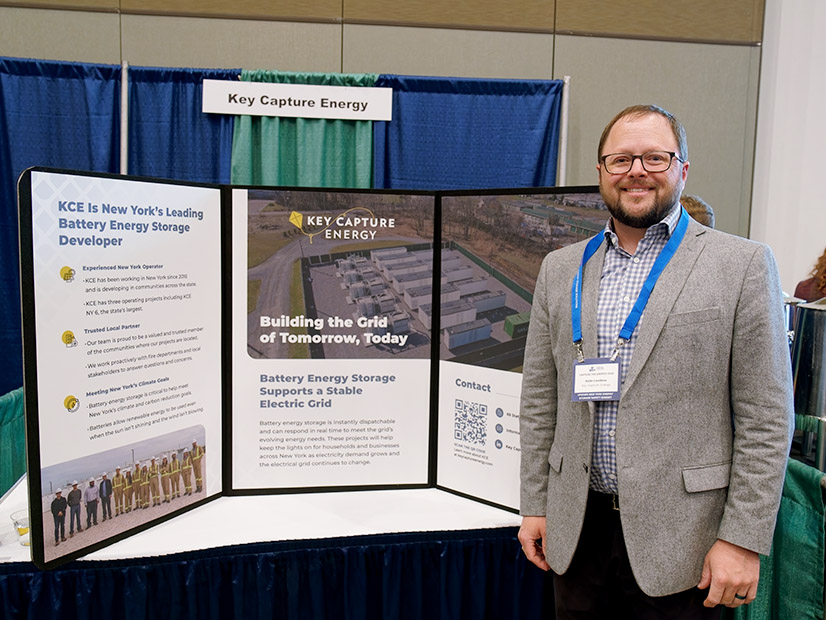
Kolin Loveless, senior director of development at Key Capture Energy, stands at the company booth during NY-BEST’s Capture the Energy Conference & Expo in Albany, N.Y., on May 14. | © RTO Insider 

Loveless hopes the fire safety review panel the state convened after the 2023 fires will calm the uncertainty or fears. Until then, the permitting structures in New York will make the fears more impactful here than elsewhere.

“Part of that is home rule and the way that is structured, and a part of that has been [in] a lot of the other states where we are operating, they either don’t have major permitting regimes — Texas does not require permits in a significant way, and so there’s not that same question — [or there are] state-run processes for energy projects.”

KCE started in Albany nine years ago, and its headquarters is just down the hill from the event venue; its operational projects are all in New York and Texas, but its development pipeline stretches from Maine to California. So it is exposed to a wide range of public policies and popular sentiments.

Loveless made a point Zahurancik also made: Execution is important. A lot of the fires have been in first-generation BESS projects, and a lot can be learned from them.

“We’re already rolling out Gen 3, 4 and 5. And what we’ve done, actually, as an industry, pretty well, is learn from what happened before and implement those things into all the different codes that we follow. The next step is basically forcing the market to follow.”

An entire bucket of community opposition in the state has been hesitation more than opposition, he said, as some local officials await the results of the New York Inter-Agency Fire Safety Working Group’s efforts.

A key recommendation was that project permit applications undergo a peer review. That might ease the hesitation, but it might not.

“In a way you’re effectively asking every town in New York to be able to make its own assessment,” Loveless said. “The idea behind what the Fire Safety Working Group has worked out is a peer review process, so they don’t need that expertise. But I don’t know that jurisdictions are all fully comfortable. Some are, some are not. So that’s the challenge that we’re all working through. And unfortunately, for projects, that’s a binary outcome.”

Calif. Looks for Ways to Spur Heat Pump Adoption

SACRAMENTO — California’s goal of deploying 6 million heat pumps in buildings by 2030 is being tackled from multiple angles, and the different strategies were the subject of a panel discussion during a recent conference. 

The California Energy Commission plans to launch in 2025 the Direct Install Program — a key piece of its Equitable Building Decarbonization program. Direct Install will provide no-cost home electrification retrofits and energy efficiency for low-income households in California. 

Another program is TECH Clean California, which offers rebates for heat pump appliances in single and multifamily homes across the state. The program just received another tranche of CEC funding, CEC Commissioner Andrew McAllister said May 6 during a panel at the California Energy Transition Summit hosted by Infocast. 

In addition, the Building Initiative for Low-Emissions Development (BUILD) program is providing incentives for construction of new, all-electric, single and multifamily homes, McAllister said. 

Panelist Jose Torres, with the Building Decarbonization Coalition, said Direct Install is geared toward older homes that are harder to electrify. The TECH Clean California program could help people living in newer homes who are interested in heat pump air conditioning, he said. 

“Both programs are beneficial; I do think both approaches are going to be necessary in order to grow the market,” Torres said.

Residential and commercial buildings are responsible for about 24% of California’s greenhouse gas emissions, according to state agencies. McAllister said about 80% of a non-electrified home’s emissions come from water and space heating. 

“Heat pumps have so many upsides,” McAllister said. “Eventually it will be a good sell, but we have to work through market barriers.” He said that’s something California has done before for solar and other technologies. 

Streamlining Installation

Other efforts to increase heat pump adoption are focused at the local level to make installations easier. 

“There’s not a lot of training and knowledge on how to safely install heat pumps compared to gas equipment,” said panelist Sam Fishman, with the San Francisco Bay Area Planning and Urban Research Association (SPUR). 

Fishman said cities often require applicants for a heat pump installation to complete the same steps as for a gas appliance installation, even though some steps may not be necessary. Heat pumps face additional planning checks, such as extra site plans and line diagrams, he said, and planning rules often restrict where heat pumps may be installed. 

SPUR also is working with the Panel Optimization Work and Electrical Reassessments (POWER) group, convened by Build It Green, to find ways around the need for electrical infrastructure upgrades for a heat pump installation. 

Solutions might include technology to avoid coincident load, such as a device to switch off an EV charger so it’s not running at the same time as a heat pump washer and dryer. 

Panelist Therese Peffer, a researcher at the University of California, Berkeley, gave an update on the Oakland Eco Block research project, which is using economies of scale to electrify an entire block of homes in Oakland rather than working on one home at a time. 

The project includes installation of electric appliances, efficiency upgrades such as insulation, and co-owned solar for the homes. The CEC largely has funded the project, which is wrapping up work on the homes and entering an analysis phase. 

The project did result in economies of scale, Peffer said. 

“Bulk purchases of appliances [were] a big deal,” she said. “Or even just getting a contractor to come out and bid on eight roofs instead of one was a big deal.” 

And if a contractor finished work on one home midday, they could get started on another home right away rather than sending workers home for the day. 

Another question was how much the “neighbor effect” would come into play, Peffer said, referring to observations that solar and EV adoption seem to be contagious in a neighborhood. The same seemed to be true in the Eco Block project for heat pump adoption, she said, even if the appliances are less visible. 

Blueprint Released

The building decarbonization discussion came just weeks after the California Heat Pump Partnership released a blueprint aimed at accelerating heat pump adoption in the state. 

The partnership, which launched in May 2024, is a public-private coalition consisting of state agencies, manufacturers, utilities and others. The group’s objective is to help the state meet Gov. Gavin Newsom’s goal of installing 6 million heat pumps by 2030. 

Among the strategies in the blueprint are improving heat pumps’ value proposition through stable incentives, expanded financing options and electrification-friendly rates. Workforce training opportunities should be expanded along with contractor support, the blueprint states. 

The blueprint also recommends a two-pronged marketing campaign focused on consumers and contractors and promotion of the electric appliances through a Heat Pump Week. 

Ohio Governor Signs Utility Law Aimed at Enhancing Competitive Market

Ohio Gov. Mike DeWine signed House Bill 15 into law, eliminating the use of “electric security plans” (ESPs) for the state’s utilities and requiring them to rely on market forces to maintain adequate generation.

“EPSA applauds Ohio policymakers for enacting Substitute HB 15 — legislation that sends a clear message: Ohio is open for business,” Electric Power Supply Association CEO Todd Snitchler said in a statement May 15. “By shifting financial risk away from captive ratepayers and enhancing transparency, this bill further enhances a competitive energy market that benefits consumers and attracts investment.”

Competitive markets lower costs and emissions without sacrificing reliability, Snitchler argued. The law provides a strong model for other states to attract the needed investment to meet higher demand from artificial intelligence, data centers and advanced manufacturing.

“This shouldn’t be viewed as just an Ohio win; it’s a roadmap for energy policy across the country,” Snitchler said. “Ohio chose competition, accountability and innovation, without subsidies to specific types of resources.”

The law passed out of the Legislature on April 30 with unanimous approval by the state Senate and by a 94-2 vote in the House of Representatives.

Ohio law previously gave utilities two options to establish their standard service offer (SSO) rates: an ESP that covered several years, or a market rate offer (MRO). ESPs have been used widely since a 2008 law allowed them. In addition to EPSA, the Office of the Ohio Consumers’ Counsel supported their elimination.

“The legislation restores the General Assembly’s vision in 1999 to deregulate power plants to bring the benefits of electric competition to Ohio utility consumers,” Consumers’ Counsel Maureen Willis testified earlier this year as the law moved through committee. “That vision was impaired by the 2008 energy law, when so-called electric security plans were created with their increased involvement of government regulators.”

The ESP will be eliminated fully once currently effective plans expire. The law requires utilities to switch to the MRO to establish SSO rates for customers who do not shop for competitive suppliers.

About 40% of the state’s customers still get default service from the utilities under the SSO, but they represent less than 20% of the state’s load, according to statistics from the Public Utilities Commission of Ohio. The new law requires PUCO to ensure that any MRO does not have an adverse effect on large-scale governmental aggregation, which allows municipalities and counties to combine their residents’ power demand and purchase supply at bulk for them.

The law also bans utilities from creating competitive retailers of their own, which is something of a fait accompli, as regulated utilities in Ohio and beyond have spun off their competitive operations over the past decade. It also changes the definition of an electric delivery utility to specifically say they cannot own generation.

Another part of the law repeals utilities’ ability to recover costs associated with the Ohio Valley Electric Corp., which was set up as a joint venture in the early 1950s to own coal plants to supply a uranium enrichment facility that long since has shut down. That part of the legislation was championed by Rep. Sean Patrick Brennan (D), who said in a statement after it passed that it had been one of his goals since joining the House in 2023.

“The inclusion of my proposal that will save Ohioans hundreds of millions of dollars is an overwhelming accomplishment that many said would never get done,” Brennan said. “Protecting Ohio’s electric customers should be a goal of all public servants. To that end, I am happy about the bipartisan support for my proposal and the bill.”

ACORE Panelists Call for ‘New Era’ in Energy Policy

A “new era of thinking” is needed to respond to the rising level of reliability risk facing grid operators, former FERC Chair Neil Chatterjee said in a webinar hosted by the American Council on Renewable Energy about the summer reliability landscape.

Chatterjee — now chief government affairs officer at climate technology developer Palmetto — was joined on the May 15 panel by Karen Onaran, CEO of the Electricity Consumers Resource Council; Devin Hartman, a senior fellow at R Street; and NERC Senior Engineer Stephen Coterillo, who shared details on the ERO’s recently released 2025 Summer Reliability Assessment. (See NERC Warns Summer Shortfalls Possible in Multiple Regions.)

The SRA, published the day before the webinar, showed multiple regions at “elevated” risk of energy shortfalls, meaning operating reserves should be adequate for normal operations but could be insufficient in above-normal conditions. Areas of elevated risk followed a line down the center of the continent touching MRO-SaskPower, MISO, MRO-SPP and ERCOT, along with NPCC-New England and WECC-Mexico in Baja California.

Reacting to the assessment’s warnings about the difficulty of meeting rising demand with resources like wind and solar power that provide “less flexibility and more variability,” Chatterjee acknowledged the electric reliability environment has changed significantly since his time on the commission, a phenomenon with which grid stakeholders still are coming to terms.

“I was quite fortunate during my tenure [at FERC] that we had relatively flat demand,” Chatterjee said. “I think what these reports are showing [is] that we are entering a new period here. … We’ve got to figure out how we meet this coming surge in demand while maintaining reliability and affordability.”

One of the “unfortunate” consequences of the era of relatively flat demand, Chatterjee continued, was “that solutions on the energy side started to become politicized,” with the political left associated with renewable energy and the right connected to traditional fossil fuel generation. He said the changing reliability landscape could “upend” this viewpoint, forcing both left and right to drop ingrained attitudes and welcome “every available electron” to meet the rising energy needs of artificial intelligence, vehicle electrification and other advancing technologies.

Onaran agreed with Chatterjee on “the need to depoliticize energy.” She referred to the SRA as the latest in a long line of reliability assessments that showed “we’re on the razor’s edge” with regard to managing increasingly impactful extreme weather events.

While there are long-term solutions that Onaran said regulators should pursue to address these issues, such as streamlining the approval process for transmission projects and interconnection requests, she also urged utilities to look at more immediate steps.

“If everything goes great and we all have sunny, 70-degree days all summer, we’re golden. But we know that that’s not going to happen, and that doesn’t happen in all regions,” Onaran said. “So, what can we do in the short term to make sure that we’re meeting … these edge experiences where we’re seeing either higher demand, or the weather’s not cooperating?”

Drawing on her experience working with large industrial consumers, Onaran suggested one positive short-term change would be to improve load forecasts so customers can know more confidently how much demand to expect. This would prevent underbuilding, leading to energy shortfalls or requiring imports, and overbuilding, which could cause unnecessary expenses to ratepayers.

Responding to Onaran, Hartman acknowledged the urgency of the near future but emphasized that utilities and regulators must not take their minds off the long term.

“We in the industry always have these … seasonal discussions about [how] things are looking in the months ahead,” Hartman said. “The truth is, the way that this industry moves at the policy level and the way investment decisions or changes in the system are made, it typically takes years to get changes made, and then years before the affected industry can respond to [them]. So, it’s always important to be looking for the long-term reliability trends and getting the apparatus correctly calibrated to expected conditions down the road.”

FERC Summer Assessment Shows Risks from Growing Demand, Extreme Weather

FERC’s annual Summer Assessment shows rising demand and shrinking reserve margins as new supply has been slow to come online. 

That situation has been well known for over a year, but this summer forecasters expect higher-than-normal temperatures, and it could be exacerbated by extreme weather, according to the assessment. 

“The increase in demand doubled from 2024 to what you’re projecting for this summer, and that is largely data center growth,” FERC Chair Mark Christie said May 15 at the commission’s open meeting, where the assessment was unveiled. “So, on the demand side, you’ve got increases. They’re pretty amazing, but we continue to lose dispatchable generation, predominantly coal and gas, and it’s being replaced with inverter-based resources, which don’t have the same characteristics.” 

The summer assessment is based partly on some of the same information that NERC used in its own reliability assessment released the same week, which identified ERCOT, ISO-NE, MISO and SPP as facing elevated risks of outages under extreme conditions. (See related story, NERC Warns Summer Shortfalls Possible in Multiple Regions.) 

Christie noted that PJM said it could have to resort to emergency conditions this summer if the region faces extreme heat that could lead to a new peak demand record there. He asked NERC why it did not also place it at an elevated level of risk. (See “Summer Outlook Finds Possible Reserve Shortage,” PJM OC Briefs: May 8, 2025.) 

“We agree that the risk under extreme conditions in PJM is present,” NERC Manager of Reliability Assessments Mark Olson said at the open meeting. “The criteria that we apply to elevated risk looks at the once-per-decade type of scenarios and low-risk scenarios. And what we noted is that PJM is preparing to call on demand response, which is part of our assessment as well.” 

It would take a combination of extreme weather and major resource outages to lead to shortages in PJM this summer, he added. 

Relying on DR seemed risky to Christie, who said at a press conference after the meeting that when PJM was hit by Winter Storm Elliott over Christmas in December 2022, just one-fourth of DR called on actually showed up. The resource can be critical when the fleet is running full and demand is high, but Christie argued it was not a replacement for generation. 

“You don’t plan a resource mix to say, ‘Well, let’s just plan on having an emergency and use emergency measures because of the reliability aspect to it,’” he added. 

Regardless of whether PJM needs to dip into DR to maintain reliability this summer, Christie noted the region faces long-term resource adequacy issues. Those have led to higher prices and significant criticism from many of its states’ political leaders. 

The RTO is seeing a changeover in its leadership, with CEO Manu Asthana set to leave at the end of the year and stakeholders recently voting out two board members, including the chair. (See related story, PJM Stakeholders Reaffirm Board Election Results.) 

“A lot of that criticism is misplaced,” Christie said. “A lot of the problems in the PJM zone are the result of state policies, and PJM is being blamed unfairly.” 

FERC cannot overrule stakeholders’ board elections, though Christie said PJM could have better governance that gives a more prominent role to states. He noted that FERC will cover PJM’s capacity market at a technical conference on resource adequacy in early June, but he also said the RTO’s leaders were doing “their best.” 

While PJM was a major topic of discussion at the open meeting, the assessment covers the entire country, and it said that broad swaths of the West as well as Texas and Oklahoma face elevated fire risk this year. 

“Long-range forecasts for above-average temperatures and below-average precipitation in much of the Western and Central United States may result in higher wildfire risks in the affected regions over the course of the summer,” it says. 

The elevated risk of fires could lead to public safety power shutoffs as utilities seek to avoid the massive liabilities associated with starting one. And if fires do start, they can lead to damaged transmission equipment and other outages. 

Drought conditions extend over 37% of the U.S., well beyond the areas at risk for fire, and that is expected to grow this summer when temperatures rise. Drought risks curtailing power plant operations, as they can be short of water for cooling, leading to derates or, more rarely, forced outages, the assessment says. 

The assessment came a week before the National Oceanic and Atmospheric Administration’s official hurricane outlook, but one from Colorado State University forecasts an active season with 17 named storms and nine hurricanes, four of which are expected to be major. That amounts to 25% more activity than a normal season, according to the assessment. 

“What struck me is the hotter temperatures, the limited water resources, the elevated risks of wildfire, hurricanes and other extreme weather events — they all show up in this report,” Commissioner Judy Chang said during the open meeting. “And these trends are only getting worse. … We keep using the word[s] ‘uncertainty’ and ‘increased uncertainty’ in these reports; I would say there’s actually an increase of certainty that this is actually the pattern that we’re seeing more and more.” 

BPA Exempted from Federal Staffing Cuts, Hairston Says

The Bonneville Power Administration will not see further staffing cuts, CEO John Hairston said during the agency’s quarterly business review May 15, adding that he hopes to strengthen the workforce when the government lifts federal hiring freezes.

Hairston pointed to a House Appropriations subcommittee hearing on May 7 in which U.S. Department of Energy Secretary Chris Wright said BPA will not undergo more staffing cuts as part of President Trump’s quest to slim down the federal government. BPA’s federal workforce now stands at around 3,150 employees, according to Hairston. (See Wright Defends DOE Budget at House Appropriations Subcommittee.)

“BPA has been exempted from DOE’s reduction-in-force plans based on the key role BPA plays in public safety and in achieving the department’s vision for reliable, affordable and more abundant energy resources,” Hairston said. “For those same reasons, BPA’s workforce was not eligible for the latest deferred resignation program that DOE offered in April.”

Despite BPA’s status as a self-funding federal agency, its staff in January received a “deferred resignation” buyout offer from Trump’s unofficial Department of Government Efficiency, immediately setting off alarms in the electricity sector about the impact on the region’s grid reliability. (See BPA to Restore 89 ‘Probationary’ Staff, Agency Confirms.)

About 200 agency employees — or 6% of the workforce — accepted the buyout offer, while 90 job offers had been rescinded following a federal hiring freeze announced Jan. 20, according to BPA.

The DOE later allowed BPA to reinstate 89 “probationary” employees.

“We are prioritizing our resources to address our most urgent priorities, and I’m hopeful that we’ll be able to strengthen our workforce when hiring restrictions are lifted,” Hairston said.

Despite workforce challenges, BPA energized two transmission projects in the second quarter: the Longhorn substation in north-central Oregon, which will enable approximately 2,500 MW of generator interconnections, and the 18-mile Midway-to-Ashe 230-kV transmission line in southeastern Washington.

Planning ‘Reforms’

Hairston also provided updates on the agency’s transmission planning changes. BPA issued a pause in February to consider new “reforms” in light of “exponential growth” of transmission service requests (TSRs). BPA’s 2025 transmission cluster study includes over 65 GW of TSRs, compared with 5.9 GW in the 2021 study. The requests exceed the total regional load projected for the Pacific Northwest in 2034, according to the agency.

“Our current processes were not designed to handle this volume, so we are seeking reforms that will allow us to move projects forward more quickly and strengthen the grid,” Hairston said. “Now I’ve asked our team to think creatively and innovate solutions, even if it means disrupting the status quo. A disruptive solution may be what’s needed to achieve my vision, which is to drastically reduce the time from transmission request to transmission service.”

Hairston said he wants to reduce the time from transmission request to service to five to six years, calling his goal “a big ask.”

“But I believe we have the right team for the job,” Hairston said. “They have my full confidence, and I’m going to do everything in my power to make sure they have the resources they need to get the job done.”

The agency is finalizing its provider-of-choice process. BPA aims to have contract offers ready beginning in late August and have them all signed by the end of 2025, Hairston said.

Hairston also commented on BPA’s day-ahead market policy issued May 9. In a much-anticipated decision, the agency selected SPP’s Markets+ as its day-ahead market choice. (See BPA Chooses Markets+ over EDAM.)

“There’s a lot more work to do before we can officially join Markets+, but we are on the right path to delivering more value for the region,” according to Hairston.

Improved Outlook

The agency’s new chief financial officer, Tom McDonald, also provided a financial update during the May 15 call.

BPA’s net revenue for the second quarter is $210 million compared with the agency’s target of $70 million. Net revenues have increased since the first quarter, McDonald said. (See BPA Committed to Trump’s Energy Goals, Hairston Says.)

McDonald said the forecast for the second quarter is based on information at the end of March 2025 and does not reflect the full impact of Trump’s executive orders on BPA.

“We’re certainly happy for the improved outlook but remain mindful that there is still the potential for significant volatility for the remainder of the year,” he added.

Texas RE’s Albright Hopes to Learn from Iberian Outage

Jim Albright, the Texas Reliability Entity’s CEO, drew on April’s mass outage in the Iberian Peninsula during the organization’s May 14 board meeting to highlight the importance of its work.

“I try to stress with staff every day that what we do is really critical to the world that we live in. When you see things like that happen, it really brings it back home,” he told board members. “It’s really important that we do the work that we do to mitigate the risks that are out there, as they talked about last week in the NERC board meeting.”

The outage lasted 18 hours and covered Portugal, Spain and parts of France. While a cause has yet to be determined, Spain’s grid operator has said the outages began with two separate generation losses.

NERC CEO Jim Robb said during the Board of Trustees’ May 8 meeting that the organization has offered to assist in the investigation. NERC staff will present findings on the outages at FERC’s June open meeting. (See NERC Offered to Help with Iberia Outage Investigation, Robb Says.)

“Even though we’re on separate continents, there’s going to be a lot that we can learn from it because we all share the same evolving resource mix that we’re all dealing with,” Albright said. “We all share the same risks, and we all need the same information to be able to be able to mitigate it.”

Albright noted the similarities with the Odessa disturbances of 2021 and 2022, when several renewable resources tripped offline. (See NERC Repeats IBR Warnings After Second Odessa Event.)

“I haven’t been told exactly what’s happened yet, but I do see some similarities to some of the things that we’ve seen here in our interconnection, so it’ll be interesting to see where it all goes,” he said.

Albright also gave the board a sneak preview of Texas RE’s Reliability Performance and Regional Risk Assessment, which will be released publicly in June.

A resource for ERCOT reliability information, the report finds an increasing risk from integrating large loads, reduced generator effects from cold weather and continued risk from inverter-based resources. It also looks at large loads’ effects on future reserve margins and the new challenge posed by artificial intelligence.

New Agreement with NERC

The board approved a new regional delegation agreement with NERC to continue serving as ERCOT’s regional entity. The agreement extends Texas RE’s ERO work until Dec. 31, 2030.

Texas RE General Counsel Derrick Davis said the discussion involved in the agreement was the “most robust” he has seen in two previous negotiations.

Board members also formally endorsed the 2026 business plan and budget, as presented to the Members Representatives Committee for its approval in April. The $21.598 million budget, which must be reviewed by NERC, is a $1.3 million increase (6.4%) over the 2025 budget; it adds three staffers to help handle the organization’s increasing workload and a 4% merit increase for personnel. (See Texas RE Endorses 6.4% Budget Increase for 2026.)

A clean audit of Texas RE’s 2024 financial statements also was approved by the board.

Debate Lingers After BPA Day-ahead Market Decision

Although the Bonneville Power Administration removed any uncertainty by selecting SPP’s Markets+ over CAISO’s Extended Day-Ahead Market (EDAM), the debate over whether BPA made the right choice likely will heat up as the West now confronts a split into two major markets. 

In BPA’s 194-page record of decision (ROD), published May 9, the agency responded to public comments submitted after it issued its draft day-ahead market policy in March. BPA said it received 1,614 comments, many of which concerned some of the more contentious issues in the day-ahead market debate, like governance, market seams and market participation costs. (See BPA Chooses Markets+ over EDAM and BPA Flooded with Comments on Draft Day-ahead Market Decision.) 

Governance has been a key concern in BPA’s decision-making process, and the agency consistently has touted the governance structure of Markets+ as “superior” to CAISO’s EDAM. 

“I think it’s been clear for some time now that the governance structures for these markets are going to matter, and they are going to drive participants to one market or another,” Lincoln Davies, professor of law and executive director of energy, resource and environment programs at the University of Utah S.J. Quinney College of Law, told RTO Insider in an interview. 

Davies, who studies the development of organized electricity markets in the West, said CAISO’s current governance structure “is something that has detracted people from joining EDAM.” 

Markets+ will be governed by an independent panel whose members “must be independent of market participants,” according to BPA’s final market policy. 

By contrast, CAISO’s markets are overseen by the ISO itself, whose Board of Governors members are appointed by the California governor. However, the West-Wide Governance Pathways initiative is developing a new independent “regional organization” (RO) to oversee CAISO’s Western Energy Imbalance Market and the soon-to-be-launched EDAM. 

The Pathways effort now hinges on Senate Bill 540 in the California legislature, which would allow the independent RO to oversee CAISO energy markets. (See Pathways ‘Step 2’ Bill Introduced in Calif. Legislature.) 

Davies noted there is “a lot of optimism” the legislation will pass and change the governance structure but, he said, “part of what BPA’s decision this month has now indicated is they’re not willing to wait to see.” 

“There [are], I think, rational reasons for them to wonder whether Pathways will play out all the way,” Davies said. Similar past attempts, including a bill that would have transformed CAISO into a regional transmission organization, have failed. Though this time might be different, the uncertainty was not good enough for BPA to commit, Davies said. 

‘Pretty Big Division’

In a May 9 call with reporters after the decision was published. Rachel Dibble, vice president of bulk marketing at BPA, said that even with implementation of the Pathways plan, CAISO still would have “a pretty significant role in governing the market.” 

BPA’s ROD contends CAISO management will continue to handle “day-to-day management of policy development and market operations.” It also notes the CAISO board’s “considerations as a [balancing authority] have the potential to influence its decisions as the market operator.” 

As the bill makes its way through the California legislature, recent amendments spurred by concerned consumer advocacy groups also “continue to erode the independence that was even in the initial bill, which we did not find to be superior to Markets+,” Dibble said. 

Under the amendments, the California Public Utilities Commission can order investor-owned utilities to leave the RO if it implements market rules and operations “detrimental to California.”  

During a hearing April 29, the bill’s author, Democratic state Sen. Josh Becker, said the amendments will protect California from possible attempt by the federal government to influence the state’s energy markets, such as pushing the state to buy power from coal-fired generators. (See California Lawmakers Seek to Trump-proof Pathways Initiative Bill.) 

But this will put BPA and other entities outside of California “in a difficult negotiating position within the regional organization governance structure when any proposed rule or business practices can be referred to the CPUC or Legislature for a determination that the proposal will be ‘detrimental’ to a broad and general set of policies,” BPA’s ROD states. 

Still, from a West-wide perspective, it would have made sense for BPA to wait for Pathways to play out, according to Davies. The entire region would benefit from a bigger market, he said. 

“From that perspective, getting everyone into one of the two markets would have been ideal,” Davies said. “I think it’s been clear for some time there’s going to be some division of the markets. And now it’s certain there will be a pretty big division of the markets.” 

Vijay Satyal, deputy director of regional markets and transmission at Western Resource Advocates, shared Davies’ sentiment. He said WRA, a consistent advocate of single Western market under EDAM, respects BPA’s decision, but noted it took the agency “six to eight years to join even a voluntary EIM market,” while the “monumental decision” to join Markets+ took about three years. 

“Why not look to the Pathways Initiative and what truly has an independent governance framework being set up, where no state jurisdiction will help influence or decide the board composition and the processes, because that was the concern with the [CAISO] structure,” Satyal told RTO Insider. 

“That’s an area of regret for WRA, that that opportunity is being discounted a bit quickly,” he added. 

Studies and Costs

Another point of controversy in the BPA decision process: the projected comparative economic benefits of the two markets. 

A production cost study by Energy and Environmental Economics (E3) commissioned by BPA in 2024 showed that participation in EDAM could deliver the agency up to $106 million in greater benefits than Markets+. (See BPA Sticks to Markets+ Leaning Despite Study Showing EDAM Benefits.) 

Proponents of EDAM have pointed to the E3 study and another by The Brattle Group — not commissioned by BPA — that found by 2032, the agency could earn $65 million in benefits from participating in EDAM versus an $83 million net loss in Markets+. (See Brattle Study Finds EDAM Gains, Markets+ Losses for BPA, Pacific NW.) 

Kelsie Gomanie, an advocate for Western markets for the Natural Resources Defense Council, said in a statement that BPA’s decision will lead to the agency and its utility customers losing out on savings “but also increasing costs for all Northwest power customers.” 

“Multiple analyses, including BPA’s own, confirm this finding,” Gomanie said. “This decision also rejects the opportunity of improved reliability and acceleration of meeting Western states decarbonization targets. The decision is inconsistent with BPA’s broad mandate, as a federal agency, to act in the best interests of the whole region it serves. We will continue to work with our partners to ensure reliability and affordability benefits reach broadly across the region and advocate for a well-integrated West-wide grid.” 

BPA has argued consistently that the studies show the largest benefits come under a scenario in which there is only a single West-wide market. But a more likely case is there will be multiple markets in the future, especially since entities already have signed with either Markets+ or EDAM, according to BPA. 

Additionally, the models do not factor in “numerous governance and design differences,” according to BPA. Ashley Donahoo, the agency’s day-ahead markets lead, reiterated that point in the call with reporters May 9. 

“The analysis has already been done, and today we’re setting our policy direction that Markets+ is the preferred day-ahead market for BPA, based on production cost modeling results, based on market design features and all of that,” Donahoo said. 

Market Seams and Connectivity

With BPA’s decision settled, Markets+ participants presumably will need to begin addressing challenges stemming from the non-contiguous nature of the market’s footprint, which is expected to consist of three isolated pockets concentrated in the Pacific Northwest, Arizona and Colorado, as well as a smaller slice in El Paso Electric’s service territory. Chief among those challenges will be the lack of transmission capacity connecting the market’s zones, which will require making energy transfers through the larger EDAM, where possible.  

Dibble acknowledged the challenges, saying transmission projects across the West will “take several years and a lot of negotiations to figure out.” 

However, “Even with market footprints that are separated geographically … there is still improvement in the dispatch when you have one entity that is dispatching across a bigger footprint,” Dibble said. “So, even if it’s not connecting between the Northwest and the Southwest initially as robustly as would be ideal, there is still improvement in the dispatch of generation and serving load when you have one entity dispatching over one larger market.” 

On market seams, BPA said in the ROD that it understands that two day-ahead markets “may create inefficiencies and will be challenging to resolve.” 

But the region has experience mitigating seams issues under the Coordinated Transmission Agreement that BPA has struck with 18 adjacent Balancing Authority Areas and 15 adjacent transmission service providers. Markets+ and EDAM also have an incentive to work out seams issues, according to the ROD. 

BPA also took issue with the notion that the agency is solely responsible for creating seams, noting that PacifiCorp and Portland General Electric (PGE) decided to join EDAM “based on their evaluation of which market is in their best interests, just as Bonneville has done with its decision to pursue participation in Markets+.” 

“However, there has been very limited discussion of seams with those entities, despite their decision relying heavily on use of the Bonneville transmission system, creating the same seams with which many commenters take issue, including PacifiCorp and PGE,” BPA stated. “All entities will need to rely on negotiating seams agreements, regardless of the day-ahead market in which they decide to participate.” 

Satyal said there will be at least three major market seams: EDAM and Markets+; intra seams within each of the markets’ footprints; and larger seams between Markets+ and RTO West — “unless they merge.” 

“Seams management and rules should be developed now, proactively, to help shape the market functioning, rather than the other way around,” Satyal said.  

BPA has indicated it is willing to take on a leading role and bring the various parties to the table, Satyal noted. 

“So the proof is now in the pudding, what BPA is going to be able to do and how, because BPA’s decision impacts the decision making of many embedded entities and load-serving customers,” Satyal said. 

Tom Kleckner contributed to this article.