Search
December 16, 2025

Around the Corner: The Promise, Uncertainty and Unparalleled Risk of Data Center Load

Recent headlines and projections related to emerging data center load are astonishing. In February, Dominion Energy reported over 40 GW of data center contracts in its Virginia service territory as of December 2024, an increase of 88% from its July number. To put those numbers in perspective, Dominion’s record peak load in 2024 was just over 23 GW.

Meanwhile, that same month PPL Corp. stated it had received 54 GW of requests across its Pennsylvania and Kentucky service areas. PPL’s 2024 peak demand was 7 GW. Through the same period, Texas utility Oncor highlighted 228 transmission-level interconnection requests for 119 GW, almost four times larger than the 31 GW of demand it currently serves.

Numerous other utilities also are seeing significant numbers, with Exelon reporting data center load of 16 GW, and some single “hyperscaler” projects well over 1 GW. For example, Meta’s $10 billion hyperscale endeavor with Entergy in northeastern Louisiana is sized at 2 GW.

This activity is part of a global race to expand artificial intelligence capabilities while growing the underlying data center infrastructure. The investments clearly will be enormous, with profound implications for many utilities, especially those close to communications cables (it’s the confluence of numerous high-speed cables that makes Dominion’s northern Virginia region the data center capital of the world). However, it has become increasingly apparent that access to existing communications infrastructure is not as important as it once was. Today’s imperative is to access electricity as fast as possible, which means more utilities eventually will be affected.

The Overriding Mandate for Power

Leading chipmaker Nvidia’s CEO Jensen Huang highlighted the primacy of power in his March GTC keynote, stating:

Peter Kelly-Detwiler |

“Remember that one big idea is that every single data center in the future will be power limited. Your revenues are power limited. You could figure out what your revenues are going to be based on the power you have to work with. This is no different than many other industries. And so, we are now a power limited industry. Our revenues will associate with that.”

It’s all about accelerated access to the electron, so data companies are willing to go wherever electricity is available. That explains why Meta is working with Entergy to build three 750-MW gas generators in a remote and impoverished province in northeastern Louisiana. It’s also why Texas is a hot spot for new data load — the state has the land, and more importantly, it’s one of the easiest places in the country to develop new generating assets.

The Risks to Utilities and Ratepayers

After decades of relatively flat — or even negative — growth, many utilities understandably like what they see: enormous, high load factor demand from some of the most well-capitalized companies on the planet. At first blush, data load looks like a perfect antidote to stagnating utility revenues. However, this value proposition brings with it a significant level of risk. To understand where that risk lies, it helps to break this issue into discrete elements:

    • The Interconnection Requests and “Phantom Load” — The data industry power imperative is simple: Get access to energy as quickly as possible to maintain competitiveness. To get that power, large players may deal with utilities directly, or they may buy existing projects put together by other developers. In either case, they are incentivized to develop multiple applications across numerous locations.
      • If Project A wins, they withdraw Projects B and C. This approach is similar to the supply interconnection queue, in which fewer than 20% of projects initially entering the queue ultimately flow power. The fluid nature of the industry also results in constant changes. For example, in March, Microsoft withdrew 2 GW of projects in Europe and the U.S., and then in April, it pulled back from three Ohio projects worth $1 billion.
      • In addition to the big hyperscalers, numerous other players are active, including speculative developers looking to grab land, access power and flip their projects to third parties. The result is an inflation of the interconnection numbers that may be quite significant.
    • Contract Lengths and Temporal Mismatches — Recent contractual structures approved by utility commissions typically include a ramp period of four to five years, followed by a period of 12 to 15 years at full load. Contracts often are structured as take-or-pay agreements, meant to inoculate ratepayers during the length of the contract period, but only for the initial contract length. The problem is the contract durations align poorly with generation and transmission infrastructure with lifespans that often exceed 30 or 40 years. If data center loads were not so large, this risk would not be as considerable. Given their magnitude, if data center load shrinks or disappears, stranded asset risk could be quite considerable.
    • Competition & Consolidation — In the U.S. alone, more than a dozen entities have developed over 40 large language models that consume huge amounts of data and electricity. If the past battle for search engine supremacy or the lessons of general economic theory are anything to go by, we can expect many of these actors to fail or be consolidated in the future, creating attendant risk for both the utilities holding the supply contracts and their captive ratepayers.
    • Constantly Evolving Technologies — Data center technologies are highly dynamic and are becoming increasingly efficient. In cooling, which consumes roughly 35% of data center load, liquid and two-phase cooling promise to cut energy consumption dramatically, by as much as 90%. Meanwhile, performance of the cutting-edge chips from Nvidia demonstrates remarkable gains. The next-generation chip — to be delivered by 2027 — will yield performance gains of 900 times that of its chip introduced in 2022. Supported by AI itself, future chip efficiencies will improve.
    • Approaches to Training the Large Language Models — The traditional “brute force” approach to training AI models has been to combine powerful chips with huge amounts of electricity to crunch data — in some cases as much as a trillion parameters in a single training model. However, news out of China this spring suggests that in some instances there may be a better way that involves far few chips and significantly less energy. DeepSeek and Baidu’s Ernie X1 reportedly focused more on algorithms and software efficiency, so that they used fewer chips and far less energy. Neither has provided solid information with regard to their metrics, so verification is difficult, but there could be far better ways to achieve AI-related outcomes.
    • The biggest question related to efficiencies is simple: If the training models get less expensive, and the applications become more cost-effective, will society simply end up applying more artificial intelligence in more sectors of our economy? We thus would use less energy in our training models and more in “inference,” the application of the models to the real work in reasoning and making decisions. It’s simply too early to say.

The Challenge and Opportunity, and the Need for More Rigor

All of these issues point to today’s indisputable reality: The entire industry is morphing so quickly that nobody really knows what it will look like just a year or two from now. Given how rapidly the industry is growing, the hundreds of billions of dollars of investments that will take place just this year alone, and the rapid evolution of the models and underlying technologies, projecting the future is impossible. But we do know that big is big. The sheer magnitude of the potential investments required for both AI and general data center load suggests the opportunities for the utilities are unparalleled, even as the risks have rarely — if ever — been greater.

Utilities and grid operators are beginning to recognize these risks and approach some of these issues with more deliberation. In April, for example, ERCOT in its Long-Term Hourly Peak Demand and Energy Forecast highlighted 86 GW of data center load in 2031 as identified by Transmission Service Providers (TSPs). That number was based on both signed contracts and attestations from TSP executives. However, ERCOT significantly reduced its data center load forecast to 24,200 MW, “based on observation of behavior and characteristics of these loads, including average project delay, load profile by type and average project realization.” That’s still admittedly a very crude approach, but better than taking the numbers at face value.

PJM’s Independent Market Monitor recently commented on data loads and their potential impacts on markets, transmission and reliability, suggesting the grid operator should create a formal interconnection process — including milestones — similar to the one for supply. “Every new generator and every large load addition should go through this process,” the Market Monitor commented, adding, “There are no short cuts.”

Utilities also need to dramatically improve their interconnection processes. They need to better understand all aspects of this rapidly expanding and evolving industry — function, purpose, key value propositions, technologies and business models — and the attendant risks and opportunities for utilities and ratepayers.

The data and utility industries come from completely different cultures, technologies and ecosystems. They now suddenly are being thrust together to create what eventually will be a central nervous system that will affect the entire planet. As such, they need to do a lot more work to better understand each other, optimize their approaches and de-risk the outcomes.

Around the Corner columnist Peter Kelly-Detwiler of NorthBridge Energy Partners is an industry expert in the complex interaction between power markets and evolving technologies on both sides of the meter.

PJM MRC/MC Preview: April 23, 2025

Below is a summary of the agenda items scheduled to be brought to a vote at the PJM Markets and Reliability Committee and Members Committee meetings. Each item is listed by agenda number, description and projected time of discussion, followed by a summary of the issue and links to prior coverage in RTO Insider. 

RTO Insider will be covering the discussions and votes. See next week’s newsletter for a full report. 

Markets and Reliability Committee

Consent Agenda (9:05-9:10)

B. Endorse proposed revisions to Manual 11: Energy & Ancillary Services Market Operations resulting from the document’s periodic review. The changes include updating hyperlinks, correcting grammar, and specifying that data centers and crypto mining fall into business segment load. (See “Committee Endorses Manual 11 Periodic Review,” PJM MIC Briefs: April 2, 2025.)

C. Endorse proposed revisions to Manual 37: Reliability Coordination drafted through its periodic review. The changes are focused on administrative updates and clarifying the default baseline voltage limits.

Endorsements (9:10-9:30)

  1. Black Start Base Formula Rate (9:10-9:30)

PJM’s Glen Boyle will present a proposal to rework how resources providing black start service are compensated. The new formula would be based on a five-year average of the RTO-wide net cost of new entry (CONE) for the 2025/26 delivery year, which would be adjusted using the Handy Whitman index in following years. PJM has argued the change will reduce the volatility of black start compensation and prevent existing providers from ceasing their participation. (See “PJM Presents 1st Read of Proposal to Rework Black Start Compensation,” PJM MRC/MC Briefs: March 19, 2025.) 

The committee will consider endorsing the proposed solution and corresponding tariff revisions. Same-day endorsement will be sought at the Members Committee. 

Issue Tracking: Black Start Base Formula Rate 

Members Committee

Endorsements (10:50-11:05)

  1. Black Start Base Formula Rate (10:50-11:05)

If endorsed by the MRC, PJM’s Glen Boyle will present the proposal to rework black start compensation to the Members Committee. 

The committee will consider endorsing the proposed solution and corresponding tariff revisions. 

Issue Tracking: Black Start Base Formula Rate 

New ERAS for SPP: Stakeholders Approve RA Studies

HOUSTON — SPP stakeholders debated a contentious tariff revision request that creates a one-time study outside the grid operator’s normal planning process during their quarterly Markets and Operations Policy Committee meeting. They took a break and then continued the debate. 

Eventually, MOPC passed a series of votes April 15 that sends the expedited resource adequacy study (ERAS) proposal (RR668) to the SPP board and its Regional State Committee, composed of state regulators in the RTO’s footprint, for final approval.  

“I think for most of us there, we had some fun elements and getting some clarity around motions,” MOPC Chair Joe Lang, with Omaha Public Power District, told the Strategic Planning Committee on April 16. 

SPP says the tariff change is necessary because large loads have increased load forecasts significantly. However, load-responsible entities could fall short by 17 GW by 2030, according to their submissions, and “large uncertainties” still exist with the backlogged generator interconnection queue.  

The Resource and Energy Adequacy Leadership (REAL) Team worked with staff to develop the ERAS. It added modifications to attestation and LRE-ceiling capacity suggested by Evergy and Xcel/Southwestern Public Service (SPS) and Empire District Electric, respectively, before endorsing it April 2. 

MOPC approved the provisional process policy in October 2024, and the RSC subsequently endorsed its cost-allocation concept. The current process is base-plan funded; under the new methodology, upgrade costs will be assigned directly to the customer, with base-plan funding covering the remaining cost. 

During MOPC’s hourslong discussion, staff accepted Oklahoma Gas & Electric’s suggestion to extend the deadline for ERAS projects’ commercial operations date from five to seven years, allowing for supply chain issues. 

“Let’s allow for some of [the] things that an LRE can control to happen and still get resources on to meet the [planning reserve margin] as quick as possible,” OG&E’s Brad Cochran said. 

Evergy also modified its own comments to add a second LRE ceiling provision: the projected deficiency multiplied by the ceiling multiplier or the projected deficiency plus the less of either 419 MW or 50% of the LRE’s highest summer season or winter season net peak demand. 

The final measure passed with 81.15% approval and five abstentions. All 18 transmission-owning members voted for RR668, but only 38 of 61 transmission-using members voted for the revision. 

Not everyone was happy. 

NextEra Energy’s Jeff Wells said SPP’s time, resources and efforts would be better supported clearing the existing GI queues. 

“SPP has made substantial efforts … my estimates are rough, but there are approximately 180 GW currently in the queue,” he said. “I would imagine that most of that could meet resource adequacy, so I think it would be important for SPP to focus on those current queues and unlocking those with [GI agreements] instead of creating a new queue exclusive to LREs. It’s unduly discriminatory.” 

Christy Walsh, with Natural Resources Defense Council-Sustainable FERC, suggested waiting until the commission responds to MISO’s ERAS filing, which is opposed by independent power producers, environmental organizations and several state regulatory bodies. MISO’s proposal also drew pushbacks from eight former FERC commissioners, who said it threatens the open-access principle. (See MISO Fast Lane Proposal Disadvantages IPPs, Retail Choice States, Critics Tell FERC.) 

Jeff Wells, NextEra Energy | © RTO Insider

“I think that should be concerning to all of us, and I, at the very least, think we need to wait,” Walsh said, noting MISO asked for action by May 17. “At least wait to see what FERC does there, to see if this proposal even has legs. I think SPP hasn’t really adequately justified the need and we haven’t done enough to ensure that the resources that are going to be in ERAS will actually come online in time. We’re doing a lot here that violates fundamental tenets for FERC rules and isn’t actually going to fix any problem that’s been identified.” 

“The biggest problem that exists with this proposal … is the challenge, the danger it poses to open access. The idea that one set of entities [has] the ability to unilaterally make a decision about who gets access to the grid runs directly contrary … to what has been established by FERC over the last two-and-a-half decades in multiple orders,” echoed Steve Gaw, with the Advanced Power Alliance. 

SPP’s Steve Purdy, technical director of engineering policy, responded to concerns that the proposal helps some entities by allowing them to jump ahead of projects stalled in SPP’s queue. 

“I don’t know that a restudy constitutes queue-jumping, but all along, we’ve said that the ERAS requests are going to get higher priority than anything that’s already been [studied] and that hasn’t had a GIA,” he said. “If you want to characterize that as queue-jumping, you can.” 

Purdy agreed with stakeholders that the ERAS process could lead to costs being shifted to SPP’s transmission planning process, but said he didn’t think it would be “dramatic.” 

“That’s been a recognition all along, with the understanding that the purpose of ERAS is resource adequacy to benefit the entire footprint,” he said. “The rationale, if you will, is for those costs to be borne by the larger footprint in order to reinforce our resource adequacy.” 

LREs will be able to determine which projects go to ERAS, Purdy added, but said they will be limited by the planning reserve margin (PRM). Perhaps worn down by the ERAS discussion, committee members quickly approved without further feedback an increase to the 2029 PRM (RR664). The summer PRM will go from 16 to 17% and the 2029/30 winter PRM will go from 36 to 38%. 

The tariff change passed with 82.54 approval. Four of 18 TOs voted against the measure and eight of 63 transmission users. 

‘Chicken & Egg’ Issue

MOPC unanimously approved a provisional load process (RR672) that allows transmission customers to add load to the system when they don’t have enough designated resources to cover their 10-year load forecast (including losses). The measure is subject to secondary stakeholder groups’ approval. 

“If ERAS is the chicken, this is the egg,” said Evergy’s Derek Brown, chair of the Transmission Working Group. “So, resources versus load. We need a way to bring loads online faster that don’t have resources procured for them yet.” 

The new planning process replaces a tariff attachment that required costly studies when customers didn’t have enough firm resources. 

MOPC approved the provisional process policy in October 2024, and the RSC subsequently endorsed its cost-allocation concept. The current process is base-plan funded; under the new methodology, upgrade costs will be assigned directly to the customer, with base-plan funding covering the remaining cost. 

SPP plans to file the tariff revision with FERC in June, assuming it secures board and RSC approval. 

“We have loads that are waiting to connect that would rely on this process,” Brown said. 

Load Growth Dominates Discussions at GCPA’s Spring Conference

HOUSTON — Texas has shown itself as capable as any state of building big things. And ERCOT is the one organized market that saw demand growth over the past two decades as it benefited from population shifts to the Sun Belt and booming industry.

The latest forecasts are so large, however, that meeting whatever fraction comes to fruition is daunting. That issue dominated discussions at the Gulf Coast Power Association’s recent Spring Conference. (See GCPA Hears Different Tales on Texas Load Growth from 2 CEOs.)

The market’s all-time peak is about 85 GW, and forecasts claim that could triple by the end of the decade due largely to new large loads from data centers, cryptocurrency mining, reshoring of industry and hydrogen production.

“I think that’s driven by the opportunities that are created by the Texas market, plus, you know, just the natural resources that Texas has,” said Goff Policy President Eric Goff. “So, it probably won’t be as big as the number ERCOT publishes, in part because they’re required to follow a particular methodology established in state law. But, also, it’s going to be big.”

The industry should take the eye-popping numbers in ERCOT’s forecasts with a grain of salt as it does similar figures on the supply side, said American Clean Power Association Senior Director Charlie Hemmeline. ERCOT’s queue similarly has eye-popping numbers in terms of nameplate capacity.

“There’s a lot of plans,” Hemmeline said. “Many of those plans work out, and many don’t. And so just being smart about what the future holds.”

Texas is trying to get more dispatchable generation onto the grid through the Texas Energy Fund (TEF), which has seen projects drop out recently. (See 2 More Projects Fall out of TEF Loan Program.)

Calpine has one project competing for state money. Its Vice President of Government and Regulatory Affairs Bryan Sams wondered how generous the Legislature will be, with different amounts allocated in the House and Senate this session.

“I think market design really is the answer for what needs to happen to build plants, but it helps at the margins,” Sams said.

The TEF gives the Public Utility Commission a new role, acting like a bank, and it is learning that job on the fly, he added. The program also comes with restrictions that could cause more projects to drop out, such as being required to sell 50% of capacity to the grid. Sams said firms could find a better deal co-locating with a data center and might leave the fund for that option.

“One of the things that I’m watching out of the TEF over the next few years is, do we see more natural gas turbines installed outside of TEF than inside TEF, and if so, what does that say to the health of our market and our market design?” Goff said.

ERCOT is working on new rules to deal with large loads seeking to connect to the grid. Those loads are defined as anything with a demand of 75 MW or above, said Large Load Integration Team Supervisor Julie Snitman. It has some interim rules to catch new sources of demand while more permanent fixes are worked out.

“This era of large loads is forcing us and the entire industry, really, to have to think about planning a whole new way,” Snitman said. “I think it’s really challenging a lot of our existing and preconceived notions about how to plan, particularly when the assumptions you’re making in these planning cases are shifting under you — often quite dramatically and quite quickly.”

The customer behind a request can change while it’s pending in ERCOT’s process, which can change how that load will affect the grid, she added. Some customers have flexible requirements, but others require 24/7 power, and that can change at specific sites while ERCOT examines their impact.

The interim process requires loads looking to interconnect within two years to register with ERCOT. But more customers planning large facilities are getting into the process with longer-term plans than that. Rules for longer lead times begin in May, so some are getting ahead of that.

“Also, I think increasingly there’s less and less space available in the near-term system, and a lot of clients are starting to recognize that, and so they’re pushing out those interconnect requests a little bit further than that two-year mark in the queue,” Snitman said.

Supply chain issues have been well documented on the supply side, but Brad Richter, senior vice president of Hut 8, said his firm, which develops Bitcoin mines and other data centers along with their required energy infrastructure, has seen large loads running into the same issue.

“These 345 breakers, there are two manufacturers of these worldwide,” Richter said. “And the interconnection queue on that side of things is also long, and whether you’re stepping up or stepping down, you need that equipment.”

Other jurisdictions have asked to stop large load development altogether as they’ve been swamped. At some point, ERCOT might need to weed out unrealistic projects to avoid that situation, he added.

Prospects for Another Round of Transmission Expansion

Large loads are a huge issue facing planners. They are harder to deal with than renewables because they come online faster and ERCOT cannot curtail customer demand like it can with power plants’ excess generation, said Zero Emission Grid President Mike Tabrizi. One area they have in common with renewables is the need for transmission.

“I think the main issue is not supply,” Tabrizi said. “The main issue is the transmission. You can have a single line. You can have an unlimited amount of generation on one side of this line. But it doesn’t mean that we can transfer all this out to the line, right? So, I think the main fundamental right now is that transmission is not being developed.”

Transmission expansion is important to former PUC Commissioner Will McAdams, who runs the McAdams Energy Group. Regulators will decide soon on whether to build 765-kV lines to help to serve Permian Basin oil production in West Texas. If they do, it follows that 765-kV lines will be built in the east of the state to support load growth around its major cities and from large customers.

“It’s a no-brainer to me, because that’s the one thing that we can guarantee the immediacy, or have more control over the immediacy, of integration and interconnectivity across the system,” McAdams said.

The Legislature has indicated it wants to keep ERCOT mostly isolated from the rest of North America’s grid. That will require more transmission within Texas to manage the new demand and supply.

“Then we need an extremely integrated system within that island in order to support ourselves,” McAdams said.

While ERCOT is likely to keep its jurisdictional status, one line that could increase its exposure to the Eastern Interconnection is Pattern Energy’s Southern Spirit line. It would connect to MISO South with full construction scheduled to start in 2029. Pattern Vice President of Origination Holly Adams noted that her firm has another HVDC merchant project linking New Mexico and California, while Grid United plans one to connect ERCOT and SPP.

“Our opinion is all the projects on this list should actually get built out,” Adams said. “There’s a lot of need for it. But I do think the ERCOT to MISO South, just in proximity for the Texas triangle, the big load growth — I think it’s really important to get that project built out.”

NERC’s studies on interregional transfer capability have shown that connecting ERCOT to MISO South and SPP would bring reliability benefits, she added. (See NERC Files ITCS to FERC, Meeting Congress’ Deadline.)

NERC studies have shown interregional HVDC lines that are long enough to get into a different weather pattern can improve the reliability of the grid, said Lasher Energy Consulting’s Warren Lasher. But the connection to vastly different market regimes would lead to less generation in Texas over time as the resources on the other side do not face the same competitive pressures that come with ERCOT’s unique market.

“It reminds me of the canals around Chicago, where they’re concerned about invasive fish getting into the Great Lakes,” Lasher said. “You’ve just got to be careful about where you build a connection from one point to another because of the long-term impacts.”

Where Will Needed New Generation Come from?

While transmission is key to serving new load, it cannot accomplish that without enough electrons. That means new generation to meet rising demand.

Vistra Energy develops solar, batteries and natural gas units, but it needs offtake agreements with customers to make renewable projects profitable enough to build. The revenues required for new gas plants increasingly are requiring that too, said Stacey Doré, its chief strategy and sustainability officer.

“We often say in rooms like this, if there are any corporate offtakers for gas plants that want to sign up for a PPA, come and talk to us,” Doré said. “And we typically don’t have a line out the door waiting for that.”

Gas plants need market signals to get built. While Vistra is developing new peaker plants in West Texas that are up for the Texas Energy Fund, it is hedging its bets and could back out of those plans if prices are not enough to justify the final investment, Doré added.

“In ERCOT in particular, where there’s no capacity market, customer choices are driving what gets built, and the customers are demanding renewables, even while our policymakers are saying we need more dispatchable generation,” Doré said. “So I think that’s a disconnect that we still haven’t quite solved in ERCOT yet.”

The existing thermal fleet ran only at 50% capacity factor last year, which means there still is headroom in current generation, she added.

The use of batteries has increased dramatically in ERCOT, with more than 10 GW today, said Jupiter Power CEO Andy Bowman, whose firm develops energy storage projects.

“I think with batteries, they come along so quickly that the market opportunity is still coming together and being articulated in state policy and in ISO policies,” Bowman said. “The opportunity here in ERCOT is very different. The first six projects that we built were built on balance sheet. These were projects that just operated in the market. They operated largely as a natural gas power plant would.”

Jupiter is developing more batteries that are contracted with PPAs, instead of just earning in the wholesale markets, he added. ERCOT will keep building solar and batteries, along with some wind and natural gas, and that will lead to more ramping needs and volatility.

“There’s a pretty good stripe of opportunity that a lot of outside forecasters, which we rely on in our finances and so on, are seeing a really solid revenue opportunity for batteries fitting into ERCOT extending through 2040,” Bowman said.

With a demand super cycle driving investment, there’s no shortage of capital to support new supply. But NRG Energy and other generators have to make enough money to justify investing it, said its Executive Vice President Robert Gaudette.

“Thermal shares a lot of the same question marks as far as, OK, well, ‘who’s wearing a risk on tariffs, or who’s wearing a risk on XYZ and all that,’ but there’s no shortage of capital,” Gaudette said.

A lot of that capital is being deployed into existing assets through merger and acquisition activity, said Vistra’s Doré.

“You can buy those plants for cheaper than you can build new plants,” Doré said. “And as long as that’s the case, capital is going to flow to those assets, because obviously they’re going to have a better return. So, then you have to ask yourself, what does the market need to do to incentivize new generation if we need new generation and how much of it do we need?”

PJM has built three times the amount of natural gas as ERCOT has in the past decade, but it has a capacity market. While that construct is not likely to be added to the Texas grid, Doré argued that something has to change.

“You’ve got to come up with some market mechanism that rewards reliability, because the fact of the matter is we have plenty of energy,” Doré said. “I mean, on your average day in ERCOT, we have a lot of excess energy. We have plenty of energy. What we don’t have quite enough of is the capacity that’s needed to fill in the gaps on the peak days when perhaps renewables, for example, are not performing as expected.”

Texas RE Endorses 6.4% Budget Increase for 2026

The Texas Reliability Entity’s Member Representatives Committee has unanimously approved the entity’s 2026 business plan and budget, which is within 1% of projections. 

The proposed $21.598 million budget is a $1.3 million increase (6.4%) over the 2025 budget. It adds three staffers to help handle the organization’s increasing workload and a 4% merit increase for personnel. 

“We’re looking at the challenges that we’re seeing with significant growth and the complexity of the work that we’re having to do, and the changing landscape with the resource mix,” Texas RE CEO Jim Albright told the MRC during the April 17 call. 

Albright said Texas RE has the lowest number of statutory full-time equivalents (72) in the ERO Enterprise but the second-highest number of registered entities (389). It has the lowest NERC ERO Enterprise Program funding per registered entity, he said. 

At the same time, the increase and types of registered entities are increasing compliance-oversight engagements. New standards or requirements in compliance areas and increased expectations from NERC and FERC for new entity outreach and engagements also are taxing Texas RE’s staff, COO Joseph Younger said. 

Looking ahead, Texas RE is projecting a 7.8% budget increase in 2027 from 2026 and a 5.5% increase in 2028 from 2027. 

Texas RE will post the budget for members’ comments. The complete plan and budget will be presented to the board May 14 for its approval. 

PUC Staff Urges Approval of 765-kV Lines to West Texas

The Texas Public Utility Commission’s staff has recommended that the commission approve construction of three 765-kV transmission lines, rather than 345-kV lines, into the petroleum-rich Permian Basin to improve the region’s reliability (55718). 

Staff said in an April 17 memo that after “careful deliberation,” they found the 765-kV import paths’ long-term benefits justify an additional 22% increase in estimated capital costs.  

Based on confidential cost filings from transmission providers and updated estimates from ERCOT, staff said the 765-kV option’s expenses have increased from $9.06 billion to $10.11 billion. In comparison, the 345-kV option has increased from $7.69 billion to $8.28 billion. 

“Staff is convinced that the commission has a unique opportunity to timely address ERCOT’s current and expected rapid load growth by deploying an extra-high-voltage transmission network at a reasonable economic cost,” they wrote. “This decision balances forecast uncertainty, cost and reliability with establishing a forward-thinking policy decision that ably prepares the ERCOT region for the future.” 

The PUC is expected to discuss the recommendation at its April 24 meeting. The commissioners have promised a decision by May. 

Staff said 765-kV lines’ lower impedance than that of 345-kV lines increases power flows. They said ERCOT indicates the 345-kV plan has an incremental transfer capability of 1,340 MW while the 765-kV plan can transfer 2,105 MW. 

“The higher value for the 765-kV transfer indicates it can carry more power, and therefore serve additional load in the Permian,” staff said, noting the “uncertainty inherent in forecasting load out as far as 2038.” 

“The ability to serve more load could offer a buffer for the 2038 load forecast and may avoid or delay the need to build additional transfer paths in the near future,” they said. “Therefore, the increased capital cost of installing 765-kV infrastructure could function as a present investment that may save additional infrastructure costs in the future.” 

Staff also said the 765-kV option’s transfer capability will help ERCOT better manage the “uncertainty surrounding load and generation siting decisions” and the flexibility for power flows to shift due to changes in location and the nature of future load and generation. 

Because the 765-kV plan allows greater transfer capability, ERCOT designed the 765-kV plan using only three paths totaling about 1,255 miles of right-of-way, staff said. The 345-kV plan, with five paths, would require about 1,676 miles of ROW. 

The lines, if built, could be Texas’ first. SPP in December approved a transmission plan that included its first 765-kV project in Southwestern Public Service Co.’s West Texas and New Mexico region. (See SPP Board Approves $7.65B ITP, Delays Contentious Issue.) 

“765-kV technology may be new to Texas, but it is not a new technology,” staff said, pointing to American Electric Power’s “decades of experience” with EHV lines. AEP has offered other transmission providers access to its 765-kV standards and guidance, they said. 

ERCOT, at the PUC’s direction, filed its reliability plan for the Permian Basin in July 2024. The plan included the 345-kV and 765-kV import paths and a 2038 need date. The commission approved the plan in October 2024 but reserved a decision on the voltage level by May 2025. (See Texas PUC Approves Permian Reliability Plan.) 

FERC, NERC Say Grid Winter Recommendations Working

The U.S. electric grid and natural gas system performed well during the cold weather events of January despite record cold temperatures across much of the Southeast, FERC and NERC staff said at the commission’s open meeting on April 17.

Low temperatures blanketed the South in waves from Jan. 3-24, separated into discrete events later dubbed winter storms Blair, Cora, Demi and Enzo. Cities as far south as Louisiana reported extreme low temperatures, with New Orleans hitting 26 degrees F on Jan. 22, while cities across the South also broke snowfall records.

Despite the severe cold, NERC and FERC reported in February that no “major [grid] incidents” occurred, and the grid also was free of “major fuel system disruptions.” The commission and the ERO announced a joint review of the grid’s performance to determine the impact of the electric and gas industries’ winter preparation activities, including changes since the winter storms of 2021 and 2022, and “additional opportunities to enhance winter operations.” (See FERC, NERC Praise Grid Performance in Cold Snap.)

Presenting the results of that review, NERC Manager of Event Analysis Matt Lewis said the U.S. “set winter records in electric demand and natural gas consumption” from Jan. 19-24, with 678 GW generated at the peak hour of 8-9 a.m. EST Jan. 22. PJM, MISO South, VACAR South (a subregion of SERC comprising parts of North and South Carolina) and the Tennessee Valley Authority all set winter peak demand records as well.

Natural gas accounted for the largest share of electric generation during this period, with 291 GW generated during the peak hour. This amounted to 43% of all generation, more than the 19% from coal and 14% from nuclear combined, and contributed to gas consumption reaching 150 Bcf/day from Jan. 21-22. Gas took the same share of generation in the other two 2025 winter events.

Jan. 22 also saw the number of coincident incremental unplanned generator outages across the Texas and Eastern Interconnections peak at 71,022 MW. The largest share of unplanned outages at this time occurred in MISO, with more than 17,000 MW out of service, which also was the highest number of unplanned outages for any electric entity across the two interconnections.

Lewis observed that both interconnections have experienced higher amounts of unplanned generator outages before: The Eastern Interconnection lost 90,500 MW of generation during Winter Storm Elliott of 2022 and Texas lost 34,290 MW during 2021’s Winter Storm Uri. No manual load shed was required as a result of the generator outages.

Cumulative incremental unplanned generator outages in the Eastern and Texas Interconnections from Jan. 3-24. | FERC

Electric entities “reported better internal and external communication compared to prior winter storms” during the 2025 events, the joint report said. Calls between reliability coordinators (RCs) also “played a crucial role in preparing for extreme weather” before the storms.

“The Southeastern RC began such calls … five days prior to each of the January 2025 arctic events,” FERC and NERC said in the report. “In the SERC footprint, calls occurred daily to provide heightened situational awareness … as a direct result of lessons learned from Winter Storm Elliott. SPP noted that enhanced coordination calls with neighboring reliability coordinators provided critical insights into how the … arctic events were impacting the grid, addressed anticipated resource constraints and identified tight operational periods.”

‘We Had No Load Sheds’

Preparations before the storms were extensive, with multiple entities “declaring conservative operations earlier than in past events to defer, recall or cancel planned transmission outages to reduce grid congestion and enhance transfer capability.” Such actions included TVA and MISO returning key transmission lines to service.

Coordination between the gas and electric industries also improved from previous winter events. FERC and NERC noted that natural gas pipelines “regularly hold customer and stakeholder meetings entering the winter seasons,” and in some cases increase the frequency of their coordination phone calls ahead of storms. The report said MISO, TVA and PJM have worked to build relationships with gas pipelines. TVA credited such relations for enabling it to procure gas needed during the Martin Luther King, Jr. holiday weekend.

Staff credited electric and gas operators with implementing many of the recommendations made after previous extreme winter events for improvements in areas such as generator weatherization, communication and coordination, operations staffing and resource availability risk assessments. Robert Clark of FERC’s Office of Electric Reliability noted that electric generators have shared their burn profiles with gas pipelines, which allows the gas providers to prepare for “the influx of gas that’s going to be needed to meet that demand.”

The report’s authors urged the electric and gas industries to continue implementing the recommendations made in previous winter storm reports, noting that mechanical and electrical generator outages remain “a critical and persistent gap,” accounting for more than half of generator outages with a reported outage cause in the January events. They warned that this trend could point to a “systemic vulnerability … that has yet to be fully addressed.”

FERC Chair Mark Christie thanked FERC and NERC staff for their work on the report, which he said shows the value of the commission and ERO’s work.

“I think it really illustrates … not [in] theory, but real life, the critical role that FERC plays and NERC plays in making the grid more reliable,” Christie said. “Because here is the proof: We had no load sheds. Think about that — we had no load sheds last winter in these storms, and then compare the load sheds that we had in Uri. … It shows you that we can make the grid more reliable.”

In a statement, NERC CEO Jim Robb agreed the report shows progress but that more work remains to be done.

“It’s great to see both electric and gas industries find ways to lean into extreme events like we saw with these winter storms,” Robb said. “As these kinds of events become more frequent, it’s important to codify what works and include that information into performance expectations for both sectors.”

GCPA Hears Different Tales on Texas Load Growth from 2 CEOs

HOUSTON — Two power industry CEOs at the Gulf Coast Power Association’s spring conference offered two different takes on ERCOT load growth over the rest of the decade — and how the sector should deal with a potential doubling of peak demand by 2031. (See ERCOT: 60 GW in Additional Demand by 2031.) 

“Everything’s bigger in Texas — but is it really that big?” Calpine CEO Andrew Novotny said at the event April 16. “Just a couple weeks ago, we were dealing with a pretty large ERCOT load forecast that was calling for more than 60,000 MW of growth. As of … really just last week … that 60,000 MW was turned into more than 100,000 MW of forecasted demand between now and 2030.” 

Those numbers are creating a lot of angst in an industry that has dealt with steady load growth for decades, but not a more than doubling of demand in five years, he added. 

Part of that forecast is 13 GW of hydrogen electrolyzers, which already were running into major cost issues before the election scrambled federal support for clean fuel solutions, Novotny said. An additional 9 GW was for cryptocurrency mining facilities, which, like hydrogen electrolyzers, would represent price-responsive demand and not have major impacts on the market’s peak. 

“We need to get more transparency in certain data, but they’re all curtailing anytime the price takes over $200,” Novotny said. “Bitcoin is soaking up the cheap wind and solar that exists and curtailing, providing their power back to the grid anytime the grid needs it.”

The biggest chunk of the forecast is 70 GW of new data centers, compared with fewer than 3 GW of data centers in Texas today. That would lead to $2 trillion of investment in the state over five years. 

“I think it’s impossible because it’s more than two times the amount of chips that Nvidia is expected to make over the next three years,” Novotny said. 

The Nvidia GB 200 chips cost $70,000 apiece and are needed for the artificial intelligence applications driving the data center boom. One of those chips uses the same amount of power as two-and-a-half average Texas homes, Novotny said. 

If Nvidia can double its growth rate, it will sell enough chips in the next three years that, with associated cooling demand, they will require 34 GW to operate. That could increase to 49 GW by 2030, which would be short of the 70 GW projected for Texas — an outlook that doesn’t consider other data center markets that also are projecting huge growth. 

To be included in the forecasts, many of the planned data centers need little more than certification from a corporate officer at the company constructing them, which requires a deposit of several million dollars — a drop in the bucket, given that the industry could spend $300 billion. 

“If we go after this hard as Texas, we can probably get somewhere between [5,000] and 10,000 megs of these things by 2030,” Novotny said. “So a number like 7,000 MW seems like a good midpoint guess to make. But I mean, aren’t we scared to even get that? I mean, how much resource adequacy challenge will we have?” 

Markets That Work

AlphaGen Chair Curt Morgan, who once was CEO of Texas’ largest generator, Vistra Energy, later that day offered a more cautionary — but bullish — view, colored by a fear of the industry missing out. Morgan came out of retirement because he wanted to participate as the industry dealt with national-scale load growth for the first time in decades. 

“This is the first time in my career I’ve seen a demand-led cycle,” Morgan said. “Usually, it’s an overbuild on the supply side. But my biggest concern right now is that if we get this wrong, then the [data center- and manufacturing-led] growth coming to this country is going to find a home somewhere else.” 

The power sector can meet the challenge, Morgan said, but worried it will not unless competitive markets send the right price signals. 

“We need markets that work, and we need the courage of our elected officials and our regulators to put a market system in place and let it work,” he added. 

The evidence from the Texas Energy Fund does not bode well for new builds, as the repeated exits from that program — which offers government subsidies for dispatchable power plants — show that many do not see enough revenues from ERCOT’s market to support the buildout. (See 2 More Projects Fall out of TEF Loan Program.)  

That kind of buildout has been done before, given that the construction of the entire power grid was supported by the balance sheet of large industrial customers who were its largest users. 

“Now we’re talking about data center growth, and the people who are going to benefit from data centers have to put their balance sheet out there to support power growth,” Morgan said. “They can’t sit it out.” 

Calpine CEO Andrew Novotny addresses GCPA on April 16. | © RTO Insider 

Morgan said he tells people he gets paid to be paranoid and right now he is worried the industry is going to miss the huge opportunity in front of it. 

“I’m really concerned because not everybody’s on the same page and there are politics being played,” Morgan said. “And I understand it, you know; it’s just going to be an expensive buildout.” 

The big tech firms that are driving the data center boom need to help because the cost shifts to other consumers otherwise would become politically infeasible, meaning the country misses out on the economic opportunity, he added. 

Markets have overseen huge resource expansions in the past, including the combined cycle boom at the dawn of electricity sector restructuring, which quickly turned into a bust and a wave of independent power producer (IPP) bankruptcies. 

“Every single publicly traded IPP in this country went in and out of bankruptcy,” Morgan said. “Not one penny of those bankruptcy costs was ever borne by a captive ratepayer. The shareholders paid for that. To me, that is the essence of competition.” 

‘Shark-infested Waters’

Some want to get away from that model and are using prospective demand growth as a reason to push for utility-owned generation in states that have banned it for decades, Morgan said.  

Utilities often still can set up competitive subsidiaries that sell generation in the states where they operate, but they would rather put the risk of new power plants on the backs of consumers a in rate base, he said. (See Utilities Pushing for Return to Owning Generation in Pennsylvania.) 

“That’s a chicken-you-know-what,” Morgan said, avoiding the expletive. “Come in here, into the shark-infested waters, and figure out how to make it work just like we are. And I’ll tell you, if we get into a situation where we start to bifurcate markets, it’ll never win. I’ll tell you why, because you’ll have retirements that will always outstrip new build, and you’ll just make a bad situation worse.” 

When it comes to Texas, Morgan said the ERCOT market needs to send price signals that support more dispatchable generation that will be needed to meet the growing demand. Capacity markets are a third rail in Texas, but some kind of price signal through ancillary services could work. 

“Markets will overbuild themselves if they believe that there’s a reasonable chance of getting return on investment and they can trust that the market scheme is going to stay the same year after year,” Morgan said. “If they think it’s going to change on them, then markets will not invest.” 

After Winter Storm Uri, the PUC cut ERCOT’s price cap down to $5,000/MWh but ordered more frequent triggering of scarcity pricing and implementation of real-time co-optimization of energy and ancillary services. Those efforts have not worked, especially with the looming need to meet data center demand, Morgan said. 

“I think we need to have something that provides the chance for people to get a return of and on their investment,” Morgan said. “We need to leave it in place. We have to have the courage to trust that it’s going to happen. If we do that, there is a ton of capital out there right now that would love to find a home and support this demand buildout.” 

Another needed regulatory fix involves the natural gas industry, which is going to become more important going forward. Morgan said. 

“I don’t think there’s a regulatory body that really holds anybody’s feet to the fire on the gas side of the business,” he said. 

The Texas gas industry suffered outages during Uri and, like the power industry, does not want to see a repeat, but regulation of its interstate pipelines is very light, he noted.  

Regulators, including FERC, have taken a more laissez faire approach to that industry, and that has its advantages, but in Texas, it is less regulation and more “advocacy,” he said 

“Nobody even batted an eye when we went from less than $3 to $300 gas during Uri,” Morgan said. “‘Ah, that’s just how that market works.’ I mean, that excuse was $8 billion of money that was basically sent through the [local delivery companies] for gas charges that occurred during Uri … and they securitized it and are paying it off over a 20-year period.” 

Christie Blasts PJM Pursuit of Transource Market Efficiency Project

FERC Chair Mark Christie on April 17 criticized PJM for continuing to consider proceeding with Transource Energy’s Independence Energy Connection (IEC) transmission project years after Pennsylvania regulators denied it a certificate of public convenience and need (CPCN).

Christie’s comments came in his concurrence with a commission order dismissing as moot a PJM request to waive its deadline to complete an annual reevaluation of the project (ER25-612).

Should Transource “and PJM succeed in persuading a federal court that the mere selection of a transmission project planned by PJM acts to preempt the states’ CPCN laws — a position vigorously opposed by all the states as expressed by the National Association of Regulatory Utility Commissioners — such a ruling will likely be a Pyrrhic victory of monumental proportions,” Christie wrote.

“Such an outcome will tell the states, which retain the authority under their inherent police powers to decide whether to allow their utilities to join, not join or leave RTOs, that the rules of the game have been changed radically after the fact — without the states’ agreement and, as the history recounted herein shows, contrary to earlier pledges to respect state laws. So perhaps state perspectives on RTO membership for their utilities should be reconsidered.”

PJM filed the waiver request in November 2024 to ask the commission to allow it to complete its annual reevaluation of the project in the third quarter of 2025, stating that its market efficiency modeling could not be complete until reliability violations had been resolved in the 2024 Regional Transmission Expansion Plan (RTEP).

In December 2023, a federal court ruled the Pennsylvania Public Utility Commission had violated the U.S. Constitution, finding the denial was based on economic protectionism rather than siting. The court said PJM must complete a new cost-benefit analysis before the project can proceed. (See Federal Court Rules in Favor of Transource Congestion Project in PJM.)

In the absence of a FERC order by Dec. 20, 2024 — PJM’s requested effective date for the waiver request — the RTO proceeded with completing the reevaluation with the same modeling used in the 2023 evaluation, resulting in the same benefit-to-cost ratio of 0.81 as the earlier analysis. That ratio was 1.09 when sunk costs were excluded. In a presentation to the Transmission Expansion Advisory Committee in January, PJM said using older data could mask impacts affecting the project.

“Significant impacts may be presently and temporarily masked by reliability and other issues which are being addressed by RTEP projects that are expected to be approved in first quarter of 2025,” PJM said.

Comments opposing the waiver request contested the benefits of the project and argued that PJM had not followed its tariff requirements. They argued PJM staff should have recommended its Board of Managers cancel the project or have considered it canceled when the PUC denied the CPCN for construction.

The commission ruled that PJM’s completion of the reevaluation with “the presently available model” rendered the request moot.

First approved by the PJM board in August 2016, the project includes two 230-kV lines across the border between Pennsylvania and Maryland. It has been suspended since September 2021 after the PUC’s denial. The Maryland Public Service Commission approved the segments of the project running through its state in June 2020 and has issued repeated extensions on deadlines for construction to start as the litigation proceeded.

Christie Argues Ignoring CPCN Denial Would Undermine State Authority

In his concurrence, Christie wrote that it is “remarkable” the issue was brought before the commission four years after the PUC denied the CPCN for the project.

The idea that PJM planning supersedes state siting authority could undermine states’ ability to require utilities to obtain CPCNs for any projects if they remain RTO members, Christie argued.

“The claim that, because PJM and other RTOs are federally regulated, the inclusion of a PJM-planned transmission project in PJM’s RTEP effectively preempts a state’s inherent police power authority to approve that and other utility projects within its borders is, frankly, outrageous. FERC Order No. 1000, which set up the entire regional planning regime under which PJM and other RTOs now operate, said the opposite,” he wrote.

He linked the possible impact to state jurisdiction to his longstanding opposition to incentives awarded to utilities that join RTOs, saying that awarding developers construction work in progress incentives for projects included in PJM’s RTEP, but which are suspended or have been denied CPCNs, inflates consumer rates. He compared the continuation of the IEC project to PJM’s abandoned Potomac-Appalachian Transmission Highline project, which he said cost consumers a quarter of a billion dollars with no construction ever beginning. (See Christie Blasts FERC Transmission Incentives in PATH, Brandon Shores Orders.)

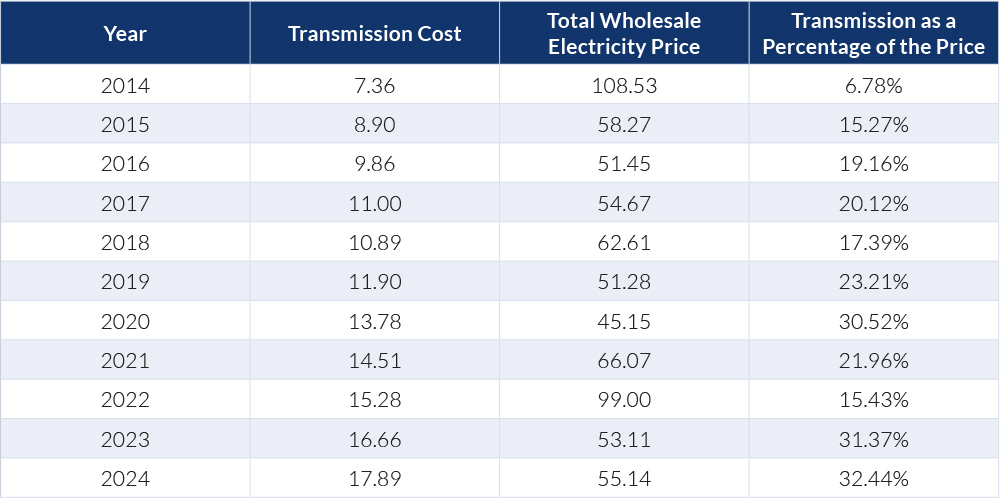
“As transmission costs rise rapidly in PJM, as well as in all other RTOs, it is past time for this commission to fulfill its duty to ensure ‘just and reasonable rates’ under the Federal Power Act by protecting consumers from the costs of FERC’s own policies that are inflating those rapidly rising transmission costs,” Christie wrote. “And to be more specific, as the debate continues over whether to give transmission developers/owners a perpetual [return on equity] adder for joining an RTO, the history recited herein is extremely relevant. History matters.”

SunZia Gets Mixed Decision on Tariff

FERC on April 17 approved the non-rate terms of SunZia Transmission’s proposed transmission owner tariff but sent the tariff’s non-subscriber usage rate to a settlement process and potential hearing (ER25-170). 

Pattern Energy is developing the SunZia transmission line, a 552-mile, 500-kV DC line that will carry wind power from New Mexico into Arizona. The SunZia line, with a planned capacity of 3,021 MW, is expected to begin operations in 2026. 

SunZia plans to join CAISO’s balancing authority area as a subscriber participating transmission owner (PTO). The subscriber PTO model allows transmission developers to join CAISO without the transmission project being selected through CAISO’s transmission planning process.  

Developers of subscriber PTO projects are responsible for funding the transmission project, rather than recovering their transmission revenue requirement through CAISO’s transmission access charge (TAC). FERC approved the subscriber PTO model in March 2024. (See CAISO Wins FERC Approval for Subscriber-funded Tx Plan.) 

In the case of SunZia, the transmission system’s existing capacity has been committed to Pattern subsidiary SunZia Wind, which has entitlements with Salt River Project, Western Area Power Administration and Tucson Electric Power to send its wind power beyond SunZia Transmission’s Pinal Central terminus to Palo Verde, which connects with the CAISO system. 

In the subscriber PTO model, transmission capacity not used by subscribers is available to CAISO market participants. CAISO will pay the subscriber PTO for that usage based on a non-subscriber usage rate (NSUR). 

The NSUR in SunZia’s proposed tariff drew protests from a group of utilities — Pacific Gas and Electric, Southern California Edison, and San Diego Gas & Electric — as well as from a group of six California cities.  

One complaint about SunZia’s proposed NSUR was that it was developed using the Appalachian methodology, which came from a 1987 FERC case involving Appalachian Power Co. As described by FERC, the methodology is “premised on the assumption that a customer using the transmission system for the 16 peak hours of the day should pay the same contribution to fixed costs as a customer who has reserved capacity on a daily basis.” 

The protesters also said SunZia hadn’t provided support for an annual escalation factor of 0.5%. 

While FERC found the escalation factor to be just and reasonable, it shared the protesters’ concerns about use of the Appalachian methodology in calculating the NSUR. 

Under FERC’s order, the chief judge will appoint a settlement judge within 45 days and a settlement conference will be held to try to resolve the NSUR matter. If a settlement can’t be reached, the issue will go to an evidentiary hearing. 

Expedited Action Requested

SunZia initially filed the proposed transmission owner tariff Oct. 21, 2024, and a month later asked for a decision by Dec. 21. 

Citing its obligation to investors, lenders and customers, SunZia Transmission filed a renewed request for expedited treatment March 14, asking FERC to issue an order by April 30. 

“If the commission does not provide expedited action, SunZia Transmission will be forced to divert its resources to an alternative plan that would require it to form its own balancing authority area (“BAA”) rather than joining CAISO’s BAA,” SunZia said in the filing. 

Forming its own BAA would take several months and require “a significant commitment of resources” from SunZia, NERC and WECC, the filing said.