Senators working through the weekend on the One Big Beautiful Bill Act — Republicans’ budget reconciliation bill — delivered renewable energy supporters an unexpected and unpleasant surprise in the form of proposed taxes that likely would stymie completion of projects already in the works.
While the electricity industry expected cuts to energy tax credits, changes to the bill released over the June 28-29 weekend just before it went to the floor added a new tax on energy projects that rely on foreign components.
“With no warning, the Senate has proposed new language that would increase taxes on domestic energy production,” American Clean Power Association CEO Jason Grumet said in a statement. “In what can only be described as ‘midnight dumping,’ the Senate has proposed a punitive tax hike targeting the fastest-growing sectors of our energy industry. It is astounding that the Senate would intentionally raise prices on consumers rather than encouraging economic growth and addressing the affordability crisis facing American households.”
The new taxes would strand hundreds of billions of dollars in investment, threaten energy security and undermine domestic manufacturing, Grumet added.
While changes to energy tax credits were an inevitable part of the legislation, American Council on Renewable Energy CEO Ray Long said, the industry had tried to come to reasonable accommodation that would allow current projects to be completed.
“To be clear, the Senate language effectively takes both wind and solar electric supply off the table, at a time when there is $300 billion of investments underway, and this generation is among the only source of electricity that will help to reduce costs and keep the lights on through the early 2030s,” Long said in a statement. “Along with battery storage and natural gas, wind and solar are the only sources of electricity that can be built in time to meet our increasing thirst for more electricity. Taking these off the table not only increases costs and ensures supply shortages, it also ensures thousands of layoffs and factory closures.”
The U.S. Chamber of Commerce generally supports the bill, but even its chief policy officer, Neil Bradley, posted on X that “taxing energy production is never good policy” and urged Congress to remove the tax from the final bill to avoid higher power prices.
An amendment from Sens. Joni Ernst (R-Iowa), Chuck Grassley (R-Iowa) and Lisa Murkowski (R-Alaska) would moderate some of the language around energy tax credits while still phasing them out for any project that starts construction after 2027.
“This amendment would provide a more workable transition for energy businesses while protecting energy sector jobs and projects currently in the pipeline,” Lisa Jacobson, president of the Business Council for Sustainable Energy, said in a statement. “Clear, predictable and long-term tax policy is essential for market confidence that will get projects deployed quickly and urgently as America faces skyrocketing energy demand. Companies plan with these tax incentives in mind and rely upon them for capital allocation, planning and project commitments — all of which will be jeopardized by abrupt cut offs or additional restrictions.”
Local line congestion is the primary cause of renewable curtailment in California — and the amount is increasing each year, CAISO said during its second-quarter Market Performance and Planning Forum on June 26.
About 80% of curtailment is due to local line congestion in CAISO’s region, rather than oversupply, which sometimes is thought of as the reason why renewable generation is reduced — or curtailed.
“The extent of congestion is widespread, going from major and regional conditions to more local conditions,” CAISO staff said at the forum.
The two primary types of curtailment for solar and wind resources are “Economic – Local,” which is the market dispatch of generators with economic bids to mitigate local congestion, and “Economic – System,” which is the market dispatch of generators with economic bids to mitigate systemwide oversupply.
On May 14, about 27,000 MW of wind and solar was curtailed for “Economic – Local” reasons and about 4,000 MW for “Economic – System” reasons, CAISO staff said. Overall, about 94% of renewable curtailment is for solar resources, and this practice is not unique to specific locations in CAISO’s region, staff said.
In recent years, solar oversupply has been reduced because more solar farms have been built with battery storage facilities nearby — a development approach that allows batteries to more easily charge during hours when solar production is plentiful, CAISO staff said. In general, battery storage resources are helping to flatten the net load in the region, meaning fewer conventional generation resources, such as gas or hydropower, need to be used to meet demand, staff added.
During the forum, ISO staff noted the region’s load has been fully met with renewable resources during intervals on 40 days so far in 2025. Renewables serve load mostly during midday hours when batteries are charging, solar production is high and demand is low.
At the forum, CAISO also reviewed battery performance on March 4 and 5. On March 5, the battery fleet was significantly less charged than normal: 13,800 MWh compared to 35,000 MWh on March 4, requiring gas generation and imports to increase significantly to make up for the lack of battery storage energy available to meet demand, staff said. Battery storage energy was low on March 4 due to higher energy prices during the middle of the day, which minimized how much solar power the batteries soaked up, staff said.
CAISO staff also noted that, during winter months, California’s morning peak is becoming as high as the evening peak. The ISO is studying how the grid can rely on storage resources to meet morning and evening peaks, staff said.
CAISO said certain solar generation forecasting errors increased in 2025 compared with previous years, in part due to growth in solar capacity.
CAISO staff also reviewed the results of a recent change to how battery resources are managed on the grid. The results specifically looked at how batteries performed now that the ISO is accounting for a battery’s state of charge in the upward flexible ramping product program.
Due to this change, the grid operator observed that fewer flexible ramping up (FRU) awards went to storage resources during morning and evening peak times. However, the average resource usage under FRU procurement did not change significantly, said Kun Zhao, CAISO engineer.
“This effort will be a longer-term monitoring project for us, and we’ll definitely give updates,” Zhao said.
The most prolific worry about large load facilities like data centers is how to power them, but the New York Power Authority raised a new concern at the NYISO Budget & Priorities Working Group’s meeting June 24.
When working with a large load customer’s interconnection, NYPA noticed an issue in the ISO tariff that would arise if such a customer ceases operation, creating a “substantial” financial risk to other load-serving entities, the utility’s Tony Abate said.
Because NYISO’s minimum unforced capacity is constant, “any remaining capacity obligation (i.e., the departing customer’s ICAP tag) is spread over all remaining load in the transmission district for the remainder of the capability year,” he said.
Typically, loads that disconnect mid-CY are negligible; but data centers disconnecting would cause a problem, Abate argued. Other LSEs in the district may not have a mechanism to protect themselves from the financial risk associated with the reallocation of UCAP should a major customer leave, he said.
NYISO and NYPA had argued about tariff interpretations until the ISO asked it to come forward with a market project, Abate said.
“We see this as being similar in kind of intent with the … large load interconnection project, which NYISO has prioritized,” Abate said.
The project would entail NYISO investigating the rules that assign or reallocate the UCAP requirement such that if a large load departs a transmission district, the remaining customers are treated equally.
Generation developer JERA Americas also submitted a project proposal to increase transparency in market operations. Specifically, it wants more data regarding system topology, branch characteristics and branch flows. It also wants transmission line ratings and the causes of transmission line outages to be published.
INDIANAPOLIS — The 2025 Mid-America Regulatory Conference tackled themes on meaningful public engagement, nuclear options, bill affordability, and diversity, equity and inclusion (DEI) programs falling out of favor.
Panelists at the June 22-25 conference appeared to agree that focus needs to stay on underserved communities; affordability should be top of mind; and microreactors will make an appearance to handle load growth in the next decade.
Andrew Valainis, an associate at the Regulatory Assistance Project, said people tend to get interested in electricity only when their rates go up.
Valainis said commissions should create public access and engagement plans as part of annual work plans. He also said that “public notice” and “publicity” for meetings are two different things. While a notice is a legal formality, ensuring that at least some of the public is aware of a consequential meeting is a different matter.
Despite more ways than ever for the public to participate in the regulatory process, “people don’t really care,” said Sarah Moskowitz, executive director of the Illinois Citizens Utility Board.
“More often than not, it’s still all of us talking to each other,” Moskowitz said, gesturing to the audience.
She asked regulatory staff to think about why they want public involvement: to “check a box,” generate ideas, get a bead on sentiment, or if they really want public voices to shape the outcome of a proceeding.
“We can’t have this conversation without being honest about what we want from the public,” Moskowitz said. She also said people tend to show up when they are angry. She said if commissions want participation on a “Wednesday night” for an “esoteric, boring” meeting, the public needs to be educated on the regulatory process.
Moskowitz also said it’s “a lot” to expect frontline groups who have been involved previously in commission matters to continue to show up regularly to meetings. She questioned whether commission staff should try to engage the public directly or if public input can be solicited through community-based groups. Either way, she said, regulatory staffs should conduct more community outreach and make webpages easier to navigate with plain language.
Moskowitz said consumer advocate groups “can’t do it all” and said they need some help from the states.
Former MISO COO and President Clair Moeller had a somewhat darker take on public participation. Moeller said he learned throughout his career that there’s a difference between “the public interest and the interested public.”
“People who are educated and have a voice have an outsized influence,” he said, mentioning “well-funded” groups that pay individuals to speak at meetings and submit comments. The regulatory processes seem set up to be confrontational and invite litigation because of their opacity until outcomes are announced. “That’s something I’ve noticed,” he said.
Moeller urged industry players to speak in plain language and not use technical terms. However, he said, “the fact that a lot of these cases end up in litigation” cannot be ignored and has a chilling effect on openness. He recalled he once gave a presentation to answer questions, and the PowerPoint presentation showed up as an exhibit in a state rate case before he could make the drive home.
He urged the industry to create an environment where “it’s safe to answer the question.”
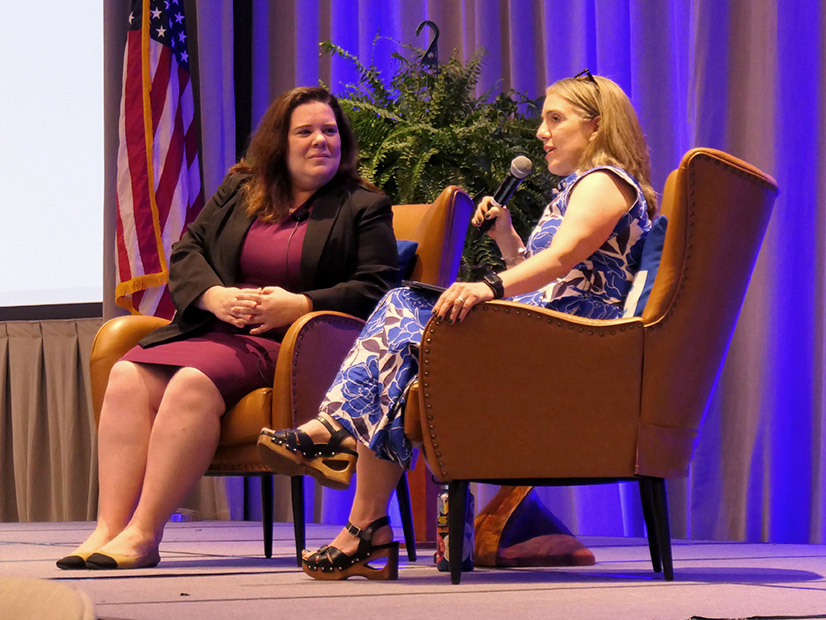
During a “fireside chat,” FERC Commissioner Lindsay See and Indiana Utility Regulatory Commissioner Sarah Freeman both said they have noticed an uptick in legal challenges to commission orders in recent years.
Freeman said she hoped the increased activity is a result of a more informed public. “That matters so much for the outcomes we deliver,” she said.
See said that while clerking for Judge Thomas B. Griffith, of the D.C. Circuit Court of Appeals, she was “struck” by the real-world implications of complex law interpretation. See said she is a huge believer in public service and state service and “genuinely considers” FERC in a partnership with the states.
“I learned a lot about how important the state voice is,” See said of her time as West Virginia Solicitor General.
See said she appreciated the divergence of policy in the midcontinent region and assured attendees that she reads states’ individual comments on FERC filings.
DEI in Actions, not Words
The recent national political backlash to DEI hiring practices and considerations in billing did not deter some panelists from appealing for their continuation.
Michelle Fleurantin, a fellow at the Institute for Policy Integrity think tank at the New York University School of Law, pushed back against the notion that the energy industry exists in a “post-DEI” world. However, she said it’s “scary and challenging” for regulators to conduct targeted outreach for historically disadvantaged ratepayers right now.
Fleurantin said regulators may have to confront a “sticky situation” in which they publicly break with messaging from the federal level and announce intentions to assist burdened communities.
Fleurantin asked regulatory staffs to reflect on the difference between the essential need to hear diverse voices in decision-making and reacting to an “unreasonable chilling effect” from state and federal lawmakers. She said it’s necessary for regulators to consider equity and inclusion in their work to figure out if initiatives “actually work on the ground” and discern whether decisions could risk putting “large swaths” of a population in danger.
“DEI is obviously super politicized, but we need to home in on outcomes,” Fleurantin said.
Fleurantin said continuing to set aside a significant percentage of investment for underserved communities should continue. She said although it’s by now a cliché to recommend people call their elected officials, she advised them to do so to encourage continued funding. However, she allowed that it’s difficult for the public to understand how to become involved in utility decisions. “It’s very opaque; it’s very technical; there’s definitely a high barrier to entry in these spaces.”
Panelists also touched on how DEI works in hiring practices in today’s political climate.
Tim Simon, principal and founder of TAS Strategies and former member of the California Public Utilities Commission, said his firm is advising clients that there is a difference between a federal mandate and state ambitions.
“Once upon a time, they called them ‘states’ rights,’” he said and noted that there’s now a “friction” between the federal government and some states. He noted that Indiana Gov. Mike Braun (R) broadly replaced the DEI efforts in the state with a “merit, excellence and innovation” philosophy.
“I don’t think it’s time to really pull out our bayonets. I think we have more in common,” Simon said. He stressed that “our workforce and our suppliers are an issue of national security” and said skilled workers across the country can fill needs. He said the best candidates can earn jobs while simultaneously satisfying divergent aims from states and the federal government.
“I think we have to get away from the nomenclature and do the work,” he said, adding that regulators have more work to make sure rates are just and reasonable. He said more and more households are being pushed into low-income status, which isn’t sustainable for the utilities’ business model.
“Do we have a diverse pool of candidates every time we have an opening? Yes,” Commonwealth Edison CEO Gil Quiniones said. He said those diverse candidates then are sized up by a diverse hiring committee, with the best candidate selected.
“I would stack up our team against any utility in the country,” he said.
Affordability Concerns
RMI Senior Associate Maria Castillo said research shows U.S. households increasingly are forgoing other expenditures to afford their energy bills.
Oracle Director of Regulatory Affairs Julia Friedman agreed there is an energy affordability crisis. She said when electricity bills rise 30 or 40%, it pushes a lot of customers who never have needed bill assistance into needing help. However, she said utilities’ increases are coinciding with a “stagnation” in customers turning toward assistance programs.
Friedman said according to Oracle’s research, customers say their mortgage or rent payments and utility bills are the household expenses they feel they have the least amount of control over.
“We have to overcome … customers feeling like they have no control over their bills,” Friedman said. She said utilities can provide an online one-stop shop for discounts and time-of-use programs.
Chris Villarreal, an associate fellow at R Street Institute, said a state-funded consumer advocate coupled with state regulators can apply “some amount of pseudo-competitive pressure” on monopoly utilities to keep their rates in check.
Villarreal said customers now have more viable options available for them to supplement their supply, mentioning rooftop and community solar.
“There’s not one place that provides the electricity. Now, there’s one distribution system that delivers the energy,” he said.
Julia Selker, of Grid Strategies’ Working for Advanced Transmission Technologies Coalition, said grid-enhancing technologies can pull more monetary value from the grid and help lower bills.
Selker said if transmission operators were to place a dynamic line rating on a highly congested line, it would pay for itself in a weekend. She said even a “walking” wind speed can cool lines down enough to carry 30% more power.
Selker said at this point, utilities’ hesitancy to deploy grid-enhancing technologies is only “cultural.”
Once Again, Load Forecasts
No industry conference is complete in 2025 without a debate on load growth, and MARC 2025 delivered.
RMI Principal Lauren Shwisberg said load forecasts should be taken “seriously, not literally.”
She said RMI has found that historically, utilities over-forecast their load by about 17%. She said while under-forecasting poses risks to reliability, over-forecasting threatens affordability.
“We’re operating at margin, and we’re doing a pretty darn good job,” MISO Executive Director of Transmission Planning Laura Rauch said. But Rauch said operating without the 25% cushion that existed when she was a “baby engineer” makes grid planning more difficult.
Rauch said the urgency surrounding the need for construction often reminds her of a saying that “the best time to plant a tree was 20 years ago if you want the shade now.”
“The next best time is today,” she said, later adding: “You can’t piecemeal your way to serving a city-size load.”
Even with a co-located generation plan, data center loads largely plan to draw on the system when their own generation is unavailable and inject into the grid when they aren’t fully using their on-site power source, she said. Utilities, data center customers and MISO need to match “desires and incentives with commitments” to weed out speculative announcements.
Google’s Tyler Huebner addressed the possibility that “six to 10 data centers might become two to three.”
“I don’t want to give the idea that we’re just playing around with load forecasts. The reality is that it’s very complicated to build a data center. … It’s not malfeasance, and it’s not [us] trying to be a bad actor in any way,” Huebner said. He said data center developers must consider the most opportune spots to connect, the availability of generation and optimal siting.
MISO Senior Vice President Todd Hillman said the energy industry is learning to be “dynamic and disruptive” with new technology avenues amid load pressure. He noted that about 97% of MISO’s interconnection queue is solar, wind and battery storage. But he also said MISO is lacking about 31 GW in new generation projects that should have been online by now but are stalled.
“Imagine 31 more gigawatts today. The summer is still going to be hot, but it’s going to be a different story in terms of what we can do,” Hillman said. He said the holdup can be traced to five causes: “People, parts, permitting, politics and pricing issues.”
“Our industry represents 5% of the economy, but it’s the first 5% of the economy,” ITC Holdings CEO Linda Apsey said.
Apsey noted that the American Society of Civil Engineers rated U.S. energy infrastructure a “D+,” which isn’t going to cut it for a grid that will see rising demand from data centers and manufacturing onshoring. Apsey said the score is the same as 20 years ago, despite pains since then to refurbish and build out the aging grid.
“Time is of the essence, and reliability and resiliency is of the utmost importance,” she said.
Apsey said the last time the country saw material load growth was in the 1970s when a wider selection of home appliances and home air conditioning took off.
She said utilities don’t have a choice but to accept the economic opportunity that data centers present or risk losing them to other states or regions. “For them, it’s a race. They have to be first to market.”
The Nuclear Option
“I don’t think you can walk into a room and not hear about data center growth,” Constellation Energy Vice President of Strategy and Growth Colleen Wright said.
Wright said there’s a “perfect storm” of conditions that can help get new nuclear built to replace baseload generation.
“I don’t think that window is open forever,” she added.
Timothy Grunloh, principal research scientist at the University of Illinois Urbana-Champaign, said he hopes the university’s plans for a research reactor can show that microreactors “can be built with a predictable schedule; a predictable budget.”
Grunloh is helping to develop a modular microreactor to figure out whether permitting, siting, safety reviews, supply chain or regulatory processes present the biggest barrier to building new nuclear generation. The demonstration reactor will rely on tri-structural isotropic fuel particles, which consist of uranium-based kernels that use graphite as a moderator.
A decade ago, he said he would have characterized the Nuclear Regulatory Commission as a “bogeyman” that tries to “trip up” developers. However, he said his experience working with the NRC is the opposite and said staff are all about, “How do we get you to ‘yes’ safely?”
Grunloh said so far, his team has found that the supply chain presents the biggest challenge.
“Beyond that, all roads go through public perception,” he said. Grunloh said the public’s recent softening toward nuclear energy thus far has been hypothetical. He said that positivity may change once some reactors become reality. Grunloh added that small reactors could be ready in commercial use sometime around 2029.
In a later talk, Gov. Braun said he couldn’t think of anything else “tested to the degree” as nuclear has been to provide future baseload power. He said he thinks U.S. Energy Secretary Chris Wright and the Trump administration should be able to clear regulatory obstacles to scale up new nuclear quickly. In response to an audience question, Braun said he’s open to experimenting with small modular reactors at the state’s military sites.
Braun said he viewed himself as a “conservationist” but in a “practical” way. He said he saw an ongoing spot for coal in Indiana’s energy mix until enough batteries or nuclear generation can be installed.
SPP has secured $150 million in financing and entered the second phase of development for its day-ahead market Markets+, the grid operator announced June 30.
Arkansas-based Simmons Bank provided the loan, which is collateralized by eight Markets+ funders, allowing SPP to begin developing “critical systems, processes and operations required to conduct market trials,” according to the announcement.
“Securing financing for phase two of Markets+ is a pivotal step forward,” Carrie Simpson, vice president of markets at SPP, said in a statement. “It allows SPP to continue developing a more efficient, transparent and reliable energy market for our western stakeholders and their customers.”
With the announcement, SPP has entered the second phase of market development. The grid operator already has started its requirement planning and Markets+ training for stakeholders. Stakeholder onboarding processes, including network and commercial modeling, are scheduled to begin Aug. 1, 2025, while connectivity and data exchange testing is slated for late 2026. SPP plans to launch Markets+ on Oct. 1, 2027, according to a timeline posted on SPP’s website.
According to the June 30 news release, the eight Western entities that have signed the agreement include Arizona Public Service, Bonneville Power Administration, Chelan County Public Utility District (PUD), City of Tacoma, Grant County PUD, Powerex, Salt River Project and Tucson Electric Power. (See SPP Secures Funding to Begin Markets+ Phase 2.)
The agreement requires the entities to provide collateral to SPP’s lender to support the financing the RTO will use to develop Markets+ during the implementation phase. The collateral is equal to the amount of the entities’ Phase 2 obligations.
The recovery of the costs to repay the implementation financing “will be incorporated into the rates charged in the Markets+,” according to a frequently asked questions document posted on SPP’s website.
Agency spokesperson Nick Quinata told RTO Insider that BPA’s commitment for Phase 2 will not exceed $36 million based on the current number of funding parties.
“If additional parties join Phase 2, that would reduce BPA’s share of Phase 2 development costs and, thus, total liability,” Quinata said. “All entities participating in Phase 2 will have these costs recovered through transactional fees once they begin market participation.”
Meanwhile, Grant PUD spokesperson Christine Pratt said the utility acquired a letter of credit for about $4.2 million to contribute to Phase 2. The credit will assist with “the upfront expenses needed for market startup. This includes computer systems — hardware and software — and personnel.”
Grant PUD noted that it did not have to contribute any funds for Phase 2 but was required to provide a letter of credit in case the market failed. Under that scenario, the credit will be called for the amount needed by SPP to recover any costs incurred in standing up the market.
“We’re preparing for Markets+ trading by evaluating our own needs for personnel and equipment,” Pratt said. “Our basic interests or priorities are for the market to succeed. These priorities will likely become more specific as collaboration continues, but for now, a successful market is the goal.”
Chelan PUD spokesperson Rachel Hansen said the utility contributed about $820,000 in collateral.
Chelan now “will focus on preparing for market readiness and has not chosen its go-live target date,” Hansen said.
SPP said in the news release that stakeholders are signing additional Phase 2 funding and participation agreements “based on their entities’ respective sector and role in the market.”
ERCOT 4.0 Shapes Path Forward for the Grid Operator
ERCOT CEO Pablo Vegas has gone public with the grid operator’s internal terminology that is shaping the market’s path forward, defining it for his Board of Directors and stakeholders.
“This represents more than just the branding of current activities that we have underway,” Vegas told the board during its June 23-24 meeting. “It really represents a distinct new phase in the ERCOT market. It also provides a strategic lens to look at the priorities and the initiatives that we’re going to be investing in to make sure that we continue to deliver on our mission, which is getting more complex and more dynamic every year.”
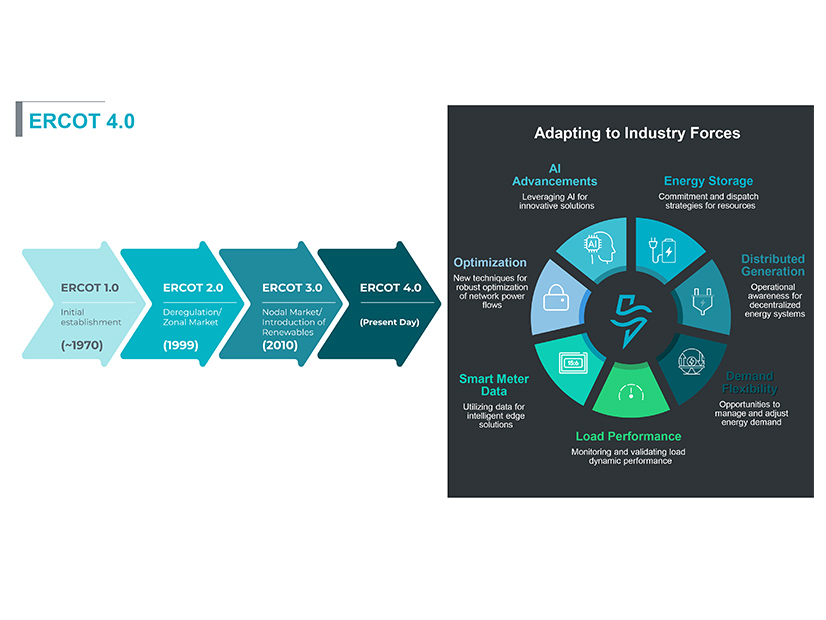
Labeled “ERCOT 4.0,” the construct builds on previous versions of the grid operator’s market and its transitions: 1.0 (original formation in the 1970s), 2.0 (deregulated competitive markets and the zonal market in 1999) and 3.0 (the nodal market in 2010).
“Each of these transitions was driven by a combination of either technology changes, regulatory changes [or] market-driven forces. ERCOT 4.0 reflects this transformation that’s underway right now,” Vegas said.
He said ERCOT 4.0 is defined by the exponential growth in system complexity and the convergence of three major drivers: the rapidly changing resource mix, significant and unpredictable load growth, and technology-driven operational changes, such as artificial intelligence advances and high-frequency data access.
“This is changing how we forecast. This is changing how we operate. This is changing how we plan,” Vegas said. “The convergence of these three things … are the core underpinnings of what ERCOT 4.0 looks like for the next generation of ERCOT. This is a new paradigm.”
ERCOT’s transition from 1.0 to 4.0 | ERCOT
Vegas said the grid operator will have to evolve its planning assumptions “to account for the uncertainty and the variability that we’re seeing across both supply and demand.” He said grid operations will have to become more adaptive and market mechanisms will have to be re-evaluated to ensure “those signals support long-term system reliability as well as short-term market efficiencies.”
“Probably most critically of all, our workforce is going to have to be equipped to lead in a system that is increasingly software-defined, data-rich and constantly changing,” Vegas said, noting the grid operator is investing in professional development and other tools so the team can “operate and lead in this new reality.”
Staff are focused on innovation to transform the organization and maintain operational excellence in a more complex system.
“It’s a huge opportunity to reinforce our leadership in the energy economy here in Texas,” Vegas said.
He closed his comments by tying ERCOT’s 2025 Innovation Summit in May to ERCOT 4.0. The summit drew more than 450 attendees, with more than 400 other people livestreaming the event.
“It was an opportunity to really showcase innovation efforts, not only within ERCOT, but [also] what’s happening in transformations around the world and around the United States, bringing people together to talk about the most complex issues that we’re dealing with, learning from each other, establishing networks of communication that are going to be helpful as we continue to work on solving these problems together.”
Board Approves $1.07B 2-year Budget
The board approved a two-year budget of $485 million for 2026 and $585 million for 2027, totaling $1.07 billion. However, the budget includes a system administrative fee of 61 cents/MWh, down 2 cents from the current fee.
Both changes go into effect in January 2026.
Board Chair Bill Flores | ERCOT
Board Chair Bill Flores, who also chairs the Finance and Audit Committee, acknowledged that the biennial budgets are “substantial increases from where we are today.”
“But as we all recognize,” he said, “because of the mandates promulgated by the legislature in the last two legislative sessions, as well as the increasing complexity and the dynamic nature of this market, as well as the focus on reliability, the cost of running the organization is higher than it was before.”
He said the budget includes “appropriate” funds and staff to address ERCOT’s strategic objectives and comply with the financial corporate standard and associated financial performance measures. The budget also funds the Independent Market Monitor and compliance with Texas Public Utility Regulatory Act and NERC obligations.
Flores said the budget assumes the administration fee can be kept flat for up to six years.
Matt Mereness, senior director of market operations and implementation, said ERCOT has received the final deliveries of vendor code and completed two operating day end-to-end tests of systems and integration. He said the test environment was deployed weeks ahead of its May 5 start date, and a first round of defects was fixed and redeployed later in the month.
After establishing connectivity with market participants and testing submissions, the RTC+B project will begin parallel production trials July 7. Mereness said market trials will focus on frequency control tests in the September-October time frame.
“All the participants will put in reasonable offers that represent [a percentage] of their costs, and we’ll start [dispatching]. That’ll be the real-time co-optimization,” Mereness said. “They’ll have [ancillary service] offers in, and ERCOT will start to print prices and signal where [participants] should go, but no one will go there. Here’s the solution, but don’t follow it.”
The project is set to go live Dec. 5.
Staff Responds to IMM Report
ERCOT staff responded to the IMM’s recent State of the Market report for 2024, saying, “Overall, it’s a very good and well-written report.”
“There are definitely some things we agree with and some other things that we may be in disagreement,” said Keith Collins, vice president of commercial operations.
He said staff are aligned with the IMM’s comments on improvements to ERCOT contingency reserve service (ECRS), which reduced the product’s average price from $76.77/MWh to $9.62/MWh, and the effective load-carrying capability in the grid operator’s Capacity, Demand and Reserve report.
“There are a few recommendations or items that the IMM pointed out that we believe we’ve already addressed,” Collins said.
Responding to the IMM’s recommendation that ECRS include a forecast trigger, he said ERCOT has a three-part trigger for the product. Collins said a trigger that looks forward at the net load ramp addresses that need.
In its report, the IMM continued to recommend that the grid operator reconsider its policies for procuring and deploying ECRS. (See ERCOT ESRs, Solar Production Lessen AS Costs.)
ERCOT also disagreed with the Monitor over non-spinning reserves’ duration. The grid operator wants four hours, while the IMM favors a one-hour duration.
Two Tx Projects Approved
The board approved a pair of Oncor transmission projects in West Texas with combined total costs of $974 million.
The $855 million Delaware Basin Stage 5 project addresses reliability concerns and accommodates “significant and rapid load growth” in the petroleum-rich area. Oncor will build 220 miles of transmission lines in creating an import path to serve load now that the basin’s peak demand is greater than a 5,422-MW threshold. (See “Oncor $855M Project Endorsed,” ERCOT’s TAC Extends Duration of Ancillary Services.)
The $119 million, 138-kV Tredway Switch and 138-kV Expanse-to-Tredway project entails upgrading 29 miles of lines and updating other facilities and infrastructure to address reliability issues. Oncor expects to finish the project in December. (See “TAC Endorses $119M Oncor Project,” ERCOT’s TAC Endorses Congestion Management Plan.)
Both projects were selected by ERCOT’s Regional Planning Group from other alternatives. As Tier 1 projects with costs exceeding $100 million, they require board approval.
With little discussion, the board also approved:
the third phase of the Aggregate Distributed Energy Resource (ADER) pilot project, which enables a new participation model for resources providing ancillary services but that are not in the five-minute real-time energy market. The first two phases limited total registered capacity of all ADERs to 80 MW for energy and 40 MW for non-spin and ECRS; staff proposed increasing the limits to 160 MW and 80 MW, respectively, for Phase 3. (See “TAC Endorses ADER Doc,” ERCOT’s TAC Extends Duration of Ancillary Services.)
a real-time market correction of $81,858 to market participants after a routine software update changed an energy management system setting to its default value, causing a stricter limit on a generic transmission constraint (GTC). That led to the activation of a post-contingency overload on the GTC, affecting dispatch optimization that resulted in a maximum shadow price of $5,251/MWh over March 28-29. The first operating day was corrected within a two-day business deadline, but not the second day. The maximum absolute value impact to counter-parties was $99,580.
Board Loses 2 More Directors
Chair Flores opened the meeting by announcing that the two most recent independent directors, Alex Hernandez and Sig Cornelius, have resigned to pursue “new opportunities” in the ERCOT market. State law requires the 12-person board’s eight independent directors to not have fiduciary duty or assets in the grid operator’s territory.
That leaves the board with three vacancies. Bob Flexon resigned in December 2024.
Flores said the board’s selection committee is working to fill the three vacant seats. He said the goal is to have them in place by the board’s September meeting.
Protocol Changes
The board approved a nodal protocol revision request (NPRR1282) and its associated Nodal Operating Guide revision request (NOGRR277) that provides longer-duration ancillary services and state-of-charge (SOC) parameters in advance of the RTC+B project’s deployment in December.
The NPRR updates duration requirements to 30 minutes for regulation service and responsive reserve service and one hour for ECRS. It also revises reliability unit commitment studies’ requirement to one hour for all ancillary services, excluding fast frequency response. (See ERCOT’s TAC Extends Duration of Ancillary Services.)
ERCOT supported the measure, saying there is a need for a four-hour ancillary service to cover periods when deploying non-spin. Dan Woodfin, vice president of system operations, said staff analysis revealed that when non-spin is deployed, “we’re basically having to cover the gap because of either an extended forecast error or units that trip offline.”
“We can deploy reserves, but then we need to last longer until we can get the next generation committed to cover the gap or until the net load goes down,” he said.
ERCOT is also developing dispatchable reliability reserve service as a four-hour AS product to cover risks.
Jupiter Power’s Caitlin Smith, who chairs the Technical Advisory Committee, said the change conflates “duration” with SOC, “a misapplication of fundamental [energy storage resource] concepts [that] results in a drastic departure from current ERCOT standards regarding duration and state of charge.”
The board agreed with ERCOT’s commitment to revisit the NPRR once RTC+B becomes part of the market.
The directors also endorsed NPRR1229, which creates a process to compensate market participants when a constrained management plan or ERCOT-directed switching instruction trips a generator that otherwise would have remained online. (See ERCOT’s TAC Endorses Congestion Management Plan.)
The consent agenda of unopposed protocol changes at TAC included five additional NPRRs, two NOGRRs, an Other Binding Document (OBDRR), an addition to the Planning Guide (PGRR) and a system change request (SCR) that:
NPRR1226: directs ERCOT to prepare and publish estimated demand response data showing aggregated state-estimated load points selected by the grid operator. Loads selected for the report will be based on periodically updated offline analysis of the frequency and magnitude of reductions observed in historical state estimator load data that are associated with LMPs, ERCOT-wide conservation appeals or other market signals.
NPRR1238 and NOGRR265: introduces a new early curtailment load (ECL) category and establishes a process allowing loads to operate as an ECL so they can be accounted for differently in load-shed tables.
NPRR1267: requires a large-load interconnection status report be published. The report won’t define “large load,” leaving that to NPRR1234 (Interconnection Requirements for Large Loads and Modeling Standards for Loads 25 MW or Greater). Confidential customer information on large loads will be aggregated.
NPRR1271: allows Mexico’s state-owned electric utility, the Federal Electricity Commission (CFE), to opt out of a requirement to designate a user security administrator and receive digital certificates. CFE is registered with ERCOT as a transmission and/or distribution service provider, a load-serving entity and a resource entity.
NOGRR275: aligns the guide with protocol changes to eliminate scheduling center requirements for qualified scheduling entities that are not wide-area network participants.
OBDRR054: creates a process by which transmission and/or distribution service providers will require market participants to successfully test retail transactions before their data universal numbering system is activated in a TDSP’s production system.
PGRR125: adds language to that guide that allows an interconnecting entity or property owner to demonstrate compliance under the Lone Star Infrastructure Protection Act should it have a subsidiary or affiliate that falls under the act’s citizenship or headquarters criteria. The subsidiary must not have direct or remote access to or control of the project, the project’s real property, resource integration and ongoing operations, the market information system, other ERCOT systems or any confidential data from the systems.
SCR830: implements a machine-to-machine client credentials authentication flow using OAuth 2.0, allowing for certain read-only endpoints of the GINR Rest Application Programming Interface to be exposed for authorized use.
IESO will begin opening some transmission projects to competition under a hybrid rate model, with cost-of-service rates following an initial 10-year contract.
IESO, which has about 1,500 kilometers of new transmission lines planned or under development, says competition will lower costs and produce innovation.
The first projects eligible for competition may be identified as soon as the fourth quarter of 2025 when recommendations from the South and Central Bulk Study are due. The grid operator also has two other major transmission projects underway, with recommendations from the North of Sudbury Bulk Study and Eastern Ontario Bulk Study expected in 2026.
Once projects suitable for competition are identified by IESO, the province will issue a directive to formally launch competitive procurements.
Incumbent Projects
But only some projects will be open for competition.
“Not every project will be suitable for transmission procurement,” Denise Zhong, IESO senior manager for resource adequacy and sector evolution, told more than 70 attendees at a June 25 webinar outlining the ISO’s Transmitter Selection Framework Registry (TSF-R). “In fact, the majority of the projects that will be recommended through transmission planning will likely go to an incumbent transmitter. But we’re looking at a very small subset of projects that will meet certain eligibility considerations.”
IESO’s Denise Zhong | IESO
The registry will allow prospective transmission builders to prequalify for upcoming procurements. Prequalifying bidders will cut procurement timelines by more than six months compared to issuing separate Requests for Qualifications for each procurement, IESO said. The Ministry of Energy and Mines’ Integrated Energy Plan directed IESO to launch the registry by Aug. 15.
The plan listed three major projects that have been assigned to incumbent Hydro One.
To expand the province’s north-south infrastructure, IESO is backing a Barrie-to-Sudbury 500-kV single circuit line due in service in 2032 and has recommended beginning early development work on a second 500-kV line along the same route.
“IESO has determined that these projects are not suitable for a competitive procurement process given their urgent need,” the Ministry said. Thus, the government will direct the Ontario Energy Board to designate Hydro One to develop the first line and to begin development work on the second.
Another project to strengthen the north-south “backbone,” reconductoring the 230-kV Orangeville-to-Barrie line, also will be awarded to Hydro One, because it owns the line.
IESO also has rejected competition for a new double-circuit 500-kV line from Bowmanville Switching Station to an existing 500-kV station in the Greater Toronto Area, again selecting Hydro One.
Rate Model
IESO said it has decided to use a “partial contracting” model in which the winning bidder will receive a contract covering all costs of financing, designing, building, operating and maintaining the line for the first 10 years of its commercial operation. In year 11, it will transition to traditional rate regulation under the OEB.
“To support a smooth trend in annual payments and consistent payments over the life of the asset,” the ISO said it will limit the year 11 payments to a percentage increase over year 10.
“So, for example, the contract may limit the filing amount for year 11 to be within 5% of the payment that was made through the IESO contract in year 10,” Nicole Kosonen, senior adviser for capacity integration and development, said during the webinar.
By holding developers to proposal costs and schedules, the partial contracting approach will protect ratepayers while working within the existing rate regulation framework, the grid operator said.
It rejected both a “selection only” option, in which it identifies a developer and immediately enters rate regulation under the OEB, and a “full contracting” model, in which the ISO signs a contract with the developer for the life of the transmission asset.
IESO said ratepayers will assume the risk of project scope, changes in law and early termination while developers would assume risks regarding routing, land acquisition, design, construction, operations and financing. The two parties will share risks of Force Majeure, tariffs and inflation, it said.
Indigenous Participation
To encourage Indigenous communities to participate in TSF projects impacting them, the rules allow the communities to engage with multiple bidders, barring developers from signing exclusivity arrangements.
IESO also has proposed that bidders submit an Indigenous Engagement and Participation Plan to identify the “engagement approach and participation opportunities” for impacted Indigenous communities.
“Those that have a higher overall level of Indigenous participation may be scored higher in the IESO’s proposal evaluation,” the ISO said.
Experience Requirements
To join the TSF-R, prospective bidders must meet requirements for experience and financial capacity.
To balance the desire for competition with the need to ensure developers have appropriate technical capabilities, the ISO said it will allow potential bidders to demonstrate their capabilities via the experience of affiliated companies.
The proposed rules require the applicant or an affiliate to have built at least two transmission lines of at least 200 kV and 30 kilometers within the past 20 years.
FortisOntario, which owns three local distribution companies, was among those calling for crediting companies for their affiliates’ experience. In comments submitted in April, the company noted that it is a subsidiary of Fortis, which owns 10 regulated utilities, including ITC, the largest independent transmission company in the U.S. “Without recognizing the value of decentralized companies, the draft rules risk creating barriers for parent companies that, despite lacking a transmission license, possess the scale, expertise and established presence in Ontario needed to deliver reliable and cost-effective transmission solutions,” it said.
Feedback to Date
IESO said it had received “broad support” from stakeholders for its proposed TSF-R program rules, although there were requests for greater clarity on efforts to encourage Indigenous involvement.
FortisOntario urged the ISO to open competition for projects above 115 kV, saying the competitive plan “currently appears focused on projects above 200 kV.”
Some stakeholders requested more clarity on credit rating requirements for smaller or privately held firms. Hydro One said IESO should boost the minimum net worth of proponents not already licensed by OEB as a transmission company to $500 million from its proposed $200 million, noting that the ISO has said the minimum project size for the TSF is $100 million.
“Taking on a project that would involve more than half of the net worth of the entire company could create significant risk for Ontario ratepayers if the project is beset with large budget overruns,” Hydro One said.
Next Steps
IESO still has to define the criteria that will be used to evaluate competing proposals, including bid parameters and cost caps.
The grid operator said it seeks feedback on whether its proposed bid structure and risk allocation “strike[s] the right balance between protecting ratepayers while providing an attractive proposition to transmitters and financiers” and how it should evaluate bidders’ proposals for providing “meaningful Indigenous economic participation and engagement.”
It also asked for ways to reduce bidders’ risk premiums and whether it should use a “highly prescriptive approach” to cost-containment or leave it open for bidders to include in their proposals.
Written feedback or questions are due to engagement@ieso.ca by July 16. The IESO plans to compile answers in an FAQ document.
IESO plans another engagement session in September to discuss its draft term sheet and additional RFP and contract design details.
The Oregon Public Utility Commission has approved wildfire mitigation plans proposed by the state’s three investor-owned utilities and supported staff recommendations that the commission said the utilities should implement in the future.
The three commissioners unanimously signed off on wildfire mitigation plans for Portland General Electric, Pacific Power and Idaho Power.
PUC Chair Letha Tawney noted that when discussing wildfire in the utility space, there usually are two intertwined questions: Are the utilities meeting the requirements of the law, and are the utilities finding the most cost-efficient way to reduce wildfire risk?
“Today, we’re not talking about the cost,” Tawney said at the PUC’s June 26 meeting. “Today, we’re talking about whether the utilities are appropriately evaluating the risk [and] responding to that evaluation and what that evaluation tells them.”
“I still expect the utilities to provide staff with all the evidence that these spending choices are prudent and reasonable,” Tawney added.
The PUC enlisted Climate Wildfire and Energy Strategies (CWE) to independently evaluate the IOUs’ wildfire mitigation plans. PUC staff also performed their own assessments of the plans. The PUC and CWE largely reached the same conclusions on whether the utilities had followed through on last year’s recommendations. However, there were some differences.
For example, even though the PUC found that Pacific Power, a division of PacifiCorp, had “partially met” recommendations related to ignition risk driver investigations, short-term fuels and assessment of vegetation actions and timing, CWE concluded the utility “did not meet” the recommendations.
Heidi Caswell, division administrator of safety, reliability and security at the PUC, said CWE’s analysis was “constrained” to a limited time frame and the specific docket of each utility, while “staff’s view could be informed by other dockets.”
As for PGE and Idaho Power, CWE and the PUC agreed the two utilities either had met or partly met staff recommendations.
“Our wildfire mitigation plan, which is approved by the Oregon Public Utility Commission, reflects the company’s ongoing efforts and substantial investments to protect the communities we serve from the risk of wildfire,” Simon Gutierrez, a spokesperson for PacifiCorp, told RTO Insider in an email. “The company is committed to working closely with policymakers and regulators to prevent wildfires before they happen.”
Recommendations
The PUC provided three recommendations to Pacific Power:
Outline how it plans to incorporate future land use and climate changes to demonstrate how Pacific Power’s “long-term plans align with the future state for those areas.” The PUC noted California has similar requirements, saying some of the processes Pacific Power uses in California can be shared in Oregon.
Provide wildfire risk scores for circuit segments.
Justify use of vendor project management to reduce costs to deliver covered conductor projects.
PGE received one recommendation:
Explain actions to address outage data quality, including why PGE uses a record set of only six years and provides information only on vegetation and equipment failure.
Kellie Cloud, PGE senior director of wildfire and operational compliance, told RTO Insider the utility is “pleased” with the approval and the “acknowledgment of the progress in our wildfire mitigation planning process.”
“We look forward to working with commission staff, stakeholders and other utilities to continue to advance our mitigation plans,” Cloud said. “PGE has been executing mitigations in advance of fire season; we are now actively monitoring and managing risks in the active season.”
Idaho Power received three recommendations:
Provide a timeline for when it will model wildfire risk for circuit segments and wildfire risk zones.
Clarify its analysis of its battery program and whether it aims to pursue a rebate program for medically vulnerable customers in Oregon. If not, the utility should explain how those customers are supported during public safety power shutoffs and other events.
Share its vegetation risk index with other IOUs.
Jordan Rodriguez, spokesperson for Idaho Power, told RTO Insider the utility appreciates the PUC’s approval of the plan. Rodriguez added that the wildfire plan details how the utility uses “wildfire risk modeling tools, extensive system hardening efforts and growth in coordination with community partners.”
Future Plans
The utilities presented their plans in February and touted various grid-hardening efforts under way, such as undergrounding of lines, installment of more powerful weather stations, fire-proofing utility poles and improved forecasting models. (See Oregon Utilities Enter 2025 With Ambitious Wildfire Plans.)
During the meeting June 26, CWE consultant Melissa Semcer said communities on the West Coast are facing the threat of “catastrophic wildfires,” whether from ignition by utility equipment or another source. Semcer argued the future of wildfire prevention should not just focus on undergrounding or other traditional mitigation efforts.
She posed the question of whether ratepayer dollars can be used for land management outside of utilities’ right of way “or to potentially invest into home hardening.”
“And might that actually be less expensive and negate the need to have some of those larger investments of undergrounding?” Semcer said. “And I think that’s really the bleeding edge of where this conversation is across the West at this point, is to maybe move out of our boxes and our silos that we’ve all … been in and try to come up with what is the comprehensive solution, because it is such a large amount of money.”
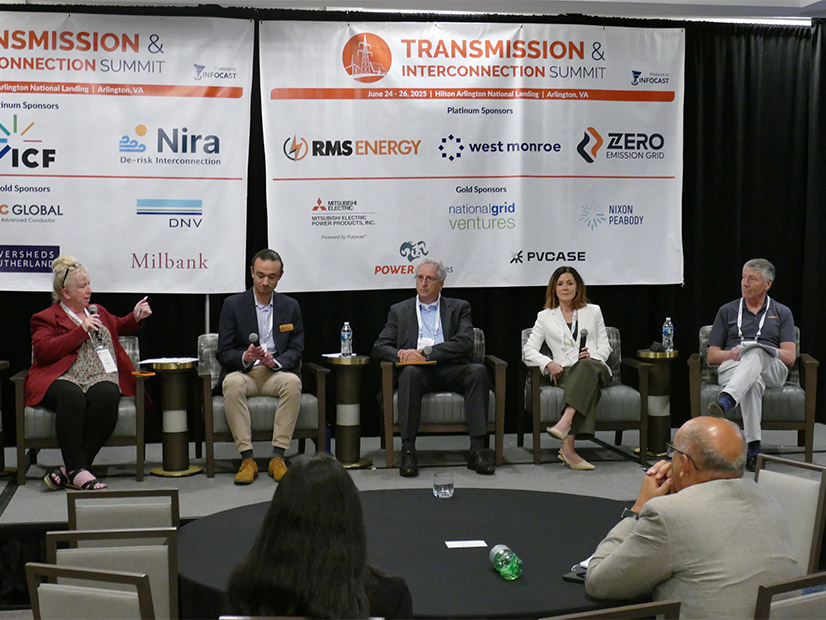
ARLINGTON, Va. — While much of the energy industry is focused on the latest news on the reconciliation budget bill and its cuts to tax credits, the transmission sector is not — because it was left out of the Inflation Reduction Act.
“This, to me, was a flaw with the original Inflation Reduction Act,” Grid Strategies President Rob Gramlich said at Infocast’s Transmission and Interconnection Summit on June 25. “They really didn’t do much transmission; it was sort of overlooked.”
The Democrats passed the IRA using reconciliation, a process that allows the Senate to vote on items related to the budget without the threat of a filibuster, in 2022. With control of the White House and Congress, Republicans now are using the same process for their so-called One Big Beautiful Bill that includes cuts to many tax credits and programs from the IRA.
In between these two major bills, bipartisan permitting legislation did make it out of the Senate Energy and Natural Resources Committee in 2024 but never was brought to the floor. Permitting legislation should get another chance, but Gramlich said it will have to wait.
“Basically, you can’t do big permitting reform in a reconciliation/budget bill,” Gramlich said. “But they did have to try, because if you’re a Republican member of Congress, why would you not try that first and see what you can get that way? And also, why would you not try to do everything you can try to do with executive action?”
The budget bill is likely to take up most of Congress’ time over the next month, but once it is back in session this fall, Gramlich expects permitting will be taken up again.
Energy Secretary Chris Wright has said he hoped transmission could get similar treatment to natural gas pipelines, which shows some in the Trump administration support changes, MWR Strategies President Michael McKenna said. Support for changing permitting laws is growing on both sides of the aisle.
“The Republicans are going to find it much easier to live with if President Trump is still president, so I think the sweet spot is going to be starting in about eight or 10 months and going until the end of the Trump presidency,” McKenna said.
While the industry waits to see if Congress can pass a permitting bill, it is implementing major changes from FERC: Order 1920 on planning and cost allocation, and Order 2023 on interconnection queues.
Some of the regions already have rules in place that have led to significant regional transmission being built under the regimes in compliance with Order 1000. MISO and SPP have different markets, but both have transmission planning processes with significant buy-in from the states in their two large footprints, ITC Holdings Director of Federal Affairs Devin McMackin said.
“So hopefully, for us at least, that means it’s not going to be a particularly arduous process to implement the order, and we’ll kind of basically see some repetition of the continuous planning efforts that we already have,” McMackin said. “So, I’m fairly optimistic that the concepts that underlie 1920 in many cases are already in place.”
The cluster study approach in Order 2023 already was adopted in some markets before FERC started working on the rule, and more utilities adopted it while the order was pending, Gramlich said.
“But that doesn’t mean it didn’t have an impact: That three-year process really led everybody to that outcome, and that’s helpful,” Gramlich said. “It doesn’t mean that’s the end of the reforms or the process either. It just means that it’s kind of herding all the cats in that general direction.”
Regional Differences
FERC left certain details in implementing the orders up to the different regions, so their choices will have an impact on how much transmission planning is truly reformed by its recent orders, Zero-Emission Grid CEO Mike Tabrizi said. Sometimes transmission planning can become a standardized process where not much gets done, especially when it comes to meeting the minimum of maintaining compliance with NERC standards, he said.
“What happens is, every year they go through this compliance process because they are so overloaded with so many other tasks that they have on their hand,” Tabrizi said. “The goal is not to actually plan the system; the goal is actually to check the boxes for the compliance.”
Grid United President Kris Zadlo said Order 1920 did not seem like a big deal to him the first time he read it because it was standard operating practice when he joined the industry during a time of high load growth.
“Over the last 25 years, we’ve had essentially flat load growth in the United States, and it allowed us to be essentially reactive,” Zadlo said. “Like I would say, for the last two decades, we haven’t been doing transmission planning. Transmission planning means you’re planning for the future. You’re not reacting.”
The industry had seen such huge load growth in the 1960s and ’70s that it overbuilt the system, and that allowed planners to be reactive for longer than the lack of load growth on its own, Zadlo said.
“We didn’t inherit an industry that had strong regional institutions that were charged with infrastructure planning,” Gramlich said. “RTOs, in any case, are 25 years old. That wasn’t their original focus for the reasons we’ve described. It was more about markets.”
FERC’s regional transmission plan applies to RTO footprints, but it also applies to utilities outside of them that have formed regions like WestConnect, which covers parts of the Southwest. While it has held meetings over the years, hasn’t selected a transmission project for the entire region, New Mexico Public Regulation Commissioner Gabriel Aguilera said.
“They’ve never selected a regional transmission project since its inception in” 2002, Aguilera said. “And I don’t know if that is a little bit shocking to any of you; it’s a little bit shocking to me that there were no regional transmission needs identified. And, so, there is some work to do there, clearly.”
Order 1920 has caused states in the West to look at regional transmission planning again, with more diverse stakeholders, including state regulators, getting involved than in the WestConnect process, which Aguilera said has been dominated by incumbent utilities and some independent transmission developers.
Every region of the country could use more transmission capacity for various reasons, and the West is no different, though things have been changing significantly there in recent years, said former FERC Chair Richard Glick, now a consultant at GQ New Energy Strategies.
The Northwest used to think it could rely on cheap and plentiful hydropower, but recent years have made clear that it needs more access to imports from other parts of the Western Interconnection, Glick said.
“The Southwest, for instance, could bring in more power from the Northwest,” Glick said. “The problem is that the grid in the West is becoming increasingly congested. It’s more difficult to engage in those transactions, certainly at an economic level. So, there certainly is a growing recognition that transmission is needed.”
Order 1920 requires more anticipatory planning, so that should force all regions to improve their actual planning processes, but it’s an open question on how much regional transmission will get built, Glick said. The region faces unique issues like huge, non-FERC-jurisdictional utilities that have to opt into planning processes and cost allocation.
“Transmission planning regions cannot plan for the needs of the non-jurisdictional utilities unless those non-jurisdictional utilities volunteer to pay whatever is allocated in the cost allocation process,” Glick said. “And the odds of that happening are obviously very small.”
Load Growth
The return of load growth, caused by very high computing demand from data centers for artificial intelligence and other applications, was not known to FERC when Glick launched the rulemaking process that led to Order 1920, but it has changed the discussion around its implementation.
ELCON CEO Karen Onaran represents traditional industrial customers who also contribute to demand growth, but the hyperscale data centers have demoted her members from large load to “middle load,” she joked. A key policy goal of manufacturers is to keep the price of energy down because that makes their products more competitive.
“Over the past year [to] year-and-a-half, one of my major focuses is going around the country and talking to state-level manufacturers … who have been fighting against transmission for a long, long time and changing that narrative of it to say, ‘Yes, transmission is expensive, but not having transmission is even more expensive,’” Onaran said.
Order 1920’s shift to 20-year plans instead of 10 is well suited to the return to demand growth, Con Edison Transmission CEO Stuart Nachmias said.
“I think 10 years have been sort of the norm,” he added. “I think looking at longer before we had growing demands and growing needs were sort of pushed off as a little bit too theoretical. We don’t really know what’s going to happen, but now we really know that there is load and there are needs, and we can look out further.”
While the order faces some legal challenges, including the question of whether FERC can force transmission owners to file cost allocation agreements struck by states they disagree with, WIRES Executive Director Larry Gasteiger said it was important to get states supporting transmission.
“I completely recognize the importance of that engagement in order to have success in moving forward and getting state buy-in on some of these projects in order to move forward,” Gasteiger said. “So I agree, I think the community where some of the success stories have been — look at things like the MISO [Multi-Value Project] process, which was a whole array of projects that came out of a process, and the underlying theory behind them — it was something for everyone in that process at the end of the day, and you had large buy in among all of the involved states, and that was absolutely critical.”
FERC has found that MISO and SPP’s 100% cost allocation to generation for the pair’s $1.7 billion Joint Targeted Interconnection Queue (JTIQ) transmission portfolio remains appropriate (ER24-2797-001, et al.).
In an order issued at its monthly open meeting June 26, the commission rejected arguments from a group of clean energy organizations that took issue with the 100% allocation to interconnecting generation, and Arkansas and Mississippi regulators, who criticized the backstop feature that allocates costs to load if the lines aren’t fully subscribed. It ruled that it continues to find that the JTIQ cost allocation is just and reasonable.
MISO and SPP won approval from FERC in late 2024 to fully allocate the costs of the JTIQ portfolio to interconnecting generation assessed per megawatt. The RTOs initially planned to use a split involving 90% to generators and 10% to load, but they abandoned the approach after the U.S. Department of Energy announced that the portfolio would receive $464.5 million from its Grid Resilience and Innovation Partnership (GRIP) program. (See MISO, SPP Ditch 90/10 JTIQ Allocation After $465M DOE Grant.) Under the approved allocation, load will act as a temporary backstop for their share of the costs until enough new generation projects commit to the lines and pick up the tab for construction.
The American Clean Power Association, Solar Energy Industries Association and Advanced Power Alliance argued that the JTIQ’s allocation, where generation pays all line costs and load pays nothing, ignores that load would “undeniably benefit” from the transmission. They also said the commission overlooked that new interconnection customers aren’t the “legally relevant cause” of the JTIQ portfolio, nor its sole beneficiaries. The groups said FERC abandoned its cost-causation principles and violated the Federal Power Act and the Administrative Procedure Act by greenlighting the allocation.
FERC said it approved the allocation “based on the unique set of facts and circumstances of the proposed JTIQ framework” and cited “‘massive amounts of interconnection requests,’ the lack of transmission system capacity at the seam to accommodate this volume of interconnection, the significant incremental cost of constructing network upgrades under the RTOs’ affected-system study process … as well as the $464.5 million DOE GRIP funding, which covers approximately 25% of the costs that will be allocated to the interconnection customers.”
The commission said MISO and SPP’s JTIQ studies and economic theory show that interconnection customers will benefit from more certain and smaller upgrade costs and a reduced interconnection timeline.
“We continue to find that, based on substantial record evidence, interconnection customers are the primary beneficiaries of the JTIQ upgrades … and therefore should bear the primary responsibility for the … capital costs. In contrast, load still receives ‘some benefit’ and is correspondingly reasonably allocated more limited, potentially temporary, cost responsibility through the backstop funding mechanism,” FERC wrote.
The commission added that MISO and SPP can continue to use their load as a backstop cost allocation for JTIQ lines despite the Arkansas and Mississippi public service commissions’ argument that MISO could not prove enough benefits would flow to MISO South from JTIQ lines to justify a footprint-wide backstop allocation.
“The RTOs have shown that the entirety of MISO will benefit to some degree from the high-voltage transmission facilities in JTIQ portfolio No. 1 that will enable the interconnection of generation, regardless of the subregion in which these facilities are located,” FERC said.
The commission said that despite MISO’s Midwest-to-South transfer limit, transmission customers in both regions would receive “minor and incidental benefits from increased transmission system robustness” and “more timely interconnection of new generation capacity that enables lower production cost generation to access the entire MISO market.” FERC also said lower congestion at the RTOs’ seam could lower MISO’s congestion payments to SPP.
FERC cited an SPP study that showed that a swifter interconnection of projects at the seam would boost reliability and confer almost $176 million of adjusted production costs benefits to the RTOs, with $76.5 million benefiting MISO.
FERC echoed MISO and SPP that the backstop allocation is “highly unlikely” to become the permanent allocation based on the “substantial” amount of proposed generation in their interconnection queues and their forecasts that call for increasing load.
MISO generation developers, meanwhile, have expressed disdain for the JTIQ cost allocation, saying the additional studies the RTO tacked onto the process could send cost assignments as high as they were under its former affected-system study process with SPP. (See MISO Gen Developers Sour on RTO’s JTIQ Cost Allocation.)
Generation developers also don’t believe GRIP funding is assured under the Trump administration. National Grid Renewables in May told MISO the “certainty of this funding has come into question under the current presidential administration.” The company said allocating costs solely to generation was approved only because the grants would fund almost half of the JTIQ portfolio. National Grid predicted challenges in construction timelines if grant funding is revoked and generators are left to pay more than what they estimated.
MISO responded at the time that it was not expecting JTIQ funding changes and said DOE had not indicated that GRIP funding is in jeopardy. However, the RTO added that “JTIQ is not contingent upon the receipt of GRIP funding.”