The PJM Markets and Reliability Committee and Members Committee endorsed the RTO’s recommended installed reserve margin (IRM) and forecast pool requirement (FPR) for the third 2026/27 Incremental Auction (IA), scheduled to be conducted Feb. 24.
The vote is advisory to the Board of Managers, which determines the values to be used in the auction.
The IRM would fall from the 19.1% used in the 2026/27 Base Residual Auction to 18.6%, while the FPR would increase from 0.9170 to 0.9291. (See “Stakeholders Endorse IRM and FPR for 2026/27 Capacity Auction,” PJM MRC/MC Briefs: March 19, 2025.)
The inputs for the parameters were based on the 2026 load forecast, which predicted lower load in the long term and shifted the concentration of reliability risk toward the summer, though the majority still lies in the winter at a 55.9% loss-of-load expectation. (See Pessimistic PJM Slightly Decreases Load Forecast.)
Most resource classes would see a modest increase in their effective load-carrying capability (ELCC) ratings, with four-hour storage resources seeing the largest benefit, going from 50 to 54%. Owing to its stronger winter performance, offshore wind generation would see a decrease from 69 to 64% and onshore wind from 41 to 38%.
Paul Sotkiewicz, president of E-Cubed Policy Associates, said the influence load has on the amount of supply that resources can offer creates a dynamic that runs contrary to economic logic. The volatility of class ratings undermines the ability for investors to make sound decisions, particularly because the control they have over their assets’ ratings is limited. Pointing to the contributions solar made in maintaining reliability during the heat waves of summer 2025, he argued ELCC is making the RTO look shorter than it is.
“This calls into question the validity of PJM’s ELCC model because if we see load decreases continue in the future … as the load increases, capacity accreditation falls and the IRM goes up,” he said.
PJM’s Patricio Rocha Garrido said the relationship between load uncertainty and the IRM has always been present, including under the previous PRISM modeling software.
“What we’re trying to do here is determine what are the risk hours” and determine resource performance at those times, he said, adding that was also the goal under the equivalent forced outage rate demand (EFORd) accreditation paradigm.
Gregory Poulos, executive director of the Consumer Advocates of the PJM States, said several consumer advocates will abstain from votes on the IRM and FPR values because it seems stakeholders have little sway on the values the RTO is proposing. He said staff put in good work developing the values, but if it’s going to be more than a check-the-box exercise for stakeholders, there needs to be more of a process around how the numbers are produced and presented.
Responding to stakeholder questions on what the vote means to the board, PJM Senior Vice President of Market Services Adam Keech said he views the vote as pertaining to whether staff followed the process for determining the IRM and FPR values. If stakeholders feel those processes should be revised, that should be pursued through a separate process.
PJM’s Suzanne Coyne presented the RTO’s Markets and Reliability Committee with revisions to Manual 28: Operating Agreement Accounting to clarify how resources are defined as offline for the purpose of determining whether they are eligible for lost opportunity cost (LOC) credits. (See “Stakeholders Endorse Quick Fix on Offline Resource LOC Eligibility,” PJM MIC Briefs: Jan. 7, 2026.)
Coyne said that while the governing documents state that resources that are offline when committed for secondary reserves are not eligible for LOC credits, the manual language can result in resources improperly being considered online if they begin operations between when they are dispatched and when the commitment begins.
The market clearing software has visibility into whether a resource is offline when it assigns a commitment; however, the settlement calculations consider only whether a unit is online when the commitment interval begins 10 minutes later.
The proposal would use real-time security-constrained economic dispatch data to determine whether a resource is online, unifying the discrepancy between dispatch and settlement, she said. If endorsed by the MRC in February, the language would be implemented March 1.
Must-offer Requirement for Self-Scheduling Resources
Mike Cocco, of Old Dominion Electric Cooperative (ODEC), presented a quick-fix proposal to define a capacity resource as having met its obligation to offer into the energy market if it self-schedules and provides its full output.
The quick-fix process allows a problem statement and issue charge to be brought concurrently with a proposed solution.
Cocco said the proposal would ensure that gas generation resources that self-schedule to ensure they are able to operate and consume fuel procured on ratable take contracts are not at risk of non-performance penalties if there is a performance assessment interval (PAI). Cocco said that all the parties he has reached out to, including PJM and the Independent Market Monitor, have said they interpret Manual 11: Energy & Ancillary Services Market Operations as already providing that protection, but he said ODEC believes that should be codified in the language.
PJM Senior Vice President of Market Services Adam Keech said the parameter-limited schedule (PLS) process is intended to cover these circumstances and questioned whether the proposal is meant to complement or replace that. When a resource owner seeks a PLS exception, it must meet a higher burden of proof that it has diminished flexibility because of the ratable take.
Cocco responded that the proposal as envisioned would not require generation owners to obtain PLS exceptions, but he wanted to consider the comment further and would reach out to PJM staff to discuss.
The proposal would revise the tariff to double the tangible net worth requirement to $2 million for those participating in financial transmission rights markets. For entities not participating in FTR markets, there would be a transition period in which the requirement would first increase from the current $500,000 to $1 million and then increase by $200,000 annually over five years. The proposal also adds a 3% fixed annual escalator.
The proposal would not change the alternative tangible asset threshold of $10 million for FTR participants and $5 million for non-FTR participants.
Consumer Advocates Form Residential Affordability User Group
New Jersey Division of Rate Counsel Director Brian Lipman announced the creation of an Affordability and Reliability for Residential Consumers User Group intended to reduce the impact on ratepayers of accelerating load growth from data centers.
Along with his agency, Lipman said the user group includes the Delaware Division of the Public Advocate, D.C. Office of the People’s Counsel, Illinois Citizens Utility Board, Maryland Office of People’s Counsel, Office of the Ohio Consumers’ Counsel and the Pennsylvania Office of Consumer Advocate.
Lipman said the group’s first meeting on Jan. 27 will include voting on the draft charter and the concept of revising governing documents to include affordability in PJM’s mission statement and Operating Agreement.
Vitol’s Jason Barker said he appreciated the goal of the user group, and while his company has no position on whether it should be formed, he objected to the announcement stating that consumer advocates only have 1% of the voting power in lower standing committees.
Barker said that when sector-weighted voting is accounted for in the MRC and MC, consumer advocates can have the power to sway votes. He pointed to the Critical Issue Fast Path process conducted in 2025 on large load growth, in which 10 consumer advocates cast votes that accounted for half the end-use customer sector, meaning those offices held 10% of the sector-weighted vote.
The 1% figure references the diluted voting power consumer advocates hold outside the MRC and MC, where each of PJM’s 1,111 members can cast votes.
Barker said it is typical for only about 10% of those members to vote in the lower committees.
PJM stakeholders Jan. 22 kicked off discussions on creating a “backstop” auction to be held in September at the insistence of the Trump administration and the governors of the RTO’s 13 states.
The Members Committee discussed the feasibility of holding such an auction and how the logistics of creating the rules for doing so should be balanced with other elements of the Critical Issue Fast Path (CIFP) proposal the Board of Managers selected for addressing large load growth Jan. 16.
The White House’s National Energy Dominance Council (NEDC) and state governors, issued the same day as the board announced its choice, envisions a one-time auction that procures new resources for a 15-year commitment period. (See White House and PJM Governors Call for Backstop Capacity Auction.)
“The PJM board should file tariff revisions expeditiously, as PJM has already received stakeholder input through the 2025 [CIFP] process, and no further CIFP processes are necessary,” they said in a statement of principles.
In its announcement of its CIFP proposal choice, the board said the RTO’s existing backstop capacity procurement method should be accelerated: It is currently triggered only after three consecutive capacity auctions fall short of the reliability requirement. (See PJM Board of Managers Selects CIFP Proposal to Address Large Load Growth.)
“Accelerating a backstop capacity procurement is especially necessary in light of FERC’s recent decision on co-location and its request for more information on utilization of this backstop procurement framework,” it said in a letter to stakeholders.
Addressing the MC on Jan. 22, board Chair and interim CEO David Mills said both the government’s and the board’s proposals don’t bear any resemblance to the existing backstop. PJM’s load forecast shows data center demand is likely to rise for a significant amount of time. “A one-time auction is not going to scratch the itch completely,” he said.
Designing an auction able to provide certainty for the supply and demand side of the auction on that timeline will require the states and FERC to be involved and take ownership over the outcome, Mills said. What can’t be allowed to happen is for there to be extended fruitful discussions only for an uninvolved party to fire a flare in the final hours, he said.
Even with a backstop auction, Mills said there are significant barriers to getting new resources built, including transmission upgrades, financing, tariffs, siting, permitting and supply chain constraints. Significant new capacity is unlikely to be available until 2032.
Manager Vickie VanZandt said the challenges of siting transmission could impede any resource adequacy benefits a backstop auction might provide. States and transmission owners will have to work together to overcome the likelihood of immense public pushback against network upgrades required to make new resources procured through a backstop deliverable.
Pennsylvania Deputy Secretary of Policy Jacob Finkel said he could not underscore the gravity of a bipartisan group of 13 governors and the White House calling on PJM to conduct the auction. He pushed back against suggestions that the September deadline was meant to be before the midterm elections in November, saying nine months seemed to be workable.
“We want this RTO to work; we want to solve this problem, but changes have to occur,” he said.
Constellation Energy Vice President of Wholesale Market Development Adrien Ford said the feasibility of holding a backstop auction in September depends on the design PJM decides to adopt and whether it tries to build off the existing capacity product or define a new one.
She said Constellation has been working with Vistra to revise the backstop mechanism that a coalition of resource owners and data center developers proposed during the CIFP process that would build off the existing definition of capacity, triggering if a capacity auction cleared below 98% of the reliability requirement and allowing for up to seven-year commitments. The auction would be open to new or reactivated resources; existing resources with offers higher than the maximum price for the Base Residual Auction that cleared short; and traditional demand response. (See “Joint Stakeholder Proposal,” PJM Stakeholders to Vote on Large Load CIFP Proposals.)
Mills said his vision of success is a ready-to-launch mechanism that accomplishes what PJM has been asked to do: Establish a market mechanism that marries new committed demand to new supply. To get to that point, stakeholders will need to chew through a lot of details, but he said that’s within their capability. He said he believes that in four to six weeks, there will be great progress on creating a workable design.
Unintended Consequences
Mills also called for stakeholders to identify areas where unintended consequences could be created by running auctions to procure capacity outside BRAs. One such challenge could be the creation of an additional cycle of grid upgrades being triggered.
The PJM Public Power Coalition’s Carl Johnson warned that a parallel capacity auction with the potential to deliver higher value for sellers could cannibalize projects already in the interconnection queue. If a substantial number of planned resources that PJM expected to come online and offer into the Reliability Pricing Model instead seek to participate in a backstop auction, there would be no net change in the amount of supply available to the grid, and the market would be even more short.
The Natural Resources Defense Council’s Claire Lang-Ree said the success of the backstop auction relies on the other components of the board’s CIFP proposal. If the bring your own new generation (BYONG) and “Connect and Manage” DR pathways for data centers aren’t strong enough, she said it would be hard to see why they would want to participate in a potentially more expensive backstop auction.
The BYONG model would allow large loads to meet their own capacity needs with new resources, which would qualify for an expedited interconnection track. Large loads that do not participate in BYONG would be subject to curtailment through load-serving entities ahead of pre-emergency load management resources in a model similar to PJM’s proposed mandatory non-capacity backed load (NCBL) brought during CIFP — though the load would remain in the capacity market. (See PJM Revises Non-capacity Backed Load Proposal.)
Mills said those changes are another area that will require buy-in from states to be successful: Because PJM cannot distinguish between consumers directly, it will be up to state utility commissions and utilities to disentangle large loads from organic economic growth.
Greg Poulos, executive director of the Consumer Advocates of the PJM States (CAPS), said he is concerned an auction awarding multiyear commitments would shift risk onto consumers.
Consumer advocates and representatives of Pennsylvania Gov. Josh Shapiro’s office urged PJM to extend the price collar that limited capacity prices to between $175 and $325/MW-day for the 2026/27 and 2027/28 auctions. Finkel said the 2028/29 BRA is not going to be able to procure enough supply and will clear at the $550/MW-day maximum price, a jump in prices he argued would not come with any reliability benefit. (See FERC Approves PJM-Pa. Agreement on Capacity Price Cap, Floor.)
Paul Sotkiewicz, president of E-Cubed Policy Associates, said constraining capacity prices would ensure that a parallel backstop auction would cannibalize resources from RPM.
The winter storm that moved through Texas and much of the Eastern Interconnection over the Jan. 24-25 weekend cut power to hundreds of thousands of people and stressed the bulk power system, but it did not create major disruptions like storms earlier in this decade.
The storm dumped snow, sleet and freezing rain across its path, with the most power outages occurring on its southern edge — especially in the lower Mississippi Valley, according to the National Weather Service. Entergy Louisiana said Jan. 26 that most customers who lost power in its territory would be restored by Jan. 28, with some repairs taking a day longer.
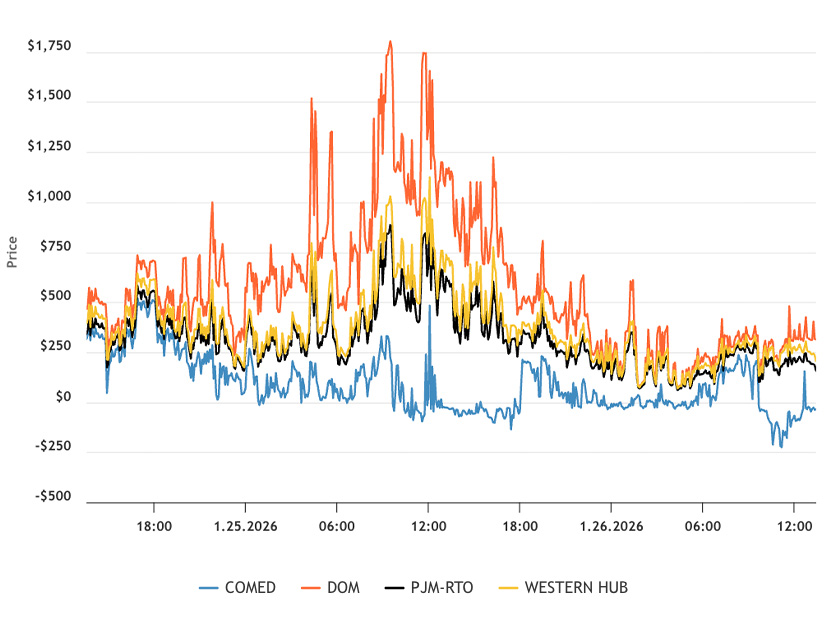
NYISO wholesale power prices briefly hit quadruple digits at about 11 p.m. ET Jan. 25 (Sunday), while the Dominion Zone in PJM saw prices above $1,000/MWh for much of the day.
PJM is actually expecting higher demand Jan. 27, with lower temperatures prompting it to issue a maximum generation alert and a low voltage alert. The RTO could break its winter peak record that day, as it forecasts peak demand of 147.2 GW, which would beat the mark of 143.7 GW set a year ago.
The RTO said that it could see peak demand hit 130 GW for seven straight days, which would be a first for winter.
“This is a formidable arctic cold front coming our way, and it will impact our neighboring systems as much as it affects PJM,” Senior Vice President of Operations Mike Bryson said in a statement. “We will be relying on our generation fleet to perform as well as they did during last year’s record winter peak.”
PJM asked DOE to issue a 202(c) order to allow it to dispatch every generator in its footprint at is maximum level without violating air quality laws — an order that remains in place through the end of January.
DOE issued a similar order to ISO-NE as New England deals with the same cold. One generator informed ISO-NE that it was running up against its permitted emission limits.
“This prolonged severe cold weather event is expected to result in a sustained high level of demand for electricity,” ISO-NE told DOE in its order application. “While the vast majority of generating units in the ISO-NE region continue to function adequately, some units may experience difficulty due to emissions/air permitting limitations or other operating constraints.”
A graph from PJM’s Data Viewer showing real time prices by different zones as the storm passed through its territory. Dominion saw the highest prices. | PJM
NYISO is facing the same winter weather as its two neighbors, announcing last week that it could see peak demand exceed 24 GW, which was near expectations for this winter, but falls short of its all-time winter peak of 25.7 GW set in 2014.
“Our assessment finds there are adequate resources to serve demand on the grid under forecast conditions, but we’ve also seen generators in recent winters challenged with accessing adequate fuel capacity during very cold conditions,” NYISO Vice President of Operations Aaron Markham said in a statement.
MISO also issued a cold weather alert that remains in place through the end of January as low temperatures impact its footprint. It also issued a conservative operations declaration covering the cold snap.
MISO saw prices peak at about $1,802/MWh on Jan. 23, although they averaged just $178.04 across its entire footprint, while prices were slightly lower by Jan. 25.
SPP Back to Normal Conditions
SPP had returned to normal operating conditions as of 12 p.m. CT Jan. 26, after expiration of conservative operations and resource advisories that were in effect during the storm. However, it extended its weather advisory — considered normal operations — through noon Jan. 28 to maintain awareness of potential weather-related effects on system resources.
A spokesperson said the RTO had sufficient generation and met reserve obligations in its 14-state footprint during the storm, with load reaching about 46 GW during the morning peak Jan. 26. Load is forecasted to remain in the mid-40-GW range through the remainder of the week. SPP’s winter peak record of 48.1 GW was set in February 2025.
“We did not experience any major transmission losses, but we did get reports of local outages, particularly in the southern portion of our footprint,” SPP’s Derek Wingfield said.
He said the grid operator remained in close coordination with neighboring systems throughout the event, providing energy exports as needed and as available generating capacity allowed.
“We will continue to monitor conditions closely and will issue additional advisories as necessary,” Wingfield said.
Stronger ERCOT Grid Performs
The ERCOT grid breezed through the storm, a marked contrast to the dayslong outages during the disastrous Winter Storm Uri of February 2021. Since then, winterization has become mandatory for power plants and critical natural gas infrastructure. ERCOT has also added about 40 GW of capacity since the 2021 storm to bulk up its energy supplies.
About 90% of the new generation added since 2021 has been wind, solar and battery storage. Batteries provided more than 7 GW of energy at 8 a.m. CT Jan. 26. ERCOT’s instant storage discharge record stands at 9.7 GW, set in December 2025.
Natural gas provided more than 50.8 GW of energy at one point Jan. 26, another record, according to Grid Status.
This comes after DOE granted ERCOT’s request for an emergency order under the FPA because of the storm. The order allows certain electric generating units to operate up to their maximum generation output in certain limited circumstances, despite federal or state environmental standards and requirements.
The order is effective until 11:59 p.m. Jan. 27.
Early demand projections of 83 GW failed to materialize. Demand is now expected to peak at around 78 GW on Jan. 27.
ERCOT did declare a transmission emergency late Jan. 25 because of the loss of generation and transmission-line issues in the San Antonio and Houston areas. The emergency was canceled during the morning hours Jan. 26.
ISO staff have also canceled the operating condition notice (OCN) issued ahead of the approaching cold weather system. OCNs are the first of ERCOT’s “four levels of communication issued in anticipation of a possible emergency condition” and are issued when the system’s safety or reliability is compromised or threatened.
More than 61,000 Texas customers were out of power as of noon Jan. 26, primarily in the northeastern region of the state where American Electric Power subsidiary Southwestern Electric Power Co. and Entergy Texas operate.
ISO-NE responded to stakeholder feedback and provided more detail on its proposed asset condition reviewer role at the NEPOOL Transmission Committee meeting Jan. 21.
The reviewer role is intended to increase transparency and scrutiny into local transmission upgrades of existing assets. Asset condition costs have risen in recent years. According to the October update to the transmission owners’ asset condition database, the cost of asset condition projects placed in service since the start of 2020 totals about $4.67 billion. The transmission owners forecast an additional $1.97 billion to be added to this total by the end of 2026.
The growth in costs, coupled with concerns about a lack of regulatory oversight into the spending, has driven efforts to standardize asset condition procedures and increase public information and engagement.
As proposed, the ISO-NE asset condition reviewer would have limited authority — its findings would be advisory; it would not take over management or planning responsibilities from the transmission owners; and it would not make legal determinations on the prudency of investments. However, the reviewer would provide information on asset condition projects (ACPs) and practices that third parties could use to challenge the prudency of projects.
“The new function is envisioned to provide an independent review and opinion of ACPs” and help the states and the public better understand “the technical merits of proposed projects,” said Al McBride, vice president of system planning at ISO-NE.
The RTO aims to establish the role by January 2027, subject to FERC approval of the budget and governing documents. It plans to hire dedicated staff with technical expertise to review projects, McBride said.
In October, ISO-NE asked for feedback on the role’s objectives, governance structure, criteria for project review, stakeholder engagement, ties to holistic system planning and outputs.
McBride said the feedback ISO-NE received emphasized the need for technical expertise, credibility and strong scrutiny of proposed projects.
“Respondents generally agree that the [asset condition] reviewer should produce clear, detailed reports that evaluate alternatives, technical needs and cost-effectiveness, and that these reports must be transparent, well-documented and completed before construction begins,” he said.
In comments submitted in December, the New England States Committee on Electricity (NESCOE) wrote, “It is imperative that the review ultimately provide information of sufficient detail to enable states, consumer advocates and others to rely upon it to challenge or support the asserted need, the project option selected and/or costs, as needed.”
McBride noted that the RTO received a range of feedback on the governance structure, with some stakeholders advocating for the creation of a new department within in ISO-NE System Planning “to better achieve efficiency and build towards the objectives of more holistic outcomes, such as right-sizing,” while other commenters pushed for a standalone department “to better ensure impartial oversight.”
After accounting for the feedback, ISO-NE proposes to create a new department in system planning. McBride said this would help avoid “duplication of expertise” and would enable “future coordination with other planning activities, such as right-sizing.”
As proposed, the role would regularly report to the ISO-NE Planning Advisory Committee on transmission owner asset management practices and would review individual projects with an estimated cost of “greater than or equal to $30 million to $50 million on an individual line or at a single station/substation over a period of five years or less.”
The reviewer would look to identify inconsistencies between the asset management practices of transmission owners and look for opportunities for standardization.
For individual project reviews, ISO-NE would evaluate whether the transmission owner justified the project need and adequately evaluated project alternatives. The RTO would also give an opinion on the transmission owner’s preferred solution.
Projects would not be allowed to begin construction until the review is complete. Material modifications to a project or a change in the preferred solution would trigger reevaluation by the reviewer.
To establish the role, ISO-NE plans to add a new attachment to the Transmission Operating Agreement to “establish requirements for information provision, standardization and reporting.” It is targeting a technical committee vote in June on its proposal.
McBride said ISO-NE plans to discuss the “development of a right-sizing capability” after the asset condition reviewer design is largely complete, likely in the third quarter of 2026. Consumer advocates in the region have expressed a strong interest in developing a right-sizing process to prevent duplicative transmission projects and identify the potential for long-term cost savings. NESCOE wrote in its comments that establishing an asset condition reviewer should add confidence to future right-sizing discussions.
Surplus Interconnection Service
Also at the Transmission Committee meeting, ISO-NE kicked off discussions on surplus interconnection service. The RTO included the topic in its 2026 work plan at the urging of several stakeholders. It plans to analyze the current rules to evaluate stakeholder concerns and “the need for and scope of potential solutions.” (See ISO-NE Publishes Draft 2026 Work Plan and Stakeholder Forum: Surplus Interconnection Can Maximize Capacity in ISO-NE.)
Alex Rost, director of transmission services at ISO-NE, noted that the RTO implemented its existing surplus interconnection service (SIS) rules in 2019 in response to FERC Order 845. He said the SIS process is intended to allow interconnection customers “to take advantage of unused capability through the use of surplus interconnection service at existing points of interconnection.”
Surplus customers are not required to go through the ISO-NE interconnection process, which is part of the reason the topic has drawn interest from stakeholders. However, surplus customers still may need to undergo studies “if the performance characteristics of the new generating facilities are materially different from the existing generating facilities,” Rost said.
He emphasized that surplus customers are subordinate to the original interconnection customer. If the original customer retires, the surplus customer would lose access to the surplus service. This constraint is part of the reason there is only one instance of a surplus interconnection agreement in the region, he said.
He asked for written feedback by Feb. 6 on any “outcomes stakeholders are ultimately looking for related to this review … and any use cases they can provide.”
The governors of states in the RTO’s territory met at the White House to discuss the flailing market; the administration’s Energy Dominance Council released a fact sheet on bringing big power plants back to solve PJM’s generation problems and a statement of principles urging it to make tariff revisions to right the ship; and the RTO’s Board of Managers released a letter directing its staff to make operational and market modifications, including revising its methods of load forecasting, instituting a reliability auction and forming a Bring Your Own New Generation (BYONG) plan for large load customers.
Alison Williams | Power for Tomorrow
The series of overlapping and likely coordinated actions has been received well by the energy community. And yet, what are being proposed are merely ideas. As Commissioner David LaCerte commented at FERC’s open meeting Jan 22: “These issues raised in these announcements will make their way to FERC soon.” Translation: We’re still talking about solving problems, not actually solving them.
So if we’re still in the planning phase, policymakers would be wise to look beyond PJM to find successful examples of the mutually beneficial outcomes everyone wants: American energy dominance, industrial competitiveness and customer protection.
Vertically integrated utilities have been doing this successfully for more than a century. In regions like the Southeast, this electric industry structure — where utilities own generation, transmission and distribution — is shielding customers from price spikes while supporting economic growth.
The data overwhelmingly support the vertically integrated model. On average, based on 2024 prices, residential customers in “deregulated” states paid 42% more for electricity than residential customers in states with vertically integrated utilities. Excluding Alaska and Hawaii — outlier states with unique geographic considerations — eight of the 10 most expensive states for electricity have a “competitive” structure.
Competition’s promise was lower prices, right? The hard data show that this promise has failed, costing residential customers billions. For example, in Illinois, a national consumer group has found that electric customers have paid $2 billion more for electric “choice” than they would have with the default utility.
The success of the vertically integrated utility isn’t by chance. And it isn’t monopoly power run amok. Rather, the vertically integrated utility model exists to serve the public interest and place the customer front and center. When Congress passed the Federal Power Act, it chose this approach because electricity requires massive infrastructure investment and therefore demands a different framework. We don’t need to imagine what thousands of wires individually bringing power to homes would look like because we see that in some parts of the world, and that is the way power was delivered in New York City in the late 19th century.
The primary operating principle of the vertically integrated utility is an obligation to serve all customers. These utilities are required to conduct extensive long-term planning where supply and demand must be balanced over decades and the procurement of resources must be the best combination of least cost and least risk. None of these actions or plans can move forward without oversight and approval by state regulators, who hold the dual objectives of supporting state-based growth and ensuring electric rates are fair, reflect actual costs and are allocated fairly across all customers. This relationship between utilities and their regulators is the original public-private partnership — and it doesn’t just work for electricity; it’s also a successful model for water, sewer and gas heating.
Yet, despite a century of success and recent data affirming that customers win under the vertically integrated model, some believers in “competition” continue to make the case for expanding it throughout the electric sector, including pushing for open solicitations for transmission projects. But the data are clear there too, and the pattern repeats: “Competitive” transmission delivers the same disappointing results as “competitive” electricity markets.
Consider what “competitive transmission” actually means. Planning entities determine which transmission projects are needed before any competition begins. Developers (the ones supposedly competing) merely bid to see who builds projects, not on identifying needs or providing ongoing competitive service. Indeed, competitive transmission operators have been fighting for years to be treated like regulated utilities when it comes to prices. Moreover, their so-called competitive bids routinely fail to translate into actual customer savings, proving the theory wrong.
A revealing example comes from New York in 2022, where a “competitive” bid came in 22% lower than the local utility’s proposal. Advocates of competitive transmission celebrated this as proof that competition in transmission can work. But the developer encountered cost overruns of about $74 million above its cost cap because of regulatory delays, transmission line rerouting, tree clearing and wetland mitigation. Tellingly, the original bid failed to account for these costs — whether through strategic omission to win the contract or unfamiliarity with local terrain and regulatory requirements. Ultimately, this project’s cost reached $249 million, up 38% from the winning bid and exceeding what the experienced local utility would have charged.
These stark examples of “competition” failures are particularly important now, as many state legislative sessions resumed at the start of the year and legislators are feeling pressure to find solutions to rising energy costs. Perennial bill proposals on energy often include doubling down on market structures, deregulation and pushes for retail or industrial “choice.” But these options can be best described as “competition for competition’s sake.”
Today’s policymakers should ask a simpler question for finding energy solutions: “What approach best serves customers?” The answer is clear: Well-regulated, vertically integrated utilities have a proven track record of protecting customers.
Electric utilities overseen by smart regulators provide the actual benefits that “competition” is supposed to deliver — downward pressure on prices, accountability for performance and incentives for efficiency — but with additional protections that markets cannot provide, including mandatory service obligations, reliability requirements, and protection from price volatility and market manipulation.
Regulators disallow cost recovery for imprudent investments, enforce lowest reasonable cost standards, and ensure balanced consideration of customer and shareholder interests. These are not theoretical benefits; they are demonstrated outcomes from a century of sound regulatory practice. We have examples of success popping up across the country, where vertically integrated utilities are recruiting data centers and advanced manufacturing with fair electricity rates that don’t harm small customers and average citizens.
The choice facing policymakers is straightforward: proven regulatory approaches that prioritize customers, or continued experimentation with “competitive models” that have repeatedly failed to deliver on their promises. After a century of evidence and recent high-profile market failures, the answer should be clear.
Alison Williams is senior vice president of Power for Tomorrow, a nonprofit that provides practical research, commentary and information regarding how the regulated electric utility model protects consumers and promotes consumer benefits.
The California Energy Commission has signed off on a forecast showing the state’s electricity consumption could surge by as much as 61% over the next 20 years, but it pegs the biggest driver as increased electric vehicle use, with new data centers coming in second.
The CEC on Jan. 21 voted to approve a resolution adopting the forecast and including it in the agency’s 2025 Integrated Energy Policy Report (IEPR), which informs the state’s resource adequacy requirements, integrated resource plans, reliability assessments, and transmission and distribution planning.
The adoption of electric vehicles is the biggest driver of peak load growth at 8,234 MW, followed by new data centers (4,721 MW), fuel substitution from electrification (4,464 MW) and climate change impacts (1,811 MW), according to CEC lead forecaster Nick Fugate. New consumption outside those categories accounts for 6,011 MW of peak load growth.
Fugate noted that the 2025 forecast is the first for which the CEC has considered using “known load” data in its forecasts, which include “energization requests at the distribution system level” and “project-level data” from investor-owned utilities — many of which are proposed data centers.
Still, the CEC decided not to include known load data in this round of planning forecasts because it lacked historical records to examine “when evaluating key assumptions made in our analysis,” Fugate said. The agency did provide alternative forecasts that reflect those data, and Fugate said the agency will continue to monitor known loads in 2026 and 2027 for possible inclusion in future planning forecasts.
“The approach we’ve taken to determine incrementality to our forecast allows for substantial room for double counting,” Fugate said. “It’s meant to give a bookend estimate to cover the very high-end risk, rather than to project a most likely outcome at the system level. So, while we are working with the IOUs to sort through the energization timelines to better understand this data, to validate our key assumptions and to refine our analytical approach, there is still this question of how to mitigate potential risk applied by known loads data.”
The forecast’s “high case” shows that California’s annual electricity consumption could rise to 450 TWh in 2045, compared with about 280 TWh in 2025. By comparison, the state’s consumption was 270 TWh in 2005. (See Calif. Electricity Consumption Headed off the Charts, CEC Forecast Shows.)
The high case shows a compound annual grow rate (CAGR) of 4.2% from 2024 to 2030 and 1.5% from 2030 to 2045, translating to 2.3% over 2024-2045.
For the “mid case,” the CAGR figures are 2.3%, 1.7% and 1.9%, respectively, with 2045 consumption estimated at just above 400 TWh.
“This is one of the most important aspects of the commission’s role and job, and one that I’ve always been very, very fascinated with and interested in,” Commissioner Nancy Skinner said ahead of the vote during the CEC’s monthly business meeting Jan. 21.
But speaking on behalf of the California Coalition of Large Energy Users during the meeting, Meredith Alexander said the group was troubled by the CEC’s decision to exclude known loads from its planning and local forecasts.
“At this point, we’re concerned that there could be real effects on reliability and costs in the next few years, if the forecast is artificially low,” she said. “Load-serving entities could under-procure capacity, meaning that our load-serving entities are not sufficiently resourced to serve our new loads.”
Speaking ahead of the vote, Commissioner Andrew McAllister said he was “comfortable with” adopting the forecast while acknowledging the concerns, which he said reflected the “increased uncertainty” around growing loads.
“I do want to note there are so many moving parts and so many new electric technologies being introduced to the market — really, at rates we’ve never seen before — that close dialogue with stakeholders and continued engagement throughout the years is more important than ever, so that we get as close to being right as we possibly can,” CEC Chair David Hochschild said.
In late 2025, U.S. cleantech manufacturing investment cancellations reached their highest level of any quarter in the eight years a database has been tracking such announcements.
Also in the fourth quarter of 2025, new investment announcements dipped to their lowest level in five years.
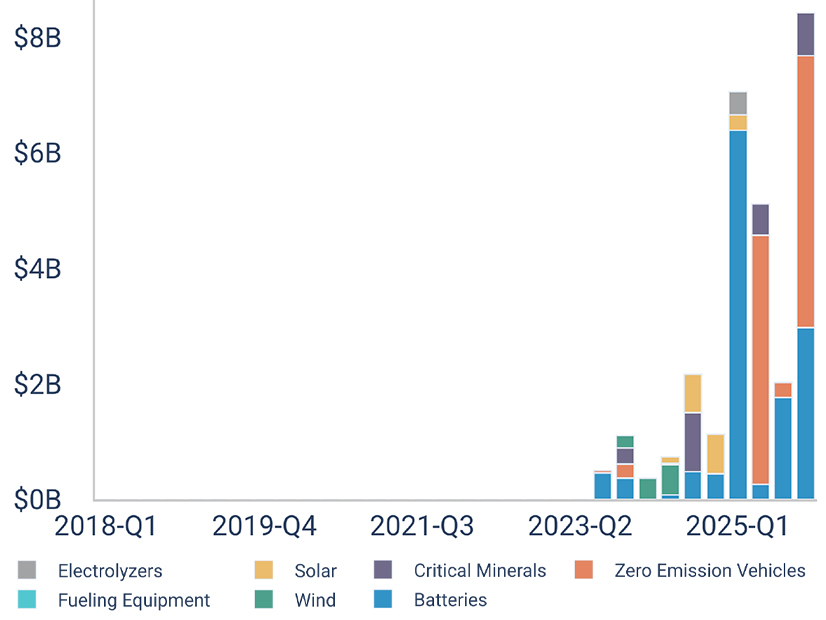
The Clean Investment Monitor (CIM), maintained by Rhodium Group and MIT’s Center for Energy and Environmental Policy Research, tallied $3.4 billion in quarterly investment announcements and $8.4 billion in cancellation announcements.
For all of 2025, amid President Donald Trump’s opposition to many clean energy technologies, the CIM tallied $24.1 billion in manufacturing investment announcements and $22.6 billion in cancellations. By comparison, 2024 saw announcements worth $32.5 billion and cancellations worth $4.4 billion.
Investment cancellations by technology | Rhodium Group
The ratio was even more lopsided in 2023 — $65.5 billion announced and $1.6 billion canceled.
The decrease in actual investment activity — the dollars actually being spent — was not as marked. Many previously announced investments were still being carried out in the fourth quarter. The CIM placed total actual investments at roughly $9.3 billion — down 29% from a peak of about $13.1 billion in the third quarter of 2024.
The majority of the $3.4 billion in new manufacturing announcements for the quarter was related to batteries — $2.5 billion, including Ford Motor Co.’s $2 billion decision to convert an EV battery factory in Kentucky to battery energy storage system production.
There were just five announced cancellations in the CIM for the fourth quarter, but they all were huge, and all were connected in some way to EVs. Ford’s planned electric pickup truck and commercial van factories in Tennessee and Ohio were valued at a combined $4.71 billion; Gotion’s EV battery factory in Michigan at $2.44 billion; Westwin Elements’ nickel refinery in Oklahoma at $748 million; and ICL Group’s battery materials factory in Missouri at $546 million.
The combined $8.44 billion in cancellations was the most of any quarter in the CIM database since its start in 2018.
U.S. cleantech manufacturing investment announcements tallied by the CIM peaked in 2022 as the landmark Inflation Reduction Act worked its way through Congress and was signed into law by President Joe Biden: $91.4 billion for the year, capped by $32.2 billion in the fourth quarter alone.
By contrast, the CIM tallied just $24.1 billion in 2025 announcements, capped with the $3.4 billion in the fourth quarter — the least of any quarter since the final months of Trump’s first term.
The CIM also tracks cleantech investments in the U.S. energy industry and retail sectors, neither of which has tapered off the way the manufacturing sector has.
Combined investments in all sectors hit a record-high $75.4 billion in the third quarter, mostly from consumers rushing to buy EVs before federal tax credits expired.
FERC has rejected a rehearing request of its order approving SPP’s proposed one-time accelerated study of shovel-ready interconnection requests, sustaining its original 2025 decision (ER25-2296).
Clean energy groups and public interest organizations — including the Advanced Power Alliance, American Clean Power Association, Natural Resources Defense Council and Sierra Club — opposed the Expedited Resource Adequacy Study (ERAS) during the stakeholder process, arguing that it amounts to queue jumping, bypasses open access to the RTO and violates FERC’s principle of nondiscriminatory access to the grid.
The organizations filed for rehearing in August, one month after FERC’s order. They contended the commission’s decision was arbitrary and capricious because it was based on unexplained assumptions that little to none of the capacity being studied in SPP’s current interconnection process will be available to serve near-term resource adequacy needs.
The groups called the assumptions “implausible,” noting that the RTO assumed none of the 4,500 MW of summer-accredited capacity in a 2022 study cluster will be available to meet 2030 needs; only 418 MW of over 31,000 MW of energy storage in the queue will meet 2030 resource adequacy needs; and no capacity from the 2024 study cluster will be available in 2030.
They said the grid operator has projected in other forums that 40% of the generation in the queue will come online, “inconsistent with SPP’s assumptions,” and that it did not discount future load growth to reflect historical rates.
FERC disagreed. In an order issued at its monthly open meeting Jan. 22, said SPP had met its burden to show that the ERAS process is just and reasonable and supports near-term resource adequacy needs.
“A number of well documented factors are contributing to what SPP has characterized as a looming resource adequacy crisis,” the commission said. It noted SPP “expects” available capacity to drop below reserve margins by 2027 and for the region to have insufficient capacity to meet peak demand in 2030.
“SPP further [predicts] that, within the next two to five years, [load-responsible entities] will be unable to meet their state-mandated obligation to serve load” and the tariff’s resource adequacy requirements, FERC said, pointing to the RTO’s projections that an additional 16.7 GW of accredited capacity will be needed by 2030.
The RTO has 552 active interconnection requests in its queue for more than 130 GW of capacity. It told FERC that given proposed commercial operation dates, historical withdrawal rates and capacity accreditation rates, “actual capacity to meet SPP’s near-term resource adequacy needs was likely to be far more limited” and that its current interconnection process could not meet expected needs.
The commission also rejected open-access arguments, saying ERAS interconnection requests are “necessarily subject” to SPP’s more stringent criteria for eligibility.
“ERAS interconnection customers are differently situated than interconnection customers that do not meet these criteria,” FERC said, “in their expected ability to achieve commercial operation more quickly to participate in this one-time process to respond to the near-term needs of particular LREs that SPP has determined are expected to face a capacity deficiency.”
In approving the ERAS process in July 2025, FERC found that SPP had “existing authority” under its tariff to evaluate and maintain resource adequacy and to manage its interconnection queue in providing sufficient generation to meet RA requirements. (See FERC Approves SPP’s ERAS Process, Accreditation.)
Order 2023 Compliance Accepted
In a separate order issued during the meeting, FERC accepted SPP’s second compliance filing with the requirements of Orders 2023 and 2023-A (ER24-2026).
In partly accepting SPP’s first compliance filing in June 2025, the commission found that its proposed tariff revisions amending FERC’s pro forma large generator interconnection procedures (LGIP) and generator interconnection agreements partly complied with the order. (See FERC Partly Accepts SPP’s Order 2023 Compliance.)
It found SPP followed its subsequent directives by proposing to adopt, without modification, the pro forma LGIP requirement that an affected system restudy be completed within 60 calendar days from the restudy need’s date. The commission also said the grid operator complied by removing language from the pro forma LGIP requiring interconnection customers to submit a deposit with each request, even when more than one request is submitted for a single site.
FERC issued Order 2023 in July 2023 in an effort to clear backlogged interconnection queues by implementing a first-ready, first-served cluster study process; increasing interconnection customers’ financial obligations; and penalizing grid operators for missing study deadlines. (See FERC Updates Interconnection Queue Process with Order 2023.)
In 2024, the commission rejected challenges to the interconnection rules under Order 2023 and made several clarifications, minor modifications and an extended compliance deadline with Order 2023-A. (See FERC Upholds, Clarifies Generator Interconnection Rule.)
FERC Releases Letter Orders
In a Jan. 20 letter order, FERC accepted SPP’s proposed tariff revisions modifying language related to the local market power test for resources in frequently constrained areas (FCAs) (ER25-3331).
The revision, with an effective date of Jan. 26, prohibits market participants from nominating and acquiring — and portfolios from containing — certain auction revenue rights and transmission congestion rights (TCRs) that source and sink in electrically equivalent settlement location groups.
SPP’s Market Monitoring Unit supported SPP’s proposal, saying it “more clearly define[s] the full scope of trades that are not permissible in SPP’s TCR market.”
The commission directed SPP to submit a compliance filing within 30 days of the order’s date.
In another Jan. 20 letter order, FERC approved the RTO’s proposal to modify language setting the conditions under which a resource is determined to have local market power (ER26-562).
The commission found it reasonable for resources within an FCA to undergo the same level of scrutiny as resources outside the area when testing for local market power with respect to constraints outside the FCA. It said SPP’s proposal applies the existing resource-to-load distribution factor and binding reserve zone conditions for all resources while retaining other conditions for resources in an FCA.
FERC has approved a 40-year license for a proposed 1.2-GW pumped hydroelectric storage facility near the city of Goldendale in Klickitat County, Wash. (P-14861-002).
According to the commission’s order, approved at its monthly opening meeting Jan. 22, Rye Development will build and operate the closed-loop, 12-hour Goldendale Energy Storage Project along the cliffs of the Columbia River Gorge and near the John Day Dam. It will include two reservoirs, one at the bottom of the cliffs and another about 2,300 feet higher.
A powerhouse built in an underground cavern will contain three, 400-MW pump-turbine units. A 500-kV transmission line will connect the project to the Bonneville Power Administration’s system through the existing John Day substation. The project is expected to generate power eight hours on a typical day and up to 12 hours a day if needed.
“The energy produced will be delivered to the wholesale market to be purchased by utilities in the Pacific Northwest and California to help satisfy periods of peak demand and provide grid flexibility,” FERC said in its order.
According to the project’s website, it has a price tag of more than $2 billion. The expected commercial operation date is 2032.
Erik Steimle, Rye’s chief development officer, called the approval “a landmark moment for the Pacific Northwest.”
“With electricity demand and energy costs on the rise, this license represents a huge step toward a more reliable grid and affordable energy prices for the region,” Steimle said in a statement.
The reservoirs initially will be filled with 7,640 acre-feet of Columbia River water bought from Klickitat Public Utility District. An additional 360 acre-feet will be purchased each year to make up for water loss from evaporation and seepage. The initial fill will take place over seven months, from September through March, to avoid Columbia River flow reductions that could delay salmon smolt migration.
The project area is within Klickitat County’s Energy Overlay Zone, which is intended to streamline energy development. The upper reservoir site is within the Tuolumne wind farm.
The lower reservoir is planned at the former site of Columbia Gorge Aluminum smelter. The landowner and the former smelter operator are working with the state on cleanup efforts, and project owner Copenhagen Infrastructure Partners has pledged $10 million to help.
The state’s Department of Ecology issued a water quality certification for the Goldendale project in May 2023, which was upheld on appeal in January 2025.
The project faced opposition from members of the Yakama Nation, Umatilla Tribes, Confederated Tribes of the Warm Springs Reservation of Oregon and Nez Perce Tribe. It is on property that has historical significance and is used for sacred ceremonies. (See Wash. Approval of Pumped Storage Project Sparks Dissent.)
The FERC order noted that Rye proposed protecting cultural resources and mitigating unavoidable impacts to historic sites through a historic properties management plan. Other measures include consulting with tribes to provide post-construction access to the project area for cultural programs and to ensure construction doesn’t block access to traditional fishing areas.
Rye is a partnership between EDF power solutions and Climate Adaptive Infrastructure. It is also developing the 393-MW, eight-hour Swan Lake pumped storage project in Klamath County, Ore., and the 266-MW Lewis Ridge pumped storage project in Bell County, Ky.