Former Federal Energy Regulatory Commission Chairman Jon Wellinghoff improperly shared in public a video excerpt of a deposition taken during a 2013 commission investigation, according to a report released Tuesday by Department of Energy Inspector General Gregory Friedman.
But Wellinghoff on Tuesday told RTO Insider the video snippet in question was not “nonpublic” information when he played it during an industry conference on March 9.
While disclosing information is forbidden during an investigation, certain portions of it become public after an investigation is completed, Wellinghoff said.
“I’m kind of bemused by [the report] in the sense that, No. 1, this information is not confidential at all. I don’t understand where they get this,” Wellinghoff said.
The Inspector General also faulted FERC for inadequate safeguards inside the agency to prevent such disclosures and has asked current Chairman Norman Bay to do more to prevent disclosure of nonpublic information and strengthen post-employment guidance.
Perhaps ominously for Wellinghoff, Friedman asked Bay to determine if the former FERC chairman violated a Confidentiality of Investigations requirement at the agency “and ascertain what, if any, sanctions are available to address the former chairman’s actions.”
‘How Not to Behave’
Wellinghoff, who served as chairman from 2009 to 2013, is currently a partner at the energy law firm of Stoel Rives. He’s been widely sought after as a speaker and panelist at various utility industry conferences.
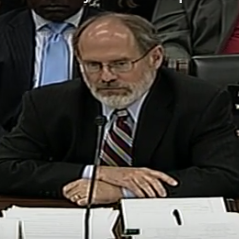
Jon Wellinghoff (Source: FERC)
It was at such a conference on March 9 when, Friedman said, Wellinghoff shared a video excerpt of a nonpublic deposition taken during a “major” Office of Enforcement investigation resolved in a July 2013 agreement.
The video clip showed a trader being evasive while questioned by investigators. Wellinghoff presented the clip during the conference “as an example of how not to behave in front of regulators,” Friedman wrote.
Wellinghoff said the point of showing the video during the conference was instructional, in the context of “don’t do this” if you’re being questioned by regulators.
“But the snippet had no substantial information at all” concerning the underlying case, he insisted.
Records show that Wellinghoff was on the agenda to moderate a panel on “FERC and CFTC Enforcement” at the Western Systems Power Pool’s spring operating committee meeting, in Sonoma, Calif. After the panel discussion, a FERC employee, along with an attorney for the energy trading firm targeted in the 2013 investigation, “expressed concerns to the commission that the disclosure may have been unauthorized and in violation of federal law regulation,” according to the report.
FERC Integrity at Stake?
The Inspector General “confirmed the essence of the allegation, finding that Mr. Wellinghoff had, in fact, disclosed nonpublic OE information in a public setting. We concluded that the disclosure of such information could threaten the integrity of FERC’s regulatory and enforcement process.” Under FERC regulations, Friedman said, “virtually all of the information gathered during the course of an investigation is nonpublic.”
The report faults FERC management for failing “to take action to positively ascertain the scope of information still in possession of the former chairman.”
“In our view, the seriousness of this matter required more aggressive intervention and involvement by the commission,” the report said.
Friedman said FERC staff were focused on preventing future disclosures and failed to determine whether the former chairman possessed other nonpublic, sensitive commission material. FERC attorneys spoke with Wellinghoff on March 20, asking him to call the commission before releasing any other material in public so they could determine whether or not it was nonpublic, according to the report.
The report said Wellinghoff agreed, but he informed the attorneys that his computer had crashed in February and that all of his documents had been permanently lost. “However, we were told that Mr. Wellinghoff used a personal computing device to show the video clip during the March 9 presentation, despite having told commission attorneys that all of his documents were lost due to the computer crash,” the report said.
On April 29, the day before the Inspector General announced its investigation into the matter, FERC asked Wellinghoff to destroy any remaining commission material he possessed. Wellinghoff confirmed that he had on May 4.
The Inspector General said Wellinghoff has declined repeated requests to discuss the matter.
FERC Policies Faulted
Also faulted were FERC’s post-employment guidance and exit processes, such as how employees leaving FERC should treat information. The review did cite steps taken since the public release of the deposition came to light. For example, in an April email to current employees, FERC’s ethics official outlined potential criminal penalties for unlawful removal and distribution of federal records.
But Friedman said the risk of unauthorized disclosure by current and former FERC employees “remains unacceptably high.”
He recommended that Bay:
Determine if Wellinghoff violated the Confidentiality of Investigations requirement and whether sanctions are available;
Determine if the commission has necessary safeguards in place to prevent disclosure and propose statutory or regulatory changes; and
Expedite the effort to strengthen post-employment guidance and exit processes, including a better understanding of what constitutes nonpublic information.
Major Enforcement Case
Neither the conference nor the firm whose traders were targeted in the FERC investigation are identified in Friedman’s report.
According to FERC records, there were two major enforcement cases resolved in July 2013. One involved Barclays Bank, which FERC determined had violated the Anti-Manipulation Rule involving electricity trades in the western U.S. The commission assessed penalties of more than $435 million.
The public record of the case includes the names of traders found to have run askew of federal laws and includes summaries of depositions they’d made.
The other case resolved that month involved make-whole payments and related bidding strategies of JP Morgan Ventures Energy. Again finding a violation of the Anti-Manipulation Rule, FERC levied massive sanctions that included a $285 million civil penalty.
Wellinghoff declined to confirm to RTO Insider whether it was from one of these two July 2013 cases that he pulled the video deposition. The former FERC chairman said he did not identify the case at the March 9 conference.
Bay on Board
In a letter to Friedman, Bay said he agreed the video excerpt shared by Wellinghoff constituted nonpublic information.
“I have directed appropriate senior commission staff to explore whether further steps are available to address this situation and to share their findings on that issue with me by Sept. 1,” Bay wrote.
Wellinghoff has stepped on toes within FERC previously since leaving the post. In 2014, commissioners criticized their former colleague for publicizing information from a FERC analysis on grid security. Wellinghoff was attempting to demonstrate more could be done to safeguard the nation’s electrical infrastructure. (See FERC Criticism of Ex-Chair Mounts.)
MILWAUKEE — A top Environmental Protection Agency official on Monday gave the most detailed hints yet about how the agency will revise its proposed carbon emission regulations on existing power plants when the final rule is released this summer.
Janet McCabe
Janet McCabe, acting assistant administrator for EPA’s Office of Air and Radiation, indicated that the final rule will include relaxed interim goals and informal ways for states in the Midwest and elsewhere to combine their efforts to ease compliance.
McCabe made her comments at the opening session of the Mid-America Regulatory Conference, where Wisconsin officials promised that they will be among the states filing legal challenges to the Clean Power Plan.
McCabe has appeared frequently before gatherings of state regulators and also testified at the Federal Energy Regulatory Commission’s technical conferences on the reliability impacts of the proposed rule. In previous appearances, McCabe made vague promises that the agency was listening to the feedback it has received on EPA’s proposal. (See MISO, SPP Stakeholders Developing Trading Plan to Comply with EPA Carbon Rule.)
Rule Sent to White House
With the final rule nearing release — it was sent to the White House for review last week — McCabe was a bit more forthcoming.
She indicated support for the Midcontinent States Environmental and Energy Regulators (MSEER), which has been developing a mechanism that would allow utilities to trade emission allowances within and across state lines. McCabe said efforts by MSEER and others to create “trading ready” compliance plans that don’t require time-consuming memoranda of understanding among governors have been “very instrumental in our thinking.”
“What an excellent idea that is, and we’re certainly pursuing that,” McCabe said.
McCabe acknowledged the widespread opposition to EPA’s proposal that states meet most of their 2030 emission targets by 2020, which critics have said would impede regional compliance and result in stranded costs for generators shuttered before the end of their economic lives. “We certainly, certainly heard that. We heard that loud and clear,” she said.
She also acknowledged fears that the rule might subject state energy efficiency and renewable portfolio standards to federal oversight, saying, “I think you’ll see more thought on that.”
Wisconsin’s Welcome
McCabe spoke after Mid-Atlantic Conference of Regulatory Utilities Commissioners attendees received a welcome from Wisconsin Lt. Gov. Rebecca Kleefisch, who warned that the EPA rule will dramatically raise electric prices, damaging the state’s ability to use its lower rates to attract industry from Illinois and other states. Under the proposed rule, Wisconsin would be required to cut its carbon emissions by 32% from its 2012 levels.
Brad Schimel, Wisconsin Attorney General
Kleefisch introduced Attorney General Brad Schimel, who all but guaranteed that the state would be among those challenging the final rule. Schimel said EPA’s proposal had “serious legal flaws” and set unfairly harsh goals for the state, whose economy is dependent on energy-intensive industry.
McCabe acknowledged the Midwest’s heavy reliance on coal, and promised that “affordability is very much on our minds as well.” She said the agency has proven that environmental regulation is compatible with economic growth, saying air pollution has been reduced by 70% since 1970 while the economy grew “by orders of magnitude.”
She also responded to criticism that the proposed state targets — which require some states to cut emissions much more than others — are inequitable, saying “we’re looking hard at that.”
She rejected suggestions that the agency was overreaching, saying it was charged with enforcing laws enacted by Congress. She said the rule would withstand legal challenges, saying it was “very solidly based in the Clean Air Act.”
“EPA is not an energy agency. We’re not trying to be an energy agency,” she continued. “We are an agency that protects the public health, and in this case that means addressing air pollution that contributes to climate change.”
In a brief interview afterward, Schimel said he heard nothing from McCabe that made it less likely that Wisconsin will challenge the rule. “She conflates clean air with climate change. That’s not a good sign for where they’re going,” he said.
FERC Commissioner Plays Peacemaker
Commissioner Colette Honorable (Source: FERC)
Federal Energy Regulatory Commissioner Colette Honorable, who spoke after McCabe, urged state officials not to take absolutist stands.
She said states challenging the rule’s legality should also be prepared to respond if it is upheld in the courts. Some opponents have urged states not to file compliance plans; EPA has said it will impose a federal implementation plan for such states.
“I don’t want to do anything to harm jobs; I know you don’t either. I don’t want to do anything that harms reliability or ensuring just and reasonable costs; I know you don’t either. Having said that, we have a job to do,” Honorable said.
“There’s a saying that metal sharpens metal. If we continue to stay engaged we will be in the best possible position to be prepared for whatever happens with the Clean Power Plan. I’m … convinced that we will be able to strike the right balance because of what we continue to hear from you.”
Rule Survives First Legal Challenge
The Clean Power Plan survived its first legal challenge on Tuesday. In a unanimous decision, the three-judge D.C. Circuit Court of Appeals found that a challenge to the rule by 12 states was brought too early, as it is still being finalized.
“Petitioners are champing at the bit to challenge EPA’s anticipated rule restricting carbon dioxide emissions from existing power plants,” Judge Brett Kavanaugh said. “But EPA has not yet issued a final rule. It has issued only a proposed rule.
“They want us to do something that they candidly acknowledge we have never done before: review the legality of a proposed rule. But a proposed rule is just a proposal. … We do not have authority to review proposed agency rules.”
The court’s remarks in its ruling mirrored the skepticism it expressed when it heard oral arguments in April. (See Federal Briefs, “Judges Appear Skeptical of Challenge to EPA Air Rules.”)
WASHINGTON — The Federal Energy Regulatory Commission was the subject of intense criticism Wednesday and Thursday as members of a congressional subcommittee considered legislation to rein in the agency’s Office of Enforcement.
The House of Representatives Energy and Commerce Committee is considering a legislative package that would institute a wide variety of changes to energy policy. This week’s Energy and Policy subcommittee’s hearing focused on Title IV, which would make changes to FERC’s enforcement procedures, along with Department of Energy efficiency standards and the Public Utility Regulatory Policy Act (PURPA).
Under Section 4212 of the title, FERC would be required to disclose to investigation subjects “any exculpatory materials, potentially exculpatory materials, or materials helpful or potentially helpful to the defense” within a week of issuing preliminary findings.
Brady Doctrine
The provisions are in response to criticism by defense attorneys — embraced by some congressional Republicans — that Enforcement has denied subjects due process. The allegations were highlighted in the Powhatan Energy Fund case, in which brothers Richard and Kevin Gates claim that FERC withheld exculpatory evidence from them in violation of the Brady doctrine. (See Gates, Powhatan Say FERC Enforcers Didn’t Share Crucial Info.)
Larry Parkinson, FERC
Responding to a question on Wednesday from Rep. Jerry McNerney (D-Calif.) about the implications of the phrase “helpful or potentially helpful” in the section, FERC Enforcement Director Larry Parkinson called it “a pretty dramatic rewrite” of the Brady doctrine.
The doctrine, stemming from the 1963 case Brady v. Maryland, holds that the prosecution may not withhold evidence that could aid a defendant.
Under the proposed language, “essentially what it would end up being is an open-file discovery policy,” Parkinson said. “If you say you’re entitled to information in possession of FERC that is ‘helpful or potentially helpful’ to the defense, I don’t know what wouldn’t be, whether it’s inculpatory, exculpatory or anything even neutral.” He also noted that Brady doesn’t apply to civil cases, even though FERC voluntarily adopted the doctrine in 2009.
These comments incensed Rep. Morgan Griffith (R-Va.), who flung his hands in the air and stood up in exasperation. When it was his turn for questioning the witnesses, he blasted Parkinson’s remarks.
“I don’t know how y’all did it wherever you worked, but the really good prosecutors … they gave you the open file because it helped you reach a settlement,” said Griffith, who referred to himself as a “simple country lawyer.”
Rep. Morgan Griffith
“So I don’t understand the resistance. I’m having a real hard time sitting here listening to you talk about how this a problem.”
“This is not a hide-the-ball kind of process,” Parkinson responded. “We lay out in extraordinary detail for the subjects of our investigations everything we’ve concluded, both factually and legally.”
On Thursday, the subcommittee heard from William Scherman, a former FERC general counsel who has led the attack on the agency, making his case in a law review article, Wall Street Journal op-ed and National Association of Regulatory Utility Commissioners conference. Senate Republicans quoted from his critique during the confirmation hearings for former Enforcement Director Norman Bay last May. (See LaFleur Cruises, Bay Bruises in Confirmation Hearing.)
Scherman told the subcommittee that it was “shocking” that Parkinson would say the language was not necessary. He suggested replacing “helpful” with “favorable.”
“There is no possible way that [FERC] could object to that,” Scherman said.
Commissioners’ Role
The proposed legislation would also allow investigative subjects “to communicate with the commissioners regarding the substance of settlement considerations to the same extent as such communications occur between the commissioners and the investigatory staff of the commission.”
Parkinson said that such a change would “impede the ability of the enforcement staff to regularly communicate with the commission or with others in the agency. It is simply unworkable to restrict the enforcement staff from those communications unless we ignore the fact that the commission itself owns and manages its enforcement program.”
Bill Scherman, former FERC General Counsel
“I don’t know how a commission effectively oversees an enforcement program if the enforcement staff isn’t able to regularly communicate with them without having to put it in writing, or without having to give the investigative subject the opportunity to address the commission in the same way.”
Griffith, however, criticized what he saw as the dual role of FERC commissioners as prosecutors and judges. Griffith compared this to a building code investigator going to the judge and asking how he should investigate and lay out his case against a potential violator.
Scherman noted that because Enforcement staff has regular communication with commissioners, “human nature would suggest that cannot be a fair adjudication. It has nothing to do with the integrity of the commissioners personally. But if you’re told for five years that somebody is guilty of fraud, if you’re told for five years that somebody has manipulated the markets, if you’re told for five years that somebody has unjustly enriched themselves at the detriment of consumers, and at the very last part you then have to sit, where only one party has had access to you, where only one party knows what you’re thinking and only one party has had a free exchange, that is a problem.”
Griffith suggested allowing the commissioners to retain their power to settle cases but said adjudication should occur in federal court “where you can have a legitimate, due process-filled trial.”
Scherman thought it would be a good idea — if FERC recognized that de novo review meant a new trial. “The commission is taking the absurd position that the words ‘de novo review’ does not lead to a full trial, does not lead to discovery, does not lead to the right to confront witnesses,” he said. “They’re taking the position that de novo review is essentially no different than a court review, where the commission gets deference on the record that they built on a flawed process.”
‘Neutering’ Enforcement
McNerney, who noted that California is still dealing with the aftermath of the Enron scandal, expressed concern that the section went too far in “neutering FERC’s investigative authority.”
Sue Kelly, APPA
With no one from FERC on Thursday’s witness panel, Sue Kelly, CEO of the American Public Power Association, attempted to defend the agency.
“I would just note that what they’re trying to do is protect consumers in these electric markets,” she said. “And if you look at the orders that have come out, if you look at the entities that are being chastised, if you look at the behaviors that are being engaged in, I think a case could be made that it’s really important to have a strong enforcement at the FERC because consumers are otherwise going to be taken to the cleaners.”
Scherman countered that “It is easy to say ‘don’t do this’ when your members are not subject to the very regulations that are violating due process. Ms. Kelly’s members are not subject to these rules. They’re not subject to this enforcement process.”
Kelly interjected: “Not true.”
“Well it is true, Sue. Other than [the North American Electric Reliability Corp.], what are you subject to?” Scherman replied.
Kelly noted that there was an enforcement case against an APPA member in ISO-NE. But “generally speaking, we don’t engage in behavior that would require” the enforcement process, she said to laughter. Kelly, however, was not smiling.
A consumer group and the Illinois Attorney General have asked the Federal Energy Regulatory Commission to launch an investigation into whether Dynegy illegally manipulated MISO’s Planning Resource Auction last April, resulting in a nine-fold price increase in Zone 4.
Public Citizen Inc. also alleged that MISO brushed aside recommendations by its staff that Zones 4 and 5 be merged due to their concerns about Dynegy’s growing share of capacity in Zone 4 after the company acquired four generators in the zone from Ameren. MISO didn’t want to risk Dynegy leaving for neighboring PJM, Public Citizen alleges.
Its complaint (EL15-70), filed Thursday, is the most serious volley yet by consumer interests still simmering over April auction results that saw prices in Zone 4, comprising much of Illinois, clear at $150/MW-day, compared with just $16.75 a year earlier.
The result will raise annual electric bills of Ameren Illinois residential customers by more than $140, the complaint states.
Illinois Attorney General Lisa Madigan filed a similar complaint Thursday, arguing that the 800% jump in Zone 4 prices is unjust and unreasonable and that the Dynegy acquisition made it a “pivotal supplier” in the zone.
“If Dynegy-controlled generation capacity physically located within Zone 4 is not bid, there would be insufficient capacity in Zone 4 to clear its local clearing requirement,” Madigan said. “Thus, Dynegy is able to set the price for the marginal clearing capacity, regardless of its internal cost of providing that capacity. If there were no pivotal supplier, one would have expected the Zone 4 price to match the result in Zones 1 through 7.”
Madigan also noted that in approving the Dynegy acquisition, FERC declined to look at its effect on competition and prices in Zone 4 and instead only considered a competitive analysis of MISO as a whole.
Public Citizen’s complaint suggests Dynegy could have inflated prices by either not offering some capacity or by offering some of it at such a high price that it would not clear.
Dynegy issued a statement saying it “follows and respects all the rules, tariffs and obligations in the markets and areas where we operate.”
“Dynegy offered all of its megawatts into the MISO auction with no physical or economic withholding in accordance with MISO tariffs and as approved by the Independent Market Monitor,” Dynegy said. “MISO’s Independent Market Monitor has publicly stated that ‘the auction results are reliable and participants’ behavior was in line with all tariff rules and procedures.’”
Spokesman Micah Hirschfield declined to comment on the price of the company’s offers. “As noted in the statement, our bids were approved by the Independent Market Monitor and within the rules and tariffs of MISO,” he said.
MISO said Friday that it is reviewing the complaint and will respond in the FERC proceeding.
Investigation Sought
Public Citizen alleges the auction results “may be the result of illegal manipulation and gaming of the auction bidding process, specifically capacity withholding” contrary to Section 222 of the Federal Power Act.
The group also alleges that MISO failed to make a rate change filing with support for the increases for FERC and public review, as required under Section 205 of the FPA. The new capacity rates took effect June 1.
The Public Citizen complaint does not explicitly accuse Dynegy of withholding capacity, but says it was in a unique position to do so after its 2013 acquisition of four coal-fired plants totaling 3,150 MW in Zone 4. That gave Dynegy control of eight generating plants in Zone 4 with a capacity of 6,000 MW.
“Because MISO has no plans to make company-specific bids public, we cannot know for sure how much of the several thousand of megawatts Dynegy owns in Zone 4 it bid, how much couldn’t be bid due to contract obligations, or how much it withheld from bidding altogether,” the complaint says.
Public Citizen said that the Ameren acquisition raised red flags for MISO staffers. It cited minutes from a 2014 MISO Loss of Load Expectation Working Group in which Zheng Zhou, manager of economic studies, purportedly stated that staff “are concerned with Dynegy’s offer strategy in the next Planning Resource Auction as they [Dynegy] are now the dominant provider of capacity in the zone.”
Mark Volpe, Dynegy’s senior director of regulatory affairs, speaking at Infocast’s MISO Market Summit in Indianapolis Thursday
In early 2014, MISO staff proposed merging Zone 4 and Zone 5 to blunt Dynegy’s newfound dominance. The proposal to merge zones failed, “under stiff resistance from Dynegy,” the complaint states. Specifically, it points to a June 2014 meeting of MISO’s Supply Adequacy Working Group, on which Dynegy Senior Director of Regulatory Affairs Mark Volpe served as vice chair.
“His role and the role of other powerful utility and financial stakeholders in the auction’s design and coordination do not lend credibility to the auction process and cry out for FERC review of the auction results under Section 206 at least.”
Volpe declined to comment Friday.
The consumer group alleges Dynegy “had financial incentive to intentionally withhold capacity” by either refusing to offer some units for bid or offering them at high prices with a low likelihood of clearing so as to drive up auction prices.
A UBS analyst estimated that a withholding strategy would generate about $5 million in earnings before interest, taxes and amortization (EBITA) for every 100 MW cleared at auction. In April a Dynegy spokesman said the company expected to make about $30 million out of the auction.
MISO Beholden to Members?
The complaint claims Dynegy used strong-arm tactics to manipulate MISO, threatening that if MISO did not adopt capacity market rules that were similar to PJM’s, Dynegy would part ways with MISO and join PJM. (See Dynegy: Change MISO Capacity Rules or We’ll Join PJM.)
“This fundamental flaw exposes MISO’s political science problem: FERC has placed a private organization in charge of developing power markets, and that organization’s insecurity about member flight results in decisions about rate structures … driven primarily by the need to retain membership, thereby prioritizing power generator profits at the direct expense of consumers,” the group said.
Last month the Chicago-based Citizens Utility Board called for a federal investigation of the auction results, citing significant rate hikes for downstate Illinois Ameren customers.
FERC Split over Previous Auction Challenge
Public Citizen may find at least a couple of allies in its request to reopen the auction results.
In September, a shorthanded FERC split 2-2 over whether it should reject the results from the ISO-NE’s February 2014 auction due to unchecked market power.
Republican Tony Clark and Democrat Norman Bay called for FERC to reject the auction results, but then-Chairman Cheryl LaFleur and Republican Philip Moeller said the commission should seek only prospective changes in the auction rules. Because of the 2-2 deadlock, the 2017-18 auction results “became effective by operation of law.” (See Congressional Meeting Fails to Sway LaFleur on Capacity Results.)
The RTO’s eighth Forward Capacity Auction (FCA) resulted in a sharp price increase after nearly 3,000 MW of capacity submitted retirement requests. Fearing they would have less capacity offered than required, ISO-NE officials applied administrative price rules to the auction.
Since the September vote, Bay has ascended to chairman and former Arkansas regulator Collette Honorable has joined the commission. Moeller’s term expires in June.
Court Ruling
Public Citizen’s complaint cites an April 29, 2015, opinion by the Ninth Circuit Court of Appeals, California v. Harris, that it said found that electric market rates, such as the Planning Resource Auction results, must be reviewed after-the-fact as well as in advance to determine whether they actually produce just and reasonable rates.
Facing opposition in Arkansas, a transmission developer is using an unusual tactic in order to garner public support for a proposed project: online petitioning.
Clean Line Energy Partners is asking signers of its Change.org petition to send a pre-written letter to the Department of Energy, telling “Secretary [Ernest] Moniz to support the delivery of low-cost clean energy to consumers” and approve the Plains & Eastern Clean Line, a $2 billion 600-kV high voltage, direct current transmission line. Clean Line posted the petition three weeks ago and, as of press time, has collected more than 2,400 signatures.
Online petitioning is usually utilized by activists and grassroots organizations for populist causes. In fact, those in opposition to the Plains & Eastern project started their own Change.org petition in January. It has gathered more than 1,400 signatures since then.
The line would stretch 720 miles, beginning in the Oklahoma panhandle, through Arkansas and end in Tennessee, southeast of Memphis. Clean Line is touting the project as a way to deliver up to 3.5 GW generated from wind farms in Oklahoma to customers in the Southeast.
The Plains & Eastern is the first transmission project being developed with the U.S. Department of Energy under the Energy Policy Act of 2005’s Section 1222. The department issued a request for proposal under the section in 2010 and selected Clean Line for the project in 2012.
The section allows for the department’s Western Area Power Administration or Southwestern Power Administration to partner with private companies in developing new transmission facilities if the department determines that they are necessary to reduce congestion or meet demand. The facilities must be located in states in which the power administrations operate. SWPA owns transmission lines and facilities in Texas, Oklahoma, Missouri, Louisiana and Arkansas.
The Energy Department is currently evaluating public comments on its draft environmental impact statement for the project. Meanwhile, the department requested updates to Clean Line’s application in December 2014. The public comment period for this “Part 2” application ends June 12.
Battle for Public Support
The pre-written letter in the petition tells Moniz “I am writing to express support for the Plains & Eastern Clean Line and to urge the Department of Energy and Southwestern Power Administration to participate in the proposed project.”
Clean Line’s petition is just one of the tools it’s using to help supporters submit comments during the public comment period, said Sarah Bray, the company’s director of communications.
“We’ve been engaging with supporters in all kinds of ways,” Bray said. “We have a tremendous amount of support for this project. You wouldn’t think people would mobilize for a transmission line … it’s been really exciting to see.”
Many in Arkansas, however, oppose the project. According to the Times Record, multiple cities have passed resolutions opposing the project. Last week in Van Buren, multiple residents spoke in opposition to the line, even after the city’s mayor and council received a presentation from a Clean Line representative who highlighted the boon in jobs and tax revenue the area would see as a result of the project.
In February, Arkansas’ two senators, Republicans John Boozman and Tom Cotton, introduced the Assuring Private Property Rights Over Vast Access to Lands (APPROVAL) Act. The legislation would require the Energy Department to receive approval from the governor and public service commission of a state in which the department wanted to exercise eminent domain for Section 1222 projects.
While eminent domain is often unavoidable, “this difficult decision should not be in the hands of Washington bureaucrats,” Boozman said. “If a project is not good for Arkansas, our governor or public service commission should have the power to say ‘no.’”
In January 2011, the Arkansas Public Service Commission denied Clean Line status as a public utility. The commission said that while it supports building transmission infrastructure in the state and that Clean Line’s efforts were “laudable and its work to be commended,” the line would not deliver power to Arkansas customers, a key part of the definition of “public utility.”
The Oklahoma Corporation Commission and the Tennessee Regulatory Authority granted Clean Line public utility status in 2011 and January 2015, respectively.
MISO and PJM have again narrowed a list of “quick hit” flowgate projects with the potential to relieve market-to-market congestion.
Resagging of the NIPSCO section of the Michigan City-LaPorte 138-kV line is expected to cost $2.3 million. Had it been in place in 2013-14, it would have provided congestion relief of $2.7 million.
After reducing their list of potential projects from 39 in March to four in April, RTO officials told the MISO-PJM Joint and Common Market Initiative meeting on Wednesday that the list had now been reduced to two.
In March, MISO officials said they and their counterparts in PJM were considering projects to address 39 flowgates responsible for about $408 million in historical congestion.
In April, the PJM-MISO Interregional Planning Stakeholder Advisory Committee whittled the list of potential projects to four. The committee said most of the potential projects were unneeded because about $279 million of the congestion would be addressed by upgrades already planned or in service and that other flowgates in the initial selection had not experienced congestion recently.
At Wednesday’s MISO-PJM JCM meeting, RTO staff said two of those remained on the recommended list, after determining that the other two were already being addressed. An additional five will be monitored for recommendations in the future.
Had the two projects been in place for 2013 and 2014 — the period studied — they would have reduced congestion by $9.6 million.
One is a SCADA equipment upgrade for the 161-kV Beaver Channel-Sub 49 line, providing congestion relief of $6.9 million.
The other is the 138-kV Michigan City-LaPorte line, which is resagging in the Northern Indiana Public Service Co. section, with congestion relief of $2.7 million.
Costs for the proposed Beaver Channel project are “minimal,” while Michigan City-LaPorte is estimated at $2.3 million, according to RTO officials.
Talks are underway with transmission owners and entities that would benefit from the upgrades. The projects are to be evaluated for inclusion in MISO’s 2015 Transmission Expansion Plan (MTEP15) for recommended approval in December.
MISO identified about $99 million in remaining congestion that hasn’t been addressed for service upgrades. About $80 million of that congestion is along the Michigan interface that will be subject to further study in the second half of this year.
Deliverability Improvements
Meanwhile, MISO has introduced a proposal to remove hurdles preventing it from importing more capacity from PJM. MISO said that while the MISO-to-PJM direction is “almost fully subscribed,” the transmission capability in the PJM-to-MISO direction is “minimally utilized.” One idea contemplated is expanding an external network resource interconnection service that allows an external resource to serve network load as would an internal network resource. The external resource would require transmission service to the MISO border.
Another is a modified external network integration transmission service (NITS) concept. MISO would offer NITS to generators and allow the MISO network load to be identified in the Planning Resource Auction.
“Right now, if you’re an external generator without existing load, your only option is point-to-point service,” said Jesse Moser, manager of infrastructure studies at MISO. The RTO is seeking stakeholder feedback by June 26.
The ideas emerged as part of broader talks between the RTOs to comply with the Federal Energy Regulatory Commission’s Order 1000 compliance filing, which is due June 16.
Stakeholders at the JCM meeting were told the RTOs have agreed to most of FERC’s directives and non-substantive revisions to eliminate differences between the two RTOs’ filings. Cost allocation remains under discussion.
Central Hudson Gas & Electric’s decision to include distributed energy resource projects in its rate case before New York regulators is providing an early look into a utility’s and stakeholders’ approach to the state’s energy industry overhaul.
New York’s Reforming the Energy Vision, as spelled out in a February 2015 order by the Public Service Commission, requires utilities to propose demonstration projects by July 1.
Central Hudson included its proposal as part of its pending rate case (14-E-0318, 14-G-0319).
“We find there are opportunities to make our system smarter, better and stronger under REV and proposed projects that we feel will help achieve these goals,” said John Maserjian, a company spokesman.
Shaping the Rules
The demonstration projects and rate case are on separate regulatory tracks before the NYPSC. But by being first out of the gate, Central Hudson could help shape the rules.
Comments filed in response to the company’s May 1 list of proposed projects highlight the dispute over the extent to which utility ownership of DER will be allowed, even at the demonstration stage. (See New York PSC Bars Utility Ownership of Distributed Energy Resources.)
The Independent Power Producers of New York objected to the Central Hudson-owned community solar project, saying it violates REV’s prohibition of utility ownership, even under criteria for the demonstration phase. “As a private investor has proposed a community solar project, there is no reason, and it would violate the commission’s objectives, for Central Hudson to go forward with its competing proposal.”
Consolidated Edison Solutions has proposed its own community solar project and also objects to Central Hudson project ownership.
Need for Transparency
A coalition of intervenors representing commercial and industrial customers said “targeted demand response” identified as a solution to transmission congestion in the Central Hudson region is a worthy goal, but it called for more transparency. “The information necessary for other parties to evaluate this specific project, beyond the general concept, simply has not been made available … inasmuch as customers are being asked to fund the project, the relevant information as to the estimated costs and benefits of the project need to be disclosed, with ample opportunity for parties to comment thereon, prior to it being approved.”
The projects proposed by Central Hudson were the result of a collaborative process among competitive suppliers, environmentalists and consumer groups in the utility’s territory.
Project List
The demonstration projects are:
Central Hudson’s Community Solar: The project, expected to cost up to $10 million, would be owned by the utility and would sell energy to customers in 100-kWh blocks under a 25-year power purchase agreement.
SolarCity’s community solar: Similar to Central Hudson’s project, this 2.5-MW array would be located on Central Hudson property but owned by SolarCity.
Central Hudson’s demand response: The project will promote residential and commercial customer aggregation in three areas of Central Hudson’s service territory.
Central Hudson’s microgrid: Central Hudson would install generating capacity designed to meet critical power needs during an outage for customers that join. The project could integrate storage, local renewable and distributed energy resources and local demand response resources. A letter of intent has been executed with several customers and NRG Energy, which has prior microgrid experience in New Jersey and the Caribbean.
Central Hudson’s behind-the-meter services: The company proposes to demonstrate the viability of behind-the-meter services for 1,000 customers for six months at no cost to explore product and services made possible by smart devices; and
Citizens for Local Power’s community choice aggregation: Over 30 months, municipalities within Ulster County will engage in detailed energy planning, setting of goals and priorities, and other actions to create the first CCA “2.0” in New York. The project, which was not in Central Hudson’s original proposal, does not meet REV criteria of having competitive suppliers and third parties pay most of the demonstration costs. Central Hudson said it is willing to help, but as proposed, the nearly $800,000 in start-up funds would come from ratepayers.
PSC staff will review projects for compliance with the order. “If any are selected to move forward, they will fall under further review for REV compliance by state regulators,” Maserjian said.
Even if a project is not deemed to be a demonstration project, those deemed to have value will proceed in a different setting, according to the PSC.
WILMINGTON, Del. — A first-read proposal to disband a deadlocked Financial Transmission Rights/Auction Revenue Rights (FTR/ARR) Senior Task Force drew a strong reaction from stakeholders, with some expressing fears the dissolution might lead to a unilateral filing by the PJM board and others who said it was time to move on to other issues.
“We did reach consensus on one thing,” task force facilitator Dave Anders told the Markets and Reliability Committee on Thursday. “The group felt that it was not likely that there was anything more fruitful we could do with the FTRSTF.”
However, he said there was a chance one package that had garnered nearly 50% approval at the task force might win broader support with modifications.
“Members can make a motion at the MRC or [Members Committee] to propose something they feel might be able to reach a supermajority sector-weighted vote,” he said. “It did seem in the task force discussions that there’s a possibility out there — we just hadn’t latched on to it yet.”
The task force, formed last spring, was charged with evaluating causes for FTR underfunding and determining stakeholders’ expectations of ARR and FTR.
Stu Bresler, vice president of market operations, agreed with Anders. “We’ve been at this for a while and we’ve been unable to receive stakeholder consensus on a package of proposals. … We’ve seen an increasing percentage of stakeholders who say they want to see a change from the status quo. What is the expectation on the part of the stakeholders of how that might happen?”
Steve Lieberman of Old Dominion Electric Cooperative took Anders up on his offer and asked for a chance to draft a proposal for consideration at the next MRC meeting.
But others, including Bruce Bleiweis of DC Energy, who served on the task force, said it was time to move on.
“This is not the first task force that’s discussed this issue,” Bleiweis said. “This has gone on for years. There’s a large percentage of people who have been at the task force who have not offered alternatives, but they vote that they want change. The skeptical part of me asks, why do people want to keep having these discussions? Is it if we keep talking about these issues, [the Federal Energy Regulatory Commission] won’t act, PJM won’t act?
“I think the task force has been done for a while. We haven’t seen anything come out of the task force that would have a meaningful impact.”
Susan Bruce of the Industrial Customers Coalition said that while a majority of stakeholders might want change, the change they want varies widely.
“I want to make sure it’s clear from an industrial customer perspective that we have voted that we’re looking for change, but the definition of change that my clients are looking for and the definition of change that others are looking for may be different.
“The change that we’re looking for is incremental, if you will, and it is not fundamental,” Bruce said.
WILMINGTON, Del. — PJM likely will recommend reducing a proposed $30,000 fee for studying transmission projects of $20 million or more.
PJM has deferred filing the plan with FERC pending further review, Paul McGlynn, general manager of system planning, told the Markets and Reliability Committee on Thursday.
McGlynn said that as planners were preparing the filing, data indicated that the fee might be more than necessary to cover the costs of internal labor and external consulting associated with the competitive windows during the approximately two-year trial period.
The fee proposal was approved Feb. 26 by the MRC and Members Committee after the Federal Energy Regulatory Commission rejected as discriminatory a previous plan to apply the fee to all greenfield projects but not upgrades of less than $20 million. (See FERC Rejects Fee on Greenfield Transmission Projects.)
McGlynn said the decision was based on the increased number of projects being considered under this new approach along with the most recent data drawn from the limited 2014 proposal windows.
“We just wanted to give you a heads-up that we will delay filing it and will update the proposal to some amount other than $30,000,” he said.
PJM had planned to ask FERC for approval that would affect the window that ended in February. Now, McGlynn said, “It likely will not be in effect for any proposal windows this year.”
A revised proposal is expected to be presented at the Planning Committee next month.
PJM: Mistaken LOC Credits Total $7M to $15M
PJM this week expects to finalize the amount of money it will seek from generators that mistakenly received lost opportunity costs when they were on forced outages and ineligible, Chief Financial Officer Suzanne Daugherty told the MRC.
Daugherty said staff had narrowed the total overpayments over two years to between $7 million and $15 million. The next step is to break down the cost by generator.
“It’s taking time to do this,” she said. “We are having to look at reporting data systems that have not been designed to interact with each other.”
While Daugherty said it’s likely the erroneous payments extend before April 2013, the Tariff allows the RTO to recover only 24 months’ worth.
Affected generators will begin being contacted this week, she said. Following these conversations, billing adjustments will be appearing in the June month-end statements, she said, and might roll into July’s bills.
The compensation applies to combustion turbines that are scheduled in the day-ahead energy market but are not committed in real time. However, if they are not able to operate in real time, they are not eligible for the credit. (See PJM to Recoup up to $15 Million in Mistaken Lost Opportunity Costs.)
Members OK Gas-Electric Initiative
The committee approved a problem statement and issue charge to review options for moving the day-ahead energy market and reliability unit commitment timelines in response to FERC’s final rule on coordinating gas and electric schedules.
The initial proposed solution involves shrinking the amount of time, from four hours to three and a half, that PJM has to resolve offers.
In a related discussion later in the meeting, stakeholders expressed concern that the earlier the offer deadline is moved, the less accurate a load forecast will be due to lack of good information about impending weather and gas trades.
Joe Wadsworth, who made a presentation on behalf of Vitol, raised several concerns, including that robust natural gas trading does not occur before 9:30 a.m. and often is later, especially in the winter. And, he said, trading is unlikely to shift earlier regardless of whether PJM moves up its day-ahead bidding. In addition, he said in his presentation, “Sequencing of NYISO’s DA market clearing well in advance of PJM’s DA bidding deadline is critical.”
The next educational session on the issue will be held following the June 10 Market Implementation Committee meeting.
Interim Fee for Virtual Transactions Fails
Two proposals from Inertia Power to impose a temporary $0.07/MWh uplift charge on virtual transactions failed — not surprising given the reception on their introduction in April. (See Cool Response to Proposed 7-Cent Fee on Virtual Transactions.)
One proposal would have imposed the fee on up-to-congestion bids (UTCs), increment offers (INCs) and decrement bids (DECs); the other would have applied to UTCs only. The first proposal failed with only 26% support; the alternative motion fell short at 31%.
The proposals would have expired in six months or upon FERC approval of an alternative. Transactions placed between September 2014 and the effective date of the filing would not have been affected.
“We haven’t been able to reach consensus. We need something to protect the market in the interim,” said Noha Sidhom in making the case for the proposal.
The fee, she said, would provide transactional cost certainty as well as a new revenue stream for uplift as the system heads into volatile summer months. It also would give insight into what a permanent fee could look like.
The proposal was in response to a Section 206 proceeding ordered by FERC to determine whether PJM is improperly treating UTCs differently from INCs and DECs.
While INCs and DECs are charged uplift and subject to the financial-transmission-rights forfeiture rule, UTCs are exempt from both. UTC trading volumes crashed after Sept. 8, the refund-effective date set by FERC for any uplift assessments.
Those who supported the fee pointed to the fact that at least it would constitute something rather than nothing.
“We’re not sure FERC is going to order retroactive refunds,” said Dave Pratzon of GT Power Group. “If they don’t, you might have a period of six to nine months where you’re collecting revenue where you don’t have that now.”
Some also worried that a large refund could potentially bankrupt some financial participants.
The Independent Market Monitor, represented by Howard Haas, led the opposition to the measure.
“We think this is an end-run around the EMU process,” he said in an interview after the vote, using a shorthand reference for the Energy Market Uplift Senior Task Force (EMUSTF).
If implemented, the proposed fee would replace an allocation of uplift charges in any retroactive collection ordered by FERC, he said. By relieving such pressure, it would remove the incentive for financial participants to reach a solution at the task force, he said.
And he said, “The jury is still out on the benefits of virtuals, particularly UTCs.”
Manual Changes Unanimously Endorsed
Members endorsed the following manual changes:
Manual 36: System Restoration — Annual review. Adds detail about when PJM assumes control and when it returns to normal operation. Also adds guidance on completion of interconnection checklist. Effective: June 15.
Manual 03: Transmission Operations — Updates index and operating procedures for PJM RTO operation (nuclear station voltage limits, operation procedures with neighboring systems and operation procedures for AEP, ComEd, Dominion, PPL, UGI, PSEG and PECO.) A change to section 2.1.1 adding a requirement that load dump rating be at least 3% higher than emergency rating was removed due to differing ideas over what it meant. The issue will return to the committee later. Effective: June 1.
Manual 38: Operations Planning — Makes minor changes due to system upgrades and specifies periodic review of IROL facilities. Updates the study process for transmission reliability analysis procedure. Effective: June 1.
The Independent Market Monitor for the Regional Greenhouse Gas Initiative found no evidence of anti-competitive conduct in the CO2 allowance secondary market, according to its report.
Potomac Economics found that the average transfer price of CO2 allowances during the first quarter of 2015 was $5.46, approximately 5% higher than in the prior quarter and 41% higher than the first quarter of 2014. The clearing price in Auction 27, held on March 11, was $5.41, which was consistent with secondary market prices leading up to the auction.
RGGI Reorganizes Executive Board
A Connecticut regulator has assumed the chair of the Regional Greenhouse Gas Initiative.
Katie Dykes, deputy commissioner for energy at the Connecticut Department of Energy and Environmental Protection, became the new chairwoman on Friday, replacing Kelly Speakes-Backman. The executive committee includes Joseph Martens, commissioner of the New York Department of Environmental Conservation, vice chair; Thomas Burack, commissioner of the New Hampshire Department of Environmental Services, secretary; James Volz, chairman of the Vermont Public Service Board, treasurer; and David Small, secretary of the Delaware Department of Natural Resources and Environmental Control, member-at-large.
Biographies of executive committee members and of the entire RGGI board are available here.
State lawmakers have overwhelmingly approved a bill that would ban power companies from signing up residents for variable-rate electricity contracts. The measure, which would take effect Oct. 1, now goes to Gov. Dannel P. Malloy, who is expected to sign it into law.
The legislation attempts to quell a source of consumer complaints against third-party suppliers who seek to switch residents from the state’s two utility-managed standard-generation offers.
Although the bill would prohibit suppliers from signing up customers for variable-rate plans, it does not ban variable rates outright. The majority of residents with variable electric plans do not sign up for such plans; they are rolled over into a variable plan by their suppliers at the termination of their fixed-rate plans. The legislation requires regulators to address this issue.
Proposed Gas Rate Changes Would Increase Larger Users’ Cost
The state’s chemical industry is fighting a proposed Delmarva Power & Light natural gas rate plan that would lower costs for residential customers while increasing charges by 6 to 30% to larger users. The utility proposed the changes after a consultant for the Public Service Commission said last year that some gas customers appear to be subsidizing larger, bulk purchasers. “A potential 25% natural gas cost increase to Delaware businesses is not the message that the state should be sending,” Josh Young, executive director of the 14-member Chemical Industry Council of Delaware, said in a letter to the PSC. For residential customers, the changes would mean a 1.4%, or $1.75, decrease in bills for an average winter month.
A public workshop is scheduled for Wednesday in Wilmington. The PSC said a decision could come by the end of the year.
Exelon’s Nukes in Limbo as Legislature Ignores Bill
Three clean power bills — including one backed by Exelon to support three of its struggling nuclear plants — have stalled in the General Assembly. Part of the legislature’s delay relates to the surprise results of MISO’s Planning Resource Auction, which is expected to result in higher rates next month. (See related story, Public Citizen to FERC: Investigate Dynegy Role in MISO Capacity Price Jump.) “There are an awful lot of questions, some of which arose after the auction,” said Steve Brown, spokesman for House Speaker Michael Madigan.
On Monday, in an 8-K filing with the Securities and Exchange Commission, Exelon said that it doesn’t expect the legislature to pass its proposed Low Carbon Portfolio Standard during the current session. The company has said that without the revenue the legislation would bring in, it might have to close the plants in Byron, Quad Cities and Clinton. (See Exelon-Backed Bill Proposes Surcharge to Fund Illinois Nukes.)
In April, Exelon Executive Vice President Joseph Dominguez had said the company wouldn’t wait until the fall veto session for an answer. Last week, however, the company appeared to be more flexible. “We remain open to participating in any and all discussions designed to enact a legislative package,” the company said.
Northern Indiana Public Service Co. will reimburse customers nearly $1 million and reapply for any rate increases under a settlement reached with the Utility Regulatory Commission. The settlement, a response to a state Court of Appeals ruling that overturned the IURC’s previous approval of NIPSCO’s seven-year infrastructure modernization plan, will result in refunds averaging about $6 per customer.
The settlement covers only NIPSCO’s electric customers. A separate plan covers the company’s gas customers.
The Office of Utility Consumer Counselor and some of NIPSCO’s industrial customers appealed the company’s seven-year plan, saying they were concerned about double recovery and the accuracy of the company’s rate-based investments.
The Legislature’s Energy, Utilities and Technology Committee on Thursday scuttled Republican Gov. Paul LePage’s energy proposals in a 7-6 party line vote.
LePage’s proposals would have made sweeping changes in longstanding state energy policies designed to encourage renewable energy development and to fund efficiency programs. They included a repeal of the state’s renewable portfolio standard and a measure that would require utilities to provide a credit “backstop” to help large businesses expand natural gas pipeline capacity. One bill would cut conservation programs by returning a larger share of revenue from a regional carbon credit auction.
LePage’s energy director, Patrick Woodcock, said that he hoped some elements of the governor’s proposals could be resurrected this year.
Two-Year Fracking Ban Enacted as Hogan Declines Action
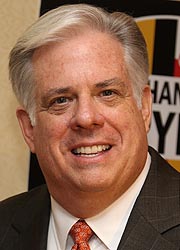
Hogan
Gov. Larry Hogan last week allowed a state-wide fracking ban to take effect without his signature.
When the ban passed in both houses of the General Assembly with a veto-proof majority, Hogan said he would neither sign the law nor veto it. The deadline for action passed Friday night, and the ban will go into effect on Oct. 1.
Sponsors of the bill said the ban would allow scientists the chance to study the potential environmental impacts of fracking. Hogan had called fracking an “an economic gold mine” during his 2014 election campaign. But since taking office in January, he had been quiet on the issue.
Protesters Interrupt Snyder; Call for Action on Enbridge Pipeline
Environmental activists opposed to an aging Enbridge oil pipeline interrupted a speech by Gov. Rick Snyder at the 2015 Mackinac Policy Conference, before being escorted out of the conference.
The protesters are calling for the closure of the 61-year-old Enbridge Pipeline No. 5, which carries crude oil from northern Wisconsin to southern Ontario beneath the Straits of Mackinac. They cited studies from an environmental nonprofit that question the pipeline’s structural integrity.
Pipeline safety is a looming issue, especially in Michigan. Just last week Enbridge reached a $75 million settlement with state environmental regulators related to a 2010 spill into the Kalamazoo River. Cleanup for that spill, which is ongoing, has already cost the company $1.21 billion.
PUC Approves $250 Million Geronimo Energy Solar Project
The Public Utilities Commission has approved a $250 million solar project comprised of 21 facilities throughout the state.
The sites for the Aurora Solar Project are mostly in rural Minnesota near established transmission lines. The power will be sold to Xcel Energy. It will be the largest solar installation in the state and increase the state’s solar output by a factor of seven. Surprisingly the project beat several natural gas projects in the bidding process.
“This signals that something big is happening in solar energy in Minnesota,” said Michael Noble of Fresh Energy, a non-profit solar advocacy group. The PUC rejected three other sites because of local zoning rules.
Literal Power Struggle Keeps Revel Casino from Opening
A legal standoff between the developer that bought Atlantic City’s Revel complex out of bankruptcy and ACR Energy Partners, its sole power supplier, will keep the shuttered casino at the complex from reopening this summer.
Glenn Straub, the developer who bought the casino, agreed to a tentative deal with ACR to keep the building minimally powered while he looks for a way to either connect into the Atlantic City Electric grid or tap into the defunct Showboat casino next door, which is now owned by Stockton University. Straub’s company, Polo North Country Club, is battling ACR over fees. The state’s second tallest building was without power for three weeks after ACR pulled the plug April 9 following the bankruptcy sale. State officials have ordered the two companies to keep the building’s fire-suppression powered. The parties also are dueling over who owns $40 million in electric equipment that connects ACR to the complex.
NYISO is changing its Consumer Impact Analysis, a process that evaluates the impact of market administration projects and rule changes, to improve transparency and provide more opportunities for stakeholder input.
The Consumer Impact Analysis evaluates the potential impact of changes based on reliability, environment, cost and transparency. The revised process will give stakeholders notice at the outset of a market design initiative if a project is expected to have a major consumer impact. Stakeholders will receive a description of the methodology to be used in the impact analysis, the results of which will be presented at least 30 days prior to stakeholder votes.
The changes incorporate feedback received from end-use consumer representatives, other market participants and policymakers.
Some residents in Walnut Grove, a town of about 1,500 located on top of potential shale gas reserves, are objecting to a state plan to conduct core sampling on publically owned land to explore for natural gas.
“The community we love is in the middle of a David-and-Goliath battle with big industries that seem to care very little about the people in the area we call home,” town resident Tracy Brown Edwards said. Walnut Grove already hosts the third-largest coal ash dump in the state.
The legislature approved fracking last year but almost immediately issued a moratorium while legal challenges are prepared.
PUCO Delays Decision on AEP’s Coal Rider Until PJM Capacity Auction, FERC Ruling
The Public Utilities Commission said it would wait until after the PJM capacity auction to rule on American Electric Power’s request to guarantee rates from its aging coal plants in return for a vow to keep them operating.
The commission in February approved most of AEP’s three-year security plan but rejected the company’s guaranteed-income request. Two other utilities — FirstEnergy and Duke Energy — have similar requests pending before the commission.
The commission said it wants to see the results of the PJM Base Residual Auction, and the final outcome of the state’s plan to meet the Environmental Protection Agency’s Clean Power Plan, before ruling. The auction for 2018-19 should have taken place in May, but it was delayed to give the Federal Energy Regulatory Commission time to approve PJM’s Capacity Performance proposal. That reform is expected to benefit coal plants in PJM, including those in AEP’s fleet.
Gov. Mulls Ban on Fracking Bans After Texas Passes Similar Law
A law prohibiting local government bans on fracking is awaiting the governor’s signature.
The Senate voted 33-13 on the bill — which also prohibits local bans on wastewater disposal wells — at the urging of the oil and gas industry. The industry has faced increased pressure from communities where fossil fuel opponents have made headway after Denton, Texas, last year voted to ban fracking within town limits. Denton is located in the heart of the Barnett Shale region.
The industry argues that regulation of oil and gas development comes under the aegis of state or federal regulators, not local officials.
Coal Alliance: Benefits of Clean Power Plan Overestimated
Pennsylvania Coal Alliance CEO John Pippy says the federal government has underestimated the cost of imposing regulations related to the Environmental Protection Agency’s Clean Power Plan and overestimated its benefits.
Washington needs to consider the effect of forcing coal plants into retirement, Pippy told the Pittsburgh Business Times. “There’s no place to sell the coal right now,” he said.
Last week, Murray Energy and Alpha Natural Resources announced layoffs of more than 2,000 people. Alpha plans to close its Emerald mine in Greene County by the end of the year. Consol Energy has said it will reduce its state mines to a 32-hour workweek.
Wolf Nominates Environmental Professional to Seat on Public Utility Commission
Gov. Tom Wolf nominated a gas industry executive and climate change researcher to the Public Utility Commission. Andrew Place, EQT ’s corporate director for energy and environmental policy, would take the place of outgoing Commissioner James H. Cawley.
“Andrew Place brings the knowledge and expertise to help advance my vision for the PUC, and I am pleased to nominate him,” Wolf said. “We must ensure there is a balance between consumers and utilities. We also have to develop Pennsylvania’s abundance of energy resources to make sure we have the infrastructure to support the natural gas and other energy industries.”
Place has degrees in economics and public policy and worked as a research fellow at Carnegie Mellon University’s Department of Engineering and Public Policy, becoming an expert in carbon capture and sequestration.
Qualifying electric vehicles bought or leased and registered in the state will be eligible for rebates of up to $2,500 beginning June 15.
The total pot of money available for consumers is $682,500, and it will be doled out on a first-come, first-served basis. Drivers of zero-emission battery electric vehicles will get $2,500. Those that lease or buy plug-in hybrid electric vehicles will receive $1,500.
Dealerships will be responsible for filing a claim and then will give the money to their customers.
Xcel Energy is asking state regulators to raise its fixed monthly fee for electricity and natural gas customers, rather than seeking an increase in usage rates.
Xcel wants to increase the fixed monthly customer charge from $8 to $18. The company said it would decrease its usage rate by about 0.7 cents/kWh. The increases would boost electricity revenue 3.9% and gas revenue 5%.
Regulators in neighboring Minnesota this year rejected a similar request by Xcel to increase the customer charge. Customer advocates said fixed-fee increases penalize smaller users and reduce the incentive to conserve. The company argues that bigger fees provide for a more equitable recovery of costs to maintain distribution networks. “The nature of the electric grid is going to change,” an Xcel executive said. “The grid is there and costs something regardless.”
Manitoba Hydro has asked the Public Utilities Board for a 3.95% increase in its electricity rate to cover increased borrowing costs, especially for projects like the Keeyask plant. The request comes after the utility received a 3.5% increase in 2013 and a 2.75 % interim increase in 2014.The Consumers’ Association of Canada and the Manitoba Metis Federation have told the PUC they oppose the rate increases, which they say will hurt lower-income customers. Consumer advocates also noted that Manitoba Hydro has said it will seek a similar increase next year.
Keeyask is a 695-MW hydro station being built on the Nelson River. When completed it will be the company’s fourth largest hydro station.