A Maryland circuit court judge Wednesday declined to stay Exelon’s acquisition of Pepco Holdings Inc. while it considers an appeal from the state’s Office of People’s Counsel.
In June, OPC appealed the Maryland Public Service Commission’s 3-2 decision to approve the $6.8 billion deal in Queen Anne’s County Circuit Court. It was joined by Public Citizen, the Sierra Club and the Chesapeake Climate Action Network. In late July the parties jointly filed a motion to stay the deal while the appeal process continued.
“It’s a denial of the motion to stay, but our appeal obviously goes forward,” People’s Counsel Paula Carmody told the Baltimore Business Journal.
“We are pleased the judge agreed with our view that the requests for a stay had no merit,” Exelon spokesman Paul Adams said in a statement.
Along with the Maryland PSC, regulators in Delaware, New Jersey and Virginia have approved the acquisition, as has FERC. Only the D.C. Public Service Commission has yet to rule on the deal. Exelon has said it expects the deal to close by the end of the third quarter this year.
Carmody told the Journal that oral arguments in the appeal are scheduled in December and acknowledged this would mean that arguments could take place after the deal is closed.
Iberdrola USA has refiled its acquisition plan for UIL Holdings with Connecticut regulators, attempting to address objections that scuttled the previous plan.
The plan, filed Friday with the state Public Utilities Regulatory Authority, promises more ratepayer benefits, increased employment in Connecticut and protections for the state subsidiaries from any financial difficulties encountered by Iberdrola’s other U.S. or international operations (15-07-38).
The lack of “ring-fencing” protection for the electric distribution company, United Illuminating, in the original February filing was one of the deal-killers that PURA staff cited in its draft decision that recommended rejection of the deal. (See Iberdrola Withdraws UIL Acquisition; Plans to Refile.) “Ring-fencing measures will protect the UIL utilities from unforeseen potential future events affecting the IUSA affiliates or their other affiliates, including utilization of a special purpose entity and a ‘Golden Share,’” the filing states. The Golden Share would be held by an independent director from outside the company who would essentially hold veto power over any voluntary bankruptcy petitions filed by UIL.
The proposal also says the utility units will be rated by the credit rating agencies and will issue their own debt. “As a result, UIL and the UIL utilities will be maintained as separate entities and be afforded with important financial and bankruptcy protections.”
“With this new application, we believe that we’ve effectively addressed all of the points of concern that were outlined in PURA’s draft decision relating to the original application,” James P. Torgerson, UIL’s president and CEO, said in a statement. “We are fully prepared to move forward in this process.”
Other proposals to smooth the approval include:
Customer rate credits of $20 million in the first year following the closing, or greater amounts spread over longer time periods;
A new management position drawn from the ranks of existing local management and based in the state, titled president of Connecticut operations;
Connecticut operations would be headquartered in the state for at least seven years;
No involuntary terminations, except for cause or performance, in Connecticut for at least three years following closing of the deal, along with a commitment for 150 new employees;
A freeze of electric distribution rates until Jan. 1, 2017; and
$6 million over three years for the state’s clean energy initiatives.
Under Connecticut law, regulators have 120 days to act on the filing.
The Environmental Protection Agency’s final Clean Power Plan provoked howls of outrage from coal interests, praise from environmentalists and cautious optimism from regulators and grid operators.
The rule was a mixed bag for the nuclear industry but a win for wind and solar power advocates. Natural gas proponents were miffed by an unexpected change that means they may benefit less than expected from coal’s decline.
On Wall Street, traders punished coal companies while many utility stocks were up modestly.
Below is a summary of the initial reactions to the final rule.
Coal: Rule is Illegal
“Even in the face of damning analyses and scathing opposition from across the country, EPA’s final carbon rule reveals what we’ve said for months: This agency is pursuing an illegal plan that will drive up electricity costs and put people out of work,” said Mike Duncan, president and CEO of the American Coalition of Clean Coal Electricity.
Arch Coal, whose shares plunged 90% on bankruptcy fears, echoed the sentiment.
“The administration seems increasingly desperate to salvage an ill-advised and poorly designed rule which won’t work, won’t pass muster with states and won’t stand up to legal scrutiny,” said Deck Slone, Arch’s senior vice president of strategy and public policy.
Regulators, RTOs: Cautiously Optimistic on Reliability Safety Valve
Federal Energy Regulatory Commission Chairman Norman Bay, a Democrat, praised EPA’s “willingness to consider potential reliability concerns and its efforts to address those concerns by adding time and flexibility for compliance, adopting a reliability safety valve and requiring state plans to be reviewed for reliability.”
Republican Commissioner Tony Clark also praised EPA’s engagement but struck a less optimistic view, warning of “the difficult path that now lies ahead.”
“The regulation makes it likely consumers will be required to bear the burden of stranded costs of investments forced to retire years before the useful life of the asset has expired,” he said. “Whatever EPA believes are the environmental benefits of this regulation, it cannot be said that it will be easy or inexpensive. Such is the stuff of unicorns and leprechauns.”
The National Association of Regulatory Utility Commissioners said it would conduct a detailed review to determine how the rules will affect states. “Although NARUC has taken no position on whether the EPA should establish these rules, we have stated that if the agency does issue rules, it should provide states with maximum flexibility to respond,” President Lisa Edgar said.
MISO said it is conducting a regional and state-by-state analysis of the rule. “We will work now on modeling the final rule and run the analysis to help stakeholders better understand compliance options,” the RTO said in a statement.
PJM said it will analyze the reliability safety valve EPA offered in response to grid operators’ concerns.
Environmental Groups Generally Pleased
Environmental groups were generally pleased, though some expressed disappointment with the delay in the initial deadlines, which were pushed from 2020 to 2022.
“For too long the United States has failed to take action on climate change, held hostage by climate deniers in Congress and by industry laggards unwilling to limit pollution that threatens the U.S. and global environment,” Conservation Law Foundation President Bradley Campbell said. “Now we finally have a plan that’s right for our environment and our economy, encouraging states to work together to reduce carbon emissions on a national scale.”
Jordan Stutt, a policy analyst at the Boston-based Acadia Center, said the experience of states participating in the Regional Greenhouse Gas Initiative has shown that a market-based program can reduce CO2 emissions while driving economic growth and innovation. “EPA has recognized this potential for low-cost emissions reductions and has designed the Clean Power Plan in a way that supports widespread implementation of RGGI-like trading programs.”
Allison Clements, director of The Sustainable FERC Project, said the plan “provides states with achievable goals to cut carbon pollution and builds upon the ample flexibilities provided in the original proposal. The final rule’s extra time for initial compliance, requirement that states consider reliability implications and limited ‘reliability safety valve’ put to bed any concerns that the rule will cause grid reliability problems.”
Wind, Solar Celebrate
Renewable energy advocates were quick to praise the plan, with the wind industry saying it could provide a majority of the clean power states will need.
“Low-cost wind energy reduced carbon emissions by 5% in 2014, and we’re capable of doing a lot more. We can build a more diverse, reliable, cleaner energy mix for America, while creating jobs and keeping money in consumers’ pockets,” said Tom Kiernan, CEO of the American Wind Energy Association.
Not to be outdone, the solar industry said that it can provide a 50-state solution.
“Solar energy is the most sensible compliance option for states under the Clean Power Plan. Solar works in all 50 states, has zero carbon emissions, creates more jobs per megawatt than any other technology and can be deployed cost-effectively and quickly — all while improving grid reliability,” said Rhone Resch, CEO of the Solar Energy Industries Association.
Mixed Emotions for Nuclear
The Nuclear Energy Institute said it was pleased that the final rule will count nuclear plants under construction and plant uprates toward compliance rather than the starting point for goal-setting calculations.
“Based on our preliminary review, the final rule appears to require larger carbon reductions than the proposed rule and places a greater emphasis on mass-based compliance approaches. Those two factors alone should drive increased recognition of the value of existing nuclear power plants,” it said.
The group said it was disappointed, however, that EPA did not incorporate the “carbon-abatement value” of existing nuclear power plants.
Exelon says its Clinton nuclear plant has been losing money due to low natural gas prices and competition from wind. The Nuclear Energy Institute expressed mixed feelings about the final EPA rule. (Pictured above: Clinton nuclear plant. Source: Exelon)
“EPA notes correctly that ‘existing nuclear generation helps make existing CO2 emissions lower than they would otherwise be but will not further lower CO2 emissions below current levels.’ What the final rule fails to recognize is that CO2 emissions will be significantly higher if existing nuclear power plants shut down prematurely.”
Natural Gas: Half a Loaf
Calpine, the country’s largest generator using natural gas, called the plan “a workable and achievable approach to control CO2 emissions that will benefit generations to come.”
“This flexible, market-based solution will reward the companies that invest and have invested smartly in cleaner generation,” CEO Thad Hill said.
America’s Natural Gas Alliance took issue with changes from the proposed rule that mean natural gas will fill less of the void left by retiring coal generators.
“The White House is ignoring market realities and discounting the ability of natural gas to achieve the objective of emissions reductions more quickly and reliably while powering growth and helping consumers,” said the group, which represents independent gas exploration and production companies. “We believe the White House is perpetuating the false choice between renewables and natural gas. We don’t have to slow the trend toward gas in order to effectively and economically use renewables.”
The Edison Electric Institute said its primary concern “remains the overall timing and stringency of the near-term reduction targets.”
“Until we review the final guidelines in their entirety, it is difficult to assess whether they address the range of concerns we have raised over the past year. Ultimately, it is imperative that the final guidelines respect how the electric system works and provide enough time and flexibility to make the necessary changes to achieve carbon emission reductions.”
Business and Industry Split
Businesses outside the electric industry were split.
Last week, 365 companies and investors sent letters to more than two dozen governors voicing their support for the plan and encouraging the states’ “timely finalization” of implementation plans to meet the new standards.
“Our support is firmly grounded in economic reality,” wrote the businesses, including industry giants such as General Mills, Mars, Nestle, Staples, Unilever and VF Corp. “Clean energy solutions are cost-effective and innovative ways to drive investment and reduce greenhouse gas emissions. Increasingly, businesses rely on renewable energy and energy efficiency solutions to cut costs and improve corporation performance.”
“Having access to clean energy choices, whether efficiency or renewable energy, helps us manage our energy-related costs while also reducing our environmental impact,” said Letitia Webster, senior director of global sustainability at VF Corp., a North Carolina-based apparel company whose brands include The North Face and Timberland.
The American Iron and Steel Institute said, however, that the rule will raise electricity costs for domestic steel companies and threaten the industry’s ability to remain competitive with foreign suppliers.
“The leading steel-producing states in the U.S. are heavily dependent on coal for electricity production. This rule will have a disproportionate impact on coal-fired utilities and, in turn, impede economic growth for steelmakers,” CEO Thomas J. Gibson said.
Gibson added that the domestic steel industry competes with steel producers in countries where energy costs are often subsidized. “Limitations on CO2 emissions instituted in the U.S. must also apply at the same level of stringency to other major steel-producing nations, such as China. Otherwise, steel production and manufacturing jobs will shift to other nations with higher rates of greenhouse gas emissions.”
Stock Market
While the Dow Jones Industrial Average closed down 91.66 points (a 0.52% drop), electric utility stocks generally fared well. Nuclear-heavy Exelon was up 1.1%, while coal-dependent companies fared slightly worse, with Duke Energy gaining 1%, American Electric Power up 0.85%, Southern Co. up 0.51% and Entergy up 0.4%.
Not unexpectedly, major coal companies suffered through a tough Monday. Arch Coal saw its shares drop from $1.80 to 18 cents, while Peabody Energy was down 9.2%. Consol Energy, a coal, oil and natural gas company with a mining business focused in the Appalachian Basin, dropped 7.6%.
After sifting through 4.3 million comments and attending months of meetings with state regulators, utilities and RTO officials, the Environmental Protection Agency yesterday released a final Clean Power Plan that relaxes some controversial proposals while increasing its target for emission reductions.
As expected, EPA bowed to nearly universal opposition to a requirement that states meet interim goals as soon as 2020, replacing that with a 2022 target while leaving 2030 as the deadline for full compliance. As also expected, the rule incorporates a reliability “safety valve.”
At the same time, the Obama administration upped its ultimate target, saying it will require a 32% reduction in power plant CO2 emissions from 2005 levels, up from 30% in the draft rule.
EPA said it will permit all low-carbon resources, including renewables, energy efficiency, natural gas, nuclear and carbon capture and storage to have roles in compliance.
Natural gas generators will play a smaller role in replacing retiring coal plants under the final rule than EPA projected in its draft plan. Source: Duke Energy
But the final plan anticipates less switching from coal to natural gas and more reliance on — and incentives for — renewables. EPA projects renewables will account for 28% of generating capacity by 2030, up from 22% in the proposed rule, an increase of nearly one-third.
EPA said it increased renewables’ role in part because of the falling cost of solar and wind power and expectations of additional reductions in the future. The agency will seek to take advantage of those economics while offering pollution credits for states that add renewables before 2022, with similar incentives for those that make early energy efficiency investments in low-income communities.
Trading-Ready State Plans
In addition to delaying initial compliance by two years, EPA said the final rule also grants states more flexibility in meeting their targets, allowing them to develop trading-ready compliance plans for participating in emission credit markets with other states without the need for complicated interstate agreements.
State plans are due in September 2016, but states that need more time can make a preliminary filing and request extensions of up to two years for submitting a final plan.
Litigation Expected
EPA also released a federal implementation plan that it said can provide a model for states while also serving as a “backstop” for states that balk at compliance.
The solar industry says it offers a “50-state” solution to replacing coal-fired generation.
EPA will have to use that backstop if some states stand firm in their pledges to refuse to comply, as Senate Majority Leader Mitch McConnell, a Republican from coal-producing Kentucky, has urged. About two dozen states have indicated they may challenge the plan in court.
EPA, however, says that many states are already on the path to compliance, noting that all states have demand-side energy efficiency programs and all but 13 have renewable portfolio standards or goals. Half of the states have energy efficiency standards or goals.
“The idea of setting standards and cutting carbon pollution is not new. It’s not radical,” President Obama said at a White House ceremony announcing the plan. “What is new is that, starting today, Washington is starting to catch up with the vison of the rest of the country.”
Reliability ‘Safety Valve’
The rule seeks to ensure sufficient generation resources by requiring states to address grid reliability in their plans and includes a “safety valve” that could buy some retiring generators additional time to address any reliability concerns.
EPA noted that — unlike the Mercury and Air Toxics (MATS) rule — the Clean Power Plan does not impose plant-specific requirements, allowing states flexibility to “smooth out” their emission reductions over time and across sources.
International Audience
The Clean Power Plan is the latest of the Obama administration’s initiatives — which includes the controversial loan guarantees for clean energy technologies, a doubling of fuel economy standards for cars and light trucks, and a separate rule limiting emissions from new power plants — directed at climate change.
By now addressing power plant emissions — the largest source of greenhouse gases (32% of the U.S. total) — the Clean Power Plan will give the Obama administration a platform for urging other nations to cut their emissions at a United Nations climate change conference in Paris in December.
“I am convinced that no challenge poses a greater threat to our future and future generations than a changing climate,” Obama said in a 25-minute speech that was frequently interrupted by applause from supporters.
Obama also quoted the observation of Washington Gov. Jay Inslee: “We’re the first generation to feel the impact of climate change and the last generation that can do something about it.”
“We only get one planet,” Obama continued. “There’s no plan B.”
What Changed in the Final Rule?
The Environmental Protection Agency made a number of significant changes to the final Clean Power Plan based on feedback to the preliminary plan released last year. Here is a summary of the most important changes:
Source‐specific CO2 emission performance rates: The plan uses two different CO2 emission rates to define the “best system of emission reduction” (BSER), one for coal-steam and oil-steam plants and a second for natural gas plants.
Rate‐ and mass‐based state goals: The plan uses the CO2 performance rates to set both rate‐based (CO2 lbs/MWh) and mass‐based goals (total CO2 metric tons) for states. The draft rule used only rate-based targets; the mass-based targets were added to accommodate states that want to take part in emissions trading.
Energy efficiency building block eliminated: The final plan eliminates building block 4, relying on demand‐side energy efficiency, reportedly due to concerns it might be unenforceable: utilities can’t control their customers’ efficiency. “EPA nonetheless anticipates that, due to its low costs and potential in every state, demand‐side EE will be a significant component of state plans,” the agency said.
Refinements to the three remaining building blocks:
Building block 1: Improved efficiency at power plants. EPA originally proposed heat rate improvements of 6% for coal and oil generators, which industry officials said was unachievable. The final rule anticipates improvements of 2.1 to 4.3%, depending upon the region.
Building block 2: Shifting generation from higher emitting coal to lower emitting natural gas power plants. The final rule assumes natural gas plants will run at 75% of net summer capacity. The draft expected natural gas units to run at 70% of their nameplate capacity, a metric that many commenters said was incorrect because it doesn’t reflect real operating conditions.
Building block 3: Shifting generation to zero‐emitting renewables. The final BSER analysis does not include existing or under‐construction nuclear power or existing utility‐scale renewable energy generation as part of building block 3. EPA expects a bigger role for renewables than originally proposed “based on up‐to-date information clearly demonstrating the lower cost and greater availability of clean generation than was evident at proposal. It takes into account recent reductions in the cost of clean energy technology, as well as projections of continuing cost reductions.” Generation from under‐construction nuclear facilities and nuclear plant uprates can still be incorporated into state plans and count towards compliance. “Nuclear power competes well under a mass‐based plan, as increased nuclear generation can mean that fossil fuel units are operating less and emitting fewer tons of CO2,” EPA said.
Grid reliability measures: States must show they have considered reliability in developing their compliance plans, “such as consultation with appropriate state reliability or planning agencies.” To address unexpected reliability concerns, states can amend their approved plans or seek temporary relief under a reliability safety valve.
Trading‐ready mechanisms: In response to concerns that requiring formal, up‐front agreements between states would deter use of trading as a compliance mechanism, the final rule allows states to design rate‐based or mass‐based trading-ready plans permitting individual power plants to use out‐of‐state reductions to achieve required CO2
Clean Energy Incentive Program: EPA will reward states making investments in renewable energy and demand‐side energy efficiency projects implemented in low‐income communities during 2020 and 2021 by awarding them emission rate credits (ERCs) or allowances.
Relaxed initial deadlines: The plan allows states a two‐year extension to submit compliance plans. By September 2016, states must submit either a final plan or an initial plan with a request for an extension to September 2018. Initial compliance goals will go into effect in 2022, not 2020.
Ameren reported last week that earnings were flat in the second quarter, largely on milder temperatures that reduced demand for electricity.
The St. Louis-based company earned $150 million ($0.61/share) compared with $149 million ($0.61/share) in the same period last year. Operating revenues were $1.40 billion versus $1.42 billion last year.
Ameren said its results were buoyed by earnings from investment in electric transmission and delivery infrastructure, along with a lower tax rate.
The company raised its full-year earnings-per-share guidance slightly, to $2.48 to $2.68 from $2.45 to $2.65.
— Chris O’Malley
Lower Revenues Dim CMS Energy Profits in Q2
Second-quarter net income for CMS Energy fell 19% on a 8% decline in revenue, the company reported last week.
The Jackson, Mich.-based parent of Consumers Energy earned $67 million ($0.25/share) compared with $83 million ($0.30/share) during the second quarter of last year. Revenue was down to $1.35 billion, from $1.47 billion a year earlier.
Nevertheless, CMS reaffirmed its 2015 earnings-per-share guidance of $1.86 to $1.89, consistent with its goal of 5 to 7% annual adjusted EPS growth.
President and CEO John Russell said CMS is still on track to retire its seven oldest coal plants — amounting to one-third of its coal fleet — by next April. The units being shuttered are an average of 60 years old and will be replaced by gas-fired units.
Russell also said CMS will proceed with its first-ever utility-scale solar generating station. The 10-MW demonstration project will be evaluated for the potential of additional utility-scale units in Michigan.
— Chris O’Malley
Unfavorable Weather Cited in DTE Earnings Drop
DTE Energy’s second-quarter profits fell 12% on increased costs and unfavorable weather.
The Detroit-based company posted net income of $109 million ($0.61/share) compared with $124 million ($0.70/share) in the same quarter last year.
Operating earnings in DTE’s electric segment were down by $18 million, while the gas utility segment recorded a $3 million decline. Operating revenue for the company fell 15%, to $2.27 billion.
During a conference call, executives cited strong growth in the gas storage and pipeline business and in energy trading. As a result, DTE raised its 2015 operating EPS guidance to $4.54 to $4.90, from $4.48 to $4.72.
— Chris O’Malley
Eversource Q2 Earnings Jump 63%
Eversource Energy said last week that the company’s second-quarter profits this year increased by nearly 63%, from $127.4 million ($0.40/share) in 2014 to $207.5 million ($0.65/share).
“We had an excellent first half of 2015, with financial performance consistent with our targeted 6 to 8% long-term earnings growth rate and our 2015 projected earnings of $2.75 to $2.90 per share,” Eversource CEO Thomas May said in a statement.
“We don’t believe it poses any unanticipated challenges to the construction of the project,” said Lee Olivier, executive vice president of enterprise strategy and business development. He added that plans for site approval will be filed with state officials in “early to mid-fall,” with review taking about one year.
— William Opalka
Exelon: Quad Cities Decision as Soon as September; Awaiting Pepco Decision from DC
Exelon CEO Chris Crane told analysts during the company’s quarterly earnings conference call that if Illinois legislators fail to pass a law that would essentially guarantee profits for its nuclear plants, the company may be forced to close its Quad Cities generator, with a decision coming as soon as September.
Crane and other company officials have long said that three of its six nuclear stations in Illinois are losing money on the wholesale market, primarily because low natural gas prices are pushing wholesale power prices down.
Even anticipated revenue boosts from PJM’s Capacity Performance program “will not be enough to keep all the units economically viable,” Crane said. The decision on whether to keep its Clinton nuclear station open — which bids into MISO and therefore is governed by different rules — won’t be made until the first months of next year.
“We don’t take the decision lightly,” Crane said. “We understand the effect that we have on the communities and potential effect on employees, but this has been a long-term issue that we’ve been evaluating and trying to come to a resolution [on], and we’re staying within the timeline.”
Exelon reported second-quarter earnings of $508 million ($0.59/share) compared with $440 million ($0.51/share) this time last year.
The company said profit rose due to higher sales and a hedging-related gain. Crane also credited strong financial performance by Exelon Generation.
Crane also said the company is prepared to quickly finalize its $6.8 million acquisition of Pepco Holdings Inc., pending approval by regulators in D.C. As the company awaits the ruling, expected late this month, it extended the deal’s termination date from July 29 to Oct. 29.
Pepco’s second-quarter earnings were flat compared with the same period in 2014, with net income of $53 million ($0.21/share).
“Increased operation and maintenance costs, primarily driven by the implementation of a new customer information system, impacted second-quarter results,” CEO Joseph Rigby said.
— Suzanne Herel
FirstEnergy Beats Expectations
FirstEnergy beat its own expectations, reporting second-quarter net income of $187 million ($0.44/share) compared with $64 million ($0.16/share) for the same period last year, despite the fact that the company’s revenues stayed flat at $3.5 billion, the company said.
“We remain focused on implementing our regulated growth initiatives and our Cash Flow Improvement Project, which was launched in April,” CEO Charles Jones said in a statement. “I’m pleased that the opportunities we have identified as part of that project are expected to result in cash savings of $240 million by 2017, exceeding our original targets.”
Operating earnings for the Akron, Ohio, company’s regulated distribution business were flat compared with the same period last year, as the benefit of higher distribution revenues and approved rate cases was offset by higher operating expenses and a higher effective income tax rate.
The regulated transmission business saw higher transmission revenues, in part related to the company’s Energizing the Future plan to upgrade its grid.
The company’s competitive energy services benefited from lower operating expenses and a slightly higher commodity margin compared with last year.
The company said the loss reflected a $1 billion hit from discontinued operations of the competitive supply business.
For the same period last year, PPL had reported net income of $229 million ($0.34/share).
Not taking into consideration the spinoff and some other accounting items, the utility reported second-quarter earnings of $329 million ($0.49/share), an 11% increase from adjusted earnings of $296 million ($0.44/share) for the same period in 2014.
The company also narrowed its 2015 forecast range from ongoing operations to $2.15 to $2.25 per share and increased its quarterly common stock dividend to $0.3775/share.
“Based on the strong performance of PPL’s seven regulated utility businesses in both the U.S. and the U.K., the continued rate base growth from our significant infrastructure investment and our solid business plan to grow earnings per share, we are increasing the midpoint of our 2015 earnings forecast,” CEO William H. Spence said in a statement.
“The new PPL Corp. — with its strong growth profile, a solid dividend and diverse mix of holdings — is a unique and very compelling investment option in the U.S. utility sector,” he said.
— Suzanne Herel
PSEG Q2 Earnings Up 62%
Public Service Enterprise Group on Friday reported second-quarter net income of $345 million ($0.68/share) compared with $212 million ($0.42/share) for the same period in 2014.
“Our businesses performed well. [Public Service Electric & Gas’] expanded investment program is successfully translating into improvements in customer satisfaction at the same time operational improvements at PSEG Power supported increased output,” CEO Ralph Izzo said in a statement.
Operating earnings for PSE&G rose to $167 million ($0.33/share) from $151 million ($0.30/share) this time last year. The company attributed the boost to an expansion of its capital program, warmer-than-normal temperatures and a recovering economy.
Meanwhile, PSEG Power reported operating earnings of $110 million ($0.22/share) compared with $87 million ($0.17/share) this time last year.
The company said the results reflect improvement in operations of its nuclear and fossil fuel generating facilities, higher prices on its hedged energy output and a drop in the cost of its gas supply.
— Suzanne Herel
WEC Energy Group Erases $0.24/Share on Integrys costs
Costs related to its June acquisition of Integrys Energy put the squeeze on WEC Energy Group’s second-quarter profits.
Milwaukee-based WEC earned $80.9 million ($0.35/share), a 39% decline from $133 million ($1.04/share) in the second quarter of 2014. Excluding the acquisition costs, which cut EPS by $0.24, WEC would have reported EPS of $0.59.
Like many northern utilities, a cooler-than-normal June crimped electricity revenues. Operating revenues declined to $991.2 million from $1.04 billion last year.
WEC’s results do not yet include the financial performance of Integrys or its subsidiaries.
— Chris O’Malley
Xcel Reports Flat Earnings for Q2
Xcel Energy reported flat profits for the second-quarter, with earnings of $197 million ($0.39/share), compared with $195 million ($0.39/share) for the same period last year.
Minneapolis-based Xcel said the results were generally in line with expectations. Though the company missed analysts’ estimates by $0.01/share, it reaffirmed its full-year earnings-per-share guidance of $2 to $2.15.
Xcel blamed unfavorable weather conditions that affected customers’ heating and cooling costs and adjustments to a rate request in Minnesota.
Second-quarter electric margins increased due to new rates and riders in various jurisdictions and a lower Public Service Company of Colorado earnings test refund. Xcel said that increase was offset by higher depreciation, a lower allowance for construction funds and higher property taxes, operating and maintenance expenses and interest charges.
Xcel’s Monticello nuclear plant is operating at full capacity, having received final Nuclear Regulatory Commission approval. The facility was uprated to 671 MW from 600 MW in 2013, at a cost of $748 million (a $0.16/share hit to profits). Xcel said its Cherokee combined-cycle plant in Colorado completed its first-fire during the quarter and is on budget and on time.
PJM and nine interstate pipelines have signed an information-sharing agreement to improve the reliability and flexibility of natural gas supplies for the RTO’s generators.
The pipelines said they are willing to sign contracts to “firm up” services for generators that do not have primary firm service. The MOU notes that the pipelines may require additional facilities to provide firm service.
Each of the pipelines will provide PJM a description of services they are offering to generators that could satisfy the RTO’s Capacity Performance requirements. They also agreed to provide PJM a summary of services that have been requested by generators and the status of those requests. PJM may share any information obtained under the MOU with the Independent Market Monitor.
In return, PJM will provide the pipelines with performance requirements for gas-fired generators serving as capacity resources, including a demonstration of access to firm gas during the peak hours of the electric day and evidence of hourly flexibility — ensuring that generators will not seek compensation due to an inability to procure gas outside the normal scheduling window.
“This agreement sets the stage for greater coordination between electric generators and the natural gas pipeline industry,” said PJM Chief Operations Officer Mike Kormos in a statement. “As electricity-generating facilities increasingly turn to natural gas, it is important that we all communicate clearly to assure reliable service.”
“Continued dialogue will result in more informed decisions by the PJM market participants that operate and rely upon gas-fired electric generators,” said Don Santa, CEO of the Interstate Natural Gas Association of America.
According to data from the U.S. Department of Energy, natural gas surpassed coal as the country’s top source of electric power generation for the first time in April.
The pipelines signing the MOU are Dominion Cove Point LNG; Dominion Transmission; Columbia Gas Transmission; National Fuel Gas Supply; Natural Gas Pipeline Co. of America; Tennessee Gas Pipeline; Texas Eastern Transmission; Texas Gas Transmission; and Transcontinental Gas Pipe Line.
The agreement will run through June 2016, after which it will continue on a month-to-month basis unless terminated by the parties.
CARMEL, Ind. — News that MISO is reconsidering a market congestion project in Southern Indiana sparked renewed complaints from developers over the RTO’s transmission planning processes.
MISO officials told the Planning Advisory Committee on Wednesday that they were considering swapping one Southern Indiana project for a second one on which PJM has offered to assume more than one-third of the cost.
Despite a potential $29 million in savings for MISO, transmission developers accused the RTO of disregarding its transmission planning process and not giving stakeholders enough time for review.
The new development came as some stakeholders were still simmering over the way in which MISO approved Entergy’s $187 million out-of-cycle upgrade near Lake Charles, La. Only a few hours before MISO’s presentation to the committee, PAC participants were discussing ways to restructure the out-of-cycle review and approval process to address their concerns. (See Ideas to Reform MISO Out-of-Cycle Process Emerge.)
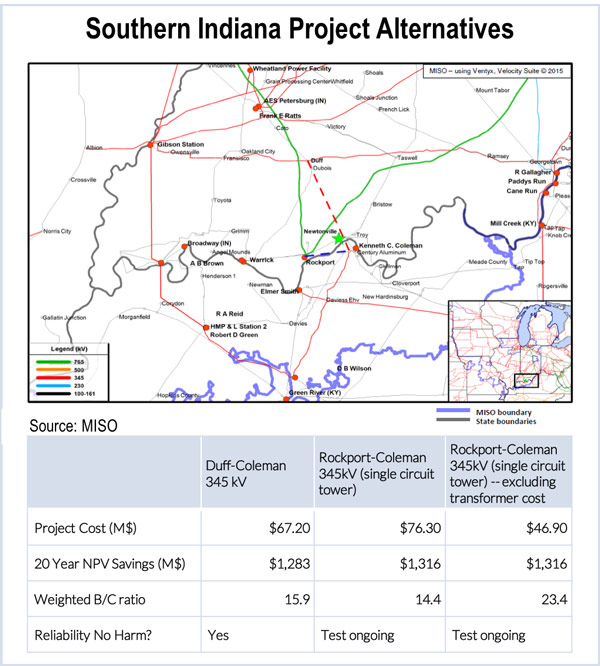
But it seemed that any goodwill created by potential out-of-cycle reforms had evaporated by the afternoon, when MISO proposed replacing the Southern Indiana project that was judged as having the highest benefit-cost ratio among proposed market congestion projects in the North-Central region: the 345-kV Duff-Coleman project, estimated to cost $67.2 million.
MISO planners are considering replacing the 345-kV Duff-Coleman transmission project (red dotted line) with the 345-kV Rockport-Coleman project (blue dotted line). The Rockport-Coleman project’s benefit-cost ratio to MISO jumps from 14.4 to 23.4 when PJM assumes the cost of the transformer. (Click to zoom.)
MISO staff said they are considering replacing Duff-Coleman with the project with the second-highest cost-benefit ratio, the $76 million 345-kV Rockport-Coleman line.
PJM recently proposed picking up the cost of a 765/345-kV transformer connecting the Rockport substation. “This would potentially reduce the total MISO cost by $29 million and make Rockport-Coleman 345-kV … the project with the highest B/C ratio,” according to the presentation.
Stakeholder Feedback Loop
George Dawe, vice president at Duke American Transmission Co., was incredulous.
“What you’re saying is that this needs to be done quickly. And we’ve already heard about the cost estimation process [this morning] and how there’s supposed to be a stakeholder feedback loop and [yet] there’s a whole bunch of things that tend to need to happen at the last minute [without stakeholder review or process], just before the System Planning Committee needs to get a recommendation. And we scurry around to try to find answers,” he said.
‘Rigidity of Process’
Jeff Webb, MISO’s director of planning, denied that the RTO was “flipping gears” or that it was suddenly committing to Rockport-Coleman. Webb said MISO is only exploring the idea because PJM came to the table with an idea that provided potential cost savings.
“The only thing we don’t want to happen is the rigidity of the process, George, to interfere with progress in doing the right thing. And I don’t think [the Federal Energy Regulatory Commission] would want that either, unless in doing so that we are somehow egregiously creating an inequity for someone.”
Dawe complained that, while he had seen a lot of cost information about the Duff-Coleman project, “I haven’t seen anything on Rockport.”
Digaunto Chatterjee, MISO senior manager of economic studies, countered that the RTO has been evaluating both Southern Indiana projects since at least the beginning of the year, and thus it is not comparable to an out-of-cycle project request. “This isn’t a brand-new project. We’ve been studying it.”
‘Smells Like’ Cross-Border
Dawe and other stakeholders questioned whether PJM’s financial assistance made Rockport-Coleman an interregional project subject to review by the Interregional Planning Stakeholder Advisory Committee (IPSAC).
“My issue is that it looks and smells like a cross-border project. And it’s not following that cross-border project process,” Dawe said.
Flora Flygt, strategic planning and policy advisor at American Transmission Co., echoed Dawes’ concern. “We’re now taking what is part of an [market efficiency project] process and now we’re turning it into [a multi-value project], an interregional MVP, basically.”
Chatterjee disagreed, saying it is not an interregional project as defined in the RTOs’ joint operating agreement.
“We’ve been through the IPSAC and it has resulted in no projects,” Webb added. “We’re looking for a way to get something to result in projects.”
During its annual meeting in June, MISO said it will reevaluate metrics used in evaluating market efficiency transmission projects (MEPs) because of concerns they are unduly conservative and prevent viable solutions to congestion. (See MISO to Reevaluate Metrics on Market Efficiency Tx Projects.)
Delays Feared
Chatterjee said MISO will soon discuss the matter further with PJM and make a recommendation — likely at the next PAC meeting.
Flygt said she feared the review could result in delays, with the next PAC not until Aug. 19 and the MISO Transmission Expansion Plan (MTEP) is scheduled to go to the board Dec. 10. “We’re sitting here at the end of July,” she said.
Webb insisted the review would not cause delays, and PJM’s Chuck Liebold assured the committee that his RTO could quickly analyze an interconnection request.
“The first thing I said [to PJM] was if this keeps us from taking an MEP to the MISO board in MTEP 15, it’s a show stopper,” Webb said. “If there’s a delay we’re doing Duff-to-Coleman, OK? If we can get this done and we can show ourselves and stakeholders that this is a better deal for MISO, we certainly want to let MISO know that.”
11th Hour Concerns
Flygt said that FERC Order 1000 requires transparency at every point in the process. “When you’re in a competitive market and you’ve got these processes to follow, I think it’s more important to follow the process than the implication that we’re getting here.”
PAC Chairman Bob McKee said he was concerned that, after all the analysis, the proposed alternative was only coming up now. “Why are we getting all this shuttle diplomacy and all of this right at the 11th hour, right before we’re to go to the board?”
Webb replied that PJM became aware of the potential for a win-win solution, albeit “late in the game.”
“I think it’s unfortunate that the awareness came late and I think that’s a process issue. That’s the point I’m raising,” McKee said.
No Violation of MISO Process
Kip Fox, director of transmission strategy and grid development at American Electric Power, said MISO identified three projects with similar benefit–cost ratios. “In my mind, this is the way the process is supposed to work. I don’t see a lot of process change. These projects have been talked about ever since we went through the [market congestion planning study] process.”
McKee wasn’t buying it. “I would say I respectfully disagree that this is how the process should work. The reason why I say this is that, look at all the confrontation that we’ve had,” he said.
Webb said if a plan is presented to MISO stakeholders that produces more benefits to the RTO at a lower cost, but the stakeholders rejected it because it didn’t follow a certain process that they were comfortable with, “I think we will want to make that clear so that FERC at the end of day can react to that too.”
If MISO stakeholders demonstrate that the project doesn’t follow the process and can’t be done, “then that’s probably the way it will end up,” he added.
Webb said that it was “a little murky” to him about what part of the process MISO is violating.
“We had the [Rockport-Coleman] project here already. The only thing new is that the entity that we already had studied, that we were going to connect to [PJM], said, ‘Yeah, that’s a great idea. … That’s the only change so I’m not sure that’s a big process change.”
KANSAS CITY — The Integrated Marketplace’s first 12 months of operations provided the highlights for SPP’s 2014 State of the Market report, which notes a maturing market, changing congestion patterns due to completed transmission projects and lower energy prices.
Alan McQueen, director of SPP’s Market Monitoring Unit (MMU), briefed the Board of Directors/Members Committee last week on the draft report.
The report says the market, which went live in March 2014, “provided wholesale electricity at modest prices that compare favorably to those in regions with well-established markets,” with LMPs generally tracking the steadily decreasing price of natural gas.
“We saw significant maturing and growth in the market, maturing in the market participants and in how they participated in the market,” McQueen said. He pointed to “robust participation” in the day-ahead market, with 99% of the reported load clearing, efficient management of wind resources and reductions in uplift.
“We saw fewer make-whole payments in this market, and that’s a good thing,” McQueen said. The report said make-whole payments made up less than 1% of electricity’s “all-inclusive price,” with 70% of make-whole payments related to reliability unit commitments.
Golden Spread Electric Cooperative’s Mike Wise, however, challenged McQueen’s assertion. He said the market’s make-whole payments are low because of its over-reliance on simple-cycle combustion turbines as quick-start resources in the RUC market.
“The market wants to use them all the time, but it’s not paying the startup costs,” Wise said. “We’re having more maintenance costs because they’re being run so much.”
In response, McQueen said the Monitor doesn’t believe startup charges should be included as costs recovered through make-whole payments.
“It’s an area of concern, but we have a difference of opinion,” McQueen said.
McQueen said the Market Working Group will study the issue further.
McQueen said there also needs to be further discussion with the MWG related to the transmission congestion rights (TCR) market. He said TCRs have been underfunded each month (85% of full funding), while the opposite is true of auction revenue rights positions (112% of full funding). “The concern is that if all the ARRs and TCR rights are allocated early in the process, they can’t be supported by the market later in the year.”
The report recommends reducing the amount of transmission capacity made available in the TCR and ARR process, earlier reporting of planned transmission outages and improvements to modelling of the conversion of ARRs to TCRs.
(Click to zoom.)
The report also said SPP successfully integrated 9 GW of wind turbines in 2014. Wind produced as much of 33% of the RTO’s energy needs during the year. The market also navigated a winter-weather event with a natural gas supply shortage in March and coal delivery delays through the summer and fall.
Board Chairman Jim Eckelberger said his reading of the report indicated “we have done a good job starting the market, but it seems we’re missing a lot of equipment members have to offer.” He asked MOPC chair Noman Williams of South Central MCN to brief the MOPC and MWG on the report to ensure “good ideas are being pursued” and gather additional feedback on market improvements.
“I disagree with how the MWG has approached this thing. I think rapid-cycle CTs need to be handled differently,” Eckelberger said. “I want to ensure Noman makes sure all sides are addressed.”
NEW YORK — While the New York Public Service Commission may seem to be driving the Reforming the Energy Vision initiative, it is public demand for more control over their energy choices that is the true driver, speakers said at the Infocast New York REV Summit last week.
The challenge, said Jigar Shah, president of Generate Capital, is harnessing the public interest and providing the regulatory structure to enable markets to provide services and technologies that support distributed energy resources (DER).
“Customers do want access to innovative technology, that’s absolutely true, but whether it’s 50% of customers, or 10% of customers, it doesn’t matter. That 10% can create a grassroots movement that’s the type that bowls over politicians. You don’t need 50%,” said Shah, the founder of renewable generator SunEdison.
Shah said the relationship of the utility with the public radically changed as a result of Hurricane Irene and Superstorm Sandy in 2011-12, “with people saying, ‘Wow, I can be out of power for two weeks, and what can I do to solve that problem?’”
That also changed the role of regulators, said Anthony Belsito, a PSC policy advisor. “The former model was regulating from the top down, and it was easy to hang out in the ivory tower,” he said. “… We’ve seen public involvement in the two REV proceedings that so far has been unprecedented.”
O’Brien
David O’Brien, vice president of BRIDGE Energy Group, said New York’s initiative is a start. “Are regulators fully prepared to tackle these issues or to look at the complexity of all this? My feeling is not necessarily,” he said. “But what I really like about REV is its comprehensiveness.”
DeCotis
Paul DeCotis, a director at West Monroe Partners, also expressed doubts. “I have a real concern that there’s a lack of real hard evidence on how to determine the impact [of DER] on cost,” he said.
“There’s a real reason there’s a tension in this room,” said Chris Hickman, CEO of Innovari. “At its core, everybody here knows we better not screw this up.”
Federal regulators’ approval last week of SPP’s request to terminate an interconnection agreement with the proposed Tres Amigas “superstation” won’t hurt plans to unite the three major U.S. grids, developers said (ER15-1797).
“In our minds, it’s not that significant,” Tres Amigas CFO Russ Stidolph said in an interview Monday. “While the ruling canceled the agreement, it also said as soon as the participants are ready to work together again, they can. It’s not the end of the world for us.”
The Federal Energy Regulatory Commission’s ruling ending the agreement with Xcel Energy’s Southwestern Public Service noted that Xcel and SPP are “willing to work with Tres Amigas” on a new interconnection agreement once the developers can meet contractual milestones.
‘No Appreciable Progress’
SPP filed the termination request in May after the company told FERC that Tres Amigas had failed to make an initial $1.4 million payment. SPS said it had already agreed to cut the payment from $7.5 million and that it extended compliance deadlines four times, delaying the agreement’s commercial-operation date by two years.
Xcel said that Tres Amigas made “no appreciable progress toward placing its transmission line project in service or interconnecting with the SPS transmission system,” creating uncertainty for SPS as it plans its transmission system.
Stidolph said making that payment would have committed Tres Amigas to spending $500 million immediately. “That was not a good use of capital for us,” he said.
Tres Amigas would connect the Eastern Interconnection, Western Interconnection and Texas Interconnection through HVDC lines. Developers say the project would use the latest power grid technology to “facilitate the smooth, reliable and efficient transfer of green power from region to region.”
SPS would provide Tres Amigas with its link to the Eastern Interconnection. The project would be built on 14,400 acres in Curry County, N.M., near the city of Clovis and the Texas border.
Fundraising Slow
Project developers have been slow to raise funds for the $1.6 billion project and have yet to set a groundbreaking date after initially saying construction would begin in 2014. In January, Curry County commissioners voted unanimously to ask the state to reallocate $350,000 intended for Tres Amigas, so the county could use the money elsewhere.
Asked about groundbreaking, Stidolph said Monday, “I think you will see activity out there by year’s end.”
Stidolph said Tres Amigas is finalizing agreements with wind developers that would ship power from eastern New Mexico to the west.
“We’ve had no issue giving [Public Service Co. of New Mexico] notice to proceed on the western side,” he said. “We’ve posted significant capital there.”
Tres Amigas protested the termination because, “given the complexities of its project, it has not been able to secure funding.”
“Transmission development is not easy,” Stidolph said. “It takes longer than you think, and it always ends up costing more.”
The interconnection agreement, originally filed in 2013, would have linked a 73-mile, 345-kV Tres Amigas-owned transmission line providing a 750-MW, two-node intertie between the SPS transmission system in the Eastern Interconnection and the PNM transmission system in the Western Interconnection.
Texas Roadblock?
The project may also be facing further roadblocks in Texas, which has long prided itself on having its own electric grid, exempt from FERC regulation. In June, Texas Gov. Greg Abbott signed into law a bill that gives the Public Utility Commission of Texas the ability to sign off on major power lines connecting ERCOT to multi-state grids elsewhere.
State Sen. Troy Fraser, the bill’s author and a long-time proponent for the Texas electric industry, believes the state should make those kinds of decisions.
“These interconnections can create tremendous risk for our electric system, including having Texas lose control over its own electric system,” Fraser said during hearings in March.
The bill says electric utilities or municipally owned utilities “may not interconnect a facility to the ERCOT transmission grid that enables additional power to be imported into or exported out of the ERCOT power grid,” unless a certificate of convenience and necessity (CCN) is obtained from the PUCT. The bill requires the application for a CCN be made at least 180 days before the developer seeks a FERC order related to the interconnection.
Tres Amigas is one of several projects managed by Connecticut-based AltEnergy, an investment fund focused on alternative energy and agriculture.