KANSAS CITY — SPP’s Z2 credit project, years in development and the source of much member frustration, is on track to be completed in 2016. But those involved say they can’t estimate the size of the bills SPP may be handing out as a result.
“We don’t know if this is a bread box or a semi-trailer yet,” said Dennis Reed, chair of the Regional Tariff Working Group, who briefed the Markets and Operations Policy Committee last week.
The purpose of the project is to create software that would properly credit and bill transmission customers for system upgrades under Tariff attachment Z2. The problem has been trying to avoid over-compensating project sponsors and include a way to “claw back” revenues from members who owe SPP money for other reasons. Accounting for transfers of reservations has also been a challenge.
“This policy decision was made 10 years ago … we didn’t plan for [the bills] to build up over time,” said Kansas Power Pool’s Larry Holloway, one of several members expressing frustration. “I asked SPP at the time if they had enough Commodore 64s to get this done, and they said they did.”
Reed, director of FERC compliance for Westar Energy, said his group and SPP staff are working to estimate the amount of crediting, but he noted an accurate number can’t be made until the software is completed.
“We have to go through the bulk of the process before we know what the numbers will be,” explained SPP Chief Operating Officer Carl Monroe.
Reed said possible methods of phasing in catch-up payments are also being developed.
Reed said installment payments would help “the smaller entities who don’t have big budgets — say a small city — that all of a sudden [are] faced with a huge bill.”
Reed said the RTWG would bring back some ideas to the October MOPC meeting that “may or may not require” a Tariff filing.
Accenture, which helped SPP implement the Integrated Marketplace on time and on schedule last year, has been hired to manage the Z2 project. The company expects to have a production-ready system built and tested by the end of January 2016.
Following the system’s implementation, SPP will begin the process of calculating past billings and payments, billing customers and paying those who funded network upgrades. Monthly billing will be a change for current long-term service customers.
“The number is going to come out. We can’t predict it, but the cloud of uncertainty is there,” said Aundrea Williams of NextEra Energy Resources. “I need to get ready for the number and to start planning for it.”
KANSAS CITY — SPP members approved four over-budget transmission projects and sent three others back to the drawing board last week amid widespread criticism of the process used to estimate project costs.
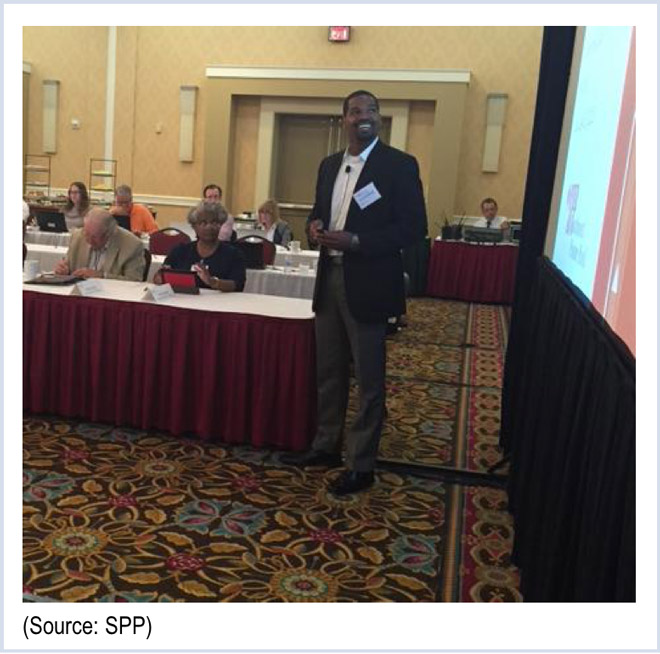
SPP Director of Planning Antoine Lucas makes a presentation to the Markets and Operations Policy Committee as board members Harry Skilton and Phyllis Bernard (front row) listen.
Of 30 committed projects resulting from the 2015 near-term (ITPNT) and 10-year (ITP10) planning processes, 23 are facing cost estimate increases exceeding 30%, SPP officials told the Markets and Operations Policy Committee last week. Three projects are coming in more than 30% below estimates with only four within the 30% “bandwidth.”
Describing a 152% increase on the Hobart-Roosevelt Tap-Snyder rebuild in American Electric Power territory in Oklahoma, SPP Director of Planning Antoine Lucas said “it makes us question whether this was the right project.”
“I find this really appalling,” SPP Board Chairman Jim Eckelberger said. “We’ve taken a huge step backwards. We need a procedural adjustment.”
A third-party engineer estimated the project — rebuilds of a 10-mile, 69-kV line from Hobart to Roosevelt and an 18.7-mile, 69-kV line from Roosevelt to Snyder — would cost $14.3 million.
SPP now expects it to cost $36 million due to additional right-of-way acquisition; licenses and permits; additional substation work; and costs related to a crossing through Mountain Park Wildlife Management Area. SPP also cited AEP’s recommendation that the project be designed anticipating an eventual conversion to 138 kV.
Fire the Engineer
SPP should fire the third-party engineer “and never use him again,” Eckelberger said, drawing applause from many of the about 120 in attendance.
“I’ve seen this over and over again,” Director Julian Brix complained. “This is not a 69-kV project [as originally approved by SPP]. It’s a 138-kV project. This is not the first or second or third time we’ve seen this. This is why we get into trouble with the [Regional State Committee],” he said, referencing state regulators who must collect from ratepayers for transmission upgrades.
AEP officials said the use of 138-kV standards was responsible for only $400,000 of the additional costs. “A no-brainer,” AEP’s Richard Ross said. AEP’s Terri Gallup called complaints of “scope creep” unfair, saying the company had proposed the rebuild as a 138-kV project — that would initially be operated at 69 kV — to begin with.
Xcel Energy’s Bill Grant noted that incumbent transmission owners would become responsible for providing cost estimates for non-competitive projects under a plan approved by the MOPC earlier in the meeting. (See related story, “Initiative on Non-Competitive Studies Advances” in SPP Strategic Planning Committee Briefs.) “I think we have a solution,” Grant said.
Marguerite Wagner of ITC Holdings said transparency would improve the process, calling for release of cost estimates to stakeholders. “If a project is not competitive, how is releasing the cost estimate competitive information?” she asked.
Director Harry Skilton said the cost estimate increases represented a “lesson learned” as the RTO begins considering competitive projects. “We’re going to need a feedback loop” regarding costs, he said.
NTCs Withdrawn
SPP planners recommended that notifications to construct (NTCs) for seven projects with the largest overruns be suspended and the projects restudied, including the Hobart-Roosevelt project.
But Gallup said Hobart-Roosevelt and two other AEP reliability projects on the list had in-service dates that might not be met if they were delayed for more study.
The MOPC ultimately voted to retain the three projects and one in Westar territory, suspending NTCs for only three of the seven recommended by planners: South Shreveport-Wallace Lake 138-kV rebuild (AEP); Martin-Pantex North-Pantex South-Highland Park 115-kV reconductor (Southwest Public Service); and Iatan-Stranger Creek 345-kV voltage conversion (Westar/KCP&L Greater Missouri Operations).
Alliant subsidiary Interstate Power & Light is retiring or switching five Iowa power plants from coal to natural gas and upgrading two other Iowa coal-fired plants as part of a settlement with the Environmental Protection Agency and the U.S. Department of Justice.
Plants in Cedar Rapids, Dubuque, Burlington, Clinton and Marshalltown will be switched to burn natural gas or retired, and new emissions controls will be installed at its two largest coal-fired plants, in Lansing and in Ottumwa. “The terms we negotiated in this settlement are consistent with our long-term plan for clean energy,” said Doug Kopp, Alliant Energy president. “We settled with the EPA to avoid unnecessary delays and ongoing uncertainty associated with litigation.”
The settlement closes out litigation in which the EPA said Alliant upgraded plants in 2006 and 2009 without installing required emissions controls. The upgrades will cost about $620 million, the company said, on top of the $6 million it will spend on environmental mitigation projects and a $1.1 million civil penalty.
Kinder Morgan Board Gives Go-ahead for $3.3B Pipeline
The Kinder Morgan Board of Directors approved the $3.3 billion Northeast Energy Direct natural gas pipeline that will run from Wright, N.Y., to Dracut, Mass. But the pipeline will have a smaller capacity than originally estimated.
The 30-inch diameter pipeline to be constructed by Kinder Morgan’s Tennessee Gas Pipeline Company will carry up to 1.3 billion cubic feet per day, down from initial estimates of 2.2 bcf per day. The company said it would amend its application with the Federal Energy Regulatory Commission if circumstances dictated the need to increase capacity.
The project is designed to deliver Appalachian shale gas to New England utilities and power plants. The company said the lack of pipeline capacity caused customers of ISO-NE to pay $7 billion more for electricity during the past two winters than they did during the winter of 2011-12.
NRG’s Canal Generating Station in Sandwich, Mass., will be returning to service, fueled by natural gas, according to Sandwich town officials.
Town manager Bud Dunham said NRG confirmed that the plant would switch from fuel oil to natural gas. The 1,112-MW plant, formerly a Mirant asset, has been inactive for several years. The repowering project is expected to be completed in 2019.
“After many years of anticipation, NRG let us know they are formally announcing plans for a repowering project in Sandwich,” Dunham said. NRG has not yet made a formal announcement.
Xcel Energy, Dairyland Power Cooperative and WPPI Energy will have to submit a new construction plan to Wisconsin regulators for a high-voltage transmission line under construction near La Crosse to halt activity during a sensitive bird nesting season.
Construction stopped last month in an area where state-protected birds were nesting. The Wisconsin Department of Natural Resources said that a 1-mile section of the project must halt during nesting season, but work in areas outside of the nesting zone will be allowed to continue.
The $500 million, 345-kV line will run between La Crosse and Rochester, Minn.
Emera Investing $80 Million in Tiverton Power Station
Emera Energy is investing $80 million to upgrade its 265-MW Tiverton power station in Rhode Island, boosting the output of the combined-cycle gas plant by 22 MW and improving its efficiency.
The upgrades to the plant’s gas turbines will save an estimated $1 million per month in fuel costs, allowing it to be dispatched more often by ISO-NE. The project will be completed during a planned maintenance outage in April.
Alpha Natural Resources, a Bristol, Va.-based coal producer, says its shares will be delisted from the New York Stock Exchange because its stock price is too low.
The company said the exchange suspended trading of its shares, which were priced last at 24 cents. Alpha recently announced it was cutting 800 jobs.
Coal mining companies are under stress, especially those in the East, because of low coal prices, low natural gas prices and competition from other states. Patriot Coal in May filed for bankruptcy for the second time in three years.
WEC Energy Group, the newly created $9 billion merger of Wisconsin Energy Corp. and Chicago-based Integrys Energy, appears to be in no hurry to set up new corporate headquarters.
WEC hasn’t narrowed down a location nor has it hired commercial real estate brokers to assist in the search, WEC spokesman Brian Manthey told the Milwaukee Business Journal. For now, WEC’s center of gravity remains in Milwaukee, the home of the former Wisconsin Energy Corp.
Most of the management in the new WEC Energy consists of Wisconsin Energy executives, including CEO Gale Kappa. WEC said its new headquarters will be in the Milwaukee area but it will retain separate offices for operating units. Wisconsin Public Service Corp., which was owned by Integrys, will keep offices in Green Bay. Integrys’ former Peoples Gas unit will retain divisional offices in Chicago.
Xcel’s Monticello Nuclear Plant Running at Increased Output
The Nuclear Regulatory Commission has granted permission for Xcel Energy’s Monticello Nuclear Generating Plant to operate at a higher capacity following upgrades that cost $748 million.
The permission allows the plant in Monticello, Minn., to operate at 671 MW, up 12% from 600 MW.
The NRC action also means Xcel can include the upgrade costs in its next rate case. The cost of the project ballooned from $320 million to $748 million. The Minnesota Public Utilities Commission blamed the problems on Xcel’s “imprudent management” and didn’t allow the company to receive a return on its investment. Xcel wrote off $125 million, nearly half of its first-quarter profits.
Dynegy is on the hunt for corporate employees following a flurry of acquisitions over the last year. The company said it was looking to fill 113 jobs, with some of them needed at its Houston headquarters where about 300 people now work.
Dynegy has made a total of $6.25 billion in acquisitions in the last year. They include the purchase of EquiPower Resources and Brayton Point Holdings. It also snapped up $2.8 billion in commercial generating assets from Duke Energy.
Invenergy to Build 200-MW Wind Project in Minnesota
Invenergy announced plans to build a 200-MW wind energy facility near Albert Lea, Minn. The company has been working to obtain landowner agreements for seven years. Invenergy said the 29,000-acre site would have about 100 turbines.
At the same time, MISO is looking at plans to construct high-voltage transmission lines to deliver the power from southern Minnesota to markets.
Invenergy also owns and operates the 357-MW Cannon Falls Energy Center, a natural gas-fired plant that went into operation in 2008.
PSEG Long Island Remains Last in Customer Service Ranking
PSEG Long Island remains last in the country among major electric companies in residential customer satisfaction, but it managed to increase last year’s score by 10%, according to a J.D. Power survey.
PSEG Long Island scored 584 out of a total 1,000 points in the survey, which reviews factors such as power quality, billing, affordability and communications. The utility’s score was 52 points higher than in 2014, when Public Service Enterprise Group took over the Long Island Power Authority. In 2013, LIPA scored 519.
Daniel Eichhorn, vice president of customer services at PSEG Long Island, said the figures showed the utility was the most improved among a list of utilities with more than 750,000 customers. “The numbers tell us we’re very focused on customer satisfaction. We are trying to create a better customer experience, to make it easier to do business with us, and improve reliability.”
ISO-NE says June Saw Lowest Monthly Prices in 12 Years
Wholesale power prices in New England fell in June to under $20/MWh, according to ISO-NE. The regional grid operator said it was the lowest monthly price in the 12 years of the competitive power markets and nearly half of the $37.92 price last June.
“It’s supply and demand,” said Matthew White, chief economist at ISO-NE. “With June’s mild weather, demand for natural gas and electricity were both low, and the pipeline capacity was available to deliver a plentiful supply of exceptionally low-priced natural gas.”
White noted that the dip in prices illustrates the seasonal volatility of prices in the New England market, which he attributed almost entirely to natural gas pipeline constraints.
The Regional Greenhouse Gas Initiative provides substantial economic benefits and has not raised prices or impaired reliability, according to an independent study released at a meeting of state regulators last week.
The report by economic consulting firm Analysis Group said that RGGI added $1.3 billion in economic value, created more than 14,000 new jobs and saved consumers $460 million on electricity and heating bills from 2012 through 2014.
“Based on an analysis of years of hard data, RGGI shows that multi-state, market-based carbon control mechanisms work and can deliver positive economic benefits,” Analysis Group Vice President Paul Hibbard said. “That’s not to say programs designed to cut greenhouse gas emissions are economic development programs — their goals are different. But the data clearly show that cutting carbon emissions can be a net positive for the economy.”
The report’s authors said the findings “provide valuable lessons for states” preparing for the Environmental Protection Agency’s proposed Clean Power Plan. The report was released last Tuesday at the summer meeting of the National Association of Regulatory Utility Commissioners in New York.
RGGI regulates carbon emissions from power plants in the six New England states, New York, Maryland and Delaware. The states have received about $2 billion in auction proceeds over its existence, investing those funds in energy efficiency programs, low-income assistance and clean energy development.
The report said initial costs are more than recovered in customer savings. “Although CO2 allowances tend to raise electricity prices in the near term, there is also a lowering of prices over time primarily because the states invest so much of the allowance proceeds on energy efficiency programs,” the report said.
The region also cut annual carbon emissions by about a third, from 140 million metric tons in 2008 to 90 million tons in 2014, according to the report. RGGI also reduced dollars used to pay for fossil fuels imported from outside the region by more than $1.27 billion in 2012-2014.
“The implementation of RGGI over six years has not adversely affected power system reliability in New England, New York or PJM. The pricing of carbon in Northeast and Mid-Atlantic electricity markets has been seamless from an operational point of view and successful from the perspective of efficient pricing of emission control in regional markets,” the report said.
The report was funded the Barr Foundation, the Energy Foundation, the Thomas W. Haas Foundation and the Merck Family Fund.
PJM told federal regulators last week they should reject requests to incorporate demand response and energy efficiency in upcoming transition auctions for the RTO’s new Capacity Performance regime.
But the RTO also offered two alternatives for including DR and EE in the auctions, saying the “less risky” option would be to limit participation to previously cleared resources.
On Monday, PJM also responded to a separate challenge by consumer advocates who asked FERC to order the RTO to use an improved load forecasting model for the transition auctions and the Base Residual Auction set for Aug. 10-14 (EL15-83).
PJM said the changes in the new model “are yet to be finalized and are not ready to implement.”
“In essence, the complainants seek to utilize the complaint process to supplant a technical regional transmission organization process of testing and review of load forecasting enhancements [that is] still underway.”
Glide Path
PJM said the transition auctions were designed to “provide a glide path” for generation resources that needed time to make investments to meet Capacity Performance requirements and were not necessary for other resources. PJM also said it was concerned about the continuing uncertainty following the D.C. Circuit Court of Appeal’s EPSA ruling voiding FERC’s jurisdiction over DR.
The RTO, however, offered what it called “constructive alternatives” should the commission grant the complainants’ request.
Given the risk that EPSA could be upheld by the Supreme Court, “it is reasonable to limit participation of DR and EE to previously cleared Annual DR and EE for these transitional auctions,” PJM said in its July 15 filing (ER15-623, EL15-29).
PJM said the 1,246 MW of DR and EE that cleared for the 2016/17 delivery year and the 2,828 MW that cleared for 2017/18 could submit sell offers in the transition auctions to convert to a Capacity Performance product.
“PJM cautions the commission from allowing more Annual DR and EE than that which has already cleared from being eligible to participate in the transition auctions. This limitation would allow previously cleared DR to become eligible as Capacity Performance without increasing the magnitude of any unwinding and replacement of DR should the Supreme Court’s ruling be adverse to the commission,” PJM said.
More Risky
The RTO said a “much more risky and less preferred option” would be to allow previously offered but uncleared Annual DR and EE to participate in the transitional auctions. That would allow participation of as much as 4,337 MW for 2016/17 and 8,981 MW for 2017/18.
The practicality of either option is questionable under the current schedule, however. The transition auction for 2016/17 is set for July 27-28 and that for 2017/18 for Aug. 3-4.
PJM said the resources would have to submit updated DR sell offer plans 15 days prior to the auction and EE measurement and verification plans 30 days prior to the auction, as they had to do for participating in the Base Residual Auctions. All of those dates have expired, PJM said.
Federal regulators last week rejected a request by a natural gas distributor to relax restrictions on its sharing of non-public information received from electric utilities.
The Federal Energy Regulatory Commission dismissed National Fuel Gas Distribution’s request in two rulings. In one, FERC dismissed the company’s request for clarification on communication allowed under Order 787, saying it was beyond the purview of its rulemaking (RM13-17-002). The other rejected NFG’s rehearing request on rules adopted by PJM under the order (ER14-1469-002).
With Order 787, the commission in 2013 opened up the sharing of non-public operational information between interstate natural gas pipelines and public utilities, saying that increased coordination would benefit reliability. (See Talk among Yourselves: FERC Urges Gas-Electric Coordination.)
Impact on Local Distribution Companies
It did not codify, however, how utilities could share such information with local distribution companies, leaving the issue to RTOs and ISOs to address individually through tariff changes. Subsequently, FERC received filings from PJM and NYISO amending their rules. (See FERC OKs Gas-Electric Talk.)
NFG is an LDC serving western New York and northwestern Pennsylvania.
FERC ultimately approved a PJM Operating Agreement change requiring LDCs and intrastate pipeline operators to promise not to disclose non-public, operational information received from PJM to third parties “or in an unduly discriminatory or preferential manner or to the detriment of any natural gas or electric market.” It also barred sharing of the information through a “conduit.”
No intervenors opposed PJM’s proposal, which was approved by FERC in July. But a month later, NFG came forward to say that a blanket restriction forbidding LDCs from disclosing such information to any third party “may inhibit appropriate sharing of operational data and discourage LDCs and intrastate pipelines from maximizing use of the data to improve reliability.”
It pointed out that “third parties” would include pipelines already qualified to receive information under Order 787 and others with whom LDCs need to coordinate to increase reliability.
For example, it said, if an expected increase in a generator’s use of natural gas in one part of the pipeline could affect a load pocket of the LDC, the company would want to be able to warn large customers in that area of an imminent capacity constraint.
NFG also took issue with the notion of requiring LDCs to guarantee their use of data would not be “to the detriment of any natural gas or electric market,” contending that “changing capacity use inevitably affects some retail customers negatively just as changing upstream supplies may affect market participants negatively.”
‘Very Broad’
In denying NFG’s request, FERC said it intentionally made the scope of information-sharing under Order 787 “very broad.” Quoting from the order, FERC added, “The commission is intentionally permitting the communication of a broad range of non-public, operational information to provide flexibility to individual transmission operators, who have the most insight and knowledge of their systems, to share that information [that] they deem necessary to promote reliable service on their system.”
It said that the potential for competitive harm under that broad scope warranted limiting it with a blanket authorization.
When Order 787 was announced, several commenters called the no-conduit rule too restrictive and offered modifications, including exclusions from the third-party restriction. FERC denied those requests.
“PJM states that it intended its restrictions on LDCs and intrastate pipelines to be an extension of the commission’s no-conduit rule to non-FERC jurisdictional facilities, applied in a manner that mimics, as closely as possible, those restrictions,” it said.
‘Untimely’
As for NFG’s request for a rehearing, FERC determined it “untimely and thus statutorily barred.”
It also noted that nothing in PJM’s Tariff precluded NFG or any other entity from sharing non-specific information needed to ensure the reliability of system operations.
“As long as NFG Distribution does not reveal, directly or indirectly, the non-public, operational information shared by PJM (e.g., information concerning a particular electric generator), NFG Distribution can request or direct its customers and operational counterparties to perform specific actions based on such information,” it said.
Talen Energy announced its first post-spinoff acquisition Monday, agreeing to spend $1.175 billion to purchase 2,500 MW of combined-cycle generation that expands the company’s presence in ISO-NE and marks its entry into NYISO.
(Click to zoom.)
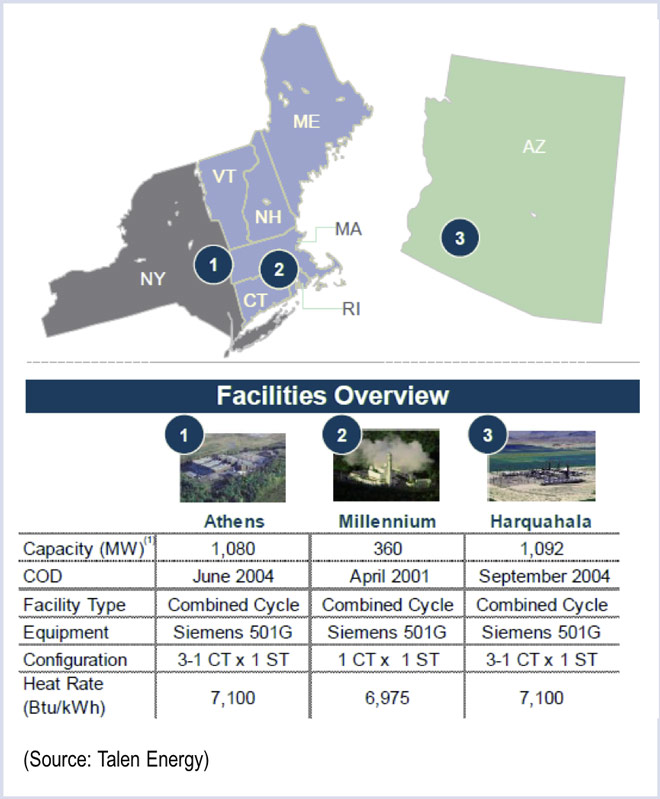
The company, which completed its spinoff from PPL and Riverstone Holdings on June 1, announced it will acquire three generators from MACH Gen: the 1,080-MW New Athens plant in Athens, N.Y.; the 360-MW Millennium plant in Charlton, Mass.; and the 1,092-MW New Harquahala plant near Tonopah, Ariz.
The key to the deal for Talen is the two plants in NYISO and ISO-NE, regions in which the company had previously said it was setting its sights. The acquisition will increase its geographic diversity, reducing PJM’s share of its fleet from 83% to 71% while doubling ISO-NE’s share to 2%.
It also reduces its dependence on coal and nuclear power, with coal’s share of the fleet dropping from 40% to 34% while natural gas increases from 22% to 33%.
All of those numbers will change as a result of the company’s need to divest 1,300 MW to meet market power concerns. Pre-divestiture, the company’s fleet would total 17,600 MW. (See PPL, Riverstone Accept FERC Mitigation Plan on Talen Spinoff.)
Immediately Accretive
Talen said the acquisition brings substantial tax benefits and will be immediately accretive to earnings despite poor “market dynamics” that have limited the Arizona plant to less than a 20% capacity factor, resulting in losses. All three plants are powered by Siemens 501G engines installed between 2001 and 2004.
Talen also said it expects the economics of the Athens plant to improve with the completion of pipelines that will give the plant access to low-cost Marcellus shale gas and electric transmission improvements expected to reduce congestion in NYISO’s Zones F and G.
‘Powder’ for Future Deals
Importantly, said CEO Paul Farr, the deal will retain flexibility to make additional acquisitions. “We still have dry powder given the mitigation process underway,” Farr said in a conference call with stock analysts.
The purchase will be financed with a combination of debt and cash but the precise mix would depend on interest rates and the status of its divestiture efforts, Talen said. The company said earlier this month that it had a $1 billion “war chest” for future acquisitions.
The company is believed to be considering the acquisition of American Electric Power’s merchant fleet in Ohio and Indiana, which AEP announced in January it was putting on the block. (See AEP Considering Sale of 8,000 MW in Ohio, Indiana.)
UBS Investment Research says there is a 50% probability Talen will purchase AEP’s assets. It said Talen could swallow AEP’s assets even after the MACH Gen deal because an AEP deal is not likely to occur until late 2015 or early 2016 because of pending Ohio regulatory proceedings.
Arizona Plant a Throw-In
(Click to zoom.)
It appears that taking on the money-losing Arizona plant was a condition for acquiring the assets Talen did want. Talen, which has no other assets in the region, said it may move the plant elsewhere or sell it for parts.
MACH Gen, which was owned by affiliates of Credit Suisse Group and Bank of America among others, filed for Chapter 11 bankruptcy protection in March 2014, saying it had assets of $750 million and liabilities of $1.6 billion. The company said it had a net loss of $120 million on $350 million in operating revenue in 2013.
The company said the Federal Energy Regulatory Commission’s rejection of its plan to sell the Harquahala plant had undermined its efforts to cut its debt. FERC said the sale — to investors that also owned two of the four natural gas generating units in Gila Bend, Ariz. — would have harmed competition within the Arizona Public Service balancing authority area (EC13-11).
The company said most of its creditors had agreed to a prepackaged reorganization that would give its second-lien debt holders 93.5% of the restructured company and reduce about $1 billion of debt. FERC approved the restructuring in April 2014 (EC14-46).
The Federal Energy Regulatory Commission last week rejected multiple requests for rehearing of its October 2014 order finding fault with SPP’s interpretation of long-term congestion rights (LTCRs).
SPP had joined with Kansas City Power & Light to request a rehearing in November. Also requesting rehearing were five transmission-dependent utilities.
FERC did conditionally accept SPP’s January compliance filing, saying the RTO had partially complied with the October order (ER14-2553).
In the October order, FERC ruled that SPP’s response to Order 681 did not meet the order’s requirement that long-term transmission rights made feasible by transmission upgrades or expansions must be available to any party that pays for the improvements under prevailing cost-allocation methods.
The commission said SPP’s proposal did not grant LTCRs to “‘any party’ that funds upgrades,” but instead awarded transmission-service revenue credits, “which are only available to transmission service customers and are not based on the value of congestion revenue.”
FERC also found SPP’s filing did not fully comply with Order 681’s requirement that load-serving entities have priority over non-LSEs in the allocation of long-term firm transmission rights supported by existing capacity.
No Opportunity for Profit
In denying SPP’s request for rehearing, the commission said it disagreed with the RTO’s contention that Attachment Z2 credits are “reasonable equivalents to LTCRs for financial entities.”
“SPP’s Attachment Z2 crediting process awards transmission service revenue credits up to the cost of the facility, but the value of a LTCR could exceed the cost of the facility,” FERC said. “Z2 credits up to the cost of the facility may be a reasonable incentive for some market participants to sponsor upgrades … However, the Attachment Z2 credits would not serve as an incentive for financial entities that fund transmission projects to sponsor any upgrades because the most they could receive is their initial investment with no opportunity to make a profit.”
The commission also denied SPP and KCP&L’s claims that the October 2014 order questioned the justness and reasonableness of Attachment Z2. “SPP’s decision to use tariff language that already existed in a prior context” to satisfy Order 681’s requirements, FERC said, did not absolve the commission of its responsibility to determine whether the proposed language is just and reasonable.
FERC also denied a rehearing request by the City of Independence, Kansas Power Pool, Missouri Joint Municipal Electric Utility Commission, Missouri River Energy Services and West Texas Municipal Power Agency (filing as TDU Intervenors).
The group expressed concern that adoption of a nomination process will not ensure LSEs obtain sufficient LTCRs. The commission said that SPP’s use of a nomination process before the simultaneous feasibility test “addresses TDU Intervenors’ concerns and render their proposed revisions unnecessary.”
The commission added that the intervenors failed to demonstrate how SPP’s process would result in their being unable to nominate LTCRs at a level equal to their “reasonable needs.”
Compliance Filing
Boston Energy Trading and Marketing protested SPP’s proposal to provide incremental LTCRs, in lieu of revenue credits, to entities that fund upgrades. SPP proposed network upgrades costs of $5 million or more be compensated with candidate incremental LTCRs, if elected, but Boston Energy said that inclusion is contrary to Order 681 and more restrictive than other ISOs and RTOs.
FERC conditionally accepted SPP’s proposal for awarding incremental LTCRs but required it to remove the $5 million threshold.
FERC also directed SPP to separate the provision of incremental LTCRs from the proposed nomination process and to establish a new process providing incremental LTCRs when the sponsored upgrade goes into service. The commission also asked SPP to inform FERC whether the LTCRs’ initial allocation will be implemented in the 2016 ARR/TCR year, and to explain how its process will treat the provision of LTCRs and incremental LTCRs for network upgrades funded through a combination of rolled-in transmission rates and directly assigned charges.
The American Wind Energy Association and the Wind Coalition had requested clarification on how the LTCR process will affect future transmission in the RTO’s planning and interconnection processes. They also requested clarification on how incremental LTCRs resulting from transmission capacity created by upgrade sponsors would impact transmission service customers.
FERC responded by saying SPP’s compliance filing showed its transmission-planning process “ensures the continued long-term feasibility of awarded LTCRs and incremental LTCRs, and therefore has complied with the transmission planning and expansion requirements of Order 681.”
The New York Public Service Commission on Thursday approved rules designed to allow low- and moderate-income apartment dwellers to own renewable energy projects (15-E-0082).
“Shared Renewables places customers who do not own homes on an equal footing with traditional single-home customers and creates opportunities for low- and moderate-income families who don’t have access to electricity generated from renewable resources,” PSC Chair Audrey Zibelman said.
Customers can band together to form larger groups that share in the benefits of renewable energy projects, such as solar energy installations and wind farms.
The plan contemplates “community solar” projects, where solar panels are erected on a shared site, such as a vacant lot, with the economic benefits shared among its participants.
Under the first phase of the program, from Oct. 19 through April 30, 2016, projects will be limited to those that site distributed generation in areas where it can provide the greatest benefits to the power grid or support economically distressed communities (at least 20% participation by low- and moderate-income customers).
A second phase beginning May 1, 2016, will make shared renewable projects available throughout entire utility service territories.
The program was proposed in Gov. Andrew Cuomo’s 2015 State of Opportunity Agenda. “This program is about protecting the environment and ensuring that all New Yorkers, regardless of their zip code or income, have the opportunity to access clean and affordable power,” he said.
MISO has won approval to revise its Tariff to provide common treatment for network customers seeking to serve network load not physically interconnected with the RTO.
The tariff mechanism sought by MISO and approved by the Federal Energy Regulatory Commission last week is expected to eliminate the need for filing specific non-confirming network integration transmission service agreements on a case-by-case basis (ER15-1745).
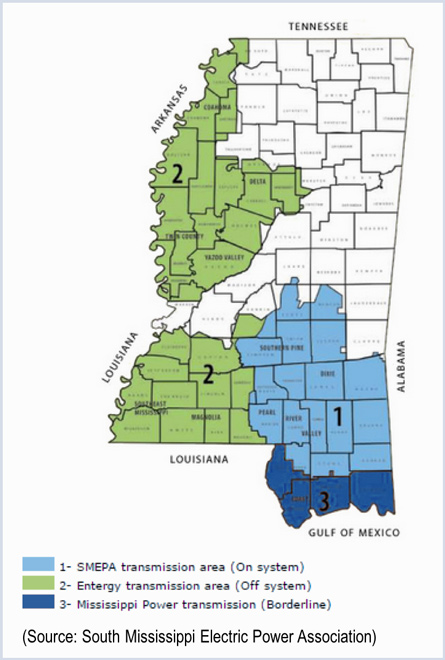
South Mississippi Electric Power Association delivers wholesale power to its cooperatives in three transmission areas.
The change stems from two non-conforming NITS requests: a 2013 request to allow South Mississippi Electric Power Association to take network service to serve a network load pseudo-tied to SMEPA but not physically interconnected with a transmission owner or independent transmission company within MISO (ER13-2008), and a 2014 MISO request to allow Arkansas Electric Cooperative Corp. a similar right to serve pseudo-tied load (ER14-684).
A pseudo-tie is a mechanism for operationally transferring a resource from the balancing authority in which it is physically located to another BA, which becomes responsible for it for system reliability.
Some MISO transmission owners filed comments in those cases, raising concerns that the two utilities could be receiving special treatment. The transmission owners asked FERC to order MISO come up with a global solution to the issue through changes to its Tariff.
In response, FERC said it expected MISO to offer non-conforming service on a non-discriminatory basis to other transmission customers in similar situations.
After discussions with transmission operators, MISO proposed several changes to Section 31.3 of its Tariff, which required that network load be physically interconnected with a MISO transmission owner or independent transmission company.
The revised Tariff requires that the non-interconnected network load “be part of a pricing zone in MISO, so that the network customer is subject to a rate for network service.”
One way to meet such eligibility requirements is if a non-interconnected network load is pseudo-tied into the MISO balancing authority. MISO stated that provision is necessary because otherwise there wouldn’t be a mechanism to charge the network customer for network service, “meaning the network customer could receive this service for free.”
MISO noted that in its NITS agreements with SMEPA and AECC, it required them to pay a rate for network service based on the MISO zone in which the physically interconnected portion of their load is located.
The revised Tariff also requires network customers to have coordinating arrangements in place with the host transmission owner or independent transco for reporting network load.