As Yogi Berra didn’t say (at least not first): It’s tough to make predictions, especially about the future.
But I’m going to stick my neck out and predict that the dozens of independent federal agencies like FERC will survive the Supreme Court’s revisiting of Humphrey’s Executor v. United States.
The conventional wisdom is that the court will invoke something called the “unitary executive theory” to reverse 90 years of precedent, and allow the president to unilaterally fire whoever he wants from any federal agency for any reason at any time.
The unitary executive theory doesn’t make any sense because it’s premised on the notion that Congress can’t pass a law granting a federal agency some element of independence from the whims of a president. Why can’t Congress do that? It’s the first branch of our government with the power to pass laws. That’s what it’s supposed to do. And let’s remember that the president can always veto a law he or she doesn’t like, which then requires Congress to muster an overwhelming majority to override the veto. And let’s note that the veto is a “legislative” power (it’s in Article I after all), which discredits the notion that legislative and executive powers can’t mix.
But somehow the idea emerged that Congress’ legislative power to pass laws, subject to veto, is circumscribed by a president’s executive power to override such laws because, well, he’s the president.
Let’s put aside all the intricacies and nuances that have inspired countless law review articles on this subject.
Instead let’s surmise what the swing justices think of Donald Trump’s conduct. Justices don’t live in a vacuum. They see the same stuff that we do (or at least I hope so).
Prior drafts of this column listed 34 of Trump’s worst constitutional, legal, ethical and aesthetic outrages in 2025 (actually 37 when I added the latest offshore wind, Greenland and battleship-naming outrages). But having depressed myself assembling the list, I realized that I shouldn’t pass it on, at least not in the holiday season. You may have your own list. And I hope the swing justices do as well.
I am guessing, and hoping, that the cumulative effect on the swing justices will be that they just can’t stomach giving Trump more power. They won’t take this further step toward autocracy, as happened in other countries. “Centralization of head-of-state control over the executive branch of government provides a pathway to autocracy. Indeed, unilateral presidential control of the executive branch constitutes a defining characteristic of autocracy.”
But maybe this is just wishful thinking.
Speaking of wishes, I wish you and yours the best for the year ahead.
AUSTIN, Texas — Having finally added real-time co-optimization to the market like every other U.S. grid operator with an effort that began in 2019, ERCOT can turn its attention to other pressing issues in 2026.
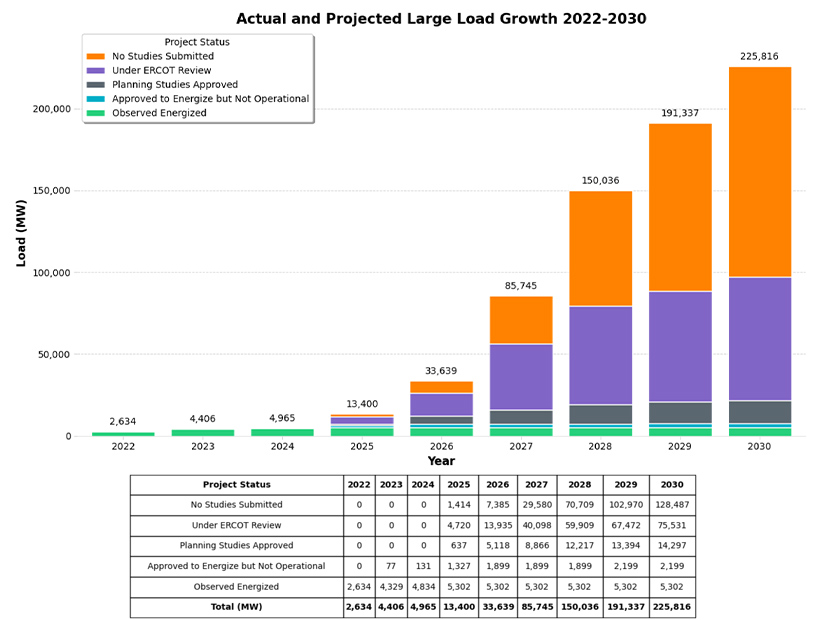
Of course, figuring out the most effective and efficient way to safely interconnect the hundreds of requests from large loads — data centers, bitcoin miners, large industrial facilities and the like — that have flocked to Texas’ welcoming arms tops the list. The grid operator began the year with 63 GW of interconnection requests in its large-load queue but enters 2026 with more than 233 GW, up 269%. Data centers account for about 77% of that load.
Then there’s ERCOT’s continuing work on a dispatchable reliability reserve service (DRRS), a product that staff call an ancillary service but that some stakeholders don’t. It is the third iteration of the product, mandated by state law in 2023 and a high priority for the Board of Directors and the Public Utility Commission.
A little less sexy initiative but equally important is the full-scale analysis that will take place in 2026 of the grid’s reliability standard. It will be the first formal evaluation of the new reliability standard the PUC established in 2024.
But wait. ERCOT isn’t finished with RTC. Nearly a dozen issues and tweaks have been identified to stabilize the market mechanism, requiring the task force that deployed RTC to stay active.
CEO Pablo Vegas says ERCOT is going through a transition “characterized by high and very rapid growth” of intermittent and short-duration supply resources.
“It’s characterized by a rapidly changing customer base that includes price-responsive loads like crypto miners, rapidly growing large-scale data centers, and continued penetration of distributed energy resources throughout the grid,” he told his board in December. “It’s a significant shift in operational requirements, and it represents an opportunity to create a more resilient and cost-effective grid for the benefit of all Texans.”
Vegas says ERCOT’s load growth is “fairly unprecedented” and renders obsolete historical interconnection processes. As of November, the ISO had energized only a little over 5 GW of large loads in 2025. To remedy that, Vegas and other members of his leadership team proposed a new approach to interconnection called a “batch study” process. (See ERCOT Again Revising Large Load Interconnection Process.)
Projects ready to be studied will be grouped together in batches and allocated existing and planned transmission capacity. ERCOT says this will provide large-load customers with study efficiency, consistency, transparency and certainty. The first group, Batch 0, will create a foundation and baseline for subsequent batches, building on the assumptions that have changed from the previous group.
Staff will develop the batch study’s framework, taking input from market participants and regulators. ERCOT has rolled out a stakeholder engagement plan during January and February that includes six presentations to the PUC and stakeholder groups. It plans to file a proposed study process framework for discussion before the commission’s Feb. 20 open meeting.
“There’s clearly a pressure to move quickly and support the economic growth that’s coming our way,” Vegas told the PUC in December.
ERCOT Tries Again with DRRS
There’s also pressure on ERCOT to produce the DRRS product, mandated by House Bill 1500 in 2023. The law requires the grid operator to develop DRRS as an ancillary service and establish minimum requirements for the product.
Lawmakers followed up by directing the PUC to revise ERCOT’s original protocol change to establish DRRS as a standalone ancillary service. The new direction resulted in allowing only offline resources to participate and the change was withdrawn.
ERCOT now has filed a protocol change (NPRR1309) that meets all statutory criteria and improves the previous change by allowing online resources to also participate in DRRS. The new design enables the product to be awarded in real time and co-optimized its procurement with that of energy and other ancillary services under RTC.
An accompanying protocol change (NPRR1310) adds energy storage resources as DRRS participants and a release factor so the product can support resource adequacy. NPRR1309 has been granted urgent status and is due before the board for its June meeting. The same status has not been accorded to NPRR1310.
“We recognize there’s likely to be a lively stakeholder debate,” Keith Collins, vice president of commercial operations, told the board in December. “We are optimistic that it can move through the stakeholder process expeditiously, but we didn’t necessarily want to burden it with a timeline for that.”
ERCOT contracted Aurora Energy Research, which has a large local presence, to study future resource adequacy conditions and the effect of different market designs, including variations of DRRS. The research firm determined that DRRS’ design adds more cost-effective dispatchable capacity and provides greater resource adequacy benefits in different load and extreme weather conditions. (See ERCOT: New Ancillary Service Key to Resource Adequacy.)
ERCOT’s large-load interconnection requests as of November | ERCOT
During a December workshop to review the report, stakeholders peppered Aurora staff with questions on the study. DRRS is meant to achieve a revenue goal, not an operational goal, the firm’s representatives said as stakeholders questioned whether it is an ancillary service.
Collins said the DRRS mechanism and its eligibility requirements strengthen reliability through ancillary services, whereas ERCOT’s operating reserve demand curve, about 10 years old, uses energy to improve reliability.
“In our mind, [DRRS] is using ancillary services to achieve reliability, so it is an ancillary service plus,” he said. “I’m not aware of any other market that has a tool quite like that.”
Saying he doesn’t understand how an ancillary service could ever procure 100% of eligible capacity, energy consultant Eric Goff, who represents the consumer segment, said, “It seems like that’s a stretch to call it an ancillary service.”
The workshop signaled the conversations that will happen over the next few months. ERCOT has scheduled another workshop for the Technical Advisory Committee on Jan. 7.
“Obviously, there’ll be more discussion on 1309 and 1310 next month,” Collins said.
Strengthening the Grid
After 2021’s devastating Winter Storm Uri and the legislative session that followed, the PUC ordered ERCOT to create a reliability standard as a performance benchmark to meet consumer demand for three years into the future. The standard is composed of three criteria to gauge capacity deficiency: frequency (not more than once every 10 years), magnitude (loss of load during a single hour of an outage) and duration (less than 12 hours).
ERCOT and its Independent Market Monitor are required to evaluate the costs and benefits of any market design changes proposed to address deficiencies identified through the assessment process. The first such reliability standard assessment will be conducted in 2026 and then every three years and will include a forward review and analysis of the generation mix.
Vegas said in December that additional supply has been “helpful” in improving the grid’s reliability characteristics.
“In the long term, there is increasing risk if the load materializes and infrastructure development doesn’t keep up,” he told the board.
ERCOT has deployed what it calls its “most significant” design change since its nodal market went live in 2010. The grid operator went live with RTC in early December and it has been successfully procuring energy and AS in real time every five minutes ever since. (See ERCOT Successfully Deploys Real-time Co-optimization.)
“Mission accomplished. It was absolutely brilliant,” ERCOT’s Matt Mereness, who chaired the stakeholder group managing the effort, told the board in December.
The ISO says new functionality, which also improves the modeling and consideration of batteries and their state-of-charge in participating in RTC, will yield more than $1 billion in annual wholesale market savings.
However, there’s still work to be done stabilizing RTC and transitioning to normal processers. Staff and stakeholders have identified nine issues to further evaluate in 2026. Those issues run from reviewing the ancillary service demand curve to evaluating concerns with AS deliverability and will be transferred to TAC.
ERCOT has identified five likely protocol violations and mitigation plans with the PUC and has filed a protocol change (NPRR1311) to reverse language allowing ancillary service prices above the $5,000/MWh cap during emergency conditions.
Mereness said the plan is to have everything resolved by Jan. 31. The grid operator will spend the first few months of 2026 releasing updates for remaining non-critical defects.
RTC’s successful implementation is another plus for ERCOT and Vegas. He told the board during its year-end meeting that the ISO is determined to be the “most reliable and innovative grid in the world … in the world.” (See “Vegas Sets Lofty Goal,” ERCOT Board Approves $9.4B 765-kV Project.)
“We are one [of the best], if not the leading, grids globally when it comes to operational and technical complexities,” Vegas said. To be successful, we need to be a clear leader on a stage that represents the entirety of this planet.”
As part of its strategy to “advance knowledge sharing in grid innovations,” ERCOT is hosting its third annual Innovation Summit on March 31 at a resort near Round Rock, Texas, where “visionaries, thought leaders and innovators” share ideas to address “challenges and opportunities facing grid operators around the world.”
Or those thought leaders could just ask ERCOT staff, who already may be there.
As 2025 dawned, the way ahead for NERC’s management seemed clear.
The ERO’s most recent three-year plan was set to expire in December, and NERC was set to develop a new one to begin in 2026 and carry the organization through 2028. But as the planning process got underway, ERO leaders began to realize the challenge they faced.
NERC was wrapping up the Interregional Transfer Capability Study, an unprecedented continent-wide examination of the transmission system with the potential to change how the ERO conducted reliability assessments. The second Trump administration had sowed major confusion about trade policy and other issues. The ERO’s Board of Trustees kicked off a review of the standards development process that wouldn’t be finished until February 2026. Multiple issues appeared to be in flux, a difficult environment for long-term plans.
With all this uncertainty in mind, NERC management decided that following through with the original goal would be “a fool’s mission,” as CEO Jim Robb told stakeholders in a May 21 webinar. (See 2026 to be ‘Bridge Year’ for NERC Budget.)
Instead, Robb and other executives agreed to treat 2026 as “a bridge year” in NERC’s budget and come back a year later to create a new three-year plan that would guide the ERO from 2027-2029.
Looking back on this decision near the end of 2025, Robb said he still believed it was the right call. The delay allowed NERC to get “a little bit more clarity on how we can make the most important difference possible” in the challenges facing the reliability landscape.
“We were just very early in our exploration of [large loads]. We’ve got a much clearer view now than we did a year ago,” Robb said. “Reliability assessments, same thing. … Gas-electric [coordination], I think we’re seeing a lot more progress than we would have guessed a year ago. So while there’s still a lot of uncertainty in the environment, I think a lot of it has resolved well enough for us to do a more thoughtful plan than we would have put in place [this] year.”
Cybersecurity Remains a Major Concern
In conversations with ERO Insider, Robb and other NERC managers described the organization as well-positioned to meet the year ahead, having overcome the uncertainty that characterized early 2025. One source of that ambiguity was the presidential transition, which left many crucial posts in government open — including the director of the Department of Homeland Security’s Cybersecurity and Infrastructure Security Agency.
Nearly a year after the inauguration, CISA still lacks a Senate-confirmed head. The agency has been led by Deputy Director Madhu Gottumukkala since his appointment in May 2025. President Donald Trump nominated Sean Plankey, formerly of the Department of Energy’s Office of Cybersecurity, Energy Security and Emergency Response, to head the agency shortly after taking office, but his nomination has stalled amid holds placed by multiple senators.
More disruption came during the 43-day government shutdown, accompanied by the expiration of the Cybersecurity Information Sharing Act of 2015 (CISA 2015), which set requirements for cybersecurity information sharing by the federal government and provided liability protections for voluntary information-sharing by private entities.
CISA’s operations were restored on Nov. 12 when Trump signed a continuing resolution that also renewed CISA 2015 through Jan. 30, 2026, but the episode sparked fears about the continuity of the federal government’s role in the cybersecurity ecosystem. (See Stakeholders Urge Cyber Info Sharing Act Renewal.)
Michael Ball, CEO of the Electricity Information Sharing and Analysis Center, acknowledged the turmoil of the past year and the concerns it created among stakeholders. However, he said that, despite outward appearances, the connection between the government and the ERO, including the E-ISAC, remains strong.
“There is a lot of concern about what that [relationship] looks like down the road. I can say with a lot of confidence, at least from the lens that I have, that we haven’t seen that really degrade,” Ball said. “We have great contacts within the different agencies. The changes haven’t degraded the objective and the goal.”
“Where my concern would be is the degradation over time in that [commitment], and my optimism [there] is pretty high,” he continued. “We know that when there’s administration changes, there tends to be [a shift] without stakeholders that we work through, and they tend to reconstitute and sometimes create new opportunities.”
Cybersecurity remains a critical focus for NERC and the E-ISAC in 2026. As Russia’s conflict with Ukraine continues, tensions between China and Taiwan intensify and other nation-state actors like North Korea and Iran jockey for advantage, the chance increases that those rivals will try to advance their interests by damaging U.S. infrastructure. Groups believed to be affiliated with China are known to have infiltrated U.S. telecommunications networks, and as they gain experience and confidence the threat is only expected to grow.
Risks also remain from straightforward criminal actors employing ransomware and other tactics to gain financial benefit. Ball said the growth of generative artificial intelligence is “enabling amazing capabilities, even for what would have been less sophisticated threat actors” to conduct social engineering campaigns and gain access to utilities’ computer networks. These criminals are further fueled by an industry that has grown up to market malware, information and other cybercrime tools.
“The bad guys are bad, but they’re not dumb. They’re very, very capable … well-financed and well-resourced, and persistent — you can’t let your guard down once, because they’ll [be] there to take advantage of it,” Robb said.
Standards Modernization, Large Loads Efforts to Continue
Cybersecurity is far from the ERO’s only iron in the fire; NERC has multiple efforts underway that are expected to hit milestones in 2026. One of the most prominent of these is the Modernization of Standards Processes and Procedures Task Force, which the ERO stood up following a directive from the Board of Trustees in February 2025.
NERC’s board started the MSPPTF to examine the ERO’s standards development process after trustees twice invoked their authority under Section 321 of NERC’s Rules of Procedure to break voting impasses over proposed standards that put NERC at risk of breaking a FERC deadline. Chair Suzanne Keenan urged the task force’s leaders to make sure the process remains “stakeholder-based, with reasonable notice, opportunity for public comment, due process [and] openness.” (See NERC Leaders Highlight Canada-US Collaboration.)
NERC has called the resulting work one of the biggest outreach efforts in the ERO’s history, with presentations reaching more than 5,000 stakeholders over the last year. The task force is expected to deliver its final recommendations at the board’s February meeting in Savannah, Ga. NERC will then work on updates to the ROP, which must be submitted to FERC for approval.
“We’re still quite a ways away from implementation of a new process, but the team did a great job in living up to what we asked them to do,” Robb said. “It hasn’t been a smoke-filled room; there’s been a lot of engagement, and … the task force has taken what they heard in those engagements and used it to make the process better [and] more palatable. … So [we’re] very pleased with that.”
Large loads are expected to be another major area of focus for the ERO in 2026. NERC’s Large Loads Task Force has been operating since 2024 to study the impacts of data centers, hydrogen fuel plants and other emerging large loads on grid reliability, along with multiple simultaneous other efforts.
The organization also issued a Level 2 alert in September 2025. The alert provided recommendations for registered entities to mitigate risks associated with integration of large loads into the grid while requiring responses to a series of questions on their experience with large loads, their understanding of the risks associated with large loads and their current efforts to address those risks. Responses to the alert are due Jan. 28, 2026.
Robb described the ERO’s large loads work as “doing stuff in parallel that we would normally do in sequence.” Along with the LLTF and the Level 2 alert, NERC is developing a reliability guideline on risk mitigation with emerging large loads and recently commented on an Advance Notice of Proposed Rulemaking at FERC discussing potential changes to NERC’s registry criteria and standards actions on large loads.
“We won’t get ahead of our skis, but we’re going to be prepared to move as quickly as we can on each of these initiatives,” Robb said.
Changes to LTRA Process
NERC will be carrying out its plans at a time when the ERO receives a growing amount of attention from lawmakers and the general public. As a sign of how NERC’s profile has grown, Robb observed that at a 2024 meeting of the Senate Energy and Natural Resources Committee, both Chair Joe Manchin (I-W.Va.) and ranking member John Barrasso (R-Wyo.) used maps produced for NERC’s reliability assessments. The CEO also mentioned a recent appearance on NBC’s Today to speak about risks facing the energy grid.
“The CEO of NERC’s not supposed to be on the Today show. Just think about that — that the stuff that we’re doing is reaching a mainstream audience, not just the nerds in the corner planning the electric grid,” Robb said. “People are paying attention, and they’re using our materials to inform decisions.”
The increased attention to NERC’s assessments forms part of the backdrop for the ERO’s work to update its reliability assessments, particularly the Long-Term Reliability Assessment, which is published each year. The 2025 LTRA is due in January.
John Moura, NERC’s director of reliability assessments, said ongoing changes in the electric grid — including rapid shifts from traditional generation to inverter-based resources like wind and solar, along with the growth of large loads — meant the ERO’s previous approach to the LTRA was no longer valid. He described the former approach as “very much … ground-up,” involving collecting data directly from utilities which the ERO would “piece together at the end.”
Moura said recent experiences have demonstrated that “each system is more reliant on neighbors than we ever have been in the past … and so coming together earlier on in the process to make sure assumptions and scenarios and base cases are … modeled in unison [is] essential.” NERC began a pilot program in 2025 to establish common platforms and standardized assumptions for the Eastern, Western and Texas interconnections, enabling interconnection-wide energy assessments.
That effort has been productive, Moura said, although not ready to be used in the 2025 LTRA. He explained that the Interregional Transfer Capability Study, filed with FERC in 2024 in accordance with a mandate in the Fiscal Responsibility Act of 2023, provided a “foundation” for the wide-area assessments by pushing NERC to develop tools and processes for information gathering and storage that could then be used for the LTRA.
“The ITCS gave us that step change. It kind of elevated our capability,” Moura said. “If we had not had the ITCS … we would have [eventually] said, ‘Wait, we need to understand the interregional transfer capability between the regions.’ … But the ITCS actually gave us a step change up … allowing us now to do things in a simultaneous manner.”
The most important task for NERC in the coming years, Robb said, will be to preserve its reputation for independence and fact-based analysis, and to avoid any perception of favoring one side or another in the increasingly polarized political climate.
“We’ve had as good a conversation with the current committees of jurisdiction in the House and Senate that we would have had two years ago, [and] our relationship with DOE is as strong today as it was two years ago, because we’re not partisan,” Robb said. “We’re kind of the truth tellers. And while not everybody likes what we have to say, they at least respect it and pull it into their own thinking. I think that’s really important … that we don’t let ourselves ever be turned into a tool or start telling people what they want to hear, because once we do that, we’ve lost our power.”
Heading into 2026, the New England states, ISO-NE and energy industry stakeholders are counting on an increasingly collaborative approach to energy policy as federal opposition to renewable energy development threatens affordability, reliability and decarbonization objectives in the region.
As President Donald Trump ramped up his anti-renewable resource policy in 2025 — punctuated by the administration’s Dec. 22 order halting all U.S offshore wind construction — the New England states moved forward with multistate transmission and generation procurements intended to meet forecasted load growth and state clean energy goals.
ISO-NE forecasts power demand to roughly double by 2050, and the RTO has expressed concern about resource adequacy starting in the 2030s, especially in light of the offshore wind industry’s challenges.
How the region will meet growing demand in the coming decades is an unsettled question, and there is no certainty that the region’s offshore wind industry will be able to rebound after the end of Trump’s presidency. It also remains to be seen how effective the states’ collaborative approach will be at supporting the continued growth of the region’s power system.
While these questions may not be fully answered in the new year, 2026 will likely provide some important indications about the success of the states’ approach, including results from a pair of major transmission procurement efforts. 2026 is also poised to be a crucial year for ISO-NE’s ongoing effort to overhaul its capacity market, as the RTO has filed with FERC a potentially controversial set of resource accreditation and seasonal auction changes with a proposed effective date of March 31.
The recent political attention around energy affordability — which may be heightened by 2026 gubernatorial elections — likely will put pressure on ISO-NE and state officials to prioritize cost savings in all areas, including the capacity market changes and efforts to rein in spending by transmission owners on local transmission upgrades.
In an event in December, Gordon van Welie, who served as ISO-NE CEO from 2001 through the end of 2025, spoke about the improvements in stakeholder collaboration he saw during his 25 years at the RTO, saying, “Even when things do seem a bit tense, we’ve developed mechanisms to deal with those frictions.”
2026 is poised to be a substantial stress test for New England’s mechanisms to deal with energy policy frictions.
Accreditation Mad Dash
In 2026, ISO-NE and New England stakeholders face a heavy workload and a ticking clock in the effort to develop and build consensus around capacity accreditation changes and a new seasonal capacity auction design.
The changes are a major focus for a wide range of interests because of the potential effects on clearing prices and capacity revenues for individual resources.
The RTO first introduced its Resource Capacity Accreditation project in 2022 before expanding the project to include a wider array of changes, including to the timing of auctions and capacity commitment periods (CCPs).
On Dec. 30, ISO-NE filed the first phase of the Capacity Auction Reform (CAR) project, which proposes to drastically reduce the amount of time between auctions and CCPs and decouple resource deactivation from the auction process (ER26-925).
The RTO is poised to spend much of 2026 working to finalize the second phase of the CAR project, which includes accreditation changes and the development of a seasonal auction design splitting CCPs into six-month winter and summer periods.
Overarching affordability concerns may increase the stakes of the process. While the capacity market has not been a major driver of consumer costs in the region, state officials are eager to avoid the major capacity price spikes experienced recently in PJM and MISO. Some market participants in New England expect demand growth and Pay-for-Performance risks to push up prices in future auctions, and the proposed CAR changes add to the price uncertainty.
“Consumer affordability concerns and gubernatorial elections across the six states will heighten the political focus on all actions in this industry,” said Dan Dolan, president of the New England Power Generators Association.
He emphasized the importance of “a cooperative structure of government policies and regulations” to help strike the right balance between reliability, affordability and clean energy investment, adding that “the public spotlight to get this right will be extraordinary.”
The accreditation reforms would introduce several important factors into the capacity auction process, including gas supply constraints, on-site fuel storage, pipeline contracts, resource outage rates, battery duration and seasonal resource performance variability.
Resource accreditation values would be dynamic auction-to-auction, with changes in the region’s generation and demand profile affecting the value of each resource.
ISO-NE is aiming to complete the accreditation and seasonal auction changes by the end of 2026, which may be no easy task given the high-stakes and potentially controversial nature of the reforms. The RTO hopes to have the full suite of CAR changes in place for its 2028/29 CCP. (See NEPOOL Supports First Phase of ISO-NE Capacity Market Reform.)
The RTO will also have to navigate the rocky waters of accreditation under new guidance; longtime COO Vamsi Chadalavada took over for van Welie as CEO at the start of January.
Chadalavada’s appointment has been met with strong support from NEPOOL members, with some expressing optimism that he will build on the collaborative approach taken by ISO-NE in the first phase of the CAR project.
If ISO-NE is not able to complete the project and obtain FERC approval in time for the 2028/29 CCP, it may be forced to run the first phase of CAR changes as a standalone design, a circumstance that many stakeholders in the region hope to avoid.
Transmission, New and Old
Van Welie’s tenure at ISO-NE was characterized, in part, by a strong reliability record and a major shift in the region’s generation fleet as more efficient gas-fired plants replaced aging coal, nuclear, gas and oil generators. This transition was aided by investments in new transmission in the mid-2000s, which reduced congestion and allowed lower-cost resources to come online. (See Retiring ISO-NE CEO van Welie Reflects on 25 Years at the RTO.)
Chadalavada has assumed the leadership role amid another period of transition, characterized by demand growth and renewable power proliferation. The changing mix of demand and supply will likely require a large amount of new transmission investment over the next couple decades: A 2023 study by ISO-NE estimated that transmission upgrades needed to meet 2050 demand could cost up to $26 billion. (See ISO-NE Prices Transmission Upgrades Needed by 2050: up to $26B.)
New England already has some of the highest transmission rates in the country, and long-term transmission needs could put significant additional pressure on transmission costs.
Given the anticipated long-term needs, consumer advocates are hoping to rein in some of the region’s transmission spending through added scrutiny on asset condition projects. These upgrades account for the majority of the transmission investment in New England and have been a topic of growing concern for states and ratepayer advocates in recent years. In spring 2025, ISO-NE agreed to take on a non-regulatory role reviewing asset condition projects.
While ISO-NE has emphasized it will not make judgments on the prudency of transmission investments, its findings on projects could be used by other third parties in FERC proceedings to challenge investments. As it works to develop these internal review capabilities, the RTO plans to rely on a hired consultant to conduct reviews for a subset of asset condition projects.
State officials also have gone directly to FERC to seek relief; in mid-December, the Maine Office of the Public Advocate asked FERC to initiate evidentiary hearing procedures to investigate the prudency of asset condition projects placed in service in 2022. (See Maine Public Advocate Asks FERC for Hearing on Asset Condition Costs.)
To address long-term transmission needs, ISO-NE and the states kicked off in 2025 the first transmission procurement under the new Longer-term Transmission Planning (LTTP) process. The solicitation is aimed at reducing transmission constraints in Maine to enable renewable development in the northern part of the state.
To be eligible for selection, each project’s estimated benefits must exceed its estimated costs. If no projects pass this threshold, the LTTP process allows states to opt to cover the extra costs, but it is unclear whether a state would assume this responsibility in the current environment of affordability concerns.
A successful first LTTP procurement could set a strong precedent for future procurements and other collaborative efforts among New England states, while a failed procurement would likely represent a significant setback for transmission development in the region.
In conjunction with the LTTP procurement, Maine has launched an additional solicitation of renewable energy and associated transmission in Northern Maine. The Public Utilities Commission published its RFP for the Northern Maine procurement on Dec. 19 and aims to select winning bids by the end of May 2026. (See Maine PUC Issues Multistate Transmission, Generation Procurement.)
Also in 2026, ISO-NE is slated to begin stakeholder discussions for its compliance with FERC Order 1920, which will likely build on the existing LTTP process.
“While our LTTP process is an excellent starting framework for planning and procuring regional-first beneficial transmission, Order 1920 will require further improvements that ISO-NE must incorporate into its practice, such as scenario-based planning, consideration of rightsizing and use of alternative transmission technologies,” said Alex Lawton, a director at Advanced Energy United.
Long-term Energy Adequacy and Resource Development
While ISO-NE expects to have adequate resources to meet demand in the coming year, it has expressed concern about potential supply issues in the 2030s.
If able to complete construction, the Vineyard Wind and Revolution Wind offshore wind projects would provide a combined 1,500 MW of nameplate capacity to the region’s grid. Vineyard is partially operational, and Revolution is nearing the completion of construction.
The Bokalift 1 and Bokalift 2 heavy lift vessels at the Revolution Wind site | Revolution Wind
Susan Muller, senior energy analyst at the Union of Concerned Scientists, emphasized the potential winter cost and reliability benefits of these resources.
The power from Vineyard and Revolution “should make a significant difference in the overall wholesale cost of energy supply, which will benefit all retail customers in New England on an ongoing basis,” Muller said, highlighting a study by Daymark Energy Advisors that found that 3,500 MW of offshore would have cut ISO-NE energy market costs by about $400 million in the winter of 2024/25. (See New Study Highlights Winter Benefits of OSW in New England.)
In a statement responding to President Trump’s suspension of offshore wind construction, ISO-NE wrote that the affected projects “are particularly important to system reliability in the winter when offshore wind output is highest and other forms of fuel supply are constrained.”
“While ISO-NE forecasts enough generation capacity is available for the current season, canceling or delaying these projects will increase costs and risks to reliability in our region,” the RTO added.
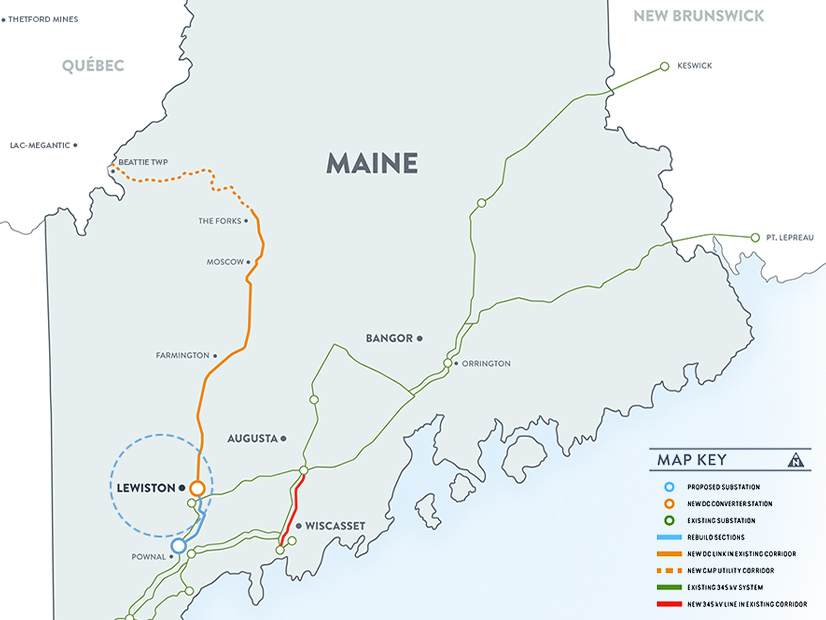
The New England Clean Energy Connect (NECEC) transmission project — itself delayed by multiple years because of political challenges in Maine — should be online for the winter of 2026. The project includes a 20-year power purchase agreement for baseload energy from Hydro-Quebec, and ISO-NE studies have indicated the line will provide significant winter reliability benefits to the region.
Beyond NECEC and the two offshore wind projects, there is a high degree of uncertainty regarding the next wave of supply into the region.
Experts are somewhat divided on what the long-term effects of Trump-era policy will be on the offshore wind industry in the U.S. While some have expressed optimism that the industry will rebound with a new administration in Washington and continued state support, others have expressed doubt that investors will return.
With the looming July 4, 2026, construction deadline for solar resources to receive the federal investment tax credit, solar developers and state energy officials are scrambling to push late-stage projects forward as quickly as possible.
NECEC project map | Avangrid
In a coordinated, expedited procurement led by Connecticut, four New England states recently selected a combined 173 MW of advanced-stage solar projects from across the region. (See New England Coordinated Procurement Nets 173 MW of New Solar.) Massachusetts also recently announced the selection of 1,268 MW of energy storage from a separate procurement.
“Our main focus next year is very tactical — working on project-execution-related matters for our portfolio, including asset financing, trying to advance some early-stage projects and looking for growth opportunities,” said Aidan Foley, founder of Glenvale Solar, which had two projects selected in the recent solar procurement.
“We need a continued pace of procurements and long-term policy initiatives, both to bring near-term assets online and to communicate to developers [and] investors that there will be paths to market in the future,” he added.
On the distribution side, solar developers are also working to start construction and bring projects online as quickly as possible.
“The first half of 2026 is going to be a sprint to get the last batch of projects in the door,” said Jessica Robertson, director of New England policy and business development at New Leaf Energy. “Then, the next several years are going to be a really hard focus on getting things online by those ITC deadlines, and in parallel, trying to develop our storage verticals.”
She noted there are several hundred megawatts of distributed solar in the various stages of Massachusetts’ interconnection queue.
To help expedite the development process, she said it will be important to increase the frequency of Affected System Operator studies and potentially enable rolling determinations of whether a project needs a study.
In the long-term, New Leaf is looking at “figuring out how to keep solar going without the ITC,” Robertson said. “That’s not going to work everywhere right away, but certainly states like Massachusetts don’t plan to stop after next July.”
The Extended Day-Ahead Market took center stage at CAISO in 2025 as the ISO tabled other long-term initiatives to ensure the market’s timely launch in May 2026 with PacifiCorp as its first participant.
And EDAM preparations continue to be the primary focus for the ISO and its stakeholders in the new year.
According to a December report from CAISO CEO Elliot Mainzer, 2025 saw thousands of stakeholders from California and throughout the West tune in to EDAM implementation workshops that enlightened and sometimes perplexed stakeholders, with the ISO trying to quickly address new critical problems to keep EDAM’s schedule intact.
The year started with a bang: In February, Powerex — which has committed to joining SPP’s competing day-ahead market Markets+ — published a paper contending that EDAM contained a “design flaw” that could result in $1 billion in unjustifiable charges for non-CAISO participants.
The paper said EDAM’s treatment of firm transmission rights and congestion would leave the market’s non-CAISO participants exposed to charges for constraints occurring outside their systems while not providing them adequate ability to recover or hedge against those costs. (See Powerex Paper Sparks Dispute over EDAM ‘Design Flaw’.)
About a month later, CAISO began an “expedited” initiative to decide how to allocate congestion revenues when a transmission constraint in one EDAM balancing authority area causes congestion in a neighboring BAA. (See Fast-paced Effort will Address EDAM Congestion Revenue Issue.)
In late summer, FERC approved CAISO’s new EDAM congestion revenue allocation design. The approved design is a short-term solution, and the ISO said it would propose a long-term design within the next two years. (See CAISO’s EDAM Scores Simultaneous Wins at FERC.)
Top EDAM Challenges
RTO Insider asked CAISO and a few of its stakeholders their views on EDAM’s top challenges in 2026.
CAISO Vice President of External Affairs Stacey Crowley said the ISO worked with vendors to deliver timely functionality for market simulation, supported participating entities in developing tariffs through the FERC process, and established a transitional congestion revenue allocation design informed by stakeholder input — all critical steps to enable EDAM launch.
PacifiCorp, which will join EDAM in May as the first participant, said it faced several key challenges while preparing for EDAM’s 2026 launch.
“Building and testing interconnected IT systems for PacifiCorp and CAISO required extensive coordination and design adjustments that had to be integrated into the development plans of both organizations,” PacifiCorp spokesperson Omar Granados told RTO Insider. “Additionally, managing communication and testing across numerous transmission customers and 14 neighboring utilities added significant logistical challenges.”
Priorities in 2026
The coming months in 2026 will see heightened activities around EDAM implementation, with stakeholders anticipating several challenges to ensure the market opens as planned in May.
PacifiCorp remains confident in the EDAM go-live timeline, but it must resolve issues that have never been encountered, Granados said.
For example, starting in February, PacifiCorp and CAISO will begin parallel operations for their respective market systems, staff and support processes. While the ongoing market simulations have suggested the utility is ready for EDAM, parallel testing likely will “reveal adjustments needed before launch,” the spokesperson said.
To address this concern, PacifiCorp is working closely with software partners and has established an internal issue-resolution team to quickly identify and resolve problems, Granados said. After starting in the market, further refinements and process optimizations are expected, he said.
CAISO’s Department of Market Monitoring (DMM) will be “closely watching and reporting on” critical areas as EDAM is implemented, DMM Executive Director Eric Hildebrandt said. One area is market efficiency and performance, such as pricing and volumes of self-scheduling versus supply/demand that is bid into and clears EDAM. DMM also will watch how EDAM affects the broader real-time Western Energy Imbalance Market.
DMM will monitor congestion within EDAM, specifically how much transmission is available in the day-ahead market for transfers between BAAs; the amount of “unscheduled flows” and congestion revenues created by schedules in one BAA on other BAAs; and how these congestion costs and revenues are allocated among BAAs, Hildebrandt said.
Two other focuses for EDAM: the day-ahead resource sufficiency requirement and evaluation, and the day-ahead imbalance reserve product, including the impact it has on EDAM prices, he said.
As for CAISO, Crowley said the ISO will work with vendors to test systems and procedures, and to ensure market participants have the training and practices needed to fully engage at launch.
Working Across Agency Lines
RTO Insider asked CAISO how it plans to work with the California Energy Commission and the California Public Utilities Commission as EDAM launches.
Crowley noted that EDAM is regulated under FERC, but “we have worked collaboratively with California agencies such as the CEC and CPUC — as well as regulators across the West — to ensure they are informed and able to provide input into the market design.”
“There is an important role for state regulators through the [Western Energy Markets] Body of State Regulators and the public stakeholder process,” she said. “While state agencies do not have direct oversight of EDAM, they have also been actively engaged in the development of legislation like Assembly Bill 825, which will establish an independent governance board, committee of state regulators and other public processes similar to what occurs at … CAISO now.”
DMM will publish quarterly, annual and other special reports on the performance of CAISO markets, with state regulators and policymakers being a primary audience for those documents and the recommendations they contain.
“We do outreach to key regulatory agencies in all the EDAM/WEIM states in order to highlight our reports and recommendations, answer questions and get any input state agencies have on what types of analysis and reporting they would find most useful,” Hildebrandt said.
While DMM’s recommendations often play a role in shaping market design, “we do not have any role in the actual implementation,” Hildebrandt added. Instead, the Monitor “will be focusing on quickly identifying and helping address any problems or unexpected issues that arise” with EDAM implementation, he said.
Batteries Provide Sneaky Reliability, Kinks to Work Out
While EDAM implementation demanded much of the ISO’s and stakeholders’ attention in 2025, CAISO weathered yet another year without needing to issue a flex alert or call for rolling blackouts. CAISO leaders repeated highlighted the addition of massive volumes of battery storage resources as a critical contributor to grid reliability.
By April 2025, more than 12,000 MW of battery storage capacity was online in the ISO — up from about 500 MW in 2020. An additional 15,000 MW of storage resources are expected by 2028, accounting for the majority of the 20,000 MW of new resources expected in that time.
The increase in batteries has kept CAISO focused on technical issues throughout the year, such as outage management enhancements, battery nonlinearity guidance and state of charge clarifications. The ISO also started an initiative to improve the visibility of distributed batteries, especially when they are needed for resource adequacy purposes.
CAISO will continue to lean on batteries in the coming year, specifically in the ISO’s resource adequacy program and qualifying capacity (QC) process. Stakeholders asked CAISO to provide more clarity on how battery durations will be counted in CAISO’s default QC counting rules, asking the ISO to avoid lumping all battery capacity together, including eight-hour batteries and four-hour batteries.
CAISO’s DMM early in 2025 raised concerns about the potential gaming and inefficient bidding behavior in CAISO’s bid cost recovery (BCR) process for battery storage resources. In an August report, DMM said the current BCR design creates gaming opportunities for battery storage units, “especially through manipulation of various biddable parameters used to manage state-of-charge.” (See CAISO Monitor Sees ‘Gaming’ Potential in Battery Storage Bid Cost Recovery.)
At the final Management Committee meeting of 2025, NYISO CEO Rich Dewey addressed stakeholders and staff, thanking them for their cooperation and work during a full, “challenging” year.
“When we started the year, we talked a lot about our concerns we had with respect to reliability,” said Dewey, who went on to list aging generation and explosive load growth as key drivers of reliability concerns. “Some tough decisions were made through the course of the year. … I am really happy and confident where we landed thinking about the planning process.”
Dewey warned stakeholders and staff that 2026 would be just as full, if not fuller, than 2026.
“If I told you 2026 was going to be easier, you should not believe me,” he said. “We have a lot of continued work ahead of us, and so it’s going to be a challenge to address the issues that we have on our plate already.”
Chief among those challenges are the upcoming discussions on changes to the reliability planning process. Stakeholders recently approved a Comprehensive Reliability Plan that calls for structural changes to the process. (See NYISO Reliability Plan Calls for ‘New Dispatchable Generation’.) NYISO wants to move planning from a “reactive posture” to a more proactive approach accounting for a wider range of outcomes in reliability planning rather than a single expected future. The ISO also called for new dispatchable generation. This angered environmental stakeholders, who accused the ISO of endorsing fossil fuel-fired development in all but name.
Most of the specifics of how the reliability planning process would determine needs were left open to discussion. During an Operating Committee meeting Oct. 16, Ross Altman, NYISO senior manager of reliability planning, said discussions with stakeholders would need to happen in order to determine which range of forecasts would be considered actionable. (See NYISO Notes ‘Fluctuation’ of Outlooks for Grid Reliability.)
New York City Reliability Need
The third-quarter Short-Term Assessment of Reliability (STAR) found there was a reliability need in New York City. This is the second year in a row a reliability need was found for the city. (See NYISO Again Identifies Reliability Need for NYC.) The city could be 650 MW short by the summer of 2026 if the Champlain Hudson Power Express (CHPE) does not come online on time.
The STAR also found reliability needs for Long Island and the Lower Hudson Valley in 2027 and 2030, respectively, but neither are as large as New York City’s.
The findings triggered a formal process in which the ISO will seek solutions to the issue, including transmission, generation and energy efficiency, either alone or in combination. The process is sure to dominate stakeholder discussions for months in 2026.
The shortfall is driven primarily by the impending retirements of the Gowanus and Narrows gas generators in the city. These generators are being kept online by an ISO reliability designation under New York state’s peaker rule. If CHPE and Empire Wind complete on time, they would, according to the ISO, solve the deficiency.
The previous year’s reliability need was “solved” by considering certain large loads, including cryptocurrency mines and hydrogen electrolysis plants, “flexible,” meaning that they would not operate during peak hours for economic reasons. (See NYISO: Large Load Flexibility Eliminates 2034 Shortfall Concern.)
With the rapid proliferation of inflexible, “always on” data centers in the interconnection queue and this year’s reliability shortfall coming from a lack of generation, it is less likely that a similar solution will present itself to NYISO. Until CHPE and Empire Wind are completed, the ISO is in an awkward position of trying to solicit solutions for a problem that may solve itself.
Resetting the Demand Curve Reset
Late in 2025, NYISO began discussion with stakeholders about how the demand curve reset process would be reformed. It is highly likely that this will continue to dominate stakeholder meetings in 2026. The DCR sets capacity prices every four years based on the capital costs of a new generator on the market. DCRs are time and resource intensive and contentious between stakeholder sectors.
Even though both stakeholders and NYISO staff identified the DCR as a priority during the Capacity Market Structure Review project, it is likely that any changes to the process will also be controversial between stakeholder sectors.
An issue discovery report was supposed to be presented to stakeholders at the final Installed Capacity Working Group meeting of the year, but it was not on the agenda. (See NYISO Begins to Discuss Demand Curve Reset Process Changes.) It is unclear when this report will be presented.
A Possible Hudson Valley Power Authority?
Late in the year, a coalition of environmental groups, local activists, politicians and electricity consumers released the results of a feasibility study that found that the Hudson Valley Power Authority Act, which was introduced in the state legislature in 2025, could save the Central Hudson Gas & Electric system, including ratepayers, $15.2 million after its first year of passage. By Year 30, these savings would climb to $210.5 million annually, a 12.7% difference in rates and saving $2.9 billion cumulatively.
The bill would allow the state to acquire Central Hudson’s assets and convert the utility to a nonprofit utility. The purchase price would be roughly $3.5 billion.
“This is a common step in municipalization and other public ownership campaigns,” said Sandeep Vaheesan, legal director of the Open Markets Institute. “At a minimum, the purpose is to show that this is a practical choice in terms of dollars and cents.”
NewGen Strategies and Solutions, a management and consulting firm, conducted the study on behalf of the coalition. The firm said that the savings would be realized primarily by not paying profits to shareholders, issuing cheaper debt and being exempt from state and federal taxes.
“The question is, could they acquire and operate the utility at a lower cost to ratepayers?” said Scott Burnham, a partner at NewGen. “One of the critical elements of the analysis is that we did not conduct an appraisal of these assets. … We looked purely at publicly available information.”
Central Hudson has come under political fire for requesting double-digit rate hikes in 2024, followed by another rate case in 2025. In response to rising energy bills, lawmakers passed a bill that requires utilities seeking rate increases to “fully and publicly explain all capital expenditures included in the request.” The bill passed after the Public Service Commission approved a three-year rate hike package over the summer.
“There’s a lot of discontent with Central Hudson in the Mid-Hudson Valley, specifically over rates,” Vaheesan said. “There’s a widespread view that Central Hudson has been seeking and obtaining aggressive rate increases and that their service record is mediocre.”
The New York Times reported that Fortis, the owner of Central Hudson, had no interest in selling. A spokesperson for Central Hudson told the Times Union that any attempt to purchase the company would only result in a drawn-out and costly legal battle.
MISO has indicated that new generation to serve data centers and other large loads will be mission critical over 2026 and said it will take pains to interconnect units.
The grid operator also will plan accordingly for fewer renewables in the footprint in the future and will embark on long-range transmission planning for its Southern load pockets.
‘Speed to Power’ + Fast Pass Gen Projects
MISO CEO John Bear said speed to power will be MISO’s theme in 2026, as it is nationally. He said MISO’s interconnection queue fast lane is working as intended to sate demand.
“The first cycle of GIAs is signing within days, not years,” Bear reported at MISO’s Dec. 11 board meeting.
MISO created a temporary queue express lane to get necessary generation online faster. Throughout 2026, MISO will welcome four more 15-project cycles into its interconnection queue express lane.
The first two cycles of projects are composed overwhelmingly of gas generation. MISO expects the 11 GW of new natural gas generation from the first two classes of its fast lane to begin coming online in 2028. (See MISO Accepts 6 GW of Mostly Gas Gen in 2nd Queue Fast Lane Class.)
Bear said MISO is working to condense timelines in the ordinary interconnection queue. He said regular queue phases are “shrinking dramatically” and can now be measured in days, not years.
“We have to be faster, and we have to be better,” Bear told stakeholders, members and board members.
MISO has vowed to ease the process to bring co-located generation and load online sooner, trying to move as fast as new large loads demand. The RTO said it may create interconnection agreements where generation is barred from injecting into the MISO system. The design work would take place over 2026. (See MISO Floats ‘Zero Injection’ Agreements to Bring Co-located Gen Online.)
MISO Senior Vice President Andre Porter said MISO today has 180 GW of installed capacity, 138 GW of that accredited. He said though MISO contains more gigawatts than it did a decade ago, its accredited capacity values have remained flat. However, he said members are making demonstrable progress on the RTO’s supply.
MISO reported that its three-year historical supply additions increased over 2025 from 4.7 GW to an estimated 6.7 GW annually. But Porter added that incremental load growth by 2030 also increased over 2025, up to 23 GW from an 18-GW estimate just months earlier.
“Members are making real progress in terms of additions they’re making. There’s significant momentum in the MISO region that’s going to allow us to rise above the noise,” Porter said, referring to the daily headlines on growing demand.
Porter said MISO has a goal to complete 25 generator interconnections per quarter over 2026 and 2027. He said MISO likely will need to sign on 8 GW of accredited capacity per year to continue to meet resource adequacy targets.
“You’re going to see much more speed within the generator interconnection queue,” Porter promised members a Dec. 10 Advisory Committee meeting. He said MISO understands that the queue “can no longer be an impediment” to generation development.
MISO’s regular generator interconnection queue contains 910 projects at 169 GW, much lower than the more than 300 GW MISO began 2025 with. Developers have withdrawn 129 GW worth of projects over 2025 since the Trump administration announced a phaseout of tax credits for renewable energy. MISO has yet to factor in the projects that queued up for the 2025 cycle. The RTO warned that the regular queue will fluctuate over the first half of 2026 as more developers remove projects and as it adds 2025 projects.
MISO, by its estimate, will field expedited transmission requests to support 13.1 GW in load growth throughout 2026. MISO approved expedited transmission projects to support 9.7 GW of large load additions in 2025.
“Since we’ve closed our [Transmission Expansion Plan] process in September, we’ve had more requests for expedited review than in all of 2025. And last year was multitudes of the year before,” MISO Executive Director of Transmission Planning Laura Rauch reported at the MISO Board of Directors’ System Planning Committee meeting Dec. 9.
Load Grows Where Data Centers Go
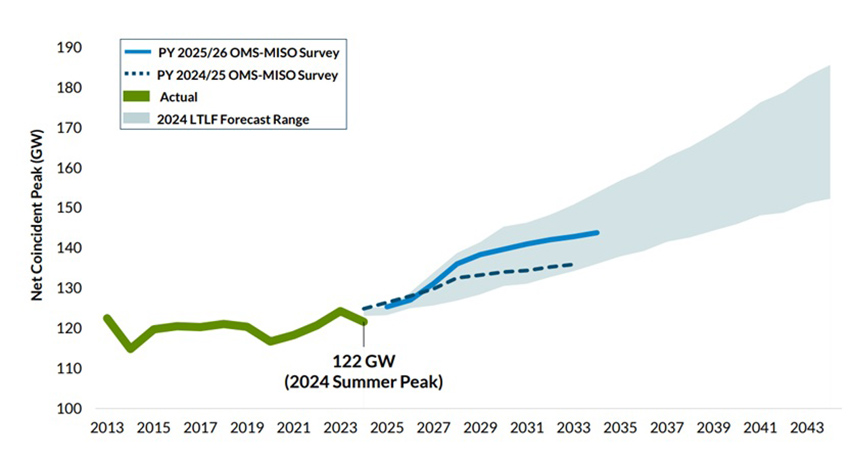
MISO Senior Vice President Todd Ramey said MISO members’ load forecasts show an uptick in load around 2027, when the net coincident peak could pass 130 GW.
MISO members’ combined load forecasts. MISO’s range of load forecasts is represented by the shaded region. | MISO
“We’re pretty tight on surplus capacity here, so I think this shows a need to focus on getting accredited capacity online as load growth continues to pick up,” Ramey said during the RTO’s June Board Week.
The RTO reported that it noticed a drop in members’ plans for standalone renewable energy and increasing plans for dispatchable resources.
Rauch said MISO clocked a sizable difference between the future generation plans its members submit now versus what they submitted a few years ago. She said members foresee more thermal, dispatchable energy within 20 years. MISO has said more on-call energy will prove useful to combat load growth.
MISO has reported that since 2024, its members’ plans for new, dispatchable resources jumped from 32 GW to 50 GW by 2043. Plans for standalone renewable energy, on the other hand, dropped from 103 GW to 55 GW. MISO said it noticed the sea change from surveying its members about their plans for its 2024 Regional Resource Assessment and again in 2025 as part of the OMS-MISO Resource Adequacy Survey.
Despite the renewable slowdown, MISO expects to have about 40 GW of installed solar capacity at the end of 2028.
“We’re expecting to see a significantly more balanced system” than before, Porter said.
But MISO’s four transmission planning scenarios, to be finalized in spring 2026, don’t allow for much energy storage, a detail MISO Director Barbara Krumsiek asked about during MISO’s quarterly Board Week in December.
Rauch said MISO’s reworked versions of the future simply don’t contain as much excess energy production from renewable energy, making storage a less compelling avenue.
At a Dec. 10 Advisory Committee meeting, Clean Grid Alliance’s Beth Soholt urged MISO not to underestimate storage expansion and consider giving it a broader use category in the markets.
“It’s like bacon. It makes everything better. Add it to a sandwich and it tastes better,” Soholt joked.
Soholt said MISO’s market rules for storage can either be a “barrier or a facilitator.”
More DOE Emergencies, More Thermal Resources
Porter said MISO expects to receive more emergency orders from the Department of Energy to keep thermal resources online. However, he said some members themselves might be considering delaying retirements on some of those units.
“The thought is that perhaps we won’t need as many of those orders moving forward,” Porter said.
Since May, there’s been no end in sight to DOE’s interventions to keep a Michigan coal plant online. The Department of Energy in fall ordered Consumers Energy’s J.H. Campbell coal plant to delay closure through the winter. But MISO and its Independent Market Monitor said J.H. Campbell did not clear the planning resource auction and was not needed for resource adequacy. (See MISO: Retirement-delayed Campbell Coal Plant not a Capacity Resource.)
According to Yes Energy data, the 1.45-GW plant had an average 70% capacity factor over June and July 2025.
Ramping Needs
With a solar fleet capable of a 14.5-GW peak and set to double over 2026, MISO will pay more attention than it ever has to its steeper ramping needs, which have risen dramatically with a growing renewable fleet.
Zak Joundi, executive director of markets and grid strategy, said MISO will design a process to dynamically set requirements for ramp capability and regulation reserves throughout 2026.
MISO must “clear the right products in the right areas,” Joundi told the MISO Board of Directors in early December. However, Joundi said while designs would be more computationally complex, MISO would stop short of clearing ancillary services on a nodal basis, like its real-time energy market.
MISO South Long-Range Tx Plan an Open Question
MISO will turn its attention to long-range transmission planning for the most constrained load pockets in its South region. The RTO has pledged to conduct a risk assessment as part of its first long-range transmission effort in MISO South in 2026, focusing on load pockets across Louisiana and southeast Texas.
Rauch said MISO would “practice what a long-term transmission plan and risk assessment will look like” with its South stakeholders over 2026. She said MISO won’t propose solutions until it and stakeholders can review results of the risk analysis and better understand whether generation, transmission or something else might be needed.
“We don’t want to commit to anything until we see those,” Rauch said. She added that MISO could conduct more assessments after the initial risk assessment to further flesh out solution decisions.
MISO’s South planning announcement was prodded in part by a late May 2025 load shedding incident in New Orleans. Repercussions from widespread blackouts in the New Orleans area are to reverberate into 2026 as MISO has promised to launch a new transmission warning system. (See MISO to Debut Tx Warning System in 2026.)
Finally, MISO in 2026 will manage planned transmission outages related to construction of its first, $10.6 billion batch of long-range transmission projects in MISO Midwest that were approved in 2022. Executive Director of System Operations J.T. Smith said the construction is expected to alter MISO’s usual congestion patterns.
Smith said “good, solid outage coordination” will be key, alongside reflecting changes in MISO’s financial transmission.
“It is going to be impactful. There are going to be some right of ways that we lose access to for a while,” Smith told MISO directors at a Dec. 9 Markets Committee of the Board of Directors.
Bear agreed that outage coordination will be key as the first long-range transmission projects are built. MISO expects the largest disruptions from LRTP project construction in 2026, 2027 and 2028.
Energy storage is the great enabler of the clean energy revolution, moving electricity in time, much like transmission moves it in space. In 2026, utility-scale energy storage projects in the United States will face headwinds that could slow the pace of a technology that is fast becoming a global grid staple.
The question is whether the challenges the energy storage industry faces will outweigh the strong demand for its services. And if they do, what implications will it have for the grid?
Battery energy storage systems (BESS) provide a vital service for clean energy that is generated with a side of intermittency — solar and wind — by taking electricity generated at one time of day and storing it until it’s needed. The obvious benefits of smoothing supply and limiting wasteful curtailment are just the start.
BESS can provide stability, resilience and resource adequacy services to the grid, even when wind and solar aren’t involved, supporting baseload reliability. And at a time when interconnection queues are measured in years, integrating BESS can enable developers to build larger renewable projects than the interconnection point otherwise would allow.
These benefits provide real, measurable value. For example, a recent report found that solar and battery storage growth could reduce New England wholesale energy costs by more than two-thirds of a billion dollars a year by 2030. (See Report Shows Cost Savings from New Solar, Storage in New England.)
Emerging Stability After a Year of Uncertainty
2025 was a doozy: on-again-off-again tariffs, supply chains redirected to avoid foreign entities of concern (FEOC) restrictions, political standoffs over critical minerals, massive renewables projects suspended on a whim and U.S. battery manufacturing rushing to fill the gap. Yet despite everything, growth in the onshore manufacturing base and deployment of utility-scale BESS grew throughout the year.
Dej Knuckey
The energy storage market, which law firm Troutman Pepper Locke called “bruised but buoyant,” largely was spared in President Donald Trump’s tax bill (One Big Beautiful Bill Act, or OBBBA) because of batteries’ role in providing baseload power. “However, the battery storage industry faces significant constraints from the OBBBA, most notably, the FEOC rules. These restrictions — which vary depending on the tax credit and tax year in question — prevent entities linked to adversarial nations, particularly China, from accessing, directly or indirectly, the benefits of U.S. energy tax incentives,” its report said.
Wood Mackenzie and the American Clean Power Association attributed the year’s strength to rising demand and the need for grid reliability. “These installations deliver the flexible, reliable grid support America needs today, boosting reliability and keeping power bills in check,” said John Hensley, ACP senior vice president of markets and policy analysis.
So, what lies ahead for our versatile friends in 2026?
Trend 1: Market Solid as Global Supply Chain Concerns Fade
2026 should see a solid, but not stellar, market.
The good news: The volatility of early 2025 has settled. Early 2025 saw so much regulatory whiplash that analysts resorted to issuing high and low predictions. One thing the market hates more than new regulations is uncertainty, and the return to single-scenario forecasts shows a return to confidence.
Analysts are mixed about 2026. The most optimistic expect only a modest rise, while others expect a modest pullback. There’s no concern about demand; supply constraints and interconnection queues will dictate how the year will unfold.
The often-conservative EIA estimates that U.S. utility-scale BESS will grow from 45.6 GW at the end of 2025 to 65.6 GW at the end of 2026, more than doubling total installed capacity since the end of 2024. The 20 GW addition is only a slight increase from 2025’s 18.6 GW capacity addition, according to its December 2025 Short-Term Energy Outlook.
On the other end of predictions, Wood Mackenzie forecasts that supply chain issues in the near term will drive an 11% contraction in the U.S. utility-scale storage market in 2026, followed by an 8% decline in 2027. Despite the expected pullback in the coming year, the medium-term outlook is rosier than earlier in 2025. “Notably, the utility-scale five-year forecast has increased 15%” compared to pre-OBBBA projections.
Materials and manufacturing constraints will continue to throttle the market.
The U.S. may have some of the not-so-rare-earth materials needed to build batteries, but even when they can be mined, there’s often no way in the U.S. to refine them to battery-grade purity. It hasn’t been economically viable in the past, and building out those capabilities won’t happen overnight.
Similarly, building a battery factory requires a significant amount of time, as well as massive amounts of capital, which is flighty in a time of political intermittency. Battery manufacturing had a head start as factories already were under construction. In 2026, we’ll see several of those plants come online and others expand production, increasing the supply of cells and batteries made in the U.S. LG Energy Solution’s plant in Arizona should come online, and its Michigan plant should increase production. SK On’s Georgia plant should begin production in the second half of the year after pivoting from automotive to stationary energy storage.
Trend 2: Energy Storage Everywhere
In the past five years, BESS has begun to be decoupled from renewables. Its versatility means it’s solving problems throughout the increasingly overburdened grid. While many solar farms have BESS on site, 2026 will see an increase in the use of BESS to provide resilience, stability and reliability. A couple of examples: In Oregon, backup systems sited at substations provide resilience, while in California, a whole-town backup system with BESS and hydrogen fuel cells has been installed in Calistoga to power the town during public safety power shutoffs on high-fire risk days.
While most of the new utility-scale energy storage capacity will be in California and Texas, the need for resilience knows no borders. With the rise in extreme weather events that can knock the grid offline, there’s increased demand for grid-tied microgrids that support critical infrastructure such as hospitals.
Energy Storage and the Growth of AI
The rise in AI data centers has upended forecasts from just a few years ago and is driving creative ways to meet demand without yearslong delays. This need to move quickly in an industry slowed by regulation and the need for so many rounds of community engagement is bringing forth creative ways to slip energy projects in with AI data centers that are being fast-tracked.
One potential solution is what RMI calls “Power Couples,” which leverage batteries so AI data centers can be built out without impacting local electricity reliability and cost. RMI defines a Power Couple as the “pairing of a large electricity consumer with new-build solar, wind and battery resources sized to meet the on-site load, all located near an existing generator with an approved interconnection.”
This would mean the customer who benefits could bear the costs and take advantage of fast-track approval for connecting the new generation resources to the grid, and strict physical safeguards would ensure that the new load cannot affect grid reliability.
Trend 3: Community Resistance will Go Pro
While most other headwinds will die down in the coming year, community resistance will be an increasingly significant problem in 2026. Concern about BESS’ safety has grown following the high-profile January 2025 fire at Moss Landing, Calif., at the time the world’s largest lithium-ion battery system. It raised awareness of the potential risks of having BESS sited nearby, and armed community opposition groups around the country with a vivid example.
When they occur (which is not that often), lithium battery fires are difficult to extinguish and can produce toxic substances such as hydrogen fluoride, phosphorus pentafluoride and phosphoryl fluoride. Community groups can draw on a growing body of evidence that the risk persists beyond the initial fire, such as the recent report on toxic residue in the Elkhorn Slough wetland near Moss Landing.
Some lithium battery chemistries are safer than others; for example, lithium iron phosphate (LFP) batteries are less likely to have thermal runaway than lithium nickel manganese cobalt (NMC), the battery chemistry used at Moss Landing. For that reason, LFP will take an ever-larger share of the market — estimates put LPF at about 80% of the utility-scale market in the U.S. But once a developer is educating the public about the nuances of battery chemistries, it’s already losing the public relations battle.
NIMBY, Meet BESS
The forces that don’t want renewables to flourish (I’m looking at you, oil and gas) have taken a leaf from the misinformation campaigns used by the tobacco industry (if you haven’t seen “Thank You for Smoking,” it’s a must watch). So far, solar and wind farms have been their primary targets, but if they haven’t already, these “astroturf” campaigns will set their sights on BESS.
Astroturf is the tongue-in-cheek term for non-local organizations that are trying their darndest to look like grassroots efforts. Of course, some of the opposition is grassroots, but astroturf groups supercharge them, supplying ready-to-execute playbooks that savvy political insiders have tested and refined.
How to tell if they’re behind community opposition campaigns? Look for overly wholesome names (Patriotic Americans for Energy Freedom, anyone?) and search their materials for language that been used to stonewall projects throughout the country. For example, NIMBY groups protesting solar farms consistently described them as “industrial solar,” a negative term that proved effective in early anti-solar fights.
Are they succeeding? In part. In the past year, significant projects were shelved due to community pressure, including a 650-MW project on Staten Island that was canceled. Others, like the 320-MW Seguro project in San Diego, are mired in hearings. Some of these projects are large enough to materially affect regional storage deployment, and all will cause developers to think twice about planning projects anywhere near communities.
Batteries Withstanding Market Battering
Taking all the positives and negatives together, 2026 should be a solid, though not soaring, year. Batteries will continue to be the bright spot in the clean energy landscape in the United States, and their ability to support the grid and delay costly transmission projects makes them critical.
To help the market grow, developers will need to get ahead of community resistance or focus on projects away from residential areas or rural idylls rather than risk being mired in endless permit fights. Groups like American Clean Power need to continue educating and lobbying critical audiences to ensure BESS projects aren’t unduly harmed.
And the industry needs to differentiate types of lithium-ion batteries to end-run community and fire service objections. LFP, despite its lower energy density, will continue to take an ever-larger share of the market, at least until new chemistry batteries are widely available.
Project developers and the grid their projects connect to operate in time frames well beyond any single administration. BESS projects are fortunate to have avoided the Trump administration’s crosshairs, which harmed other clean energy sectors. My hope for 2026 is that it will continue to work its magic, quietly installing reliability and avoiding controversy.
Power Play columnist Dej Knuckey is a climate and energy writer with decades of industry experience.
As 2025 opened, there was no uncertainty surrounding Donald Trump’s opinion of the wind power industry. The question was how soon the opinion would turn to action and how damaging it would be.
The answer: “immediate and significant.”
As 2026 opens, we have a clearer view: Every onshore wind project that falls within federal purview is delayed, and the U.S. offshore wind pipeline is a shadow of its former self, reeling from a blanket stop-work order on all remaining projects in late December. (See All U.S. Offshore Wind Construction Halted.)
Onshore wind is an established sector of the U.S. energy market, unlike offshore wind, and seems better able to ride out the hostile policy changes of Trump 2.0. Land-based wind turbines for years have been the leading U.S. source of renewable energy. The pace of construction slowed in recent years, and photovoltaic solar was poised to surpass it as the leader in installed renewable capacity.
But with its higher capacity factor, wind still produces far more electricity: 451,904 GWh, compared to 219,834 GWh from utility-scale solar arrays in 2024, according to the U.S. Energy Information Administration.
This compares with 232,896 GWh from conventional hydropower, 652,156 GWh from coal combustion, 718,865 GWh from nuclear reactors and 1,869,892 GWh from natural gas combustion.
John Hensley, senior vice president of markets and policy analysis at the American Clean Power Association, said U.S. onshore wind experienced a marked regulatory slowdown in 2025. The restrictions on wind and solar projects on public land included multilayered review processes that extend to projects on private land for things such as incidental eagle take permits and U.S. Army Corps of Engineers permits. Approvals essentially halted as a result.
“To date, we have not heard of any [wind] project that’s actually received any approval to move forward,” Hensley told RTO Insider.
The slowdown for onshore wind in the early 2020s came despite the Biden administration’s support for renewables and has several underlying factors, Hensley said.
The extensive buildout from 2005 to 2020 saturated some markets; filled up some of the prime locations; and left utilities and large offtakers wanting some diversity in their generation mix.
Solar construction took off synergistically: Solar typically is strongest at midday, when onshore wind often is weakest, and interest was growing in renewables in regions with good solar irradiance but weak wind speeds, including the Southeast and Mid-Atlantic.
Importantly, the cost of solar components plummeted, Hensley said.
But there was a rebound for onshore wind in 2025, which ACP expects will end with 36% more additions than in 2024.
There is more to come in 2026 and beyond, Hensley said, reiterating what ACP and other clean energy advocates have been saying for the past year: The U.S. demand for electrons is too great to sideline the fastest, least-expensive source of new generation — solar and wind — at a time when gas turbine orders are backlogged for years, no one is building coal or large conventional hydro, and new nuclear will not come online until the 2030s at best.
In their fourth-quarter wind report, ACP and Wood Mackenzie predict 46 GW of new wind installations through 2029, plus 2.5 GW of capacity additions via upgrades through 2028, thanks to a strong repowering market.
BloombergNEF, meanwhile, has reduced its 2025-2035 U.S. onshore wind projection by 46% but still expects 74 GW of new capacity in that period.
“We’re in this interesting moment in the market where, because of a lot of the electricity growth that we’re seeing and the resource adequacy concerns that a lot of these markets are showing, there’s just a voracious appetite for new power plants across the entire technology stack,” Hensley said.
The demand exists for additional onshore wind, and the industry can meet it, he added, but this is subject to external influence.
“I think it becomes a question of how long [the hostile policies] stay in place, and how much of the project pipeline is impacted,” Hensley said. “Even though wind has been growing slower than solar and storage, it is still a very large and mature industry in the U.S., with a substantial manufacturing base.”
He conceded that a large enough regulatory burden and high enough costs could slow the onshore wind industry.
Just look at offshore wind.
Whatever chance the industry had of meeting President Joe Biden’s aspirational 2030 goal of 30 GW of wind capacity in U.S. waters was gone well before Trump was elected to his second term, because of cost, logistical and other factors.
But 2025 saw a series of policy crackdowns by the Trump administration aimed at fulfilling his campaign promise to block offshore wind development. Amid this, a series of developers put their projects on hold or quit the U.S. market altogether.
NextEra Energy Resources’ Callahan Divide wind farm in Texas | NextEra Energy Resources
There were a few bright spots. In September, a federal judge threw out a stop-work order the Department of the Interior slapped on Revolution Wind. In early December, a different federal judge threw out Trump’s Day 1 pause on wind power permits in a case brought by the attorneys general of New York and 17 other states.
The Alliance for Clean Energy New York joined that lawsuit as a plaintiff intervenor. Alicia Gené Artessa, director of ACE NY’s New York Offshore Wind Alliance (NYOWA), told RTO insider a week later that the ruling was a sign of hope for the offshore wind industry in its battles with Trump, providing a foothold for states and the industry to take the federal government to court over permit denials.
That conversation was a week before Interior ordered a halt to all U.S. offshore wind construction activity — five projects with 5.8 GW of combined nameplate capacity costing tens of billions of dollars, some of them very close to completion.
The latest stop-work order is a dramatic escalation of Trump’s war on wind. As of press time, the order’s full impacts are still unclear, and the next steps by the government and industry has not been announced.
But Gené Artessa’s takeaway message on the offshore wind sector is relevant regardless of the blow-by-blow with Trump and its ultimate outcome: The industry and its partners in state government need to fix the problems that afflicted U.S. offshore wind before Trump returned to office, and they need to prepare for the next tranche of projects to follow his departure from office — particularly in a state like New York, which is counting on offshore wind to decarbonize its grid.
“That’s one thing that I think the state recognizes, we have to protect this industry,” Gené Artessa said. “So to get through the next few years of federal hostility, we need to look inward, because we had attrition before Trump took office. We had issues with our procurement process that needed to be solved. That’s what we are hyper-focused on for 2026.”
The Trump administration already has scared away investors critical to future offshore wind projects in U.S. waters. The question remains whether they will come back during the future administration of a wind-friendly president, because even the fastest project could extend beyond a single four-year presidential term.
Gené Artessa acknowledged that some developers will quit the U.S. offshore wind market and others will struggle mightily, which she said directly contradicts Trump’s stated desire to boost jobs and increase power generation. But there is the opportunity to fight back in court, she said, and the opportunity for states to improve their own processes.
“To me, it doesn’t make any sense,” she said, “but we are alive for another day, and we’re keeping the good fight going over here at NYOWA.”
In mid-2023, NV Energy officials called the utility’s reliance on short-term market purchases “risky and costly” and asked state lawmakers to declare that its open position should be closed quickly.
A year later, the company set targets in its 2024 integrated resource plan to reduce its open position.
Now, at the start of 2026, NV Energy says it will take longer than previously planned to reach its open-position targets. “Open positions” refer to resource needs that are met through short-term market purchases rather than by the utility’s own resources or long-term contracts.
“We aren’t able to have the decrease come as quickly as our plans from the 2024 IRP,” said Janet Wells, vice president of resource planning. The delay is “in order to both consider the load needs as well as the resource availability in the short term.”
Wells’ comments came during a stakeholder briefing Dec. 18 about the company’s plans to file its next IRP in April 2026.
The 2026 resource plan is coming two years after NV Energy’s 2024 IRP, even though the company is only required to file a plan every three years. Nevada Assembly Bill 524, enacted in 2023, authorized NV Energy to file an IRP more often “if necessary.”
The company has faced criticism for following each IRP with a series of amendments, often including proposals for high-priced new resources. Resources proposed in amendments, sometimes with a claim of urgent need, don’t get the thorough review they would receive in a full IRP, critics say.
AB 524 also instructs utilities to include in their IRPs a scenario in which enough resources are acquired to close the open position. That won’t necessarily be the IRP’s preferred scenario. (See Bill Would Require NV Energy to Examine Market Reliance.)
Early IRP Filing
NV Energy did not respond to emails asking why it is filing its next IRP early. But Wells pointed to possible reasons during her presentation to stakeholders.
The utility’s projected load growth over the next 20 years is up roughly 25% compared to projections in the 2024 IRP, she said. At the same time, Wells said, the company is facing an array of challenges. Federal tax credits for solar and wind projects are soon expiring, and federal policy has shifted regarding solar and wind. Tariff impacts on imports remain uncertain.
Meanwhile, the Trump administration has emphasized the need for U.S. dominance in artificial intelligence.
And even as load is growing, NV Energy must still meet the state’s renewable portfolio standard of 34% in 2026, 42% from 2027-2029, and 50% in 2030.
One resource strategy NV Energy is adopting is to prioritize projects that reduce or remove the need for permitting on federal lands.
“This way we would provide the greatest likelihood of delivery in the remaining critical years where production tax credits remain possible,” Wells said.
Potential resources being evaluated include solar and storage — both paired and standalone — as well as geothermal and gas turbine projects.
Wells said there are potential projects that would use the utility’s clean transition tariff, in which a large load customer brings their own generation. Those proposals would be submitted in a separate filing around the same time as the IRP.
In response to a question about how many megawatts of new resources would be from renewables compared to fossil fuel-fired resources, Wells said the company would share more information in the next stakeholder briefing, scheduled for Jan. 14.
Open Position Concerns
Brian Turner, director at Advanced Energy United, said NV Energy’s delay in reducing its open position was “somewhat” concerning, given that “the overall market situation in the West is tightening.”
NV Energy’s decision in 2025 to withdraw from the Western Resource Adequacy Program was understandable, Turner said, but adds to the concerns.
“There’s less transparency and less understanding of what’s going to be available,” Turner said.
That makes an alternative resource adequacy program being explored by NV Energy and other entities planning to join CAISO’s Extended Day-Ahead Market all the more important, he added. (See NV Energy Filing Reveals Extensive Talks Around EDAM RA Program.)
Another issue, Turner said, is whether NV Energy’s requests for proposals are robust enough given the growing demand. AEU is calling for reform to the company’s procurement process.
Load Forecasts
Wells said the Jan. 14 stakeholder briefing would also include more details on NV Energy’s load forecast.
In a base case forecast, large loads are “mitigated” — meaning requested loads are reduced by half if a line-extension contract has been signed or by 85% if there’s no contract.
In addition to a base case, the company is analyzing two alternative scenarios. In one, growth from data centers and AI is removed. In the other, mitigations aren’t applied to anticipated large loads.
The alternative scenarios are primarily for use in policy decisions, Wells said, rather than producing realistic forecasts.