Vivint Solar, an upstart business in the home security and automation fields, is planning an initial public offering for its solar segment, according to sources. Vivint’s IPO could come out as soon as September.
Vivint is the second biggest residential solar installation company in the U.S., behind SolarCity, which went public in December 2012 at $8 per share. Solar City shares closed Friday at $70.14.
Sunoco Logistics, still finalizing its first cross-state pipeline in Pennsylvania to transport Marcellus Shale gas liquids, has already signed up a customer for a second pipeline. Austrian chemical company Borealis signed a 10-year agreement to buy ethane produced in the Marcellus and Utica shale fields. Ethane is used in plastics production.
The new agreement would go into effect in 2016. Sunoco is in the final stages of constructing its first line, Mariner East. It is scheduled to go into operation later this year. That project generated controversy among residents of the areas the pipeline crossed. Sunoco has been asking the state Public Utility Commission to designate the pipeline a public utility, which would ease the process of gaining rights of way. So far, it has been unsuccessful.
Unit 2 at Exelon’s LaSalle Nuclear Generating Station went into automatic shutdown last Tuesday when one of the station’s steam valves closed. The shutdown went according to plan, and no damage or impact on customers occurred, a station spokesperson said. The company is looking into the cause.
The Tennessee Valley Authority said last week that it will accomplish most of its 2,000 job reductions through attrition, retirements and voluntary resignations, avoiding the need for massive firings. The cuts are TVA’s largest in 20 years.
TVA began the year with about 12,500 employees. This is down from 51,000 employees in 1981. TVA President Bill Johnson said the employee reductions are necessary in order to cut down on expenses and to keep electricity rates competitive in the region.
Labor unions are concerned that the layoffs merely mean that TVA is hiring more contractors. “As TVA is laying off some of our workers, they are filling some of that work with contractors or selecting managers or others to do the work from outside of our bargaining unit. Those are our major concerns,” said Faye Headrick, senior international representative for the Office and Professional Employees International union. The union represented 3,000 TVA employees 40 years ago but only about 600 now.
Workers at FirstEnergy’s Harrison Power Station in Haywood, W.Va., have been given their first contract. The Utility Workers Union of America, which has been negotiating since 2010, announced the contract last week. The coal-fired plant employs 184 workers. They’ve been fighting for a contract since they voted to unionize in September 2010. The 3.5-year collective bargaining agreement covers wages, benefits and working conditions. The plant was owned by Allegheny Energy and became part of FE’s fleet through a merger in February 2011.
PSEG Nuclear is close to filing a draft environmental impact study on its plan to build a new nuclear station on Artificial Island. The company would need to complete a land swap of 631 acres with the U.S. Army Corps of Engineers on the island in order to go forward. Other studies, including a storm surge study, are also necessary. The environmental impact study could be filed as soon as September. Final action could come late next year, with a separate decision on technologies, design and construction to follow.
FirstEnergy, Duke Energy, NRG Energy, Dynegy and AES all announced second-quarter earnings last week with FirstEnergy capturing headlines for its decision to exit most retail sales and AES saying it won’t sell Dayton Power and Light after all.
FirstEnergy Announces Retail Exit as Earnings Rebound
FE executives said that price volatility due to extreme weather and a “fundamental” change in retail markets has made the company decide to exit retail.
“We intend to exit the medium commercial and industrial, or MCI, and mass-market retail channels as existing contracts expire, but we will continue to serve strategic large industrial and commercial customers as well as our governmental aggregation in [provider of last resort] channels as appropriate,” FirstEnergy CEO Anthony Alexander said last week.
Volatility, eroding price stability and the need to swallow costs on fixed-rate offers translated into too much risk, Chief Financial Officer James Pearson said. “We were already taking steps to be more selective in our sales to the large and medium-sized commercial and industrial customers during the second quarter,” Pearson said.
The company reported earnings of 16 cents per share in the second quarter on earnings of $64 million and revenue of nearly $3.5 billion, compared to a loss of $164 million, or 39 cents per share, with revenue of more than $3.5 billion for the same period the year before.
Pearson said operating earnings were driven by a lower commodity margin, higher investment income and lower operating and maintenance costs.
Meanwhile, the four Pennsylvania subsidiaries of FE last week filed rate-increase requests to help pay for infrastructure enhancements.
Under the proposals, residential customers who use 1,000 kWh a month would see their bills increase by 11.8% for Penn Power, 14.7% for West Penn Power, 16.3% for Penelec and 17.8% for Met-Ed. A company spokesman said the new rates would allow the company to use technology to reduce the number of outages and the number of customers affected when outages occur.
The utilities want the state Public Utility Commission to approve the rates effective Oct. 3.
AES, parent of DPL, has changed its mind about the company again. Three months after saying it was seeking buyers for DPL, parent of Dayton Power and Light, AES said the company is off the block.
The offers received “were not attractive relative to the long-term value to AES,” Chief Financial Officer Tom O’Flynn said during a conference call last week. “We therefore decided not to sell.”
Dayton Power and Light owns 2,897 MW of capacity, most of it coal-fired. DPL subsidiary DPL Energy owns 556 MW of peaking capacity in Ohio and Indiana. AES bought DPL in November 2011 for $3.5 billion, saying it wanted to increase its presence in the Midwest, where it already owned Indianapolis Power & Light.
At its first-quarter earnings call in March, however, O’Flynn told analysts AES would “explore all potential options to optimize” DPL, including a sale.
An improving wholesale energy market is one of the things that convinced AES to hang on to DPL, for the time being.
“The market is still higher than what we were projecting at the start of the year,” O’Flynn said. “Second, we saw an improvement in PJM [capacity] prices, which doubled, albeit from low level at the last auction, and outstanding proposals to provide additional improvement.”
He also cited a plan to improve generation plant performance and its multiyear commercial hedging strategy.
AES reported second-quarter earnings of 28 cents a share on revenue of $340 million, compared to 35 cents per share on revenue of $289 million for the same period last year.
Duke Earnings up 80%
Second-quarter earnings for Duke rose 80% over the same period last year, fueled in part by higher customer rates in the Carolinas from 2013 rates cases, warmer-than-usual weather and higher PJM capacity prices.
The company reported earnings per share of 86 cents on $609 million in profit and revenue of $5.17 billion, compared to 48 cents/$339 million/$4.83 billion for the same period last year. The company also credited lower taxes and lower operational costs.
In a conference call, Duke CEO Lynn Good highlighted the company’s five-year growth plan through 2018, in which it will spend $18 billion to $20 billion on investments. These include $1.9 billion in three large natural gas-fired generation plants in Florida, and $600 million for a 750-MW plant in South Carolina.
This is on top of the company’s recent announcement that it was buying out North Carolina Eastern Municipal Power Agency’s ownership of 700 MW at Duke Energy Progress plants for $1.2 billion.
Good spent a significant amount of time on the call addressing the company’s Dan River coal ash spill and cleanup. Good said cleanup expenses were about $20 million through June and that she did not expect total costs to be material.
“We are cooperating with and defending the company in ongoing investigations resulting from the Dan River accident,” she said. Good noted that there have been legislative moves to require Duke to clean up some, or all, of the company’s remaining coal ash ponds. North Carolina’s legislature adjourned without approving a bill, and Good would not say what the total cost could be. But she said that depending on legislative and regulatory action, some or all of Duke’s costs could be covered.
“We believe the recoverability of coal ash based in closure cost will be determined by the Carolina’s Commission.”
NRG Posts Loss
NRG saw a downturn in the second quarter, posting a loss of $97 million, or 30 cents a share, compared with a profit of $124 million, or 37 cents a share, for the same period last year. Its retail operations posted a loss, but its wholesale businesses all posted profits for the quarter.
CEO David W. Crane said the past two quarters prove NRG’s move to diversify away from strictly wholesale generation was a good one.
“Never before in my 11 years at NRG do I recall a first half of the year where we were so whipsawed by the weather,” he said. “A severely cold winter followed by a summer, which, to date, through the second quarter and so far into the third quarter, has been completely devoid of extreme weather in any of our core markets.
“Fortunately, to some degree, our diversification away from being exclusively a wholesale generator, first, into retail and then into clean energy, has increased the resilience of our earnings in the face of mild weather and tepid wholesale electricity demand.”
Perhaps the biggest news out of NRG is its decision to reorganize its business units. The three business units will be NRG Business, holding the wholesale generation business; NRG Home, which includes retail operations such as residential solar; and NRG Renew, its large-scale solar, wind and other renewables business.
Crane acknowledged on the conference call that yet another reorganization may be confusing for some investors but said it makes sense nonetheless.
“The way we’re organized going forward allows senior executives of the team to sort of focus in their area and win in their area because each area is pretty distinct,” he said. “I mean they’re mutually reinforcing, but each has different competitors.”
Dynegy Revenue up, Earnings Down
Dynegy reported a loss of $123 million, or $1.23 a share, compared to a loss of $145 million, or $1.45 a share, for the same period last year. Revenue for the second quarter rose to $521 million from $301 million a year ago, a 73% jump.
Dynegy has narrowed its losses since coming out of bankruptcy in 2012. Its second-quarter operating loss in its coal-fired generation business was $5 million, compared to a $49 million loss for the same period in 2013. Its gas segment shows a similar story, with a second-quarter loss of $2 million, compared to a loss of $36 million for the same period last year.
Dynegy President and CEO Robert Flexon is taking a long-term view.
“The underlying fundamentals continue to indicate improving capacity prices and higher energy prices and volatility,” he said. “These improvements are driven by a market expectation of reduced supply as a result of plant retirements, the majority of which will occur in the 2015-2016 timeframe.”
After nearly four years of investigation, the Federal Energy Regulatory Commission Tuesday publicly accused an energy trading firm of market manipulation in a case that dogged FERC enforcement chief Norman Bay through his confirmation as commissioner.
The staff “notice of alleged violations” accuses Houlian (Alan) Chen and the Powhatan Energy Fund LLC of engaging in “manipulative” up-to-congestion trades in PJM in 2010.
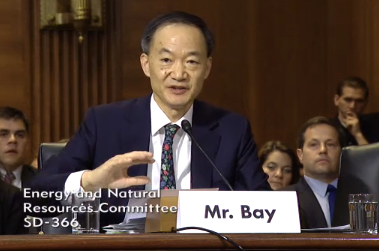
Norman Bay, with Richard Gates looking on, responds to questions during his Senate confirmation hearing in May.
The notice was issued the day after Bay was sworn in as a FERC commissioner and his deputy at the commission’s Office of Enforcement, Larry Gasteiger, was named acting director. Bay’s handling of the Powhatan case was cited during his Senate confirmation hearing in May as evidence of what critics said was his unit’s harsh and unfair tactics.
[Editor’s Note: An earlier version of this article inaccurately stated that FERC had “charged” Powhatan. The notice is merely a public disclosure of a previously non-public investigation.]
Powhatan, based in West Chester, Pa., is a private investment fund headed by portfolio manager Kevin Gates and his twin brother Rich. FERC staff says Powhatan and a predecessor fund netted $4.7 million in profits in 2010 by taking advantage of a loophole for making low-risk up-to-congestion trades to profit from line loss refunds.
The investigation was disclosed under a policy approved by FERC in December 2009 to balance “the need to protect the subject’s confidentiality in the early stages of an investigation with the public interest of promoting additional transparency during investigations.” It allows the Director of Enforcement to authorize a Preliminary Notice of Violations “after the subject of the investigation has had the opportunity to respond to staff’s preliminary findings letter.”
“In our experience, once staff provides its preliminary conclusions to a subject, the existence of the investigation is likely to become public in any event, through a negotiated settlement, an order to show cause, or, in the case of a publicly traded company, a securities filing,” the commission said in approving the policy. “The absence of disclosure means that a greater amount of time passes before the public becomes aware of potential violations that enforcement staff is investigating.”
Kevin Gates on Tuesday issued a statement vowing to fight the allegations. “We’ve read it and it makes no sense. We will aggressively fight their allegations. We can only speculate on FERC’s motives,” he wrote. “When a regulator is not concerned with the facts or the law, then traders can become easy targets if it has a political agenda.”
It is unclear what, if anything, FERC will do next. FERC staff advised Powhatan of its preliminary findings in August 2013 and Powhatan responded with its rebuttal in October. Powhatan said it has rejected an earlier settlement offer from enforcement staff.
“This is an acknowledgement that an investigation is going on,” FERC spokeswoman Mary O’Driscoll said today. “This is not an indication of whether the commission is going to go to court. There is no other step at this point.”
The case has drawn widespread attention and was highlighted in a Wall Street Journal op-ed penned by former FERC general counsel William Scherman. In it, Scherman accused Bay of driving Wall Street banks out of energy trading with heavy-handed enforcement tactics.
Republicans grilled Bay on the case and his management of the enforcement unit during his confirmation hearing. Bay declined to comment on the Powhatan case, which was then “non-public,” but dismissed Scherman’s allegations of due process violations as untrue.
FERC’s Larry Gasteiger answers questions about FERC enforcement as Michael Spofford of Bingham McCutchen (R) listens at an Energy Bar Association panel discussion in April.
Gasteiger responded to charges that FERC was unfairly targeting traders during a panel discussion at an Energy Bar Association conference earlier this year. “We take these cases extremely seriously, whether it’s individuals or companies,” he said. “We won’t take on a case unless we think we have an extremely solid case to present to the commission and if necessary to take it to a hearing before an [administrative law judge] or a district court proceeding.”
Tuesday’s notice alleges that Chen, trading on Powhatan’s behalf, placed “millions of megawatt hours of offsetting trades between the same two trading points, in the same volumes and the same hours — an intentional effort to cancel out the financial consequences from any spread between the two trading points while capturing large amounts of MLSA [Marginal Loss Surplus Allocation] payments.” FERC charges this was “wash trading,” which is illegal.
The Gates brothers said it was savvy trading and legal until the “loophole” was closed later in 2010.
After being under investigation by Bay’s enforcement unit for more than three years with no charges filed against them, the Gates brothers went on the offensive. In March, they released documents they say prove they have been unfairly hounded. The fund enlisted testimonials from an all-star team, including Susan J. Court, Bay’s predecessor as enforcement chief, Harvard professor William Hogan and John N. Estes III, a prominent defense attorney. (See PJM Trader Calls FERC on Manipulation Probe.)
The Gates brothers filed a Freedom of Information Act lawsuit to obtain agency records relevant to their case, lobbied the Senate to block Bay’s confirmation and lurked behind Bay during his confirmation hearing. In a letter to the editor published in The News Journal days before Bay’s confirmation hearing, Richard Gates said they were offered a settlement by FERC.
“While that would have been the easier and cheaper thing to do, Powhatan declined,” he wrote. “Instead, we planned for protracted litigation against the federal government.”
A state appeals court decided that Commonwealth Edison must pay for the spoiled groceries and other costs that 35,000 of its customers suffered from a series of 2011 storms. The decision could set a precedent and force the company to pay in future cases.
The ruling upheld a 2013 decision by the Illinois Commerce Commission resulting from six summer storms and a blizzard in 2011. ComEd has said the decision could cost it up to $35 million in claims.
Exelon signaled that its Ginna Nuclear Power Plant in Ontario, N.Y., will remain a part of its nuclear fleet when it filed a petition for continued operation with the New York Public Service Commission. Earlier in the year, published reports indicated that the company was considering shutting the plant down, arguing that it was uneconomical.
The petition, filed in late July, indicates that the company will keep the 581-MW Ginna plant running if it gets a good enough power-purchase contract from Rochester Gas and Electric. An earlier study conducted by NYISO indicated that the plant was necessary for the continued reliability of the grid. Without that study, Exelon said, it would have considered shutting down the plant.
Entergy’s Indian Point Nuclear Plant may be temporarily shut down by an order from the New York Department of Environmental Conservation in a move designed to protect fish populations.
The outages, which would affect both units, could be for 42, 62 or 92 days a year, the department has proposed. The outages would take place between May and August of each year during the plant’s 20-year license extension period.
Entergy Vice President of License Renewal Fred Dacimo said taking the units offline during peak energy consumption months would result in increased prices and could lead to blackouts. “All of these impacts might be worth considering if outages at Indian Point were actually necessary to protect fish eggs and larvae, but they are not,” he said. He said Entergy has proposed alternate methods to protect aquatic wildlife.
Bolts that caused an extended outage at Unit 2 of Public Service Enterprise Group’s Salem nuclear plant were composed of an alloy that had been ruled unfit for use in nuclear equipment as far back as 1984, according to findings by the Nuclear Regulatory Commission and other sources.
The failure of the bolts, which were inside two reactor coolant pumps, was found during a scheduled offline period in April as the reactor underwent fuel replacement. PSEG announced in mid-May that the shutdown would be extended to fix the problem. The company restarted Unit 2 last month.
The manufacturer of the bolts, Westinghouse Electric, warned that parts loosened by bolt failures could have created a “substantial safety hazard” if they locked up rapidly spinning parts in one or more of the coolant pumps, according to NRC spokesman Neil Sheehan.
PSEG spokesman Joe Delmar said that Westinghouse issued a technical bulletin on the issue in 1996. The bulletin concluded that even if all bolts on a pump failed, “it would not affect the performance of the pump and, therefore, they did not recommend going in and replacing the bolts with others with different material unless you were going into the pump for another purpose,” Delmar said.
The NRC notified officials at Dominion’s Surry Units 1 and 2 reactors near Newport News, Va., of the problem. Surry is the only other plant to use the same “A-286” alloy bolts in coolant pumps. Dominion is reviewing reports from Salem “to evaluate a course of action going forward,” Sheehan said.
DTE Energy will close two units at its Trenton Channel coal plant in Trenton, Mich., in 2016 in part because of new Environmental Protection Agency emissions rules, the company announced last week. The two units generate a total of 210 MW. The closings will leave a single unit in operation at the plant, the 520-MW Unit 9.
“The decision was made because of new federal emissions regulations taking effect in the next few years, and because of DTE’s focus on reducing customers’ rates and maintaining competitive electric rates in the future,” DTE Randi Berris said.
Exelon and Pepco told the Federal Energy Regulatory Commission last week that competitive and environmental concerns raised by the Independent Market Monitor and others over their proposed merger are unfounded, reiterating their request for FERC approval by Aug. 30.
“None of the objections to the transaction has any merit, and the commission should approve it without conducting an evidentiary hearing or imposing additional conditions,” the companies said in a July 30 filing (EC14-96).
Although the transaction will not substantially increase Exelon’s generation portfolio — Pepco owns only 17 MW — commenters have told FERC the pairing threatens to hurt competition, the health of the Chesapeake Bay, prospects for renewable energy and the PJM stakeholder process.
Commenters also asked FERC to ensure that costs of the transaction are not passed on to transmission customers and to strengthen provisions to prevent cross-subsidization among Exelon’s subsidiaries.
Competitive Concerns
The IMM said FERC should require the companies to provide more information and impose behavioral mitigation to address “potential vertical and horizontal market power issues.”
The Monitor said that Exelon’s ownership of the intrastate natural gas distribution systems of PECO Energy and Baltimore Gas and Electric, combined with the gas assets of Pepco’s Delmarva Power & Light unit, raise concern over gas-fired generators’ access to fuel.
Julie Solomon of Navigant Consulting, who evaluated the competitive impact of the merger on behalf of the applicants, said that new gas-fired generators will likely connect directly to interstate pipelines and bypass Exelon’s local distribution companies (LDCs).
But the IMM said the application did not discuss the state rules for such bypass arrangements and whether LDCs can impose charges or other conditions on generators seeking service directly from an interstate pipeline.
The Delaware Public Service Commission said Exelon and Pepco’s LDCs have the potential to favor their generation affiliates “especially during periods when interstate natural gas pipelines in the Mid-Atlantic are severely constrained,” because they hold gas storage entitlements and firm transportation contracts on interstate pipelines.
Exelon and Pepco said their combination will hold 6% of the interstate pipeline capacity in PJM and 7-8% of the capacity in the AP South region and the 5004/5005 submarket in Maryland. Their share of natural gas storage in PJM will be about 2.5%.
The Delaware PSC also said the companies should demonstrate that they cannot use their LDCs’ pipeline capacity entitlements to raise delivered natural gas prices “and, consequently, electricity prices to the advantage of their generation affiliates.”
Exelon said that because it already owns BGE and PECO, “the only potential vertical market power concern” raised by the merger relates to Pepco’s Delmarva affiliate, “which does not serve any natural gas-fired generation from its local distribution facilities.”
“Certainly the Delaware PSC can make no claim that any of the applicants have ever improperly withheld gas transportation capacity or that the transaction in any way would facilitate the improper withholding of such capacity,” the applicants said.
Exelon Transmission Concentration
The IMM said that the increased ownership of transmission is also a concern and that the applicants overstated PJM’s control over their assets. The merger would give Exelon nearly one-quarter of the PJM transmission network, adding Pepco’s transmission, which accounts for 6.6% of PJM transmission service credits, to Exelon’s current 16.8%.
The IMM also said FERC should consider the impact of the merger on competition among transmission developers under FERC Order 1000.
Transmission owners can determine “the timeliness, the technical requirements for and the costs of” interconnections and set the line limits used by the RTO in their network models, the IMM said.
Exelon “will have substantial and increased influence over decisions that directly relate to competition in PJM among developers of transmission projects. Although the RTO has responsibility for the interconnection process, transmission owners perform interconnection studies for generation. Having a transmission owner involved in the study process creates a conflict of interest if they are also the developer or potential developer of a project or own competing generation,” the IMM said.
The IMM said FERC could address its concerns through behavioral mitigation, such as ordering independent interconnection studies and a process for reviewing and updating transmission limits.
Exelon said the IMM’s concern is “purely hypothetical [and] completely unsupported by any data or other evidence.”
It said its market power is mitigated by both its membership in PJM and FERC’s requirement that all transmission providers operate under the competitive protections of an Open Access Transmission Tariff.
Impact on Transmission Rates
The Southern Maryland Electric Cooperative (SMECO) and the Delaware Municipal Electric Corp. said FERC should prohibit Exelon from recovering its “acquisition premium” — the 25% difference between Pepco’s stock market value and Exelon’s purchase price — through wholesale transmission rates.
SMECO, which depends on seven interconnections with Pepco to supply its members, said that while Exelon promised not to seek recovery of the premium through retail rates, it made no such commitment to wholesale transmission customers. SMECO said FERC should insist Exelon’s promise to hold transmission customers harmless for five years applies to both the acquisition premium and transaction costs.
It also called for revisions to Pepco’s existing formula transmission rate to improve transparency and ensure customers have the information needed to review and challenge future rate-increase requests.
Exelon said it should not be prohibited from recovering merger-related costs if they are offset by merger-related savings. The applicants said FERC lacks jurisdiction to require changes to formula-rate protocols in the merger proceeding. “Such changes to an existing rate schedule may be ordered only in connection with a Section 206 complaint,” the company said.
Cross Subsidization
In their May 30 application to FERC, Exelon and Pepco said that “because of the de minimis nature of the competitive overlap,” the commission should be able to approve the transaction within 90 days.
The Delaware Municipal Electric Corp. said FERC should reject the applicants’ request for an expedited ruling, noting that state regulators have not yet examined the adequacy of the “ring-fencing” measures to address cross subsidization.
The D.C. Office of the People’s Counsel said the financial and geographical size of the merged company raises questions of “whether any one state regulatory body will be able to regulate the local utility subject to its jurisdiction.” The post-merger company would have regulated utilities in Illinois, Pennsylvania, Maryland, Delaware, New Jersey and D.C.
Exelon responded that the merger satisfies the commission’s cross-subsidization standards so that “no particular ring-fencing should be required.”
Environmental Concerns
The Clean Chesapeake Coalition, a group of nine northern and eastern Maryland counties, complained that Exelon — whose post-merger service territory would surround the Chesapeake Bay and its tributaries — has displayed a “lack of environmental due diligence.”
The coalition wants Exelon to do more to prevent sediment trapped by the dam at the Conowingo Hydroelectric Project from being released into the Chesapeake during storms.
The counties said they approached Exelon to express their concerns — at FERC’s direction — after attempting to intervene in the relicensing of the dam. They said that the company has not responded after more than three months. “Such disregard of local government concerns [is] an affront to the public interest,” the coalition said.
The Institute for Energy and Environmental Research and the Nuclear Information and Resource Service, two Maryland-based environmental groups, said the merger will increase Exelon’s influence in public policy debates over the merits of nuclear power versus renewables. Exelon would increase its share of residential electric distribution customers from 50% to 80% in Maryland while adding virtually all D.C. residents.
Exelon has been seeking additional compensation for the carbon-free generation of its nuclear fleet. The environmental organizations said this pits Exelon’s interests against those who support more renewables. The groups cited Environmental Protection Agency estimates that reducing carbon emissions through renewable portfolio standards costs $3 per metric ton while subsidizing “at-risk nuclear units” would be $12 to $17 per metric ton.
“If corporate money is free speech, as the Supreme Court has ruled, then FERC is obliged to consider the effect of increasing Exelon’s ability to speak in the political arena that the merger would cause,” the groups said.
Exelon said the environmental claims are “irrelevant to the commission’s review” of the merger.
PJM Influence
The IMM, Delaware PSC and D.C. Office of the People’s Counsel complained that the merger could give Exelon undue influence in the PJM stakeholder process.
Having divested its generation, Pepco has more in common with transmission-only cooperatives than generation owners such as Exelon; Pepco representative Gloria Godson has often sided with load against supply in PJM debates. (See Pepco to Lose its PJM Voice; Consumers Lose Frequent Ally.)
“The potential for the elimination of [Pepco]’s independent voice in the PJM stakeholder process should give this commission serious pause,” the DC Office of the People’s Counsel said.
The Delaware PSC noted that Exelon is a member of the Electric Power Supply Association (EPSA), the plaintiff in the lawsuit that resulted in an appellate court voiding FERC’s authority over compensation for demand response. “Exelon’s support for that outcome is not in line with consumer interests,” the Delaware regulators said.
The IMM said that “transmission owners have significant leverage” over RTOs and noted that Exelon’s participation in PJM is voluntary.
“Like any organization, RTOs are concerned with protecting their size, scope and importance. The exit of a transmission member would be a very significant negative for an RTO,” the IMM said. “The greater the proportion of the RTO’s assets represented by the transmission owner, the greater the threat of exit to the RTO and the greater the potential influence of the transmission owner over the RTO governance and processes.”
Exelon said the claims are irrelevant and incorrect.
Pepco and Exelon each have one vote in PJM’s top two stakeholder bodies, the Members Committee and Markets and Reliability Committee — Pepco in the Electric Distributor sector and Exelon in the Transmission Owner sector. Post-merger, Exelon will have only one vote in the 14-member TO sector.
“Consequently, far from increasing Exelon’s influence in the stakeholder process, the transaction will reduce by one vote the influence the merged company will have,” Exelon said.
PJM’s Board of Managers will ask the Federal Energy Regulatory Commission to approve a proposal opposed by generators to reduce payments to frequently mitigated units (FMUs).
General Counsel Vince Duane told the Markets and Reliability Committee last week the RTO will make the request under Section 206 of the Federal Power Act because the proposal by PJM and the Independent Market Monitor failed to win two-thirds of the Members Committee in June.
The plan garnered a 65.6% sector-weighted vote of the committee, with support from only 23% of Generation Owners and about half of Transmission Owners and Other Suppliers. End Use Customers and Electric Distributors voted unanimously in favor of the proposal, which would limit FMU adder payments to units whose net revenues are not covering their avoidable cost rate (ACR). (See FMU Proposal Falls Short.)
President Obama last week named Cheryl LaFleur as chairwoman of the Federal Energy Regulatory Commission effective July 30 and said new Commissioner Norman Bay will succeed her in the top spot on April 15, 2015.
LaFleur has been serving as acting chair since Nov. 25, when former Chair Jon Wellinghoff resigned.
Bay, who has served as director of FERC’s Office of Enforcement since 2009, won confirmation to the commission under an unusual agreement that Obama wouldn’t promote him to the chairmanship for nine months.
The compromise was crucial to winning the votes of some who criticized Obama’s plan to make Bay — who has never been a regulatory commissioner — chair immediately upon his appointment.
The last five FERC chairmen served a median of 30 months before becoming chair. Only one served less than a year on the panel before his promotion.
The four-unit, 2,422-MW coal-fired Roxboro Steam Plant in in Semora, N.C., is one of the largest power plants in the United States. (Source: Duke)
The North Carolina Eastern Municipal Power Agency is selling its stake in four Duke Energy Progress power plants to Duke in a deal valued at $1.2 billion, the organizations announced last week.
The agreement involves about 700 MW at two coal-fired plants and three nuclear units. When the deal closes, Duke will be the sole owners of the Roxboro Unit 4 and Mayo Unit 1 coal plants, and the Brunswick Units 1 and 2 and Harris Unit 1 nuclear stations. All of the plants are in North Carolina.
Duke also entered into a 30-year power-purchase agreement to supply wholesale power to the 32 municipalities represented by NCEMPA. The terms of that agreement were not released.
The deal will allow the agency to unburden itself of a large chunk of the approximately $1.9 billion in debt under which it has been struggling.
The single-unit, 900-MW Harris Nuclear Plant is located near New Hill, N.C. (Source: Nuclear Regulatory Commission)
“NCEMPA’s decision to sell its power generating assets was driven by a desire to lower its power costs and reduce its risk of generation ownership,” said NCEMPA spokesperson Rebecca Agner on Friday. “This agreement will reduce NCEMPA’s outstanding debt by more than 70% and make our costs more competitive. After the sale, NCEMPA will not own any generation assets.”
The agreement needs approval from the Federal Energy Regulatory Commission and several state agencies.
Duke spokesman Jeff Brooks said the agreement was attractive for the company for a number of reasons. He acknowledged that the $1.2 billion sales price was somewhat higher than “book value” of the plants, but he said having sole ownership “will provide long-term fuel savings,” benefiting both Duke and its customers.
“These units were among the least costly [in the Duke fleet] to operate from a fuel standpoint,” he said. In buying back the 700 MW of capacity, Duke will be able to increase wholesale energy revenue while lowering its average fuel costs.
Municipalities will benefit from lower debt service costs.
Although Duke has retired a number of coal units in the region in recent years, the Roxboro and Mayo plants are among its youngest and have already seen substantial emissions control retrofits.
“We have made substantial investments in emissions control and dry ash” collection, Brooks said. “The coal units are among the cleanest in the nation.”
The two nuclear stations could run for at least two decades. The licenses for Brunswick Units 1 and 2 are good until 2034 and 2036, respectively. The Harris license expires in 2046.
The Markets and Reliability Committee last week endorsed two manual changes and approved changes to rules on black start compensation and auction-specific transactions.
Manual Changes
Members endorsed changes to Manual 37: Reliability Coordination to update the System Operating Limits (SOL) definition and violation language (sections 3.1, 3.2) to conform to the North American Electric Reliability Corp. standard.
Revisions to the cost allocation section of Manual 14B: PJM Region Transmission Planning Process also won endorsement. The changes describe the current solution-based methodology as detailed in the PJM Tariff.
Revisions to Manual 14A: Generation and Transmission Interconnection Process were deferred to await coordination with MISO. The revisions are intended to reflect changes in how interim deliverability studies are conducted.
Black Start Compensation, ‘Back Stop’
Members approved a “back stop” mechanism for acquiring black start services through transmission providers when PJM solicitations fail to obtain service for a zone. Members also approved minor Tariff and manual changes relating to the compensation of black start units. (See PJM to Seek Smaller Black Start Changes.)
The new rules:
Allow energy-only black start units to be compensated. There was previously no mechanism to compensate energy-only generators through the base formula rate.
Allow automatic load rejection (ALR) units to recover NERC Compliance costs as documented to the Market Monitor.
Allow fuel-storage compensation for liquefied natural gas, propane and oil. Previously, only oil storage was compensated.
Limit black start units sharing a common fuel tank to claim the fuel-storage compensation for only one unit, closing a loophole.
Schedule a review of compensation formulas every five years (down from the current two years) to align it with the RTO-wide black start solicitation.
The System Restoration Strategy Senior Task Force had considered several proposed changes but none of the others received the minimum 50% support to forward it to the MRC for consideration. With its work complete, the task force will be sunset, said MRC Chairman Mike Kormos, PJM’s executive vice president for operations.
Auction-Specific Transactions
Members gave final approval to a manual change that will make it easier for banks to purchase capacity providers’ revenue streams. The change, proposed by Citigroup Energy, will allow auction-specific transactions to be entered into PJM’s eRPM system after the auction that initiated them. Previously, such transactions could not be submitted to PJM until after the third incremental auction for a delivery year. (See Stakeholders Look to Expedite Auction-Specific Transactions.)
PJM will increase performance penalties and incentives and seek ways to incorporate firm gas transportation in energy prices under an initiative announced last week to reduce generator outage rates.
PJM CEO Terry Boston announced the initiative, which he said resulted from a three-day meeting of the Board of Managers and discussions with present and former leaders of the Members Committee and stakeholder sectors.
The action was prompted by January’s extreme cold, when as much as 22% of PJM’s generation suffered forced outages, three times the normal winter rate.
“We would have to interrupt load if this happened in [future] winters,” Boston told the Markets and Reliability Committee Thursday, noting that the RTO will lose about 8,500 MW of generation to retirements by the winter of 2015/16. “We feel [changing capacity rules] has to be one of our highest priorities.”
Officials said the changes may increase capacity costs but should also reduce volatility during tight supply/demand conditions.
Redefinition of Capacity
“You should think of this as a holistic redefinition of what capacity is,” said Andy Ott, executive vice president for markets.
Members’ initial response to the initiative — which PJM said would be conducted under expedited procedures outside the normal stakeholder process — was muted.
David “Scarp” Scarpignato of Direct Energy questioned whether PJM would bring proposed changes to “advisory” votes before the MRC or Members Committee.
Gregory Carmean, executive director of the Organization of PJM States (OPSI), expressed concern that additional costs would be largely for winter performance while capacity cost allocation is based on summer loads.
Carl Johnson, representing the PJM Public Power Coalition, expressed misgivings over the initiative during a later MRC discussion regarding the Triennial Review of capacity auction parameters.
Johnson said stakeholders haven’t received enough information on the cost impact of the parameter changes, which include a potential increase in the Installed Reserve Margin. Referring to PJM’s plans to “redefine” capacity Johnson said, “When we don’t understand what we’re buying when we buy capacity, to say we’re going to be buying more of it, we cannot support.”
The Consumer Advocates of PJM States discussed the initiative yesterday and was expected to issue a statement later this week.
Fuel Security
A key part of the new definition will be fuel security, meaning incentives are likely to encourage nuclear generators, dual-fuel units and firm gas contracts.
“At 20 mph [the speed at which gas flows], there’s not a lot of difference between just-in-time delivery and too dang late,” Boston said.
He also referred to two coal plants that were unable to operate in January because they lacked natural gas needed to start up. “Twenty thousand dollars’ worth of fuel oil could have brought those units up,” Boston said. “I would pay that now.”
More Flexible Operations
Officials also will be seeking to reverse a trend toward less flexible unit operating parameters. In a 23-page white paper issued Friday, PJM said unit flexibility has dropped as a result of staffing reductions and other cost cuts. (See Problem Statement on PJM Capacity Performance Definition.)
Ott said limits on unit flexibility must be a function of operational limits, not financial concerns. “We’ve seen units with three starts per day reduced to one; units with very short minimum run times became very long minimum run times,” he said.
The effort will also seek to boost operations and maintenance spending to improve generator availability on “low probability peak events” such as January’s polar vortex or last September’s unexpected heat wave.
“Generation owners may choose to cut O&M costs or choose not to make investments that enhance availability as a means to manage costs,” the report noted. “In making such a decision, the generation owner has implicitly or explicitly made a calculation that the benefits of such measures [increased net revenues] do not cover these ‘additional’ costs.”
Generator owners also have complained that there is no way to reflect such costs in supply offers.
“Competitive pressure to clear in the RPM capacity market may push generation owners to not make these investments if they feel other competitors are taking a similar strategy due to the risk of pricing themselves out of the market,” the report said.
Insufficient Penalties
PJM said current penalties for capacity resources that are unavailable during the 500 “peak” hours per year are insufficient.
The Tariff defines summer peak hours as Hour Ending 1500 to HE 1900 on non-holiday weekdays from June through August. Winter peak hours are HE 800 to HE 900 and HE 1900 to HE 2000 on non-holiday weekdays in January and February.
Penalties are assessed only if the forced outage rate during peak hours (EFORp) is more than the five-year average forced outage rate (EFORd5) of the resource.
Generators are often able to avoid even these penalties because the Tariff forgives outages related to a lack of gas as “Out of Management Control (OMC).”
“The penalties for being unavailable during the pre-defined peak hours … provides no incentive to make investments in O&M or infrastructure to enhance availability since there is little risk of incurring a capacity market penalty for being unavailable during reliability critical events,” the report said.
The current structure “provides an incentive for generation owners to hide the real cause behind an outage, or to shift the cause of an outage to a third party such as a gas pipeline” and claim it as OMC, the report said. However fuel delivery contracts and installation of dual-fuel capacity “are business decisions well within the control of the generation owner.”
‘Enhanced’ Liaison Committee Process
PJM officials said they will invoke a never-used “Enhanced Liaison Committee” process so that the new rules can be filed with the Federal Energy Regulatory Commission in time for the winter of 2015/16.
“If Polar Vortex conditions occurred in 2015/16 and outage rates were as high as PJM experienced in January 2014 … PJM would almost certainly experience a loss-of-load event,” the report said. PJM hopes to reduce outages this winter by resuming winter generation testing.
The process — developed by the Governance Assessment Special Team (GAST) in 2011 and documented in Manual 34 — was created to allow members to provide input on issues for which consensus is unlikely and the board acts independently.
“There will be a lot of opportunity in the next two months for dialogue,” promised Dave Anders, director of stakeholder affairs.
PJM has scheduled two meetings — 1-4 p.m. Aug. 12 and 18 — to discuss the initiative and the problem statement white paper.
On Aug. 20, PJM plans to release a draft white paper detailing proposed solutions; it will be the subject of a third meeting from 9 a.m. to noon Aug. 22. Stakeholders’ written comments on the second paper will be due Sept. 12, followed by a fourth meeting to receive additional comments Sept. 24.
The enhanced liaison process will begin Oct. 7 when PJM issues the final version of its solutions whitepaper. Additional input from stakeholders will come through coalitions, which will be required to submit briefing papers by Oct. 28.
The board will meet with the Enhanced Liaison Committee Nov. 4.
The proposed solutions may incorporate cold-weather initiatives being conducted by other committees, including energy storage participation in RPM (Planning Committee); qualifying transmission upgrade (QTU) credits and unit market offers (Market Implementation Committee); and cold weather resource performance improvements and gas unit commitment coordination (Operating Committee).
Arbitrage Technical Conference
General Counsel Vince Duane said PJM will ask FERC to delay scheduling of a technical conference the commission ordered in May, when it rejected the RTO’s plan to curb speculation in capacity market auctions. The conference is to develop solutions to eliminate arbitrage opportunities between the base residual auction (BRA) and incremental auctions (IAs).
“Any conversations with FERC thus far I would characterize as very preliminary,” Ott said in response to a stakeholder question.

 Vivint Solar, an upstart business in the home security and automation fields, is planning an initial public offering for its solar segment, according to sources. Vivint’s IPO could come out as soon as September.