VALLEY FORGE, Pa. — A senior PJM official acknowledged last week that a proposal to allow load-serving entities such as the Illinois Municipal Energy Agency to use external resources to meet their capacity requirements could be construed as “somewhat preferential.”
Stu Bresler, vice president of market operations, outlined a proposal to allocate capacity transfer rights (CTRs) to resources external to the PJM region that historically have been used to serve the needs of the PJM load.
“We think this is a relatively small population and we can do this … very narrowly,” Bresler told the Market Implementation Committee.
PJM estimates 1,037 MW of historic external resources would qualify under its proposal: 122 MW in the DOM zone, 533 in COMED, 261 in AEP and 121 in DAY.
GT Power Group’s Dave Pratzon, who represents generation owners, took issue with the plan. “What you’re proposing seems like a real sweetheart deal, and any rules I’d want to see would be very strict in terms of identification and not be able to be expanded in the future,” he said.
“I’ll be the first to admit the treatment here could be seen as somewhat preferential,” Bresler responded. The question for stakeholders, he said, is “does the historic nature of the commitments justify that solution?”
Independent Market Monitor Joe Bowring asked whether IMEA could sell its rights to a third party under the proposal.
Bresler said “that level of detail is not decided yet.” He said PJM will expand the detail of the proposal and return it to the committee in March.
Members on Wednesday approved an optional scheduling product intended to reduce uneconomic power flows between PJM and MISO, similar to the Coordinated Transaction Scheduling product launched Nov. 4 with NYISO. (See NYISO Scheduling Product Wins FERC OK.)
The product would allow traders to submit bids that would clear only when the price difference between the two regions exceeds a threshold set by the bidder.
The product would operate on a joint clearing mechanism in which each party would evaluate the prices individually, and the common set would be the transactions that flow.
PJM stakeholders will have to vote on the accuracy of the product’s prices before the offering goes live.
The RTOs are expected to agree upon a common method of interface pricing by November 2016.
PJM, MISO near Agreement on M2M Language
PJM and MISO expect to file a revised Joint Operating Agreement this spring on three market-to-market rules.
PJM’s Asanga Perera told the MIC that the two RTOs have agreed in concept on all three issues and drafted language for one, a change to the threshold for naming flowgates. Perera said RTO officials were still “wordsmithing” provisions regarding conflicting constraint control and hold-harmless settlements for planned outages submitted after the day ahead market deadline.
The threshold for flowgates will be amended for transmission lines at 138 kV or less. The change means that 138-kV and lower elements will not be named as flowgates unless flows from the neighboring RTO amount to 35% or more of the line’s rating, up from the current 25%. The 20% threshold will remain for lines more than 138 kV.
Perera said language on the other two rule changes should be complete by the March MIC meeting. A filing with the Federal Energy Regulatory Commission is targeted for early in the second quarter.
Test Shows Highest Promised Load Reductions
(Click to zoom.)
Summer limited demand response produced 135% of promised load reductions in tests this year, the highest ever.
The test showed 9,668 MW of limited DR responding, 2,510 more than the commitment. However, some providers failed the test, resulting in penalties of $2.7 million, at an average penalty rate of $140/MW-day.
PJM has not actually called on DR during delivery year 2014/15.
Faulty Models Hamper Net Energy Metering Study
(Click to zoom.)
PJM’s attempt to track the growth of distributed solar generation is being hampered by modeling issues. In a briefing on its net energy metering quarterly review, PJM told members that the locations identified as sources of “negative energy” — net energy injections at load buses — are not where most solar PV is located.
“Usually the largest ‘injections’ are because of modeling issues on the distribution system,” PJM’s Ken Schuyler said. “We haven’t really seen a trend of negative injections because of net energy metering.”
PricewaterhouseCoopers’ fourth-quarter 2014 power and utilities mergers and acquisitions report showed an increase in both the number and value of deals greater than $50 million. The firm recorded 22 deals in the last quarter, compared to 12 in the third and 14 in the fourth quarter of 2013. The total value of the deals increased 57% to $17.4 billion in Q4 from $11.1 billion in Q3.
PSE&G Ranks Highest in Gas Service Customer Satisfaction in East
Public Service Electric & Gas was named No. 1 in gas-service business customer satisfaction in a poll by J.D. Power, with a score of 690 on a scale of 1,000. The ranking comes on the heels of PSE&G’s first-place ranking in electric-service business customer satisfaction among 12 utility companies earlier this year. It is the first time the company has achieved first-place rankings in both categories.
PPL Shutting Down J.E. Corette Coal Plant near Billings, Mont.
A PPL subsidiary said that it will permanently shut down its mothballed 153-MW coal-fired J.E. Corette plant near Billings, Mont. PPL Montana closed the plant in 2012 because of low market prices and the high cost of environmental upgrades. At the time, it said that the plant might be returned to service if power prices warranted. It is not part of the PPL-Riverstone Holdings deal that will form a new merchant generation company, Talen Energy.
Entergy Says Vermont Yankee Decom Money not Guaranteed After 60 Years
Entergy is not guaranteeing that it will finance any decommissioning costs at the now-closed Vermont Yankee plant if it takes longer than 60 years.
Entergy Vice President Michael Twomey told Vermont legislators that if decommissioning isn’t completed by then, “there would probably be quite a lot of litigation” concerning additional funding. Vermont Yankee’s decommissioning fund currently holds about $600 million. He said he believes the fund will grow enough to cover the cost of dismantling the reactor and at least part of the cost of managing the plant’s spent fuel.
Because there is still no federal spent-fuel storage facility, all of the spent fuel since the plant started up in 1972 remains on site in pools. Twomey said the company has arranged two lines of credit to pay for transferring the fuel to dry casks and expects to be reimbursed by the U.S. Department of Energy.
Atlantic Coast Pipeline Signs $400 Million Pipe Contract
While awaiting approval from the Federal Energy Regulatory Commission, and battling with opponents in Virginia, Atlantic Coast Pipeline is moving forward with a planned 550-mile natural gas pipeline and just signed a $400 million contract with a steel pipe company. The line is intended to bring shale field gas through Virginia into North Carolina. Last week, the consortium behind the pipeline said it contracted with Dura-Bond Industries to produce steel pipe ranging from 30 to 42 inches in diameter. It is the largest single order in Dura-Bond’s history, and the company’s Steelton, Pa., plant will add a second shift to help complete the order.
Duke Energy Buys Majority Stake in Calif. Solar Company
Duke Energy added to its solar portfolio last week by buying a majority stake in REC Solar, a commercial solar company based in San Luis Obispo, Calif. Industry figures put REC Solar as the eighth largest solar installation company in the U.S. It has installed more than 400 commercial systems totaling more than 140 MW. Although the terms of the transaction were not disclosed, Duke has said it is ready to invest up to $225 million more in REC projects.
Duke Energy said it plans to spend up to $68.7 million on solar projects in South Carolina over the next five years, adding 111 MW of solar capacity to the state’s grid. The plan calls for 53 MW of commercial solar capacity and 58 MW of rooftop solar. The residential rooftop solar will be spurred by customer incentives of up to $5,000 each, the company said.
Dominion Awaiting FERC OK for Gas Tx Projects in Md.
The Federal Energy Regulatory Commission is in the final phase of reviewing two natural gas transmission projects proposed by Dominion Transmission to fuel two new power plants in Maryland. The 725-MW CPV St. Charles Energy Center in Waldorf and the 735-MW Keys Energy Center in Brandywine will be fed from Dominion’s existing pipeline, but the taps on the pipeline need to be approved by FERC. The $775 million St. Charles plant is under construction and due to come online by June 2017. Construction of the Keys Energy Center, a $750 million plant, will begin this year and come online in early 2018.
The Tennessee Valley Authority board last week approved a plan to buy a 760-MW natural gas-fired combined-cycle plant in Ackerman, Miss., for $340 million. The board also approved plans to enter into a power purchase agreement with an 80-MW solar plant to be built near TVA’s Colbert Fossil Plant in North Alabama. Charles “Chip” Pardee, chief operating officer, said the decisions were driven by a desire to add a cleaner mix to its coal-heavy portfolio to help meet pending Environmental Protection Agency emissions mandates. TVA has built or purchased five combined-cycle plants totaling 3,900 MW.
FirstEnergy Investing Nearly $35 Million in Tx Projects to Support Shale Gas
FirstEnergy said it is upgrading existing transmission lines and building new substations in a $35 million project to support the Marcellus Shale gas industry in western Pennsylvania. Although the projects are aimed at serving the growing power needs of the shale gas industry, FirstEnergy customers will also reap the benefits: new shale gas projects account for about 370 MW of projected load growth in the area, the company said.
Maria Korsnick, Exelon Generation’s senior vice president for Northeast operations and chief nuclear officer of the company’s joint venture with Electricite de France, is being loaned to the Nuclear Energy Institute for an 18-month assignment as the lobbying group’s chief operating officer. Korsnick has 28 years of experience in the nuclear industry.“Under Maria’s leadership, nuclear energy facilities at Constellation Energy Nuclear Group and Exelon have operated at exceptional levels of safety and performance,” said Marvin S. Fertel, president and chief executive officer at the NEI. “Maria will provide that same organizational effectiveness, vision and leadership working with our staff and members at NEI.”
Google Signs 20-Year Wind Contract with NextEra Energy
Google has signed a 20-year power purchase agreement with NextEra Energy to buy wind-generated electricity for its Googleplex headquarters in Mountainview, Calif. The company committed to buying half of the output from NextEra’s windmills on the Altamont Pass in eastern Alameda and Contra Cost counties. The output is estimated at 43 MW. Terms of the deal were not disclosed.
Ameren Asking for More Time to Meet EPA Emissions Goals
Ameren is asking for an additional five years to meet emissions-reduction goals set by the Environmental Protection Agency, saying the current schedule that calls for incremental goals to be reached by 2020 is unreasonable. It said that expecting states to meet the goals “with such stringent targets at short notice” would lead to “staggering costs” of approximately $4 billion. It said it could meet the targets of compliance by 2035, five years past the suggested 2030 deadline.
“The EPA should allow states that put in plans that show they would be hitting the 2030 targets within a reasonable time frame around that 2030 date — in our case 2035 — the EPA should be flexible and allow that,” said Joe Power, Ameren’s vice president of federal legislative and regulatory affairs.
Dynegy has reached a settlement with PJM’s Independent Market Monitor to alleviate market power concerns over its purchase of 12,400 MW of generation from Duke Energy and Energy Capital Partners.
In an agreement filed Feb. 6 (EC14-140), Dynegy said it would not to buy any of the plants that will come on the market as a result of the PPL-Riverstone Holdings spinoff to form Talen Energy.
Additionally, Dynegy committed to offer all of its units into PJM capacity market auctions and promised it wouldn’t retire any units unless they failed to clear. It also promised to enter such plants into reliability-must-run agreements if PJM decided they were necessary. The settlement also contained commitments concerning energy and ancillary services offers, which Dynegy said would be good for seven years.
Dynegy is hoping to acquire 11 Duke generating units in the Midwest and 10 Energy Capital Partners generators in the Midwest and New England. Dynegy would gain about 9,000 MW in PJM, boosting it to more than 10,700 MW and eighth in generation share in the RTO. (See Dynegy Back in the Game with Duke, ECP Acquisitions.)
(Click to zoom.)
In their application for approval of the purchase, the companies told the Federal Energy Regulatory Commission that Dynegy’s 6.5% share of the PJM market post-acquisition would have a minimal impact on competition.
The settlement was filed along with a response to a Jan. 16 deficiency notice in which FERC said that the applicants had not addressed all of the commission’s competitive concerns.
The response included market power analyses it said proved that the transactions “will not have an adverse effect on competition” in PJM or any PJM submarket.
Noting that the Monitor was the only intervenor to raise competitive concerns in PJM, the companies asked FERC to approve the deals by April 1. Dynegy said additional delays would cost it $1 million a day in financing costs, impact outage coordination activities needed to prepare for summer operations and threaten the consummation of the deal.
Nuclear a Renewable Resource? Arizona Senate Panel Says ‘Yes’
A state Senate committee has passed a bill — by one vote — that would declare nuclear power a renewable energy source. SB1134 would define nuclear energy as renewable if it comes from “sources fueled by uranium fuel rods that include 80% or more of recycled nuclear fuel and natural thorium reactor resources under development.” State code currently holds nuclear and fossil fuels as non-renewable.
Senators’ Bill Would Give States Say over Feds on Tx Lines
The state’s two Republican U.S. senators, prompted by a proposed Clean Line transmission project in the state, have introduced federal legislation to “restore the right of states” to rule on transmission projects before the federal government steps in.
Sens. John Boozman and Tom Cotton introduced the Assuring Private Property Rights Over Vast Access to Lands (APPROVAL) Act, which calls for the U.S. Department of Energy to get approval from states’ governors and public service commissions before exercising eminent domain. Such decisions, Boozman said, “should not be in the hands of Washington bureaucrats. If a project is not good for Arkansas, our governor or public service commission should have the power to say ‘no.’”
Environmental Groups Ask Judge for Venue to Stop Oil Shipments
Rebuffed by two state boards, two environmental groups went to a Superior Court judge to appeal a state order allowing increased crude oil shipments out of the Delaware City Refinery. At issue is a 2013 order by the Department of Natural Resources and Environmental Control, which granted an amended air pollution permit for the refinery. The permit allowed crude to be loaded on vessels at the refinery’s dock. Now, long lines of rail cars carrying crude are rolling into the refinery and the crude is being shipped out.
The environmental groups argue that such use is a violation of the state’s Coastal Zone Act. But both the Environmental Appeals Board and Coastal Zone Act Industrial Control Board have said challenges to the permit are outside of their jurisdiction. The groups asked Superior Court Judge Andrea L. Rocanelli to identify a venue for their challenges to the permit. She is expected to rule within 90 days.
Madigan, Emanuel Call for Investigations of Peoples Gas
Madigan
Chicago Mayor Rahm Emanuel and state Attorney General Lisa Madigan are calling for an audit of Peoples Gas to be made public in light of the company’s burgeoning cost overruns on pipeline replacement projects. Costs for the project went from a projected $2.2 billion to $4.6 billion. Madigan and Emanuel have called for a subpoena of the auditing company, Liberty Consulting Group, to have it testify about what it discovered about the projects and the company’s management of them. Peoples is replacing about 1,700 miles of gas mains and is supposed to complete that by 2020. An administrative law judge earlier this month denied Madigan’s request to make the audit public.
IURC Denies IPL’s $12.3 Million Recovery Request for Charging Stations
Indianapolis Power & Light’s request for $12.3 million in cost recovery that would have paid, in part, for a program to build charging stations for electric cars was denied by the Utility Regulatory Commission. IPL said it would decide whether to appeal the decision. It had asked for the money to install charging stations and kiosks for the BlueIndy project, part of Indianapolis’ electric-car sharing program.
Gov.’s Office Says We Energies ‘Double-Dipping’ in UP Deal
Gov. Rick Snyder’s senior policy advisor accused We Energies of “double-dipping” for collecting ratepayer subsidies to keep an Upper Peninsula power plant on while at the same time getting paid by a returning industrial customer whose departure helped spur the subsidies in the first place.
We Energies is collecting about $8 million a month in system support resource (SSR) payments to keep the Presque Isle plant in Marquette open. Those payments and higher rates were necessary, the utility successfully argued, to keep the plant open. But Cliffs Natural Resources, an industrial customer that left two years ago, returned earlier this month. Cliffs Natural Resources makes up 85% of the plant’s load. “We absolutely believe they are double-dipping,” said Valerie Brader, Snyder’s senior policy advisor said.
WE spokesman Brian Manthey disputed that, saying the industrial customer is not guaranteed to stay with the company. Cliffs Natural Resources “could leave at any time, leaving other customers at risk,” Manthey said. “Without a long-term agreement over an extended period of time with the mines, they could potentially leave. We feel the SSR should stay in place at this point because they are not committed.” The company has until Feb. 25 to respond to the Public Service Commission.
State to Meet 10% Renewable Energy Goal by End of Year
The Public Service Commission says the state will have 10% of its energy come from renewable sources by the end of the year. Its report said that the level was at 8.1% in 2014, up from 7.8% in 2013. “By the end of the year, Michigan will have reached its renewable energy portfolio standard — 10% by 2015,” PSC Chairman John D. Quackenbush said. “The RPS can be credited with over 1,450 MW of new renewable energy projects becoming commercially operational since [the law] took effect.” The PSC said 59% of its renewable energy comes from wind, followed by 16% hydro and 14% biomass.
The Public Utilities Commission last week approved three solar projects proposed by Xcel Energy that will increase the state’s solar capacity by a factor of 10. The largest of the three projects is a 100-MW array in North Branch. Community Energy Solar, a Radnor, Pa.-based company selected by Xcel to build it, said it will be “far and away the biggest” solar project in the Midwest. Two other projects near the towns of Tracy and Marshall will add another 87 MW of capacity. Those two alone will be enough to allow Xcel to meet its state mandate for 1.5% of its electricity from solar by 2020.
TransCanada Puts Keystone Land Buys on Hold Pending Suit
TransCanada, the company attempting to build the Keystone XL Pipeline, is holding off on buying any more state land until a state court decision on a suit filed by landowners who don’t want to sell. The company has already purchased about 90% of the land necessary for the proposed pipeline to run through the state.
A 2012 state law gave the governor the power to determine the pipeline route through the state. Landowners are suing, saying that power properly rests with the state Public Service Commission. Four of the seven state Supreme Court justices already ruled in the landowners’ favor, but five justices are needed to strike down a state law.
Senate Passes Bill that Would Force BPU Approval of Wind Plan
The state Senate passed a bill that would force the Board of Public Utilities to approve the proposed Fishermen’s Energy offshore wind project. The BPU has twice rejected the $188 million project, saying it would be burdensome for ratepayers. S2711 now goes to Gov. Chris Christie for his signature. The project already has $46.7 million in federal funding, but one of the requirements to get that money is BPU approval.
For the third time in three months, Piedmont Natural Gas has filed with regulators here and in South Carolina to cut its natural gas rates. The rates are a pass through on a dollar-for-dollar basis, and dropping wholesale natural gas prices are driving the reductions. If approved, residential customers would see an average savings of about $10 per month.
The Public Utilities Commission is near a decision on whether to grant American Electric Power a power purchase agreement that will guarantee income on its share of a coal-fired generating plant. The company said the agreement is necessary to ensure continued operation of the plant in the face of increased competition. AEP, which has a larger, similar request before the commission, has hinted that if PUCO denies either request, it may decide to sell more than 2,700 MW of generation in the state. Consumer advocates and environmental groups are against it, because it transfers the risk from AEP shareholders to ratepayers.
Earthquake Victim Filing for Class Action Lawsuit Status Against Energy Companies
A woman whose home was damaged in a 2011 earthquake she claims was caused by hydraulic fracturing has sued two energy companies. Jennifer Lin Cooper filed in Lincoln County, saying the quake caused $100,000 damage to her home and she cannot afford repairs. She named Spess Oil and New Dominion as defendants. The suit seeks class action status for residents of nine counties whose homes suffered damage from three large earthquakes in the Prague area. Oklahoma had more earthquakes than California last year. It recorded 585 quakes of 3.0 magnitude or greater in 2014, more than the past 35 years combined.
New Gov.’s Shale Gas Tax Gets Rise Out of Industry
Gov. Tom Wolf almost immediately announced new taxes on gas extraction in the state when he got into office, but a coalition of energy companies thinks Wolf’s moves will put a chill in the state’s energy industry. As part of Wolf’s Pennsylvania Education Reinvestment Act, shale gas operations will be taxed at 5% of income and an additional 4.7 cents per 1,000 feet of gas extracted. “Make no mistake, adding a 5% tax to any business sector, including the energy industry, is going to reduce capital spending and hit the supply chain, especially Pennsylvania-based small and mid-sized business,” said David Spigelmyer, president of the Marcellus Shale Coalition.
PSC-Approved Tx Project Facing Land Rights Challenges
A 144-mile, $54 million transmission line approved by the state Public Service Commission is in jeopardy because Black Hills Power is having difficulty convincing property owners to let them build. Black Hills Power wants to build the line between substations in Wyoming and South Dakota, but 65 property owners are balking. The company had estimated the line would be complete by the end of the year but said it may have to resort to eminent domain action to move forward.
House Passes Bill to Give Lawmakers Last Say in EPA Clean Power Mandates
The state House overwhelmingly passed a bill that would give the legislature the last word when it comes to developing a compliance plan to meet the U.S. Environmental Protection Agency’s Clean Power Plan. The plan gives each state a goal to reduce carbon dioxide emissions and calls for each state to come up with a compliance plan. The bill, which has not yet passed the house, would call for state agencies to deliver compliance plans to the legislature, rather than to the EPA.
“In my opinion, the EPA has overstepped its boundaries,” said the bill’s sponsor, Del. Josh Nelson.
Judge Overrules PSC’s Solar Panel Size Restriction
A Dane County judge ruled last week that the state Public Service Commission erred when it set a limit on the size of solar panels that could qualify for net metering. The PSC, backed by arguments from utilities that were mandated to pay solar panel owners who qualified, said there needed to be a size restriction on the program that allows businesses, schools and churches with large solar arrays to earn credits for power they sell back to the utilities. The judge said that the PSC didn’t gather enough information before issuing its ruling.
The owner of the R.E. Ginna nuclear power plant announced an agreement with Rochester Gas & Electric on Friday that will keep the plant operating for another three and a half years with fixed monthly payments of about $17.5 million.
The New York Public Service Commission in November ordered a reliability support services agreement between the Rochester utility and plant owner Constellation Energy Nuclear Group in an effort to save the 580-MW generator on Lake Ontario. NYISO and RG&E said the plant is needed until at least 2018 to maintain system reliability in western New York.
RG&E estimates an average residential customer using 600 kWh a month will see bills rise about 4.2%, or about $3.89. The exact amount will depend on the monthly output of the plant and changes in wholesale energy and capacity market prices.
RG&E will recover some of its $17.5 million in monthly payments through its share of the plant’s “applicable revenues”: 85% of energy and capacity sales and 100% of ancillary services.
The companies originally faced a Jan. 15 deadline to complete talks for the agreement. Two extensions were granted by the PSC while negotiations continued until Friday. The agreement, which was also filed with the Federal Energy Regulatory Commission, runs from April 1 of this year to Sept. 30, 2018.
“The RSSA will ensure grid reliability in the greater Rochester area while RG&E completes a host of necessary transmission and distribution upgrades,” Exelon said in a statement. “In addition, the agreement protects 700 facility jobs, up to 1,000 skilled contractor jobs and critical tax revenue for Wayne County and the region.”
RG&E CEO Mark Lynch said the company “worked diligently in the best interests of our customers to reach an agreement with Ginna, recognizing the importance of ensuring reliable service on reasonable terms for all parties.”
The agreement is subject to approval by the PSC and FERC.
“The focus of PSC’s in-depth review will be to ensure that the reliability of the electric grid is maintained,” PSC spokesman James Denn said in a statement. “This review will include a significant opportunity for public and stakeholder comment and input.”
RG&E, a subsidiary of Iberdrola USA, has the right to terminate the agreement early with 12 months’ notice. The proposed end date in late 2018 is when a transmission upgrade in western New York is scheduled to go online. That project is intended to provide enough energy into the RG&E service territory without Ginna.
The agreement could be extended for 18 months if RG&E gives notice by Jan. 30, 2017.
Constellation, a unit of Exelon, said the plant has lost $100 million over the past three years and would be mothballed without better financial terms.
Hedge fund twins Kevin and Richard Gates, already embroiled in a battle with the Federal Energy Regulatory Commission’s Office of Enforcement, have now taken on PJM.
The Gates brothers and a trader for their Powhatan Energy Fund are awaiting a ruling from FERC on an order to show cause why they shouldn’t be fined for allegedly making round-trip up-to-congestion trades to collect line-loss rebates.
A PJM analysis done at the request of the Office of Enforcement showed that Powhatan’s trading strategy cost more than 20 market participants at least $100,000 each. PJM issued a statement Feb. 3 criticizing Powhatan’s trading activities, saying the fund failed “to appreciate the unique legal and regulatory framework governing organized wholesale electricity markets.” (See PJM: Gates’ Trades Cost Exelon, AEP, Dominion $1M Each.)
“Yeah, perhaps we do not understand this ‘uniqueness,’” Powhatan said in a press release last week. “We were under the impression that constitutional protections applied to all regulated markets in this country, including theirs.
“Our activities were perfectly legal,” the statement continued. “And the thing is — PJM knows it.”
PJM spokesman Ray Dotter’s response to the latest Gates salvo was short and to the point.
“While we stand by our position, the simple fact is that Powhatan’s problems will be resolved by FERC and the courts and not by any opinions held by PJM or Powhatan,” he said.
A Utah company trying to a develop a small wind generation project filed a complaint with the Federal Energy Regulatory Commission last week accusing PacifiCorp of violating commission rules and making racially and sexually disparaging remarks toward its employees.
Sage Grouse Energy Project told FERC that PacifiCorp employed “trickery” in its management of the interconnection queue in order to secure an agreement with rival Utah wind company Blue Mountain Power Partners. Calling PacifiCorp and Blue Mountain “conspirators,” Sage Grouse claims that parcels of land identified in Blue Mountain’s interconnection request actually belonged to Sage Grouse, rendering Blue Mountain’s request invalid.
Additionally, Sage Grouse accused PacifiCorp employees of repeatedly calling its company principal a “voodoo bitch,” and suggesting that she “go back to where she came from,” citing this as a microcosm of its treatment of minority-owned interconnection customers. A PacifiCorp spokeswoman said the allegations were “unsubstantiated and baseless.”
A decision by the Department of Energy to terminate funding for the FutureGen 2.0 clean coal/carbon-capture project in Illinois likely means the project’s demise. FutureGen Alliance CEO Ken Humphreys said the department decided to ax its $1 billion funding because the 2009 federal stimulus deal set a deadline of September of this year for project completion. Despite being in the works for more than a decade, the plant is nowhere near being operational and still faces substantial opposition, including legal challenges from the Sierra Club.
NRC’s IG Finds Room for Improvement in Spent Fuel Pool Oversight
The Nuclear Regulatory Commission’s Inspector General’s Office released its report on the agency’s spent fuel pool oversight program and while it found no safety issues, it pointed to some areas that could be improved. The report, issued last week, found that spent fuel pool inspections vary from site to site.
The IG recommended that the NRC pool-inspection program develop a “generic” regulatory framework of inspections and regulations. It also recommended that inspections of older pools be stepped up to check for degradation. The agency inspects a total of 93 spent-fuel pools at operating or retired reactors in the U.S.
NRC Staff OKs Watts Bar 2 Operating License Approval
The Tennessee Valley Authority’s Watts Bar 2 nuclear station, currently under construction, received an important approval from a Nuclear Regulatory Commission committee in its bid for an operating license. The commission’s Advisory Committee on Reactor Safeguards said “there is reasonable assurance that the [unit] can operate as a second unit of the dual-unit Watts Bar Nuclear Plant without undue risk to the health and safety of the public.”
The approval will be considered by the NRC in its final decision on granting an operating license. The plant is due to go on line between September and June 2016.
Brattle Group Report Finds Few Reliability Concerns with Clean Power Plan
A group of clean energy companies said in a report last week that there is no clear evidence reliability would suffer if the Environmental Protection Agency’s Clean Power Plan was adopted by all states. The Advanced Energy Economy Institute, made up of Competitive Power Ventures, EnerNOC, General Electric and other companies invested in clean-power technology, commissioned the report. The Brattle Group concluded in the report that, “Following a review of the reliability concerns raised and the options for mitigating them, we find that compliance with the CPP is unlikely to materially affect reliability.”
A 109-mile transmission line in Arizona running from Maricopa County to Pinal County went into service last week, strengthening a crucial energy junction serving Arizona, Nevada and California. The Electrical District No. 5-to-Palo Verde Hub line, which came in on time and about $3 million under budget, eases constraints in that region. It was a joint project between the Department of Energy’s Western Area Power Administration and the Southwest Public Power Resources Group. The $79 million project was funded through the American Recovery and Reinvestment Act.
“This transmission line is a clear example of how, through partnerships, we can modernize our energy infrastructure to jumpstart our energy-based economy ahead of its time. We are extremely optimistic that the new line will add reliability to the region’s grid and provide another pathway to interconnect more renewable generation resources,” said Western Administrator and CEO Mark Gabriel.
The Federal Energy Regulatory Commission last year approved 19 hydro licenses totaling 1,936 MW, according to its Energy Infrastructure Update. In 2013 there were 12 such approvals. This year, the commission will consider 18 applications for license and exemptions that were filed in 2014. The FERC update said hydro makes up 8.42% of the installed capacity in the U.S.
Vermont Yankee Plant Gets ‘Green’ Finding After Closing
The now-closed Vermont Yankee nuclear plant received a “green” finding from the Nuclear Regulatory Commission because of a problem found the day after the plant shut down for good. Entergy workers realized that water levels in the reactor core were lower than they thought because of faulty calculations, according to the NRC. The 43-year-old reactor was shut down Dec. 29 and is being decommissioned. The NRC said the problem was of “very low safety significance.”
DTE’s Fermi 3 Takes Next Step Toward Getting License
Nuclear Regulatory Commission staff have recommended that DTE’s proposed Fermi 3 nuclear plant be granted a combined construction-operating license. Although DTE has not yet made a final decision to build the reactor, the licensing process is moving forward. If the license is granted by the NRC, it will give DTE more options in deciding on a final plan. “We have not announced or committed to building a unit at this time,” said Guy Cerullo, DTE spokesman. “We’re keeping our options open.”
Exelon’s $6.8 billion bid to acquire Pepco Holdings Inc. took two steps forward last week when it gained approvals from both the New Jersey Board of Public Utilities and the staff of the Delaware Public Service Commission.
The New Jersey BPU gave final approval Wednesday to a settlement that will give Atlantic City Electric customers $62 million in rate credits.
The BPU’s approval means that the acquisition now needs only the regulatory approval of Delaware, Maryland and D.C. The Delaware PSC must vote on the staff settlement agreement, which was announced Friday.
Among other incentives in the agreement is a stipulation that guarantees New Jersey customers benefits equal to those eventually approved by Delaware, Maryland or D.C.
Pepco Holdings is headquartered in D.C., and includes Atlantic City Electric, Pepco, which serves D.C., and Delmarva Power & Light, with customers in Delaware and Maryland.
The $62 million in rate credits comes out to about $114 for each of Atlantic City Electric’s 544,000 customers.
Wednesday’s agreement contains other incentives, including:
An energy-efficiency program that would provide $15 million in energy savings over five years;
Promises to hire 60 union workers, protect wages and benefits and keep a headquarters at Mays Landing, N.J.; and
Charitable contributions equal to Atlantic City Electric’s current $709,000 annual giving for 10 years.
“This merger represents a great compromise that will provide many benefits to New Jersey,” BPU President Richard S. Mroz said in a written statement. “Additionally, the settlement protects the jobs of nearly a thousand New Jersey residents and keeps the company’s local operational headquarters in Mays Landing.”
Exelon CEO Christopher Crane and Pepco CEO Joseph Rigby also issued statements praising the agreement.
One party that didn’t sign the agreement was New Jersey’s consumer advocate, Stefanie Brand, director of the Division of Rate Counsel. Brand said the agreement, which was approved by the BPU staff last month, fails to protect consumers.
“There is nothing in the agreement that keeps Exelon from coming in and asking for a rate increase later that wipes out” the customer credits, she said in an interview Wednesday. “We certainly made our concerns known” during hearings and negotiations, she said.
Brand said Exelon more than doubled its initial rate credits offer during the negotiations that led to the settlement. “We do think [the BPU] got some good concessions, and I’m hopeful that Exelon won’t do things to wipe them out,” she said. “We were looking to lock it down a little bit more.”
More Approvals Needed
While Exelon has the approvals needed from the Federal Energy Regulatory Commission, Virginia and now New Jersey, it still needs those of Maryland, D.C. and Delaware.
“We are working cooperatively and productively with the public service commissions and other stakeholders in Delaware, the District of Columbia and Maryland to demonstrate how the merger will benefit the PHI utilities’ customers and communities,” Exelon Spokesman Paul Elsberg said Wednesday night. “We continue to expect the merger to close in second or third quarter of this year.”
Maryland
Maryland finished evidentiary hearings yesterday. Those hearings were supposed to conclude last week, but it took so long to go through every witness that two more hearings were added. Because of that, the decision of the Public Service Commission has been pushed back a week, from April 1 to April 8.
The state’s consumer advocate, the Office of People’s Counsel, has urged the PSC to turn down the deal as it stands, calling the benefits Exelon is offering “either non-existent or woefully deficient.”
Exelon has offered $40 million in customer credits in Maryland. The PSC staff has recommended $167 million in credits.
District of Columbia
Exelon and Pepco are also facing headwinds in D.C., where People’s Counsel Sandra Mattavous-Frye has called on the Public Service Commission to reject the merger.
Exelon has promised $14 million in incentives for D.C. Evidentiary hearings were to begin this week, but Mattavous-Frye asked the commission for more time to review additional information filed by Exelon and Pepco. A revised schedule for the hearings was released Wednesday night, which has evidentiary hearings pushed back to the end of March.
Delaware
Delaware has three days of hearings scheduled to start Feb. 18, but they may not be needed.
Late Friday afternoon, Exelon issued a statement that said it reached a settlement with the PSC staff, the Delaware Public Advocate, the Department of Natural Resources and Environmental Control and several trade groups.
The agreement calls for:
$49 million in rate credits for Delmarva electric and gas customers over 10 years;
$2 million in energy-efficiency program funding;
Reliability improvement commitments;
Hiring of at least 83 union employees;
Maintaining a headquarters in Newark and company facilities in Wilmington and Millsboro; and
Charitable contributions exceeding Delmarva’s 2013 level of $699,000 for 10 years after the merger.
Earlier in the week, Public Advocate David Bonar said Exelon initially offered $17 million in customer credits for Delmarva Power’s Delaware customers. “Obviously, we felt that was substantially low,” he said.
So did a consultant hired by the Public Service Commission, who said $62.9 million, or about $100 per customer, would be a more appropriate figure.
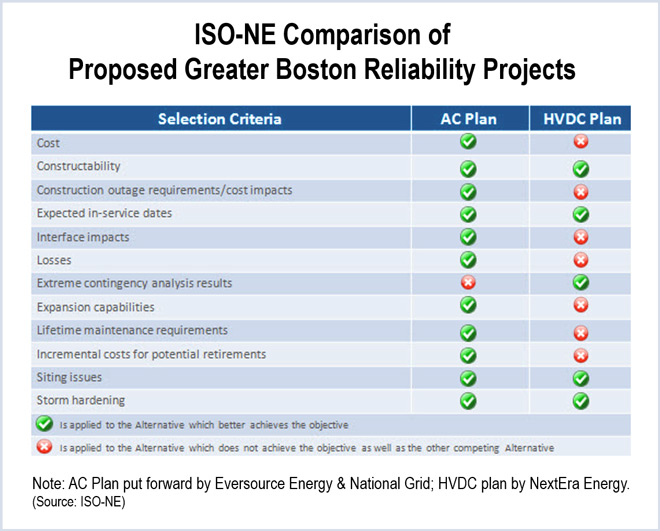
ISO-NE announced Thursday it had chosen a land-based, alternating current transmission project to address reliability concerns in the Boston area that came in about $260 million less than a competing undersea cable proposal.
The Greater Boston and Southern New Hampshire Reliability Project, proposed by Eversource (formerly Northeast Utilities) and National Grid, has a price tag of $739.7 million and is expected to be completed in 2018.
(Click to zoom.)
The all-AC project was chosen over a proposal from New Hampshire Transmission, which included both AC and underwater high voltage, direct current transmission.
ISO-NE said the AC plan was selected because it is significantly less expensive and it promised superior operating performance.
“Greater Boston is the largest area of consumer demand on New England’s power system, and its transmission system is in critical need of an upgrade,” said Stephen Rourke, vice president of system planning.
The project is past due, ISO-NE said in a statement. “The year of need for certain components of the Greater Boston Reliability Project was pre-2013. The ISO is analyzing whether additional special operating plans need to be developed to be able to manage the system in Greater Boston during peak load conditions” before the project is complete, it said.
The land-based AC plan is a 25-mile series of overhead lines in existing rights-of-way, connecting a substation in New Hampshire with one in Massachusetts, along with two eight-mile underground sections.
SeaLink Falls Short
The competing project outside Boston, dubbed SeaLink, was proposed by NHT, a subsidiary of NextEra Energy, owner of the Seabrook nuclear station in southern New Hampshire. It would have run 50 miles of undersea HVDC cable from the Seabrook substation to a substation in Massachusetts, with another 18-mile section buried on land.
(Click to zoom.)
The two project sponsors engaged in a vigorous debate about their opponents’ estimates and the costs to be incurred by ratepayers. The AC partners pointed to the initial high cost of SeaLink, its expensive technologies and the risks associated with undersea cables.
NHT contended SeaLink would be cheaper, saying the AC project would affect service, forcing utilities to buy more expensive replacement power during its construction. NHT upped the ante by offering to swallow any overruns above a cost cap of $679 million.
Both plans include the reconductoring of several 115-kV lines and other substation and transmission equipment upgrades, estimated to cost $221 million.
Concerns Identified in 2009
ISO-NE said the Boston area’s reliability concerns were identified in 2009. Several upgrades, including line reconductorings, were advanced to ensure reliability could be maintained after the retirement of all four Salem Harbor generating units — two in 2011 and two in 2014, according to the RTO.
In 2013, ISO-NE updated its original needs assessment to reflect several major system changes, including resource additions and retirements, changes in underground cable ratings in Boston, and updated load forecasts.
ISO-NE planning engineers worked with NHT to help develop its plan from a conceptual proposal into a workable solution. The RTO also worked with Eversource and National Grid to update components of the AC project based on the findings of the 2013 needs assessment. Updated versions of both plans were presented to the ISO-NE Planning Advisory Committee in June 2014.
The project will be discussed at Wednesday’s PAC meeting.
Eversource ups Tx Spending
In an earnings call with analysts last Thursday, Eversource identified the Boston area as one of its key areas for investment. It announced that it will spend $3.9 billion on transmission upgrades and expansions from 2015 to 2018, a $900 million increase over the $3 billion proposed a year ago.
It identified several big-ticket items in the area, including its share of the AC plan, totaling at least $707 million. There are also “hundreds” of reliability projects throughout New England coming in at $968 million.
Exelon’s $6.8 billion bid to acquire Pepco Holdings Inc. took another step forward Wednesday when the New Jersey Board of Public Utilities approved a settlement that will give Atlantic City Electric customers $62 million in rate credits.
The board’s approval means that the acquisition now needs only the regulatory approval of Delaware, Maryland and D.C.
Among other incentives in the agreement is a stipulation that guarantees New Jersey customers benefits equal to those eventually approved by Delaware, Maryland or D.C.
Pepco Holdings is headquartered in D.C., and includes Atlantic City Electric, Pepco, which serves D.C., and Delmarva Power & Light, with customers in Delaware and Maryland.
The $62 million in rate credits comes out to about $114 for each of Atlantic City Electric’s 544,000 customers.
Wednesday’s agreement contains other incentives, including:
An energy-efficiency program that would provide $15 million in energy savings over five years;
Promises to hire 60 union workers, protect wages and benefits and keep a headquarters at Mays Landing, N.J.; and
Charitable contributions equal to Atlantic City Electric’s current $709,000 annual giving for 10 years.
“This merger represents a great compromise that will provide many benefits to New Jersey,” BPU President Richard S. Mroz said in a written statement. “Additionally, the settlement protects the jobs of nearly a thousand New Jersey residents and keeps the company’s local operational headquarters in Mays Landing.”
Exelon CEO Christopher Crane and Pepco CEO Joseph Rigby also issued statements praising the agreement.
One party that didn’t sign the agreement was New Jersey’s consumer advocate, Stefanie Brand, director of the Division of Rate Counsel. Brand said the agreement, which was approved by the BPU staff last month, fails to protect consumers.
“There is nothing in the agreement that keeps Exelon from coming in and asking for a rate increase later that wipes out” the customer credits, she said in an interview Wednesday. “We certainly made our concerns known” during hearings and negotiations, she said.
Brand said Exelon more than doubled its initial rate credits offer during the negotiations that led to the settlement. “We do think [the BPU] got some good concessions, and I’m hopeful that Exelon won’t do things to wipe them out,” she said. “We were looking to lock it down a little bit more.”
More Approvals Needed
While Exelon has the approvals needed from the Federal Energy Regulatory Commission, Virginia and now New Jersey, it still needs those of Maryland, D.C. and Delaware.
“We are working cooperatively and productively with the public service commissions and other stakeholders in Delaware, the District of Columbia and Maryland to demonstrate how the merger will benefit the PHI utilities’ customers and communities,” Exelon Spokesman Paul Elsberg said Wednesday night. “We continue to expect the merger to close in second or third quarter of this year.”
Maryland
Maryland finished evidentiary hearings yesterday. Those hearings were supposed to conclude last week, but it took so long to go through every witness that two more hearings were added. Because of that, the decision of the Public Service Commission has been pushed back a week, from April 1 to April 8.
The state’s consumer advocate, the Office of People’s Counsel, has urged the PSC to turn down the deal as it stands, calling the benefits Exelon is offering “either non-existent or woefully deficient.”
Exelon has offered $40 million in customer credits in Maryland. The PSC staff has recommended $167 million in credits.
District of Columbia
Exelon and Pepco are also facing headwinds in D.C., where People’s Counsel Sandra Mattavous-Frye has called on the Public Service Commission to reject the merger. Exelon has promised $14 million in incentives for D.C.
Evidentiary hearings were scheduled to begin this week, but Mattavous-Frye asked the commission for more time to review additional information filed last week by Exelon and Pepco. According to a revised procedural schedule released Wednesday night, evidentiary hearings have been pushed back to the end of March. D.C.
Public Service Commission spokeswoman Kellie Didigu said that commission policy is to issue a decision within 90 days from the date the record closes. Under the revised schedule, the record will close May 13, pushing a decision to as late as August.
Delaware
Delaware has three days of hearings scheduled to start Feb. 18, but Public Advocate David Bonar thinks they may not all be needed. “We’re still working very hard to try to reach a settlement agreement,” he said in an interview Wednesday, “and we’re fairly confident that we can achieve that goal.”
He said Exelon initially offered $17 million in customer credits for Delmarva Power’s Delaware customers. “Obviously, we felt that was substantially low,” he said.
So did a consultant hired by the Public Service Commission, who said $62.9 million, or about $100 per customer, would be a more appropriate figure.
Since then, Exelon has sweetened the pot, according to Bonar. While he wouldn’t give hard figures, he said “it has grown substantially.”
He said he feels the sides are close to a settlement. “We are pretty well done meeting face to face,” he said.
The original version of this story incorrectly stated that two more “public sessions” were added to Maryland PSC evidentiary hearings due to the amount of people who wanted to testify. The sentence has been corrected to reflect that two more hearing dates were added due to the length of time it took to hear every witness.