Twin Cities Power will pay $2.5 million in penalties and disgorge almost $1 million in profits for manipulating energy prices in MISO under a settlement approved by the Federal Energy Regulatory Commission last week (IN12-2).
Twin Cities admitted the violations, while the three traders accused in the case neither admitted nor denied wrongdoing, FERC said. Traders Jason Vaccaro, Allan Cho and Gaurav Sharma did agree to pay civil penalties of $400,000, $275,000 and $75,000 respectively. They also agreed to bans from energy trading: Vaccaro for five years, and Cho and Sharma for four years each.
FERC said that while Twin Cities traded and scheduled power in MISO, it also traded financial products on Intercontinental Exchange, including the MISO Cinergy Hub Balance-of-Day Swap (Bal-Day-Cin).
“Twin Cities engaged in a consistent pattern of flowing physical power in the direction of its financial swaps. Twin Cities imported power into MISO when it held a short swap position, or exported power from MISO when it held a long swap position,” FERC said. “Moreover, Twin Cities’ financial positions were larger than its physical positions, such that the increase in the value of Twin Cities’ swaps exceeded the losses from its physical flows.” This showed that Twin Cities was moving energy prices to benefit their swaps, FERC said.
The three traders worked for Twin Cities Power Canada, a Twin Cities subsidiary in Calgary that ended operations in September 2012. At first, the company’s only employees were Cho as president and Vaccaro as vice president. At the time of the violations, the company employed 11 traders, including Sharma. On Feb. 1, 2011, several months prior to FERC’s investigation, Cho, Vaccaro and Sharma were fired.
The penalty is higher than most FERC approved in fiscal year 2014. It is the second penalty approved in fiscal year 2015, after CAISO agreed to pay $2 million for reliability violations related to the 2011 Southwest blackout.
Entergy powered down the Vermont Yankee nuclear station for the final time last week, leaving ISO-NE even more dependent on natural gas as it also faces retirements of its coal-fired generation.
The 615-MW plant in Vernon, Vt., which went on line in 1972, retired Dec. 29 after a protracted battle with state government and environmentalists.
Marcia Blomberg, a spokeswoman for ISO-NE, said that a 2012 study concluded that New England would have enough generation without the plant.
“But the loss of other non-natural gas generation throughout the region is causing concern about long-term reliability,” she said. “This generation is most likely to be replaced by natural gas, which will only exacerbate our dependence on that resource.”
The nuclear plant’s loss has been compounded by other recent and planned closures in New England. The 352-MW Norwalk Generating Station in Connecticut closed in 2013 and the 720-MW Salem Harbor Generating Station in Massachusetts shut down last spring. The 1,557-MW Brayton Point plant in Massachusetts is scheduled to retire in 2017.
New England now gets about half of its generation from natural gas, meaning generators are increasingly competing against heating load for gas in a region with limited pipeline capacity.
The switch to natural gas was what led to Vermont Yankee’s closure, according to Entergy. In its August 2013 announcement of the plant’s demise, it cited “a transformational shift in supply due to the impacts of shale gas, resulting in sustained low natural gas prices and wholesale energy prices.”
It also cited Vermont Yankee’s high cost structure and the costs of regulatory compliance on a small plant. Decommissioning is expected to last decades and cost more than $1.2 billion.
The plant employed more than 600 people with about one-half of those retiring or laid off by Jan. 19. Entergy will provide $10 million in economic development aid for Windham County over five years and $5.2 million in clean-energy development funds.
Entergy’s decision accomplished what state officials and environmentalists were unable to do.
Vermont passed legislation to force the plant’s closure, but Entergy successfully challenged that move in federal court. The court ruled the state lacked jurisdiction, as nuclear power was primarily licensed and regulated by the federal government.
PJM’s request to raise the cost-based energy cap to $1,800/MWh through March (EL15-31) drew a flurry of comments and protests in the days before the Christmas holidays.
Load representatives generally opposed the proposal, warning it could result in windfalls to generators at ratepayers’ expense. Suppliers told FERC that PJM’s proposal didn’t go far enough and that marginal costs more than $1,800 should be able to set market-clearing prices. Other commenters offered limited support for the idea, suggesting tweaks to the language or recommending that FERC simply extend the waiver it granted last year to allow gas-fired generators to cover their costs.
The proposal to boost the cap from $1,000/MWh — prompted by natural gas price spikes last winter — was made in a Section 206 filing to the Federal Energy Regulation Commission after members failed to reach consensus over the past eight months. (See PJM Board to Seek $1,800 Offer Cap.)
Load: ‘Profit Opportunities’
The PJM Load Group — consumer advocates and state regulators for West Virginia, Delaware, Illinois, Maryland, New Jersey and D.C., along with several other load-serving entities and groups representing load – was among those who urged FERC to reject PJM’s proposal outright. If the cap is raised, the group wants payments in excess of $1,000/MWh refunded to ratepayers through a credit against capacity charges.
The Pennsylvania Public Utility Commission said a higher cap is unnecessary, saying “other equally effective mechanisms exist to address the issue of unexpected spikes in fuel costs or other weather-related events.”
Likewise, the Maryland Public Service Commission rejected the proposal, saying, “It is clear that the purpose is to create profit opportunities for generators whose costs do not exceed the offer cap.”
Suppliers: Too Late, Too Little
The PJM Power Providers Group said PJM should have filed much earlier than it did, on Dec. 15, noting that last year’s polar vortex struck in the first week of January. “This filing leaves PJM and the commission exposed to the same ‘relative frenzy’ that both PJM and the commission experienced last winter,” the group said.
While the group agreed the current tariff is unreasonable, it said, “The proposed $1,800/MWh is not supported by any evidence. PJM appears to pick a number out of thin air with the only justification being that the number was part of a failed stakeholder compromise that was never voted upon by the PJM stakeholders.”
It suggested the commission set PJM’s filing for a paper hearing and establish procedures to develop an “appropriate energy market offer cap” by Aug. 1, in time for next winter.
PPL said PJM’s compromise — limiting offers that may set LMPs to $1,800/MWh and providing compensation for marginal costs above that through uplift payments — is “bad policy.”
“The proposal departs unreasonably from past commission and court precedent and from sound economic theory, sound principles of market design and PJM’s own expressed views as to the benefits of an LMP-based system and the harmful effects of payments needlessly being made via uplift,” PPL said.
Public Service Enterprise Group agreed that capacity resources should be able to bid their marginal costs into the market and set price.
It also called on FERC to prevent seams issues among neighboring markets with different policies, saying the commission should order PJM to adopt rules allowing generators to update their offers on an hourly basis to reflect real-time fuel costs. “Given the overwhelming benefits of hourly reoffers, we respectfully request that FERC direct PJM to begin a stakeholder process to develop rules similar to those already implemented in New York and New England,” PSEG said.
Coordination of comparable offer caps also was the concern of NYISO. “Offer caps must be discussed at a regional level in order for all interested parties to evaluate the potential for seams issues that could arise from different offer caps. … Materially different offer caps in neighboring regions that depend on the same natural gas supply could require operator actions to avoid electric system reliability impacts during periods of cold weather and high gas prices. NYISO is concerned that a number of markets in the Mid-Atlantic and Northeast are competing for the same supply of gas and generators subject to lower offer caps could be denied access to fuel.”
Independent Market Monitor Joe Bowring expressed general support for the proposal, but he challenged some of the details, saying the highest valid cost-based offer the Monitor reviewed last winter was less than $1,500, not the $1,724/MWh cited by PJM.
He also advised that because it was natural gas spikes that prompted the filing, the cap should be restricted specifically to the cost to procure gas.
Bowring also expressed concern that the proposal not affect the maximum system scarcity price. “PJM does not explain what would happen if cost-based offers between $1,000 and $1,800 [were] applied during scarcity conditions,” he said. “The Market Monitor requests clarification that the maximum price would never be greater than the current maximum scarcity price even if cost-based offers exceed $1,000/MWh.”
Xcel Energy, already a top U.S. producer of wind energy, announced plans to vastly increase its renewable generation by 2030 and cut its use of fossil-fired generation.
The goals, included in its “2016-2030 Upper Midwest Integrated Resource Plan” filed with the Minnesota Public Utilities Commission, call for a 30% reduction in carbon emissions by 2020 and a 40% reduction by 2030.
The company plans to add 600 MW of wind energy to its portfolio by 2020 and 1,200 MW by 2030, bringing its total to 3,600 MW. It also plans to add nearly 2,400 MW of solar by 2030, maintain operations of its Monticello and Prairie Island nuclear plants, and reduce reliance on its coal-fired Sherburne County Generating Plant.
Entergy Adds New CCGT Plant to Louisiana Generation Fleet
Entergy Louisiana has added its first new power plant to its fleet in nearly 30 years. The Ninemile 6 combined-cycle gas turbine plant in Westwego was completed for an estimated $566 million, on time and below budget, the company said. Entergy Gulf States Louisiana and Entergy New Orleans will buy 45% of the 560-MW plant’s output.
Entergy also announced recently its subsidiaries will spend $948 million to acquire the 1,980-MW gas-fired Union Power Station in El Dorado, Ark. The Union Power Station is owned by Union Power Partners, an independent power producer owned by Entegra TC. Both companies filed for Chapter 11 bankruptcy protection in August. Entergy said the plant’s price was about half what it would cost to build a new power plant.
PSEG Taking over Completed Solar Plant in Waldorf, Md.
PSEG Solar Source is acquiring a 12.9-MW solar facility near Waldorf, Md., its 11th utility-scale photovoltaic project. It brings PSEG Solar’s total capacity to 123 MW.
The facility is being constructed by juwi solar and has a 20-year power purchase agreement with Southern Maryland Electric Cooperative. Construction is expected to be completed by June. Terms of the sale were not announced.
American Electric Power will install 105,000 automated meters in Ohio, the third phase of its meter updating program.
The wireless meters will only allow the utility to take readings from a passing vehicle, unlike smart meters, which can both send and receive signals and allow two-way communication about electricity usage. With the new program, nearly a third of AEP’s 1.5 million Ohio customers will have the automated meters, which eliminate the need for a manual reading and should cut down on the number of estimated bills.
AEP has also proposed to increase the size of its smart meter program, which is currently still in the pilot stage.
UGI Energy to Build $150 Million Gas Pipeline to Power Plant
UGI Energy Services plans to spend $150 million to build a 20-inch pipeline to deliver natural gas to a proposed generating station near Shamokin Dam on the Susquehanna River in Pennsylvania.
The 35-mile line, which would cross five counties, would connect the Transcontinental Pipeline to the power plant. The company said about 90% of the gas will go to the power plant.
The proposed 1,000-MW power plant, called Hummel Station, will be owned by Sunbury Generation and is slated to go on line in 2017. Sunbury recently retired a coal-fired generating station at the 216-acre site. The former PPL plant still has active oil-fired units on site.
Dominion Buys 20-MW Solar Plant in Calif. from EDF
Dominion Resources added 20 MW of solar capacity to its fleet with the purchase of a facility in King’s County, Calif., from EDF Renewable Energy. Dominion now has 344 MW of solar either in operation or under construction in California, Connecticut, Georgia, Indiana, Utah and Tennessee.
The announcement comes after the company said it bought a 50-MW solar project in Millard County, Utah, from juwi solar. That purchase came just two months after Dominion purchased two other solar plants, the 24-MW Cottonwood and the 12-MW Catalina Solar 2 facilities. Both of those California plants were purchased from EDF as well.
Asheville, NC, Demand Spurs Duke to Build 3 New Substations
Duke Energy has spent $13.6 million to buy three sites for new substations in Asheville, N.C., in order to bolster the company’s distribution system as demand grows in the western North Carolina city. The new substations will be the first in the city in 40 years.
Duke said it plans to open the first new substation by 2018. It did not release cost estimates for the project.
FirstEnergy Spending $100 Million on Shale Gas-Related Tx Projects
FirstEnergy said it is investing about $100 million on transmission lines and related projects in West Virginia to support industrial activity to process shale gas and oil, as well as power pumping and compression equipment to send shale-related energy to markets.
Substations, transmission lines and other equipment are included in the list, the company said. Projects include a $52 million 138-kV line to support demand in Doddridge, Harrison and Ritchie counties, and an 18-mile, $55 million 138-kV line expected to go into service near Oak Mound in late 2015.
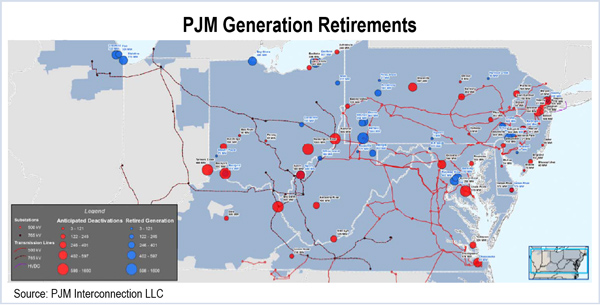
PJM wants a one-time waiver to avoid releasing 2,000 MW of capacity for the 2015/16 delivery year, when the RTO fears it may run short of resources due to retirements of coal-fired generation.
PJM officials told the Markets and Reliability Committee Dec. 18 that they would seek to postpone generation retirements — or accelerate planned new generation — to help the RTO ride through potential shortages next winter. (See PJM Seeks to Postpone Some Generation Retirements through 2015/16.)
On Dec. 24, PJM made two filings with the Federal Energy Regulatory Commission to put its plan in action.
In one, PJM asked for a one-time waiver on rules that would otherwise require it to release 2,000 MW of capacity in the Feb. 23 Third Incremental Auction for 2015/16 (ER15-738).
In the second, PJM proposed revising its Tariff to allow it to enter into capacity agreements made outside the Reliability Pricing Model auctions (ER15-739).
Officials told the MRC they would seek to forestall some of the estimated 9,500 MW of retirements expected next year as a result of the Environmental Protection Agency’s Mercury and Air Toxics Standards (MATS) and more than 2,000 MW being shut down by New Jersey’s High Energy Demand Day regulations.
In addition to offering reliability-must-run (RMR) compensation to delay retirements, officials said they are considering incentives to encourage some generation slated to come on line in delivery year 2016/17 to accelerate construction and launch earlier. In total, officials said they will attempt to secure as much as 2,500 MW of generation through April 2016.
In a related matter, PJM released its 2015 load forecast report. It includes a 2.6% reduction in the load forecast for 2018, due in part to a temporary change in modeling that aims to address over-forecasting in recent years. (See Model Change Results in Lower Load Forecast for PJM.)
The big news of 2014 in PJM was the same subject that’s likely to be big news in 2015: the capacity market.
Of RTO Insider’s 25 most-read stories of 2014, seven were about PJM capacity market rule changes or the results of the May Base Residual Auction.
With PJM seeking to overhaul the market with its Capacity Performance proposal — now pending before the Federal Energy Regulatory Commission — capacity issues are sure to be among the top stories for RTO Insider in the coming year. (See PJM Files Capacity Performance Plan.)
Speaking of FERC, four stories about FERC enforcement and commissioner confirmations also ranked in the top 25. The dynamics of the five-member commission will be fascinating to watch in 2015, with the arrival of new commissioner Colette Honorable and Chairman Cheryl LaFleur and Commissioner Norman Bay swapping seats in April. (See stories No. 2 and No. 18 below.)
DR, M&A, EPA
Demand response, mergers and acquisitions, Environmental Protection Agency regulations and the Artificial Island stability fix each claimed two spots on the list.
The EPA will be the subject of much coverage this year as its Mercury and Air Toxics Standards (MATS) force thousands of megawatts of coal-fired generation into retirement, and as it finalizes its carbon emissions rule in June. Legal challenges to the rule, which have already begun, will surely increase traffic at the D.C. Circuit Court of Appeals.
It was that court that roiled the demand response industry last year with a ruling voiding FERC jurisdiction over pricing of DR in wholesale energy markets, a decision FERC is hoping the Supreme Court will reconsider. (See related story, FERC Report Shows Spotty Growth for DR, Advanced Meters.)
The mergers and acquisitions that were big news in 2014 also will generate headlines this year as they make their way through the regulatory approval process. Among the most prominent: PPL’s spin-off of its generation in a combination with Riverstone Holdings; Exelon’s purchase of Pepco Holdings Inc.; Wisconsin Energy’s acquisition of Integrys Energy Group (with Exelon taking on Integrys’ retail power and gas subsidiary); Dynegy’s acquisition of generation from Duke Energy and Energy Capital Partners; and Constellation combining its commercial and industrial demand response business with Comverge.
PJM had hoped that the selection of a transmission developer for the Artificial Island fix — its first competitive transmission project under FERC Order 1000 — would be completed last summer. But controversy over PJM planners’ selection of Public Service Electric and Gas led the PJM Board of Managers to reopen the bidding for four finalists. Planners hope to present a final recommendation to the Transmission Expansion Advisory Committee in a few weeks. (See PSEG Nuclear Calls on PJM Board to Block ‘Risky’ Artificial Island Fix.)
RTO Insider’s Expansion
While we’ll be writing about a lot of the same issues in 2015, we’ll be doing so with an expanded reporting staff and geographic focus as we deepen our coverage in MISO, SPP, NYISO and ISO-NE.
With this issue, we are expanding our state briefs column to include the 11 MISO states not shared with PJM. Welcome to Arkansas, Louisiana, Mississippi, Missouri, Texas, Iowa, Minnesota, Montana, Wisconsin and the Dakotas — both of them!
Ten of those states are also shared by SPP. We’ll be adding the four states in the rest of SPP’s footprint, along with New York and the states in ISO-NE, later this year.
Welcome to Cruthirds Report Readers
We’ll be doing it with a much larger audience, thanks to our agreement to supply the unexpired subscriptions of The Cruthirds Report. Sadly, The Cruthirds Report ceased operations in December after 11 years of covering Entergy, Southern Co. and the electric industry in the Southeast.
Happily, its founder, former Dynegy regulatory attorney David L. Cruthirds, has agreed to continue raising hell with his observations as a columnist for RTO Insider. You’ll see his introductory column on page 1 of today’s issue.
David also will be writing from the Louisiana Public Service Commission’s monthly Business & Executive meeting in Baton Rouge on Jan. 21 and the Gulf Coast Power Association’s one-day briefing on “Challenges & Changes in Energy on the Bayou” in New Orleans on Feb. 5. The GCPA event will include a discussion on how the MISO South market has worked in the first year and what challenges lie ahead.
David is an outspoken advocate for competition, fairness and transparency. You may not agree with David’s opinions, but you’ll never have a question about where he stands.
We are thrilled to add David’s voice and loyal readers as we continue to build RTO Insider as your eyes and ears in the organized electric markets. Whether it happens in Valley Forge, Washington, Albany or Carmel — RTO Insider will be there bringing you exclusive “in the room” coverage.
Thanks for your support in 2014. Here’s to a great 2015!
The Federal Energy Regulatory Commission Friday rejected a challenge by New England states to recalculate the contributions of demand response and distributed resources in advance of February’s Forward Capacity Auction.
FERC accepted the installed capacity requirement (ICR) filed by ISO-NE for the 2018/19 delivery year (ER15-325). However, FERC did order the RTO to conduct a stakeholder process to develop market rules that would consider DR in time for the 2016 FCA.
The New England States Committee on Electricity said ISO-NE has underestimated the impact of distributed generation and its pay-for-performance (PFP) program on the region’s capacity needs. FERC disagreed.
“We agree with ISO-NE that it would have no basis to use forecasted performance data in the absence of actual historical performance under this nascent two-settlement market design. We therefore support ISO-NE’s current methodology, which incorporates actual resource performance data,” FERC said.
FERC also suggested that a request to include distributed generation as part of the calculation was too soon, saying that the RTO first “must examine the market and operational issues.”
ISO-NE’s Nov. 4 filing established its ICR, local sourcing requirements and Hydro-Quebec interconnection capability credits (HQICC) for FCA 9.
The ISO proposed an ICR value of 35,142 MW, which includes 1,970 MW of emergency generation assumed obtainable from New Brunswick, New York and Quebec. The net amount of capacity to be purchased, after deducting the HQICC value of 953 MW per month, is 34,189 MW, the ISO said.
Southwestern Electric Power Co. announced that it is dropping plans to construct a $116 million, 60-mile transmission line after SPP decided it wasn’t needed. SPP told SWEPCO that its latest forecasts show lower load growth than previous ones for the area.
“Based on SPP’s new findings, we are notifying landowners, community leaders and elected officials that we have withdrawn our application to the [Public Service Commission] for authority to construct the Shipe Road to Kings River transmission project,” said Venita McCellon-Allen, SWEPCO’s president.
The 345-kV line would have run between Benton and Carroll counties. It was a source of contention for both property owners and environmentalists. Opponents to the line successfully petitioned the PSC for a rehearing on the line. SPP is in the process of withdrawing its Notification to Construct, the basis for SWEPCO’s construction plans and application.
A developer of a failed attempt to build a $1 billion data center and power plant on the University of Delaware campus is suing his former business partner.
Robert Krizman, who was recruited to work as president of The Data Centers LLC, filed suit in the Court of Chancery against chief executive Earl Kern, alleging that Kern kept him in the dark about business decisions. Krizman, who was also a minority partner in the project, wants to be released from his share of about $1 million in debt the project racked up.
After months of studies and lobbying, the university decided against hosting the project. Much of the community backlash that doomed the project centered on a proposed 279-MW power plant.
Indianapolis Power & Light asked the Utility Regulatory Commission for a rate increase that would boost the average residential customer’s bill by 8%, its first general rate increase request since 1994.
Although it has been more than two decades since IPL asked for a general rate hike, it has received other boosts, including 3% rate increases for system improvements for each year between 2013 and 2019. The company also filed a request in 2014 to add about $1 to each monthly bill to pay for the conversion of its Harding Street coal-fired plant to natural gas.
IPL’s general rate increase would generate $67.8 million a year in revenue and would boost the typical residential monthly bill by $8. If approved, it would take effect at the end of 2015.
Gov. Terry Branstad’s top energy expert was fired without notice last month, leaving a multi-million dollar energy fund without a leader.
Paritosh Kasotia, team leader of the state energy office, was asked to leave Dec. 8, according to an Associated Press report last week. Kasotia had just returned from a national energy conference when she was told she had been ousted, and she stopped working the same day.
Kasotia began overseeing the Office of Energy Independence under Democratic Gov. Chet Culver, administering grants in the $71 million Iowa Power Fund. Branstad, a Republican, began dismantling the fund after taking office in 2011, moving the energy office to the economic development agency.
Opposition is mounting in the state against a plan by Kinder-Morgan Energy to convert its existing Tennessee Gas Pipeline to carry natural gas liquids from Appalachian shale fields to the Gulf Coast.
Marion County joined Boyle County in passing a resolution opposing Kinder-Morgan’s plan to repurpose the 71-year-old pipeline to carry a mixture of natural gas liquids like propane and butane to a Gulf Coast processing plant. The pipeline passes through 18 counties in Kentucky.
Marion County last year opposed construction of the Bluegrass Pipeline, which also would have carried NGLs. That pipeline died after a state judge ruled that its planners didn’t have eminent domain powers.
The Public Service Commission has approved construction of the first utility-scale solar plant in the state. Kentucky Utilities will own 61% of the 10-MW facility and Louisville Gas & Electric will own the remaining 39%.
The plant will be built on the site of KU’s E.W. Brown Generating Station in Mercer County, with its $36 million cost subsidized by ratepayers.
KU and LG&E originally applied to build both the solar plant and a 670-MW combined-cycle plant. Plans for the natural gas-fired plant were canceled after KU lost nine wholesale power contracts from municipal customers.
Industrial Boom Points Toward Need for New Power Plants
Low utility prices and cheap natural gas are fueling a boom in industrial growth in Louisiana, and utilities are struggling to keep up with demand. Entergy just fired up a new combined-cycle plant, but some estimates show that more plants, or more imported electricity, will be needed by the end of 2015, and still more by the end of 2019.
In addition to building new plants in Louisiana and Arkansas to meet demand, Entergy is purchasing even more power from wholesale markets. “All that will help, but ultimately we’re going to need to build new generation,” said Phillip R. May, head of Entergy’s Louisiana operations. “It has to be new steel in the ground to meet all of this new load. … We’re on the front end of a pretty steep curve in growth.”
Entergy has yet to file a multiyear rate increase request to help finance the need for new plants, but consumer advocates are already marshaling forces to block them if they do. “We don’t feel it’s fair that residential and commercial customers should have to foot the bill (for power) that will be needed primarily by the large industrial sector,” said Casey DeMoss Roberts, head of the Alliance for Affordable Energy. “The industrial customers should have a special rider to pay for it.”
Judge Affirms PSC Ruling on Cove Point Power Plant
A Baltimore judge has upheld the Public Service Commission’s approval of Dominion Resources’ plans to build a 130-MW generating station to support its liquefied natural gas export terminal at Cove Point.
Circuit Court Judge Alfred Nance ruled the PSC did not act outside its authority when approving the power plant. The Accokeek, Mattawoman, Piscataway Creeks (AMP) Communities Council had appealed the PSC decision.
The power plant is part of Dominion’s $3.8 billion project to convert the LNG importation terminal into an export terminal.
Cost of Kemper Plant Keeps Growing: Another $25 Million in Overruns Reported
Mississippi Power, the Southern Co. subsidiary building a coal gasification power plant in Kemper County, revealed a further $25 million in cost overruns in a filing with the Securities and Exchange Commission on Friday. The plant’s initial cost was $2.8 billion and it was projected to begin operations in 2013. The latest overruns bring the cost to more than $6.1 billion, and a report due later this month may detail even more overruns.
Southern Co. said the overruns reduced its after-tax profit by $258 million in the third quarter. The Kemper plant is designed to convert soft lignite coal to gas that will fuel its boilers. Carbon dioxide from the combustion process is to be captured for industrial uses or storage underground.
Similar plants are also experiencing trouble. Duke Energy’s Edwardsport, Ind., plant suffered from construction delays and cost overruns. And FutureGen 2.0, a government-backed project in Illinois, was announced in 2003 and still isn’t operational.
Ameren Missouri has filed a three-year, $135 million energy efficiency plan with the Public Service Commission, saying it would provide more than $260 million in benefits to its customers over 20 years. The company’s first energy efficiency plan, mandated by the state with the intention to cut energy use and reduce emissions, covers two years and runs out at the end of this year.
The new plan, which has 10 programs to help residential and business customers cut energy use and costs, provides incentives for energy-efficient heating and air conditioning equipment, appliances and lighting systems.
A company spokesman said the programs, together, could save up to 426,000 MWh. “That’s equivalent annual use of 33,000 average-size homes on our system, so it’s a very significant amount of savings on behalf of our customers,” Dan Laurent said.
Rejecting its staff’s recommendation, the Public Service Commission voted 3-2 against allowing NorthWestern Energy to buy power from a 25-MW wind farm near Fairfield.
Greenfield Wind would have sold power to NorthWestern for $54/MWh under a 25-year contract. That compares to a recent hydro contract that did get PSC approval at $57 to $58 per megawatt hour.
Commission Chairman Bill Gallagher, one of the objecting voters, said tying the utility, and its ratepayers, into the wind power contract would cost it money when the wind power was available but not needed, and would be sold at a loss on the wholesale market. “The difference in that price is going to be left to the consumer,” Gallagher said.
BPU-Set Gas Rate Means Refunds for Some State Gas Customers
Elizabethtown Gas residential customers will get an average refund of $40 after the Board of Public Utilities approved a lower supply charge.
Company officials said the lower cost of gas from Marcellus Shale production will save its customers $10 million. The refund is on top of the lower gas rate approved by the BPU late last year.
“Essentially, there’s an abundant supply of natural gas now that’s serving to lower prices for customers,” said Duane Bourne, a company spokesman.
Environmental Group Still Concerned About Pine Barrens Pipeline Project
A proposed natural gas pipeline through the Pine Barrens that failed to gain approval by the Pinelands Commission last year poses a “real cause of concern,” according to the year-end report of the Pinelands Preservation Alliance.
The environmental group’s “State of the Pinelands Report” said the commission’s deadlocked 7-7 vote on the pipeline shows that pressures still exist on the natural resources in the area. After the vote, Gov. Chris Christie nominated two new members for the commission, but those appointments were put on hold in a contentious legislative hearing that focused mostly on the pipeline proposal. South Jersey Gas wants to build the pipeline to fuel the B.L. England power plant, which is being converted from coal to natural gas.
“The most well-known threat to the integrity of the Pinelands protection rules over the past year is the South Jersey Gas pipeline issue,” the alliance’s report stated.
PSC Approves Another 172 MW of Wind Power at Antelope Hills
A $240 million wind farm on 22,000 acres in western North Dakota received approval from the Public Service Commission. The 86-turbine, 172-MW Antelope Hills Wind Project near Beulah, Mercer County will be in service by the end of this year, according to PSC Chairman Brian Kalk.
Basin Electric Cooperative has signed a 25-year power purchase contract for the full output of the new facility. It will be added to the 1,600 MW of wind power currently operating in the state and 1,200 MW of wind power already approved by the commission.
Antelope Hills has applied for a 9.5-mile, 345-kV transmission line to carry its output to a grid connection at Basin Electric’s Antelope Valley Station coal-fired plant.
FirstEnergy Sweetens the Pot for its Proposed Rate Plan
FirstEnergy, in an attempt to show support for its controversial “Powering Ohio’s Progress” electric security plan, filed a proposed joint settlement agreement with the Public Utilities Commission.
FirstEnergy’s proposal to receive supply guarantees for several power plants has prompted a backlash from opponents, who said the company had already been rewarded for its merchant plants during the state’s transition to market rates.
Now, in exchange for the price supports, FirstEnergy proposes a freeze on distribution rates through 2019, $23 million in economic development funding and up to $7 million in low-income funding. The company said it has the support of 15 parties, including the city of Akron, labor and various user groups. PUCO will schedule hearings on the plan soon. The commission’s staff hasn’t filed its comments yet.
Sustainable Energy Board Meeting to Spotlight Coming Projects
The annual meeting of the Sustainable Energy Board on Jan. 15 will feature an update on projects for the state.
Met-Ed and Penelec will provide an overview and update on their mapping program that shows where sustainable energy grants were apportioned. West Penn Power will provide an overview of projects funded by its program and will talk about a sustainable energy fund bond program it recently launched with the state. PPL will report on an LED lighting project at Harrisburg International Airport. And PECO Energy will detail its new third-party financing project for renewable energy projects.
The meeting is set for 11 a.m. in Hearing Room 1 of the Commonwealth Keystone Building in Harrisburg.
Keystone May Have Votes in Congress, but State Approval Key
Incoming members of Congress may have approval of the Keystone XL Pipeline in their sights, but the Public Service Commission still needs to grant a crucial approval, and that may not be too easy. More than 40 groups have filed to intervene in the commission’s approval process.
The PSC approved the pipeline in 2010, but that construction permit expired last June. TransCanada has filed for a new construction permit, but most of the groups who have filed with the PSC are against the project.
The commission has scheduled hearings in February, March and April to consider what can be heard and filed at the final hearings, which are scheduled for May 5-8.
LNG Terminal Plans on Hold Due to Falling Gas Prices
Excelerate Energy told the Federal Energy Regulatory Commission that it is putting its floating liquefied natural gas terminal project near Port Lavaca on hold, partly because of plunging natural gas prices.
“Due to the recent global economic conditions, the company has determined that, at this time, this project no longer meets the financial criteria necessary in order for us to move forward with the capital investment,” the company announced last week. The company asked FERC to put its project filings on the shelf until April 1.
The export facility was to have been built in Lavanca Bay, about 30 miles southeast of Victoria. The $2.5 billion project would have been the first floating LNG export terminal in the U.S.
Residents Question Need for Line: Dominion Short on Answers
Northern Virginia residents have questioned the need for a transmission line proposed by Dominion Virginia Power to serve an unnamed high-tech client near Haymarket in Prince William County, west of Manassas National Battlefield Park.
Although Dominion won’t identify the customer, rumors abound that a major Amazon data center is planned for the area. Dominion spokeswoman Le-Ha Anderson said the utility’s existing lines aren’t large enough to supply the prospective client’s needs. Dominion estimates the costs of the new line and a substation are about $65 million.
Residents of Haymarket and surrounding areas say the proposed line would be unsightly and impact property prices. A town hall meeting for residents is scheduled for tonight at Battlefield High School.
The Public Service Commission has approved American Electric Power’s $550 million sale of half of its Mitchell Power Plant to one of its subsidiaries, Wheeling Power.
The 1,600-MW coal-fired plant, on the banks of the Ohio River in Moundsville, is 43 years old, but it recently had its emissions-control systems upgraded.
Another AEP subsidiary, Kentucky Power, owns the other half of the plant. The entire plant had been owned previously by AEP’s merchant generation business.
PSC to Let Cheyenne LF&P to Fix $5.1 Million Mistake
Cheyenne Light, Fuel & Power made a mistake when doing the calculations for its most recent rate case – a $5.1 million mistake. Its 2014 rate case left out a monthly collection from its residential customers of about $8.88 a month. This resulted in a collection shortfall for November and December of $985,875, which would grow to $5.1 million over a full year.
The company asked the Public Service Commission for permission to make up the difference on an interim basis, pending approval of a new rate case. The commission ruled in late December it would allow the company to re-file the rate case, but that ruling is on hold pending an appeal by two of Cheyenne’s industrial customers.
The state collected $43.2 million more in sales and use taxes during the first five months of its fiscal year, ending November. That’s good news for state officials, but there’s bad news on the horizon.
State finance officials say the strongest counties – Campbell, Laramie and Converse – collected $26.1 million of that, and much of that was due to energy industry jobs and services.
“From an industry perspective, the mining [including oil and gas], retail trade and construction sectors have captured most of the collection gains to date,” said Jim Robinson, principal economist for the Economic Analysis Division of the state Department of Workforce Services. But the recent plunge in natural gas and oil prices means tax collections in those counties are almost sure to drop as well.
A Québec pension fund has agreed to spend up to $593 million to acquire up to 30% of Indianapolis Power & Light from AES, which is seeking to lighten its share of U.S. utilities as their coal-fired generation in MISO and PJM face increasing environmental pressure.
IPL on Dec. 23 filed for Federal Energy Regulatory Commission approval on the deal (EC15-56), which also needs an OK from the Committee on Foreign Investment in the United States, an interagency groupthat includes the U.S. Treasury, Department of Energy and State Department.
Caisse de dépôt et placement du Québec (CDPQ) will pay $244 million for 15% of AES Investments, an IPL parent company, and contribute up to an additional $349 million for up to 17.65% of IPALCO Enterprises, IPL’s direct parent, based on capital calls.
At the end of the two-step process, CDPQ will have indirect ownership of 15% to 30% of IPL and will be able to nominate two IPALCO directors. AES Investments would nominate nine of the directors.
Environmental Pressures
IPL, which owns about 2,623 MW of coal-fired generation (83% of its total), is scrambling to comply with the Environmental Protection Agency’s Mercury and Air Toxics Standards (MATS), and may face compliance expenses under the EPA’s proposed carbon emissions rule. In its earnings report for the second quarter, AES said it was too soon to determine what impact the carbon rule, and state plans for implementing it, will have on the company.
From 2014 to 2016, IPL plans to spend $326 million on MATS compliance alone.
At least half of IPL’s capital spending plan involves replacement of coal-fired units. The biggest project, at $600 million, is the construction of a 671 MW gas-fired generating station to replace aging coal units at its Eagle Valley plant, 30 miles south of Indianapolis.
AES’ Second Thoughts About U.S.
Although it is based in Arlington, Va., three-quarters of AES’ pre-tax income from continuing operations comes from its international investments.
AES, which bought IPL in 2000 for $2.15 billion, would see its stake in IPALCO fall to 70% under the deal.
Earlier this year AES tried to sell its Dayton Power & Light’s generation fleet rather than spinning it off into an unregulated subsidiary by 2017, as the Public Utility Commission of Ohio had ordered.
AES bought DPL in 2011 for $3.5 billion, about a 9% premium to DPL’s stock price. But AES later expressed regrets about the purchase, saying it hadn’t received the benefits it expected. In its 10-K filed last February, AES cited Ohio’s market-based pricing and low wholesale prices.
In July, however, AES said it had dropped its plan to sell DPL. “In light of the potential recovery of power prices, as well as PJM capacity prices, AES believes that this business has additional value that can be captured by continuing to own and operate these generation assets,” AES said in a statement.
Moody’s Likes Deal
Moody’s Investors Service said in a Dec. 15 report that the sale would help the credit rating of IPALCO, which is in the midst of a $1.4 billion capital spending plan.
“CDPQ’s contractual commitment is credit positive for IPALCO and its wholly owned subsidiary Indianapolis Power & Light … particularly considering CDPQ’s strong credit quality compared to AES,” Moody’s analyst Natividad Martel wrote.
Moody’s did not change its ratings for IPL, IPALCO or AES, however, which are Baa1 stable, Baa3 stable and Ba3 stable, respectively.
IPL has a current capital structure of 45% equity and 55% debt.Virtually all of the utility’s profits are returned to AES as dividends, which has left the utility thinly capitalized. In the first nine months of 2014, IPL paid $78 million in dividends to AES.
Map of AES’ US businesses (Click to zoom)
Over the last two years, AES contributed $156 million in additional equity to IPL, said Moody’s.AES and CDPQ will contribute another $62 million on top of CDPQ’s $349 million.
Although it would ultimately receive less in dividends from IPL, AES would enjoy a reduction in requirements to make equity contributions to IPL. That will “enhance AES’ parent only free cash flow position,” said Moody’s.
That’s notable because AES recently announced it would double dividend distributions starting in the first quarter of 2015.
As of Sept. 30, IPL had an available borrowing capacity of $249.3 million under its $250 million unsecured revolving credit facility after outstanding borrowings and existing letters of credit.
CDPQ
The purchase is being made by CDP Infrastructure Fund GP, a New York-based investment fund and a wholly-owned subsidiary of CDPQ.
CDPQ has a controlling interest in Gaz Metro Limited Partnership, the biggest natural gas distributor in Quebec and the 100% owner of Vermont’s Green Mountain Power.
In MISO, in which IPL operates, CDPQ has a 24.7% interest in Invenergy Wind, whose projects include Bishop Hill Energy III, in Henry County, Ill.
IPL is asking FERC for expedited approval of the CDPQ deal. Even with Invenergy Wind’s current and proposed projects, Invenergy and IPL would own or control on a combined basis 2% of MISO’s installed generation capacity, IPL said in its filing. IPL noted that FERC recently accepted market-based rate filings by affiliates of Invenergy Wind based in part on the passive nature of the CDPQ interests.
New Source Review Liability
IPL, meanwhile, could find itself facing other environmental costs outside of its $1.4 billion capital program.
Although not mentioned in the context of the CDPQ deal, IPL remains haunted by the specter of a 16-page Notice of Violation the EPA handed the utility in 2009.
It alleges IPL updated three generating plants over 23 years without adding the most modern pollution controls. The EPA’s New Source Review (NSR) requires utilities to undergo a pre-construction review for new plants and whenever existing plants are modified in a way that involves “non-routine” physical changes resulting in a significant increase in emissions.
IPL contends that the maintenance projects were routine.
In its third-quarter earnings report, AES said it has met with EPA officials to resolve the NOV and noted that in other NSR cases the EPA has “required companies to pay civil penalties, install additional pollution control technology on coal-fired electric generating units, retire existing generating units, and invest in additional environmental projects.” Such an outcome could have a “material impact” on IPL and AES, the company said.
One such case involving similar allegations cost American Electric Power $75 million in penalties and environmental projects as part of a 2007 settlement with the EPA. AEP agreed as part of the settlement to make $1.2 billion in additional sulfur- and nitrogen-control upgrades at its Rockport and Clinch River generating plants.
AEP’s settlement came after almost eight years of litigation.
Saying the “time is ripe,” the Federal Energy Regulatory Commission has consolidated four years of Entergy Corp.’s disputed annual cost allocation cases for hearing and settlement.
At issue is how Entergy allocates production costs among its half-dozen operating companies under its system agreement. The companies essentially operate as one system, although each have different operating costs.
Each year payments are made by low-cost operating companies to the highest-cost company in the system, using a “bandwidth” remedy that ensures that no operating company has production costs more than 11% above or below the Entergy system average.
Under the 2014 bandwidth implementation — its eighth —Entergy Texas would pay $15.3 million to Entergy New Orleans.
Regulators in each state where Entergy operates have regularly challenged the annual bandwidth filings. FERC agreed Dec. 18 to review not only the 2014 filing but also Entergy’s fifth, sixth and seventh bandwidth formulas (ER14-2085).
The commission said the filings raise factual issues that it could not resolve based on the existing record. It set a refund effective date of June 1, 2014.
In Entergy’s 2014 filing, the New Orleans City Council sought a hearing to determine if Entergy’s rate calculations and accounting practices are in agreement with the bandwidth formula and previous FERC orders.
The council also raised an issue with the 2013 bandwidth filing, noting that it includes the cancellation costs of the Little Gypsy Repowering Project that a FERC judge in an initial decision (ER12-1384) excluded from the bandwidth calculation.
The Louisiana Public Service Commission, meanwhile, said it wanted a hearing to determine whether Entergy’s inputs are unjust and unreasonable due to incorrect calculations, “misapplications of the formula or imprudence.”
The Public Utility Commission of Texas also sought a hearing on the 2014 filing but asked that it be delayed until the accounting for the previous years are resolved.
“Our preliminary analysis indicates that Entergy’s proposed rates have not been shown to be just and reasonable and may be unjust, unreasonable, unduly discriminatory or preferential, or otherwise unlawful,” FERC said.