Maryland’s Office of People’s Counsel is recommending that regulators set tougher energy-efficiency targets for the state’s utilities, which it says are winding down their efforts.
Utilities have largely met their goals under the 2008 EmPOWER Maryland Energy Efficiency Act, which requires them to reduce electricity usage and peak demand by 15% of 2007 levels by 2015.
That’s good news for environmentalists and consumers. But according to a report by the OPC’s consultant, Vermont Energy Investment Corp., that has led to a reluctance by the utilities to continue their energy-efficiency efforts beyond what is mandated.
“While their motivations for this fact may not all be similar, VEIC suspects that a primary driver is that the 15% goals set in the 2008 legislation have come to their natural conclusion, and the utilities have for the most part met those goals,” the OPC said in a letter to the Maryland Public Service Commission. “Without a clear goal established to take the place of the 2008 legislative goals, there is nothing compelling the utilities to expand their efforts.”
Based on VEIC’s report, the OPC is recommending that the PSC direct the five utilities identified by the legislation – Baltimore Gas and Electric, Delmarva Power & Light, PEPCO, Potomac Edison and the Southern Maryland Electric Cooperative – to achieve an average annual net savings rate of 2% of 2012 residential retail sales in its 2015-2017 plans.
According to the report, Delmarva, Potomac Edison and SMECO have already met their 2015 savings goals, while PEPCO is “on track” to meet its goal. BGE, which has by far the highest goal of 3.5 million MWh, has saved nearly 2 million MWh. (See DR at Home: EmPOWER Maryland.)
By William Opalka, Chris O’Malley and Rich Heidorn Jr.
The National Oceanic and Atmospheric Administration says this winter will be 12% warmer than last winter. So why aren’t grid operators jumping for joy?
Maybe because NOAA never saw the polar vortex coming.
The operational challenges presented by last winter’s severe cold has led grid operators from the Midwest to New England to institute winter generator testing, fuel stockpiling and increased communications with natural gas pipelines.
But the reliability cracks that became so apparent last winter are more than a function of the polar vortex. Last winter exposed long-term challenges that will take years to address, from the industry’s growing dependence on volatile and often scarce natural gas, to the market trends threatening the viability of nuclear generation and what some critics say is an overreliance on renewables and demand response.
So RTO and ISO officials’ answers to the question “Are you ready for the coming winter?” are cautiously optimistic at best — some more cautious than others.
PJM spokesman Ray Dotter told RTO Insider the RTO should have adequate power supplies “based on [weather] forecasts.”
NYISO spokesman David Flanagan declared that the ISO is “well prepared.”
Eric Callisto, president of the Organization of MISO States (OMS) and a member of the Wisconsin Public Service Commission, told the Federal Energy Regulatory Commission last month that “there has been an appropriate response in the MISO footprint” to the challenge of tightening reserve margins.
ISO-NE spokeswoman Marcia Blomberg painted the least rosy picture, saying New England will be in a “precarious operating position for the next several winters.”
While the likelihood of a repeat of last winter — the coldest in 20 years — is unlikely, there is no uncertainty about the trends facing RTO and ISO officials as they head into this winter.
Pipeline growth is not keeping up with the increasing dependence of the electric industry on natural gas, and most of the gas-fired capacity lacks firm-fuel contracts.
And while most of the coal-fired generation that helped prevent disaster in 2014 will remain in operation for the coming winter, an estimated 15,000 MW will be gone by winter 2016/17. PJM said plants scheduled for retirement had outage rates of 40% to 50% because of a lack of operations and maintenance spending.
FERC Commissioner Philip Moeller has been vocal about his concerns, saying grid operators have to assume the coming winter will be as bad as last year’s. He has called for exposing consumers to real-time prices as a way to reduce peak-demand stresses — a call that few state regulators have rushed to embrace.
“I think we should brace ourselves, particularly after the AccuWeather forecast from yesterday,” Moeller said at last week’s commission meeting.
AccuWeather’s annual winter forecast, released Oct. 15, predict a polar vortex will occasionally return to the Northeast in January and February, although the cold is not expected to be as prolonged. Higher-than-normal snow totals are forecast west of the I-95 corridor. The forecast predicts the Midwest will see below-normal snowfall and temperatures as much as 7 degrees warmer than last year.
“This winter was an example of the very thing that keeps me up at night,” Donald Schneider, president of FirstEnergy Solutions, told a FERC technical conference in April. “How did we, as regulators and operators responsible for keeping the lights and heat on for our customers, get to a place where we were nearly 500 MW away from depleting all synchronized reserves on the [PJM] system?”
In a June article in Public Utilities Fortnightly, ICF consultant Judah Rose warned that last winter might be a harbinger of a “new normal.”
“What the polar vortex brought to light is that we have had a distorted view of system capacity due to market rules and regulatory assumptions from [FERC] that have failed to properly value (or consider) reliability,” he wrote.
In addition to challenges wrought by the shift from coal to natural gas, Rose blames what he calls “overly optimistic expectations” for the winter contributions of demand response and renewables.
In addition to raising reliability concerns, last winter also boosted costs dramatically. Because of gas purchasing schedules, PJM was forced to run high-cost gas generators through the entire Martin Luther King Jr. holiday weekend to ensure their availability the following Tuesday morning. The combination of heating and power demand led to spikes in gas and electricity prices, forcing a few retail marketers into default and quadrupling bills for many retail electric customers with variable rate plans.
“Last winter, reliability was sustained but at very high cost,” FERC Chairman Cheryl LaFleur said last week.
Maryland Public Service Commissioner Lawrence Brenner is among those who cautions against responding to the challenges with a pipeline- and generation-building spree, saying reliability needs must be balanced against costs. Instead, he said RTOs should redouble their efforts to improve the coordination of energy and capacity across seams.
Winter Reliability Standard?
A commission review of the 2011 Southwest cold snap recommended the North American Electric Reliability Corp. consider a winter reliability standard.
Although NERC has issued winter readiness guidelines, FERC staff told the commission last week that “there has not been any movement on new standards.”
Asked in a press conference after the commission meeting whether she supports a winter standard, LaFleur also cited cost concerns. “I’d want to think about it a little more before I take a position,” she said.
The U.S. Supreme Court declined to hear an industry group’s appeal that the Environmental Protection Agency’s 75 parts-per-billion ozone rule is too strict.
The Utility Air Regulatory Group, made up of mining and generation companies, argued that the EPA’s standard, originally set by the Bush Administration in 2008, restricts industrial growth and power generation. The standard sets a limit for ground-level ozone, a byproduct of fossil-fuel combustion. The EPA said elevated ozone levels can contribute to respiratory problems and contribute to smog. An even stricter standard may be in the works.
Environmental Protection Agency chief Gina McCathy has named a former regional EPA official as the agency’s acting deputy administrator.
Stan Meiburg, second from left, with officials of Volkert Inc., winners of a Gulf Guardian Award in 2011. (Source: EPA)
Stan Meiburg, who retired earlier this year as deputy director of the agency’s Region 4 office in Atlanta, will return to assist McCarthy in the national office. “His experience spans the agency, having worked closely on air, enforcement, toxics, operations and countless other EPA issues,” McCarthy wrote in a memo to employees. Meiburg started with the agency in 1977.
Drilling Boom on Fed Lands Fuels Methane Emissions Rise
The increase in drilling on federal lands and waterways in recent years has caused a steady increase in methane emissions, according to a study by the Wilderness Society and the Center for American Progress.
The study found a 135% increase in methane emissions between 2008 and 2013. Drillers emit or burn off methane when infrastructure such as pipelines and processing facilities is not in place to take away the gas. The practice is common in areas where well construction has outpaced infrastructure development. Much of the increase was linked to the oil and gas booms in North Dakota and New Mexico, according to the study.
The Bureau of Land Management is seeking ways to address the problem on federal lands. The Environmental Protection Agency is considering rules that would regulate methane emissions at all US. oil and gas wells. The study came out days after the EPA released a report that found emissions from the oil and natural gas industries fell 12% since 2012.
Powhatan Energy Fund, charged with manipulative trading practices by the Federal Energy Regulatory Commission, filed a motion last week asking FERC Commissioner Norman Bay to recuse himself because Bay headed the investigation against Powhatan. “It is clear … that Mr. Bay has already prejudged the merits of this investigation,” Powhatan said in the motion. “Mr. Bay himself has already said so – and even put it in writing.”
Bay, who was director of enforcement during the Powhatan investigation, now heads the agency. Powhatan said it would be unfair for him to adjudicate a case that he essentially prosecuted. “There can be no more clear-cut case of bias and conflict,” it said in its motion. The motion cited several U.S. Supreme Court rulings that hold that a fair trial is a “basic requirement of due process” and that fairness “requires an absence of actual bias in the trial.”
FERC has not issued any statement regarding the motion.
The Nuclear Regulatory Commission has appointed a seven-year agency veteran as the new resident inspector of Exelon’s Byron Nuclear Generating Station in Illinois.
Jason Draper joined the NRC in 2007 as a reactor engineer. He will work under Senior Resident Inspector Jim McGhee. Each U.S. commercial nuclear station has at least two resident inspectors.
DOE Declassifies Oppenheimer Security Hearing Transcripts
The Department of Energy last week lifted the veil over the 1954 security-clearance revocation of J. Robert Oppenheimer, one of the fathers of the nation’s nuclear-weapons program.
Oppenheimer headed the Manhattan Project during World War II, which developed the nuclear bombs dropped on Japan. During the Red Scare, he was accused of having Communist sympathies. His security clearance was suspended in 1953 and revoked entirely the following year, though the reasons were never publicly disclosed.
Steven Aftergood, director of the Project on Government Secrecy for the Federation of American Scientists, said the release of the documents finally lifts the cloud of secrecy on the Oppenheimer case that has fascinated historians and scholars for decades.
“This was a landmark case in U.S. history and Cold War history,” he said. “It represents a high point during anti-communist anxiety and tarnished the reputation of America’s leading scientist.”
DOE declassified the entire 20-volume record of the Oppenheimer hearings. The transcripts are posted on the department’s OpenNet website.
Offshore Wind Could Cut U.S. Power Costs by Billions
A report by the Department of Energy determined that offshore wind energy, though relatively expensive now, could ultimately save American energy consumers about $7.8 billion a year.
The report found that installing 54 GW of offshore power would make wind energy a major player in the country’s energy industry. The National Offshore Wind Energy Grid Interconnection Study concluded that the potential for offshore wind energy is enormous – more than 134 GW at 209 identified sites. It also noted that many of the sites are near densely populated areas with high energy prices, such as the coastal Northeast, Mid-Atlantic and northern California.
Members agreed last week to consider cutting compensation for Tier 1 synchronized reserves, but PJM officials are likely to oppose a change they said could upset the balance of the RTO’s scarcity pricing scheme.
The Market Implementation Committee approved a problem statement from Market Monitor Joe Bowring, who said the current payment scheme is resulting in unnecessary payments of more than $85 million a year.
Tier 1 synchronized reserves, which are all on‐line resources following economic dispatch and able to ramp up at PJM’s request, are paid the Tier 2 synchronized reserve market clearing price whenever the non-synchronized reserve market clearing price is more than zero.
Bowring noted that Tier 1 is paid the same price as Tier 2, although the latter is subject to penalties for non-performance.
“Tier 1 is not doing anything [additional]. They’re not standing by. There’s no reason to pay it,” Bowring said. “Tier 1 is just available ramp room.”
Stu Bresler, vice president of market operations, said PJM “would have to think really hard about changing” the payment scheme. “This is the way the product was designed when we introduced shortage pricing,” he said.
Bresler said the pricing was intended to ensure Tier 1 reserves receive equal compensation to offline, unsynchronized reserves, a lower quality product. “I think it’s a question of consistency,” he said.
No Pay for Hydro, Others
The MIC also endorsed changes to Manuals 11 and 28 that will set the default Tier 1 estimates to zero MW for nuclear, wind, solar, batteries and hydro generators. The change means those resources will not receive compensation unless they actually produce during a spinning event.
PJM officials said Wednesday they are optimistic that demand response will continue its role in capacity and energy markets, even though only 30% of current DR will be immediately eligible under the RTO’s proposed response to the Electric Power Supply Association decision.
At an hour-long briefing with members at PJM’s Valley Forge headquarters, General Counsel Vince Duaneand Executive Vice President for Markets Andy Ott fielded questions on the legal and operational implications of the white paper released Tuesday in response to the D.C. Circuit Court of Appeals’ May 23 ruling (Electric Power Supply Association v. Federal Energy Regulatory Commission) that overturned FERC Order 745.
To sidestep the legal issues, PJM proposes to have load-serving entities bid for DR and energy efficiency beginning with the May 2015 Base Residual Auction for the 2018/2019 delivery year.
Ott said 30% of DR is currently provided through retail marketers and other load-serving entities. For the remainder, Ott said PJM “will work with states on how those relationships could evolve.”
Ott said there was no need to conduct simulations on the potential impact on the capacity market if only 30% of current DR were available. “I don’t think it’s a realistic assessment to say only 30% will participate,” he said. “All we’re talking about is changing the contractual relationship with customers. The capability is there. We believe there’s enough incentive to encourage participation.”
‘Trial Balloon’
Duane said PJM is continuing to operate under its current Tariff but will need to decide by the end of the year whether to include DR in the 2015 Incremental and Base Residual Auctions.
“We will be ever more nervous [working under the Tariff] but we have no choice,” he said. “We’re really floating more of a trial balloon than anything else. We’re very interested in what kind of feedback it gets and whether its gets support and interest.”
Vince Duane (Source: PJM)
PJM submitted the white paper, “The Evolution of Demand Response in the PJM Wholesale Market,” as an informational filing in response to FirstEnergy’s revised Sept. 22 complaint asking FERC to throw out the DR that cleared in the May BRA for delivery year 2017-18 (EL14-55).
Duane said PJM made the filing because ex parte rules prevented the RTO from talking directly with the commission about the path forward. “We have not been able to have any kind of reasoned discussion with the commission because of the pending [FirstEnergy] complaint,” Duane said. “The only way to express ideas is to do so in a very public way.”
Duanesaid PJM believes its plan complies with EPSA because it’s “not a pay-for-curtailment” but rather would result in lower clearing prices and avoided costs of capacity and energy.
“It’s really a savings as opposed to a rebate,” said Ott.
‘Arranged Marriage’
DR providers did not rush to embrace PJM’s proposal.
Bruce Campbell of EnergyConnect said he was concerned about how the proposal “would sustain competition and innovation.”
Katie Guerry, vice president of regulatory affairs for EnerNOC, thanked PJM for being “proactive” but called the proposal “a little overly conservative” and said it conflicts with “the realities of supply arrangements and contractual agreements between LSEs and customers.”
“Fundamentally, PJM’s proposal amounts to an arranged marriage between DR providers and load-serving entities. That’s the antithesis of choice, which is the fundamental principle of healthy, competitive markets,” Guerry said.
“We don’t believe this maximized what is available to us within the bounds of the law,” she continued, adding that the proposal may conflict with recent 3rd and 4th Circuit Court opinions that barred New Jersey and Maryland from subsidizing construction of new generation as an infringement on federal authority.
Direct Energy’s Marji Philips said PJM’s proposal is premature and would disrupt longstanding relationships between DR resources and curtailment service providers (CSPs).
“If every CSP can’t come to an agreement with the LSE then that capacity goes away,” she said in an interview. “In terms of a transition, there’s a better way.”
Philips said states could delegate management of DR to PJM, similar to the arrangement that governs the Generation Attribute Tracking System (GATS), which states use in awarding renewable energy credits (RECs).
In the white paper, PJM acknowledged that other approaches “are conceptually possible under the EPSA decision” but said it chose its proposal to avoid “exposing PJM and its members to unacceptable litigation risk and uncertainty as to settled market outcomes.”
“The reach of the EPSA decision is subject to debate. Technically, the decision vacated FERC Order No. 745, which was confined only to the payment of demand resources in the wholesale energy market. However, the jurisdictional analysis applied by the majority to reach the vacatur suggests a precedent that could apply, when litigated, to PJM’s Reliability Pricing Model capacity market.”
States
John Brodbeck of Pepco Holdings Inc. said Maryland and Delaware’s DR programs are “heavily dependent” on capacity revenue and could “starve” without it.
PJM officials said they had discussed the options with “several states,” including New Jersey and Maryland.
Duane said the proposal “will require coordination and some degree of participation with the states. The states we have talked to have been very thoughtful about how they might continue to encourage” DR.
He acknowledged it may place responsibilities on electric distribution companies (EDCs). “We are prepared to work through these details,” he said.
Eric Matheson, energy advisor to Pennsylvania Public Utility Commissioner James Cawley, said it was unclear how the proposal would play in his state. “There’s not enough meat on the bones right now. I just don’t know,” Matheson, who attended the briefing, said in an interview afterward.
Deputy Delaware Public Advocate Ruth Ann Price agreed. “Given the cursory review and the details given … there’s so few facts it’s hard to evaluate,” she said in an interview.
Next Steps
More than 300 stakeholders and reporters listened in to the briefing via phone — a new record for a PJM webcast, according to Dave Anders, director of PJM stakeholder affairs — in addition to more than 20 stakeholders who attended in person.
Ott said it will be up to FERC and the courts to decide on the path forward. “Ultimately it’s going to be done at FERC,” he said. Whether stakeholders get to weigh in formally “will depend on what FERC does,” he said. “At this point it’s not” a stakeholder process.
FERC asked the D.C. Circuit Sept. 22 to stay its decision until it and the U.S. Solicitor General decide whether to seek a Supreme Court review. The petition for certiorari — a very long shot — would be due Dec 16.
Members will continue discussions on the proposal at the Oct. 30 Markets and Reliability Committee meeting in Wilmington.
PJM said it expects to file an answer opposing the FirstEnergy complaint by Oct. 22.
Holding firm on their plans to redefine the capacity market, PJM officials Tuesday offered a revised proposal that they said is less punitive and restrictive.
The revisions attempt to address the concerns of stakeholders who filed numerous comments complaining about aspects of PJM’s original proposal. The changes also include a plan to address an appellate court ruling voiding federal jurisdiction over demand response.
The revised proposal retains two products: Capacity Performance and Base Capacity. But it contains several proposed changes from the original plan released in August:
Simplified eligibility requirements for Capacity Performance resources.
Resources would not be required to provide officer certifications. Instead, capacity sellers offering the product would be “representing that [they have] taken sufficient actions to ensure the resource has the capability to provide energy when needed during both summer and winter peak-load conditions and extreme weather events.”
Resources would not be excluded based on eligibility requirements but would be held to stringent performance standards. PJM said the change should “avoid the potential for inadvertent barriers to participation.”
Reduced risk uncertainty. Non-performance penalties would be based on the net cost of new entry (CONE) rather than LMPs. Penalties would be capped at 1.5 times net CONE for the delivery year and 0.5 times net CONE for a single event.
Simplified flexibility requirements for Capacity Performance resources. PJM has eliminated “resource classes” and would instead depend on the “demonstrated physical capabilities of each resource.”
A more incremental transition mechanism. The proposed transition will “include a more gradual phase-in approach.” PJM said it “recognizes the need to develop a balanced transition mechanism that provides incremental improvements to address the issues while recognizing the need to allow time for investment, transition of contracts and transition cost management.”
PJM’s original schedule called for filing a revised proposal incorporating stakeholder feedback. The only question was how much PJM would change in response to the widespread criticism it received. (See Something for Everyone to Dislike in Capacity Performance Proposal.)
Demand Response Change
PJM also proposed changing its handling of demand response and energy efficiency in response to the D.C. Circuit Court of Appeals’ May 23 ruling (Electric Power Supply Association v. Federal Energy Regulatory Commission, case No. 11-1486) that overturned FERC Order 745. The court ruled that FERC’s order, which required PJM and other RTOs to pay DR resources market-clearing prices, violates state ratemaking authority. (See Appeals Court Snuffs Hope for FERC Demand Response Jurisdiction.)
To sidestep the legal issues, PJM proposes to have load-serving entities use DR and EE to reduce their demand beginning with the May 2015 Base Residual Auction.
LSEs would submit bids specifying how much they are willing to cut their demand at a given price. Cleared bids would effectively shift the demand curve left and reduce the volume of capacity procured.
PJM said it “continues to believe that it is critical for wholesale demand to indicate its preferences with respect to the price it is willing to pay for capacity but above which it does not wish to purchase capacity and instead commits to limiting its consumption when PJM approaches emergency conditions.”
Because of uncertainty about how FERC may respond to the court’s ruling, PJM said it “reserves the right to modify the timing and approach of its proposal for allowing demand response participation in [capacity] auctions based on subsequent actions of the courts and the FERC.”
PJM detailed its proposed DR changes in a white paper also issued late Tuesday. It will brief stakeholders on the proposed DR approach at 9 a.m. Wednesday, before the Market Implementation Committee.
PJM will discuss the revised Capacity Performance proposal with stakeholders from 1 to 4 p.m. Oct. 15.
The Board of Managers will make the ultimate decision on what PJM files with FERC following an Enhanced Liaison Committee meeting with members Nov. 4 in Philadelphia. PJM officials are targeting a FERC filing by Dec. 1 in order to have the changes in place for the May 2015 BRA.
PSC Official Urges People to Pay Attention to Pepco Takeover
After three public meetings about Exelon’s pending takeover of the parent company of Delmarva Power & Light drew scant interest, the Public Service Commission’s executive director called on residents to come forward and voice their concerns.
Robert Howatt said he was disappointed that only 13 speakers attended the sessions over the future of Delmarva, which has more than 300,000 customers. “Hopefully, more Delmarva customers will take the opportunity to submit written comment on the merger,” he said. Most of the 13 speakers said they support Exelon’s purchase of Pepco Holdings Inc., although one was concerned about Exelon’s opposition to renewal of the federal wind production tax credit.
The PSC is taking written comments until Dec. 10. Comments can also be emailed to psc@state.de.us, referencing PSC Docket 14-193, or by using the Public Comments link on the Public Service Commission electronic filing system, DelaFile.
Commonwealth Edison will refund customers $46 million in a settlement the company reached with Illinois Attorney General Lisa Madigan and approved by the Illinois Commerce Commission.
The settlement, which came out of a dispute over rates dating back to 2008, will be used to credit customers on their November bills. The average refund will be about $8, the company said.
The settlement ends arguments over two issues. The first was a method the company used to compute its capital investments, part of a complicated rate calculation. The second concerned a surcharge to finance the company’s smart meter program.
In its last session, the Indiana legislature eliminated the state’s energy-efficiency program, known as Energizing Indiana. Last week, a legislative study report concluded that the program was a success and will provide benefits for several years to come, even though it has fallen off the books.
A report on the program by The Energy Center of Wisconsin, a utility-funded organization that promotes sustainability, showed that for every dollar spent on the state’s energy-efficiency program, it provided $3 in benefits. Indiana Utility Regulatory Commissioner David Ziegner said the program provided millions in benefits. Legislators, however, eliminated the program and are now calling for a new program that concentrates on rate controls, rather than energy efficiency.
Northern Indiana Public Service Company halved the estimated rate hike it said would accompany its seven-year modernization plans for its electric and natural gas systems. Earlier reports put rate hikes associated with the plan at 10%, but documents filed last week show that the requested increase will be closer to 5%. The lower rate estimates came after NIPSCO adjusted its allowed rate of return to comply with Indiana Utility Regulatory Commission orders. The utility said it plans to spend about $1.9 billion in the next seven years.
Saying they are butting up against construction deadlines, the developers of a 755-MW power plant are asking the Public Service Commission to expedite final approval of the project. In a letter dated Wednesday, Genesis Power asked the commission to shorten the deadline for challenges to the Keys Energy Center, which is scheduled to take 33 months to complete.
The company said it had agreed to the recommendations from all parties in the proceeding and that it has to be in operation by June 2017 in order to meet a guarantee that was set when it bid into the PJM capacity auction in May. “Prompt approval is vital to being able to complete construction and begin operation by June 1, 2017, to satisfy PJM requirements,” the company told the commission. “Time is already short.”
The Keys Energy Project is a two-on-one combined-cycle plant in Brandywine, Prince George’s County.
Consumer advocates say that customers should receive refunds from We Energies as a result of a MISO order last year concerning a Michigan power plant.
We Energies was going to close its 430-MW Presque Isle Power Plant in Marquette, Mich., last year when its biggest customer, the operator of two iron ore mines on the Upper Peninsula, switched to a different supplier. But MISO ordered WE to keep the plant in operation to ensure grid reliability. Since February, ratepayers in Wisconsin and Michigan have been paying more than $4 million a month to cover the plant’s costs.
The Wisconsin Industrial Energy Group and the Citizens’ Utility Board say that ratepayers have already been charged for plant costs and that the MISO payments are allowing We Energies to exceed its maximum profit rate set by the Wisconsin Public Service Commission.
The Wisconsin PSC is beginning public hearings on the We Energies rate case. The next one is Oct. 8.
The company behind a proposed 25-MW offshore wind pilot project that has failed to gain state approval is asking the Board of Public Utilities for a chance to resolve regulators’ concerns through negotiations. Fishermen’s Energy, which has garnered federal funds for its project but not state approval, said it hasn’t been able to gain a clear understanding of its difficulty in gaining state approval and that it wants help.
“It is inconsistent with a government regulatory process for FCAW [Fishermen’s Atlantic City Windfarm] to continue to attempt to guess at these concerns, a continual moving target, without the benefit of real negotiation,” Fishernen’s said in a letter to the BPU.
A state appellate court in August overturned a previous BPU ruling against Fishermen’s request for ratepayer subsidies, saying the BPU must recognize that Fishermen’s already had federal funding equal to about a quarter of the project’s cost.
“Two independent respected branches of government have found in favor of FACW, and FACW can’t even secure a meeting to discuss this matter with BPU,” according to the letter. Although the BPU has scheduled time in its November meeting to discuss the project, a BPU spokesman said it was unlikely that a meeting before that would happen.
Turkey Waste-Fired Plant at Risk, Wants PSC Ruling
The owners of a plant scheduled to switch from burning timber waste to fuel derived from turkey droppings want the state’s Public Service Commission to referee a dispute it has with Duke Energy.
Coastal Carolina Clean Power’s facility in Kenansville sells its power to Duke now. The two companies have been negotiating a new contract since 2012. Duke said CCCP wants to charge too much for its power once it switches to turkey-derived fuel, up to 500% more than similar plants. CCCP says it will close the plant at the end of the year unless it reaches a contract with Duke, leaving turkey farmers with no place for their birds’ waste.
“In today’s renewable energy landscape, the price being requested by CCCP is noncompetitive and would be a burden to Duke Energy customers,” Duke spokesman Randy Wheeless said. Duke wants the PSC to throw out the request.
A rate proposal by American Electric Power should have been ruled on by the Public Utilities Commission by now, but the deadline has passed and PUCO hasn’t said when the ruling will come. “They will rule on it when they are ready,” a PUCO spokesman said.
AEP filed the proposal in December and said it would probably lead to a small rate decrease for Central Ohio customers, but it contains one provision that would have rate payers guaranteeing income to one of AEP’s coal-fired plants, Kyger Creek plant in southeastern Ohio. Similar proposals have been floated by Duke Energy and FirstEnergy in an attempt to keep plants profitable while guaranteeing a supply of power for the region. Opponents of the plans call them a bailout for merchant generators.
Ohio law calls for rate-ruling decisions within 150 days of the initial filing, but the deadline is rarely observed. Some utility analysts believe that the AEP plan, the first of several anticipated, could be so divisive that the commission may be waiting until after the November election to rule.
Pennsylvania’s natural gas lines sprang more than 31,000 leaks last year but the location of the pipelines — and whether they still leak — is kept secret by the Public Utility Commission. “It’s important to … protect that information because of security interests and security concerns. You don’t want everyone outside the utility knowing exactly where the pipelines are,” PUC Commissioner Gladys Brown told the Pittsburgh Tribune-Review.
The newspaper reported that the secrecy policy has had dangers, such as when a pipeline cracked in Lehigh County in 2011, and Allentown workers couldn’t find the shutoff valve and didn’t have access to the gas system maps. A fatal gas explosion followed. “There’s no regulation in the state that requires these folks to share this information with us. They get away with it by saying, ‘You know, we have Homeland Security issues’ and such,” Allentown Mayor Ed Pawlowski said.
Dominion’s Cove Point facility today (Source: Dominion)
The Federal Energy Regulatory Commission yesterday gave Dominion Cove Point LNG the green light to build a natural gas liquefaction plant along the Chesapeake Bay.
FERC also approved parts of the project located in Virginia, including a compressor station and metering and regulating sites (CP13-113).
Dominion has said it will have the $3.8 billion Cove Point project in service by June 2017. Although hotly contested by some residents and environmentalists, FERC, with its ruling, has found that the project is in the public’s interest. The agency’s ruling comes after two years of analysis, three public meetings, 140 speakers and more than 650 comments.
Despite requests from U.S. Sens. Ben Cardin and Barbara Mikulski (both D-Md.), FERC Chairmain Cheryl LaFleur declined to schedule additional public meetings on the project or to extend the comment period by 30 days.
FERC has approved three other LNG export projects, all in the Gulf of Mexico: the Sabine Pass Liquefaction Project, the Freeport LNG Project and the Cameron LNG Project. Fourteen LNG export proposals are still pending.
NRC Considers ‘Graded’ Look at Foreign Nuke Ownership
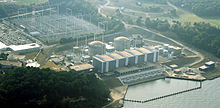
Calvert Cliffs
The Nuclear Regulatory Commission is taking a fresh look at the implications of foreign ownership of U.S. nuclear generating facilities, a review that could allow a French company to build a third reactor at Maryland’s Calvert Cliffs plant. An NRC staff paper released this month recommended the commission replace its Cold War-era prohibition on foreign ownership with a “graded” approach.
The Nuclear Energy Institute praised the staff report, saying that the agency has been relying on an “unnecessarily restrictive interpretation” of the 1954 Atomic Energy Act, which prohibits foreign ownership of a U.S. nuclear station if such ownership could be a threat to the country. “Experienced foreign nuclear energy companies including AREVA, EDF, Toshiba and Mitsubishi have participated in the U.S. market for decades,” NEI Vice President and General Counsel Ellen Ginsberg said. “The U.S. nuclear industry and the U.S. economy benefit from both foreign financial investment and foreign construction and operating experience.”
France’s UniStar asked the NRC to reconsider the rule after the agency’s Atomic Safety and Licensing Board rejected its request to build a third reactor at the Maryland plant. UniStar is seeking a U.S. partner for its Calvert Cliffs project while waiting for the full commission to take action. Although the staff’s recommendation was prompted by the Calvert Cliffs plan, whatever the NRC decides could apply to all U.S. nuclear facilities.
McCarthy: Don’t Believe Talk About States Resisting Rules
Gina McCarthy
Environmental Protection Agency Chief Gina McCarthy said she’s not worried that states like Texas and West Virginia will refuse to implement the agency’s proposed carbon emission rule, despite public opposition from their governors.
“The public discussion may be a little bit different than the roll-up-the-sleeves discussion that we are actually having on a technical basis around these rules,” McCarthy told reporters on Friday at EPA headquarters. “And I’m really anticipating that those discussions will continue and that you will have many states see that the standards that we set were reasonable.
“I think the states know that we are within the Clean Air Act. The best thing they can do is to design their own plans and really create their own path forward that is in line with where they want to go economically and energy wise,” she added.
The Department of Energy is investing $2 million in a study to find ways to build even taller wind turbines in an effort to reach higher winds.
Tower heights currently top out at about 260 feet, a limitation primarily of transportation constraints in moving components such as blades. But newer plans call for towers to reach nearly 400 feet. Such towers would allow blades to be powered by the stronger winds found at higher elevations. That could boost wind energy production by a factor of five at some sites.
The Federal Energy Regulatory Commission’s 2015 schedule for its open meetings has been announced. The meetings take place at FERC headquarters at 888 First St. NE on the third Thursday of each month. No meeting is held in August.
The open meeting dates:
Jan. 15, Feb. 19, March 19, April 16, May 21, June 18, July 16, Sept. 17, Oct. 15, Nov. 19, Dec. 17.
At least one-third of the nation’s 125,000 schools could save money by installing solar PV systems, according to a study conducted for the Solar Energy Industries Association. The report found that solar systems would be cost-effective for 40,000 to 72,000 schools and that 450 school districts could each save more than $1 million over 30 years.
Solar installations nationwide have grown from 303 kW to 457,000 kW in the last decade. New Jersey schools ranked second nationally in solar capacity, behind only California. Pennsylvania, Ohio and Maryland ranked sixth, seventh and ninth, respectively.
“In a time of tight budgets and rising costs, solar can be the difference between hiring new teachers — or laying them off,” SEIA CEO Rhone Resch said.
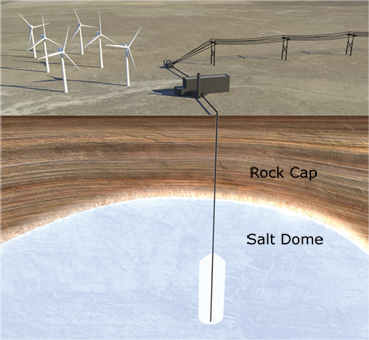
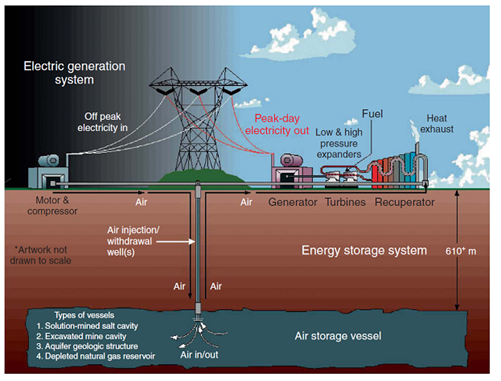
A novel project: Energy generated from wind turbines (in Wyoming) powers compressors (in Utah) that inject high-pressure air into salt caverns underground. The compressed air is stored for high-demand hours.
Duke Energy is joining a novel $8 billion project using Wyoming wind energy and Utah salt mines to provide power to Los Angeles.
Duke-American Transmission Co. (DATC) is one of four companies proposing the project, which would be the first time underground compressed-air storage would be used on such a scale in the U.S.
“This project would be the 21st century’s Hoover Dam — a landmark of the clean energy revolution,” said Jeff Meyer of Pathfinder Renewable Wind Energy, one of the four companies involved.
Meeting California Renewable Goals
The project is one of about 200 plans California officials will consider to help it reach its renewable-energy goals. Duke and the other companies said they would be submitting the proposal in early 2015.
The project would start with a $4 billion, 2,100-MW wind farm north of Cheyenne, Wyo., to be built by Pathfinder Renewable Wind Energy. Power from the facility would be sent to an energy storage facility near Delta, Utah, on a $2.6 billion, 525-mile transmission line to be built by DATC.
In Utah, four massive caverns — each a quarter-mile high and 290 feet in diameter — would be carved out of underground salt formations.
At times of low demand, electricity from the wind farm would power compressors that would inject high-pressure air into the caverns.
At times of high demand, the high-pressure air, combined with a little natural gas, would power eight generators. The $1.5 billion facility, to be built by Pathfinder, Magnum Energy and Dresser-Rand, would be rated at 1,200 MW.
An existing 490-mile transmission line would deliver the power through Utah, Nevada and California to Los Angeles.
Intermittent Wind
(Source: Dresser-Rand)
The project is intended to address the challenge of matching wind’s variable output with energy usage patterns.
California’s wind farms tend to generate most of their power in the evening, dropping off when energy demand reaches its peak. Wyoming wind, by comparison, tends to increase later in the day.
Dresser-Rand designed and built the first facility using compressed-air energy storage (CAES) in Alabama; the facility is linked to a coal-fired generating station. The 110-MW unit went into operation in 1991, and boasts a 96.7% reliability record in generation mode. There is one other operating CAES facility in Huntorf, Germany.
If the project goes forward, one of the first jobs will be excavating the caverns, using a process called solution mining. Magnum Energy, which has excavated other storage caverns, said it would inject water into the underground salt formations, dissolving the salt and pumping the salt solution to the surface, where it would be dried. Underground caverns have long been used for oil and natural gas storage.
The project, which is not expected to be completed until 2023, would be subject to numerous state and federal regulatory approvals, none of which has been applied for yet.
Exelon Generation is adding another 2,000 MW of fossil generation to its fleet in Texas, which will bring the company’s total generation in ERCOT to nearly 6,000 MW.
The company announced Monday it was investing more than $500 million in four gas and two steam turbines to build combined-cycle plants at two of their existing sites.
General Electric H-Class Turbine (Source: BusinessWire)
In addition to using the most fuel-efficient technology, the plants will be air-cooled, rather than water-cooled, a big plus in drought-threatened Texas. The turbines will be General Electric H-class models, which GE says will allow more than $8 million in fuel savings per turbine a year.
French company Alstom is providing the heat recovery steam generators. Earlier this year, GE agreed to buy the power arm of Alstom for $16.8 billion.
It will be the first use of the new GE turbines in the U.S.
“What we see is a clean-energy future that includes this kind of new technology, which uses little water and produces few emissions while generating electricity at a very low cost,” said Ken Cornew, president and CEO of Exelon Generation.
The new combined-cycle plants are to be built at Exelon Generation’s Wolf Hollow site in Grandbury, southwest of Fort Worth, and the Colorado Bend plant in Wharton County, southwest of Houston.
Exelon Generation currently has six generating stations in Texas with a combined output of about 3,700 MW. It has wind farms generating an additional 281 MW, for a total of nearly 4,000 MW.
The two new plants will boost that total to nearly 6,000 MW. Exelon said it would start construction of both plants in 2015 and expects both to be in service by 2017.