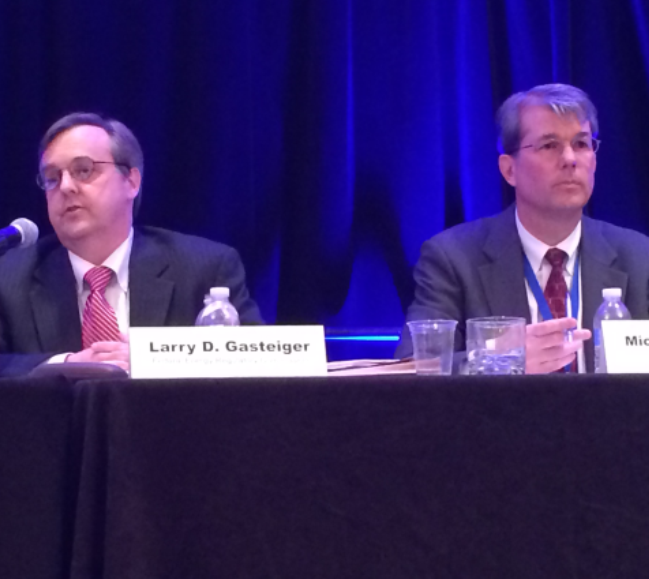
The Market Implementation Committee began work last week on an initiative to create more accurate capacity market price curves and a recommendation by the Market Monitor to eliminate adders for frequently mitigated units (FMU).
Load Curves
An issue charge proposed by Exelon in June calls for modifying the algorithm used for publishing supply curves from the annual capacity auction.
Exelon and other stakeholders are seeking improvements to the supply curve currently produced by the Market Monitor, which masks individual price-quantity offers. Exelon said the current curves — a compromise intended to balance transparency against disclosure of commercially sensitive data — aren’t accurate enough for use in analysis. (See Capacity Supply Curve Review Gets MIC OK.)
The current method is the result of a Federal Energy Regulatory Commission order in a dispute over PJM’s proposal to publish price-quantity pairs after the 2010 Base Residual Auction.
One generator representative noted that the capacity auction results have far-reaching implications for generators and other market participants. Because the curves are imprecise and not released until several days after the auctions, “we are sometimes at a disadvantage to explain certain outcomes” in the auction, he said.
Market Monitor Joe Bowring called for the review, saying the adders are no longer needed because of the introduction of the capacity market in 2007 and changes to scarcity pricing rules in 2012. The adders are “anachronistic” Bowring told the committee Wednesday.
He softened his previous statements somewhat, saying that PJM might need to keep the adders for a few “outliers.”
Less than 1% of megawatts sold last year were offer capped. But because the affected units are concentrated in load pockets they can have more significant local impacts, Bowring said.
Next Meeting
Most of Wednesday’s session was taken up with introductory educational briefings from PJM’s Tom Zadlo on the two issues. The committee will hold its second meeting on the two issues December 4.
PJM planners expect to recommend construction of a $1.2 billion double circuit 345 kV line to address a short circuit problem in the PSEG zone, ruling it less expensive than other alternatives.
The 2012 Regional Transmission Expansion Plan identified several busses where fault currents exceed 80 kA.
Planners evaluated several alternatives, including rebuilding stations to a 90 kA standard, installing current limiting reactors and installing fault current limiters.
PSEG Short Circuit Solution (Source: PJM Interconnection, LLC)
The solution chosen will isolate the Hudson 230 kV from the 138 kV at Marion and 345 kV at Farragut by converting the 138 kV buses and transmission facilities between Linden and Bergen to a double circuit 345 kV capacity.
It is projected to cost $1.2 billion but will incorporate more than $1 billion in existing baseline projects, resulting in an “avoided cost” of $160 million.
Planners rejected a recent stakeholder proposal to build parallel 700 MW HVDC converter stations. That would have cost $614 million but would not have addressed the reliability problems to be fixed by the other baseline projects.
As a result, the double circuit project “is significantly less expensive than the HVDC alternative,” PJM’s Paul McGlynn told the Transmission Expansion Advisory Committee Thursday.
An independent consultant, Burns & Roe, will validate costs and schedules and identify risk areas in the project before planners recommend it to the PJM Board of Managers.
The project, which will be constructed by PSEG, will take about four years and will require acquisition of additional underground and underwater rights of way and land acquisitions for expansion of several substations.
Payments to black start generators could increase by 27% to more than 500% under proposals scheduled to go to a stakeholder vote today.
The System Restoration Strategy Task Force will vote through Nov. 20 on up to four alternatives to the current compensation method for black start units.
An analysis presented to the task force in October showed the annual operations and maintenance compensation for a 20 MW combustion turbine would increase from the current $51,000 to more than $312,000 under NRG Energy’s market based “Proxy” formula. The PJM-Market Monitor “Modified Incentive” would boost compensation to $65,000, while Dayton Power & Light Co.’s “Minimum Incentive” would set compensation at $71,000.
While the increases could be large compared to current compensation, the overall impact on prices would be limited. Black start charges were responsible for only $0.03 of the $35.23/MWh total price of wholesale electricity in 2012 (0.1%), according to Monitoring Analytics’ State of the Market Report.
The Proxy proposal was based on a review of practices in New York and New England as well as cost figures provided by more than 50 generators that responded to PJM’s recent solicitation for black start resources. It would increase capital compensation more than six-fold and payments for fuel storage more than eight-fold.
Old Dominion Electric Cooperative (ODEC) proposed a “cost allocation” alternative that would allow increased compensation but seek to spread the costs beyond load to external generators that clear in the annual capacity auction and internal generators that neither provide black start service nor offer to do so.
“We would be willing to consider increasing compensation, but without [broader] cost allocation we remain troubled by this,” ODEC representative Steve Lieberman said at the task force’s most recent meeting last Tuesday.
Generator representatives reacted coolly to Lieberman’s request to negotiate a consensus with load-serving entities, with one calling it “worse than a zero-sum game” for generators relative to the status quo.
Black start units must be capable of starting without an outside electrical supply, maintaining frequency and voltage under varying load, and maintaining rated output for a specified time, typically 16 hours.
Proposed Changes
(Source: System Restoration Strategy Task Force)
The following changes are included in one or more packages to be considered by the task force:
Increasing the incentive factor — currently 10% of black start costs for units using base formula rates to determine O&M cost recovery — to the greater of 10% or $25,000.
Adding incentives based on unit availability, start times and fuel diversity.
Reducing the frequency of reviews of cost components from annual to once every five years.
Allowing compensation for NERC compliance insurance.
Allowing automatic load rejection (ALR) units to recover NERC Compliance costs as part of their variable operations and maintenance costs, as currently allowed for other black start units. ALR units can remain operating after disconnecting themselves from the grid during a disturbance.
Black Start Pool Increased
On Sept. 6, the Federal Energy Regulatory Commission approved tariff revisions that PJM said will increase the pool of potential black start generators by 64,000 MW (ER13-1911).
PJM initiated the changes over concern that it will lose much of its existing capacity by 2015 due to coal plant retirements. The RTO told FERC in its tariff filing that about 42% of its current black start capacity “may be impacted by environmental regulations.”
The changes included a broadened definition of units eligible to provide black start service and a provision allowing units in one zone to help restart generation in neighboring zones.
Revised Charter
In April, stakeholders expanded the task force’s charter to allow consideration of changes to black start cost allocation and compensation.
The Maryland Public Service Commission expressed concern with the expanded charter, telling FERC that the cost of black start service had doubled in recent years. The commission said there was a “need for cost controls given that black start service has rarely, if ever, been used.”
The task force’s expanded charter also included consideration of “back stop” options if response to PJM’s voluntary request for resources leaves gaps in coverage. However, PJM officials said last month they were pleased with the response to their recent request for additional black start resources.
PJM Executive VP Mike Kormos said the response indicated “a large pool of viable units, both proposed and existing.” Officials said it will take months to select their fleet of black start resources from among current resources and the new bidders.
PJM proposed a change in its real-time pricing mechanism, saying the current methodology is depressing energy and reserve prices.
PJM told the Market Implementation Committee Wednesday that it will propose a problem statement to consider increasing reserve requirements under certain circumstances. The revised methodology could increase reserve and real-time energy prices while reducing uplift.
Reserve requirements would be increased when operators are carrying additional resources (generation, reserves or emergency DR) to cover units at risk – for example when it is unknown whether a generator with environmental limitations will receive a waiver to continue operating.
Requirements also could be boosted when operators have data quality concerns or are uncertain about load or interchange.
An unexpected influx of imports caused prices to crash July 18 after PJM operators called on demand response.(Source: PJM Interconnection, LLC)
Because they cannot be exact in dispatching emergency demand response or scheduling generation, operators tend to err on the side of calling on more resources than are ultimately needed. PJM cited the July 18 heat wave, when an unexpected influx of imports from New York caused prices to crash after the deployment of DR.
“It’s really a matter of having the [pricing] engine recognize these actions. Right now we don’t have a mechanism to do that,” said PJM’s Angelo Marcino.
The proposal was welcomed by several stakeholders. “LMPs have been crushed for years and years and years when DR gets called,” said David Pratzon, who represents generators.
Some other members, however, said they feared that the changes could result in overly conservative actions by PJM operators, resulting in a net increase in costs rather than just a shift.
“I would hate to see reserve requirement creep,” said David “Scarp” Scarpignato, of retail marketer Direct Energy.
“We risk over-responding,” agreed one load-serving representative.
Barry Trayers, of Citigroup Energy, said the changes could increase uncertainty. “It’s going to make it even harder for stakeholders to ascertain where we are in the world of scarcity.”
One representative said PJM also should work to incorporate intraday changes in natural gas costs. But Pratzon said PJM should act promptly on this issue and defer a wider-ranging discussion until later. “People are already making arrangements for buying and selling energy” for next summer, Pratzon said.
Market Monitor Joe Bowring said he supports PJM’s efforts but added: “The mechanics of what PJM is planning need to be made substantially more clear.”
AP South and the Cleveland interface attracted the most attention in PJM’s inaugural window for proposed market efficiency upgrades.
PJM staff provided the Transmission Expansion Advisory Committee last week with a summary of 17 proposals ranging from $200,000 to $64 million.
Merchant developer LS Power was the most ambitious, proposing four projects totaling $181 million in eight zones. Transource (American Electric Power and Great Plains Energy) was second, proposing three projects in the AEP and ATSI zones totaling $135.5 million.
The three incumbent utilities that took part — Commonwealth Edison, Dominion Virginia Power and FirstEnergy — all stayed at home, with proposals in their own transmission zones. Duke (with partner American Transmission Co.) did the same, proposing one project in the Duke Ohio-Kentucky zone.
AP South
AP South attracted seven congestion relief proposals.
Transource proposed two alternatives to address congestion at AP South and the AEP-Dominion interface. The cheaper option features a 500 kV substation with series capacitors at a cost of $39.3 million. A second builds on the first with additional series compensation at an extra $24 million.
Dominion proposed three projects incorporating Thyrister-controlled series capacitors at costs ranging from $20.1 million to $24.6 million (total cost $69.4 million).
FirstEnergy and LS Power made pitches for AP South and the Hunterstown 230/115 kV line with projects of $54.3 million and $61.7 million, respectively.
Separately, LS Power proposed a new Hunterstown-Cumberland 230 kV line and substation improvements for $63.9 million. FirstEnergy proposed spending $8 million to add a 230/115 kV transformer and reconductor the Hunterstown-Oxford 115 kV line.
Cleveland Interface
(Source: PJM Interconnection, LLC)
FirstEnergy, LS Power and Transource each proposed projects to relieve congestion at the Cleveland Interface.
The most expensive is FirstEnergy’s $61.7 million proposal to improve a 138 kV substation in the ATSI zone.
LS Power’s $44.9 million project, which includes the ATSI and PENELEC zones, would add a new Erie West–Ashtabula 345 kV line and a 345/138 kV transformer.
Transource offered the least costly project, a new 138 kV substation in the ATSI zone at a cost of $32.9 million.
Next Steps
PJM’s request for congestion relief proposals was its first under Order 1000, in which the Federal Energy Regulatory Commission sought to increase competition by largely eliminating utilities’ monopoly over transmission development in their territories.
Proposals must clear a minimum 1.25 benefit-to-cost threshold to be considered by the Board of Managers for inclusion in the Regional Transmission Expansion Plan. PJM staff will review the projects through January and make recommendations to the Board in February.
PJM will conduct independent cost reviews on projects exceeding $50 million and on those below $50 million that have tight benefit-cost margins, said PJM’s Paul McGlynn.
PJM’s weather normalized summer peak increased 950 MW in 2013, the largest increase since load growth resumed after the recession.
The 0.6% increase over 2012 is “no great shakes but moving in the right direction,” PJM’s John Reynolds told the Planning Committee during a briefing last week.
The peak was 0.2% (368 MW) below PJM’s forecast. “It’s been a challenging time for us for load forecasting since the recession,” said Steve Herling, vice president of planning. “The primary input is econometrics — over which we have no control.”
Peak diversity for 2013 as 0.3%, much lower than the forecasted 4.3%, as a result of the single RTO-wide heat wave July 15-19.
It was the first summer that the top five coincident peaks have come in the same calendar week since PJM started collecting the data. “The entire story of the summer of 2013 can be told in one week in the middle of July,” Reynolds said.
The Planning Committee approved a manual change that will result in PJM identifying potential transmission upgrade requirements earlier in the study process.
In past years, studies identified many reinforcements which were ultimately not needed as projects dropped out of the backlogged transmission interconnection queue. As the backlog has been reduced, however, some projects have cleared the Impact Study phase without any apparent violations, only to have violations indicated when they are evaluated at 100% in the Facilities Study.
As a result, PJM plans to eliminate the 19% probability for Feasibility Studies and replace it with the 53% currently used for Impact Studies. Impact Studies will use the 100% probability. The changes will be incorporated in Manual 14B. (See Transmission Studies to Flag Upgrades Earlier.)
PJM CEO Terry Boston and Federal Energy Regulatory Commissioner Cheryl LaFleur kicked off PJM’s third annual Grid 20/20 conference in Philadelphia last night.
In keeping with the theme of this year’s conference, LaFleur told an audience of about 100 about the need to create a “culture of resiliency.”
“When there is a problem on the grid, very rarely is it the result of one thing. It’s a succession of mistakes where if you had defense in depth it could have been stopped,” she said. “There has to be a line of sight between what people are doing and the bigger issues…These little thing will add up to the big things.”
About 180 people gathered for today’s daylong session at the Sheraton Society Hill.
PJM is changing the way it estimates Tier 1 Synchronized Reserves and is open to lifting the cap on demand response participation in Tier 2, officials told the Operating Committee last week.
A review of more than 40 Synchronous Reserve events since January 2012 found that only 71% of estimated Tier 1 reserves responded when called upon. The response rate drops to 62% when two outlier events — in which there was over-performance — are excluded.
PJM officials decided to take a look at their estimation methods after an SR call during the Sept. 10 heat wave provided only 12% response.
PJM plans to implement several changes in its methodology by the end of the year:
Cap all units used in the Tier 1 estimate at the lesser of Eco Max or Spin Max (by end of year).
Remove all hydropower units – which don’t respond automatically to synch reserve events — from the Tier 1 estimates (already done).
Remove all combined cycles units from the Tier 1 estimate except units that have submitted a Spin Max < Eco Max (done).
Remove units with a manual dispatch instruction from the Tier 1 estimate (by end of year).
During hot or cold weather alerts, the Degree of Generator Performance (DPG) modifier will be used to adjust the Tier 1 response estimate (by end of year).
Tier 2 Synchronous Reserve Response Performance for Events > 10 Minutes (% of Assignment Provided) (Source: PJM Interconnection, LLC)
Units assigned regulation, which are assumed to be able to respond with the MWs outside their regulation band, will remain in the Tier 1 estimate.
Units providing constraint control are expected to respond to a Synch reserve event and will remain in the estimate.
Tier 2 Unchanged
Also unchanged are the Tier 2 calculations. PJM filed new Tier 2 penalty rules for nonperformance Nov. 1 (ER14-297).
The new rules were approved by the Members Committee Oct. 24 in response to concerns that the existing penalties were insufficient to ensure compliance.
Demand response and generation have each provided 59% of requested MWs for Tier 2 events of 10 minutes or longer in 2013, according to a PJM analysis provided last week to the Operating Committee. That was a decline after steady increases in performance from 2009 through 2012.
PJM officials said they don’t know the reason for the fall off in performance. “There’s nothing that jumped out” as a cause, said PJM’s Tom Hauske.
DR Cap
Although the cap on DR participation was raised to 33% last fall, it provided only 224 of the 925 MW (24%), with generation providing the remainder.
DR typically offered between 200 and 250 MWs per hour into the market. Mike Bryson, executive director of system operations, said the decline in SR prices affected the volume of DR bidding into the market, rendering the cap moot.
Asked by EnergyConnect’s Bruce Campbell whether PJM still sees a need for a limit on DR participation, Bryson responded: “I think it’s certainly worth discussing.”
Adam Keech, director of wholesale market operations, said that PJM would need to improve its data collection before considering a change in the cap. About 9% of MWs assigned to DR failed to provide PJM with data in 2013, down from 46% in 2012.
Officials said one concern with removing the cap would be the operational impacts because of differences in the ramp rate of DR versus generation in the first 10 minutes of spin events.