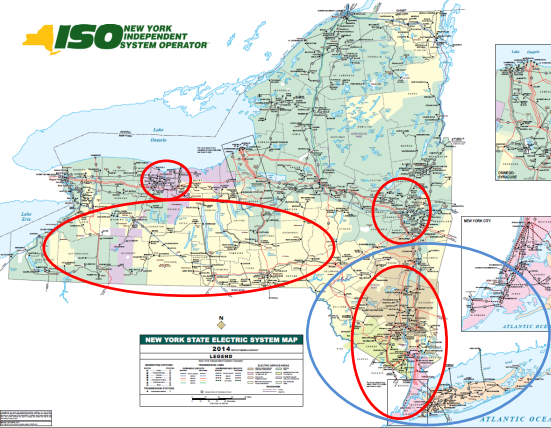
The NYISO Management Committee approved a mandatory black start requirement in part of in the Consolidated Edison territory, despite opposition by generators who said the previous voluntary system had been working well.
The committee approved the new rules with 63% support at its Aug. 27 meeting, clearing the 58% threshold.
Con Ed and the New York State Reliability Council say the program is needed to provide quicker service restoration in New York City (Zone J). Con Ed said no new black start resources have been constructed in the city since the New York energy markets opened in 1999.
The NYSRC is an independent organization governed by a 13-member executive committee representing transmission operators, wholesale generators and others.
Con Ed would be able to require black start service from generators that it can show would materially improve the speed, adequacy or flexibility of its plans for resuming operations after a blackout.
The ISO could grant a requested exemption for “good cause” — meaning that inclusion of a plant would be burdensome to the plant owner for technical, financial or other reasons.
The plan heads to the NYISO Board of Directors for final approval in October.
PJM officials said last week they will likely recommend that the Board of Managers approve 23 reliability projects proposed during the first solicitation window of the 2014 Regional Transmission Expansion Plan.
Twenty-two of the projects, totaling $82 million, are upgrades and would be awarded to the incumbent transmission owner in the zone.
PJM officials told the Transmission Expansion Advisory Committee they are still comparing several greenfield proposals against incumbent PPL’s proposed upgrade to correct overloads on the Montour–Milton–Sunbury 230-kV line. In addition to two upgrades proposed by PPL, PJM also received 10 greenfield proposals in the PPL zone ranging from $29 million to $164 million.
PPL has also proposed a new double circuit 500-kV line and substations spanning the PPL and Penelec zones at a cost of $1.367 billion.
The 22 “preliminary recommended solutions” ranged from $20,000 (closing a normally open switch) to $26.5 million (reconductoring a 230-kV line and upgrading terminal equipment). They were selected from 45 proposed transmission owner upgrades and 61 greenfield projects addressing about 50 facilities in 18 transmission zones.
Projects not recommended were either more expensive than the selected alternatives or addressed reliability issues related to expected generator retirements or additions. Projects addressing changes in generation will be reconsidered as retirements and additions are finalized.
Top Congestion Spots Identified
Planners also released the list of PJM’s 25 most costly transmission constraints in preparation for the opening of a second RTEP window that will include “market efficiency” proposals to reduce congestion.
The top 25 chokepoints are responsible for almost $539 million of the $593 million in projected congestion costs for 2015.
The analysis found congestion resulting from wind generation in the ComEd zone and being reduced by new generation planned for the MAAC and Southern PJM regions.
Rising load and natural gas prices are expected to add to congestion in future years. Higher gas prices after 2020 are expected to aid coal-fired generation.
Planners said they will conduct cost-benefit analyses to determine whether to accelerate planned reliability projects that also benefit market efficiency.
The second window, which will also include long-term reliability fixes, will be open from Nov. 1 through February 2015. PJM will finalize the proposal document and criteria for proposals in October after accepting feedback on the model through September.
‘Lessons Learned’ Poll Results
Meanwhile, PJM officials said they will work with stakeholders to improve the solicitation process based on feedback received in response to a poll conducted last month. Eleven topics received 10 or more votes in favor.
Commenters said PJM should develop and follow a step-by-step process consistent with its Tariff, including clear identification of the metrics the RTO will use to evaluate proposals.
Some respondents said incumbent TOs should be awarded responsibility for construction when PJM significantly modifies proposed projects to develop the most effective solution.
Planners were criticized in July for their recommendation that Public Service Electric & Gas be selected to fix the Artificial Island stability problem in southern New Jersey. PSE&G’s winning proposal was estimated at $1.066 billion before PJM planners eliminated two 500-kV lines from it, reducing the project’s cost by more than three-quarters. (See PJM Board Puts the Brakes on Artificial Island Selection.)
Others said proposal submission requirements should be more general for windows open for only 30 days than for 120-day windows. The 30-day windows would use high-level cost estimates, environmental analyses and power flow data to demonstrate the proposals’ effectiveness.
Dynegy said last week it may seek to move its Illinois generation to PJM unless MISO changes its capacity market rules.
The company is framing the issue as one of system reliability and consumer protection. However, there could be substantial financial benefits to Dynegy if its MISO generation were part of PJM, where capacity prices are far higher.
“MISO’s own forecasts show that it expects to be short of generation in the next few years,” Dynegy spokeswoman Katy Sullivan said. “The potential for consumer rate shock as the market moves across the vertical demand curve is high. Our point is that there are several ways for Illinois to address this concern and benefit all market participants.”
“Improving the MISO capacity construct is one,” she said, “moving to PJM is another.”
Dean Ellis, Dynegy’s managing director for regulatory affairs, first floated the potential move in an interview with Crain’s Chicago Business.
Why Switch to PJM?
MISO’s voluntary capacity market uses a vertical demand curve and procures resources one year in advance. PJM’s mandatory market uses a sloped demand curve and obtains capacity three years ahead of delivery.
MISO has only conducted two auctions so far, for 2013/2014 and 2014/2015. The clearing price for the zone, including Dynegy’s Illinois generation, was $16.75/MW-day for the 2014/2015 delivery year. The PJM clearing price for the same period was $125.99/MW-day.
Critics say MISO’s construct makes it hard to attract capital investment and that its vertical demand curve causes excessive price volatility.
Among the critics is MISO’s Independent Market Monitor, whose 2013 State of the Market Report cited as flaws the vertical demand curve, “barriers to capacity trading with PJM and barriers to participation in the auction affecting units with suspension or retirement plans impacting the planning year.
“MISO’s economic signals in 2013 would not support private investment in new resources, which is partly due to the modest capacity surplus that currently exists in MISO,” the report said. “However, we believe the economic signals would continue to be inadequate even under little or no surplus because of the shortcomings of MISO’s current capacity market.”
The IMM said MISO’s 2013 replacement of its Voluntary Capacity Auction (VCA) with an annual Planning Reserve Auction (PRA) didn’t go far enough. “Though an improvement, the PRA continues to reflect a poor representation of the demand for capacity [or planning reserves], which undermines its ability to provide efficient economic signals.
“It will be critical to address these issues in the near future because increased retirements and capacity exports are projected to generate a capacity deficiency as soon as 2016. Improving the performance of the capacity market may play a pivotal role in ensuring that MISO will continue to have access to sufficient capacity.”
What Dynegy Has at Stake
Dynegy currently has about 13,200 MW of generation, including 7,042 in MISO from five coal-fired plants it bought from Ameren last year.
Only Exelon, with its nuclear fleet of more than 11,000 MW, has more generation than Dynegy in Illinois.
Dynegy, which currently has 1,780 MW in PJM, would gain about 9,000 MW in the RTO if it wins approval for deals announced last month to purchase generation from Duke Energy and Energy Capital Partners. About 2,500 MW of that would be in Illinois’ PJM region.
MISO’s share of Dynegy’s total generation will fall to 29% from 53% as a result of the expansion in PJM and New England. But Dynegy CEO Robert Flexon said he was counting on Dynegy’s participation in MISO to be a plus for the company. The next several years, he said, “should be a really peak time for the MISO marketplace” due to plant retirements.
No filings have been made with the Federal Energy Regulatory Commission.
MISO declined comment when asked about Dynegy’s suggestion that it may leave the RTO. The Illinois Commerce Commission also declined to comment.
PJM spokesman Ray Dotter said the RTO “does not comment on the market positions and plans of individual members. We cannot speculate on Dynegy’s reported plans.”
Exelon, which has one nuclear generating station — the 1,078-MW Clinton Power Station — in MISO, has said in the past that Clinton’s economic viability is limited in part by MISO market rules.
“We agree that the MISO capacity market needs to be improved to protect the reliability of the system for Illinois electric consumers and the state’s economy,” the company said in a statement. “We have not seen Dynegy’s proposal and cannot comment on it.”
ComEd’s Departure
It wouldn’t be the first time companies switched from one RTO to another.
In 2002, Commonwealth Edison, and its parent company, Exelon, asked FERC for permission to leave MISO and join PJM. The move came after it was unable to reach agreement on new rate structures with MISO.
Exelon said most of its wholesale trading partners and suppliers and its strongest interconnections were to the east of ComEd. The integration was completed in 2004.
ComEd’s PJM zone was initially an island, separated from the rest of the RTO to the east, until American Electric Power and Dayton Power and Light joined later that year. Since then, Duquesne Light, Dominion Virginia Power and FirstEnergy in Ohio have also joined PJM.
To leave one RTO and join another could involve several steps, including showing that negotiations with the current RTO had been unsuccessful. Affected state regulatory agencies, in this case the ICC, could choose to intervene in the FERC case on one side or the other.
Dynegy is also eyeing other markets. In an interview last week with the Houston Business Journal, Flexon said that the portfolio of Energy Future Holdings — parent company of power generator Luminant, TXU Electric and transmission company Oncor — might be a nice addition to Dynegy’s growing portfolio. Energy Future Holdings’ operations are in the ERCOT market in Texas, and the company is going through bankruptcy proceedings now.
Although Dynegy’s headquarters is in Houston, it has no operations at all in Texas since emerging from its own bankruptcy. “If there ever were portfolios for sale in Texas, that could one day be something that Dynegy would have an interest in,” Flexon said.
“We want to operate in well-functioning markets, and that is what we are looking to do,” Dynegy’s Sullivan said.
Market Monitor Joe Bowring and stakeholders representing load expressed doubts last week about PJM’s latest capacity market proposals, questioning the cost and need for what Bowring called a “dramatic redesign” of the market.
The RTO last month proposed the creation of a Capacity Performance product that would supplement the existing Annual Capacity offering. In a late afternoon meeting Wednesday, Bowring said he was “very skeptical of the multi-product proposal,” echoing other stakeholders in saying it could encourage withholding by generators.
Parameter Changes Opposed
The meeting coincided with PJM’s release of stakeholder letters urging the Board of Managers not to act on PJM staff’s proposed changes to capacity auction parameters. Stakeholders representing load interests said the board shouldn’t consider staff’s proposed changes in the shape and position of the capacity demand curve — which failed to win stakeholder consensus last month — until it evaluates how they would interact with PJM’s new product proposal.
PJM’s proposals come as the capacity market is still digesting changes implemented in May’s Base Residual Auction, when prices in most of the RTO doubled following limits on the role of imports and demand response.
The Southern Maryland Electric Cooperative called Capacity Performance “the most material changes to PJM markets since the advent of [the Reliability Pricing Mechanism] itself.” Regulators from Maryland and Illinois said the proposal means “fundamental changes to the very nature of the capacity product.”
The “Load Coalition,” a group of 17 stakeholders, including regulators and load-serving entities, said that “load must never be viewed by the PJM board as offering a blank check.”
The letters served as a preview of the arguments the stakeholders would likely make if the board seeks the Federal Energy Regulatory Commission’s approval of staff’s proposed changes.
Old Dominion Electric Cooperative noted that members participating in the Triennial Review of capacity market parameters failed to reach consensus on changes to the demand curve, the calculation of the cost of new entry (CONE) or the cost of capital.
“Dispute over any one of these components will be contentious and polarizing at FERC. All three together could be paralyzing and will distract from other priority PJM initiatives,” ODEC said.
In all, regulators or public advocates for seven of PJM’s 13 states and D.C. weighed in against the parameter changes. Also expressing opposition as members of the Load Coalition were American Municipal Power; Blue Ridge Power Agency; Duquesne Light; North Carolina Electric Membership Corp.; Rockland Electric; the Public Power Association of New Jersey; the American Public Power Association; and the PJM Industrial Customer Coalition.
Dynegy also raised objections.
The board received only two letters in favor of the changes, one from the PJM Power Providers Group and another from American Electric Power, Dayton Power and Light and FirstEnergy Service Co. They supported the proposed changes to the variable resource requirement curve but said PJM staff’s 8% after-tax weighted average cost of capital is too low.
Monitor’s Meeting
Wednesday’s meeting was scheduled to discuss the Monitor’s analysis of the 2017/18 Base Residual Auction in May. The Monitor’s report, released in July, concluded that PJM capacity prices would increase sharply but reliability would not be threatened if a recent federal court ruling eliminated demand response from wholesale markets. The report also evaluated how prices would have been affected had other changes favored by the Monitor been enacted. (See Life without Demand Response: Higher Prices but No Reliability Crisis, Says Monitor.)
Bowring told attendees he hopes to release sensitivity analyses of PJM’s Capacity Performance proposal as soon as this week. Bowring said his office is discussing the analyses with PJM to ensure the assumptions are valid and that the results don’t violate confidentiality rules.
“We want to have some meaningful results,” Bowring said. “We don’t want to make [unreasonable] assumptions.”
Bowring said that the PJM proposal had “a lot of positives,” citing staff’s call for heightened performance incentives and penalties. “Leaning heavily on the performance incentives makes sense,” Bowring said.
Jim Benchek of FirstEnergy questioned how market power would be mitigated under the PJM proposal. “That’s a part that’s been left a mystery to us,” he said.
ODEC’s Ed Tatum asked Bowring to compare the costs of PJM’s proposal to the $600 million in uplift in January, saying the PJM proposal might cost ratepayers more than it saves.
Citigroup’s Barry Trayers expressed a similar concern, saying PJM’s changes may be an overreaction to a “once-in-20-year” winter, noting that PJM typically has a 30% reserve margin during the cold months.
Bowring said he shared concerns about overreacting to last January, when as much as 22% of PJM’s generation suffered forced outages. At the same time, he reiterated his contention that capacity prices have been improperly suppressed by the role of Limited and Extended Summer demand response.
At the Operating Committee meeting last week, several members expressed concern about including new rules regarding gas unit commitment as part of the Capacity Performance filing with FERC.
Dave Pratzon of GT Power Group said there wasn’t enough time to reach consensus on the gas rules and that their inclusion could lead to more adversarial proceedings before FERC.
John Farber of the Delaware Public Service Commission agreed. “To try to force this into the same filing, I think a lot would be lost,” he said.
Auction Parameters and Capacity Performance
Members deadlocked last month on changes to capacity market parameters, with none of five proposals resulting from the FERC-ordered Triennial Review winning a supermajority at the Markets and Reliability Committee. (See Members Deadlock on Capacity Parameter Changes.)
As a result, the Board of Managers will decide for itself whether to seek FERC approval for PJM staff’s proposed changes. The board also is expected to decide unilaterally whether to seek FERC approval for staff’s Capacity Performance proposal under the never-before-invoked Enhanced Liaison Committee process. PJM officials said they initiated the Liaison process because they did not expect stakeholders to reach consensus.
In their letters, load representatives said changing the auction parameters and introducing the new capacity product could cause unreasonable increases in capacity costs. Maryland and Illinois regulators said the proposed parameter changes could increase capacity costs by $1.5 billion annually.
“In the Capacity Performance discussions with PJM staff last month, PJM indicated that 140,000 MW of resources are potentially compliant with the requirements of being a Capacity Performance resource, meaning that the clearing price required of those resources which are not compliant will create a windfall for the remaining compliant resources,” SMECO said. “By creating two classes of annual capacity products, the potential for the exercise of market power in the supply curve of Capacity Performance resources is only exacerbated by the changed VRR curve shape proposed by PJM.”
The Load Coalition said the board should defer action on the capacity parameters for which there is no consensus “so the board may ensure the interrelated parts of RPM work together appropriately to satisfy the applicable reliability standards while still honoring the Federal Power Act’s ‘just and reasonable rates’ standard.”
The coalition challenged PJM staff’s contention that the parameter changes and Capacity Performance initiative are “separate and distinct.”
The coalition noted that PJM asked FERC to defer action on its Section 206 proceeding on replacement capacity — PJM’s effort to reduce arbitrage opportunities in incremental capacity auctions — pending the Capacity Performance filing.
“The Load Coalition views the Triennial Review to be at least as closely linked, if not more so, with the Capacity Performance initiative than the Replacement Capacity effort may be, particularly because PJM’s proposed VRR curve shape has been shown individually by PJM’s own simulations to procure capacity materially beyond what would be required to meet our resource adequacy objectives,” the coalition said.
Based on the modeling assumptions of PJM’s consultant, the coalition said the parameter changes would result in a Loss-of-Load Expectation of one load shed event in 16.7 years — far above PJM’s 1-in-10 LOLE standard. The coalition said the consultant’s assumptions “greatly overstate volatility and reliability risk.”
“As virtually captive customers to the PJM markets, load must never be viewed by the PJM board as offering a blank check. With the close nexus between energy markets and economic growth, the PJM board has a serious responsibility to ensure not only reliable operations but also rates that are just and reasonable and not unduly discriminatory, as the Federal Power Act requires.”
The Maryland and Illinois commissions said the Capacity Performance initiative and the possible elimination of the $1,000 Offer Bid Cap in the energy market could add to the increased costs resulting from the parameter changes.
“The commissions believe it is important to evaluate these measures together rather than a piecemeal fashion so that a full understanding of all of the implications of these changes upon PJM’s capacity market can be achieved. Changes to RPM have often had unintended outcomes; a process that does not fully evaluate proposed changes jointly will do nothing to minimize the occurrence of such unintended outcomes.”
The P3 Group said the board should seek FERC approval of the demand curve changes without delay, saying they are necessary to “enhance the long-run performance of the curve, ultimately improving auction outcomes and supporting long-run reliability.”
“The purpose of the Triennial Review is distinct from the Capacity Performance proposal. The components of the Triennial Review work to establish the volume of procured capacity to meet resource adequacy standards. In contrast, the capacity performance proposal describes the attributes of the capacity commitment. Further, the outcome of the capacity performance proposal is uncertain. Its uncertainty should not cloud the completion of the Triennial Review.”
WASHINGTON – When the Federal Energy Regulatory Commission held a technical conference on capacity markets last year, many commenters pointed to PJM as the source of best – if imperfect – practices.
At FERC’s workshop yesterday on uplift and price formation, it was NYISO and MISO that speakers pointed to as the most forward-thinking.
PJM, meanwhile, was a target for criticism from market participants smarting over the $600 million uplift bill from January’s polar vortex.
A FERC staff report released last month said that PJM’s uplift ranked second among organized markets from 2009 to 2013, with charges increasing from about $0.50/MWh to more than $1/MWh over that period. (See FERC: PJM Uplift Ranks High Among RTOs, ISOs.)
Two dozen speakers discussed the causes and impacts of uplift, along with ways to reduce it, during the daylong session. All four FERC commissioners attended at least part of the forum, part of a broad inquiry on price formation that will continue Oct. 28 with a session on offer-price mitigation and offer-price caps (AD14-14).
Asked whether the workshops would lead to a rulemaking, Chairman Cheryl LaFleur said, “We’re keeping an open mind. We don’t have a predetermined next step.”
Robert Weishaar, representing the PJM Industrial and Load Coalition, said FERC “needs to restore public confidence in the existing uplift rules.”
“We still don’t know why we had an extreme blowout in January,” when as much as 22% of PJM’s generators failed to operate. He called for changes to PJM’s force majeure provisions, saying “you could drive a truck through them.”
Uplift Hurts Retailers
Although uplift represented only 1% of PJM’s total cost per MWh in 2013, energy retailers and financial traders said yesterday it has a much larger impact on their businesses.
Peter Fuller, New England director of regulatory and market affairs for NRG Energy, which serves 3 million retail customers, said uplift is “hugely damaging to our efforts to provide pricing predictability.”
Because uplift is not hedgeable, retailers have to estimate the costs, said Elizabeth Whittle, representing the Retail Electric Supply Association. “That works until you have a January 2014 polar vortex.”
In January, PJM had $177 million of uplift for deviations and $387 million for reliability resulting from operators’ conservative operations.
“If you were really good at [minimizing] deviations you could avoid” those charges, Whittle said. But there was no way to avoid reliability charges, she said. “The impact on retail [load-serving entities] was devastating.”
Other Impacts
Mark Smith, vice president of government and regulatory affairs for Calpine, said uplift discourages generation owners from making investments to make their units more flexible, such as reducing minimum run times.
Michael Schnitzer, representing Entergy Nuclear Power Marketing, said that by suppressing LMPs, uplift provides the wrong incentives for demand response and fast-ramping resources. “You’re missing price signals on cold days” that would spur dual-fuel generation and pipeline expansions, he added.
Financial Trader Leaves PJM
Wesley Allen, CEO of Red Wolf Energy Trading, said his small financial trading firm has abandoned the PJM market due to fears that up-to-congestion trades might soon be assessed uplift charges.
FERC last week ordered a review of PJM’s rules regarding UTCs, questioning why they — unlike increment offers and decrement bids — were not being assessed for uplift. (See related story, FERC Orders Review of UTC Rules, page 4.)
Allen, who spoke on behalf of the Financial Marketers Association, said PJM and ISO-NE unfairly charge uplift to virtual trades that don’t cause the problem. NYISO doesn’t charge uplift to virtuals, while CAISO, ERCOT and MISO net their virtuals, essentially eliminating their exposure, Allen said.
Allen compared uplift to a “gas guzzler” tax. In MISO, you get charged the tax if you drive a big sport utility vehicle, Allen said. “In PJM, they don’t care if you ride a bike. They don’t care if you take the bus. Everybody pays.”
Allen said PJM’s uplift charges dwarf the profits on virtuals, which average less than $1/MWh.
While uplift may be small for many, “for virtual traders it’s huge,” Allen said. “There’s just no other way around it.”
Transparency
Allen echoed PJM Market Monitor Joe Bowring’s call for more transparency on the causes and recipients of uplift.
Bowring said transparency could result in market-based solutions in some locations where individual generators receive millions in uplift payments. PJM had 19 generating plants receiving more than $10 million and 33 receiving at least $5 million in 2013, the 33 representing 82% of total uplift for the year.
Bowring has called on PJM to identify the generators receiving uplift, but PJM officials said they are prevented from doing so by confidentiality rules and would require a FERC order giving them approval. (See PJM Won’t Name Uplift Recipients.)
“The fact that we’ve had massive payments to the same units suggests that the market doesn’t know about it or is not reacting,” Bowring said. Transparency “is the only solution we can think of. If it remains secret, the market cannot self-correct.”
John Rohrbach, director of regulatory and market affairs for ACES, said confidentiality was intended to protect competition. “To the extent it is preventing competition from occurring, that is something that should be addressed.”
But David Patton, Market Monitor for NYISO, MISO and ISO-NE, questioned what solutions would result from transparency.
The upper peninsula of Michigan has been a persistent cause of uplift in MISO, he noted. “Everybody sort of knew what was happening. But nobody is going to do anything about it because there’s no product that someone can make a profit off of. You need products and you need pricing. Transparency alone I think will have limited impact.”
Role for RTEP
Bowring also said PJM should consider uplift when developing its Regional Transmission Expansion Plan. “As far as I can tell [uplift fixes] are not incorporated into RTEP,” he said.
Stu Bresler, PJM vice president of market operations, said the RTO can address such issues in the RTEP. He cited the RTO’s decision to add two transformers at the Wylie Ridge substation to eliminate use of Transmission Loading Relief procedures.
Planners “consider these uplift payments even if they’re not captured in LMP,” Bresler said. “It’s another signal that the system is chronically constrained.”
Bowring was not satisfied. “I don’t think it’s being done adequately now,” he said. “It’s not going to solve all uplift, but it can address those persistent problems when there’s a transmission solution.”
Bowring and Bresler also squared off over the issue of closed-loop interfaces, which PJM has begun using in the last year to capture in LMPs operator actions taken to address voltage problems. The RTO has also used them to get sub-zonal demand response to set price, which Bowring called an “inappropriate use of a closed-loop interface.”
Bowring also said the interfaces can have unintended consequences on Financial Transmission Rights funding and virtual bidding.
What other RTOs are doing:
Speakers pointed to NYISO’s “hybrid pricing” as a strategy that has reduced uplift. MISO recently won FERC approval for a new initiative, Extended LMP, which builds on the NYISO model.
Patton said he has recommended that MISO also introduce a local reserve product. RTOs also should change their hourly settlement policies to align them with the five- or 15-minute dispatch procedures, he said.
FERC Chairman Cheryl LaFleur in her office. Photo courtesy of FERC.
With a disruptive confirmation process behind her, Federal Energy Regulatory Commission Chairman Cheryl LaFleur said she believes morale at the agency is improving as she attempts to make progress on priority issues before she turns over the gavel to Norman Bay in April.
In an interview with RTO Insider last week after her return from a late August vacation, LaFleur said she is happy that the leadership succession is now clear. “After more than a year of uncertainty,” she said “now there’s clarity that I’m chairman.”
LaFleur said it was hard to judge the impact that the failed nomination of Ron Binz and the bruising confirmation of Bay had on the agency’s 1,500 staffers. “But I think people have a little spring in their step knowing we’re past that stage.
“We talk a lot about the commissioners, but you know there’s a body of employees at FERC that maybe don’t get enough love. I think their efforts are what keeps this place moving along.”
LaFleur was appointed acting chairman in November to replace Jon Wellinghoff. After LaFleur and Bay were confirmed by the Senate in July, President Obama removed the “acting” title from LaFleur. She will serve as the panel’s head until April 15, when Bay, formerly FERC’s director of enforcement, will become chair.
The unusual arrangement was the result of a deal by the White House to win support for Bay’s confirmation. Some senators were angry that Obama had signaled his intent to appoint Bay immediately as chairman over LaFleur, who has served on the commission since 2010. The last five FERC chairmen served a median of 30 months before becoming chair.
The removal of the acting title allowed LaFleur to promote David Morenoff to general counsel, a position he had been serving in an active capacity for nearly two years.
LaFleur declined to say whether she received any assurances from Bay that he would keep Morenoff on next year.
“I did discuss it with Norman. I discussed it with all my colleagues. But it was my decision,” she said.
“When Norman is chairman he’ll make such decisions as he makes. That’s not for me to say [whether Morenoff will remain]. I don’t think David will stop being terrific.”
PJM Capacity Proposal
LaFleur said she was unable to comment about the specifics of PJM’s Performance Capacity proposal, which will be submitted for FERC approval later this year. (See related story, PJM Members, Monitor Skeptical of Capacity Market Overhaul).
Instead, she pointed to FERC’s April 1 tech conference. “We talked conceptually about whether there were ways to price more fuel security into the electric product,” LaFleur said. “This is one of the hardest parts of the gas-electric coordination – that the gas and electric industries attract capital differently.”
EPA Carbon Rule
LaFleur said conversations with state commissioners suggests many states are open to regional collaboration as a way to reduce the cost of complying with the Environmental Protection Agency’s proposed cap on carbon emissions from existing generation.
“I do think we will see some regional collaboration in some places,” she said, noting the carbon trading systems in California and the Regional Greenhouse Gas Initiative, which includes New York, the members of ISO-NE and Maryland and Delaware in PJM.
PJM is considering identifying transmission operators that are chronically tardy in submitting outage tickets, officials told the Operating Committee last week.
PJM released an analysis that showed transmission operators submitted less than half of their outage tickets on time in the first seven months of 2014. Only 51% of tickets under the one-month rule (outages of five days or less) and 44% of tickets under the six-month rule (outages exceeding five days) were submitted on time. The late outage notifications repeated a pattern seen in 2013.
Many transmission operators were also slow to notify PJM when they cancelled outages. PJM had three days or more notice for only 54% of cancellations. About 42% of the notifications came the day of or one day before the scheduled outage.
PJM shared only aggregate data with the committee, with no individual TOs identified. But Mike Bryson, executive director of system operations, said the identities may be made public in the future to address “habitual” late filers.
Dave Pratzon of GT Power Group noted that NYISO recently began assessing TOs for uplift costs resulting from late outage notifications and cancellations. “Suddenly, performance got a lot better,” Pratzon said.
NYISO spokesman Ken Klapp said the ISO’s day-ahead congestion residual balancing shortfalls are allocated 100% to the transmission owner of the line that is out of service. “From a market design perspective, this approach creates a financial incentive for transmission owners to minimize transmission outages,” he said.
In total, PJM received 11,342 outage notices in the first seven months, a 7% increase over the same period in 2013. About 9% of the outages in 2014 resulted in congestion, PJM’s Lagy Mathew said.
New Frequency Response Rule Requires Improved Performance by Generators
PJM will begin contacting generation operators this fall to ensure the RTO’s compliance with a new frequency response reliability standard that takes effect April 1.
Standard BAL-003, approved by the Federal Energy Regulatory Commission in January, measures primary frequency response 20 to 52 seconds after the start of an event. The rule establishes a minimum frequency response obligation for each balancing authority, provides a uniform calculation of frequency response, establishes frequency bias settings and encourages coordinated automatic generation control (AGC) operation. (See FERC OKs Rules on Geomagnetic Disturbances, Frequency Response.)
In 2013, non-nuclear steam units provided more than 90% of generator frequency response, PJM senior engineer Brad Gordon said during a presentation to the OC. Units scheduled for retirement or considered at risk were responsible for about 20% of generator response. “That’s something we need to address and to monitor,” Gordon said.
Gordon said PJM will be looking more closely at individual generator performance and requesting generators other than nuclear units to set their dead bands to ≤36 MHz with a maximum 5% droop. “We have performance. We’re not sure where it’s coming from,” he said.
PJM to Wait on SPP Decision on Combined-Cycle Model
PJM wants more price certainty before it considers moving ahead with more sophisticated modeling of combined-cycle plants.
Currently, combined-cycle generators must be entered into eMKT as either a combustion turbine or steam unit. Neither option captures these plants’ true capabilities, which can vary greatly based on unit configurations and use of duct burners.
PJM is considering software from Alstom that officials initially thought would cost about $1 million.
Southwest Power Pool has a prototype of the Alstom model in production but balked at moving into full-scale implementation after the projected price tag rose to $7 million, PJM’s Tom Hauske told the OC last week. “That’s significantly more than what we thought this might cost,” Hauske said.
SPP is attempting to conduct a cost-benefit analysis before deciding whether to proceed, Hauske said.
PJM’s Market Monitor told the OC last month that better modeling would allow operators to use combined-cycle units more efficiently but that it had been unable to quantify the benefits with any certainty. (See Combined-Cycle Model’s Cost, Benefit Uncertain.)
Bryson said PJM is waiting to see the results of SPP’s analysis before making a decision. “Right now we’re on at least a short holding pattern,” he said.
Stakeholders have expressed near unanimous support for new requirements for enhanced inverters serving solar generators and other asynchronous generation. All but one of 69 stakeholders polled said they support a requirement that enhanced inverters be able to automatically reduce active power in response to high system frequency or increase active power when system frequency is low.
The rule, which the Planning Committee will consider Oct. 9, would also require inverters to autonomously provide dynamic reactive support within a range of 0.95 leading to 0.95 lagging at inverter terminals.
Enhanced inverters must also adhere to North American Electric Reliability Corp. standard PRC-024 regarding voltage and frequency ride through and have the ability to limit ramp rates.
The rule would apply to inverter-based asynchronous generators with an interconnection service agreement or a wholesale market participation agreement. It would not apply to merchant transmission facilities, high voltage DC inverter-converter facilities, existing generation or generation already in the new service queue.
PJM hopes to win stakeholder approval in time to file the rule with the Federal Energy Regulatory Commission in February.
TOs to Present Criteria Changes to PC
Transmission operators will brief the Planning Committee on all future planning criteria changes under a new policy announced last week by PJM officials. Although TOs already file such changes with FERC, Paul McGlynn, general manager for system planning, said the new procedure is an effort to increase transparency.
The first TO to participate in the new procedure is Dominion Resources, which briefed Planning Committee members last week on its new method for determining the “end of life” for transmission infrastructure. Facilities will be considered at the end of their life when they become at risk for failure and continued maintenance or refurbishment is not a viable option to ensure system reliability.
The designation will depend on factors including the manufacturer’s recommended service life and the facility’s performance history.
Once an end-of-life designation has been assigned to a facility, its deletion becomes part of PJM’s base case for transmission studies.
PJM will order transmission upgrades to address any reliability problems caused by the facility’s removal — similar to the reliability analyses the RTO performs in response to generator retirement announcements.
No Change in Preliminary IRM Results
PJM expects to leave its Installed Reserve Margin at 15.7% for planning year 2018, unchanged from 2017.
A preliminary reserve requirement study shows the need for a 0.1% increase based on the PJM load shape and another 0.1% from capacity model changes. But these increases are offset by a 0.2% expected increase from imports under PJM’s capacity benefit margin.
The analysis shows a slightly lower loss-of-load expectation for the peak week — the third week of July — and slightly higher risk the following week than in 2017.
The PC will vote on the recommended IRM Oct. 9.
Planners Seek Info on DCB Line Protection Schemes
PJM planners are asking the PJM Relay Subcommittee to provide an inventory of all directional comparison blocking (DCB) line protection schemes on 500-kV lines. The request is in response to a stakeholder’s concern that DCB schemes are prone to overtrips that can cause system instability.
Officials said the initial inventory, due Sept. 30, will likely be followed by a request for information on such schemes on 345-kV lines.
PJM will simulate DCB overtrippings to determine their impact on system performance and may order baseline transmission upgrades as a result.
Locations of transmission security needs. (Source: NYISO)
Some areas of New York could face transmission violations as soon as next year and capacity shortages are likely by 2019 — one year earlier than expected — according to NYISO’s latest Reliability Needs Assessment.
“These reliability needs are generally driven by recent and proposed generator retirements or mothballing combined with load growth,” the report says.
Transmission security violations could occur as soon as next year in Rochester, Western & Central New York, the Capital Region, the Lower Hudson Valley and New York City.
Generation resources needed to keep reserve margins above 17% will fall short in about 2019 and get worse from then on, the document states. This is a year earlier than the ISO’s 2012 assessment predicted. “The most significant difference between the 2012 RNA and the 2014 RNA is the decrease of [New York’s] capacity,” the new assessment says.
This summer’s Installed Capacity Reserve was at 122.7%, well above the 117% margin reserve requirement. But the new report shows the ISO’s 2019 margin as 2,100 MW less than what was expected in the 2012 report. The change resulted from increased load growth and a decline in capacity resources and special-case resources — end-use resources that can be interrupted on demand.
The NYISO Management Committee approved the analysis, the first step in assessing the state’s reliability needs from 2015 to 2024, on Aug. 27. The Board of Directors will review the report in October, after which the ISO will issue requests for solutions from transmission operators and developers.
Additional generation plants could delay the shortfall beyond 2019, NYISO said.
Some of the transmission constraints in western New York would be mitigated by the repowering of the mothballed Dunkirk power plant. State regulators and plant owner NRG have agreed on a plan to convert the former coal plant to 435 MW of natural gas-fired electricity in late 2015.
NYISO also expects market rule changes, such as the creation of a new capacity zone in the Lower Hudson Valley, to entice generation owners to add additional capacity in Southeastern New York. Opponents say the zone represents a windfall for existing power plant owners, who will benefit long before any new generation plants are built.
The ISO said generation capacity could be reduced more than expected as a result of the Environmental Protection Agency’s Mercury and Air Toxics Standard, which takes effect next year, and proposed caps on carbon emissions.
Compared with the previous assessment, the new report predicts the following for 2019:
Capacity resources decline by 874 MW (724 MW upstate and 150 MW in SENY)
Baseline load forecast increases by 250 MW (497 MW higher upstate and 247 MW lower in SENY)
Special-case resources drop 976 MW (685 MW upstate and 291 MW in SENY).
The Market Implementation Committee last week approved the following changes recommended by the Credit Subcommittee:
Risk Documentation Requirements – Remove the requirement that officer certifications be notarized and allow electronic submissions. Eliminate the requirement for annual submissions of risk policy documentation; PJM will accept certification that no substantive changes have been made since the last submission.
Peak Market Activity (PMA) Exclusions – Spot market energy, transmission congestion and transmission loss charges resulting from virtual transactions will be excluded from the peak market activity (PMA) credit requirement. Virtual transactions have their own credit screening rules. Screened export transactions also will be excluded from the PMA. The PMA is used to set baseline credit requirements for members based on historical activity.
Virtual and Export Transactions Credit Requirement Timeframe – Reduce the credit requirement timeframe for export transactions to two days from four days. The MIC approved a similar change in August for virtual transactions. (See PJM MIC OKs Settlement, Credit Changes.)
Demand Bid Volume Limits – PJM will establish a daily demand bid limit for each load-serving entity by transmission zone. Bids would be limited to the LSE’s calculated zonal peak load reference point for the day plus whichever value is more, 30% of the reference point or 10 MW. The 30% limit was based on analysis showing that the largest two-day-ahead zonal forecast shortfall from January 2013 through March 2014 was 28%.
PJM said the need for such limits was illustrated by the default of People’s Power & Gas in January. Due to an input error, the company entered a demand bid about 100 times the retailer’s load. Because demand bids are currently unlimited, bids exceeding actual load act as a decrement bid but lack the protections of the virtual transaction credit screen and minimum participation requirement.
Sampling to Replace Outdated Studies for
DR in Synchronized Reserve Market
The MIC heard a first read on proposed rules that would allow use of statistical sampling to calculate the performance of residential demand response resources providing synchronized reserves. The sampling would apply to homes without meters reporting data hourly or in shorter intervals.
The samples will be stratified to group like resources by characteristics including end-use device (e.g. air conditioners, water heaters), curtailment measures (50% cycling, 100% cycling, thermostat set point) and geography.
The sampling results would have to show an error rate of less than 10% at a 90% confidence level.
The sampling would replace outdated studies such as the Deemed Savings Estimate Report, which is based on data from 2001–2005 from zones in Maryland and New Jersey. Since then, PJM’s footprint has grown to include Kentucky and Chicago, and air conditioners and other appliances have become much more efficient.
Sampling is a way to improve accuracy without the cost of installing one-minute meters on every participating household, PJM said.
The rule would take effect June 1, 2015 with a transition mechanism for resources that cannot meet new requirements for delivery years 2016 through 2018.
Pricing Interface Ordered at Warren, Pa.
PJM instituted a closed-loop interface at Warren, Pa., in the Penelec zone to set real-time LMPs for when operators take actions to address voltage problems. The interface, effective Sept. 2, is being modeled in the day-ahead market and financial transmission right auctions and is expected to help minimize FTR underfunding. There is no end date.
PJM also provided additional details about the Black River interface that took effect Sept. 1. PJM’s Joe Ciabattoni said the interface, which was instituted to address voltage or thermal issues resulting from a transmission outage, is unlikely to be implemented before it expires Oct. 31 because of forecasts for mild temperatures.
“Ninety-five-plus degree days is what this is targeted for,” Ciabattoni said. “I highly doubt we’ll use it.”
In response to calls for more transparency, Ciabattoni said PJM will notify members whenever it is “seriously considering” adding a new pricing interface. “We do a lot of thinking about things that don’t go anywhere,” he explained.
PJM Gains $200K in Settlement Adjustments
PJM will receive a net $212,000 from MISO as a result of two market-to-market settlement adjustments.
The cancellation of a scheduled outage on the Monticello–East Winamac 138-kV line on July 7 and 8 resulted in a recalculation of firm-flow entitlements and a refund from MISO to PJM of $733,611. A modeling error by PJM resulted in incorrect calculations regarding the Pleasant Prairie–Zion 345-kV line for several days in June. PJM will refund $521,193 to MISO.

 The NYISO Management Committee approved a mandatory black start requirement in part of in the Consolidated Edison territory, despite opposition by generators who said the previous voluntary system had been working well.