FERC has approved an agreement between Southern California Edison and Longroad Development Co. regarding interconnection of a 500-MW battery energy storage project, with one commissioner acknowledging Longroad remains “between a rock and a hard place.”
In an April 10 order (ER26-518), FERC accepted a design, engineering, procurement and construction letter agreement between SCE and Longroad Development related to Longroad’s Rosa storage project, to be built in Moorpark, Calif.
The letter addresses shared network upgrade obligations for Longroad’s project under the CAISO tariff and SCE’s transmission owner tariff.
SCE filed the agreement with FERC for review in November 2025 because it differs from the pro forma agreement for interconnections SCE developed in response to FERC Order 2003. The agreement remains unexecuted after SCE and Longroad hit an impasse in negotiations in 2025.
Longroad submitted an interconnection request to CAISO during the Cluster 14 application window. The project was assigned a share of reliability network upgrades based on Cluster 14 interconnection studies. The Rosa project is “parked” in CAISO’s interconnection queue.
According to SCE’s filing, Longroad objects to the project payment schedule and requirement to post collateral to secure funding for its portion of the shared upgrades. Longroad said it planned to wait for the results of CAISO’s second deliverability allocation cycle to determine the commercial viability of the project before moving forward. Until that step is completed, Longroad doesn’t want to post $18.75 million in collateral.
Longroad posted $8.74 million for the project’s first financial security payment in 2023. The company argued that Appendix DD of the CAISO tariff — which applies specifically to customers parked in the Cluster 14 queue — establishes “a defined sequence” for interconnection financial security obligations, with the second payment preceding the third.
The CAISO tariff “links higher financial commitments to increasing informational certainty,” Longroad said.
In its own filing, CAISO said Longroad had misinterpreted the tariff.
“The bulk of Longroad’s protest argues that its election to park its project to reseek deliverability takes precedence over its obligation to finance its portion of shared network upgrades that ‘first-ready’ interconnection customers need to remain on schedule,” the ISO wrote. “These arguments contradict the plain language and intent of the CAISO tariff.”
The ISO said 64 interconnection customers in Cluster 14 completed all obligations, including financing, and 27 others withdrew.
In accepting the agreement between SCE and Longroad, FERC found it just and reasonable and not unduly discriminatory or preferential. The commission disagreed with Longroad that there is a defined sequence to the second and third financial security postings in the CAISO tariff.
Commissioner David LaCerte concurred with the order but issued a separate statement. He said CAISO’s tariff recognizes the importance of timely and efficient interconnection, particularly when it comes to shared network upgrades.
But two provisions of CAISO’s tariff “have placed Longroad between a rock and a hard place,” LaCerte said.
“Longroad is forced to choose between: (a) making an $18.75 million third milestone security payment for shared network upgrades before knowing whether it will have the transmission deliverability to utilize those upgrades; and (b) not making an $18.75 million third security payment for shared network upgrades, withdrawing from the queue and forfeiting its first milestone security payment,” LaCerte wrote.
“Should Longroad choose to play the long game and try again to interconnect to the CAISO grid in a later queue cluster … its odds of obtaining deliverability may be improved,” he added.
Maryland legislators passed the Utility RELIEF Act, which responds to rising power prices by trimming surcharges for a state efficiency program, eliminating the RTO adder for its utilities and requiring the Public Service Commission to review supplemental transmission projects.
The House of Delegates version (HB 1532) and the Senate version (SB 841) went into the weekend with different amendments, but leadership from the two houses and Gov. Wes Moore (D) announced a deal April 13 to get the legislation through on the last day of the session.
“Over the past year, energy prices have soared and people are getting crushed,” Moore said at a press conference. “Since just last year when this new federal administration came on board, energy prices are up 13% in the state of Maryland.”
An “all-of-the-above” approach to energy works because the state should be supporting what is fastest and cheapest to help address a looming capacity shortfall in PJM, he said. The fastest resources that can come online are renewables like solar, which have run into problems with the federal government.
Moore was among the bipartisan group of governors who attended a White House event in January where they called for a backstop capacity auction and an extension of a cap on prices in the main auction, which are being implemented. (See White House and PJM Governors Call for Backstop Capacity Auction.)
The cap on capacity prices is expected to save the average PJM customer $400. Moore said the state law would save hundreds of dollars more.
The bill addresses the backstop auction being developed by PJM to ensure the costs of it are allocated to data centers, Senate President Bill Ferguson (D) said at the press conference. (See PJM to Present Initial Reliability Backstop Proposal.) It also sets up a registry at the PSC to deal with “phantom load” from speculative data center projects, he added.
“Under this law, data centers will pay for the grid upgrades they need and not the people of the state of Maryland,” Moore said. “Under this law, utility companies can’t come back after the fact and stick you with extra charges. Utility companies can no longer pass their unlimited salaries onto ratepayers.”
The bill requires utility participation in PJM and would make it so they are not eligible for the adder to transmission rates, with Moore saying the bill “ends that loophole.”
The legislation also requires the PSC to review most new transmission lines above 69 kV, with some exceptions for projects that are just rebuilding old lines on existing rights-of-way with minimal changes. Any proceedings for a certificate of public convenience and necessity will require that utilities analyze whether advanced transmission technologies could be used, the bill said.
While the bill was popular with Democrats, in the end Republicans generally voted against the bill, which passed the Senate by 35 to 11 and the House by a vote of 105 to 27. Democrats enjoy substantial majorities in both chambers.
In remarks before the final vote, Senate Minority Leader Steve Hershey (R) called the legislation “a bill about talking points” that saves just a little bit of money.
“Leadership and the governor can come to the people of Maryland and say, ‘hey, we did something for you,’” Hershey said. “And what we’ve said all along is you might have done something — you’ve done the absolute bare minimum.”
Vineyard Wind is asking a court to block its turbine manufacturer from walking away from a nearly complete offshore wind project as the two squabble over hundreds of millions of dollars in cost overruns.
Vineyard Wind 1 outlined the dispute with GE Renewables US in a memorandum filed April 8 in Suffolk County Superior Court in Boston (2684cv01041).
Vineyard maintains that its 2021 turbine supply agreement with the subsidiary of GE Vernova clearly allows Vineyard to withhold payments in the amount that GE Renewables owes to Vineyard as determined through an impartial review by the project engineer.
The 806-MW wind farm off the coast of Massachusetts has sustained two years of delays and more than $1 billion in damages from component failures that GE Renewables admitted were its own fault, Vineyard said, particularly the replacement of turbine blades determined to contain manufacturing defects.
The project engineer so far has decided claims worth $853 million in Vineyard’s favor, the court filing states, and Vineyard has withheld $308.1 million. The contract is worth approximately $1.32 billion, according to the filing.
No reply by GE Renewables was present in the docket as of April 13, but the parent company told RTO Insider in a prepared statement:
“GE Vernova recently completed the installation of all 62 wind turbines at the Vineyard Wind Farm. The majority of these turbines are now generating electricity for homes and businesses in Massachusetts. Unfortunately, Vineyard Wind has chosen to withhold payments for more than 18 months, totaling more than $300 million, for work performed.
“Consequently, GE Vernova exercised its contractual right to terminate the ongoing project agreements for non-payment. The company remains committed to the safety of the wind farm and stands by our performance and our contractual obligations. We will vigorously defend our position through the appropriate legal process.”
GE Vernova has suffered continuing losses and setbacks in its offshore wind business and has indicated it will be stepping back from the offshore sector after it fulfills its contract obligations.
But stepping back prematurely would be disastrous for Vineyard Wind, the plaintiffs say, dooming the project to failure and leaving behind a “dormant wind farm graveyard.”
GE Renewable Energy’s 13-GW Haliade-X was billed as the most powerful offshore wind turbine on the market when introduced. It has been deployed only at Vineyard and at Dogger Bank, under construction in the North Sea.
The Vineyard turbines still have dozens of significant nonconformities curtailing their performance, the court filing states, and will require specialized maintenance for their entire service lives.
The Haliade-X is larger and more complex than other turbines, the filing states. Most or all troubleshooting, optimization and repair work will rely on GE Renewables’ propriety tools and components.
The manufacturer is irreplaceable in the project, Vineyard says, which is why the parties agreed to a contract provision requiring GE Renewables to continue working during any dispute resolution process or related court proceeding.
Vineyard’s April 8 emergency motion for preliminary injunction and temporary restraining order seek to force it to do just that.
GE Renewables gave notice to Vineyard on Feb. 27 that it would terminate the contracts effective April 28 on grounds that it is owed more than 5% of the contract price. The two parties met as recently as April 6 but were unable to reach an agreement.
Vineyard said that under a mutually agreed timeline, GE Renewables will file an opposing brief by April 15 and if it chooses to reply, Vineyard will do so by April 17. A hearing will follow the week of April 20.
The group developing a new resource adequacy program for non-CAISO members of the ISO’s Extended Day-Ahead Market is soliciting stakeholder participation to develop a proposal and has scheduled a series of meetings with assistance from the Regional Organization of Western Energy (ROWE).
A coalition of EDAM supporters asked stakeholders to provide input on the RA program and announced virtual meetings beginning April 28 and running through September, according to an April 10 email sent out by ROWE.
ROWE, which is not a sponsor of the program, is facilitating some aspects of the initiative, such as hosting material on its website and creating a mechanism for stakeholders to fund the effort through separate accounting with ROWE’s fiscal sponsor.
“The intent of the proposal is to design a voluntary, interoperable program to leverage the EDAM footprint and complement EDAM’s market-based efficiencies while ensuring that each participant maintains sufficient physical and contractual capacity to reliably meet its load obligations under a wide range of system conditions,” the email said. “This group has organized itself into an RA sponsor group (EDAM BAAs and EDAM-leaning BAAs) and established a work group made up of additional potential program participants, to partner with stakeholders in designing this proposal.”
The email follows an announcement from non-CAISO EDAM participants that they are designing a new RA program, with the hope that the ROWE — the independent body established by the West-Wide Governance Pathways Initiative to oversee CAISO’s EDAM and Western Energy Imbalance Market — would govern it. (See EDAM Utilities Moving to Develop RA Program.)
Participants in the RA project include PacifiCorp, Portland General Electric (PGE), Public Service Company of New Mexico, Los Angeles Department of Water and Power, NV Energy, the Turlock Irrigation District and the Balancing Authority of Northern California. (See Alternative Western RA Program Starts to Take Shape.)
“All existing resource adequacy programs in the United States utilize an organized energy market to effectuate the exchange in load and resource diversity,” Pam Sporborg, PGE senior director of transmission and market services, told RTO Insider in an email.
“PGE is collaborating with EDAM members on a resource adequacy program to align with a broader footprint and more integrated market structure,” Sporborg wrote. “This approach supports seamless power transfers and regional coordination, as demonstrated during the January 2024 storm when over 6,000 MW flowed through the Western Energy Imbalance Market to maintain reliability. By focusing on EDAM’s transmission connectivity and geographic diversity, PGE is positioning itself for long-term reliability and efficiency gains.”
The new resource adequacy program is seen as an alternative to Western Power Pool’s Western Resource Adequacy Program (WRAP).
Participants in the day-ahead market competing with EDAM — SPP’s Markets+ — will be required to join WRAP. EDAM members also may join WRAP, but some expected EDAM participants stepped back from the program in late 2025, questioning its readiness and voicing concern that Markets+ participants could exercise outsized influence over the program. (See PacifiCorp Next to Leave WRAP After Raising Concerns.)
Development of the alternative RA program is expected to continue through the fall, with a proposal to be presented to ROWE’s initial board for consideration later in the year, the email said.
The first workshop — focusing on the effort’s stakeholder process — is scheduled for April 28, followed by a May 7 workshop featuring an “RA primer” and covering “foundational principles” and “key design elements.” Additional workshops on May 19, 21 and 26 will continue the focus on program design elements.
PJM is to present its initial design for a reliability backstop procurement (RBP) intended to award multiyear capacity commitments for resources able to enter service within five years to serve large loads.
The two-phase procurement would begin with a window where PJM and its consultant Charles River Associates (CRA) would moderate bilateral contracts between large loads and new resources that could provide them with capacity. If there still is a need for more capacity, a centralized procurement would be opened for each zone where PJM identifies a shortfall. Unlike the bilateral phase, where the contracts would be between individual large loads and resource owners, the centralized procurement would see PJM as the counterparty to capacity sellers.
A PJM paper outlining the proposal stated bilateral contracts are seen as superior by providing “more efficient risk-sharing and tailored cost structures.” While the proposal will be aired at the first meeting of the Critical Issue Fast Path (CIFP) process initiated to draft the RBP framework, the concept has been discussed since the 2025 CIFP aimed at addressing rising large load growth.
Several reliability backstop workshops have been conducted over the winter, leading to the PJM Board of Managers opting to open the latest CIFP. (See “PJM Selects ‘Expedited’ CIFP Process for Backstop,” PJM MRC/MC Briefs: March 25, 2026.)
The RBP is intended to be a one-time action to alleviate a 50- to 60-GW capacity shortfall expected over the next decade. PJM noted its Board of Managers instructed staff to engage with stakeholders in a holistic review of the RTO’s markets and the incentives they collectively send.
“PJM is viewing the reliability backstop procurement as a one-time, transitional procurement of capacity designed to begin to address the unprecedented load growth in the region. PJM does not believe the reliability backstop procurement is a long-term fix for its resource adequacy issues,” PJM wrote.
The PJM paper states the proposal would meet the objectives of the 13 governors of PJM states and National Energy Dominance Council in a statement of principles published in January. The principles included a request that PJM conduct a backstop auction by September to meet rising data center load. (See White House and PJM Governors Call for Backstop Capacity Auction.)
The RBP “seeks to get net-new generation online in the PJM footprint [and] allocate costs to the load that is purchasing the capacity and has a strong focus on establishing a one-time procurement to allow for a broader review of investment incentives in PJM, with a focus on returning to competitive markets for resource adequacy as soon as possible thereafter,” PJM wrote.
The amount to be procured through the centralized procurement would be based on the 2026 Load Forecast estimates for the amount of large load expected to come online between the summers of 2026 and 2029, excluding fixed resource requirement entities. It would award capacity commitments between two and 15 years, selecting bids based on cost, inclusive of network upgrades. The resource owner would bear the risk of effective load-carrying capability (ELCC) class ratings changing over the term of the commitment.
Resource eligibility would be limited to new capacity, defined as those that have not been committed in a Base Residual Auction (BRA) prior to the RBP, and projects capable of entering service before June 1, 2031. Submissions that would bring deactivated resources back online would be eligible, along with demand response, distributed energy resources and projects already in the interconnection queue that would transfer capacity interconnection rights (CIRs) from a deactivating unit to a new resource. Uprates, delayed retirements, surplus resources and projects to switch a resource’s fuel type would be disqualified.
Resources that do not begin operations before the in-service date listed in their bid would be subject to a penalty set at 120% of the RBP clearing price. This would apply only for years when PJM is enforcing its embryonic Connect and Manage system, under which PJM would identify a megawatt value of curtailable large loads in each zone.
The paper said PJM considered an auction design where bids would include all of a resources’ costs, including energy and ancillary services, but opted for procuring only capacity to reduce complexity and impacts rippling to other markets.
“Containing commitments to the capacity space still provides an amount of revenue certainty to new resources while simplifying implementation and avoiding unintended consequences, such as degraded performance incentives, in other market areas,” PJM wrote.
PJM still is deciding how it would set the maximum price for the RBP, with an eye toward avoiding influencing the bilateral phase.
The proposal would expand the credit and collateral requirements for EDCs with RBP commitments to include a multiplier accounting for the multiyear terms. The paper includes an example where the collateral requirement for a 100-MW commitment at $400/MW-day price and 15-year commitment would have a collateral requirement of $15.5 million.
PJM plans to request formal submissions of information from resource developers and large consumers that might participate in the RBP, asking about the circumstances under which they would participate in either the bilateral contracting or central procurement systems.
The information, which would be confidential, may include the zone they plan to build in, possible in-service dates, their capacity, preferred contracting type, price expectations, desired commitment term and existing supply agreements. The request would be opened before PJM finalizes its proposal.
HOUSTON — Former U.S. Rep. Eric Cantor (R), one-time House majority leader and Young Gun, spent 27 years in the political arena before what he calls a “very unscheduled departure from politics.”
However, he got his start interning at his local utility, Dominion, in its government relations office. Who else then, do you invite to your power conference to speak about the political weaponization of the grid?
“Most people don’t think about the grid until something goes wrong,” Cantor said while “fireside” chatting with Barbara Clemenhagen, the Gulf Coast Power Association’s executive director, during GCPA’s 39th annual Spring Conference and Exhibition on April 6-8.
He referenced several major grid outages, including ERCOT’s dayslong blackouts during the 2021 winter storm, that were “certainly attention-grabbing events.”
“I think people really, at least in the beginning, thought that they were isolated,” Cantor said.
Of course, that has changed with the tsunami of interconnection requests from large loads that will require billions of dollars in infrastructure costs, all of which eventually will land on ratepayers’ bills. Communities in Virginia, Texas and elsewhere also are complaining about data centers’ massive electricity consumption and water use, noise pollution, strain on local infrastructure and limited job opportunities.
According to a 2025 Data Center Watch report, $64 billion in U.S. data center projects have been blocked or delayed by local opposition. The report says the pushback is bipartisan, with Republicans concerned about tax incentives and energy grid strain and Democrats focused on environmental impacts and resource consumption.
“The NIMBY factor has also played a role in making the grid political because if the utility wanted to lay a line through your neighborhood, you better darn sure bet that that’s a political issue,” Cantor told Clemenhagen. “I think where we are today is when you have electricity prices going up in the context at a time in which inflation has taken hold, where people are already sensitive to higher gas prices … and you combine that with this almost ferocious negativity around data centers, that’s when I think we have arrived at the point where this thing is really political and the grid has become political.”
Look no further than democratic socialist Sen. Bernie Sanders and right-wing Florida Gov. Ron DeSantis. Despite being on opposite ends of the political spectrum, both have come out against the growth of artificial intelligence data centers. Sanders (I-Vt.) has called for a national moratorium on data center construction. DeSantis has unveiled an AI bill of rights that would allow local communities to block their builds.
“It’s kind of crazy, and I think a little bit scary, the fact that they have decided to come full circle and meet in the middle by calling for a moratorium on data centers,” Cantor said of his former colleagues. “We’ve got a lot of work to do to get around this growing perception … that is influenced by inaccurate cost-benefit analysis. Let’s just dial it back.”
One of the GOP’s so-called Young Guns along with Paul Ryan and Kevin McCarthy — and like Cantor, both now out of office — he was first elected in 2000 riding George W. Bush’s coattails. He worked his way into the GOP leadership and was the party’s House majority leader from 2011 to 2014.
When Cantor was upset in his primary that year by political newbie Dave Brat, an economics professor, he resigned his position and then his seat. He quickly accepted an opportunity with global investment bank Moelis & Co., where he is vice chairman and managing director.
“At Moelis, we are doing a lot in terms of infrastructure and digital-infrastructure financing,” he said. “As we see with these forthcoming [initial public offerings] — just trillion-dollar AI companies — there is a lot in place on the future here.
“Even the politicians that are pro-AI and believe and support this tremendous capex that’s going into digital infrastructure, they’re just as soon saying, ‘Hey, we’d rather have it in another community. Certainly, people would not mind,’” he added. “Right now, what that causes is, frankly, no political downside for a politician just like DeSantis and Sanders taking this kind of position.”
Cantor offered some hope for data center proponents. He said the administration’s 2025 reconciliation bill, also called the One Big Beautiful Bill Act, stopped short of squashing the renewable industry because enough Republicans came out in support.
“It will mean something to the development of data centers and the advancement of AI and America’s leadership,” he said. “I think that is our best route back to trying to settle this down, so it doesn’t become even more weaponized. … I know it’s hard because you’re sitting there in a position to want to commit capital in vast sums to try and beat the challenge, and yet you don’t really know where the pendulum is going to swing in Washington [D.C.].”
Data Centers Respond to Pushback
The public pushback has led some data center developers to alter the way they interact with local communities.
Ali Fenn, Lancium’s president, said the company focuses on its role as participants in the community, as opposed to just being players. The energy technology and infrastructure company is developing a massive 1.2-GW Stargate 1 AI data center campus in Abilene, Texas, designed for high-performance computing using renewable energy.
“We care deeply about all the local stakeholders, and we care deeply about our, ideally, leave-no-trace kind of a motto,” she said during a keynote presentation.
Stargate 1 will feature a closed-loop, direct-to-chip liquid cooling as an alternative to the evaporative cooling Fenn said many data centers use.
“It’s the cheapest thing to do. … That’s great from an overall cost perspective, but it uses a ton of water,” she said. “We use something like less than 1% of Abilene’s water. Currently, we’re not even in the top 100 users. I think the [amount] we use is the equivalent to five Starbucks. It’s super important. We have to be a net benefit to these communities, and we have to be proactive about that because we cannot win AI at the expense of everybody else.”
“It’s all about communication,” said Chris Matos, Google’s energy market development strategic negotiator, noting the company once tried to slip into communities under the radar. “We go in first and explain we actually have a water-sustainability policy that looks at the water trend rates in the local community and says, ‘Can we use water insight relative to electricity?’ Water has become increasingly the biggest risk to project that comes from the energy side.”
Satoshi Energy COO Brock Petersen said community engagement is critical, especially in the rural areas of Texas that have become targets for large load construction.
“The community can definitely make your life difficult. You don’t want to be a bad community member,” he said, stressing the need to create solutions. “We’ve kind of seen with other states that kind of blow back on some of the data center build out. We’re operating in these rural communities … so making sure from a water perspective that you’re being a good steward of that. No one wants all the traffic and everything else, especially when you live in a pretty rural place. That can be pretty jarring.”
Gresham Gets Pat Wood Award
The conference began by honoring Kevin Gresham with its 2026 Pat Wood Power Star Award for his significant contributions to the industry.
Gresham has been heavily involved in the ERCOT market for more than 20 years and was credited for being a steady, collaborative force in shaping its competitive landscape. He chaired the ISO’s Protocol Revision Subcommittee for nearly a decade, where he helped draft the market rules for the transition to competition, and represented the generator segment on the grid operator’s board until 2021.
“This organization means a lot to me … over the years, and it continues to expand the ability to bring stakeholders together and to hear and discuss issues,” Gresham said in accepting the award.
He retired from German firm RWE Renewables Americas in 2025, where he directed U.S. legislative and regulatory activities. He also led regulatory affairs for Reliant Energy. Gresham has chaired the American Council on Renewable Energy, the North American Generator Forum, and the Advanced Power Alliance’s board. He was appointed to and served on the U.S. Department of Commerce’s Renewable Energy & Energy Efficiency Advisory Committee (2014-2016).
The award is named for former FERC and Texas PUC chair Pat Wood, its first honoree in 2006. It celebrates those who have “pushed boundaries and fostered positive change.”
Wood was unable to attend but participated in a congratulatory video reel for Gresham. He said he and his wife were in the Himalayas, “So we will be saluting you from on high, very high, and wishing you all the very best.”
“You were shepherding our wonderful stakeholder group [in drafting the competitive market’s rules], helping us with the regulations at the commission, getting it all right,” Wood said. “From the beginning, you’ve been there and had a wonderful career across our industry, ever since. You’ve been a constant presence and a real inspiration to a lot of us that care a lot about Texas.”
CAISO’s Extended Day-Ahead Market is on schedule to launch May 1 with PacifiCorp as its first participant, as the new market goes through a third and final phase of parallel operations testing before starting.
The ISO urged EDAM participants to “remain fully engaged in real-time operations” by submitting real-time economic bids, staff noted during an April 9 meeting to discuss the market’s status.
“Doing so ensures sufficient system flexibility and supports the fulfillment of associated DAME product obligations, and ensures the real-time market results being produced reflect economic pricing and are both production-like and operationally feasible,” CAISO staff said, referring to the day-ahead market enhancements (DAME) that will go live in parallel with EDAM.
But EDAM parallel operations testing has highlighted some potential problems, including issues with data, Khaled Abdul-Rahman, CAISO chief information and technology officer, said during the meeting.
“The data is always a challenge for us,” Abdul-Rahman said. “Which data do you want to use from the parallel operations? Is it data from production? Is it data that participants are submitting on the parallel operations systems? This has always been a challenge for us.”
For EDAM’s launch, data sorting is “even more challenging because we are dealing with changes that require additional data in our parallel operations,” Abdul-Rahman added.
One data issue occurred on April 6 when CAISO observed an “extreme” Residual Unit Commitment (RUC) price for SCE. The RUC is a reliability tool for committing resources and procuring capacity that has not been reflected in the day-ahead schedule. The ISO identified and has since corrected the issue, Abdul-Rahman said.
There were also some problems with greenhouse gas (GHG) pricing.
“We were seeing a lot of zero GHG prices in the real time when we are expecting [prices] greater than zero,” Abdul-Rahman said.
CAISO’s GHG model distinguishes between the ISO’s balancing area and California’s GHG regulation area, and differences between GHG data from the two areas resulted in high GHG prices during parallel operations training. The GHG issues were “largely corrected but some high prices persist due to area definitions,” CAISO staff said. The ISO therefore plans to match California’s GHG regulation area with CAISO’s area, staff said.
Another “major impact” in the ongoing real-time testing was that BPA said it would not participate in parallel operations “due to some change on their side that they need to [implement] before they start participating,” Abdul-Rahman said.
“BPA was very short in terms of satisfying their load by 7,000 MW and that is due to the parallel operations omission,” he said.
One participant asked how CAISO is going to manage EDAM’s implementation schedule if issues continue beyond April 15.
“We don’t believe there are any big issues left to make configurations changes,” Abdul-Rahman said. “Any configurations changes will be after go-live. The current issues that we are talking about can be resolved. I feel comfortable about that.”
As of April 13, CAISO received 721 issues cases regarding EDAM testing phases. The ISO has closed or resolved 512 of those cases, Gio Arechavaleta, CAISO senior client representative, said during an April 13 EDAM parallel operations meeting.
Currently, about 120 scheduling coordinators are participating in EDAM testing, Arechavaleta said.
The attack on Iran by the United States and Israel is drawing retaliation against critical infrastructure cyber assets in the energy sector, according to an advisory issued by the Cybersecurity and Infrastructure Security Agency and other federal organizations.
CISA joined the FBI, Department of Energy, Environmental Protection Agency, National Security Agency and U.S. Cyber Command to warn that “Iran-affiliated” hackers have targeted programmable logic controllers (PLC) used by organizations in multiple critical infrastructure sectors including government services and facilities, water and energy.
The agencies identified similarities with a previous campaign by a pro-Iran hacking group that cybersecurity firms have given various names, such as CyberAv3ngers, Shahid Kaveh and Bauxite, and said a recently observed escalation of Iran-linked campaigns against the U.S. was “likely in response” to the conflict begun by the U.S. and Israel on Feb. 28. (See Dragos: Attacks on ICS Increased in 2024.)
PLCs are computer systems that constantly monitor the state of input devices and control the state of output devices. Controllers manufactured by Rockwell Automation under the Allen Bradley brand are known to have been targeted by the attackers, specifically the CompactLogix and Micro850 device lines. Other brands and manufacturers may have been targeted as well, according to the agencies, based on the directing of malicious traffic to network connection points used by companies other than Rockwell.
Intruders were observed to access the PLCs through “overseas-based IP addresses [using] leased, third-party hosted infrastructure” with Rockwell’s configuration software, which allowed them to create accepted connections to the targeted equipment. The advisory includes a list of IP addresses used by the threat actors and when they were observed.
According to the FBI, attackers used their access to extract the devices’ project files and manipulate data on human machine interface and supervisory control and data acquisition displays, causing “operational disruption and financial loss.”
Advice for defending organizations partly focused on reactions to suspected attacks. These include:
Disconnecting the affected PLC from the public-facing internet.
Switching the controller to “run” mode rather than “program” or “remote” to prevent modification, if possible.
Enabling programming protection to limit remote modification permissions, if available.
Backing up PLC logic and configurations offline in a secure location.
The authors also mentioned steps to strengthen the general security posture, such as implementing multifactor authentication for external access to the organization’s operational technology network, and tools like network proxies, gateways and virtual private networks to control access to the PLCs. Additional measures include keeping PLCs updated with the manufacturers’ latest software patches, disabling unused authentication measures and monitoring network traffic for suspicious content.
Despite the advice to network defenders, CISA and the other agencies emphasized “it is ultimately the responsibility of the device manufacturer to build products that are secure by design and default.” To accomplish this goal, they urged manufacturers to follow the principles in CISA’s Secure by Demand guidance, including changing default settings to prevent inadvertent exposure to the public internet, supporting phishing-resistant MFA methods and providing basic security features without additional fees.
The authors also recommended organizations test their security programs against threat behaviors identified in the ATT&CK matrix developed by engineering and information technology consultancy MITRE. They suggested testing security programs “at scale in a production environment to ensure optimal performance.”
Coal generation retirements dropped to a 15-year low in 2025 as the energy industry tried to maintain existing capacity and the Trump administration sought to halt coal’s decline.
The U.S. Energy Information Administration reported April 13 that coal plant operators began 2025 with plans to retire 8.5 GW of capacity but then retired only 2.6 GW — or about 1.5% of the U.S. fleet:
Indian River Generating Station Unit 4 in Delaware (410 MW);
Cholla Units 1 and 3 in Arizona (383 MW);
Intermountain Power Project Units 1 and 2 in Utah (1,800 MW); and
Prairie Creek Unit 1 in Iowa (15 MW).
It was the least since 2010, EIA said, and is a small fraction of the total in 2022, when 13.7 GW of coal capacity was retired (about 6.5% of the U.S. fleet).
In 2025, operators canceled plans to shut down 1.1 GW of coal-fired capacity and deferred plans to retire 4.8 GW.
The deciding factor in some of the changes was the U.S. Department of Energy acting in response to President Donald Trump’s Day 1 declaration of a national energy emergency, his vision of U.S. energy dominance and his initiative to reinvigorate “beautiful clean coal.”
DOE has kept several generating units from being retired through temporary orders under Section 202(c) of the Federal Power Act:
J.H. Campbell Units 1, 2 and 3 in Michigan (1,331 MW);
Transalta Centralia Unit 2 in Washington (670 MW);
R.M. Schahfer Units 17 and 18 in Indiana (722 MW);
F.B. Culley Unit 2 in Indiana (90 MW); and
Craig Unit 1 in Colorado (427 MW).
Environmental and ratepayer advocates have criticized the 202(c) orders because of the financial and environmental impacts of continuing the operation of these plants. Regulatory debates and litigation continue. (See related story, States, Environmentalists Argue DOE is Usurping Authority via 202(c).)
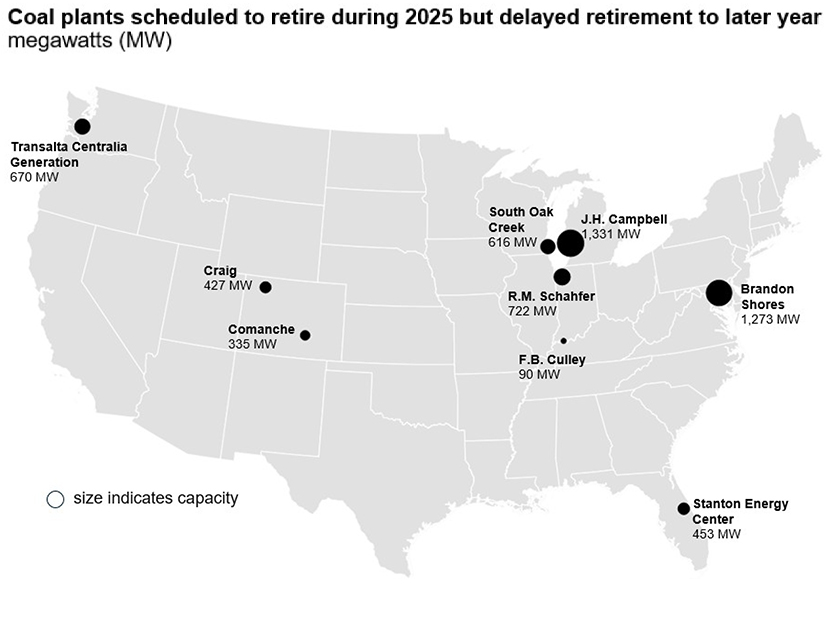
Meanwhile, some operators decided to delay retirements of 2.2 GW of capacity that had been scheduled in 2025:
Brandon Shores in Maryland;
South Oak in Wisconsin; and
Comanche in Colorado.
The U.S. Energy Information Administration maps coal-fired power plant retirements deferred in 2025. | EIA
The EIA reports the energy industry plans to retire 6.4 GW of coal generation in 2026, or nearly 4% of the U.S. fleet, but notes that regulatory actions and economic factors could cause those plans to change. (See Coal’s Decline Slows Amid Demand Growth in 2026, Trump’s Support.)
Coal has been on a sharp, sustained decline in the 2000s in the U.S. power sector because of the advent of cheaper natural gas and imposition of stricter environmental regulations. Statistics previously produced by the EIA quantify the slide:
U.S. coal productionhas dropped from 1.17 billion short tons in 2008 to 513 million in 2024.
From 2015 through 2024, U.S. coal-fired generationdropped from 1,352 TWh to 652 TWh/year, with every year but one lower than the year before. (The total jumped to 737 TWh in 2025 amid higher gas prices.)
The number of U.S. coal-fired plants dropped from 491 in 2014 to 219 in 2024.
From 2015 through 2024, the time-adjusted capacity of the U.S. coal fleet dropped from 286 GW to 176 GW, and its capacity factor fell from 54.3% to 42.6%. (The fleet capacity factor also saw a rebound in 2025, jumping to 48.7%.)
IESO has refined how it will work with the Ontario Energy Board (OEB) on the construction of a third transmission line into Toronto and broadened rules for prospective bidders to demonstrate their experience.
ISO officials disclosed the changes in an engagement session April 9, saying they were developed in response to stakeholder feedback on the estimated $1.5 billion HVDC line under Lake Ontario, the first transmission project IESO will award under competition.
Officials say the 65-km, 900-MW Toronto Third Line (TTL) is needed to meet a potential doubling of Toronto’s electricity demand by 2050.
Andrew Lee, an adviser for IESO’s resource acquisition, transmission development and procurement unit, announced version two of the Transmitter Selection Framework registry rules, published March 18. The revised rules are intended to provide “greater flexibility and additional clarity for prospective applicants,” while ensuring those seeking to participate “have demonstrated a baseline level of experience and competency,” Lee said.
The registry window will be open until about 60 days prior to anticipated launch of the procurement, currently set for Q1 2027.
The new rules will allow an applicant to cite more than one designated affiliate to demonstrate its organizational experience.
“That change was made in response to feedback and reflection on how corporate groups are often structured in practice,” Lee said. “In some cases, relevant experience may sit across multiple affiliate entities rather than neatly within a single one. Allowing reliance on more than one designated affiliate introduces flexibility and better reflects those realities.”
Limited HVDC Experience
Stephen Lachan, a supervisor for resource acquisition, transmission development and procurement, said the ISO will be flexible in evaluating the experience of prospective bidders, noting there are “only a handful of [HVDC] projects in North America.”
“The types of qualifying projects that we could consider include … an underwater HVDC transmission, underwater transmission in general [including AC lines], underwater linear infrastructure [such as] telephone cables or pipelines, or overland HVDC cables,” he said.
“The ISO is still considering the balance between stringent qualifying project requirements and increased market participation, and this is where we’re seeking feedback from you all today,” he added.
Pattern Energy’s Frank Davis questioned whether the ISO’s requirement that bidders demonstrate their capacity by having at least two “directors/officers with [qualifying project] experience” will be “definitive.”
“I believe in prior procurements … there was a bit of a wider net cast, like language like ‘managerial authority,’ as opposed to specific roles,” Davis said.
Past procurements required that the director/officer can bind the proponent organization, Lachan said.
“Much what we’re putting out today is … our initial proposal,” he said. “So, we do welcome feedback, and if there [are] distinctions that you think we should take into consideration as it relates to how we characterize a director officer within a proponent entity, I think we’re happy to take that on.”
IESO, OEB Roles
Nicole Kosonen, supervisor of resource acquisition, transmission development and procurement, said the ISO has dropped its initial model, in which the winning bidder would have received a contract covering all costs of financing, designing, building, operating and maintaining the line for the first 10 years of commercial operation. In year 11, the contract would have transitioned to traditional rate regulation under the OEB, which would approve annual revenue requirements for continued operation. (See IESO Removes Credit Requirement for Transmission Registry.)
Instead, Kosonen said IESO will select the bidder and approve its capital cost requirements, then turn the rate regulation over to the OEB when the design and build phase is complete. OEB will oversee the operational phase and approve costs related to operation, maintenance and sustaining capital.
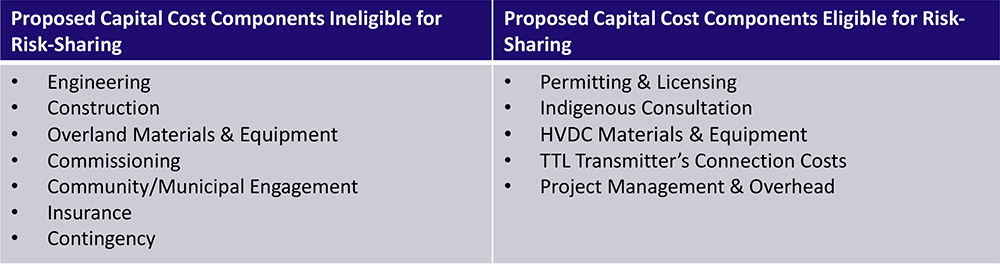
Capital cost components excluded from and eligible for risk sharing. | IESO
“The benefit of this approach is that it enables the ISO to have oversight over the entirety of the capital costs, reducing the risk of shifting costs between the [ISO] contract and the OEB. The boundaries of the ISO contract and the OEB oversight are relatively straightforward, which will minimize implementation challenges,” Kosonen said.
“The actual determination of rates and payments to the transmitter will be determined by the OEB through their rate setting,” she added. “No contractual payments will be made from the ISO to the transmitter, and the transmitter will not start receiving payments until the line is in operation.”
Ceiling Price vs. Target Price
To control costs, IESO is considering allowing bidders to propose a ceiling price, with any costs above the ceiling borne by the transmission company. It is also considering allowing developers to propose a target price for certain capital cost components, such as permitting and licensing, HVDC materials and equipment and connection costs. “If the transmitter is able to perform the scope of the activity governed by that target price for less than the contracted amount, then the difference is shared” between the developer and ratepayers, Kosonen explained.
‘Bankability’ Question
Adam Butterfield, Mott MacDonald’s practice leader for energy infrastructure in Canada, questioned whether the TTL project would be “bankable.”
“The linear infrastructure procurement world has kind of moved away from all-in fixed price [contracts] and is kind of looking more toward alliance or progressive design builds, where bidders put in their costs for the known amounts … and then once the development phase is completed and costs are a little bit more known, then there’s a negotiation on the actual construction cost.”
“I just worry that at the early stage you’re going to market with this, that bids are going to be based off wildly different assumptions,” he continued. “For example, no one knows what the subsurface conditions are along the route. So, you don’t even know how long your cable is going to be. We don’t even know where it’s going to tie in to the converter stations on either end. So, unless you provide a strawman for bidders to bid on, it’s going to be garbage in, garbage out. Everyone will put in a total bid price, but they’ll be vastly different, because [there] are just too many unknowns at this stage.”
Lachan said although the ISO is proposing to have all the capital costs subject to the IESO contract “that does not mean that we are suggesting that all of the capital costs … would be fixed. We are seeking to get a better understanding of which of the cost categories for this type of project need to have some sort of reasonable change provisions.”
Leave to Construct, ‘Engagement Fatigue’
Lachan said the ISO is considering whether the OEB’s “leave to construct” process — in which the regulator determines whether a project is in the public interest — is appropriate for the TTL project, “understanding that the ISO will be doing a competitive procurement where … a lot of the aspects of the regulatory review associated with the LTC will be captured.”
Denise Zhong, senior manager of transmission development and procurement, said the ISO has developed a digital guide to help municipal officials in the path of the TTL learn the basics of transmission and procurement concepts.
“I want to acknowledge … that ‘engagement fatigue’ is real,” she said. “Many communities and stakeholders are being asked to participate on multiple initiatives at the same time, often on complex technical topics. On top of that, the electricity sector itself can be difficult to navigate at times, particularly for those that are newer to transmission or competitive procurement processes. The intent is to support meaningful participation … without requiring people to become subject matter experts overnight.”
Next Steps
The IESO asked for the next round of written feedback by April 23 at engagement@ieso.ca. It said it will hold the next engagement session in May or June on refined procurement and contract concepts and documents.