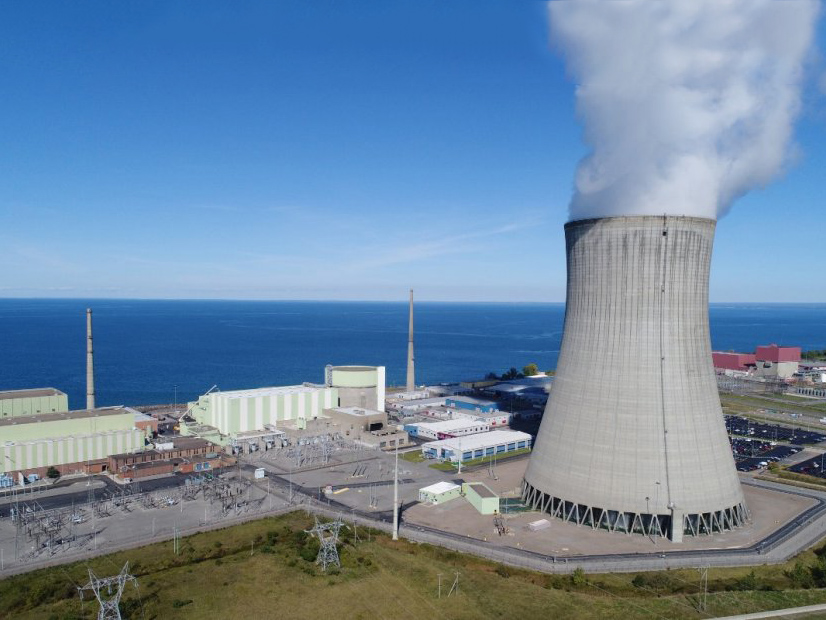
Each of President Donald Trump’s nominees to the Tennessee Valley Authority’s board of directors said they did not support the privatization of the utility or selling its assets, as feared by some environmentalists.
Speaking at their confirmation hearing before the Senate Environment and Public Works Committee on Oct. 22, Mitch Graves, Jeff Hagood and Randy Jones each simply said “no” when asked by Sen. Ed Markey (D-Mass.) whether they supported TVA’s privatization. Florida Public Service Commissioner Arthur Graham said, “I think there’s absolutely no reason to do anything different here.”
When asked by Markey to agree not to “sell off any portion of TVA’s service region” or infrastructure assets, the nominees mostly answered to the senator’s liking.
“I do not see any reason to sell any of TVA’s assets off,” Jones said, which Graham echoed after Markey said: “that was the correct answer.”
Graves said, “I don’t think that’s the board’s decision,” to which Hagood agreed.
The nonprofit group Appalachian Voices had urged senators to question the nominees on privatization based on comments Trump made during his first administration. The TVA board has lacked a quorum for months after the president fired three of its members. (See Nonprofits Warn of Potential TVA Privatization Ahead of Board Hearings.)
The committee will vote on advancing the nominees to the Senate floor Oct. 29.
All four spoke about TVA’s importance in keeping electricity affordable for its customers. Graves, a member of the Memphis Light, Gas & Water board, and Hagood, a Knoxville-based attorney, each emphasized preserving it as a local institution.
When questioned about meeting load growth, each emphasized the importance of nuclear power, with Hagood calling it TVA’s “best hope.”
“We need a sense of urgency” on nuclear, agreed Jones, an insurance executive who also serves on the Guntersville Electric Board in Alabama.
Graham said small modular reactors are “key” to meeting increased demand. But first he wanted “to make sure the numbers people are talking about [in terms of gigawatts] are legitimate. I mean, is this a pipe dream, or is this actually going to come true? I believe it is,” but the board needs to verify the anticipated demand through its integrated resource plan, he said. “I saw what happened in Georgia with Vogtle … and no one wants to be the next one going down that path.”
Sen. Mark Kelly (D-Ariz.) suggested power purchase agreements for large loads to protect customers from rate hikes created by the increased demand. Graves said he “100% agreed” with Kelly “that it cannot be on the backs of ratepayers.”
Each also agreed they would consider creating a separate rate class for large load facilities like data centers.
“This is all we’re about now, is data centers,” Jones said in agreement. “But what’s it going to cost to supply the power for them? And what if they leave five years from now and we’re left holding the bag?”
Stakeholders spent much of the Electric System Planning Working Group’s meeting Oct. 20 debating the validity of NYISO’s recent finding of a reliability need in New York City by summer 2026.
In its third-quarter Short Term Assessment of Reliability (STAR), the ISO said there would be a shortfall in the city if several ongoing projects — including the Champlain Hudson Power Express (CHPE), Empire Wind and the Propel NY Transmission Project — fail to be energized by their anticipated in-service dates. The projects would provide the power that would be unavailable from the planned retirements of the Gowanus and Narrows generators. (See NYISO Again Identifies Reliability Need for NYC.)
“Until these plans are completed and demonstrate their power capabilities, the identified reliability needs in New York City would continue to remain,” said Keith Burrell, a transmission planning adviser for NYISO.
Stakeholders tried to get the ISO to clearly articulate how likely it might be that that CHPE would be in service by the second quarter of 2026, potentially solving the nearest-term reliability need for New York City.
“I guess I’m trying to understand whether CHPE needs to be proposed as a solution or is it a solution that is going to be looked at in each STAR?” asked Tony Abate, representing the New York Power Authority.
Another NYISO staff member repeated Burrell, saying that once CHPE has demonstrated its ability to provide power, that would be a solution.
“I’m struggling to understand what has changed in the last 90 days,” said Howard Fromer, director of regulatory affairs for Bayonne Energy Center, referring to the most recent STAR. “It can’t be the load. Has it materially changed from what you were using in the Q2 STAR?”
“We’ve been identifying needs in the STARs all along and continue to identify CHPE as a potential solution,” Burrell said. He pointed to a figure in the most recent report that illustrated the city’s transmission security margin. According to those forecasts, if CHPE entered service as planned, there would not be a deficiency until 2029.
After some discussion about what future STAR reports might look like if CHPE came online as expected, the ISO clarified that each STAR was a snapshot of system conditions in time. If a project, or deactivation, meets the base inclusion criteria, it gets into the latest STAR.
“I think what people are trying to identify is, ‘What is the next step?’” said Yachi Lin, director of system planning for NYISO. “And the next step is that NYISO will be soliciting [solutions] starting in early November. In that solicitation we will have more details about the solicitation type.”
Lin said that a market-based solution that could potentially come online earlier to serve the need found in the STAR would be “something for the NYISO to consider.”
“But we don’t know yet what the kind of proposed solution or answer to the solicitation is. It’s difficult for us to forecast what the outcome is going to be,” Lin said.
Presenters at NYISO’s 2025 Fall Economic Conference painted a confusing portrait: Conflicting evidence between a weak labor market and overall economic growth leaves uncertainty about whether the economy might tip into a recession.
“I could have just presented a ‘shrug’ emoji and just left for the next few hours. But I feel like that probably would not have been that enlightening,” said Adam Kamins, senior director of Moody’s Analytics. “Instead, we’ll try to walk through all the different sources of uncertainty.”
NYISO engages Moody’s Analytics to present on state and federal economic trends twice a year as part of the Load Forecasting Task Force. Economic outlook is a major component of load growth.
In the Oct. 23 presentation, Kamins showed an index of employment gains across 260 industries from the Bureau of Labor Statistics. Over the previous six months, the balance of industries adding vs. shedding jobs tipped in favor of shedding. Monthly growth in non-farm payroll has flattened, according to the BLS.
Another point of concern in the labor market is the sharp decline in immigration due to a Biden executive order in June 2024 capping asylum requests. That was followed by President Donald Trump’s dramatic increase in immigration enforcement actions and deportations. This has led the foreign-born share of the labor force to contract.
“We are seeing hiring at very, very low levels,” said Kamins. “The way firms are hiring is consistent with the kind of thing you would see during a recession.”
Firms are “just sitting tight” on their workforces, said Kamins. Companies are waiting to see where the economy is going.
A stakeholder asked whether Kamins and other economists had considered the “integrity” of data coming out of the Trump administration. Kamins pointed at the firing of BLS head Erika McEntarfer in June when the jobs data were not to Trump’s liking. While the BLS largely was staffed by “apolitical civil servants,” Kamins explained, if the administration puts political actors in charge of the bureau, that could damage the credibility of BLS data.
“We’ve started to think about what other ways can we verify the data we’re getting from the BLS,” Kamins said. While he wasn’t as worried about the BLS as he is about the Federal Reserve, Moody’s is taking steps to confirm government figures. “We’ve done some of the work to create our own indexes of other sources out there. Bottom line, yes, it’s a concern.”
Later in the presentation, Kamins showed a timeline of the effective U.S. tariff rates and the statutory increases that have bounced around since Trump took office. He said the effective U.S. tariff rate was higher than it had been since 1920. A survey from the Federal Reserve Bank of Dallas found that more than 75% of manufacturers intended to pass on tariff costs to consumers, and 50% said they were absorbing costs internally.
“There are some that are doing both,” said Kamins. “There was a lot of action to make the impact of tariffs not necessarily that evident to consumers.”
Eventually, this would increase costs across the economy, which in turn would create inflationary pressure, Kamins explained. Tools and hardware, vehicles, bicycles, jewelry, meat, poultry and fish are places where you can find evidence of tariff-based price increases.
This increased price pressure makes it difficult for the Federal Reserve to balance its targets in the job market and inflation. Kamins added this is even more difficult because of the administration’s erosion of Fed independence.
“Any day now there’s going to be a nominee for who will be the next Fed chair,” Kamins said. “I think that will be a very telling indicator of where things are headed. Whether there’s going to be a political operative or if it’s someone who is generally respected in the economics community.”
New York’s Resilient Economy
While the nation might be experiencing an overall decline in job growth, New York’s labor market is healthier, Kamins said. The labor market is anchored by hiring in state government, health care, education and construction. New York’s consumer sentiment is higher than the U.S. average, meaning that people feel better about the economy in New York than elsewhere.
Several metro areas in New York are experiencing economic expansion, particularly Albany, Kingston and Rochester. The upstate city of Glens Falls is a trouble spot. Kamins said it was more reliant on Canadian tourism than other areas of the state and likely already is in recession.
Some of this growth is from the state’s lack of reliance on federal money. According to the state comptroller, New York historically has been one of the few states to put more money back into the federal government than it receives. As of the most recent report, New York had not fully returned to this pre-pandemic norm, but it was getting close.
“It’s a bit of a good-news, bad-news situation,” said Kamins. “The good news is that New York is not as dependent on federal government expenditures as some of its peers. … The bad news is that by no means is New York immune from potential cuts.”
Kamins said New York faced the most risk from federal funding cuts through programs like Medicaid. New York and Minnesota were the only two states that signed a provision of the Affordable Care Act, the Basic Health Program, to create a state-administered public option. If that were cut, New York would get hit harder than most other states.
New York also is heavily dependent on microchip fabrication for its upstate economic outlook. Without the impact of the new Micron chip fabrication center, upstate economic outlook looks much bleaker.
Housing prices have begun to level off statewide as more supply comes onto the market. Prices are high, and that likely will drive office-to-apartment conversions in markets like New York City. Supply-constrained areas like Rochester and Monroe County have seen supply gains more rapidly than other areas of the state.
When solar and the grid are mentioned in the same breath, acres of shining panels come to mind. But it’s time for rooftop solar to become a part of that vision, not the peripheral realm of hippies and preppers. Two milestones were reached that reinforce why the United States needs to take rooftop solar seriously and how it can be an essential part of our energy mix.
On Oct. 18, California clocked its 200th day of 2025 where wind, solar and hydro supplied 100% of the main grid’s needs for part of the day, a milestone noted in a LinkedIn post by Stanford University professor of civil and environmental engineering Mark Jacobson. That means that more than two-thirds of the days in 2025 have had times where renewable energy production was so high that its output was curtailed or, one hopes, stored in batteries for later use.
Yet as impressive as that was, it excluded the significant contribution of rooftop solar.
The Role of the Rooftop
As California hit its 200th day with 100% of demand met by renewables for a slice of the day, a different milestone was being reached Down Under.
South Australia achieved greater than 100% of its “operational demand exclusively from rooftop photovoltaics” for the 13th time since September 2023, John Noonan, a consultant who watches Australia’s electricity markets closely, responded to the post celebrating California’s milestone. His comment led me down a rabbit hole, exploring the energy system of my homeland, how it’s become the world’s leader in rooftop solar and what that means for the grid.
When you talk to many grid operators in the United States, rooftop solar is perceived like homemade goodies at a bake sale: cute, but hardly a threat to Big Cake. It’s only in states like Hawaii, Massachusetts and California where the sum of the rooftop systems is considered significant that it’s seen as an integral part of the energy system.
In California, utility-scale solar supplied about 19% of the state’s total electricity net generation in 2024, and when small-scale systems (less than 1 MW) are included, that increases to 32%. The majority of small-scale systems are residential rooftop systems.
To See the Future, Look South
To see what the grid could look like when rooftop solar is not just common but plentiful, we need to look south, as far south as South Australia, the country’s fifth-most populous state.
Of course, Australia and the U.S. are wildly different: Australia is about the same size as the contiguous lower 48 states, with a population smaller than Texas’, and South Australia is about 1.5 times the size of Texas with a population like Idaho’s. But the two countries have similar housing stock, with around two-thirds of households in single-family homes and two-thirds of those homes owner-occupied.
In Australia’s other state with more than 50% penetration, Queensland, residential and business rooftop solar broke records recently, contributing more than 5 GW (>52%) of state demand on a day that set new springtime temperature records.
Can There be Too Much Rooftop Solar?
In late 2022, South Australia had a chance to answer that question. A storm toppled a 275-kV transmission tower, severing the state from the national electricity market. Suddenly, rooftop solar provided more than enough power to the then-isolated state grid, and the grid operator remotely turned off 400 MW of rooftop solar to ensure grid stability. Why? According to the Institute for Energy Research, “if rooftop solar can meet all or most of local demand, there is little or no firm capacity available for the system operator to use if another major incident affects the grid.”
This is where deployment of batteries, both behind-the-meter and utility-scale, comes into play. Rooftop solar is a grid asset when grid operators can use batteries to play the crucial role of firm capacity. Referring to blackouts in Spain and Portugal earlier in 2025, RMI said: “If U.S. grid planners wish to learn from the Iberian Peninsula’s story, there is one resource that has proven it can compete to provide grid stability and affordability at the same time: batteries.
“Batteries can support all three main components of grid reliability: resource adequacy — the long-term ability to meet demand on peak; stability (also known as operational reliability) — critical short-term services like frequency and voltage regulation that stabilize the grid; and resilience — the ability of the grid to quickly recover from or support critical systems during an outage.”
On Track to 100% Renewables
In Australia, rooftop solar is not simply a nice bonus that supplements utility-scale electric generation during peak demand; it is an essential slice of the power supply as the country moves to 100% renewables. And, not surprisingly, utility-scale electric generation no longer is dependent on fossil fuels, though they are far from fully phased out.
Utility-scale solar and wind have been significant in Australia for some time, and the country is ramping up deployment of utility-scale energy storage to enable it. In August, renewables provided more than 47% of all grid power for a time, setting a record.
There still are some highly polluting fossil fuel power plants on the grid. For example, brown coal — a wetter, and therefore less efficient, type of coal also called lignite — still powers half of my home state of Victoria’s grid, with the country’s largest brown coal mine supplying two power plants that feed 3.4 GW of base load into the grid.
A transformation of the scale of Australia’s is hard to imagine without the strength of its rooftop solar market.
In any country with a strong rooftop solar market, its growth didn’t happen in a vacuum: policies such as feed-in tariffs, net metering and tax credits supported the industry. That’s why not-particularly-sunny Germany took the early lead in the global market. In Australia, where sunshine is plentiful, generous feed-in-tariffs encouraged many homeowners to adopt rooftop solar, though a widespread desire to stick it to the utilities tipped the scale.
Today, 38.7% of the 10.9 million Australian homes have solar, and 5% of those also have batteries. Compare that to the U.S., where just 7% of homes have solar, a number not likely to double until 2030, and even that’s in question given recent political headwinds.
Globally, rooftop solar will continue to grow. The DNV Energy Transition Outlook 2025 said plunging costs of solar and battery hardware mean that behind-the-meter solutions “will represent 30% of all solar and 13% of all power generated by 2060.”
Even in markets with high solar penetration, growth will continue as batteries are added to solar systems, both new systems and those undergoing retrofit. Those batteries provide the critical energy storage that enables solar generated at the height of the day to be consumed during early evening peak consumption.
Toward Baseload Rooftop PV
Energy storage is essential if rooftop solar’s large share of generation is to be considered as baseload power, Noonan said: “The frequency of these 100% operational demand reports from South Australia is going to become routine as South Australia begins to define the concept of ‘baseload rooftop PV’ when paired with large behind-the-meter industrial-scale, commercial-scale, residential-scale and battery electric vehicle-scale grid-forming (GFM) synthetic inertia (SI) battery energy storage systems.”
Energy storage is important to the economics of the rooftop solar industry. The DNV outlook said installing stand-alone solar has become less profitable in regions with higher rooftop solar penetration and time-of-use tariffs, such as Australia, Germany and Spain. “Focus is shifting instead to solar+storage systems, where prosumers store excess energy and use it during peak-price periods to maximize savings. This is also supported by growing adoption of dynamic feed-in rates, declining lithium-ion battery costs, and evolving grid tariffs, taxes and levies.”
Comparing the total renewables production on the main grid to total grid demand shows periods of the day where renewables production exceeds grid demand. Production of electricity from baseload fossil fuel and nuclear continues throughout the day, and excess production is either charging utility-scale batteries or curtailed when renewables production peaks.
The same trend is being seen in the U.S. In California, for example, batteries are paired with more than half of new residential solar systems.
Solar’s Momentum Needs Steady Policy, Low Prices
In the U.S., state rooftop solar markets start and stop like an old car needing a tune-up. Residential solar in the U.S. has a reputational problem — arguably because of the industry’s sales and financing methods — with 40% of homeowners believing it is hard to find a trustworthy installer. And with multiyear payback periods and the lingering stain from some sales practices, selling solar is a struggle in many markets.
In 2025, the U.S. rooftop solar market’s struggles have grown: state-level battles over feed-in-tariffs and net energy metering policies are a constant challenge, and now federal tax credits face early termination at the end of the year.
Rising concern about the reliability of the grid in the U.S. is countering these headwinds. Grid reliability — a problem perceived by more than half of homeowners — is becoming one of residential solar’s strongest selling points. Before the recent federal policy changes disrupted the economics, 76% of homeowners saw solar as a good investment, according to an Aurora Solar survey: surprisingly high given how few of them have actually invested in a home solar system.
Yet the biggest issue slowing rooftop solar in the U.S. is price: the industry sees no end to the burdensome soft costs — especially permitting hurdles that vary by town — that drive prices up to three or more times those of comparable systems in Australia. The resulting high installed-system prices make payback periods two to three times longer than in Australia, and the loss of the federal tax credits will tack on another year.
While we struggle to restart the market after each policy bump in the U.S., in Australia, its momentum is unstoppable. Why? Because it’s so damn cheap.
Australia’s rooftop solar is dramatically cheaper than in the U.S., so much so that Saul Griffith, MacArthur Genius and author of Electrify, said Australian rooftop solar is “the cheapest retail energy ever provided to a consumer in human history. It is extraordinary.”
Beyond Federal Policy: What We Can Do in the Meantime
For as long as I’ve followed the U.S. residential solar market, there has been talk of cutting the soft costs so American rooftop solar is competitively priced by global standards. Industry and government efforts have failed so far.
I’ve heard solar installers rail against my neighboring city, where permits cost thousands of dollars, take weeks and require five copies of paperwork, much of which is gratuitous. Two cities over, the same system gets a permit in 15 minutes at a reasonable cost, with simple electrical line drawings.
The Department of Energy’s admirable SolarAPP+ program was supposed to do what the industry failed to do: streamline permitting across the thousands of local permitting jurisdictions so that adding solar to a home has no more red tape than, say, electrifying appliances or adding home EV charging.
If America’s distributed energy system is to flourish, the states need to get together and do what the federal government no longer cares about. It’s a strategy that blue-state governors are using to address health care costs. They could easily do the same for rooftop solar by rolling out the existing SolarAPP+ program across every town and city in their states. Similarly, if PUCs pushed for rapid interconnection of home solar systems, going solar would be less frustrating for installers and homeowners.
If permitting and interconnection become cheap, fast and easy, the cost of residential solar should fall enough to offset some of the loss of the federal tax credits, and perhaps even the tariffs on imported system components. And if all of that leads to simpler sales and fewer buyers bailing mid-process, costs will become even more competitive.
Rooftop solar — and the grid that benefits from it — deserves the same coordinated approach many states are giving health care. Doing so will protect thousands of jobs, offer American homeowners a way to get reliable and affordable energy, and improve grid reliability.
Power Play Columnist Dej Knuckey is a climate and energy writer with decades of industry experience.
IESO is considering ways to grow Ontario’s economy and secure its energy supply without relying on trade with its U.S. neighbors, just as President Donald Trump launched another salvo in his ongoing trade war on Canada.
Trump on Oct. 23 posted on Truth Social that he was ending all trade negotiations with Canada after learning that an advertisement sponsored by Ontario would be broadcast during Game 1 of the World Series the next day. The somber ad included images of Americans working while excerpts from a 1987 radio address by President Ronald Reagan criticizing tariffs are heard.
In a subsequent post Oct. 25 calling the ad “fraudulent” and a “hostile act,” Trump announced he will increase the tariffs on Canada by an additional 10%.
Trump’s posts came just after Prime Minister Mark Carney announced a goal for Canada to double its non-U.S. exports in the next decade, pointing to the president’s ongoing tariffs. “We have to take care of ourselves because we can’t rely on one foreign partner,” Carney said.
The moves are just the latest in the nine months of “chaos” since the trade war began, as Lauren Tedesco, COO of the Automotive Parts Manufacturers’ Association, described them during a meeting of the IESO Strategic Advisory Committee on Oct. 16.
Providing a customer perspective to a panel discussion on the role of electricity in economic growth, Tedesco spoke about “the amount of stability that we need across Ontario right now given what’s happening right now in the south with our biggest trading partner.”
“We have about $45 [billion] or $46 billion that have been invested in the last couple of years across the federal and provincial governments looking at what the future is for electric vehicles here in Canada,” Tedesco said. “We have a lot of advanced manufacturing that takes place” in Ontario that consumes a “huge” amount of energy. “This will grow even further.” That depends on “stability here at home … because of the nature of what’s happening in the world, not just with our partners in the south. …
“Of course, looking at the instability that’s happening across the U.S. right now, it’s only been nine months, and we’ve seen a lot of chaos,” she said. “I think the biggest role of the ISO is that, people do not understand how important the stability and reliability of energy is in the province because they are so used to it. … People often take things for granted. So I think part of that economic growth is also the awareness of the role of the ISO.”
“One of the key strategic issues for the IESO is to broaden its lens to incorporate both economic growth and innovation,” moderator Monica Gattinger, a professor of political studies at the University of Ottawa and chair of the college’s Positive Energy program, said in introducing the panel. “This is new for the organization.” Economic growth “can be quite lumpy in its dynamics and, in the current moment, can also be very uncertain. …
“The IESO plays a pivotal role in terms of economic growth and innovation by fostering integration and alignment across a number of key areas of the energy system,” including between transmission and distribution, and the gas and electricity sectors, Gattinger said.
Much of the discussion focused on how to attract foreign investment to the province — without relying on the U.S.
“The reality is, our ability to grow Ontario’s economy is going to found itself in our ability to make sure we can attract investment into the province,” said Heidi Bredenholler-Prasad, vice president of commercial, strategy and business development at Enbridge Gas. “And it really does depend on ensuring that we do have a stable, future-looking energy system.”
Bredenholler-Prasad emphasized “removing red tape and reducing friction for businesses to want to do business in Ontario.”
“The reality is there’s a misalignment right now with respect to the regulatory environment as well as government policy,” she said. “And those two really need to sync up at the pace with which customers need to move.”
IESO can help by providing “well-informed scenario modeling” and set an “example of what good coordinated and integrated planning might look like,” she said. It also can have a role in “advancing coordination between gas distributors, municipalities, as well as the” Ontario Energy Board. “This coordinated planning needs to be streamlined.”
Tedesco urged IESO, and the province, to focus on the benefits they can provide.
“I travel back and forth to D.C. a fair bit, and when we are having these meetings at places like the Department of Commerce … we can stand there with all of our facts and our data to say, ‘This is why Canada is important; this is why automotive is important; this is why you should pay attention and your tariffs are not helpful to us’ — that does not resonate,” Tedesco said. “Could I be so bold as to say they don’t care? They have so many things happening internally, and there’s so much upheaval that is taking place, and their goal is to protect the U.S. …
“When we’re looking to attract investment, it has to be with the eye of not, ‘here’s what Ontario has to offer,’ but with ‘here’s how we can help you.’”
She also praised the country’s new Major Projects Office as important to increasing province-to-province coordination. (See “Major Projects Office,” Ontario Environmentalists Slam New Nuclear Units.)
WASHINGTON — Two FERC veterans shared their worries over the commission’s future as an independent agency as it awaits a crucial Supreme Court ruling.
In a panel discussion at S&P Global’s Nodal Trader conference Oct. 24, former FERC Chair Richard Glick and former FERC economist Devin Hartman cited expectations that the Supreme Court will overturn an FDR-era precedent — allowing President Donald Trump to fire commissioners of independent agencies such as FERC without cause. (See Will the Supreme Court End FERC’s Independence?)
“That has a whole series of ramifications that are not, in my opinion, positive,” said Glick, a Democrat, who was denied reappointment in 2022 after crossing former Sen. Joe Manchin (D-W.Va.) on natural gas policy. (See Glick Bids Farewell to FERC.) “I mean, the reason that we have agencies like FERC is because they perform quasi-judicial functions. … It’s not going to be a positive result when the president tells whatever commissioner, ‘You’re going to vote this way on this particular rate case, or you’re not going to be here any longer.’”
Hartman, director of energy and environmental policy at the center-right R Street Institute, questioned how FERC would operate if it were subjected to Office of Information and Regulatory Affairs (OIRA) review at the Office of Management and Budget.
“So how does this work now? Do the five commissioners sit there and negotiate something and then check in with the White House? Does the chair check in with the White House?” asked Hartman, who worked at FERC between 2012 and 2016.
“OMB isn’t staffed to understand what independent agencies do. We’ve talked with OIRA before. They don’t even know … what taxonomy to apply to cost-of-service regulation. Is this a regulatory action or deregulatory action compliant with the president’s agenda? We don’t even know what box to check on this. That’s literally where we’re at right now.”
The two FERC veterans, and fellow panelist Erin Eckenrod, vice president of environmental products for AES, also discussed permitting reform, Trump’s war on offshore wind and difficulties expanding grid-enhancing technologies.
‘Permitting Permanence’
Hartman said Trump has introduced a new type of risk into the electric industry by rescinding the Bureau of Ocean Energy Management’s approval of offshore wind projects: the loss of “permit permanence.”
“There is so much more artificial risk of executive actions [now]. … This is a huge problem. … When [the Trump administration does] this, it legitimizes and sets precedent for future administrations to do the same thing for resources they don’t like. You have some of the more liberal members of the Senate [thinking], ‘What goes around comes around here.’ And notably, look at how the oil and gas industry — who ostensibly this administration wants to help — responded to some of the punitive actions on renewables. One of the leading LNG developers — I won’t say who — told me right after the offshore wind decision: ‘We have to make decisions over the next seven to eight presidential cycles. We cannot have this much artificial risk.’”
“The risk premiums are going up for a variety of infrastructure projects,” Hartman added. “At the very least, I think that could creep into some of the congressional conversations [on permitting legislation: the concept of] permitting permanence.”
Eckenrod agreed. “The risk premium that is now being built in, I will argue, it’s offsetting any benefits you’re getting from reduced interest rates. It’s counterproductive.”
‘New Environment’ for Permitting Legislation?
Eckenrod questioned whether the Trump administration might seek to undo the Clean Air Act (CAA) if it threatens the siting of natural gas-fired generators.
Hartman said the CAA could be at risk because the courts’ willingness to let Trump stretch the limits of executive authority has changed the outlook for potential congressional action on permitting legislation. (See Bipartisan Transmission Permitting Reform Bill Introduced in House.)
“The White House is feeling very optimistic, frankly, about where they can go with just executive authority alone in this new … environment,” he said. “If you’re going to see a permitting package pass, the Republicans are going to want to see deeper permitting reform than what they sought last year, because they think that the status quo has shifted favorably. So, things like, yes, the Clean Air Act might be on the table now. Should ambient air quality standards have a cost-benefit test? … I think there’s going to be this … new political equilibrium.”
Expanding Use of Grid-enhancing Technologies
Glick said utilities have not embraced grid-enhancing technologies (GETs) because the utilities’ incentives are “backwards,” encouraging them to invest in expensive transmission projects rather than smaller investments that could produce savings for ratepayers.
“When I was at FERC, we looked at … the shared savings approach — we send some of the savings to consumers, send some of the savings to utilities — but it wasn’t nearly enough to really get utilities to change their mindset,” he said.
“It seems to me a good idea — maybe the only idea that can actually work at … the federal level — to get utilities to engage sufficiently in GETs,” Glick said.
“The only real policy progress that’s been very concrete on this topic was Order 881,” which requires transmission providers to use ambient-adjusted ratings, said Hartman. “That was sort of the lowest-hanging fruit, because … it’s a uniform best practice. You don’t need to do a cost-benefit breakdown in every little circumstance. It’s just good utility practice.
“It’s trickier, though, once you start getting into these other GETs, because they’re not uniform best practices; they’re very situation-specific, so you have to start attaching … bits of conditionality to this, and that’s very difficult.”
Hartman suggested FERC and the Department of Energy hold annual technical conferences to establish a record on the commercial viability of emerging GETs.
“I think you can then enable the ability for also some more bottom-up motivation, say an RTO framework where the PUCs and the consumer groups are really motivated,” he said. “Then you start to have the laggards feeling the heat a little bit. … And then if people want to file complaints later, or FERC wants to do an investigation … knock yourself out. But I think we’re only going to be able to squeeze so much juice out of rulemakings.”
The U.S. Department of Energy approved PJM’s request to extend an order allowing Talen Energy to continue operating its oil-fired H.A. Wagner Unit 4 to exceed the 438 hours it is permitted to operate each year.
The Oct. 24 order allows the 397-MW generator, located outside Baltimore, to continue operating for 80 days to mitigate the risk of load shed during “certain system conditions or transmission limitations” within the Baltimore Gas and Electric (BG&E) region. The order lifts the run hour limit when PJM declares or anticipates a maximum generation alert or transmission security emergency. (See DOE Lifts Run Hour Restrictions on Maryland Generator.)
“PJM anticipated that, for the remainder of 2025, there will be a continued need to schedule Wagner Unit 4 in order to maintain reliable system operations during projected peak demand and/or increased flows on transmission facilities that are required to serve the BG&E Zone,” the order states. “Additional circumstances that could cause the need for increased scheduling of Wagner Unit 4 include high system demand, additional transmission facility outages, and generation outages or a combination of these factors.”
In its application asking DOE to exercise its Federal Power Act (FPA) 202c authority, PJM said the EPA and Maryland Department of the Environment (MDE) informed it that the consent order imposing the run hour limitation would not be able to be modified within 2025 and it has taken steps to avoid dispatching the unit as much as possible.
PJM to Seek Extension of Order Defining Wagner, Brandon Shores as Capacity
PJM Senior Counsel Chen Lu outlined the RTO’s intention to ask FERC to include Wagner and the adjacent 1,289-MW Brandon Shores coal-fired generator in the capacity market supply stack for the 2028/29 Base Residual Auction (BRA), extending an order defining the two resources as capacity in the prior two auctions (ER25-682). (See FERC OKs Changes to PJM Capacity Market to Cushion Consumer Impacts.)
PJM’s governing documents allow reliability-must-run (RMR) units to be exempted from the requirement that resources offer into the capacity market.
However, against a backdrop of tightening supply/demand balance, consumer advocates argued that if the generators are being relied on for transmission security, it also should be assumed they will be available during capacity deployments. Opponents of that stance protested that including RMR units in the supply stack would distort market signals and suppress the prices needed to bring on replacement resources.
The commission’s order was limited to two delivery years to give PJM time to work toward a pro forma RMR agreement that defines resources as capacity. That effort is ongoing in the Deactivation Enhancement Senior Task Force (DESTF), where PJM has presented a draft pro formaagreement.
“It’s really a stop-gap for these two Talen units,” Lu said, adding that it doesn’t make sense to shift the two generators onto an eventual pro forma agreement since they’re already operating under a FERC-approved RMR.
ERCOT has told the Texas Public Utility Commission it has prioritized a project in 2026 to gather information from the more than 200 GW of large loads in the interconnection queue, a 227% increase in a year’s time.
Data centers account for nearly three-fourths of the queue, ERCOT said. Crypto mining, which constituted half of the queue last year, is down to 1.3%.
ERCOT staff told commissioners during their Oct. 23 open meeting that the industry’s developers and customers are stating their needs for certainty and transparency. The concern is two-way, as most everyone realizes all 200 GW will not show up.
The project will begin after real-time co-optimization is deployed in the market in December.
“That’s just going to help the [interconnection] process in moving forward and giving us clear information,” Kristi Hobbs, vice president of system planning and weatherization, told PUC commissioners.
To that end, Hobbs said the grid operator wants to re-evaluate whether large loads should have a direct relationship with ERCOT. She said staff proposed a protocol change in 2022 that would increase their relationship with the end-use customers but said it received pushback during the stakeholder process.
“We pivoted to the utilities having the relationship,” Hobbs said. “We work with the utilities and what we find is that it hampers transparency … [for] the large loads and the developers being able to understand where ERCOT is in the process.”
She said having better relationships with the end-use customers would help with their concerns.
“At the end of the day, I don’t think there’s one solution. It’s going to be a combination of all of these things,” Hobbs said, referring to updated ERCOT operating procedures as the bridge between grid improvements and changes to large loads’ systems and operations.
“In the middle, there’s us improving our operating procedures and our planning processes so that we can all meet that same goal for reliable power in the state,” she said.
First up is ensuring the large loads can meet voltage ride-through requirements.
“When you had several thousand megawatts of large loads on the system, it was not as much of a concern,” Hobbs said. “In recent years, we’ve continued to see the number of events where you see faults on the system. We’ve got to be able to protect the system from that, especially as we look ahead to hundreds of gigawatts of potential load on the system. We need to make sure we have the right requirements in place and we’re taking the proper precautions to protect their businesses as well as their neighbors.”
PUC Chair Thomas Gleeson said his foundational issue is to provide certainty to loads in the interconnection process. He provided anecdotal evidence of one large load that entered the process in the first quarter of 2024.
“As of yesterday, it still was kind of in limbo about where they were and how long the process might take,” he said. “I think it’s incumbent on us to talk through that and see if we can improve upon that to give these customers some sense of how long the process may take, understanding that there are a number of variables and unknowns.”
Hobbs responded by saying ERCOT has looked at how its neighboring grid operators’ processes. She said large loads must show a commitment before they’re included in a study.
“The study process is really just a short part. It’s the transmission build and physics doesn’t change that,” she said. “Here in Texas, we can do it in three to five years, where in other regions, it’s six to 12. I think Texas is well positioned to be able to welcome those loads in the future.”
CenterPoint Settlement Corrected
The PUC signed off on CenterPoint Energy’s settlement with Houston and other cities for nearly $1.1 billion in system restoration costs eligible for recovery and securitization after Hurricane Beryl and other storms in 2024 (58028, 58252). The commission approved the order during its Oct. 2 open meeting but held off from signing it until the requested legal consulting and non-consulting expenses could be corrected. The settlement estimated those costs at $2.2 million when they were nearly $2.9 million. Gleeson authorized the expenses to be recovered in CenterPoint’s next ratemaking proceeding.
Year-over-year prices rose in MISO to serve a typical September peak.
MISO members served an average 76.3 GW daily load over September, with a 106-GW peak occurring Sept. 16. The month’s peak demand wasn’t unusual, less than a gigawatt from the 105.5-GW peak in September 2024 and smaller than September 2023’s 114.6-GW peak. Average daily load was up slightly when compared to the approximate 75-GW average in September 2024.
Real-time prices, however, rose almost 1.5 times from September 2024, at $41/MWh versus $28/MWh. Average natural gas prices climbed from $2/MMBtu in September 2024 to $3/MMBtu September 2025. Coal stayed flat at about $2/MMBtu year over year.
MISO’s solar peak was 14.5 GW while wind registered a 20.7 GW peak. Both occurred in early September.
Over the month, MISO experienced 47 GW in average daily generation outages, 9 GW higher than last September.
MISO declared a capacity advisory for the entire footprint Sept. 29 because of forced generation outages and limited transfer availability. It also called conservative operations on Sept. 28 due to unseasonably warm temperatures, generation outages and lower-than-normal renewable energy forecasts.
ALBANY, N.Y. — The Alliance for Clean Energy New York’s Fall Conference could well have had a somber atmosphere, given the way 2025 has gone for renewable energy.
But the annual ACE NY event, held Oct. 22-23, drew its largest audience ever, the mood was not somber, and state policymakers and industry leaders offered messages of full support even as they acknowledged the federal roadblocks thrown in their path.
“New York remains a steadfast leader in our work focused on advancing clean energy and environmental protection,” Department of Environmental Conservation Commissioner Amanda Lefton said in a keynote speech. “We have and will continue to achieve nation-leading progress, which is even more important than ever during these unprecedented times.”
Federal interference is the latest setback for a state that has fallen behind on its self-imposed timeline for grid decarbonization. If New York cannot add enough new renewables, it will need to keep some of the oldest fossil-burning plants in the country online longer or even consider new fossil generation, a prospect that is anathema to many state policymakers.
So the effort now is to get renewable projects off the drawing board and into motion in time to qualify for federal 45Y and 48E investment and production tax credits before the window closes next year.
In September, the New York State Energy Research and Development Authority launched a rush solicitation for late-stage large-scale solar and wind projects that could make the deadline. (See Latest N.Y. Renewables Solicitation a Race Against Time.) NYSERDA President Doreen Harris told the conference that industry rose to the occasion.
“The response was just what we needed and just what we wanted. These are projects that are ready to go, that are ready to compete, and ultimately ready to build,” she said Oct. 23, just two days after the first-stage application deadline for the solicitation.
New York and the renewables industry both need these projects to go forward, Harris said, and Gov. Kathy Hochul has committed to an all-of-government push to get as many new megawatts of capacity into the pipeline as possible. “I’d like to assure you that the shifting federal priorities are not impacting the level of ambition that we have as a state,” she said.
Harris said New York has 100 clean energy projects rated at a combined 10 GW in operation or under development; a dozen large-scale projects are under construction in the state or off its coast.
“That’s a huge pipeline. As someone who’s worked in this industry for decades now, that only happens if we have the durability of commitment, purpose and, ultimately, the ability to get through those challenges together,” she said.
Moving Forward
The first panel discussion was populated by the top ranks of power regulation and delivery in New York.
NYISO President Richard Dewey explained the central problem for New York’s grid in detail, and he also framed it succinctly: New clean-energy generation is not keeping pace with retirements and anticipated load growth, and the ISO is having to make some decisions that are unpopular with clean energy advocates.
“We’re getting pretty dangerously close to the margins,” he said. “It’s bad news if a generating station that is polluting the environment needs to stay online. It’s worse news if the lights go out, and that’s really what we’re trying to balance.”
Georges Sassine, NYSERDA’s senior vice president for large-scale renewables, spoke of the scramble unfolding as policymakers try to secure as many clean megawatts as possible before prices jump: “The state of New York has a big role to play in driving industry forward, but we are also, all of us collectively, reacting to this big tectonic shift on the federal front.”
The New York Power Authority is part of the scramble. Its latest mandate — develop at least 1 GW of new advanced nuclear capacity — is still well off in the future. But in the near term, NYPA is trying to maximize the tax credit eligibility of the 64 emissions-free projects in its 7-GW pipeline, Senior Vice President of Development Christopher Hutson said, and devise other funding mechanisms for those that miss out on the credits.
New York’s challenges developing clean energy existed long before President Donald Trump kicked off his campaign against solar and wind energy development in January.
New York is an expensive place to do business, and it typically has had a slow regulatory process for renewable energy development. One obvious example: There still is no official definition of “zero-emissions” power more than six years after the state’s landmark climate law mandated a zero-emissions grid by 2040.
Even attempts to speed things up tend to move at a deliberate pace.
The RAPID Act was signed into law in April 2024 to speed renewables and transmission development. Through great effort, draft regulations were produced in just six months. The draft went through an extensive in-person, virtual and electronic public comment process, then was revised. The revised regulations (24-M-0433) were posted Oct. 22 and are open for public comment though Dec. 8. There is no target date for the Public Service Commission to review the comments then revise and finalize the rules, presumably in 2026.
But all this deliberation is a critical part of the process, said Zeryai Hagos, executive director of the state Office of Renewable Energy Siting and Electric Transmission (ORES).
“We received over 2,000 comments” on the RAPID Act draft, he said, “and we got some really excellent feedback.”
The need to make the process work better is real, and it is pressing. A detail stood out for Hagos in NYISO’s latest Power Trends report: “For every megawatt that we add, we’re losing two when we look backwards over the last four or five years. We can’t keep going on that way. We need to be able to build these projects in a more streamlined manner.” (See NYISO Makes Case for Repowering in Latest ‘Power Trends’ Report.)
There will be attrition among the 110 proposals in the ORES pipeline, he said. For starters, about two-thirds have not reached a safe harbor point where they can qualify for the federal tax credits. Some do not have financing or interconnection or REC contracts secured.
But Hagos said the all-of-government approach Hochul directed means every agency will be pulling to get as many of those projects as possible as close to groundbreaking as possible.
“If you take away one thing from my message here, it’s not going to be because of ORES; it’s not going to be because of a New York state agency and our bureaucracy and inefficiencies that these projects don’t achieve their timelines. We are doing everything we can to coordinate and make sure we’re moving things as efficiently as possible.”
Jessica Waldorf, director of policy implementation at the Department of Public Service, spoke of the many and sometimes competing needs facing New York — updating an aging grid, slashing its carbon footprint, expanding its capacity, protecting its ratepayers and factoring in its stakeholders’ opinions — but also told the audience there are multiple efforts to strike the balance.
“We have a lot of challenges ahead, a lot of opportunities to be creative as a state, and that’s what we’re laser-focused on,” she said.
The Headwinds
Land-based wind and solar can continue in New York in the Trump era; it just will be even more expensive than it has been.
Offshore wind, which New York has been counting on as a significant part of its decarbonization strategy, is a higher level of hurt: The federal government controls what happens in U.S. waters.
After two stop-work orders, the Trump administration is — at the moment — allowing work to continue on the five offshore wind farms under construction in U.S. waters but has moved to block any others from starting construction. (See Judge Lifts BOEM’s Stop-work Order on Revolution Wind.)
New York’s own Public Service Commission canceled planning for an offshore transmission network to serve the fleet of wind turbines envisioned off the New York coast, saying there was no point in incurring costs now for transmission for generation that will not be built anytime soon. (See NY Steps Back from OSW, Halts Offshore Tx Planning Process.)
There has been skepticism about whether investors who have been losing money hand over fist will be willing to lay out billions more under a future president who is friendly to offshore wind.
In a bit of exquisitely literal timing a day before the ACE NY conference, JERA Nex BP announced that it was exiting the U.S. offshore wind market and shelving Beacon Wind, the first phase of which once held a New York contract.
None of these things were featured at the conference, where speakers instead cheered the two New York projects under construction and the one already completed, and looked forward to a brighter future after Trump’s second term ends.
“The state’s commitment to offshore wind is emblematic by the fact that our own governor has stood up for these projects in a way that not only kept Empire Wind 1 alive but ultimately allows us to say that offshore wind can and will be a very significant part of our state’s future,” Harris said.
(Empire Wind 2, meanwhile, has been shelved by its developer, and the Trump administration has said it is planning to reconsider the 2024 approval for the second phase of Empire Wind 1.)
Despite all this, New York is arguably the de facto leader among the states pursuing offshore wind, with three wind farms in operation or under construction — two more than any other state.
Oceantic Network CEO Liz Burdock said $25.5 billion has been invested in the U.S. offshore wind sector, and the market fundamentals remain strong. “We will be able to build a comeback in 2028-2029 because of this.”
The details of any such comeback probably are unknowable so far in advance; Burdock offered none. Harris too spoke about the state’s goal but not the means of reaching it in the current environment. Afterward, NYSERDA offered RTO Insider essentially the same thing: policy but not strategy.
“Offshore wind remains a vital part of New York’s all-of-the-above energy policy for the long term,” a spokesperson said.
Three industry speakers framed Trump’s second term as a reset, a chance to fine-tune the approach to offshore wind development.
Kris Ohleth, executive director of the Special Initiative on Offshore Wind, revised the old analogy that executing the clean energy transition is like designing and building an airplane while flying it.
Offshore wind is the plane, and it is now grounded, she said, so let’s figure out how to get it back into the air. “This is our opportunity to have that more robust conversation and build some of the fundamentals into the system that maybe we just didn’t have time or knowledge to do previously.”
Better risk management is important to developers, said Zach Fuerst, director of business development for Vineyard Offshore. “New York has done a lot already to help developers and take a lot of feedback from developers about how to mitigate that risk through inflation-adjustment mechanisms that are factored into the contract and the PPA, and those are immensely difficult things to get perfect or to get right.”
Matthew Brotmann of Equinor Renewables America said New York state has been a good partner in the push to develop offshore wind, but in retrospect there are things that could have been done differently. “The expectations on offshore wind were extremely high,” he said. “The expectations were unrealistic, but we were all very enthusiastic, and I was totally on board with that.”
Brotmann and Ohleth said the opportunity exists to shift the narrative from the costs of offshore wind to its benefits — reliable power at a fixed cost in a time of rising demand and rising costs for electricity.
Both also spoke of narrowing the scope of what offshore wind is expected to be: a source of electrons rather than a Christmas tree with a host of ancillary benefits for the state economies and local communities. This might lower the strike price.
Brotmann called for states to collaborate rather than compete on supply chains and infrastructure: “I think it’s going to be essential moving forward because, quite honestly, developers are quite gun shy about trying to invest in large infrastructure without a guarantee of a pipeline, which, given the current administration and who knows what the next administration will be, we can’t guarantee that.”
Fuerst spoke of laying the groundwork for 2029 or 2030.
“I think the resource isn’t going away, and I think the fundamentals of this market don’t go away, and I think what we do over the next three years will be critical as to how quickly the industry is able to move toward building again and really be able to deliver on some of the ambitious targets that New York has for offshore wind and for the climate.”
Interesting Times
Trump-bashing was not on the agenda at the conference, although there were plenty of oblique references to the effects of Trump administration’s policies.
As Harris put it: “Every week is a new adventure when it comes to what the federal government will be doing with respect to clean energy.”
But neither was there an atmosphere of defeat.
As Harris also put it: “I have to say, I am extraordinarily thankful this year and every year to be working in the state of New York, a state which has demonstrated the durability of our commitment, our ability to deliver on what we promise, and ultimately an industry that will only continue to build.”
The resolute messages are to be expected: The attendees for the most part have a significant financial or professional or emotional stake in the continued growth of renewables and are not ready to give up.
After the conference, ACE NY Executive Director Marguerite Wells told RTO Insider she saw a similarly cheerful tenor six weeks earlier at the RE+ conference in Las Vegas. (See Livewire: Renewables Ready to Out-innovate, Outlast Trump.)
“I think there is a reasonable amount of optimism for the near term, call it the next three or four years, for people who have projects that they can safe harbor equipment and try to get them built in four years before the tax credits expire,” she said. “There is cautious hope that that’s a path. I think the question in everybody’s mind, which I don’t believe anyone has answered, is, what do you do with your pipeline after that?”
There are factors pulling in opposite directions. The state provides strong support for renewable energy development, and it presents high costs for development. It is also well down in state rankings for solar irradiance and onshore wind speed but has good offshore wind speed.
The state’s 9-GW-by-2035 offshore goal now appears challenging to meet, but the state remains committed to pursuing it, and Wells said that even amid all the damage the Trump administration is inflicting on the U.S. offshore wind sector, there is some cause for optimism for New York. The demand for electricity along the East Coast will only be greater in 2029, she said, and the alternatives to offshore wind — gas turbines and nuclear reactors — are slow to deploy and expensive.
The developers that have shelved offshore wind projects could resume work on them, rather than write off the large investments they have made to date, she added.
“There’s going to be demand for what they have, and for some number of the players, there will be projects to build, assuming a new administration opens things back up again,” Wells said. “There are tons of people who will have fled and licked their wounds and put their money elsewhere after that. There’s a hope that there are some who did not.”