The fate of a 6.2-GW cluster of solar energy projects in western Nevada is uncertain following the Bureau of Land Management’s decision to break the group into individual projects for review.
On its National NEPA Register, BLM changed the status of the Esmeralda 7 to “canceled” Oct. 9. The group consists of seven proposed solar projects ranging from 500 MW to 1.5 GW, each with battery storage, on federal land in Esmeralda County.
But the Department of the Interior clarified in an email that “BLM did not cancel the project.” Instead, “the proponents and BLM agreed to change their approach” to project review, the department said.
“The projects were initially submitted as a group,” Interior said. “The developers will now pursue individual applications for their respective projects. This approach ensures focused, thorough assessments of potential impacts on public lands while supporting responsible energy development.”
Interior said the new approach “aligns with the administration’s emphasis on improving permitting efficiency and reducing regulatory burdens.”
It wasn’t clear how the change in the BLM review process might impact project timelines, or whether all the proposed projects will proceed. If completed, several of the individual Esmeralda solar projects would be among the largest in the U.S.
In July 2024, BLM released a draft programmatic environmental impact statement and resource management plan amendment for Esmeralda 7. A 90-day public comment period followed. The completed work will still be useful as individual projects move forward, Interior said.
And at least one project developer plans to forge ahead.
NextEra Energy Resources is developing the Esmeralda Energy Center, described in a November 2023 project overview as 1 GW of solar with battery storage.
“We are in the early stages of development and remain committed to pursuing our project’s comprehensive environmental analysis,” a NextEra Energy spokesperson said in an email. “[We] will continue to engage constructively with the Bureau of Land Management.”
Another project is Lone Mountain Solar, 1 GW of solar and 500 MW of battery storage being developed by Leeward Renewable Energy. A timeline on Leeward’s website shows a 2027 construction start date with projected completion in 2029. A Leeward spokesperson said the company did not have any information to share regarding the impact of changes to the BLM review process.
The other projects are:
Gold Dust Solar, 1.5 GW of solar and 1 GW of storage developed by Arevia Power;
Nivloc Solar, 500 MW of solar with battery storage by Invenergy;
Smoky Valley Solar, 1 GW of solar with battery storage by ConnectGen; and
Red Ridge 1 and 2, each 600 MW of solar with battery storage by 335ES 8me.
Developers had planned to interconnect their projects through Greenlink West, NV Energy’s 350-mile, 525-kV transmission line under construction across the west side of the state.
Each solar project would include a tie line connecting to Greenlink West’s Esmeralda substation.
One goal of Greenlink West and Greenlink North, a transmission line planned across northern Nevada, is to open more of the state to renewable resource development. When completed, the two Greenlink lines along with the existing One Nevada Line will form a transmission triangle around the state.
Energy development within transmission corridors such as Greenlink West is expected to drive additional local and regional renewable energy development, BLM said in its draft environmental report.
The antipathy of the Trump administration to the offshore wind industry is well known, and so it has come as little surprise that various federal agencies have been directed to impede the progress of offshore wind developments. This comes at a bad time, just as the multibillion-dollar industry was gearing up, constructing ports and building ships, while training the workforce necessary for the remarkably challenging task of building gigawatts of wind capacity miles offshore.
An Initially Promising Resource: In the early and heady years, the U.S. industry had looked eagerly to Europe’s North Sea, where each new offshore project boasted progressively lower costs, and gigawatt-scale projects quickly emerged. That anticipation soon translated to U.S. markets, where billions of dollars were funneled into enabling infrastructure and supply chains, and the Biden administration announced an ambitious target of 30,000 MW of offshore capacity by 2030. Offshore federal leases for hundreds of thousands of acres along the East Coast were signed, followed by the first steel in the ground, for projects as large as Dominion’s $10.9 billion, 2,600-MW Coastal Virginia Offshore Wind Project.
A Radical Change in Direction: With the 2024 presidential elections, however, the winds of fortune shifted rapidly. Within months, the Trump administration announced it was taking a hard line in opposing such projects, and it became clear the future of the industry might be in peril. Most observers were surprised, however, by the intensity of the opposition.
Since taking office, the new administration’s Bureau of Ocean Energy Management (BOEM) has stopped leasing new projects, rescinding all previously designated offshore wind areas, while withdrawing nearly $680 million for ports and manufacturing, and prematurely ending the program of federal tax credits. Perhaps even more critically, the Trump administration took the additional and largely unexpected step of targeting specific projects that already were underway.
The first affected was New York’s 810-MW Empire Wind project, which was roughly 30% complete when hit by a stop-work order in April which Secretary of the Interior Doug Burgum justified in a letter to the BOEM saying the project had been “rushed through” the approval process by the previous administration “without sufficient analysis or consultation among the relevant agencies.” The project got back on track a month later, apparently following an arrangement for a quid pro quo affecting a long-delayed New York gas pipeline.
That was followed by New England’s 700-MW Revolution Wind project, which was 80% complete when it got smacked by a stop-work order. The justification in this instance was national security concerns, with Secretary Burgum at one point citing the possibility that “people with bad ulterior motives against the United States would launch a swarm drone attack through a wind farm.” That order was quickly overturned by a U.S. District Court judge, who characterized the order as being “the height of arbitrary and capricious action.”
Then last month, the BOEM also filed a lawsuit to revoke a critical permit for the 2,200-MW Maryland Offshore Wind Project, claiming it had previously underestimated the effect on search and rescue helicopters and to offshore fisheries.
For its part, the Coastal Virginia Offshore Wind endeavor continues to move forward, reaching 60% completion, with plans to start delivering power by March 2026. It thus far has managed to avoid federal backlash, with a Dominion spokesperson recently and explicitly citing the historical bipartisan support for the endeavor.
So, for at least the next several years, we will have two categories of projects: those that manage to squeak through to commissioning, and those that will never make it, despite years of planning, permitting activities and investments in ancillary infrastructure such as ports and ships. Longer-term, the industry may take decades to recover, if it ever does, with investors rightly reluctant to dip their toes into politically fraught waters.
The Costs to Our Power Grids and Investors: Already, the economic casualties are mounting. The latest, announced the second week of October, is Maersk’s cancellation of an order for a $475 million offshore wind turbine installation ship that is 99% complete and was intended to support New York’s Empire Wind effort. There will be many more such investments stranded on the hostile shores of the U.S. offshore wind debacle, totaling in the many billions of dollars, and the implications of these failures likely will spread well beyond a few wind farms. Let’s examine the ones that matter the most.
First, there are significant implications for utilities and grid planners in affected areas. Many of these offshore projects have been in the planning stages for years, and the grid operators (as well as other energy investors) have incorporated them into their energy resource and transmission planning processes.
Since these are big projects, their success or failure matters greatly, especially given the difficulty and time required for alternative projects to navigate interconnection queues. One doesn’t simply replace these canceled projects with a fleet of gas turbines overnight (one will probably have to wait many years to access a new turbine).
Pursuant to the Revolution Wind stop order, grid operator ISO-NE commented that it “is expecting this project to come online and it is included in our analyses of near-term and future grid reliability. Delaying the project will increase risks to reliability. … Beyond near-term impacts to reliability in the summer and winter peak periods, delays in the availability of new resources will adversely affect New England’s economy and industrial growth.”
The grid operator went on to say: “Unpredictable risks and threats to resources — regardless of technology — that have made significant capital investments, secured necessary permits and are close to completion will stifle future investments, increase costs to consumers, and undermine the power grid’s reliability and the region’s economy now and in the future.”
And that gets to the heart of the matter for all energy investors. Unpredictability is the greatest threat to a functioning economy, especially if that uncertainty is politically driven and perceived to be mercurial. Today’s energy darling can quickly become tomorrow’s pariah.
Offshore wind may be the target of the current administration, but at some future date, those winds may shift again. Which is why ExxonMobil CEO Darren Woods commented to The New York Times in September that “ever-changing policy, particularly as administrations change, is not good for business.”
In September, Martin Durbin, senior vice president of policy for the U.S. Chamber of Commerce, voiced similar sentiments and cautioned against yanking existing project permits, since such a practice “injects significant uncertainty into the infrastructure development process” and could increase the cost of electricity for consumers.
That sentiment was echoed more recently by the president of Shell USA, who pointed out in October that the current approach of canceling permitted projects is damaging to business, noting the risk: “However far the pendulum swings one way,” she said, “it’s likely that it’s going to swing just as far the other way.”
The Need for a More Consistent Regulatory Environment: The stroke of the regulatory pen is powerful in its ability to stimulate investments at a time when the country’s economy desperately needs more energy. But if that same pen cannot be relied upon to exhibit some level of predictability and consistency, then our energy future becomes very uncertain indeed. The infrastructure that supports our ability to generate and move those critically needed electrons relies heavily on a regulatory environment that offers some consistent level of predictability.
Investors must have faith that the hundreds of billions of dollars they place at risk in building out our future energy world will not be arbitrarily affected by a capricious regulatory approach supported by flimsy justifications. The U.S. traditionally has been a far more stable haven for investment than many parts of the world, and we have flourished as a result.
However, if we increasingly turn this effort into a risky and unpredictable political game, the global flow of capital will look for a more hospitable home, and we in the United States will all be the poorer for it.
Around the Corner columnist Peter Kelly-Detwiler of NorthBridge Energy Partners is an industry expert in the complex interaction between power markets and evolving technologies on both sides of the meter.
New Jersey is evaluating a request by two solar companies to change state rules that bar out-of-state solar electricity generators and providers from participating in the program for Class 1 renewable energy certificates (REC).
The two companies — VC Renewables of Newark, a solar developer, and an affiliate, Vitol, an energy provider — say the change would allow 23.5 GW of already-installed out-of-state renewable resources to participate in the REC program and help the state fulfill its renewable portfolio standards (RPS) obligations. They say the rule change could save ratepayers hundreds of millions of dollars.
“Permitting competition from lower-cost out-of-state solar resources could generate New Jersey consumer savings of at least $200 million to $500 million per year while maintaining New Jersey’s ambitious clean energy goals as well as the economic and employment benefits of in-state solar development,” the companies argue in their petition.
Allowing out-of-state solar into the program would “increase competition to generate Class I RECs and thereby decrease the New Jersey ratepayer costs of compliance with the state’s ambitious RPS targets,” the petition argues. It also would enable third-party suppliers and basic generation service providers to “satisfy their renewable portfolio standards obligations,” the petition said.
The New Jersey Board of Public Utilities (BPU) voted Oct. 8 not to rule on the issue for 90 days while it considers the issue. “I think there is going to be a lot of stakeholder input on this matter,” so more time to deliberate would be helpful, said BPU President Christine Guhl-Sadovy.
Consumer Price Cutting
RPS programs lay out requirements for the amount of clean energy from low- or zero-carbon emission sources; all suppliers or providers that sell energy to retail customers must in the current energy year ensure that 35% of it is clean energy, rising to 50% clean energy by 2030.
As in some other states, New Jersey offers a REC — a payment for the generation of 1 MW of clean energy — to developers or generators as an incentive to encourage investment in clean energy generation
While wind, tidal, geothermal, methane, biomass and other types of energy generated outside of New Jersey are accepted in the Class 1 REC program, solar energy must be generated in-state to participate.
The New Jersey Class 1 REC program is a separate market from the similar — but more lucrative — incentive program that supports most residential solar and other solar facilities in New Jersey, the solar renewable energy credit (SREC) program. Having gone through several iterations, the program — known now as the solar renewable energy certificate II (SRECS-II) program — is part of the successor solar incentive program.
The petition filed by VC Renewables and Vitol, which provides energy in the state basic generation services (BGS) auction, argues that preventing out-of-state solar from taking part in the Class 1 REC program has contributed to a rise in Class 1 REC price from $13 in 2019 to $31 in 2024, which is passed on to New Jersey ratepayers.
Because the state limits supply, New Jersey Class 1 RECs are more expensive on the market than those from Pennsylvania and Maryland. Opening New Jersey to competition from out-of-state generators would push down New Jersey’s REC prices, the petition argues.
“Our petition offers a simple and potentially swift solution to the consumer affordability challenges facing New Jersey residents,” said Jason Barker, vice president for regulatory affairs at VC Renewables. He said it could mean every ratepayer gets the equivalent of an annual credit of $50 to $125.
The petitioners had hoped to have the new rules in place before the state’s next BGS auction in February, enabling providers such as Vitol to submit lower bids, because they will be delivering electricity supported by Class 1 RECs, he said. However, the BPU’s 90-day delay likely means the rule change — if accepted — would not be ready in time.
The change also could stimulate solar development, he said.
“By increasing the opportunities for REC sales, it certainly is an incentive and a motivator for project development throughout the PJM footprint,” he said. “And that helps investors to develop and finance their projects.”
“The RECs are a component of the income stream for a renewable project of any stripe,” he said. “So when a renewable energy developer is developing a project, they’re thinking about all of the potential income streams, whether it’s energy capacity or the clean energy attribute.”
The rule change, he said, is “simply expanding the market for the clean energy attribute for solar across the PJM footprint.”
Market Disruption
The debate comes as New Jersey, like other states, is searching for ways to create new generating capacity in preparation for an expected dramatic increase in demand, mainly driven by the need of data centers and artificial intelligence projects, and to curb the rise in utility rates. The average New Jersey residential electricity bill increased by 20% in June, a hike some industry analysts and state officials say was driven largely by the expected future supply shortage.
Abraham Silverman, a former BPU general counsel who now is a research scholar at Johns Hopkins University’s Ralph O’Connor Sustainable Energy Institute (ROSEI), said New Jersey likely limited out-of-state developers to protect New Jersey’s then-fledgling solar sector. But that protection is not needed now.
Abraham Silverman, former BPU general counsel | Christian Fiore
“At this point it’s just an administrative thing that probably simply increases costs for consumers and means that we buy more wind and less solar,” because out-of-state wind is allowed in the REC program, he said. “We have a very, very robust in-state solar market. … Given where we are today, it really does feel like New Jersey consumers are paying more than they need to.”
Fred DeSanti, executive director of the New Jersey Solar Energy Coalition, said he believes the rule changes would reduce ratepayer costs, calling it a “good thing in the current energy cost environment driven as you well know by a lack of new capacity.”
But Leeward Renewable Energy, a Dallas-based wind and solar energy developer, said in an Oct. 1 letter opposing the move that it would create a “regulatory disruption that fundamentally changes New Jersey’s REC market. “
The move would “undermine the original policy aims, disrupt market rules and jeopardize future investment in renewable energy to serve New Jersey,” the company said, noting that providers have signed long term supply or “off-taker” agreements based on existing rules.
“New Jersey’s REC market is the bellwether state for investors evaluating PJM’s market health. Market disruption in New Jersey cascades to investor uncertainty across the entire region,” the letter argued. “Unfortunately, the mere filing of the petition has already created market uncertainty and, in turn, eroded investor confidence in the market.”
LS Power, a New York-based developer, said the change would strand in-state facilities that were developed based on a revenue stream defined by existing rules, which then might face a reduced revenue stream, according to an Oct. 2 letter to the BPU. That would weaken “regulatory certainty” and reduce “investor confidence for future development,” the company said.
In addition, allowing out-of-state projects to take part in the REC program would mean funds flowing to “projects in neighboring states that bypass New Jersey’s permitting, agricultural preservation, and labor standards, creating a regulatory race to the bottom while forfeiting the local job creation, clean air benefits, and grid resilience that in-state projects deliver,” the letter said. Moreover, it added, the change would only minimally reduce New Jersey rates.
Maryland residents can benefit from the rollout of heat pumps the most by targeting state funds for low-income customers, according to a report released Oct. 14 by the Sierra Club’s Maryland Chapter and the Center for Progressive Reform (CPR).
“Building Electrification in Maryland: Implementation of Zero-Emission Heating Equipment Standards for Low-Income Households” found that the right strategies could lead to $145 million in health benefits, $350 million in energy savings and $311 million in climate benefits.
The Climate Solutions Now Act of 2022 set up the zero-emission heating equipment standards (ZEHES) to start replacing fossil-fuel burning heating equipment at the end its life with heat pumps and heat pump water heaters starting in 2029.
The regulations implementing the ZEHES have not been written, and the report seeks to put numbers on the costs and benefits of switching to heat pumps as consumers’ existing equipment needs replacement, report co-author and CPR Senior Policy Analyst Bryan Dunning said in an interview. Another factor was ensuring that low-income customers were not left behind in the transition to technology that has higher upfront costs but is cheaper over its lifetime.
“Utility bills are already high in Maryland right now, full stop,” Dunning said.
The ZEHES program will require that 14,000 space heating units and up to 22,000 water heaters are replaced with heat pumps each year for low-income consumers, who will need significant help to cover those costs, according to the report. Based on the lifespan of current equipment, water heater replacements should be accomplished by 2039 and building heating equipment by 2059.
“In the context of replacements for [low-income] households, modeling projects a yearly total cost of close to $300 million, with an additional cost, depending on implementation policy, of an additional $80 million for building weatherization,” the report says.
Even without the ZEHES program, the water and air heating equipment would need to be replaced at the end of its lifetime at an estimated annual cost of $185 million for low-income households.
While the benefits outweigh the costs, the state will need to help low-income customers, or their landlords, pay for the upfront costs, and recent policy changes at the federal level complicate that.
“Federal funds are not included in our pathway forward,” Dunning said. “One can hope that the feds may elect to support electrification in the future again, the way they had previously done, or perhaps more so, but we did not hang our recommendations on that. So, the numbers that are in our report in terms of the costs and where cost allocation has to come from [are] totally focused on the state side of things. It’s really looking at also specifically leaning on non-general fund money, so you don’t need an additional allocation from the legislature.”
Those funds include the Strategic Energy Investment Fund that comes from the Regional Greenhouse Gas Initiative, the EmPOWER program, the Clean Heat Standard being developed by the Maryland Department of the Environment and low- to zero-interest financing from green banks. In general, the paper recommends that bigger shares of the funding from some of those programs go to low-income consumers.
Given that the program does not start until 2029, the report suggests starting on replacing heating sources that have the biggest payback, which are oil, propane and electric resistance heating, the last of which is not part of ZEHES. But rolling out heat pumps comes with a quicker repayment period now than those that use natural gas, at just four years, while replacing electric water heaters with heat pump technology can be paid back in three years.
“Over 61% of water heaters in [low-income] Maryland homes currently employ electric resistance and would quickly benefit from replacement,” the report says. “Tanked heat pump hot water heaters can heat during off-peak hours, holding the hot water until peak morning hours during the winter and peak evening hours during the summer. Because they can schedule operation, these heaters can lower peak electric demand, thus contributing to lower electric rates and reducing grid congestion.”
All heat pumps have some electric resistance backups in them, which would kick in during the rare winter arctic cold snaps that impact Maryland, though generally the state’s climate is well suited for the technology, Dunning said.
“Maryland exists in a bit of a Goldilocks zone climate wise,” he added. “It’s our position that you can do this without backups.”
Backup heating sources are sometimes in states further north, but Dunning said arguments from utilities to keep natural gas heating as a backup do not make sense given the normally mild winters in Maryland.
PJMpresented several non-competitive projects it plans to recommend be included in the 2025 Regional Transmission Expansion Plan Window 1, with a first read on the competitive selections planned for the November TEAC meeting.
A $58.5 million project would rebuild 11.9-mile segments of the College Corner-Collinsville and College Corner-Trenton 138-kV lines in the DEOK zone and adjust relays at the three substations to avoid an overload on the College Corner-Collinsville line. The project has a required in-service date of June 2030.
A $45.8 million project would install a 765/345-kV transformer at the Wilton Center substation in the ComEd zone to resolve two overloaded transformers at the site, with a required in-service date of Dec. 1, 2030.
A $23.9 million project in the APS zone would construct a 138-kV substation, named McCanns Road, to be cut into the Redbud-West Winchester and Bartonville-Stephenson 138-kV lines. The segment between McCanns Road and Redbud also would be reconductored. It would mitigate a potential load drop exceeding 300 MW in the winter case under N-1-1 contingencies. It has a required in-service date of June 1, 2030.
A $9.15 million project in the APS and PN zones would rebuild 1.9 miles of the Garrett Tap-Garrett 115-kV line, install optical ground wire and adjust relaying at surrounding substations to alleviate overloads identified on the line.
A $9.93 million project in the PSEG zone would reconductor the 230-kV corridor between the Roseland, Livingston Avenue and Laurel Avenue substations to resolve overloads on lines. The project has a required in-service date of June 1, 2030.
Many of the competitive submissions proposed expanding the 765-kV backbone. Several large load adjustments in the PPL region, including around 2.7 GW of load expected near the Susquehanna switchyard by 2030, are driving need for additional transmission between the Mid-Atlantic Area Council and PPL. Generation growth in southern Dominion also will require upgrades across the region. (See “PJM Presents RTEP Update,” PJM TEAC Briefs: Sept. 9, 2025.)
Supplemental Projects
FirstEnergy presented a $156.7 million project in the Penelec zone to rebuild around 34.1 miles of its Fores-Glade 230-kV line, which it said is nearing the end of its life at 65 years old. Inspections found deteriorating wood poles and broken insulators along the line and one outage was caused in the past five years by a pole failure. The project also includes reconductoring a bus at the Glade substation. The project is in the conceptual phase with a projected in-service date of May 31, 2029.
The utility also presented a $50.2 million project in the JCPL zone to mitigate the risk of 52 MW being taken offline under N-1-1 contingencies by rebuilding its Leisure Village substation and replacing equipment at the Manitou and Lakewood facilities. Leisure Village would be reconfigured as a breaker and a half (BAAH) with nine new 230-kV breakers, an additional 230/34.5-kV transformer, attached to two high side breakers, and two new 34.5-kV transformers. Line relaying at South Lakewood, Silverton, Drum Point and Cedar Bridge also would be adjusted. The project is in the conceptual phase with a possible in-service date of June 1, 2029.
AEP presented two needs to serve load growth in New Carlisle, Ind., and Madison County, Ohio. The Indiana customer seeks to expand the load connecting to the proposed Navistar 345-kV substation by 692 MW, with a requested in-service date by June 2029. The Ohio customer wants a new 345-kV delivery point with an initial load of 100 MW on Aug. 14, 2029, which is expected to grow to 750 MW.
PPL presented a $231.7 million project to serve a customer seeking to bring 290 MW to the Frackville, Pa., region in 2027, with the intention of growing to around 600 MW by 2029. The project would construct a new 230-kV BAAH substation, named Gordon, cutting into the Eldred-Frackville 230-kV line. The 36.5-mile, 230-kV corridor through Sunbury, Eldred and Frackville would be upgraded from single- to double-circuit, with more terminal equipment installed at each substation. Gordon would be connected to the customer with three 0.1-mile 230-kV lead lines. The project is in the conceptual phase with a projected in-service date of May 30, 2027.
A $74.9 million PPL project would serve a new customer seeking 230-kV service for 200 MW near Lackawanna, Pa., projected to grow to 1,400 MW by 2031. The project would construct a new BAAH 230-kV substation, named Sturges, cutting into the 230-kV Summit-Lackawanna No. 1 and No. 2 lines, as well as the Lackawanna-Callender Gap No. 1 line. Sturges would connect to two customer substations with six, 230-kV lead lines. The project is in the conceptual phase with a possible in-service date of July 30, 2028.
Exelon submitted a need to serve a new customer in the PECO region seeking to bring 250 MW to the Fairless Hills, Pa., region in 2027, which is expected to ramp to 600 MW the following year.
The utility revised a supplemental project to serve a new large load in the ComEd zone, changing the planned lines and increasing the cost from $175 million to $215 million. The substation now will connect to the 138-kV network at Waterman-Crego Road and Line No. 11106, as well as the 345-kV Line No. 15502. The project originally was presented at the Feb. 6, 2024, TEAC meeting and is in the engineering phase with a projected in-service date of Dec. 31, 2027.
Dominion presented 26 needs for data center growth in its zone, several of which are to serve data centers in the growing cluster around Dulles International Airport. Six projects also were presented to serve data centers in Prince William, Stafford, Henrico and Hanover counties, totaling $125 million.
A $30 million project would construct a new substation, named Flamingo, cut into the Elmont-Short Pump 230-kV line.
A $33.5 million project would construct a new substation, named Tropical, cutting into the Techpark Place-Darbytown and Portugee-Chickahominy 260-kV lines.
A $16.5 million project would serve a 213.7-MW data center with a new substation, named Alto, which would cut into the Spartan-Centreport and Aquia Harbor-Allman 230-kV lines.
A $15.5 million project would construct a substation, named Baritone, which would cut into the Alto-Centreport and Alto-Allman 230-kV lines.
WASHINGTON — The challenges of meeting soaring forecasts of data center load growth dominated the Organization of PJM States Inc. (OPSI) Annual Meeting on Oct. 6-7.
PJM CEO Manu Asthana said much of the discussion has centered around reliability and affordability, but what is at stake is national competitiveness over the next century as the U.S. races to keep pace with China in developing artificial intelligence technology. Electricity supply is proving to be a significant bottleneck, he said, as China brought 428 GW of new supply online last year compared to the 49 GW completed in the U.S.
Senior Director of Market Operations Tim Horger laid out PJM’s latest proposal in the Critical Issue Fast Path (CIFP) process focused on large load growth: expediting interconnection studies for large generators, tinkering with voluntary load flexibility through price-responsive demand (PRD) and demand response, and creating more of a role for state utility commissions in reviewing the RTO’s load forecasts. He spoke on the first panel during the meeting, titled “Data Center Load Growth: Is further adaptation at the wholesale level needed?”
The expedited interconnection track (EIT) is designed to create a parallel study process for projects that carry a high certainty of reaching commercial service in a time frame that allows them to address the reliability gap, while minimizing the impact to the wider queue by limiting participation to 10 resources annually.
PJM also is considering requirements for large loads to provide financial commitments before they can be included in the load forecast, a proposition Horger said has been welcomed by data center developers. He said that builds on recent requirements that large loads obtain firm service agreements from their utilities three years in advance before their load can be included in the capacity market. Beyond those three years, he said the ability to have certainty that a particular service request will result in actual load growth becomes murkier.
Data Center Coalition Vice President of Energy Aaron Tinjum said the industry is supportive of expanding commercial readiness verification, such as requirements for electricity supply agreements; permitting reform for construction of new supply; standardization of submitting utility forecasts; and construction milestones for large loads. He said forecasting is foundational to the conversation, as it allows projects to proceed more quickly and with more confidence.
Independent Market Monitor Joe Bowring said he is amazed PJM has not attempted to exercise more authority over requests to adjust the load forecast it publishes, arguing that its stance abdicates the role of maintaining reliability to instead managing unreliability. He said PJM should implement a load interconnection queue that prevents large loads from coming online until they can be served reliably, with an expedited pathway for those bringing their own generation — a concept the Monitor is to present at the Oct. 14 CIFP meeting. He questioned whether it makes sense for PJM to allow large loads to sign up to receive service the RTO cannot provide.
While Bowring said improving the forecast is an important step in understanding the scale of the problem, he cautioned against spending too much time focusing on solutions that do not move the needle on ensuring new load is matched by capacity. He said Monitoring Analytics has been working to improve its own load forecasting, which has long relied on a bottom-up look at the next three years; that has been supplemented with a longer-term, top-down layer looking at the amount of large load that is reasonably expected to come to fruition across the U.S.
Looking at the availability of the chips used by the most power-hungry data centers and the amount of capital expenditure available to the industry, Bowring said about 60 GW of data center growth is expected across the country by 2030. That can be further divided across regions with sensitivities that assume that the share of large load growth will continue along existing projects or following trends in construction or announced projects, which creates a range of 22 to 26 GW of growth within PJM.
Horger said it’s not PJM’s place to call “balls and strikes” on which large load facilities are likely to be built and incorporated into the load forecast. Expanding the RTO’s role in developing the forecast would be complicated by the disparate requirements that states and utilities have on when large loads can be included in the forecasts submitted to PJM, with some requiring contracts and financial commitments.
Arnie Quinn, Vistra senior vice president of regulatory policy, said the Monitor’s proposal would effectively prevent new load growth until the 2030s and faulted PJM’s EIT proposal for requiring new resources to be sponsored by state utility commissions to qualify, which he said could put regulators in a precarious position. He said more focus should be put on who is bearing the risk associated with load growth, suggesting that more of it should be placed on load-serving entities signing up large loads by requiring them to procure capacity or pay a penalty.
He said ensuring the forecast is accurate would guide what forms of load flexibility PJM should pursue, arguing it would be a very different prospect for a consumer to enroll in a program when curtailments are to be expected every few years or much more regularly.
The Needs of AI vs. Cloud Computing
Aroon Vijaykar, Emerald AI senior vice president of strategy and commercial, said data centers appear as inelastic demand while investment in processing power remains high, but that is likely to moderate down the road and create more of an incentive for flexibility as power prices remain high. The large complexes expected to come online also have more of an incentive to explore the range of flexibility options available to them when compared to small consumers. Emerald develops software to allow AI load to be shifted across data centers to manage power consumption based on signals from LSEs and electric distribution companies.
The training phase of AI load tends to be less interruptible because of the risk of introducing errors to complex calculations, but reducing the response time on inference queries can deliver outsized reductions in load, Vijaykar said.
Bowring said the focus on load flexibility is an opportunity to rethink PJM’s market structures, arguing the PRD model isn’t well suited to the task, and the flexibility Vijaykar outlined could be the starting point for new market structures. He has often advocated for shifting DR to the demand side of the capacity market.
Tinjum said hyperscalers represent a small subset of data center usage compared to the shift to cloud computing, which often gets conflated with AI load growth. He said it can be difficult for data center operators who contract server capability out to smaller users, such as with cloud computing, to participate in load flexibility when their contracts require minimum uptimes. Backup generation can provide some curtailment capability, but diesel units can create a flood of noise and air quality complaints when operated for extended or regular periods in populated areas, such as Data Center Alley in Northern Virginia. The optionality and incentives for flexibility should reflect the diversity of data center users, he said.
For most data center developers and operators, the capacity and energy market revenues from DR participation are nice to have, but not a core focus, Tinjum said. If the program could be tied to interconnection timelines, that could provide much more value, he said.
During the OPSI Market Monitoring Advisory Committee meeting Oct. 7, Bowring said data centers should be required to bring their own generation and not be allowed to outbid regular consumers for capacity resources. He said it’s become a regular refrain to say the markets should be allowed to work to bring the generation needed to serve data centers, but some of the outcomes that could produce, such as blackouts or capacity being taken out of the market through bilateral contracts, are not functional solutions.
“The market can’t solve the problem of having 30,000 MW of capacity drop out of the sky,” he said.
Bowring said his statements should not be taken as advocacy for lower prices, but instead as an effort to find ways of applying cost-causation principles to the risks associated with data center load. He said those impacts already are being seen, with an analysis from the Monitor finding that the $175/MW-day price floor implemented in the 2026/27 Base Residual Auction (BRA) — which cleared at the $329/MW-day maximum — would have been relevant if data center load had been removed. (See PJM Capacity Prices Hit $329/MW-day Price Cap.)
David Mills, chair of the PJM Board of Managers, said the RTO is trapped in a “multidimensional Gordian knot” of trying to solve for price and hold reliability constant, while adding 20 to 30 GW of supply to serve data centers and controlling the associated emissions. That also is caught in a political challenge where some of the same voices advocating for lower prices are encouraging the economic development from data center development.
He suggested the impact to residential and commercial ratepayers could be controlled by states implementing bifurcated ratemaking systems.
New Jersey Board of Public Utilities Commissioner Zenon Christodoulou questioned if high energy prices and the rush for generation and interconnection equipment could be crowding out investment in the infrastructure required for electric vehicles, reshoring industry and electrification.
Mills and Bowring both said load growth outside data centers and some heavy industry remains fairly limited and unlikely to outpace the ability for the electric industry to respond without the added pressure from large loads.
“This is an outlier event in the sense that we’ve got all this new load coming in a short period of time, and your question is a valid one because it might eat up that surplus,” Mills said.
Future of the Capacity Market
The impact of large load growth also weighed on a pair of panels focused on speeding pace of new supply and the future of the capacity market.
Denise Foster Cronin, East Kentucky Power Cooperative vice president of federal and RTO regulatory affairs, compared the scale of data centers to adding a new zone to PJM, but without the requirement that a new entity seeking to join PJM demonstrate that it can procure the capacity it needs. She said LSEs should be active servers of their load and capacity auctions should return to their residual nature.
PJM Vice President of Market Design and Economics Adam Keech said the reliability backstop procedures may be worth revisiting. He said the trigger for the backstop — three consecutive BRAs that clear short of the reliability requirement — was designed at a time when the scale of load growth and reliability degradation was not envisioned. The backstop allows PJM to conduct a procurement process for transmission and generation owners to submit solutions to the reliability issue, including new generation to receive a multiyear commitment.
PJM Executive Vice President of Operations, Planning and Security Aftab Khan said the RTO is on pace to complete its transition to a cluster-based interconnection study process in April 2026, clearing tens of gigawatts worth of projects to proceed to development. There has been a slowdown in the pace of new generation coming online, with developers reporting issues around financing, permitting, siting and policy changes.
The majority of the resources in the queue and with interconnection service agreements that have not yet entered service are solar, which does not carry a high effective load-carrying capability rating. He said the RTO has major concerns if that is the only resource type coming online over the next few years.
“It’s important for PJM that we have the right generation portfolio mix,” he said.
Floods have been top of mind in 2025, mainly because of the tragic Central Texas flash flood, which took more than 130 lives over the July 4 weekend. The Texas disaster came less than a year after Hurricane Helene dumped more than 20 inches of rain far inland, causing massive floods that caught residents off guard and destroyed areas in the Carolinas, Tennessee and Virginia.
For grid operators, power generators and utilities, the rise in extreme rain events causes immediate damage and requires long-term planning to minimize future damage.
If you think you are hearing about heavier rain events more often, it’s because you are. Most areas of the United States are experiencing heavier rainfall, according to Climate Central. Earlier in 2025, four 1-in-1,000-year rain events hit Texas, North Carolina, New Mexico and Illinois.
By the end of July, 2025 had broken records for the most flash flood warnings issued by the National Weather Service in the first seven months of a year, with nearly 4,000 issued. Most flash floods occur between May and September each year when the warmer atmosphere carries more moisture and the drier soil is unable to absorb the rain.
Houston has seen a substantial increase in the intensity of rain events. | Climate Central
Like many flash floods, the Texas floods this year were caused by a tropical storm or hurricane: the remnants of Tropical Storm Barry. There have been deadlier flash floods in the United States, but the Texas event had the highest flash flood death toll in nearly 50 years. While cell phone alerts and real-time tracking usually enable faster reaction to rapidly evolving weather events, the Texas storm became a disaster in part because of failure to send timely warnings, incompatible first responder communication systems and inadequate local emergency manager training.
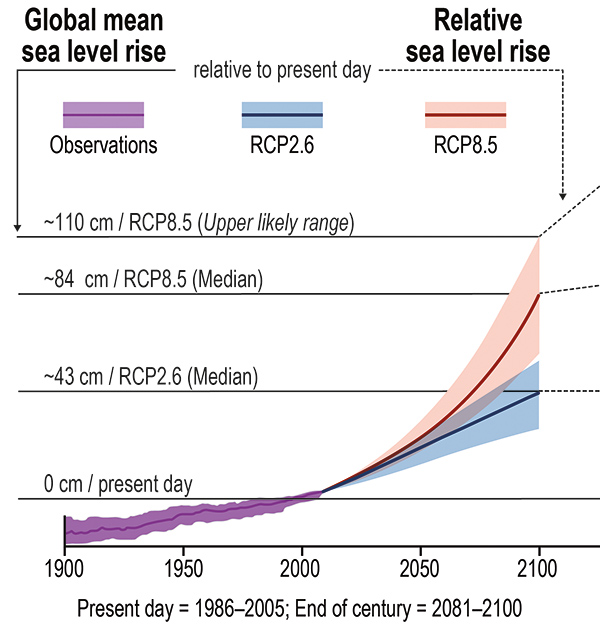
Flash floods aren’t the only type of flood that impact the grid: river floods and storm surge floods also are dangerous, but without the surprise factor. They also tend to have fewer fatalities, and without the rapidly moving debris carried by the water, property damage differs. Sunny-day flooding, when high tides inundate seaside neighborhoods, will be explored in a future column on sea-level rise.
La Niña, Meet Bombogenesis
As extreme precipitation events have become more common, colorful meteorological terms have crept their way into the lexicon. Even if you don’t understand the nuances, there’s a good chance you’ve added derechos, microbursts, atmospheric rivers and bomb cyclones to the long list of more common wet weather events you grew up with: thunderstorms, tropical storms, hurricanes and La Niña, which officially has arrived.
They are all variations of the water cycle we all drew in elementary school, and all are getting worse and more common for the same reason. Climate change causes more extreme precipitation events: for every degree Fahrenheit the atmosphere is warmer, it holds 4% more moisture. So when, say, a hurricane forms over the Gulf during a marine heat wave, it will carry significantly more water than if it had formed in normal temperatures, and that extra moisture means heavier rains along the path of the storm.
Warmer air carries significantly more moisture, leading to more extreme precipitation. | Climate Central
Sometimes, extreme precipitation arrives as a solid, not a liquid. Hail is formed when updrafts push raindrops into freezing areas of the atmosphere where they collide and join. If the trip down to earth isn’t warm enough, they hit, still frozen. Hailstone size is determined by the speed of the updraft: A 60-mph updraft can create walnut-sized hail, while a 100-mph updraft can produce grapefruit-sized hail, large enough to kill someone.
Extreme weather doesn’t happen only on the hotter side of the temperature scale. While hailstorms are more likely in spring and summer, in winter, there are risks of heavier snow or ice storms, which can take down power lines and make it challenging for repair crews to reach the damaged lines. In fact, winter is the fastest-warming season of the year, meaning more moisture in winter storms as well.
Mapping the Wetter Climate Future
The Texas Hill Country is known as flash flood alley due to the mix of topography and soil types that can lead to heavy rainfall moving quickly into gullies and gaining speed. Sophisticated software can model where and how fast water will flow, but as climate change increases the frequency and severity of events, meteorological and climate science professionals need up-to-date data to better predict the impact of storms. Without it, emergency services and utility crews will have less chance to prepare for storms.
Even with great models, damage from extreme rain can be larger than predicted, such as when a hurricane stalls like 2017’s Hurricane Harvey that dumped 60 inches of rain on Nederland, Texas, 90 miles east of Houston, or when one detours further inland like Hurricane Helene.
In First Street’s report on extreme precipitation, its climate data team said the past precipitation maps from NOAA are losing relevance as they were generated with inconsistent time periods and do not reflect the most recent and relevant rainfall data. The NOAA Atlas 15 map of precipitation risk, intended to address the problems in old maps, was at risk of being shelved during recent budget cuts. However, funding for the project was reinstated after the devastating floods in Texas. For utilities and grid asset owners, the National Water Prediction Service’s Flood Inundation Mapping tool offers planning teams insight into where they are most at risk.
The Perfect Storm of Storms
Floods cause more deaths than any other type of natural disaster. Residents, first responders and utility crews face immediate danger from rising or fast-moving water; downed wires or inundated underground systems add the potential for electrocution. Outages of power, communication and traffic systems exacerbate these risks. And once the rain stops, they all face the (sometimes lengthy) task of living with damaged infrastructure while it’s being rebuilt.
In terms of the grid, the distribution network is most at risk of poles and wires being taken down by falling trees or fast-moving debris. Where heavy rains follow a fire, mudslides up the ante.
“A debris flow is like a flood on steroids,” Jason Kean, a research hydrologist with the U.S. Geological Survey told the New York Times after the Palisades and Altadena fires in Southern California earlier in 2025. “It’s all bulked up with rocks and mud and trees.”
The transmission system is more likely to be harmed by extreme weather events that include high winds, but even without winds, fast-moving water can erode pylon foundations and inundate underground assets. A 2019 report by Oak Ridge National Laboratory noted: “Water from inundation or flooding may follow electrical lines back to underground conduits and vaults, damaging underground substations.”
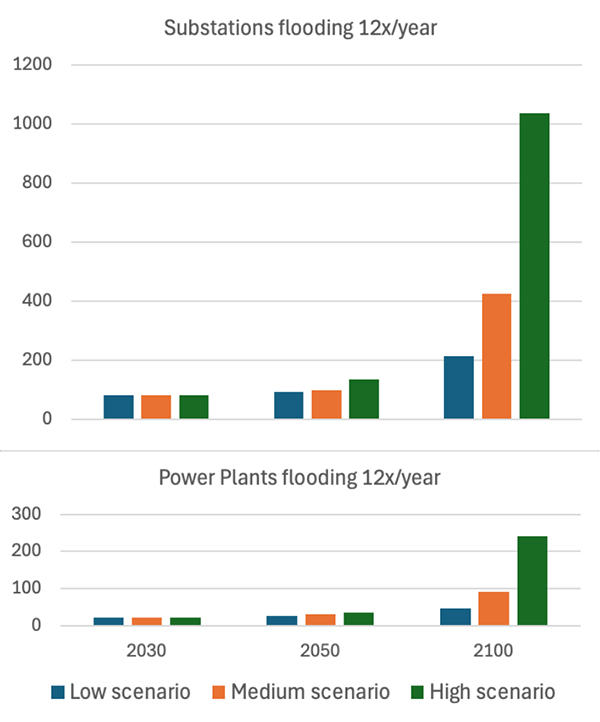
The power generation system is at risk as well. Power plants are at risk of flooding, the Oak Ridge report said, “a consequence of the need for most thermoelectric plants to be close to sources of cooling water,” though there is little research quantifying it. After Hurricane Harvey, ERCOT said about 7,500 MW of generation capacity was out of service, with other units operating at reduced capacity. And Texas’s 2021 disastrous deep freeze showed how vulnerable the gas generation system was to extreme cold.
Hydro generation — which you would expect to benefit from more precipitation — is vulnerable if dam levels aren’t properly managed during a flood. Michigan’s Edenville Dam, which was built in the 1920s for hydroelectricity but had its license revoked by FERC in 2018 due to safety issues, failed in a 2020 flood, which overwhelmed its mile-long embankment.
Hail can damage grid assets such as solar farms, though solar panels are designed to handle a significant impact. At a SolarWorld event in 2015, I shot panels with a hail gun that sent ice pellets at 50 miles an hour, and the modules were unscratched. But I’ve also seen images of acres of broken panels following severe hail. Today, solar farms with trackers that tilt the modules to face the sun have software that uses hyper-local weather data to know when a hailstorm is approaching and stow panels vertically to minimize damage.
All for One, and One for All
As the prevalence and severity of extreme weather events rises, utilities’ ability to respond quickly and effectively will become even more critical. Part of that response is ensuring coordination with first responders and utilities in neighboring areas.
Utilities help each other out when disasters strike, often crossing state borders and staging ahead of a storm. The mutual assistance networks, coordinated by groups like the Edison Electric Institute and the American Public Power Association, speed up recovery. But as extreme weather events become more common, we’re more likely to run into challenges where crews will be too busy in their own area to help out nearby.
The cost of climate disasters also comes into play. Earlier in 2025, the firefighters union in Austin, Texas, voted no confidence in the city’s fire chief for withholding participation in the mutual aid effort following the Kerrville floods. He claimed the city budget meant they could not afford to support the neighboring area in its time of need.
Building Resilience for a Wetter Future
For utilities, grid owners and operators, planning for a wetter future requires hardening the physical infrastructure and readying other resources.
For the physical infrastructure, what seems over-engineered today may be just right in a future where larger and more common floods may erode foundations, and debris may try to take power poles with it. And before undergrounding wires, transformers and substations — an oft-requested upgrade in fire-prone areas and high-end developments — check those all-important precipitation and inundation maps to understand the potential for those assets to be inundated the next time extreme rain hits.
It is easy to understand why utilities are stockpiling key components to make future rebuilding easier, even though it may exacerbate shortages nationwide. The industry already is facing shortages and extended lead times for transformers, distribution poles and substation equipment. Tariffs have exacerbated the issue, as 80% of transformers, for example, are imported.
As far as human resources go, mutual assistance networks will be critical as neighboring utilities call on each other to respond to a rising number of floods and other extreme weather events. And utilities and asset owners will need to build larger contingencies in their budgets for the extra overtime and asset replacement that goes along with that response.
Power Play Columnist Dej Knuckey is a climate and energy writer with decades of industry experience.
IESO and the Ontario Energy Board have added three new members to their governing bodies — including two Indigenous female mayors — while the ISO is seeking candidates for its Technical Panel.
Wendy Landry, mayor of the municipality of Shuniah and a member of the Red Rock Indian Band, was appointed by the minister of energy and mines as the newest member of the IESO Board of Directors. Landry is vice president of Indigenous Leadership, Strategies and Partnerships at Confederation College, her alma mater, and formerly worked for Enbridge as senior adviser for Indigenous initiatives.
“Wendy joins us at a time when Indigenous voices and partnerships are playing an increasingly vital role in shaping our energy future,” IESO said in a press release. “Her leadership in municipal governance and extensive experience in First Nation and Métis relationship building will be instrumental as we work to advance reconciliation and build out Ontario’s electricity system.”
Commenting on her appointment to IESO, Landry cited her former role as president of the Northwestern Ontario Municipal Association (NOMA).
“Everybody in the region is excited [that] we have a Northwestern voice at that table, and … I have the Indigenous” perspective also, she told RTO Insider in a phone interview Oct. 13 after a morning moose hunt. “I know that [IESO is] working on a reconciliation action plan, and some of that work with our communities is vital to [their ability to transition from] diesel,” which is used both in electric generators and home furnaces.
“An average person born and raised in Southern Ontario doesn’t understand … the geography and just the distance between our towns, where a transmission line can make a huge difference,” she added.
Michael Liebrock, OEB | Ivey Business School
Shuniah’s council has been asked to pass resolutions notifying IESO of their support for two electric projects in the municipality: Powerbank’s proposed two 200-MW battery energy storage systems, and Current H2’s proposed 100-MW peaker plant, which could burn natural gas, hydrogen or a mixture of the two.
Landry told TBnewswatch in September that the projects are an economic development opportunity for the community. Now that she’s been appointed to IESO, however, she said she will not participate in meetings on the projects to avoid a conflict of interest.
NOMA released a study last year that said IESO’s existing and proposed transmission was insufficient to support nearly 1,500 MW of demand from planned mining projects. The organization requested six transmission upgrades, including doubling sections of the Waasigan and Watay transmission projects and improvements west of Thunder Bay.
“There hasn’t been a commitment [to NOMA’s requests], but there’s been a lot of discussion, both with the IESO as well as with the minister of energy,” current NOMA President Rick Dumas said in an interview. “With Wendy now being on the board, she could bring the concerns that were written in that [study] to the government and to the [IESO] board.”
Landry is one of six independent board members. The board charter requires between eight and 10 independent members in addition to the ISO’s CEO.
OEB
The newest members of the OEB’s Board of Directors are Cheryl Fort, mayor of the township of Hornepayne, and Michael Liebrock, managing director at The Stronach Group, a private investment company with interests in horse racing, gambling, technology and real estate development.
Fort, a graduate of Athabasca University, is the first woman and the first Indigenous person to serve as mayor of Hornepayne. A former conductor and locomotive engineer for Canadian National Railway, she is a member of the railway’s management team for locomotive engineer training and compliance. She is also president of the Northern Ontario Women’s Association and the Ontario Good Roads Association.
Cheryl Fort, OEB | Cheryl Fort
Liebrock, a former management consultant with The Boston Consulting Group, worked in politics at the provincial and federal levels from 2003 to 2006. He holds an undergraduate degree from the University of Western Ontario, an MBA from Ivey Business School and a Master of Laws from the University of Toronto.
Fort and Liebrock did not respond to requests for comment.
With the addition of Fort and Liebrock, OEB’s board has six members. Per the Ontario Energy Board Act of 1998, the board is composed of five to 10 members appointed by the Lieutenant Governor in Council, acting on behalf of the premier and his ministers. New members, who must meet six criteria, receive two-year terms and may be reappointed to subsequent terms of up to three years.
Technical Panel Seeking Candidates
IESO is seeking candidates to join its Technical Panel, which reviews proposed changes to market rules. (See What to Know About IESO.)
IESO’s announcement highlighted the need for members to represent generators, consumers and energy-related businesses and service providers.
Per the IESO’s Terms of Reference, the Technical Panel comprises one chair, one IESO member, up to 10 members representing “core market” participants (generators, transmitters, distributors, importers/exporters, consumers, demand response, and energy storage) and up to six other members. The panel currently has 14 members.
Stakeholders Endorse Manual Revisions on DR and DERs
The Market Implementation Committee endorsed a package of revisions to Manual 18: PJM Capacity Market to eliminate the availability window and rework how the winter peak load (WPL) for demand response resources is determined and detail how distributed energy resources will participate in the capacity market under the RTO’s implementation of FERC Order 2222.
The proposal to model DR in all hours was approved by the MIC during its Feb. 5 meeting, replacing a ruleset that looked only at the reduction capability of DR resources between 6 a.m. and 9 p.m. in the winter and 10 a.m. to 10 p.m. in the summer under the effective load-carrying capability modeling.
Curtailment service providers argued that limiting the time in which a customer is considered available doesn’t account for those with flat load profiles and the resource class’s ability to react to risk being concentrated across a wider range of winter hours. Skeptics said the change could result in DR participants being paid to curtail overnight, when they are more likely to already be offline.
There also was disagreement over when the change should be implemented; CSPs advocated for targeting the 2026/27 Base Residual Auction to allow them to respond to an expected spike in clearing prices, while others argued there was little time before the start of pre-auction activities. The MIC endorsed implementation for the 2027/28 BRA. (See “Expanded Demand Response Modeling Endorsed,” PJM MIC Briefs: Feb. 5, 2025.)
The changes also redefine the WPL to measure each DR participant’s load at 9 a.m., which is the hour PJM argued best matches DR performance with system needs. The RTO argued that continuing to derive the class-wide WPL from each customer’s peak at any hour within the availability window overstates the curtailment capability since those peaks are not expected to coincide. (See PJM Stakeholders Endorse More Detailed Demand Response Modeling.)
PJM Plans to Request 1-year Extension of RMR Resources Participating in Capacity Market
Associate General Counsel Chen Lu told stakeholders that PJM is preparing to ask FERC to extend tariff language allowing it to model the output of Talen Energy’s 1,289-MW Brandon Shores coal plant and 843-MW H.A. Wagner oil-fired units as supply in the capacity market. The commission approved including the units as price-takers in the 2026/27 BRA and the subsequent auction, which would be extended to apply to the 2028/29 auction under PJM’s proposal.
The two generators have been operating on reliability-must-run agreements compensating them for continuing to operate past their desired deactivation dates while transmission upgrades are completed to allow the units to deactivate reliably. (See FERC OKs Changes to PJM Capacity Market to Cushion Consumer Impacts.)
As the capacity market has tightened, several stakeholders argued that if resources operating on RMR agreements are being paid to be available to mitigate transmission violations, their reliability contribution should be reflected in the capacity market.
The temporary nature of the filing and its focus on two generators was intended to allow PJM’s Deactivation Enhancements Senior Task Force more time to draft a pro forma RMR agreement that explicitly allows the RTO to dispatch them in response to a capacity emergency. A draft of such an agreement was presented at the Sept. 18 task force meeting.
Jamie Van Nostrand’s tenure as chair of the Massachusetts Department of Public Utilities has been defined, in large part, by the department’s effort to align gas utility regulation with the state’s decarbonization laws and targets.
Prior to his appointment in 2023, the DPU faced significant criticism from public advocacy groups over a gas decarbonization planning process largely dominated by the long-term vision put forward by the state’s investor-owned gas utilities.
Following the election of Gov. Maura Healey (D) in 2022, Energy and Environmental Affairs Secretary Rebecca Tepper appointed Van Nostrand and fellow Commissioner Staci Rubin, tasking them with building “a 21st-century DPU” centered around “a commitment to transparency, equity and innovation.”
At the time, Van Nostrand was a professor focused on energy issues at the West Virginia University College of Law. Earlier in his career, he represented utilities in regulatory proceedings in the Pacific Northwest, and nonprofits and public interest groups in proceedings in New York and Virginia.
After 12 years at WVU, “I had the opportunity to come to Massachusetts, and couldn’t say no to Secretary Tepper,” Van Nostrand said in a recent interview with RTO Insider. “It was a dream job.”
Two and a half years after taking the helm at the DPU, Van Nostrand will leave the department Oct. 17 after leading it through a series of major changes in its approach to natural gas regulation.
In December 2023, the DPU published Order 20-80-B, which concluded the department’s contentious multiyear investigation into the decarbonization of the state’s gas network. While utilities had pushed for a framework centered around partial electrification and alternative fuels like hydrogen and renewable natural gas (RNG), the DPU largely sided with climate and consumer advocacy groups in its assessment that gas system decarbonization must focus on electrification.
The order marked a significant step toward an eventual transition away from natural gas, setting the stage for the challenging technical and political questions the DPU has been working on over the past two years. (See Massachusetts Moves to Limit New Gas Infrastructure.)
It required gas utilities to consider non-gas alternatives before investing in new gas infrastructure; directed the utilities to submit climate compliance plans every five years; mandated integrated planning with electric utilities; banned the companies from promoting natural gas expansion; and prevented them from including in the rate base the costs of procuring hydrogen or RNG.
With the order and the proceedings that followed, “I think we pretty much staked out the position as the No. 1 state in the country on the gas transition,” Van Nostrand said.
The Obligation to Serve
Following the order, the DPU has taken more steps to amend its line-extension policies, which would limit the utilities’ ability to spread the costs of connecting new gas customers across their rate base; minimize spending on pipe replacement projects and update the utilities’ “obligation to serve” gas customers.
The obligation to serve, the companies have argued, would prevent them from decommissioning entire sections of pipe if any customers refuse to give up their gas service. In 2024, the legislature amended the statutory basis for this obligation, authorizing the DPU to “order actions that may vary the uniformity of the availability of natural gas service” to enable emissions reductions and compliance with the state’s climate laws.
In early October, stakeholders submitted comments to the DPU on how it should interpret the legal definition. The gas companies argued that the DPU cannot require them to disconnect existing customers, while climate advocates, the Massachusetts Attorney General’s Office and Sen. Mike Barrett, the top senator responsible for drafting the 2024 legislative changes, argued that the DPU does have this authority (D.P.U. 25-40 through 25-45).
The obligation to serve “is a tough nut to crack,” Van Nostrand said.
“How do you shrink the system if you identify a decommissioning possibility and not all the customers want to electrify?” he said. “That would completely thwart the ability to decommission the pipe, so your throughput is going to go down, but your fixed costs aren’t going to go down.”
He said addressing the obligation to serve is part of a broader need to carefully manage the transition to prevent customers who cannot afford to electrify from being saddled with an increasing share of the gas system’s fixed costs.
“An unmanaged transition results in much, much higher rates for customers who can least afford to pay them,” Van Nostrand said. “I think we’re leading the nation on it, but I’ve learned a lot from regulators in the other states who are struggling with the same issues.”
The Coal Trap
While teaching at WVU, Van Nostrand wrote “The Coal Trap,” a book about how the close alignment of the coal industry and top West Virginia politicians prevented the state from taking advantage of clean energy opportunities between 2009 and 2019, hurting the state’s economy and environment.
He said he sees some parallels between the Massachusetts gas industry’s resistance to electrification and the West Virginia coal industry’s pushback against emissions regulations under the Obama administration.
For the coal industry, “there was a resistance to giving it up,” Van Nostrand said. “The coal industry tended to want to just put their head in the sand and say, ‘Oh, everything would be fine if Obama’s job-killing EPA would just leave us alone.’”
In Massachusetts, Van Nostrand said, he has faced some frustration in his effort to bring the utilities to the table to work through challenging aspects of the gas transition.
“I’ve encouraged the LDCs [local distribution companies] to work with us to try to figure out how we can incentivize the LDCs so they will be on board with electrification and not necessarily hide behind the obligation to serve and customer choice,” he said.
“At the end of the day, we have to maintain the financial viability of the utilities, and we’ve got to make sure that, as long as there’s gas going through the pipes, it’s going to be safe,” he added.
He praised a recent filing by Eversource Energy (D.P.U. 25-86) proposing a new regulatory framework to develop networked geothermal heating in new construction projects. Networked geothermal offers significant efficiency benefits over standalone heat pumps, and Eversource already is operating a networked geothermal pilot project. (See Networked Geothermal Breaks Ground in Framingham.)
“I think good utilities get out in front of it, they see the direction things are going, and they plan accordingly,” Van Nostrand said. “There are great workforce transition benefits with network geothermal, because you’ve got the pipes running down the middle of the street and laterals going out to houses, just like what a gas company does. And I think Eversource gets that.”
New Leadership at the DPU
On Oct. 20, Van Nostrand will be replaced as DPU chair by Jeremy McDiarmid, former general counsel for Advanced Energy United, while Liz Anderson, former chief of the energy and ratepayer advocacy division at the Massachusetts Attorney General’s Office, will take over for DPU Commissioner Cecile Fraser.
Representatives of multiple public interest groups active in the state expressed optimism that the new DPU will carry on Van Nostrand’s work to implement a managed transition away from gas.
But challenging questions remain for the incoming commissioners about the role of the state’s gas network and the need for new investments in the system.
While the DPU has directed the gas utilities to reduce their reliance on supply from the Everett LNG import terminal, some industry experts have expressed skepticism about whether the state will be able to eliminate its need for the facility when existing utility supply contracts expire in 2030. (See Gas Industry Sees Political Opportunity in New England and Massachusetts DPU Approves Everett LNG Contracts.)
The uncertain future of Everett, coupled with the utilities’ continued addition of gas customers, leaves regulators in a difficult position as they work to affordably meet existing needs for gas while attempting to avoid larger-than-necessary investments in long-term gas infrastructure.
Eversource recently filed a supply agreement to support a limited expansion of the Algonquin pipeline in the state. While the utility claims this proposal would reduce costs for its own customers, it is unclear whether the proposal would shift costs to customers of other utilities that rely on Everett if the facility remains open beyond 2030.
As regulators in Massachusetts continue to grapple with the existential questions of the gas transition, Van Nostrand plans to live full time in Philadelphia, where his wife teaches. He said he hopes to continue working on issues related to the clean energy transition but is looking forward to taking on a slightly less stressful gig.
“It’s probably more likely to be on the gas side, because that’s where the challenge is the greatest,” he said.