California continues to go all in on data center development, with Pacific Gas and Electric playing its role in the last quarter of 2025 by pushing gigawatts of projects through the investor-owned utility’s design and approval process.
From Q3 to Q4 2025, about 2 GW of data center projects moved into PG&E’s final engineering phase. An additional 50 MW began construction during that time.
“We are excited by the opportunity to bring on large loads and deliver savings to our bundled customers,” PG&E CEO Patti Poppe said during the utility’s Feb. 12 earnings call, which covered Q4 and full-year performance. “The good news is that real [data center] load growth in project stages makes [future load] very real. We have lots of confidence about that.”
An example of PG&E aiding data centers is a recent 20-MW project in San Jose owned by Equinix. The Equinix project is part of a joint agreement between the IOU and the City of San Jose to bring data centers on faster, Poppe said.
The data center will receive power through PG&E’s Santa Teresa substation, which was renovated to meet the new load. Equinix paid for the necessary substation upgrades, PG&E said in a Jan. 22 release.
“This [project] was an opportunity to demonstrate that PG&E is delivering on our promise to provide fast, reliable power to large energy users,” Poppe said.
One analyst on the call asked if the improved visibility of real data center load will help PG&E have “line-of-sight to higher growth.”
“I would say … yes,” Poppe said. “We had previously said that 1.5 GW of [data center load] would be online by 2030. Now we are saying it’s closer to 1.8 GW [that] would be online by 2030. Obviously that continues to change and evolve as we get more applications, we combine projects and bring things online faster.”
Data center load could lower customer bills, Poppe said.
“For each gigawatt of large load, we see the potential to drive savings of 1% or more on average monthly electric bills,” Poppe said. “To do this, it is actually quite simple: We just need to get the price right.”
“We want a relationship between data centers and customer affordability — [this is] receiving a lot of attention at the national level,” Poppe said.
Everyone should understand the value of the IOU model and how important attracting low-cost, high-quality investment is to spreading the cost for infrastructure for customers over the long haul, Poppe said.
In 2025, PG&E’s capital expenditures were $13.4 billion, with $12.4 billion forecast for 2026, $13.4 billion for 2027 and $15.4 billion for 2028. In addition to these forecast expenditures, PG&E identified opportunities for investment in transmission infrastructure for data centers, the IOU said in its Q4 2025 Form 10-k filing.
“There’s other things … that we’ve got in the hopper to help drive affordability [like] supply cost. There’s a lot that goes into a customer’s bill to help get us to that 0% to 3% [bill increase] range,” Poppe said.
PG&E’s unadjusted earnings came in at just over $3.3 billion for 2025 ($1.50/share), compared with $2.9 billion in 2024 ($1.36/share).
In multiple Facebook groups, Indiana residents say their gas and electricity bills have skyrocketed — sometimes quadrupling — since the start of winter.
They share bills detailing more than $1,000 in gas and electric expenses, often with hundreds of dollars’ worth of gas delivery charges. They discuss using woodstoves to heat homes, grilling out in the cold, switching to propane and closing vents in little-used rooms.
Small businesses, churches and cat rescue shelters issue fundraising pleas to defray utility costs. Those comments are interspersed with allegations of price gouging, class action lawsuits and appealing directly to President Donald Trump for relief.
But a consumer advocacy group says the affordability crisis dogging Northern Indiana Public Service Co.’s ratepayers is the product of an indulgent state legislature.
Kerwin Olson, executive director of Indiana consumer and environmental advocacy organization Citizens Action Coalition, said the affordability crisis was built on state law that has been too accommodating to utilities for more than a decade. Indiana law is “incredibly pro-utility” and “forces customers to pay for anything and everything,” he said.
“We’ve for a long time been pointing to incredibly favorable legislation that all but mandates the Indiana Utility Regulatory Commission approve these increases,” Olson said in an interview with RTO Insider.
Olson said that even before a July 2025 rate increase for NIPSCO, customers had already been subjected to the largest increases in 20 years.
Indiana’s unaffordability journey can be traced to Indiana Senate Bill 25, enacted in 2011, that granted utilities incentives for already made investments or those they were required to make, shifting all costs of federal mandates to ratepayers — all without a least-cost energy rule, Olson said.
SB 251 was followed by 2013’s Senate Bill 560, which created a tracker that allows recovery of “billons and billions” in infrastructure projects through automatic rate hikes outside of rate cases, he said.
By 2019, the legislature had enacted House Bill 1470, which again involved a tracker to make it easier for Indiana utilities to recover up to 80% of the costs of transmission, distribution and storage system improvements.
“What we’ve seen with Indiana utilities, especially with NIPSCO, is significant, significant capital investment,” Olson said.
State law, including two bills from the House of Representatives in 2023 and 2025, has also rendered the IURC “all but a rubber stamp,” allowing NIPSCO to recover “extraordinary amounts of capital investments” in gas pipelines, transmission and distribution, and clean energy projects after it committed in 2018 to phasing out coal generation.
Olson said that’s on top of ratepayers still covering the costs of older generating assets.
“The challenge is folks are still paying for the old while they’re paying for the new,” he said, adding the Indiana statehouse has never addressed how to deal with stranded costs through securitization or other “creative” means.
Statehouse Scrambles on New Bill
Facing pressure, the House drafted and passed House Bill 1002 in January. The bill would introduce a performance-based ratemaking structure among Indiana utilities, linking their annual revenue and profit to their ability to meet the needs of residential consumers.
Under the plan, utilities would be placed on multiyear plans for rate increases that include “incentives and disincentives in target areas such as service restoration, reliability and affordability.” The bill would also extend grace periods on service cutoffs in the hottest and coldest months and offer levelized billing options to customers.
The bill is before the Indiana Senate for consideration.
Olson said HB 1002 “is sort of a tacit agreement” that the spend-and-receive model isn’t working in Indiana. He said it’s the first indication that Indiana lawmakers could shift to performance-based increases and more predictable bills, and away from trackers that have “pancaked cost upon cost upon cost.”
“We can certainly be doing more than HB 1002,” Olson said. “But for once, we have a bill that is pro-consumer. I’m encouraged with how the conversation is going. I can tell you the statehouse is hearing these folks loud and clear.”
Olson warned that progress would be slow and take time to reach the IURC. Nevertheless, he predicted a paradigm shift in the state to move “away from simply rewarding utilities for spending money.”
In the meantime, Olson sympathizes with residents receiving bills that rival or eclipse mortgage payments.
“It is absolutely outrageous. We saw this coming; we were warning this day was right around the corner. We have been sounding the alarm, not only about the legislature, but also the NIPSCO rate case and in general over the years,” he said. “That’s a shame because people are hurting.”
Olson also said for NIPSCO’s service territory, cost spikes caused by data centers haven’t entered the equation.
“Data centers are not the No. 1 reason right now. They will be,” he said. But Olson said the current situation in NIPSCO isn’t induced by data center plans, though they are “absolutely driving up bills.”
In response to the affordability crisis and RTO Insider’s request for comment, NIPSCO has repeatedly advertised its budget billing plan, which spreads the cost of average usage over 12 months. It is meant to provide a consistent monthly statement, except in May, when the utility conducts reviews to adjust for over- or underpayments.
Ahead of winter, NIPSCO warned that heating bills would be 16% higher in the 2025/26 season than in the previous year.
And rates are not done increasing. In March, NIPSCO is slated to roll out the second phase of a two-part hike allowed by the IURC in June 2025. The commission allowed a total 16.75% increase in electric bills to support NIPSCO’s infrastructure projects.
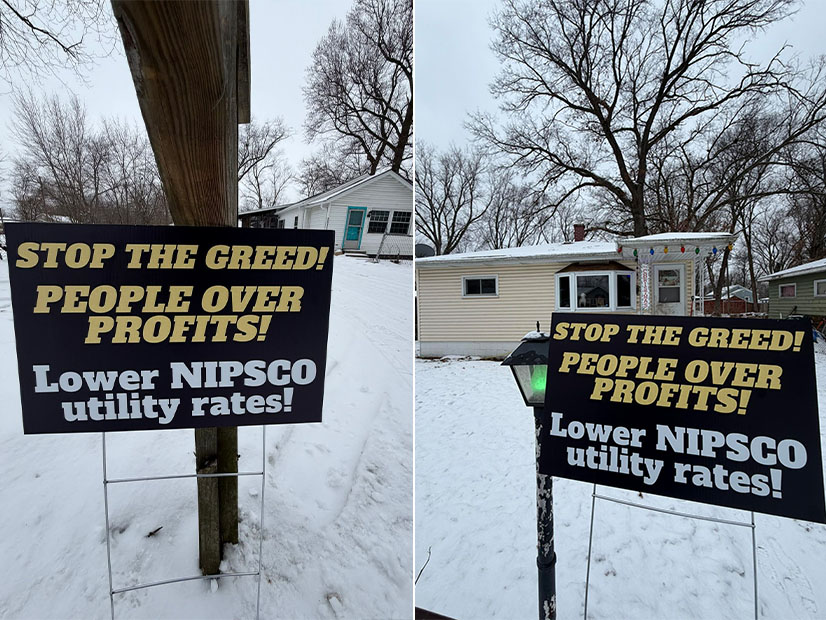
Signs in front of homes in NIPSCO service territory | Amanda Wothke (left) and Des Cain via Facebook
NIPSCO said the rate mark-up will fund more than $2 billion in capital investments to transition its generation to a more “balanced” portfolio and $769.5 million for critical infrastructure upgrades, including replacing aging poles and lines, constructing new substations, and modernizing grid facilities to improve reliability.
Beyond that, the IURC allowed gas rate hikes in 2022, 2023 and 2024 and an electric rate increase in 2023. Before the 2025 rate increases, NIPSCO’s residential customers paid the highest electric bills in Indiana.
The IURC in November 2025 opened an investigation into possible billing discrepancies with customers’ natural gas meters. However, that investigation focuses solely on errors with gas meter readings, not NIPSCO’s exponentially growing gas delivery charges or other billing aspects.
IURC: ‘We Recognize the Burden’
The IURC declined to comment on its ongoing investigation. External Affairs Specialist Ben Gavelek also declined to comment on “any potential commission actions or future investigations.”
The commission is encouraging any customer who has concerns about the accuracy of their bill to call its Consumer Affairs Division, Gavelek said.
The IURC is “an advocate of neither the public nor the utilities” and is “required by statute to make decisions in the public interest to ensure the utilities provide safe and reliable service at just and reasonable rates,” he said.
“With that stated, the commission understands that these are challenging and unprecedented times for many Hoosiers, and we recognize the burden that higher utility bills can have on customers. Keeping this in mind, our role continues to be the careful examination of the evidence in each specific proceeding to ensure utilities are making prudent decisions as they meet their obligation to provide safe and reliable service,” Gavelek said.
However, he added that the Indiana General Assembly determines policy directives and sets the considerations that the commission must follow and weigh in each case. Gavelek said that includes Indiana’s “Five Pillars” statute, which obligates the commission to consider “reliability, resiliency, stability, environmental sustainability and affordability” in ratemaking.
Rep. Ed Soliday (R), chair of the legislature’s Utilities, Energy and Telecommunications Committee, did not comment on RTO Insider’s question on whether past legislation may have had unintended consequences on ratepayers and whether he thinks HB 1002 goes far enough to rectify the issue.
Instead, Soliday and other area Republican representatives’ press office shared a press release from Rep. Alaina Shonkwiler (R), who authored HB 1002.
“Our utility framework has served communities well for many decades, but as technology, policies and generation types advance, we must update our regulatory process to continue to meet ratepayers’ needs,” Shonkwiler said in the late January release. “This legislation moves us to a performance-based system that holds utilities accountable for the outcomes we want — strong reliability, improved resilience and better affordability.”
NIPSCO: Rates Approved by IURC
Acknowledging the outcry, NIPSCO has said higher bills are the result of cold weather, gas prices and infrastructure costs. In January, CEO Vince Parisi told local news stations that unusually low winter temperatures were the driving force behind the bill increases.
“We understand that some customers are seeing higher‑than‑normal winter bills, and we want them to know we hear them. We know this is frustrating, and our priority is to support customers, answer questions and help them stay connected,” NIPSCO said in a statement to RTO Insider.
NIPSCO said its gas delivery charges “support the operation, maintenance and safety of the entire natural gas system, including transmission and distribution mains, service lines, regulator stations and emergency response.” The utility said they increase when more gas is used and pointed out that the charges are approved by the IURC.
The utility did not answer RTO Insider’s question as to whether it is rolling new investments into bills that previously were not recovered.
The utility has not made a post on its Facebook page since Dec. 28, 2025. Before then, the utility often issued inclement weather advisements through posts; the page stayed silent during a late January winter storm. Recent posts have attracted angry comments from customers.
NIPSCO also said rising data center load is not impacting bills.
“Any data center development in our service territory will be served under the NIPSCO Generation LLC structure, a model built specifically to ensure that large, energy-intensive customers do not shift costs onto residents or local businesses,” NIPSCO said.
When NIPSCO decides to evaluate small modular reactors, some of those costs could also get tacked on to ratepayer bills. Senate Bill 424 allows utilities to pass along some of the pre-construction costs to their customers — even if the nuclear generation is never finished.
NIPSCO said it’s internally evaluating SMRs for its integrated resource planning but so far has not had customers pay for development or other associated costs.
With CAISO’s Extended Day-Ahead Market to launch May 1, some parties are urging Nevada regulators to wait until initial results are in before deciding whether to grant NV Energy’s request to join EDAM.
“Given that EDAM is scheduled to ‘go live’ in May 2026, we will have a much clearer picture of these risks [of EDAM participation] in one year’s time,” Michael Roberson, utility analyst with the Nevada Bureau of Consumer Protection, said in written testimony. “Both the governance structure and the identities/volume of participants should become much clearer. Most importantly, we will see real cost/benefit data instead of projections.”
NV Energy filed its request to join EDAM in October 2025. The Public Utilities Commission of Nevada (PUCN) set a Feb. 10 deadline for parties to file testimony in the case. A hearing is scheduled for March 10.
NV Energy’s target date for EDAM entry is fall 2028. (See NV Energy Files Request to Join EDAM.) PUCN is expected to issue an order within 135 days of the initial filing.
As part of its request, NV Energy asked the commission to approve its participation in EDAM as prudent.
Roberson said PUCN should deny that request. A prudency determination now, while it’s not known if projected benefits of EDAM participation will materialize, would shift risk to ratepayers, he said.
Positive WEIM Experience
Factors in NV Energy’s choice of EDAM — rather than SPP’s competing day-ahead market, Markets+ — include its positive experience with CAISO’s Western Energy Imbalance Market (WEIM), the company said in its filing. NV Energy accrued $931 million in benefits from the time it joined WEIM in 2015 through the third quarter of 2025.
NV Energy also pointed to better transmission connectivity within the anticipated EDAM market footprint compared to that of Markets+.
A Brattle Group study, updated in October, projected that NV Energy would save $93.1 million a year by joining EDAM, compared to participating in WEIM alone. In contrast, joining Markets+ would increase annual costs by an estimated $7.3 million.
David Chairez of DSC Utility Consulting recommended that the PUCN wait to see whether benefits modeled for the electric utilities joining EDAM in 2026 and 2027 materialize before making a prudency finding for NV Energy to join EDAM. Chairez filed testimony on behalf of Boyd Gaming Corp., Caesars Enterprise Services, MGM Resorts International, Nevada Gold Mines, Southern Nevada Water Authority, Station Casinos and Venetian Las Vegas Gaming.
The PUCN should also wait to see what changes are made to NV Energy’s open access transmission tariff (OATT), Chairez said.
“The commission cannot decide on prudence without reviewing those proposed changes to understand the effects they will have on Nevada customers,” he said.
Another unknown is how much participants might end up paying in resource sufficiency evaluation (RSE) penalties, Chairez said. The RSE is intended to make sure each balancing authority can meet its own obligations before making transfers with other EDAM participants.
Participation Timeline
EDAM is expected to launch on May 1 with participation from PacifiCorp. Initially, the day-ahead market will identify efficient resource commitments and energy transfers among the PacifiCorp West, PacifiCorp East and CAISO balancing areas, a CAISO spokesperson said. Portland General Electric plans to join EDAM in fall 2026.
The Los Angeles Department of Water and Power, Public Service Company of New Mexico, Turlock Irrigation District and Balancing Authority of Northern California are planning their entry in 2027, followed by Imperial Irrigation District in 2028.
Berry said EDAM would give NV Energy access to a highly diverse — and complementary — resource mix, including low-cost solar from California and wind resources from the Pacific Northwest. And NV Energy can leverage its experience with WEIM to reduce implementation risk and uncertainty “compared to joining an entirely new market construct,” she said.
Regulatory operations staff at the PUCN recommended several conditions for commission approval of NV Energy’s EDAM request.
Those include ordering the company to develop a commission-approved method for quantifying annual production cost savings from EDAM participation; and filing progress reports on revisions to the OATT. Another recommendation is that NV Energy’s shareholders should bear the cost of any RSE surcharges.
California’s reliance on a large amount of imported electricity and fossil fuels is a potential weakness in the state’s energy security portfolio, a California Energy Commission staff report finds.
About 30% of the state’s electricity, 90% of its natural gas and 75% of its petroleum are imported, resulting in a potential “key vulnerability to the state’s overall energy health,” according to the agency’s California Energy Security Plan (CESP), which staff presented at a Feb. 11 CEC business meeting.
The CESP examined the state’s energy use and infrastructure and outlined state government agencies’ responsibilities in preventing and mitigating energy disruptions.
California imports more electricity than any other state and is the third largest consumer of electricity in the country.
Natural gas-fired power plants provide most of the state’s electricity capacity — 39,689 MW, or 45% of capacity. But about 90% of the state’s gas supplies are from out-of-state production basins, which are often thousands of miles away, the report says.
California is vulnerable also to spikes in electricity demand and downstream disruptions, which have been occurring more frequently in recent years, the report says.
During grid emergencies, CAISO might decide to reduce power exports and increase power imports. Energy shortages can affect any state resident but often affect vulnerable people most significantly.
Most of the state’s energy assets and infrastructure are owned and operated by private entities. This means that the state’s energy security plan relies on a free-market approach to control energy distribution and supply, the report says.
At the Feb. 11 meeting, CEC Vice Chair Siva Gunda asked if the agency should be considering other areas of concern not listed in the security plan.
Generative artificial intelligence is one of those areas, said Justin Cochran, senior nuclear policy adviser and emergency coordinator at the CEC.
“[Generative AI] is a developing concern still, though some of the concern has ramped down as build-out of generative AI is slowing or encountering barriers on both the deployment and technology side,” he said.
Another security concern: drones.
“I think the conflict in Ukraine has really expanded upon or shown the capability of drones, so that is a developing concern,” Cochran said.
Earthquakes are the natural hazard of highest concern, the report found. California has more than 200 faults that are potentially hazardous, while more than 70% of residents live within 30 miles of a fault where high ground shaking could occur in the next 50 years.
The next two most concerning hazards are wildfires and floods. In 2022, wildfires in the state killed nine people while destroying 772 structures and damaging 104 more.
The report also updated the state’s strategy for responding to a state emergency. One of the CEC’s roles in such an emergency is to develop and maintain the fuels set-aside program, which can be used during and after an earthquake, for example, the report says.
At the meeting, the CEC also approved a nearly $5.7 million grant for Monterey County to install 390 EV chargers and four solar photovoltaic systems at municipal facilities. Despite the increased availability of EVs and charging infrastructure, local governments in California continue to face barriers to scaling up municipal fleet decarbonization, translating into a need for significant state investment to increase the pace of EV adoption, the CEC’s award notice said.
New Jersey’s Board of Public Utilities is asking the state’s four utilities for thoughts on how to help waive regulations and speed up the connection of distributed energy resources as it seeks to modernize its grid.
A Request For Information seeks written responses from the utilities on five topics the state hopes will illuminate how to enhance the capacity of DERs to help meet a predicted dramatic increase in electricity demand. Utilities must file their responses by March 5.
Several of the questions ask how the utilities are complying with updates to grid modernization rules approved in May 2025 meant to reduce delays in the distribution grid interconnection process and speed up the timeline for projects to come online. (See N.J. BPU Backs New Grid Modernization Rules.)
The RFI also asks utilities to identify opportunities for the BPU to “modify or waive existing regulations in order to improve efficiency and speed of interconnecting new projects.”
Other questions ask how the BPU can improve hosting capacity maps, identity constrained circuits within the company’s service territory and address “other means of supporting development of DERs on constrained circuits.”
“New Jersey has seen a rapid expansion of solar deployment,” the RFI states, in part due to the development of its Community Solar Energy program and the Competitive Solar Incentive program, which seeks to stimulate grid-scale solar projects. “This progress, however, is hindered by an electric distribution grid with severe hosting capacity constraints on key circuits.”
ACE: Infrastructure Modernization
The RFI stems from one of two executive orders issued by Gov. Mikie Sherrill (D) on her first day in office, in line with her campaign promise to address the state’s rapidly rising electricity rates. The average electricity bill rose by 20% in June.
Analysts say the price hike stems in part from the state’s generating capacity shortfall due to the rapid closure of aging, mainly fossil fuel generators and the much slower uptake of clean energy resources. New Jersey is an energy importer, and analysts predict a dramatic rise in demand due to energy-intensive data centers, significantly worsening the state’s energy shortfall.
Asked about the governor’s RFI, Atlantic City Electric (ACE), one of the state’s four utilities, and one that has faced criticism for delays in connecting electricity projects, welcomed the “continued engagement with regulators and stakeholders.” (See Solar Developers: New Jersey’s Aging Grid Can’t Accept New Projects.) The other utilities are PSE&G, Central New Jersey Power and Light, and Rockland Electric Co.
“We are committed to modernizing our energy infrastructure to further improve energy service for our customers,” ACE said in response to an inquiry by RTO Insider. The utility noted it’s executing its Powering The Future initiative. That’s a multiyear infrastructure investment plan that will facilitate the “interconnection of approximately 385 MW of new solar generation — equivalent to 50,000 average residential solar arrays — enabling more distributed energy resources at a time when demand continues to increase,” the company said. Included in the plan is $33 million to enable “the deployment of additional solar and other DER projects,” of which $20 million would go toward solar/DER distribution line improvements, according to the plan.
“We are reviewing the Board of Public Utilities’ request on accelerating DER interconnections and look forward to identifying additional ways to help customers adopt cleaner energy resources,” a statement released by ACE, a subsidiary of Exelon, said. “At the same time, we recognize the strain of high energy costs.”
New Solar Capacity Slows
Sherrill’s executive order requires the BPU to accelerate solar generation with a new solicitation for grid-scale solar and an extra 3,000 MW of generation under the Community Solar Program. (See New N.J. Governor Rapidly Confronts Electricity Crisis.)
The governor’s executive order acknowledges that the excess of demand over supply facing the state is a “significant driver of the electricity crisis,” and identifies solar and storage generation resources as the quickest way to address the problem. New installed capacity has slowed in the past two years, with 307,225 kW added in 2025, about 30% lower than two years earlier. Installed solar resources, which totaled 5.38 GW at the end of 2025, account for about 7% of New Jersey’s electricity generation.
The order adds that solar and storage projects are delayed “often by electric distribution utilities, as they are responsible for reviewing and approving applications from electricity generation facilities to interconnect to the power grid, including applications from renewable energy projects.”
The BPU, seeking to illuminate the reason for connection delays, asks the utilities to identify at least two circuits that “receive high numbers of interconnection application requests (either by total capacity requested or number of applicants), that are either closed or close to being closed due to voltage constraints.”
The RFI also asks the utilities to “provide a list of circuits with the worst reliability performance based on outage data that should be prioritized for infrastructure upgrades.” And it asks them to “include the metrics, methods and criteria used for selecting the worst-performing circuits.”
The issue of how to improve the ability of DER projects to get connected has been “perennial” in New Jersey and elsewhere, said Paul Patterson, an energy analyst for Glenrock Associates. Central to the issue are questions over whether “resources are being hooked up fast enough, and what’s causing the delays,” he said.
“It’s the context that makes this more significant,” he said. That includes the dramatic price hike stemming from PJM’s capacity auction, and Sherrill’s embrace of utility affordability at the center of her campaign.
“It’s very preliminary. They just seem to be asking for information,” he said of the RFI. “The real question is, what does Sherrill and her administration really come up with in the way of a policy to actually deal with the issue of rising electricity prices?”
The average cost for electricity in NYISO was $201.89/MWh in January, up nearly 53% from January 2025 and possibly the highest ever for the month, the ISO reported in its first market operations report of the year.
“I went back and manually clicked through all the previous January and February monthly market operations reports I could find,” said Shaun Johnson, vice president of market structures for NYISO. “This was the highest.”
Johnson cautioned he could not definitively say whether the prices were the highest for January ever. He said the documents he was able to pull were not comprehensive, and several years were missing market operations reports.
“$137 was the previous high number I was able to find,” he said, pointing to a report from February 2022.
Stakeholders asked whether this meant January’s average was the highest ever when adjusted for inflation. Johnson said he was not prepared to assert that. He said the figures from 2013, during the polar vortex cold snap, were also quite high.
The culprit was the late January winter storm. A graph in the operations report depicting the average daily cost shows a dip below $60/MWh before spiking as high as $840/MWh when the storm hit. The average cost for January 2025 was $132.26/MWh.
Johnson said the storm’s unusually large footprint, and the long duration of extremely low temperatures, contributed to the spike. The storm hit almost the entire East Coast, and demand on all of the Eastern Interconnection was high for an extended period.
The average locational-based marginal price was $192/MWh, up from $107.81/MWh in December 2025 and $127.05/MWh in January 2025. Natural gas prices at NY Transco Zone 6 were $19/MMBtu, up from $6.93/MMBtu in December 2025, showing the strong correlation between gas prices and electricity prices NYISO reported in the aftermath of the storm. (See NYISO: Gas Demand Soared Across Eastern U.S. During Fern.) However, it was a 2.2% decrease from January 2025.
A stakeholder representing Central Hudson Gas and Electric asked whether NYISO would consider also tracking the natural gas prices at Iroquois Zone 2, given that they also went “through the roof” during January. Johnson said he would look into it, but NYISO does not have a source that it can publish numbers from publicly.
Uplift costs were higher in January 2026 compared to the previous month: $1.79/MWh, from $1.11/MWh. Johnson said that he anticipated the Market Monitoring Unit would go into depth on this in its quarterly State of the Market report.
Northern Indiana Public Service Co. replied to comments on and protests to its request that FERC allow it to recover the costs of continuing to operate the R.M. Schahfer Generating Station from the 11 states in MISO Midwest, insisting that it is the quickest solution (EL26-36).
The utility said waiting for the states to create a cost allocation method through the MISO stakeholder process would unnecessarily delay its requested relief after being forced to keep the plant online past its scheduled retirement by the U.S. Department of Energy.
If approved by FERC, Schahfer would follow in the footsteps of the J.H. Campbell coal plant in Michigan, which is also operating under an emergency order from DOE under Federal Power Act Section 202(c) and was granted a MISO Midwest-wide allocation.
In an early February response, NIPSCO said many of the challenges to its request rest on the lawfulness of the order itself and “amount to an impermissible collateral attack on action taken by the U.S. secretary of energy.”
“The comments and protests raise issues that are outside the scope of this proceeding and impinge on NIPSCO’s constitutional and statutory rights to recover costs,” the utility said.
MISO states had asked FERC to order discussion in the RTO’s stakeholder process to settle on a cost allocation design. (See Regulators: MISO Stakeholders Should Decide Cost-sharing for DOE Coal Plant Orders.) The Organization of MISO States said DOE’s “self-determined energy emergency does not obviate the commission’s obligation to establish just and reasonable rates.”
In mid-2025, DOE began issuing emergency orders under Section 202(c) to keep power plants in Pennsylvania, Michigan, Indiana, Colorado and Washington online past their scheduled retirement dates. OMS said a cost allocation design should be formed with input from the states affected, especially because DOE is likely to continue ordering other retiring thermal units to stay online.
But NIPSCO said rate recovery issues are FERC’s domain, not a MISO stakeholder process matter. It argued that there is no harm in allowing a regionwide cost allocation because it has not yet sought to recover the costs of keeping the coal plant available. It said interested parties would be free to review and contest it when it does, regardless of allocation.
“Establishing a mechanism now does not prejudice any party’s rights,” NIPSCO said.
The utility also said it is “incurring significant capital, operating and maintenance costs to comply with these directives.” It said delays would undermine its “ability to recover costs it is legally obligated to incur.”
LITTLE ROCK, Ark. — SPP CEO Lanny Nickell says the grid operator’s Regional State Committee, composed of regulators from its (current) 14-state footprint, offers a structure others might follow.
“I believe that the SPP RSC model is unique, and I think it’s the best-in-class among the RTO world,” Nickell told the committee’s members during its February meeting. “It’s based on shared responsibility, transparency, and it’s something that I value very much. Our staff and our board remain committed to strengthening our relationships with you and supporting your work every step.”
Nickell pointed to recent discussions he has had with legislators as he tours the service territory to raise awareness. He said in a recent visit with the Kansas legislature, he learned how the Kansas Corporation Commission’s Andrew French and his staff have explained the value SPP brings.
“These conversations have reaffirmed for me just how important our RSC partnerships are,” Nickell said.
The RSC was created in 2004 to provide regulatory input on “regional importance related to the development and operation of bulk electric transmission.” In approving the group’s creation, FERC recognized the need for a mechanism that facilitates regional consensus on critical issues related to transmission planning and operation.
The commission also made the RSC the first organization of state regulators from multiple states to be expressly granted authorities in a FERC-jurisdictional grid operator. The commissioners exercise this authority by determining whether and to what extent participation funding will be used for transmission improvements and whether license plate or postage-stamp rates will be used for the regional access charge.
The RSC has grown to 13 members with the recent addition of Montana commissioner Randall Pinocci. The membership will increase again with the RTO’s expansion into the Western Interconnection in April.
Two future members, Wyoming’s Mike Robinson and Arizona’s Nick Myers, watched from the sidelines. A third, Colorado’s Eric Blank, called in.
The committee also welcomed two new members in the Louisiana Public Service Commission’s Eric Skrmetta and the New Mexico Public Regulation Commission’s Greg Nibert. Skrmetta replaces Mike Francis, and Nibert takes over for Patrick O’Connell, who chaired the RSC in 2025.
Economic Consultant Approved
The RSC approved the selection of Bates White Economic Consulting to provide expertise in transmission cost allocation and evaluating its benefits.
The D.C.-based firm, chosen by the committee’s leadership from five respondents to a request for proposals, will be tasked with providing information and education, analyzing cost-allocation options for the SPP RTO region, a facilitate discussion among the committee’s members and its Cost Allocation Working Group.
“I feel this is an indication of the increased focus on cost allocation by the RSC,” Texas’ Kathleen Jackson told her fellow commissioners during their February open meeting, noting the consultant is a first in “recent times.”
The commissioners also agreed to sunset the Improved Resource Availability Task Force, which was formed in the aftermath of 2021’s Winter Storm Uri. The group carried out recommendations from SPP’s post-storm report, ensuring generators have reliable fuel and the grid operator improves how it plans for and manages resource availability.
The task force handed off its leftover items to the Resource and Energy Adequacy Leadership Team when the latter was formed in 2023.
“The issues have been challenging, but I think the REAL Team has really stood up, stepped up and developed much-needed policies that strengthen reliability across the entire footprint,” Nickell said. “Some of the favorable outcomes from [January’s winter storm] were a result of a lot of the work that the REAL Team did … and all the stakeholders that played a role along the way.”
The Trump administration is not done fighting offshore wind power construction.
Interior Secretary Doug Burgum told Bloomberg that an appeal “absolutely” is coming on the stop-work orders his agency imposed — and judges quickly lifted — against all five offshore wind projects being built in U.S. waters.
The Dec. 22 stop-work order cited national security as justification — the wind turbines’ towers and blades recently had been said to interfere with radar in a way that could generate false targets or obscure genuine threats. (See All U.S. Offshore Wind Construction Halted.)
Eleven months after President Donald Trump returned to office and began attacking U.S. offshore wind, the sector consists of five projects — Vineyard, Sunrise, Revolution, Empire and Coastal Virginia Offshore Wind — being built by four developers. Future construction starts are uncertain at best.
Vineyard already was sending partial power to the onshore grid, while Revolution and Coastal Virginia were months away from that milestone.
Speaking to Bloomberg, Burgum offered the standard Trump administration criticism of wind power — that it is intermittent and expensive and that it needs subsidies and relies on foreign components.
But he also said recent evolution of warfare makes the massive towers and blades a threat to national security, as they might obscure aerial or underwater drone attacks launched by a hostile nation against the East Coast.
“I’m sure as we get into court and have sessions and share classified information there will be further discussions on this,” Burgum said. “People are saying that, ‘Oh, this is some kind of ideological attack on offshore wind.’ No, this is like a real, genuine concern, and as Americans, we should be concerned … If you wanted to attack America, you’d launch autonomous drones through those things, or you’d launch autonomous submarines. We just have to wake up: Warfare has changed in the last four years. The world’s different. We have to be ready to respond to it.”
LITTLE ROCK, Ark. — In what Lanny Nickell called one of his “toughest meetings” as SPP’s CEO, the Board of Directors approved a framework for demand response and a peak demand assessment (PDA) despite the Members Committee’s opposition.
The committee shot down the proposed tariff change (RR703) with its advisory vote for the board, 4-12, with five abstentions. However, the directors approved the measure in their separate ballot, signaling it was time to move forward over stakeholders’ calls for more time to work on DR and to sever the PDA from the framework.
“This is the most contentious meeting I have ever seen here,” whispered one stakeholder during the Feb. 3 discussion.
Board Chair Ray Hepper recapped the history of RR703, which began in early 2025. It was endorsed by several stakeholder groups, but the Markets and Operations Policy Committee in January voted to delay its approval for three months over the load forecast’s evaluation and potential financial penalties for not meeting resource adequacy requirements. (See “Peak Demand Assessment Delayed,” SPP’s MOPC Adds Conditional IC Process for Large Loads.)
Stacey Burbure, vice president of FERC and RTO strategy and policy for American Electric Power, called the proposal’s approval a “failure of our stakeholder process.”
“The fact that we are having such a meaningful debate here when the proposal is before the board; when we hear a call for more time; when we hear substantive issues and people expressing concern around imminent litigation that will result — I encourage my team always to pick up your pencil and not to bring rocks alone,” Burbure said. “Pick up your pencil, lean into the problem and bring a solution forward. So I would encourage us to take this one back and pick up our pencils.”
“When I voted for this [during a Resource and Energy Adequacy Leadership Team meeting in December], it was because I was afraid on the reliability side that we had gone too far in trying to meet everybody’s needs,” Hepper said. “I think it’s time to move forward with this. I understand that PDA is never going to be popular. I understand why nobody wants to be subject to financial consequences for any of their actions.”
“Not everybody’s equally happy, but we accomplished what we needed to accomplish, and I appreciate everybody’s patience,” Nickell said.
The board sided with a recommendation brought forward by the Regional State Committee, which endorsed the implementation of a load-modifier cap for load-responsible entities in 2027 and full implementation in 2028 subject to the following provisions:
Controllable non-registered DR programs will be capped at 2,152 MW, based on 2025 workbook-forecasted non-registered DR for the 2027 summer season.
Limiting LRE load-modifying DR resources to 2027’s forecasted amount, unless they opt into PDA for the summer 2027 season.
Market-registered and reliability-registered DR will be available to all LREs in 2027 to serve resource adequacy needs and will not count against the 2,152-MW cap.
SPP says DR is “increasingly critical” as it faces rapid load growth, evolving resource mixes and tighter energy conditions. It says a structured DR policy provides stakeholders with multiple participation pathways while helping defer the cost of new generation and supporting resource adequacy compliance.
Still, the policy will likely draw protests at FERC, including one from SPP’s Market Monitoring Unit, which has filed three sets on comments on RR703, saying the policy design is “overly complex” and that it does not address all the issues in the original initiative. The MMU urged the board to postpone approval to explore alternatives, including not capping load-modifying DR.
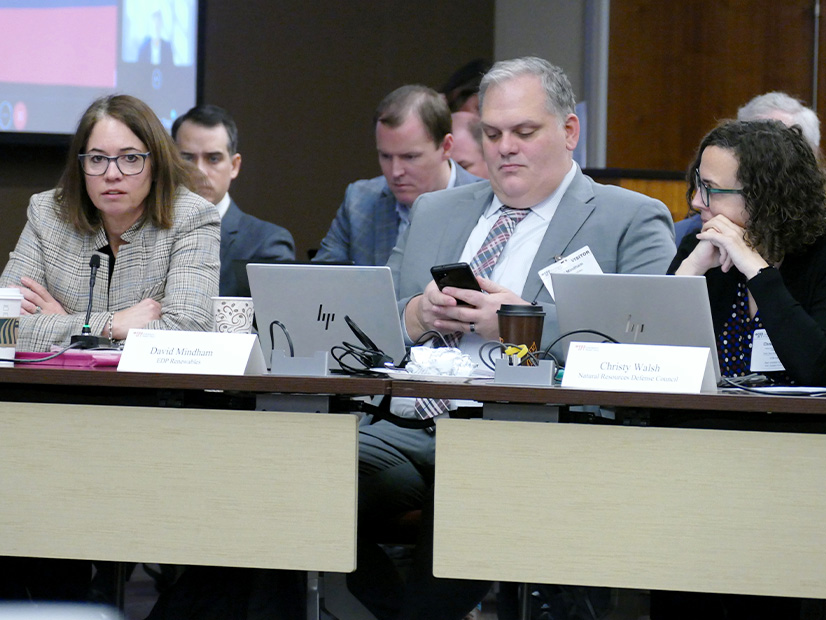
“If we move forward with the PDA policy and have a fight at FERC, that could derail the DR policy,” said Christy Walsh, with the Natural Resources Defense Council’s Sustainable FERC Project. “I ask you all to think about either filing these two things separately at FERC so that any controversy over PDA doesn’t bring down the DR policy.”
Competitive Short-term Projects
The board’s public session ended with the approval of four short-term reliability projects, including two 765-kV lines, that are eligible for competitive upgrades, overcoming stakeholder concerns about the process, cost management and timelines. Transmission-owning members urged the board to competitively bid the projects, asserting that it would ensure they are constructed on time and at the least cost.
Members approved the proposal 12-9, with transmission owners outvoting transmission users. An amended motion to remove the 765-kV lines from the recommendation failed 10-11, with the members essentially reversing their votes. The board also rejected the amended motion with its ballot.
As the board adjourned for its closed session, several stakeholders gathered on the sidelines to plot next steps.
“The TOs win again!” one stakeholder said, raising his arms in exasperation.
Addressing what he called the “elephant in the room,” OGE Energy’s Adam Snapp said there is a perception that “costs will double overnight” and utilities “will run wild and spend … because we don’t care about our customers.”
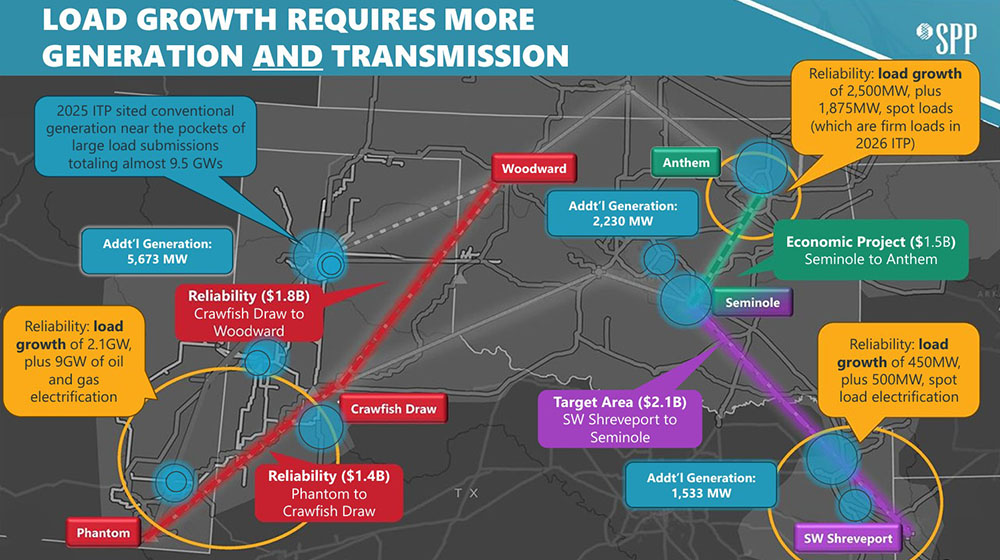
SPP’s 765-kV overlay | SPP
“That’s the furthest thing from the truth,” said Snapp, OGE’s transmission planning senior manager. “We are uniquely incentivized to keep the projects costs low because it’s our customers who pay for them. When we invest in transmission, it puts pressure on our rates and our ability to invest in generation and distribution, and if the project gets out of hand, we won’t be able to make other investments that we need to make in our system. We are the only ones that are inherently incentivized to do that.”
Staff committed to work with the incumbent TOs to develop an agreement addressing cost overruns and delays and report back to the May board meeting.
The four projects are:
Southwestern Public Service’s $1.37 billion, 239-mile, 765-kV Crawfish Draw-Phantom project in New Mexico and Texas;
Evergy’s $21.6 million, 6-mile, 161-kV Crosstown-Blue Valley Station project in Missouri;
Midwest Energy’s $23.3 million, 8-mile, 115-kV North Hays-Chetolah Creek project in Kansas; and
the $2.4 billion, 315-mile, 765-kV Seminole-Southwest Shreveport project between central Oklahoma and northwestern Louisiana.
The two 765-kV projects form the southern legs of SPP’s proposed extra-high-voltage backbone. Both regions experienced load-shed events in 2025 and are seeing “massive amounts of reliability needs,” said Casey Cathey, SPP’s vice president of engineering. They were approved in November as part of the 2025 Integrated Transmission Plan’s record $8.6 billion portfolio. (See SPP Board Approves 2025 ITP with 4 765-kV Projects.)
Construction permits will be issued for the projects within 45 days of the board’s approval.
The proposals met SPP’s requirements as short-term reliability projects because they are competitive upgrades and are needed in three years or less to address reliability needs.
Conditional Load Process Approved
TOs also helped push through a tariff revision that builds on a previous change to integrate and operate high-impact large loads (HILLs) and was previously approved by MOPC and the RSC.
RR720 complements the FERC-approved study process for new HILLs and associated generation through the HILL generation assessment (HILLGA) by providing a path for conditional transmission service and interconnection. (See “Large Load Integration OK’d,” SPP Board Approves 765-kV Project’s Increased Cost.)
The conditional high-impact large load (CHILL) framework has two paths for large loads looking to interconnect: they have adequate generation but are contingent on transmission upgrades; or when accredited, equivalent supporting generation reaches commercial operation.
“I like to characterize that as speed to information, getting the info that you need in order to determine the cost and the necessary upgrades required to bring on large loads,” said Carrie Simpson, vice president of markets. “The second piece is speed to power. So maybe not all the transmission is in place. Maybe not all the full studies have been done to be a full [designated network resource]. This enables you to get your load on faster, so speed to power now.”
The RR doesn’t place a cap on the amount of the footprint’s CHILL load because it will be supported by generation. However, a CHILL will be curtailed if supporting generation is not available and/or if there is a net effect to the transmission system during system CHILL curtailments.
“This policy takes the next step, adding yet another option that will enable even quicker interconnections without materially affecting market prices and without materially reducing reliability,” Nickell said.
The Members Committee endorsed the change 11-0, with 10 abstentions from renewable interests and other transmission users.
“We are at the end of our designated resource pipeline, and we are looking for more flexibility to address the loads that are requesting to be connected to our system, so I hope this gets filed quickly,” Evergy’s Denise Buffington said.
Several tariff changes and other items fared much better when they were considered.
Following members’ 19-1 endorsement, the board approved five of six recommendations by a task force meant to improve the RTO’s TO selection process for competitive projects and FERC Order 1000 compliance.
“Our goals were to improve the quality of the process, accelerate the process, and ensure that it continues to be fair and objective,” said Director Irene Dimitry, who chaired the task force.
The board and members asked staff to develop a proposal for the sixth recommendation that transfers the industry expert panel’s work to SPP, augmented by consulting expertise. The panel evaluates and scores the proposals before recommending a designated TO. It is reconstituted for each project, leading to a lack of consistency, Dimitry said.
Staff will have to develop communication protocols and protect staff from being lobbied by market participants, she said. Staff committed to bringing its proposal to the board meeting and hope to have a process in place for the 2026 transmission plan.
The Advanced Power Alliance’s Steve Gaw, a former speaker of the Missouri House of Representatives, raised a point of order, noting the measure passed as a substitute motion that did not require a vote on the base motion. He was overruled by SPP General Counsel Paul Suskie, leading to a second vote with identical results as the first.
“I’ve been overruled many times, but that does not mean I’m wrong,” Gaw cracked, drawing laughter.
Three other measures were approved after members endorsed them with voice votes:
staff’s recommendation to modify a 115-kV competitive project in New Mexico by changing a termination point. The action will save $8 million to $9 million but will require SPP to solicit new proposals for what is now the Battle Axe-Phantom project. A previous request for proposals will be withdrawn.
RR704, which establishes a business practice that formalizes the baseline modeling assumptions, data inputs and study parameters used in the loss-of-load expectation study.
RR729, which changes the cost of new entry’s value from $85.61/kW-year to $139.85/kW-year for the 2026 summer season.
Nickell Says JTIQ Loan ‘Retained’
Almost lost in Nickell’s quarterly president’s report was this sentence: “We retained a $464.5 million grant in funding for the interregional [Joint Targeted Interconnection Queue] projects.”
DOE has not responded to RTO Insider’s requests for comment. However, its website lists the JTIQ grant as having been awarded to the Minnesota Department of Commerce — which led the GRIP funding application with help from the Great Plains Institute — in October.
Minnesota has said little about the grant beyond that its status has not changed and the projects are proceeding as planned. A Great Plains staffer at the board meeting declined comment. MISO CEO John Bear said during his board’s December meeting that the funding had been restored. (See MISO, Minn. Say Federal Funds for JTIQ in Play.)
The GRIP funds offset about 25% of the capital costs for the JTIQ portfolio’s five projects. The projects are centered on the RTOs’ northern seam and have been framed as enabling 28 GW of primarily renewable generation. Each grid operator would have two projects in its footprint and share the fifth.
Nickell also gave the board, members and other stakeholders a sneak peak of the SPP’s rebranding effort, which will be officially revealed after April’s RTO expansion into the West.
He said his platform is for SPP to “boldly lead the industry. And that’s not just staff. That’s this entire organization.” Through focus groups and interviews, Nickell said staff heard two things: to continue SPP’s focus on its core mission of reliability and to remain committed to “facilitating consensus among diverse stakeholder groups in pursuit of innovative solutions.”
“We all have a part in boldly leading this industry that we all love,” Nickell said. “We want to be more visible. We want to communicate the value that we provide better and more often toward that goal.”
A two-minute video showed a quick glimpse of the logo and the catchphrase intended to reflect who the grid operator is: Powering the Future.
SPP’s logo has been tweaked only once since its creation in the 1990s, but Nickell said stakeholders should still recognize its elements in the new logo.
“A lot of really, really important work needs to be done, and I trust that you all will work with us to achieve what I believe are really, really important goals for the organization,” he said.