The first couple years of the data center boom have brought significant growing pains across the U.S.
Data center development, coupled with electrification and reindustrialization, has driven dramatic growth in load forecasts after years of relatively stagnant demand. Regulators, policymakers and RTO officials have scrambled to respond to this growth and balance the interests of consumers and private developers.
The scale of growth could be massive: Grid Strategies forecasts U.S. electricity demand increasing by 5.7% annually over the next five years, coupled with 3.7% annual growth of peak load. The U.S. Energy Information Administration forecasts more modest growth over the next two years, projecting 1 and 3% growth in 2026 and 2027. (See EIA Predicts Sustained Power Growth in 2026 and 2027.)
While there is significant uncertainty about how much of the currently proposed large loads will materialize, the potential for rapid demand growth has major implications for consumer costs, decarbonization and infrastructure needs.
Data center demand already has contributed to capacity price shocks in PJM and MISO. In 2025, rising demand helped drive a large increase in coal-fired generation, increasing power sector emissions as human-caused climate change nears 1.5 degrees Celsius of warming.
As demand growth accelerates, a strong regulatory framework is essential to preventing consumer and environmental impacts, said Jesse Jenkins, head of the ZERO Lab at Princeton University. Jenkins also recently co-founded Firma Power, a generation development company focused on providing clean, firm power to large load customers. He will be a keynote speaker Feb. 25 at Yes Energy’s EMPOWER 2026 Conference.

In a recent interview with RTO Insider, he stressed that data center developers must match their demand with new clean supply to prevent consequences for other consumers and the climate.
At the ZERO Lab, Jenkins’ research focuses on modeling future energy systems to help inform resource development and guide policy and long-term planning. Prior to the data center boom, energy system researchers were grappling with the expectation of substantial demand growth due to electrification, he noted.
“That has had us in this mindset of growth in the electricity sector several years before the rest of the market caught up to us with the growth of data centers — which, to be fair, we weren’t anticipating at the scale it is now,” he said. With the addition of data center load growth, “this is a new epoch in the sector, and it’s certainly awakened a lot of people to the challenges of being able to rapidly expand electricity supply.”
The data center development boom has brought a complex mix of challenges and opportunities, Jenkins said. The power sector could see broad benefits from developers willing to be early adopters of emerging technologies like advanced nuclear. But rapid increases in demand also likely will undermine energy affordability in the absence of strong consumer protections.
Unlike load from electrification, data center demand is highly concentrated — some planned developments would require multiple gigawatts of power.
“These are city-scale electricity consumers in one big building,” he said. “That raises very particular challenges around network constraints and network expansion, and the uncertainty of demand growth.”
“You can’t bring 2 GW of demand to the grid without bringing 2 GW of new supply without either prices going up a lot or grid reliability suffering, or maybe both,” Jenkins added, referencing a deal recently announced by Meta to procure power from multiple proposed advanced nuclear plants and 2,176 MW of capacity from two existing nuclear plants in PJM. (See Meta Announces Nuclear Projects with Vistra, TerraPower, Oklo.)
While high prices eventually may induce new supply to come online, he said treating data center developers like any other customer in the market does not appear to be a viable approach.
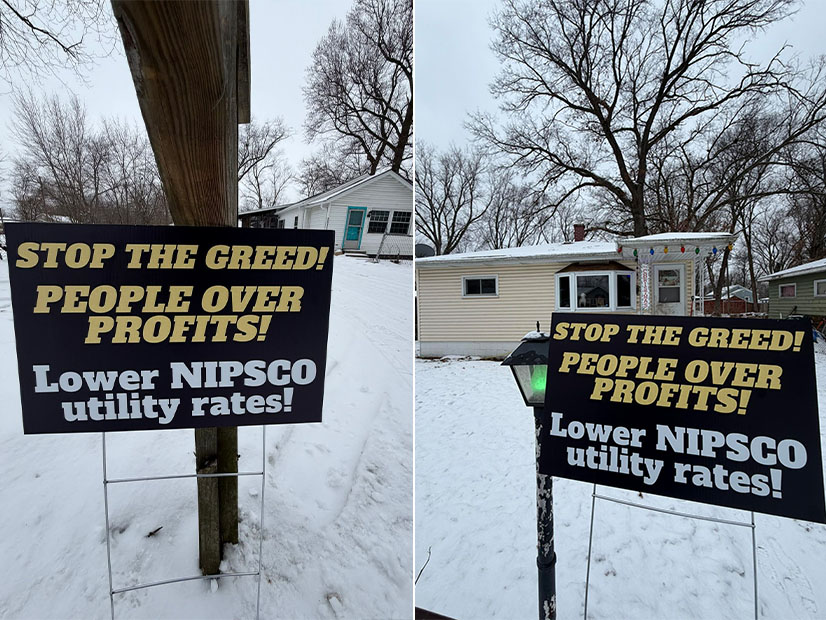
Price spikes and environmental concerns have led to increasing blowback against data centers across the country. According to one report, $98 billion in U.S. data center projects were blocked or delayed by political opposition in the second quarter of 2025. In New York, Democrats in the legislature are pushing for a three-year moratorium on data center siting and permitting. (See Data Center Moratorium Bill Introduced in N.Y. Legislature.)
Jenkins emphasized the importance of pairing data center developments with an equal amount of accredited new capacity and hourly matched clean energy. This could be accomplished by regulatory requirements or by fast-tracking the regulatory process for data center developments that meet these parameters, he said.
While developers so far have favored a voluntary process over bring-your-own-clean-supply requirements, a well-designed voluntary process could accomplish the same consumer protection objectives, he said.
“As long as there’s sort of a time to power advantage … it’s still like a competitive requirement to do it, because if you connect slower than your competitors, you’re not going to have much market share,” he said.
Asked about the possibility of FERC asserting jurisdiction over the interconnection of large loads, Jenkins said the idea “makes a lot of sense in theory.”
“I do think there’s a lot of merit to the idea that anything above a certain threshold size that’s connected to transmission voltage should be treated symmetrically to a generator of a similar scale,” he said. “In some ways it could make it more coordinated because you could do simultaneous generation and load interconnection.”
However, he said a lot will depend on implementation, and the change in regulatory approach could create complications for existing efforts to regulate data center loads.
“As with any regulatory change, the question is: Does it blow everything up for a period of time when there’s so much uncertainty about what’s going to happen that it halts all progress as people wait for the process to settle?”
Jenkins’ keynote address, “A Rock & A Hard Place: Challenges and Solutions to Meet the Data Center Demand Crunch,” will be delivered Feb. 25 at Yes Energy’s EMPOWER 2026 conference in Boulder, Colo. To learn more about EMPOWER, visit empower.yesenergy.com.