Search
December 7, 2025

FERC Approves PG&E’s Cost Recovery Request for Abandoned Battery

FERC approved PG&E’s request to recover more than $600,000 in costs for an abandoned battery plant in California, saying the company sufficiently demonstrated it meets the requirements for cost recovery as established under previous commission orders (ER25-2238).

In an Oct. 10 order, FERC allowed PG&E to recover $602,472, or 50% of about $1.2 million, for planning and scoping the now abandoned 7-MW Dinuba Battery Storage System in Fresno, Calif.

CAISO approved the project after identifying several reliability concerns with transmission systems in Tulare and Fresno counties between 2010 and 2013. The ISO proposed resizing the battery facility from 7 MW to 12 after identifying more issues in 2019 because of the retirement of a local generator, according to FERC. It would have been CAISO’s first storage project fully dedicated as a transmission asset. (See Storage Week: Hairless Cats, Rising Stats and Skeptics.)

However, in its 2023/24 transmission plan, CAISO said it found an alternative solution that would address the reliability concerns “more comprehensively and effectively” than PG&E’s battery storage system, leading to the cancellation of the project, according to the order.

PG&E filed a request for cost recovery May 15 for the scoping, engineering, feeder, switchgear, control building and relay design, and material procurement associated with the abandoned project. It also requested authorization to amortize and recover the abandoned plant costs over a one-year period.

The company contended it was entitled to cost recovery because CAISO considered the battery storage system as a transmission asset as required for cost recovery under Opinion 295, which instituted the abandoned plant policy in 1988. The abandoned plant costs should be evenly split between customers and shareholders, PG&E argued.

FERC agreed, saying CAISO selected the project as a transmission asset to address thermal overloads. The commission also noted that PG&E would have operated the project under the direction of CAISO, similar to other wholesale transmission facilities, it said.

“We find that PG&E has demonstrated that it qualifies to recover 50% of the prudently incurred project costs based on the facts and circumstances presented in this proceeding, consistent with Opinion No. 295,” the order stated.

CEC Approves 5 Offshore Wind Projects at California Ports

The California Energy Commission has approved $42 million for five offshore wind projects at ports in the state, despite recent federal policy changes that have left the future of the renewable resource in limbo.

Existing port infrastructure in California is “insufficient” to support the offshore wind industry because of long development timelines and high investment costs, one of the commission’s grant awards said.

The largest funding amount went to the City of Long Beach, which received $20 million to build a 400-acre offshore wind terminal at the Port of Long Beach. The funding will go toward the completion of engineering calculations, environmental assessments and community engagement activities. Engineers on the project also will determine whether the port can be designed to be a zero-emissions terminal. Construction is planned to start in 2027 and be completed by 2035.

In 2022, the CEC set a goal to install up to 5 GW of offshore wind capacity by 2030 and 25 GW by 2045. That amount of capacity requires 15-MW turbines, which have components that are “so large that the only feasible way to transport them is by waterborne transit; road and rail transit are not feasible,” the grant says.

Also in 2022, California passed Assembly Bill 209, which created the Offshore Wind Waterfront Facilities Improvement Program and directed the CEC to develop plans to improve California’s ports, harbors and waterfront facilities for floating offshore wind purposes.

“The wind [energy] resource offshore is significantly better and stronger, and actually more enduring than the wind on land,” Chair David Hochschild said at the CEC’s Oct. 8 business meeting. “One of the key steps is the port investment and the port infrastructure.”

At the national level, offshore wind projects are expected to see a sharp decline in construction over the next five years and beyond, a BloombergNEF analyst reported to the CEC. (See Renewable Construction Slump Starts in 2028, Forecast Shows.) This decline is due to recent federal policy changes that eliminated some tax credits for renewable energy construction projects.

CAISO, however, in May selected Viridon, a transmission engineering firm, to build about 400 miles of new transmission lines for two planned offshore wind facilities in Humboldt County. The transmission projects could cost an estimated $4.1 billion. (See CAISO Chooses Viridon to Develop Humboldt OSW Transmission Projects.)

At the CEC meeting, the commission also awarded $18.2 million to the Humboldt Bay Harbor, Recreation and Conservation District to convert an existing industrial site into a heavy-lift terminal for the manufacturing of large offshore wind components. Humboldt Bay can provide a “critical role for offshore wind development in Central California, Northern California and Oregon,” the award says.

Three smaller grants approved at the meeting were as follows:

    • The Port San Luis Harbor District: $3 million to continue the design of port upgrades to receive offshore wind equipment and to fund community engagement activities about offshore wind energy off the Central Coast.
    • The City of Oakland: $750,000 to design upgrades to the Port of Oakland that would prepare the port for offshore wind equipment delivery and fabrication purposes.
    • The City of Richmond: $750,000 to complete 30% of a design to upgrade port infrastructure on up to 216 acres at the Point Potrero Marine Terminal. These sites offer “extensive berth availability, access to deep-water navigation channels and a strategic location within the San Francisco Bay, close to the five current California offshore wind lease areas,” the grant award

MISO Mulling New Way to Convey Spate of Advisories in South

MISO is contemplating a better way to communicate generation shortfalls in its Southern load pockets than continuing to send out repeat capacity advisories. 

The RTO also announced it would introduce transmission system warnings to convey that space on the system is critically low. 

Senior Director of Reliability Coordination John Harmon said the RTO has fielded a “steady increase” of emails and requests to stakeholder relations for reasons behind the every-other-day capacity advisories issued for MISO South. 

Stakeholders told MISO in early October they needed a better explanation for the advisories, which have become standard since the beginning of summer. They said the nonstop nature of the alerts has made it easier to disregard them. (See Stakeholders Demand Answers on Repeat MISO South Capacity Advisories.) 

MISO issued capacity advisories regularly in its South region a few weeks after it was forced to order load shedding in Greater New Orleans over Memorial Day weekend. (See MISO Says Public Communication Needs Work After NOLA Load Shed.) The grid operator has shown no signs of slowing its flurry of capacity advisories so far this fall. 

At a Reliability Subcommittee meeting Oct. 9, Harmon confirmed that the advisories are a corollary of the Memorial Day weekend load shed event. But he also said the frequent advisories don’t represent a change in the risk parameters MISO uses. He said MISO instead has been disclosing publicly the risks that it used to communicate privately with affected utilities’ control rooms. 

“The only change from MISO’s process perspective is we’re communicating these externally,” Harmon told stakeholders. 

Harmon said the advisories concentrate mostly on Downstream of Gypsy and Amite South load pockets in southeastern Louisiana. He said the area has a lack of quick-start generation and MISO often is forced to line up more supply through its Voltage and Local Reliability (VLR) generation commitments. 

MISO issues capacity advisories when five or more hours in an operating day are predicted to have a capacity deficit of any size or when any hour of the operating day is predicted to have a deficiency of 100 MW or larger. 

Harmon said that lately, abnormal loads and forced outages paired with the limited import capability of the South load pockets mean that “available generation in those load pockets is less than the requirement spelled out in operating guides.” 

As Harmon spoke, MISO issued conservative operation instructions for the South region because of scheduled transmission and forced generation outages in southeastern Louisiana. 

Harmon said MISO has been “borrowing the capacity advisory template to communicate” the risk in the load pockets. He said the corporate communications team is examining whether it could “improve messaging” of the advisories and differentiate load pocket risk from regional shortages. 

Jim Dauphinais, an attorney for multiple industrial end-use customers in MISO, said members typically keep an eye out for capacity advisories, but the onslaught makes them seem inconsequential. 

“I think we need to explore calling these new notifications as something else. The concern is these are so frequent that they’re lowering the situational awareness,” Dauphinais said. 

Bill Booth, consultant to the Mississippi Public Service Commission, asked if there is any required action that utilities should take when the advisories are in effect. 

“It’s difficult to get warnings and not know what’s expected of you. … It’s the ‘cry wolf’ thing,” Booth said. 

Harmon said the advisories are more to create situational awareness and signal utilities to run their own risk evaluations. 

MISO Senior Manager of Unit Commitment Amber Alewine also said the RTO is shifting to more forward-looking capacity advisory and conservative operations declarations using a forecast model that predicts uncertainty on the system multiple days in advance. She said it’s a “change in posture” for MISO when declaring capacity advisories. 

The RTO also has begun employing more capacity advisories on a Friday when resource sufficiency on the following Monday is questionable, she said. And “especially over the last couple of weeks,” it has been reaching out to market participants to make sure generation offers are correct and reflect actual capability, she added. 

MISO to Roll out Transmission Warning System

MISO said it would add more nuance to its warning system and debut transmission warning notifications. 

Clayton Umlor, North region manager of reliability coordination, said MISO understands there is a need for more clarification around transmission risk. The new warning is meant to communicate elevated risk beyond conservative operations declarations but not quite to the level of a local transmission emergency or transmission system emergency. 

MISO’s conservative operations apply to generation and transmission assets alike and request that utility operators return offline assets to service where possible to produce megawatts and open flow capability. 

Umlor said MISO would issue a transmission warning when it and members have exhausted many or most of congestion management procedures and “post-contingent load shed becomes the primary mitigation plan.” He said MISO would issue the warning when it has “reasonable confidence that load shed will be required.” 

MISO is in the early stages of updating procedures and would have to ensure operators are ready for the change through added training, Umlor said. The warnings would be ready to use in 2026. 

Louisiana Public Service Commission consultant Lane Sisung said he didn’t see how the new warning would have helped during the Memorial Day weekend blackouts. 

“I don’t believe that load shed became the primary option until the [transmission system emergency] was called,” Sisung said. He said MISO should focus on working more advance warning into its temporary interconnection reliability operating limit (IROL). 

MISO’s Harmon disagreed and said the warning would have been sent out prior to the May 25 emergency. He said the warning serves to “communicate when we see risk emerging on transmission-related items.” 

Dauphinais asked MISO to reassess the events of May 25 and tell stakeholders at exactly what time the RTO would have published the warning. Harmon made note of the request. 

David Shaffer, adviser to the New Orleans City Council, said he wasn’t sure the warning would provide timely information. WEC Energy Group’s Chris Plante also said he didn’t see how the warning would work when it’s issued only when load shed is the last remaining option. 

Umlor said transmission warnings might not escalate into emergencies and that MISO doesn’t have to be in system operating limit (SOL) or IROL exceedance to issue the warning. 

Harmon said the warning would signify that MISO is out of options before load shed but that doesn’t have to mean transmission flows are in violation or load shed is imminent.  

“The intent is: ‘It’s getting tight. We’re running out of redispatch room.’ … It’s a credible threat. The intent is not to issue this and then, five minutes later, we’re in an emergency,” Harmon said. 

Harmon said MISO’s capacity warning escalations are well understood among market participants and that MISO wants to use a similar escalation with transmission capability. However, he said, it doesn’t want to use an advisory-level notification for transmission because it would run the risk of becoming too frequent. 

MISO Says JTIQ Tx Portfolio Stands — for Now

The $1.6 billion Joint Targeted Interconnection Queue transmission portfolio of MISO and SPP remains in play even though the U.S. Department of Energy has reneged on almost half a billion dollars in funding.

DOE in early October revoked the $464.5 million from the department’s Grid Resilience and Innovation Partnerships (GRIP) program that it awarded the JTIQ portfolio in 2023. (See DOE Terminates $7.56B in Energy Grants for Projects in Blue States.)

“MISO is monitoring this developing situation,” MISO Director of Expansion Planning Jeanna Furnish said at an Oct. 8 Planning Advisory Committee meeting.

Furnish said MISO has not yet received a cancellation notice from DOE for the funding nor has it heard from its project partners that any projects should be excised. The Minnesota Department of Commerce led the application for federal funding with assistance from the Great Plains Institute.

Mississippi Public Service Commission consultant Bill Booth asked if MISO still is moving ahead with the JTIQ, at the Oct. 7 meetup of the Entergy Regional State Committee Working Group.

“At this point, the projects are still approved, so we’re still including them” in modeling for planning, Furnish replied. She declined to answer questions on whether MISO and SPP would consider a change to their cost allocation due to the federal government withdrawing funding.

MISO and SPP received approval from FERC in late 2024 to allocate the costs of the JTIQ portfolio 100% to interconnecting generation assessed on a per-megawatt basis. The two RTOs initially planned to use a split involving 90% to generators, 10% to load, but abandoned the approach after DOE announced the portfolio would receive federal money. (See MISO, SPP Ditch 90/10 JTIQ Allocation After $465M DOE Grant.)

When FERC approved the allocation, it said it did so “based on the unique set of facts and circumstances of the proposed JTIQ framework.” It cited the $464.5 million DOE GRIP funding that would cover about 25% of project costs, the “massive amounts of interconnection requests,” the lack of transmission system capacity at the seam to accommodate this volume of interconnection, and the significant incremental cost of constructing network upgrades under the RTOs’ old affected system study process. (See FERC Upholds MISO and SPP’s JTIQ Cost Allocation over Criticism.)

Booth asked whether the same amount of renewable energy is anticipated to connect at the seams, considering that the Trump administration terminated renewable energy tax credits. The JTIQ portfolio is expected to enable 28 GW in mostly renewable generation additions. Furnish again declined to answer.

In May, National Grid Renewables warned MISO that the “certainty of this funding has come into question under the current presidential administration.” The company was voicing concerns over what it called a “lopsided” cost allocation of the JTIQ portfolio, where generation pays 100% of line costs and load isn’t charged anything. National Grid said the allocation solely to generation was approved only because the grants would fund a good portion of the JTIQ portfolio. It predicted challenges in cost allocation and construction timelines if grant funding is revoked and generators are left to pay significantly more than what they estimated.

The Southern Renewable Energy Association similarly predicted that MISO and SPP’s cost allocation method “could further complicate cost recovery if DOE funding were not to materialize.”

MISO responded at the time that it wasn’t expecting JTIQ funding changes and said DOE had not indicated that GRIP funding is in jeopardy. However, the RTO added that “JTIQ is not contingent upon the receipt of GRIP funding.” The Trump administration has initially paused and is reviewing all GRIP funding awards doled out under the Biden administration.

MISO Debuting Pilot for Better Long-term Load Forecasting

MISO is taking load updates and stakeholder suggestions as part of a pilot program to improve its long-term load forecasting.

MISO Strategic Insights Manager Dominique Davis said MISO will use stakeholders’ ideas and data to perform an annual refresh of the long-term forecast that it first published at the end of 2024.

Speaking at an Oct. 8 Planning Advisory Committee, Davis said the load forecasting pilot will help refine how MISO collects load data that informs its long-term transmission planning and resource adequacy projections. The RTO launched a stakeholder survey Sept. 25 that will stay open through Oct. 31.

Davis said MISO eventually hopes to create a “24/7 repository” of load data. However, she added that’s an “ambitious goal,” so for now, it is open to hearing how often it should collect load estimates.

The grid operator plans to publish an updated load forecast in the first quarter of 2026.

MISO’s efforts come as forecasting large loads has garnered national attention.

In mid-September, FERC Chair David Rosner requested MISO and other RTOs’ perspectives on large load forecasting. (See FERC Focusing on Large Loads, Clearing the Decks Under Rosner.) Rosner issued a letter request to CEO John Bear using the same docket as Republican states’ complaint seeking to scale down MISO’s second long-range transmission plan portfolio (EL25-109). MISO has said data center load growth makes the nearly $22 billion transmission portfolio more relevant than ever.

Rosner posed a series of questions to MISO, asking the RTO to describe how it, its utilities and state regulators obtain commercial operation estimates for large loads; how it screens large load requests before including them in forecasts; how it estimates actual electricity consumption compared to a load’s requested level of interconnection service; and how the RTO coordinates with utilities at the regional or interregional level to share best practices and avoid double-counting.

Nebraska AG Sues Largest Utility to Block Coal Retirement

Nebraska’s attorney general is suing the state’s largest electric utility in an attempt to block partial retirement of an aging coal- and gas-fired power plant. 

Attorney General Mike Hilgers (R) said the plan would increase cost and decrease system reliability. 

The Omaha Public Power District converted three of the five generating units at the North Omaha Station from coal to gas in 2016. It is preparing to retire those units, which date to the 1950s, and perform a coal-to-gas conversion on the other two units, which date to the 1960s. 

Hilgers sued OPPD in Douglas County Court on Oct. 9, saying the move would reduce output of the plant by 40% at a time when demand is rising and would boost prices for ratepayers who now enjoy some of the least expensive electricity in the nation. 

Maintaining the status quo at the North Omaha Station would save OPPD and its ratepayers more than $40 million over the next five years and nearly $440 million over the next 15 years, Hilgers said in a news release. 

The plan therefore directly conflicts with the legislative vision for public power in Nebraska, Hilgers said. 

“Public power providers should not achieve their self-imposed environmental goals by raising prices for Nebraska consumers,” he said. “The proposed changes at North Omaha Station do not align with the fundamental objectives outlined by the Legislature, undermining the promise of public power.” 

OPPD did not respond to a request for comment for this story. 

Nebraska’s Largest

With 413,000 retail customers and annual sales of 17.1 million MWh, OPPD is the largest of 166 utilities in the only state served entirely by publicly owned utilities, serving approximately 45% of Nebraska’s residents. The 563-MW North Omaha Station is the second-largest generation asset in OPPD’s over-3.2-GW portfolio. 

The station’s location on the edge of a neighborhood with a higher poverty rate and a higher percentage of Black residents than the rest of Douglas County has led to complaints of environmental racism as the process of conversion and retirement stretched over more than a decade. 

OPPD initially had targeted completion in 2023, but in 2022, its board voted to postpone the move until two new natural gas facilities finished construction and completed the SPP interconnection process. That has happened: The 450-MW Turtle Creek Station started operation in June, and the 150-MW Standing Bear Lake Station apparently is complete. 

The move runs counter to the pro-coal stance of President Donald Trump and some other Republicans. Nebraska Gov. Jim Pillen (R) applauded the lawsuit, saying: “It’s foolish for any power district to turn away from the single-most affordable means of energy production known to mankind. Nebraska is blessed to have readily available coal reserves in Wyoming and the railroad infrastructure to get it here.” 

Hilgers’ lawsuit draws heavily on OPPD’s own statements and data. It states and asserts: 

    • The mission of Nebraska’s public power utilities as dictated by unambiguous state policy is to provide reliable electricity at the lowest cost consistent with sound business judgment. 
    • OPPD policies — notably the decision to end coal at the North Omaha Station — prioritize other considerations. 
    • By OPPD’s own admission, the retirement/conversion plan for North Omaha Station was based primarily on environmental considerations, in contravention of state policy. 
    • OPPD has formally incorporated environmental justice into its decision-making process and placed “environmental sensitivity” on par with affordability and reliability, which are “enshrined” as the central pillars for Nebraska’s public policy regarding electricity generation. 
    • OPPD itself has said retiring capacity will make it more difficult to serve existing and new customers, and that rising demand means that without generation capacity additions, it will face a deficiency in its ability to serve new large load requests in the next 10 years. 
    • OPPD said it expects approximately 2,000 MW of new customer requests over the next decade, a much faster rate of growth than previously anticipated. 
    • Replacing coal-fired dispatchable baseload generation resources such as North Omaha Station with intermittent resources will increase the cost of electricity for Nebraskans. 
    • OPPD has announced an aspirational goal of net-zero carbon emissions by 2050; its “Pathways to Decarbonization” calls for the end of coal generation by 2045 but also recognizes that baseload generation still is needed. 
    • OPPD’s decisions indicate it considers environmental justice to be a policy consideration of at least equal and arguably greater importance than the core considerations set forth by the state Legislature: reliability and cost. 
    • The North Omaha Station complies with all national ambient air quality standards; its coal-fired units have a low-emitter status under the federal Mercury and Air Toxic Standards; and OPPD is unaware whether the facility might be making anyone sick. 

OPPD Explains

In letters attached as an appendix to the lawsuit, OPPD President Javier Fernandez said the units to be retired — 1, 2 and 3 — are the oldest in the fleet and are used less than they once were. 

The North Omaha Station’s generating units’ service date, nameplate capacity and average output in the past five years are: 

    • Unit 1: 1954, 63 MW, 6,929 MWh; 
    • Unit 2: 1957, 71.8 MW, 10,423 MWh; 
    • Unit 3: 1959, 92.5 MW, 66,555 MWh; 
    • Unit 4: 1963, 117.7 MW, 612,678 MWh; 
    • Unit 5: 1968, 216.2 MW, 878,663 MWh. 

Fernandez said the system is expected to meet federal and regional grid reliability regulations after the retirement and conversion is complete but acknowledged it would have more margin and better reliability/resiliency if maintenance and life-extension work were performed and North Omaha remained in service in its current configuration. 

Fernandez said OPPD has taken steps to replace the loss of supply from North Omaha. But he also said eastern Nebraska peak growth has increased 500 MW in the past five years, and if sustained load growth continues, OPPD would expect sustained challenges in securing resources to ensure affordable, reliable and timely electric service. 

He estimated OPPD could face a deficiency of anywhere from a few hundred to nearly 2,000 MW in its ability to serve new large load requests over the next 10 years without new capacity beyond assets OPPD already has or is planning. (Present-day system peak load is 2,810 MW.) 

Along with the two new gas-fired stations totaling 600 MW, OPPD has the new Platteview Solar farm, which has a nameplate capacity of 81 MW but SPP accreditation for only 42 MW in the summer and 29 MW the rest of the year. OPPD will buy or build four more 225-MW gas- or oil-fired units that are targeted for 2029 grid operation, as well as a 420-MW solar+storage facility that would go online in 2027 and have summer accredited capacity of 400 MW. 

In May, Sen. Jared Storm introduced and Sen. Tom Brandt co-sponsored Legislative Resolution 234, an interim study to “examine the impact of the net-zero plans and goals of public power utilities.” One of the stated purposes of LR234 is to evaluate the cost and impacts of net-zero initiatives, and the questions Brandt and Storm posed to Fernandez drill down on this. 

What state and federal laws prompt this transition at the North Omaha Station? There are none beyond EPA greenhouse gas regulations, Fernandez wrote in response, and the Trump administration has expressed intent to repeal those. 

Why is North Omaha being partly shut down if OPPD needs more generation? Because that is the plan the board of directors approved in 2014, primarily for environmental reasons, Fernandez said. 

Will the retirement make it harder to serve OPPD’s load? Yes, Fernandez responded. 

Storm asked: “In your professional opinion, should OPPD shut down [North Omaha] at this time?” 

Fernandez replied: “I respectfully must reserve that for our publicly elected board that has hired me to provide direction and implementation of the board’s strategic goals and policies.” 

Hilgers names OPPD, Fernandez and six of the eight OPPD board members as defendants in his lawsuit. 

He’s asking the court to declare that OPPD’s prioritization of factors other than cost or reliability directly contravenes state policy; to deem action under such prioritization invalid; and to enjoin all efforts, initiatives or actions that do not prioritize the cost and reliability of the electricity OPPD delivers. 

SPP Wants to Defer $7B in 765-kV Projects to 2026

SPP staff have reiterated their position to defer part of the RTO’s planned 765-kV transmission overlay, setting aside about $7 billion in regional projects from its 2025 transmission assessment.

Instead, they plan to seek approval of up to 50 projects with an estimated cost of $11.16 billion, a 45.9% increase over the record 2024 $7.65 billion assessment. That does not include more than $1 billion for 22 stakeholder-submitted zonal planning criteria (ZPC) projects that also were studied in the 2025 Integrated Transmission Plan for system impact.

“This particular ITP has been a big lift,” SPP’s Casey Cathey, vice president of engineering, told state regulators during an Oct. 10 education session for the Regional State Committee. “It’s probably the most comprehensive study that SPP and its members have ever done, and it reflects where the system is and where our region is growing. Load is growing faster than we’ve ever seen, and our grid is feeling the strain.

“So, the question is, how do we stay ahead of it responsibly and cost effectively?” he asked. “This is a challenging situation for everyone.”

Cathey said deferring $7 billion of transmission projects “that we do believe is necessary” will allow staff to refine termination points for the upper part of a proposed 765-kV overlay in the southern portion of the footprint. He said staff are trying to better understand the full buildout that will be needed to meet the load growth they see ahead in 2026.

“It’s indicating load growth from all of Kansas state all the way up through North Dakota that will necessitate additional EHV [extra-high-voltage] and possibly ultra-high-voltage facilities in the 2026 time frame,” Cathey said.

The southern 765-kV overlay builds on the RTO’s first EHV project, Southwest Public Service’s 345-mile Potter-Crossroads-Phantom transmission line that was part of the 2024 ITP. (See SPP Stakeholders Endorse Record $7.65B Tx Plan.)

Staff said subsequent analysis using 2025 data demonstrated that a single 765-kV facility would not provide adequate energy delivery or voltage support for a region where load has increased from 4,700 MW to 11,500 MW between the 2023 and 2025 ITP forecast cycles. They said the SPS region’s isolation from the broader SPP grid makes it critical to use 765-kV solutions to establish “highly efficient” bulk power delivery.

The portfolio includes four 765-kV projects totaling $7.55 billion in costs, comprising the first phase of SPP’s 765-kV backbone. It connects SPS’ grid with the broader SPP network through Oklahoma and back down to Shreveport in northwestern Louisiana.

The Markets and Operations Policy Committee heard much the same presentation during a September education session. (See SPP Considers Deferring 765-kV NTCs to 2026.)

Staff’s presentation to the RSC included two 765-kV segments that they propose to defer while they refine termination points. By deferring a construction permit for the Potter-Woodward segment, a 471-mile facility in western Oklahoma predicted to cost $1.35 billion, SPP preserves the flexibility to evaluate whether more strategic or cost-effective alternatives could be achieved, they said.

SPP says the 2026 ITP will evaluate the need for a complete regional 765-kV network, including areas to the north in the footprint where spot loads were submitted for study for the first time. The Consolidated Planning Process transition assessment that follows also will consider additional EHV lines.

SPP says there’s a fine balance when deferring projects. | SPP

Staff cautioned the RSC that deferring costs may lighten the burden for the 2025 ITP but have unintended consequences for future assessments.

“What we don’t want to do is defer too much where we increase the burden of future ITPs and actually disrupt models,” said Kirk Hall, manager of transmission planning. “If there’s not enough transmission in the model because we’ve deferred too much, then it makes it really difficult to perform studies. It makes it difficult to explain what is going on in the models because in some cases, they may not even solve appropriately.”

Oklahoma Corporation Commission Chair Kim David said new legislation in her state requires the commission to consider an “extensive list” of criteria before approving construction permits for any transmission lines.

“I can just see the writing on the wall with some of this: that there could be a lot of delays; there could be some certificates [of convenience and necessity] not granted,” she said. “When I’m looking at that, I’m just seeing costs rising and costs rising and costs rising. I have some real concerns about it actually coming to fruition.”

“It’s going to be challenging,” Minnesota Public Utilities Commissioner John Tuma agreed, calling 765-kV projects “different animals.”

MISO’s second long-range transmission plan portfolio includes several 765-kV projects that the Minnesota PUC is grappling with. (See MISO Affirms Commitment to $21.8B Long-range Tx Plan in Final Workshops.)

“I hope estimates are being reworked for 765,” Tuma said. “They’re going to be a challenge for us to site.”

It took SPP several meetings with the RSC, Board of Directors and stakeholders to get SPS’ 765-kV project formally approved. The project had a cost estimate of $1.69 billion when it was approved in 2024, but SPS filed a revised estimate of $3.62 billion in June. (See SPP Board Approves 765-kV Project’s Increased Cost.)

The 2025 portfolio, excluding the ZPC projects, has a benefit-to cost ratio between 6:1 and 10:1, preserves reliability and mitigates rising energy costs because of increasing demand, SPP said.

During a joint meeting Oct. 1 between the Transmission and Economic Studies working groups, the TWG endorsed the assessment 10-9, with four abstentions, and the ESWG voted 6-4 in favor, with three abstentions.

The 2025 ITP now goes before MOPC during its Oct. 14-15 meeting in Little Rock, Ark.

PJM Drops Non-capacity Backed Load, Shifts Focus to Resource Queue, PRD

PJM has withdrawn its non-capacity backed load (NCBL) proposal, shifting the focus of its solution for rising large load additions (LLAs) to creating a parallel resource interconnection queue, reworking price-responsive demand (PRD) and providing more insight into the load forecasting process for state utility commissions. (See PJM Revises Non-capacity Backed Load Proposal.)

The changes were presented Oct. 1 to stakeholders as part of PJM’s Critical Issue Fast Path (CIFP) process addressing LLAs, now in its second phase, in which design components are fine-tuned before being bundled into comprehensive solutions during phase 3. Another phase 2 meeting is scheduled for Oct. 14 with 11 proposal sponsors set to present.

PJM’s proposed expedited interconnection track (EIT) aims to create a pathway for resources capable of quickly entering service to receive a generator interconnection agreement through a 10-month study process. Applicants would be required to pay a nonrefundable study deposit starting at $500,000 and a $10,000/MW readiness deposit, as well as commit to being in service within three years of requesting an EIT study, though output may be limited if network upgrades are not complete by then. PJM Vice President of Planning Jason Connell said the EIT is envisioned as a permanent addition to the RTO’s interconnection processes.

If a resource does not enter service within three years, it would forfeit the readiness deposit and be subject to the same penalties for breaches of project milestones in the standard interconnection process.

All fuel types would be permitted, but projects would have to be at least 500 MW to participate and only 10 applications would be approved annually. The studies would be conducted according to when they were requested, and network upgrade costs would be assigned individually. No changes would be permitted in site control or attributes such as fuel type, nameplate capacity or equipment type.

Applications would be required to receive sponsorship from the state in which the resource would be located, which Connell said is intended to provide a degree of buy-in and reduce the odds that a project might receive expedited treatment from PJM only to become mired in siting and permitting challenges.

Connell said PJM decided on the 500-MW requirement by determining it would meet the amount of annual load growth expected while limiting the impact to projects in the standard interconnection queue. If a smaller requirement and larger number of applications were allowed, PJM found that would extend the amount of time needed to complete interconnection studies and defeat the purpose of an expedited pathway, he said.

Grant Glazer of MN8 Energy questioned if PJM would consider allowing a portfolio of projects to be included as one application to reach the 500-MW requirement. He said projects with a lower voltage and smaller nameplate capacity would be faster to develop and could provide a more economic form of capacity than larger resources.

PJM’s Tim Horger said EIT studies would use the latest system model case, and the upgrades they’re assigned would be added to the modeling for the next queue cycle. For any projects submitted while Transition Cycle 2 is ongoing, the latest model for that cluster would be used, and the resulting network upgrades would be added to the modeling for Cycle 1.

Adrien Ford, Constellation Energy’s vice president of wholesale market development, questioned if PJM would consider shrinking the 500-MW threshold, saying there are 300-MW uprate projects to nuclear units that could take advantage of the process.

Connell said PJM did not focus on facilitating uprates, as there are already opportunities for their studies to be accelerated.

Unpopular NCBL Dropped

The NCBL concept would have required participating large loads to forgo the guarantee of capacity, exempt them from paying for the service and removed that load from the capacity market.

It would have been triggered if the amount of forecast supply in a Base Residual Auction (BRA) fell short of the amount of expected demand.

The mandatory variant of the proposal received the greatest backlash from stakeholders, who argued it would make the PJM region unattractive for data center developers and undermine market signals. Opponents also argued that making the model voluntary would not solve jurisdictional issues around the RTO defining the retail service consumers could receive.

PJM sought to address the jurisdictional challenges by shifting the responsibility for assigning NCBL status to customers onto electric distribution companies and load-serving entities. It would have determined the RTO-wide amount of NCBL that would be needed to meet the reliability requirement in an auction and allocated portions to zones according to the amount of planned large loads forecast.

Claire Lang-Ree, an advocate with the Natural Resources Defense Council, said it was unlikely that resources utilizing EIT would be able to enter service before 2030, and thus would be unable to help with high capacity prices until after 2033. She questioned whether PJM’s revised proposal could deliver the same reliability as the mandatory NCBL concept.

Old Dominion Electric Cooperative’s Mike Cocco said removing NCBL from PJM’s proposal eliminates the original’s core design component from a reliability perspective. He said the load growth in PJM is unprecedented, and there needs to be a way to ensure it can be integrated reliably without impacting existing consumers, which NCBL would have accomplished. He suggested that changes to the manual load shed procedures could provide a similar benefit, but these decisions need to be part of the centralized CIFP solution, as the issue will only become more contentious if stakeholders wait to negotiate until after the capacity auction.

Horger said PJM is considering changes to manual load shed, but those will likely come outside the CIFP process.

Additional Changes to CIFP Proposal

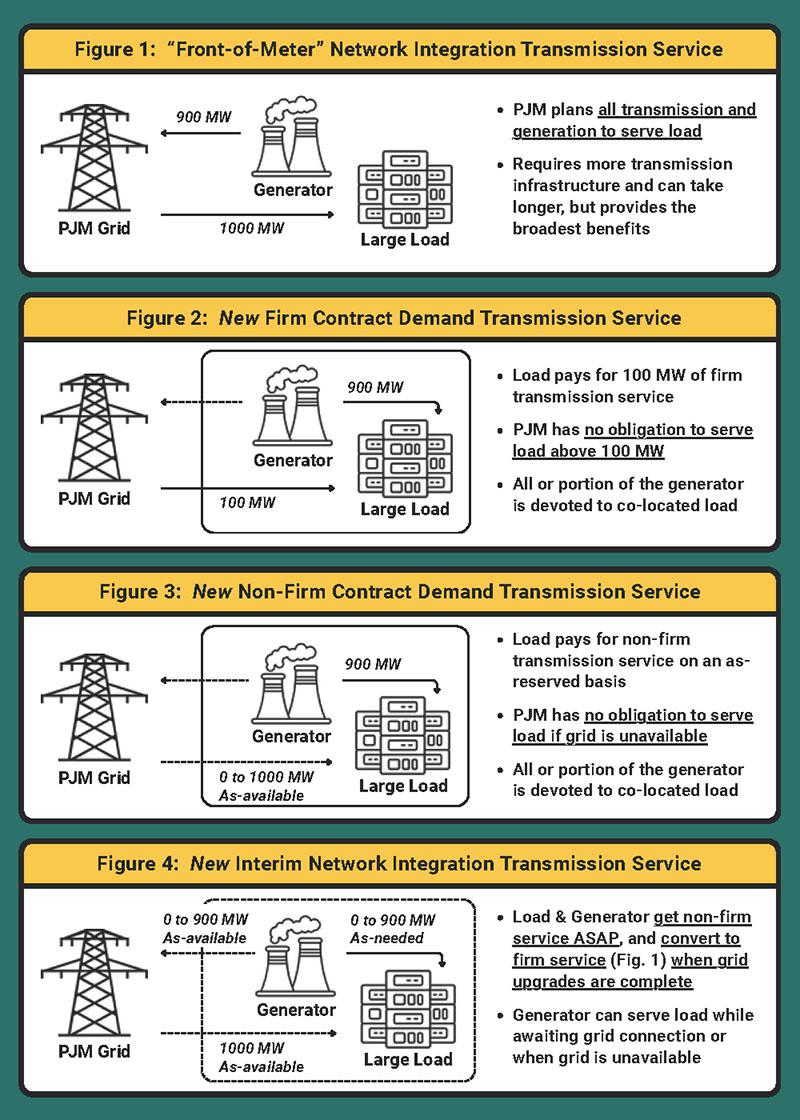
Instead of the NCBL construct, Horger said PJM is now proposing changes to PRD to encourage flexibility from large loads.

The dynamic retail rate for PRD would be replaced with an energy market price, with the strike price serving as the offer. Horger said the change would make PRD function similar to a voluntary NCBL construct.

PJM is also proposing changes to its load forecasting process to add a step in which state utility commissions could review and provide feedback on the LLAs submitted by utilities under their jurisdiction.

Entities submitting LLAs would be required to ask the customer requesting service whether they are considering multiple sites for their projects and provide that response to PJM. Horger said the change is intended to identify instances where several utilities are projecting load growth for a data center that will ultimately only be built in one location.

Commitments to procure a minimum amount of capacity for planned large load customers are also being considered.

PJM Executive Vice President of Market Services and Strategy Stu Bresler said the RTO is open to exploring a model for long-term capacity procurement, either as part of its CIFP proposal or through subsequent stakeholder processes. He noted that the reliability backstop auction provides for some of that capability already, albeit following three years of the capacity market falling short of the reliability requirement and FERC approval of its implementation.

Advanced Power Proposes Higher Maximum Price

A design component from Advanced Power would double the maximum price of an Incremental Auction (IA) if the corresponding BRA clears short of the reliability requirement and use the increased ceiling for the subsequent BRA if the higher price is needed to clear enough capacity.

Ron Paryl, vice president of markets and risk management for Advanced, said this would create an additional opportunity for demand response to resolve the shortfall, while also allowing the auction to be responsive to updates to load forecasts and provide price discovery for the value of capacity. It would also avoid discrimination between consumers and allow those most price-sensitive to avoid high capacity costs, he said.

Advanced also proposed to lock resources’ effective load-carrying capability ratings if they would fall between a BRA and corresponding IAs, preventing sellers in the BRA from having to procure additional capacity to cover their commitment, particularly if prices increase above the original maximum price under the company’s first two components. If ELCC ratings increase, the resource owner would be able to bid that additional capability into the auction.

The potential for changes to the load forecast to shift resources’ ELCC ratings was seen in discussions around how to apply the 2025 load forecast to the parameters for the third 2025/26 IA; the forecast led the risk profile to shift toward the winter, causing ratings for several resource classes to fall. PJM opted not to include preliminary figures from the forecast, and stakeholders voted to lower the Capacity Performance penalties resources face if they cannot meet their commitment due to falling accreditation. (See PJM Stakeholders Endorse Proposals to Rework ELCC Accreditation.)

Stakeholders questioned how DR offers are mitigated and whether the proposal would create market power concerns, while DR providers said adding reviews of offers would be complicated for aggregated resources.

Paryl said there is no requirement that DR be mitigated and so it should be able to make offers the sellers feel represent the costs for them to curtail.

Joint Proposal from Suppliers, Data Centers

A proposal from large suppliers and data centers would focus on making the forecasting of large loads more accurate and add triggers for demand and supply-side solutions. The proposal was sponsored by Calpine, Constellation, Talen Energy, Amazon, Google and Microsoft.

Large loads would be required to provide commitments, such as electric service agreements or arrangements to bring their own supply, in order to be included in the load forecast. A “reality check” would look at possible supply chain constraints, historic completion rates and other factors that could inhibit the number of projects completed. Characteristics such as ramping and utilization would also be factored in.

If a BRA falls below 98% of the reliability requirement, the demand-side solutions would be implemented immediately in that auction, starting with a voluntary large load DR model where participation is limited to a set number of hours a year, with reduced ELCC ratings. That could be followed by deployment of a new emergency procedure dispatching emergency backup generation to bring some of the large loads off the PJM system. The final step would be a curtailment of large loads participating in a voluntary model akin to NCBL.

If a shortfall persists after the demand-side options have been implemented, the proposal would see PJM solicit multiyear commitments of up to seven years, with shorter offers clearing first. Eligible resources include new and reactivated generation, existing generation with an offer cap above the top of the variable resource requirement (VRR) curve and DR. Those resources would clear at the top of the VRR curve and then enter subsequent auctions at the default gross avoidable-cost rate for their technology class minus the unit-specific estimated energy and ancillary service revenues. The clearing price the units would receive would remain the same across the duration of their commitment. The model would be in place between the 2028/29 and 2031/32 BRAs.

Constellation’s Ford said the BRA trigger criteria are important to minimize the impact to the market signals to attract long-term solutions. “We really want to avoid reliance on these potentially lower-quality products,” she said.

Enchanted Rock

A proposal from microgrid and backup power developer Enchanted Rock would establish a voluntary NCBL model in conjunction with states, EDCs and LSEs to allow large loads to be more flexible and create a pathway for them to interconnect ahead of network upgrades that might inhibit their ability to be reliably integrated onto the grid on a firm basis.

Joel Yu, Enchanted’s senior vice president of policy and external affairs, said voluntary NCBL is the best option for providing data centers with the ability to choose their level of flexibility, but there needs to be more adequate incentives on the supply side.

“If that load is making a commitment to provide flexibility via an NCBL structure or perhaps a different structure — as long as that flexibility can be modeled up front in an interconnection study process — we believe there’s an avenue for that load to access some amount of non-firm grid service on a provisional basis,” Yu said. “We’re not proposing any changes or options with respect to broader planning processes, but [it would] help to attract voluntary participation via the speed-to-power incentive.”

Additional Proposals to be Discussed Oct. 14

Several stakeholders have also submitted alternatives, to be presented during the CIFP meeting Oct. 14.

They include a joint proposal from Eolian Energy and the Brattle Group; proposals from the NRDC, Vistra and East Kentucky Power Cooperative; and a package from Johns Hopkins University associate professor Abe Silverman and Sue Glatz, principal consultant at Glatz Energy Consulting.

There will also be presentations from NOVEC, the Independent Market Monitor, Mainspring Energy, the Maryland Office of People’s Counsel and the office of Pennsylvania Gov. Josh Shapiro, but materials from these had not been posted online as of press time.

The EKPC proposal would require that large loads identify the LSE that will serve them before they can be incorporated into the load forecast and VRR curve, and institute “significant” penalties for LSEs that do not cover their own demand through owned or bilaterally contracted capacity. The penalties would only be assessed against LSEs within locational deliverability areas that are short of their reliability requirements in a BRA. Large loads would be defined as at least 50 MW.

Vistra proposed to impose penalties on any LSEs that are capacity deficient during emergency procedures in an effort to create an incentive for physical hedging and load flexibility. It includes a handful of options for how penalties could be determined.

The NRDC proposed a mandatory NCBL variant for any large loads coming online after the 2026/27 BRA that are not bringing their own generation. Large loads would also be able to gain firm service by participating as DR or PRD, or signing other loads to participate on their behalf; their curtailment risk could also be reduced by contracting with energy-only generation.

The Eolian and Brattle package would create a bilateral integration of generation portfolios and load structure for large loads to procure capacity through adjacent supply, with some backup provided by load flexibility. New resources participating would qualify for a 90-day expedited interconnection study and would not have their output derated by ELCC; instead, the owners of the resource and load would share the risk of underperformance.

The proposal from Silverman and Glatz is based on mandatory NCBL for new large loads so long as the capacity auction clears above the midpoint on the VRR curve. Another option would be to bifurcate the auction, first clearing non-LLA customers and then running a second auction for LLAs and any capacity resources that did not clear in the first run. To reduce the potential for double-counting large loads, they proposed to exclude them from the load forecast unless the relevant utility confirms that all distribution and transmission upgrades will be complete on time; the customer attests that it is not considering alternative locations for the project; and the customer can provide evidence of commercial maturity.

Split Colo. PUC Approves Xcel Energy’s Markets+ Application

The Colorado Public Utilities Commission on Oct. 9 issued a split decision approving Public Service Company of Colorado’s application to join SPP’s Markets+, finding that market participation is in the public interest and will “provide a number of benefits.” 

The commission, in a 2-1 vote, approved PSCo’s participation, with Chair Eric Blank and Commissioner Tom Plant finding in favor of the request and Commissioner Megan Gilman dissenting. 

PSCo, a subsidiary of Xcel Energy, filed its request to join Markets+ in February. The commission voted to approve the utility’s participation July 30 but did not issue a comprehensive written decision — including approval of some cost-recovery measures — until now. (See Colo. PUC Approves PSCo’s Markets+ Participation.)  

“In sum, we grant Public Service’s application and authorize the company to recover the costs associated with joining SPP Markets+ because increased integration between Public Service and other utilities in the Western Interconnection will likely provide a number of benefits in the short term, while allowing the company and stakeholders to explore longer-term benefits that may result from [organized wholesale markets] or continued Markets+ participation,” Blank and Plant wrote. 

PSCo’s participation in Markets+ is in the public interest and will improve dispatch of generation resources in Colorado while alleviating market seams, Blank and Plant found. “Adding to those economic benefits are other shorter-term benefits, including near-term resource adequacy benefits associated with participation in the Western Resource Adequacy Program (WRAP),” the commissioners said. 

Markets+ has in place efficient greenhouse gas accounting mechanisms, and participation will lead to wholesale market price transparency and financial benefits, Blank and Plant wrote. Participation in Markets+ also is a step toward PSCo potentially joining an RTO in the future, the decision noted. 

However, Gilman did not share Blank and Plant’s conclusions, reiterating many points she made when the PUC approved PSCo’s Markets+ participation in July.  

Instead, Gilman sided with four organizations that intervened in the case to urge the commission to deny the application. Gilman wrote in her dissent that PSCo “fundamentally failed to satisfy the public interest criteria listed in commission Rule 3752(a) and, therefore, should have properly been denied by the commission without prejudice.” 

For example, Gilman argued that Markets+ lacks sufficient greenhouse gas accounting protocols, noting those are still in development, “leaving the final result unknown.” 

“Further, several parties point to the new potential for unprecedented federal interference, especially related to emissions tracking,” Gilman added. “Such an obvious and emerging risk should not be taken lightly and could stand to significantly complicate processes moving forward.” 

Blank and Plant noted in the decision that Colorado will have some utilities participating in RTO West and Markets+, both of which are operated by SPP, arguing that this is progress toward resolving seams issues. 

However, Gilman said, “There does not appear to be a solid plan for better integration of these markets, nor a timeline upon which to do so provided in this record.” 

Gilman also appeared skeptical that PSCo’s Markets+ participation will lead to greater economic benefits or that the utility will join an organized wholesale market by 2030 as required under Colorado law. 

On the issue of resource adequacy, Gilman noted that while SPP requires Markets+ participants to also join WRAP, the utility “could join the WRAP independent of joining Markets+.” 

“So, while it is accurate that such benefits could come from the necessity to join the WRAP in order to participate in Markets+, it is disingenuous to point to this as a benefit of Markets+, as the WRAP benefits could be achieved for a significantly lower cost in just joining WRAP itself,” Gilman added. 

Advanced Energy United was one of the intervening parties in the case. 

The organization’s regulatory director, Brian Turner, sits on the Launch Committee of the West-Wide Governance Pathways Initiative, established to shift governance of EDAM from CAISO to an independent regional organization. 

“This decision further balkanizes the Western grid, leaves Colorado clean energy isolated, and undermines Colorado’s ability to ensure an affordable, reliable energy future,” Turner told RTO Insider in an email. 

“We are pleased the Colorado Public Utilities Commission approved our participation in Markets+, a wholesale energy market that will benefit our customers and Colorado,” Xcel Energy spokesperson Michelle Aguayo said in an email. “Markets+ is anticipated to lead to economic, operational and environmental benefits, by reducing operational costs through more efficient use of generation resources, which could lead to lower overall energy costs for customers. When paired with a robust transmission network, it can enhance reliability of the power grid by providing sufficient generation resources during times of increased demand.” 

Ørsted to Slash Workforce, Refocus on European OSW

Ørsted will reduce its workforce roughly 25% through the end of 2027 as it wraps up construction of offshore wind farms and remakes itself as a more competitive company.

The Danish company said Oct. 9 that it expects to shrink from approximately 8,000 employees to about 6,000 in the next 27 months, starting with around 500 who will be made “redundant” before the end of 2025.

CEO Rasmus Errboe made no specific mention of Ørsted’s U.S. projects in a news release, except to say that the company is committed to finalizing its existing portfolio off the coasts of three continents.

Ørsted’s financial problems stem to a significant degree from the U.S. market, where it built an early leadership position but has been sustaining substantial cost increases and impairments for more than two years. The future is even bleaker, thanks to President Donald Trump’s open hostility to offshore wind development and his administration’s efforts to thwart it.

Errboe said Ørsted will focus on the European market and certain Asian markets in its future offshore wind development efforts. In early 2024, the company said it remained committed to U.S. operations, despite problems there. (See Ørsted Exits Offshore Wind Markets, Remains Committed to US.)

The workforce reduction will come through attrition, terminations, divestment and outsourcing. Errboe said the process will yield a company that is more financially robust, competitive, efficient and flexible — and better able to bid on new offshore wind projects that would build value for Ørsted. It is expected to yield $310 million in annual cost savings.

“We’re committed to maintaining our position as a market leader in offshore wind,” he said. “We also need to reduce our costs for developing, constructing and operating offshore wind farms to strengthen our competitiveness.”

Ørsted has the largest fleet in the offshore wind industry, and the 8.1 GW now under construction would bring its installed capacity to 18.3 GW.

The company operates the first offshore wind farm built in U.S. waters, Block Island Wind, and the first utility-scale facility, South Fork Wind. It is building Revolution Wind and Sunrise Wind off New England and New York. It previously canceled its Ocean Wind project in New Jersey and paused Skipjack Wind in Maryland.

The portfolio is the largest in U.S. waters, and it ran into financial trouble well before Trump was elected to his second term, as the industry struggled with cost and supply chain challenges.

In the 11 months since the election, things have gotten even worse for Ørsted, culminating in a monthlong federal stop-work order in August against Revolution Wind, which was 80% complete at the time. (See Judge Lifts BOEM’s Stop-work Order on Revolution Wind.)

Ørsted in August announced it would raise $9.3 billion and self-finance Sunrise Wind. (See Ørsted to Raise $9.3B, Self-finance Sunrise Wind.) Its stock price cratered on the news, punctuating a yearslong slide. The share price has rebounded since then but still is only half what it was a year ago.

Errboe spoke with journalists Oct. 7, after conclusion of Ørsted’s rights issue of new shares to raise the cash. Reuters reported that he said work has fully resumed on Revolution Wind, which is expected to begin operation in the second half of 2026, and that Sunrise Wind is still targeted for commercial operation in the second half of 2027.

Ørsted has said the combined investment in Revolution and Sunrise will be approximately $15.5 billion.