Photovoltaic solar is expected once again to account for a significant percentage of U.S. generation capacity additions in 2026, even as the number of gigawatts being installed decreases from record highs in 2023 and 2024.
The degree of risk and uncertainty springing from indifferent or outright obstructive new federal policies in 2025 has trimmed planned solar deployment, but not “bigly,” because the central argument for solar endures for now: It is a relatively quick and cheap way to add emissions-free electrons to a grid that sorely needs more electrons.
“We’ve seen a tremendous decrease in the levelized cost of solar, though that has slowed in recent years, given a lot of the supply chain and tariff effects that are out there,” said John Hensley, senior vice president of markets and policy analysis for the American Clean Power Association. “But solar in many of these markets is the least-cost new-build resource. And in some cases, you pair that with storage, which is a fairly cost-effective strategy, and that combo pack just looks very enticing in a lot of these markets.”
Solar has another advantage: Alternatives are limited.
No one is likely to build new coal or large conventional hydro generation; new nuclear is coming but not for several years; and new natural gas turbines are expensive and backlogged for a few years.
New deployment of wind power has slowed to the point that solar is poised to surpass it as the largest U.S. renewable resource by nameplate capacity.
Countering these factors is President Donald Trump. While he does not express the same hostility for solar panels as for wind turbines, he does treat solar like a rival to fossil fuels and is moving to limit solar through policy restrictions, tariffs and elimination of tax credits.
What new surprises the Trump administration holds for solar and other renewables in the new year can only be guessed.
But so far, the effect has been significant if not severe. BloombergNEF in November lowered its 2025-2035 projection of solar capacity additions by 25% but still expects to see 432 GW of new utility-scale solar.
The Solar Energy Industries Association and Wood Mackenzie in December maintained their projection of 250 GW of solar installations from 2025 through 2030, with the caveat that significant uncertainty hangs over the industry and its future.
The U.S. solar industry has the potential to build more than 250 GW, WoodMac added.
In February 2025, well before the One Big Beautiful Bill Act codified an early end to federal tax credits for solar and wind projects, the Brattle Group looked at the possible outcome of eliminating or altering clean energy credits in a report commissioned by ConservAmerica. It concluded solar additions through 2035 would drop from 550 GW to 242 GW.
Samuel Newell, who leads more than 50 electricity-focused consultants at Brattle and was a co-author of the report, told RTO Insider that solar will continue to see growth, though not unbridled.
“Solar is absolutely a proven technology and continuing, even still, to improve, and so we’ll still see more of it,” he said. “I think the headwinds are there too. There is community opposition. There is the cost relative to gas-fired [generation] in a world that’s not paying for its emissions, and it also has the challenge that … in terms of meeting resource adequacy needs, it has lower and lower marginal value the more you add, and even lower energy value the more you add.”
The drop-off is a few years away, Newell predicted.
With “wind and solar, there’s obviously a rush to build the plants currently far enough along to be able to meet the safe harbor to still get the tax credits,” he said. “After that, I would expect them to fall off quite a bit. Some states will still build them where they’re economic because there’s such good wind and solar resources. They won’t build as many as they would have if there had been the tax credits.”
Alexander Heil, a senior economist with The Conference Board whose work centers on renewables and the energy transition, said the numbers still support solar even if policy does not.
“If you look at some of the data, solar and storage is now cheaper than natural gas when it comes to electricity generation,” he said. “So I think it’s probably a question of how much that transition is going to slow in the U.S., [rather than] completely turn around.”
Heil added the caveats that economics and solar resources are far from equal from one region of the country to the next.
(One example: The Energy Information Administration reported that 2023 capacity-weighted average cost of new solar construction in the Northeast was $2,584/kW — 61 to 67% higher than in the South, West and Midwest. It also reported that solar capacity factors in the Northeast states are lower or much lower than in those other regions of the country.)
Coal produced 196% more U.S. electricity and natural gas produced 750% more than utility-scale solar panels in the last year of Joe Biden’s presidency. Plenty of people and interest groups would like to raise those percentages even higher, and they have the ear of policymakers in the first year of Trump’s second presidency.
SEIA in November issued a report warning that more than 500 solar and storage projects totaling 117 GW of capacity are threatened by political attacks. On Dec. 4, it sent Congress a letter signed by 143 solar companies asking it to get the Department of the Interior moving again on permitting solar projects. A near-total moratorium had been in place since an Interior memo in July that revised the review procedures, they complained.
That memo was a master work of byzantine bureaucracy and analysis paralysis. ACP and many other clean energy advocates called it an intentional effort to slow renewables. It specifies separate reviews by two high-ranking Interior officials of a 68-point checklist for wind and solar facilities on public land and then a third review by the Interior secretary himself. The 69th point is a catchall for anything not included in the first 68 points.
The policy extends beyond public land to include anything on private land that needs a permit from the Interior, requires the department to sign off on another agency’s permit or uses its resources.
Two weeks after the SEIA protest letter, Interior signed off on a 700-MW solar project proposed in western Nevada.
Whether or not this was an actual or de facto moratorium, the takeaway is the same: The momentum the U.S. solar industry carries into 2026 is shadowed by uncertainty and risk.
“I think there’s a number of officials who look at executive orders and some of the action by Interior or other parts of the administration, and the gut thinking is that, ‘Oh, this only affects projects that are on public lands or in public waters,’” Hensley said. “But when you read deeper into those documents … you realize it affects more.”
All this comes after considerable effort and expense to establish a U.S. photovoltaic manufacturing base — something that would mesh well with Trump’s stated priorities if it did not involve renewable energy.
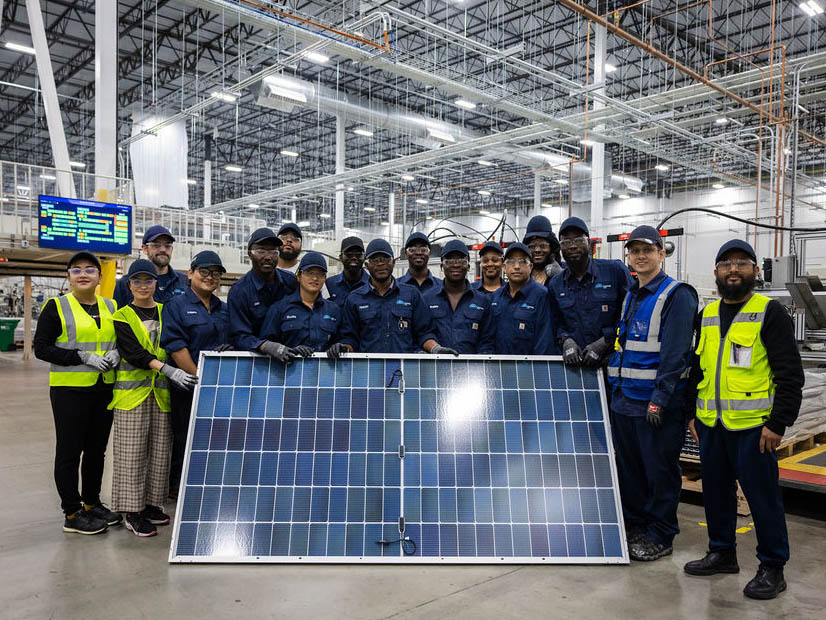
Sixty-five solar and storage manufacturing facilities began or expanded production in the first three quarters of 2025, SEIA said, including an ingot and wafer factory that completed the supply chain. Every major component of a solar farm now can be sourced from U.S. factories.
Just in those nine months, U.S. solar cell production capacity more than tripled, and it has increased more since then.
“We’ve seen tremendous advancements in the development of solar and battery module manufacturing facilities, increasing focus and intent on bringing the cell manufacturing lines here to the U.S.,” Hensley said. “We don’t want to lose sight of that. It’s not just about bringing electrons to the system; there’s a lot of job creation and economic growth activity that’s going on in the manufacturing space as well, and it’s happening fast.”
ACP tallied 146.2 GW of utility-scale solar generation nationwide at the end of the third quarter of 2025, nearly half of which came online after 2022. EIA reported that solar was expected to account for more than half of all new U.S. generating capacity coming online in 2025.