Forty years after adopting a public involvement policy, the Bonneville Power Administration is reviewing the document with an eye toward modernizing it.
BPA held a workshop Feb. 3 to start gathering feedback on the 16-page policy, issued in 1986.
“It is quite aged. There are things in it that are not really part of how anybody does business anymore,” said Kim Thompson, BPA’s vice president of Northwest requirements marketing.
The policy was written before the arrival of spellcheck, and one task will be to correct typos.
At the same time, BPA wants to rewrite the policy so it holds up in coming years despite changes such as technology advancements.
BPA wrote the policy in response to requirements of the 1980 Northwest Power Act. The policy applies to “major regional power policy formulation.” It also allows for varying levels of public involvement on issues such as transmission, renewable resources, energy conservation, and fish and wildlife.
The public involvement policy exempts certain other processes, such as ratemaking and major resource acquisition, which follow their own specific procedures. The policy also preserves the BPA administrator’s discretion to react quickly when warranted.
BPA plans to review the 1986 document’s definition of “major regional power policy,” as well as the list of exemptions. Tariff changes under the Federal Power Act are a possible new exemption.
Another area for review is the best method for publishing notices of intent. Depending on the situation, BPA might publish a notice in the Federal Register, mail it to landowners or use another means.
One workshop participant said it would be helpful to Bonneville’s “core audience” if notices were included in BPA tech forums — an email distribution group — even if they’re published in other ways.
Another attendee asked if notices could include links to relevant documents so stakeholders could get a head start on reviewing materials.
A section that’s being eyed for deletion pertains to public comment forums, in which members of the public gather to comment on an issue in person. A verbatim transcript of the forum is then prepared to be added to the record.
Although BPA still occasionally holds a public comment forum, written comments have become the standard.
The 1986 policy specifies a 30-day window for submitting written public comments, a period that allowed for mailing materials back and forth, BPA representatives said. Even though comments may now be submitted more quickly by electronic means, workshop participants seemed to favor keeping the comment period at 30 days.
“It’s not just about the time it takes to review and write comments,” said Fred Heutte, senior policy associate with the NW Energy Coalition. “Many organizations have internal processes that they have to go through to respond to an important formal proposal by Bonneville.”
BPA plans to hold at least one additional workshop on its public involvement policy. A draft policy would then be released in early April followed by a public comment period. BPA hopes to finalize the policy around July 1.
Feedback on the scope of policy changes may be submitted by Feb. 11 to communications@bpa.gov.
Picture this: It’s late on a school night and a kid asks their parents for a last-minute trip to the store. There’s a project due the next day, and without an emergency run to the market, disaster looms. What follows is familiar: some back-and-forth about how this happened, a short lecture on procrastination and finally a reluctant agreement to make an exception.
Lately, it’s hard not to feel like state and federal energy regulators are playing this game, facing utilities that waited too long and now insist everything is urgent.
A clear example is FERC’s recent approval of ERAS processes in both MISO and SPP (the Expedited Resource Addition Study and Expedited Resource Adequacy Study, respectively). These new processes allow certain power plants to effectively jump the interconnection line, skipping ahead of hundreds of other projects already waiting their turn. (See FERC Dismisses Rehearing Ask for SPP’s ERAS Process.)
When ERAS was proposed through stakeholder processes, the underlying rationale was widely understood: Utilities had not planned far enough ahead, particularly for new natural gas plants, and now wanted a faster path forward.
When ERAS was proposed in 2024, MISO and SPP together had more than 300 GW of generation projects in their queues. The vast majority were wind, solar and battery storage by competitive developers, with relatively little natural gas by the utilities. In fact, MISO’s queue grew so large that the grid operator was forced to cap new entries altogether. Yet at the same time, utilities and planners began warning of an imminent reliability crisis.
Simon Mahan
Integrated resource planning (IRP) processes exist specifically to avoid this outcome. Many utilities conduct IRPs every two to three years to forecast demand and identify future resource needs. Those plans routinely show large additions of solar, wind and battery storage, often alongside some natural gas.
The labyrinth of interconnection studies can take three to four years. Renewable projects often can be built in one to two years once contracted. Natural gas plants frequently take much longer. Utilities know this all too well, yet many failed to submit gas projects early enough to align with their own forecasts.
Now, with electricity demand rising from data centers, industrial growth and electrification, utilities are asking regulators to let them cut in line.
MISO already has received more than 60 ERAS project requests, with nearly three-quarters of the proposed megawatts coming from natural gas. These projects often skip competitive solicitations, too. They are self-identified by utilities as “needed” and advanced on an expedited basis. Entergy alone has submitted more than 8,500 MW of gas generation through ERAS. (See MISO Accepts 6 GW of Mostly Gas Gen in 2nd Queue Fast Lane Class.)
Traditionally, state commissions approve new power plants only after reviewing a full certificate application, including cost estimates, alternatives analysis and transmission impacts. ERAS turns that structure upside down. Under these expedited processes, regulators are asked to effectively bless projects before a formal application is even filed. Once a project receives accelerated interconnection treatment, it becomes far harder to later reject it or disallow its costs.
After all, once you’re already standing in the checkout line with emergency school supplies in hand, it’s difficult for a parent to say, “You’re on your own, kid.”
In this case, tens of billions of dollars are at stake.
To be clear, ERAS technically is resource neutral. Wind, solar, battery storage, gas and even nuclear projects are eligible. A few have been submitted. But they pale in comparison to the surge of utility-owned, non-competitively selected natural gas plants now racing ahead of the queue.
Fast-tracking these projects risks rewarding exactly the behavior regulators should be discouraging.
So, what can regulators do instead? Here are three practical solutions:
IRPs must be more than a paper exercise. They provide value only if regulators are actively engaged, assumptions are realistic, load forecasts are transparent and modeling reflects real-world timelines.
Competitive procurement is essential. Requiring utilities to issue requests for proposals ensures that regulators and consumers can see what the market is offering. Competition disciplines costs. Sole-source generation does not.
Diversification and transmission expansion must remain central to reliability planning. A grid built around a narrow set of resources is inherently more fragile, not less. Maybe there’s merit in a connect and manage interconnection option, like what ERCOT has.
ERAS may be described as a temporary emergency valve, but history suggests that “temporary” exceptions have a way of becoming permanent precedents.
If regulators aren’t careful, today’s emergency trip won’t be the last time.
And that’s a lesson ratepayers shouldn’t be forced to pay for.
Simon Mahan is executive director of the Southern Renewable Energy Association.
The geothermal electricity sector continues its slow growth in the U.S., but the cost of next-generation technology has fallen sharply, setting the stage for wider expansion.
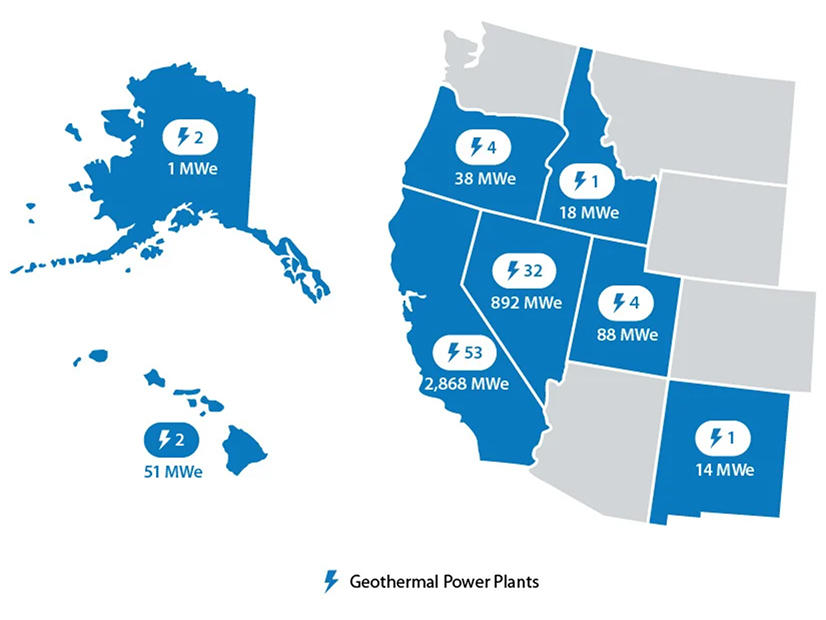
The 99 U.S. plants online in 2024 had a combined nameplate capacity of 3.97 GW, up 8% from 2020, a new report indicates.
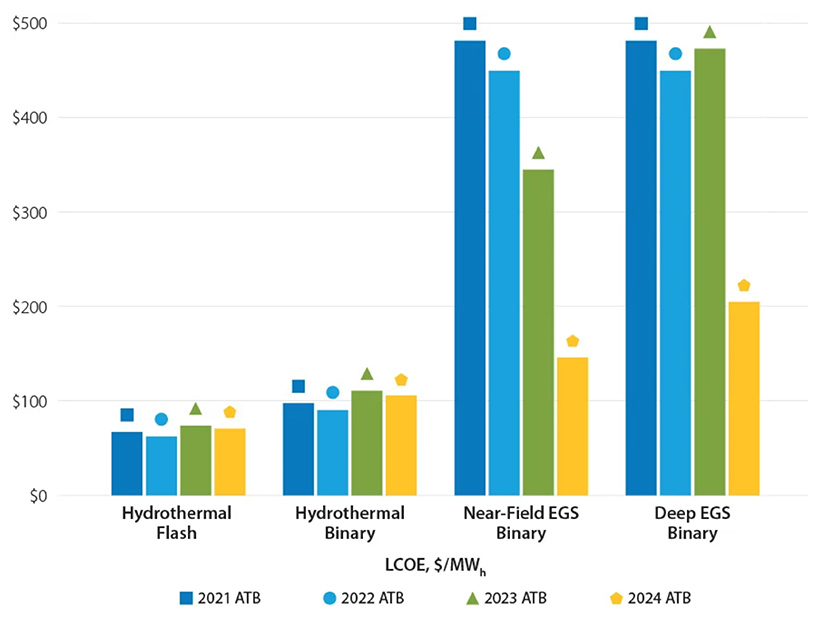
Over the same time frame, the levelized cost of electricity (LCOE) for conventional geothermal technology held relatively steady at $63 to $74/MWh for flash plants and $90 to $110/MWh for binary plants. With reported geothermal power purchase agreements running in the $70-to-$99/MWh range, the authors say, these LCOEs are considered investable for a firm, high-capacity factor source of electricity.
While the LCOE for enhanced geothermal systems (EGS) remained significantly higher — as much as $200/MWh in 2024, depending on technology — it was close to $500/MWh just three years earlier.
Recent advances could lower the cost of EGS to the level of conventional geothermal technology by the mid-2030s, the authors write.
The details come in the “2025 U.S. Geothermal Market Report,” issued in January by the former National Renewable Energy Laboratory (NREL) and nonprofit advocacy group Geothermal Rising.
The levelized cost of electricity from enhanced geothermal systems decreased sharply from 2021 to 2024. | National Laboratory of the Rockies
The Trump administration recently renamed NREL the National Laboratory of the Rockies, an indication and reflection of its energy priorities. However, geothermal energy is among the few components of the renewable energy sector in favor with the current administration amid its push for more oil, gas and coal combustion.
Recent advances in oil and gas extraction techniques have brought down drilling costs in that sector. While geothermal drilling remains more expensive than oil and gas drilling, its costs have declined as well, which is important — drilling accounts for 29 to 57% of the total cost of developing a geothermal field, according to the report, which is an expansion of a 2021 NREL report.
However great its potential, geothermal was a minimally used resource in 2024, accounting for only 15,407 of the 4,308,634 GWh of electricity generated nationwide in all utility-scale sectors, according to the U.S. Energy Information Administration.
The 8% increase in U.S. geothermal generation from 2020 to 2024 was higher than the 7.4% increase for all types of utility-scale generation over the same period.
U.S. geothermal power generation is concentrated in the Southwest. | National Laboratory of the Rockies
Geothermal nonetheless remained one of the least used technologies — wood and other biomass fuels were burned to make three times as many watts as geothermal generated in 2024.
But the report makes an optimistic case for the potential of the earth’s heat to generate more electricity and to heat or cool more structures in the United States.
It indicates the number of geothermal projects in development increased from 54 in 2020 to 64 in 2024 as research improved replicable EGS processes with substantial decreases in drilling time.
As of late 2025, 29 states had enacted geothermal incentive policies, 17 of which encourage geothermal electricity production.
The authors further present geothermal as a component of U.S. energy security and independence: a potential power plant for data centers, a potential option for hybridization with thermal storage and a potential source of critical materials from the extracted underground brine.
A recent analysis by the laboratory estimated 27 to 57 TW of EGS potential at a depth of 0.62 to 4.3 miles across the continental U.S. Approximately 4.4 TW of that is in areas under federal management, but only about 1% of it would be considered economically developable.
California and Nevada remained the center of the U.S. geothermal sector as of 2024, the sites respectively of 53 and 32 of the nation’s 99 facilities.
Analysts with the Public Service Commission of Wisconsin said ratepayers are at risk of subsidizing data centers if We Energies’ proposed rate framework for data centers is given the go-ahead as proposed.
We Energies in late 2025 proposed a framework for customers requiring 500 MW or more to subscribe to dedicated resources, poised to be mostly natural gas at this point.
The utility proposed two types of electricity subscriptions for very large customers: The first would allow data centers to take all of a resource’s output provided they cover all costs associated with the resource; the second would allow data centers to count a resource toward their capacity needs. In the second case, data centers would foot the bill on 75% of the specified resource’s fixed costs; other customers would cover the remaining 25% plus all fuel costs. We Energies theorized that MISO market revenues would be enough to offset the expenses allocated to other customers (6630-TE-113).
Data centers that enroll would be bound to an initial, minimum 10-year contract, renewed thereafter in one-year increments. The rate styles contain early termination provisions where data centers could be billed for unrecovered capital costs if the resources don’t find other customers.
Staff with the commission flagged consumer protection weak spots in We Energies’ filing in late January. They said without stronger protection, utility customers could financially support data centers’ grid needs. They said the 75/25 allocation and 10-year contract term were cause for concern.
Andrew Field, a utility auditor with the commission, said We Energies didn’t capture the full range of market price volatility in its assumption that its other customers wouldn’t underwrite data centers. In testimony, he said We Energies didn’t “provide much detail supporting the specific future scenarios, or potential alternatives, upon which the provided analyses are based.”
Field said We Energies’ own analyses show the potential for costs to exceed benefits for the general rate base.
Even with the hopeful scenarios in its analyses, Field said We Energies found a net benefit for non-participating customers in only 67% of cases that include We Energies’ pending Foundry Ridge turbine project and 81% of the cases that include its planned Red Oak Ridge turbine project.
Tyler Meulemans, a utility financial analyst with the PSC, said he harbors concerns with the 10-year term, including a data center’s “ramp-up period,” when projected load isn’t fully realized. He said including the ramp-up period raises concerns over whether the agreement length is “sufficient to cover the costs incurred to provide service” of a massive data center.
Meulemans said when PSC staff requested a demonstration of revenue recovery would look like during a ramp-up period, We Energies’ analysis showed that a 10-year term “would not cover all costs.”
Two data center projects in We Energies’ territory — Microsoft’s AI data center campus in Mount Pleasant, Wis., and the Vantage/Oracle/OpenAI facility in Port Washington, Wis. — are to double We Energies’ load by 2030. We Energies’ investor presentations show the utility is prepared to spend $19.3 billion on new generation through 2029. The increase of more than $6 billion is due to increasing data center demand.
The Citizens Utility Board of Wisconsin and Power Forward Wisconsin, the latter of which is composed of clean energy groups, oppose the 75/25 allocation and have called on the PSC to make sure data centers pay for all the costs they cause.
Sierra Club’s Jeremy Fisher was critical of the utilities’ proposed rates and said they relied on assumptions that are too rosy.
Fisher said the rate structures “appear to have been negotiated and designed with the company’s new data center customers, Microsoft and Vantage/Oracle,” and rely on the assumptions that immense data centers will become profitable and future customers would have massive electricity needs and the means to finance them.
Fisher asked what happens if the AI boom fizzles.
We Energies “may look at these customers as an enormous opportunity to increase its rate base and expand operations, but the purpose of the tariffs must not only be to provide for reasonable allocation under optimistic conditions but ensure that incumbent ratepayers are protected under adverse scenarios,” Fisher said in testimony to the PSC.
Fisher also said the rates would lead to an “inconsistent and balkanized planning process that should be deeply concerning to regulators in assessing actual resource requirements.”
Richard Stasik, vice president of regulatory affairs of We Energies’ parent company, said PSC staff and interest groups ignored We Energies’ statutory obligation to serve all customers. He said the Sierra Club didn’t quantify risks wrought by data centers and didn’t acknowledge that the situation would be riskier without a dedicated rate schedule.
Stasik said We Energies existing customers would pay at least $1.5 billion in additional capital investments if large customers were to take service under the utility’s existing rate designs.
ACEG said the reforms are starting to improve outcomes in several regions, but rising demand from data centers, manufacturing and electrification are increasing the cost of delay, especially where planning processes remain incremental or reactive.
“Progress is real, but it’s uneven — and demand growth means delay now carries real costs for customers,” ACEG Executive Director Christina Hayes said in a statement. “Where regions have embraced proactive, long-term planning, we’re seeing better results. Where planning remains fragmented, reliability risks and costs increasingly show up in household electricity bills.”
Grades assess performance at the regional level and do not assign responsibility to single institutions, instead reflecting the collective actions of utilities, regional planning organizations, states and other stakeholders. To earn top grades, regions must adopt proactive, long-term, scenario-based planning that evaluates multiple system benefits, integrates regional and interregional needs, and delivers transmission at the pace required to meet rising demand.
CAISO, MISO and SPP continue to show the benefits of proactive, long-term regional planning. SPP’s Coordinated Planning Process, once approved by FERC, would be an important reform that merges transmission planning and generator interconnection planning, the report said.
ISO-NE, NYISO and PJM have shown meaningful improvement due to FERC Order 1920 compliance filings and greater engagement with states.
ERCOT got a C, with the report highlighting the Permian Basin Reliability plan to electrify oil and gas drilling and data centers, which was released in July 2024 with options for 345-Kv and a 765-Kv portfolio. The Texas PUC picked the 765-Kv option in April 2025. While Texas has seen plenty of transmission planned, the report noted it still is done in a “siloed” style, which kept it from a higher grade.
Many regions — including all the non-RTO regions — “continue to face significant gaps in both regional and interregional planning frameworks,” the report said, “In these regions, transmission development often occurs through individual utility investments or ad hoc coordination rather than durable, region-scale planning processes, limiting the ability to fully capture systemwide benefits.”
The West, which is split into three regions, is meeting under the Western Transmission Expansion Coalition (WestTEC), a voluntary interregional planning process that the report called “one of the best interregional transmission planning practices in the country.”
The first report card from ACEG came out in 2023 and ranked the regions before Order 1920 was issued, while the second one from 2024 did not change the grades and checked in after that order. Now, the report takes the requirements from Order 1920 and adds a new focus on interregional transmission.
Load growth forecasts have changed significantly since the last report, with Grid Strategies’ summary of nationwide, five-year peak load forecasts going from 24 GW three years ago to 150 GW in its most recent update. Load growth is affecting transmission development, with FERC saying it was the main driver for 1,000 miles of new facilities in 2024.
“While today’s load growth can tempt a crisis‑response mindset focused solely on short‑term fixes, the industry must move beyond ad hoc solutions and embrace long‑term regional and interregional planning,” the report said. “Proactive, holistic long‑term planning that also accommodates near‑term needs has proven to deliver the lowest costs to consumers. It captures economies of scale that ‘just‑in‑time’ projects miss and enables high‑capacity upgrades to come online ahead of demand.”
The report looked at interregional planning and gave the country an overall “C-minus” that reflects continued reliance on voluntary coordination rather than a formal requirement for regions to implement interregional planning best practices capable of finding the highest value projects.
“The takeaway is not that nothing is working,” Hayes said. “Transmission planning works when it’s proactive, coordinated and long term. The challenge now is scaling those successes fast enough — across and between regions — to keep electricity affordable and reliable for all Americans as demand continues to grow.”
BOSTON — While there is near-universal recognition that New England will need to add a significant amount of new generation over the next two decades, conflicting political and market forces have created major uncertainty about what the next wave of generation projects will look like.
This uncertainty extends to how the region will spur the development needed to meet demand growth, several speakers said at a Northeast Energy and Commerce Association conference on power markets in Boston on Jan. 29.
The scale of the need could be substantial: ISO-NE forecasts peak load roughly doubling by 2050, and decarbonization would require additional clean energy to replace much of the existing fossil fuel fleet.
Incentivizing new generation solely through the wholesale markets may be a difficult proposition. Although energy affordability has dominated policy discussions over the past year, wholesale market prices had remained relatively low until the past two months, which have brought a major increase in energy costs due to sustained cold weather. (See Cold Weather Drives Record December Energy Costs in New England.)
Dan Dolan, president of the New England Power Generators Association, said there has been a “dramatic disconnect” between consumer costs and wholesale market prices. For generators relying on capacity and energy revenues, “if anything, there’s a revenue crisis.”
With consumer prices already high, the increased energy and capacity prices needed to spur new development could lead to political backlash and caps on market prices.
This dynamic has occurred in PJM, where “we’re just now seeing these markets shifting from being long on capacity to being more at equilibrium,” said Ben Griffiths of NRG Energy. “It’s not clear that the prices that [power developers] would require to bring in new entry are actually politically feasible.”
If market prices alone are not enough to bring new generation online, the New England states could assume an even larger role in the procurement of new generation and capacity. But continued reliance on state power procurements would bring its own set of difficulties.
Connecticut’s 10-year power purchase agreement with the Millstone nuclear plant has demonstrated some of these challenges. The difficulty of reconciling PPA costs through rates has led to major swings in the monthly costs to consumers, and Connecticut officials have been pushing for other states to shoulder some of the plant’s costs after the current contract expires in 2029.
Griffiths noted that former ISO-NE CEO Gordon van Welie had pushed the states to take on a larger role in capacity procurement through bilateral contracting.
He added that the region could consider capacity market changes aimed at increasing revenue certainty, such as altering the demand curve to stabilize prices or reintroducing some version of a price lock for new capacity.
But he expressed skepticism about the long-term sustainability of the proposal by the PJM state governors and the White House’s National Energy Dominance Council for a one-time “backstop” auction to procure 15-year contracts with new capacity resources. (See Government-proposed ‘Backstop’ Auction to Test PJM Stakeholder Process.)
“It doesn’t feel long-term sustainable to have bifurcated markets that are providing the same benefits in real time,” Griffiths said, adding that he is “increasingly skeptical of the approach of trying to move all the money out of the capacity market.”
Bob Ethier, current PJM board member and former vice president of system planning at ISO-NE, stressed the need for longer-term solutions to high costs.
“The tension that I see is that there are times where we can do things in the short term that will lower bills but will hurt the market’s functioning in the long run,” he said, emphasizing the importance of maintaining long-term entry and exit signals in the market.
Multiyear price locks for capacity could help reduce year-to-year price volatility, he said, adding that states may be better situated to pursue this strategy than RTOs. He emphasized the need to have these conversations prior to price spikes.
Once a crisis hits, like in PJM, “all we can do is ride [it] out, tweak things around the edges and hopefully learn from it for the next one.”
Policy Pickles
Conflicting objectives between federal and state policies have also added significant challenges and uncertainty to resource development, several speakers said.
“We’re in a pickle in the region for what we can build and what is a sound investment,” said Matt Nelson, principal at Apex Analytics and former chair of the Massachusetts Department of Public Utilities. “We’ve lost some tailwinds and are picking up a lot of headwinds when it comes to clean energy policy.”
Despite the load growth projections and increased demand over the past two years, there is a relatively small amount of generation in the ISO-NE interconnection queue. The first iteration of the Order 2023 cluster study process, initiated by ISO-NE in October, includes 5,632 MW of storage, 355 MW of solar and the 1,200-MW SouthCoast Wind project, which faces considerable challenges from the Trump administration. (See Storage Projects Dominate ISO-NE Transitional Cluster Study.)
Nelson said each new resource category has its own drawbacks: New gas generation seems unlikely with the region’s winter gas constraints and grid’s current “overreliance” on gas; new nuclear looks to be at least 10 years out; the federal government appears to have taken offshore wind off the table; and large-scale solar development faces questions about the loss of federal incentives and a potential capacity revenue hit from ISO-NE’s proposed accreditation changes.
To address load growth amid so much uncertainty about sources of new development, the region must build consensus around a cohesive plan, Nelson said. He added that distributed solar and storage may play an increasingly large role over the next few years.
“State programs are about the only thing left where clean energy resources can get an incentive,” he said.
Aaron Lang, a lawyer focused on clean energy development at firm Foley Hoag, said renewable developers are dealing with “a mountain of uncertainty” related to tariff policy and other potential state and federal policy changes over the past year.
“The pressure is really on the states to do a lot of stuff,” he added, while expressing some optimism about Massachusetts’ efforts to establish a new consolidated permitting and siting process for clean energy resources.
The new process stems from climate and energy legislation passed by the state in 2024. Under the new rules, developers must apply for consolidated state and municipal permits, with the permitting review process limited to 15 months for large projects and 12 months for smaller projects.
The law requires the state to promulgate final regulations by March 1. The state plans to start processing projects through the new process in July.
While there may be some short-term “bumps in the road,” the new process should provide long-term benefits for resource development, he said. “The idea of a consolidated permit is an excellent idea.”
Consumer Cost Drivers
Over the past couple years, New England has seen electricity prices rise faster than inflation, though the inflation-adjusted rate of increase has been relatively modest for most of the region, said Todd Schatzki, principal at the Analysis Group. When accounting for use and rates, customer costs have fallen since 2010 but have risen since 2020, he said.
He emphasized that the cost increases are not felt equally by all customers, with larger impacts on residential customers who have not seen wage growth in line with inflation.
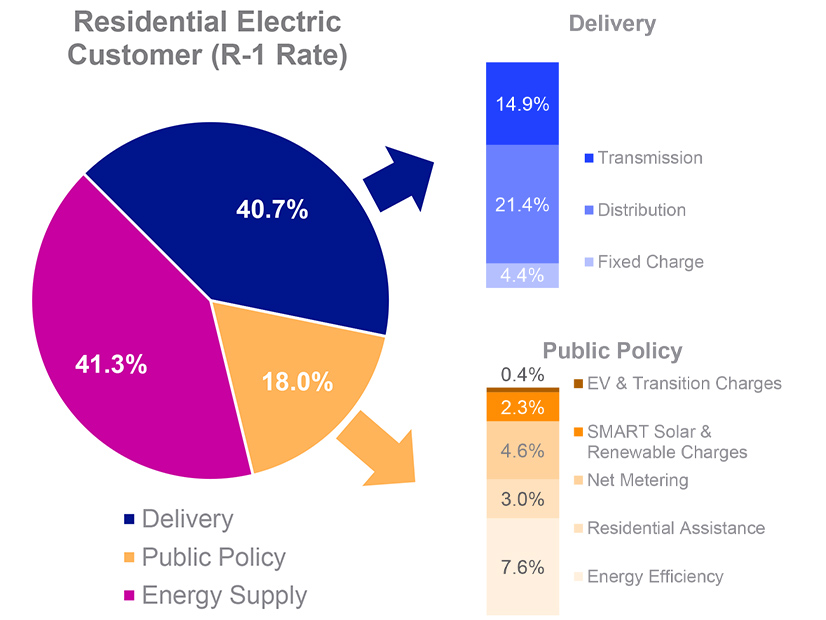
Sandy Grace, vice president of U.S. policy and regulatory strategy at National Grid, presented a cost breakdown of a typical Massachusetts residential electric bill for November. The main cost categories were energy supply (41.3%), distribution (21.4%), transmission (14.9%), energy efficiency (7.6%), net metering (4.6%) and utility fixed charges (4.4%).
Example electric bill for a National Grid residential customer in Massachusetts | National Grid
“It really does require a partnership across sectors to address these costs,” she said.
Rhode Island Public Utilities Commission Chair Ron Gerwatowski focused much of his remarks on the rise of transmission rates in the region.
Asset condition spending, or investment to address degradation of existing transmission infrastructure, has risen significantly in recent years and makes up the bulk of new regionalized transmission spending in ISO-NE. The rising costs, coupled with the limited regulatory scrutiny the spending receives, has prompted efforts to establish internal asset condition review capabilities at ISO-NE.
While this role would not be a regulatory entity, it would be intended to increase transparency into projects and provide information that could be used by third parties to challenge project costs with FERC.
“Quite frankly, it may not be enough,” Gerwatowski said. “We need the transmission owners to temper their appetite for investment in asset condition projects.”
If transmission owners do not scale back their spending, the states may be forced to try to step in and do it for them, he said, noting that states “still control both the method and the timing” of how transmission rates are recovered.
Instead of allowing the quick recovery of transmission spending as pass-through costs, the states could require the recovery of transmission costs through the full base rate case process, he said.
Introducing regulatory lag “could give the financial folks an incentive to push back” on asset condition spending, he said.
If state regulators have little or no confidence in the asset condition planning and development process, he added, “What other options do we have?”
American Electric Power and Springdale Energy will pay ReliabilityFirst a combined $180,000 in penalties for violations of NERC’s reliability standards, according to settlements between the regional entity and the utilities approved by FERC.
NERC submitted the settlements Dec. 30, 2025, in its monthly spreadsheet notice of penalty, along with a separate nonpublic SNOP regarding violations of NERC’s Critical Infrastructure Protection standards (NP26-3). FERC indicated in a Jan. 29 filing that it would not further review the SNOPs, leaving the penalties intact.
AEP’s settlement, carrying a $150,000 penalty, concerned PROC-026-1 (Relay performance during stable power swings), which was in effect from 2018 to 2024. The standard has been replaced by PRC-026-2, but the violation by two AEP subsidiaries, Ohio Power and Indiana Michigan Power, occurred while the earlier version was in effect, according to a self-report submitted by the utility in October 2022.
According to the settlement, PJM notified AEP in December 2020 that it had added the utility’s 765-kV Sorenson-Marysville line to its list of elements covered by PRC-026-1. Requirement R2 of the standard says a transmission owner must ensure the load-responsive protective relay settings on a transmission line meet the criteria in the standard within 12 months of being notified of the line’s inclusion.
The Sorenson substation is owned by Indiana Michigan Power, while the Marysville substation is owned by Ohio Power, and both are managed by separate engineers. While the engineer overseeing the Marysville facility reviewed the line relays within the 12-month period, the Sorenson facility’s manager did not review its relays until August 2022, about eight months after the deadline. Two of the relays were found to be out of compliance and require adjustment.
RF determined the root causes of the violation were “ineffective internal controls and workflow tools to ensure evaluations were completed in compliance with PRC-026-1,” the RE wrote in the SNOP. AEP had flagged the Sorenson relays within its tracking system, but no one was assigned to complete the evaluation and no follow-up notifications were issued to ensure completion.
RF also observed a lack of coordination between AEP’s subsidiaries, with the engineer from Indiana Michigan incorrectly assuming Ohio Power’s engineer would complete the evaluations on the Sorenson facility as well as the one in Marysville.
The RE assessed the violation as posing a moderate risk to grid reliability: greater than minimal because an extra-high voltage line was affected, the evaluation was late and the relays eventually were found to be noncompliant; but not serious or substantial because of the “limited scope of the noncompliance.” RF acknowledged that AEP performed an extent of condition review across the footprint of all its operating companies and found no other instances of noncompliance with PRC-026-1 R2.
AEP’s mitigation activities included performing the required evaluations of the Sorenson-Marysville line, along with the extent of condition review and creating a unified process for evaluating relays for PRC-026 compliance. The utility also updated its tracking system to specify the due date, estimated completion date and personnel assigned to each task.
Vendor Failed to Ensure Springdale’s Compliance
Springdale’s settlement stemmed from a violation of PRC-025-2 (Generator relay loadability). The utility notified RF in August 2022 that it was in violation of requirement R1 of the standard, which requires generator owners to apply the appropriate settings to their load-responsive protective relays “while maintaining reliable fault protection.”
RF observed that Springdale’s violation “was a continuation of a prior noncompliance” that the utility had failed to fully mitigate. Springdale reported the initial noncompliance in February 2020, telling the RE that it had failed to ensure the correct relay settings on three of its five generating units. To mitigate the issue, the utility hired a vendor to update the relay settings.
A month later, the vendor reported it had completed the updates; based on this report, Springdale reported to RF that mitigation was complete. However, when the utility retained a new vendor to review relay settings two years later, the second vendor discovered the settings still were not in compliance.
Springdale launched an investigation into the original vendor, which reported that “the technician who performed the work had properly changed” one relay’s settings but had incorrectly changed another. Six relays were affected by the oversight. The original vendor returned to fix the error in May 2022, but the second vendor reported in June that one of the units still was not compliant, affecting two relays. These finally were brought into compliance in November 2022.
RF determined that the root cause of the second noncompliance was vendor oversight, because the utility did not validate that settings changes had been implemented correctly. The RE assessed the violation as a moderate risk, observing that although the noncompliance lasted more than three years and the size of the settings changes increased the risk of an unnecessary trip, the limitation to three of five generating units “somewhat” reduced the potential magnitude of harm. The earlier violation did not constitute a reason to aggravate the penalty, RF added.
Springdale’s mitigation efforts included updating its vendor contracts to require engineering review of changes within 48 hours and vendor draft reports within 30 days after completion of work. The utility also implemented a vendor quality assurance process to ensure Springdale staff review the vendors’ work, and a requirement that the NERC compliance manager review the vendor draft report to check that it includes all necessary information to demonstrate compliance.
CAISO released its first mandatory report under the California assembly bill that paves the way for an independent regional organization to assume responsibility over the ISO’s energy markets.
Under AB 825, CAISO must submit an annual report to the California governor and Legislature about the ISO’s various initiatives and decisions. Gov. Gavin Newsom signed the law in September 2025, and CAISO submitted the first report to the Legislature on Feb. 1, according to a news release.
“The ISO appreciates the commitment by Gov. Newsom and the Legislature to support independent governance of the real-time and day-ahead regional electricity markets that benefit consumers across the West,” CAISO CEO Elliot Mainzer said in a statement. “We look forward to continuing to work with the state and stakeholders throughout the region to help make that new governance framework a reality.”
AB 825 allows for the creation of an independent organization to oversee CAISO’s Western Energy Imbalance Market and soon-to-be-launched Extended Day-Ahead Market. The bill authorizes CAISO and California’s investor-owned utilities to join the organization.
In the AB 825 report, CAISO listed activities from the past year, including federal tariff proceedings, policy initiatives, decisions, market activity and transmission planning.
The report lists suggested enhancements to congestion revenue rights, initiatives to address reliability needs and uncertainties between the day-ahead and real-time market, new resource adequacy rules, storage enhancements and greenhouse gas coordination, among other initiatives.
CAISO also is working to “extend participation in the day-ahead market to the [WEIM] entities in a framework similar to the existing WEIM approach for the real-time market. EDAM will improve market efficiency by integrating renewable resources using day-ahead unit commitment and scheduling across a larger geographic area,” according to the report.
The report notes that CAISO intends to seek approval from its Board of Governors for its 2025/26 transmission plan in May 2026.
Under the 2024/25 transmission plan, CAISO received approval for 31 projects valued at $4.8 billion, 28 of which are for reliability purposes for $4.6 billion. The ISO estimated it needs 76 GW of additional capacity to meet increasing building electrification and electric vehicle loads. (See CAISO Approves $4.8B Transmission Plan to Support 76 GW of New Capacity.)
NYISO began what is expected to be a yearlong effort of revising its Reliability Planning Process at a Transmission Planning Advisory Subcommittee meeting Jan. 20.
“This is the best opportunity, if you have more concrete feedback, especially any specific suggestions so that we can consider those as we consider revisions before we roll them out,” said Ross Altman, NYISO’s senior manager of reliability planning.
The existing process uses a single base case to determine whether the transmission system meets all reliability criteria. Base case assumptions are identified in May, finalized over the summer and voted on in fall. The final reliability need assessment is issued in late fall. This goes hand-in-hand with the Comprehensive Reliability Plan (CRP), which considers system conditions a decade into the future.
“The only specific feedback we’ve received so far to process revisions is to consider a longer horizon,” Altman said. “There was a suggestion of 15 years. We welcome folks’ thoughts on that.”
Altman said the use of base case means the ISO needs to use the most conservative assumptions to account for growing uncertainty across all elements of grid planning. (See NYISO’s 2026 to be Dominated by Reliability Concerns.) The use of a single base case when reliability margins are tight can mean “flip flopping” between having and not having a reliability need.
Several stakeholders said they were concerned with moving away from a single base case to multiple base cases or scenarios that might trigger a reliability need. Representing Multiple Intervenors, Mike Meager asked Altman to clarify how the ISO would weigh different scenarios or circumstances probabilistically.
Altman said it was difficult this early in the process for the ISO to come up with a “true stochastic” look at probabilities.
“Not declaring needs on outliers is something we’re thinking about how to accomplish,” Altman said.
He said the process must maintain that reliability needs be based on criteria, and he added that multiple combinations of system conditions could more accurately reflect the changing grid. He stressed that the ISO was committed to “open and transparent” stakeholder involvement in revising the process.
The ISO is planning to review key study assumptions for the 2026 reliability needs assessment study with a particular focus on load uncertainty, aging generation, emergency assistance and generator outage rates.
Howard Fromer of Bayonne Energy Center asked how the ISO planned to stick to a 10-year planning horizon for the CRP, given that it was planning on folding multiple forecasts into the reliability process.
“How do we prevent that flexibility you’re looking for from swamping the competitive market, which is what we designed to achieve whatever our reliability requirements are?” Fromer asked.
Altman said that was always a risk when using a decadelong planning horizon for a one-year market. He suggested that the issue be separated from short-term reliability needs planning.
Fromer replied that it deserved consideration because the ISO could force a lot of unnecessary infrastructure investment.
Another stakeholder asked whether NYISO would consider changing some of its base case inclusion rules to be more realistic rather than conservative. Meager said he agreed and wanted the ISO to seriously consider how realistic its assumptions are.
“It’s not difficult to show some reliability criteria will be violated … if there’s no bounds or restrictions or constraints on what assumptions the NYISO can pick and choose to use each year,” Meager said.
Altman replied that the ISO is indeed considering the issue.
Alex Novicki, representing Avangrid, requested that extreme weather events be accounted for in the base case because, he said, NERC was going to try to account for them in upcoming resource adequacy standards.
Meager also questioned the ISO’s timeline for potential changes.
“What you are contemplating are some of the most significant changes to the Reliability Planning Process we have ever considered, with huge impacts moving forward,” Meager said. “There’s not a lot of meat on the bones before us right now. The idea that we’d be voting on tariff changes in a couple months is incredibly ambitious, if not highly unlikely.”
New York generators had to rely on oil as gas was scarce throughout the Eastern Interconnection during the Jan. 25-27 winter storm, NYISOsaid in a preliminary analysis that was a last-minute addition to the Installed Capacity Working Group’s agenda Feb. 2.
“We wanted to be timely and at least talk about some high-level stuff about what happened last week for folks so we could at least level-set some of the conversation,” said Shaun Johnson, NYISO vice president of market structures.
While the storm, dubbed “Fern” by the Weather Channel, caused few disruptions in the Northeast, it had such a large footprint that it affected demand and prices across the East.
“For those of you who are upstate New York natives, last week’s weather was cold, but it wasn’t extreme New York cold,” Johnson said. “The really important part of this is that it was cold in Atlanta.”
The weather created high demand for natural gas, causing price spikes that rippled through the market. Downstate generators had difficulty obtaining natural gas at all. Index prices during the winter storm were in the $50 to $200/MMBtu range, with some spot quotes in excess of $300. Average prices typically are much lower, with Johnson citing October 2025’s average of $2.17/MMBtu as an example.
Dual-fuel units shifted to trucked-in oil, which is less efficient than piped gas. Simultaneously, snow on solar panels and overcast conditions prevented solar resources from shaving down the peak load.
“During the first two days of Fern, we went through 20% of our oil inventory in New York,” Johnson said. He said the ISO ran its fuel survey multiple times over the week and heard stories of oil-fired generators being continuously served by caravans of tanker trucks “running out the gate” the entire week.
Johnson opened a map of the U.S. from the National Oceanic and Atmospheric Administration that showed the entirety of New England, New York and most of the PJM footprint under an extreme cold advisory. Cold weather extended southward into Tennessee Valley Authority and SPP territory. Effectively, the entire eastern half of the U.S. was in a state of elevated natural gas and electricity demand.
Johnson cited the NYISO 2025 Gold Book forecast of 24,200 MW of peak load in winter. He said the ISO had come close to that several days the previous week. He displayed a graph of day-ahead peak load forecasts during Fern that plateaued just under the Gold Book forecast for several days.
Additionally, several emergency actions were taken to reduce demand. The Special Case Resource program was activated multiple hours daily Jan. 25 to Jan. 30.
External prices also were extremely high, making it impossible to stabilize prices with cheap imports, Johnson said.