FERC has clarified the reporting requirements of its Sept. 18 order approving NERC’s most recent cold weather standard as the ERO requested in October, while also answering a clarification request from a group of trade associations on the commission’s authority to set the effective date of the standard (RD25-7).
FERC approved EOP-012-3 (Extreme cold weather preparedness and operations) at its September open meeting, ordering that it take effect Oct. 1, less than two weeks later. (See NERC Cold Weather Standard Gains FERC Approval.) NERC had requested that the standard take effect at a later date, but commissioners said the Oct. 1 deadline would allow the standard to be enforceable before the coming winter and argued that registered entities should already be aware of the coming new requirements because the process was public.
In its approval order, FERC directed the ERO to collect and submit informational filings every two years starting no later than October 2026 and ending in October 2034. The filings must include:
the number of cold weather constraint declarations submitted to each regional entity;
the number of declarations approved, and their aggregate megavolt-amperes; and
a summary of the rationales provided for approved declarations.
NERC told the commission Oct. 17 that it does not currently analyze generating units based on megavolt-amperes but on their real power in megawatts. It asked whether reporting the aggregate megawatts would be sufficient. The ERO also asked whether it could consolidate the biennial filings for EOP-012-3 with the annual filings that FERC directed in its approval order for the prior standard EOP-012-1, observing “significant overlap in some aspects of the information” to be collected in each order.
In its Dec. 5 response, FERC clarified that it ordered NERC to report the aggregate megavolt-amperes “to help the commission understand the reliability risk … from a generator cold weather constraint.” FERC added that it was “persuaded by NERC that collecting real power data [in megawatts] is a reasonable alternative” and gave it permission to use that information in its filings.
The commission then addressed NERC’s question about the EOP-012-1 filings, stating that the biennial filings for EOP-012-3 “build upon” the annual filings and were intended to supplement them. FERC therefore agreed that NERC could consolidate the filings as it suggested. It also clarified that the 2034 sunset date for the biennial filings would apply to the consolidated filings overall, meaning that the ERO would not have to continue the EOP-012-1 filings after that date.
Associations’ Request Denied in Part
A group including the American Public Power Association, Electric Power Supply Association, Large Public Power Council, National Rural Electric Cooperative Association and Transmission Access Policy Study Group (filing as the Joint Trade Associations) asked for clarification on the commission’s authority to set Oct. 1, 2025, as the effective date for EOP-012-3.
The associations wrote that they did not object to the Oct. 1 date, but they pointed out that the implementation plan for the standard said that if it was approved after July 1, 2025, the standard would take effect Jan. 1, 2026. They further observed that the Federal Power Act requires FERC to remand a standard to NERC for further consideration if the commission concludes that it is “not just and reasonable.”
Asserting that NERC’s Rules of Procedure call the effective date “a mandatory and enforceable component of” a standard and that the commission sees the “effective date(s) [as] an element … in determining whether a … standard is just and reasonable,” the associations requested clarity on FERC’s authority to change the date. Specifically, they asked whether the commission “acted based on [language] in the proposed implementation plan specifying that [EOP-012-3] could become effective ‘as otherwise provided for by the applicable governmental authority.’”
In its response, FERC affirmed it “relied on” the language the trade associations cited in establishing the Oct. 1 date. However, it went on to write that NERC’s ROP “do not apply to the commission or otherwise limit commission actions.” They also cited FERC’s “policy that the requirements [of a standard] are [its] essential, substantive language … and that the commission can direct revisions to compliance-related provisions … without a remand.”
As a result, FERC denied the clarification request “to the extent it suggests that the commission lacked the authority to alter the effective date without remanding the standard to NERC,” despite answering the associations’ question about language in the implementation plan.
FERC has approved an SPP tariff change that adds real-time dispatchable interchange transactions to its Integrated Marketplace, extending the current day-ahead market dispatchable transaction model into the real-time balancing market.
The commission said in its Dec. 10 order that the proposed design will allow more economic dispatch by enabling price-sensitive, dispatchable interchange transactions in the real-time market. It directed SPP to make a compliance filing establishing the effective date, currently set at a placeholder of Dec. 31, 9998 (ER25-2753).
The RTO’s Market Monitoring Unit and the Western Area Power Administration both protested the tariff change, saying it could result in market harm through structural market power and transmission withholding. WAPA added that the lack of offer validation for real-time dispatchable transactions (RTDTs) beyond a $2,000/MWh cap could lead to market power.
FERC found the protests alleging market power issues to be “speculative.” It said the MMU did not provide additional explanation beyond high-level arguments of the behavior or its potential to increase. The commission did note that SPP said it will continue to work with the MMU to address instances of market power and that the Monitor could refer the behavior to FERC.
The MMU said SPP’s proposal would remove barriers to participation in the real-time market and could increase market efficiencies across seams by reducing the real-time price volatility associated with the grid operator’s fixed interchange transactions. It said it couldn’t support or oppose the tariff change due to missing details in the RTDTs.
The marketplace’s participants use the interchange transactions to import and export energy out of the SPP balancing authority area. The transactions can be fixed or dispatchable in the day-ahead market and are only fixed in the real-time market.
WAPA said that while it supports the RTDT concept, it thinks SPP’s proposal will harm reserve levels, intraday-reliability unit commitment and ramp distribution between hourly market products and the proposed RTDTs. The federal power agency said the RTO had not yet shared with stakeholders its proposal to address ramp-capability issues and contended the use of non-firm transmission service and hourly non-firm dynamic interchange scheduling also creates reliability concerns.
FERC rejected the parties’ other protests, including the MMU’s claim that SPP’s proposal was missing key details. “We find that the record before us has sufficient information for us to render a decision on the proposal,” the commissioners wrote.
Commission Nixes Accreditation Rehearing
In a Dec. 12 order, FERC rejected rehearing requests by several public interest organizations (PIOs) and clean energy associations over its approval of SPP’s modifications on capacity accreditation (ER24-1317, ER24-2953).
Citing the court decision in Allegheny Defense Project v. FERC, the commission said the requests may be deemed denied by operation of law. However, FERC modified the discussion in the accreditation order and continued to reach the same result in the proceeding.
The commission in July approved SPP’s performance-based accreditation (PBA) for conventional resources and effective load carrying capability (ELCC) methodologies for traditional and renewable resources, respectively. (See “ELCC, PBA Methodology Approved,” FERC Approves SPP’s ERAS Process, Accreditation.)
The PIOs and clean energy groups argued FERC erred in the order by relying on its finding that the proposed accreditation methodologies would be improvements over the status quo. They said the commission accepted a proposal that is unduly discriminatory and accepted revisions that provided an insufficient amount of detail on the loss-of-load expectation (LOLE) model, violating the rule of reason.
FERC agreed with the protesters that “mere improvement” over the status quo is “insufficient to render a tariff filing necessarily just and reasonable.” It said it instead found and continued to find that the proposed accreditation methodologies are just and reasonable under the Federal Power Act’s Section 205 standard.
The commission also said it found that SPP’s revisions provide a “sufficient level of detail” on the use of the LOLE study under the rule of reason.
WASHINGTON — Data center developers’ imperative of speed to market not only stresses the power grid but also is felt on the ground as the giant facilities — often paired with onsite generation — spring up in neighborhoods overburdened with pollution.
Infrastructure developers often pick “communities of least resistance” that usually are low-income and often minority-majority, NAACP CEO Derrick Johnson said at a summit his group hosted to develop strategies to ensure the wave of data center development in the U.S. does not overwhelm communities where they are sited.
“Data centers will exist, unfortunately,” Johnson said. “We know this. The real opportunity here is, how do we collaborate and establish best practices for their existence so they’re not predatory in nature, on our environment, our communities and our quality of life?”
The NAACP has organized against xAI’s Colossus data center in Memphis, which went online this year using unlicensed, onsite gas generation in a city that had some of the worst air quality in the region, according to a letter threatening to sue the firm run by Elon Musk.
“Part of the reason why we’re seeing that kind of thing happen in certain communities is because of the wait in order for them to actually get the energy that they need, and so then they’re trying to find these quick fixes in order to get their data center up and running as quickly as possible,” said Abre’ Conner, director of the NAACP’s Center for Environmental and Climate Justice.
In debates around the massive data center, Tennessee state Rep. Justin Pearson (D) often hears that opponents are just “NIMBY” people.
“And I say we’re not that in the way that you think. We’re ‘NIMBY again’ — not in our backyard again,” Pearson said. “Eighty percent of the pollution that comes out of Shelby County is concentrated in the district that I represent today.”
Data centers and other infrastructure often get sited in poor, minority neighbors because the developers think it will be easy, Pearson said.
“One of the things that really ignited the movement was the company literally said: ‘We chose this community because it’s the path of least resistance,’” Pearson said. “And when they looked at the historicity of our communities, that was a story that was being told. They looked at the fact that we had been red-lined, and that the same places that were red-lined became the same places where industrial parks were placed. And so now in this country, 75% of Black, African American or Latino folks live within three miles of a toxic release inventory facility.”
But organizing can counteract that, as Pearson, who is running for the U.S. House next year, pushed back against the Colossus facility and its impact on Memphis. Now xAI is building another massive data center in Southaven, Miss., just outside Memphis in a largely white area.
“They are buying these tools to check the decibels of sound because they’re so close to the turbines, they can hear it inside their homes, and when they go outside, it nearly doubles,” Pearson said.
While the two communities might have their differences, they both are pushing back against the same opponents.
“I’m working with some Republicans who don’t want to see more datamining, don’t want to see more cryptomining, don’t want to see a data center in their own neighborhoods,” Pearson told reporters. “And so, one of the principles that I’m operating with is we have to find common ground without compromising our values. And this is one of the issues where I think we’re going to find common ground across the political spectrum.”
Pearson is running a primary campaign against Rep. Steve Cohen (D-Tenn.), who has held the seat since 2007, and if he gets into office next Congress, he’s ready to propose some broad outlines for federal legislation around data centers.
“We really need to prioritize transparency, siting [and] health protections for the people who are really suffering right now with the way that many data centers are operating,” Pearson said. “I’m hearing stories every single day from communities where the water is disappearing because of these companies, the air is being polluted and communities are being locked out of the conversation. That’s not fair.”
‘Seat at the Table’ for Communities
While data centers are going up around the country wherever they can get access to the grid, fiber-optic networks and other needed resources, the largest market still is Data Center Alley in Northern Virginia, in the suburbs of D.C.
In that region, denser development has taken shape near Metro rail stations, and that was the plan for the Silver Line, which connects Dulles Airport to the district, said Karen Campblin, chair of the Environmental and Climate Justice Committee of the NAACP’s Virginia State Conference.
“Loudoun County developed a long-range plan that was supposed to complement this to the extension of the Silver Line Metro rail,” Campblin said. “AOL headquarters closed down, and so it was a large swath of land that could be redeveloped, and they identified it as this wonderful mixed-use community. It was going to have affordable housing.”
Instead of new housing and commercial spaces, the land was snapped up by data center developers, so the region now has a new metro station in an area where few people live. Campblin noted that a parking garage tied to the station was largely vacant at rush hour recently.
“One of the trends that we’re seeing is localities losing their opportunity to follow their long-term goals,” she added.
The growth around Data Center Alley was intentional as Virginia and the region attracted the businesses with tax incentives and other enticements in the early 2000s, said state Delegate Karen Keys-Gamarra (D).
“They say, if you build it, they will come,” Keys-Gamarra said. “And they have certainly come.”
Keys-Gamarra represents Fairfax County, and she noted that its neighbors in Loudoun County have benefited from data center development in their tax bills, paying about 80 cents per $1,000 worth of real estate compared to $1.30 per $1,000 in her county.
“It creates so much money for the locale,” Keys-Gamarra said. “But now we’re being forced to try to figure out what is the impact on everyone around it.”
U.S. Rep. Jennifer McClellan (D-Va.) now serves in Congress, but during her time in the Virginia legislature, she was one of the main sponsors of the Virginia Clean Economy Act and was a chief backer of the Environmental Justice Act, which was the first time the commonwealth looked into those issues.
“What does environmental justice look like?” McClellan said. “How do we ensure that more people have a seat at the table for zoning decisions, permitting decisions, whether it’s data centers, energy projects, you name it?”
Communities were interested in the tax and other benefits from hosting these major facilities, but residents often did not find out about development plans until it was too late to influence them, she added. Data centers are inevitable, with everyone using the internet requiring their expansion.
“That is a fact of life we’ve got to come to terms with,” McClellan said. “But that doesn’t mean that we can’t be thoughtful about how, where, when data centers are built, how they are operated, how they use energy, how they use water, and where they go. And we’ve got to make sure that the public has a seat at the table at the beginning of the process, not in the middle or at the end.”
‘Disturbing Trend’
Data Center Alley has been a major driver of increased demand in PJM, which has contributed to much higher capacity prices in recent auctions. But the RTO is home to plenty of other smaller data center markets, including the area of southern New Jersey (Exit 1 off the New Jersey Turnpike) that Assemblyman Dave Bailey (D) represents.
“What happens in Virginia affects my folks in New Jersey,” Bailey said. “What I’m doing in New Jersey or not doing in New Jersey affects my cousins in Delaware and Maryland and Ohio and different places across the country. So, it’s important that we keep our eye on the goal.”
Rising costs and narrowing reserve margins have led to calls for reform at PJM, and while Bailey welcomes those, he said the RTO already has made improvements in terms of responding to state concerns. (See Governors Call for More State Authority in PJM.)
“If you look at the minutes of their meetings and their various meetings they’ve had recently, they’re just a different tone,” Bailey said. “There is more transparency. It’s not perfect yet. We’ve got to continue to fight for that, and I fully agree that we need to continue to look at their overall voting procedures and how they make decisions at the various committee levels.”
Ultimately, FERC is the main regulator of PJM, and McClellan said she worries about the agency’s independence.
“Right now, I don’t think FERC has the ability, because of how many federal employees have been fired,” McClellan said. “Trump fired the chair of FERC for no reason, and Congress is not doing its oversight job as strongly as it should be. And so, I think we’ve got to make sure we have a robust federal oversight role of all of the grid operators.”
The situation FERC faces has played out in the states, where legislators often get involved in ratemaking decisions. The NAACP event was held four days after the Supreme Court heard arguments in Trump v. Slaughter, which could lead to the end of independent regulatory agencies at the federal level. (See Supreme Court Justices Seem Skeptical on Agency Independence.)
McClellan pointed to what she called a “disturbing trend” in Virginia and other states in which authority that was granted to expert-driven public utility commissions a century ago is being stripped away.
“Too much of that authority is taken away and given to legislators that are part-time generalists, and to me, that has been one of the biggest problems in electric rate regulation at the state level, and we’re beginning to see it at the federal level,” she said.
When surging seawater inundated Con Edison’s 13th Street substation during Superstorm Sandy in 2012, explosions lit up the New York City sky. As control room staff were being rescued by boat, a million people in its service area were left in the dark, five times as many as the previous high from Hurricane Irene just a year earlier. If water and electricity are a bad combination, salt water and electricity are worse.
As part of a billion-dollar resilience program, it took nearly a decade and $180 million for Con Ed to harden that substation to withstand future storms, elevating the control room two stories, installing corrosion-resistant fiberglass components, and adding retaining walls and floodgates.
Storm surge events like Sandy offer insights into what the worst of sea level rise may do to an area’s infrastructure and how the power industry needs to think about this slow-moving but inevitable threat.
It’s easy to think of sea level rise as a subtle and future challenge: After all, sea level rose by only 0.14 inches per year from 2006–2015. However, that was 2.5 times the average annual 0.06-inch rise throughout most of the 20th century. In total, the seas have risen 8 to 9 inches since the late 1800s, when Edison was building his first power plants.
Even looking at a 30-year time frame, the threat sounds concerning, not catastrophic. If you play around with NOAA’s sea level rise map and look at what the estimated rise by 2050 will do, it’s hardly “Waterworld.” The scariest numbers — if all of Antarctica’s up-to-three-mile-thick ice were to melt, global sea levels would rise by around 200 feet, and Greenland’s ice sheet would add an additional 23 feet of sea level rise — aren’t forecast this millennium.
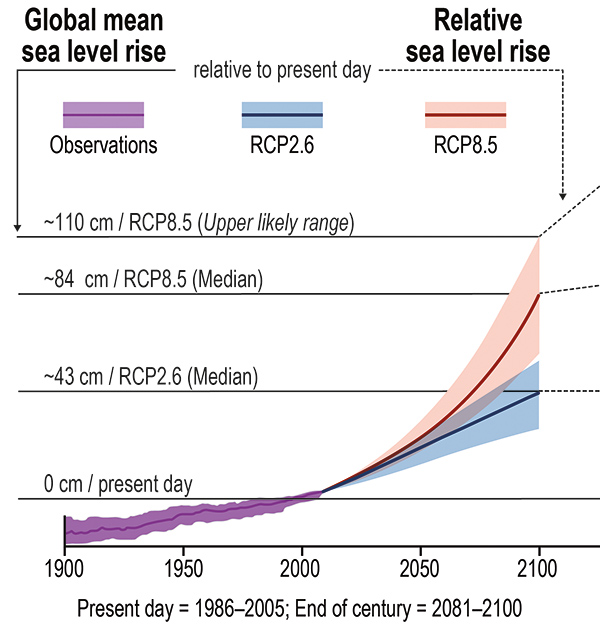
Estimates for sea level rise in 2100 range from 16.9 inches higher than today’s sea level as the median in a low-emissions scenario to 33.1 inches as the median in a high-emissions scenarios and 43.3 inches in the upper likely range for that scenario. | ICPP
But 2050? The next 30 years see an additional 8- to 10-inch rise if the midpoint of climate scenarios plays out. There’s little evidence, however, that policy changes and demand spikes won’t send us stumbling into poorer climate scenarios. Worse: The high-emissions scenario adds a couple of inches to that estimate. Worst: The Antarctic ice sheets join the party.
The real concern is when we look out to the end of the century, and in an industry that builds infrastructure that’s expected to last into the 2100s. That’s where we should be focused. While most scenarios range from 16 inches to three feet in rise over today’s sea levels, some threats could add significantly to that. Most concerning is the potential collapse of Antarctica’s Thwaites Glacier (or, as his friends call him, “Doomsday”), which not only holds enough ice to raise sea levels a couple of feet, but also is the stopper holding back much of the massive West Antarctic Ice Sheet.
Sea levels rise not only because ice caps and glaciers are melting, but also because the oceans expand as they warm. There’s also displacement as land held down by the weight of ice rises as that ice thins.
All Coasts are not Equal
It’s easy to assume sea level is, well, level in the same way a water level finds equilibrium. But the global mean sea level is just an average. The coastal impact will vary significantly, based on how the earth rotates, how the oceans flow and how tectonic plates are moving; it’s why the Pacific Ocean side of the Panama Canal is eight inches higher than the Atlantic side.
For the U.S., NOAA’s model predicts the Gulf Coast will rise 14 to 18 inches by 2050 and the East Coast from Virginia to Maine will rise 10 to 14 inches but the Pacific Coast will rise only 4 to 8 inches. This means infrastructure owners have to plan and prioritize their upgrades using detailed local projections.
The NOAA mapping tool uses mean higher high water (MHHW), not mean sea level, as the starting point, as it represents the elevation of the normal daily tide movements where the shoreline normally is inundated. The MHHW is the high point of “normal.” If the MHHW rises, not only is the daily sea level higher, but also king tides and storm surges start from a higher baseline.
Oh, We Do Like to be Beside the Seaside
Face it: We love the ocean. More than swimming in it or gazing at it, we love shipping goods across it, cooling power plants with it, sucking oil out from under it and reclaiming it to expand cities.
All of this commerce means coastal cities and counties are home to more than a third of Americans. The result: While around 13 million homes are at risk of flooding in the upper end of NOAA’s regional scenarios, the infrastructure many millions more depend on is at risk. That infrastructure ranges from airports (12 of the nation’s busiest airports have runways at risk of storm surge) to hospitals to water treatment plants.
The energy sector is no exception: Many power plants, substations and transmission corridors were historically sited near water for cooling and logistics. These assets may be damaged by storm surge, tidal flooding and erosion. Additionally, buried cables, conduits, control systems and transformers near the coast are at risk of saltwater intrusion as groundwater rises.
Asset owners will need to invest in moving, raising or otherwise hardening those coastal assets if they are to maintain service reliability and manage the cost of insuring those assets.
Substation by the Sea
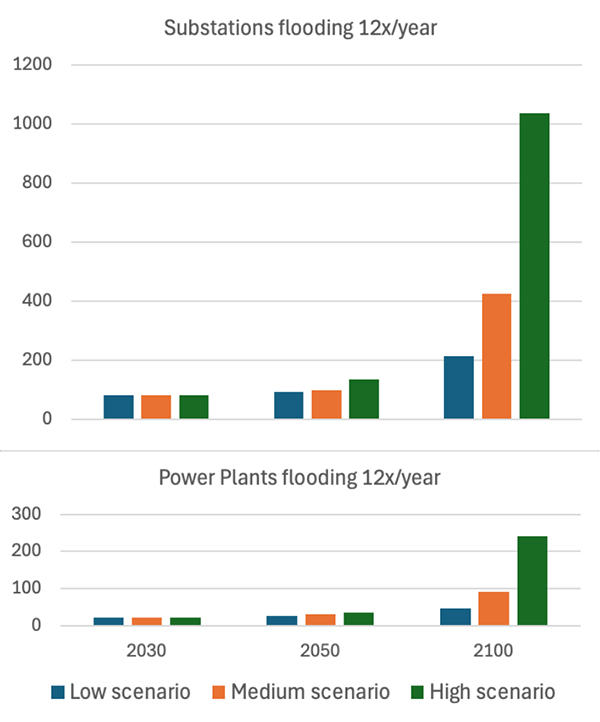
More than 150 substations are expected to be heavily affected by flooding twice or more annually by 2050 | Based on data from the Union of Concerned Scientists
A significant number of energy assets are built by the shore: 2,681 power stations and 8,750 substations, according to the Union of Concerned Scientists. The UCS study looked at all critical infrastructure: power and substations, public safety and health facilities such as hospitals and fire stations, educational institutions, public and affordable housing, industrial contamination sites, and government facilities.
Some states have significantly more critical infrastructure at risk than others, with Louisiana (334) and New Jersey (304) most at risk by 2050 under a medium sea level rise scenario. As time goes on, Florida leaves all other states behind, and by 2100, it has more than three times the number of critical infrastructure assets (4,599) at risk than any other state under the high sea level rise scenario.
In terms of the energy sector, by 2050, 151 electrical substations are likely to be heavily affected by flooding at least twice annually under a medium sea level rise scenario. By 2100, more than 1,000 substations and 240 power plants are at risk of monthly flooding under a high sea level rise scenario.
Companies with assets near the coast can explore the interactive map to discover which critical infrastructure assets in are at risk.
Preparing to be High and Dry
The IEEE model for wildfire preparedness discussed earlier in this series includes three lines of defense: prevention, mitigation and proactive response, and recovery preparedness. Sea level rise needs a similar approach, though in its case, utilities can’t prevent it.
Most actions fall into the second line of defense: mitigating damage by hardening, raising or moving infrastructure inland. Con Ed’s post-Sandy upgrades, for example, included “walls to keep water out of substations, submersible equipment that keeps operating even when submerged in salty water, stronger poles and wiring for the overhead system, transformers that can be installed quickly and other measures,” a spokesperson told RTO Insider.
“It also included the reconfiguring of two electric networks in Lower Manhattan, allowing us to shut off service (due to flooding) to customers near the coast while leaving the customers located more inland to stay in service.
“We estimate that the upgrades made since Sandy have prevented more than 1.2 million outages.”
In some areas, there’s a tradeoff to consider: Do you lessen the chance of wind damage by undergrounding assets, or does that increase their chance of being damaged by sea level rise? And, as with any emergency, having islandable backup power for hospitals and other critical infrastructure will improve safety and resilience.
For grid and power plant owners and operators with assets in coastal areas, the only good news about sea level rise is that it’s relatively predictable and there’s time to act. While it may not save assets from storm surge as named storms become more frequent, there is time to prepare for 2050- and 2100-level sea levels.
Preparation Starts with Data
Infrastructure upgrades start with good modeling to understand what’s at risk. Just like with other climate-exacerbated disasters, asset owners shouldn’t base plans on outdated FEMA maps; utilities need forward-looking, climate-adjusted models that include groundwater rise and compound flooding. And given the expected variation in sea level rise along coasts, local studies are critical, particularly for major cities.
While watching Ken Burns’ “American Revolution” recently, I was surprised to see a map of Boston that looked nothing like the Boston I know. Today, it has a significant amount of reclaimed land; half the city is built on landfill and earth moved from hills flattened after the tea went into the harbor. As a result, a lot of its important infrastructure is at sea level. As RTO Insider’s Jon Lamson reported last year, a report delves into the local impacts that could be felt, and it’s a solid starting point for prioritizing upgrades.
Similarly, following the big freeze in Texas, the state’s regulators, ERCOT and state emergency management officials mapped its critical infrastructure to ensure better coordination in future emergencies.
For areas that have no granular studies, the NOAA tool offers a range of local scenarios that map low, intermediate and high projections up to 2100 and that can be overlaid onto existing infrastructure maps.
Along with physical preparation, utilities need to incorporate climate projections into integrated resource planning and state PUCs need to align requirements with future climate risks, not historical conditions.
“We went to our regulator and got approval to invest $1 billion to fortify our energy systems against extreme weather,” the Con Ed spokesperson said. “Fortifying the energy systems against extreme weather is now part of our ongoing planning and investing.”
Regulators in areas that haven’t had a Superstorm Sandy-style wakeup call would be well-served by helping utilities invest in fortification before a similar crisis strikes.
The Calm Before the Storm
Proactive response is critical, especially for storm surge, which is sea level rise on steroids. With larger storms and the surge starting from a higher baseline, the threat is amplified compared to past storms.
It’s not feasible to move or harden all infrastructure that could be affected by storm surge, but acting ahead of a storm can minimize damage. When storm surge is expected, powering down at-risk infrastructure may inconvenience customers, but ultimately leads to shorter blackouts and less equipment damage, as shown in Superstorm Sandy when Brooklyn’s Farragut substation was proactively powered down hours before the 13th Street substation was involuntarily powered down by sea water. Farragut was de-energized when it was inundated, and equipment was quickly dried and power restored by noon the day after the storm.
The third line of defense, recovery preparedness, is essential as well. It’s an investment that will pay off across all types of crises. For example, Con Ed’s hardening program included buying 110 bucket trucks and staging them an hour outside of Manhattan, so crews flown in from other states can be deployed rapidly for future recovery efforts.
No Utility is an Island
Sea level rise will affect many types of coastal infrastructure, so coordinated plans should be developed to use construction projects. It is planning that should be done at the state or national level, though many states still are using 20th-century assumptions for 21st-century risks.
Some measures, such as building sea walls, may help entire cities and their infrastructure. But seawalls are expensive and not an option in many areas due to geography or geology. Miami, for example, is built on porous limestone, so a barrier around the edge would do nothing to stop the water from seeping up through the ground in low-lying areas. Parts of Miami already experience sunny-day flooding during high tides, and some are suggesting it’s time to talk about managed retreat. But as one of the most vulnerable cities in the country, Miami’s been proactive in assessing its risk and planning a coordinated response. Its Sea Level Rise Adaptation Plan provides a complete, though sobering, look at everything needed to keep Miami inhabitable as the seas rise.
For many utility upgrades, it will be more cost-effective to coordinate with other services that need to be hardened than to have all affected infrastructure owners prepare piecemeal for the coming sea level rise.
Physics, not Politics, Must Guide Us
The grid and power system must be redesigned for the coastline we will have, not the one we remember. The physics of rising seas is not negotiable. While storms will give us a taste of how damaging rising sea levels can be, there is time to prepare for the everyday sea level rise that utilities and grid operators in coastal communities will face.
Utilities, regulators and policymakers must treat this as an engineering and planning challenge, not a political one. While climate reports are being removed from federal agency websites, leaders in affected communities know they can’t afford to waste time debating whether it’s happening and why.
For power plant and grid owners and operators, there’s no simple choice between investing now to avoid catastrophic outages or paying later in dollars and lives. The cost of proactive resilience is massive for a problem of this scale. What is clear is that we must understand where the risks are before we can prioritize where to invest.
The seas are rising whether we prepare or not. The grid needs to rise to the challenge.
In its final meeting of the year, the NYISO Business Issues Committee unanimously approved a motion recommending the Management Committee approve changes to the tariff to update the interconnection agreement between the ISO and Hydro-Quebec ahead of the completion of the Champlain Hudson Power Express.
Stakeholders also unanimously approved a motion recommending the MC approve new tariff revisions to implement the Improve Duct Firing Modeling project, which will accommodate combined cycle generators equipped with duct-firing capability for real-time dispatch.
The committee also heard a market operations report for November. The average locational-based marginal price was $57.14/MWh, $10 more than in October and much higher than November 2024’s price of $35.26/MWh. The average year-to-date monthly cost of power was $70.24/MWh, a 70% increase over that of last year.
Natural gas and distillate prices also rose over the last month. Natural gas rose about a dollar to $3.16/MMBtu in November. Year-over-year natural gas prices have risen 60.6%. Jet Kerosene Gulf Coast rose about a dollar to $16.57/MMBtu, up 8.6% from last year. Ultra Low Sulfur No. 2 Diesel also rose a little over a dollar to $17.91/MMBtu. Distillate prices were up 12.8% year over year.
Operating Committee
The Operating Committee also unanimously recommended the MC approve the tariff changes to facilitate CHPE integration.
Stakeholders also heard and approved a system impact study for a large load interconnection of a data center in the Buffalo area. Digihost, the project owner-operator, is seeking to increase its retail load from 9.8 MW to 60 MW. NYISO found that the project would not cause thermal or voltage issues on the local grid and that no new upgrades would be needed to support the project.
The OC heard a brief presentation of November’s operations metrics. Peak load for the month hit on Nov. 11 during the 5 p.m. hour at 20,325 MW. This set the peak for the 2025/26 winter reliability period so far but was below the all-time record of 25,738 MW set in January 2014. Peak wind occurred on Nov. 28 with 2,338 MW. Combined front- and behind-the-meter solar peaked at 3,510 MW on Nov. 4.
Several notable system events occurred during the month. On Nov. 11, NYISO issued an alert during the 11 p.m. hour and reduced power flows to 90% of ratings because of an intense solar storm. Several elements of the Smart Path Connect transmission project were put in service incrementally throughout the month.
A trade group representing multiple MISO power producers has lodged a complaint against retroactive pricing revisions in MISO’s 2025/26 capacity auction, joining Pelican Power in calling the repricing unlawful.
The Coalition of Midwest Power Producers (COMPP) filed the second complaint Dec. 12, asking FERC to “restore confidence” in the capacity auction by ordering MISO to return seized revenues and cease any further resettlements.
Pelican Power is a member of COMPP, which was joined in the complaint by renewable developer JERA Nex Americas and Rainbow Energy Center, owner of the Coal Creek Station in North Dakota.
COMPP told FERC that capacity auction results are financially binding. If MISO’s after-the-fact adjustments rely on too broad an interpretation of MISO’s resettlement authority, “that cannot be squared with the plain language of the tariff or the limitations imposed” by the Federal Power Act.
MISO is making $280 million worth of pricing adjustments to its 2025/26 capacity auction clearing prices, charging an unnamed number of market participants that sold capacity. The RTO announced the repricing after it discovered a yearslong coding error for the loss of load expectation calculation in a third-party vendor’s software. The mistake raised the RTO’s planning reserve margin for almost a decade and caused it to procure more capacity than necessary. (See MISO Discloses $280M Error, Over-procurement in 2025/26 Capacity Auction.)
MISO began issuing the first of three rounds of settlement adjustments in September. The initial set of corrections totaled nearly $77 million. MISO warned market participants that if the adjustment should exceed their credit limit, it would trigger a margin call to cover losses within two business days.
COMPP said MISO should “return hundreds of millions of dollars that have been taken from market participants in connection with MISO’s unlawful resettlement of the 2025/26 Planning Resource Auction” (PRA). It said “any confidence that had been provided by the auction results has been shattered by MISO’s decision to reopen the results months after the PRA concluded and after the 2025/26 planning year commenced on June 1, 2025.”
MISO has said its markdowns or markups aren’t to be construed as it issuing new clearing prices or rerunning or resettling the auction.
But COMPP and companions have countered that MISO effectively is rerunning the market and has significantly reduced the compensation resources receive for capacity.
COMPP said generation owners realize MISO is attempting to correct an error but that MISO can’t replay the auction with different loss of load inputs.
“There simply is no way to predict how changes in the parameters used to run the auction would have changed the behavior of market participants or the resulting [auction clearing prices],” COMPP argued. “The only thing certain is that MISO’s misguided re-run threatens to undermine the confidence in the MISO markets in a manner that does not align with the objectives of encouraging investment or maintaining reliability.”
COMPP requested FERC put an end to MISO “sowing further dysfunction into the PRA.”
According to COMPP, a resource in MISO South would have its $666.50/MW-day summer clearing price set by the 2025/26 PRA reduced by $374.3/MW-day, down approximately 54%. In MISO Midwest, capacity prices are expected to drop by $207.40/MW-day, down 31% from the summertime clearing price.
“The market-wide uncertainty created by MISO’s decision to conduct what amounts to a rerun of the 2025/26 PRA will harm MISO’s ability to retain and attract investment in the baseload resources needed to maintain resource adequacy,” COMPP wrote. The group added that independent power producers stand to be particularly adversely affected. They and their investors will be “incentivized to avoid investments in the MISO markets,” COMPP warned.
MISO: Dismiss Pelican Complaint
MISO responded to Pelican’s complaint Dec. 15, asking FERC to dismiss.
The grid operator said it’s duty-bound by its tariff to correct continuing errors with “appropriate adjustments to address financial impacts.” It said it further has the discretion to make adjustments, and absent a tariff-defined remedy, used its judgment to revise prices using an auction simulation that featured a corrected loss of load expectation value and changed sloped demand curve.
The result, “however harsh, is required by the filed rate doctrine, which requires MISO to follow the tariff and ‘does not yield, no matter how compelling the circumstances,’” MISO wrote.
The RTO argued that suppliers and load-serving entities alike had an expectation that the 2025/26 PRA would be conducted using the correct loss of load expectation calculation, per the tariff.
MISO said the eight-year-old error wasn’t easily detected because it placed “reasonable reliance on the vendor’s representations that the LOLE software was fully compliant” with its tariff requirements.
“Pelican Power, like all market participants, has an understandable pecuniary and partisan interest in the outcome of this case, and as such, the arguments forwarded by Pelican are inherently biased toward the best outcome for Pelican Power and therefore must be viewed with skepticism,” MISO told FERC.
MISO has ended its 10-year run allowing energy efficiency in its capacity market.
The RTO’s acceptance of energy efficiency in its capacity auctions is officially over with a Dec. 12 order from FERC (ER26-148). MISO asked for permission to discontinue auction eligibility in October.
FERC allowed the request to take effect Dec. 15. MISO will prevent energy efficiency resource registrations beginning with the 2026/27 planning year starting June 1. MISO’s Independent Market Monitor has long advocated for the deletion. (See MISO to Axe Energy Efficiency from Capacity Market.)
MISO said just two market participants have registered and cleared energy efficiency in the auctions since it began allowing it under a new type of planning resource in 2015. The RTO required that energy efficiency measures be in use for less than four years to enroll for auction participation or count toward a planning reserve margin requirement.
MISO said prohibiting capacity offerings from energy efficiency would prevent the double-counting of it on both the demand and supply sides and avert payouts to market participants for energy efficiency measures that would have occurred anyway without the capacity registration.
MISO also said the move would “eliminate the opportunity for unjust enrichment by midstream contractors,” and noted that middlemen have registered energy efficiency in capacity markets based solely on energy-efficient product sales data attained from retailers and distributors, with consumers unaware that they signed on to provide capacity.
The description was an apparent callback to FERC’s nearly $1 billion fine on American Efficient, which culled sales data associated with products sold at retailers such as Home Depot, Lowe’s and Costco. (See FERC Seeks Nearly $1B in Penalties from EE Provider in MISO, PJM.)
American Efficient, one of the two market participants that have registered and cleared energy efficiency megawatts in MISO capacity auctions, protested the filing to no avail.
MISO has said load-serving entities are free to continue to use energy efficiency measures on the demand side to reduce their coincident peak demand forecasts.
FERC decided that energy savings reflected in peak demand forecasts only still would account for energy efficiency contributions. It said MISO’s request was fair and reasonable.
MISO said its auction workload would be lighter if it didn’t have to evaluate the registrations of energy efficiency resources and go through the process of measuring and verifying their energy savings.
ReliabilityFirst expects “normal risk” for the upcoming winter season thanks to positive developments across its territory, one of the regional entity’s engineers assured listeners during a webinar hosted by the organization.
Tim Fryfogle, RF’s principal engineer for resources, engineering and system performance, joined the Dec. 15 webinar to discuss the results of RF’s Winter Reliability Assessment, which the RE released Dec. 10 as a companion to NERC’sWRA.
The assessment is intended to provide a closer look at reliability risks in the RF footprint during the winter months of December through February, based on data from PJM and MISO; parts of both RTOs are in the RE’s service area.
NERC’s WRA found “pockets of elevated risk” across North America, indicating a “potential for insufficient operating reserves in above-normal conditions.”
However, the WRA left PJM and MISO out of this group, assessing both areas under the “normal” classification. This means they possessed sufficient generating capacity to meet demand under both the ERO’s 50/50 load forecast, which denotes a 50% chance the actual load will be higher or lower than predicted, and the 90/10 forecast, meaning a 10% chance that the actual load is higher than predicted. (See NERC Winter Reliability Assessment Finds Many Regions Facing Elevated Risk.)
Fryfogle observed that RF’s assessment came to the same conclusion, despite using different analyses. Both assessments use the same data drawn from NERC’s Generating Availability Data System, which collects performance information from conventional, wind and solar plants.
The difference, Fryfogle said, is that RF’s analysis is based on historical GADS data covering December through February over a rolling five-year period, while NERC uses the average forced outages for weekdays in the same months over the past three years. Fryfogle did not describe either approach as superior but said the fact they reached similar conclusions is “a great way to provide some verification and validation with regards to the end result.”
Fryfogle observed that the assessment of MISO and PJM represents a significant change from last winter, when NERC’s WRA found both MISO and PJM faced elevated risk during extreme weather scenarios. He cited several reasons for the shift.
First, he pointed out that the 2024/25 winter risk determination factored in the impact of litigation over the Transco Regional Energy Access gas pipeline and potential constraints on its use. FERC’s reinstatement of the pipeline’s certification allowed the risk to be downgraded, Fryfogle said. Second, since last year’s assessment MISO has implemented a seasonal resource adequacy construct and unit accreditation, allowing the region to better assess resource availability.
The changes mean PJM has a less than 1% chance of being unable to serve load even in the 90/10 scenario, Fryfogle said, while MISO’s likelihood of being unable to serve its load under the same conditions is about 3%. However, he urged listeners to remain cautious because severe weather could develop quickly. He suggested utilities make use of resources such as RF’s winterization assistance visits. (See RF Presenter Plugs Winterization Assist Visits.)
“We have a great team that … will help you pinpoint any issues … but please continue to do your due diligence [and] please share best practices,” Fryfogle said. “We are continuously getting better, but that’s because of outreach, everyone sharing great ideas and thoughts on how to weather these cold winter storms.”
Texas regulators have approved two more applications under the Texas Energy Fund’s completion-bonus program, making the generation resources eligible for more than $100 million in grants.
During its Dec. 12 open meeting, the Public Utility Commission sided with staff’s recommendation to issue eligibility notices to Calpine and NRG Energy for their projects that add 916 MW of dispatchable gas-fired capacity to the ERCOT grid. The companies can execute grant agreements with the PUC upon the generation’s “timely and successful” interconnection (57937).
Both projects already have been awarded 20-year loans at 3% interest under the fund’s In-ERCOT Generation Loan Program and are expected to come online before summer 2026.
Calpine, which was granted a $278.3 million loan in October, now is eligible for $55.2 million in performance-dependent TEF funds over a 10-year period for its 460-MW Pin Oak Creek peaker. NRG could receive as much as $54.7 million in grants for two gas turbines, totaling 456 MW, at its TH Wharton plant. The units were awarded a 20-year loan of up to $216 million in August. (See NRG Energy Secures $216M Loan from TEF.)
The Completion Bonus Program is one of four under the fund. Applications must meet a set of nine criteria that include market participation and whether they provide dispatchable energy or are a non-storage facility.
The commission also approved staff’s recommendation to extend timelines for the first disbursement of loans to seven applicants in the In-ERCOT program (56896). Under a recently enacted state law, the first loan payments were due to be disbursed before January.
Staff said each loan applicant had multiple market factors outside their control and had taken “reasonable steps to mitigate the delays caused by these factors.” They cited global demand for transformers and turbines, cost and availability of contractors, construction and permitting delays, and economic constraints.
“A confluence of market forces … make it unlikely that the commission could timely enter into a loan agreement with the applicants,” PUC staffer Susan Nance told commissioners.
With the extensions, the PUC now faces deadlines of June 30, July 31, Sept. 30 and Dec. 31 in 2026 to disburse the first loan payments. Together, the applicants’ 10 projects amount to 4,063 MW in nameplate capacity.
Entergy 500-kV Line Approved
The PUC approved an administrative law judge’s decision allowing Entergy Texas to build a 500-kV, 41-mile single-circuit transmission line in Southeast Texas (58136).
Entergy said the Cypress-Legend project is necessary to address load growth from new and expanded industrial facilities and an increase in residential and commercial demand in Texas’ Golden Triangle. The region’s load is expected to grow by about 40% in the next five years.
MISO identified Entergy’s proposal as a baseline reliability project. It has an estimated cost of $398.7 million.
However, PUC Chair Thomas Gleeson moved to grant the rehearing for the “limited purpose” of including additional findings and explanation. He said the chosen route “best meets the transmission line routing factors the commission must consider.”
The Western Transmission Expansion Coalition plans to publish its 10-year outlook for Western transmission needs in February 2026 and has begun outlining the 20-year plan, according to Energy Strategies, which is developing the report.
The WestTEC effort, jointly facilitated by the Western Power Pool (WPP) and WECC, will address long-term interregional transmission needs across the Western Interconnection. The goal is to produce transmission portfolios for 10- and 20-year planning horizons. (See WestTEC Tx Study on Track Despite Delays.)
The 10-year outlook is slated for release in February 2026, pending approval from the WestTEC Steering Committee, said John Muhs, senior consultant with Energy Strategies, during a WestTEC Regional Engagement Committee meeting Dec. 11.
The 10-year report will include a six-page summary, a 20-page report and technical appendices with supplemental data and methodology, according to presentation slides.
“The study work itself is largely done pending approval,” Muhs said. “But the 20-year is further behind — it’s earlier on in the study process.”
The goal for the 20-year plan is to have a report in front of the WestTEC Steering Committee by September 2026, Muhs said.
The consulting firm has begun developing the 20-year reference case nodal models and hypothesis map. Energy Strategies is using the 10-year models as a starting point to develop the production cost model and system reliability assessment, according to the slides.
Energy and Environmental Economics (E3) will provide data on expected electricity demand by 2045, which Energy Strategies will use to develop area-level load profiles for the 20-year reference case with feedback from the WestTEC Assessment and Technical Taskforce (WATT).
Based on data from E3 and the 10-year outlook, Energy Strategies is mapping out how the transmission system could look in 20 years, according to the slides.
The main objective of WestTEC is to create an “actionable” transmission study by conducting integrated planning analysis across the Western Interconnection.
The study horizons focus on evaluating transmission requirements in 2035 and 2045, with the goal of prioritizing “flexible and scalable transmission solutions for nearer-term needs to help better position the system for efficient long-run expansion,” the study plan reads.
The effort has support from stakeholders across the Western region. For example, WATT members include representatives from the Bonneville Power Administration, Western Area Power Administration, Powerex, Northwest Power and Conservation Council, and more.
In June, CAISO cited WestTEC as one of the factors influencing its interregional transmission planning, saying it will use the information to help identify opportunities it will emphasize, either by itself or in collaboration with other entities. (See Inland Wind, WestTEC to Guide CAISO Interregional Planning.)
Energy Strategies will present “a much more finalized version and set of results” of the 20-year outlook during WPP’s all-committee meeting in January, Muhs said.