The California Public Utilities Commission approved a request to cancel Pacific Gas and Electric’s contract with California State University, Monterey Bay to convert hundreds of the university’s residential units from gas and electric service to all-electric service.
The project between PG&E and CSU Monterey Bay included retirement of about eight miles of existing natural gas piping and installing electric-only service and equipment at about 1,200 dwellings. As part of the project, the university would have waived its right to receive gas service in the future, said the decision, approved at a Nov. 20 voting meeting.
The project would have addressed customer safety needs, long-term rate affordability and customer energy preference, and would have aligned with California’s climate goals, PG&E said in its application.
PG&E originally introduced the project as a case study in “how a utility can use building decarbonization as a tool to both reduce emissions and promote long-term gas ratepayer affordability,” the decision says.
The company’s original application showed that electrification instead of new gas infrastructure would have resulted in “net present value of approximately $1 million to benefit utility customers,” the Natural Resources Defense Council said in a filing.
“This is in addition to the climate and air quality benefits of these investments, and the avoided risk of future stranded assets,” the NRDC said in the filing.
But in January, PG&E requested to withdraw the project application due to safety concerns, specifically around plastic fusion failures on the existing gas piping system. These failures needed to be repaired or replaced by Dec. 15, 2026.
However, PG&E said 2026 was the earliest year the regulatory approval process for the project would have concluded. This timeline would be too late to safely remediate the piping issues, the decision notes.
The NRDC disagreed with PG&E’s request, saying the investor-owned utility did not prove the timing of the project was infeasible.
CPUC ruled that it is “reasonable and in the public interest” to grant PG&E’s motion to withdraw the project application: The terms agreed to by PG&E and CSU Monterey Bay allow either entity the option not to pursue the project at any point, the decision says.
CPUC ordered PG&E to submit a lessons-learned report that summarized ratepayer impacts and operational experiences associated with the canceled project, the decision says.
SCE Reliability Contracts Approved
At the meeting, CPUC approved eight Southern California Edison contracts with energy storage and solar generation facilities as part of SCE’s midterm reliability request for offers to cover the agency’s 2023-2028 resource procurement compliance requirements.
The battery storage and solar facilities have capacities between 20 MW and 238 MW and are expected to start providing energy in 2026 and 2027, according to the resolution.
The contracts are part of CPUC’s Decision 21-06-035, which required load-serving entities to procure 11,500 MW of midterm reliability capacity.
Multiple transmission owners have questioned the need behind a suggestion that MISO work more checks into its process for reviewing troubled transmission projects.
MISO transmission customers have asked MISO to use a 20% cost overrun on transmission projects in progress to trigger the RTO’s variance analyses. That would take the place of the RTO’s existing 25% over-budget threshold. MISO uses its variance analysis to reassess transmission projects that experience significant cost increases or other obstacles.
The group of transmission customers asked MISO to involve its Board of Directors with project reviews and decisions on transmission projects. They’ve also suggested MISO draw on third-party experts to decide projects’ fate.
After it wraps up a variance analysis, MISO can decide either to let projects stand as-is, develop a mitigation plan for them, cancel projects or assign them to different developers if possible.
At a Nov. 18 stakeholder cost allocation meeting, Ken Stark, with the Coalition of MISO Transmission Customers, said that although transmission construction is needed, it must be done in an affordable manner. Stark has advocated for tighter rules around the variance analysis since late 2024. (See End Users Push MISO for More Intensive Cost Overrun Evals on Tx Projects.)
“It’s top of mind for regulators right now,” Stark reasoned. He pointed out that SPP uses a 20% cost overrun to trigger reviews.
ITC’s Cynthia Crane criticized the proposal for borrowing some of SPP’s transmission cost containment process while ignoring key components. For instance, she said the 20% threshold SPP uses to re-examine projects is applied later, only after cost estimates are much more concrete than MISO’s preliminary estimates.
Further, Crane said the SPP board is much more directly involved with day-to-day operations, having to sign off on tariff changes before they’re submitted to FERC. The MISO board, on the other hand, takes a self-proclaimed “noses in, fingers out” governance approach, she said.
Stark said the board could have a “discreet and focused” role that doesn’t drastically expand its authority.
MISO’s Jeremiah Doner said the RTO provides frequent updates on the status of transmission projects. He said the board is not “hands off” when it comes to transmission development.
Stark said it then “makes sense” for the board to have a say in transmission projects that have hit a snag, given that the board approves MISO’s annual transmission expansion plans.
Crane said MISO’s End-Use Customer sector is “cherry picking” pieces of SPP’s process.
“I fail to see how the proposal you’re proposing is adequate,” Ameren’s Justin Stewart added.
Other stakeholders said MISO’s 25% cost overrun threshold had stakeholder backing and would be more appropriate than borrowing another RTO’s approach just for the sake of it.
The Planning Advisory Committee will take written stakeholder opinions on the proposed variance analysis edits through early December and hold a special meeting on Dec. 16 for further discussion on the topic.
MISO South states have signaled their intent to strike out on their own on a cost allocation design for long-range transmission projects located exclusively in the South subregion.
During a Nov. 18 MISO teleconference, New Orleans City Council attorney David Shaffer, representing MISO South states, introduced the proposal southern regulators put together.
“What’s envisioned is the state agreement process would apply to long-range transmission projects in the MISO South region,” Shaffer explained.
Shaffer emphasized that the MISO South state agreement process document is simply a framework to be used to design a cost allocation, not a cost allocation methodology itself.
According to the document, the South’s design process would last no longer than six months after the MISO Board of Directors approves a slate of long-range projects.
The document instructs MISO South states to devise cost allocations that are roughly commensurate with estimated benefits. It also stipulates that benefit estimations should meet the Entergy Regional State Committee’s criteria of “accurate, objective, measurable, quantifiable, non-duplicative, forward-looking, replicable and supported by data.”
Participation in the development of and votes on cost allocation methods would be limited to relevant state entities, Shaffer said. However, state entities could agree unanimously to designate more organizations to participate in the process.
Some MISO stakeholders said the document was ambiguous as to when the design process would start.
FERC’s Order 1920 directs RTOs to involve states when developing or amending a long-term regional transmission cost allocation. It gives states the go-ahead to meet independently to negotiate and devise cost allocation methods to offer to FERC in place of RTOs’ methods.
MISO must file the state agreed-upon allocation alongside its own suggested allocation, even if it doesn’t agree with it. MISO previously said its established, 100% postage stamp to load allocation could work for South long-range planning. The RTO changed its stance after it announced that the first MISO South long-range planning effort would be limited to Louisiana and a portion of Texas. MISO leadership said they couldn’t picture using a subregional postage stamp allocation on a load-ratio basis for projects limited to just two states.
MISO South’s Entergy Regional State Committee has said it won’t support any postage stamp aspect in MISO’s long-range transmission allocation.
Prior to Order 1920, the Entergy Regional State Committee Working Group proposed an allocation in early 2024 for upcoming MISO South long-range transmission plan portfolios. It involves assigning 90% of costs based on adjusted production cost savings and avoided reliability projects; the remaining 10% would be charged to new generation that interconnects in MISO South based on a flow-based methodology. (See Entergy States Debut Long-range Tx Cost Allocation Proposal, MISO Members Unconvinced.)
MISO’s Jeremiah Doner said MISO will review the South state agreement process when it’s finalized around March 2026. He said the South’s allocation process will “have to be memorialized” in MISO’s tariff as part of Order 1920 compliance.
MISO’s Order 1920 compliance filing is due to FERC in June 2026.
FERC staff expect “grid operators will have adequate generating resources to meet demand across the United States under normal conditions” during the coming winter months, presenters said at the commission’s monthly open meeting Nov. 20.
However, “difficult to predict” severe weather events “could create tight supply conditions” in some areas and require operational mitigations to avoid reliability issues, they warned.
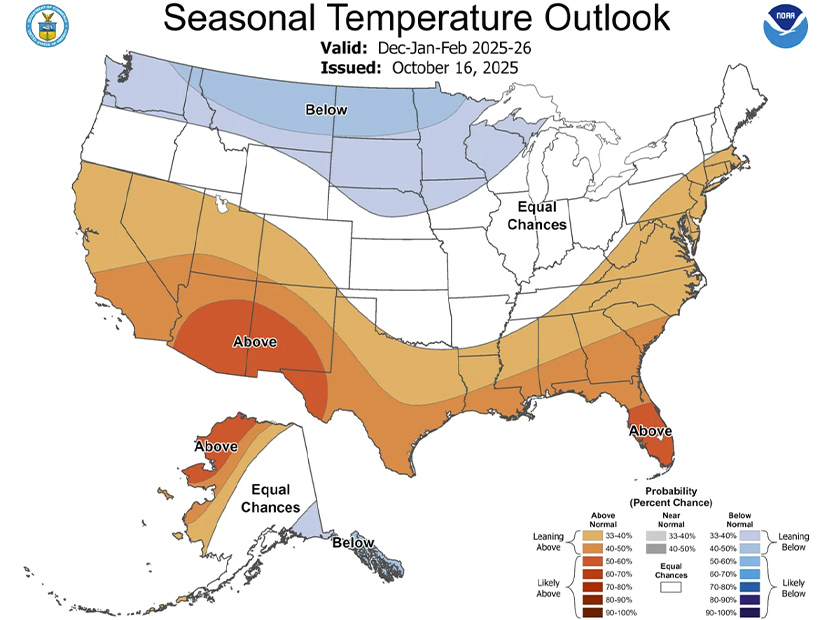
Presenting FERC’s 2025-2026 Winter Energy Market and Electric Reliability Assessment, Eric Primosch, of the Office of Technical Reporting and Economics, told commissioners the National Oceanic and Atmospheric Administration predicts higher-than-average temperatures across most of the southern continental U.S. for the winter months of December, January and February. Only in the northernmost states are mildly lower-than-average temperatures expected.
For this reason, the U.S. Energy Information Administration predicts the number of nationwide heating degree days — a metric that measures how cold a given location is by comparing its average outdoor temperatures to a reference temperature — to drop by about 8% from the previous winter.
Multiple states in the West and Southeast U.S. also either are likely to develop drought conditions over the winter or to see current droughts continue, Primosch said. These dry conditions “could significantly reduce hydroelectric output in WECC, disrupt fuel deliveries and impair cooling for power plants in the Central U.S., and elevate wildfire risk across the country,” he said.
Despite the warmer conditions, and a slight expected increase in natural gas production from last year, Primosch said gas prices are expected to be higher at most hubs than they were last winter. Henry Hub futures averaged $4.39/MMBtu as of Nov. 4, up 26% from last winter’s settled average of $3.49/MMBtu. FERC’s report attributed the rise to growing demand for gas in the South-Central region.
In its seasonal temperature outlook, NOAA forecast higher-than-average temperatures across most of the southern continental U.S. | NOAA
Possible explanations for rising prices at other hubs include competition with other regions for LNG at the Algonquin Citygates hub, potential supply constraints at Transco Zone 6, and infrastructure constraints at both SoCal-Citygate and PG&E-Citygate in California. However, gas storage inventories stood at 3,915 Bcf at the beginning of the withdrawal season, near the top of the five-year range, and are expected to “remain relatively robust through winter,” helping to moderate price volatility.
Solar, Batteries Lead Capacity Additions
On the electricity side, Shannon Zaret of OTRE told commissioners that EIA predicts total electricity consumption of 1,035 TWh this winter, slightly less than the 1,041 TWh recorded the previous winter but still higher than the five-year average.
Zaret said the greatest use is expected in the residential sector, at 387 TWh, followed by commercial users at 359 TWh and industrial at 254 TWh.
Electricity usage in the commercial sector is projected at 5% above its five-year average, Zaret said, with EIA attributing the rise in part to data centers in the PJM region.
EIA forecasts the electric sector to have new generation capacity totaling 64.7 GW this winter, comprising 25.7 GW of generation completed between March and November and 39 GW expected between December and February 2026. The new generation is offset by 2.4 GW of retirements already completed by November and 6.2 GW of further retirements expected by February. Most of the retirements are coal-fired plants, while solar generation accounts for half of the capacity additions and batteries 30%.
NERC Senior Engineer Robert Tallman shared a summary of the ERO’s Winter Reliability Assessment, published Nov. 18. (See NERC Winter Reliability Assessment Finds Many Regions Facing Elevated Risk.) That report found that several subregions face elevated risk for outages this winter if they experience severe weather, with the highest risk in the WECC Northwest and Basin subregions, ERCOT, SERC Reliability’s Central and East subregions, and the Northeast Power Coordinating Council’s New England and Canadian Maritime Provinces subregions.
Asked by FERC Chair Laura Swett whether gas production in the U.S. will “keep pace” with demand this winter, Primosch said the elevated production, along with precautions taken by producers, gave cause for optimism.
“We’ve seen producers really focus on improving winterization … in terms of preventing equipment failure [and] wellhead freeze-offs, [and] really trying to maintain as much production as possible on their system during these winter weather events,” Primosch said. “This strategy was effective last winter, as we saw the collaboration of producers, pipelines [and] storage operators all work together to help meet peak record demand, [and] we expect that to be the case again this winter.”
FERC said Nov. 20 it has closed its enforcement investigations into possible unlawful activity related to 2021’s Winter Storm Uri, just a few months before the statute of limitations on the issue is to expire.
The storm knocked out power across much of Texas for days, leading to hundreds of deaths, and caused massive electricity price spikes there while driving up natural gas costs across a broad swath of the country.
FERC and NERC quickly released a report on the reliability issues in ERCOT in November 2021, which included recommended changes to winter reliability standards that since have been put in place. (See FERC, NERC Release Final Texas Storm Report.)
The commission released its fiscal 2025 Report on Enforcement at its regular meeting Nov. 20, but earlier versions of the report for 2023 and 2024 explained some of the nonpublic investigations into activity around the storm.
The 2023 version explained how FERC dropped a probe into a natural gas marketer that cited a “force majeure” clause to stop the sale of gas to one customer, which was sold to another, but the agency lacked evidence to move forward on any allegation. Then-Chair Willie Phillips said additional investigations were ongoing. (See FERC Enforcement Report Details One Closed Probe into Winter Storm Uri.)
The 2024 version of the report detailed a couple of other cases FERC opened and then closed without action. One involved market manipulation in the gas sector in which a firm contacted a price index reporter to remove a price on the lower end from their indices during the storm after learning it would have a significant positive financial effect on the company.
Another one involved a probe into a company doing business in CAISO that was alleged to have withheld physical energy during Uri and at other times to drive up prices and secure firm contracts, but it was closed due to a lack of evidence.
FERC does not name the targets of its investigations unless it decides to move forward with a settlement or other enforcement actions.
“I would not speak to any nonpublic investigations before the commission makes them official,” Chair Laura Swett said at post-meeting press conference. “There’s a reason for that regulation: It’s to protect the entities before we come up with a conclusion, and they are given appropriate due process.”
FERC has five years after an event to move forward on cases, which means it would have to do so on any Uri investigations within the next three months — but the agency confirmed that will not be happening.
The storm has sparked many civil lawsuits, and utility customers around the country still are paying for its costs, which in some areas have been securitized over many years in rates to spread out price spikes.
FERC lacks any authority over ERCOT’s market and a state court has found the Public Utility Commission of Texas followed the law in keeping prices at the $9,000/MWh cap throughout the week of outages. (See Texas Supreme Court Rules for ERCOT, PUC During Uri.)
Other lawsuits have targeted natural gas market participants, but many of them involve the intrastate markets in Texas and Oklahoma, which are important even outside those states. In 2023, the 5th U.S. Circuit Court of Appeals ruled that FERC could not fine BP for trades on the Texas gas system during a 2008 event. (See FERC Approves Smaller Fine for BP After 5th Circuit Decision.)
One lawsuit filed by CirclesX Recovery against many major natural gas firms contends that widespread withholding of gas during Uri caused its price to spike from about $2/MMBtu to $208/MMBtu at Texas’ Waha hub and to as high as $1,200/MMBtu at unregulated nodes on the intrastate natural gas system. That suit is pending at the Texas 1st Court of Appeals.
IESO is considering a broader range of long-duration energy storage technologies in its upcoming long lead-time procurement but will not include hydroelectric redevelopments, officials told stakeholders at an engagement session Nov. 19.
ISO officials also said they are considering changes to a termination provision and additional flexibility on outages.
IESO created the long lead-time procurement (LLT RFP) because energy storage resources such as compressed air and pumped hydro require longer planning cycles than the four-year lead times for resources offering in the pending Long Term 2 (LT2) procurement. The ISO plans to seek 600 to 800 MW of capacity and up to 1 TWh of energy from resources requiring at least five years of lead time in a solicitation expected about Q4 2026.
The energy stream of the LLT RFP will be open to new build hydroelectric facilities with a nameplate capacity of at least 1 MW that do not include pumped storage. LDES projects will be eligible for the capacity stream.
Eligible Technologies
IESO’s Jasdeep Kahlon | IESO
In response to stakeholder requests for greater flexibility, IESO said it is considering increasing the limit on Class II LDES technologies to 200 MW from 100 MW and lowering the minimum to 10 MW from 50 MW.
Stakeholders said the proposed 50-MW minimum project size and a 100-MW cap would limit the procurement to only one or two LDES projects. Stakeholders proposed minimum project sizes as low as 1 MW.
“Most likely, with the current setup, we would be procuring only one project,” acknowledged IESO’s Jasdeep Kahlon. “However, we maintain that the need for a cap is required to limit risk related to these less proven technologies.”
Kahlon said the ISO doesn’t see the benefit of dropping the minimum size below 10 MW, “as the minimum size requirement is intended to ensure participation from commercial-scale projects and not intended to procure less proven pilot-scale technologies.”
Hydro Redevelopments
The ISO also rejected participation by hydro redevelopments, saying it has received limited information about potential projects and noting that “historical redevelopment timelines are highly variable,” with some taking up to six years and others being completed in less than four years.
It also said there is “little evidence to justify” the 40-year contracts planned for the LLT procurement for hydro redevelopments and said such projects should seek 20-year contracts under the LT2 RFP scheduled for early 2026. (See IESO Officials Deny Favoring Gas Resources in Upcoming Procurement.)
Optional Termination
At an engagement session in October, the ISO said it would seek to reduce risks in the procurement by reserving the right to reject proposals that are too expensive and allowing the ISO and generation developers to cancel deals in the first few years. (See IESO Seeks to Manage Risks in Long Lead-time Procurement.)
The ISO said the termination option could be exercised by IESO or the project developer in the first two or three years after the contract date.
Stakeholders said the termination option would increase developers’ risk and make financing more expensive, while reducing participation levels. They also said it could discourage participation by Indigenous communities that “typically invest in projects with a high likelihood of reaching commercial operation and generating long-term revenue.”
The ISO said it would specify the circumstances that could result in a termination — such as failure to meet key milestones or obtain permits — and the date on which the optional termination right would lapse. It also is considering the termination payment that would apply when IESO or the supplier terminates and whether suppliers that terminate projects would be eligible for future procurements.
Reserve Prices
IESO proposed to use reserve prices — a confidential price threshold — to ensure it doesn’t pay too much for energy or capacity in the solicitation. The ISO said the thresholds will be based in part on prices in the first window of the LT2 procurement and differences in the obligations of LT2 and LLT resources.
Many stakeholders opposed the proposal, saying prices from recent IESO procurements are not a good comparison due to the lifespans of the technologies procured.
The ISO said reserve prices will ensure the procurement is cost effective and broadens Ontario’s supply mix while addressing the uncertainty of developing LLT resources. “The potential benefits associated with long lead-time resources, along with the longer lifetimes, will be considered in the determination of a reserve price,” it said.
Outages
IESO said it is developing a proposal to provide additional flexibility for “mid-term extended outages” and aligning them with annual planned maintenance outage requirements for LDES technologies. IESO had proposed a single outage of up to 12 months after the 20th anniversary of the contract. (See IESO Ups Capacity Target for Long Lead-Time Resources.)
Stakeholders told IESO it should consider permitting suppliers to take outages beginning after year 10 of the contract term and allow them to take multiple outages adding up to 12 months. Some said technologies using mechanical storage, such as compressed air energy storage (CAES) and pumped hydro, should be able to take an annual planned outage for up to 10 business days, similar to that for natural gas generators under the LT2(c-1) contract.
Early In-service Provisions
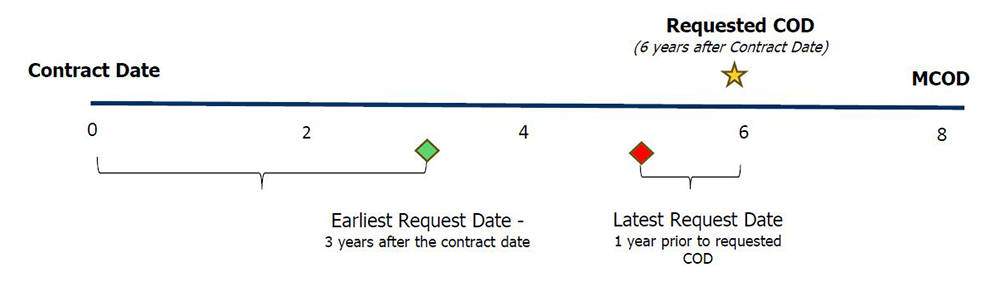
ISO officials said they may allow developers to begin commercial operation before the planned commercial operation date (COD). The request would have to be filed no earlier than three years after the contract date and at least one year before the expected COD. Commercial operation could be no earlier than five years after the contract date.
IESO approval would depend on deliverability and system needs (e.g., Annual Planning Outlooks showing a need for energy arising earlier than capacity).
Environmental Approvals and Permitting
Because some LDES technologies are new to Ontario, the ISO said developers should consult early with the Ministry of Environment, Conservation and Parks regarding the environmental assessments and permitting requirements that will apply.
Team Member Experience
Kahlon said IESO is considering providing more flexibility to the team member experience requirements.
Under IESO’s proposal, hydro developers must have at least two team members with experience with a hydro facility with a nameplate capacity of at least 1 MW that has achieved commercial operation in Canada or the U.S. within the past 15 years.
Stakeholders said the proposed requirement may create obstacles for mature resource types such as pumped hydro because no such projects have been commissioned within the past 15 years.
IESO may allow developers to begin commercial operation before the planned commercial operation date. The request would have to be filed no earlier than three years after the contract date and at least one year before the expected COD. Commercial operation could be no earlier than five years after the contract date. | IESO
“For pumped storage projects, the requirement to have developed a ‘same technology’ project should include conventional hydroelectric facilities, as pumped storage is a direct variant of hydroelectric generation and the relevant development expertise is transferable,” Andrew Thiele, senior director policy and government affairs for Energy Storage Canada, said in written feedback.
Jim Beamish, head of planning and analysis for Access Capital Corp., said requirements should be functional, as they were in the early 2000s when Ontario started procuring wind and solar generation.
“I recognize your concerns,” Beamish said, “but the ISO really needs to look back at that and say, ‘Well, what didn’t work?’ Because … there have been no CAES projects that reached commercialization in in the last 15 years.”
“The intent here is definitely not to limit participation through team member experience,” responded IESO’s Danielle D’Souza. “It’s really meant to just ensure that we have the best chance of these projects getting across the finish line.”
Municipal Support Resolutions
Paul Ernsting, of Peterborough Utilities, said it may be challenging for developers to obtain required support resolutions from municipalities because of 2026 elections.
“If you’ve got less than three-quarters of council coming back, then that’s a lame duck period. They don’t do any decision-making during that period,” he said.
“You’ve got your elections happening Oct. 26. Once everyone’s elected, they don’t start meeting until mid- to late November at the earliest. … That can be a tight timeline for this procurement, as well as for LT2 window two.”
D’Souza welcomed the feedback. “We’ve heard that it’s very different from municipality to municipality,” she said.
Next Steps
The IESO asked stakeholders to comment on the LLT RFP by Dec. 3 using the feedback form posted on the engagement webpage.
MISO predicts it will have anywhere from 383 GW to 454 GW of installed capacity in its footprint by 2045, according to a preliminary version of its 20-year planning futures.
MISO charted resource totals at 383 GW, 403 GW, 446 GW and 454 GW for its Futures 1-4, respectively. The grid operator makes capacity expansion predictions under its 20-year planning scenarios, which help decide which long-range transmission projects are useful. This time around, MISO’s predictions contain more natural gas generation and fewer renewable energy resources.
At a Nov. 18 stakeholder teleconference to debate the futures, Director of Economic and Policy Planning Christina Drake said they “limit all-in costs to members” while respecting states’ and utilities’ decarbonization goals and still being able to serve peak demand and meet planning reserve margin targets.
MISO has been constructing its planning futures for more than a year. It paused in mid-2025 to recalibrate the generation expansion assumptions in its futures after the Trump administration revoked tax credits for renewable generation. (See MISO Seeking Realistic Gen Buildout for Tx Planning Futures.)
Drake said MISO will perform more sensitivity analyses to test whether the four futures are “broad enough.” MISO plans to use sensitivities to test other assumptions, like more load hyperscalers than MISO anticipates in its updated load forecast, a drop in cost for small modular reactors or long-duration storage, the reinstatement of renewable tax credits or natural gas prices that rise faster than expected.
Drake said MISO would not adjust members’ stated resource plans to test assumptions, considering those plans set in stone. She has said “MISO will not be putting its finger on the scale” by changing planned units.
MISO Independent Market Monitor David Patton has suggested MISO introduce a sensitivity that contemplates cost caps on members’ decarbonization goals. Patton reasoned that utilities would not spend infinite amounts of money to meet their clean energy goals when they have shareholders to answer to.
Drake said MISO will share its chosen sensitivities in December.
MISO said it will incorporate its growing load into the futures and plans to include data from its long-term load forecasting pilot program. (See MISO Rationalizes Load Forecasting Pilot Program.) According to early results, MISO could have an additional 64 GW to serve within 20 years.
Sustainable FERC Project’s Natalie McIntire asked how MISO would capture the “uncertainty” behind the rise in large loads, where some may not materialize.
Clayton Mayfield, manager of MISO’s economic planning team, said MISO would evaluate its stakeholder sources of data to figure out which large-scale load projects plan to minimize their needs. He also said MISO would use a project certainty ranking for loads, with a “high” classification for publicly known load projects in development with known locations, a “medium” ranking for loads under study and included in MISO’s long-term forecast and “low” for loads still in talks and unreported in the long-term forecast.
MISO’s first, most conservative future would include only high-certainty loads, while the second, middle-of-the-road future would include high- and medium-certainty projects. MISO’s most aggressive fleet change scenario would include all potential load growth.
Mayfield said MISO is using a siting process for load additions similar to its capacity expansion process to depict load locations.
Bryn Baker, senior director at the Clean Energy Buyers Association, requested MISO consider that some large loads bring their own co-located or behind-the-meter generation to the table to aid their needs.
WPPI Energy’s Steve Leovy similarly asked MISO to consider that some loads might be interruptible or construct on-site generation.
Finally, MISO won’t include Louisiana’s previous goal to reach net-zero greenhouse gas emissions by 2050 in its futures. At a late October workshop, Drake said MISO had “active discussions” with Louisiana officials and was told the Louisiana goals have been discontinued.
“Probably for the entire expansion, it’s not going to move the needle much,” Drake said.
MISO will hold more futures stakeholder workshops Dec. 17, Jan. 29 and Feb. 26.
The PJM Members Committee voted against each of the dozen proposals brought to address rising data center load as part of the RTO’s Critical Issue Fast Path (CIFP) process. (See PJM Stakeholders to Vote on Large Load CIFP Proposals.)
The proposal from the Southern Maryland Electric Cooperative (SMECO) was the highest vote-getter at a special MC meeting Nov. 19, receiving 46.66% sector-weighted support, still falling short of the two-thirds required for endorsement. It was followed by the Independent Market Monitor’s proposal at 39.88% and PJM’s at 38.66%. The voting was advisory to the RTO’s Board of Managers, which expressed its intent to file changes with FERC in December to be effective for the 2028/29 Base Residual Auction (BRA).
Addressing the committee after the vote, PJM CEO Manu Asthana said those goals stand, and more detail around timing will be forthcoming. Though there was no winner among the packages, Asthana said there was plenty of information for the board to review from the input shared during the meeting preceding the vote, the last to be held as part of the process.
The CIFP meeting, during which each of the sponsors presented their proposals to the board, lasted much of the day, beginning at 9 a.m. and stretching past its 2 p.m. scheduled end time, pushing the MC’s meeting to start at 3:45 p.m. The CIFP meeting was closed to the media, and there was no discussion on the packages themselves during the MC meeting before the vote opened.
RTO spokesperson Jeff Shields said the board plans to act in the next few weeks.
“PJM opened this conversation about the integration of large loads and greatly appreciates our stakeholders for their contributions to this effort,” he wrote in an email statement. “The stakeholder process produced many thoughtful proposals, some of which were introduced late in the process and require additional development. This vote is advisory to PJM’s independent board. The board can and does expect to act on large load additions to the system and will make its decision known in the next few weeks.”
The SMECO package adopted the changes sought by PJM, including changes to the pricing and dispatch of price-responsive demand (PRD), the addition of state reviews of large load adjustments and an expedited interconnection track (EIT) for state-sponsored projects. Both SMECO’s and PJM’s proposals would shift PRD to an energy market strike price, rather than a dynamic retail rate, but SMECO proposed a $1,000/MWh limit and PJM would set it at $1,849/MWh.
The PJM proposal also would align PRD dispatch with demand response by requiring it to respond regardless of bid price, subject it to performance assessment interval (PAI) penalties and mirror their 30-minute energy bid price caps. SMECO would subject PRD participants to Capacity Performance penalties only if the resource is dispatched when the strike price or PAI conditions have not been met and require that they have supervisory control over the load and the ability to curtail.
The EIT would create a 10-month process for resources of at least 250 MW and nonrefundable study deposits of $10,000/MW for projects paired with large loads and doubled for standalone development. They would require letters of support from the governor or utility commission for the state they are sited in, which is intended to avoid expending limited resources for studying requests on projects that will be mired in permitting and siting challenges at the state level. Only 10 projects would be allowed to proceed each year.
The RTO’s executive summary of its package included a request for the board to initiate a second phase of the CIFP process focused on changes to the reliability backstop and incentives for large loads to bring their own generation or participate in DR programs.
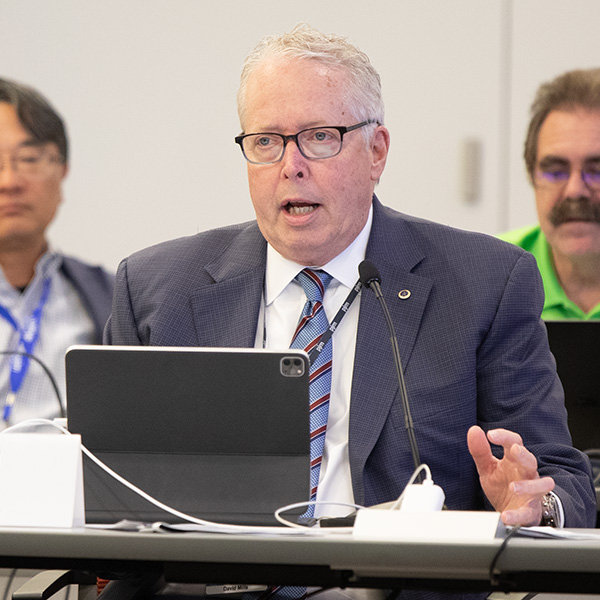
Board Chair David Mills said it will work to assemble a proposal that makes sense of all the information provided throughout the CIFP process.
“It’s been an arduous journey to get to this point. I’m actually not surprised we got such disparate accounts on all of these proposals. … Just because none of these passed does not mean the board will not act,” he said.
During an open-ended discussion following the MC’s regular monthly meeting Nov. 20, Mills said he could envision changes to the CIFP process. One possible change could be adding milestones throughout the process if there are many proposals being considered.
Tom Rutigliano, senior advocate at the Natural Resources Defense Council, said the board has difficult decisions ahead of it to ensure that data center growth is not subsidized by the public.
“The growth of data centers is colliding with the reality of the power grid. PJM members weren’t able to see past their commercial interests and solve a critical reliability threat. Now the board will need to stand up and make some hard decisions. We hope they fulfill their obligation to 67 million people and commit to protecting reliability, not subsidize data centers at public expense, and treat all customers fairly,” he said in a statement.
“The public faces a $163 billion bill through 2033; and the region could suffer multiple rolling blackouts each year. If the board doesn’t step up, the region won’t be able to meet record demand and will suffer declining reliability for years to come.”
WASHINGTON — FERC Chair Laura Swett presided over her first monthly open meeting at the helm of the commission, giving her a chance to set the tone for her tenure.
“Regarding my priorities, we are at a critical juncture in our nation’s history, a time to cement the United States’ energy dominance,” Swett said. “It is crucial to our economic and national security that we win the artificial intelligence data race for our country so that American data does not go abroad. In addition to our core mission of keeping the lights on for all Americans at reasonable costs, my priority as chairman is to ensure that our country can connect and power data centers as quickly and as durably as possible.”
Another priority is to streamline regulations at FERC to ensure that needed infrastructure can get built as quickly as possible, she added.
Commissioners David Rosner, Lindsay See and Julie Chang all welcomed the new chair, as well as new Commissioner David LaCerte, in comments at the start of the meeting.
“We had some more elaborate talking points, but somebody abbreviated them to say, ‘Yay, five!’” Rosner joked.
As it also was his first open meeting, LaCerte laid out his priorities for the job.
“I understand our nation’s need for critical expansion of generation and transmission,” he added. “Now, more so than ever, it’s important that companies seeking to generate and transmit our energy are not thrown unnecessary obstacles to stymie their efforts. [National Environmental Policy Act] reviews across the federal government have run off course, failed to protect the environment and often only serve to delay or derail infrastructure projects. All American people deserve better, and we have to do better.”
He added that the AI race needs to be met with bold action to ensure economic and national security.
“That obviously is top of mind for me,” Swett said during a post-meeting press conference. “That issue is my biggest priority, and an issue facing our country of this import cannot be solved by any one person or one agency alone. And that’s why we are so excited to open this docket for comments, because it is so important that everyone weighs in.”
Comments are due in the docket (RM26-4) by close-of-business Nov. 21, and Energy Secretary Chris Wright asked for a final decision by April 30, 2026.
Another issue looming over FERC and other independent regulatory agencies is Supreme Court case Trump v. Slaughter, which will decide whether the president has broad authority to fire members of the Federal Trade Commission, which could be extended to FERC. Recently, a group of 11 former commissioners filed a brief arguing for the court to uphold “for cause” removal protections across the board, or at least separately for ratemaking agencies such as FERC and the Federal Reserve. (See Former FERC Commissioners Ask Supreme Court to Preserve Agency Independence.)
Swett was asked about her position on the issue, and she said the law still preserves FERC’s independence.
“Everything that FERC does is independent, and it is independently voted on by five people with very diverse viewpoints,” Swett said. “I have the honor of being designated chairman based on the president’s faith in my independent experience and my independent judgment to run this agency. And by the nature of the statute that created FERC — the DOE Organization Act of 1977 — we are explicitly carved out of DOE jurisdiction, with no review powers from anyone at DOE on FERC’s independent actions.”
Two weeks ago, a reporter asked me what I thought about Energy Secretary Chris Wright’s recent Section 403 directive to FERC. Being immersed in things ERCOT as of late, I was puzzled. “Rick Perry’s ‘save the coal plants’ project from 2017?”
“No, I’m talking about large load interconnection.” Oh.
So, I read it. And it was good, even elegant. I read it again. I liked Wright’s strong reliance on the standard generator interconnection policy we adopted in Order No. 2003 back when I led FERC. There is a clear parallel between what we did then to speed the building of new generation at the turn of the millennium and what DOE wants to do today to accelerate the growth of critical data infrastructure.
States regulate the building of large generation; FERC regulates their interconnection to the interstate transmission grid. States regulate retail service to large loads; why shouldn’t FERC regulate their interconnection to the interstate transmission grid?
This symmetry on both ends of the bulk electric system seems like a slam dunk in the courts. From the past Supreme Court rulings, and considering its current direction, it would seem FERC would get a warm reception there.
Then, the real question is: In standardizing a large load interconnection process, what could FERC do to actually make things better?
The ‘Energy Intelligence’ Era
First, acknowledge this is a national imperative. Large new power users must have rapid and predictable access to electricity. The Fifth Industrial Revolution is underway, its start date accelerated, ironically, by the pandemic that spread from China.
This “Energy Intelligence” era is defined by the rapid electrification of the planet and the advent of artificial intelligence. Our failure to timely serve these customers will cede the leadership role for this revolution to China. You don’t have to be born on the Fourth of July to know that is unacceptable.
Second, lay down the law about the other two-thirds of the power system: generation and delivery. The inane pissing match between fossil fuels and renewables, between central station and distributed power, benefits only those who don’t want American dominance. We need EVERYthing.
To enable that, we need a much more robust and smarter transmission and distribution system. Wind, solar and natural gas are the cheapest fuels to create power, and this country has huge amounts of all of them. Storage and flexible demand are the newest players on the field, and I expect nuclear, geothermal and others will come. All of this is being enabled by dramatically advanced information technology. So, Team America wins with addition, not subtraction. And the faster, the better.
Standardize and Connect
On to substance. Adopt a clear, transparent interconnection process for large load customers. Use a standardized large load interconnection contract and require grid operators to complete interconnection studies on aggressive timetables.
To encourage transmission owners to also move at the speed we need, we should reward them for making network upgrades quickly and penalize them for taking too long. If the large load customer can get local construction and engineering done faster and/or cheaper through a third party than the utility, that adds discipline and cost control to the overall process.
For all connections to the transmission grid, we should embrace the “connect and manage” approach we’ve used successfully with interconnecting ERCOT generators since 1997. Spread it to all generation and to large loads nationwide.
In effect, we tell the interconnecting facility, “we’re going to hook you up pronto and do our best to serve you 24/7, but you’re going to get best efforts (interruptible) service for a while until we get the grid beefed up in your neighborhood.”
If interruptible service isn’t acceptable to large load customers, we should ensure that on-site generation and batteries are a viable option. Assuming most customers want firm service eventually, we can use the network upgrade process from Order No. 2003 where interconnecting customers fully fund their local interconnection costs and front a deposit for new network upgrades that they trigger. This deposit should be large enough to protect other grid customers if the large load fails to show up.
A key factor causing slow interconnections to date is the calculation of needed network upgrades and their cost. On a swiftly evolving network where flows change every second, computing and attributing a transmission network upgrade’s cost to a single party is a fool’s errand. The important thing is to set a fair deposit amount quickly and conclusively. Ideally, a flat rough average $/kW amount should be sufficient. A version of this “entry fee” concept is being used for generators in SPP.
Manage the Grid with Latest Tools
While the regional infrastructure is being upgraded, utilities and grid operators must manage and get more out of the network with grid-enhancing technologies, advanced power flow controls, topology optimization, dynamic line ratings, reconductoring with high performance conductors and the like.
I’ve seen these tools employed in specific applications for a couple of decades now; it’s time we make them a central part of 21st century grid operations. Large load customers’ demand profiles sometimes could resemble those of a steel mill or foundry.
Customers with highly varying loads should be encouraged to manage those with on-site equipment like batteries with inverters and on-site controller software. This could be done through incentives like shorter timetables or reduced entry fees. I prefer carrots like these to sticks, but perhaps this jagged load profile impact upon the grid is one where a requirement may be in order.
‘Win-win’ Cost Allocation Scenarios
Issues relating to rates that the large load pays to take retail service remain with state regulators. We already see utilities and regulators creating new tariffs to protect other customers from cost shifts from large load customers.
Many of these new customers have deep pockets, so if there is any cost shifting at all, it should benefit existing customers, who have paid plenty already to build the system we have. There are many win-win scenarios here.
Some believe that data centers, in particular, will be the flexible load we’ve been waiting for to bring discipline to what always has been a generator-centered system. I’m not sure how flexible they really are. But that’s OK. Let’s set up a market to purchase flexibility just as we buy generation, and we’ll find a lot of other customers who are flexible.
Getting the wires interconnection done is crucial, but the power itself is most important. Several large players are developing their own gas/battery/solar microgrids to accelerate their market entry. That’s fine as a speed-to-market strategy, but the whole reason we worked for the past generation to set up robust, open access, wholesale market grids was to enable reliable, cheap and clean power for all customers.
Let’s bias toward ultimately relying on the grid for primary power, and favoring local assets for backup power, instead of vice versa. But if large loads do add backup power, we should allow and encourage them to use it to benefit all of us, particularly when extreme weather stresses the grid. Again, I prefer market-based carrots rather than regulatory sticks on this.
Thoughtful standardization reduces costs, speeds entry and provides certainty for customers. The Good Lord has blessed our country with abundant natural resources. And with optimism. Let’s put it all to work. Now. At scale. Game on.
Pat Wood III, Executive Chairman of the Hunt Energy Network, is past chairman of the Public Utility Commission of Texas and of the Federal Energy Regulatory Commission.