PJM plans to modify and refile a proposal to revise how capacity interconnection rights (CIRs) can be transferred from a deactivating resource to a new unit after FERC rejected the tariff because of language that would have allowed developers to bypass the commercial operation date deadline (ER25-1128).
The proposal would create a nine-month process for PJM to conduct a replacement impact study on resources inheriting the CIRs from a deactivating unit and for an interconnection agreement to be offered. It would allow replacement resources to proceed through the expedited study process if minor network upgrades are identified and would not bar any resource class, thus allowing storage to receive CIRs. The revised tariff language will be brought to the Members Committee for endorsement Sept. 25. (See PJM Stakeholders Endorse Coalition Proposal on CIR Transfers.)
Stakeholders who supported the changes when the Planning Committee first endorsed the language in 2024 argued it would allow gas generators deactivating amid state clean energy policies to be replaced more quickly.
PJM Senior Manager of Interconnection Projects Jason Shoemaker told the PC that FERC signaled support for the overall proposal but identified two areas of concern: exempting resources with long development times from the COD requirement, and a one-time process for developers to request an indefinite delay for their CODs.
In its order rejecting the initial proposal Aug. 8, the commission faulted PJM for allowing developers to request a delay in transferring their CIRs without any time limit, which it said could allow resource owners to effectively withhold CIRs and create barriers to new entry. The commission said that undermines the RTO’s stated goal of allowing more resources to come online ahead of a capacity deficiency identified in the 2030 time frame.
“We find that PJM’s lack of a maximum time limit for the one-time option for an extension of a replacement generator resource’s commercial operation date regardless of cause renders PJM’s proposal unjust and unreasonable because it undermines the purpose of the generator replacement process,” the commission wrote. “That is, the main purpose of the generator replacement process is to avoid duplicative study costs and operational costs that otherwise would occur when the request to replace an existing generating facility must proceed through the interconnection study queue process, which will in turn avoid delaying the replacement of older resources with more efficient and cost-effective resources.”
The revised language would set the COD requirement at the greater of four years from when the developer submitted an application to construct a replacement resource, or three years from the requested deactivation date of the original resource.
Developers could request an alternative COD during the final agreement negotiation process, but they would have to demonstrate why the requirement should be shifted — akin to the milestone extensions permitted in the generation interconnection agreement process.
After the interconnection study is complete, developers could submit changes to the project to mitigate material adverse impacts and potentially reduce the network upgrades they are assigned. The submission would have to be made within 15 business days of receiving the study results and could be done only once. PJM would retool its analysis with the changes.
The commission also wrote that it saw the logic behind allowing generators with long development timelines some flexibility in their COD requirement but said the language could be ambiguous. While it did not cite that as a rationale for rejecting the proposal, FERC recommended that PJM include more specific language in any refiling.
“We also agree with PJM’s goal of offering replacement generation resources that face long lead times a certain degree of flexibility with respect to achieving commercial operation and agree that such resources ‘can make a significant contribution to meeting resource adequacy needs, at a time when PJM needs additional resources to maintain reliability,’” the commission wrote.
The COD exemption for resources with “industry-recognized significant construction time frames” was eliminated from the proposal.
Ontario’s energy regulator is learning new ways to identify inefficiencies and malign behavior under IESO’s Market Renewal Program, which introduced LMPs and a financially binding day-ahead market.
OEB said the MSP will continue to track “market participant conduct and the efficiency and competitiveness” under the new market. “However, the complexities of the renewed markets have increased relative to the legacy markets,” it said.
The MSP, which transferred from IESO to the OEB in 2005, has three members: Chair Ken Quesnelle, former vice chair of the OEB and former chair of the Electricity Distributors Association; Brian Rivard, an adjunct professor at the Richard Ivey School of Business at Western University and a principal at Charles River Associates and IESO’s former director of markets; and Darren Finkbeiner, IESO’s former director of rule compliance and market surveillance. The MSP is supported by OEB staff and uses data provided by IESO’s Market Assessment Unit.
The MSP’s previous recommendations have been adopted by both the OEB and IESO — including some of the changes implemented under Market Renewal. MSP reports also have led to action by the IESO’s Market Assessment and Compliance Division, resulting in settlement repayments and financial penalties.
New Market: Locational Marginal Prices and Single Clearing
Under Market Renewal, day-ahead market (DAM), pre-dispatch and real-time prices are calculated at about 1,000 LMP nodes, instead of Ontario-wide. With a financially binding DAM, there now is a single dispatch schedule.
Here are some of the other changes under the new market, and how the MSP plans to respond:
Congestion Management Settlement Credit (CMSC) payments: CMSC payments encouraged participants to follow dispatch during transmission constraints under the former two-schedule system. They were replaced by LMPs — which embed the cost of congestion — and make-whole payments (MWPs), which compensate for lost opportunity costs when IESO dispatches resources out-of-merit.
While continuing to use the highest-cost peaking natural gas generators as an initial screen, the MSP also will use statistical models to identify anomalous LMP differences not explained by losses or congestion. “This type of monitoring analysis will replace the monitoring of legacy CMSCs to assess potential market flaws or inappropriate conduct not explained by grid conditions,” OEB said.
The MSP will monitor large MWPs, as well as MWPs to individual market participants or for specific facilities, to identify anomalous results or market manipulation. A new MWP Anomaly Index will put MWP levels in perspective relative to resource margins in the day-ahead and real-time markets. The index is calculated as: MWP ÷ (Resource Revenues + MWP) x 100. “This metric will tend to filter out changes in the level of MWPs due to variations in fuel costs … as well as those due to the frequency with which particular types of units are committed, to better identify potential anomalies and changes in behavior,” OEB said.
Reserve Shortage Penalties: IESO now is using reserve shortage penalty prices (a maximum operating reserve area penalty price, a penalty price for 30-minute operating reserve and an area minimum operating reserve penalty price) to ensure that day-ahead, pre-dispatch and real-time calculation engines respect mandatory reserve requirements, that prices reflect those requirements, and to encourage market participants to meet their reliability obligations.
The MSP will review all applications of reserve shortage penalty prices to identify the causes of the shortages and potential anomalies in market design or inappropriate market conduct.
Operating Parameters: The renewed market requires non-quick-start gas generators, hydro and variable generation to submit additional data on their operating parameters.
The MSP will monitor changes to individual facility data for their effects on dispatch and economic efficiency. “Changes to this data may be part of a broader strategy by a market participant to inappropriately influence market outcomes, MWPs and prices to the benefit of the participant [at the expense] of other market participants and consumers,” OEB said.
IESO Market Power Mitigation
IESO introduced a three-pronged market power mitigation (MPM) scheme to prevent suppliers from market power due to their location on the transmission grid:
An ex-ante (before-the-fact) approach applied in the day-ahead, pre-dispatch and real-time scheduling processes to police the energy and operating reserve markets.
An ex-ante mitigation process to prevent market power in the settlement of make-whole payments.
An ex-post (after-the-fact) mitigation of market power to address physical withholding and economic withholding on uncompetitive interties.
OEB’s surveillance unit will evaluate the effectiveness of the MPM framework through its own three-part market power screen: a conduct test (for withholding activity); a material price impact test (determining whether the conduct of a market participant significantly impacted market prices), and a profitability test (whether the MP’s conduct benefited the participant).
Market Control Entities
IESO will use data from market control entities — companies that control generators and other market participants (dispatchable and price responsive loads, electricity storage resources, energy traders or virtual traders) — to assess physical withholding by examining in aggregate the offer quantities of resources that share a common MCE.
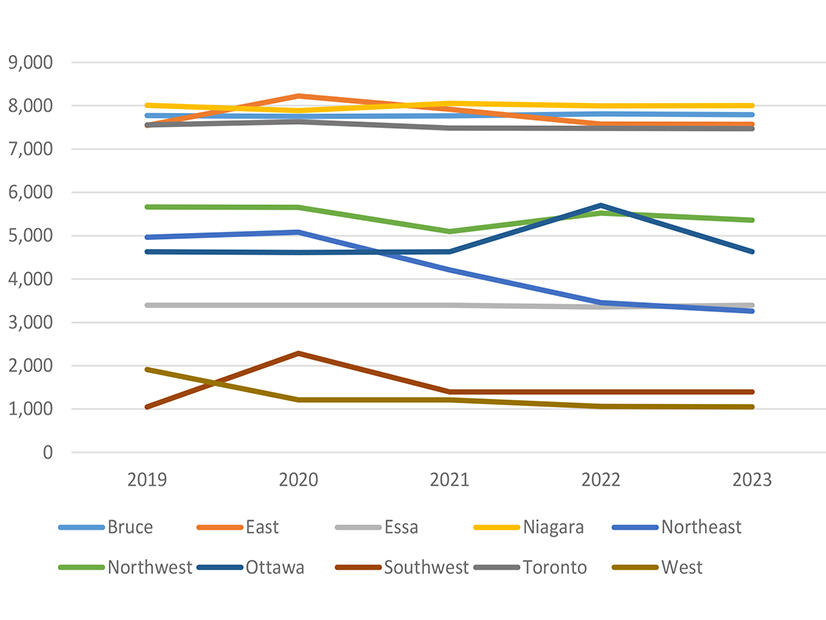
Herfindahl–Hirschman Index of registered capacity per zone, 2019-2023. Except for the West and Southwest zones, HHI scores were greater than 1,800 throughout the period, indicating highly concentrated zones. | Ontario Energy Board Market Surveillance Panel State of the Market Report 2023
The MSP will incorporate the data in calculating structural measures of competition such as the Herfindahl–Hirschman Index and Residual Supplier Index.
OEB said the MSP will monitor persistent price differences between DAM and RT to ensure they are not a result of illiquid markets or gaming.
New Tool for IESO
To assess the effectiveness of the renewed markets and identify potential solutions to unintended outcomes, the IESO developed the Market Analysis and Simulation Toolset (MAST), which enables it to conduct “but-for” analyses of market outcomes through inputs into the market calculation engines.
OEB said the MSP also may use MAST in its assessment of the market’s efficiency in its annual State of the Market reports, as well as to analyze anomalous market outcomes and identify potential market flaws.
“In an upcoming State of the Market report, after sufficient data has been collected to permit such an analysis, the MSP intends to provide a comparison of the relative efficiency and competitiveness of the legacy markets to the renewed markets,” OEB said. “This analysis is not intended to be an audit of MRP at achieving its objectives. Instead, it is intended to offer insights into the overall efficiency implications of the changes, including where certain efficiencies may or may not have been realized and where improvements in design may be desirable.”
Amid the growing push for new sources of power generation — especially from the data center sector — we have seen an extraordinary number of announcements concerning nuclear power. At this point, they are occurring almost weekly, something few would have anticipated just a few years ago.
These announcements generally fall into one of three areas: rehabilitation of closed nuclear facilities, potential development of new large-scale facilities such as the AP 1000 technologies currently deployed across the country, and development and deployment of an entirely new class of smaller reactors commonly referred to as small modular reactors (SMRs) or modular nuclear reactors (MNRs). The buzz in the space is considerable, but there still are numerous hurdles to be overcome before we can declare a win for the much anticipated “nuclear renaissance.”
Not Dead Yet
In recent years, numerous nuclear plants were struggling to survive, especially in competitive power markets where low-cost gas-fired and renewable plants were seriously denting their economics. Indeed, the economic outlook was so poor that five states (Connecticut, Illinois, New York, New Jersey and Ohio) threw their nuclear plants lifelines and created subsidy programs to keep 14 nuclear plants operating.
Several other states, though, chose to let plants be taken out of service. The typical decommissioning process is to remove and store the fuel, dismantle the plants and decontaminate the sites. In fact, that process has been followed by dozens of sites over recent decades.
Peter Kelly-Detwiler
However, as forecast power demand has rapidly increased recently, several recently decommissioned sites are now being pressed back into service. These include the 837-MW Three Mile Island 1 in Pennsylvania that is slated to deliver power to Microsoft for 20 years, the 800-MW Palisades plant in Michigan and the 615-MW Duane Arnold facility in Iowa. And most recently, Holtec International, the owner of the 2,000-MW decommissioned Indian Point nuclear plant in New York, suggested the possibility of rehabilitating the facility for an estimated $10 billion.
While these efforts eventually may bring back over 4,000 MW of capacity online, there may not be many other resurrection efforts to follow, since many of the other decommissioned plants are either too far along in the process or may not prove economically viable.
An addition to this category might include the uncompleted V.C. Summer plant in South Carolina, which was abandoned in 2017 after burning through $9 billion of investment capital. That facility was thought to be dead until January 2025, when utility Santee Cooper issued a request for proposals seeking “to acquire and complete, or propose alternatives, for two partially constructed generating units at the VC Summer Nuclear Station.” In May, the utility said it had received responses to the RFP but offered few details.
Revisiting Large Light Water Reactors
New nuclear power supply may come from the traditional light water reactors that have been employed by the U.S. power industry for many decades. For example, the proposed gargantuan 11,000-MW Fermi Project in Texas recently submitted an application to the NRC that includes four, 1,000-MW Westinghouse AP1000 nuclear reactors. (The last such units deployed were in the Vogtle plant in Georgia back in 2023, coming in more than seven years behind schedule and $17 billion over the original budget.) However, it appears that the new smaller and modular nuclear technologies may dominate this space.
Smaller Cookie-cutter Modular Units
In recent years, SMR-related investments and project announcements have surged, with much of this coming from the data industry. Dozens of companies — from large and established energy players such as GE, Hitachi, Rolls Royce and Westinghouse to numerous startups — are vying for success in this industry. They typically distinguish themselves from the existing light water reactor technologies in terms of size and technology, with many boasting fail-safe designs.
Models range in size from so-called “micro reactors” as small as 1 MW to larger units offering almost 500 MW of output. Many startups feature competing technologies that have not yet been tested commercially, and given the large number of contenders, many will fail commercially. But that hasn’t seemed to slow the sector of late. In fact, in the frothy SMR waters, just since mid-August the following commitments have been heralded:
Tennessee Valley Authority announced a contract with developer ENTRA1 Energy for a 6,000-MW deployment of MNR startup NuScale’s 77-MW reactors, the only ones thus far to have received NRC approval for their design.
Startup X-energy hailed a collaboration with Amazon, Korea Hydro & Nuclear Power and Doosan Enerbility “to accelerate the deployment of new Xe-100 advanced nuclear reactors in the United States,” with a stated goal of deploying more than 5,000 MW of new nuclear capacity across the U.S. by 2039, while mobilizing up to $50 billion in public and private investments.
Data co-location giant Equinix announced three separate deals with different modular nuclear companies for nearly 775 MW of new capacity in the U.S. and Europe, with power to come from reactors ranging in size from just over 1 MW to 470 MW.
Finally, the Utah Office of Energy Development (OED), TerraPower (the Bill-Gates-backed company) and Flagship Companies signed a memorandum of understanding “to explore the potential siting of a Natrium reactor and energy storage plant in Utah.”
It’s increasingly looking like a new generation of nuclear reactors may become part of our energy future.
Big Data, Big Commitments
Much of the recent momentum is directly attributable to the data center companies that are hungry for power, while in many cases striving to maintain commitments to reduce associated carbon emissions. In addition to Equinix’s more recent announcements, it also had signed a deal to buy up to 500 MW of power from SMR startup Oklo, with a $25 million pre-payment for future power output and a right of first refusal for from 100 to 500 MW of power.
Google also has been active. In May, it signed an agreement with nuclear project developer Elementi to commit early-stage development capital to support at least three projects that each would generate more than 600 MW. The company has the option to be a project off-taker once the facilities are commissioned (terms and locations were not specified).
In October 2024, Google said it would financially support deployment of seven SMRs from startup Kairos Power that eventually would generate up to 500 MW of output, with a first unit operational by 2030 and additional reactors online within five years. Kairos already has started construction of a demonstration project in Oak Ridge, Tenn.
For its part, Amazon has invested more than $500 million in SMRs, and took the anchor role in a $500 million funding round supporting SMR developer X-energy. And last fall, Oracle announced it intended to develop data centers powered by SMRs.
More such announcements are likely to come as the data center industry appetite for new power supplies continues to grow. Data centers are not the only industries showing interest. Among others, utility Energy Northwest and materials science company Dow both have committed to projects using X-energy’s technology, with Dow already having designated a development site in Texas.
Rare Bipartisan Support in Washington
While the promotion of many energy sources fall into red or blue camps, nuclear generally has managed to remain purple. In 2024, Congress passed the strongly bipartisan Accelerating Deployment of Versatile, Advanced Nuclear for Clean Energy (ADVANCE) Act, which specifically seeks to promote advanced reactor technologies.
In addition, the U.S. Department of Energy has provided significant financial support, including a $900 million effort that began during the Biden administration to accelerate the development and deployment of SMRs. In August, DOE selected 11 advanced reactor projects for accelerated deployment, streamlined testing and fast-tracking toward commercialization.
A Nuclear Renaissance Won’t Happen Unless Certain Conditions are Met
Major challenges remain to be addressed before we can proclaim the nuclear industry as reborn. The thorny nuclear waste issue remains to be solved. So does the issue of security. It’s one thing to guard the 50+ nuclear sites operating today and quite another to secure hundreds of them. There also are the siting challenges and the problem of convincing neighbors to accept these plants in their communities. Nuclear sites also will face the same interconnection challenges that have bedeviled any other generating assets connecting to the grid.
Perhaps most critically, though, these new nuclear plants will need to be cost-competitive. Manufacturers will have to build the manufacturing facilities to make all the parts and entice enough firm orders to create the necessary economies of scale. It will not be enough for companies to build these new nuclear reactors in the single digits. The winners in this race likely will need to build dozens of them to get the costs down to where they can become competitive with other sources of generation.
It’s one thing to do that with solar modules or batteries, where global supply chains wring out inefficiencies through production of literarily hundreds of millions of the devices. It’s quite another to create such efficiencies in a new industry, in which there are many competing companies and technologies.
To succeed, the infant industry will have to migrate from one-off projects to a broad-based, factory-centered production approach, enjoying a large and predictable order book. It also will need to nurture the necessary talent to manufacture, site and operate the plants in the field. We’re not remotely there yet, but for fans of a nuclear renaissance, recent events offer encouraging signs.
Around the Corner columnist Peter Kelly-Detwiler of NorthBridge Energy Partners is an industry expert in the complex interaction between power markets and evolving technologies on both sides of the meter.
The California Energy Commission approved a $28 million grant to Electrochemistry Foundry to build and operate a battery fabrication and testing facility in Hayward, Calif.
The 20,000-square-foot facility will be “shared-use” and able to produce 10,000 lithium-ion battery cells per year.
California does not have open-access battery manufacturing facilities, the CEC said in the grant award. Without these types of facilities, startups face “long delays and steep cost barriers that cause many promising battery innovations — especially in underserved sectors like heavy-duty transportation, industrial electrification and stationary storage — to stall before reaching the market,” the agency said.
Most shared battery testing facilities are thousands of miles away in the Midwest, South or East Coast, Electrochemistry Foundry representatives said. Building such facilities within a one-hour drive of people who use them is ideal and ensures maximum ease of access and collaboration, they said.
“Early-stage startups cannot justify leasing their own dedicated facilities, and most startups currently can only access fractional lab space from biotech facilities, which are not well-suited for supporting battery and electrochemical companies,” Electrochemistry Foundry representatives said.
However, Barry Broome, CEO of the Greater Sacramento Economic Council (GSEC), asked the CEC to defer approval of the item and require an outside audit of the award process that granted the project to Electrochemistry Foundry.
GSEC founded Cal EPIC, a nonprofit that finished second in the CEC’s grant award process, behind Electrochemistry Foundry. GSEC is a public-private partnership that connects business and community leaders to build a regional economic development strategy that focuses on growth, sustainability, equity and competitiveness, the organization says on its website.
“Given our engagement with the CEC and others during this grant process, we have serious concerns as to the fairness of the solicitation development and award decision and transparency of the communications and processes surrounding them,” Broome said in a Sept. 9 statement.
“This [battery facility] is a critical asset to our community. … And, you know, in this era of transparency in government, we’re counting on our government to set the tone for that, since it’s been lost throughout the country,” Broome said at the CEC’s Sept. 10 business meeting. “This location has unique advantages that we thought were missed in the [grant award] scoring.”
VGI Grants, REC Software Changes
At the meeting, the CEC also approved about $15.4 million in grants to nine entities related to Vehicle-Grid Integration (VGI) work. Grants included about $2.4 million to Rivian to build an alternating current bidirectional charging system and $2.7 million to Lucid Group to build an alternating current bidirectional onboard charging system.
Also at the meeting, representatives of the Western Electricity Coordinating Council (WECC) told CEC commissioners they are working to find new software for the Western Renewable Energy Generation Information System (WREGIS), which tracks renewable energy certificates predominantly in the Western Interconnection.
WREGIS operates using software provided by CleanCounts, but the organizations’ contract expires Dec. 31, 2027, and CleanCounts has chosen not to extend it, WECC staff said. The contract’s expiration has prompted reevaluation of how WREGIS’s future looks and how its services to users and programs can be enhanced, they said.
To replace CleanCounts, WECC staff recommend building custom software for WREGIS. They also recommend separating WREGIS from WECC, which would allow the owners of WREGIS to focus solely on the program’s goals.
SPP says it has cleared its backlog of generator interconnection requests that dates back to 2018, paving the way for a transition to its “first-in-the-country” Consolidated Planning Process.
The grid operator said in a news release that the six study clusters through 2023 have all reached the restudy phase. Each request in the clusters has completed the two-part study phase and is either signing GI agreements, moving into GIA negotiations or undergoing a restudy, an SPP spokesperson told RTO Insider.
“SPP’s interconnection customers deserve an efficient study process to enable their proposed generator projects,” Jennifer Swierczek, the RTO’s manager of generation interconnection policy and study, said in a statement.
SPP said efficient interconnection studies are critical and give developers and utilities the cost certainty and regulatory approvals needed when energy demand is rising.
Staff have completed 24 cluster studies since 2022, analyzing 340 GW of generation — six times SPP’s peak load — and evaluating 1,652 projects through its definitive interconnection system impact studies (DISIS).
The work has resulted in 190 signed GIAs for more than 30 GW of generation. Another 20 GW of additional generation is expected to execute GIAs in the next 12 months, the RTO said.
According to SPP’s GI queue dashboard, 191 active requests from the backlog remain in the GI queue. The 2024 study cluster, which has not yet gone through DISIS, includes 345 requests for about 90 GW of capacity.
SPP began tackling the backlog in 2022 with the 2018 cluster. The queue contained 1,139 active requests for 221 GW of capacity at the time; it now has 552 active requests for 130.5 GW of capacity. (See “SPP Modifies GI Backlog Process,” SPP Markets & Operations Policy Committee Briefs: Oct. 15-16, 2024.)
The grid operator’s board, state regulators and members approved the CPP in July and August. It replaces the current sequential planning and GI studies that have led to an average of six-year wait times before resources go into service.
The new process includes a long-term 20-year study and an annual 10-year assessment, aligning system modeling, planning assumptions and cost allocation across load and generation needs. The CPP-10 includes a GI capability study, a GI decision point and a regional transmission assessment that recommends projects for construction. The CPP-20 establishes a 20-year regional vision. (See SPP Celebrates Novel Consolidated Planning Process.)
Staff will be able to use the process once it has FERC approval, significantly accelerating the addition of new generating resources to the grid. SPP has said it plans to file the tariff change with the commission by October and will request an effective date of March 1, 2026.
Full implementation will begin in 2027, and the first CPP portfolios are expected to be delivered in 2028. Transitional work will bridge the gap between the CPP framework and the current study process for the 2026 and 2027 assessments.
The Planning Committee voted to endorse a PJM quick fix proposal to expand provisional interconnection service to allow resources that are not fully deliverable to enter service as energy-only resources. The quick fix process allows an issue charge and corresponding proposal to be voted on concurrently. (See “1st Read on Expanded Provisional Interconnection Service,” PJM MRC/MC Briefs: Aug. 20, 2025.)
PJM Director of Interconnection Planning Donnie Bielak said the proposal is intended to allow resources to begin operations while their requisite network upgrades are proceeding, making more energy available to dispatchers going into emergency conditions. As of the Sept. 9 PC meeting, he said more emergency conditions had been declared in 2025 than in the previous decade combined, a trend he said is likely to continue with rising load growth and limited new generation.
Provisional interconnection service allows a planned resource to enter service before the network upgrades assigned to it have been completed only if an interim deliverability study determines it can reach its full output without triggering transmission violations. The proposal would loosen that standard to grant provisional status if a resource can deliver part of its installed capacity, which would be documented in an operational guide to inform dispatchers about how the unit can be operated. It targets provisional service requests for the 2026/27 delivery year; any agreements it awards would need to be renewed by developers with annual interim deliverability studies until the resource enters full service.
The quick fix proposal focuses on expanding the pathway for developers to apply, and pay, for PJM to study a planned resource for provisional service. A separate issue charge endorsed by the PC will explore a process for PJM to proactively identify projects that might quality for provisional service without slowing the overall interconnection study process.
The longer-term issue charge envisions a 10-month stakeholder effort charging the Interconnection Process Subcommittee with identifying possible changes to the tariff and business manuals. The out-of-scope section includes generation that does not fall under FERC jurisdiction, the requirements for resources to participate in the capacity market, and changes to the interconnection process not pertaining to provisional service.
Bielak said the proposed manual language was amended after the August first read to state that PJM will publish the provisional interconnection service offered to resources to allow market participants to have the same insight on the status of the transmission grid. Additional language was added around how the resources would be dispatched to clarify they won’t receive special treatment.
“The existing procedures under these operations will prevail, and these will be treated like any other energy-only resource,” Bielak told the PC.
Paul Sotkiewicz, president of E-Cubed Policy Associates, argued PJM should post all requests for provisional service, stating it could inform market participants’ hedging strategies. He said the manual language detailing the information about service requests and awards PJM would post should explicitly specify attributes like the output resource owners seek to inject.
Bielak questioned the value that information would provide and said he prefers more generic language to avoid situations where changes to the posting requirements for the overall interconnection process might fall out of sync with the provisional pathway.
Gregory Pakela, manager of regulatory affairs for DTE Energy Trading, said the data Bielak presented shows the bulk of emergency procedures have been initiated during the summer, suggesting reliability risk corresponds to load peaks during heat waves more than PJM’s winter-skewed risk modeling would suggest.
“We have to treat models as tools, but the interpretation of those models is almost more of an art,” he said.
Several panelists and public commenters at the quarterly meeting of the ISO-NE Consumer Liaison Group criticized the RTO over its record on accountability and accessibility, as well as its policy related to distributed energy resources.
The tenor of CLG meetings has been critical of ISO-NE since a coalition of climate activists took control of the group’s coordinating committee in 2022. (See Climate Activists Take Over Small Piece of ISO-NE.) Many of the same themes and critiques from past CLG meetings resurfaced as the group met in Manchester, N.H., on Sept. 11 for its third-quarter meeting.
Marla Marcum, an activist associated with the climate group No Coal No Gas, criticized the closed nature of NEPOOL stakeholder proceedings. She said grassroots climate activists are interested in engaging in discussions around ISO-NE’s ongoing overhaul of its capacity market but are prevented from meaningfully participating in discussions because they are not members of NEPOOL. (See ISO-NE Kicks off Talks on Accreditation, Seasonal Capacity Changes),
Responding to the criticism, Anne George, ISO-NE’s chief external affairs and communications officer, said all materials and minutes from stakeholder meetings are posted publicly, and members of the public are welcome to submit input for review by the RTO’s market development team.
“The ability for us to throw our comments into the whirlwind, no matter how good they are, is not the same as being able to meaningfully participate in this process,” Marcum responded.
Meanwhile, New Hampshire Consumer Advocate Don Kreis repeated his past criticisms of the RTO for being incorporated in Delaware, arguing that it would be more accountable to ratepayers in the region if it was incorporated in New England.
The meeting also featured a panel on how ISO-NE can help address energy affordability. Several panelists urged the RTO to do more to help demand response and DERs participate in its markets.
Allison Bates Wannop, a lawyer and DER advocate with experience working in all U.S. RTOs, said she has “found ISO-NE to have a preference for not enabling distributed energy resources.”
While she praised the work of ISO-NE staff, she said the RTO generally appears “distrustful” of DER aggregators and has been overly conservative in its compliance with FERC Order 2222, which requires RTOs to lower barriers to DER aggregators to participate in wholesale markets.
Bates Wannop highlighted FERC Commissioner Allison Clements’ concurrence on FERC’s ruling on ISO-NE’s original Order 2222 compliance proposal, in which Clements strongly criticized the RTO for putting forward “a proposal that was almost universally panned by prospective market participants seeking to integrate behind-the-meter resources into its markets.” (See FERC Gives ISO-NE Homework on Order 2222.)
Clements wrote in her concurrence that ISO-NE’s submetering proposal for DER aggregations is significantly more burdensome for aggregators than the proposals of other RTOs, adding that ISO-NE’s unique circumstances do not “necessarily provide an excuse for not adopting an approach similarly to those successfully pursued elsewhere.”
Also during the panel, Kreis asked speakers about a recently passed bill directing the New Hampshire Department of Energy to study the possibility of withdrawing from ISO-NE. Multiple speakers expressed hope that the study would allow for a constructive look at improving the RTO.
However, several speakers expressed skepticism about the viability of leaving ISO-NE, along with the benefits this move would have for New Hampshire consumers.
Henry Herndon, acting general manager of the Community Power Coalition of New Hampshire, said the bill poses an “interesting opportunity to ask questions.”
Bates Wannop said that “while I don’t think New Hampshire should leave ISO-NE, I think constantly asking the question how it can be reformed is important.”
Imagining an Ideal RTO
Also at the CLG meeting, Ari Peskoe, director of the Electricity Law Initiative at Harvard Law School, delivered a keynote speech centered around imagining an ideal grid operator for the region, unincumbered by history, compromises and agreements that have led to the current structures and roles of ISO-NE and NEPOOL.
“ISO-NE’s governance is tied to the peculiar history of New England utilities, rather than any particular attributes,” he said.
Peskoe noted that, due to the history of ISO-NE’s formation, New England transmission owners participate in ISO-NE voluntarily and retain filing rights over the revenue requirements for their own system. Meanwhile, candidates for the ISO-NE board of directors are nominated by a committee made up of current board members and NEPOOL participants and are approved by the NEPOOL Participants Committee and the board.
If the region was starting from scratch, Peskoe said, it still would be beneficial to have some form of nonprofit regional entity to ensure cost and operational efficiency across the region’s grid, but he would like to see greater independence from market participants and a stronger emphasis on innovation.
While the hypothetical, redesigned RTO would remain a non-regulatory independent entity, Peskoe said the states could take on a larger role. He floated the idea of allowing each governor to nominate one non-state employee candidate to the board.
The U.S. EPA is moving to end greenhouse gas emissions reporting requirements for electricity generators and dozens of other industrial sources.
EPA Administrator Lee Zeldin announced the proposal Sept. 12, saying the reporting is not mandated under the Clean Air Act, has no bearing on the environment or public health, and imposes hundreds of millions of dollars a year in compliance costs on American businesses.
Eliminating the requirement will help streamline operations, unleash American energy and advance EPA’s core mission of protecting human health and the environment, he said.
More than 8,000 facilities and suppliers in 47 source categories are subject to the requirements of the Greenhouse Gas Reporting Program.
The move was not unexpected. Zeldin announced March 12 that EPA was reconsidering the program.
It is the latest of many attempts to roll back regulations and protections, and it fits with the Trump administration’s skepticism regarding global climate change.
“It costs American businesses and manufacturing billions of dollars, driving up the cost of living, jeopardizing our nation’s prosperity and hurting American communities,” Zeldin said Sept. 12. “With this proposal, we show once again that fulfilling EPA’s statutory obligations and Powering the Great American Comeback is not a binary choice.”
Environmental advocates expressed dismay and vowed to fight.
The Sierra Club countered that the program was in fact fully authorized under the Clean Air Act and said: “EPA cannot avoid the climate crisis by simply burying its head in the sand as it baselessly cuts off its main source of greenhouse gas emissions data.”
The Environmental Defense Fund said it would fight the move because “the information shows the sources and scale of pollution that causes climate change, including from oil and gas facilities, landfills, and power plants, allowing for better decisions about how to address that pollution. The Greenhouse Gas Reporting Program allows us to create policies that make life safer, healthier and more affordable for all Americans.”
The proposed amendments to the Greenhouse Gas Reporting Program run 114 pages. EPA will accept comments for 47 days after it is published in the Federal Register.
EPA indicated in a fact sheet that it is proposing to permanently remove reporting requirements for 46 source categories because there is no statutory requirement for it to collect that data except for petroleum and natural gas emitters in Subpart W subject to the Waste Emissions Charge.
(Subpart W is being undercut as well: EPA proposes to halt reporting for one of the 10 industry segments and suspend reporting for the other nine until 2034, as directed by the One Big Beautiful Bill Act.)
EPA estimates the proposal will save businesses $303 million a year through 2033. That breaks down to $256 million for Subpart W sources and $47 million for the other 46 sources.
California lawmakers have passed a landmark bill that will allow CAISO to transition the governance of its markets to the independent “regional organization” envisioned by the West-Wide Governance Pathways Initiative.
With little discussion and no debate, Assembly Bill 825 on Sept. 13 passed the state Senate on a 34-0 vote, followed by a 67-2 approval in the Assembly. Days before the vote, backers of the recently revised bill had expressed confidence the measure would fly through both houses after the initial Pathways bill stalled in the Assembly in July.
AB 825 will implement the Pathways Initiative’s “Step 2” plan to create a regional organization (RO) to oversee CAISO’s Western Energy Imbalance Market and soon-to-be-launched Extended Day-Ahead Market — and authorize the ISO and California’s investor-owned utilities to participate in the RO. (See Pathways Initiative Approves ‘Step 2’ Plan, Wins $1M in Federal Funding.)
“Some doubted if we’d ever get here, but we landed in a great place,” bill co-sponsor Sen. Josh Becker (D) told his colleagues ahead of the Senate floor vote.
Referring to the previous three failed efforts — over 2016 to 2018 — to pass legislation to “regionalize” CAISO into a Western RTO, Becker said AB 825 “enables something that’s been a decade in the making: a Western energy market.”
“This is a pivotal moment for California, and we have an opportunity to make energy in the state of California cheaper, cleaner and more reliable,” co-sponsor Assemblymember Cottie Petrie-Norris (D) said before the Assembly vote.
Becker and Petrie-Norris both played up the affordability angle of the bill, pointing to a January Brattle Group study showing California ratepayers stand to save about $790 million a year if the state were to participate in an “expanded EDAM” that consists of most of the West. The study showed those savings will be more modest, though still significant, in a more likely scenario in which the EDAM shares the region with SPP’s competing Markets+ offering. (See Brattle Study Shows Big Benefits for California in ‘Expanded’ EDAM.)
Previous efforts to regionalize CAISO failed in large part due to the opposition of powerful labor interests — namely the International Brotherhood of Electric Workers — concerned about the impact of such a change on the buildout of renewable resources in the state. But this time around, labor, along with California’s publicly owned utilities, became key supporters of the Pathways Initiative, along with clean energy and environmental groups, who see a broader Western market as a way for all participants to tap increased amounts of renewable energy through geographical diversity.
AB 825 also had bipartisan support in California’s overwhelmingly Democratic state legislature.
“I think most of the stuff we’re doing today will make life less affordable to Californians, but this is one bill that will make life more affordable for Californians,” Republican Sen. Tony Strickland said before the Senate vote. “Expanding our energy markets to include other Western states will help us lower our costs for energy, and that is good for the people of California.”
Petrie-Norris pointed to the estimated $7 billion California utilities have saved from their participation in the WEIM over the past 10 years.
“And this expanded, day-ahead market has even more potential for optimizing costs,” she said. “The reliability benefits of this proposal are just common sense. As we move toward more weather-dependent renewables powering our grid, we need to ensure that we have a grid that is bigger than the weather. So with this proposal, the wider market will make it easier for California to rely on excess solar from Arizona or wind from Wyoming.”
Renewed Support
Passage of the bill in its current form was the product of considerable last-minute maneuvering in the legislature, partly orchestrated — or enforced — by Gov. Gavin Newsom (D), according to sources close to the process.
The original vehicle for the “Pathways” legislation during the 2025 session was Senate Bill 540, sponsored by Democratic Sens. Josh Becker and Henry Stern. SB 540 passed the Senate in early July on a 39-0 vote after picking up a set of controversial amendments.
Those additions prompted some of the original bill’s strongest backers to pull their support, causing the bill to stall in the Assembly. They particularly objected to a provision that would have authorized a new Regional Energy Market Oversight Council to force CAISO and the state’s IOUs to withdraw from the regional market if it found participation no longer served the interests of the state. (See Calif. Pathways Bill Delayed After Orgs Withdraw Support, While Newsom Signals Backing for Effort.)
Sen. Josh Becker shepherded the Pathways bill through the California legislature during the 2025 session. | Office of Sen. Josh Becker
But just as the session was drawing to a close, the Pathways effort was given new life in the 11th hour after lawmakers from both houses worked behind the scenes to strip out the controversial provisions added to SB 540, then shifted the contents into AB 825, originally an “energy affordability” bill that already had passed the Assembly and was poised for a Senate vote before the legislature was scheduled to go into recess on Sept. 12. (See Calif. Pathways Legislation Poised for Passage After Being Shifted into New Bill.)
While the new bill still gives California an out from participating in the RO, its contents largely align with the principles and plans set out by the Pathways Initiative. With that, the backers who’d pulled their support renewed their calls for passage of the bill.
Some of those supporters were first out the door to celebrate passage of AB 825.
“Today’s vote sends a message to the West. California will be part of a fast-moving revolution in how electricity will be bought and sold across the region,” Katelyn Roedner Sutter, California state director at the Environmental Defense Fund, said in a statement. “Despite delays, California lawmakers have committed to regional action that will help deliver a clean, affordable energy future.”
“This is a pivotal moment for the West, demonstrating California’s commitment to regional collaboration and ensuring all states’ voices will be represented,” Leah Rubin Shen, managing director at Advanced Energy United, said. “The broad geographic footprint enabled by this legislation will provide the greatest economic benefits, improve affordability for consumers and support a more resilient future for the whole region.”
The Northwest Energy Coalition (NWEC) said passage of the bill “has addressed the primary concern cited by the Bonneville Power Administration (BPA) when it chose Markets+” over EDAM in May: the CAISO market’s lack of independent governance. (See BPA Chooses Markets+ over EDAM.)
“This legislation is a fundamental change to the governance of EDAM and makes BPA’s choice to prioritize joining Markets+ over reducing energy costs for the region even more questionable,” NWEC’s Ben Otto said in press release. “We continue to urge BPA to reassess its decision, particularly in light of this fundamental change to the market options. BPA can still change course and choose the better energy market for Northwest customers.”
Seattle City Light, a BPA preference customer that has strongly urged the agency to join EDAM rather than Markets+, said it “applauds the passage of AB 825 (formerly SB 540) as an important step toward establishing an independent, West-wide regional market.”
This legislation reflects strong leadership and thoughtful engagement with stakeholders across the West, laying the foundation for a robust independent governance structure that will ensure reliable, affordable and clean energy outcomes for customers,” the utility said. “Building on the success of CAISO’s market services, AB 825 creates the opportunity for market participants across the west to collaborate and deliver the best results for the communities and customers we serve.”
BPA called the passage of AB 825 “a positive development toward a more equitable market landscape in the West,” but defended its decision to join Markets+.
“While Bonneville participated in the development of several important provisions in the Pathways Initiative – like broader stakeholder engagement and the assurances for public purposes – BPA has been and remains clear in its desire to participate in a market wholly separate from the authority of any single state or entity,” BPA said.
“Markets+ offers the independent management and governance that Bonneville seeks and meets the needs of our customers. It also offers advantages in market design such as support for a regional resource adequacy platform and meeting the state policy obligations of its participants,” it said.
CAISO commended the legislature, Newsom “and the diverse coalition of stakeholders for their leadership in advancing this important legislation. This marks a crucial next step toward independent governance of Western electricity markets — a milestone shaped by years of successful and evolving regional collaboration.”
The ISO said it will “coordinate closely” with the Pathways Initiative as it develops the new RO “to ensure alignment with legislative requirements.”
‘Sound Foundation’
The passage of AB 825 unsurprisingly drew praise from those who drove the work of the Pathways Initiative.
“The [Pathways] Launch Committee is excited to see the California Legislature’s passage of AB 825, enabling participation in the new, independent Regional Organization,” Launch Committee co-chairs Kathleen Staks (Western Freedom) and Pam Sporborg (Portland General Electric) said in a statement. “It is a critical step in implementing the work of the Pathways Step 2 proposal and achieving the largest energy market footprint possible resulting in the greatest affordability and reliability benefits for customers. We are looking forward to the incorporation of the new, fully independent Regional Organization in the next few months and seating the initial board.”
“Energy affordability and reliability are top of mind for households across the West”, Oregon Public Utility Commission Chair Letha Tawney said. “The West-Wide Pathways Initiative and AB 825 have created a sound foundation for our work on these critical priorities. I appreciate the thoughtful work of the Launch Committee creating solutions that protect customers in every state.”
“The dedication of the Launch Committee, and those involved from the beginning, deserve a huge round of applause!” Arizona Corporation Commission Chair Kevin Thompson said. “Thank you to the California Legislature for resolving the governance issue of developing a Western day-ahead market with the passage of, and signing of, AB 825. Well done!”
“Commissioners across the West are working to ensure as many options as possible exist to enable affordable, reliable power. The West-Wide Pathways Initiative is an example of what we are doing, [and] passage of AB 825 is an important element of achieving the goal,” New Mexico Public Regulation Commission member Pat O’Connell said.
“The passage of AB 825 is a significant step to improve electric reliability and affordability in the West,” California Public Utilities Commission President Alice Reynolds said. “This achievement was the result of the extraordinary efforts the Pathways Launch Committee and a broad array of stakeholders across the West. I am grateful for everyone’s contributions”
BOEM is formally seeking to vacate approval of the US Wind project off the Maryland coast, saying it made errors in granting the approval.
The move is the latest in the campaign against offshore wind power development that President Donald Trump initiated hours after the start of his second term in January.
Along with erecting a series of new regulatory barriers to future projects, the Trump administration has moved to impede existing projects in advanced development or actual construction.
It issued stop-work orders against Empire Wind and Revolution Wind, two projects in active construction; remanded the air quality permit for Atlantic Shores; and most recently indicated it would seek to remand Biden-era construction and operations plan (COP) approvals for New England Wind, SouthCoast Wind and US Wind. (See Interior Reconsidering Approval of Two OSW Projects and BOEM Plans to Vacate New England Wind Project Approval.)
The three COP remands are sought as part of lawsuits that offshore wind opponents filed against federal agencies seeking to invalidate their approvals of the three projects.
In the US Wind case in U.S. District Court in Maryland (1:24-cv-03111), elected leaders of Ocean City, Md., and others are trying to prevent construction of wind turbines with as much as 2.2 GW of nameplate capacity as close as 10 nautical miles from the popular vacation destination.
On Sept. 12, the Bureau of Ocean Energy Management asked the court to remand and vacate its approval of the COP for the Maryland project. BOEM said its desire to reconsider the approval is by itself sufficient reason to grant remand, and BOEM’s identification of an error in the approval process justifies vacating the approval.
BOEM also asks the court to dismiss the lawsuit if it grants the motion to vacate approval, as the lawsuit would be moot. If only remand is granted, BOEM asks the court to place the lawsuit on hold for the duration of the remand.
There was no real suspense about the Sept. 12 filing: BOEM had indicated in an Aug. 25 filing that it would make such a motion no later than Sept. 12.
US Wind struck back first.
On Sept. 3, it countersued the Department of the Interior and other defendants in 1:24-cv-03111, saying the effort to vacate or otherwise undermine the federal agencies’ previous efforts is illegal, factually incorrect and a pretextual means to achieve policy goals.
It wrote: “The federal defendants’ efforts to vacate and undermine the federal approvals are inextricably tied to a wider plan to hinder or kill outright offshore wind projects (and renewable energy projects more generally) for political purposes, as evidenced by numerous official acts and public statements by federal defendants, various members of the current presidential administration and others within the federal government acting in concert with federal defendants.”
US Wind is asking the court to declare that federal approvals for its project were lawfully issued, to enjoin the federal defendants from taking any action to undermine any of the approvals, and to award legal fees and costs.
In its Sept. 12 motion, BOEM faults its prior assessment of factors in Title 43 Section 1337(p)(4) of the U.S. Code, which pertains to commercial activity on the Outer Continental Shelf.
As examples, BOEM said it now feels it underestimated the effect the offshore wind farm would have on helicopter search and rescue operations and said its impact on commercial fisheries may not be sufficiently mitigated under terms of the COP.
BOEM brushed aside US Wind’s objections: “US Wind may be concerned that BOEM will make a different decision than its prior COP approval, but those concerns are speculative and unripe.”
BOEM also said offshore construction still is months or years away, so it would not be disruptive for the court to vacate the COP approval.
Later Sept. 12, the Oceantic Network criticized BOEM’s motion: “Today’s news is yet another targeted action against American energy. The unlawful actions by the Trump administration against fully permitted offshore wind projects up and down the East Coast represent one of the largest, economically devastating assaults on U.S. workers, businesses and energy in decades. Revoking a permit on an approved project after years of thorough agency review will raise electricity prices for families, jeopardize private investment, delay economic growth and weaken our power grid.”
The Maryland Offshore Wind project dates to an Aug. 19, 2014, auction of what now is OCS-A 0490. BOEM issued a record of decision in favor of the project in September 2024 and approved the COP in December 2024.
The first two phases of the project — the 300-MW MarWin and the 800-MW Momentum Wind — hold offshore renewable energy certificate agreements with Maryland.