EnergyHub and Brattle Group released a report showing that utilities can achieve significant savings if they actively manage electric vehicle charging.
“Demonstrating the Full Value of Managed Electric Vehicle Charging” includes the results of a real trial of 58 EV drivers in Washington state who got $100 upfront and $10 per month when they limited opt-outs to three or fewer in a month. They were tested for four weeks with time-of-use rates. Energy Hub actively managed their charging using an unmanaged baseline on flat, volumetric rates.
“We found that with the solution, it enabled distribution utilities to host over twice the number of EVs on the same system as if they were unmanaged,” Energy Hub CEO Seth Thompson said in an interview. “So, it kind of doubles the distribution grid’s EV hosting capacity just by managing the EV charging load and in terms of cost impacts. We found that in the long term, it could bring the cost of hosting EVs from about $800 per year per EV if they were unmanaged, to about half of that if they were managed.”
EnergyHub’s main business is to contract with utilities to manage EVs and distributed energy resources (DERs) on their systems.
In the past, a lot of that work was focused on replicating a peaker plant with distributed resources. But as EVs become more common, the industry needs a way to manage their impact on distribution circuits.
“EVs clearly were starting to apply a degree of pressure to the distribution grid where the sort of traditional idea of a one-time or occasional, discrete activation of a VPP [virtual power plant] was not what the grid needed,” Thompson said. “The grid needed a system that sits there running all the time, protecting the system from overloads and essentially just moving load around to raise your utilization factor. That’s the future of VPPs, to be able to do both of those things.”
Active managing of EV charging delivers 95% of that load to off-peak hours, which helps cut customer bills. A more passive approach using time-of-use (TOU) rates (with lower off-peak charges) can deliver similar benefits when EV penetration is low, but it can exacerbate peaks when too many EVs are on one distribution circuit, Brattle managing associate and report co-author Akhilesh Ramakrishnan said in an interview.
“It’s not a generalized finding about TOU, but it’s specific to the type of load that EVs are, where they’re basically this kind of huge load that’s coming from one source,” he added. “EVs can be double the peak load of a typical house, and so you really don’t want all of these things charging and discharging at the same time.”
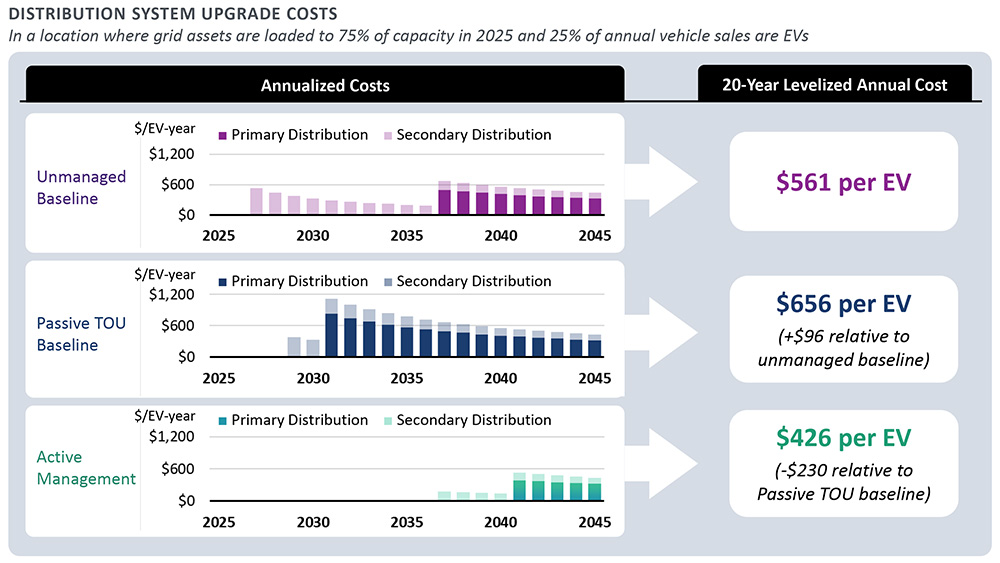
With passive TOU rates, customers would set their EVs to start charging once the cheaper power kicks in and everyone on the block would start pulling power at the same time, leading to a larger peak than even flat rates. Energy Hub’s management system can spread those charges over the entirety of the off-peak hours, flattening the peak.
“Every EV will let you set a charging schedule, and essentially, if you were trying to do this through behavior change, the more successful you are at getting everybody to pay attention to that black-and-white pricing signal, the greater the peak,” Thompson said. “And so, the ideal combination is a mix of the TOU signal and a piece of software that kind of randomizes and distributes that strategically over time.”
The study looked only at TOU rates, which offer discounts in off-peak hours. Thompson argued that more complex rates, like passing through wholesale costs, do not attract customers.
“If you go around Europe, if you go to Australia, in major other markets, the per capita participation with flexible loads is lower than it is in the U.S.,” Thompson said.
EnergyHub’s and other distributed energy resource management systems can link up EVs, solar panels, smart thermostats and other resources to those wholesale signals and optimize their performance for the grid, Thompson said.
The need for that management scales up with EVs on the system. Ramakrishnan said a local grid can handle a car or two but that once more start to plug in, their charges need to be managed to avoid the need for distribution upgrades.
“You can assume there’s a random distribution of these things up to a point, and you never know whether you’re already basically at capacity or there’s tons of headroom,” Thompson said. “The other thing that you hear from utilities all the time is that there’s clustering, and so you might have 5 or 10% adoption in the service territory, but you might have 25% in a neighborhood.”
The market changed for EVs in general in 2025 as federal tax incentives expired at the end of the third quarter. That led to a spike in purchases as consumers sought to take advantage of those, Thompson said.
Now the industry is waiting for new quarterly figures to get a sense of how fast EV sales will grow absent federal tax incentives. Even with those incentives, most of the plug-in models were more expensive, which kept their sales numbers low. With technology improving, prices are expected to come down and that could lead to significant growth.
“We now have the ability to tackle this in an orderly way,” Thompson said. “What’s nice about the way we’ve built this solution is that a utility can adopt it very cost effectively at small scale, get comfortable with sort of understanding what does it do? How does it work? How do they integrate it with our other systems?”
Once they begin building consumer awareness, “as they hit these levels of kind of a critical mass, whether that’s locationally or across their whole system, they’re ready for it,” he added.