Search
December 10, 2025

Swett and LaCerte Nominations Clear Committee on Party Line Votes

The two nominees to open seats on FERC, Laura Swett and David LaCerte, both cleared the Senate Energy and Natural Resources Committee in largely party line votes of 12-8 in a hearing Sept. 11. 

Swett is widely considered to be named the chair of FERC assuming her nomination gets through a full Senate vote. With LaCerte, the two commissioners would give President Trump a majority on FERC for the first time this term. The committee votes came just a week after Swett and LaCerte testified in another hearing. (See: Senators Focus on FERC’s Independence at Swett, LaCerte Confirmation Hearing.) 

Committee Chair Mike Lee (R-Utah) said FERC has important authority that ensures a reliable and affordable energy system and that the two nominees would help get that work done. 

“It performs these and many other functions that in many cases not all of us think about every day. When it performs that duty with discipline within FERC, the country prospers. When it strays from its mission, the bill lands squarely on the kitchen tables of American families. That is the gravity of the task before Ms. Swett and Mr. LaCerte. Both nominees bring with them valuable experience that can serve the commission.” 

Swett has been a FERC attorney at the law firm Vinson & Elkins and has worked at the commission before, including as staff for former Chair Kevin McIntyre and former Commissioner Bernard McNamee. LaCerte lacks direct experience with FERC. 

While Lee said LaCerte is qualified for the job, Ranking Member Martin Heinrich (D-N.M.) noted that FERC nominees are, by statute, supposed to be experienced on the issues before the regulator. 

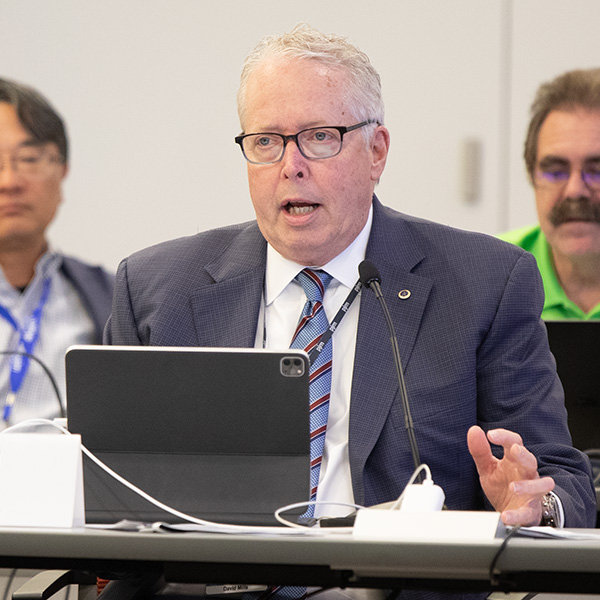
David LaCerte | © RTO Insider LLC

“The commission’s independence, its bipartisanship and its members’ expertise have always been part of its strength,” Heinrich said. “They have contributed to, rather than detracting from, the making of good energy policy, and I believe Ms. Swett has the necessary qualifications for this job.” 

Normally, Heinrich said, he would have voted in favor of Swett’s nomination. He added that LaCerte lacked the qualifications for the job, saying he “does not meet the basic statutory requirements.” However, neither of them got his vote and all but one Democrat on the committee voted against the pair. 

“These are not normal times,” Heinrich said. “This administration is issuing illegal stop work orders on fully permitted projects. They are creating a grid crisis. They are killing good union jobs, and they are raising electricity prices, and until they are willing to comply with the letter of the law, it will be difficult for me to support their nominations.” 

The two nominees need to get approved by the entire Senate in floor votes before they can move into offices at 888 First St. NE. Sen. Lisa Murkowski (R-Alaska) asked Lee to impress on leadership the imperative of getting FERC back to a full quorum. 

WEIM Prices Rise on Higher Gas Costs in Q2 2025

Western Energy Imbalance Market prices increased sharply in the second quarter of 2025 compared with the same period in 2024, mostly due to higher natural gas prices at Western hubs — with some seeing 80% gains.

That was a key finding in a report CAISO’s Department of Market Monitoring (DMM) delivered at the Western Energy Markets Governing Body’s general session Sept. 9.

The report showed 15-minute market prices across the WEIM averaged $26/MWh during the quarter, a 12% increase compared with 2024.

California experienced the highest electricity price in the market — about $28.40/MWh, marking a 22% increase. The Desert Southwest region saw the biggest gain at 40%, while Pacific Northwest prices were up 14%.

Rising gas costs and higher load drove the price gains, Eric Hildebrandt, DMM executive director, said in the report.

Natural gas prices at most major Western hubs were “up significantly compared to the second quarter of 2024,” with the average prices at Henry Hub, PG&E Citygate, SoCal Citygate, and NW Opal Wyoming increasing by 55%, 27%, 80% and 64%, respectively, compared with the second quarter of 2024, Hildebrandt said in the report.

Asked by RTO Insider to provide more insight into the causes of gas price increases, CAISO said it “doesn’t monitor these markets directly.”

“Our regulator, FERC, would be in a better position to answer this question,” the ISO said. “We generally treat gas prices as inputs.”

Demand increased in the WEIM, too, but not by much: Total system load averaged 74.7 GW, which was about 1.4% greater than the load in the second quarter of 2024. The Pacific Northwest region’s average load came in at about 21 GW, up 1% from the second quarter of 2024. CAISO’s average load was about 22 GW, up 1.9%.

Policy Project Updates

Speaking during the session, WEM Governing Body Chair Rebecca Wagner said the WEM’s policy projects are “back on track” after a “hiatus due to the work on the congestion revenue rights [initiative].”

Wagner said the WEM Governing Body was changing its approach to policy updates at its meetings.

“Rather than having a detailed policy initiative update, you can find that information in our informational reports … and so what we’re going to do instead is just policy hot topics,” Wagner said. “What are the key topical items that are rising to the top for ISO management and most importantly with stakeholders?”

Becky Robinson, CAISO director of market policy development, said the ISO plans to potentially bring certain policy initiative decisions to the next WEM board meeting in October.

Specifically, Robinson said CAISO could have a proposal ready for a decision associated with the ISO’s gas resource management initiative. That initiative has “set out to determine what parts of our market design may limit the ability of gas resources from participating in the WEIM or the EDAM when it’s up and running next year,” Robinson said.

The goal of the new proposal is to address what factors might be restricting gas resources’ ability to accurately reflect their gas cost and availability, she said.

The proposal could include three parts.

First, it could provide updates to day-ahead advisory market runs, so that “we are providing that information to market participants … potentially in advance of the day-ahead market,” Robinson said.

The second part could include providing more options for cost inputs and cost recovery for gas resources better accommodate variables such as extreme weather, she said.

The third part of the proposal could include more options for managing certain limits encountered by gas resources, Robinson said.

No Joint General Session

The WEM Governing Body general session was held a day before the body’s joint executive session with the ISO Board of Governors, but no joint public meeting between the boards will be convened in September — just as in July.

Asked about the reason, a CAISO spokesperson said: “General session meetings are held only when there are planned topics of discussion. Since there are no general session topics for the joint meeting or the Board of Governors meeting this month, those two general sessions were not scheduled.”

ISO-NE Kicks off Talks on Accreditation, Seasonal Capacity Changes

ISO-NE kicked off discussions on the second phase of its capacity auction reform (CAR) project at the NEPOOL Markets Committee on Sept. 10, beginning long-awaited talks on accreditation and seasonal capacity auction changes. 

Changes to capacity accreditation would directly affect the capacity market revenues available to resources in the region, which makes it a particularly hot topic for New England stakeholders. 

The second phase of the CAR project also includes a proposal to split ISO-NE’s annual capacity commitment period (CCP) into six-month summer and winter seasons with separately procured capacity. 

ISO-NE is aiming to finalize and file the CAR seasonal and accreditation (CAR-SA) changes by the end of 2026. The RTO is nearing the end of its work on the first phase of the CAR project (CAR-PD), which is focused on transitioning from a forward to a prompt capacity auction, along with resource retirement changes. (See Stakeholders Mixed on ISO-NE Prompt Capacity Market Proposal.) Both phases of the CAR project are intended to take effect for the 2028/2029 CCP. 

The RTO’s CAR effort began in 2022, but it paused the work for an extended period to expand the scope of the project to include changes to the auction format. 

The proposed accreditation reforms would base each resource’s capacity value on “how an increment of capacity from the resource would reduce the total amount of expected unserved energy.” 

Steven Otto, manager of economic analysis at ISO-NE, said this approach should better account for resources’ actual contributions to regional reliability, improving market efficiency and providing more accurate signals for resource entry and exit.  

“The [marginal reliability impact] framework, in conjunction with the other elements of the CAR proposal, will help the capacity market meet its core objectives of reliability, sustainability and cost effectiveness by accrediting resources based on their expected performance during simulated hours where additional available capacity would mitigate or prevent load shed,” Otto said. 

In the new format, each resource’s accreditation would be subject to change as the resource mix evolves, which could incentivize a more diverse resource mix. For example, as the proliferation of solar generation reduces reliability risks during early evening hours in the summer, incremental additions of solar capacity would reduce the accreditation of all solar resources. 

Under the existing rules, “resources’ [qualified capacity] values are largely static, which may cause disparities between resources’ capacity market compensation and their resource adequacy contributions as system conditions evolve,” Otto said. 

One key component of the accreditation reform proposal will be the calculation of the winter gas constraint, intended to reflect the region’s limited access to gas during cold periods. 

Otto noted that ISO-NE plans to develop a “market-based gas constraint for the winter season,” which would be based on separate demand curve for gas resources that lack firm fuel contracts. 

ISO-NE wrote in a 2024 memo that the approach “would decrease the amount of gas capacity procured in the winter… and would pay that capacity a lower price.” 

Though the details of this market constraint have yet to be developed, the mechanism will likely reduce accreditation values for gas resources that do not have firm fuel arrangements, creating incentives for generators to secure their fuel supply. 

Stakeholder Proposals

Also at the MC, stakeholders proposed several changes to ISO-NE’s CAR-PD proposal. 

Andrew Gillespie, director of governmental and regulatory affairs at Calpine, made the case for ISO-NE to change its formula for calculating the capacity offer price threshold (COPT) in the capacity market. Market participants that bid above this threshold are subject to market power review by the Internal Market Monitor and must submit a detailed cost workbook. 

For the 2028/2029 CCP, ISO-NE plans to base the threshold on the average of the clearing price from previous Forward Capacity Auction (FCA) and a clearing price forecast for the upcoming auction. 

Gillespie argued that relying on the clearing price from previous capacity auction, which would have been held about four years earlier, inadequately accounts for the recent spike in capacity scarcity hours. 

Elaborating on a proposal outlined at the MC in August, he said the RTO should instead rely on the opportunity costs, as defined by a formula multiplying the balancing ratio by the performance payment rate by the expected number of capacity scarcity hours. (See “Seller-side Market Power,” NEPOOL Nears Vote on 1st Phase of ISO-NE Capacity Auction Reforms.) 

Relying on this formula would significantly increase the threshold price, Gillespie said. He estimated that the threshold price for the past three auctions would have been more than double the auction clearing price for the past three FCAs. 

He said recent FCAs have underestimated the number of scarcity hours and added that, “without modification to the threshold price, suppliers that submit an offer based on ‘opportunity costs’ may be mitigated by IMM.” 

Ben Griffiths, vice president of wholesale market policy for LS Power, offered an alternative proposal for the threshold, proposing to rely on the most recent annual reconfiguration auction clearing price instead of the most recent FCA clearing price. 

He said this proposal should be applied solely to the 2028/2029 CCP and would serve as a “one-time, targeted fix that it preserves the broader tariff framework and leaves the general COPT formula unchanged for future auctions.” 

Griffiths added that the annual reconfiguration auction clearing price would be a “reasonable substitute” for the FCA clearing price, since annual reconfiguration auctions “are deliberately designed to mirror the FCA in many of their mechanics.” 

Also at the meeting, FirstLight Power’s Tom Kaslow proposed tariff changes to impose Pay-for-Performance charges on exports during capacity scarcity events. ISO-NE also advocated for this change in its annual report, published earlier in 2025. (See ISO-NE Monitor Discusses Market Trends, Energy Transition.) 

In response to the proposal, some stakeholders have advocated for explicit language exempting capacity-backed exports from performance charges. 

Report: Gas Powerful Tool for Energy Assurance

With electric utilities worldwide facing rapidly rising demand and an “unpredictable” planning environment, natural gas continues to hold a strong role “supporting long-term sustainability and energy security” in the global market, according to the International Gas Union’s 2025 Global Gas Report.

The report, released Sept. 10 and co-authored with European gas pipeline operator Snam, analyzed trends in the international gas market and compared them with developments in the electric landscape. Overall gas demand grew to 4,122 billion cubic meters in 2024, up 1.9% from the year before, while gas production grew by 65 Bcm, or 1.6%.

Demand growth was strongest in Asia, which consumed 36 Bcm (3.6%) more in 2024 than in 2023, followed by Russia, up 11.5 Bcm (2.5%), and North America, up 22.9 Bcm (2%). Consumption fell by 0.6% in South America and 1.5% in Africa. About 80% of the natural gas supplied in North America went to the U.S., IGU said, partly because of historically low Henry Hub prices making gas more cost-competitive with coal for electric utilities.

Power generation made up about one-third of gas consumption worldwide in 2024, more than any other application; industrial applications and residential and commercial uses came in second and third, continuing the pattern of the previous four years. Similar results were seen in North America, Asia and the Middle East.

Despite this steady demand growth, the report noted that “shifts in technology, climate and geopolitics” have introduced uncertainty into the market. Record high summer temperatures in 2024 contributed to peak power demands in multiple countries including the U.S. Import tariffs imposed by the Trump administration also have the potential to “weaken global liquified natural gas demand despite strong support for the oil and gas sector domestically … exacerbated by the unpredictable pace of the energy transition.”

The ongoing data center boom is expected to drive structural increases in electricity demand as well. IGU observed that about 73 GW of new data center capacity is under construction and planned in the next five years, on top of the close to 45 GW that existed in 2024, with most facilities concentrated in Georgia, Arizona, Texas and Virginia. “Favorable conditions such as low-cost energy, tax incentives and robust fiber infrastructure” are behind the anticipated growth, according to the report.

The weekly power balance in Germany for 2024 by energy source, showing the use of natural gas to meet demand during periods of low wind generation. | European Network of Transmission System Operators for Electricity

In light of these growing pressures, IGU argued that “gas is well positioned as a force of resilience [and] a lower-carbon alternative to coal.” The organization noted the use of gas as “insurance for power systems” that have seen growing penetration by intermittent resources like wind and solar, citing the “dunkelflaute” incidents in Germany in 2024 when wind activity, and thus wind power generation, fell off steeply, leaving the slack to be taken up by gas, coal and imports.

Gas also constitutes “a proven technology partner to batteries,” the report said, pointing to the experience of California in the first six months of 2025, when gas regularly ramped up to compensate for decreased output from solar and battery facilities. These global examples show the role of gas “as a flexible solution in balancing [renewable energy] variability,” IGU said.

Given the importance of gas, the report argued for the U.S. and other developed nations to pursue “targeted investment across the natural gas value chain, careful alignment of technology choices with system needs and reform of power market structures to ensure project viability.” Potential value chain investments include upstream supply, midstream infrastructure such as pipelines and storage, and increased gas generation capacity. Market reforms could include clarifying the role of gas plants as support for renewable energy rather than as baseload power.

“The future role of natural gas in power systems will vary widely depending on feasibility considerations, best practices and regional integration strategies,” the report said. “Existing infrastructure, current power mixes and policy environments will determine how extensively gas-to-power can contribute to system flexibility. Therefore, unlocking the full potential of natural gas as a dispatchable and balancing power source will require a set of targeted measures at both national and global levels.”

Permitting Hearing Shows Tricky Politics of Getting a Bill Passed

The House Natural Resources Committee held a hearing Sept. 10 on three pieces of permitting reform legislation that showed the political disputes that will have to be solved if any of them are going to pass. 

“It’s a bipartisan issue,” Chair Bruce Westerman (R-Ark.) said in opening remarks. “It’s not just people who vote Republican that are coming in my office to tell me that. We had a hearing on this topic in July, and in that hearing, many of my friends across the aisle were calling fouls on the current administration, saying they shouldn’t be doing this. But you know what? This time a year ago on our side of the aisle, we were calling fouls on the Biden administration, saying they shouldn’t be doing this.” 

Congress has an opportunity to enact permitting legislation that will improve the process regardless of who occupies the White House, he added. 

The committee is not the only one working on the issue, with the House Energy and Commerce Committee planning a hearing on other permitting legislation for Sept. 16. Senate committees have been crafting bills as well. (See related story, Permitting Legislation Effort Picks Up Steam, but Passage Remains Difficult.) 

Two of the bills before the committee, H.R. 573 and H.R. 4503, are focused on modernizing the permitting with new technologies and enhanced data, but Ranking Member Jared Huffman (D-Calif.) said Westerman’s bill — the SPEED Act (H.R. 4776) — “takes a sledgehammer” to the National Environmental Policy Act’s core provisions. 

“The SPEED Act treats public input like it is an annoyance, like a hurdle, rather than a resource that can guide better decisions,” Huffman said. “It restricts what major environmental impacts can even be considered for review. It eliminates the spotlight that NEPA provides for the public to help government get it right, and by shrinking analysis and compressing timelines without investing in greater agency permitting capacity, you’re really just inviting shoddy analysis, and ultimately that’s going to lead to more litigation and uncertainty.” 

The act is meant to cut red tape and relieve the “logjam” caused by onerous reviews under NEPA that have slowed down infrastructure projects, Westerman said. 

“NEPA must be further reformed to put definitive guardrails around what agencies are expected to review,” he added. “Much like the review documents themselves, the NEPA litigation has gotten out of control. NEPA is the most frequently litigated environmental statute.” 

The SPEED Act does have a Democrat as a co-sponsor: Rep. Jared Golden (Maine), whose district is among the most conservative in New England, with President Donald Trump winning it in the past three presidential elections. But beyond the opposition from the leading Democrat on the committee, other members of the rank and file questioned why they should work with an administration that is actively working against their states’ policies. 

“I want to get to ‘yes’ on this bill,” Rep. Seth Magaziner (D-R.I.) said. “I’m not there now, but I want to get there because I understand that … we need to build out our infrastructure, repair our highways and bridges, and achieve the clean energy transition and so much more. We need to make it easier to build in this country again.” 

The conversation about how to balance against the need for environmental protections and allowing impacted communities a voice in the NEPA process is something that normally Congress should be engaged in, he added. 

“But we are having this normal conversation in an abnormal time, a time when the Trump administration is unilaterally and most likely illegally canceling and stopping clean energy projects, including a very important project in my district, the Revolution Wind project that was set to deliver energy to the grid at a below-market rate for consumers and meet a third of my state’s electricity demand,” Magaziner said. 

The bills before the committee have their merits and deficiencies, but they also have to be considered in the context of the administration blocking clean energy, he added. 

MISO, Stakeholders Appeal to FERC to Leave Long-range Tx Plan Intact

MISO and several stakeholders came to the defense of the RTO’s $21.8 billion, 24-project long-range transmission plan (LRTP) portfolio for the Midwest as five Republican states seek to repeal the projects’ approval.

The state utility commissions of Arkansas, Louisiana, Mississippi, North Dakota and Montana filed a complaint in late July asking FERC to order MISO to revoke the classification of its second LRTP portfolio and nullify the portfolio’s load-ratio share cost allocation. The five states claim MISO and its board erred by advancing transmission projects that will cost more than the value they can provide and said FERC should scrutinize all the RTO’s future business cases supporting long-range transmission portfolios (EL25-109).

The states argued that MISO has no authority to direct the projects’ construction because the projects don’t meet the required 1:1 benefit-cost ratio in the RTO’s tariff. (See MISO States Split on FERC Complaint to Unwind $22B Long-range Tx Plan and Five Republican States File FERC Complaint to Undercut $22B MISO Long-range Tx Plan.)

MISO didn’t mince words in a Sept. 9 response. It said the derailment of a 765-kV backbone furnished by the projects would jeopardize it and its states’ ability to meet growing electricity demand and swap comprehensive regional planning for a more expensive, piecemeal buildout. MISO said the states made nothing more than a collateral attack on its established planning practices and long-established postage stamp cost allocation method for projects.

“The deficient and misleading complaint filed in this docket puts at risk not only the needed infrastructure resulting from a comprehensive, stakeholder-driven planning process, but also future generation, transmission and large load additions by creating regulatory uncertainty, which the commission, federal and state policymakers and the courts have sought to reduce,” MISO said.

The grid operator said the five states advocated for a “haphazard and unrealistic approach to regional transmission planning” that is “profoundly inconsistent” with FERC precedent and Order 1920. MISO added that North Dakota and Montana stand to benefit significantly from the second LRTP portfolio “in exchange for a very small percentage of the costs” and stood by its original 1.8 to 3.5:1 cost-benefit estimate for the total portfolio.

Arkansas, Louisiana and Mississippi are not going to fund any of the projects because MISO South was not part of the LRTP planning exercise. The South is destined for its own long-range planning that is set to begin in 2026.

MISO said it conducted more than more than 300 stakeholder meetings, considered 100 alternative projects and made 500-plus revisions to assumptions in its planning process on the advice of its stakeholders. The RTO also said the five state commissions didn’t attempt to initiate MISO’s dispute resolution process while the portfolio was in the draft stages.

Several MISO stakeholders asked FERC to throw out the complaint in other responses posted on the Sept. 9 deadline.

Xcel Energy agreed with MISO and said the RTO granted requests from the North Dakota Public Service Commission to model up to nearly 15 GW of additional wind capacity in the state and included more dispatchable resources in the plan, even though the hypothetical megawatts didn’t appear in states’ generation plans.

Xcel said the second LRTP portfolio is now — “if anything — more essential and more urgent” given that load growth projections have eclipsed what MISO could have predicted in 2024. It said North Dakota was joined in its complaint by “state commissions that either effectively sat out” the planning process (Montana) or states that have “no concrete stake” in the portfolio (Arkansas, Louisiana and Mississippi). The utility argued that now is the time for developers to “go forth and build, without endless trips back to the commission or nonstop second-guessing.” Xcel also criticized the states for appearing to demand MISO be a “Soviet-style central planner” that should have planned generation and transmission simultaneously.

IMM Doubles Down that MISO Benefit Calculations are Faulty

However, MISO Independent Market Monitor David Patton again said the RTO overstated its future transmission needs through the 20-year planning future it based the portfolio on.

Patton was a vocal opponent of the second LRTP portfolio throughout 2024 and repeatedly said MISO should consider capacity expansion with fewer intermittent renewable resources and more energy storage and dispatchable generation built closer to the load they would serve. (See $21.8B Long-range Tx Plan Goes to Membership Vote; MISO Resolute, IMM Protesting.) This would obviate the need for 113 GW of intermittent renewable resources by 2042 and reduce costs by $92 billion, he said.

MISO’s second future — which the second LRTP portfolio is based on — predicts the RTO operating with 466 GW of nameplate capacity by 2042, broken down into 160 GW of wind generation, 112 GW of solar, 65 GW of natural gas, 41 GW of other generation, 31 GW of battery storage, 12 GW of nuclear, 10 GW of storage, 6 GW of coal and 29 GW of shadowy, “flex” dispatchable resources that will be necessary to meet reliability but aren’t in member plans.

Patton said the transmission portfolio “will undermine the market incentives for participants to invest in lower-cost resources and transmission upgrades that would be more efficient and lower MISO’s long-term costs.” He asked FERC to order the RTO to revise the transmission portfolio based on a more realistic view of the future system and a more thorough benefits assessment.

Patton also argued that the trajectory of members’ generation planning is changing, evidenced by the mostly dispatchable energy lining up for MISO’s newly introduced expedited queue lane. Patton said the queue fast lane will “substantially” lower the RTO’s transmission needs. (See MISO Selects 10 Gen Proposals at 5.3 GW in 1st Expedited Queue Class.)

The Coalition of MISO Transmission Customers agreed with the Monitor that the RTO overstated the benefits of the projects and that it didn’t meet a least-regrets planning standard with the portfolio.

8 States vs. 5 States

Eight states registered comments supporting the LRTP portfolio.

The Illinois Commerce Commission, Michigan Public Service Commission, Minnesota Public Utilities Commission and Public Service Commission of Wisconsin united to defend the portfolio in a joint filing. They said that of MISO’s 15-state jurisdictions and the New Orleans City Council and Manitoba (which makes 17 total jurisdictions), just five states disputed the portfolio, with the three Southern states not set to pay anything for the Midwest projects.

The band of Northern states said the 765-kV projects will help MISO meet a peak load that’s expected to grow by 1 to 2% annually through 2044, with anywhere from 23 to 37 GW coming from new data centers. The LRTP portfolio, they said, will “help maintain reliability as load continues to grow, the fleet transitions and weather becomes more extreme.”

The four states further disagreed that MISO defied its tariff and said the RTO has “wide latitude” to measure the benefits of long-range transmission.

The Minnesota PUC and Minnesota Department of Commerce called MISO’s planning process “thorough, transparent and collaborative” and asked FERC to reject the complaint with prejudice.

Indiana Secretary of Energy Suzanne Jaworowski (a former MISO employee) said the state’s leadership is “steadfast” in support of the second LRTP, which she said will ensure long-term reliability of the grid while accommodating higher loads.

The Kentucky Public Service Commission agreed, saying, “The buildout of large-scale, high-voltage transmission is part and parcel to the overall value proposition of RTO membership.”

Iowa Gov. Kim Reynolds likewise said the portfolio would help the Midwest reliably meet demand and reduce congestion. She wrote that more than 7 GW of proposed generation in the state is on the line if the second LRTP portfolio is interfered with. The Iowa Utilities Commission said the state risks “delayed transmission infrastructure, resource adequacy concerns and potential reliability issues” if the portfolio doesn’t proceed.

Consumer advocates, including the citizens utility boards of Illinois, Michigan and Minnesota and the Alliance for Affordable Energy, called the complaint a “full-out assault on MISO’s transmission planning process” that fails to specify how the RTO violated its tariff.

“The complainants must not be allowed to come forward months after the fact and allege that MISO’s tariff should have included their preferred assumptions,” they said.

TOs Unsurprisingly Back LRTP

As expected, MISO transmission owners said the complaint amounted to an “unconvincing attack” on MISO’s well established transmission planning process.

They said derailing the projects would jeopardize the Midwest’s ability to get essential generation online, including 117 GW of MISO’s 300-GW interconnection queue and the 26.5 GW that lined up for the fast-track queue.

“The complaint, if granted, would arrest this potential generation influx and result in unnecessary obstacles to MISO’s efforts to reliably, efficiently and cost-effectively address the load-growth projected for the next years. Transmission and generation investment will almost certainly be chilled, compromising MISO’s ability to plan the transmission facilities needed to support historic load growth — particularly the load growth due to growing electrification and, crucially, the proliferation of data centers that support budding artificial intelligence technology,” the TOs argued. They said if MISO is forced to complete a time-consuming re-evaluation and reassignment of the 24 transmission projects, transmission and generation planning would be “irrevocably” delayed.

The TOs noted that the five states filed the complaint eight months after the MISO Board of Directors voted to approve the portfolio in December 2024 and more than three years since the RTO began the planning process.

DTE Energy likewise said it supported the LRTP’s role in modernizing the grid and said the portfolio is “necessary during these unique transitional times in our nation’s energy journey.”

A joint protest from Clean Wisconsin, the Environmental Defense Fund, Fresh Energy, the Natural Resources Defense Council, Sierra Club, the Solar Energy Industries Association, Sustainable FERC Project and Union of Concerned Scientists said the five states’ “true contention is that MISO should have used the modeling assumptions they prefer.” They said the complainants were silent as to the fact that MISO doubled-checked the value of the portfolio against its more conservative, first 20-year planning future that contemplates less renewable energy growth and still found a benefit-cost ratio better than 1:1.

Groups including the Data Center Coalition, the Clean Energy Buyers Association and the Electricity Customer Alliance emphasized the need for electricity infrastructure like the LRTP portfolio to win the AI race.

Americans for a Clean Energy Grid pointed to the U.S. Department of Energy’s triennial state-of-the-grid report, which found that the Midwest region needs to more than double its regional transmission to meet moderate load growth by 2035.

The Corn Refiners Association and emPower Rural America also said the lines are “long overdue” in comments.

The nonpartisan think tank Institute for Policy Integrity at the New York University School of Law weighed in that the five states “nitpick[ed] at MISO’s numbers.”

Stakeholder Forum: What Does a Reliable Grid Cost?

By Michelle Bloodworth

More and more, energy policy analysis seems to be based on finding a preferred answer rather than a realistic answer. Case in point, a recent Grid Strategies report, sponsored by several environmental organizations, claims that Department of Energy (DOE) emergency orders to temporarily keep fossil power plants from retiring could cost either $3 billion or $6 billion annually by 2028. 

Each estimate is based on a different assumption about how many fossil fuel power plants might retire over the next three years. For perspective, these costs, even if correct, would represent either 0.6 or 1.2% of annual consumer expenditures for electricity, which total about $500 billion. (According to EIA, end use electricity expenditures totaled $488 billion in 2023, which is the most recent data.) 

The Secretary of Energy has the legal authority under Section 202(c) of the Federal Power Act to issue orders to prevent “energy emergencies.” The potential reliability problems NERC has been warning about qualify as an emergency under the Federal Power Act. 

Michelle Bloodworth

Former FERC Chair Mark Christie in July warned that “the reliability threat is not on the future horizon. It is now here.” 

One of the primary reasons for these serious warnings is the retirement of fossil power plants. That’s why it has become increasingly important to stop retiring power plants because they are needed for reliability.   

From a cost-benefit standpoint, it’s important to consider the benefits of 202(c) orders, which the report ignores. DOE, for example, estimates the annual cost of blackouts to be $150 billion.  

Also, an unreliable electricity grid during Winter Storm Uri cost the Texas economy between $80 billion and $130 billion.  

As to the possible cost of DOE orders to keep plants running, the report makes a number of questionable assumptions that drive its large cost estimates. One assumption is that all fossil power plants (as many as 90, according to the report) that might retire for one reason or another over the next three years actually will retire. 

This seems improbable because fossil power plants will be needed to satisfy load growth driven by data centers, advanced manufacturing, crypto mining and electrification of the economy, and EPA is rewriting rules that were expected to cause the premature retirement of many fossil power plants. In fact, utilities already are changing their minds and, so far, have deferred the retirement of 29,000 MW of coal-fired generation. 

Another assumption is that every one of these 90 retiring plants would be directed by DOE to continue operating for a full year. However, we don’t really know how many plants actually would receive 202(c) orders, but we know that DOE’s authority under Section 202(c) has been used sparingly — just 27 times since 2000. Only two of these orders lasted for more than 90 days, so assuming that every retiring plant, regardless of how many there might be, would be directed to operate for one year seems unlikely, if not improbable. 

We thought using different assumptions would be an interesting way to test the Grid Strategies cost estimates. So we assumed that fewer retirements would happen (half the number Grid Strategies assumed), that only half of these retirements would receive 202(c) orders and that the orders would direct each of the plants to operate for three months, not a full year. 

With these alternative assumptions, the cost estimates are more than an order of magnitude lower. The $3 billion estimate is reduced to a little less than $200 million, and $9 billion is reduced to $370 million. 

Obviously, no one knows what will happen by 2028, but suspending plans to retire coal and natural gas power plants is even more critical for grid reliability than issuing temporary 202(c) orders.   

Michelle Bloodworth is president and CEO of America’s Power. 

MISO Discloses $280M Error, Over-procurement in 2025/26 Capacity Auction

MISO said a yearslong software error caused it to clear more capacity than intended in past capacity auctions and resulted in an approximate $280 million impact to market participants in this year’s auction.  

MISO said it uncovered the coding error — which had gone unnoticed since 2017 — in a third-party vendor’s work. The error caused MISO to clear additional capacity at higher auction clearing prices in the 2025/26 Planning Resource Auction (PRA), the RTO said.  

That likely means the error produced higher prices and higher reserve margin requirements in MISO’s auctions all the way back to the 2018/19 planning year.  

MISO said the error calculated its loss-of-load expectation (LOLE) using an “all-hours” methodology, rather than the tariff-defined “daily peak hour” methodology, leading this year’s auction to clear more capacity than intended.  

MISO’s tariff defines LOLE as “the sum of the loss-of-load probability for the integrated daily peak hour for each day of the year.” As currently defined, a day with a loss-of-load event is counted in MISO’s LOLE calculations only if the event happens during the hour with daily peak load.  

MISO said it discovered the error in June while running simulations of LOLE in preparation for the very change the software error induced. MISO wants to change its LOLE definition from one that’s expected only on the daily peak hour (the “daily peak hour” methodology) to one that could crop up at any hour in the day (the “all-hours” methodology). MISO has said that increasingly, generation emergencies can strike at any time.  

MISO made a FERC filing in late August to transition from the daily peak hour to the all-hours LOLE methodology. It plans to use the approach formally beginning with the 2026/27 planning year if it receives FERC permission.  

In MISO, the LOLE is the primary factor that determines demand curves in the capacity auction, which has a direct effect on clearing prices.  

MISO said that while it won’t specify the exact number of additional megawatts that ended up clearing, the all-hours software approach led to an estimated 1 to 2% over-procurement of resources in the case of the 2025/26 auction.  

In an email to RTO Insider, MISO said the $280 million financial impact from the over-procurement will extend to companies that entered the auction long or short on megawatts. That means if a market participant was paid based on auction results, then they must pay back a portion of their earnings to MISO. Market participants who were charged, on the other hand, can expect a refund from MISO. 

MISO added that it will make only “paper adjustments” without financial impact for market participants that netted out their generation and load in the auction.  

Settlement adjustments could affect any generator with accredited capacity in the 2025/26 PRA, MISO added.  

MISO acknowledged that planning reserve margin requirements likely have been skewed since 2018 because of the software error. However, the RTO noted that its tariff limits evaluation of a continuing error to a one-year look-back period.   

MISO’s seasonal planning reserve margin requirements for the 2025/26 planning year are 7.9% in summer, 14.9% in fall, 18.4% in winter and 25.3% in spring.  

MISO said it will not retroactively alter 2025/26 capacity clearing prices to correct the error. 

“MISO is not rerunning or resettling the PRA. We are not accepting new bids or establishing a new auction clearing price. Instead, adjustments will be made via settlements, not through price recalculation,” MISO said in a statement to RTO Insider.

The 2025/26 auction cleared at $666.50/MW-day in summer, $69.88/MW-day in spring, $33.20/MW-day in winter and $91.60/MW-day in MISO Midwest and $74.09/MW-day in MISO South for fall. (See MISO Summer Capacity Prices Shoot to $666.50 in 2025/26 Auction.)  

MISO said it’s sending notices to generation companies about the financial impacts to their portfolios. It said it plans to “issue all adjustment statements or invoices” by Sept. 25. 

MISO told RTO Insider that it would not disclose the vendor responsible for the error. The grid operator did not comment on whether it would continue to use the vendor’s services. MISO said at the time it discovered the error, the vendor “confirmed the software has never calculated LOLE based on the daily peak hour methodology since implemented in the 2018/19 PRA.”

MISO said it made a self-report with FERC and notified its Independent Market Monitor and Board of Directors. The grid operator also said it’s “working to strengthen validation and product testing for critical software.”  

MISO leadership plans to discuss the software error and ongoing correction efforts with its board during a Sept. 16 meeting in Detroit, part of its quarterly Board Week.

EIA Increases Projections of Power Generation Growth

The U.S. Energy Information Administration is boosting its estimate of national power generation growth to 2.3% this year and 3% next year. 

The details are reported in the September Short Term Energy Outlook the agency issued Sept. 9. In the outlook published in January, it had forecast an average of 1.5% growth in 2025 and 2026. 

EIA said the increase is from a colder-than-expected start to 2025 and load growth assessments by ERCOT and PJM. The latter had the largest amount of generation of any region in 2024: 873 billion kWh. It is expected to have 904 billion in 2025 and 946 billion in 2026. 

ERCOT is forecast to have the largest increase in generation, from 459 billion kWh in 2024 to 560 billion in 2026 — a 22% jump. 

The January STEO forecast only 499 billion kWh in ERCOT in 2026 and only 902 billion kWh for PJM. 

The predictions for all other grid regions are nearly the same in the September report as in the January report. 

To meet this rising demand, utility-scale solar generation is expected to increase 33% this year over 2024, the most of any technology, and then 19% in 2026. 

Natural gas generation is expected to be 3% lower in 2025 than in 2024 because of sharply higher gas prices, but it still will be the largest source of electricity by a wide margin, providing 1,698 billion kWh, or 40% of the country’s electricity. 

Coal-fired generation is expected to be 9% higher this year than last — the first year-over-year increase for coal since 2021. The 2024-2025 decrease in gas and increase in coal both are approximately 61 billion kWh. 

The U.S. Energy Information Administration expects significantly more solar and coal power generation in 2025 than in 2024 from increases in installed solar capacity and increases in natural gas prices that make coal more attractive. | EIA

Small increases also are forecast in 2025 for wind power (4%) and hydropower (2%). Together with solar, this puts renewable energy at 25% of U.S. electricity generation in 2025 and 26% in 2026, compared with 23% in 2024. 

Nuclear fission is expected to produce only slightly more power in 2025 than in 2024 but 2% more in 2026, thanks to the anticipated restart of the Palisades Nuclear Plant in Michigan. 

The average price per kilowatt-hour is projected to increase from 16.48 cents in 2024 to 17.22 cents in 2025 and 17.9 cents in 2026 for residential customers; 12.85 to 13.36 and 13.5 cents for commercial customers; and 8.15 to 8.49 to 8.54 cents for industrial customers. 

Nationwide average electricity prices for the three classes are projected to be 13.53 cents/kWh this year and 13.79 cents next year. The West South Central region — Texas, Oklahoma, Arkansas and Louisiana — retains the lowest average in 2025, at 9.87 cents/kWh, and New England remains highest, at 25.12 cents. 

NWPCC Updates Power Plan Model in Light of Trump

The Northwest Power and Conservation Council has provided more details regarding how its ninth power plan will consider new federal policies that could affect the buildout of new resources and transmission.

The council will consider two priority scenarios to build the plan’s model, including a changing hydro operations scenario and a new resource and transmission risk scenario, the latter of which was discussed during the Sept. 9 meeting.

“This is exploring a range of uncertainty or risk … related to the region’s ability to build new resources and transmission,” Jennifer Light, director of power planning at NWPCC, said during the meeting.

The resource and transmission risk scenario includes six sensitivities:

    • Constrained new resources.
    • Changing transmission availability.
    • Changing technology costs.
    • Limited short-duration storage availability.
    • Slower demand-side resource availability.
    • Evolving federal policy landscape.

These sensitivities are intended to help the council get a better understanding of the availability of resources under certain circumstances.

When council staff first started developing the sensitivities at the beginning of 2025, President Donald Trump had yet to target tax incentives for renewables under the Inflation Reduction Act. (See NWPCC Considers Trump, Data Centers in Regional Power Plan.)

Council staff anticipate the administration will remove amendments to the Clean Air Act that imposed stricter requirements on the buildout of new natural gas resources.

Five of the sensitivities originally were modeled with the tax credits and gas requirements in mind, and the evolving federal landscape scenario considered what would happen if those were removed.

“Well, now we’re flipping that around a bit,” Light said.

Since those clean energy incentives and gas requirements no longer are relevant, council staff have removed them from the bulk of their modeling. Instead, those are tacked on to the federal landscape scenario, which assumes the credits will return in 2030, Light explained.

“Why are we proposing doing that? Well, the IRA gives us a set of assumptions we can use,” Light said. “We’ve already started using them. So, it wouldn’t make sense to come up with different tax credits now, and I think that’d just be a lot of work and a lot of guessing, not necessarily getting us any more precise than using IRA assumptions that they come back.”

The council is required under the Northwest Power Act “to develop a plan to ensure an adequate, efficient, economical and reliable power supply for the region,” according to its website. NWPCC publishes a plan every five years, and the goal is to have a draft ninth power plan done by July 2026 and a final version by the end of that year. (See NWPCC’s Initial Demand Forecast Sees Sharp Growth for Northwest.)

“If there is another administration down the road that wants to bring stuff in, it’s not necessarily going to look identical to the Inflation Reduction Act,” Light said. “But it is a set of policies that we have that we can use as a basis for assumptions that feels just as good as making a guess. And I think it will give us directionally useful information.”