Search
December 11, 2025

West Coast Senators Urge Passage of Calif. Pathways Bill

Six Western U.S. senators came out in support of the California legislation needed to transform CAISO’s market into an independent regional energy market, saying in a letter to Gov. Gavin Newsom that the bill promises “improved grid reliability and significant energy cost savings.” 

Democratic U.S. Senators from Oregon, Washington and California issued the letter in support of SB 540, urging Newsom to help get the bill passed before the Golden State’s legislative session ends Sept. 12.  

A heavily amended version of the bill passed the state Senate on a 36-0 vote in early July but stalled in the Assembly after many backers pulled their support in protest of the amendments.  

While one of the bill’s sponsors, Sen. Josh Becker (D), recently expressed confidence about passage of a suitable version of the bill this session, supporters are under pressure to ensure a stripped-down version of the legislation is printed before midnight Sept. 9 to comply with a rule requiring an amended bill to be in print for 72 hours before lawmakers take a vote on it. (See Pathways Bill Will Make It to Newsom’s Desk, Author Says.) 

The bill would implement the plans of the West-Wide Governance Pathways Initiative, a multistate effort to create an independent “regional organization” (RO) to govern CAISO’s Western Energy Imbalance Market and Extended Day-Ahead Market (EDAM), the latter set to launch in 2026. 

“In California, Oregon and Washington, broad participation in an expanded regional power market will result in improved grid reliability and significant energy cost savings for our constituents,” the senators’ letter said. 

Sens. Jeffrey Merkley and Ron Wyden of Oregon, Sens. Patty Murray and Maria Cantwell of Washington, and Sens. Adam Schiff and Alex Padilla of California signed the letter. 

The lawmakers emphasized many of the arguments EDAM supporters have made, including claims that the day-ahead market option will result in expanded access to generation resources across the West, improved grid resiliency and affordable electricity. 

They also noted that the onset of new load from data centers, onshoring manufacturing and increased electrification “is straining both the grid and our constituents’ pocketbooks.” 

“In tandem, consumer electric bills have soared — a result of rising demand, increasing wildfire risk and the misguided, impractical policies of the Trump administration,” the lawmakers wrote. “It is now being reported that around 80 million Americans are sacrificing basic expenses like food or medicine just to keep the lights on. Expanded regional power markets would allow for better utilization of existing generation, helping to meet growing demand while lowering energy costs.” 

“We urge you to take this extraordinary opportunity to jump-start the expansion of regional markets by enabling the CAISO, through legislation, to partner with an independent RO, thereby improving grid reliability and electric bill affordability for all West coast states as soon as possible,” the lawmakers stated. 

In tandem with CAISO’s EDAM, SPP is developing a competing day-ahead market for the West — Markets+. 

One of the largest participants in Markets+ is the Bonneville Power Administration, which manages the output from 31 hydroelectric dams in the federal Columbia River Power System, while also operating more than 15,000 miles of transmission lines — about 75% of the Northwest grid. 

In the lead-up to BPA’s day-ahead market choice, the U.S. senators from Oregon and Washington issued multiple letters, including one in December 2024 saying BPA had failed to make a financial case for joining Markets+. (See BPA Has not Made ‘Business Case’ for Markets+, NW Senators Say.) 

After BPA issued its final record of decision in favor of Markets+ in May, Wyden and Merkley told RTO Insider that the agency had rushed its decision, expressing disappointment. (See BPA Chooses Markets+ over EDAM.) 

Robert Mullin contributed to this article. 

SPP Board Approves 765-kV Project’s Increased Cost

SPP’s Board of Directors has approved a pair of contentious measures that were put aside during its August quarterly meeting: a tariff change to integrate and operate high-impact large loads, and a revised cost estimate for a 765-kV transmission project in New Mexico and Texas.

The latter approval is contingent on cost and schedule control measures that “meet the [board’s] expectations.”

Southwestern Public Service’s 345-mile project, SPP’s first 765-kV line, was approved in February with an estimated cost of $1.69 billion. SPS filed a revised cost estimate of $3.62 billion in June, more than double the earlier projection and easily outside the variance bandwidth of +/-30% that can lead to a re-evaluation. (See SPP Board Sets Aside 765-kV Costs, Large Load Policy.)

SPS CEO Adrian Rodriguez said during a Sept. 4 special board meeting that the utility has committed to a cost cap and regular reports to the board. He also said it is open to a third-party monitor, as suggested by Texas regulatory staff.

“We’re talking about working with the Southwest Power Pool board, the Southwest Power Pool staff, for this type of transparency and scrutiny and highlight that this is important not just for us, not just for our customers, not just for our regulators in Texas and New Mexico, but for all of you,” Rodriguez told the board, state commissioners and members. “We’re focused on reliability in the Southwest Power Pool and being mindful of the cost impacts to customers across SPP.”

SPP staff said the Potter-Crossroads-Phantom project, which crosses the New Mexico-Texas state line, remains the best technical solution to provide the region with voltage support. It also resolves several needs in the 2025 and 2026 Integrated Transmission Planning assessments and addresses load projections; the RTO’s latest 10-year forecast indicates 105 GW of potential load, almost doubling its current peak of 55 GW.

Casey Cathey, the grid operator’s vice president of engineering, said when the 765-kV project is removed from the 2025 ITP models, staff must add nearly 4 GVARs of temporary reactive power to support the region’s voltage. He said 35 generation projects totaling 10 GW of capacity, some of which are under construction, also are contingent on the SPS line.

“[The SPS project] is required before we can even contemplate moving forward with the 2025 ITP assessments and understanding what that portfolio looks like,” he said. “We did look at alternatives, multiple 345 facilities [and] double-circuit 500-kV facilities. All of those were actually more expensive, [had] wider rights of way and were just less optimal compared to the single 765.”

SPS submitted a cost-cap proposal to the board as part of its commitment to build the project in a “cost-effective manner, with reasonable and measured oversight and customer protections.” It also said it will forgo the return on equity applicable to the cost overruns above the current cost estimate and a 20% variance cap.

The company’s guarantee can be adjusted for exceptions consistent with those provided in competitive bids, such as changes in statutory tax rates, investment costs, import tariffs or secondary impacts on domestic markets, or the schedule resulting from changes in federal, state or local legislation and laws that became effective after Jan. 1. Other exceptions include force majeure (as defined in the SPP tariff) and increases in interest rates.

“I hope we have demonstrated our commitment and transparency to SPP, the staff, board and the commissioners by setting the foundation for 765-kV estimates,” Rodriguez said. “I want to highlight our commitment to being competitive, being transparent and being committed, not just to our customers at SPS but to the entire SPP as we’re evaluating this reliability project.”

He noted the exclusions are primarily based on items that are outside of SPS’ immediate control and those for which it has limited opportunity to mitigate.

The Members Committee approved the revised cost estimate with an 11-1 advisory vote. EDP Renewables opposed the motion, casting doubt on SPS’ cost-containment guarantee, and nine other members — primarily public power entities — abstained.

“We can be a case study on 765,” Rodriguez said. “Our transparency means that we have informed the market, including bidders, of our perspectives on this line, and we can be the case study to make sure that these types of major projects move forward with a clear understanding from the board, from the staff, as to what can be done, what issues arise and where cost mitigations can occur.”

Large Load Integration OK’d

Similar cost concerns were raised by regulators during a Sept. 3 education session on the 765-kV project and SPP’s fast-track study to integrate high-impact large loads (HILLs).

While they favored SPP’s tariff change (RR696) to expedite faster and more predictable interconnection timelines for rapidly developing large loads, they also want to maintain regional reliability, transparency and equitable cost allocation.

Minnesota Public Utilities Commissioner John Tuma spoke for several when he expressed worries about accommodating large loads that might not show up. He drew on the state’s experience in the Iron Range, where he said loads with service agreements don’t always materialize.

“We see a big technology boom. There’s going to be a lot of capital flowing in. It’ll look really sexy,” Tuma said. “Everybody wants to get in the middle of it, but some of them are going to bust, and that’s just a reality that we have to live with. … That’s one of the big concerns as a state that we have because in the end, we pay for our neighbors’ mistakes.

“We want to be quick and nimble. We don’t want to be dumb,” he added. “And so, I’m hoping that we continue to analyze these things carefully. We’re all partners in this together, and if one of our partners screws up, it could cost us and our ratepayers money.”

SPP CEO Lanny Nickell agreed. He said staff will work with the regulators and the Regional State Committee to develop a “fully informed and appropriate” cost-allocation approach for the future.

“The amount of load growth being projected, with much of that driven by data centers, will certainly drive significant transmission upgrade investment,” he said. “We need to make sure that ratepayers aren’t having to bear unfair portions of the cost needed to connect those loads while we have some time to figure out the best cost-sharing approach.”

Staff revised the large load policy to reflect the numerous comments and feedback received from stakeholders, removing conditional high-impact large load service (CHILLS) and the design associated with dispatch, study and charges for the service from its original proposal. It also removed one of three paths for high-impact large load generation assessment (HILLGA).

HILL studies will remain on a 90-day timeline. Changes include a revised HILL definition that clarifies its transmission service study process and its independence from non-conforming load.

SPP members endorsed the tariff change, 18-1, with three abstentions. OGE Energy voted against the measure, citing concerns with delays in the interconnection process and accreditation issues with increases to the planning reserve margin.

Approval is contingent upon SPP modifying the tariff to reinstate a 60-day study under Attachment AQ, which governs upgrades or other changes to delivery point facilities.

Stakeholders approved RR696, as modified, during the Markets and Operations Policy Committee’s own special meeting in August. The measure passed with 95.7% approval after failing during MOPC’s regular quarterly meeting in July at 53.7%. (See SPP MOPC Passes Revised Large Load Policy.)

The tariff change resulted from a directive by then-Chair John Cupparo in May that staff propose by the board’s August meeting a timely, scalable and reliable approach to manage the exponential growth of load demand across the footprint. (See “Cupparo Issues ‘Executive Order,’” SPP Board OKs 1-time Study for LREs’ Gen Needs.)

The CHILLS policy will be taken up during the MOPC, RSC and board meetings in October and November.

Common Charge Wants to Grow Distributed Resources to Meet Spiking Demand

With rising demand putting pressure on the system, a new group has launched to encourage distributed solutions such as virtual power plants that can be deployed quickly and cheaply.

“Right now, those are two of the biggest issues that we have on hand: affordability and reliability,” Katherine Hamilton — acting executive director of the new group, Common Charge — said in an interview. “And, so, the way we want to do that is to maximize distributed assets that are already being developed and can be plugged into the grid, and to ensure everybody has access to those technologies and those applications.”

Common Charge is a coalition, not a trade group. While it includes companies in the distributed energy resource industry, it also includes nonprofits and consumers, Hamilton said. Founding members include Advanced Energy United, Charge Ahead Partnership, Coalition for Community Solar Access, Eco Capital, Institute for Local Self-Reliance, Pivot Energy, Solar United Neighbors, Sunrun and Vote Solar.

“Distributed solutions often are not even considered in the mix as part of the solution set for mitigating for rate increases and prices going up,” Hamilton said. “So, we want to unlock that and make sure everybody has access to those solutions.”

The distribution system is state regulated, and how much distributed resources are used varies by jurisdiction, so part of the group’s efforts is to figure out best practices and ensure they are adopted as widely as possible.

“If you try to follow the distributed energy resource ecosystem, it is very diverse and very disaggregated,” Hamilton said. “And what we’re trying to do is bring a little more organization to that and then drive a lot more impact.”

Distributed resources are at work in different regions, with Common Charge pointing to PJM’s dispatch of thousands of megawatts of demand response during heat waves this year. New York delivered 6 GW of distributed solar early and under budget in 2024. New England benefited from behind-the-meter solar this summer as it helped meet high demand reliably.

ERCOT has a pilot program providing the grid with nearly 60 MW of power from customer-sited assets, and microgrids in Texas have helped keep hospitals running. In a recent test in California, 100,000 distributed assets simultaneously discharged to the grid for two hours, functioning like a power plant and helping to cut peak demand.

“From a small business improving operations through an energy management system, to a community leveraging solar to save on energy bills, to homeowners enjoying the comfort of smart thermostats, millions of distributed assets already exist, and more are waiting to be leveraged in a modern, coordinated energy grid,” Hamilton said. “These assets are proven to increase reliability, lower utility costs and grow local economies.”

Some of the distributed technologies like solar panels are tied to climate change and the divisive politics surrounding it, with skeptics dominating the federal government now, but Hamilton said Common Charge was focused on more bipartisan issues.

“We’re trying to address two of the big issues that [exist] regardless of whether people are talking about climate change or not, and we’ve just seen as demand rises and more strain is put on the grid — from data centers, from increased manufacturing, from electrification — that affordability and rates are going up,” she added. “Affordability is huge, and that’s regardless of what’s happening on the climate side, regardless of what’s happening on the federal side; it’s really just about affordability on a very day-to-day, kitchen table issue.”

The other major issue implicated by demand growth is reliability, which has been a focus of the Trump administration, and distributed resources can help there, Hamilton said.

Former FERC Chair Pat Wood — now CEO of Hunt Energy Network, which is deploying distributed assets across ERCOT — endorsed Common Charge’s mission. He is working on a parallel effort by the Pew Charitable Trusts with former New York Public Service Commission Chair and PJM COO Audrey Zibelman to expand the use of DERs around the country.

The Pew effort is to give decision-makers, which include utilities, state regulators, governors’ offices and even federal officials, a detailed plan for maximizing the benefits of DERs. Wood said he benefited from similar resources while working to restructure Texas’ electricity market in the 1990s when he chaired the Texas Public Utility Commission.

“What we’re trying to do with this group is put out, not just the principles, but how do you do it?” Wood said. “What do you need to address, for interconnection costs, for timetables, for standardization of equipment, for rates, for customer engagement or other customer protection aspects to it, which we’ve learned from all the other industries that just because they’re a competitor, it doesn’t mean they’re nice.”

The rules need to be balanced so that customers’ privacy is protected without being so onerous they hold back the deployment of DERs to benefit the broader grid, he added.

“We’re in the mode of no megawatt left behind, because with all this kind of electrification of everything, and then, of course, the data tsunami that’s kind of sweeping over everywhere, we’re going to need power coming off every corner of the grid,” Wood said.

The distribution grid has been used to ship power one way historically, but recently that has changed, with advances in computing enabling appliances from smart thermostats to water heaters, pool pumps and plug-in cars to help balance the power system.

“There’s just so much more on the grid than when we opened up the Texas market, or when I was at FERC and we were getting the final rules done on the transmission grid,” Wood said. “That same zeal and effort need to continue all the way to the meter.”

FERC has issued major orders on tapping the demand side to benefit wholesale markets in the past, and numerous states have held “grid of the future” proceedings, but both Common Charge and Wood think now is the time that the technologies will really take off.

It is twice as expensive to build a natural gas plant as it was five years ago, and while renewables have helped keep wholesale prices in check, that has not flowed through to the distributed grid, with the rates rising.

“The regulated rates are going up way faster, and the competitive rates coming down, [and they] kind of net each other out,” Wood said.

The promise of competition was lower prices overall, not just shifting costs from the competitive side of the industry to the regulated side, Wood said, and enhancing DERs can make that promise come true. Now with the pressure of rising demand helping push prices even higher, it has attracted more attention from politicians, with governors and legislators around the country focused on ensuring affordability. Wood said that is not a bad thing.

“They can help create the investments and certainty for generators to come in to help push the monopoly utilities to open up their grid and embrace new technology to incentivize customers to get smart and to use their power in the market to discipline price and service,” Wood said. “I mean, who better than the governor or even a president to do that?”

MISO 2025 Tx Expansion Estimate Drops Slightly to $12.4B

The cost estimate for MISO’s 2025 Transmission Expansion Plan (MTEP 25) has fallen slightly from previous estimates to $12.36 billion.  

MISO previously clocked MTEP 25 at $13.1 billion and 444 projects, driven by growing load. (See MISO 2025 Transmission Planning Cycle Rises to $13B.) The newest version includes 10 fewer projects.  

The RTO said MTEP 25 “is shaping up to be another significant year driven by load growth and reliability.” According to the grid operator, MTEP 25 includes 1,930 miles of transmission lines (44% of which are new) that would accommodate nearly 11.6 GW of spot load additions.  

The 2024 MTEP included $6.7 billion worth of projects. That figure does not include the $22 billion second long-range transmission portfolio that technically was included under the annual planning cycle.  

MTEP 25 contains $3.44 billion in baseline reliability projects as dictated by NERC standards, $673 million in projects necessary for generator interconnections, nearly $5 billion in projects for load growth, $1.38 billion in projects to address the age and condition of existing facilities, $1.3 billion in projects to satisfy locally defined reliability criteria and $489 million to address more general local needs.  

Louisiana is set to receive the most investment this year, at more than $3.4 billion. The amount is split between baseline reliability projects and those needed to meet load growth.  

MTEP 25’s 10 most expensive projects account for 44% of the portfolio’s total cost, with four of the 10 in Louisiana. Entergy Louisiana’s Cargas 500-kV station and Smalling 500/230-kV station project in the northern part of the state is the year’s most expensive, at $1.2 billion. Entergy Louisiana said the project is necessary to support new customer load. The work would be located near a proposed Meta data center slated for Richland Parish. 

MTEP 25 spending by category | MISO

Entergy Louisiana’s Babel-to-Webre 500-kV baseline reliability project takes the second-most expensive slot at almost $1.1 billion.  

This year, 49 projects went through MISO’s expedited project review and were cleared to begin construction before MISO’s Board of Directors votes on approving this year’s transmission package in December.  

At a Sept. 5 West Subregional Planning Meeting, Joseph Dunn, MISO director of transmission planning, said the “tremendous” number of expedited review requests were brought on by load growth.  

MISO’s modeling for MTEP 25 assumes projects from the second long-range transmission portfolio enter the scene on schedule in 2035. Five MISO states — the majority of which won’t contain a project — are trying to revoke the cost-sharing of the $22 billion portfolio, which would put the projects in jeopardy. (See MISO States Split on FERC Complaint to Unwind $22B Long-range Tx Plan.)  

This year’s transmission expansion package also contains a blast from the past, as Northern States Power has entered a $92 million maintenance project for a 345-kV line that was part of MISO’s 2011 Multi-Value Project portfolio.  

According to MISO, any maintenance on Multi-Value Projects must be classified under the multi-value category.

MISO plans to publicly post its MTEP 25 report Sept. 29, kicking off a two-week comment period for stakeholders. The grid operator will preview a more final MTEP 25 report at the Oct. 8 Planning Advisory Committee meeting.  

Aging, Expensive N.Y. Nuclear Plants a Bargain, Report Finds

A new report estimates keeping New York’s aging commercial nuclear reactors running through 2050 would save $50 billion in energy. 

Other economic and environmental benefits would accrue from continued operation of the four reactors, which now account for nearly half of New York’s emissions-free electricity, the authors point out. 

The state’s energy planners have concluded the same — they included nuclear energy in the state’s updated energy plan and have recommended the state continue subsidizing the reactors until 2049. 

The Carbon Free NY Coalition, a nuclear power advocacy group, announced the new report by the Brattle Group on Sept. 4. 

Along with the $50 billion in savings, the Brattle analysis concluded that extended operation would contribute $38 billion to the state’s economy; support 2,020 direct jobs and 12,380 other jobs; and preserve $10 billion in tax revenue, $4 billion of it going to the state. 

The four reactors also are increasingly important to New York’s decarbonization goals, as efforts to develop solar and wind generation within the state’s borders are proceeding more slowly than hoped. 

Fossil generation equivalent to the reactors’ 27.5 TWh output in 2024 would have emitted 16.4 million tons of CO2, the coalition noted. The state has paid the reactors’ operator $3.69 billion in subsidies since 2017, in recognition of the reactors’ high cost of operation as well as their high value to the state’s grid and environment. 

“Keeping the upstate nuclear plants operating until midcentury will contribute substantially to New York’s clean energy goals and keep costs lower for ratepayers. It will also support the New York economy, contributing substantially to GDP and jobs — particularly in the upstate region,” said Dean Murphy, lead author of the report and a principal of The Brattle Group. 

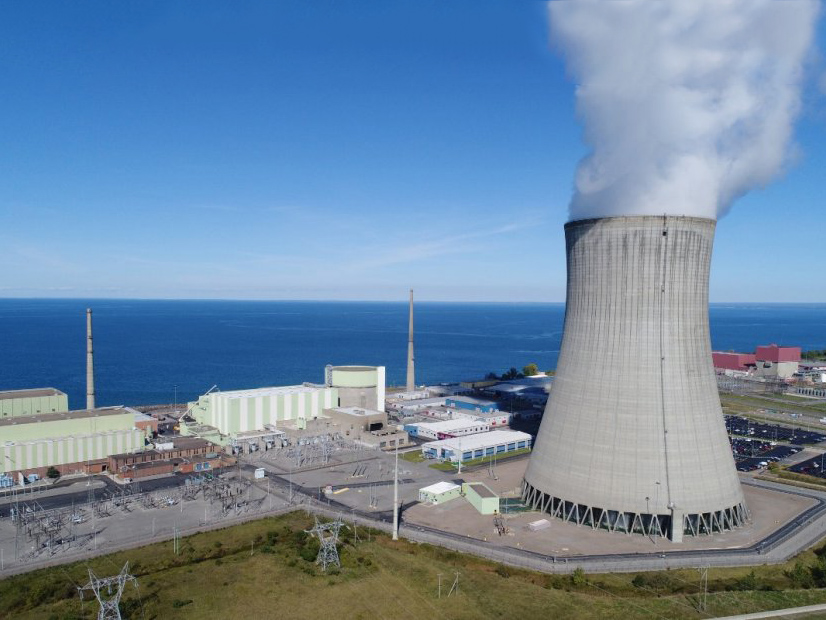
The four reactors at three plants in two locations along the south shore of Lake Ontario all are owned by Constellation Energy, which is part of the coalition that commissioned the Brattle report. 

Nine Mile Point Unit 1 is the oldest operating commercial reactor in the nation, and the Ginna reactor is the second-oldest. The FitzPatrick reactor entered commercial operation in 1975; Nine Mile Point Unit 2 is a relative youngster, entering commercial operation in 1988. 

Constellation needs signals of support to take the step of updating and relicensing the geriatric plants, and New York is moving to provide those signals. (See N.Y. Makes Case for Extending Nuclear Subsidies to 2049.) 

Given that renewables are developing slowly in New York, and given that the state is pinning its energy strategy on the hope that new technologies will be perfected, affordable and scalable, nuclear power takes on considerable importance for the Empire State if it is to meet its decarbonization targets. (See N.Y. Considers New Fossil Generation as Renewables Lag.) 

The report analyzes the impact of FitzPatrick, Ginna and Nine Mile Point 1 retiring in 2029, due to expiration of New York’s ZEC subsidy program, and Nine Mile Point 2 retiring in 2032, due to expiration of the federal 45U tax credit. 

They have a combined nameplate rating of 3,537 MW and run at a five-year average 94% capacity factor, and their retirement would lead to an average 3.36% annual increase in retail prices from 2030 to 2050, the report states. 

Retirement of the four reactors likely also would increase the amount of fossil generation the state needs — the report points out that this is exactly what happened when the Indian Point nuclear plant was shut down. 

Earlier in 2025, Gov. Kathy Hochul (D) directed the New York Power Authority to develop new nuclear generation. (See N.Y. Pursuing Development of 1-GW Advanced Nuclear Facility.) 

MISO Selects 10 Gen Proposals at 5.3 GW in 1st Expedited Queue Class

MISO has assembled 10 generation finalists to enter its first interconnection queue fast track, and the list includes five natural gas proposals, three solar farms, one wind farm and a battery storage facility.  

About 4.3 GW of the projects’ combined installed maximum capacity of nearly 5.3 GW would come from natural gas generation. The projects under evaluation span six states and have in-service dates ranging from January 2027 to August 2028. MISO whittled the list down from 47 applications. (See 26.5 GW of Mostly Gas Gen Compete for MISO’s Sped-up Grid Treatment.)  

The RTO said it continues to evaluate the remaining 37 proposals for inclusion in upcoming study cycles. MISO plans to study up to 10 generation projects per quarter, with a maximum of 68 projects, before it retires the temporary express lane process Aug. 31, 2027. The fast track aims to get necessary generation interconnected sooner than MISO’s regular queue currently allows.  

MISO said the first cycle of generation projects to enter the expedited study process were selected by a combination of the timestamp of their application submission and application withdrawals, a review of common constraints near the project and developers’ ability to rectify shortcomings in their applications prior to the study kickoff.  

“The first 10 projects cover all three regions of MISO, stretching from Louisiana to Minnesota,” MISO Senior Vice President of Planning and Operations Jennifer Curran said in a press release.  

Curran said each project “must meet rigorous standards to make sure only necessary and feasible proposals move forward.” 

Applicants had to identify a specific resource adequacy need their projects would address and secure a blessing from their relevant regulatory authority to be considered.   

Entergy La.’s Gas Plants for Meta Make the List

Entergy Louisiana’s proposed 1.64-GW gas plant, intended to meet the upward of 2 to 2.3 GW Meta will need to operate its $10 billion, hyperscale data center, is the largest on the list. (See Louisiana PSC Approves 3 Controversial Gas Plants Ahead of Schedule for Meta Data Center.) The Franklin Farms units are two of the three Entergy Louisiana would need to build to keep Meta’s facility powered.  

Invenergy’s proposed 1.2-GW gas plant in Kenosha County, Wis., to address a 1.75- to 2-GW need among Wisconsin Electric customers is the second-biggest project.  

Otter Tail Power is the sole battery facility to make the cut. The 75-MW Hoot Lake Battery Energy Storage System is proposed to serve a need highlighted in Minnesota’s Integrated Resource Plan.  

MISO also agreed to study Interstate Power and Light Co.’s separate requests for a 750-MW combustion turbine and 350-MW wind farm in central Iowa to help serve a 3.2 to 3.5-GW projected need in MISO’s Local Resource Zone 3.  

Other contenders in the fast lane include: MidAmerican Energy’s 263-MW natural gas combustion turbine in Adair County, Iowa; Lincoln Capital Land’s 125-MW solar farm to serve City Water Light & Power’s unmet needs from generation retirements in downstate Illinois; Ameren Missouri’s 300-MW solar farm in the northern portion of the state; Minnesota Power’s 85-MW Boswell Solar Project in Itasca County, Minn.; and an upgrade of the gas turbine at Minnesota Municipal Power Agency’s Faribault Energy Park in southern Minnesota that requires 60 MW of additional interconnect capacity.  

Curran called the queue fast track a “critical tool we can use to support reliability as we work toward long-term improvements in the interconnection process.”  

MISO plans to accept another round of applications for expedited study in early November and begin studying them at the beginning of December.  

BPA Transmission Pause Questioned During Workshop

The Bonneville Power Administration estimates it would need up to seven years and billions of dollars in upgrades to handle the 65 GW of transmission service requests in the queue, staff said during a Sept. 4 workshop. 

The workshop is part of a series of public meetings the agency is hosting as part of its Grid Access Transformation Project (GAT). 

BPA paused certain planning processes and launched the GAT program to consider changes following a surge of transmission service requests. The federal power agency’s 2025 transmission cluster study includes more than 65 GW of requests, compared with 5.9 GW in 2021. The requests exceed the total regional load predicted for the Pacific Northwest in 2034, according to the agency. (See BPA’s Proposed Tx Access Changes Prompt Questions of Industry Readiness.) 

Conducting an actionable study would require the agency to “model unrealistic load increases or unrealistic generation dispatch patterns to achieve the load reverse balance that’s necessary to perform a power flow study,” said Abbey Nulph, manager of transmission commercial planning at BPA, during the workshop. 

“Our best estimate is that the batches that we believe would not require unrealistic load or generation patterns would have us batching roughly 10 to 20 GW of batches,” Nulph said. “Using our current [Transmission Service Request Study and Expansion Process] timelines, it would take between seven and eight years to process just the existing queue. And while we were undergoing those studies, we would continue to be getting more requested.” 

Alex Swerzbin, vice president of power marketing and transmission at NewSun Energy, asked about the six- to seven-year timeline, saying others in the industry have estimated the process to take between three to four years under a batch framework. 

Nulph replied that even if BPA was able to process 65 GW, the result would be a “massive collection of plans of service.” 

“And the host of plans of service that will come out of study of this size would likely necessitate several billion dollars more in upgrade,” Nulph added. “We do not have that access to capital.” 

Some of the new proposed updates to planning processes include readiness criteria and a new Network Integration Transmission Service initiative where any new forecast increase of 13 MW or more during any year would require participation in commercial planning.  

The agency also is contemplating offering interim service and moving toward proactive planning, meaning building ahead of transmission service requests, according to a July 9 workshop presentation. (See BPA Outlines Proposed Transmission Planning Reforms.) 

‘Slings and Arrows’

NewSun CEO Jake Stephens also weighed in during the Sept. 4 discussion, contending that BPA should have continued processing requests under the current rules instead of issuing the pause. He noted the 2023 TSEP studied 15 GW, triggering “universal upgrades.” 

“We would recommend go ahead and process the first 15 GW of the current queue without waiting and running a whole litigated process, which could take a long time and is probably pretty contentious, because we actually know right now that you can process at least 15 or 20 GW more,” Stephens said. 

Nulph said BPA can process many requests but could run into issues that arose during the 2023 process, where a “large portion of our queue drops away because the plans of service are too expensive.” 

“So, it feels like a waste of our time and our effort,” Nulph said. “Especially when we are relatively resource-constrained in our ability to perform these sorts of studies. We are wanting to spend our slings and arrows on the work that is the most effective for us. And our assessment at this point is that conducting the largest study we think we could will not result in actionable results at the other end.” 

Stephens responded that the market and studies point to the need for more buildouts, while BPA is “sort of saying, ‘Well, we can’t build all this stuff that everybody needs, so we want to adopt policies to shrink everything back to a small-enough set that it doesn’t need all the upgrades that we all need.’ But we do need that.” 

“It’s not what I’m saying,” Nulph said. 

“I’ll clarify,” she added. A “vast portion” of requesters dropped out when BPA offered the Preliminary Engineering Agreements after the 2023 TSEP, Nulph said. 

“And the cited reasons were that those projects were too expensive for them to proceed with,” Nulph said. “So, this isn’t a Bonneville assessment that we can’t afford to build these. It’s that the region is telling us they can’t afford these.” 

Next steps in BPA’s GAT process include a customer-led workshop Sept. 10. Additionally, the agency plans to respond to customer comments from previous workshops in October. 

BPA is also moving from a business practice process to a tariff proceeding process and will publish a webpage and host additional workshops on those proceedings, according to presentation slides. 

RF Presenter Plugs Winterization Assist Visits

Speaking at a NERC-hosted webinar Sept. 4, a presenter from ReliabilityFirst urged attendees to take advantage of the resources available to them ahead of the upcoming winter months.

In his introduction to the webinar, Darrell Moore, NERC’s director of reliability risk management, observed that extreme winter events “have had a very significant impact on … reliability, readiness and security of the” grid over the last 15 years. That period has seen eight major storms, he pointed out, with winter storms Uri in 2021 and Elliott in 2022 causing widespread load shedding in Texas and the Southeast, respectively.

“As we get ready to enter another winter season, we must ensure the processes, equipment, procedures and personnel are prepared for this winter and future winter seasons,” Moore said.

Kellen Phillips, a principal analyst at RF, discussed the regional entity’s winterization assist program. Begun in 2014 after the polar vortex brought record-low temperatures and caused widespread generator failures, the program sees RF staff visit select generators — with the owners’ permission — and review their preparations for extreme cold weather.

Phillips said that while the program has conducted six to 12 visits per year on average since inception, the number of engagements has ramped up in the past few years, with 16 visits in the winter of 2023/24 and 20 in 2024/25.

Sites are selected based on requests submitted to RF from registered entities, narrowed down with data on cold weather-related losses over the previous two years from NERC’s Generator Availability Data System. RF also prefers to visit newly registered generators of 300 MW gross output or greater “to ensure they have a robust winterization program in place,” Phillips said. PJM, which operates in a large portion of the RE’s footprint, has been participating in the program for the past two years and attended most site visits in the most recent winter season.

Prior to the visit, plants complete an informational survey to provide RF staff with plant-specific information. Visits consist of a morning session, containing presentations from RF and PJM, followed by reviews of winterization procedures, processes and work orders; and an afternoon session, which mainly consists of a tour of the control room and the plant’s exterior examining how those processes are put into place.

“We try and get a lot of the heavy lifting done off-site and just cover the critical components on-site,” Phillips said. “We don’t take up too much of their time. We realize they’re trying to run the plant, which is not an easy task … so we try to get in and out as quick as we can.”

Items often checked by the RF team include heat tracing equipment and monitoring systems; temporary and permanent wind breaks; heating systems for the air inlets; and cooling tower de-icing systems. The visitors also check the winter supply areas to ensure that the equipment they listed in their preparation materials is ready.

A visit typically concludes with a final review and initial recommendations; the RE then prepares a full report on the visit, which usually is shared with the registered entity within two weeks. Phillips emphasized this report is not shared with NERC or FERC; however, RF does keep a file of best practices observed in previous visits that it updates each year, and also prepares a yearly after-action report that is available on its website.

Asked if the RE has decided which sites it will visit this year, Phillips said visits typically occur in December and January, and the team still is working through the data to determine where they will take place. He said RF probably will visit 20 to 30 generator facilities this winter.

ISO-NE Monitor Discusses Market Trends, Energy Transition

BOSTON — The New England wholesale electricity markets performed competitively in 2024, while decreased imports and higher emissions compliance rates increased overall market costs, the ISO-NE Internal Market Monitor told the NEPOOL Participants Committee on Sept. 4. 

David Naughton, executive director of the IMM, discussed the group’s 2024 annual report, which originally was published in May. 

The IMM found that wholesale market costs totaled about $10.2 billion in 2024, up by about $1 billion from 2023. This increase largely stemmed from higher energy market prices, which were caused by greater emissions compliance costs and a significant drop in imports from Quebec, which caused the region to rely more heavily on higher-priced natural gas generation, Naughton said. (See Drought, Climate Drive Uncertainty on New England Imports from Québec.) 

Regional Greenhouse Gas Initiative (RGGI) costs increased by about 55% in 2024 compared to 2023, he noted, adding that this increase was offset partly by a 61% decline in Massachusetts’ cap-and-trade program. Overall, carbon compliance costs totaled $509 million for New England generators, Naughton said. This translated to $910 million in added wholesale market costs, as higher marginal resource costs increased the clearing price paid to all participants. 

He noted that the New England states reinvest most of the RGGI proceeds in energy efficiency programs, which help mitigate the cost impacts of carbon prices. 

“These energy efficiency programs saved approximately 17.5 TWh in energy, or roughly $757 million in wholesale energy market costs based on the 2024 LMP,” the IMM wrote in its annual report. 

In 2025, wholesale costs are on track for a significant year-over-year increase, largely from low winter temperatures and periods of extreme heat in the summer, Naughton said. 

He noted that market revenues in 2024 were lower than the cost of entry for most new resources.  

“Market-based revenues in 2024 were below the going-forward costs of new entrant gas-fired generators,” Naughton said. Market revenues for wind and solar resources also were well below the CONE, and these resources remain heavily reliant on state programs, he added. 

Naughton also noted that, while combined cycle plants generally earn more from the capacity and ancillary service markets than in the capacity market, fossil peaker plants are increasingly reliant on capacity market revenues. 

2024 net market revenues for fossil generators | ISO-NE

“These observations indicate that some older, less efficient units could face exit decisions if current market conditions persist, especially when faced with large capital and fixed operating expenses,” the IMM wrote in its report. 

Naughton said the IMM has seen “gradual” impacts of the clean energy transition so far on supply and demand. Average solar output in the region doubled between 2020 and 2024, but wind output remained stagnant during this period. 

Behind-the-meter solar growth has led to a growing duck curve in the region, with mid-day demand frequently dropping below nighttime levels. This has caused growing morning and evening ramp requirements and is beginning to present increased arbitrage opportunities for energy storage resources, Naughton said. 

While the saturation of the storage market has led to declining regulation revenues, energy market revenues have started to tick up for storage resources, he said. 

Recommendations

Naughton also discusses the IMM’s recommended market changes, which include a proposal to subject exports to pay-for-performance (PFP) penalties during capacity scarcity events. 

PFP payments are intended to incentivize resource performance during capacity shortages. While imports receive the PFP rate and LMP, “exporting-only participants are only charged the LMP,” Naughton said, adding that this “over-incentivizes procuring imports” instead of limiting exports. 

He said participants that both import and export power during a scarcity event are subject to PFP netting rules, but there could be a “gaming opportunity” for related companies to schedule imports and exports during a scarcity event and profit without delivering actual energy. 

To fix this issue, the Monitor has recommended that ISO-NE “apply the PFP rate symmetrically to exports, aligning financial incentives and ensuring that external transactions — whether imports or reduced exports — are valued equally for their contribution to system reliability.” 

Net market revenues for battery storage resources | ISO-NE

Responding to the proposal, some stakeholders expressed a concern about applying the PFP to capacity-backed exports and asked ISO-NE to exempt them from performance penalties. 

The Monitor has recommended that ISO-NE update its bidding software “to allow low-cost resources to more easily submit real-time specific offers” and change the external interface clearing rules “to reduce incentives for strategic virtual bidding and incentivize participants to submit more accurate, cost-reflective offers closer to the operating day.” 

Asset-condition Review

During the MC meeting, ISO-NE COO Vamsi Chadalavada discussed the RTO’s work to establish an asset-condition reviewer role.  

The RTO has agreed to pursue this role at the urging of states and consumer advocates and with the agreement of the transmission owners. It has stressed it will not take on a regulatory function investigating the prudence of investments. Instead, its role would be aimed at increasing transparency into projects and could, hypothetically, provide information that would aid stakeholders in prudence challenges with FERC. (See ISO-NE Open to Asset Condition Review Role amid Rising Costs.) 

Chadalavada said ISO-NE’s work is complicated by the fact that no similar role exists elsewhere in the U.S., requiring the RTO to develop these capabilities from scratch. Once developed, the role could serve as an example for the rest of the country, he added. 

He noted that ISO-NE has hired Electrical Consultants Inc. to “help develop a framework for a new asset-condition reviewer role,” as well as to “review selected asset-condition projects in the interim review cycle, through the end of 2026.” 

ISO-NE stillis working to determine which projects it will include in this interim review process generally but will focus on high-cost or abnormal projects, he said. 

Tri-State Seeks FERC Approval for Data Center Load Tariff

Tri-State Generation and Transmission is seeking FERC’s approval for a new tariff designed to manage the heavy volume of data center load expected to materialize in its member utilities’ service territories over the next decade (ER25-3316). 

The filing is part of a growing trend among utilities and states in crafting policies to protect ratepayers from the financial — and reliability — risks stemming from the voracious energy demands of new artificial intelligence data centers. (See related story, Large-Load Tariffs Touted as Alternative to ‘Side Deals’.) 

The proposal is the product of “months of collaboration with members and stakeholders,” the Colorado-based cooperative said in an Aug. 29 press release. 

“The proposed tariff is designed to establish a repeatable and fair process for incorporating high-impact loads onto the Tri-State system without adverse impacts to reliability or affordability,” Tri-State said. “The process would allow Tri-State members to respond in a consistent manner to requests for services from heavy energy users, such as data centers.” 

“We’re in the business of providing electricity, and we are committed to doing it in a way that can meet the needs both of new loads and Tri-State members,” said Lisa Tiffin, Tri-State’s senior vice president of energy management. “This approach allows us to grow responsibly and limits the potential for stranded assets that could result in financial risk to Tri-State and our members.” 

Tri-State is a power supply cooperative that serves electric distribution cooperatives and public power districts across four states. It said in its filing with FERC that new load requests from data centers among its members would, over the next 10 years, more than double its current system peak demand of 2.5 GW. 

In the filing, Tri-State noted that data centers “support local economic development, improve the efficient utilization of utility resources and provide steady revenue streams when fully integrated into a service provider’s system.”  

But it also warned that integrating such large loads also “carries risks,” including the need to build new transmission lines and generation, and the potential for increasing interconnection queue backlogs and delays in procuring needed resources. 

“Large load interconnections also present serious reliability and cost-shifting risks for a utility’s customers,” Tri-State added. 

Tri-State’s existing Electric Resource Planning (ERP) process, designed for a more measured rate of native load growth, is not equipped to handle those risks and the expected pace of new demand from what the co-op calls high-impact load (HIL) projects, it explained in the filing. 

“HIL projects are more speculative than utility members’ prior requests for new or modified delivery points, or native load growth in general. HILs also require accelerated and significant transmission upgrades that do not fall neatly into the existing ERP process,” Tri-State said. 

‘Avoid Socializing the Risk’

Tri-State’s proposed High Impact Load Tariff (HILT) would provide an alternative planning approach for integrating those loads into its system. 

According to the filing, the “guiding principles” for the HILT are: “(1) facilitating economic development across Tri-State’s utility members’ systems at an unprecedented level and pace; (2) limiting the risk of stranded assets resulting from high-impact load integration, which could create financial risk for Tri-State and its utility members; and (3) continuing to meet all resource planning and associated regulatory requirements.” 

Modeled on similar tariffs filed by other U.S. utilities, the Tri-State HILT would establish a biennial planning cycle for customer loads rated at 45 MW or higher. 

“This separate HIL planning cycle process is necessary because HILs are of a size that require significant generation capacity additions or procurement of long-term [power purchase agreements], which necessitates proper planning. Ratepayers may suffer financial consequences if capacity additions are completed only for a HIL to not materialize,” Tri-State wrote. 

Each planning cycle would begin with a “kickoff” meeting among Tri-State, co-op members and potential HIL customers, where participants will “set forth the requirements and timing for a HIL participation package [prepared by the utility member], a process for verifying the participation package components are met and a HIL evaluation process.” 

Intended to ensure that only non-speculative projects are presented to Tri-State for study, the participation package would include:  

    • a completed member project request form; 
    • evidence that the HIL customer has at least 90% site control over its project location; 
    • payment of a nonrefundable HIL evaluation fee; 
    • a certified engineering diagram of the project’s expected load and property acreage; 
    • an executed member-customer high-impact load (MCHIL) agreement; and 
    • a high-impact load agreement (HILA) to be executed between the utility member and Tri-State. 

For HIL requests under 80 MW, the evaluation fee would start at $35,000 plus $1,000/MW, increasing to $150,000 for projects between 80 and 200 MW, and $250,000 for projects above 200 MW — levels Tri-State said are consistent with the megawatt deposit thresholds under its large generator interconnection procedures.

Tri-State said the evaluation process would focus on “reliability, economic and environmental criteria, as well as transmission metrics.” 

“The reliability review will ensure the HIL will not have an adverse impact on the reliable operation of Tri-State’s system, including compliance with Level I (base metrics) and Level II (extreme weather events) reliability metrics. The economic criteria focus on whether the HIL project is economically priced so as to minimize Tri-State’s system costs, and reduce or maintain Tri-State’s rate requirements,” the co-op said. 

The proposed HILA would include “minimum billing demand and energy floors” intended to ensure that, regardless of whether a HIL customer’s load grows as forecast, Tri-State is compensated for system upgrades sufficiently enough to avoid shifting costs to other customers. 

The HILA also would stipulate that a HIL customer provide a minimum security deposit of $2.7 million/MW to offset the risk that “the HIL customer begins commercial operations late [or] ceases operations before the expiration of the HILA term or the HIL does not operate at the expected level (or at all). In short, the security requirement enables Tri-State to avoid socializing the risk of the HIL customer’s under- or nonperformance across Tri-State’s entire membership.”