Industry stakeholders will have a chance to weigh in on the proposals of NERC’s Modernization of Standards Processes and Procedures Task Force in the coming weeks, task force leaders said at the Nov. 10 meeting of the Member Representatives Committee.
NERC has been seeking comments on the MSPPTF’s draft recommendations since Oct. 21, task force Chair Greg Ford reminded attendees, observing that the comment period actually closed earlier that day. (See NERC Seeks Feedback on Standards Modernization Recommendations.) The ERO’s Board of Trustees created the MSPPTF in February in light of the rapidly evolving risk environment, which has made it increasingly difficult to keep up with new threats to reliability.
While the online comment submissions are closed, Ford said stakeholders can share their views on the recommendations at two upcoming stakeholder forums, to be held Nov. 13 in Salt Lake City and Nov. 19 in Atlanta. These forums were intended to be to be held in person, but because of uncertainties around flight availability arising from the ongoing federal government shutdown, Ford reminded listeners that an online option is available.
“We really encourage everyone to come participate in this,” Ford said. “This is where we, as the task force, can learn a little bit more about what your comments were intended to address, but it’s also more for you to hear from the task force members on where our recommendations were headed. We’ll take all of that input and get ready for our December workshop.”
The MSPPTF’s recommendations apply across the standards development process. They include organizing a biannual period for requesting, reviewing and initiating new standards projects; implementing a subcommittee under the Reliability Issues Steering Committee to drive standards drafting; and revamping the standards balloting process to provide more accountability and encourage stakeholder participation.
The task force will revise its proposals based on feedback submitted online and at the forums, and present its final recommendations to the board at its February 2026 meeting in Savannah, Ga.
Leadership Elections and Plan Update
Ford took over running the MRC meeting briefly while Chair John Haarlow, CEO of Snohomish County Public Utility District, and Vice Chair Matt Fischesser, of ACES Power, excused themselves so members could vote on a proposal to grant them another term in their positions.
Haarlow and Fischesser were the only nominees received during the nomination period, which lasted from Sept. 11 to Oct. 9, and as a result were unanimously confirmed to remain.
Camilo Serna, NERC’s senior vice president for strategy and external engagement, then gave members an overview of the ERO’s progress on its next three-year strategic plan. NERC’s current three-year plan will conclude at the end of 2025; the organization had planned to create a new plan to begin in 2026 but concluded earlier this year that long-term planning would be a “fool’s errand” because of the uncertainty introduced since President Donald Trump’s return to office. Instead, 2026 will be treated as a “bridge year” before the new plan begins in 2027.
Serna said NERC is defining the priorities, goals and initiatives to be addressed in the plan and how it will measure progress. The organization will provide a draft of the priorities to the MRC in January so that members can provide feedback ahead of the February board and MRC meetings; this list will be finalized by March.
LITTLE ROCK, Ark. — SPP state regulators have approved several motions related to FERC Order 1920’s mandate for long-term, scenario-based planning to ensure the system can meet future needs and be fairly compensated.
The Regional State Committee endorsed the continued use of SPP’s highway/byway cost allocation for long-term regional projects during its Nov. 3 quarterly meeting. It also approved the Cost Allocation Working Group’s recommendation to allocate long-term projects with public policy benefits to the state they benefit.
Under the grid operator’s highway/byway methodology, one-third of the cost of byway projects — lines rated at 100 to 300 kV — are allocated to the RTO’s full footprint, with customers in the transmission pricing zone in which the project is built being allocated the rest. “Highway” projects, those larger than 300 kV, are allocated RTO-wide.
The RSC offered several amendments to the motions brought forward by a CAWG sub-group, but both failed. Both would have established a $150 million threshold for projects to be cost allocated, provided that a simple majority of affected committee members vote to initiate the process.
However, separate votes to require alternative ex post cost allocation methodology be approved by either a two-thirds or simple majority both failed with deadlocked ballots.
John Krajewski, a consultant for the Nebraska Power Review Board who led the CAWG sub-group, said SPP has never identified a project or issued a notification to construct (NTC) out of a 20-year study.
“So, in some respects, this was an academic exercise,” he said, “but I also think it was important because we’re required to do it under Order 1920, and it’s possible in the future this may be an issue.”
Order 1920 requires transmission providers to plan for at least 20 years, create at least three different long-term scenarios to identify future needs and evaluate potential solutions for cost-effectiveness. The order also incorporates a landowner bill of rights, tribal impact reports and engagement plans with environmental justice communities. The compliance filing is due in June.
Nickell Recaps ‘Transformational’ Year
SPP CEO Lanny Nickell thanked the RSC for the “key role” it played in helping the grid operator move initiatives related to resource adequacy and cost allocation that made 2025 a “transformational” year.
Nickell name-checked the one-time expedited resource adequacy study (ERAS) to fast-track qualified projects and a provisional load process, both approved recently by FERC. He also mentioned the Consolidated Planning Process that would combine transmission planning and generator interconnection studies; it was filed with FERC on Nov. 3.
“That, in and of itself, is going to be revolutionary,” he said of the CPP.
Nickell said SPP received 36 submissions as part of the ERAS process, totaling 13.2 GW of capacity. About 73% of that is gas generation, with solar and batteries accounting for the rest. Generator interconnection agreements will be made during the first quarter of 2026, he said.
“That’s the kind of generation we’re going to need to help us with our accreditation and to help load-serving entities meet their requirements,” he said.
The RTO expansion into the Western Interconnection remains on track, Nickell said, with a Dec. 2 go/no go date fast approaching to determine whether to open the transmission congestion rights market in the West on Jan. 1, 2026. The next key decision comes Feb. 2, he said, when SPP will decide whether or not to stick with the April 1 go-live date.
The grid operator’s other Western market, Markets+, has 41 entities that have committed to fund the development of the market’s systems development and hardware. SPP is targeting a go-live date in late 2027.
“We’re in a time of change, and I think it’s just important to realize and to show and to demonstrate what can be done when you put your heart to it and put your mind to it,” Nickell said.
JTIQ Funds Remain in Limbo
General Counsel Paul Suskie told the committee that SPP has yet to receive “official word” about the status of the U.S. Department of Energy’s $464 million grant for the grid operator’s Joint Targeted Interconnection Queue initiative with MISO.
“Fingers are crossed that the funds will still be there,” Suskie said. “I’m personally an optimistic person. I’m optimistic the current administration will see the value that JTIQ will have for the region to get new generation online.”
The DOE loan under its Grid Resilience and Innovation Partnerships (GRIP) program would account for more than 27% of the $1.7 billion portfolio, comprising five 345-kV projects along SPP’s northern seam with MISO. Each grid operator is responsible for two projects in its footprint, and they share the fifth.
The funds were awarded in 2023 to the Minnesota Department of Commerce, the lead applicant in the JTIQ initiative that also involves the Great Plains Institute and the two RTOs. However, the department in early October included the $464 million grant on a list of projects that it intended to terminate. (See DOE Terminates $7.56B in Energy Grants for Projects in Blue States.)
Suskie said conversations continue between DOE and parties to the initiative. NTCs have been awarded to Omaha Public Power District and Evergy for the JITQ projects, he said, giving them the obligation to move forward with their portions of the projects and making them eligible for cost recovery.
FERC has approved the RTOs’ request to allocate the portfolio’s costs 100% to interconnecting generation assessed on a per-megawatt basis. In doing so, it cited the GRIP funding as one of the “unique set of facts and circumstances of the proposed JTIQ framework.” (See FERC Upholds MISO and SPP’s JTIQ Cost Allocation over Criticism.)
RSC Selects New Leadership
The RSC approved the Nominating Committee’s slate of officers for the 2026 term, with Nebraska’s Chuck Hutchinson succeeding New Mexico’s Patrick O’Connell as president.
Oklahoma’s Kim David will serve as the RSC’s vice president, while Arkansas’ Justin Tate and Missouri’s Kayla Hahn will take the secretary and treasurer positions, respectively.
O’Connell said it was an honor to have led the committee and its differing points of view.
“We work together to try to get to consensus and focus on the region first,” he said. “That’s not always true in daily life in general, especially these days. This isn’t just professionally a great experience; it’s also kind of a respite from the real world sometimes. I really, on a personal level, really appreciate how the RSC works together, and then I appreciate that SPP allows us to work together in that way.
“So, thank you all for that,” O’Connell said. “Dry your eyes, OK?”
The RSC’s roster grew to 13 with the addition of Montana’s Randy Pinocci. Observing from the audience were Wyoming Public Service Commission Chair Mike Robinson, another potential new member, and New Mexico’s Greg Nibert, who will replace O’Connell on the RSC in 2026.
VALLEY FORGE, Pa. — The PJM Market Implementation Committee endorsed by acclamation revisions to Manual 18 to define how distributed energy resources will participate in the 2028/29 capacity auction in accordance with PJM’s Order 2222 compliance filing.
The Independent Market Monitor had proposed revising the language to address a possible issue where resources could bypass market power mitigation by offering into an auction as an aggregation of demand response resources, which are not subject to market power mitigation rules, but then include generation during the delivery year by classifying the resource as heterogeneous.
The recommended language would have sorted DERs into either homogenous distributed generation, homogeneous demand response or heterogeneous resources. If a resource failed to abide by its classification in the delivery year it would fail to meet its capacity commitment. It was not included as an amendment to PJM’s language.
Deputy Monitor Catherine Tyler said a resource with a DER plan should be required to supply the same type of aggregation that it offered into a Base Residual Auction. An aggregation composed of a combination of generation and DR that changed the concentration of one or the other would not be affected by the proposal, she said.
Questioned how PJM would handle such an issue today, PJM’s Pete Langbein said the information collected about market participants would make it clear how a resource is being offered into the market. If there appears to be an effort to exercise market power, PJM would reach out to the participant and potentially refer them to the Monitor or FERC’s Office of Enforcement. He said it likely would be rare for a DER to solely be composed of DR, but if such a resource was offered into an auction and then installed a significant amount of generation, that would raise red flags to PJM staff.
Aaron Breidenbaugh, senior director of regulatory affairs at CPower Energy Management, said it can be difficult to anticipate the future three years in advance. A DR participant might decide to install storage or solar and then be unable to do so, which could create compliance risks for customers interested in aggregation. Adding onerous limitations would discourage participants and possibly punish participants who had no adverse impact on market power.
“It’s a harsh solution in search of a potential problem,” he said.
Monitor Joe Bowring responded that if an entity believes they may participate in the capacity auction as a more advanced resource, they should offer as such.
“It is ineffective to substitute red flags and potential referrals for good market rules. Good market rules are not punishment unless participants attempt to exercise market power,” Bowring said.
The Manual 18 revisions also reflect changes to how DR is offered into the market, removing the availability window to model DR as being dispatchable in all hours and changing the calculation of participants’ winter peak load to be based on the 9 a.m. coincident peak, rather than each DR site’s individual peak. (See PJM Stakeholders Endorse More Detailed Demand Response Modeling.)
PJM Update on Regulation Market Redesign
PJM’s Michael Olaleye presented an update on the implementation of PJM’s redesign of the regulation market, which went live Oct. 1. The changes shifted the market from two bidirectional signals to one, shortened clearing and commitment to 30 minutes, and established the tracking ramp limited desired parameter. (See “PJM Presents Regulation Market Rework,” PJM MRC/MC Briefs: Dec. 20, 2023.)
Since the go-live date, there have been more days with high clearing prices, with Oct. 3 seeing two intervals at $33,897/MWh and $29,636/MWh. There were 11 intervals where the clearing price exceeded $5,000/MWh. Despite performance scoring being tightened to consider only the precision of a resource’s response — accuracy and delay were eliminated as criteria — Olaleye said average scores have remained largely the same.
A handful of market participants said the lost opportunity costs seen during October were shocking and questioned whether this is likely to be the norm.
Rebecca Stadelmeyer, Gabel Associates vice president of wholesale power and market services, said it was not expected that clearing prices would be in the thousands and that participants are working to figure out how to price load deals for auctions in deregulated states and ensure customers are protected. She suggested PJM hold education sessions on the results of the market changes, adding that past discussions relied on theory about how the redesign might play out.
NYISO presented the results of Phase 1 of the 2024 Cluster Study process at a special Operating Committee meeting Nov. 4.
The vast majority of the projects in the study are energy storage systems throughout New York. Of the 202 projects in the study, only three were found to be physically infeasible and barred from transitioning to Phase 2 of the cluster study process.
Three projects were examined for the 2025 Expedited Deliverability Study. Only one project, Empire Generating Units 1 and 2, was found to be able to satisfy the NYISO Deliverability Interconnection Standard at its requested capacity resource interconnection service level without system upgrades.
The committee unanimously approved both studies, with one abstention.
ICAP Working Group
The Installed Capacity Working Group received a presentation on the impact on consumers from NYISO’s planned implementation of FERC Order 2222.
NYISO found that reliability would improve from more participation of suppliers in the operating reserves program and that ancillary services prices for 30-minute reserves would increase slightly. No measurable impact was found on the capacity market. The order was also found to increase the price signals of new technologies.
The ISO also presented an update on the Improved Duct Firing Model project. It has identified elements of the model’s design that are incompatible with its current software. The ISO is exploring options, including possible tariff revisions, to implement the FERC-approved model design.
FERCrejected a complaint that the Kentucky Public Service Commission and attorney general filed against American Electric Power over a cost-allocation dispute involving the AEP East Operating Cos.’ transmission agreement (EL25-67).
AEP East provides transmission service to its utilities in PJM and some transmission-only affiliates in the region in an arrangement that started in 1984, predating the utility’s membership in the RTO, which began in 2004. The allocation of transmission costs for lines of 69 kV and above is shared among its utilities in Kentucky, Indiana, Michigan, Ohio, Virginia and West Virginia under a deal approved by FERC in 2010.
The deal covers all PJM projects, even “supplemental” transmission that transmission owners use to plan for their own, local needs. Under its Attachment M-3, PJM allocates the cost of supplemental projects only to the utilities that build them, but the 2010 Transmission Agreement allocates them across AEP’s utilities in the region.
Kentucky complained that setup is not fair because its residents do not benefit from supplemental transmission investments made in other states.
“Since 2019, AEP East has added $3.4 billion in AEP East Attachment M-3 Projects to rate base, of which more than $75 million has been allocated to Kentucky electricity consumers,” the order said. “Complainants aver that few, if any, of those AEP East Attachment M-3 Projects have any relationship to serving Kentucky Power retail or wholesale customers.”
The transmission agreement has been around since 1984 and in addition to joining the RTO, AEP stopped centrally planning its generation, the latter of which was a key part of FERC’s reasoning for approving the arrangement in the first place.
AEP argued that Kentucky consumers still use all of the AEP East transmission system and the benefits they get are roughly commensurate with the costs they paid. The utility holding company approaches local planning as if the AEP East utilities were a fully integrated system.
“AEP East states that this means making transmission investments at the local level with the purpose and effect of benefiting the entire AEP East transmission system, as reflected in AEP East’s transmission planning guidelines, and asserts that the AEP East transmission system was developed to be, and remains, a system within a system,” the order said.
FERC found that the complaint failed to prove the 2010 Transmission Agreement’s rules for allocating supplemental projects were unjust and unreasonable. Commission rules require that consumers pay for transmission that benefits them and allocations are done in way “at least roughly commensurate with benefits.”
Cost allocations do not have to be done with “exacting provision,” but FERC needs a plausible reason for why they are roughly commensurate with assigned costs. The commission previously explained it has a strong policy of requiring rolled-in costs when any degree of integration has been shown.
“Complainants point to a selection of 26 AEP East Attachment M-3 Projects that they argue do not provide benefits to Kentucky customers that are commensurate with the approximately $15 million per year in costs allocated to Kentucky customers for those projects,” FERC said. “As discussed above, providing a selection of projects as evidence that a cost-allocation framework is no longer just and reasonable is not sufficient to overturn a cost-allocation framework approved by the commission.”
It still makes sense to allocate supplemental projects across all of AEP’s operating companies in PJM because while different utilities might have created the need for the upgrades, to the extent another firm benefits from them — it can be said to have “caused” part of the costs.
“Complainants focus on which entities drive the initial need for a transmission project, but that is not the end of the cost-causation analysis — rather, the cost-causation principle requires that the costs for a transmission project be allocated to those who benefit from the project,” FERC said.
“As discussed above, the commission has rejected challenges to cost allocations for specific transmission facilities where those facilities formed part of the integrated transmission system. Kentucky Power’s system is part of AEP East’s integrated transmission network. Thus, it is reasonable to conclude that Kentucky Power’s customers benefit from the AEP East Attachment M-3 Projects that become a part of that transmission network.”
Duke Energy reported third-quarter earnings of $1.4 billion ($1.81/share), up from a year earlier on higher retail sales volume and new rates.
“We approach 2026 with momentum as our company converts large load economic development prospects into tangible projects with signed electric service agreements, and we are already turning dirt on projects to meet this load and grow,” CEO Harry Sideris said on an earnings call Nov. 7. “We’re carrying out an ambitious generation bill that will add more than 13 GW of capacity to our system in the next five years.”
Duke expects its new five-year capital plan for 2026 to 2030 to be between $95 billion and $105 billion, up from the $87 billion that was planned for 2025 to 2029. The spending will help Duke modernize its system and bring new large load customers like data centers online, Sideris said.
“The step up is primarily related to investments in new generation that will drive earnings-based growth of more than 8.5% through 2030,” Sideris said.
While investments are accelerating, Sideris said Duke is keeping affordability in mind for its customers, both large industrials competing in global markets and households trying to manage their budgets.
“We continue to leverage AI and pursue a technology-enabled industry leading cost structure as we invest in our system,” Sideris said. “Other tools we are utilizing to keep rates as low as possible include the combination of the Duke Energy Carolinas and Duke Energy Progress utilities, which, if approved, would save retail customers more than $1 billion through 2038.”
Other activities on affordability include storm cost securitization, which Sideris said would cut the impact to bills by 18% compared to traditional mechanisms, and new tariffs and contract provisions for large load customers looking to take service from its utilities, he added.
“These are just a few of the many solutions we use to ensure our 10 million customers receive the service they count on at a fair price,” Sideris said. “We recognize that our work to provide affordable energy for customers is never done, but we are proud that average rate changes have paced below the rate of inflation over the last decade, and that our rates are well below the national average.”
Duke is building 8.5 GW of new dispatchable generation across its footprint over the next five years, which includes 1 GW of uprates. The rest is new natural gas plants.
The company is considering new nuclear plants, both small modular reactors and, after a request from the North Carolina Utilities Commission, traditional nuclear.
“We feel nuclear is a very important part of the future,” Sideris said. “With that said, there’s a lot of things that we have to determine and figure out before we move forward. We’re encouraged to see the government and some of the partnerships with Westinghouse that were recently announced leaning into this and addressing supply chain concerns, which is one of the items that we have on our list.
“We still need to figure out what we’re going to do with cost overrun protection and how we’re going to protect our investors and our customers from overruns on those projects, as well as how we’re going to protect the balance sheet if we move forward with nuclear, so we’re working to resolve those working with government officials as well as some of the tech customers.”
VALLEY FORGE, Pa. — PJMpresented its shortlist of projects for inclusion in the first window of its 2025 Regional Transmission Expansion Plan (RTEP), which includes need for increased west-to-east transfer capability to supply rising data center load in Northern Virginia and the PPL region.
The projects were sorted into four regions: the PPL region of the MAAC zone, the overall MAAC zone, a southern cluster focused on resolving transmission violations and a western cluster centered around Columbus, Ohio. PJM expects to present its recommendations to the Transmission Expansion Advisory Committee during its Dec. 2 meeting.
The need in PPL is being driven by load growth increasing by about 5 GW between the 2024 and 2025 load forecasts, which is driven predominantly by data centers. The removal of 7.5 GW expected from offshore wind projects in New Jersey also caused five 500-kV lines to overload, increasing the need for more transmission into the Mid-Atlantic.
PJM added scenarios removing the offshore wind generation to reflect the New Jersey Board of Public Utilities canceling solicitations for development and postponing construction of transmission and other infrastructure. (See N.J. Puts on Hold Remaining Pieces of $1.07B OSW Transmission Project.)
PJM has shortlisted a single portfolio from PPL, which would make several upgrades to transmission around the Susquehanna nuclear generator for $565 million. The package includes building a new Kelayres 500-kV substation, extending the Susquehanna-Sunbury 500-kV line to cut into Kelayres and rebuilding the Juniata-Sunbury 500-kV line.
PJM Director of Transmission Planning Sami Abdulsalam said this is the first time a transmission owner has submitted a complete competitive RTEP portfolio with a fixed cost cap. He said there is strong confidence the utility’s forecast will increase again next year, creating the need for upgrades of this magnitude.
Increased transfer capability into the larger MAAC region is being prompted by data center growth in PPL, with three portfolios shortlisted and a fourth under consideration. A joint FirstEnergy and MAIT project would build two 500-kV lines between the Keystone and Susquehanna substations for $1.16 billion; a NextEra and Exelon package would build a 765-kV line from Kammer to Juniata, with two new 765/500-kV substations along the corridor for $1.74 billion; and a proposal from NextEra, Exelon and MAIT would build the Kammer-Juniata 765-kV line, plus a 500-kV line from Keystone to Susquehanna, for $2.82 billion.
New generation in southern Dominion paired with load growth in Northern Virginia is expected to cause multiple overloads on 500-kV lines between the two regions in 2032. Three packages were shortlisted: a high-voltage DC line from the Heritage substation to Mosby paired with a 500-kV line between Elmont and Kraken sponsored by Dominion for $4.82 billion; a pair of 765-kV lines from Heritage to Vontay and between Joshua Falls and Morrisville, passing through Cunningham brought by Transource for $1.97 billion; and two 500-kV lines between Heritage and Morrisville and from Finneywood to Cunningham and ending at Morrisville proposed by Dominion for $1.99 billion.
Several residents voiced support for the HVDC line, noting it would be underground and mostly follow existing transmission corridors. Many of the comments also called for more underground HVDC options. PJM staff responded that they’re limited to the solutions presented by project sponsors.
Abdulsalam said there are several benefits to underground HVDC beyond aesthetics, including easier expansion capability and reduced injection of short circuit. But he cautioned that it’s not a given the transfer capability is greater than overhead 765 kV.
The western cluster aims to address load growth in Ohio near Columbus and Melissa, as well as regional power flows shifting toward the eastern and southern regions of PJM. Transource submitted a $2.78 billion project including several upgrades to the 765-kV and 500-kV networks around Columbus, including a 765-kV line from Greentown mostly using greenfield right-of-way; a $2.92 billion project from NextEra and Exelon to construct a greenfield 765-kV ring from Gwynneville and looping around Columbus; and $1.49 billion to build a 765-kV line from Belmont in West Virginia to Vassell and upgrade several lines to the southwest of Columbus.
Supplemental Projects
FirstEnergy presented a $50 million project in the APS zone to replace 93 wood H-frames with steel structures and reconductor 12.72 miles along the Carroll-Mount Airy 230-kV line. The utility said the wood poles show signs of accelerated decay and woodpecker damage. The project is in the conceptual phase with a projected in-service date of June 30, 2029.
The utility also presented a $36.8 million project to serve a new customer requesting 230-kV service near the Doubs substation by constructing a 230-kV substation along the Doubs-Sage 230-kV line. The facility would feature 10 breakers and have a breaker-and-a-half (BAAH) configuration. The scope also includes reconductoring 2.9 miles of the Doubs-Sage line. The project is in the conceptual phase with a projected in-service date of Feb. 18, 2032.
FirstEnergy presented a $30 million project in the Penelec zone to rebuild 6.7 miles of the Johnstown-Seward 230-kV line to resolve deteriorating wood structures and insulator bells. The project is in the conceptual phase with an in-service date of June 15, 2027.
AEP presented a need to make repairs along 74 miles of its Hanna-Tanners Creek 345-kV line, which has experienced damage to structure legs, insulator assemblies and conductor strands. Brackets holding suspension insulator strings also are wearing out on 87% of the structures inspected, creating increased risk that a conductor could fall from the towers. There have been five momentary and two permanent outages on the line in the past five years.
PECO presented a $176.6 million project to serve a new customer seeking to bring 600 MW of load near Fairless Hills, Pa., by 2028. The project’s first phase would install two temporary 230-kV lines tapping into the double-circuit Ford Mill-Emilie line, followed by the construction of a 230-kV BAAH substation, named Sinter, with 11 breakers and two customer feeds. The line segment between Sinter and Emilie would be rebuilt, and terminal equipment at Emilie would be upgraded.
Two new service requests were presented for 750 MW near Limerick, Pa., by 2032 and another for 500 MW of load in Philadelphia expected to come online by 2029.
PJM has expanded its guidance on spare equipment for transmission owners, increasing the document from a single page to eight in an effort to consider equipment likely to fail during extreme weather.
The Planning Committee requested that the Transmission & Substation Subcommittee re-evaluate the document, including the possibility of a “targeted return to service” when determining the adequate supply of spare parts, as well as the logistics to deliver that equipment. (See “PJM Seeks Stakeholder Attention on Spare Equipment Requests,” PJM PC/TEAC Briefs: Dec. 3, 2024.)
The new language lists several major types of equipment that may be difficult to procure or transport after a failure, such as transformers, reactors, circuit breakers, tower components and conductors, and it gives high-level guidance on spare equipment storage and typical replacement timelines.
“Spare equipment is critical to the continued integrity of the bulk electric system (BES),” the document reads.” Failure to maintain adequate spare equipment can lead to unnecessary higher operating costs and unnecessarily long outage times, consequently compromising transmission and overall system reliability.
“Interconnected transmission owners (ITOs) need to be able to support any local interconnection agreements. The purpose of this philosophy is to ensure that thought is given to maintaining adequate spare equipment for the BES. Any new facility connecting to the bulk electric system should observe this philosophy.”
LITTLE ROCK, Ark. — SPP’s Board of Directors has awarded its eighth competitive project and third in 2025 under FERC Order 1000, a 345-kV upgrade in the Texas Panhandle.
A panel of industry experts designated Transource Oklahoma and Southwestern Public Service as the transmission owners for the project, on a 150-mile line from Beckham County, Okla., to Potter County, Texas.
NextEra Energy Transmission Southwest was the only other bidder on the project in what the panel said were two high-quality proposals.
“Both proposals were from highly qualified, experienced entities with a successful history in the design, build and operation of similar and relevant projects,” said Tom Bozeman, chair of the industry expert panel (IEP).
That was apparent in the IEP’s scoring. The panel saw less than 3 points of difference between the two proposals, with NEET Southwest’s bid getting a slightly higher score than the Transource-SPS proposal: 1,088.54 to 1,086. However, Transource and SPS submitted a lower cost, or “present value requirement,” to customers: $248.68 million to $269.53 million.
Bozeman said the panel questioned the results but agreed the small difference between the bids was “reflective of two highly qualified respondents with very similar proposals.”
“We found [the Transource-SPS proposal’s] cost to customers’ savings of almost $21 million to be a distinguishing package,” he said.
SPP staff has given the project an estimated $429.73 million price tag and a projected November 2029 in-service date.
The Transource-SPS bid was the only one to offer a cap on the annual transmission revenue requirement. That also played a part in the IEP’s unanimous decision.
During questions by the board, the IEP said its requirements did not include information on cost caps and how to deal with them. Director Irene Dimitry, who leads an Order 1000 Strategic Review Task Force that is trying to improve the selection process’ effectiveness and reduce the cycle time, agreed more information and analysis is needed.
“There’s this need to make sure we’re getting all the information we need to make an informed decision,” she said. “We have work to do, especially in thinking about the projects that are coming out of the 2025 ITP. What can we do differently moving forward, so that the information is gathered from the bidders and that guidance is given to whoever’s doing the evaluation to deliver the analysis that we need?”
Dimitry said the task force is weighing the use of outside consultants to augment the IEPs and provide additional expertise to ensure they can handle the volume of projects coming out of the 2025 assessment.
“We’re presuming there will be some big projects coming in, including an expectation of our first [competitive] 765[-kV] projects,” she said.
The Members Committee unanimously endorsed the IEP’s recommendation with its advisory vote. The Advanced Power Alliance and Basin Electric Power Cooperative abstained.
The Beckham-Potter project was one of four competitive upgrades that were approved out of the 2024 Integrated Transmission Plan. It is a companion to SPS’ 765-kV Potter County-Crossroads-Phantom project, which also came out of the same ITP assessment but does not directly address any 2024 needs by itself.
“We’re going back to the future as it relates to administrative fees,” CFO David Kelley said, unveiling a 2026-2027 budget that includes a nearly 5% reduction in the effective administrative fee (EAF) that members and customers pay for the RTO’s services.
The EAF will drop to 45.7 cents/MWh from 47.9 cents/MWh, effective Jan. 1, 2026, thanks to a net revenue requirement (NRR) of $216.5 million boosted by the RTO’s expansion into the Western Interconnection. The 2025 NRR was budgeted at $204 million, but SPP expects the expansion to add about $16 million of positive NRR in 2026.
Kelley said the Western RTO participants will bring in slightly more than 40 TWh of transmission billing units, about a 9.3% increase, when the market goes live April 1, 2026. That will help offset an 8.7% increase in budgeted operating expenses, from $273.9 million in 2025 to $297.7 million.
The board approved the budget following the MC’s unanimous endorsement. The board also approved a $27.6 million capital allocation to invest in artificial intelligence and associated hardware.
“We are investing in technology to make the organization more efficient and to limit future increases to our administrative fees,” Kelley said, “both from a staffing headcount perspective and outside services and future technology.”
The rate schedules that go into effect Jan. 1 are calculated by the NRR and the billing determinants for each schedule.
“What I’ve seen is the sophistication of our financial planning has increased over the seven years that I’ve been with SPP,” Director Susan Certoma said. “The complexity of the financials has increased also, but David, his team and all those involved in the budget process have been able to translate the complexity into clear and powerful messages, which provide all stakeholders with a clear understanding of the budget.”
Capacity Assessment Appeal
Board members approved Golden Spread Electric Cooperative’s appeal of a rejected tariff change (RR642) that would enable transmission customers and host TOs to access load-hosting capacity assessment in determining the amount of load the existing system can handle without requiring additional network upgrades.
Golden Spread’s Mike Wise brought the same appeal to the Markets and Operations Policy Committee in October, when it received only 29.51% approval. SPP’s TO members united to vote against the change, citing concerns over reliability issues with sharing load-hosting capacity and creating operational risks. (See Golden Spread to Appeal Rejection of Capacity Assessment Change to Board.)
Staff drafted the proposed change to tariff Attachment AQ’s screening process following a recommendation from the Holistic Integrated Tariff Team’s (HITT) 2019 report. It would allow SPP to proactively perform analysis to determine load capacity at each node on the system without incremental investment. Information gathered from the load-hosting capacity assessment would determine whether transmission customers would be required to go through an AQ delivery point network study.
“It’s my understanding that nobody opposes the tool, necessarily; that it’s a point in time where you have potential, available capacity,” Evergy’s Denise Buffington said. “The challenge we had was it should not replace the study, the need for a study, right? The hosting capacity is like a heat map at a point in time, but if you’re actually going to use it to connect something to the system, then the study needs to be performed. It’s not good enough just to rely on this tool.”
“This tool, as laid out, does not bypass the transmission owners’ right to ask for the study. It’s their prerogative,” Wise said. “This is not removing that decision.”
SPP staff said they would continue their work on the tool with the Transmission Working Group. They offered to gather technical feedback, fix the tool and come back to the board with another recommendation.
Members endorsed the successful appeal 21-1, with one abstention. Liberty Utilities voted against the measure.
Change to LTCR Market
The board approved a proposed tariff change (RR697) modifying the language to allow netting of flows in the long-term congestion rights (LTCR) allocation, giving more opportunities to all participants to receive the rights.
“We’ve spent a lot of time trying to figure out how to improve our congestion-hedging process. I think this is just another step on that way,” SPP CEO Lanny Nickell said.
Eligible entities can nominate up to 50% of each path under the change and hold any awarded LTCRs for five years. All current awarded LTCRs will remain under the current rules and can be released yearly, if desired.
The MC endorsed the proposal 17-4, with two abstentions. Basin Electric, Nebraska Public Power District, Oklahoma Gas & Electric and Omaha Public Power District all opposed the measure, as did their state utility commissions (Nebraska, North Dakota and Oklahoma) during the RSC meeting.
The board approved three other revision requests that received a single dissenting vote between the RSC and MC:
RR655 establishes clear outage-submission requirements, including definitions, data standards, timelines and rules for submission, extension and updates. Market participants will be required to provide accurate timely outage and capability information; transmission providers will review and potentially deny noncompliant submissions.
RR707 incentivizes on-site fuel storage by applying a unique class average for resources that provide the capability. Newly constructed thermal resources and those that undergo a primary fuel conversion will be applied with a 0% equivalent forced outage factor (EFOF) for the first winter season; non-NERC registered resources will use class average EFOF for the 2022/23 and 2023/24 winter seasons.
RR719 aligns cost allocation for deliverability by allowing network resource interconnection service’s delivery portion before the Consolidated Planning Process is deployed to also be eligible for base-plan funding.
Rew, Osburn, Ross Honored
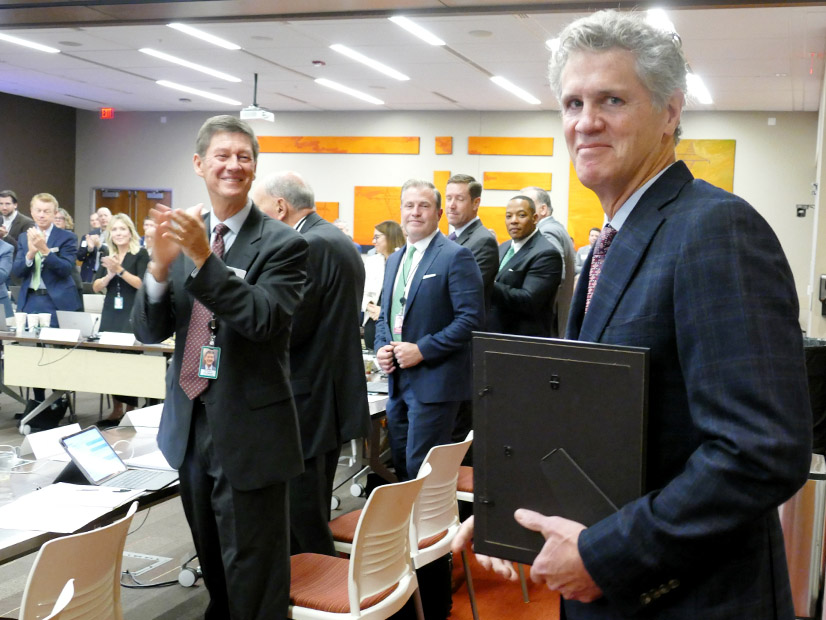
Stakeholders celebrated SPP’s Bruce Rew and Oklahoma Municipal Power Authority’s Dave Osburn, who are both retiring, with several standing ovations.
Nickell presented official resolutions to Osburn and Rew, one of SPP’s original 14 employees. Rew announced his retirement in April after 35 years with the RTO. Osburn is stepping away from the MC but plans to continue participating in the Resource Energy and Adequacy Leadership Team through February 2026.
“One of the things that’s always impressed me when I came here and got involved with SPP is while we sometimes have different business goals when it came to the organization and what’s best for the power pool in general, people kind of came together, found a way to collaborate and reach consensus,” Osburn said. “And I just always appreciated what takes place at SPP and how we try to figure out a good solution for everybody, not just our system.”
“When I reflect back, a lot of things have changed, but a lot of things have stayed the same,” Rew said. “One of those things are meetings like this, where the members are passionately committed to making a difference for SPP and setting the future for SPP. Shortly after I started, SPP celebrated 50 years and a short 15 years from now, it will be 100 years for SPP. So I do want an invitation to the 100-year anniversary so I can see what difference this organization has made in the next 15 years while I’m gone.”
Nickell also called out American Electric Power’s Richard Ross, who is giving up the Market Working Group’s chair after 21 years in the seat.
“I want to call [Ross] a super chair because a lot of work was done under his leadership,” he said. “I remember what our Market Working Group secretary said about Richard: ‘You have guided the MWG with a boot, a gavel, a steady hand, sharp insight and a collaborative, feisty spirit that has left an undeniable mark on this group and on SPP’s market evolution.’”
“That’s the truth,” muttered an SPP staffer in the audience.
Nickell said he wanted to give Ross one of the Gold Stars that he hands out for work well done, except for one small problem: “I’ve just never been awarded one.”
Bastone, Hepper, Wright Re-elected to Board
Members re-elected independent Directors Bronwen Bastone, Ray Hepper and Steve Wright to new three-year terms on the board during the Annual Meeting of Members.
Bastone, Wright and Hepper were first elected in 2020, 2022 and 2023, respectively. Hepper, the board’s chair, said Stuart Solomon has agreed to serve as vice chair, effective immediately.
Members also elected four new members and six incumbents to the MC, which acts as a sounding board and provides input to the directors. The four new members and the sectors they represent are:
Brad Hans, Municipal Energy Agency of Nebraska, and Paul Mahlberg, Kansas Municipal Energy Agency (Municipal);
Chris Matos, Google Energy (Large Retail); and
Ken Miller, OG&E (Investor-owned Utility).
The re-elected incumbents are:
Buddy Hasten, Arkansas Electric Cooperative Corp., and Jeremy Severson, Basin Electric (Cooperative);
Brett White, Pine Gate Renewables (Independent Power Producer/Marketer);
Bleau LaFave, NorthWestern Energy, and Stacey Burbure, Public Service Company of Oklahoma (Investor-owned Utility); and
Patrick Woods, ITC Great Plains (Independent Transmission Company).
The nominations were brought forward by the Corporate Governance Committee. Each member will serve two-year terms.
Competitive Project Proceeds
His seat at the table not yet warm, OG&E’s Miller pulled from the consent agenda a working group’s recommendation to make no changes to a construction permit for the 345-kV Sooner-Wekiwa competitive upgrade.
The Project Cost Working Group analyzed the project, awarded to Transource Oklahoma in 2020, but determined it couldn’t make a ruling on a reported cost increase that exceeded commitments because Transource included a confidential obligation in the proposal.
Miller said he had concerns about SPP’s competitive process but that his complaint was about not being able to see the cost overruns.
“We don’t know whether they’re reasonable and should be recoverable. We can’t see that,” he said. “I have concerns about the competitive process, but I also have concerns we are signaling to FERC that these cost overruns are reasonable.”
SPP assured the board and members that staff will continue to review the project and address any issues. The project has a Nov. 17 in-service date.
Miller abstained from the vote on the motion, which passed the MC 19-0, with three other abstentions.
The consent agenda, passed in a voice vote, included the violation relaxation limit analysis report; CGC’s nominations of Miller to the Strategic Planning Committee, and Western Farmers Electric Cooperative’s Rodney Palesano and OG&E’s Brad Cochran to the Human Resources Committee; and RR706. The tariff change adds the federal service exemption transfer point as a qualifying source for candidate LCTRs and auction revenue rights.
The agenda also included recommendations to accept new cost estimates for five projects as reasonable, nine out-of-cycle re-evaluations and two withdrawals.
PJM’s winter outlook found the RTO should have enough resources to meet the forecast peak load of 145,700 MW, although the reserve margin continues to decline as new resource development lags. If the forecast is reached, it would surpass the previous winter’s record-setting peak of 143,700 MW. (See PJM Sets Record Winter Peak Load.)
Load growth has continued to erode PJM’s reserve margin, which stands at 7.5 GW in the forecast, down from 8.7 GW in the previous year. About 4.8 GW of new nameplate generation was included in the modeling. Much of that is solar, however, and amounts to just 1 GW of capacity. (See PJM OC Briefs: Oct. 10, 2024.)
“The grid is set up to keep the power flowing reliably this winter under forecast conditions, but the tightening of our margins will begin to impact us in the next few years if it continues,” said Aftab Khan, PJM executive vice president of operations, planning and security, in an announcement of the winter outlook. “PJM is working on multiple levels with all of our stakeholders to reverse this trend of demand growing faster than we can add generation,”
The analysis shows 180.8 GW of operational capacity, which includes 177.9 GW with commitments in the capacity market, as well as resources anticipated to be available. An additional 7.7 GW of load management will be available. Of those resources, 15.9 GW is expected to be on outage during periods of system strain, and 5 GW of exports were included.
The reserve margin measures the amount of operational capacity above the 90/10 diversified load forecast plus the 6.8-GW day-ahead scheduling reserve requirement.
The amount of operational capacity reflects improvements in resource performance observed since the December 2022 Winter Storm Elliott. After that storm, PJM made several changes to its emergency procedures, non-performance penalties and advance commitment practices. The announcement says the margin could become tighter if those improvements do not continue.
“Generator performance will be critical to maintaining reliability this winter,” said Mike Bryson, PJM senior vice president of operations. “We are encouraged by the work we have seen by generation owners to fortify their units for winter operations, and we will continue to focus on communication and coordination that help us understand how PJM can help to mitigate gas scheduling challenges or other generator limitations.”
Presenting the outlook during the Nov. 3 Operating Committee meeting, PJM’s Akash Patel outlined the preliminary results of scenarios exploring how low renewable generation or the largest gas contingency could affect the reserve margin. If wind and solar output were to be 3 GW lower than expected, there would be 200 MW of operational capacity available before load management would be required. The largest gas contingency would take 4.7 GW off the system, shrinking the reserve margin to 5.8 GW; pairing the two scenarios would leave a 2.8-GW margin.
Paul Sotkiewicz, president of E-Cubed Policy Associates, questioned why PJM included 5 GW of exports in the analysis, stating that PJM’s governing documents require that non-firm ties to other regions be curtailed if it falls into a reserve shortage.
PJM Director of Operations Planning Dave Souder said the 5 GW is the historical value PJM has exported over peaks. The study results indicate with that level of exports PJM would be deficient and would begin implementing procedures to curtail off-system sales.
The announcement of the outlook says PJM and ReliabilityFirst intend to double the number of site visits they will conduct at 30 generators to share best practices on winterization. PJM also will conduct unannounced tests of generators that have not run in the weeks ahead of the winter season.
More than 400 stakeholders attended a set of workshops where CAISO staff described new processes for scheduling intertie resources and resource adequacy imports in the ISO’s Extended Day-Ahead Market, which will begin operation in May 2026.
ISO staff used the Nov. 5 and 6 workshops to review a white paper on the subjects.
“I haven’t seen [this many participants] on a CAISO call since you were dealing with the 2020 blackouts,” said Dan Williams, principal adviser at The Energy Authority.
One of the new EDAM processes involves intertie resource bidding and scheduling. Intertie resources in CAISO are currently modeled at specific scheduling points, but under EDAM, those resources will be modeled at a generation aggregation point (GAP).
A GAP is the collection of supply resources in a balancing authority area or group of BAAs.
EDAM will have three types of GAPs: default, custom and generic. A GAP can be resource specific or not, and its location will be in a Western Energy Imbalance Market (EIM) or non-WEIM BAA where the energy is produced or consumed, CAISO staff wrote in the white paper.
The GAP approach will significantly improve power flow and market accuracy, improve alignment with actual power flows by reducing phantom congestion and reduce operator conformance of transmission limits in real time, staff wrote.
CAISO Executive Principal George Angelidis described five intertie resource types: system resources, intertie transaction resources, intertie generating resources, transfer system resources and mirror system resources.
Some participants said they were unclear about these terms.
“I am already a little lost between the difference between a system resource and an intertie generating resource,” said Carrie Bentley, CEO of Gridwell Consulting. “The words seem almost exactly the same. I’m wondering if it would be helpful to ground us all in what all these different terms are for and maybe … dumb it down for us.”
“Both the system resource and intertie generating resource are registered in the master file,” Angelidis said. “The system resources in implementation are non-resource specific intertie resources.”
Williams added: “We are seven months out from this [process] being a live part of CAISO’s market, and as far as I am aware today, there are sort of two sources of power that trade in the forward market: a CAISO source and a non-CAISO source.”
“Western markets are not set up to be trading with any amount of liquidity on a resource-specific basis in the pre-day-ahead market space,” Williams said.
The paper introduced indirect intertie scheduling in EDAM. CAISO currently offers direct scheduling at interties but will now include indirect scheduling in EDAM to allow non-EDAM BAA resources to wheel power through a WEIM BAA that requires explicit wheel-through schedules, the paper says. Indirect scheduling is more complicated than direct scheduling and requires coordinating schedules of multiple resources, the paper says.
The paper also described generic RA import requirements.
CAISO tried to simplify monthly RA showings in EDAM. Monthly generic RA showings will not be resource specific, and scheduling coordinators who have generic RA import obligations will show these obligations in the ISO’s customer interface for resource adequacy (CIRA) system.
The paper also described requirements for imports of flexible RA. Monthly flexible RA will be resource specific, and CIRA will confirm that a scheduling coordinator has obtained the maximum import capacity at the intertie. If the source of the flexible RA obligation is in a non-WEIM BAA, the custom GAP must be the location of a physical resource in that non-WEIM BAA, the paper says.