Search
December 10, 2025

ISO-NE Open to PFP Changes Following NEPGA Complaint

Responding to a complaint about “serious flaws” in ISO-NE’s Pay-for-Performance (PFP) design, ISO-NE said it is open to capping the balancing ratio used to calculate PFP payments at 1.0 to prevent capacity resources from being required to provide more power than their capacity supply obligations (CSOs).

Multiple generation companies, associations and municipal utilities supported the New England Power Generators Association (NEPGA) complaint and the proposed solution. Consumer advocates and the New England states expressed support for the general concept that generators should not be required to provide more power than stipulated in their CSOs (EL25-106).

NEPGA’s complaint stems from an ISO-NE capacity shortfall event on June 24, in which New England experienced its highest peak load in over a decade. ISO-NE estimates that PFP payments associated with this event totaled over $114 million. (See Extreme Heat Triggers Capacity Deficiency in New England.)

The RTO’s PFP mechanism compensates resources for performing beyond their obligations during scarcity events, while charging these costs to underperforming resources with CSOs. The amount of power that capacity resources are required to provide during shortage events is determined by the balancing ratio, which equals the region’s capacity requirement divided by the total amount of available capacity.

During the June 24 event, the balancing ratio exceeded 1.0 for the first time in the region’s history, averaging 1.031 over the three-hour scarcity period. This required capacity resources to provide power in excess of their CSOs, costing capacity resources about $25.6 million.

In a Section 206 complaint submitted by NEPGA to FERC following the event, the association argued that ISO-NE should be required to cap the balancing ratio at 1.0 to prevent “improper charges” on capacity resources. (See NEPGA Seeks Relief for ‘Improper’ Pay-for-Performance Costs in ISO-NE.)

NEPGA also took issue with ISO-NE’s method for allocating stopped losses for underperforming resources. ISO-NE’s PFP rules include stop-loss provisions capping the total charges an underperforming resource can accrue each month. ISO-NE allocates the under-collection of charges caused by the stop-loss limit to all capacity resources that have not hit their limit.

NEPGA argued that these costs should not be socialized among capacity resources and that the under-collection instead should be deducted from the credits paid to performing resources.

Stakeholders including RENEW Northeast, the Electric Power Supply Association, LS Power, FirstLight Power and the Massachusetts Municipal Wholesale Electric Co. supported NEPGA’s filing in comments submitted to FERC prior to the Aug. 21 deadline.

“The proposed changes are not only reasonable but essential because they eliminate penalties on perfectly performing resources and preserve durable, risk-balanced price signals for future scarcity events,” wrote LS Power.

The New England States Committee on Electricity (NESCOE) and a coalition of consumer advocates from five of the six New England states offered general support for the concept of capping the balancing ratio.

“NESCOE does not take a position on whether or not the commission should grant or deny NEPGA’s complaint or whether or not the commission should order NEPGA’s requested relief,” the states wrote. “However, NESCOE does agree with NEPGA on the general principle that a capacity resource should not be held to a performance standard that exceeds its capacity supply obligations.”

The states also echoed NEPGA’s concern that penalizing perfectly performing capacity resources “will eventually either disincentivize resources from participating in the Forward Capacity Market or cause higher risk premiums, which in turn increases both reliability risks and prices.”

The consumer advocates took a similar stance, and encouraged FERC, ISO-NE and stakeholders “to develop a solution that (1) retains the existing insulation of load from direct financial costs of CSCs [capacity scarcity conditions], and (2) avoids the incorporation of unnecessary and potentially substantial risk premiums into future capacity supply offers due to the now material possibility that a capacity resource could be financially liable for failure to overperform during a CSC.”

They noted they generally are “wary of any rule or market design that could broadly disincentivize participation in the capacity market,” and that, “in a time of increasing demand forecasts and already increasing capacity product prices, the region cannot afford the financial or reliability ramifications of a short capacity market.”

ISO-NE did not endorse any changes to the PFP methodology but said it “would not oppose an order from the commission to cap the balancing ratio at one … so long as adequate time is provided for the ISO to evaluate and make other necessary changes to the Forward Capacity Market rules so that the capping does not create other problems.”

The RTO wrote that capping the balancing ratio likely would not “materially undermine” incentives for resources to perform during capacity scarcity events.

It acknowledged that many suppliers are not capable of providing power in excess of their CSOs and conceded NEPGA’s argument that “the risk of the balancing ratio going above one was discussed only as a theoretical possibility, and that suppliers very well may not have accounted for it as a result.”

However, ISO-NE opposed NEPGA’s complaint and proposal regarding the allocation of stopped losses.

It argued that all resources with CSOs “potentially benefit from the stop-loss mechanism because — in addition to limiting a supplier’s net financial losses — it enables a supplier to know its maximum loss exposure prior to participating in the Forward Capacity Auction, and to communicate its maximum loss exposure to third parties with which it may do business, such as external entities providing financing.”

While ISO-NE argued that NEPGA failed to demonstrate that the allocation of stopped losses is not just and reasonable, it acknowledged NEPGA’s proposal to adopt PJM’s cost allocation methodology may be a viable alternative. The RTO said that “implementing such a replacement rate is feasible under the 180-day compliance timeline.”

Vitol, which operates as a power marketer in New England, opposed NEPGA’s complaint in its entirety, arguing that NEPGA failed to demonstrate that the current rules are not just and reasonable.

“NEPGA cannot escape the fact that the PFP program FERC approved in 2014 was designed to impose a share-of-system obligation on capacity resources during scarcity events, and that it was expressly recognized that the balancing ratio could exceed 100%,” Vitol wrote. “The PFP design feature at issue in the complaint was debated, and it was approved by the commission.”

Vitol noted it does not hold capacity commitments in the region, and that it earned PFP credits by importing power to the region during the scarcity event. It argued that NEPGA’s proposed changes “would harm reliability in New England by diluting incentives for suppliers to deliver energy in scarcity circumstances when it is most needed.”
Clean Energy Investments Tapering Off in Mid-2025

Clean energy investments plateaued in the second quarter of 2025 and the pipeline of new project announcements has contracted sharply, a new report shows. 

In an Aug. 28 update, the Clean Investment Monitor said U.S. clean energy and transportation investment totaled $68 billion for April-June 2025, down 0.3% from the preceding quarter but up 1% from the same quarter a year earlier. 

Individual segments within the broad category showed wider fluctuations: 

    • Retail consumer purchases and installations totaled $34 billion, 6% more than the preceding quarter but 3% less than a year earlier. 
    • Industrial decarbonization and utility-scale clean energy investments totaled $23 billion, 13% more than the preceding quarter and 7% more than a year earlier. 
    • Manufacturing investments totaled $11 billion, 15% less than the preceding quarter and 19% less than a year earlier.
    • The Clean Investment Monitor is a joint effort of Rhodium Group and MIT’s Center for Energy and Environmental Policy Research. 

The data in the Clean Investment Monitor update has been influenced by the pro-fossil, anti-renewable policy changes President Donald Trump has made since his return to office in January. A notable development in the second quarter of 2025 was the debate and enactment of the One Big Beautiful Bill Act, which spelled out just how significantly certain clean energy and transportation initiatives would be harmed. 

The number and scope of new projects announced during the second quarter gives an indication of how these policy changes were received: 

    • Utility-scale clean-energy announcements totaled $21 billion, 51% lower than the first quarter. 
    • Industrial decarbonization announcements totaled $2 billion, 17% lower than the first quarter and 38% lower than a year earlier. 
    • Manufacturing project announcements totaled $4 billion, 59% lower than the first quarter and 44% lower than a year earlier. (Manufacturing project cancellations totaled $5 billion, exceeding the value of new announcements for the first time.) 

The report places total investment in new clean energy generation and technology manufacturing facilities at $351 billion in the three years since enactment of the Inflation Reduction Act in 2022 and indicates $517 billion worth of announced investments have yet to be spent. 

The authors note that OBBBA will affect the clean energy investment landscape. 

“The tax credit eligibility changes may influence how quickly announced investments materialize [into] actual capital expenditures,” they write. “The early sunset for EV, heat pump and distributed energy consumer tax credits could reshape the composition of U.S. clean investment, which has been strongly driven by the retail segment, in the quarters ahead.” 

New Data Show Queues Shrank in 2024 as Reforms Implemented

FERC has processed the first round of Order 2023 compliance filings, and the latest round of interconnection queue reforms is being implemented. Some new data indicate the efforts are starting to work. 

A recent analysis from consulting firm Wood Mackenzie found that grid operators as a whole in 2024 processed 33% more interconnection agreements than they did in 2023. At the same time, they saw 9% fewer new requests and a 51% increase in withdrawals of non-viable projects. That has helped reduce queue lengths. 

Interconnection capacity agreements reached historic highs in 2024, with 75 GW approved. Through July 2025, grid operators had approved an additional 36 GW. That’s on pace to match 2024’s record, Wood Mackenzie said. 

The analysis reports that ERCOT’s connect-and-manage approach continues to work, leading to the highest success rates and speed to interconnection in the country. ISO-NE takes second place. Wood Mackenzie notes that the ISO-NE delay from moving serial processing to a new cluster study method means it takes four times as long to sign an interconnection agreement there as it does in Texas. 

The Lawrence Berkeley National Lab also recently released a nationwide queue data set, which includes the same kind of data used to develop its “Queued Up” reports in years past. (See IRA Driving New Clean Energy as Interconnection Queue Backlogs Persist.) 

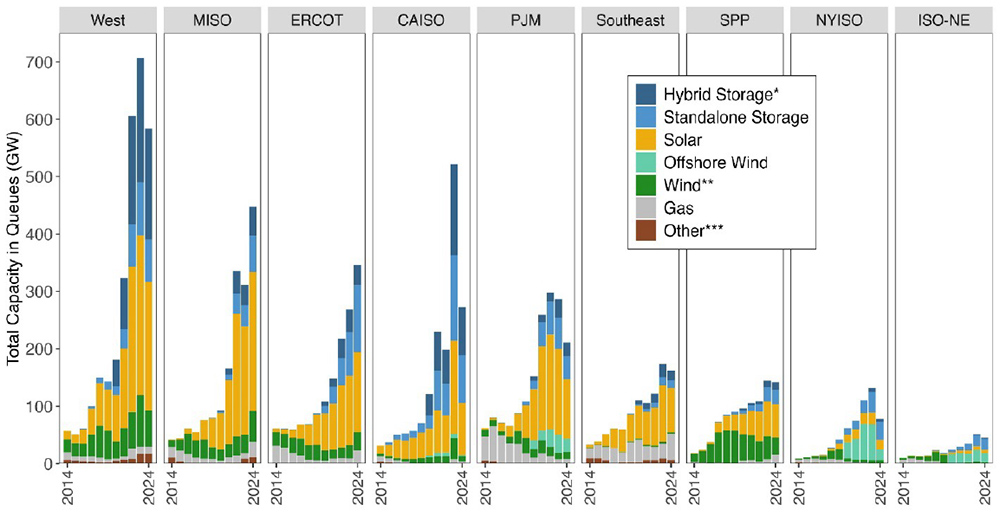
Graphs from the Lawrence Berkley National Lab showing regional queues and their share by generation technology over the past decade. | Lawrence Berkley National Lab

LBNL’s data comes from all seven organized markets and an additional 49 non-ISO balancing areas that are home to 97% of installed generation in the country. It includes generation projects seeking to connect to the transmission system (with none seeking distribution level interconnection) through the end of 2024. 

The country’s grid operators had 2,290 GW in their queues at the end of 2024, which includes 481 GW of requests made that year. That is down from 2,598 GW overall and 908 GW of new requests in 2023. The number of older projects from previous years continued to grow, but at just 119 GW, it was at the slowest rate so far this decade. 

Nationwide, queues set a record for withdrawals (dating back to 2000), with 340 GW of projects pulling out of the process in 2024. That compares with 127.1 GW in 2023 and is well ahead of the previous annual record of 197.1 GW. 

Solar and storage continued to be the two largest technologies seeking to connect to the grid in 2024, but at around 900 GW apiece (including hybrid and standalone projects), both saw the amount in the queues drop from 2023. Natural gas generation is at a fraction of that nameplate capacity, but it saw growth on the year going from 69.4 GW of standalone projects in 2023 to 123.4 GW last year. 

Among the ISO/RTOs, MISO had the largest queue at the end of 2024, with 447.5 GW, with just over half of that coming from solar. ERCOT was second at 346 GW at the end of 2024, including 139.4 GW of solar and 116.8 GW of storage. 

CAISO had the largest queue by far in 2023, but its line was down by hundreds of gigawatts in 2024 to a still-large 272.9 GW, with storage representing 167 GW (both standalone and hybrid) and solar an additional 90 GW. 

While the number of new requests was down overall, the potential capacity in the queue continues to exceed installed capacity, with 2,290 GW in line compared to 1,322 GW of installed capacity. 

LBNL reported that most of the projects in the queue hope to connect to the grid by 2028, with 300 GW planning to connect in 2025, 371 GW in 2026, 403.6 GW in 2027 and 429.1 GW seeking interconnection in 2028. 

The data LBNL released includes five-year forecasts of demand and retirements compared to advanced projects in the queue with either signed or drafted interconnection agreements. The one region with a major gap between forecast load and new supply is PJM, which is facing significant load growth. 

CPUC Fine-tunes Approach to Utility Climate Adaptation Program

The California Public Utilities Commission is looking for ways to improve a utility-oriented climate adaptation program designed to help protect the most vulnerable people and lands in the Golden State.

At an Aug. 27 workshop, CPUC staff and representatives from investor-owned utilities (IOUs), tribes and other stakeholder groups unveiled possible ways to improve IOUs’ Climate Adaptation Vulnerability Assessments (CAVAs). A CAVA identifies vulnerabilities and risks to IOU assets, operations and services stemming from the effects of climate change.

“Robust climate adaptation planning in a time of worsening climate impacts is a prudent next step to ensure the safety and reliability” of IOUs, the CPUC said in the “Climate Adaption” section of its website.

“This [workshop] is really critical work to ensure that equity is part of the [climate change reduction] solution,” Audrey Neuman, energy adviser to CPUC Commissioner Darcie Houck, said at the workshop.

In a CAVA, an IOU must describe possible ways to confront vulnerabilities to itself and its infrastructure. These options could be used to determine investments in climate adaptation work, the CPUC said.

The CAVA is part of the CPUC’s 2018 Order Instituting Rulemaking (OIR) 18-04-019 to consider strategies and guidance for climate change adaptation. IOUs must submit a CAVA to the CPUC every four years.

CPUC staff said they are currently working with stakeholders to help create “quantitative equity metrics,” such as a matrix that shows the adaptivity potential of vulnerable communities and infrastructure. Other possible metrics include quantifying a community’s access to resources during an outage; the cost burden of an outage; the impacts of outages on different populations; the impacts of high-frequency outages; and the impacts of long-duration outages.

At the workshop, some stakeholders said too much analysis would be harmful to people who need support now.

“We don’t need to tie together all of the various equity processes … in order to get to some actionable plan that is good enough now,” one stakeholder said. “There are things we know we need to do now, and we don’t have to wait for paralysis by analysis to get to the optimal answer.”

Pacific Gas and Electric representatives said the utility is currently defining which communities need the most attention. Part of the challenge, the representatives said, is that the definition of disadvantaged and vulnerable communities (DVCs) is not specific, which makes it difficult to determine the most vulnerable groups.

“We are looking to target the most vulnerable communities because the DVC definition is quite broad,” said Nathan Bengtsson, PG&E interim director of climate resilience and adaptation. “When we went to [research groups] with the [DVC] definition, almost every group said, ‘Wow, that doesn’t represent a lot of us. You’re leaving out farmworkers, you’re leaving out people with disabilities.”

In 2024, the CPUC required a CAVA to implement a model called the “global warming levels approach,” which seeks to draw a link between regional climate change and specific levels of global warming. This approach is meant to help reduce temperature bias in the CAVA program and “largely separates climate projections from underlying socioeconomic scenario assumptions,” as the climate generally acts uniformly at different global warming levels “regardless of how society gets itself there,” CPUC staff said in OIR 18-04-019.

MISO on Track to Wrap Summer with 122-GW Peak, Addresses Frequent South Advisories

MISO is poised to close the door on summer 2025 with an almost 122-GW peak while issuing several capacity advisories for MISO South.

MISO recorded a 121.6-GW peak on July 29, a few gigawatts more than July 2024’s 118.1-GW peak. Load for the month averaged 92.2 GW, higher than any July in recent years.

Hot weather across the footprint led MISO to its late July peak, which occurred during a maximum generation warning and conservative operations instructions for the entire footprint and while MISO South was under a local transmission emergency. (See MISO Skirts Max Gen Emergency in July Heat.)

Before summer, MISO estimated it would navigate a 122.6-GW peak in its most likely forecast scenario. (See MISO Braces for Hot Summer, Potential 130-GW Peak.) The last time the system hit 122 GW was August 2024.

At an Aug. 28 Reliability Subcommittee meeting, Senior Director of Reliability Coordination John Harmon said the system performed as expected during a “hot, hot, humid and stormy month.”

July’s average daily generation outages were 40 GW, higher than the average 32 GW of the past three years in July. The month’s solar peak at 13.1 GW closed in on a 15.4-GW wind peak. Both occurred in early July.

July’s real-time prices averaged $47/MWh, owing mainly to higher gas prices at $3/MMBtu. In July 2024, $2/MMBtu gas held prices at $30/MWh. Day-ahead market congestion collections for the month more than doubled to $116.59 million from $63.23 million in July 2024.

MISO published more than 50 notifications throughout July for various reasons, including cautioning members about a lack of capacity or transmission capability, warning of severe weather, or updating or canceling instructions and alerts. Many of the notifications were aimed at MISO South.

Majority of Days Come with Capacity Advisories in MISO South

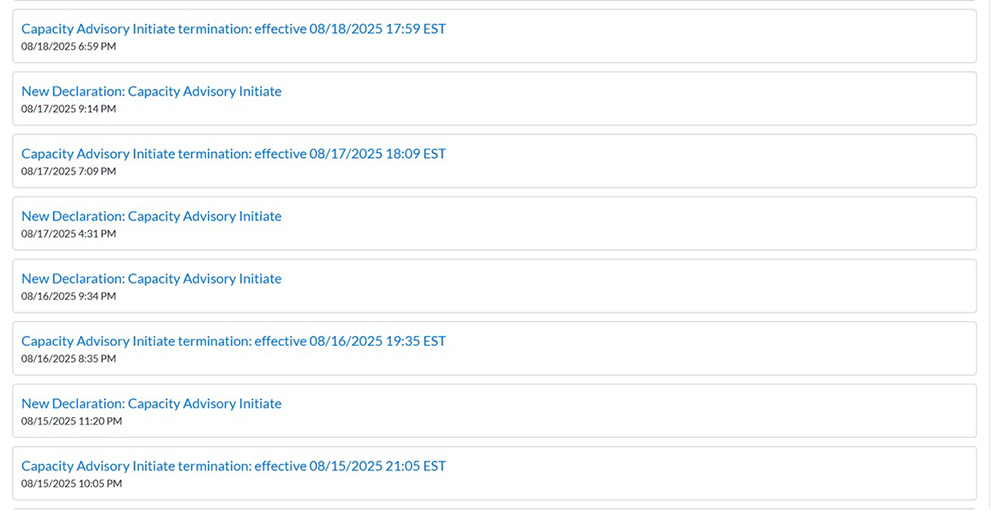
MISO kept up a near-daily cadence of capacity advisories for MISO South — namely Entergy — throughout August. The RTO cited either higher-than-forecast load, squeezed transfer capabilities or forced generation outages as reasons behind the advisories. So far, MISO South has been the focus of 17 capacity advisories in August.

MISO expanded a capacity advisory to the Midwest as well as the South in mid-August as heat enveloped the footprint.

Stakeholders at the Reliability Subcommittee meeting asked MISO what’s behind the more prevalent advisories for the Entergy territory. Harmon said it “made a change to increase the communication about the risk that we see in load pockets” throughout the South. Otherwise, Harmon said systemwide July notifications were from a combination of hotter weather and generation outages.

“They’re almost daily, aren’t they?” Mississippi Public Service Commission consultant Bill Booth said of the advisories directed at Entergy.

WEC Energy Group’s Chris Plante said the declarations have been issued on top of one another, with another announced moments after one expires.

MISO

A series of capacity advisories in mid-August for MISO South | MISO

Harmon said MISO’s advisories are only for specific hours of the day that contain elevated risk. He said that’s why the RTO terminates them and reissues them for the following day.

Booth asked if the capacity advisories are part of MISO’s communication response to the Memorial Day weekend load-shedding event in greater New Orleans. (See MISO Says Public Communication Needs Work After NOLA Load Shed.)

Harmon said the string of advisories aren’t a direct result of the New Orleans outage, but that it lines up with “how can MISO communicate risk further in advance.” He said they’re meant to communicate greater risk beyond a normal operating day in MISO South.

“You just see so many of them that after a while you tend to ignore them,” Booth observed.

MISO

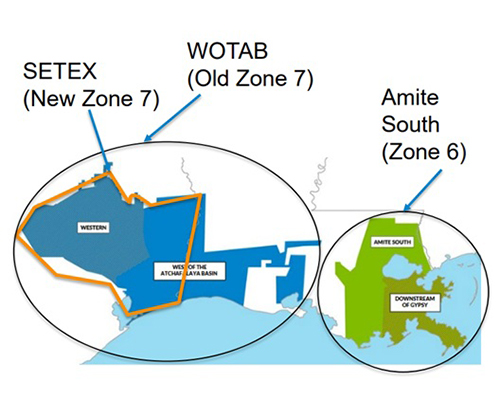
MISO South’s current Operating Reserve Zone 7 in the circle and the new zone outlined in orange | MISO

The RTO also announced at the Reliability Subcommittee meeting that it will redraw an operating reserve zone in Louisiana and Texas.

MISO South’s Operating Reserve Zone 7 currently includes the West of the Atchafalaya Basin (WOTAB) load pocket. The RTO wants to trim the eastern portion of WOTAB out of the zone to make the Southeast Texas (SETEX) load pocket the more consequential area to the zone.

MISO’s operating reserve zones are different than its local resource zones and are split up so it can ensure ancillary services like regulating and contingency reserves can be dispersed to meet predicted shortages. The RTO currently has eight such zones and can alter them after conducting quarterly studies.

MISO’s Dalton Daughtrey explained that SETEX is a more transfer-limited pocket than WOTAB. He said the RTO is initiating the change so it can more “sufficiently manage reserves in real time.”

Daughtrey explained the narrowed reserve zone aligns with Entergy’s operating guide for the area. He said SETEX contains more “impactful tie lines” and explained there is smaller transport capability in SETEX.

Harmon added the change will make sure reserves are deliverable.

The RTO plans to relegate the eastern portion of WOTAB cut from Zone 7 to Zone 8, which encompasses most of MISO South that isn’t in either Zone 7 or Zone 6 (the Amite South load pocket in southeastern Louisiana).

Eddystone Ordered to Remain Operational for PJM 90 More Days

The U.S. Department of Energy has issued another emergency order keeping Units 3 and 4 of the Eddystone Generating Station in Pennsylvania in operation. 

The dual-fuel, 380-MW subcritical steam boiler-turbine generator units are 55 and 58 years old, and Constellation Energy had scheduled them for retirement May 31. 

But Energy Secretary Chris Wright on May 30 issued an emergency order keeping them in operation to minimize the risk of energy shortfalls in the Mid-Atlantic region. 

That order was to expire the evening of Aug. 28. Wright issued the follow-up order to Constellation Energy and PJM the evening of Aug. 27. 

In an Aug. 28 news release, he said keeping Units 3 and 4 operational has improved energy security in the PJM region. He pointed to the June and July heat waves, when PJM called on the two units to generate electricity. And he said the emergency conditions that led to his first order persist. 

The new order continues until Nov. 26. 

PJM spokesperson Jeff Shields described the order as a “prudent, term-limited step” to keep Eddystone operational. 

“PJM has previously documented its concerns over the growing risk of a supply-and-demand imbalance driven by the confluence of generator retirements and demand growth. Such an imbalance could have serious ramifications for reliability and affordability for consumers,” he wrote in an email. “PJM supports the U.S. Department of Energy’s extension of its order, originally issued May 30 pursuant to Section 202(c) of the Federal Power Act, to defer the retirements of certain generators operating in PJM’s footprint, which spans all or part of 13 states and the District of Columbia.” 

FERC approved a PJM filing to allocate the costs across all RTO load that Constellation incurs keeping Eddystone operational. But that proposal was effective only until Aug. 28. Stakeholders are working toward a longer-term solution for addressing cost allocation for DOE emergency orders through the DOE 202(c) Cost Allocation Senior Task Force. The RTO did not answer questions about whether another Critical Issue Fast Path (CIFP) process is expected to be required for costs under the latest DOE order. (See FERC Approves Cost Allocation for Eddystone Emergency Order.) 

President Donald Trump, Wright and other administration officials have been pushing to halt retirement of gas- and coal-burning power generation facilities as part of their pro-fossil, anti-renewable campaign for American energy dominance, saying a power generation crisis is developing. 

Wright also blocked retirement of the J.H. Campbell coal-burning plant in Michigan in May and issued a follow-up order Aug. 20 extending its potential operation for another 90 days. 

Wright also lifted annual run-hour restrictions on the H.S. Wagner Generating Station Unit 4 in Maryland in July. 

In both cases, Wright cited a shortage of generation capacity.

Constellation said it is prepared to continue operating Eddystone into the fall.

“Constellation is continuing to work with the Department of Energy and PJM in taking emergency measures to meet the need for power at this critical time when America must win the AI race. Constellation will continue to operate Eddystone Units 3 and 4 during the fall,” Constellation said in a statement about the order.

These orders and others issued by Wright are under authority of Section 202(C) of the Federal Power Act, which historically has been an obscure provision but is seeing more frequent use in the second Trump administration. 

The Biden administration issued 11 emergency orders under Section 202(c) in four years, all weather-related. With the Eddystone order, the Trump administration has issued eight orders and two extensions in a little more than four months.

Environmental groups and others have railed against the orders, calling them unnecessary, expensive and causing further pollution.

The DOE order “undermines our energy security and endangers public health and the environment,” Tracy Carluccio, deputy director of the Delaware Riverkeeper Network wrote in a statement.

FERC decided that “the cost of keeping the plant open can be charged to consumers, compounding the harm to our communities who have to now pay to be polluted,” Carluccio added.

“The order should be rescinded and the company should rightly refuse to comply with it,” Carluccio wrote. Pennsylvania Gov. Josh Shapiro (D) “should intervene to stop this egregious order to protect the public and the environment from any further pollution from Eddystone. Anything less makes Pennsylvania and the company complicit with the human health and environmental harms being caused.”

Solar and Battery Cheaper than Gas, Jefferies Finds

Investment bank Jefferies’ latest analysis finds that the levelized cost of solar-plus-battery storage is cheaper than that of gas, saying slow turbine deliveries and inflationary equipment pricing make the renewable alternative an “attractive” opportunity as data centers drive demand. 

Jefferies’ analysis for combined-cycle gas turbines shows levelized cost of energy (LCOE) at $87/MWh, while paired solar-plus-four-hour battery energy storage systems have a levelized cost of $77/MWh, despite several obstacles ahead, the investment bank said in an Aug. 27 research note. 

The renewable alternative still will be cheaper at $83/MWh even after new rules on foreign entities of concern (FEOC) become effective in 2026, according to Jefferies. The rule is intended to prevent tax credits from going to companies owned or controlled by entities tied to China, North Korea, Iran or Russia. (See Tax Credit Phaseout Threatens Projects, Jobs in New England.) 

“Given the elongated delivery timelines for turbines coupled with inflationary equipment pricing upending project economics, we see attractive solar+battery development opportunity with [investment tax credits] relatively intact,” the bank said. 

Jefferies’ analysis follows the Trump administration’s tightening of tax credit rules on new wind and solar construction. However, the new guidance was not as strict as many in the industry had feared. (See IRS Guidance on Wind and Solar Credits Not as Bad as Feared.) 

To establish eligibility for tax credits under the new rules, developers now must show that significant physical construction has been started before July 5, 2026, proceeded continuously and was completed within four calendar years. 

Jefferies said in its update that the “optimum route for developers” is to procure Chinese solar and BESS and claim the base 30% tax credit, while forgoing a 10% tax incentive aimed at promoting U.S.-sourced materials. 

“Going into 2026 once FEOC kicks in, we estimate the ideal route is to procure U.S.-made solar panels, but Chinese batteries (still competitive vs. U.S. due to reliance of U.S. on Chinese supply chain) thus claiming ITC+domestic content adder on solar only,” Jefferies said. 

The bank added that FEOC, tariffs and other potential levies related to national security concerns “will be a major swing factor in our equation.” 

Gas plants have timelines of five to six years, given slow turbine deliveries, while renewables have much faster deployment cycles, according to Jefferies. This can give paired solar and batteries the upper hand as data centers continue to drive power demand, the bank said. 

“With gas equipment increasingly inflationary, while renewable technology continues to improve AND get cheaper (holding tariffs constant), we see hybrid generation as an increasingly viable solution to meet power demand/supply gap on a timely basis,” Jefferies contended. “As data centers begin to explore paths to work with interruptible service (which is happening), expect these tailwinds to strengthen.” 

Jefferies’ report is consistent with findings published in June by financial advisory firm Lazard. (See Lazard: Solar and Wind Retain Lowest LCOEs.) 

Lazard concluded that wind and solar are the least expensive new-build power generation for the 10th year in a row, while new gas-fired generation has hit a 10-year high, with equipment shortages expected to drive further increases. 

“Batteries are not fungible equivalents to gas alternatives — they are simply just available ‘today,’” Jefferies said in its note. “We are seeing wider adoption from geographic perspective (Midwest/etc.) to help accelerate data center timelines. Core markets (TX/CA), however, appear to offset meaningful growth elsewhere for storage. What’s more is the low cost of Chinese alternatives could yet incent developers to side-step the ITC altogether, given procurement impediments to qualify for [One Big Beautiful Bill Act] benefits.” 

NRG, PJM IMM Disagree on LS Power Deal’s Market Power Impact

NRG Energy is pushing back against arguments from PJM’s Independent Market Monitor (IMM) that its deal with LS Power would increase market concentration in the RTO and needs to meet conditions before FERC approval (EC25-102).

In an earlier protest, the IMM called for bidding limits on generation and demand response resources. (NRG will acquire CPower in the deal.) Those resources have grown in importance as the supply-demand balance in PJM has narrowed. (See PJM Monitor Calls for Bidding Limits on NRG Generation, DR in LS Deal.)

NRG told FERC in an Aug. 7 response that its deal to buy power plants and a DR aggregator from LS Power would not have an adverse impact on PJM. NRG filed a delivered price test (DPT) and updated analysis from economist John Morris. As in past proceedings, the IMM proposes conditions that are directed at the effectiveness of the PJM markets and mitigation measures as a general matter that goes beyond FERC’s normal merger review process, NRG said.

The DPT analysis from Morris “showed that the transaction will have no adverse effect on competition in PJM or any relevant or potentially relevant PJM sub-market,” the firm said. “Indeed, while applicants are not required to show that the transaction will enhance competition, the DPT analysis shows that the transaction would actually reduce concentration in the PJM market and all relevant or potentially relevant sub-markets in most time periods.”

FERC staff posted a deficiency letter Aug. 13, seeking more information on the deal, including questions about whether demand response resources were included in the horizontal market screens for PJM and NYISO. Staff asked other questions about data NRG submitted around generation.

The IMM filed an answer Aug. 27 arguing that NRG failed to rebut findings that its structural market power would grow with the deal as measured by the “three pivotal supplier [TPS] test.”

“NRG applicants should not be permitted to exercise market power, and the transaction should not be approved without reasonable measures to protect the public interest in competition and competitive market outcomes,” the IMM said.

The deal will increase market power in sub-markets of PJM, and NRG misstates the deal’s impact on the concentration of ownership in demand response, the IMM said.

“The applicants must provide record support for a finding that a transaction is consistent with the public interest,” the IMM said. “Showing that a transaction has net positive benefits for competition would provide evidentiary support … consistent with the public interest finding. Showing that a transaction does not harm competition is the minimum. No transaction can be approved under the applicable standard if it harms the public interest.”

NRG pushed back by saying the IMM failed to provide enough evidence backing up its “alternative competitive analysis” and instead relies on a dataset that is not available to NRG or the public.

“Over and above the unfairness to applicants of accepting such an analysis, doing so would create massive regulatory uncertainty extending beyond this proceeding as entities considering transactions involving assets in the PJM market would be left with no way of evaluating, in advance, whether those transactions could even potentially be deemed to present competitive issues,” NRG said.

Morris’ initial analysis argued that the deal essentially will flip the supply positions of NRG and LS Power in PJM, with very little change in market concentration. NRG would grow from 1.2% of supply to 5.4%, but LS’ share falls from 6.5% to 2.4%, resulting in lower market concentration across the RTO.

The IMM and consumer advocates ignore the second part of the deal, NRG said, focusing on NRG’s growth and ignoring the shrinking supply of LS Power, which will remain as a competitor in PJM.

While FERC previously said it does not rely on the TPS test for analysis of mergers, NRG noted that even so, the market already has rules in place when a firm fails the TPS test — when its generators are dispatched for constraint control, the unit is dispatched at the lower of the cost or price offer, NRG said.

While FERC has said it does not condition approval of mergers on the TPS test, it has never said the Monitor’s analysis is irrelevant or uninformative, the IMM said.

“The transaction creates new opportunities and/or enhances existing opportunities for NRG to raise energy market prices (LMP) to the benefit of its generation through economic or physical withholding because PJM needs NRG’s supply to manage transmission constraints,” the IMM said. “The transaction creates new opportunities for NRG to raise capacity market prices, and energy market prices on peak days, by significantly increasing ownership concentration in PJM demand response resources. Both areas of concern are relevant to the transaction.”

NRG also pushed back on worries about DR — noting the resource does not operate as a separate product in PJM and is bid into its markets alongside generation.

“Moreover, even as to measures of who controls demand response, the figures provided in the IMM report are misleading, because as Dr. Morris indicates, curtailment service providers, like CPower, are just ‘intermediaries between retail customers and PJM,’ and it is the retail customers that ‘control whether demand response will be provided and, if accepted as a capacity resource, whether they will perform,’” NRG said.

“It is also the case that demand response represents a small percentage of the total capacity in the PJM market. What appears to concern the IMM is not increased concentration in some imagined demand response market but instead perceived inadequacies in the rules governing demand response participation in the broad energy, capacity and ancillary services markets.”

The IMM said that was wrong and PJM’s own tariff defines Curtailment Service Providers as market participants.
“This is an incorrect and misleading characterization of how demand response works in the PJM markets,” the monitor added. “CSPs are market participants that control market strategy, control market offers, and hold the responsibility for demand response performance in the PJM markets.”

Stakeholders Mixed on ISO-NE Prompt Capacity Market Proposal

As the first phase of ISO-NE’s capacity market overhaul nears its final form, New England stakeholders remain mixed on the proposed move from a forward to a prompt capacity auction.  

While the second phase of the RTO’s capacity auction reform (CAR) project — centered on capacity accreditation changes and splitting capacity commitment periods (CCPs) into seasonal periods — likely will draw more attention, the prompt changes still would cause a major shift in the region’s approach to procuring capacity and could have significant effects on market outcomes.  

ISO-NE’s proposed transition from a forward capacity market, with auctions held more than three years before each capacity commitment period (CCP), to a prompt capacity market, with auctions less than a month prior to each CCP, requires significant changes to the RTO’s rules regarding resource entry and exit from the market.  

In a prompt market, new resources would need to prove they are fully operational to gain a capacity supply obligation (CSO), and resources under development would have no guarantee of future capacity revenues until they come online.  

This also would affect the costs resources are allowed to include in bids: generators could include only incremental costs associated with assuming a CSO in their bids and not include development costs that already have been incurred.  

The shift to a prompt market also would significantly affect ISO-NE’s rules for retiring resources. The RTO currently processes retirements in the capacity auction process, providing the region with about four years’ advanced notice on retirements. In a prompt auction format, ISO-NE has proposed decoupling the retirement process from the capacity auction process and would require retiring resources to submit a binding deactivation notice one year prior to the relevant CCP.  

The effects these changes will have on resource entry and exit is unclear; while some NEPOOL members are optimistic the new auction format will more accurately reflect the capacity available to the region in each CCP, stakeholders also have expressed concern it will create challenges for resource development and could lead to more prolonged reliability must-run (RMR) agreements.  

Tom Kaslow, chief market policy officer at FirstLight Power, said the prompt proposal “appears to present both improvement and concern.” 

He said the requirement for resources to be fully operational before participating in auctions will eliminate market distortions caused by new resources that gain CSOs in the forward capacity market but fail to come online in time to meet their obligation.

However, he said it is unclear how this requirement will affect the ability to develop new resources that lack long-term power purchase agreements with states or utilities. 

“The prompt auction framework also raises questions regarding the extent to which existing resources will be able to reflect their going forward costs, such as major maintenance, in capacity auction offers,” Kaslow said. “In addition, if the cost of new entry is sunk before a new resource’s first capacity auction opportunity and existing resources face difficulty in reflecting the full extent of their going forward costs, the market could face greater volatility where sizable exit and entry occur.” 

Some stakeholders also have raised the concern that ISO-NE’s proposal could increase reliance on long-term state power purchase agreements to ensure resource adequacy. 

This concern is not universal, however, and one representative of a renewable energy company expressed optimism that a prompt market would lower risks for solar and storage developers, as they would not have to commit to a CSO years prior to their commercial operations date.  

ISO-NE said in a statement that the prompt auction format “allows new resources to sell capacity as soon as they are operational and no longer have to predict their commercial date three years in advance.” 

“We generally expect that capacity revenues are just one piece of a project’s economics that developers consider in addition to the expected energy and ancillary services a resource can contribute over the project’s lifetime,” ISO-NE added. “The capacity revenue for a single year comprises only a small portion of these expected lifetime revenues.” 

Some NEPOOL members have argued ISO-NE’s proposed one-year notification timeline for resource retirements could increase the length of reliability-must-run agreements if retiring resources trigger reliability issues, saying that developing a reliability solution within a year would be challenging.  

ISO-NE initially proposed a two-year retirement notification timeline, but reduced it to one year, saying a shorter timeline “allows resources to consider as much relevant information as possible, maintaining as much option value as possible, hence improving the probability of efficient deactivation decisions.” 

At the NEPOOL Markets Committee (MC) meeting in August, the RTO acknowledged “the shortened notification timeline may increase the duration of a reliability retention.” 

“However, the improvement in a resource’s assumptions about future market prices and operating conditions may prevent a premature deactivation, thereby potentially eliminating the need for a reliability retention,” said ISO-NE analyst Kevin Coopey. 

Unclear Effects on Market Outcomes

Multiple stakeholders emphasized the difficulty of forecasting how the prompt changes will affect market outcomes, especially when coupled with the seasonal and accreditation changes. The two phases of CAR will be filed separately with FERC but both are intended to take effect for the 2028/29 CCP.  

The Massachusetts Attorney General’s Office (AGO), which advocates for the state’s ratepayers, has asked ISO-NE to provide quantitative analysis on the prompt proposal, but the RTO has provided little information on how the updated proposal would affect market outcomes.  

ISO-NE commissioned Analysis Group to conduct a preliminary analysis in late 2023 on a prompt-seasonal market. The findings indicated that, relative to the existing forward capacity market, a prompt-seasonal format would reduce total capacity payments by about 12% and that the prompt changes alone would reduce total costs by about 10%. (See NEPOOL Markets Committee Briefs: Jan. 11, 2024.) 

In a recent statement, ISO-NE said this analysis demonstrated “numerous benefits to consumers and suppliers, as well as market efficiency gains, which helped inform the decision to pursue the Capacity Auction Reforms.” 

The RTO plans to conduct a comprehensive impact analysis during the second phase of the CAR project, allowing it to quantify the effects of both the prompt and the seasonal/accreditation changes.  

In a recent interview, the Massachusetts AGO said it has been closely following the proposed resource entry and exit changes associated with a prompt auction, but added it lacks clear insight into how the changes will affect prices, and is eager to see more specific numbers on the expected impact of the proposal.  

Other consumer advocates in the region expressed a similar interest in better understanding how the changes will affect costs for ratepayers. 

Matthew Fossum, director of regional and federal affairs at the New Hampshire Office of the Consumer Advocate, emphasized the importance of ensuring the shift to a prompt market “does not create for New England the kind of issues that we have seen recently in other regions, particularly PJM.” 

“With the long lead times and supply chain we are hearing about for investments in generation resources, and with the uncertainty around state and federal policies at present, we need to be thoughtful about the reforms that shorten the time frame for capacity auctions so New England does not end up designing markets that land us in the same unwelcome place,” Fossum added. 

Connecticut Consumer Counsel Claire Coleman said she hopes transitioning to a prompt auction “will reduce costs for consumers by removing some of the risk that suppliers build into their capacity auction bids” and “will make it easier to bring new energy supply online and facilitate more accurate modeling of what generation assets are available for use within the region.” 

However, she acknowledged the impact on consumers “remains to be seen” and said the Office of Consumer Counsel is approaching the capacity market overhaul “with the hope that some of these changes will result in bills reductions for consumers down the road.” 

Next Steps

In a memo Aug. 20, ISO-NE announced a one-month delay to the NEPOOL voting schedule for the prompt proposal and now plans to seek a vote at the MC in November and the Participants Committee in December. The RTO said this delay will not affect the timeline for commencing work on accreditation.  

Several NEPOOL members said they are anxious to get started with the work on the seasonal/accreditation changes, which almost certainly will be the more controversial phase of the project, and ultimately may have a riskier path to approval with FERC if the RTO is unable to build a broad consensus.  

New Study Highlights Winter Benefits of OSW in New England

The addition of 3,500 MW of offshore wind capacity would have reduced ISO-NE energy market costs by about $400 million over the past winter, according to a recent study by Daymark Energy Advisors. The study also found the added capacity would have eliminated $128 million in costs associated with a higher capacity price in the Southeast New England capacity zone.

The study, sponsored by clean energy association RENEW Northeast, comes in the wake of the Trump administration’s stop-work order on Revolution Wind, a 704-MW project contracted by Connecticut and Rhode Island that is estimated to be 80% complete. (See BOEM Slaps Stop-work Order on Revolution Wind.)

“This study shows that delays in bringing offshore wind projects online are costing New England families and businesses real money,” said Francis Pullaro, president of RENEW Northeast.

Daymark used historical weather data to estimate the offshore wind production profile over the past winter and compared this forecast production with ISO-NE real-time energy offer data. The firm estimated that the added wind resources would have contributed 3.6 billion kWh of electricity over the winter months, reducing the need for high-cost fossil units. The study also found that the wind resources would have reduced carbon emissions by about 1.8 million tons.

In the capacity market, Daymark noted that a shortage of capacity cleared in the Southeast New England zone caused a higher clearing price ($3.98/kW-month) than the rest-of-pool (ROP) price ($2.611/kW-month). It said the injection of 3,500 MW of offshore wind would have avoided this issue, saving $128 million in capacity costs by substituting the higher zone-specific price with the ROP price, “even after accounting for increased cost of winter excess capacity.”

“The OSW capacity would have also displaced the highest price cleared capacity in ROP, likely decreasing the ROP price,” Daymark added. “Our analysis conservatively assumes no additional savings from this likely outcome.”

New England faced high electricity prices and high consumer energy costs over the past winter due to consistently cold weather.

The region’s power sector has become increasingly reliant on natural gas over the past decade, but gas infrastructure into the region is constrained, leaving it susceptible to large price spikes during cold periods. Gas generators typically do not enter firm gas supply contracts, and gas resources often struggle with gas supply during cold periods when heating demand from gas distribution utilities is high.

According to ISO-NE, energy costs over the past winter were 147% higher than the previous winter, driven by a 179% increase in gas prices, and the total estimated wholesale market cost of electricity increased by about $2.4 billion. (See New England Energy Market Costs Grew by over $2B in 2024/25 Winter.)

The RTO has said offshore wind’s increased production profile during the winter would provide significant reliability benefits by allowing generators to conserve stored fuel. (See ISO-NE Warns Halting Revolution Wind Boosts Reliability Risk.)

However, the offshore wind industry in the region faces an uncertain future due to antagonism from the Trump administration, which has created both short-term challenges and long-term concerns about the ability to attract the investment needed for development.

“With several OSW projects already contracted but delayed, the findings underscore the urgent need to accelerate offshore wind deployment to meet both economic and climate goals,” Pullaro said.

Susan Muller, a senior energy analyst at the Union of Concerned Scientists, said the Daymark study “shows the power of offshore wind to lower energy prices in New England, especially in winter,” and added that “New Englanders need rate relief and a more reliable grid now, and President Trump’s nonsensical decision to stall a nearly completed project cannot stand.”