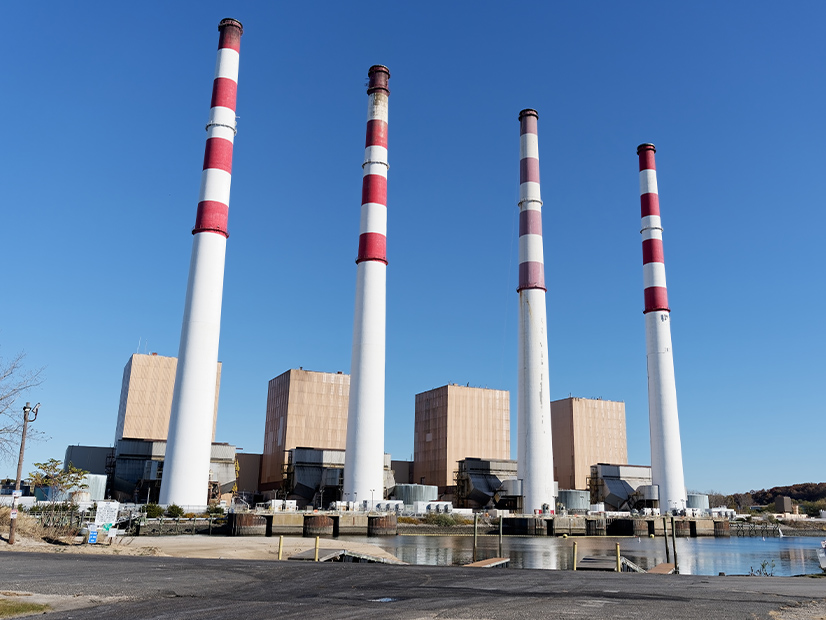
U.S. Secretary of Energy Chris Wright issued more emergency orders under Section 202(c) of the Federal Power Act to keep a pair of Indiana coal plants, F.B. Culley and R.M. Schahfer, running past their previously scheduled retirement at year’s end.
CenterPoint Energy owns the F.B. Culley generating station in Warrick County, Ind., which is made up of two coal-fired units — the 103.7-MW Unit 2 and the 265.2-MW Unit 3, said the order issued Dec. 23. Unit 2 was poised to retire in December 2025, and the order keeps it open until March 23, 2026.
Northern Indiana Public Service Co. (NIPSCO) owns the Schahfer plant, which is made up of two gas-fired units and two coal-fired units at 423.5 MW apiece, the latter of which were going to retire in December. The order keeps the plant open at least until March 23, 2026.
“The Trump administration remains committed to swiftly deploying all available tools and authorities to safeguard the reliability, affordability and security of the nation’s energy system,” Wright said in a statement. “Keeping these coal plants online has the potential to save lives and is just common sense. Americans deserve reliable power regardless of whether the wind is blowing or the sun is shining during extreme winter conditions.”
Both orders cite declining reserve margins in MISO as the reason for keeping the power plants running past their intended retirement dates. The most recent Organization of MISO States and MISO survey of resource adequacy shows a risk of falling short of planned reserve margins later this decade. (See MISO, OMS Report Stronger Possibility for Spare Capacity in Annual RA Survey.)
The orders also note that MISO is trying to address the situation, especially with its Expedited Resource Adequacy Study (ERAS) proposal, which FERC approved this summer. (See FERC Approves MISO Interconnection Queue Fast Lane.)
“The ERAS process should help expedite the construction of needed new capacity,” DOE said in the order. “However, resources studied under the ERAS will have commercial operation dates that are at least three years away and are provided an additional three-year grace period to commence commercial operations.”
Earthjustice called the latest two 202(c) orders a “power grab to override the decisions made in the interest of customers by power companies, grid operators and state utility regulators.”
“The plants at issue here were marked for retirement because coal is expensive and unreliable,” Earthjustice senior attorney Sameer Doshi said in a statement. “These aging power plants emit deadly air pollution, contaminate water with toxic metals, harm our climate and increasingly break down when we need them most — and the Trump administration is now asking ratepayers to pay more to keep burning coal. What’s more, the Federal Power Act should be applied based on its plain text. An event carefully planned for years is not an ‘emergency.’”
Citizens Action Coalition of Indiana Program Director Ben Inskeep said keeping the two coal plants running would add to affordability worries for the state’s ratepayers.
“The federal government’s order to force extremely expensive and unreliable coal units to stay open will result in higher bills for Hoosiers who are already reeling from record-high rate increases in 2025,” Inskeep said in a statement. “We can’t afford this costly and unfounded federal overreach.”
With support from the Trump administration and demand from data centers, 2025 and now 2026 are high times for the U.S. natural gas sector.
But the picture is not uniformly rosy: Large gas turbines are hard to come by and increasingly expensive, gas transmission pipelines are constrained in some regions, and rising LNG exports further weld the U.S. market to global price volatility.
Natural gas accounted for 43.4% of U.S. utility-scale generation in 2024, more than nuclear (18%) and renewables (17%) combined, according to the U.S. Energy Information Administration. Net generation from natural gas was 3.5% higher in 2024 than 2023, while renewables jumped 12.8% and nuclear held steady.
Renewable energy, particularly solar, is likely to carry this momentum well into President Donald Trump’s second term, despite his efforts to boost fossil fuels, but a large pipeline of natural gas projects awaits.
GE Vernova, which claims the title of world’s largest gas turbine manufacturer and supplier, said in early December it would end 2025 with a backlog of 80 GW of orders and manufacturing slot reservations — and need until the end of 2028 to fulfill it. The company has been raising its prices as well — CEO Scott Strazik said in October that a new combined-cycle gas plant now runs in the range of $2,500/kW of capacity.
Two large competitors, Siemens Energy and Mitsubishi Heavy Industries, report similarly strong order books.
“We continue to see high demand for gas turbines particularly in the U.S., where new electricity demand from the data center buildout and other factors are driving capital expenditures at our utility customers,” Mitsubishi CFO Hiroshi Nishio said in November.
Siemens Energy said in November it closed its 2025 fiscal year with a $162 billion backlog and with a 43% increase in transactions for its gas services division, which sold 194 gas turbines.
Natural gas-fired generation has had its ups and downs. It replaced coal as the dominant U.S. power generation fuel when advances in hydrofracking techniques made the nation the world’s leading natural gas producer.
Federal priorities quickly swung toward renewables under President Joe Biden, then swing back even more suddenly under President Donald Trump.
Natural gas-fired generation capacity will grow, Brattle Group principal Samuel Newell told RTO Insider. But that does not necessarily lock the U.S. into decades of use.
Samuel Newell | Brattle Group
“I think the next several years, the demand growth is such that the combination of using the existing gas-fired fleet more and new capacity, we’re going to be burning a lot more gas in the next several years,” he said. “But in the long run, if we go in a direction that does take climate change seriously, you’d have to increase non-emitting generation a lot, some combination of renewables and nuclear. [But] the gas-fired is still helpful to have there for reliability reasons.”
The larger problem is that load forecasts are increasing at a rate that outstrips the supply chain’s ability to produce new gas-fired generation, said Newell, who leads more than 50 electricity-focused consultants at Brattle.
“I think we’re in a position where it would really help to have everything,” he said, which is why he expects wind, solar and storage development to continue despite the policy shifts against wind and solar.
The political shifts are not the only influence on energy-sector strategies, but they can be hard to overlook.
Strazik said in December 2024 that GE Vernova had secured 9 GW of turbine manufacturing reservations just in the month after Election Day.
NextEra Energy in February 2023 boasted it was the word’s largest generator of renewable energy from the wind and sun. In January 2025, it emphasized that it had the nation’s largest natural gas fleet and recently had struck a framework agreement with GE Vernova to pair new gas generation with renewables and storage.
NextEra’s December 2025 investor presentation contains more than 200 references to “gas” and boasts of being the quintessential all-forms-of-energy company: Gas-fired generation, nuclear, electric transmission, gas pipelines, storage and renewables, in that order. The December 2023 investor presentation contains only 26 references to “gas,” and 16 of those were buried in the fine-print disclaimers at the end.
GE Vernova does not operate in this space — its offerings start at around 35 MW.
The company says its 35-MW LM2500 aeroderivative gas turbine will consume about 60% more fuel and emit 60% more carbon dioxide per megawatt hour generated than its 7HA.03 heavy duty combined-cycle gas turbine configured in a 2×1 block, while its 90-MW 7E simple-cycle gas turbine’s consumption and emissions are roughly 90% higher.
But a new 7HA.03 is taking about 24 months to reach commercial operation, compared with about six months for the 7E and about six weeks for the LM2500.
Strazik said in December 2025 that GE Vernova is not losing deals to competitors pitching small generation.
However, he said, there are projects that initially will rely on someone else’s reciprocating engine or other small generation as a bridge solution to eventual installation of his company’s heavy-duty turbines.
“But I don’t really cry in my beer over that because it’s enabling the heavy-duty to get done later,” Strazik said.
SPP Markets+ stakeholders have unanimously approved the first version of the day-ahead market’s protocols, providing a framework for market design, operations and settlements as its future participants build its systems and processes.
The grid operator said the protocols will provide additional guidance on how market rules are applied by translating policy requirements into operational procedures as stakeholders construct and implement Markets+ in its second phase.
“A big milestone for this group to be able to get that approved,” Arizona Public Service’s Kent Walter said during a Dec. 18 virtual meeting of the Markets+ Participant Executive Committee (MPEC). The committee’s vice chair, Walter led the meeting in Chair Laura Trolese’s absence.
MPEC and its working groups and task forces are well into the $150 million implementation effort to add a bundle of services that will centralize day-ahead and real-time unit commitment and dispatch. Markets+ offers Western entities an alternative to CAISO’s Extended Day-Ahead Market as the two grid operators develop regional markets where none existed before.
“What we’re contemplating here is a huge improvement over the status quo, but I’m hopeful that someday, we’ll get to the more optimal use of the transmission system,” Western Power Trading Forum Executive Director Scott Miller said. “I appreciate what SPP is doing. We believe that this is going to go relatively smoothly. … But for a lot of people, this is one of those areas where it’s like, ‘We’re going to watch to see how this operates.’”
Two working groups brought the draft protocols forward. The Markets+ Resource Advocacy Task Force incorporated four outstanding parking lot items into the protocols, including adjustments to the appropriate must-offer calculation for storage resources that are self-committed to charge.
The task force will spend 2026 working on two more parking lot items and addressing any new developments that emerge from the Western Power Pool’s Western Resource Adequacy Program. (See WRAP Wins Commitments from 16 Entities.)
The Markets+ Design Working Group (MDWG) added market transfer, balancing authority area constraints and violation relaxation limits to the protocols. They would optimize market flows between BAs, using an e-tag framework for source and sink that defines the system limits in optimizing each interval.
The work represents an “early alignment” between the MDWG and SPP staff ahead of the broader design buildout, said Xcel Energy’s Nick Detmer.
Jim Gonzalez, SPP’s senior director of seams and Western services, said the interface portion of the protocols gets into “some of the deep nuts and bolts of the technical implementation” of the approved tariff.
“Version 1 of the protocols generally covers all the business practices of the approved tariff language from [January 2025] … where we really need that starting point to fully appreciate as we move in through this implementation effort,” he said. “A lot of the structure is correct. It’s in place. It’s really not going to change what we’re talking about as all the extra work is really fine-tuning.”
The protocols now go to the Interim Markets+ Independent Panel, composed of three SPP board members, for its consideration Jan. 6.
PacifiCorp filed a partial motion to dismiss a complaint Amazon Data Services submitted to Oregon regulators alleging the utility had breached agreements to provide electric service to four data centers in its service territory.
Portland-based PacifiCorp filed the motion with the Oregon Public Utility Commission on Dec. 19, along with a nearly 40-page answer to the complaint contending the utility has “at all times … negotiated in good faith with ADS and diligently worked to discharge its obligations under the parties’ agreements.”
Amazon contended that, for the first campus, called Specialized, PacifiCorp has been “supplying significantly less power than promised,” while the second campus, Litespeed, has received no power.
For two other campuses, called Pivot and Gray, PacifiCorp has “refused to even complete its own standard contracting process,” Amazon alleged.
The company said it had exhausted “all reasonable efforts” to work with PacifiCorp to comply with the agreements and asked the PUC to either require the utility to provide the contracted volumes of power or shift the data centers into the territory of another utility willing to supply electricity — effectively shifting utility boundaries.
PacifiCorp’s partial motion for dismissal focuses on that latter request, arguing that, contrary to Amazon’s argument, there is no basis under Oregon law for the PUC to reallocate a service territory or electric customers “without the agreement of the affected utilities.”
“There is no legal basis for the commission to remove portions of PacifiCorp’s exclusive service territory so that the territory can be served by a different utility. Such a process is prohibited by the Territory Allocation Laws, which set forth the exclusive process for allocating and reallocating service territory and do not recognize the process ADS requests,” the utility argued.
‘Intervening Events’
PacifiCorp’s broader answer drills down into the specifics of Amazon’s complaint.
The utility said that under the terms of the master electric service and facilities improvements agreement (MESA) it entered with Amazon to serve Specialized, it paid nearly $100 million for transmission system upgrades and obtained transmission service from the Bonneville Power Administration, Umatilla Electric Cooperative and PacifiCorp Transmission.
PacifiCorp said it began serving the Specialized campus on a date that was redacted from the public version of the document and since that time has “provided all power required by ADS’ current operations” at the facility.
“Contrary to ADS’ allegations in the complaint, ADS has consistently requested PacifiCorp to deliver far less power than the amounts it is entitled to under the Specialized MESA. But if ADS were to increase its load to the full amount to which ADS is contractually entitled, PacifiCorp would be prepared to serve the full amount,” the utility wrote.
Regarding Litespeed, PacifiCorp wrote that, after “extended negotiations” with the property owner, it has acquired necessary easements for the “significant upgrades” required to power the facility and has begun their construction.
The utility said it has been supplying “bridging power” to the Litespeed site since a date also redacted from the document. It noted that Litespeed’s projected in-service date — also redacted — is later than the target completion date set out in the facility’s MESA, signed in 2023, but attributed the delay to “factors outside PacifiCorp’s control.”
“ADS has contributed to the delay by failing to timely complete required steps in the project construction and energization schedule, and the current projected in-service date is driven by the construction schedule for necessary upgrades that Portland General Electric is completing at one of its substations,” PacifiCorp added.
PacifiCorp said that meeting the full contracted future demand at Specialized and providing desired redundancy would require additional system upgrades, including building a new substation and 230-kV line — the cost estimates for which were redacted. The utility said it likely would incur similar costs to serve Pivot.
PacifiCorp argued that Amazon had failed to pay all “actual costs” required to serve Specialized and Litespeed, pointing to the company’s refusal to pay “gross-up” charges that reflect the amount of income tax the utility incurred from ADS’ financial contributions to construction.
“Cost responsibility for these upgrades is not discussed in the Specialized MESA because the upgrades were necessitated by intervening events and therefore were identified after the MESA was executed. However, ADS has been aware of the need for these upgrades since 2023, and PacifiCorp understood that ADS was willing to pay for these upgrades,” the utility said.
Among those intervening events was this year’s passage of Oregon House Bill 3546, which requires that utility contracts with data centers avoid shifting network upgrade costs to other retail electricity customers.
PacifiCorp said it and ADS recognized this past summer that negotiations over a contract to cover all four sites “had become protracted” but that ADS rejected the utility’s “last, best and final” offer that would be consistent with rules under HB 3546.
“While PacifiCorp remains ready and willing to serve all four data center campuses, it cannot agree to terms for electric service to ADS that contravene Oregon law or policy or otherwise shift costs or risks to PacifiCorp’s other customers,” the utility said.
Reached for comment on PacifiCorp’s answer, Amazon spokesperson Lisa Levandowski said the company has paid more than $100 million for PacifiCorp over the past four years “to build and upgrade its electrical infrastructure” to “ensure it can deliver the power we’ve agreed on for our data centers … without passing additional infrastructure costs to its other customers.”
“Despite these investments and our compliance with all commission-approved policies, PacifiCorp has delivered only a fraction of its contractual obligations, forcing us to file with the Oregon Public Utility Commission,” Levandowski said in an email.
Federal funding for MISO and SPP’s Joint Targeted Interconnection Queue (JTIQ) portfolio is still intact nearly three months after the U.S. Department of Energy said it was revoking its grant for the transmission projects.
“The federal grant for the JTIQ portfolio has not changed since the award was issued, and projects are proceeding as planned,” the Minnesota Department of Commerce said in a statement to RTO Insider.
The $464.5 million in federal funding for the $1.7 billion portfolio was among the 321 grants DOE said it was canceling in early October. (See DOE Terminates $7.56B in Energy Grants for Projects in Blue States.) The state Commerce Department led the application for federal funding with assistance from the Great Plains Institute.
When asked about the JTIQ funding status, MISO issued an identical statement to the Minnesota agency. Neither organization offered any details on the possible reconsideration of the projects by DOE, nor whether they were notified that the funding no longer was in jeopardy.
MISO said it is “not in a position to speak on the DOE’s processes.” CEO John Bear mentioned that JTIQ’s federal funding was restored at the RTO’s Board of Directors meeting Dec. 11.
DOE did not respond to RTO Insider’s request for comment on the JTIQ portfolio’s funding status.
MISO and Minnesota’s implication that the funds are not in doubt doesn’t quite square with congressional record.
Earlier in 2025, the chopping block appeared to be the most likely outcome for the $464.5 million from the department’s Grid Resilience and Innovation Partnerships (GRIP) program awarded to the JTIQ portfolio in 2023. While the department did not specifically name the portfolio in its announcement, it was on a list of projects slated for cancellation that was posted by Democrats on the House Appropriations Committee.
MISO, Minnesota and the Great Plains Institute have said they have never been formally notified that GRIP funding for the JTIQ projects is rescinded. However, regulators publicly appeared nervous about the status of the funding.
“I wish all the people who spent many thousands of hours on those projects strength in these trying times,” Wisconsin Public Service Commissioner Marcus Hawkins said at the Organization of MISO States’ annual meeting in October.
Brattle Group Praises JTIQ, Calls for More Interregional Transmission
Brattle Group Principal Johannes Pfeifenberger issued an appeal for more interregional transmission planning during the Midwestern Governors Association’s webinar on transmission benefits Dec. 15.
He praised the JTIQ portfolio in particular. By spending a couple of billion dollars, MISO and SPP “can create interconnection headroom more cheaply than in individual interconnection queues.”
“Doing something more proactive on both sides of the seams can really save some money,” he said.
Pfeifenberger said upgrade costs for generation developers under the JTIQ should be about half as expensive as the upgrades identified in MISO and SPP’s separate interconnection queues.
He also expressed hope that the 765-kV projects under MISO’s $22 billion long-range transmission portfolio eventually could be “interconnected into a macro grid.”
Overall, much remains to be done on the interregional front, Pfeifenberger said. He said RTOs’ interregional planning processes come last and that grid operators often will focus on local needs at the expense of more beneficial interregional links.
Pfeifenberger said spending on transmission has increased tenfold over the past 30 years, from $3 billion per year in the mid-1990s to $30 billion annually today. However, he said most of the investment is spent to refurbish local infrastructure.
“MISO is the exception,” Pfeifenberger said. But overall, he criticized transmission planning as “too siloed and reliability-focused.”
Pfeifenberger said the simulations RTOs use to plan transmission tend to underestimate the savings projects can deliver.
He said simulations use normal weather conditions that don’t test heat waves or cold snaps. He also said they don’t account for fuel price spikes or unusual generation or transmission outages.
Pfeifenberger said on Dec. 15, Henry Hub in the MISO footprint was trading at $5/MMBtu, up from the average $3/MMBtu, while gas in Boston was valued at $25/MMBtu. But if RTOs always experienced normal weather, outages and fuel prices, “we wouldn’t need half the grid we have.”
“Sometimes you have to spend money to save money,” he said.
MISO and SPP are considering a FERC filing to amend their joint operating agreement to be able to consider more types of benefits to justify future interregional transmission projects.
PHOENIX, Ariz. — Arizona Gov. Katie Hobbs and panelists discussed efforts to meet rising energy demand at a Western Governors’ Association workshop, with some noting opportunities and challenges navigating state-level permitting and regulation.
Hobbs delivered the keynote at the association’s two-day workshop — Energy Superabundance: Unlocking Prosperity in the West — Dec. 17. The governor said while innovation in chip manufacturing and artificial intelligence is “booming” in the U.S., more energy is needed to support those efforts.
Hobbs touted recent Arizona initiatives, including a $15.6 million investment for grid resiliency projects and an executive order to streamline energy development. She urged Western states to collaborate, saying, “The fact is that America’s energy future runs through Arizona and other Western states.
“We stand on the frontier of energy innovation and generation, and our collective power has the ability to support and promote American advancement for generations.”
In a separate panel on the relationship between energy and economic development, Jake Dubbs, lead adviser for external affairs and tribal relations at SPP, discussed increasing electricity demand and the need for regional cooperation to bring new generation online more quickly.
SPP projects “an increase of almost 35%” in electricity demand by 2030, according to Dubbs.
“The West requires so much attention, and it requires a lot of different groups coming together,” Dubbs said. “And I think that’s one thing that we are really working hard towards at SPP, making sure that all the different groups, unique perspectives, are coming together to talk.”
He said SPP’s RTO expansion and development of the day-ahead market, Markets+, are part of efforts to increase partnerships in the West and take advantage of the region’s resources. (See SPP Markets+ Cruising Through Early Development.)
Navigating state agencies remains a challenge for developers, said Ashley Bunch, manager of government relations and stakeholder engagement at BluEarth Renewables.
Some places, like Arizona, are easier to navigate because agencies are aligned and “understand what our goal is,” Bunch said. “And they really are all kind of working together.
“We sometimes see in other states that a game and fish department may not be as on board as, say, another state land entity, and it makes things … more difficult. … If the state agencies can come together and … put forth the guidelines very clearly … that would be very helpful to us. And I do think Arizona does a very good job of that.”
Long interconnection queues also pose obstacles to new generation, said Chris Pasterz, economic development director in Navajo County.
Developers and large energy users look for favorable governments “that have pathways for development,” Pasterz said. Expanding the use of private land is one part of the solution, he noted.
“That’s one thing that we’ve done in Navajo County to promote the private landowners’ utilization of their lands, their resources,” Pasterz said.
The agreements between private landowners and developers must ensure that local communities reap the benefits from new projects, he added.
Policymakers “can really help with that speed of development by finding your areas where there is a pathway for private land development,” Pasterz argued. “But also supporting those private elected officials who are negotiating those deals locally to make sure that those benefits are retained into the future for their community.”
The U.S. Department of Energy is exceeding its authority by using Federal Power Act Section 202(c) to keep the J.H. Campbell coal plant in Michigan running under several consecutive “emergency” orders, opponents argued in recent court filings with the D.C. Circuit Court of Appeals (25-1159).
By defining “emergency” beyond its spatial and temporal limits while continuously extending mandated operation, DOE is taking unprecedented power to control the U.S. generation mix, the attorneys general of Michigan, Illinois and Minnesota argued in a joint brief filed Dec. 19.
The law was meant to give DOE the authority to keep plants online amid war or similar emergency circumstances, like extreme weather.
“Historically, DOE has used that authority narrowly and sparingly,” the attorneys general said. “But here, DOE asserts that a 15-state region of the country is in an energy ‘emergency’ that, if upheld, would empower DOE to order any and all power plants in the region to operate for ‘years.’”
DOE ordered plant owner Consumers Energy and MISO to postpone Campbell’s retirement, originally scheduled for May 31. The states, joined by several environmentalist organizations, challenged the order in July. Since then, the department has issued an additional two orders keeping the plant running. (See related story, MISO: Retirement-delayed Campbell Coal Plant not a Capacity Resource.)
Earthjustice, the Environmental Defense Fund, Natural Resources Defense Council, Sierra Club and other organizations filed their own joint brief in the case making similar arguments.
“Section 202(c) places meaningful limits on the department’s discretion, permitting it to compel generation only where an ‘emergency exists’ — that is, to prevent an imminent, unexpected shortage of electricity,” they argued. “The Federal Power Act addresses long-term grid reliability elsewhere, in provisions that withhold federal authority to exercise command-and-control authority over the grid. The department therefore may not use Section 202(c) to address long-term grid reliability concerns.”
Section 202(c) gives DOE important and necessary authority to deal with actual, short-term emergencies on the grid, Earthjustice senior attorney Michael Lenoff said in an interview.
“They’ve expressly said that they are using 202(c) to address long-term issues,” Lenoff said. “And those long-term issues are not part of DOE’s authority. That’s the role of states and grid operators and FERC.”
The Forrestal Building in Washington, D.C., home of the U.S. Department of Energy | DOE
The industry has processes like reliability-must-run agreements and system support resources that can keep power plants running when shutting them down would lead to reliability violations, he said.
“You enter an RMR deal when there actually is a reliability reason that you need to address,” Lenoff said. “You don’t mischaracterize or misunderstand the evidence that props up a resource that’s not needed and that costs massive amounts of money to produce power.”
MISO had more than enough power to make it through peak demands this summer without the Campbell plant, he added.
While the case is focused on Campbell, DOE also has ordered the Eddystone plant in Pennsylvania online since the summer, and on Dec. 16, the department stopped the Centralia coal plant in Washington state from shutting down. (See related story, DOE Orders Retiring Wash. Coal Plants to Stay Online for Winter.)
Energy Secretary Chris Wright has said he would try to keep coal plants running, and with several other plants around the country to retire at the end of 2025, more orders could be coming, Lenoff said. Tri-State Generation & Transmission’s Craig Unit 1 is up for retirement at the end of the year, and the co-op has toldThe Colorado Sun it expects a 202(c) order. Lenoff said the Schahfer 17 and 18 coal plants in Indiana also could be the subject of future orders.
“All those are scheduled to retire pursuant to long-developed plans by utilities and state regulators and consumer advocates and a host of other stakeholders to ensure that consumers don’t pay more than what they need to pay to keep the lights on,” he said.
In the case of the Campbell plant, Consumers executed a state-approved plan to retire it and replace the capacity with newer resources that would increase available generation capacity, save ratepayers money and cut pollution, the attorneys general said in their brief.
“The agreement directed the Campbell retirement and the construction, procurement and extended operation of other major generating resources,” they added. “Those resources are now online and producing cleaner, lower-cost power. The net effect was to substantially increase the total generating resources available in the region.”
DOE used its 202(c) authority just 19 times between 1977 and 2024, mostly in response to extreme weather, and in each case at the request of a system operator, utility or both, the attorneys general said. The Campbell order proposes a transformative use of the law, which effectively displaces state law and FPA Sections 205 and 206, which FERC uses to regulate resource adequacy, they argued.
“Indeed, it defies logic that Congress would grant DOE general authority over which power plants may retire across the country — a function with profound implications for rates, state sovereignty and a broad array of stakeholder interests — without any obligation to assess the effect on ratepayers or seek public input,” they said.
The New York University School of Law’s Institute for Policy Integrity filed an amicus brief arguing that DOE exceeded its authority.
“The states, with support from FERC and regional grid operators, are primarily responsible for ensuring regional ‘resource adequacy,’ which is achieved when a region has enough energy supply to meet expected demand under various uncertain future conditions,” it said. “DOE is not the proper entity to independently identify a resource as essential for achieving resource adequacy, nor to impose its divergent determinations about resource adequacy on those who manage the grid.”
Using 202(c) to seize the role of resource adequacy monitor means DOE is usurping the role the FPA assigns to states, the institute argued.
ERCOT has proposed revisions to its large load interconnection process just days after a new rule established more rigorous criteria for connecting data centers, bitcoin miners and other power-hungry facilities to the grid.
A new framework is necessary because the new process already is outdated, ERCOT leaders told regulators during the Public Utility Commission of Texas’ Dec. 18 open meeting.
“The processes that we’ve historically used to connect large loads are not providing the clarity or the certainty that’s needed for developers, so we’ve made improvements to those processes,” ERCOT CEO Pablo Vegas told the commissioners. “Those changes, however, are already insufficient to manage the increases and the volume that we are seeing coming through … we think additional changes are needed.”
The ERCOT protocols define a “large load” as one or more facilities at a single site with an aggregate peak demand greater than or equal to 75 MW behind one or more common points of interconnection or service delivery points.
ERCOT had 63 GW of requests from large loads seeking interconnection at the end of 2024. It will go into 2026 with more than 233 GW in the queue, a staggering 269% increase. Data centers account for about 77% of that load.
“What we’re dealing with today is fairly unprecedented,” Vegas said.
The long-term solution is developing the infrastructure to serve the large loads, as Texas is doing. ERCOT, SPP and MISO have all approved extra-high voltage transmission projects of 500 or 765 kV, but those lines will not be completed until the 2030s. (See ERCOT Board Approves $9.4B 765-kV Project.)
Vegas said the current interconnection process “effectively studies the system” at a specific point in time. Within three to six months, an approved interconnection point may not be as suitable as once thought. Projects being pancaked in the same areas create a need to restudy and reconfirm the ability to serve the loads.
That introduces uncertainty and a lack of clarity as to where the customer is in the process, Vegas said.
“When you consider the size, the volume and the dollars that are being invested in these kinds of projects, it’s really an untenable process to continue with that approach,” he said.
Batch Process
To address the issue, ERCOT in February plans to roll out what it calls a batch process that will group together projects ready to be studied. That will establish transmission needs and capacity for the locked-in group of customers.
The first group, Batch 0, will create a foundation and baseline for subsequent batches, building on the assumptions that have changed from the previous group.
“There’s an interim period of time where we have to manage how to connect those large loads in a reliable way and do so expeditiously and in a way that optimizes the capacity that is on the grid today,” Vegas said. “There’s plenty of capacity for growth to connect, so we want to optimize bringing resources into that while the grid is upgraded and infrastructure is built.
ERCOT CEO Pablo Vegas (right) lays out for Texas regulators the proposed interconnection process for large loads. | AdminMonitor
“We think that a batch process would best serve and be able to support getting clarity and transparency to developers,” he said.
ERCOT has retained McKinsey & Co. to organize the work and coordinate communications between the grid operator and its stakeholders. Staff plan to talk to transmission service providers (TSPs) and large load customers first to understand their issues and concerns.
At the same time, subject matter experts will develop the framework for the batch study process. General Counsel Chad Seely said ERCOT will use the Large Load Working Group as a forum to “check in” and the member-led Technical Advisory Committee to provide any updates. He said staff will update the PUC during its January open meetings, bringing a proposal on the batch study framework to the commission in February.
“There’s clearly a pressure to move quickly and support the economic growth that’s coming our way,” Vegas said, emphasizing that input from affected stakeholders will be “critical to doing this accurately.”
The work will include modifying ERCOT’s existing large load interconnection processes. The grid operator on Dec. 15 introduced a number of changes to the interim process that has been in place since 2022 with a revision to the Planning Guide (PGRR115).
The PGRR applies time limits to ERCOT’s review of TSP interconnection studies and allows large load projects to be included in other customers’ studies. With the change, ERCOT can evaluate large load projects in a quarterly stability analysis. TSPs also are required to submit a load-commissioning plan establishing the schedule for energizing each phase of the load’s project and update the schedule as the facilities serving the load are identified and eventually constructed.
Vegas likened the process to a restaurant that doesn’t accept reservations but promises a table to customers for dinner at 7 p.m. However, before then, other customers come in and end up with the available tables.
“That’s effectively the way the transmission study process works today,” Vegas said.
“Maybe we’re just so popular now that we have to start having a reservation system,” Commissioner Courtney Hjaltman said.
Vegas said milestones need to be developed to hold capacity committed to the transmission system until a project is built because serious projects ready to develop will be queued up. When milestones aren’t met, a process will be needed to reclaim the transmission capacity for subsequent batches, he said.
‘Whatever the Kitchen Cooks up’
ERCOT plans to process several batches each year, with the entire process expected to last three to five years “until significant infrastructure gets built.”
The PUC has opened a docket in the proceeding (59142) to capture comments from stakeholders and serve as a document depository. Several large load entities wasted little time in filing comments.
Schaper Energy Consulting said ERCOT’s “abandonment” of PGRR115 and “sudden pivot” to an undefined batch study procedure “threatens to undermine transparency and discard stakeholder-approved protocols.”
“It could erase years of development progress. ERCOT’s unannounced reversal introduces severe regulatory risk and undermines the certainty essential for continued investment,” the company wrote. “An abrupt regulatory change without sufficient transparency or thorough stakeholder engagement is not aligned with the stable regulatory environment for which Texas has historically been recognized and risks eroding confidence in ERCOT.”
Referencing Vegas’ restaurant analogy, Schaper said the batch study process “defies the logic of their own metaphor.”
“It is akin to a manager handling a dinner rush by forcing eager patrons into the parking lot to wait for whatever the kitchen cooks up,” the company said.
Google and energy project developer Lancium filed joint comments warning that the PUC needs to maintain cohesion across its proceedings related to Senate Bill 6. The legislation was signed into law earlier in 2025 and requires the commission to determine a cost allocation for large loads to ensure they’re paying their fair share of infrastructure expenses. (See Texas PUC Releases Rulemakings for Large Loads.)
“Without cohesion across proceedings, Texas risks under-planning the system, misallocating financial commitments and slowing substantial economic development,” Google and Lancium said.
IESO has released proposed market rule and manual revisions to require synchrophasor data from storage resources, part of its effort to expand the use of phasor measurement units (PMUs).
The proposed market rules and manual revisions will require storage units rated at least 20 MVA, including aggregations, to provide their voltage and current phasor measurements and frequency for all three phases. The PMU requirements also apply to generators of 100 MVA and larger.
The ISO also proposes doubling the reporting rate to 60 samples per second for all resources.
IESO officials briefed stakeholders on the changes at a Dec. 18 engagement session.
PMUs “are becoming more important for monitoring the power system as it’s becoming more dynamic,” said Dame Jankuloski, lead power system engineer with IESO’s performance validation and modeling group. “We are seeing within various jurisdictions the utilization of such data for both offline and real-time applications. It also helps us to promote interconnection-wide monitoring by sharing PMU data … with our neighboring jurisdictions.”
Dame Jankuloski, IESO | IESO
Ontario’s traditional supervisory control and data acquisition (SCADA) uses data from grid-connected facilities every two to 10 seconds, but the data lack precise time stamps needed to evaluate system disturbances, such as the January 2019 event at a steam unit in Florida that caused oscillations across the Eastern Interconnection. (See Oscillation Event Points to Need for Better Diagnostics.)
NERC, which has published PMU guidelines, is expected to elevate them to a reliability standard in the future, Jankuloski said. “The changes that we are proposing here are positioning the ISO to be able to comply with those changes that could come in the future.”
The Novel Applications for Synchronized Power Instrumentation working group — formerly the North American Synchrophasor Initiative — is drafting a research paper to propose future NERC requirements for real-time stability monitoring using synchrophasor data, IESO said.
IESO has 54 PMUs monitoring 24 facilities: four gas-fired generators, 14 wind farms, one solar installation and five substations. It expects to increase that number to 240 PMUs at 111 facilities, including 30 inverter-based resources.
Feedback on the rule and manual changes is due Jan. 22. Technical Panel approval is expected by May, with an effective date targeted for December 2026.
Large loads classified as inverter-based resources are not included in the proposed rule changes but are expected to be subject to such requirements in the future.
IESO applications for such loads should include PMU-capable devices and associated infrastructure in their project design during the System Impact Assessment process.
The Texas Public Utility Commission has put out a proposed rule for public comment that would establish the fourth and final program under the $10 billion Texas Energy Fund.
The program would provide $1.8 billion in funding for qualifying entities to install and operate backup power equipment at hospitals, nursing homes and other facilities that support community health, safety and well-being. Staff’s proposed rules define a backup power package as a stand-alone, multiday backup power source for facilities without passing through a utility electric meter.
“Applications to this program could be in the thousands,” staff’s Rama Singh Rastogi told commissioners.
She said the program’s loans are structured as forgivable loans, with 100% forgiveness should the applicant comply with performance requirements. The program excludes sourcing power from electric school bus batteries until the PUC further studies their use and integration into the program.
Comments are due Jan. 30, 2026.
The commission also approved staff’s recommendation to approve more than $282 million in grants to six applicants for their 14 projects under the TEF’s Outside ERCOT program. The program offers grants for facility modernization, facility weatherization, reliability and resiliency, and vegetation management (58492).
Southwestern Public Service Co. is eligible for about half of the loans. It applied for $200 million in reliability and resiliency awards and was approved for $148.6 million, covering three projects. El Paso Electric was approved for $61.3 million in loans for two applications covering a variety of reliability projects.
The applicants still must pass a review by the PUC’s executive director before any funds are disbursed.