The Western Transmission Expansion Coalition plans to publish its 10-year outlook for Western transmission needs in February 2026 and has begun outlining the 20-year plan, according to Energy Strategies, which is developing the report.
The WestTEC effort, jointly facilitated by the Western Power Pool (WPP) and WECC, will address long-term interregional transmission needs across the Western Interconnection. The goal is to produce transmission portfolios for 10- and 20-year planning horizons. (See WestTEC Tx Study on Track Despite Delays.)
The 10-year outlook is slated for release in February 2026, pending approval from the WestTEC Steering Committee, said John Muhs, senior consultant with Energy Strategies, during a WestTEC Regional Engagement Committee meeting Dec. 11.
The 10-year report will include a six-page summary, a 20-page report and technical appendices with supplemental data and methodology, according to presentation slides.
“The study work itself is largely done pending approval,” Muhs said. “But the 20-year is further behind — it’s earlier on in the study process.”
The goal for the 20-year plan is to have a report in front of the WestTEC Steering Committee by September 2026, Muhs said.
The consulting firm has begun developing the 20-year reference case nodal models and hypothesis map. Energy Strategies is using the 10-year models as a starting point to develop the production cost model and system reliability assessment, according to the slides.
Energy and Environmental Economics (E3) will provide data on expected electricity demand by 2045, which Energy Strategies will use to develop area-level load profiles for the 20-year reference case with feedback from the WestTEC Assessment and Technical Taskforce (WATT).
Based on data from E3 and the 10-year outlook, Energy Strategies is mapping out how the transmission system could look in 20 years, according to the slides.
The main objective of WestTEC is to create an “actionable” transmission study by conducting integrated planning analysis across the Western Interconnection.
The study horizons focus on evaluating transmission requirements in 2035 and 2045, with the goal of prioritizing “flexible and scalable transmission solutions for nearer-term needs to help better position the system for efficient long-run expansion,” the study plan reads.
The effort has support from stakeholders across the Western region. For example, WATT members include representatives from the Bonneville Power Administration, Western Area Power Administration, Powerex, Northwest Power and Conservation Council, and more.
In June, CAISO cited WestTEC as one of the factors influencing its interregional transmission planning, saying it will use the information to help identify opportunities it will emphasize, either by itself or in collaboration with other entities. (See Inland Wind, WestTEC to Guide CAISO Interregional Planning.)
Energy Strategies will present “a much more finalized version and set of results” of the 20-year outlook during WPP’s all-committee meeting in January, Muhs said.
ERCOT’s Board of Directors has approved staff’s proposed 765-kV Eastern Backbone project and its $9.4 billion capital cost price tag, making it the most expensive project in the grid operator’s history.
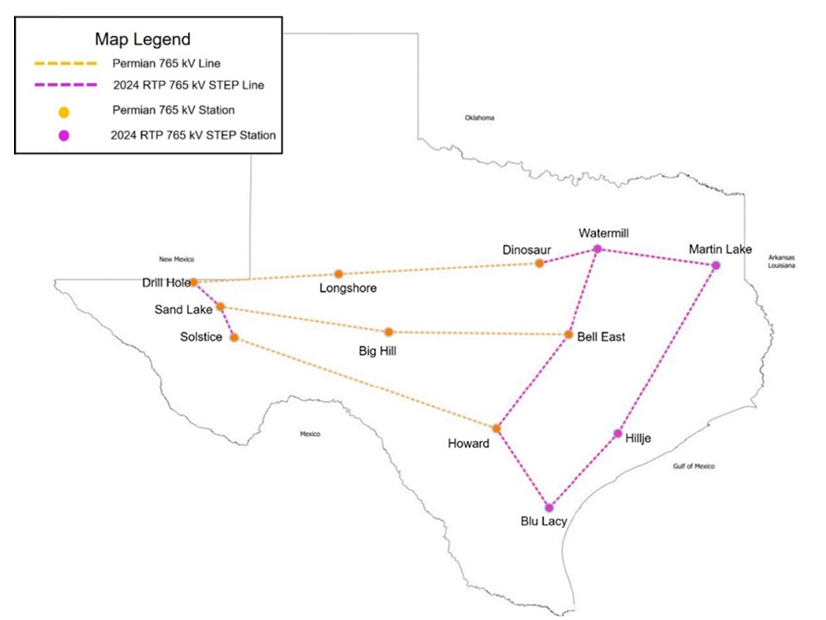
The 1,100-mile project, a subset of the 2024 765-kV Strategic Transmission Expansion Plan (STEP), will address Texas’ significant load growth and reliability needs, ERCOT said. Much of that demand is driven by more than 233 GW of interconnection requests by data centers, cryptocurrency miners and other large loads, and the electrification of the state’s oil and gas industry.
“We see the need for this infrastructure to be able to reliably serve the future demand on the system,” Kristi Hobbs, vice president of system planning and weatherization, told the board during its Dec. 8-9 meeting.
Incumbent transmission providers American Electric Power — an industry leader in building and operating 765-kV lines since the 1960s — CenterPoint Energy, CPS Energy and Oncor will build the project’s seven segments of extra-high-voltage transmission lines, four 765-kV substations, 11 765/345-kV transformers, and 69 765- or 345-kV circuit breakers.
Hobbs said recent transmission plans have indicated a need to incorporate 765-kV facilities in meeting staggering demand increases.
“We realized we cannot keep planning the system the way we always had,” she said.
The new approach won’t come cheaply. ERCOT’s 2024 345-kV Regional Transmission Plan and the 765-kV STEP both expect about $5 billion per year of investment over a six-year planning horizon. Staff say a 765-kV network will enable power to flow more efficiently through long-distance transmission to urban load centers.
Hobbs and Thomas Gleeson, chair of the Texas Public Utility Commission, assured questioning board members that their respective staffs have a firm grip on escalating costs. ERCOT used a 20% adder for mileage estimates to account for right-of-way issues, Hobbs said.
Gleeson told the board he joined the PUC as staff during the Competitive Renewable Energy Zone process, which was completed in 2014 at a cost of $6.9 billion, $2 billion over projections. However, the project resulted in 3,600 miles of 345-kV CREZ lines that freed up over 23 GW of wind capacity in West Texas.
ERCOT’s Eastern Backbone project and EHV paths into the Permian Basin | ERCOT
“I’m very aware of the public’s desire to know cost overruns if the schedule slips,” he said. “I think it’s important, given the magnitude of this and the cost, that we are transparent about any cost overruns and slips in schedules. We will do everything we can at the commission to make sure that that information is public so that everyone from the governor to the legislature to the public at large knows what’s going on with this project.”
The board approved two other transmission projects with a combined cost of $852.8 million, pushing the total estimated value of endorsed infrastructure to $10.3 billion:
Oncor and AEP’s proposed 104-mile, single-circuit 765-kV project in West Texas that closes the western end of ERCOT’s EHV backbone. The Drill Hole-Solstice project has a projected capital price tag of $742.2 million.
Oncor upgrades to a 345/138-kV switch and 9 miles of 138-kV line, and 13 new miles of 345-kV lines in far West Texas. The project has an estimated capital cost of $110.6 million and completion date in December 2026.
All three projects will require construction permits from the PUC.
Vegas Sets Lofty Goal
CEO Pablo Vegas told the board that ERCOT has updated its vision, mission and core values that see the grid operator as the “most reliable and innovative grid in the world.”
“Not just in Texas, not just in the United States, but in the world,” he said. “We are one [of the best], if not the leading, grids globally when it comes to operational and technical complexities. To be successful, we need to be a clear leader on a stage that represents the entirety of this planet.”
The vision builds on the ERCOT 4.0 construct that Vegas unveiled earlier in 2025. At the time, he said ERCOT 4.0 was a “strategic lens to look at the priorities and the initiatives that we’re going to be investing in to make sure that we continue to deliver on our mission, which is getting more complex and more dynamic every year.” (See ERCOT Board of Directors Briefs: June 23-24, 2025.)
“It represents a transition in our market that is characterized by high and very rapid growth of intermittent and short-duration supply resources,” Vegas told the board Dec. 9. “It’s characterized by a rapidly changing customer base that includes price-responsive loads like cryptominers, rapidly growing large-scale data centers and continued penetration of distributed energy resources. … It represents an opportunity to create a more resilient and cost-effective grid.
“To achieve this vision, we will ensure a reliable grid with competitive and cost-effective electricity markets,” he added.
NPRR1309 and its associated Nodal Operating Guide revision (NOGRR283) address stakeholder feedback that DRRS procurements be co-optimized with obtaining energy and other ancillary services. The protocol change is the third iteration of DRRS’ design, which began development in 2023 as a subset on non-spinning reserve service. The PUC has set DRRS as a key commission priority.
In designating DRRS as a board priority, the directors also ordered TAC to bring the measures, structured to meet statutory requirements, to the June board meeting for consideration.
ERCOT has withdrawn NPRR1235, which would have developed DRRS as a standalone ancillary service.
The IBR measures granted priority status were NPRR1308 and its associated change to the Nodal Operating Guide, NOGRR282.
NPRR 1308 defines a large electronic load (LEL) as exceeding 75 MW, in which 50% or more of the site’s demand is computational load from a data center or cryptomining facility. NOGRR282 establishes frequency and voltage ride-through requirements for LELs.
Staff said the inability of LELs to ride through disturbances on the grid poses a growing reliability risk for ERCOT. They have identified 26 LEL ride-through events since the beginning of 2023. ERCOT says it is determining whether additional ride-through requirements are needed for other large loads.
ERCOT says the draft’s release will help improve the final product’s quality and strengthen the transparency of the data and associated processing steps. Staff have added additional scenarios that look at the effects of assumptions based off new rules for large-load curtailment and projects approved for Texas Energy Fund loans.
“Getting input from the stakeholders throughout the process has been beneficial,” Hobbs said.
The CDR gives a five-year look ahead at generation that has met certain requirements for connecting to the grid in the future. It also includes forecast demand received from utilities.
The report predicts a summer peak load hour of 138 GW and a net peak load hour of 126 GW in 2030. (Net peak load subtracts renewable energy generation.) It also forecasts 60 GW of additional generation by the summer of 2030, with solar and storage accounting for 86% (52.3 GW) of that total.
Real-time Price Correction
The board approved another real-time market price correction with more than $812,000 in impact, representing almost 4% of settlements for the Oct. 14 operating day.
Staff said a software issue led to an “inappropriate” effect on generation dispatch values. The issue was not discovered within the two-business-day deadline, meeting the criteria for a board-approved correction. ERCOT said the software bug’s cause has been identified and a fix deployed.
The board also rubber-stamped three staff recommendations to approve requests from market participants:
BHER Power Resources’ bid for a permanent site-specific exemption from complying with metering protocols by placing it on the combination ballot. The company said its Falcon Seaboard facility in Big Spring was built in such a way that it can’t meet a 500-kW maximum load limit requirement for auxiliary distribution factors. The facility has operated for 35 years.
Lamar Electric Cooperative’s request to transfer about 60 MW of peak load from the Rayburn Country Electric Cooperative load zone to the competitive North LZ. The transfer will go into effect January 2030.
The committee will welcome three new members, including AEP’s Erin Rasmussen, who replaces long-time TAC member Richard Ross. The other new members are CenterPoint Energy’s Ebby John and Garland Power & Light’s Curtis Campo.
The directors also approved 11 NPRRs, two NOGRRs, a Planning Guide revision (PGRR) and a system change request (SCR):
NPRR1263: remove the accuracy testing requirements for coupling capacitor voltage transformers.
NPRR1274: update the estimated capital cost for the tier-classification rules used in the Regional Planning Group (RPG).
NPRR1280: establish an RPG review process for proposals to permanently bypass an existing series capacitor or un-bypass a series capacitor previously designated as permanently bypassed.
NPRR1285: expand the current reliability unit commitment opt-out window to incent self-commitment, increasing capacity available to the market at lower expense and reducing RUCs and associated costs.
NPRR1287: replace the defined term “Maximum Daily Resource Planned Outage Capacity” with “Resource Planned Outage Limit” (RPOL) to align with the actual calculated RPOL; add the maximum duration of a proposed transmission outage with a described lead time to align with current outage-coordination practices; define conditions under which ERCOT can accept an outage request if it could exceed the planned outage limit; and clarify that energy storage resources submit outages.
NPRR1293: clarify the “Update Network Operations Model Production Environment’s” milestone dates.
NPRR1294: incorporate the other binding document “Demand Response Data Definitions and Technical Specifications” into the protocols, standardizing the approval process.
NPRR1298: require comments on proposed rule changes to be delivered to ERCOT within 14 days of the revision request’s posting. Comments posted after the 14-day comment period can be considered at the Protocol Revision Subcommittee’s discretion.
NPRR1299: clarify and clean up language related to the emergency response service program, including a data file produced at the end of the procurement process using code managed entirely within ERCOT’s Demand Integration group. The file is manually produced and must be posted manually, which is affected by weekends and holidays.
NPRR1300: implement Senate Bill 1877 by including the Texas Office of Public Utility Counsel as an entity permitted to receive protected information or ERCOT critical energy infrastructure information without violating the protocols.
NPRR1303: revise language to change the method for submitting and receiving declaration of natural gas pipeline coordination from a physical form to an electronic format.
NOGRR279: modify the monitoring equipment installation deadlines established by NOGRR255 (High Resolution Data Requirements) to Jan. 1, 2029, consistent with NERC standard PRC-028-01 (Disturbance Monitoring and Reporting Requirements for Inverter-Based Resources), and clarify that synchronized resources with standard generation interconnection agreements executed prior to July 25, 2024, have 12 months after their commercial operations date to comply with the new equipment standards.
NOGRR280: remove language governing communication path requirements for CREZ circuits and stations.
PGRR131: implement mandatory reporting requirements for transmission service providers’ and ERCOT’s interconnection-cost reporting, and delete gray-box language superseded by the requirements.
SCR831: modify the network model management system, operational data management system, topology processor and the modeling-on-demand system to incorporate short-circuit modeling data for maintaining models built by the System Protection Working Group.
When the Western Area Power Administration decided to reconductor a transmission line in North Dakota, it made “perfect sense on paper,” according to WAPA’s former CEO.
But the switch from a 230-kV line to a 345-kV line equipped with the latest technology had cascading impacts, Mark Gabriel told the Colorado Public Utilities Commission on Dec. 11.
“The reality was a number of the downstream small co-ops and municipal entities were negatively impacted, because it required changing out transformers, changing out reclosers and reconfiguring the system moving down,” said Gabriel, who now is CEO of Colorado electric cooperative United Power.
The upgrade ended up costing those entities hundreds of thousands of dollars, he added.
Gabriel was one of several speakers at a PUC informational meeting on reconductoring. The presentations were organized by the Colorado Electric Transmission Authority (CETA).
Reconductoring involves replacing the wires between existing transmission towers, leaving those structures in place. It’s typically faster and cheaper than new construction or a rebuild, the speakers said. Because existing right-of-way is used, environmental hurdles and permitting challenges may be reduced.
An Idaho National Laboratory (INL) report found that reconductoring with advanced conductors can double the capacity of existing lines at a cost about one-third that of building new lines. Advanced conductors use modern materials to withstand the high temperatures of heavy loads while managing sag. Power flow can be increased.
The INL study found that 118,821 miles of existing transmission lines — out of around 600,000 miles of transmission across the U.S. — would benefit from reconductoring with advanced conductors.
Reconductoring Pitfalls
Reconductoring is getting the attention of state lawmakers, including those in California. Gov. Gavin Newsom in 2024 signed Senate Bill 1006, which requires utilities to study the feasibility of using advanced reconductoring and other grid-enhancing technologies. They must submit reports to CAISO, which will review the findings as part of its annual transmission planning. (See California GETs Bill Gets Newsom’s Signature.)
Still, there are situations where reconductoring may not be the best option, such as when transmission structures need replacing.
“If you’ve got 70-year-old wooden poles in a fire-prone area, [it] might not be the best opportunity to go back and put up new conductor on top of those,” said Joe Coffey, vice president of transmission at Prysmian, a conductor manufacturer. Coffey worked on the INL reconductoring report.
Coffey noted that reconductoring wouldn’t necessarily remove bottlenecks at substations or other places on the grid.
Gabriel of United Power said reconductoring isn’t the only solution. He pointed to other grid-enhancing technologies such as dynamic thermal circuit rating. The technology, also known as dynamic line rating, adjusts a transmission line’s rating based on local conditions rather than using static rating assumptions, potentially boosting the line’s capacity.
“Reconductoring is … a great alternative in some situations,” Tom Green, director at Energy Strategies, told the PUC. “There are limits to what that can do.”
Reconductoring might not remove the need for new transmission that’s necessary for resilience, Green noted.
Meeting Transmission Needs
Green worked on a report for CETA titled “Transmission Capacity Expansion Study for Colorado.” The study found that planned transmission wouldn’t be sufficient to accommodate the 15 GW of renewable energy that Colorado needs to achieve its clean energy goals. More than $4.5 billion in new transmission investment is needed over the next 20 years.
Increasing the capacity of existing lines through reconductoring projects accounted for nearly 80% of the line miles identified in the study but only 28% of the cost.
“The benefits of reconductoring seem pretty straightforward and common-sensical,” CETA Executive Director Maury Galbraith said during the PUC meeting.
Galbraith said CETA is talking with transmission developers about potential partnerships. He’s interested to see if there’s a role for CETA to play in reconductoring.
CETA can issue revenue bonds to help finance transmission construction. The authority will host a study session on Jan. 7 to review findings of a whitepaper on the strategic use of public financing to accelerate transmission development.
CAISO continues to work to revise the rules around how congestion revenues will be allocated to participants in the ISO’s Extended Day-Ahead Market, which will be launched in spring 2026.
The ISO published a proposed set of design principles that would help eliminate or reduce self-schedule incentives in its approved congestion revenue allocation design. Self-scheduling incentives could lead to significant unintended cost shifts, experts cautioned earlier in 2025.
CAISO early in 2025 prioritized EDAM congestion revenue allocation, specifically under parallel — or loop — flows, after Powerex published a paper contending the EDAM model contained a “design flaw” with potentially $1 billion in unjustifiable charges at stake. (See Powerex Paper Sparks Dispute over EDAM ‘Design Flaw’.)
But the approved design stoked concerns among some stakeholders, and CAISO decided to make the design “transitional” for EDAM’s opening in May 2026.
“[The initial design] is transitional to allow us room to further additional enhancements in this second phase, as well as evaluating a more long-term design,” said Milos Bosanac, CAISO regional markets manager, at a Dec. 11 workshop on the subject.
The initial design creates incentives for energy resources to self-schedule in order to receive the congestion rebate, CAISO’s Market Surveillance Committee said in a June letter. Other RTOs/ISOs use financial rights designs to hedge congestion to avoid similar self-scheduling and below-cost bidding incentives, they said.
The MSC cautioned that self-scheduling incentives potentially reduce the benefits of coordinating unit commitment and dispatch across multiple balancing areas that EDAM is intended to provide and could cause cost shifting among participants.
“The potential negative consequences we describe may not be material, particularly in year one given the limited scope of EDAM, but we have not seen enough empirical evidence for us to conclude that this will definitely be the case,” the MSC said. “We recommend that the CAISO seek to transition to financial congestion hedges for future years. How material these self-scheduling incentives and impacts will be during near-term year one EDAM operations with PacifiCorp is uncertain.”
CAISO then started “Phase 2” of its effort to improve the design of congestion revenue allocations.
Phase 2 will study two primary issues: how to eliminate or reduce self-schedule incentives and how to ensure symmetry in allocation of parallel flow congestion revenues for CAISO balancing areas.
ISO staff presented the new design principles at a Dec. 11 stakeholder workshop and they state that:
Congestion revenues should be allocated in an equitable manner to avoid undue cost shifts.
A revised design should support the ability of transmission customers with firm transmission rights or congestion revenue rights (CRRs) to manage and hedge congestion risk exposure considering grid conditions and feasibility of flow.
A revised design should support continued administration of CRRs in the CAISO balancing area and continued sale of OATT transmission rights.
The proposed design principles “provide a starting point for consideration but certainly won’t be the universe of design [principles] we will consider,” Bosanac said.
The revised design also should provide a comparable allocation method for the CAISO balancing area with a CRR construct and for EDAM balancing areas that sell firm OATT transmission, CAISO said. Doing so should enable symmetry in allocation between CAISO and EDAM balancing areas.
CAISO requested stakeholder comments on the design principles by Jan. 16. The ISO plans to present a full proposal for approval in the fourth quarter of 2026.
PJM staff plan to recommend an $11.6 billion package of transmission projects intended to address rising load growth in the east of the RTO’s footprint.
PJM Director of Transmission Planning Sami Abdulsalam said the first window of the 2025 Regional Transmission Expansion Plan is one of the largest iterations of the planning process the RTO has undertaken, if not the largest. It includes constructing a greenfield 765-kV corridor from West Virginia to central Pennsylvania; an HVDC line in Virginia from Brunswick County to Loudoun County; and upgrades to the 765- and 345-kV networks around Columbus, Ohio. (See PJM Presents Shortlist of RTEP Projects.)
The need is being driven by 8 to 12 GW of load growth expected in the PPL and Mid-Atlantic Area Council (MAAC) regions, along with the risk of capacity resource deactivations and significant delays in offshore wind development, Abdulsalam said.
The window was broken into three clusters — west, MAAC and south — as well as $2.3 billion of in-zone projects and $18.5 million in short-circuit upgrades. Independent cost estimates procured by PJM put the total for the clusters, without the in-zone projects, at $10.2 billion.
Additional upgrades could be required along the 765-kV corridor between PJM’s northwestern region and the AEP zone, depending on how generation planned in ComEd and the northwest is constructed.
A set of seven-year scenarios was included in the analysis to properly size the projects to be able to address long-term needs and offer expandability.
Southern Cluster
The southern cluster of projects includes a new 185-mile undergrounded HVDC line between converter stations to be constructed at the Heritage and Mosby substations. It also includes a new 500-kV line between the existing Elmont substation and planned Kraken substation, and rebuilding several 500-kV lines across Dominion Energy’s territory. The package was proposed by Dominion at a $4.8 billion cost, with an independent estimate at just over $5 billion.
The cluster is intended to improve transfer capacity from the southern region of PJM up to Data Center Alley in Northern Virginia, around Dulles Airport.
Several Virginia and Maryland ratepayers spoke in support of the HVDC project on the basis that the subterranean cables would minimize disturbance to surrounding residents compared to the overhead 765-kV alternatives.
Abdulsalam said there are technical benefits to HVDC as well, as the Dominion proposal offers between 500 MW and 1 GW of additional transfer capability over the AC options, and it would not contribute to short-circuit issues that have been growing in Dominion.
The runner-up in PJM’s analysis was a $2.9 billion Transource Energy project to construct a pair of 765-kV lines, one from Heritage to Vontay and the other between Joshua Falls and Morrisville.
Western Cluster
Load growth in Columbus and to its west contributed to thermal overloads and voltage issues across the region. About 1.7 GW are expected to be added between 2029 and 2030, followed by an additional 3 GW in the subsequent two years.
PJM determined a $2.8 billion Transource and FirstEnergy Transmission project to construct several 765-kV lines around the city is the technically superior option and has an independent cost estimate $600 million lower than a joint NextEra Energy and Exelon proposal the RTO evaluated.
The package includes a 765-kV line spanning 172 miles between the Greentown and Marysville substations, with a new 765-kV substation named Teddy to be built around 35 miles west of Marysville. A 32-mile 765-kV line would be built to connect the expanded Conesville substation to the Guernsey facility, and a 38-mile 765-kV line would link the Adkins substation to West Millersport, which also would be expanded. Conesville and West Millersport would be connected with a new 49.1-mile 765-kV line.
MAAC Cluster
The need in MAAC is driven by about 5 GW of additional load growth identified in the 2025 Load Forecast expected by 2030 and delays in the development of 7.5 GW of offshore wind in New Jersey. Staff selected a $1.7 billion NextEra/Exelon proposal to construct a 222-mile, 765-kV line from the Kammer substation in West Virginia to Juniata in Pennsylvania. Two 765/500-kV substations would be built along the line: Buttermilk Falls would be 114 miles east of Kammer and loop into the 500-kV Keystone-Conemaugh line, and Mountain Stone would be constructed near Juniata.
Several stakeholders questioned whether PJM’s medium-high assessment of the land acquisition and right-of-way risks for the proposal are overly optimistic given the amount of greenfield development needed to construct the line.
Abdulsalam said almost half of the route proposed by FirstEnergy overlaps with the NextEra/Exelon corridor, demonstrating that three entities looked at the needs and determined the ideal solution is to use the corridor. The joint proposal offers the greatest transfer capability of all the packages in the cluster.
Below is a summary of the agenda items scheduled to be brought to a vote at the PJM Markets and Reliability Committee and Members Committee meetings Dec. 17. Each item is listed by agenda number, description and projected time of discussion, followed by a summary of the issue and links to prior coverage in RTO Insider.
RTO Insider will cover the discussions and votes.
Markets and Reliability Committee
Consent Agenda (9:05-9:10)
As part of its consent agenda, the committee will be asked to:
B. Endorse proposed revisions to Manual 14B: PJM Region Transmission Planning Process drafted through its periodic review. The changes would allow transmission owners to choose having the ambient ratings for their lines modeled at 59 or 60 degrees Fahrenheit in the light-load case used in the Regional Transmission Expansion Plan. References to phase angle regulators were added throughout the document when referencing phase-shifting transformers to improve consistency. (See “Planning Manual Revisions Endorsed,” PJM Stakeholders Endorse Manual Revisions for Modeling DERs.)
C. Endorse proposed revisions to Manual 14D: Generation Operational Requirements proposed as part of its periodic review. The language would require generation owners to notify PJM of any issues that may affect their units’ ability to start during a cold weather advisory and add detail to the cold weather operating limit data requests and cold weather advisory drill. (See “Manual 14D Revisions Endorsed,” PJM Monitor Presents Spin Event Performance.)
D. Endorse proposed revisions to Manual 14D to rework the rules for generation owners seeking to deactivate units. The FERC-approved changes would require a one-year notice before a resource can be retired and increase the amount of information publicly posted, including the reliability-must-run revenue allocation zonal rate for areas assigned part of the cost associated with agreements to keep units online past their desired deactivation date (ER25-1501). The deactivation avoidable cost credit would be tweaked to remove a $2 million limit on project investments, limit the yearly adder on investments to 10% and remove the trigger causing the daily deficiency rate to be used in lieu of the deactivation avoidable cost rate. (See “Stakeholders Endorse Changes to Generator Deactivation Requirements,” PJM MRC/MC Briefs: Jan. 23, 2025.)
E. Endorse proposed revisions to Manual 19: Load Forecasting and Analysis drafted through the document’s periodic review. The language would reflect the forecast horizon being extended from 15 years to 20 and correct printing issues with formulas included in the manual.
F. Endorse proposed revisions to Manual 18: PJM Capacity Market, Manual 20A: Resource Adequacy Analysis and Manual 21B: PJM Rules and Procedures for Determination of Generating Capability to conform with FERC Order 2222 and detail how distributed energy resources will participate in the 2028/29 Base Residual Auction. The language would eliminate the availability window for demand response and rework the calculation of the winter peak load for participants to be determined at the system’s coincident peak, rather than individual participants’ peaks. (See PJM Stakeholders Endorse Manual Revisions for Modeling DERs.)
B. The Energy Co-op Executive Director Divya Desai will present proposed amendments to the proposal to revise how the minimum tangible net worth would be calculated under the main motion.
The committee will be asked to endorse the proposed solution and corresponding tariff revisions.
As part of its consent agenda, the committee will be asked to:
C. Endorse and approve proposed revisions to the tariff, Reliability Assurance Agreement and Operating Agreement drafted by the Governing Document Enhancement and Clarification Subcommittee.
Endorsements (10:35-10:45)
1. Elections (10:35-10:45)
PJM’s Michele Greening will review the proposed sector representatives to serve on the Finance Committee in 2026, as well as sector whips and the MC’s vice chair for the year. The committee will be asked to elect the proposed representatives.
A new report estimates that solar and battery storage growth in New England between 2025 and 2030 could reduce wholesale energy costs across the region by about $684 million annually by 2030.
The analysis, written by Synapse Energy Economics for the Solar Energy Industries Association, makes the case that continued policy support for solar and storage is part of the solution to the region’s energy affordability challenges.
The authors evaluated the wholesale energy market impacts of adding solar and storage resources between 2025 and 2030 at a pace consistent with meeting Massachusetts’ clean energy plans.
Massachusetts consumers would receive $313 million of the savings, the report notes. The added energy supply accounts for about 80% of the estimated savings, while demand reductions accounted for about 20%, the authors wrote.
The increased solar and storage capacity would displace the need for about a quarter of the state’s electric-sector gas demand and provide annual carbon reductions of about 1.6 million metric tons in 2030, the authors wrote, adding that the gas savings could help avoid costly investments in new gas pipeline infrastructure.
“Electricity demand is rising across the country, driven by the expansion of data centers, electric vehicles and heat pumps,” the authors wrote. “Relying on gas to meet this rising demand is risky: Gas prices are volatile, and building new pipeline infrastructure is expensive and unpopular. Solar, increasingly paired with battery energy storage, is fast to deploy and part of a solution to maintain grid reliability and energy independence in Massachusetts.”
The authors wrote that the solar and storage growth will help winter grid reliability by providing additional supply and helping to flatten peak demand. They estimated that about 44% of the savings would occur in the winter months between November and March, adding that “many of these savings are realized during the highest-load winter hours, when reliability risk is the greatest.”
Report co-author Selma Sharaf, a Synapse associate, said the analysis helps to refute a “common misconception” that solar and storage resources do not provide benefits during the winter.
Synapse’s modeling estimated that, “in the top 50% of winter hours ranked by load in 2030, solar and storage serve 11% of demand.”
Co-author Patrick Knight, senior principal at Synapse, emphasized that the energy market cost savings would benefit all electricity consumers throughout the region, not just those that directly deploy behind-the-meter solar or storage.
He noted the analysis largely was focused on energy market impacts and does not provide a full cost-benefit analysis of solar and storage development. It does not consider costs associated with public benefit charges, capacity, ancillary services, transmission and distribution, or public health.
The study comes amid a period of heightened political attention around energy affordability, which has brought tension around the future of state clean energy incentives and programs.
In November, Massachusetts Rep. Mark Cusack (D), co-chair of the Joint Committee on Telecommunications, Utilities and Energy (TUE), introduced a wide-ranging bill that would give the state legal cover for missing its 2030 climate goals; scale back the state’s Renewable Portfolio Standard; and prohibit state agencies from creating any new climate regulations or programs deemed to have “unreasonable adverse impacts” on energy costs. (See Top Mass. House Members Seeking Major Rollback of Climate Laws.)
The proposed legislation, which was supported by the House members of the TUE Committee, faced major pushback from clean energy advocates and grassroots groups, causing House lawmakers to delay further votes on the bill.
Negotiations are poised to resume in 2026, though the legislation has a long way to go before becoming law. Gov. Maura Healey (D) has filed her own energy affordability bill, and Senate lawmakers likely will move forward with their version of an affordability bill at some point in the new year. (See Stakeholders Mixed on Massachusetts Energy Affordability Bill.)
The press release from the Synapse report notably included a statement from Cusack, who said the analysis demonstrates that “solar and energy storage are incredible levers that the commonwealth can pull to deliver utility bill savings, winter reliability and climate benefits to the state’s residents.”
Clean energy advocates have expressed support for select aspects of Cusack’s legislation, including provisions that would give the state greater clean energy procurement authority, raise the municipal cap on solar net-metering and lower barriers to surplus interconnection service.
“To help realize these benefits, we are prioritizing legislation this session that will eliminate barriers blocking these cost-competitive resources,” Cusack said. “We look forward to collaborating with our state government, clean energy industry and environmental partners to pass meaningful legislation.”
INDIANAPOLIS — MISO has trimmed its annual budget and is now expecting to spend a little less than $431 million in 2026, down from almost $450 million.
MISO’s $430.7 million budget includes $394.7 million dedicated to its base operating expenses and $36 million reserved for project investments. The RTO said the spending increase is driven by employee-related increases and technological improvements.
At MISO’s Dec. 11 board meeting, CEO John Bear said the RTO was able to scrape together a $15 million permanent savings in the budget. (See MISO Requests Nearly $450M Budget for 2026.)
“We know it’s your money, and we respect that,” Board of Directors Chair Todd Raba told stakeholders, adding that MISO has implemented some “pretty good cost control” measures in 2025.
CFO Melissa Brown said MISO was able to lower its budget by trimming some outside services from its base operating expenses and cut $9 million from its project investments by taking on some work internally and extending the design and planning phase of some projects to delay spending on implementation.
“We’re trying to be more efficient in how we use our money,” Brown told the board’s Audit and Finance Committee on Dec. 4.
MISO is poised to end 2025 spending $370.5 million on base operating expenses — $700,000, or 0.2%, under the 2025 budget — and $38 million in project investments (right on budget).
Brown said MISO’s purchase of its Carmel, Ind., headquarters in 2024 saved approximately $2 million in 2025.
At its Dec. 11 meeting, the board inducted new transmission owner Sam Houston Electric Cooperative, a Texas-based rural cooperative, and non-transmission members Pegasus Energy Futures, a power marketer; Spanish utility Bahia de Plata Holdco SL, which would become a competitive transmission developer in MISO; and transmission developer Longview Infrastructure Wisconsin.
The board unanimously elected director Barbara Krumsiek as board chair in 2026.
MISO replaced longtime board counsel Karl Zobrist with newcomer Marilee Springer, a lawyer with firm Faegre Drinker who specializes in providing outside general counsel to tax-exempt organizations, organizations for social change, wealthy families and donors, and “quasi-governmental entities.”
“We look forward to relentlessly torturing you,” Raba joked.
Zobrist is retiring at the end of the year. He has been a fixture in MISO since 1998, before the RTO had a name, and was MISO’s first president and director.
Board Approves IMM Budget
Relatedly, the board’s Markets Committee unanimously approved the Independent Market Monitor’s $10.6 million monitoring budget for 2026 on Dec. 9. The committee initially told IMM David Patton he didn’t provide enough detail behind the numbers to gain approval. (See MISO Board Orders More Detail into Monitor’s 2026 Budget.)
Patton specified his $5.9 million base monitoring budget includes monitoring market participant conduct, evaluating market outcomes and anomalies, evaluating operations, establishing reference levels, monitoring the capacity auction, attending meetings, managing data and publishing reports.
Patton broke out other aspects of the budget, including a combined $1.6 million for software, a little more than $1 million for IT and security, $850,000 on market design initiatives and $725,000 dedicated to FERC matters and investigations, among other smaller expenses.
Patton said the Monitor had to take on larger software costs in 2026 to keep up with MISO’s new market platform. The budget also assumes Patton will spend $100,000 over the year assessing transmission planning, a role FERC ruled he could take on after MISO resisted the idea.
Patton said his increase in service costs tracks inflation, at about 3.5 to 3.7% in the past two years. He also said PJM monitoring services cost about 65% more than MISO’s.
Director Bob Lurie thanked the IMM for furnishing a more detailed budget.
“We’re going to continue to be doing our due diligence with this and see where we can gain efficiencies in the future,” Lurie said.
Director Trip Doggett said the board held several closed-door discussions on the numbers with the IMM.
Patton said creating the line items took considerable time. He said he hoped he could provide this information to the board “in the future with less effort.”
Patton said the mitigation he provides far outweighs his budget requests. He said he is directly involved in real-time revenue sufficiency guarantee savings of more than $120 million annually and additionally delivers harder-to-quantify market improvements.
MISO and its Independent Market Monitor tracked a rise in energy consumption in fall 2025 and reviewed operational rough patches, while the RTO explained why its machine-learning risk predictor remains a work in progress.
The updates were part of an annual fall review to the MISO Board of Directors at a Dec. 9 Markets Committee meeting.
Executive Director of System Operations J.T. Smith said average load was a couple of gigawatts higher than in other recent autumns. As a result, Smith said congestion and uplift payments trended higher.
Smith told the board that he and MISO leadership would scrutinize whether the usage increase is poised to become a long-term trend.
The MISO system averaged 73 GW over the fall. It peaked Sept. 16 at 106 GW, short of MISO’s 110-GW prediction.
MISO’s average daily generation outages veered higher, at 52 GW, 7 to 8 GW higher than in 2023 and 2024.
Smith said MISO has found that its peers have experienced a similar uptick in generator unavailability after reaching out to them. “This isn’t just a MISO phenomenon.”
Monitor Carrie Milton said MISO recorded a 2% increase in average load compared to the previous autumn. She said MISO’s average $39.29/MWh real-time price over the season was 44% higher when compared to 2024 because of gas prices that crept beyond $3/MMBtu.
During a public comment period before the meeting concluded, Minnesota Public Utilities Commissioner Joe Sullivan said he believed MISO leadership and board members didn’t focus enough on the 44% rise in energy prices. Sullivan urged them to spend more time discussing affordability and resource diversity to combat the hefty influence of natural gas on MISO wholesale prices.
Milton drew attention to MISO’s ramping challenges as its solar fleet now is capable of 14.5-GW peaks.
Milton said MISO’s more dramatic ramping needs in the evening have increased the frequency of operating reserve shortages, which doubled from fall 2024 to fall 2025 and occur mostly from 5-7 p.m. ET. She said MISO renewable forecasting appears to miss when solar and wind generation drop off for the evening. Milton reported that MISO experienced operating reserve shortages on seven days, including one 40-minute event Sept. 25 where prices averaged $3,150/MWh.
Milton said MISO should establish a floor on its short-term reserve requirement so there is enough short-term supply to go around should MISO’s largest contingency occur.
Milton also praised “MISO operators’ swift actions” on Sept. 16, when the RTO was forced to declare a local transmission emergency after a 500-kV line unexpectedly went offline for two hours in southeastern Louisiana. (See IMM Advises Better Constraint Management After MISO Tx Emergency.)
“This is the third transmission emergency in the South since May,” Milton said.
MISO scrounged up 700 MW to serve load and avoid blackouts during the emergency. It sent some resources into their emergency ranges and manually redispatched a large nuclear unit, two steam units and a solar facility, racking up nearly $800,000 in day-ahead market assurance payments, Milton said.
Finally, the IMM said it has noticed that some transmission owners in MISO Midwest are slow to switch from summer line ratings to their more relaxed winter ratings in fall. Milton said one MISO Midwest transmission owner’s constraint amassed $63 million in congestion from Oct. 1 until the TO moved to winter ratings on Dec. 1.
“Switching to a winter rating earlier — or adjusting for temperature — would have virtually eliminated this congestion,” Milton said.
Risk Predictor not Quite There Yet
MISO’s risk prediction machine learning model failed to predict MISO’s six highest risk days over the fall, Smith reported.
“In fall, we were zero for six,” he said wryly. Smith said the risk prediction model is more accurate in the winter, when weather correlates more closely with system risk.
Smith said the model struggles, for instance, to understand why MISO would experience high thermal outages or low wind output “in the fall, when you have a 70-degree day under blue skies.” He also said the model’s prediction capability for transmission system congestion is not yet accurate.
Smith hypothesized the model would improve as it receives more data inputs on MISO’s off seasons and has a chance to mature.
“We’re very early in this usage. It’s telling us that there’s still a lot of work to be done,” Smith said.
“It certainly jumps off the page that there were six high-risk days, and none of them were correct,” Director Barbara Krumsiek said, adding jokingly that the topic could be brought up later in the day at the board’s Human Resources Committee.
Director Theresa Wise asked staff to explain its “enthusiasm” behind being “zero for six,” drawing laughs from stakeholders.
Smith said the model is “adding value in situational awareness” as it evolves and is helping MISO better anticipate its risk profile in the day-ahead, even though it failed to name the highest-risk days over the fall. He said MISO “recognizes that the model is still in its infancy.”
“It’s giving us a one-hour peak prediction on a day-to-day basis,” Smith said.
MISO has been using the risk prediction model for about a year.
Smith closed by telling board members MISO is prepared for a winter that likely will contain above-average temperatures in MISO South, while normal temperatures prevail in the Midwest alongside active precipitation in the Great Lakes region.
INDIANAPOLIS — MISO members don’t doubt that large loads will turn up at the beginning of the next decade and are occupied with how the industry can make sure ratepayers don’t subsidize supersized customers.
MISO’s Advisory Committee discussed large load integration at its quarterly Dec. 10 meetup, part of MISO Board Week.
“It’s a pleasure to be here to talk about this very minor issue,” MISO Executive Director of Markets and Grid Research DL Oates joked as he introduced the topic.
Coalition of Midwest Power Producers’ Travis Stewart said large loads are a matter of when, not if. He said most of the loads that have requested connection in MISO and are being studied are expected to be online beginning in 2030.
“These years are just around the corner, and we need the infrastructure to support them,” Stewart said.
Alliant Energy’s Mitch Myhre said his company is confident loads will materialize in a magnitude that couldn’t be understood a decade ago. He joked that back in the 1980s, Dr. Emmett Brown discovered that just 1.21 GW was the key to time travel.
MISO itself is anticipating approximately 60% load growth from 2025 to 2044.
Aaron Tinjum, guest speaker and vice president of energy at the Data Center Coalition, said data center developers consider several aspects to site a data center — tax and regulatory environment and access to IT and construction skilled labor — but he said above all, data centers prioritize access to reliable power.
“Preference No. 1 would always be to locate on the grid and be part of it,” Tinjum said. But he said self-supplied power “makes its way into the equation” if constraints are too tight and the wait is too long.
Tinjum said there’s a perception that data center developers are opposed to consumer protections; however, he said developers welcome provisions such as minimum exit fees, contract requirements and stranded asset guardrails “as long as they’re rooted in evidence.”
Affordability Concerns
Illinois Commerce Commissioner Michael Carrigan said consumer affordability and making sure large loads pay their costs is paramount for state regulators. Carrigan said there’s been a recent increase in intervenors speaking before the commission on affordability, representing “people on the lowest rungs of economic ladder.”
Carrigan told other stakeholders that developers should moderate some of their speed to power expectations because regulations take time, as is proper.
“I’d never call it speedy,” Carrigan said of the regulatory process, emphasizing that commissions must do due diligence before signing off on plans.
Luke Kinder, attorney for the Arkansas Public Service Commission, pointed out that state commissioners have minimal control over the costs associated with the transmission projects needed to serve large loads.
But Michigan Public Service Commissioner Dan Scripps said MISO’s long-range transmission cost allocation that’s rooted in a load ratio share is fitting for the moment. Scripps said MISO designed the allocation with a usage rate knowing that transmission users would change over time. Scripps said new large loads are “proving out the wisdom behind that strategy.”
Jim Dauphinais, an attorney for multiple industrial end-use customers in MISO, said connection agreements today seem to overlook “back-end risks.” He said data centers’ rate contracts typically cover only a 10- or 15-year term.
“But the assets that are being added have a much longer life, and they’ve only depreciated so much at the end of the contract,” Dauphinais said.
Clean Grid Alliance’s Beth Soholt questioned data centers’ commitment to sustainability goals. She pointed out that MISO’s interconnection queue fast lane is overwhelmingly filled with natural gas generation projects.
“So which wins, fast or clean?” Soholt asked Tinjum.
Tinjum said it “doesn’t have to be an either/or” situation, but he conceded that “speed is the overriding factor in many ways.”
“That doesn’t mean the sustainability goals are thrown out. I don’t think it’s coming completely at the expense of clean energy,” he said.
Tinjum said developers are pushing for “firm, clean energy,” including small modular reactors, batteries and geothermal resources in some cases.
Tinjum said the “tailwind behind the data center development” is unprecedented demand for data-centered services, like Ring doorbells and smart thermostats at home and videoconference meetings at work.
Oates said zero-injection GIAs would reduce the overall transmission needed to serve growing load. He added the agreements would be useful only for generation with plans to be situated at the same spot as the load facility.
WEC Energy Group’s Chris Plante suggested MISO consider extending the temporary expedited queue process for states’ necessary generation projects. He said the first two cycles show the queue fast lane is working well. (See MISO Accepts 6 GW of Mostly Gas Gen in 2nd Queue Fast Lane Class.)
But Wisconsin Public Service Commissioner Marcus Hawkins said the Organization of MISO States likely would be against extending the queue fast lane.
“MISO should dedicate focus to fix the existing queue,” Hawkins said.
Queue Work
MISO reported that it’s making progress bringing new generation online.
The grid operator said it has completed 47 generator interconnection agreements representing about 30 GW during 2025. Vice President of System Planning Aubrey Johnson said MISO would double that amount in 2026 with the assistance of Pearl Street’s automated SUGAR (Suite of Unified Grid Analyses with Renewables) study software. (See MISO: New Software Effective, Faster than Previous Queue Study Process.)
At a Dec. 9 System Planning Committee meeting, Johnson said MISO will conduct “SUGAR rushes,” or orientations with developers to get them acquainted with MISO’s reworked study process in 2026.
Yet, Johnson warned that MISO has amassed 70 GW of approved interconnection projects that have not been built. That’s up from MISO’s longstanding 50 GW. About 60% of the waiting generation are solar projects.
MISO leadership emphasized the unbuilt generation throughout Board Week.
Senior Vice President Andre Porter said delayed projects make up nearly 50% (32 GW) of overall approved generator interconnection agreements. He said more should be done to complete network upgrades and overcome supply chain issues and siting delays.
“There’s a significant opportunity for speed,” Porter urged developers.
MISO CEO John Bear echoed the request that members prioritize getting as much of the 70 GW online as soon as possible. “We’d like to work through that with you all,” he said at a Dec. 11 board meeting.
The Union of Concerned Scientists’ Sam Gomberg told MISO that it shouldn’t rush so much to support large loads that it sacrifices reliability.
“If the lights go out, we’re going to find ourselves in a world of finger pointing and in a hole,” Gomberg warned.
Oates said MISO moving forward would update a long-term load forecast annually to have a better idea of what it and members need to do.
MISO will hold a stakeholder workshop dedicated to large loads Jan. 30. Oates said MISO would hold more workshops on large loads throughout 2026.