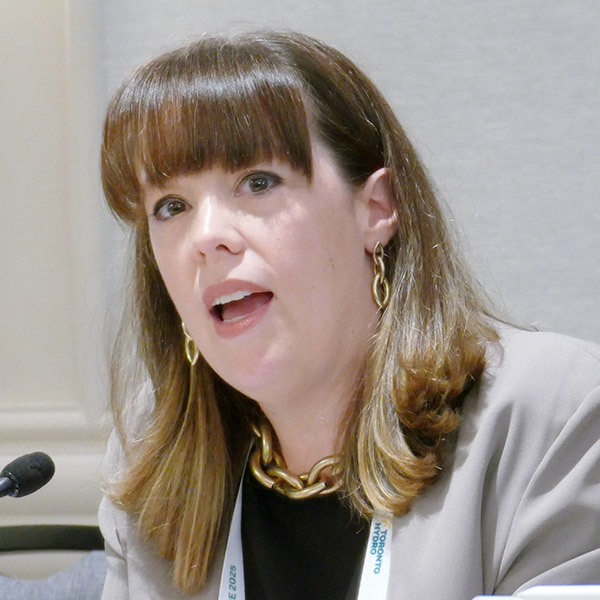
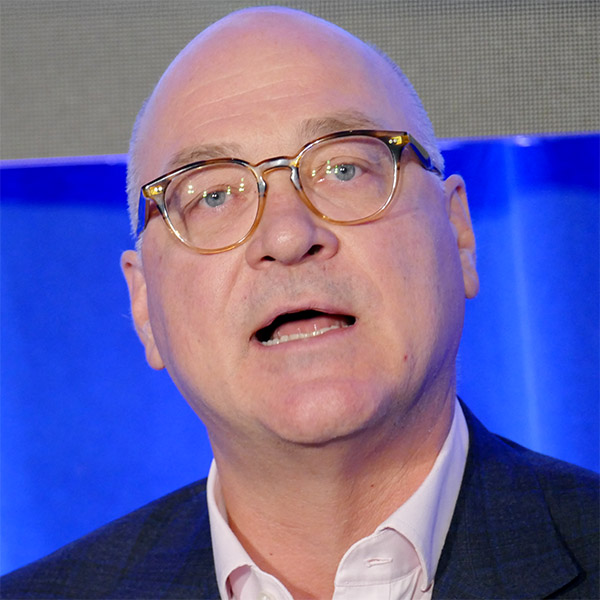
TORONTO — The Ontario government’s efforts to align IESO and the Ontario Energy Board to make the province an energy “superpower” were the dominant theme at the 2025 Ontario Energy Conference on Sept. 29.
Premier Doug Ford, the first speaker at the conference, received a standing ovation after laying out his plan for using the province’s energy sector to “build the strongest economy in the G7.”
Ford’s ambitions were spelled out in the Ministry of Energy and Mines’ Integrated Energy Plan (IEP) in June, which called for expanding nuclear power and natural gas and making economic development a core mission of both IESO and the OEB. (See Ontario Integrated Energy Plan Boosts Gas, Nukes.)
The conference, sponsored by the Ontario Energy Association and the Association of Power Producers of Ontario (APPrO), attracted more than 450 attendees to the Marriott Downtown at CF Toronto Eaton Centre.
Outside the hotel, members of the Ontario Clean Air Alliance protested the government’s support for gas-fired generation, calling for the province to instead triple wind and solar generation. They were joined by members of the Toronto East Residents for Renewable Energy, who rallied against a proposal to expand Ontario Power Generation’s Portlands Gas Plant by 50 MW from its current 550 MW. They said the plant should be shuttered by 2030.
Inside the hotel, however, there was no overt opposition to the government’s plan, although some speakers acknowledged the likelihood of rate increases and warned of the risks of building new nuclear generation.
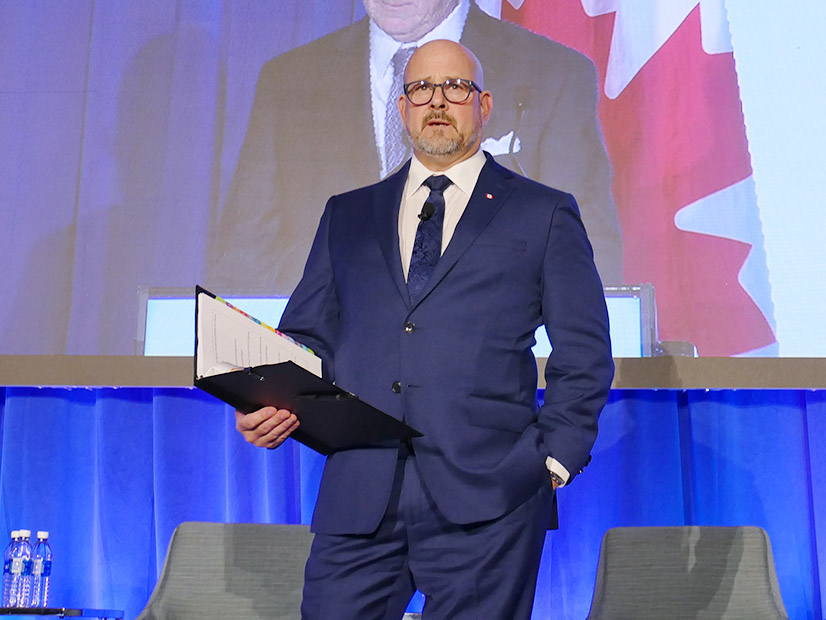
IESO CEO Lesley Gallinger referred to the ministry’s “bold and pragmatic vision.”
“Economic growth, supporting population growth, supporting sovereignty and supporting First Nations reconciliation. I mean, this is a grand slam home run if we do this right,” enthused Harry Taylor, CFO and interim CEO for Hydro One.
In addition to a “relatively well-managed” transmission system and successful generation procurements, “for the first time in decades, we have also a vision,” said Robert Reinmuller, Hydro One’s vice president for transmission system planning and large accounts.
A.J. Goulding, president of London Economics International (LEI), gave the strongest critique of the IEP in his keynote address, raising questions about bullish load forecasts, the nuclear investment and the risk of policies being reversed after a change in government. (See related story, Goulding Hasn’t Drunk the ‘Energy Dominance’ Kool-Aid.)
Province and Federal Government Aligned on Nuclear Expansion
Ford called for making Ontario “more competitive, more resilient and more self-reliant” to “build the strongest economy in the G7.” Central to that vision, Ford said, was its “massive potential as an energy superpower.”
The IEP developed by Energy Minister Stephen Lecce calls for the construction of four small modular reactors totaling 1,200 MW and the addition of up to 4,800 MW of nuclear capacity at the Bruce Nuclear Generating Station.
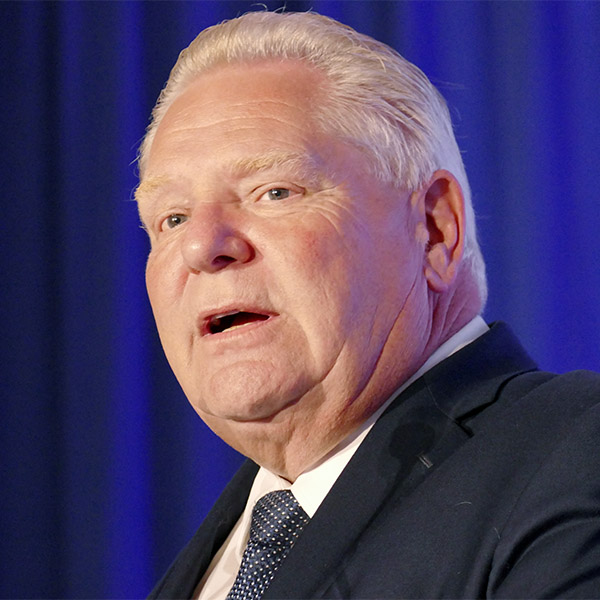
“I love the guy,” Ford said of Lecce. “I talk to him every single day, four or five times.”
Ford, a member of the Progressive Conservative Party, praised Liberal Party Prime Minister Mark Carney, who identified four SMRs planned at Ontario’s Darlington nuclear power plant as one of the “nation-building” projects he said are needed to bolster the country’s economy in response to U.S. President Donald Trump’s escalating tariffs. (See Ontario Environmentalists Slam New Nuclear Units.)
“He’s all in on large-scale nuclear [and] on the SMRs,” Ford said. “He understands it. He gets it.”
That comity was apparent later in a panel discussion featuring André Bernier, director general of Natural Resources Canada, the federal government agency responsible for energy and minerals, and Sam Oosterhoff, the province’s associate minister of energy-intensive industries.
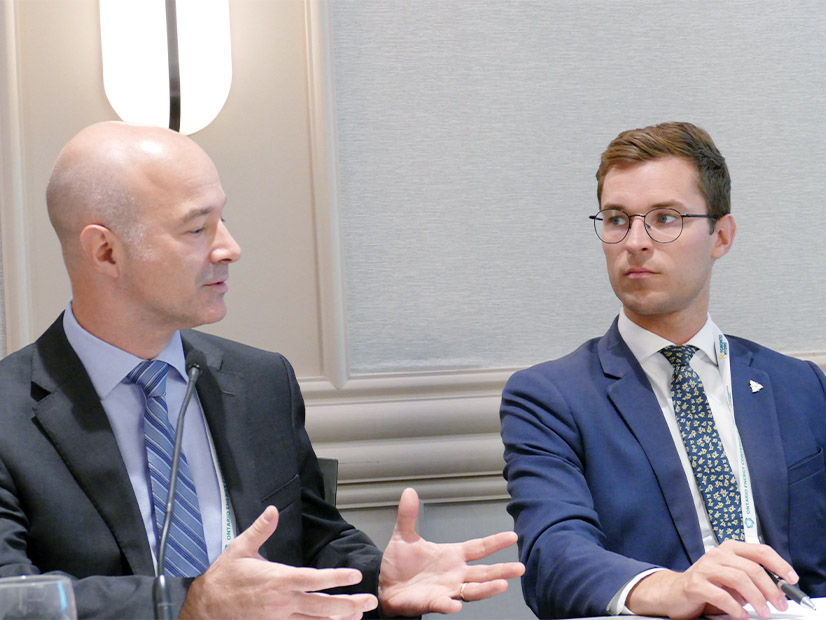
“I think we might be in danger, minister, of finishing each other’s sentences,” Bernier told Oosterhoff.
Later, in a keynote speech at the conference’s evening gala, Lecce noted that though the provincial and federal governments are headed by different political parties, “we are on the same team in this moment. We’re fighting for a similar cause. We have to stand up for our country, safeguard our workers against [the] great level of risk from the U.S., in China and Iraq.
“I like what I hear from the feds … moving with speed … nation building, regulatory reform, ending duplication [of environmental reviews, things] so important to the province’s and the country’s economy. But we now need them to do those things. We need an impact assessment law that does not take five years to assess projects [that] in the European Union can be done in 12 or 18 months. We need the feds to end duplication on critical projects.”
Lecce also called for federal support to help meet the “massive, massive financial challenge” for needed infrastructure.
“We need a commitment on investment tax credits and the clean energy credits. … All of this [is] really important if we want to provide stability to the sector, which is why we’ve asked for a 50% commitment for the feds to help us derisk those investments and … protect ratepayers.”

Lecce called it a “moment of pride” that Canada will build the first grid-scale SMR in the Group of Seven, “before the Brits or the French or the Japanese or the Americans.”
“We need to get into the business of net new [nuclear],” Lecce said. “We can’t just refurbish. We can’t tweak. I think that incrementalism is really of the past. … There is no path to decarbonization; there’s no path to economic growth; there’s no path to … a domestic policy of jobs if we don’t invest in new nuclear, embracing Canadian technology.”
DERs’ Role

Numerous speakers cited the importance of distributed energy resources and demand response in helping meet a projected 75% increase in electricity demand by 2050.
Sheikh Nahyaan, executive vice president and chief operating officer for Toronto Hydro, said his company is “using non-wires solutions in a really meaningful way.” It is seeking to acquire about 30 MW this year.
“We’re trying to forecast what’s going to happen in 10 or 15 years,” said Philippe Dunsky, president of Dunsky Energy + Climate Advisors. “DERs are really a risk mitigator — in addition to a cost reducer — for that uncertainty.”
Market Design’s ‘Stress Test’
IESO’s Gallinger said summer 2025 was a “stress test” for the grid operator’s new market design, which launched May 1.
“It was a remarkable season for our system,” Gallinger said. After a 2024 summer peak of 23,852 MW, multiple heat waves pushed the region past the 2024 peak seven times in 2025.
The day-ahead market — which became financially binding under the new nodal market — cleared more than 95% of demand. (See Ontario Nodal Market Nearing ‘Steady State’ After Nearly 4 Months.)
The summer “put in sharp focus the value and the strengths of Ontario’s diverse supply mix, using our all-of-the-above approach to keep the system reliable, including new resources like the [250-MW/1,000-MWh] Oneida Energy Storage project that came online in May,” Gallinger said. “We also saw important contributions from demand response. Peak Perks adjusted more than 270,000 thermostats to achieve an average load reduction of more than 200 MW in what has become the largest virtual power plant built in Canada.
“Commercial and industrial customers also provided significant reductions through the Industrial Conservation Initiative and the capacity auction. In total, consumers lowered demand by up to 7% over the peak periods.”
Delivering on Promises, Controlling Costs of Transition
Numerous speakers talked about the challenge of winning public support for infrastructure investments that will be needed to meet growing demand.
“Don’t kid ourselves about how much money this buildout — of essentially doubling the size of our electricity system — [will cost],” Oosterhoff said. “It’s hundreds and hundreds of billions of dollars. You know, last year, I think the number I saw for generation and for transmission was $400 billion. I’m sure by now it’s higher. … That is a lot of money that people, ratepayers [and] taxpayers will have to pay.”
But, he added, not building to meet need “is going to cost more than action. And the economic costs of not having that capacity for the next Volkswagen plant or the next LG plant, or the next tech company … is something that we have to be very upfront with people about.”
Hydro One’s Taylor said utilities will have to execute “almost flawlessly.” He said First Nations partnerships would be essential to building transmission across tribal lands.
And he said innovation is essential. “If we are still doing building … the way we did 10 years ago, even five years ago, we’re taking too long [and] it’s costing too much,” he said. “We’ve got to find a way to bring innovation to everything that we do so that we can tighten time frames and reduce capital expenditures.”
Customers and policymakers are not the only ones who will be watching how utilities deliver, he said, noting that some of his company’s largest investors are from Australia, Asia and Europe. “How do we compete across the globe for scarce capital?” he asked.
Hydro One’s Reinmuller called for more certainty for investors’ cost recovery and quicker decision-making.
“A lot of the things that [will be proposed from IESO’s] bulk regional planning this year, we probably knew some of the answers two, three years ago,” he said.
Natural Resources Canada’s Bernier acknowledged that “when I think of the discipline of getting projects approved and built, getting through regulatory barriers … our recent track record is maybe not all the way we want it to be.” He praised the nuclear refurbishments in Ontario, saying they “have done a great job [keeping the] projects on budget.”
Pluses and Minuses of Expanding Consultation

Moderating a panel on “Coordinated Integrated Planning for Growth,” Dunsky asked whether a drive for increased coordination and agreement on common assumptions could concentrate risk. “In other words, if we’re wrong, we’re all working together, right?
“We are talk[ing] about launching a very complicated, exhaustive, coordinated process involving essentially the entire village,” he continued. “How do we avoid this process becoming a kumbaya that slows us down instead of an alignment that speeds us up?”
Toronto Hydro’s Nahyaan said having multiple parties at the table creates transparency and ensures multiple perspectives.
“It reduces the risk of being wrong, because you’re now having multiple parties and interested groups … keeping you on your toes in terms of making sure that you are remaining agile.”
LEI’s Goulding weighed in on the question in his keynote speech. “Focused, time-limited consultation will lead to better plans,” he said. “Risk management requires process. The worst mistakes I have made in my career have come from failure to consult and be deliberate, exacerbated by a belief in my own invincibility.”
Municipalities Warming to Energy Development
Spencer Sandor, senior adviser for the Association of Municipalities of Ontario (AMO), said his organization is helping its members evaluate potential energy projects’ impacts and benefits.
“The average municipality has only six full-time employees, so that would be a clerk, a treasurer an administrative staff, and probably three guys driving the snowplow or a road grader, depending on what season it is,” he said.
Over the past two years, AMO, IESO, the province and organizations including the Ontario Energy Association have helped municipalities develop resources, such as a procurement tool kit, a guide “to help both municipalities and developers understand how to talk the same language to each other,” he said.
At AMO’s annual conference in August, Sandor said, representatives from multiple municipalities approached the IESO booth “saying, ‘How do I get one of these projects?’”
Sandor said municipalities are looking for impartial sources of information to address their concerns. “If, say, it’s a battery storage project, they are inevitably going to say, ‘Is this thing going to catch fire?’
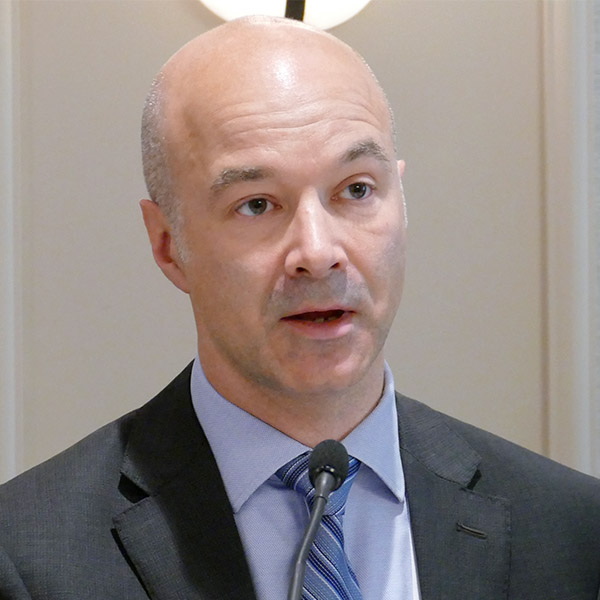
“There’s kind of two responses to that question. One is, ‘Don’t worry, it won’t catch fire, trust me.’ And the other one is … ‘You’re right, they have caught fire in the past. The technology has evolved. … Here are several resources from the Fire Chiefs Association, from the Energy Storage Association, from Hydro One, that talk about how the technology has improved, and more importantly, what we can do as a fire service to respond to that.’
“I’ll give you one guess which one of those answers is more likely to get a municipal support resolution.”
During IESO’s first long-term solicitation, “the story that was being told [was that] these municipalities are saying ‘no,’” Sandor said.
“Coming out of that process, IESO was still able to get contracts for more capacity than they targeted,” he said. “Now that municipalities do have more expertise, the dialogs are a lot more constructive.”
Gas not Going Away
Minister Lecce cited the province’s Natural Gas Policy Statement, calling it “the ultimate insurance program” for the power sector.
Lecce said the Ontario grid will reach a target of 99% non-emitting generation by 2050, largely through more hydro and nuclear power.
“Renewables will play a critical role in this space. … But we’re not going to … negate the role of having [gas] on the option lists. That is just ideological insanity, and that’s the type of policy, frankly, that led to Ontario having the highest energy cost on the continent.”
A year or two ago, “the world’s messaging was, ‘We’re getting out of fossil fuels,’” said Brian Johnson, general manager and senior vice president of Enbridge.
On the coldest day this year, he said, the gas system produced 4.9 times the energy of all other sources combined. “So, I think we’re getting, hopefully, back to some practicality.”
Elexicon at the ‘Tip of the Spear’
Amanda Klein, CEO of electric distribution company Elexicon Energy, said customer demand growth in the Greater Toronto Area East is “nothing short of bananas,” with a projected customer increase of nearly 20%.

“That’s a whole SkyDome full of new customers for a utility that fills about five SkyDomes today,” she said, referring to the Toronto Blue Jays’ stadium (now called the Rogers Centre).
While other utilities are projecting peak demand by 2060, “we’re going to have most of that happening in the next decade, rather than the next 25 years,” she said.
“So what I see at Elexicon is that we’re going to be, for the industry, really the tip of the spear in terms of population and economic growth in Ontario that we’re seeing.
“We’ve got a capital program that’s doubled in recent years. It’s about to double again.”