The West-Wide Governance Pathways Initiative’s Launch Committee approved the bylaws and incorporation documents for the organization that will govern CAISO’s energy markets, in a step marking the “culmination of over two years of work,” according to the committee’s co-chairs.
The committee’s members voted unanimously Dec. 12 to approve the certificate of incorporation for the Regional Organization for Western Energy (ROWE). The committee plans to file the certificate in Delaware in January and register as a nonprofit with the IRS shortly thereafter.
The IRS filing will include ROWE’s three-year budget, business plan and conflicts of interest summaries, along with the newly approved bylaws.
“With today’s vote, the Pathways Initiative Launch Committee has adopted the official incorporation documents for the new [ROWE], creating a foundation that includes the critical public interest focus and independent structure included in the Pathways Final Proposal,” Launch Committee co-chairs Pam Sporborg, of Portland General Electric, and Kathleen Staks, of Western Freedom, said in a joint statement.
“This vote also represents the culmination of over two years of work by committed volunteers and stakeholders who served on the Launch Committee or contributed input and insights throughout the process, and we are so grateful for the hours and support,” the co-chairs said.
ROWE will be the product of California Assembly Bill 825, which implements the Pathways Initiative’s “Step 2” plan to create an independent organization to oversee CAISO’s Western Energy Imbalance Market and soon-to-be-launched Extended Day-Ahead Market — and authorizes the ISO and California’s investor-owned utilities to join ROWE. (See Newsom Signs Calif. Pathways Bill into Law.)
One goal in establishing ROWE was to remove what some see as a barrier to wider participation in CAISO-run markets by ensuring they are not governed solely by officials and stakeholders in California.
The board selection is an important step in giving ROWE independent oversight, especially in negotiations with CAISO over tariff modifications to shift responsibility of the markets to the organization, Staks noted during the Dec. 12 meeting.
“That initial board gives us and … the new regional organization that independent oversight,” Staks said. “It gives its own identity, and it creates that truly independent entity for the negotiations for all of these various work streams that will enable us to fully implement the Pathways proposal.”
The goal is to file the tariff with FERC by the end of 2027, according to presentation slides.
Funding continues to be a focus for Pathways with the launch committee seeking $7 million to $8 million in start-up costs for ROWE. The costs are associated with the executive search firm, initial board members and staff members, and legal support, Staks said.
The committee is exploring funding primarily through stakeholder contributions, grants and debt financing.
Some stakeholders already have signed pledge forms to contribute to the initiative, according to Staks.
“We are also having some conversations with some foundations about some philanthropic support for this work and are optimistic that we will see some grants to support a portion of our funding gap as well,” Staks said. “And then, we are pursuing some debt financing options that we’re hoping to have in place sometime next year to cover those remaining gaps that will get us where we need to be by the time we get our … ongoing funding through the tariff, hopefully in early 2028.”
Two SERC Reliability subregions face elevated risk of energy shortfalls if they experience severe conditions this winter, though all subregions should have enough resources under normal conditions, according to the regional entity’s recently released 2025 Winter Reliability Assessment.
SERC releases its WRA each December as a companion to NERC’s WRA, providing “a deeper regional dive into topics” relevant to the Southeast and covering the months of December, January and February. NERC’s assessment, released Nov. 18, found “pockets of elevated risk” across North America due in part to demand growth outstripping generation additions since last winter. (See NERC Winter Reliability Assessment Finds Many Regions Facing Elevated Risk.)
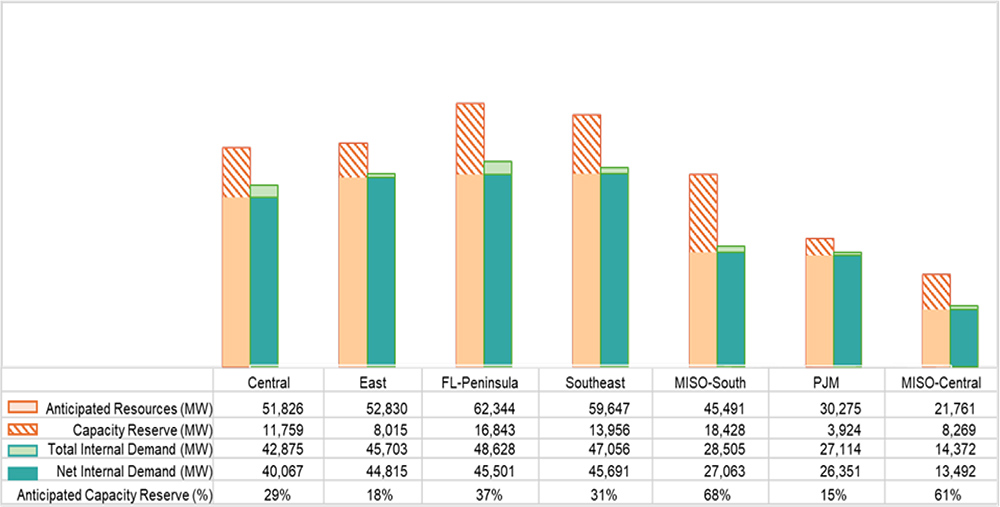
In a Dec. 11 webinar accompanying the release of SERC’s assessment, the RE’s Senior Reliability Advisor Heather Polzin said the report’s findings are largely consistent with those of NERC’s WRA. All of SERC’s seven subregions are at or above the 15% minimum reference margin under the region’s 50/50 load forecast, which denotes a 50% chance that the actual load will be higher or lower than predicted. Five are expected to meet the reference margin in the 90/10 forecast, meaning a 10% chance that the actual load is higher than predicted.
The two exceptions are the Central subregion — which includes all or parts of Alabama, Georgia, Iowa, Kentucky Mississippi, Missouri, North Carolina, Oklahoma, Tennessee and Virginia — and the East, which includes North and South Carolina. Both regions were assessed as “elevated” risk under the 90/10 scenario because their reserves are projected at 7% for Central and 8% for East. These figures are below the 15% minimum to be considered low risk, though above the 6% reserve considered high risk.
Polzin reminded listeners of the increasing frequency of extreme weather in recent years; the assessment included data from the National Oceanic and Atmospheric Administration showing the five-year average annual cost of climate disasters grew from around $58 billion in 1980 to more than $500 billion in 2024. Referring to recent winter storms, she warned that utilities may not be as lucky as they have been in the past.
SERC projected winter regional demand and resources | SERC
“In Winter Storm Elliott, although it didn’t last an especially long time, the storm’s immense size meant that … entities couldn’t obtain assistance from those that they might normally have counted on,” Polzin said. “During Winter Storm Uri, they were fortunate that the storm was not more widespread, so that a lot of power could be imported from east to west … but grid entities need to plan and prepare for a storm that could be both large and long-lasting, in which they may not have access to emergency resources.”
Across the SERC footprint, utilities reported nearly 317 GW of generating capacity for the winter season. Natural gas makes up about 178 GW, with coal accounting for 60 GW and nuclear 43 GW. Hydropower follows with 12 GW, pumped storage with 9 GW, oil with 6 GW and wind at 2 GW. Energy storage, biomass, solar and other generation all make up 1 GW or less.
SERC’s team also performed an independent transmission assessment for both the 50/50 and 90/10 load forecasts, incorporating planned transmission and generation outages for winter. The team concluded that wide-area weather-related transmission events were unlikely and subregions “are expected to perform reliably” during the season. Although “SERC East and SERC Southeast had certain scenarios that triggered additional contingency analysis,” utilities in both subregions have mitigation strategies to address those contingencies.
WASHINGTON — The Department of Energy is working to avoid additional generator retirements and bring new units online as the grid sees demand spiking because of new large loads coming online, acting Under Secretary of Energy Alex Fitzsimmons said at this year’s gridCONNEXT conference.
“We’re seeing a precipitous decline in resource adequacy across virtually every region, every RTO and ISO, over the next 10 years,” Fitzsimmons said at the event, held by the GridWise Alliance on Dec. 9-10. “We cannot allow that to happen if we’re going to deploy the generation we need to win the AI race and reshore manufacturing. And so, a big part of that is stopping the premature retirement — in many cases, the policy-driven premature retirement — of reliable assets that we need.”
DOE has used Section 202(c) of the Federal Power Act to keep several plants running this year. Fitzsimmons said that a number of utilities also have delayed retirements after the department’s actions.
“We understand the urgency of the moment, and so a big part of our strategy is to optimize the existing system,” Fitzsimmons said.
Secretary Chris Wright told attendees of a natural gas conference that DOE was considering ways to leverage backup generation that many large power customers, from big box stores to data centers, use to help balance the grid. Fitzsimmons confirmed that work.
“This has been a fascinating thought exercise,” Fitzsimmons said. “There was not one big, beautiful list of backup power like behind-the-meter generation of data centers and large industrial customers, unfortunately, and no one really knew where it was. And so, we’ve been working to compile a list of backup generators, because we know there are tens of gigawatts of backup generators, diesel, natural gas, batteries and others.”
That backup generation should not be used most of the time, but it could help to shave down peak demands on the grid and be used to avoid blackouts, he added.
Making the grid more efficient is part of that work, with DOE looking to use advanced transmission technologies to help meet load growth.
“The criteria that we’re applying to transmission buildout, and especially reconductoring, is targeting specific areas that have significant load growth; that have sufficient existing generations,” Fitzsimmons said. “If you reconductor a line and don’t have enough megawatts to push through it, then you haven’t done anything so that we can increase incremental load-serving capability. That’s our target.”
Rep. Julie Fedorchak (R-N.D.) said she is focused on transmission issues in Congress after a year running the National Association of Regulatory Utility Commissioners as its president. The conference came a couple of days before Fedorchak introduced the High-Capacity Grid Act, which would require FERC to establish a best available transmission conductor standard and then make it so utilities get guaranteed cost recovery when using that technology.
“Forecasts indicate the United States will need at least 100 GW of new power in the next five years — more than we’re anticipated to bring online,” Fedorchak said in a statement. “To meet this record demand, we need to optimize our existing infrastructure, which is exactly what the High-Capacity Grid Act does.”
Another bill Fedorchak recently introduced on transmission is the FAIR Act, which she said would prevent ratepayers from paying for transmission projects built to meet clean energy goals in other states. The bill follows a complaint filed at FERC that North Dakota signed onto over MISO’s long-range transmission plan. (See Five Republican States File FERC Complaint to Undercut $22B MISO Long-range Tx Plan.)
“Transmission is really valuable, but not all transmission is needed,” Fedorchak said at gridCONNEXT. “And if we don’t set the right signals to the market, we’re going to end up building a grid that is far more expensive than we need.”
As a member of the North Dakota Public Service Commission, Fedorchak had argued in MISO stakeholder forums that renewable generators should have to pay for transmission that brings them to market, but many such lines were included in its recent long-term plans with postage stamp cost allocations that applied to North Dakota and other states without renewable mandates.
“Other states have very aggressive climate goals; lines are being built to meet those, to bring on the power to help them meet those goals, and my ratepayers and many others are paying the same prices,” Fedorchak said. “It’s not fair.”
Rep. Sean Casten (D-Ill.) said many of the actions of the Trump administration were working against energy development: Permits have been slow walked or pulled at the last minute; load guarantees have been revoked; and funding has been pulled for many programs. He said the private sector is taking note.
“A company came to me early on in this term, and they said, ‘We’re trying to figure out with our lawyers whether we need to rewrite the standard force majeure language in our contracts, because we get a force majeure out of acts of war, civil disobedience [and] change in law. We don’t have any language in there about what happens if the U.S. federal government refuses to enforce the law.’”
Congress could have done more to defend its own powers and the rule of law, but Casten said Republican leadership has declined to do so.
He also argued FERC could do more with its authority than it has, specifically noting that it has been authorized to do performance-based ratemaking for a decade and has not yet.
“FERC could exercise more authority than they have on being a permanent backstop for transmission,” Casten said. “We could push them to do that, but they’ve been a little bit reluctant to go into that. … FERC needs to be a totally independent agency, because any conversation about rate equity and cost allocation goes sideways.”
Since former Sen. Joe Manchin (I-W.Va.) declined to support former Chair Rich Glick for a second term, commissioners have had to pay more attention to politics, Casten said. That trend is likely to continue if the Supreme Court overturns a key precedent on agency independence. (See Supreme Court Justices Seem Skeptical on Agency Independence.)
The policy debates in Washington come as power prices have become part of an affordability crisis, Brattle Group Principal Peter Fox-Penner said. Part of his talk at the conference explained a study Brattle did with Lawrence Berkeley National Laboratory on what has driven power price increases in some states. (See LBNL Study Examines Drivers Behind Higher Power Prices in Some States.)
While the study generally predates the boom in demand growth because of new large load customers, it found that states benefited from spreading the costs to a growing customer base, leading to lower rates for all. Adjusting for inflation, states on the coasts had prices rising more during the study’s timeline of 2019-2024.
“I think this picture is changing going forward,” Fox-Penner said. “As the data centers kind of look for cheaper power, they are gravitating to the center of the country. We see that quite a bit in our retail practice, and that is going to reduce regional disparities going forward, even though I think they will remain quite large.”
That means the affordability issues are going to be felt in more states, and consumers on the lower end of the income scale are facing tough choices. A quarter are behind on their bills; 20% set their thermostat at a temperature that is unhealthy; and 34% have to choose between which necessities to pay for: energy, food or medicine.
“These numbers are as high and as tragic as I have ever seen them in my practice, going back quite a few decades,” Fox-Penner said.
The energy poverty numbers have looked bad in the past, whether it was 2008’s great recession or the oil crisis in the 1970s, but now they are part of a broader affordability crisis facing Americans.
“That has implications for us,” Fox-Penner said. “On the one hand, we have to do as much as we can to help the situation out, because all the sectors that are experiencing these price increases have their own particular causes and their own work to do and to bring them down. But at the same time, we have to recognize that this problem is bigger than us, and we can’t solve it alone.”
ISO-NE’s new day-ahead ancillary services market added about $258 million in incremental costs between March and August, equal to 7.6% of total energy market costs, according to the RTO’s Internal Market Monitor (IMM).
The volatility and incremental costs have alarmed some consumer advocates and load-side participants, who have expressed concern that the market costs have been significantly higher than initial expectations.
Launched in March, ISO-NE’s new day-ahead market is intended to optimize the procurement of energy and 10- and 30-minute reserves, and ensure the region has procured enough supply to meet forecasted demand. (See FERC Approves ISO-NE’s Day-Ahead Ancillary Services Initiative.)
In its 2023 filing of the changes, the RTO wrote that the new combined day-ahead energy and ancillary services market “will clear energy and ancillary services jointly in a way that maximizes the efficient use of the region’s resources to meet day-ahead energy demand and to satisfy both the load forecast and day-ahead reserve requirements (ER24-275).”
Dónal O’Sullivan of the IMM discussed the performance of the new day-ahead market with the NEPOOL Markets Committee on Dec. 9.
He noted that meeting the day-ahead 10- and 30-minute reserve requirements was “the significant cost driver,” with these needs accounting for about $210 million of the incremental costs. These flexible response service (FRS) costs were themselves driven by high opportunity costs during the tightest days on the system, he said.
Over half of incremental costs were incurred during 10 high-load days during the summer, he noted.
“Periods of elevated FRS clearing prices occurred during high-demand periods that also had high energy market prices,” the IMM wrote in its summer markets report. “Opportunity costs can be highly impactful to FRS clearing prices during periods like this as the magnitude of the inframarginal energy market rents foregone by units that are ‘redispatched’ to satisfy reserve requirements can be large.”
The day-ahead energy and ancillary service clearing prices incorporate opportunity costs associated with selling other day-ahead products. ISO-NE wrote that this is needed “to avoid creating an incentive for suppliers to submit offer prices inconsistent with their costs in an attempt to clear for a ‘more profitable’ product.”
The high costs have not been isolated to summer price spikes. After prices dropped in September, monthly costs rebounded in October and November. ISO-NE has said this was due in part to an increase in resource outages.
‘Serious Concerns’
O’Sullivan also discussed the impacts of the new Forecast Energy Requirement (FER) constraint, which is aimed at procuring enough load to meet the day-ahead demand forecast.
This design is intended to help prevent gaps between the energy forecast and the amount of supply cleared in the day-ahead energy market. Physical resources participating in the day-ahead market earn both the clearing price — subject to closeout charges — and a separate FER price.
The IMM estimated that, without the FER constraint, the total incremental costs of the new day-ahead ancillary services market would have been about $48 million lower over the six-month period.
The day-ahead ancillary services market’s $258 million in incremental costs are well beyond ISO-NE’s initial estimates; the RTO forecast in an impact analysis that the new day-ahead products would increase energy and ancillary services costs by about $140 million annually, based on a 2019-2021 study period.
“Our office has serious concerns about the magnitude and volatility of DASI [day-ahead ancillary services initiative] costs to date, including the degree to which these costs have exceeded the ISO’s original impact analysis,” a spokesperson for the Massachusetts Attorney General’s Office wrote in a statement.
“We have and will continue to advocate for additional analysis and clarity surrounding the various components of DASI to ensure that consumers are not unfairly burdened by unnecessary or inefficient costs and to ensure that all market products and components are delivering benefits commensurate with their costs,” they added.
In response to consumer concerns about higher costs associated with the new market design, ISO-NE representatives have said they are closely following market performance but have stood by the market design and urged the need to accumulate a full year of data on the new day-ahead design before considering changes.
“We still think some time is helpful to go through the winter cycle to see how it performs in the winter,” ISO-NE COO Vamsi Chadalavada said at the NEPOOL Participants Committee meeting in December. “The objectives are not going to change. It is, for us, I think the best way to secure those services.”
ISO-NE has expressed confidence the new day-ahead market has improved grid reliability, though these benefits can be difficult to quantify.
The outlook for utility-scale batteries in PJM is more complex than it has been at any point in the past decade.
Ali Karimian
While PJM historically has been seen as a market with large demand and deep industrial bases, when it came to actual deployment of batteries, investors typically found themselves confronted with unfavorable economics and slow interconnection processes.
But after the radical shifts of the past 12 months and those on the horizon, PJM is entering a new phase, marked by sharply rising capacity prices, more acute reliability pressures and a growing recognition that storage will be central to keeping the lights on.
In this article, we explore the outlook for battery storage in PJM.
Front-of-the-meter Model
In PJM, the front-of-the-meter (FTM) model traditionally has been built around two revenue pillars: frequency regulation services and participation in the capacity market.
Frequency regulation services have long been a reliable, but shallow, pool of income. PJM procures only around 600 MW of regulation as of late 2025, and as more batteries enter the market, prices soften. Most sophisticated investors therefore treat regulation revenue not as the core of a project’s value but as a bonus: useful, but not bankable.
On the other hand, the capacity market has transformed dramatically. Large numbers of fossil fuel power stations host data centers on-site, which effectively takes the capacity of the power plant out of the generation stack (in all or selected hours, depending on the data center load shape).
Electrification, particularly the expansion of data center load across the mid-Atlantic, has caused demand forecasts to spike. The result is a system that needs new, fast-responding capacity and is willing to pay for it.
The implementation of effective load carrying capability (ELCC) also has redefined how PJM values the contribution of limited-duration resources such as batteries. While the ELCC multiplier for storage is expected to decline over time as more storage joins the system, the immediate impact has been positive. In the 2025/26 and 2026/27 auctions, clearing prices surged, reflecting both the new valuation methodology and a tightening supply–demand balance.
For investors, this creates a more predictable and meaningful revenue floor for battery assets than at any time in recent memory. But capacity revenues alone are not the full story.
One of the reasons arbitrage historically has been weak in PJM is the region’s modest penetration of variable renewables on the system. Unlike California or Texas, PJM does not yet experience deep mid-day solar troughs or abundant periods of near-zero marginal-cost generation.
Arbitrage opportunities in such markets are driven by predictable, repeated patterns of low prices (when renewables flood the system) and high prices (when that renewable output fades). Without this dynamic, PJM’s price spreads have been comparatively shallow, limiting the upside. But this, too, is beginning to change.
As demand volatility increases, the frequency and magnitude of price swings is increasing. While PJM may not yet have the solar-driven volatility of CAISO, it is experiencing more meaningful peak-period scarcity pricing, which creates valuable opportunities for well-optimized storage assets. Even so, arbitrage remains secondary to capacity in the current environment; it is not yet the engine that can justify a standalone FTM build.
For many, these dynamics raise an inevitable question: If regulation is shallow, arbitrage still is emerging, and ELCC eventually may decline, is the FTM model fundamentally flawed in PJM? The answer is no, but it is evolving.
FTM storage requires a diversified revenue stack and a careful understanding of regulatory timing. The surge in capacity prices has revived interest in the model, and interconnection reforms are clearing some of the historic backlog.
Even so, the risks remain real: Interconnection queues are long, drop-out rates high, and market design still lags the reality of the grid’s need for flexible, fast-ramping assets. Ancillary-service saturation is a threat. Investors must approach FTM with eyes wide open.
Behind-the-meter Storage Tells a Different Story
When batteries sit behind large industrial or commercial loads, they deliver guaranteed value through peak shaving, demand-charge reduction and resilience benefits. Behind-the-meter (BTM) economics for battery storage are not tied primarily to wholesale-market conditions.
A factory, data center or distribution facility with high load during PJM coincident peaks can materially reduce its future capacity and transmission costs by deploying a battery, even without ever participating in regulation or arbitrage. As capacity and transmission prices surge, these avoided costs become even more valuable.
For businesses that control meaningful load, the BTM business case can be compelling, and dependably so. For businesses with large industrial loads, this means batteries can function as financial instruments as much as technological ones: tools for cost avoidance, resilience enhancement and participation in high-priced wholesale services.
Hybrid Structure Most Interesting
But the most interesting model today is neither pure FTM nor conventional BTM. Substation-located batteries, sometimes described as non-retail behind-the-meter generation (NRBTMG), offer a hybrid structure that combines the strengths of both.
When placed at a substation, a battery can offset the substation’s load during peak periods, yielding predictable cost savings while also participating in PJM’s markets when capacity, energy or regulation prices create favorable conditions. This effectively creates a dual-revenue structure: part risk-protected through peak-load reduction, part exposed to wholesale upside. It is a model that makes intuitive sense in a region like PJM, where system needs are rising but market design still leaves certain storage services undervalued.
Although it requires more careful stakeholder engagement and interconnection planning, it ultimately may prove to be the most economically resilient approach for storage developers.
The Market Signal is Strong
For the first time in PJM history, the market signal for flexible capability is strong, consistent and grounded in clear system need.
Studies from The Brattle Group suggest PJM needs roughly 16 GW of new four-hour energy storage by 2032 simply to maintain reliability standards. Rising peak loads, extreme weather and the rapid proliferation of data centers are shifting PJM’s risk profile fast enough that storage no longer is optional; it is becoming essential.
The most recent PJM capacity auction results, which hit the price cap in many zones, reflect that urgency. Despite this, deployment remains slower than required. PJM’s interconnection queue contains many gigawatts of proposed storage projects, but attrition rates remain high.
A combination of lengthy studies, shifting cost structures and evolving rules continue to impede progress. PJM needs storage, but its market structures and regulatory processes still make it challenging to build. This tension between system need and market execution is one of the defining features of the storage landscape today.
But the trajectory is unmistakable:
Capacity prices have reset to a sustainably higher level.
Policy reforms are accelerating.
Renewable penetration is increasing.
Industrial electrification is proceeding faster than many expected.
PJM stakeholders increasingly are motivated to deploy storage not only for market participation but for cost management, reliability and energy security.
In short, the outlook for utility-scale batteries in PJM is one of cautious but tangible optimism. The optimal storage strategy in PJM is not to chase a single revenue stream, but to design assets capable of capturing multiple forms of value. The strongest projects will be those that can respond dynamically to capacity price signals, exploit emerging arbitrage opportunities, deliver ancillary services when prices spike and directly reduce peak load.
NERC’s Reliability and Security Technical Committee will soon have new leadership, after members chose a chair and vice chair at the RSTC’s quarterly meeting Dec. 10.
Current Vice Chair John Stephens from City Utilities of Springfield will move up to replace departing Chair Rich Hydzik of Avista after his term expires Dec. 31, with Srinivas Kappagantula of Arevon Energy taking Stephens’ role. An RSTC chair and vice chair can serve only a single two-year term, so Stephens will step down Dec. 31, 2027, barring unforeseen circumstances.
NERC Senior Counsel Candice Castaneda observed that, since the RSTC’s last meeting, industry stakeholders have chosen a new slate of members in an election that ended Nov. 21. The newly elected members — some of whom already are on the RSTC — will serve two-year terms beginning Feb. 1, 2026, and ending Jan. 31, 2028.
Sector 12 (State government): Cezar Panait, Minnesota Public Utilities Commission
Sector 8 (Large end-use electricity customer) had two open seats, for terms expiring Jan. 31, 2027, and Jan 31, 2028. Venona Greaff of Occidental and Mike Della Penna of Google were elected for this sector, and a sector election will be held to determine who will serve out which term.
Nominations are underway through Dec. 19 for the open at-large RSTC members, five of whom will serve two-year terms ending Jan. 31, 2028, and two of whom will serve out the terms of departing members that expire Jan. 31, 2027. The chosen representatives will join the three other at-large members whose terms end in 2027.
NERC’s Board of Trustees must approve the RSTC leadership changes and membership at its next meeting, scheduled for Feb. 11, 2026, in Savannah, Ga.
White Papers, Guidelines and Reference Documents
Following the leadership election, members approved the RSTC’s 2026-2027 Strategic Plan. The document sets expectations and deliverables for the RSTC in the coming year while guiding coordination with other standing committees.
Next, members approved a security guideline for addressing cybersecurity incidents affecting vendors of grid equipment. The RSTC’s Supply Chain Subcommittee developed the guideline in recognition of the risk cyberattacks on vendors could pose to the security of the electric grid. While following the guideline is not mandatory, it does present “key practices and information” to maintain reliable operation.
The SCS presented another guideline for approval offering “an industry-standard guide for … the development of procurement language to mitigate supply chain security risks that may be introduced by vendors.” The document provides key considerations for procurement language and suggestions for supply chain risk mitigation requirements.
Another guideline on the use of cloud computing for grid management came from the Security Working Group, which wrote that “understanding security in these complex environments is a common challenge in industry.” The document “presents basic cloud concepts, including the principles of information protection,” and is meant to supplement previous guidance on using encryption in cloud environments.
RSTC members then approved a research paper from the System Planning Impacts from Distributed Energy Resources Working Group on the impact of distributed energy resource aggregators and DER management systems on the working group’s DER modeling framework. The paper’s recommendations touch on collection and management of DER data.
Finally, the committee approved updates to a technical reference document on dynamic load modeling, intended “to reflect the current state of the art.” The new document includes updates to industrial load parameters, recommendations for use of the complex load model and changes to the load modeling data tool.
The National Association of Regulatory Utility Commissioners noted that states have come out against FERC taking jurisdiction over large loads, and that position was shared by others, including the Edison Electric Institute, Meta, the Data Center Coalition and Talen Energy. But the association also argued that FERC should convene a technical conference in January to discuss the areas on which the commission can act without sparking any jurisdictional fights.
“A technical conference will provide relevant entities with the opportunity to provide insights to the commission as well as the opportunity to exchange ideas with each other and coalesce regarding solutions,” NARUC said.
State regulators and ISOs/RTOs already are dealing with the issues, and NARUC urged FERC against any action that would derail those efforts.
The National Association of State Utility Consumer Advocates reminded FERC that while it is important to weigh the views of industry participants, it also must consider end-use consumers. Their interests might be contrary to what industry wants, and consumers’ interests in reliability and affordability need to be the lodestars that guide FERC’s actions, it argued.
“FERC should avoid taking any action in this proceeding that undermines the important progress that states and FERC have been able to make by coordinating their efforts and maximizing their respective abilities to effectively regulate within their jurisdictional bounds,” NASUCA said. “Following directly from principles of cooperative federalism, the ANOPR’s proposed reform should confirm the emerging policy development embodied in state-level large load retail electric tariffs and rules.”
The tariffs contribute to better management and pacing of large load interconnections, including weeding out speculative large load interconnections and mitigating cost shifts to other customers, it added.
The Pennsylvania Office of Consumer Advocate, Delaware Division of Public Advocate and Illinois Attorney General’s Office agreed on the cooperative federalist approach. They also argued that because residential consumers have paid for capacity for years and are not stressing the system, if rolling outages caused by a lack of resource adequacy are ever required, then grid operators should focus them on the new large loads stressing the system.
“Given the unique issues that large loads create for grid reliability, treating new large loads differently from other load is reasonable and necessary to ensure reliable service and just and reasonable rates for existing consumers, especially residential consumers,” they said. “FERC can and must appropriately treat new large loads attributable to data centers differently from other kinds of load because: (1) data centers are creating unique difficulties for the grid and impacting a uniquely vulnerable market at a uniquely expensive level; and (2) investments in data centers can be speculative and uncertain in nature, increasing the risk of a severe market correction that would create stranded costs.”
PJM’s Independent Market Monitor said that the ANOPR recognizes the need for a new large load queue at the RTO, which does not need to impinge on state jurisdiction.
“The criteria for the PJM queue could be focused on the very specific question of whether the load when interconnected can be served reliably,” the Monitor said. “Reliable service means that there is adequate capacity to meet the load, including a reserve margin. The current failure to impose a reliability requirement has led to large increases in capacity market prices but also in energy market prices and in transmission costs.”
The IMM also brought up a recent complaint that it filed seeking greater flexibility for PJM to deal with large load issues, by finding it can require that they are able to be served reliably before agreeing to connect them. It was one of many comments that focused on issues in PJM. (See Market Monitor Files Complaint Over PJM Large Load Interconnections.)
Constellation Energy Generation urged FERC to act on the pending show-cause proceeding on co-located load in PJM.
“On jurisdiction, the only immediate call the commission must make in PJM is whether to exercise jurisdiction over hybrid facilities’ shared point of interconnection to the grid,” Constellation said. “This is an easy call since the commission already exercises jurisdiction over the generator’s interconnection, and jurisdiction over the same shared facilities does not bifurcate between state and federal authority depending on the services of the moment.”
Constellation reported that the issues in PJM have gotten worse, with some transmission owners blocking hybrid facilities, in which a large load is built near a new generator, by making net billing impossible.
The Electric Power Supply Association likewise urged FERC to act on the long-pending issues in PJM and to avoid taking actions that threaten competitive markets.
“Regrettably, this proceeding is being utilized as an opportunity to press unwarranted attacks on our nation’s competitive power markets in an attempt to hijack this critical emergent concern to dismantle competitive mechanisms and allow monopolistic behavior to flourish further,” EPSA said. “Ignoring years of market price signals that justified generation retirements, transmission owners — particularly in PJM — now argue this crisis can be resolved by state-led processes that would allow these transmission owners to build and rate base new generation.”
Ultimately the issues the ANOPR raises will be dealt with only by adding more generation, along with the transmission required to bring that to market, American Electric Power said.
“AEP’s proposal in its initial comments achieves this goal by focusing on long-term, proactive solutions to generator interconnection, transmission planning and cost allocation,” the utility said. “AEP’s proposal supports the expedited connection of data centers and large industrial loads to the electric grid by effectively combining short-term speed-to-power solutions, with longer-term generator interconnection reforms and proactive transmission planning, which address the root causes of the current slow pace of large load interconnection.”
Google argued the root of the issue is more infrastructure, though its comments focused on transmission, which is squarely in FERC’s jurisdiction.
“The combination of aging infrastructure, decades of underinvestment and fragmented, highly localized planning practices have resulted in a transmission grid that is struggling to keep up with the demands of this new growth, including from data centers,” Google said. “As a result, it takes too long to interconnect new large loads and new generation, and the cost of doing so is too high. Lengthy interconnection delays are directly driving up energy prices. When new supply remains locked in a queue, it cannot meet rising demand in time, which puts upward pressure on all prices, including for energy, capacity and ancillary services. Resolving those bottlenecks by building the necessary transmission infrastructure is one of the principal steps our nation can take to solve all of those challenges.”
Talen said the only path forward is to develop new generation through transparent, market-based mechanisms that provide clear investment signals and maintain regulatory certainty.
“The fundamental underlying issue of resource adequacy will not be solved solely through a rulemaking process addressing large load interconnection,” Talen said. “Supporting market-based mechanisms designed to ensure sufficient generation resources are available to serve load demand is more pressing (and within the commission’s jurisdiction) than the issues raised by the ANOPR.”
ISO-NE continued work on the second phase of its Capacity Auction Reform (CAR) project with NEPOOL members Dec. 9 and 10, discussing modeling of the region’s gas constraints, seasonal auction design and its approach to evaluating the impacts of the auction changes.
Discussions around the CAR project are poised to take up a large portion of NEPOOL technical committee meetings throughout 2026. The second phase of CAR centers around resource accreditation changes and splitting annual capacity commitment periods (CCPs) into six-month winter and summer seasons.
The accreditation changes likely will be the most controversial aspect of the project, as the changes would directly affect how much capacity each resource can sell in the market. ISO-NE aims to complete the seasonal and accreditation design by the end of 2026.
Steven Otto, manager of economic analysis at ISO-NE, discussed the RTO’s thinking regarding the development of a gas capacity demand curve, which would be intended to account for the “shared physical constraints” limiting gas resources’ ability to access gas during cold periods.
As envisioned by ISO-NE, the gas demand curve would reduce how much gas resources are paid for their capacity relative to other resources during the winter season. Gas capacity backed by firm supply contracts would not be subject to the curve but likelywould affect the amount of gas available to remaining non-firm capacity.
The RTO “will construct a non-firm gas capacity MRI [marginal reliability impact] curve by measuring the reliability impact of substituting incremental megawatts of non-firm gas capacity with other capacity in the system,” Otto explained.
He added that, “in conjunction with the simultaneous clearing of the systemwide demand curve, the intersection of the gas capacity supply and demand curves determines how much non-firm gas-only [capacity supply obligations] will be awarded and how much less that CSO will be paid.”
The gas demand curve process would be separate from the accreditation process for gas resources; gas accreditation values would be determined largely by forced outage rate, maximum capacity and deliverability.
To determine how much gas is available to gas-only generators, ISO-NE plans to rely on modeling by the Analysis Group, which presented the initial results of its study of the region’s winter gas constraints at the meeting. The consulting firm estimated the hourly energy supply for gas resources based on 10 modeled winters intended to represent the full range of supply scenarios.
On cold days, defined as heating degree days (HDDs) at or above 45 — which equates to temperatures at or below 20 degrees Fahrenheit — the amount of available gas-only capacity averaged 4,516 MW, with a minimum of 469 MW and a median of 4,416 MW. On warmer days, available capacity averaged 6,794 MW, with a minimum of 776 MW and a median of 7,013 MW.
Gas resources did not face constraints during most days with an HDD below 45. Generation capacity equaled 8,384 MW during these days.
Responding to stakeholder questions, Todd Schatzki, principal at the Analysis Group, said the company did not find major geographic differences in access to fuel, noting there is a complex array of supply inputs to the gas system during tight system conditions.
He said it is difficult to accurately quantify local constraints, adding that constraints on the Algonquin G-Lateral appear to affect just two gas-only plants and about 5% of gas-only capacity.
ISO-NE’s proposed gas demand curve would apply equally to all non-firm gas capacity, but some stakeholders have argued that some resources are better situated geographically to access pipeline gas during tight days and should not be treated as equal to more constrained gas capacity.
The RTO plans to update the gas constraint modeling annually to account for changes in the amount of gas available to generators.
Seasonal Market
In the shift to a seasonal capacity market, ISO-NE proposes to “employ a similar approach to setting seasonal NICR [net installed capacity requirement] values and the corresponding demand curves” to the approach it uses in the current annual capacity auction format, said Chris Geissler, director of economic analysis at ISO-NE.
ISO-NE plans to split its loss-of-load expectation (LOLE) of 0.1 days per year into seasonal LOLEs set at 0.05 days per year. This is intended to maintain the one-day-in-10-years standard.
The RTO would calculate the seasonal NICR based on the amount of capacity needed to meet the LOLE requirement.
“This means, at the corresponding NICR values, the resource adequacy model predicts the same number of expected loss-of-load events in summer and winter,” Geissler said. Although the frequency of events would be the same, the severity and duration of events likely would differ, he noted.
Several stakeholders expressed concern that evenly splitting LOLE between winter and summer seasons could cause the region to under-procure capacity in the summer and over-procure in winter.
Geissler said ISO-NE does not expect the proposed LOLE distribution to skew demand curves, saying the risk split should not have significant impacts on seasonal capacity costs. He said ISO-NE will work to provide more examples in future discussions on the topic.
Impact Analysis
Geissler introduced ISO-NE’s proposed approach to evaluating the market impacts of the proposed suite of CAR changes. He said the impact analysis will focus on identifying differences between modeled results using current auction rules and CAR auction rules.
ISO-NE presented an initial impact analysis for its Resource Capacity Accreditation project in May 2024 before the RTO suspended the project, incorporating it into the broader CAR effort. (See ISO-NE: RCA Changes to Increase Capacity Market Revenues by 11%.)
ISO-NE plans to split the impact analysis into two main focuses: changes to the amount of capacity resources can sell, and changes to market clearing outcomes, he said. The RTO plans to look at metrics including clearing prices, capacity costs, cleared capacity by resource type and season, and revenues by technology type.
He noted it will be difficult for ISO-NE to predict supply offers for all resource classes amid the changing market design and broader changes in the energy landscape, including a potential increase in pay-for-performance risk.
To address the issue of uncertainty, the RTO plans to rely on a “consistent set of assumptions to derive offer prices,” which should “help to provide an apples-to-apples comparison between the current rules and CAR cases and reduce the impact of over- or underestimating offer prices,” he said.
ISO-NE plans to evaluate “multiple sets of offer prices to reflect the uncertainty of how resources may offer going forward and clearly articulate the basis for each to help participants develop their own expectations about market outcomes,” he added.
Geissler said ISO-NE will try to incorporate stakeholder-requested scenarios and analyses, but he noted “the considerable stakeholder interest and the resource-intensive nature of this work” may make it hard to follow through on all requests.
SPP’s Board of Directors has approved an updated assessment of the RTO’s 2025 transmission plan that corrects two minor errors and will re-evaluate a third project recently designated as a competitive upgrade.
Staff told the board during its Dec. 9 virtual meeting that two projects were inadvertently left off a list of approved construction permits: a new 345/115-kV transformer embedded in a larger Southwest Public Service project in West Texas, and a North Texas Electric Cooperative zonal planning criteria (ZPC) project that had an incorrect lead time when the assessment was drafted. (ZPC projects are not eligible for regional funding.)
The projects have been reviewed, verified for inclusion and recommended for notifications to construct, staff said. The board agreed and approved the NTCs, along with the updated 2025 Integrated Transmission Plan.
The approval will add $48.1 million in costs to the ITP, amounting to a rounding error given its $8.6 billion price tag. The board approved the original plan in November after trimming several of its proposed 765-kV projects. SPP has said the portfolio’s regional benefit-to-cost ratios are between 12:1 and 18:1, the highest in the RTO’s planning history. (See SPP Board Approves 2025 ITP with 4 765-kV Projects.)
The board also approved staff’s recommendation to re-evaluate a 115-kV competitive upgrade out of the same ITP in the SPS service territory. Staff said SPS requested a re-termination of the project from a line tap to a substation about “2 miles down the road.”
Casey Cathey, vice president of engineering, also asked for a pause in the project’s request-for-proposals process, saying SPP has “worked through” some of the facilities through the RFP framework.
“This re-evaluation does not change the [FERC] Order 1000 classification. It doesn’t change the needs that are addressed, and it does not change the need date either,” Cathey said. “It is simply a termination refinement.”
He said SPS will submit updated cost estimates for the project’s noncompetitive portions. SPP designated portions of the project as competitive upgrades Dec. 3.
“It should be quite cost competitive compared to the original project, but we would like to go through that re-evaluation process,” Cathey said.
The Members Committee unanimously endorsed both recommendations, with two combined abstentions.
CAISO and SPP have made “significant progress” on adapting existing tools to tackle seams between the two entities’ respective day-ahead markets, according to a CAISO representative.
Anna McKenna, vice president of market design and analysis at CAISO, discussed seams between SPP’s Markets+ and the ISO’s Extended Day-Ahead Market (EDAM) during a technical session at the WECC quarterly meeting on Dec. 9.
CAISO’s EDAM and SPP’s Markets+ are scheduled to go live in 2026 and 2027, respectively. One concern with having two separate day-ahead markets is the potential for friction at the borders of the two markets as entities join one market or the other. These seams arise from differing policies and separate dispatch between neighboring markets, which can result in additional costs for transferring energy across the boundary. (See ‘Islanded’ BAs Face Tough Choices in Western Market Future, Experts Say.)
CAISO has met with SPP, transmission owners and providers, and other partners in the West to discuss seams, according to McKenna. She said those discussions are in the early stages, noting that system reliability is the overarching principle as EDAM evolves.
Still, SPP and CAISO’s joint work as Western reliability coordinators (RCs) can help, McKenna said.
“Significant progress has been made in adapting some of the RC-based tools,” McKenna said. “And one you might have heard about is the enhanced curtailment calculator.
“This is a pretty powerful tool for us to be able to use in the Western Interconnection, so that we can ascertain what curtailments might have to happen on the system, should limits be exceeded, in a collaborative and coordinated and reliable manner. This will be foundational for some of the discussions we’ll have on the market side as to how we deal with these challenges coming up with the seams.”
The West has a history of collaboration and already has in place “a series of robust network models, real-time data sharing with each other and state estimators that we rely on,” McKenna added.
“We want to maintain and continue to use these tools as part of our engagement in the seams discussions,” McKenna said. “And of course, these things have to evolve over time. But we’re hopeful that with the work that we’ve done in the West and collaborative nature of how we do business in the interconnection will drive and will guide those discussions.”
‘Come Together and Find Solutions’
Meanwhile, SPP has launched separate efforts, including the Markets+ Seams Working Group (MSWG) and other working groups as it develops the market. At the direction of the Markets+ Participant Executive Committee, the MSWG in 2024 began developing the Seams Strategy and Roadmap, designed to identify focus areas for policies and governing documents related to seams issues with neighboring areas.
SPP also is expanding its RTO into the Western Interconnection, and the plan is to optimize Markets+ with the RTO in 2028, Carrie Simpson, vice president of markets at SPP, said during the WECC meeting.
SPP is “committed to working on seams,” Simpson said. The RTO wants to help “coordinate transfers amongst different parties, whether it’s EDAM, [Western Energy Imbalance Market], CAISO, Markets+” or non-market participants, Simpson added.
A recent report by FERC urged Western electricity industry stakeholders to get ahead of seams before the launches of Markets+ and EDAM. The paper highlighted seams coordination in the Eastern Interconnection. (See FERC Report Urges West to Address Looming Market Seams Issues.)
McKenna noted that solutions in Eastern markets are not necessarily compatible with the reality in the West.
“We think there’s going to have to be some extraordinary and important efforts between, not just the market operator to market operator, but those who are within these markets, such as the transmission owners, the transmission providers, the balancing areas,” McKenna said. “We all have to come together and find solutions.”