New Jersey’s Board of Public Utilities is asking the state’s four utilities for thoughts on how to help waive regulations and speed up the connection of distributed energy resources as it seeks to modernize its grid.
A Request For Information seeks written responses from the utilities on five topics the state hopes will illuminate how to enhance the capacity of DERs to help meet a predicted dramatic increase in electricity demand. Utilities must file their responses by March 5.
Several of the questions ask how the utilities are complying with updates to grid modernization rules approved in May 2025 meant to reduce delays in the distribution grid interconnection process and speed up the timeline for projects to come online. (See N.J. BPU Backs New Grid Modernization Rules.)
The RFI also asks utilities to identify opportunities for the BPU to “modify or waive existing regulations in order to improve efficiency and speed of interconnecting new projects.”
Other questions ask how the BPU can improve hosting capacity maps, identity constrained circuits within the company’s service territory and address “other means of supporting development of DERs on constrained circuits.”
“New Jersey has seen a rapid expansion of solar deployment,” the RFI states, in part due to the development of its Community Solar Energy program and the Competitive Solar Incentive program, which seeks to stimulate grid-scale solar projects. “This progress, however, is hindered by an electric distribution grid with severe hosting capacity constraints on key circuits.”
ACE: Infrastructure Modernization
The RFI stems from one of two executive orders issued by Gov. Mikie Sherrill (D) on her first day in office, in line with her campaign promise to address the state’s rapidly rising electricity rates. The average electricity bill rose by 20% in June.
Analysts say the price hike stems in part from the state’s generating capacity shortfall due to the rapid closure of aging, mainly fossil fuel generators and the much slower uptake of clean energy resources. New Jersey is an energy importer, and analysts predict a dramatic rise in demand due to energy-intensive data centers, significantly worsening the state’s energy shortfall.
Asked about the governor’s RFI, Atlantic City Electric (ACE), one of the state’s four utilities, and one that has faced criticism for delays in connecting electricity projects, welcomed the “continued engagement with regulators and stakeholders.” (See Solar Developers: New Jersey’s Aging Grid Can’t Accept New Projects.) The other utilities are PSE&G, Central New Jersey Power and Light, and Rockland Electric Co.
“We are committed to modernizing our energy infrastructure to further improve energy service for our customers,” ACE said in response to an inquiry by RTO Insider. The utility noted it’s executing its Powering The Future initiative. That’s a multiyear infrastructure investment plan that will facilitate the “interconnection of approximately 385 MW of new solar generation — equivalent to 50,000 average residential solar arrays — enabling more distributed energy resources at a time when demand continues to increase,” the company said. Included in the plan is $33 million to enable “the deployment of additional solar and other DER projects,” of which $20 million would go toward solar/DER distribution line improvements, according to the plan.
“We are reviewing the Board of Public Utilities’ request on accelerating DER interconnections and look forward to identifying additional ways to help customers adopt cleaner energy resources,” a statement released by ACE, a subsidiary of Exelon, said. “At the same time, we recognize the strain of high energy costs.”
New Solar Capacity Slows
Sherrill’s executive order requires the BPU to accelerate solar generation with a new solicitation for grid-scale solar and an extra 3,000 MW of generation under the Community Solar Program. (See New N.J. Governor Rapidly Confronts Electricity Crisis.)
The governor’s executive order acknowledges that the excess of demand over supply facing the state is a “significant driver of the electricity crisis,” and identifies solar and storage generation resources as the quickest way to address the problem. New installed capacity has slowed in the past two years, with 307,225 kW added in 2025, about 30% lower than two years earlier. Installed solar resources, which totaled 5.38 GW at the end of 2025, account for about 7% of New Jersey’s electricity generation.
The order adds that solar and storage projects are delayed “often by electric distribution utilities, as they are responsible for reviewing and approving applications from electricity generation facilities to interconnect to the power grid, including applications from renewable energy projects.”
The BPU, seeking to illuminate the reason for connection delays, asks the utilities to identify at least two circuits that “receive high numbers of interconnection application requests (either by total capacity requested or number of applicants), that are either closed or close to being closed due to voltage constraints.”
The RFI also asks the utilities to “provide a list of circuits with the worst reliability performance based on outage data that should be prioritized for infrastructure upgrades.” And it asks them to “include the metrics, methods and criteria used for selecting the worst-performing circuits.”
The issue of how to improve the ability of DER projects to get connected has been “perennial” in New Jersey and elsewhere, said Paul Patterson, an energy analyst for Glenrock Associates. Central to the issue are questions over whether “resources are being hooked up fast enough, and what’s causing the delays,” he said.
“It’s the context that makes this more significant,” he said. That includes the dramatic price hike stemming from PJM’s capacity auction, and Sherrill’s embrace of utility affordability at the center of her campaign.
“It’s very preliminary. They just seem to be asking for information,” he said of the RFI. “The real question is, what does Sherrill and her administration really come up with in the way of a policy to actually deal with the issue of rising electricity prices?”
The average cost for electricity in NYISO was $201.89/MWh in January, up nearly 53% from January 2025 and possibly the highest ever for the month, the ISO reported in its first market operations report of the year.
“I went back and manually clicked through all the previous January and February monthly market operations reports I could find,” said Shaun Johnson, vice president of market structures for NYISO. “This was the highest.”
Johnson cautioned he could not definitively say whether the prices were the highest for January ever. He said the documents he was able to pull were not comprehensive, and several years were missing market operations reports.
“$137 was the previous high number I was able to find,” he said, pointing to a report from February 2022.
Stakeholders asked whether this meant January’s average was the highest ever when adjusted for inflation. Johnson said he was not prepared to assert that. He said the figures from 2013, during the polar vortex cold snap, were also quite high.
The culprit was the late January winter storm. A graph in the operations report depicting the average daily cost shows a dip below $60/MWh before spiking as high as $840/MWh when the storm hit. The average cost for January 2025 was $132.26/MWh.
Johnson said the storm’s unusually large footprint, and the long duration of extremely low temperatures, contributed to the spike. The storm hit almost the entire East Coast, and demand on all of the Eastern Interconnection was high for an extended period.
The average locational-based marginal price was $192/MWh, up from $107.81/MWh in December 2025 and $127.05/MWh in January 2025. Natural gas prices at NY Transco Zone 6 were $19/MMBtu, up from $6.93/MMBtu in December 2025, showing the strong correlation between gas prices and electricity prices NYISO reported in the aftermath of the storm. (See NYISO: Gas Demand Soared Across Eastern U.S. During Fern.) However, it was a 2.2% decrease from January 2025.
A stakeholder representing Central Hudson Gas and Electric asked whether NYISO would consider also tracking the natural gas prices at Iroquois Zone 2, given that they also went “through the roof” during January. Johnson said he would look into it, but NYISO does not have a source that it can publish numbers from publicly.
Uplift costs were higher in January 2026 compared to the previous month: $1.79/MWh, from $1.11/MWh. Johnson said that he anticipated the Market Monitoring Unit would go into depth on this in its quarterly State of the Market report.
Northern Indiana Public Service Co. replied to comments on and protests to its request that FERC allow it to recover the costs of continuing to operate the R.M. Schahfer Generating Station from the 11 states in MISO Midwest, insisting that it is the quickest solution (EL26-36).
The utility said waiting for the states to create a cost allocation method through the MISO stakeholder process would unnecessarily delay its requested relief after being forced to keep the plant online past its scheduled retirement by the U.S. Department of Energy.
If approved by FERC, Schahfer would follow in the footsteps of the J.H. Campbell coal plant in Michigan, which is also operating under an emergency order from DOE under Federal Power Act Section 202(c) and was granted a MISO Midwest-wide allocation.
In an early February response, NIPSCO said many of the challenges to its request rest on the lawfulness of the order itself and “amount to an impermissible collateral attack on action taken by the U.S. secretary of energy.”
“The comments and protests raise issues that are outside the scope of this proceeding and impinge on NIPSCO’s constitutional and statutory rights to recover costs,” the utility said.
MISO states had asked FERC to order discussion in the RTO’s stakeholder process to settle on a cost allocation design. (See Regulators: MISO Stakeholders Should Decide Cost-sharing for DOE Coal Plant Orders.) The Organization of MISO States said DOE’s “self-determined energy emergency does not obviate the commission’s obligation to establish just and reasonable rates.”
In mid-2025, DOE began issuing emergency orders under Section 202(c) to keep power plants in Pennsylvania, Michigan, Indiana, Colorado and Washington online past their scheduled retirement dates. OMS said a cost allocation design should be formed with input from the states affected, especially because DOE is likely to continue ordering other retiring thermal units to stay online.
But NIPSCO said rate recovery issues are FERC’s domain, not a MISO stakeholder process matter. It argued that there is no harm in allowing a regionwide cost allocation because it has not yet sought to recover the costs of keeping the coal plant available. It said interested parties would be free to review and contest it when it does, regardless of allocation.
“Establishing a mechanism now does not prejudice any party’s rights,” NIPSCO said.
The utility also said it is “incurring significant capital, operating and maintenance costs to comply with these directives.” It said delays would undermine its “ability to recover costs it is legally obligated to incur.”
LITTLE ROCK, Ark. — SPP CEO Lanny Nickell says the grid operator’s Regional State Committee, composed of regulators from its (current) 14-state footprint, offers a structure others might follow.
“I believe that the SPP RSC model is unique, and I think it’s the best-in-class among the RTO world,” Nickell told the committee’s members during its February meeting. “It’s based on shared responsibility, transparency, and it’s something that I value very much. Our staff and our board remain committed to strengthening our relationships with you and supporting your work every step.”
Nickell pointed to recent discussions he has had with legislators as he tours the service territory to raise awareness. He said in a recent visit with the Kansas legislature, he learned how the Kansas Corporation Commission’s Andrew French and his staff have explained the value SPP brings.
“These conversations have reaffirmed for me just how important our RSC partnerships are,” Nickell said.
The RSC was created in 2004 to provide regulatory input on “regional importance related to the development and operation of bulk electric transmission.” In approving the group’s creation, FERC recognized the need for a mechanism that facilitates regional consensus on critical issues related to transmission planning and operation.
The commission also made the RSC the first organization of state regulators from multiple states to be expressly granted authorities in a FERC-jurisdictional grid operator. The commissioners exercise this authority by determining whether and to what extent participation funding will be used for transmission improvements and whether license plate or postage-stamp rates will be used for the regional access charge.
The RSC has grown to 13 members with the recent addition of Montana commissioner Randall Pinocci. The membership will increase again with the RTO’s expansion into the Western Interconnection in April.
Two future members, Wyoming’s Mike Robinson and Arizona’s Nick Myers, watched from the sidelines. A third, Colorado’s Eric Blank, called in.
The committee also welcomed two new members in the Louisiana Public Service Commission’s Eric Skrmetta and the New Mexico Public Regulation Commission’s Greg Nibert. Skrmetta replaces Mike Francis, and Nibert takes over for Patrick O’Connell, who chaired the RSC in 2025.
Economic Consultant Approved
The RSC approved the selection of Bates White Economic Consulting to provide expertise in transmission cost allocation and evaluating its benefits.
The D.C.-based firm, chosen by the committee’s leadership from five respondents to a request for proposals, will be tasked with providing information and education, analyzing cost-allocation options for the SPP RTO region, a facilitate discussion among the committee’s members and its Cost Allocation Working Group.
“I feel this is an indication of the increased focus on cost allocation by the RSC,” Texas’ Kathleen Jackson told her fellow commissioners during their February open meeting, noting the consultant is a first in “recent times.”
The commissioners also agreed to sunset the Improved Resource Availability Task Force, which was formed in the aftermath of 2021’s Winter Storm Uri. The group carried out recommendations from SPP’s post-storm report, ensuring generators have reliable fuel and the grid operator improves how it plans for and manages resource availability.
The task force handed off its leftover items to the Resource and Energy Adequacy Leadership Team when the latter was formed in 2023.
“The issues have been challenging, but I think the REAL Team has really stood up, stepped up and developed much-needed policies that strengthen reliability across the entire footprint,” Nickell said. “Some of the favorable outcomes from [January’s winter storm] were a result of a lot of the work that the REAL Team did … and all the stakeholders that played a role along the way.”
The Trump administration is not done fighting offshore wind power construction.
Interior Secretary Doug Burgum told Bloomberg that an appeal “absolutely” is coming on the stop-work orders his agency imposed — and judges quickly lifted — against all five offshore wind projects being built in U.S. waters.
The Dec. 22 stop-work order cited national security as justification — the wind turbines’ towers and blades recently had been said to interfere with radar in a way that could generate false targets or obscure genuine threats. (See All U.S. Offshore Wind Construction Halted.)
Eleven months after President Donald Trump returned to office and began attacking U.S. offshore wind, the sector consists of five projects — Vineyard, Sunrise, Revolution, Empire and Coastal Virginia Offshore Wind — being built by four developers. Future construction starts are uncertain at best.
Vineyard already was sending partial power to the onshore grid, while Revolution and Coastal Virginia were months away from that milestone.
Speaking to Bloomberg, Burgum offered the standard Trump administration criticism of wind power — that it is intermittent and expensive and that it needs subsidies and relies on foreign components.
But he also said recent evolution of warfare makes the massive towers and blades a threat to national security, as they might obscure aerial or underwater drone attacks launched by a hostile nation against the East Coast.
“I’m sure as we get into court and have sessions and share classified information there will be further discussions on this,” Burgum said. “People are saying that, ‘Oh, this is some kind of ideological attack on offshore wind.’ No, this is like a real, genuine concern, and as Americans, we should be concerned … If you wanted to attack America, you’d launch autonomous drones through those things, or you’d launch autonomous submarines. We just have to wake up: Warfare has changed in the last four years. The world’s different. We have to be ready to respond to it.”
LITTLE ROCK, Ark. — In what Lanny Nickell called one of his “toughest meetings” as SPP’s CEO, the Board of Directors approved a framework for demand response and a peak demand assessment (PDA) despite the Members Committee’s opposition.
The committee shot down the proposed tariff change (RR703) with its advisory vote for the board, 4-12, with five abstentions. However, the directors approved the measure in their separate ballot, signaling it was time to move forward over stakeholders’ calls for more time to work on DR and to sever the PDA from the framework.
“This is the most contentious meeting I have ever seen here,” whispered one stakeholder during the Feb. 3 discussion.
Board Chair Ray Hepper recapped the history of RR703, which began in early 2025. It was endorsed by several stakeholder groups, but the Markets and Operations Policy Committee in January voted to delay its approval for three months over the load forecast’s evaluation and potential financial penalties for not meeting resource adequacy requirements. (See “Peak Demand Assessment Delayed,” SPP’s MOPC Adds Conditional IC Process for Large Loads.)
Stacey Burbure, vice president of FERC and RTO strategy and policy for American Electric Power, called the proposal’s approval a “failure of our stakeholder process.”
“The fact that we are having such a meaningful debate here when the proposal is before the board; when we hear a call for more time; when we hear substantive issues and people expressing concern around imminent litigation that will result — I encourage my team always to pick up your pencil and not to bring rocks alone,” Burbure said. “Pick up your pencil, lean into the problem and bring a solution forward. So I would encourage us to take this one back and pick up our pencils.”
“When I voted for this [during a Resource and Energy Adequacy Leadership Team meeting in December], it was because I was afraid on the reliability side that we had gone too far in trying to meet everybody’s needs,” Hepper said. “I think it’s time to move forward with this. I understand that PDA is never going to be popular. I understand why nobody wants to be subject to financial consequences for any of their actions.”
“Not everybody’s equally happy, but we accomplished what we needed to accomplish, and I appreciate everybody’s patience,” Nickell said.
The board sided with a recommendation brought forward by the Regional State Committee, which endorsed the implementation of a load-modifier cap for load-responsible entities in 2027 and full implementation in 2028 subject to the following provisions:
Controllable non-registered DR programs will be capped at 2,152 MW, based on 2025 workbook-forecasted non-registered DR for the 2027 summer season.
Limiting LRE load-modifying DR resources to 2027’s forecasted amount, unless they opt into PDA for the summer 2027 season.
Market-registered and reliability-registered DR will be available to all LREs in 2027 to serve resource adequacy needs and will not count against the 2,152-MW cap.
SPP says DR is “increasingly critical” as it faces rapid load growth, evolving resource mixes and tighter energy conditions. It says a structured DR policy provides stakeholders with multiple participation pathways while helping defer the cost of new generation and supporting resource adequacy compliance.
Still, the policy will likely draw protests at FERC, including one from SPP’s Market Monitoring Unit, which has filed three sets on comments on RR703, saying the policy design is “overly complex” and that it does not address all the issues in the original initiative. The MMU urged the board to postpone approval to explore alternatives, including not capping load-modifying DR.
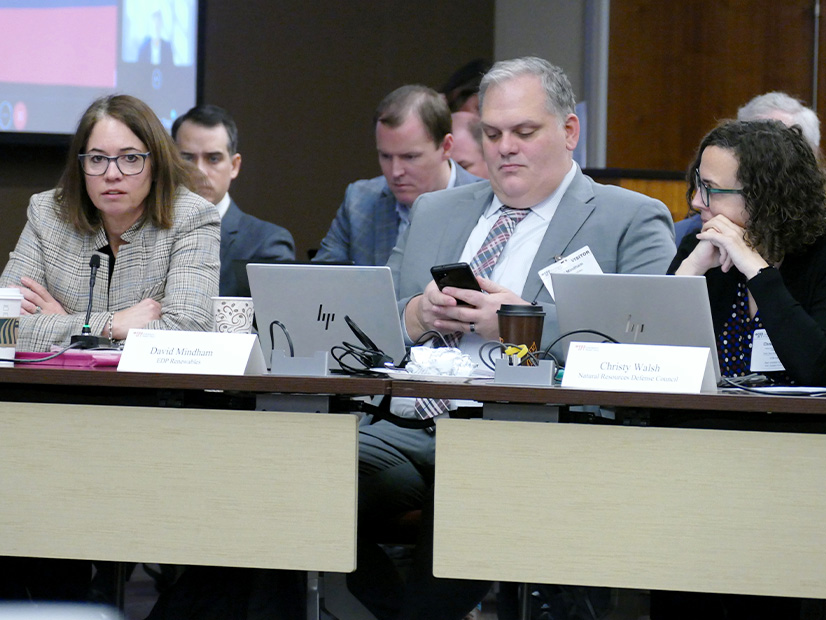
“If we move forward with the PDA policy and have a fight at FERC, that could derail the DR policy,” said Christy Walsh, with the Natural Resources Defense Council’s Sustainable FERC Project. “I ask you all to think about either filing these two things separately at FERC so that any controversy over PDA doesn’t bring down the DR policy.”
Competitive Short-term Projects
The board’s public session ended with the approval of four short-term reliability projects, including two 765-kV lines, that are eligible for competitive upgrades, overcoming stakeholder concerns about the process, cost management and timelines. Transmission-owning members urged the board to competitively bid the projects, asserting that it would ensure they are constructed on time and at the least cost.
Members approved the proposal 12-9, with transmission owners outvoting transmission users. An amended motion to remove the 765-kV lines from the recommendation failed 10-11, with the members essentially reversing their votes. The board also rejected the amended motion with its ballot.
As the board adjourned for its closed session, several stakeholders gathered on the sidelines to plot next steps.
“The TOs win again!” one stakeholder said, raising his arms in exasperation.
Addressing what he called the “elephant in the room,” OGE Energy’s Adam Snapp said there is a perception that “costs will double overnight” and utilities “will run wild and spend … because we don’t care about our customers.”
SPP’s 765-kV overlay | SPP
“That’s the furthest thing from the truth,” said Snapp, OGE’s transmission planning senior manager. “We are uniquely incentivized to keep the projects costs low because it’s our customers who pay for them. When we invest in transmission, it puts pressure on our rates and our ability to invest in generation and distribution, and if the project gets out of hand, we won’t be able to make other investments that we need to make in our system. We are the only ones that are inherently incentivized to do that.”
Staff committed to work with the incumbent TOs to develop an agreement addressing cost overruns and delays and report back to the May board meeting.
The four projects are:
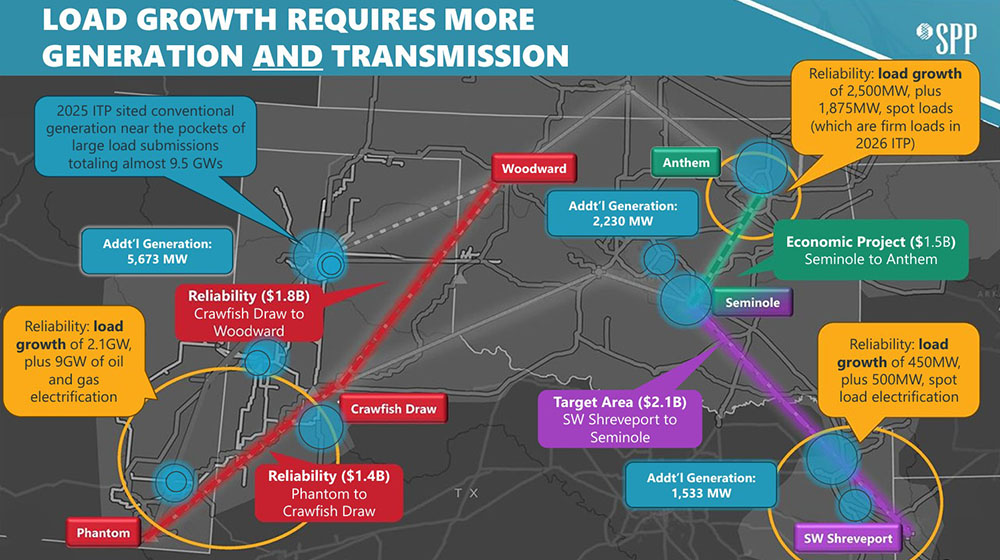
Southwestern Public Service’s $1.37 billion, 239-mile, 765-kV Crawfish Draw-Phantom project in New Mexico and Texas;
Evergy’s $21.6 million, 6-mile, 161-kV Crosstown-Blue Valley Station project in Missouri;
Midwest Energy’s $23.3 million, 8-mile, 115-kV North Hays-Chetolah Creek project in Kansas; and
the $2.4 billion, 315-mile, 765-kV Seminole-Southwest Shreveport project between central Oklahoma and northwestern Louisiana.
The two 765-kV projects form the southern legs of SPP’s proposed extra-high-voltage backbone. Both regions experienced load-shed events in 2025 and are seeing “massive amounts of reliability needs,” said Casey Cathey, SPP’s vice president of engineering. They were approved in November as part of the 2025 Integrated Transmission Plan’s record $8.6 billion portfolio. (See SPP Board Approves 2025 ITP with 4 765-kV Projects.)
Construction permits will be issued for the projects within 45 days of the board’s approval.
The proposals met SPP’s requirements as short-term reliability projects because they are competitive upgrades and are needed in three years or less to address reliability needs.
Conditional Load Process Approved
TOs also helped push through a tariff revision that builds on a previous change to integrate and operate high-impact large loads (HILLs) and was previously approved by MOPC and the RSC.
RR720 complements the FERC-approved study process for new HILLs and associated generation through the HILL generation assessment (HILLGA) by providing a path for conditional transmission service and interconnection. (See “Large Load Integration OK’d,” SPP Board Approves 765-kV Project’s Increased Cost.)
The conditional high-impact large load (CHILL) framework has two paths for large loads looking to interconnect: they have adequate generation but are contingent on transmission upgrades; or when accredited, equivalent supporting generation reaches commercial operation.
“I like to characterize that as speed to information, getting the info that you need in order to determine the cost and the necessary upgrades required to bring on large loads,” said Carrie Simpson, vice president of markets. “The second piece is speed to power. So maybe not all the transmission is in place. Maybe not all the full studies have been done to be a full [designated network resource]. This enables you to get your load on faster, so speed to power now.”
The RR doesn’t place a cap on the amount of the footprint’s CHILL load because it will be supported by generation. However, a CHILL will be curtailed if supporting generation is not available and/or if there is a net effect to the transmission system during system CHILL curtailments.
“This policy takes the next step, adding yet another option that will enable even quicker interconnections without materially affecting market prices and without materially reducing reliability,” Nickell said.
The Members Committee endorsed the change 11-0, with 10 abstentions from renewable interests and other transmission users.
“We are at the end of our designated resource pipeline, and we are looking for more flexibility to address the loads that are requesting to be connected to our system, so I hope this gets filed quickly,” Evergy’s Denise Buffington said.
Several tariff changes and other items fared much better when they were considered.
Following members’ 19-1 endorsement, the board approved five of six recommendations by a task force meant to improve the RTO’s TO selection process for competitive projects and FERC Order 1000 compliance.
“Our goals were to improve the quality of the process, accelerate the process, and ensure that it continues to be fair and objective,” said Director Irene Dimitry, who chaired the task force.
The board and members asked staff to develop a proposal for the sixth recommendation that transfers the industry expert panel’s work to SPP, augmented by consulting expertise. The panel evaluates and scores the proposals before recommending a designated TO. It is reconstituted for each project, leading to a lack of consistency, Dimitry said.
Staff will have to develop communication protocols and protect staff from being lobbied by market participants, she said. Staff committed to bringing its proposal to the board meeting and hope to have a process in place for the 2026 transmission plan.
The Advanced Power Alliance’s Steve Gaw, a former speaker of the Missouri House of Representatives, raised a point of order, noting the measure passed as a substitute motion that did not require a vote on the base motion. He was overruled by SPP General Counsel Paul Suskie, leading to a second vote with identical results as the first.
“I’ve been overruled many times, but that does not mean I’m wrong,” Gaw cracked, drawing laughter.
Three other measures were approved after members endorsed them with voice votes:
staff’s recommendation to modify a 115-kV competitive project in New Mexico by changing a termination point. The action will save $8 million to $9 million but will require SPP to solicit new proposals for what is now the Battle Axe-Phantom project. A previous request for proposals will be withdrawn.
RR704, which establishes a business practice that formalizes the baseline modeling assumptions, data inputs and study parameters used in the loss-of-load expectation study.
RR729, which changes the cost of new entry’s value from $85.61/kW-year to $139.85/kW-year for the 2026 summer season.
Nickell Says JTIQ Loan ‘Retained’
Almost lost in Nickell’s quarterly president’s report was this sentence: “We retained a $464.5 million grant in funding for the interregional [Joint Targeted Interconnection Queue] projects.”
DOE has not responded to RTO Insider’s requests for comment. However, its website lists the JTIQ grant as having been awarded to the Minnesota Department of Commerce — which led the GRIP funding application with help from the Great Plains Institute — in October.
Minnesota has said little about the grant beyond that its status has not changed and the projects are proceeding as planned. A Great Plains staffer at the board meeting declined comment. MISO CEO John Bear said during his board’s December meeting that the funding had been restored. (See MISO, Minn. Say Federal Funds for JTIQ in Play.)
The GRIP funds offset about 25% of the capital costs for the JTIQ portfolio’s five projects. The projects are centered on the RTOs’ northern seam and have been framed as enabling 28 GW of primarily renewable generation. Each grid operator would have two projects in its footprint and share the fifth.
Nickell also gave the board, members and other stakeholders a sneak peak of the SPP’s rebranding effort, which will be officially revealed after April’s RTO expansion into the West.
He said his platform is for SPP to “boldly lead the industry. And that’s not just staff. That’s this entire organization.” Through focus groups and interviews, Nickell said staff heard two things: to continue SPP’s focus on its core mission of reliability and to remain committed to “facilitating consensus among diverse stakeholder groups in pursuit of innovative solutions.”
“We all have a part in boldly leading this industry that we all love,” Nickell said. “We want to be more visible. We want to communicate the value that we provide better and more often toward that goal.”
A two-minute video showed a quick glimpse of the logo and the catchphrase intended to reflect who the grid operator is: Powering the Future.
SPP’s logo has been tweaked only once since its creation in the 1990s, but Nickell said stakeholders should still recognize its elements in the new logo.
“A lot of really, really important work needs to be done, and I trust that you all will work with us to achieve what I believe are really, really important goals for the organization,” he said.
More than 60 GW of generation is a step closer to connecting to Bonneville Power Administration’s transmission system, following the release of Phase 1 of BPA’s interconnection cluster study.
BPA hosted a workshop Feb. 9 to give an overview of the study and to start reviewing 59 interconnection points within 11 cluster regions. Presentations by region were scheduled to continue Feb. 10-12.
“We tried to take all the available information that you guys provided in your submissions to find the most reliable, cheapest interconnection point for the entire cluster area,” Dave Cathcart, an electrical engineer in transmission capabilities planning, said during the workshop, which was geared toward BPA customers.
The 167 interconnection requests included solar, wind, biofuel, gas and nuclear generation totaling 60.5 GW, and grid-charging battery storage totaling 42 GW.
“[It’s] just a phenomenal amount,” said Jeff Cook, BPA’s vice president of planning and asset management.
Requests from wind and solar generation are spread throughout most of the 11 study areas.
But 18 of the 21 interconnection requests for biofuel generators are in western Oregon. The other three are in the South 1 area.
South 1 is also the site of three of five pumped hydro storage interconnection requests. The other two are in the Lower Columbia 1 region or western Oregon.
Two interconnection requests for steam/nuclear generation — with 270 MW and 1,120 MW requested — are in the area named Tri-Cities Umatilla 1.
The study includes estimated costs for each interconnection point.
New Interconnection Approach
BPA released its 2025 Transition Cluster Study Jan. 31 as a set of reports for each of the 11 study regions. The study reflects a new approach to generation interconnection requests.
When generation requests totaled 4 GW or 5 GW a year, Bonneville used a first-come, first-served model. But by late 2023, requests exceeded 60 GW, prompting a new “first-ready, first-served” approach, said BPA spokesperson Kevin Wingert.
To put the volume of new service requests in perspective, Wingert noted that total generation throughout the Pacific Northwest in 2026 is projected at 27.96 GW.
The cluster study was launched in 2025 under BPA’s new large generator interconnection transition process. The first phase is similar to a feasibility study, Wingert said, and the second phase will be like a system impact study.
A 90-day period for BPA customers to review the cluster study ends April 30. If no customers withdraw during that time, BPA will announce within 25 business days that there will be no restudy. Customers will then have 15 days to submit a Phase 2 study agreement and a deposit.
If there are withdrawals, BPA has 30 business days to decide whether a restudy is needed. If so, the goal is to complete the restudy within four months.
The study noted that construction of equipment and facilities to connect a generator to the grid typically takes three to 10 years.
“Every project will be different,” said Cherilyn Randall, an electrical engineer in BPA’s customer service engineering. “If you need a large substation, a line build, it’s going to be a lot longer than if you’re [in] Phase 2 of something and you only need a meter.”
During the first 45 days of the customer review period, customers may modify their requests. Requested nameplate capacity or interconnection service may be reduced by up to 60%.
Increasing an interconnection request is not allowed.
“At no point may you ever increase your interconnection service,” Randall said. “That would be queue jumping.”
The surge in large load growth across the Midwest presents MISO with both an enormous opportunity and a critical test. As energy demand accelerates, the region’s ability to attract and support these facilities will depend on whether MISO can modernize its interconnection processes to match the speed and scale of business need while maintaining the reliability the region requires.
The region’s energy needs demand that MISO include clean energy technologies to support rapid load growth. The fact is that clean energy offers the lowest-cost, fastest-to-market solution to meet rapidly increasing energy demand while reducing consumer costs and driving economic growth.
MISO’s initial zero-injection generator interconnection agreement (ZGIA) represents a workable clarification of existing practice that formalizes arrangements, as already applied to three facilities in MISO South. Limiting large load solutions only to zero-injection scenarios misses the mark and can create a myriad of challenges now and in the future.
CGA emphasized the need for better information sharing between processes that currently operate in isolation despite significantly impacting each other in planning models. Generator interconnection nominally aligns with MISO’s 18-month MTEP process but recently has been taking up to five years, a misalignment that creates inefficiencies preventing project development and driving up costs unnecessarily.
Beyond Zero-injection: Leveraging Clean Energy Solutions
MISO should expand its initial ZGIA concept to leverage a larger toolkit of clean energy technologies that can facilitate rapid large load integration while maintaining grid reliability. Three technologies are of significant importance: battery storage, renewable energy paired with storage (hybrid projects) and high-voltage direct current (HVDC) transmission.
Battery Storage as Reliability Solution
Four-hour battery storage is ready to enter MISO markets. Storage responds instantaneously to variations in large loads, including sudden trips offline. This rapid response capability could prevent cascading blackouts in the event a large load suddenly disconnects, offering a reliability benefit that will become increasingly important as large load projects proliferate. Meanwhile, CGA and its members are working on market entry paths for longer-duration storage to complement and extend the benefits of four-hour batteries.
Yet MISO uniquely assesses storage for transmission service during charging, a barrier that no other RTO imposes and that directly delays the deployment needed for large load reliability. MISO should align its rules with its peers and accelerate integration of storage resources already queued in substantial quantities by more realistically modeling the reliability attributes of batteries.
By treating storage as an asset instead of a liability, MISO’s interconnection queue could unleash utility-scale batteries and their grid benefits within approximately 18 months or faster with other improvements to provide flexible capacity while longer-term transmission infrastructure comes online. (See MISO Members Push for Modernized Storage Rules.)
Renewable Energy with Storage Co-location
Co-locating storage with renewable energy maximizes use of existing transmission capacity and improves reliability. Providing grid support with this configuration will allow MISO to integrate even more unprecedented amounts of new demand in a short period of time.
Additionally, MISO should prioritize efforts to refine interconnection rules that allow renewables, storage and HVDC to enter the market with limited operations rather than waiting years for upgrades to allow full operations. This enables needed resources to come online faster while maintaining reliability. MISO must do this in a way that ensures expedited interconnection rules don’t inadvertently favor any one technology or hinder the traditional interconnection queue. Open access policies foster resource expansion and competition that keeps lights on and costs down for all consumers.
HVDC Transmission for Interregional Solutions
While HVDC represents a longer-term solution than storage or hybrid deployment, it offers critical strategic benefits that will expand siting opportunities for data centers for better fiber connectivity, cooling infrastructure or other business reasons by delivering available generation when and where it’s needed.
This matters because a single HVDC line delivers gigawatts of capacity equivalent to multiple large power plants without requiring new local thermal generation, fuel supply chains or emissions, all while allowing the grid to be “bigger than the weather” for better reliability and affordability.
The Path Forward
MISO’s zero-injection clarification represents a constructive first step, and we appreciate MISO’s commitment to expanding the current rules to address today’s complex challenges. After all, the alternative is a patchwork of narrow solutions that fail to capture the full economic and reliability value these technologies offer.
The scale and diversity of load growth projected in MISO demands more ambitious solutions and innovation. By expanding interconnection options to fully leverage battery storage, hybrid renewable energy and HVDC transmission, MISO can turn the large load challenge into an opportunity for grid modernization that benefits all customers now and for generations to come. MISO has a historic opportunity to lead in integrating large loads reliably and cost-effectively. The region’s economic growth depends on seizing it.
MISO has the tools and the moment to lead. Clean Grid Alliance stands ready to work with MISO and all stakeholders to turn today’s large load challenge into tomorrow’s competitive advantage. The Midwest’s energy and economic futures depend on getting this right.
David Sapper, vice president of transmission and markets for the Clean Grid Alliance, has been involved in the wholesale electricity industry for nearly 30 years.
NERC officials appeared before an Organization of MISO States board meeting in an attempt to quell regulators’ discontent with MISO’s “high-risk” label in the 2025 Long-Term Reliability Assessment.
“I think we understand your concerns,” said NERC CEO James Robb, who referred to “anxiety” around the exclusion of MISO’s interconnection queue fast track in the LTRA. He said the LTRA “is not a prediction in any way.”
“It’s a risk assessment,” he told regulatory staff members at a Feb. 9 Organization of MISO States board meeting.
NERC found that by winter 2028/29, MISO would struggle with reliability under normal conditions. Some state regulators bristled at the designation and criticized the assessment for not including MISO’s expedited generator interconnection process and the projects in it.
Regulators also said NERC’s conclusion essentially ignores that most MISO states must plan resources in accordance with state law and that MISO measures its reserve margins differently from in NERC assumptions. (See MISO States Dispute ‘High Risk’ Designation from NERC.)
Robb said this year’s findings in the LTRA are a product of load growing faster than resources can be added or steadily dropping resource inventories. He said NERC is seeing “more and more” regions move into elevated reliability risk. “It’s been growing and growing in severity,” Robb said.
But over the years, he said, areas designated as “normal” in the LTRA have experienced emergency shortages while areas labeled “high risk” have pulled through difficult episodes.
Robb said the emergence of winter-peaking circumstances in the LTRA is due to an increasing deployment of solar generation suppressing the summer peak.
“Solar’s a hell of a resource. It doesn’t do a lot for you in winter,” he said.
He also said NERC has in recent years found more limits overall with generators and resources that have become especially susceptible in winter.
John Moura, NERC director of reliability assessment and system analysis, explained the data collection deadline that left off generation proposals in MISO’s interconnection queue fast lane. He said NERC must cut data collection off in summer to release the assessment. The deadline helps NERC understand which resources are firm and deliverable by transmission, Moura said.
Moura said time and again, NERC sees the most certain, “Tier 1” generation projects fail to meet stated in-service dates.
“So, expecting 20 GW and getting 10 GW. We really are seeing half the resources come in on time,” Moura said. “It’s not an indictment; it’s not a prediction. We are trying to showcase the risk … to stimulate the action needed.”
Moura said the industry is learning that the “individual, isolated planning that got us a long way is breaking down a bit.” He said neighboring regions need to understand one another’s systems more. NERC strives to provide a “bedrock,” he said, by using consistent assumptions.
Wisconsin Public Service Commissioner Marcus Hawkins cautioned NERC officials about assuming all new load at speed is gospel. He pointed out that the utilities reporting load additions stand to benefit from the boosted demand. He told NERC to be careful “if all upstream assumptions are from people with vested interests.”
Michigan Public Service Commission Chair Dan Scripps said it feels like states in an RTO get “picked on” because even though most states in MISO are vertically integrated and have the same state-level mandates to maintain resource adequacy, they nevertheless are coded red.
South Dakota Public Utilities Commissioner Chris Nelson asked NERC officials if they think the LTRA is read as a prediction by the public.
Robb said it “certainly seems” the LTRA is construed that way “despite our best efforts.” He added NERC hopes to “raise the flag” about getting more infrastructure built, and “not the old-fashioned way.” He said grid expansion is going to take changes to permitting and siting processes.
MISO Senior Manager of Market Design Neil Shah said at a Feb. 10 Entergy Regional State Committee meeting that MISO is in contact with NERC to try to improve assumptions used in the LTRA.
Shah said including the generator interconnection express lane likely would “close the gap” in the NERC report. However, he said uncertainty remains due to the potential for more large loads claiming spots on the grid.
MISO expects the first projects from its expedited generator queue to come online in 2028, Shah said. Beyond that, Shah said “MISO is projecting higher rate of new resource additions in 2026” than have historically come online annually from 2022 to 2025.
“It incorporates a lot of things that we don’t necessarily agree with,” Bill Booth, a consultant to the Mississippi Public Service Commission, said of the assessment. He added that in addition to the expedited queue omission, NERC didn’t factor in the trio of coal plants in MISO kept online via the U.S. Department of Energy’s emergency orders under the Federal Power Act’s Section 202(c).
MISO Promotes Stakeholder Involvement in Reworking NERC RA Standard
Meanwhile, MISO has encouraged its stakeholders to participate in NERC’s development of a new energy assurance draft standard after it scrapped the first draft.
MISO’s Zhaoxia Xie said at the January Reliability Subcommittee meeting that stakeholders should get involved. The reliability corporation’s first draft of a proposed planning energy assurance standard failed to get enough votes in support to advance. NERC’s standard drafting team is assessing next steps and is planning a technical workshop Feb. 17 and meetups Feb. 18 and 19 to start revisions.
NERC’s original design would have had planning coordinators conducting their own Long-Term Energy Reliability Assessments using an unserved energy basis and reporting the results to NERC. Resource planners and transmission planners then would have to prove they developed corrective action plans — enforced by the ERO — to address “unacceptable” levels of reliability risks in long-term assessments.
“MISO is being open-minded and working with NERC to move along this effort,” Xie said.
Minnesota Power’s Tom Butz said it seems the NERC effort is entering “uncharted territory” and that a draft standard could be an opportunity to view system reliability in a new way. Butz asked that the RASC plan for “hands-on interplay” with the NERC docket as it’s drafted.
Xie said MISO doesn’t plan to schedule stakeholder discussion on the standard “because the project is not moving as fast” as originally thought.
MISO staff also said the RTO already covers or exceeds what the standard originally intended to include; they said even the draft standard wouldn’t push its modeling into unfamiliar ground.
PJM’s Market Implementation Committee passed by acclamation a PJM issue charge seeking to more thoroughly define how storage resources participate in the energy and ancillary service markets.
Much of the focus was on PJM’s obligation under FERC Order 841 to implement storage state of charge in its energy storage resource rules, as well as how lost opportunity costs (LOCs) are determined. The issue charge was revised after January’s first read spelling out that the LOC discussion should consider how the timing of PJM dispatch interacts with changing prices, emergency conditions and supply/demand balance.
The list of additional items for consideration was expanded to include cost-based energy offers, calculation of uplift, LOC rules for storage participating in energy and ancillary service markets, and whether pumped storage hydro resources should be part of the conversation. It also includes must-offer rules for storage resources with capacity commitments, intraday offers, cost-based offers and resource parameters.
The out-of-scope section includes changes to resource adequacy, performance assessment interval and effective load-carrying capability modeling for storage; surplus interconnection service; storage as a transmission asset; the pumped hydro optimizer; and peak shaving adjustments. A sixth key work activity was added for a possible second phase to explore out-of-scope topics.
The issue charge envisions governing document and manual revisions being drafted within six to nine months, which stakeholders said is an appropriate timeline given the numerous other market redesigns being considered.
Carl Johnson, representing the PJM Public Power Coalition, said it’s important that PJM’s planning and markets departments both be involved in the stakeholder discussion and remain aware of the changes being made. In particular, planning models should account for any changes to how storage resources offer into the energy market.
Constellation Proposes Dual-fuel Quick Fix
Constellation presented a quick fix proposal to revise the must-offer requirement for dual-fuel capacity resources to recognize that dual-fuel gas resources have a downtime when switching fuels. The quick fix process allows an issue charge and problem statement to be brought concurrent with a proposed solution. The proposal is set to be voted on by the MIC at its March 11 meeting.
The proposal would specify that a dual-fuel resource met its must-offer requirement so long as it submits offers including the primary and alternate fuels within “limitations or restrictions resulting from fuel switching time modeling within PJM’s software platforms.” The language would be added to the capacity resource offer rules in Manual 11: Energy & Ancillary Services Market Operations.
Stakeholders said there may be differences in how units switch fuels or in the details of that switching period. They said a broad change that applies to all dual-fuel resources could help avoid the must-offer requirement.
ARR and FTR Timeline
PJM laid out the schedule for the 2026/27 auction revenue rights (ARRs) and financial transmission rights (FTRs) markets. Stage 1A of the annual allocation begins on March 4 before moving on to stage 1B on March 10. Stage 2 begins on March 18.
Trading for ARRs begins on April 2, while the annual FTR auction starts April 8.